
MUST I LOVE GOD AND MY NEIGHBOR TO GET TO HEAVEN?

Introduction

* All photos are AI generated

       On Tuesday, April 7, 2026, while I was listening to the radio at work, the host of a conservative talk show in Des Moines, Iowa, stated that the pilot of Artemis II shared the gospel just before entering a planned 40-minute radio blackout behind the moon on Monday evening, April 6, 2026. When I heard this introduction, I got so excited because the whole world would probably be tuned in to hear the gospel. 

      The radio host then played the recording of pilot Victor Glover: “As we get close to the nearest point to the Moon and farthest point from Earth, as we continue to unlock the mysteries of the cosmos, I would like to remind you of one of the most important mysteries there on Earth, and that’s love.

       “Christ said, in response to what was the greatest command, that it was to ‘love God with all that you are.’ And he also, being a great teacher, said the second is equal to it, and that is to ‘love your neighbor as you love yourself.’

       “As we prepare to go out of radio communication, we feel your love from Earth. And to all of you down there on Earth and around Earth, we love you from the Moon.” 

       That was “the gospel” that was shared with the world. While Glover did not say it was the gospel, the radio host that morning in Des Moines said it was. 

       After that radio broadcast, my mind began to wonder how many people would conclude that the way to heaven is to love God with all that you are and your neighbor as yourself? Is this what Jesus taught?The Parable of the Good Samaritan (Luke 10:25-37).

The Parable of the Good Samaritan (Luke 10:25-37)
       In one of Jesus’ most famous teachings known as the Parable of the Good Samaritan (Luke 10:25-37), it seems at first glance that Christ is saying that the way to have eternal life is by loving God with all that you are and your neighbor as yourself. A ”lawyer” or expert in the Law of Moses asked Jesus, “Teacher, what shall I do to inherit eternal life?” (Luke 10:25). Jesus responded by asking the lawyer what the Law taught about that (Luke 10:26), and the lawyer answered, “‘You shall love the Lord your God with all your heart, with all your soul, with all your strength, and with all your mind,’ and ‘your neighbor as yourself.’” (Luke 10:27; quoting Deuteronomy 6:5 and Leviticus 19:18). Jesus said to him, “You have answered rightly; do this and you will live.” (Luke 10:28). 

       Did I read that right? Jesus said the lawyer answered “rightly”? Then He told the expert in the Law of Moses, “do this and your will live.” Some interpreters understand this to mean that entering God’s kingdom is based on doing good works and that  doing good works is evidence of a true child of God. If there are no good works in a professing Christian’s life, then saving faith never existed. [1]

       But such an understanding of this parable would be salvation by works which is contrary to what Jesus taught in the gospel of John where He emphasizes that eternal life is a free gift that is received by believing in Jesus for it (John 3:14-18; 4:10-14; 5:24, 39-40; 6:27, 29, 35-40, 47, 68-69; 10:28-29; 11:25-26; 17:1-3; et al). According to Jesus in John’s gospel, works have no part in obtaining eternal life as a present possession. 

       The Bible teaches that eternal life as a future acquisition is always a reward that is based upon works (cf. Matt. 19:29-30; Mark 10:29-30; Luke 18:29-30; John 4:36; 12:25; Rom. 2:7; Gal. 6:7-9; I Tim. 6:12, 19), but when eternal life is presented as a present possession it is always received as a free gift by faith alone in Christ alone (John 3:16; 4:10-14; 5:24; 6:40, 47; Rom. 6:23b; Eph. 2:8-9; Rev. 22:17). [2]

       In addition, all of the Bible teaches that salvation is by faith alone apart from any good works. [3] Since the Bible is not going to contradict itself, the parable of the Good Samaritan cannot be teaching that one must love God and one’s neighbor as oneself to get to heaven. Such an understanding can only be obtained by ignoring the context and the rest of Scripture. [4]

The Context of the Good Samaritan Parable 
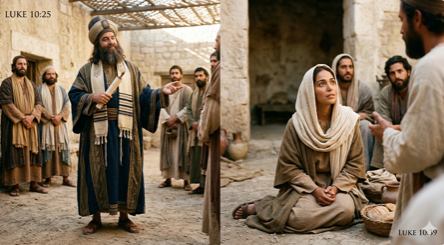
       After describing the costs of discipleship (Luke 9:57-62), Christ begins chapter 10 by appointing and sending seventy disciples out “into every city and place where He Himself was about to go” (Luke 10:1) in the nation of Israel. He assured these disciples that the spiritual harvest would be plentiful, and that God would provide for their needs (Luke 10:2-7). Their message was that Jesus was the Christ, the promised Messiah, and that He was offering the kingdom to that generation of Jews (Luke 10:9, 11). [5] Christ enabled them to confirm this message by performing miraculous healings (Luke 10:9). If the Jews rejected this message, Jesus would be the One to judge them (Luke 10:12-15) since their rejection of the seventy’s message was ultimately a rejection of Jesus and the Father Who sent Him (Luke 10:16). [6]

       When the seventy returned to Jesus, they were celebrating how “even the demons” were subject to them in Jesus’ mighty “name” (Luke 10:17) through the miracles they performed (Luke 10:19). Christ reminds these seventy disciples not to “rejoice… that the demons are subject to” them, “but rather” to “rejoice because” their “names are written in heaven” (Luke 10:20). This is a clear statement from Jesus that these seventy disciples already had eternal life by believing in Jesus. [7] Unlike Satan (Lucifer) who was kicked out of heaven when his pride led him to rebel against God (Luke 10:18; cf. Isa. 14:12-14; Ezek. 28:11-19), [8] these believers would be permanent citizens of heaven. [9]

       The next few verses (Luke 10:21-24) are key to understanding the Good Samaritan parable. “In that hour Jesus rejoiced in the Spirit and said, ‘I thank You, Father, Lord of heaven and earth, that You have hidden these things from the wise and prudent and revealed them to babes. Even so, Father, for so it seemed good in Your sight.’” (Luke 10:21). Christ refers to these believers whose names are permanently written in heaven (Luke 10:20)as “babes” (nēpiois) or infants who possess childlike faith that is unspoiled by learning in contrast to “the wise and prudent.” [10]

       Wright states,“Hodges makes the point that the Lord’s statement about names written in heaven means that these ‘babes’ had assurance of eternal life. These wonderful truths had been revealed to them as babes (v 21). The Lord was calling them to do His work, in the case of the Twelve and the seventy, but that work had nothing to do with the gift He had already given them. They could never lose the gift of everlasting life because works were not involved in any way in the gift they had received.” [11] [emphasis added]

       Jesus thanked His Father that “babes” (the seventy and rest of Jesus’ disciples – v. 23) understood “these things”about how to have their names written in heaven, that is, how to obtain eternal life (Luke 10:21b). But notice that the Father had “hidden these things from the wise and prudent” (Luke 10:21a). Christ’s thanksgiving may also be directed at having authority to judge the nation of Israel. [12]

       This thought of judgment can be seen in the next verse when Jesus says, “All things have been delivered to Me by My Father.” (Luke 10:22a; cf. John 5:20-30).God the Father had given Jesus that authority. The fact that Jesus is the Christ and can give eternal life through faith alone in Him alone is based upon knowing “who the Son is” (Luke 10:22b).These are the things “revealed” to “babes.” [13]

      Christ then turned to His disciples (babes) and told them privately that they were “blessed” because they were able to “see” these things (Luke 10:23). At the same time, the “wise and prudent” were those from whom “these things” have been “hidden” (Luke 10:21). They were and are even today spiritually blind to such truths. [14]

      In this context, “babes” are those who are convinced that Jesus is the Christ and in Him they have eternal life. Jesus is the One who will judge. The wise and intelligent, however, do not see “these things.”

       After establishing these important truths, Luke gives an example of a “wise and prudent” person (Luke 10:25-37) and an example of a “babe” (Luke 10:39). The lawyer was a “wise and prudent” man in his own eyes and in the eyes of the Jewish community. He is the one who asked Christ the question which led to the Good Samaritan Parable. But Mary was the “babe” in that she was discerning. She chose to sit at Jesus’ feet and learn from Him (Luke 10:39, 42). 

The Question of the Lawyer and the Answer from the Lord (Luke 10:25-29) [15]
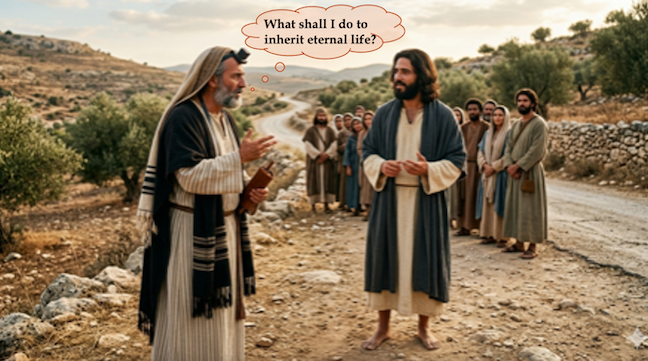
      Then we are told that “a certain lawyer stood up and tested Him, saying ‘Teacher, what shall I do to inherit eternal life?’” (Luke 10:25). Wright makes several important observations about this verse: This “lawyer” (nomikos) was considered to be “well informed about the law, a legal… expert in the Mosaic law.” [16] In Luke’s gospel, “lawyers”  gospel, “lawyers” are always presented in a negative light (cf. Luke 5:17-21; 7:30; 9:22; 11:45-46, 52-53; 14:3). The lawyer did not recognize Jesus as the Christ Who could give eternal life to him. Instead, he saw Jesus as a fellow “teacher” and addressed Him with the same word by which he as an expert in the law would have been addressed by those seeking his counsel. [17] Luke tells us this lawyer “stood up and tested Him.” The Greek word translated “tested”(ekpeirazō) occurs only four times in the New Testament and is always used in a negative way (cf. Matt. 4:7; Luke 4:12; 10:25; I Cor. 10:9). The lawyer might have sought to entrap Jesus with his question, [18] assuming that Jesus wasn’t as knowledgeable of the Law as he was.

       We also see that this lawyer did not view eternal life as a free gift that is received by believing in Christ alone as indicated by his question, “What shall I do to inherit eternal life?” (Luke 10:25b). He did not say, “What shall I believe to inherit eternal life?” Like many religious people today, his focus was on doing, not believing. He thought that he could earn eternal life, so he asked Jesus what he must do. 

       In this entire episode, the word ‘do’ is important; in the Greek text, the word in v. 25 is a participle. In His initial answer as well as in His final application, the Lord used the imperative verb form of the same word (vv. 28, 37). This section, then, begins and ends with the concept of ‘doing’ good works. The lawyer’s question fits a Jewish context. As a proud Jewish lawyer, he mistakenly thought he could earn his eternal salvation by such works. He looked to the Law of Moses to determine what those works would involve. This question not only led to the parable, it also is the key to understanding it.” [19] [emphasis added]

       Since the lawyer was an expert in the Law of Moses, Jesus directed him there when He asked, “What is written in the law? What is your reading of it?” (Luke 10:26). This question further places Jesus in the authoritative role of “Teacher” using the lawyer’s term of address. [20]

      The man summarized the Law by quoting from Deuteronomy 6:5 and Leviticus 19:18, saying, “’You shall love the Lord your God with all your heart, with all your soul, with all your strength, and with all your mind,’ and ‘your neighbor as yourself.’” (Luke 10:27). Jesus affirmed the lawyer’s answer, saying, “You have answered rightly; do this and you will live.” (Luke 10:28). Many commentators conclude from Jesus’ response that salvation is by works since Christ told the lawyer to “do this” and promised him he “will live” which in the context means he will “inherit eternal life.” The lawyer thought he could earn eternal life by doing good works (loving God with all that he is and his neighbor as himself) and Jesus tells him he can do that by doing what the Law commands. 

       Why would Jesus say this? Has He suddenly changed the gospel message, so it now includes faith and good works? No. Christ is using the Law to convict this proud man to come to his senses so he can see that he can never live up to the demands of the Law, and therefore he needs a Savior. 

       Keep in mind that Luke was a traveling companion of the apostle Paul (Acts 16:10-17; 20:5-15; 21:1-18; 27:1-37; 28:1-16; cf. Col. 4:14; Phlm. 1:24; 2 Tim. 4:11), [21] and Paul wrote, 10 There is none righteous, no, not one…12There is none who does good, no, not one… 20 Therefore by the deeds of the law no flesh will be justified in His sight, for by the law is the knowledge of sin.” (Rom. 3:10, 12, 20). The Law was intended to reveal our sin to us so we would see our need for a Savior. But the lawyer was convinced he could keep the Law. But could he?

       Paul also wrote,  21 For if there had been a law given which could have given life, truly righteousness would have been by the law. 22 But the Scripture has confined all under sin, that the promise by faith in Jesus Christ might be given to those who believe. 23 But before faith came, we were kept under guard by the law, kept for the faith which would afterward be revealed. 24 Therefore the law was our tutor to bring us to Christ, that we might be justified by faith. 25 But after faith has come, we are no longer under a tutor.” (Gal. 3:21-25). People couldn’t become righteous before God by keeping the Law because they are all sinners, incapable of keeping it. The law can’t empower sinners to obey; it can’t give “life” (Gal. 3:21). Instead, the lawrevealed God’s righteous standards and imprisoned everyone under sin’s power so that people were positioned to receive “the promise by faith in Jesus Christ” (Gal. 3:22). The law functioned as a “tutor to bring us to Christ that we might be justified by faith” (Gal. 3:24). 

       The Lord Jesus was using the Law to show the lawyer that no one can love God with his whole being, and no one can love his neighbor as he loves himself. The Lord was saying that if you could do the impossible, you would have eternal life. “The problem was, of course, that neither the lawyer himself nor anyone else (other than the Lord Jesus) has ever, or will ever, fulfill these two supreme commandments.” [22] The answer to the lawyer’s question is that he could not “do” anything to earn eternal life. Only a “wise” and arrogant person would think he could.

       Christ was using the Law to convict the lawyer of his sin so he would see his need for a Savior. Hence, what the lawyer’s response should have been was to ask Jesus, “How can I love God above all else and my neighbor as myself? I am not able. I need help.” [23]

       But instead, the lawyer “wanting to justify himself, said to Jesus, ‘And who is my neighbor?’” (Luke 10:29). This proud man tried to “justify” or defend himselfagainst the implications of Jesus’ words by getting the focus off of himself. In his arrogance, the lawyer had convinced himself that he was able to love God with all that he is, but in Leviticus 19:18, the neighbor is a fellow Jew. Yet the lawyer lived in a region where he would encounter Gentiles, especially being under Roman rule. There were also Samaritans who were despised by the Jews because they were descendants of the Assyrians and Israelites who intermarried after the Assyrians conquered the northern kingdom of Israel (722 B.C.) and introduced their idolatrous religion to the Israelites. [24]

       It is also possible that the lawyer sought to “justify himself” in a way that is  similar to the book of Romans. That is, the man wanted to be justified before God by his works. If he had to love his neighbor to do that, he needed to know whom among all the different people surrounding him were considered to be his neighbor. He is thinking if he can obtain that information, then he can put forth enough effort to be righteous in God’s eyes. This leads Jesus to share the Good Samaritan Parable. 

The Good Samaritan Parable (Luke 10:30-37)
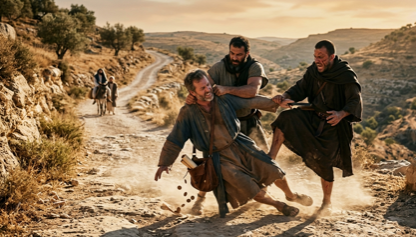
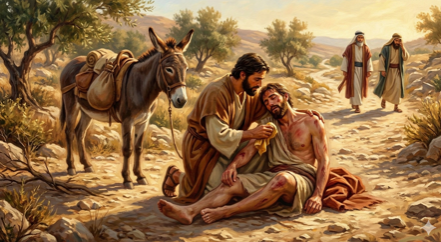
       “Then Jesus answered and said: ‘A certain man went down from Jerusalem to Jericho, and fell among thieves, who stripped him of his clothing, wounded him, and departed, leaving him half dead.’” (Luke 10:30). Christ does not specify the ethnicity or occupation of the “man” in this verse, but His listeners would probably assume he was a Jew. The 17-mile desert road that descended about 3,300 feet from Jerusalem to Jericho was treacherous, winding, and a favorite hangout of robbers. [25] Clothing was a valuable commodity in that day, so it explains why the “thieves… stripped him of his clothing.” Understandably, the man may have resisted these robbers and suffered a near fatal beating. His attackers left him “half dead.” This man was completely helpless and exposed to the elements and unable to save himself. He desperately needed help. 

       Fortunately for him a religious Jew who was expected to love others was coming down the road toward him. “Now by chance a certain priest came down that road. And when he saw him, he passed by on the other side.” (Luke 10:31). Priests were responsible for interpreting the law and officiating in the temple. [26]A priest of all people would normally show compassion to people. He served in a so-called “helping profession” and often had contact with the Scriptures and their demands. [27] He would have been familiar with Leviticus 19:18 and God’s command to love one’s neighbor. Yet this priest, for whatever reason, passed by the half dead man “on the other side” of the road. 

       Another religious Jew came and looked at the beaten man. “Likewise, a Levite, when he arrived at the place, came and looked, and passed by on the other side.” (Luke 10:32). Levites assisted the priests in the mundane affairs of Jewish worship. [28] Perhaps these two religious men had fulfilled their obligations in Jerusalem and wanted to get home, or maybe they were on their way to Jerusalem and didn’t want to be late. Maybe they thought contact with the man would contaminate them or they were afraid of being robbed themselves should they stop. Regardless, they didn’t want to show love to this man in need. [29] They did not “do” what they were commanded by God to do.    

       Like the lawyer, these two Jewish religious leaders probably took pride in being men who followed the Mosaic Law. But as the apostle Paul said, they were those who have the Law but do not keep it (Rom. 2:21-23). If the lawyer began to see himself in people like the priest and Levite, perhaps he might begin to question if he kept the Law. And if he did question it, he might begin to doubt that he could “justify himself.” [30]
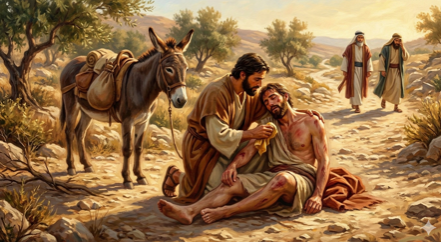
       Unlike the two religious Jews, the next man showed compassion to the stricken man. 33 But a certain Samaritan, as he journeyed, came where he was. And when he saw him, he had compassion.” (Luke 10:33). Jews hated Samaritans because of their mixed heritage. So, a Samaritan was probably not someone the lawyer thought of as a neighbor that he was required to love.     

       But the Samaritan showed “compassion” to this nearly dead man that the Jewish religious leaders ignored. It is not surprising that the only other time this verb for “compassion” (splagchnizomai) is used in Luke’s gospel is in reference to the heart of God (Luke 15:20) and Jesus (Luke 7:13). 

       Notice the extent of the Samaritan’s compassion: “34 So he went to him and bandaged his wounds, pouring on oil and wine; and he set him on his own animal, brought him to an inn, and took care of him. 35 On the next day, when he departed, he took out two denarii, gave them to the innkeeper, and said to him, ‘Take care of him; and whatever more you spend, when I come again, I will repay you.’” (Luke 10:34-35). The Samaritan “went to” the man who was left half dead, whereas the religious leaders avoided him. He poured “oil” with its medicinal properties “and wine” as a disinfectant on the man’s “wounds” before applying “bandages” to them.After taking him “to an inn,” the Samaritan watched the man overnight, caring for him (Luke 10:34). “When he departed” the next day, he left enough money (“two denarii” = two days of wages [31]) to pay for all his needs, instructing “the innkeeper” to “take care of” the man with the funds he provided while he was gone. He promised to return and to pay for whatever more the innkeeper might spend (Luke 10:35). 

       Hearing this parable was probably difficult for the lawyer. We call it the Parable of the Good Samaritan, but the word “good” is not in this passage. The lawyer would not have considered the Samaritan to be a good man. But he is the only one who fulfilled the requirements of the Law in this case, not the religious leaders with whom the lawyer would have found like-mindedness.

       The Lord Jesus asked the lawyer, “So which of these three do you think was neighbor to him who fell among the thieves?” (Luke 10:36). The lawyer originally asked who his neighbor was (Luke 10:29) because in his mind, he had to love his neighbor to obtain eternal life. He wanted to limit those he was commanded to love in order to avoid the responsibility the Law placed upon him. But Jesus turns the lawyer’s original question around to get him to focus on being a neighborIn other words, Jesus was asking, “What kind of neighbor are you?” [32] This was intended to get the lawyer to reassess what he thought about “doing” the Law. [33]

       The lawyer replied to Jesus, “He who showed mercy on him.” (Luke 10:37a). Notice that the lawyer does not say the word “Samaritan.” Why?Perhaps it was because ofhis contempt for Samaritans or on a positive note – because he now understoodthat showing mercy was the main issue, not the nationality or religion of one’s neighbor. [34]

       Having answered Christ’s question correctly, we then read, “Then Jesus said to him, ‘Go and do likewise.’” (Luke 10:37b). The passage began with what the lawyer must “do” to obtain eternal life (Luke 10:25) and now it ends with Jesus commanding him to “do” what the Samaritan did (Luke 10:37). 

The Traditional View of the Parable [35]

       While there are several interpretations of this passage, I want to focus first on the traditional interpretationamong evangelical Christians which understands this parable to be a call to social action and an end to racial prejudice. The lawyer was only talking about what he should do, but Jesus commanded him to “go” and “do” it. So instead of just talking about doing the right thing, we must go and do the right thing and show compassion to those in need. 

       For example, we are to stop and help someone who has a flat tire. We are to feed a family that is hungry or help an unemployed person find a job. What Jesus said to the lawyer He is saying to the church! We are to “do” what Jesus commanded and be a compassionate neighbor to others. [36] The question to ask is not, “Who is my neighbor?” but “Who acts like a neighbor?” [37]

       This view of the parable is seen as specifically directed toward the lawyer. He had heard the Law and knew what it said, but the question is will he do it? So, the lawyer represents those who hear God’s Word and understand what it says, but now the question is will they do it? The hearing of the Law is substantiated by obeying it. [38]

      This view is also used as a call to end racial prejudice. God can use anyone who is open to Him. The Samaritan was considered a despised minority but was still used by God. Such a person is a neighbor, regardless of his ethnicity, religion, or status in society or our churches. [39]

       As stated earlier, related to this kind of interpretation of the parable is the view that “true” Christians will do such things. According to this understanding, a person who does not fight against social ills and needs should question his eternal salvation. But how do we measure this? On several occasions, all of us have passed by people begging at street corners or stranded on the side of the road. Does that call into question our salvation?

       How many Christians today have gone to the extent that the Samaritan did to meet the needs of someone when they were given the opportunity? Have we administered first aid to a total stranger who was the victim of an assault, spent the night with him, given two days wages for others to continue caring for him, and committed ourselves to the financial costs above and beyond that if needed? If that is the standard by which we can know we are a true child of God who possesses eternal life, all of us will all live with doubt and insecurity about whether we are truly born again. 

       While I believe most evangelical Christians are familiar with this view, I agree with Wright when she concludes that such a position is a misuse of the Good Samaritan Parable because it ignores the context. [40] The lawyer’s main concern was about earning eternal life (Luke 10:25). If Jesus was telling him not to be racially prejudiced and to help those in need in order to obtain eternal life, it is clear He was teaching salvation by works. But this lawyer was one of the “wise and prudent” people who are blind to spiritual truth (Luke 10:21). The interpreter must start there and realize that this man’s desire to earn eternal life was flawed from the start. Christ was not encouraging him to continue to believe he could do enough good works to justify himself before God and obtain eternal life. Hence, I believe there is a much better way to understand this parable that is consistent with the context and the rest of Scripture. 

An Alternative View of the Parable [41]
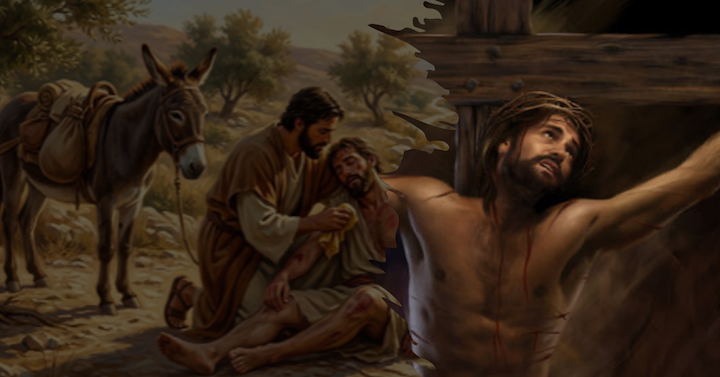
       The lawyer’s thinking was flawed from the beginning when he thought he could “do” enough good works to obtain eternal life (Luke 10:25). Hence, Jesus needed to show this arrogant “wise and prudent” lawyer (Luke 10:21) that he could not “do” enough to “inherit eternal life.” 

       The lawyer sought to limit whom he needed to love when he asked, “Who is my neighbor?” (Luke 10:29). But the Lord Jesus expanded the number of people he must love to include any person in need. The Samaritan wasn’t concerned about the nationality or religion of the man lying by the side of the road.

       None of us love like the Samaritan in the parable did. Even if a person could point to one time in his life when he showed love like the Samaritan did, it would not be on a daily or continual basis. It is impossible, just as the apostle Paul taught (Rom. 2:20-3:23). When the Lord told the lawyer to go and do that, He was telling him to do the impossible. And that is the point. The lawyer wanted to earn eternal life by his works. He could not. As one of the “wise and prudent” people of this world, the lawyer needed to become like a “babe” and realize that having his name written in heaven is given as a gift (Luke 10:20-21) and is not something that can be earned.

       THE LAWYER IS THE MAN LEFT FOR DEAD (Luke 10:30). [42] The lawyer was a self-professed wise but spiritually blind unbeliever who thought he could earn eternal life. He was spiritually dead and blind to the truth. When he came to Jesus, he was seeking life or a relationship with God, though he probably was not aware of this. Like the fallen man on the side of the road, he was spiritually destitute, naked, and dying and he could not save himself.No amount of obedience to the law could take away his sin or the penalty of his sin. He needed help. He needed rescue. This man left for dead is a picture of every unbeliever. I agree with Wright who said, “Every believer can see that at one time, before faith, he himself was the man lying, without hope, on the side of the road, but Christ came and saved him.” [43]

       RELIGION AND GOOD WORKS ARE THE PRIEST AND LEVITE (Luke 10: 31-32). When the priest and the Levite pass by the fallen man, Jesus makes it clear that the best of religion and good works cannot save a sinner from spiritual death. Spiritual leaders cannot get sinners to heaven. No one can fulfill the role of the Good Samaritan except the One telling this parable[44]

      JESUS IS THE GOOD SAMARITAN (Luke 10: 33-35). The Good Samaritan represents the Lord Jesus Christ. The Samaritan was despised and rejected by the Jews and so was Jesus. Pentecost mentions how Jesus was even “called a Samaritan (John 8:48) [and] had come to offer help for those in need. Thus, this parable may have been a veiled invitation to this expert in the law to accept the help He offered, even as the dying man had accepted the help of the Samaritan traveler.” [45] [brackets added]

       It is Jesus Who rescues the helpless and defenseless. The man on the ground is the lawyer who needed to be redeemed. [46] Although the Samaritan was hated by the Jews, he was willing to stop and help this defenseless man even though to do so could be dangerous especially if the thieves were nearby. The oil and wine that he used to treat the man’s wounds were expensive. He placed the man on his own animal and took him to the inn where he paid for the man’s stay there. The Samaritan did everything that was necessary to save this fallen man. He paid the price to rescue him from certain death. [47]  

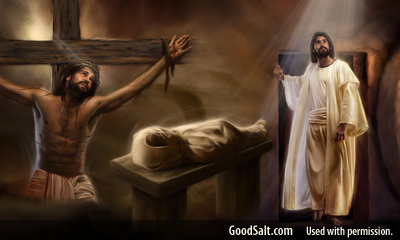
       The Lord Jesus paid the price for our salvation when He took our place on the cross and rose again (John 19:30; I Cor. 6:20). We do not pay the price for our salvation, nor do we pay the price for another’s salvation. Only Jesus, the perfect Lamb of God, can and did do this (John 1:29; I Cor. 15:3-6). 

       In addition, before the Samaritan departed from the inn, he said he would return to repay the innkeeper for any additional expenses he had while taking care of the wounded man (Luke 10:35). Though he was leaving, he was coming back. Doesn’t that sound like the Lord Jesus who said He would return after He ascended to the Father (Matt. 24:36-51; 25:14-30; John 14:1-3; et al.).

       Someone might say I am reading too much into this by identifying Jesus as the Samaritan. But in the New Testament, it is not unusual for Jesus to be the Person the parable is talking about. In the gospel of Luke, Christ shared a parable about a master (Jesus) and his servants (disciples) to teach His disciples to be ready for His return (Luke 12:35-49). In the Parable of the Minas, Jesus is the conquering King (Luke 19:11-27). In the Parable of the Wicked Vinedressers, Jesus is the beloved son of the owner of the vineyard (Luke 20:9-19). And in the Parable of the Good Samaritan, Christ was the Despised and Rejected One who came to rescue the one who could not save himself.
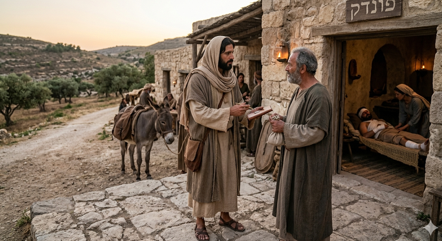
       THE BELIEVER IS THE INNKEEPER (Luke 10:35). So far, we have identified all the characters in this parable except the innkeeper. I agree with Wilkin when he says the innkeeper represents believers in Jesus. [48] “On the next day, when he departed, he took out two denarii, gave them to the innkeeper, and said to him, ‘Take care of him; and whatever more you spend, when I come again, I will repay you.’” (Luke 10:35). Before departing from the inn, the Good Samaritan told the innkeeper to take care of the wounded man he rescued the day before. The innkeeper was to continue what the Good Samaritan began. He was to serve the wounded man, just as the Samaritan had done. He was told to do it until the Samaritan returned. [49] He assured the innkeeper that when he returned, he would “repay” him for any additional expenses he incurred while taking care of the man. The Greek word translated “repay” (apodōsō) means to “recompense or reward.” [50] It is used of eternal rewards that believers will receive at the Judgment Seat of Christ in the future (cf. Matt. 6:4, 6, 18; 16:27; Rev. 22:12). 

      This is a beautiful picture of Jesus departing to go to heaven and when (not if) He returns, He will reward His servants who continue to take care of those He rescued! Christ has entrusted us to disciple those He has redeemed. If we are faithful to do this, He promises to reward us according to what we did for Him (cf. Matt. 20:1-16; 24:36-51; 25:14-30; Luke 19:11-19; cf. I Cor. 3:8-15; 2 Cor. 5:9-11; Rev. 22:12). 

Conclusion [51]

       When the pilot of Artemis II spoke of loving God with all that you are and loving your neighbor as yourself, he was not sharing the gospel by which we are saved. Those who say a person must love God and his neighbor as himself to get to heaven, have misunderstood or mishandled Christ’s Parable of the Good Samaritan. They have failed to look at that parable in light of the context and the rest of Scripture. 
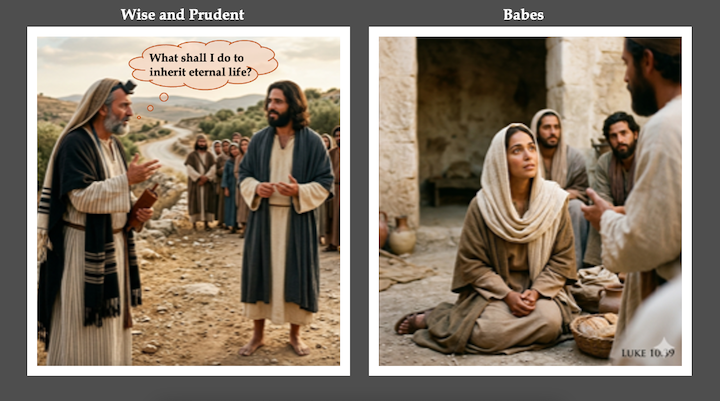
      Before Jesus shared the Parable of the Good Samaritan, He gave a summary of how people responded to His message. Some were blind to Who Jesus was and His free offer of eternal life. Jesus called them “wise and prudent.”Others saw and heard these things and were addressed as “babes” (Luke 10:21). The “babes” were able to “see”and “hear” the things Jesus taught, whereas the “wise and prudent” could not (Luke 10:23-24). 

       The lawyer who asked Jesus what he must do to earn eternal life (Luke 10:25) was an example of the “wise and prudent” who could not see or hear the things Jesus taught. He asked a question which showed that he was spiritually blind and deaf. The Lord empathized with his limitations and shared the Parable of the Good Samaritan to help the man begin to see that he could not earn eternal life, but Jesus could give it to him as a free gift. 

       There were “babes” or discerning people, who may have also heard Jesus’ parable. After the parable, Luke tells us the name of one of them. Her name was “Mary,” and she “sat at Jesus’ feet and heard His word.” (Luke 10:39). If Christ had shared the Good Samaritan parable with her, she would have heard it in a way that was much different than the lawyer heard it. She would have seen the Good Samaritan as a wonderful portrait of Jesus. And like the innkeeper, she would have been excited to care for those her Lord had rescued. If she did so faithfully, she understood that she would receive eternal rewards from her Master when He returned for His church. 

       An important application in evangelism for us as Christians is to approach non-Christians who think they can obtain eternal life through their good works the same way Jesus approached the lawyer. We are to pre-evangelize them with the Law which is designed to reveal their sin (Rom. 3:20). The lawyer was not ready to hear the gospel yet because he did not see himself as a sinner in need of a Savior. Christ masterfully used the Law to cause the lawyer to begin questioning if he could truly love his neighbor as himself. As that small ray of light began to penetrate his heart, he may have considered that he could not keep the Law as he once thought. Perhaps he would need help. 

       And if he did realize his need for help, then he would be more open to hearing the gospel of Jesus which says eternal life is a free gift we receive by believing in Christ to give it to us (John 3:14-16). Why is eternal life free? Because Jesus paid the price in full when He died in our place on the cross and rose from the dead (John 19:30; I Cor. 15:3-6). Our world needs to hear this good news! Too many are dying without Jesus’ gift of eternal lifeIf one sinner who repents, that is, changes his mind about whatever is keeping him from believing in Christ and then believes in Him for salvation, causes all of heaven to rejoice (Luke 15:7, 10), think of what happens in heaven when thousands die every day without Christ (Matt. 18:14; I Tim. 2:3-4; 2 Pet. 3:9)!

        I also believe this passage encourages us to be like the innkeeper who cared for the wounded man the Samaritan rescued the day before. The Lord Jesus is rescuing sinners all around us and it is essential that we take care of them through the discipleship process, knowing that when the Lord returns for His church, He will “repay” or reward those who remain faithful (cf. Matt. 20:1-16; 24:36-51; 25:14-30; Luke 19:11-19; cf. I Cor. 3:8-15; 2 Cor. 5:9-11; Rev. 2:25-27; 22:12; et al.). 

ENDNOTES: 

[1] Robert H. Stein, Luke, The New American Commentary, vol. 24 (Nashville, TN: Broadman & Holman Publishers, 1992), pp. 316, 319. 

[2] See Joseph Dillow, Final Destiny: The Future Reign of The Servant Kings: Fourth Revised Edition (Grace Theology Press, 2018 Kindle Edition), pp. 221-224; cf. Zane C. Hodges, Grace in Eclipse; A Study on Eternal Rewards (Corinth, TX: Grace Evangelical Society, 2016 Kindle Edition),pp. 53-69.

[3] Gen. 15:6; I Sam. 10:1-10; Matt. 18:6; 21: 32(3); 24:23, 26; 27:42; Mark 1:15, 9:42; 15:32;16:16(2), 17; Luke 8:12, 13; 22:67; John 1:7, 12, 50; 2:11, 23; 3:12(2), 15, 16, 18(3), 36(2); 4:39, 41, 42, 48, 53; 5:24, 38, 44, 45, 46, 47(2); 6:29, 30, 35, 36, 40, 47, 64, 69; 7:5, 31, 38(2), 39, 48; 8:24, 30, 31, 45, 46; 9:35, 36, 38; 10:25, 26, 37, 38(3), 42; 11:25, 26, 27(2), 42, 45, 48; 12:11, 36, 37, 38, 39, 42, 44(2), 46, 47; 13:19; 14:12; 16:9, 27; 17:8, 20, 21; 19:35; 20:29, 31(2); Acts 2:44; 4:4, 32; 5:14; 8:12, 13, 37(2); 9:42; 10:43, 45; 11:17, 21; 13:12, 39, 41, 48; 14:1, 23, 27; 15:5, 7; 16:1, 31, 34; 17:4, 5, 12, 34; 18:8, 27; 19:2, 4, 9, 18; 21:20, 25; 22:19; 26:27(2); 28:24(2); Rom. 1:16; 3:3, 22, 4:3, 5, 11, 17, 24; 9:33; 10:4, 9, 10, 11, 14(2), 16; 13:11; 15:31; I Cor. 1:21; 3:5; 7:12, 13; 9:5; 10:27; 14:22(2); 15:2, 11; 2 Cor. 4:4; Gal. 2:16; 3:6, 9, 22; Ephes. 1:13, 19; Phil. 1:29; I Thess. 1:7; 2:10; 4:14; 2 Thess. 1:10; 2:12,13; I Tim. 1:16; 3:16; 4:3, 10; 6:2(2); 2 Tim. 1:12; Tit. 3:8; Heb. 11:31; I Pet. 1:21; 2:6, 7; I John 3:23; 5:1, 5, 10(3), 13.

[4] Kathryn Wright, September 1, 2022, journal article entitled, “The Good Samaritan (Luke 10:25-37)” at www.faithalone.org or at this LINK.

[5] Ibid. 

[6] Alberto Samuel Valdez, “Luke,” The Grace New Testament Commentary: Revised Edition, 2019 Kindle Edition, pg. 430. 

[7] Wright, “The Good Samaritan (Luke 10:25-37),” at www.faithalone.org.

[8] Tony Evans, The Tony Evans Bible Commentary, 2019 Kindle Edition, pp. 1410, 1638, 2116-2117. 

[9] Valdez, “Luke,” The Grace New Testament Commentary: Revised Edition, 2019 Kindle Edition, pg. 431. 

[10] Walter Bauer, A Greek-English Lexicon of the New Testament and Other Early Christian Literature, 2000 Kindle Edition, pg. 671.

[11] Wright, “The Good Samaritan (Luke 10:25-37),” at www.faithalone.org cites Zane C. Hodges, A Free Grace Primer (Denton, TX: Grace Evangelical Society, 2018), pp. 95, 541.

[12] Wright, “The Good Samaritan (Luke 10:25-37),” at www.faithalone.org.

[13] Ibid. 

[14] Ibid. 

[15] Much of this section is adapted from Ibid, unless otherwise noted. 

[16] Bauer, A Greek-English Lexicon of the New Testament and Other Early Christian Literature, 2000 Kindle Edition, pp. 675-676. 

[17] J. Dwight Pentecost, The Words & Works of Jesus Christ (Grand Rapids: Zondervan, 1981), pg. 299. 

[18] Archibald Thomas Robertson, A. T. Robertson’s Word Pictures in the New Testament, 2014 Kindle Locations 36347 to 36352.

[19] Wright, “The Good Samaritan (Luke 10:25-37),” at www.faithalone.org.

[20] Valdez, “Luke,” The Grace New Testament Commentary: Revised Edition, 2019 Kindle Edition, pg. 432.

[21] Evans, The Tony Evans Bible Commentary, 2019 Kindle Edition, pg. 2308

[22] Zane C. Hodges, Romans: Deliverance from Wrath (Corinth, TX: Grace Evangelical Society), 2013 Kindle Locations 1311 to 1327. 

[23] John Martin, “Luke,” The Bible Knowledge Commentary Gospels, 2018 Kindle Edition, pg. 511. 

[24] Evans, The Tony Evans Bible Commentary, 2019 Kindle Edition, pp. 2210-2211.

[25] Tom Constable, Dr. Constable’s Notes on Luke, 2026 Edition, pg. 248 cites Walter L. Liefeld, “Luke,” in Matthew-Luke. Vol. 8 of The Expositor’s Bible Commentary 12 vols. Edited by Frank E. Gaebelein and J. D. Douglas (Grand Rapids: Zondervan Publishing House, 1984), pg. 943; Howard I. Marshall, The Gospel of Luke New International Greek Testament Commentary series (Exeter, England: Paternoster Press, 1978), 

pg. 447. See also Jack Finegan, Light from the Ancient Past: The Archeological Background of Judaism and Christianity 2nd edition (Princeton University Press. London: Oxford University Press, 1959), pp. 314-15. 

[26] Evans, The Tony Evans Bible Commentary, 2019 Kindle Edition, pg. 2118.

[27] Constable, Dr. Constable’s Notes on Luke, 2026 Edition, pg. 249. 

[28] Ibid. 

[29] Evans, The Tony Evans Bible Commentary, 2019 Kindle Edition, pg. 2118.

[30] Wright, “The Good Samaritan (Luke 10:25-37),” at www.faithalone.org.

[31] Valdez, “Luke,” The Grace New Testament Commentary: Revised Edition, 2019 Kindle Edition, pg. 433. 

[32] Evans, The Tony Evans Bible Commentary, 2019 Kindle Edition, pg. 2119.

[33] Wright, “The Good Samaritan (Luke 10:25-37),” at www.faithalone.org.

[34] Constable, Dr. Constable’s Notes on Luke, 2026 Edition, pg. 251. 

[35] Much of this section is adapted from Wright, “The Good Samaritan (Luke 10:25-37),” at www.faithalone.orgunless otherwise noted.

[36] Wright, “The Good Samaritan (Luke 10:25-37),” at www.faithalone.org cites Warren W. Wiersbe, The Bible Exposition Commentary, vol. 1 (Wheaton, IL: Victor Books, 1996), pg. 213. 

[37] Ibid., cites Joel B. Green, The Gospel of Luke (Grand Rapids, MI: Eerdmans, 1997), pg. 432.

[38] Ibid., cites Green, The Gospel of Luke (1997), pp. 426, 432. 

[39] Ibid., cites Grant R. Osborne, Luke: Verse by Verse (Bellingham, WA: Lexham Press, 2018), pg. 290. 

[40] Wright, “The Good Samaritan (Luke 10:25-37),” at www.faithalone.org.

[41] Much of this section is adapted from Wright, “The Good Samaritan (Luke 10:25-37),” at www.faithalone.orgunless otherwise noted.

[42] Ken Yates, May 15, 2024, audio message entitled, “The Good Samaritan,” at the 2024 Boise GES Regional Conference at www.faithalone.org or at this LINK.

[43] Wright, “The Good Samaritan (Luke 10:25-37),” at www.faithalone.org.

[44] Robert Wilkin, January 1, 1999, article entitled, “Do This and You Will Live – Luke 10:28,” at www.faithalone.org.

[45] Pentecost, The Words & Works of Jesus Christ (1981), pg. 301. 

[46] Wilkin, “Do This and You Will Live – Luke 10:28,” at www.faithalone.org.

[47] Yates, “The Good Samaritan,” at the 2024 Boise GES Regional Conference at www.faithalone.org

[48] Wilkin, “Do This and You Will Live – Luke 10:28,” at www.faithalone.org.

[49] Wright, “The Good Samaritan (Luke 10:25-37),” at www.faithalone.org.

[50] Bauer, A Greek-English Lexicon of the New Testament and Other Early Christian Literature, 2000 Kindle Edition, pg. 110. [51] Adapted from Wright, “The Good Samaritan (Luke 10:25-37),” at www.faithalone.org.

Spiritual Warfare – Part 6

Introduction

       As the celebration of Jesus’ birth approaches, I am reminded of that first Christmas which is recorded from a human perspective in Matthew’s and Luke’s gospels (Matt. 1:21-2:12; Luke 2:1-20). It is presented as a very peaceful event involving Mary and Joseph, some angels, shepherds, wise men, and the baby Jesus. The angels praised God saying, “Glory to God in the highest, and on earth peace, goodwill toward men!” (Luke 2:14). Hence, most Christmas celebrations today focus on the peace that surrounded the birth of Jesus, assuming He would bring peace “on earth” during His First Coming. 

        But at the beginning of the week before Jesus’ crucifixion when Christ triumphantly entered Jerusalem, a multitude of His followers praised God, saying: “Blessed is the King who comes in the name of the Lord! Peace in heaven and glory in the highest!” (Luke 19:38). Notice they say, “Peace in heaven,” not “peace on earth.” The first coming of Christ would establish spiritual peace “in heaven” between God and humankind (Rom. 5:1; Eph. 2:16-18). But it won’t be until Jesus’ Second Coming to earth that universal peace “on earth” will be established by King Jesus during His thousand-year reign on earth (Rev 20:4-6; Isa. 2:1-4; 9:6b-7; Mic. 4:1-5). 

       In Revelation 12:1-5, the apostle John shares a version of the Christmas story that is from heaven’s perspective, and it is the opposite of peace (see above picture). This version of the Christmas story involves three main characters: the woman, representing the nation of Israel who endured much pain in bringing the Messiah into the world (Rev. 12:1-2; cf. Gen. 37:9-11); the Child, representing the Lord Jesus Christ (Rev. 12:2, 5); and the dragon, representing the Devil (Rev. 12:3-4a, 9).

       When Jesus is born into the world, Satan is there with his army of demons represented by “a third of the stars of heaven” (Rev. 12:4a), waiting to destroy Him: “And the dragon (Satan) stood before the woman who was ready to give birth, to devour her Child (Jesus) as soon as it was born” (Rev. 12:4b – parenthesis added). While shepherds are watching, angels are singing, and wise men are worshipping, Satan is waiting to make his move. The attempt to kill the Child John sees in this vision is probably a reference to king Herod’s brutal attempt to kill Jesus (cf. Matt. 2:16).

       The next verse says, “She bore a male Child who was to rule all nations with a rod of iron. And her Child was caught up to God and His throne.” (Rev. 12:5). In this version of the Christmas story Jesus goes from being born at Bethlehem, to ruling on the throne of the universe. John uses this one verse to summarize the birth, life, death, resurrection, ascension, and future reign of the Lord Jesus Christ. Satan not only used Herod in an attempt to kill the baby Jesus, but He would later use Judas to betray Him, Pilate to condemn Him, and the Roman soldiers to crucify Him. All the fury of hell would be released against the Child born on that silent night.

      The rest of Revelation 12 talks about the last half of the Tribulation period when Satan and his fallen angels are cast down from heaven and persecute the people of God – the nation of Israel (cf. 12:7-17). Since Satan could not destroy the Christ Child Who is now on His throne in heaven, he is going to go after what is dearest to the Child – His own people. This is why there is so much opposition against God’s people today, especially His Jewish people, and it will only intensify as the Second Coming of Christ to earth draws near. If the Devil can destroy Israel before Jesus returns to earth with His Bride, the Church (Rev. 19:7-21), then there can be no triumphant return of Christ and Satan will rule the earth.

       John’s version of the Christmas story reminds us we are in a struggle with a dragon. It is a struggle we can’t win; it is a struggle Jesus already won. You see, if you are a child of God through faith in Jesus Christ, Satan is going to attack you. “Satan” means adversary. During this Christmas season (and all our lives), he wants to rob us of the joy and peace of Christmas by reminding us of our sins and shortcomings. He will accuse us of the times we have lied and been unfaithful, of the times we’ve lost our temper and broken our promises.

The Armor of God

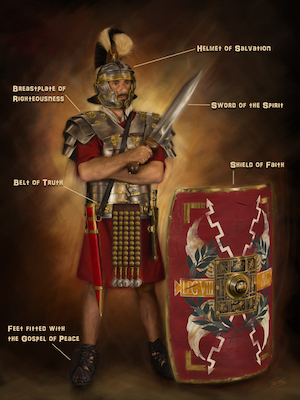
       How can we deal with this intense spiritual battle whereby the enemy seeks to rob us of God’s peace? The apostle Paul instructs his Christian readers (including you and me) to “put on the whole armor of God” so we may stand against the “wiles” or trickery of the Devil (Eph. 6:11). Paul describes the armor that Roman infantrymen wore in the order they would put it on.

       The soldier first puts on his belt which represents the Christian’s belt of truth (Eph. 6:14a). Since Satan is the father of lies (John 8:44), this first piece of armor is essential to protecting us from Satan’s deceptions and lies. We learned that truth is God’s viewpoint on a subject. It is the absolute standard by which reality is measured in its original form.Truth points us in the direction that God wants to lead us.

       After putting on his belt, the soldier then puts on his breastplate which protects his vital organs in his chest region. “The breastplate” we are to put on is “righteousness” (dikaiosunē) which refers to the quality of “being right.” [1] God’s truth is the informational base that tells us the right thing to do. The truth points our heart in the direction of God’s righteousness. The breastplate of righteousness is our response to God’s truth or viewpoint on a matter.

       When God’s truth and righteousness are operative in our lives, it will lead to the next piece of armor which has to with our feet or shoes (Eph. 6:15). Why is this so important?

The Importance of Our Feet

      In the 21st century, we have shoes for every occasion. There are dress shoes, casual shoes, work shoes, and many kinds of athletic shoes. There are shoes for cold weather, warm weather, and rainy weather. We have indoor shoes and outdoor shoes. There are specialty shoes like dance shoes (ballet,  tap, etc.), work boots (steel-toe, waterproof, etc.), and orthopedic shoes. Some of you may have a closet full of shoes that are designed to adorn your feet. The fact that we have so many varieties of shoes today demonstrates the importance of our feet. [2]

      It is also a very serious thing to have feet that hurt. Have you ever noticed how difficult it is to focus on an objective when your feet are hurting? When your feet hurt, you hurt are over. When our feet hurt, we do not make a good soldier. This is why our military places great emphasis on examining the feet of a soldier. They understand that a person’s feet need to be comfortable to be a good soldier. God understands this more than anyone. [3]

The Soldier’s Sandals

       God wants His people to wear a certain kind of shoes all the time because they will address an important issue regarding spiritual warfare in our lives. After a Roman soldier put on his belt and breastplate (Eph. 6:14), he then puts on his sandals: “And having shod your feet with the preparation of the gospel of peace.” (Eph. 6:15). The Greek word translated “shod” (hupodeō) is a compound word meaning “under” (hupo) plus “to bind/tie” (deō)or “to bind/tie under or beneath” [4](sandals). [5] It refers here to what you are wearing on your feet at all times. [6]

       The word translated “preparation” (hetoimasia) refers to the state of “readiness.” [7] If we are wearing these shoes, we will be ready for the Devil’s attacks against us. We will be prepared to deal with our enemy’s methods of deception.

        To properly understand this piece of armor, we need to realize that the Roman soldier had what modern-day American football players have. They had cleats or spikes coming out of the bottom of their shoes. “Roman soldiers wore sandals with cleats built in to help them have firm footing and to stand their ground under attack.” [8] These spikes on the bottom of a soldier’s sandals gave him stability and mobility on the battlefield. They kept him from slipping and sliding when he was under attack.

       If we were in a battle in Paul’s day, we had better be well-shod. There would be nothing worse than losing our footing with an enemy standing over us with a sword in his hand. [9]

       Paul has already emphasized the need to be stationary in battle by using the word “stand” (stēnai) or a form of this word (antistēnai/stēte) four times (Eph. 6:11, 13-14). Why? Because the Devil wants to knock us off our feet. He wants to knock us to the ground and keep us there. He desires to remove us from our place of stability.

       When Paul says to have our feet “shod,” he is talking about placing ourselves in a stationary position so that when all hell breaks loose “in the evil day” (Eph. 6:13), Satan cannot knock us down or knock us out. Why? Because what we are wearing on our feet gives us stability and sure-footedness.

       If you are like me, you know what it is like to be knocked over by the evil one. Our circumstances have knocked us over. Our finances have knocked us over. Our relationships with certain people have knocked us over. Our jobs have knocked us over. Our feet have slipped, and we are going down.

       So, what this third piece of armor teaches us is that God wants to create stability or sure-footedness for us so that when we face a Satanic full-frontal attack, we can stand firm. Evans explains, “Through the cross and resurrection of Christ, victory is already won. The devil has lost. The only power he has is the power you give him. We are to stand firm in Christ’s victory. Paul tells the Ephesians over and over: stand (6:11, 13-14). In other words, stay in the area where victory has been achieved under the cover of God’s armor. When you stand under an umbrella, it doesn’t stop the rain. But it does stop you from getting wet. You have to dress for success in this thing called the Christian life.” [10] [emphasis added]

The Purpose of Satan’s Attack

       Remember that the Devil is a thief (John 10:10a). He knows he cannot take away our salvation because we are secure forever in Christ after we believe in Him for His free gift of eternal life which can never be lost (cf. John 3:16; 6:35-40; 10:28-29; Rom. 8:38-39; Eph. 1:13-14; I John 5:13). Since the evil one cannot keep us out of heaven, he wants to make us experience hell on earth. [11] How does he do this?

       This third piece of armor teaches us that Satan wants to rob us of God’s “peace.” The opposite of “peace” is anxiety. The Devil wants God’s children to live with anxiety and fear. He knows that whatever we fear, we give control to. Hence, the purpose of the enemy’s attacks is to keep God from controlling our lives, so our salvation is not manifested through us. He wants to keep us defeated and discouraged.

       But God wants His people to have feet that are not hurting in the area of “peace.” The Lord understands that one of the Devil’s strategies is to rob God’s people of His peace. Satan wants to promise us peace through his “wiles” or trickery. He will promise us peace through counterfeit religions, drugs, education, entertainment, materialism, the occult, and sex outside of marriage. Often times we discover that we have less peace than we did before we pursued the enemy’s counterfeit peace. It is that way with everything Satan promises to use to give us peace. Instead of giving us peace, Satan’s ways lead us into bondage and death.

What is Peace?

       But God’s “peace” is real, and it protects us from the activities of the kingdom of darkness. But what is this “peace” God wants us to wear all the time? The Greek word for “peace” (eirēnē) in Ephesian 6:15 refers to a “state of concord, harmony, or well-being” [12] between Jews and Gentiles (Eph. 2:14-15) and between God and humankind (Eph. 2:16-18).

       Jesus used this word for “peace” (eirēnē) twice in John 14:27 when He referred to two types of peace. The first kind refers to His work on the cross. “Peace I leave with you.” (John 14:27a). The word “leave” (aphiēmi) implies something that Jesus does. Christ’s death on the cross would provide eternal “peace with God” (Rom. 5:1) for us because all our sins would be forgiven (Acts 10:43; Col. 2:13-14). The meaning of “peace” in this case “is the spiritual well-being that results from being rightly related to God through Jesus Christ.” [13]

       The second type of peace in verse 27 is the kind that Jesus enjoyed on earth. He says, “My peace I give to you” (John 14:27b). In the context (cf. John 14:21, 23), this peace of Christ’s is given to obedient believers. It arises from a life of faith in God. It refers to a calmness “that would come to their hearts from trusting God and from knowing that He was in control of all events that touched their lives.” [14]

       Christ distinguishes His peace from the kind of peace the world can give – “not as the world gives do I give to you.” (John 14:27c). The world cannot offer eternal peace with God. The world denies that people need to be reconciled to God. The world says that people are inherently good because they are created in the image of God. “Because God loves everyone,” the world says, “There is no need for reconciliation with God.” The world offers a false peace to people. Sin has distorted God’s image in people. Some churches deny this because the world has influenced them to believe that people are inherently good and do not need a Savior.

       The peace the world offers depends on one’s circumstances and is temporary. Itis deceptive and misleading. But the peace Jesus offers is the calm and tranquility of the soul that is independent of our external situation. [15]

       This peace is much like the painting above. [16] The sky is black with storm clouds. The waves are violently billowing up and down against the rocky shore. There is turmoil and chaos all around. 

       But on the right side of this portrait about halfway up the rocky cliff at the edge of this horrific circumstance of life, was a mother bird sitting on her nest protecting her young. One little light piercing the darkness of the clouds was shining down on the bird as it sat peacefully on its nest. 

       This picture portrays biblical peace. Biblical peace is not the absence of problems. It is not “when nothing is wrong, I am calm.” Biblical peace is when everything is wrong, and we are still calm. It is when circumstances or situations are not conducive to rest, but we are able to chill. Biblical peace is when there is calm on the inside while there is nothing but chaos on the outside. We do not know we have biblical peace until circumstances are not peaceful.

       When Jesus spoke of His peace in John 14:27, it was the night before His crucifixion. There was nothing peaceful about Jesus’ situation. He knew it would involve terrible darkness when all hell would break loose against Him and He would experience separation from His heavenly Father for the first and last time when the sin of the world would be placed upon Christ as our Substitute for sin (cf. 2 Cor. 5:21; I Pet. 3:18). Yet Jesus could speak with confidence about giving His peace to His disciples the night before His brutal death on a cross. Christ lived this peace, and He wants to empower us to do the same.

Where Do We Find this Peace?

       This third piece of armor speaks of standing in “the preparation of the gospel of peace” (Eph. 6:15). The “peace” that Jesus gives us is found in “the gospel.” This peace is not found in a pill or an injection or in entertainment or in the accumulation of wealth. It is not found in our favorite television program or movie. Nor is it found on a vacation or in an image on the computer screen. This peace is not found in a better job or in a counseling session. That’s the world’s kind of peace which is momentary.

       The peace that God wants us to continually wear on our feet is found in “the gospel.” To understand the “peace” that the apostle Paul is talking about, we need to understand the gospel. The Greek word for “gospel” is euangelion, which means “good news.” [17] So, what is the good news?

       The apostle Paul defines the “gospel” or good news by which we are saved today when he writes, that Christ died for our sin according to the Scriptures, and that He was buried, and that He rose again the third day according to the Scriptures, and that He was seen by Cephas, then by the twelve. After that He was seen by over five hundred brethren at once…” (I Cor. 15:3-6). The gospel is that Christ died for our sins and rose from the dead. We are saved from an eternity in hell when we believe in the good news of Jesus’ death and resurrection as our Substitute for our sins (Acts 16:31). At that moment of faith in Christ, we receive both the complete forgiveness of all our sins (Acts 10:43; Col. 2:13-14) and the gift of eternal life (John 3:14-16). Jesus says we are born again (John 3:3). But you may say, “I am born again but I still have anxiety and worry – the opposite of peace.” 

       One reason we may still have worry after we are born again is because we do not understand or believe the gospel. Most Christians apply the gospel only to what it takes to get to heaven. But that is just part of the gospel. The gospel also has a lot to do with living a victorious life on earth. [18]

       The apostle Paul writes, “For if when we were enemies we were reconciled to God through the death of His Son, much more, having been reconciled, we shall be saved by His life.” (Rom. 5:10). Notice that “the death of” Jesus “reconciled” (past tense) us to God so we could go to heaven (justification), but Jesus’ “life” “shall” (future tense) save us from the power of sin and its consequences (sanctification) on earth (cf. Rom. 1:18-32; 5:9). [19] Most of us know the gospel because of Jesus’ death, but we have missed the gospel of His life which progressively gives us victory over the power of sin as we learn to walk in the Spirit (cf. Rom. 6:1-8:39).

       Evans writes, “The death of Jesus reconciled us to God, but Jesus didn’t stay dead. He’s alive right now. And He’s interceding for us (see Heb. 7:25) in order to give us victory over the power of sin and its consequences. Think about it. If Jesus could take you from hell to heaven by dying, what He can do for you by living is even more exciting. Many believers who have accepted the saving death of Christ have yet to understand and access the saving life of Christ, which gives us victory in history. [20] [emphasis added]

       Let’s look now at what our sandals of peace include. [21]

Our Position that Protects our Mental Peace

       These sandals of peace include our POSITION THAT PROTECTS OUR MENTAL PEACE: “Therefore, having been justified by faith, we have peace with God through our Lord Jesus Christ.” (Rom. 5:1). The Greek word translated “justified” (diakaioō) means to be declared totally righteous [22] by our holy God [23] in heaven’s courtroom.  The perfect righteousness of Christ in us has been imputed or credited to our account in heaven by virtue of our position in Jesus.[24] 

        “Justification is a legal concept meaning that in God’s courtroom, He pronounced us innocent of all charges. He does this through what theologians call ‘imputation’—taking Jesus’s perfect record and crediting it to our accounts.” [25] [emphasis added]

       Notice in Romans 5:1 that we are “justified” not by our good life, prayers, or religion, but “by faith.” Peace with God is “through our Lord Jesus Christ.” The moment we believe in Jesus Christ and His death on the cross for all our sins, we are “justified” or declared totally righteous before God as if we had never sinned.

       The preposition “with” (pros) in the phrase “peace with God” (pros ton Theon) is very important  (Rom. 5:1). This preposition used with the accusative case (ton Theon) refers to being “friendly with” God. [26] It is the promise that through justification by faith in Jesus, the enmity and hostility that existed between a holy God and a sinful people is totally removed. The war has ended between the Christian and his or her God! And we have peace “with God.”

       How does the Christian know he has peace “with” God? There is only one way to know this, and it is through faith in God’s promise. Justification before God is not a feeling or experience. It is a judicial, legal declaration from a holy God.

       The nature of this peace is of course judicial, since justification is the act of God as our Judge. We should avoid understanding the idea as inner tranquility. The peace involved here is like that which results when two warring nations are no longer in a hostile relationship to each other.” [27] [emphasis added]

       That is why Romans 5:1 begins with the word “Therefore…” It is as though God is pointing His finger back to the finished work of Jesus Christ on the cross (cf. Rom. 4:24-25). “Therefore,” because of what Jesus has done, you have “been justified by faith” and you “have peace with God.” The war with God is over! The battle has ended!

       But Satan will try to rob Christians of this peace. He will attempt to make us think that God is angry with us. That God could never forgive us. That God is against us. He may whisper in our ears, “The reason you have so many troubles is because God is mad at you. He keeps punishing you because He is against you.”

       While it is true that God disciplines His wayward children (Heb. 12:5-11), His discipline of us is not evidence that He hates us or is mad at us. It is evidence that He loves us: My son, do not despise the chastening of the Lord, nor be discouraged when you are rebuked by Him; for whom the Lord loves He chastens.” (Heb. 12:5-6).

       Thus, putting on the sandals of peace means we have an intellectual understanding of what God’s Word says – that the believer in Jesus has “peace with God.” If we are to “stand” against the wiles of the devil (Eph. 6:11), we must know this positional truth, review it, and abide in it daily, never turning aside from it even during Satan’s most vicious or subtle attacks.

The Possession of Peace

       But our sandals of peace also include our POSSESSION OF PEACE. This can be seen in Philippians 4. Be anxious for nothing, but in everything by prayer and supplication, with thanksgiving, let your requests be made known to God; 7 and the peace of God, which surpasses all understanding, will guard your hearts and minds through Christ Jesus.” (Phil. 4:6-7). This aspect of our sandals of peace protects our emotional peace (“anxious”). God wants the Christian to not only have legal or mental peace (“peace with God”), but to also have emotional peace (“peace of God”).

      How do we gain this relationship of peace? It comes through the practice of prayer. When Paul writes in Philippians 4:6, “Be anxious for nothing…” (Phil. 4:6a), he is saying not to lose your emotional peace even though you may be facing a worrisome situation. Don’t try to resolve your anxiety by worrying about the situation. Instead, he says to resolve this worrisome situation with “prayer” (Phil. 4:6b). Talk to God about what makes you anxious. When was the last time we got alone with God and talked to Him about what we are worried about? Talking about it helps to diffuse the power of worry. But it does not stop there.

       Then God says, “in everything by… supplication” (Phil. 4:6c). The word “supplication” means to tell God what you need. Few people ever identify what they need because they are so busy worrying.

       For example, some of us may be worried about our health. So, we talk to the Lord about that. And as we do that, ask God to help us identify the underlying need. Perhaps we need protection from illness especially during the aftermath of COVID. Or perhaps we are afraid of death because we are not prepared for it. So, we need assurance of life after death. Ask God to give you the assurance that there is everlasting life both now and after death through believing in Jesus (cf. John 11:25-26). Thus, talk to the Lord about what you need from Him.

       Next, God says, “with thanksgiving, let your requests be made known to God” (Phil. 4:6d). One of my mentors taught me that the word “requests” refers to our heart’s desires which align with God’s will. Psalm 37:4 says, “Delight yourself also in the Lord, and He shall give you the desires of your heart.” The Hebrew word for “delight” (anog) can mean “to be soft” [28] or lean toward God. Just as a house plant leans in toward the sunlight coming through a window to get nutrients from the sun, so we need to lean into God during these challenging times to nourish our souls, and He promises to give us the desires or dreams of our hearts. So, talk to God about your desires or dreams. Ask God what He wants to do in your life.

       Notice that God wants us to pray with “thanksgiving.” He wants us to have a thankful heart. Why? Because when we trust God to supply our needs and wants in advance during difficult times, we can accept those circumstances and respond more appropriately. Also, gratitude stimulates the release of dopamine (happy chemical) in our brain which decreases our stress and enhances our sleep.

       As we talk to God about our anxiety, needs, and desires with thanksgiving, He promises that “the peace of God, which surpasses all understanding, will guard your hearts and minds through Christ Jesus” (Phil. 4:7). The “peace of God” is like a deep calmness in the midst of life’s storms. For example, the water underneath the surface of the ocean remains calm during a storm (see above pic). We can experience a deep-seeded calmness in our souls when we surrender to God in prayer as we face these challenging times.

       The phrase “will guard,” pictures an armed soldier walking back and forth in front of the city gate, protecting the occupants inside the city from intruders. God’s peace constantly protects those who choose to talk to Him about their worries and ask Him for what they need and want.

       Do we know this experientially? Are we practicing this kind of prayer? We live in a day of cell phones. If someone wants to get a hold of us, they send us a text or call us on our phones. Our phones alert us through vibration or a distinct sound that someone wants to talk to us.

       This illustrates how God sometimes wants us to talk to Him in prayer. One of the ways God may alert us to His desire for us to talk to Him is by allowing us to feel uneasy or anxious about something. This may be His way of inviting us to spend time alone with Him in prayer. Putting on the sandals of peace includes practicing this kind of prayer.

The Protection of Peace

       Our sandals of peace also include THE PROTECTION OF PEACE. The apostle Paul writes, “The things which you learned and received and heard and saw in me, these do, and the God of peace will be with you.” (Phil. 4:9). Paul is not talking about the “peace of God” in this verse, but “the God of peace.” This aspect of peace results when believers walk in obedience to God (“The things which you learned and received and heard and saw in me, these do…”). Paul says that when we follow the godly example of another believer, we can experience “the God of peace” being with us.

       Bubeck suggests that “the God of peace” refers to the protection of our will. The strong powerful nearness of God to us (“the God of peace will be with you”) will protect our will. It is that “peace” which God brings to us when our enemies greatly outnumber us and are about to destroy us, and the God of peace says, “No more! You cannot touch him! He is mine!” [29] 

       There are many examples of this in the Old Testament when God’s people, Israel, are surrounded by their enemies who greatly outnumbered them and were about to destroy them with no apparent way of escape. And God’s people cried out to Him, and “the God of peace” showed up and put their enemies to flight or destroyed them. Sometimes He did this with hornets or sounds in the treetops (or heavens) which frightened them and caused confusion or fear, so they fled and were defeated (cf. Exod. 23:22-28; Deut. 7:17-22; Josh. 24:11-12; I Sam. 7:10-11; 2 Sam. 5:22-25; 2 Kgs. 6:8-23; 18:1-19:37; I Chron. 14:13-17; 2 Chron. 31:1-22). And at other times God caused Israel’s enemies to turn against each other so they could be defeated (cf. 2 Chron. 20:1-24).

       God is so powerful that “when a man’s ways please the Lord, He makes even his enemies to be at peace with him.” (Prov. 16:7). God is able to make our enemies be at peace with us quickly when we live in a way that pleases Him. They will have to flee simply because of Who God is.

       It is not surprising that the phrase “the God of peace” is used in the New Testament in the context of obedience and Christian growth (cf. Rom. 15:33; 16:20; 2 Cor. 13:11; Phil. 4:9; I Thess. 5:23; Heb. 13:20-21). If we are hurting in our peace, it is important to examine our obedience to God. Are we trying to walk our own way instead of God’s way? Are we seeking our own pleasure instead of God’s?

       The Lord may let us walk our own way, but please know that “the God of peace will be with” us. He wants us to be near to Him but that cannot be our experience if we are walking our own way instead of His way.

The Person of Peace

       These sandals of peace also include THE PERSON OF PEACE. 13 But now in Christ Jesus you who once were far off have been brought near by the blood of Christ. 14 For He Himself is our peace, who has made both one, and has broken down the middle wall of separation.” (Eph. 2:13-14). Our sin not only separates us from God, but it also separates us from the people of God. The Ephesians were Gentiles who were called “Uncircumcision” by the Jews who are referred to as “the Circumcision” (Eph. 2:11).

       In their unsaved condition before the Cross, Ephesians 2:12 tells us that Gentiles “were without Christ,” having no corporate national hope centered on the promise of a coming Messiah, as the Jews did. They were “aliens from the commonwealth of Israel” in that God excluded them in having a part in what He planned to do in and through the nation of Israel. The Gentiles were “aliens” from Israel in this sense. [30] Nor did Gentiles have a direct part in the “promises” of God to Israel contained in the biblical covenants (e.g., Abrahamic – Gen. 12:1-3; 13:15-17; 15:17-21; 17:1-22; Mosaic – Exod. 19:1-24:8; and Davidic – 2 Sam. 7:12-17; I Chron. 17:3-14; 2 Chron. 7:17-18; 13:5; 21:7;  Psa. 89:1-4; et al.). As a race of people, the Gentiles had “no hope” of a corporate future promised by God to which they could look and in which they could hope, as Israel did. [31] And worst of all, they were “without God in the world.” The Greek word translated “without God” (atheos) is where we get our English word “atheist” from. Before the cross, Gentile unbelievers may have worshiped many gods, but they were without the one and only true God. [32]

       “But… the blood of Christ” not only brought us “near” to God, but it also brings Jews and Gentiles (“you who once were far off”) near to one another (Eph. 2:13). How did this take place? “For He Himself is our peace, who has made both one, and has broken down the middle wall of separation.” (Eph. 2:14). Jesus is “our peace” Whose atoning sacrifice on the cross has made Jew and Gentile “both one,” having “broken down the middle wall of separation.”

       What is this “middle wall of separation”? The next verse tells us: “…Having abolished in His flesh the enmity, that is, the law of commandments contained in ordinances, so as to create in Himself one new man from the two, thus making peace.” (Eph. 2:15). Jesus “abolished in His flesh” by dying on the cross “the enmity” or hostility that was created by the Jewish “law of commandments contained in ordinances.”

       The Mosaic Law had been the cause of the hostility between Jews and Gentiles. It was the “barrier” that separated Jews and Gentiles. Its dietary distinctions, and laws requiring separation in particular, created hostility between Jews and Gentiles. Jesus Christ broke down the barrier and the hostility that resulted from it by terminating the Mosaic Law. When Jesus Christ died, He fulfilled all the demands of the Mosaic Law (cf. Col. 2:14). When He did that, God ended the Mosaic Law as His rule of life for the Jews. The word “abolished” (katargeō) means to “cause something to come to an end or to be no longer in existence, wipe out.” [33] The Mosaic Law ceased to be God’s standard for regulating the life of His people when Christ died (Rom. 10:4; Gal. 3:24-25; et al.). [34]

       God did this through His shed blood on the cross to “create in Himself one new man from the two, thus making peace.” Christ died in our place “to make one body out of the two very distant groups. When a Jew or Gentile trusts in Christ for eternal life, he is placed in union with other believers in the Body of Christ. Jesus Christ by His death removed the barrier that separated Jews and Gentiles. By faith they become one new man, the Body of Christ, the Church. Christ is the end of the Law to all who believe (Rom. 10:4). 

       “God reconciled both Jews and Gentiles to Himself in one body through the cross, thereby putting to death the enmity (between Gentiles and Jews who believe in Christ). The Law that divided is removed, and Jews and Gentiles are in one body together.” [35] [emphasis added]

       Christ, Who is “our peace,” died “that He might reconcile” Jews and Gentiles “to God in one body,” the church, “through the cross, thereby putting to death the enmity” created by the Jewish Law (Eph. 2:16).

       This Person of peace protects our spirit. It has to do with our spiritual relationship with Jesus. [36] Our Christian faith is not primarily a system of dogmas and doctrines. It is primarily a relationship with a Person – Jesus Christ. This is a relationship that we enter into through faith alone in Christ alone (Eph. 1:13-14; 2:8-9). As we grow closer to Jesus, the more we can experience Him as “our peace” and the more we can live peaceably with other Christians. Satan seeks to divide Christians, so they do not express the image of God by living peacefully in unity with one another. But Jesus Christ is “our peace” and He is the source of reconciliation and restoration of peace within His body, the church.

Conclusion [37]

       God wants His peace to be the norm for His children on the battlefield. When God’s truth is operative in our lives, it will point us in the direction of His righteousness. We are faced with a myriad of choices and decisions in life, but how do we know we have made the right choices or decisions? How do we know we are moving in the right direction? How do we know we have the right perspective on a matter? God’s peace will confirm it. The Lord will give us a deep-seeded calm to move forward (“feet” suggest movement) with a decision even though hell may be breaking loose in our lives.   

      But if anxiety or worry is our normal way of operating, then we are not wearing the shoes God has given us. Please note that I am not talking about certain times of worry because we all battle that in our flesh. But if worry is normative for us then these shoes or sandals of peace are not being worn on our feet.

       Are we wearing our sandals of peace every day? Do we take time to put them on? Are we taking time to remember and review that we have “peace with God” now because God has declared us (not made us) to be totally righteous (“justified”) the moment we believed in Jesus (Rom. 5:1)? Are we experiencing the emotional “peace of God” through prayer and the fullness of the Holy Spirit’s presence in our lives (Phil. 4:6-7)? Through obedience, are we experiencing “the God of peace” (Phil. 4:9) Who makes even our enemies to be at peace with us (Prov. 16:7)? And are we getting to know the Person of “our peace” (Eph. 2:13-17) more intimately, so we can live more peaceably with our brothers and sisters in Christ? In the midst of war, God wants us to stand victoriously in “the gospel of peace.”

       Submarine crewmen do not get nervous when there is a storm at sea because they can go deep down where the waters are calm. Fish do not have anxiety attacks when it is storming because they know that severe storms will only reach approximately three hundred feet below sea level, [38] so they go down three hundred and one feet where it is peaceful.

       When our world gets chaotic, it is time for us to go deep into the spiritual realm where God says there is peace and calm. God will give us “perfect peace” when our mind is focused on Him (Isa. 26:3). Instead of retreating to the world for its false sense of peace, we need to redirect our attention to the mind of God. When our thoughts agree with God’s, we will experience His peace.

       For example, [39] when the three Hebrew young men, Shadrach, Meshach, and Abednego, who had  been promoted “over the affairs of the province of Babylon where they were captives” (Dan. 3:49), refused to serve the gods of Babylon and worship the ninety-foot-tall gold statue (Dan. 3:1) of king Nebuchadnezzar, they were told by the king they would be “cast immediately into the midst of a burning fiery furnace” (Dan. 3:15). When these three young men heard this news that they were about to be burned alive – which, by the way, would normally obliterate anyone’s sense of peace – they responded to Nebuchadnezzar saying, 16 O Nebuchadnezzar, we have no need to answer you in this matter. 17 If that is the case, our God whom we serve is able to deliver us from the burning fiery furnace, and He will deliver us from your hand, O king. 18 If not, let it be known to you, O king, that we do not serve your gods, nor will we worship the gold image which you have set up.” (Dan. 3:16b-18).

       Their response infuriated Nebuchadnezzar, so he commanded his servants to “heat the furnace seven time more than it was usually heated” (Dan. 3:19b). The king was extremely upset that these Hebrew men feared their God more than the king’s death threat, so he had them tied up and thrown “into the midst of the burning fiery furnace” (Dan. 3:20-21). The flames of the furnace were so intense that the mighty men carrying them were “killed” (Dan. 3:22). Keep in mind that these three men were wearing several layers of clothing (Dan. 3:21) which were most likely flammable, so there appeared to be no hope of their survival. 

       After a while, the king looked into the furnace and he was shocked to “see four men loose, walking in the midst of the fire” (Dan. 3:25a) because they had only thrown three men into the furnace. And now he sees four of them, and the three men  were no longer tied up. They were “walking” around in the midst of these intense flames full of peace and calm, “and they are not hurt” (Dan. 3:25b). How was this possible? Because there was a fourth Person with them in the fire and the kings says He had “the form…  like the Son of God.” (Dan. 3:25c). This was the pre-incarnate Lord Jesus Christ Who joined them in this terrible circumstance. God’s presence protected them from the fire (cf. Isa. 43:2). 

       It is important to understand that God is not going to join the world to help us out if we retreat to the world to find peace. If we are conforming to the world’s values and allurements and get into a bad situation as a result, and then cry out to God, He is not going to join the world because then He would be compromising His peace to join the world’s peace. These men did not bow to the king of Babylon. They remained faithful to God even though they did not know for sure if He would deliver them from this terrible situation.  

       Instead of looking to the world for peace, God wants us to take a stand in this pagan world with our minds focused on the God of peace. When we do this, the God of peace will show up in the fiery trials of life and give us His peacewhich surpasses human understanding. His presence will remove the chains or ropes that bind us so we can move freely. His presence will deliver us from the intense fires of life.

       Some of us may be facing some very significant fiery trials right now. Maybe we have lost our job or lost our health. Perhaps we have lost a relationship with a loved one. God wants us to go deep into the spiritual realm to connect with His mind so His peace can be ours. He wants us to wear these shoes of peace at all times. 

       How do we do this? As with the other pieces of armor, we can put on our shoes of peace through prayer (Eph. 6:18).  

Prayer: Lord Jesus, we are living in an increasingly chaotic world that lacks Your peace. We praise You because You not only brought us peace, but You are also our peace. Protect us from anything that would rob us of Your peace. Please help us to wear our sandals of peace every day so we may stand victoriously against the trickery of the Devil. We claim the peace with God that is ours through justification by faith alone in Jesus alone (Rom. 5:1). We desire the peace of God that touches our emotions and feelings through prayer (Phil. 4:6-7). Through our obedience, we seek the God of peace (Phil 4:9) Who makes even our enemies to live at peace with us. And we want to grow closer to You Jesus, because You are our peace. Satan and his kingdom of darkness are relentless in their efforts to keep believers divisive toward one another. As the accuser of believers, the Devil continually plants suspicions in our hearts. In the authority and name of the Lord Jesus Christ, we pull down that work of darkness and bind our enemy that he might not succeed. We ask the Holy Spirit to bring to a stop all divisive works active in our lives and in all the lives of other believers. The diversity of Your body, Lord Jesus, is part of its beauty and appeal to the lost. It adds to Your glory. Help us to love one another in our diversity. In Your precious and mighty name, we pray, Lord Jesus. Amen. [40]

FOOTNOTES:

[1] Walter Bauer, A Greek-English Lexicon of the New Testament, 2000 Kindle Edition, pp. 247-248.

[2] Adapted from Tony Evans’ video message entitled “The Shoes of Peace” on youtube.com.

[3] Adapted from Mark Bubeck’s video message, “7. Peace in the Midst of War: Ephesians 6 Series,” on the BRMinistry app.

[4] Bauer, A Greek-English Lexicon of the New Testament, 2000 Kindle Edition, pg. 1037. 

[5] Archibald Thomas Robertson, A. T. Robertson’s Word Pictures in the New Testament, 2014 Kindle Location 154992.

[6] The Greek verb hupodēsamenoi is in the aorist or past tense, meaning “having shod.” As with the first two pieces of armor, this refers to the state we should always be in.

[7] Bauer, A Greek-English Lexicon of the New Testament, 2000 Kindle Edition, pg. 401.

[8] Tony Evans, The Tony Evans Bible Commentary, 2019 Kindle Edition, pg. 2666.

[9] Jim Logan, Reclaiming Surrendered Ground (Chicago: Moody Press, 1995), pg. 182.

[10] Evans, The Tony Evans Bible Commentary, 2019 Kindle Edition, pg. 2665.

[11] Evans’ video message entitled “The Shoes of Peace” on youtube.com.

[12] Bauer, A Greek-English Lexicon of the New Testament, 2000 Kindle Edition, pp. 287-288.

[13] J. Carl Laney, Moody Gospel John Commentary (Chicago: Moody Press, 1992), pg. 265.

[14] J. Dwight Pentecost, The Words and Works of Jesus Christ (Grand Rapids: Zondervan, 1981), pg. 440.

[15] Evans’ video message entitled “The Shoes of Peace” on youtube.com.

[16] This portrait is used with permission from the artist, Katrina Case (see  katrinacaseart.com). 

[17] Bauer, A Greek-English Lexicon of the New Testament, 2000 Kindle Edition, pg. 402.

[18] Adapted from Evans’ video message entitled “The Shoes of Peace” on youtube.com.

[19] The theme of the book of Romans is the “salvation” or deliverance from God’s present-day wrath introduced in Romans 1:16-32. This deliverance includes justification through faith in Christ’s death (Rom. 2:1-5:9a, 10a) and sanctification through faith in Christ’s life (Rom. 5:9b, 10b-8:39). See Zane C. Hodges, “Romans,” The Grace New Testament Commentary, 2019 Kindle Edition, pg. 966ff; Evans, The Tony Evans Bible Commentary, 2019 Kindle Edition, pg. 2416ff; Joseph Dillow, Final Destiny: The Future Reign of The Servant Kings: Fourth Revised Edition (Grace Theology Press. 2018 Kindle Edition), pp. 198-199.

[20] Evans, The Tony Evans Bible Commentary, 2019 Kindle Edition, pg. 2430.

[21] Much of these next four sections are adapted from Bubeck’s video message, “7. Peace in the Midst of War: Ephesians 6 Series,” on the BRMinistry app, unless otherwise noted.

[22] Tom Constable, Dr. Constable’s Notes on Romans, 2023 Edition, pg. 77.

[23] The Greek word translated “justified” (dikaiōthentes) is in the passive voice, indicating that God is the One Who justifies the believing sinner.

[24] David R. Anderson, Free Grace Soteriology: Third Edition (Grace Theology Press, 2018 Kindle Edition), pp. 115-116.

[25] Evans, The Tony Evans Bible Commentary, 2019 Kindle Edition, pp. 2424-2425.

[26] Bauer, A Greek-English Lexicon of the New Testament, 2000 Kindle Edition, pg. 874.

[27] Hodges, The Grace New Testament Commentary, 2019 Kindle Edition, pg. 1012.

[28] Francis Brown, Samuel R. Driver, and Charles A. Briggs, A Hebrew and English Lexicon of the Old Testament (Omaha, NE: Patristic Publishing, 2020 Kindle Edition), pg. 2564.

[29] Bubeck’s video message, “7. Peace in the Midst of War: Ephesians 6 Series,” on the BRMinistry app.

[30] Tom Constable, Dr. Constable’s Notes on Ephesians, 2024 Edition, pg. 59. 

[31] Ibid.

[32] J. B. Bond, “Ephesians,” The Grace New Testament Commentary, 2019 Kindle Edition, pg. 1367.

[33] Bauer, A Greek-English Lexicon of the New Testament, 2000 Kindle Edition, pg. 525.

[34] Constable, Dr. Constable’s Notes on Ephesians, 2024 Edition, pg. 63.

[35] Bond, “Ephesians,” The Grace New Testament Commentary, 2019 Kindle Edition, pg. 1368.

[36] Bubeck, “7. Peace in the Midst of War: Ephesians 6 Series,” on the BRMinistry app.

[37] Much of this section is adapted from Evans’ video message entitled “The Shoes of Peace” on youtube.com, unless otherwise noted.

[38] Retrieved on December 14, 2024, from “How do hurricanes impact the deep ocean?” at www.oceanexplorer.noaa.gov.

[39] Adapted from Evans’ video message entitled “The Shoes of Peace” on youtube.com.

[40] Adapted from Mark Bubeck’s prayers entitled, “Prayer for Christian Unity” and “Prayer to Wear the Armor of God,” from Spiritual Warfare Prayers pamphlet (Chicago, IL: Moody Publishers, 1997). 

IF YOU ONLY HAVE 60 SECONDS TO LIVE, WHAT DOES GOD SAY YOU MUST DO TO GET TO HEAVEN? (Video)

With tensions escalating in our world today, you may be wondering how much longer you will be able to live here on earth. This VIDEO explains from the Bible what you must do to go to heaven, whether you have 60 seconds or 60 years to live. Please share this video with those you want to see in heaven. Thank you.

Note: The Acts 16 pictures belong to Sweet Publishing / FreeBibleimages.org. The movie clip of hell is used with permission from the makers of The Free Gift movie.

John 4 – Part 1: “From an Empty Life to Eternal Life”

“Jesus answered and said to her, ‘If you knew the gift of God, and who it is who says to you, ‘Give Me a drink,’ you would have asked Him, and He would have given you living water.’” John 4:10

In the fall of 2019, I began to realize that I had some life-controlling problems that I could not overcome on my own.  So, I began a process of recovery to overcome trauma-based addictions that were destroying my life and my relationships with those closest to me.    

Much of my battle with these addictions involves shame. Many people confuse shame with guilt. Guilt is the conviction we experience when we have violated God’s standard of holiness. In short, guilt says, “I have done wrong.” For example, when a person covets, hates, lies, lusts, murders, steals, or commits adultery, he or she has a sense of guilt for having done wrong (cf. Ps. 32:1-5; Rom. 3:1-20; James 2:10). The Bible teaches us that sin and its subsequent guilt can lead an unsaved person to believe or trust in Christ alone as his or her Savior, resulting in cleansing and forgiveness (cf. John 16:8-11; Acts 10:43; Rom. 3:20; Gal. 3:22-24). God uses our guilt to convict us of our need for Him.

The Hebrew word for “ashamed” (cf. Gen. 2:25) is bosh, which means to fall into disgrace, to be embarrassed or humiliated. [1] The Greek word for “shame” (Heb. 12:2) is aischynēs which also refers to disgrace. [2] According to some theologians and psychologists, shame is a feeling (or belief) that we are bad, defective, flawed, and worthless.

Guilt says, “I have done wrong,” but shame says, “I am wrong.” [3] Instead of focusing on what a person has done (guilt), shame focuses on who the person is. It says that at the core of our being we are bad, flawed, inferior, unacceptable, and unworthy. One author says, “Shame is a strong sense of being uniquely and hopelessly different and less than other human beings.” [4] Satan uses shame to condemn us and isolate us from God and one another.

Let me illustrate the difference between guilt and shame. When I say, “I feel bad about yelling at my children when they misbehave,” that is guilt. But when I say, “I am a bad father,” that is shame.

We can feel guilt and shame at the same time. But shame is more relational. We can feel shame because of our own actions and the actions of others. There are two types of shame: true shame and false shame.

True shame is that feeling of disgrace or embarrassment when we have sinned. This is what Adam and Eve experienced when they disobeyed God in the garden of Eden (Gen. 3:7-8, 10).

False shame is that same feeling of disgrace or embarrassment about our personhood, not our actions. We can experience shame when we have done nothing wrong, but because of the actions of others we are ashamed. False shame says, “because of what was done to you, you are now bad,” or “this happened to you because you are bad.” [5] For example, a child who was sexually abused may internalize what was done to him or her and conclude, “I am bad because that happened to me.” Or “because I am bad that was done to me.”       

When God created the first man and woman, Adam and Eve, and joined them together as husband and wife, the Bible tells us “they were both naked, the man and his wife, and were not ashamed.” (Gen. 2:25; cf. Mark 10:6-9). Before Adam and Eve sinned, they did not experience shame. Therefore, shame was not part of God’s original design for humankind. To be “naked” and “not ashamed” suggests something more than not wearing any clothes. These words describe Adam and Eve’s relationship with God and with one another. They were able to be completely open with the Lord and each other without holding anything back or hiding their true selves. Adam and Eve were fully known by God and each other and they were okay with this. This enabled them to experience uninhibited fellowship with God and with one another. [6] They knew that they were totally accepted and loved by God. There was nothing to fear and nothing to hide from the Lord and each other.

Prior to the Fall, they did not experience any self-consciousness regarding the uniqueness of their personhood as man and woman. For example, Adam probably did not doubt his masculinity or his ability to impress Eve as a man. He was not concerned about his biceps being big enough or being a good enough lover for Eve. Nor did Eve wonder if her beauty was enough to attract Adam or if her ideas were as significant as his. With an unwavering assurance, both knew that who they were and what they offered to one another was more than just good enough – it was “very good” (Gen. 1:31). [7]

When Adam and Eve disobeyed God by eating the fruit from the tree of the knowledge of good and evil (Gen. 2:16-17; 3:1-6), they experienced shame for the first time. The complete innocence and vulnerability they once had with God and one another were now lost. “Then the eyes of both of them were opened, and they knew that they were naked; and they sewed fig leaves together and made themselves coverings” (Gen. 3:7). They were now self-conscious and ashamed of their nakedness before one another, so they tried to remove their shame by covering themselves with fig leaves. They went from holding nothing back from one another to hiding and covering their true selves.

When they put their own desires ahead of God’s will for their lives, they may have realized they could also put their own interests ahead of the other’s. Would Adam be able to trust Eve after she violated God’s trust? Would Eve be able to trust Adam after he did the same thing? Once transparent and vulnerable with each other, Adam and Eve now covered their physical nakedness and the nakedness of their souls with fig leaves. Instead of trusting each other, they were afraid of being hurt by one another, so they chose to protect themselves by hiding under the cover of fig leaves.

But their sin and shame also adversely affected their closeness with God. “And they heard the sound of the Lord God walking in the garden in the cool of the day, and Adam and his wife hid themselves from the presence of the Lord God among the trees of the garden” (Gen. 3:8). Instead of being open and vulnerable before God, they now hid themselves from His presence when He pursued them. God is presented in this verse as pursuing His fallen children by walking in the garden in the cool of the day as if this was something He had always done to connect with them.      

We might assume that God came to them to punish and shame Adam and Eve for the wrong they had done but notice that God does not seek to shame His fallen children. He seeks to restore them. “Then the Lord God called to Adam and said to him, ‘Where are you?’” (Gen. 3:9). Why would an all-knowing God ask Adam a question to which He already knows the answer? Because the Lord wanted a confession from Adam. “Where are you in relation to Me?” God asks. God knew where Adam was, but did Adam know where he was in relation to the Lord? Do we know where we are in relation to God?

When Adam told God, “I was afraid because I was naked” (Gen. 3:10), God replied, “Who told you that you were naked? Have you eaten from the tree of which I commanded you that you should not eat” (Gen. 3:11)? God never told Adam and Eve they were naked. This was the natural consequence of their sin. Satan also reveals our shame to us when we sin (true shame) or don’t sin (false shame). His accusations against believers produce shame in their lives. The Devil uses shame to isolate Christians from God and one another. Like a roaring lion who focuses on those who are isolated and weak, Satan focuses on believers who are alone and weak (cf. 1 Peter 5:8).

Would Adam and Eve believe God is still the same loving and merciful God that He had always been prior to their disobedience? Or would they believe the lie of the serpent who implied that God could not really be trusted (cf. Gen. 3:1-5)? The Lord did not abandon Adam and Eve when they sinned and felt ashamed. He sought them out to restore them to fellowship with Himself.

But instead of trusting the Lord, Adam and Eve were now afraid of Him. “So he said, ‘I heard Your voice in the garden, and I was afraid because I was naked; and I hid myself’” (Gen. 3:10). Their sin and shame now became a barrier to His loving and merciful pursuit of them. Not only were they self-conscious of their nakedness before one another, they were now self-conscious of their nakedness before God. By covering themselves with fig leaves and hiding themselves among the trees of the garden, Adam and Eve removed themselves from being able to receive God’s love, grace, and mercy which He was freely offering to them. Their faith in God had now changed to fear. Unfortunately, their shame pushed them away from the Lord instead of drawing them near to Him. And shame can do the same to us today.

Like Adam and Eve, we also try to hide our shame from the Lord with modern-day fig leaves. [8] We may hide behind expensive cars, motorcycles, or homes. Some of us may take refuge behind our vast theological knowledge, ministries, or positions of leadership. We may hide behind our busyness, hobbies, humor, sarcasm, sports, or superficial interactions. Others may try to cover their shame with religious efforts and rituals like Nicodemus did (John 3:1-21). Whatever fig leaves we choose to hide behind, we are going against God’s design for us by refusing to present our true selves to Him and to one another. This never leads to the abundant life God meant for us to experience. What fig leaves are you hiding behind?

In the first part of John 4, the Lord Jesus will encounter a hurting woman at a well of water who tried to cover her shame with the fig leaf of romantic relationships. We may see God as this woman may have seen Him – as a distant and impersonable Being Who does not care about us. So, we try to medicate our loneliness and pain with romantic or sexual relationships which only intensifies our shame. These relationships may be with real or imaginary people. By imaginary I am referring to online pornography which is destroying lives today.

A man is chained to computer late at night.

Pornography is one of the most destructive practices in the church today and most churches do not know how to address it in a way that offers hope and healing for those enslaved to it. The majority of churches preach against the problem of pornography without providing a safe environment in which to address the real problem which is a deeper hurt in the hearts of those hooked on porn. Pornography is simply a surface coping mechanism for a deeper wound. Statistics indicate that 60-70 percent of men, 50-58 percent of pastors, and 20-30 percent of women in evangelical churches are sexually addicted. [9]

 “Pornography is the number one addiction for men. One out of two internet hits have to do with sex and pornography. Pornography can ruin normal sexual relationships because no real person can live up to pornographic images and fantasies. Research has shown that the limbic system bonds with whatever you are visualizing at the time of orgasm, so the next time you have sexual cravings they will be focused on that image or fantasy. This is why pornography is so addicting. Pornography is not really about sex; it is about zoning out, getting high on your own neurochemicals. Sex addicts report having withdrawal symptoms similar to cocaine withdrawal.” [10]       

Pornography is not just an adult addiction. Young people are also struggling with watching pornography online as young as four years of age and older because it is so accessible, addictive, aggressive, anonymous, and appealing. If you don’t think it’s possible for your children to get hooked on porn, you need to listen to Christian apologist and author Josh McDowell’s videos. [11]

In his book, “The Freedom Fight: The New Drug and the Truths that Set Us Free,” Ted Shimer notes the following about pornography in America in a chapter entitled “Sexualized Society”: [12]

It might come as no surprise that there is virtually no difference in monthly porn use among non-Christian men (65%) versus Christian men (64%). [13] In fact, it might even be worse than the published statistics indicate. The Freedom Fight recently conducted a survey of over 750 Christian college men from over thirty different campuses across the country. Each of the men we surveyed was involved in a campus ministry, and each considered their faith to be a vital element in their lives. Many of them were leaders in their ministries. What we found was alarming – 89% of the growing Christian men we surveyed watch porn, at least occasionally. More than six in ten view it at least weekly. More than half of these practicing Christian men say they are addicted to pornography. [14]

“The Freedom Fight’s recent survey of over 550 Christian women in ministry from over thirty university campuses across the US showed that 51% are watching porn at least occasionally. These aren’t just any college women either. These women are practicing Christians, involved in campus ministry, and many of them are in leadership positions. Though their faith is important to them, pornography remains a part of their lives.” [15]

“Two out of three Christian men watch porn regularly. [16] Many of them feel bad about it, but few of them have an urgency and commitment to break free. In fact, less than one in ten of these men seek meaningful help. [17]How can so many Christians seem content to live in sin? The answer is shame and self-deception. [18]

What kind of impact does pornography have on people? Shimer notes the following: Those who watch more and more porn do not see it as harmful and place a decreased value on the institution of marriage, the desire for children, and the need for faithfulness in marriage. [19] Research shows that the more porn someone watches, the more likely they are to be bisexual. [20] Pornography encourages behavior by producing permission-giving beliefs that say, “What I am doing is normal, doesn’t hurt anyone, and everyone is doing it.” [21] Shimer states that “this … is why many porn users – including Christians – find themselves experimenting with sexual behavior that goes against their morals, values, and even their sexual preferences.” [22]       

In addition to the psychological and spiritual repercussions, pornography consumption is also wreaking havoc on society. It rewires the brain, causing teenagers and twenty-something young men to experience porn-induced erectile dysfunction (PIED). [23] It replaces a desire for sex with real women with a desire for images and fantasy so that men are having less sex with a real person. [24] Those who view porn regularly are more likely to view hookup sex in a positive light [25] and display violence towards women. [26]        

Viewing child pornography has increased drastically in the last decade, with the FBI reporting that child porn arrests increased by 2,500%! [27] This is tragic because viewing child pornography leads to the abuse of children. [28]

This deviance that can result from porn consumption has impacted the church. In 2019, a headline in the Houston Chronicle read, “More than 100 Southern Baptist Youth Pastors Convicted or Charged in Sex Crimes.” [29]

Pornography is one of the leading contributors to human sex trafficking, which is a form of modern-day slavery. In the United States, up to 300,000 Americans under the age of eighteen are lured into the commercial sex trade every year. [30] The Rescue:Freedom organization’s survey showed that forty-nine percent of women rescued from sex trafficking in nine countries said their traffickers made pornographic videos of them while they were being raped. [31]

“One underage girl was missing for almost a year before her mother learned that sixty pornographic videos of her had been posted to multiple pornography platforms, including Pornhub and Snapchat. Pornhub described the minor girl as a ‘verified model with valid ID.’” [32]

As pornography use grows so does sex trafficking. “Reported cases of human sex trafficking in the US increased 842% in the past ten years.” [33] “The average age of a trafficked victim to begin to be sold in the United States is thirteen.” [34] “The collective billions of porn clicks per year help fuel the demand of sex traffickers who make money selling videos to porn sites.” [35]

Sociologist, Mark Regnerus says he believes the reason why never-marrieds outnumbered marrieds by 2015 is because for American men, the quality of porn and masturbation is enough to satisfy them in place of the pursuit of real sex with women. And women today expect little in return for sex in terms of time, attention, commitment, or fidelity. [36]

Porn use among women makes them more likely to cheat on a romantic partner and less likely to support traditional marriage. [37]

Researchers are forecasting that a third of Americans now in their twenties will never wed. This is more than triple the historic norm. [38]

The more porn Christians view the less will be their spiritual disciplines and the more doubts they will have about their faith. They are less likely to read their Bibles, attend church, pray, and participate in Christian service. [39]

Dr. Samuel Perry, sociology professor at the University of Oklahoma, did extensive research on the effects of porn use on a person’s religious commitments. He summarized his conclusions: “Any porn use… is associated with declines in religious commitment and behavior (i.e., attending services, prayer, etc.) and an increase in religious doubts.” [40]

While many Christian leaders are understandably calling porn the greatest threat to the Church, [41] less than 7% of pastors provide solutions to help their people break free from porn. [42]Shimer believes the reasons pastors don’t address this issue is because they are either addicted to porn themselves, [43] they are unaware of the significance of the issue, [44]or because it is such an uncomfortable topic to address. [45]

If you are struggling with pornography, contact Pure Desire at www.puredesire.org, The Genesis Process at www.genesisprocess.org, The Freedom Fight at www.thefreedomfight.org, or 423 Communities at www.423communities.org to obtain hope and healing from your addiction.         

To help us become more effective in reaching hurting and ashamed people who are addicted to porn and sex (or anything other than God) , we are going to see how Jesus presents the gospel to a hurting and ashamed woman in John 4:1-26. Let’s see HOW CAN WE CAN REACH THE HURTING SEX ADDICT FOR CHRIST.

1. CROSS OVER THE BARRIER OF PREJUDICE (4:1-7a). 4:1: The word “therefore” connects the humble and selfless service of John the Baptist (3:22-36) with Jesus making and baptizing “more disciples than John.” Jesus is referred to as “the Lord” (ho Kurios) for the first time in the gospel of John to emphasize His superiority in view of what both Johns had just established (3:28-30, 31-36). [46] Christ “knew that the Pharisees” wanted to stir up division between His disciples and those of John the Baptist (cf. 3:25-26). [47] 

4:2: John informs us that “Jesus Himself did not baptize, but His disciples” did (4:2) to downplay the spiritual significance of water baptism in a book written to tell non-Christians how to get to heaven. [48] Water baptism has nothing to do with going to heaven.   

This is also why the apostle Paul downplayed water baptism when he wrote, “For Christ did not send me to baptize, but to preach the gospel, not with wisdom of words, lest the cross of Christ should be made of no effect.” (I Cor. 1:17). He distinguishes preaching the gospel from water baptism. Water baptism is not part of the gospel message because it is not  necessary for justification before God.

 4:3: Jesus “left Judea” to go “to Galilee” to avoid trouble with the Pharisees who “heard” of His growing popularity (4:1). Jesus “wanted to avoid unnecessary premature conflict with them—not for fear of them, but because they would interfere with His ministry and schedule. John never referred to the Sadducees or the Herodians by name in his gospel, because he viewed the Pharisees as the true representativesof the unbelieving nation of Israel.” [49]      

4:4: The most popular and direct route from Judea to Galilee went straight through Samaria. [50]“Even though the Jews and the Samaritans did not get along, most Galilean Jews chose to travel through Samaria rather than taking the longer route through Perea, east of the Jordan River, which Judean Jews preferred.” [51]“The trip from Galilee to Jerusalem via Samaria normally took three days.” [52]

Instead of the normal route that Judean Jews took around Samaria by crossing the Jordan River, traveling north, and then crossing the Jordan into Galilee, Jesus went straight north into “Samaria” (see map above). Such a course was direct and shorter, but Judean Jews did not go that way because they hated Samaritans. “The Jews disliked the Samaritans, considering them an unclean race. Originally, the name Samaria applied to the capital city of the northern kingdom of Israel, which was founded by King Omri (cf. 1 Kgs. 16:23-24). But eventually the entire northern kingdom was referred to by this name. When the Assyrians conquered it, they deported many Israelites, but left others in the land. Then the Assyrians settled other conquered peoples there, who intermarried with the remaining Israelites. This mixture of peoples also involved the worship of various false gods (see 2 Kgs. 17:24-41). The Samaritans of Jesus’s day were their descendants, a people of mixed ancestry and syncretistic religious practices. Thus, the Jews despised them.” [53]

But Jesus “needed to go through Samaria.” Why did Jesus have to go through Samaria when the alternate route was available? Because He had a divine appointment there with someone. Christ did not let cultural or racial divisions keep Him from addressing the spiritual needs of hurting people and nor should we. Jesus’ love for the lost led Him to cross over the barriers that people had created to seek and to save a lost woman in Samaria (Luke 19:10).

Does our love for unsaved people motivate us to cross over man-made barriers? Are we willing to despise shame as Jesus did (Heb. 12:2) whether it be our own or the shame of another, so we can help them find lasting freedom from shame? Today there seems to be more of a stigma attached to porn and sex addictions than any other addictions (e.g., alcohol and drug addiction, etc.). Are we willing to cross over the barriers established by our secular and religious cultures  to show Christ’s love to the porn and sex addict?

4:5: As Jesus and His disciples journeyed across Samaria, they came to the village of “Sychar” [54] which means “drunken or lying-town.” [55] John locates the Samaritan city of Sychar not in terms of its geographic location, but by its historic relevance [56]near the plot of ground that Jacob gave to his son Joseph.” “This parcel of land was significant in Israel’s history as a place purchased by Jacob (who was later renamed ‘Israel’) and given to his sons (Gen. 33:18-21). This was also the place where the bones of Joseph were laid to rest after Israel’s exodus from Egypt (Josh. 24:32). John’s mention of the well is no accident either. Samaria had no major rivers to supply water, only wadis (natural drainage channels), which brought seasonal rains and then dried up for months at a time. Jeremiah used the wadi as an image of deceit (Jer. 15:18). The historic location and the presence of Jacob’s well gave Jesus (and therefore John) another perfect opportunity to draw upon the familiar symbol of life: water.” [57]

4:6: John uses two Greek words to describe “Jacob’s well.” The first was pēgē in verse 6, which means “a spring or fountain,” [58] and the second is phrear in verses 11 and 12, which means “a construction consisting of a vertical shaft, covered with a stone, for water supply” [59] or “a cistern.” [60] Hence, “Jacob’s well” was both a spring and a well. “It was a deep hole that someone had dug in the ground, that was fed by a spring. The site is still a popular tourist attraction, and the deep spring still flows. Edersheim estimated (in 1886) that the well was originally about 150 feet deep.” [61]

Being weary from His journey, Jesus rested at Jacob’s well at the “sixth hour” or noon in Jewish time while the disciples went into the city for food (4:8). While fully God (1:1), Jesus was also fully man (1:14) and experienced the thirst and fatigue that all weary travelers feel so He can understand when we are parched and tired (cf. Heb. 4:15). 

“Notice that John emphasizes the full deity (‘the Word was God, 1:1) and the full humanity (He was ‘worn out,’ 4:6) of Jesus. In theological terminology, the uniting of two distinct natures (divine and human) in one Person (Jesus Christ) is known as the hypostatic union. Jesus Christ was, is, and ever will be the God-Man (see Phil. 2:6-11). It is also important to note that Jacob’s well represents common ground, since both Jews and Samaritans revered Jacob.”[62]

4:7: While Jesus was resting, a Samaritan woman came to the well to draw water. Jesus “needed to go through Samaria” (4:4) because He had a divine appointment with a hurting woman whom God would eventually use to transform an entire community. Christ was willing to cross over the barriers of prejudice to reach her.   

Who represents your Samaria? One way to find out is to ask yourself, “Who do I dislike the most? Who do I try to avoid the most?” Are we willing to do whatever it takes to reach people that no one else wants to reach? That person at work or in our neighborhood that is the subject of jokes and gossip? That person whose values and lifestyle are the opposite of our own? The person who has so many problems and needs that the only thing they can give you is a list of complaints? Ask the Lord to show you who represents your Samaria. Then surrender to His will.

Peter modeled surrender when, after a night of failed fishing, Jesus told him to try again: “Master, we have toiled all night and caught nothing; nevertheless at Your word I will let down the net.” (Luke 5:5). Surrendered people obey God’s word, even when it doesn’t make sense. Jesus “needed” to go through Samaria. You and I NEED to go through Samaria too. We need to surrender to Jesus and go to the hurting and the despised even if it doesn’t make sense to us. If we don’t tell these hurting people about Jesus, who will?

These people are not going to come to Christ on their own. Their shame has isolated them from God and other people. They are already feeling unworthy and unwanted because of their shame. They must be approached with love and grace where they feel safe. The second way to reach the hurting for Christ is to 2. CULTIVATE THE HURTING WITH LOVE (4:7b-9). How do we do this? Listen to them. In John 3, Jesus did most of the talking in His conversation with Nicodemus. He was confrontive with Nicodemus. But in John 4, Christ listened. He was compassionate. He cultivated the Samaritan woman with His love. In John 3, only three verses record what Nicodemus says. In John 4, seven verses cover what the Samaritan woman said to Jesus. God both speaks and listens. As the hurting person begins to open up, ask questions about his or her problem. Then listen. Ask more questions. Then listen some more. 

4:7b-9: Christ said to the woman, “Give Me a drink” (4:7b). His request is most effective since water is what she has come to the well for. By asking her for a drink, He goes from the problem of an empty bucket to her greater problem of an empty life.

You can do the same thing most effectively. When talking to someone who has marriage problems, you might begin by talking about marriage in general. Then mention how you and your spouse have been helped by the teachings on marriage in the Bible. Explain how you have discovered that it is the One who created marriage that knows best how to make it work. Once the person sees the need for Christ in a marriage, you can then begin at step one: the need to know Christ personally and have the assurance of eternal life. Let’s look at this woman’s empty life.

He had come to redeem this woman and He knew how to reach her. She wore the emotional armor of a woman beaten down by the morality of the righteous. He honored her closely guarded vulnerability by appealing to her kindness.” [63]

4:8: Jesus was alone at Jacob’s well because “His disciples had gone away into the city to buy food.” Their absence suggests that Jesus knew He could not be as effective ministering to this woman with the presence of the racial and gender biases of the disciples. [64]

THIS WOMAN HAD MANY PRESSING PROBLEMS:

1. SHE WAS HATED BY JEWS BECAUSE SHE WAS RACIALLY MIXED as a “Samaritan” (4:9a). When Assyria conquered the Northern Kingdom seven hundred years before Christ, many of the Jews were exported, and many foreigners were imported. The Jews who stayed and the Gentiles who came intermarried. The offspring were half-breeds called Samaritans. The Jews hated them and would have nothing to do with them.

2. AS “A WOMAN” SHE WAS SCORNED BY JEWISH MEN (4:9b). Jesus evidently asked the woman for a drink both because she was drawing water, and to initiate conversation with her.

“The normal prejudices of the day prohibited public conversation between men and women, between Jews and Samaritans, and especially between strangers. A Jewish Rabbi would rather go thirsty than violate these proprieties.” [65]

Can you imagine not being able to talk with your own husband in public? This was wrong, but socially accepted and expected. Rabbinic Law stated that “the daughters of the Samaritans are menstruants from their cradle” [66] and therefore viewed them as continually unclean. Her water bucket would be ceremonially unclean. Imagine no one wanting to touch your things because they thought it would make them dirty if they did?                

Unfortunately, churches may treat porn and sex addicts this way. They avoid eye contact with them or even avoid asking them how they are doing. Their intentions may be good, but the addict feels unwanted and unloved much like this Samaritan woman did.

3. SHE WAS DIVORCED. As a matter of fact, she was not only divorced, but she had been through five broken marriages, and now the man she was living with was not even her husband (4:17-18). All this woman knew was an unending sense of dissatisfaction. She “had five husbands,” but none of her marriages worked. They may have left for different reasons, but she was left with the same results – loneliness and emptiness inside. She tried to quench her spiritual thirst with men, but it did not work. Many addicts today who try to medicate their pain with porn and sex end up experiencing more loneliness and shame as a result.

4. SHE WAS A SOCIAL OUTCAST. She came to the well alone at“the sixth hour” (noon – Jewish time) in the heat of the day, when it was so hot she knew no one else would be there (4:6). Normally the women came later and together. Because of her divorces and her living with a man who was not her husband, she was alienated. She probably didn’t have a female friend. She was probably the subject of jokes and gossip. They laughed behind her back and maybe to her face. Like many porn and sex addicts today, she felt unloved, unwanted, unworthy, hated, and rejected. No doubt, she hated herself. But Jesus went beyond the barriers of prejudice and reached out to this woman in love. After you’ve listened to a hurting person’s problems, you will have to speak.

3. COMMUNICATE THE GOSPEL WITH RELEVANCE (4:10-26). Jesus did not take months to get to know this woman before He shared how she could have eternal life. He shared the gospel with her during His first conversation with her. The idea that you must build a friendship with someone over a long period of time before you can share Christ with them is not always true. Jesus’ conversations with Nicodemus and this woman at the well remind us that God has some people ready to hear and believe the gospel the very first time you meet them. The truth is the longer you know a person before sharing Christ with them, the harder it becomes. If I wait five years to tell someone about the most important Person in my life, they have every right to ask me why I waited five years to mention it to him.

Christ now moves from the water that could not satisfy her thirst, to the water that could. In other words, Jesus is being relevant by communicating what this woman needs to hear in a way she could understand it. They were at a well, so He talks to her about living waters (John 4:1-26). When Christ was with the fishermen, He talked about fishing for men (Matt. 4:18-20). When He was with farmers, He talked about sowing seed (Luke 8:4-15). Jesus used methods and words they would understand and value. If we are going to be effective in reaching non-Christians, we must also minister to them in ways that they value and understand.       

Evans also notes “that Jesus did not give up His cultural and racial identity to minister to someone of a different race and culture. His willingness to engage her socially by drinking water from her cup opened the door for Him to reach her spiritually. We should never ignore or reject the humanity of different people as we seek to share with them the good news of the gospel.” [67]

What does Christ say she needs to know to quench her spiritual thirst? 4:10: She needs to know “the gift of God” (4:10-15) and the Giver (“who it is who says to you, ‘Give Me a drink,’”) of the gift (4:16-26). The word that Jesus used for “gift” (dōrean) occurs only here in the gospels. [68] It emphasizes the freeness of God’s gift. [69]

Did Jesus tell her to stop living with her boyfriend to be saved? No. Did He tell her to start centering her life around God or to be baptized? No. Does He tell her to turn from her sin and follow Him the rest of her life? No. He says to ask for the gift of God and He would freely give it to her. That is grace – getting what we do not deserve.

A friend of mine had lunch with his friend at a restaurant, and at the end of their time together my friend went to the restroom. When he left the restroom, he absentmindedly went to his car without paying for his lunch. A half mile down the road he realized this and felt terrible, so he went back. When he walked into the restaurant, he expected justice – surely the staff had called the cops, or at least gotten very angry. He hoped for mercy – that they would accept his apology and let him pay them. But he was surprised by grace – they told him that his friend had secretly paid for his lunch before he left! The woman at the well was so surprised by Jesus’ offer of grace she says…

4:11-12: The woman thinks Jesus is talking about physical water which is understandable because the phrase Jesus used in 4:10, “living water,” can refer to “flowing water.” [70]  The woman asks Jesus how He could draw water from this well since He has “nothing to draw with, and the well is deep” (4:11). Today Jacob’s well is identified by archaeologists as one of the deepest in Palestine [71] – over seventy-five feet deep. [72] In her mind, such a feat would be “greater than our father Jacob” digging the well (4:12). “Jacob gave us a well” which two thousand years later still produced good water. Could this Stranger give even better water, from a well that would never run dry? She may have thought to herself.  [73]

By mentioning Jacob as “our father,” she was reminding this Jew that Jacob was as much an ancestor of the Samaritans as he was of the Jews. [74] The Samaritans traced their ancestry from Jacob through Joseph and his sons Ephraim and Manasseh. [75]

4:13: Jesus reminds her that “this water” from Jacob’s well will only quench her “thirst” temporarily so she will have to return again and again for more. Her focus on physical water reminds us of how many times we have tried and tried to quench our spiritual thirst from the same things that no longer work – relationships, drugs, our work, pornography – but they leave us feeling emptier. The old ways don’t work any longer. We need the real thing – a permanent thirst quencher. It is seen in the next verse.

4:14a: The word “drinks” means to “believe.” Jesus said, “I am the bread of life. He who comes to Me shall never hunger, and he who believes in Me shall never thirst” (John 6:35). “To drink” means “to believe” – because both drinking and believing permanently quench our spiritual thirst. The spiritual need that Jesus’ water meets can never reoccur. One drink of His water will satisfy our need for eternal life forever. The phrase “will never thirst” [76] literally means “will by no means thirst forever!” One drink is all it takes for this living water to permanently quench one’s spiritual thirst.       

“The emphasis of the Gospel of John is on that initial act of faith that produces this permanent and unchangeable result in the person who has believed… God gives eternal life even to those who only have a temporary faith. That’s enough to get them saved.” [77]

It cannot be undone. This negates the idea that faith must be continuous to be “true saving faith.” Since drinking symbolizes believing (cf. John 6:35), one drink, that is, one act of believing in Jesus, results in eternal life. Christ specifically denies that one must keep on drinking to receive or have everlasting life. [78]

“If you receive a drink from Jesus, you don’t have to come back for another. His living water becomes its own everlasting well. Thirst no more.” [79]

Eternal life is a forever gift because it is eternal – without end. Eternal life cannot be lost because the believer can never thirst again for it. How is this possible?

4:14b: Jesus is truly greater than Jacob because when a person believes in Him, “the water that” He “shall give him will become in him a fountain of water springing up into everlasting life.” The word “fountain” (pēgē) was translated as “well” earlier (4:6) and means “a spring or fountain.” [80] The word translated “springs up” (hallomai) can mean to “bubble up” [81] or “leap up.” [82] Christ digs a well in the human heart that continuously meets the spiritual needs of the one who drinks from it, but Jacob’s well was in the earth and the drinker of it must return again and again. Men dig wells in the earth, only Jesus Christ can dig a well in the human heart that gushes up into everlasting life [83] and constantly nourishes and satisfies the human soul. [84] Jesus’ well never runs dry.

“The living water is the saving message which once received (once drunk) springs up into everlasting life. As Jesus makes clear in the following verses, the living water is the truth that Jesus is the Messiah who guarantees everlasting life to all who believe in Him. Believing in Jesus results in eternal life taking up residence in the recipient so that he or she actually has an eternal living water fountain within.” [85]

The living water that Jesus promised provided eternal satisfaction without hard work, in contrast to the physical water this woman had to draw out of a deep well by hand. [86] Christ’s living water was absolutely free! The water this woman came to the well to obtain required human effort.

This contrast between living water as a free gift and physical water as something you must work hard for is seen today among the different views of salvation within Christianity. Some say that believing in Jesus is not enough to receive eternal life. One must also work for it by submitting or surrendering to God and obeying His commands to receive eternal life. [87]

This is contrary to what Jesus taught at the well in Samaria. Eternal life is an absolutely free gift that is received forever by taking one drink, one act of believing in Jesus alone (John 4:10-14; 6:35). [88] The one who teaches anything different than what Christ and the apostles taught is preaching “a different gospel” and is “accursed” (cf. Gal. 1:6-9).        

You may say, “I believed in Jesus for eternal life some time ago but my well seems dry. My soul is parched. Why is that?” Perhaps you have plugged up your well. The sediment of unforgiveness or bitterness has stopped up your well. Perhaps your love for work or sex outside of marriage has plugged up your well. You need to unplug your well by confessing your sin to the Lord with the intent of never going back to it (I John 1:9). Confession and repentance will let the waters of eternal life bubble up again in your heart. I’m not suggesting you have lost eternal life, because that can never happen. But I am suggesting that your experience of eternal life has been hindered by unconfessed sin. Let God restore your closeness or fellowship with Him by confessing your sin to Him so you can experience the abundant life Christ wants you to have.

4:15: Thinking of the daily burden of carrying water from the well to her home, the woman cried out for the water that Jesus offered. “Sir, give me this water, that I may not thirst, nor come here to draw.” She saw His offer as a provision that would release her from a physical burden and asked for that water. Jesus had created a desire for the gift of eternal life in her heart. She saw its desirability. Now, the woman must recognize her need for this gift of God [89] and the One Who can give it to her.

Swindoll writes, “Either the woman was spiritually tone-deaf, or she was deliberately avoiding the real issue. Very often people avoid talking about spiritual matters because physical needs are easier to satisfy and frequently provide the illusion of deeper satisfaction. That’s what drives all sorts of compulsions and addictions. People also avoid spiritual discussions because they are too painfully personal. They have learned to cope with their hopelessness; they don’t want anyone upsetting the delicate balance they have worked so hard to achieve. So, the woman took the conversation back into the shallows, where she was more comfortable.” [90]

 So, Jesus confronts her with the truth to help her connect her spiritual “thirst” with her living arrangements. [91] Christ wants to shift her focus from the “gift of God” (4:10-14) to the Giver of that gift (4:15-26). 4:16: The command, “Go, call your husband, and come here,” was not intended to reveal her sinfulness to her because she was already highly aware of that. Christ’s intent was to move her towards His identity. [92]

“The woman believes that the Messiah, when He comes, will reveal all things (4:25, 29). He knows what she believes about the Messiah, and since He knows her past (and her future), He reveals His knowledge of her to make her begin to wonder if He might be the Messiah.” [93]

Constable notes, “Jesus’ instruction to call her husband was proper, because if He was really going to give her something valuable, her husband needed to be present. This was necessary to avoid any misunderstanding about the reason for the gift, especially in view of Samaritan/ Jewish tensions. In that culture giving a gift to someone implied that the recipient would give something back to the giver. If Jesus had not told the woman to call her husband, she might have suspected that He wanted sexual favors in return for His gift.” [94]

When Jesus mentions her “husband,” He was approaching the most sensitive area in her life… the area where she had experienced the most hurt and shame… the area where she had the highest and thickest walls of self-protection. Like many porn and sex addicts, she felt flawed and unworthy of love. Every fiber in her body wanted to run from this Man. At this point, she could have turned away and left (as many do), but she didn’t.

Somewhat embarrassed, she blurted out. 4:17: “I have no husband” in the traditional sense of the word. [95] 4:18: Jesus knew of her promiscuous life, which was like a Hollywood movie star’s life today, having “had five” former “husbands” and nowa live-in partner who was not her husband. [96] We do not know if her previous marriages had ended in physical death or divorce. It would have been very unusual for all her marriages to have ended in death. [97] Regardless of how they ended, Jesus was not condemning or shaming her or trying to exploit her sinfulness. He merely stated the truth and let it stand on its own. He found a way to commend half of her half-truth [98] when He said, “You have well said… and in that you spoke truly” (4:17b, 18b). How did He know all of this? She was both curious and uncomfortable. How could she pursue this conversation in a manner less painful to her? Then a thought struck her. Could He resolve an ancient dispute? Like many of us when God’s light starts to shine on a painful part of our lives, we try to change the subject.

“The woman obviously didn’t feel so threatened as to run away. Exposing the source of someone’s shame too quickly leaves him or her feeling emotionally stripped naked, and the only natural response is to run for cover. But Jesus’ timing was perfect. He had already established a rapport. He allowed the woman to see His genuine concern for her as a person, not an object. He treated her with uncommon dignity and spoke compassionately to her spiritual need. He didn’t allow her to distract Him from the real issues involved, including her attempt to flatter Him and then engage in a pointless theological debate.” [99]

4:19: A tactic that had worked with other men who got a little too close for comfort was flattery. So, she says, “Sir, I perceive that You are a prophet.” On the surface this may seem like mere flattery. But she is also starting to think more about Jesus in spiritual terms. To her “a prophet” was a messenger from God. [100] The Old Testament spoke of a Messianic “Prophet” Who would be like Moses (Deut. 18:15-18). Her reference to Jesus as “a prophet” indicates that she is focusing more on Christ’s identity now than her own sinfulness. And not just because of His insight into her private life, but because of the gracious way He talked about it with her (cf. 4:28-29). This is what Christ intended at this point in His conversation with her. He brings up her sinful arrangements with men NOT so she can become more aware of her sinfulness, but so she can understand Who Jesus truly is.  

“The Samaritans acknowledged no prophet after Moses other than the One spoken of in Deuteronomy 18:18, and Him they regarded as the Messiah … For her to speak of Jesus as a prophet was thus to move into the area of messianic speculation.” [101]

I often hear evangelistic messages today where the Christian speaker spends more time talking about the sinfulness of the lost than about the marvelous gift of God and the Giver of that gift (John 4:10-14). The importance of the cross is being deemphasized and the corruption of the sinner is being overemphasized. Such an approach magnifies sin more than the infinite Son of God and His sacrifice for all our sins!

Like the apostle Paul, I must again plead with Christians to stop embracing the wisdom of this world which perceives the message of the cross to be foolishness and human wisdom to be appealing (I Cor. 1:18-25). We think that by emphasizing the sinfulness of humanity, people will work harder (repent or turn from their sins) to get to heaven instead of resting by faith alone in the finished work of Christ alone! We must return to the centrality of the cross so our boasting will be in the Lord and His wisdom, not in our own accomplishments or our own wisdom (I Cor. 1:26-31).

Is it risky to preach the message of the cross? Absolutely. People may abuse it and live like the devil after they believe in Christ alone for His permanent and unchanging gift of eternal life (John 4:10-14). But that risk in no way justifies changing the message of the cross. God’s wisdom is expressed in the message of the cross, not in human wisdom that emphasizes our works more than God’s.

Continuing to focus on spiritual terms, the Samaritan woman brings up a spiritual concern that caused tension between her people and the Jews. 4:20: The Jews and Samaritans were like a lot of Christians today. They thought the worship of an omniscient God centered around a place. The Samaritans (“our fathers”)insisted that God was to be worshiped in the Samaritan temple on “this mountain” (Mt. Gerizim) whereas the “Jews” insisted that God was to be worshiped in the temple “in Jerusalem” on Mount Zion.      

Jesus keeps the focus on His identity, not the ancient debate between the Samaritans and the Jews. 4:21: Christ’s command, “believe Me” [102] may be more than a call to believe what He is about to say about worship. It is probably also a call to believe His claim that “salvation (everlasting life) is of the Jews” (4:22) and that He is “the Messiah” (4:25-26). Jesus announces that “the hour is coming” (a reference to the church age which will begin at Pentecost – Acts. 2:1ff), when the worship of the Father will no longer take place on Mount Gerizim or in Jerusalem. Instead, each believer in the Messiah will be a temple of the Holy Spirit (cf. 4:23-24; I Cor. 3:16; 6:19-20). [103]

4:22: The word “you” in this verse is plural and refers to the Samaritan people in general not just the Samaritan woman. Christ is saying that the Samaritans’ worship is based on ignorance (“You worship what you do not know”). Why would He say this?

“She did not know that the Messiah would be Jewish, though she knew He was coming (4:25). As a result, she did not know that ‘salvation is of the Jews.’ This is the only use of salvation (sōtēria) in John. The Lord likely is referring to the deliverance of the world from its bondage to sin. Surely, she expected a coming age in which Messiah would rule. That age, that salvation, is ‘of the Jews.’ Jesus is saying that salvation is through the Messiah—Who is Jewish—and is found in the (Old Testament) Scriptures, which are also Jewish (cf. Gen. 15:6; Isa. 53; Hab. 2:4).” [104]

The reason the Samaritans were ignorant of these truths was because they rejected all but the first five books of the Old Testament (Pentateuch) whereas the Jews accepted all the Old Testament revelation given to them by God. [105]

“Jesus insisted that her ancestral understanding of worship was flawed, and that salvation is from the Jews (4:22) because the Messiah would be of Jewish lineage, descended from the tribe of Judah. Jesus made it clear that truth trumps race and culture.” [106] 

4:23: Jesus says, “the hour is coming” after His death and resurrection, “and now is,” because the Messiah is present with her at that moment, [107] “when the true worshipers will worship the Father in spirit and truth.” God the Father “is seeking” people of all ethnicities, not just the Jews or Samaritans, to “worship Him” with their hearts (“in spirit”) and with their heads (“in truth”). Both the Jews and Samaritans of Jesus’ day paid close attention to detail and form in worship but neglected to nurture a heart attitude towards the Lord. [108] 4:24: We were created to have our spirits connect with “God” Who “is Spirit.”  To worship God “in truth” is to worship Him the way His Word instructs us (John 17:17) – through the One Who is “the truth” (John 14:6; cf. 5:23). God is seeking those who will connect with Him spiritually through His Son, Jesus Christ, based on the truth of His Word.

Today it is difficult to find a church that maintains a healthy balance in the worship of God with their hearts (“in spirit) and with their heads (“in truth”). The tendency is to lean more toward one of these approaches instead of both. Favoring either to an extreme can result in the chaos of emotionalism and sensationalism (“in spirit) or the coldness of cerebralism and stoicism (“in truth”). Finding and maintaining a healthy balance requires focusing on both the Holy Spirit and God’s Word (cf. John 14:17; 15:26; 16:13; 17:17; Ephes. 5:9, 18-20; Col. 3:16-17).

“Many people today associate worship primarily with going to church, as the Jews did with going to Jerusalem. Jesus clarified that true worship transcends any particular time or place. We can and should worship God twenty-four hours a day as we set aside (sanctify) every activity as an expression of our love and service for the Lord.” [109]       

This Prophet-like Man Who was all too familiar with her sin-stained life spoke of worship as if it pertained to her and her fellow Samaritans. The woman may have thought, “Could I be one of those whom God seeks to worship Him? But how could I ever approach the infinite and eternal Spirit Who desires my worship? My own spirit is soiled by the sinfulness of my life. And it is hopelessly dried up by the emptiness of dissatisfying relationships.”

Then she remembered: “He offered me living water that gushes up into eternal life. Life that will bring me into contact with the living God, washing away the emptiness of my life. Now she had to ask Him a question. He had said that ‘Salvation was of the Jews.’ And He was a Jew and He had offered me eternal life if I would ask Him for it. Could He be …? Was He the Messiah?” [110]

4:25a: She hesitated to put the question directly, but Jesus’ words and wisdom caused her to think of the“Messiah … who is called the Christ.”  4:25b: Her words, “He will tell us all things” suggest that she is wondering if “that Messiah” could tell her more than this Man about her life and worship? She was asking Him for the living water (4:10). She was ready for the answer and Jesus gave it to her.

4:26: “Jesus said to her, ‘I who speak to you am He.’” In the Greek language, it literally reads,“I am [He] the [One] speaking to you.” [111] The phrase “I am” (Egō eimi) is emphatic in this statement and it connects us to God’s self-identification to Moses. “I AM WHO I AM.” (Exod. 3:14).

“Both Jews and Samaritans understood Jesus’ meaning. In fact, the religious leaders accused Jesus of blasphemy for claiming to be God because of His repeated use of the ‘I am’ formula (6:48; 8:18, 24, 28, 58; 10:7, 11; 11:25; 13:19; 14:6; 15:1-3; 18:5-8).” [112]

Yes, the light of truth flooded the Samaritan woman’s soul. She had arrived at the well empty, but now she departed full of life – life with God forever. She now knew the Gift and the Giver. And that is all she needed to know. That is all anyone needs to know. And when they do, an eternal transaction occurs. Without a word or prayer, her heart had asked, and He had given her eternal life.

This tells us that no one is too bad to receive the gift of God. Perhaps you can relate to the Samaritan woman. Your life is empty and parched. You have tried to fill it with substitutes – relationships, alcohol, drugs, pornography, your work, special projects, etc., but they leave you feeling emptier. You need the real thing – a permanent thirst quencher. Ask Jesus for the gift of eternal life and He will give it to you right now.

Although the Samaritan woman sought romantic relationships with men to avoid her shame, Jesus graciously spoke the truth to her in a way that gave her dignity, not more shame. How do we know this? Because after her conversation with Jesus, she goes back to her village and says to the people, “Come, see a Man who told me all things that I ever did. Could this be the Christ?”(4:29). Would she have invited people to come see Jesus if He had shamed her or bullied her? No. Jesus knew all about the shameful things she had done, yet He still loved her. No one ever treated her with such dignity. Jesus spoke to her in a way that brought healing and hope to her heart. He spoke to her in a way that removed her shame and filled her with His love.

And He wants to do the same with you and with me. Are you willing to invite Jesus to come in to the dark and wounded parts of your soul to shine His light of love and heal your brokenness? You may have shameful secrets deep in your soul that you have shared with no one. Jesus already knows what those secrets are, and He is not upset with you.      

Jesus tells us that His heart is “gentle and lowly” (Matt. 11:29). When in the temple, Jesus read Isaiah 42:3 which described the coming Messiah: “A bruised reed He will not break, and smoking flax He will not quench.” (Matt. 12:20). Jesus, the Messiah, will not treat those of us who are “bruised” with sin and shame harshly (“break” them). He comes along side of us to strengthen and heal us with His presence rather than step on us to advance His own plans. He will not “quench” what little hope (“smoking flax”) we have left inside of us. He wants to rekindle our love and passion for Him and for life itself. He does this with His gentle and gracious presence in our lives which heals our wounds and replaces our shame with dignity. The woman at the well experienced this when she met Jesus, and her life was forever changed as we shall see in the next chapter.

Prayer: Dear Lord Jesus, I come to You now as a broken sinner who has been deeply hurt by my own sinful choices and the sinful choices of others. I have tried to satisfy my spiritual thirst with so many substitutes that have only made my life worse. I realize today that You still love me despite all of the pain I have caused You and others. I believe You died in my place for all my sins on a cross and rose from the dead. Right now I am asking You, Lord Jesus, to give me everlasting life as a free gift. Thank You for the everlasting life I now have which satisfies my spiritual thirst forever. Thank You that I can never lose this precious gift. Please help me to cross over man-made barriers to share Your life-giving gospel message with people regardless of their culture, color of skin, country, or condition. Please lead me to my Samaria – to those people no one else wants to reach with Your gospel message. I pray for Your boldness, clarity, and compassion as I communicate Your life-giving message to them. In Your mighty name I pray, Lord Jesus. Amen.

FOOTNOTES:

[1] Francis Brown, S. R. Driver, Charles A. Briggs, A Hebrew and English Lexicon of the Old Testament (Omaha, NE: Patristic Publishing, 2020 Kindle Edition), pp. 381-383.

[2] Walter Bauer, A Greek-English Lexicon of the New Testament and Other Early Christian Literature: Third Edition revised and edited by Frederick William Danker (Chicago: University of Chicago Press, 2000 Kindle Edition), pg. 30.

[3] Michael John Cusick, Surfing for God (Nashville: Thomas Nelson, 2012), pg. 67.

[4] Sandra D. Wilson, Released from Shame: Revised Edition (Downers Grove, IL: InterVarsity Press, 2002), pg. 23.

[5] https://www.ibelieve.com/faith/the-important-difference-between-guilt-and-shame.html.

[6] Cusick, Surfing for God, pg. 68.

[7] Ibid., pg. 69.

[8] Ibid., pg. 71.

[9] Jeremy & Tiana Wiles, Conquer Series Study Guide Volume 1 (Stuart, FL: KindgomWorks Studios, 2017), pg. 21.

[10] Michael Dye, The Genesis Process: For Change Groups Books 1 and 2 Individual Workbook (Michael Dye/Double Eagle Industries, 2012), pp. 206-207.

[11] See Christian apologist and author Josh McDowell’s very informative and staggering videos on October 7, 2018 at Denton Bible Church entitled, “Breaking Free from the Porn Epidemic w/ Josh McDowell” at https://vimeo.com/294241982 and on August 3, 2021 with Pure Desire Ministries entitled, “The Effects of Pornography with Josh McDowell” at https://www.youtube.com/watch?v=y3sRmLFarZc .

[12] Adapted from Ted Shimer, The Freedom Fight: The New Drug and the Truths that Set Us Free (Houston: High Bridge Books, 2020), pp. 122ff.

[13] Ibid., pg. 20 cites Proven Men Porn Survey (conducted by Barna Group), located at https://provenmen.org/2014PornSurvey/

[14] Ibid., pg. 21 cites 2019 Freedom Fight national Christian student survey involving over 550 women and 750 men from over 30 Universities across the U.S.

[15] Ibid.

[16] Ibid., pg. 58 cites 2014 Barna Group Survey at https://wwwprovenmen.org/pornography-survey-statistics-2014/

[17] Ibid., pg. 58, also Shimer states on pg. 334, footnote #2, “Dr. Ted Roberts, the Founder of Pure Desire ministry and Host of the Conquer Series, who had helped people for over thirty years find freedom from pornography, in a correspondence on July 5, 2019, estimated that less than 10% of Christian men who are struggling with porn are seeking recovery in a meaningful way. He believes shame is the biggest factor keeping believers in the shadows.”

[18] Ibid., pg. 58. Shimer also cites Dr. Samuel Perry who said in his July 3, 2019, email correspondence that his research led him to believe that Christian women under-report their porn use because of shame (pg. 334).

[19] Ibid., pg. 22-25 cites Dolf Zillman and Jennings Bryant (1988) Pornography’s impact on sexual satisfaction. Journal of Applied Social Psychology, 18, 438-453. Doi: 10.1111/j.1559-1988.tb00027.x https://profiles.nlm.nih.gov/ps/access/nnbckv.pdf Effects of Prolonged Consumption of Pornography Dolf Zillman Layden, M. A. (2010); Pornography And Violence: A New Look At The Research, in J. Stoner & D. Huges (eds.); Dr. Mary Layden, Presentation at the Set Free Summit, April 2016; The Porn Phenomenon, Barna Group, https://www.barna.com/research/porn-in-the-digital-age-new-research-reveals-10-trends/

[20] Ibid., pp. 24-25 cites The Report on Digital Sexuality 2019, https://www. yourbrainonporn.com/rebooting-porn-use-faqs/is-my-fetish-porn-induced/the-more-porn-you-watch-the-more-likely-you-are-to-be-bisexual-study-2019.

[21] Ibid., pg. 25 cites Layden, Presentation at the Set Free Summit, April 2016.

[22] Ibid.

[23] Ibid., pp. 27-29 cites inability to climax a result of porn, https://www.ncbi.nlm.nih.gov/pmc/articles/PMC5039517/, Behav Sci (Basel). 2016 Set; 6(3): 17, Published online 2016 Aug 5. doi:10.3390/bs6030017, Is internet Pornography Causing Sexual Dysfunctions? A review with Clinical Reports; TIME, April 2016, Why young men who grew up on internet porn are becoming advocates of turning it off; Dr. Abraham Morgentaler, who’s the clinical professor of urology at Harvard Medical School, says that many young men today suffer from what he calls porn-induced erectile dysfunction. These men are young, healthy men that can’t maintain an erection with the person that they’re with sexually. But they can get an erection watching porn, https:www.covenanteyes.com/2015/02/27/porn-cause-erectile-dysfunction/?_ga=2.193688685.1717636998.158773822-929581036.1558531859; A 2016 study on Canadian adolescents showed that 45.3% admitted to problems in erectile functioning, https://www.jahonline.org/article/S1054-139X(16)30056-8/fulltext

[24] Ibid., pp. 28-29 cites survey showing Americans not having sex tripled in the last 10 years, https://www.washingtonpost.com/business/2019/03/29/share-americans-not-having-sex-has-reached-record-high/?utm_term=.4d7d002bb327; Playboy, Interview, John Mayer, February 10, 2010.

[25] Ibid., pg. 29 cites D. Zillman & J. Bryant (1988), Pornography’s impact on sexual satisfaction, Journal of Applied Social Psychology, 18, 438-453; Mark Regnerus, Cheap Sex: The Transformation of Men, Marriage, and Monogamy., (New York, NY: Oxford University Press, 2017), pp. 95-98 (sexual hookups).

[26] Ibid., pp. 32-33 cites The Brain That Changes Itself, Renowned psychiatrist Dr. Norman Doide says of one of his porn-addicted patients, “His feeling that sexual intercourse was a violent act upset him greatly, yet excited him. Thoughts of sexual intercourse immediately led to thoughts of violence and thoughts of violence to sex.”; Anna Bridges, A study of the twenty-five most popular pornographic movies; Foubert, over one hundred studies have shown pornography use increases the likelihood that a man will commit violence against a woman, Malamuth, N. M; Addison, T.; & Koss, M. P. (200), Pornography and sexual aggression: Are there reliable effects and can we understand them? Annual Review of Sex Research, 11, 26-91; increase in sexual violence, https://www.nbcchicago.com/news/national-international/FBI-Report-Shows-Almost-20-Percent-Increase-in-Rape-Reports-495065881.html

[27] Ibid., pg. 33 cites https://www.thetrumpet.com/17188-pedophilia-is-more-common-than-you-think

[28] Ibid., cites 85% of those arrested for Child porn admit to abusing children, https://innocentjustice.org/know-more/

[29]Ibid., cites https://www.houstonchronicle.com/news/investigations/article/All-too-often-Southern-Baptist-youth-pastors-13588292.php

[30] Ibid., pg. 35 cites https://arkofhopeforchildrenorg/child-trafficking/child-trafficking-statistics

[31] Ibid., https://fightthenewdrug.org/by-the-numbers-porn-sex-trafficking-connected/

[32] Ibid., cites Anti-Pornhub petition gains steam, accuses adult video giant of facilitating sex trafficking, https://www.foxnews.com/faith-values/anti-pornhub-petition-sex-trafficking

[33] Ibid., cites https://www.washingtonexaminer.com/washington-secrets/human-sex-trafficking-up-842-california-leads

[34] Ibid., cites http://fortune.com/2019/04/14/human-sex-trafficking-us-slavery

[35] Ibid., pg. 36 cites https://fightthenewdrug.org/by-the-numbers-porn-sex-trafficking-connected/

[36] Ibid., pp. 36-37 cites https://www.wsj.com/articles/cheap-sex-and-the-deline-of-marriage-1506690454?mod=djcm_OBV1_092216&Paid&nan_pid=1864075905&ad_id=8030479

[37] Ibid., pg. 37 cites Regnerus, Cheap Sex, pg. 128.

[38] Ibid., cites Regnerus, Cheap Sex, pg. 121.

[39] Ibid. pp. 62-66.

[40] Ibid., pg. 62 cites Seeing is (Not) Believing: How Viewing Pornography Shapes the Religious Lives of Young Americans, Samuel L. Perry, George M. Hayward, https://academic.oup.com/sf/article/95/4/1757/2877697

[41] Ibid., pg. 87. Shimer also states that over half of pastors say porn addiction is the most damaging issue in their congregation, citing https://www.charismnews.com/us/73208-15-statistics-about-the-church-and-pornography-that-will-blow-your-mind (pg. 338).

[42] Ibid., pg. 89 cites Barna Survey at  https://www.charismnews.com/us/73208-15-statistics-about-the-church-and-pornography-that-will-blow-your-mind

[43] Shimer notes that two separate anonymous surveys showed half of pastors struggle with pornography (pg. 89). He cites on pg. 338 that a 2002 Pastors.com anonymous survey of over 1,300 pastors showed that 54% viewed porn in the last 12 months and 30% last month. He also cites Samuel L. Perry’s 2019 book Addicted to Lust (pg. 30), where Perry states that an anonymous survey by Promise Keepers showed that 54% of pastors had viewed porn in the last seven days.

[44] Ibid., pp. 89-91.

[45] Ibid., pp. 91-92. It must be noted that Shimer does an excellent job addressing how to overcome these obstacles on pages 92-99. This is well worth your time to look over especially if you are wanting to see your church be part of the solution and not part of the problem concerning pornography.

[46] Tom Constable, Dr. Constable’s Notes on John, 2023 Edition, pg. 119.

[47] J. Dwight Pentecost, The Words and  Works of Jesus Christ (Grand Rapids: Zondervan, 1981), pg. 131.

[48] Zane C. Hodges, Faith in His Name: Listening to the gospel of John (Corinth, TX: Grace Evangelical Society, 2015), pg. 74.

[49] Constable, Dr. Constable’s Notes on John, pg. 118.

[50] Ibid., pg. 119 cites Jack Finegan, Light from the Ancient Past: The Archeological Background of Judaism and Christianity. 2nd ed. (Princeton University Press. London: Oxford University Press, 1959), pp. 309-311.

[51] Ibid., cites Flavius Josephus, Antiquities of the Jews, 20:6:1; Edersheim, The Life and Times of Jesus the Messiah, Vol. 1, pg. 394.

[52] Ibid., cites Flavius Josephus, The Life of Flavius Josephus, par. 52.

[53] Tony Evans, CSB Bibles by Holman, The Tony Evans Bible Commentary (B&H Publishing Group, 2019 Kindle Edition), pp. 2210-2211.

[54] Sychar

[55] Archibald Thomas Robertson,. A. T. Robertson’s Word Pictures in the New Testament [with Bible and Strong’s Numbers Added!], 6 Volumes E4 Group, 2014 Kindle Edition), Kindle Location 53954.

[56] Charles R. Swindoll, Insights on John, Swindoll’s Living Insights New Testament Commentary Book 4 (Tyndale House Publishers, 2014 Kindle Edition), pg. 89.

[57] Ibid.

[58] Bauer, A Greek-English Lexicon of the New Testament, pg. 810.

[59] Ibid., pg. 1065;

[60] Constable, Dr. Constable’s Notes on John, pg. 120.

[61] Ibid., pp. 120-121 cites Edersheim, The Life and Times of Jesus the Messiah, Vol. 1, pg. 404. 

[62] Evans, The Tony Evans Bible Commentary, pg. 2211.

[63] Swindoll, Insights on John, pg. 90.

[64] Evans, The Tony Evans Bible Commentary, pg. 2211.

[65] Edwin A. Blum, The Bible Knowledge Commentary Gospels Editors John F. Walvoord and  Roy B. Zuck (David C Cook, 2018 Kindle Edition), pg. 573.

[66] Constable, Dr. Constable’s Notes on John, pg. 121 cites the Mishnah Niddah 4:1.

[67] Evans, The Tony Evans Bible Commentary, pg. 2212.

[68] Constable, Dr. Constable’s Notes on John, pg. 122.

[69] Zane C. Hodges, The Hungry Inherit: Winning the Wealth of the World to Come (Corinth, TX: Grace Evangelical Society, 2016 Kindle Edition), pp. 6-14.

[70] J. Carl Laney, Moody Gospel John Commentary (Chicago: Moody Press, 1992), pg. 93.

[71] Blum, The Bible Knowledge Commentary Gospels, pg. 575.

[72] Constable, Dr. Constable’s Notes on John, pg. 124.

[73] Robert Wilkin, Bond, J.; Derickson, Gary; Doskocil, Brad; Hodges, Zane; Hunt, Dwight; Leach, Shawn. “John.” The Grace New Testament Commentary: Revised Edition (Grace Evangelical Society, 2019 Kindle Edition), pg. 188.

[74] Constable, Dr. Constable’s Notes on John, pg. 124.

[75] Robertson, A. T. Robertson’s Word Pictures, Kindle Location 54300.

[76] ou mē dipsēsē eis ton aiōna

[77] Zane C. Hodges with Robert N. Wilkin, Tough Texts: Did Jesus Teach Salvation by Works? (Denton, TX: Grace Evangelical Society, 2017 Kindle Edition), pp. 106-107.

[78] Wilkin, The Grace New Testament Commentary, Kindle Edition, pg. 188.

[79] Evans, The Tony Evans Bible Commentary, pg. 2212.

[80] Bauer, A Greek-English Lexicon of the New Testament, pg. 810.

[81] Ibid., pg. 46.

[82] Robertson, A. T. Robertson’s Word Pictures, Kindle Location 54361 to 54384.

[83] Hodges, The Hungry Inherit, pg. 8.

[84] Pentecost, The Words and Works of Jesus Christ, pg. 133.

[85] Wilkin, The Grace New Testament Commentary, Kindle Edition, pg. 188.

[86] Constable, Dr. Constable’s Notes on John, pp. 124-125.

[87] John F. MacArthur, Hard to Believe: The High Cost and Infinite Value of Following Jesus (Nashville: Thomas Nelson, 2003), pg. 93; John Piper, Beyond the Gold, Desiring God Radio, May 14, 2006.

[88] See Zane C. Hodges excellent book, Absolutely Free! A Biblical Reply to Lordship Salvation (Dallas: Redencion Viva, and Grand Rapids: Zondervan Publishing House, Academie Books, 1989).

[89] Pentecost, The Words and Works of Jesus Christ, pg. 133.

[90]  Swindoll, Insights on John, pg. 92.

[91] Ibid.

[92] Wilkin, The Grace New Testament Commentary, Kindle Edition, pg. 188.

[93] Ibid.

[94] Constable, Dr. Constable’s Notes on John, pg. 125.

[95] Ibid.

[96] Wilkin, The Grace New Testament Commentary, Kindle Edition, pg. 188.

[97] Constable, Dr. Constable’s Notes on John, pg. 125.

[98] Swindoll, Insights on John, pg. 92.

[99] Ibid., pg. 93.

[100] Pentecost, The Words and Works of Jesus Christ, pg. 133.

[101] Constable, Dr. Constable’s Notes on John, pg. 126 cites Morris, The Gospel According to John, pg. 236. Cf. Edersheim, The Life and Times of Jesus the Messiah Vol. 1, pg. 414.

[102] pisteuson Moi 

[103] Wilkin, The Grace New Testament Commentary, Kindle Edition, pg. 188.

[104] Ibid., pp. 188-189.

[105] Constable, Dr. Constable’s Notes on John, pp. 127-128; cf. Laney, Moody Gospel John Commentary, pg. 96.  

[106] Evans, The Tony Evans Bible Commentary, pg. 2213.

[107] Ibid.

[108] Wilkin, The Grace New Testament Commentary, Kindle Edition, pg. 189.

[109] Constable, Dr. Constable’s Notes on John, pg. 130 cites Rick Warren, The Purpose-Driven Life: What on Earth Am I Here For? (Grand Rapids: Zondervan Publishing House, 2002), pp. 77-84.

[110] Hodges, The Hungry Inherit, pp. 10-11.

[111] Egō eimi, ho lalōn soi.

[112] Swindoll, Insights on John, pg. 94.

John 3 – Part 4: “More of Him and Less of Me”

“He must increase, but I must decrease.” John 3:30

Muhammad Ali once said to Mark McCormack, “I’m more famous than Jesus Christ.” Recounting the incident in his book, What They Don’t Teach You at Harvard Business School, McCormack remarked, “I was appalled at the statement, dismissed it as braggadocio, and let it go at that. But months later for some reason I got to thinking about it and started counting up all the Muslim, Hindu, and other non-Christian countries in which Ali was extremely well known. The statement was still braggadocio, but I realized it was also probably true.” [1] The tragedy was not just that Muhammad Ali was arrogant, but it’s that he was probably accurate.

What about in the region where you live? Is Jesus more popular among the people of your town, city, or state than the Mormons, Jehovah Witnesses, Muslims, or Hindus? Is He more popular than your governor or favorite celebrity or athlete?

In this chapter, we are going to talk more about vision. Vision is a picture of what God wants us to be and do. In this year, I believe God wants Jesus Christ to become more well-known where you and I are living. So, we are going to talk about how Jesus Christ can become more popular where we live. In doing so, we will discover three ways in John 3:22-36 how Christ can grow in prominence in our area. THE FIRST WAY FOR JESUS TO BECOME MORE POPULAR is for us to…

RESPOND TO GOD’S BLESSING ON OTHERS WITH HUMILITY (3:22-27). 3:22: “After these things” refers to Christ’s conversation with a religious leader named Nicodemus where He stressed that faith alone in Christ alone is the only way to heaven (3:5-18). If Jesus’ conversation with Nicodemus took place in Jerusalem, then the reference to Christ coming “into the land of Judea” probably refers to the Judean countryside. [2] While in this remote place, Jesus begins to develop new believers into His disciples. A disciple is a devoted follower of Jesus. Once a person believes in Christ to get to heaven, he is then initiated into the discipleship process through water baptism (Matt. 28:19-20; Mark 16:15).

Look at the phrase, “He remained with them.” This was an unhurried period that Jesus had with these new believers. They are getting to know each other. Being the Lord’s disciple meant you were with Him. You spent time with Him. New birth or getting to heaven is by believing in Christ alone (3:5-18), but discipleship involves being “baptized” with water and instruction (3:22; cf. Matt. 28:19-20). In all nations, God wants to expand His church through the discipleship process whereby older Christians meet with younger Christians one on one or in small groups to reproduce devoted followers of Christ. This is God’s only plan for increasing Jesus’ popularity around the world (cf. Matt. 28:19-20; 2 Tim. 2:2).

Jesus was not the only one baptizing. 3:23: While Jesus baptized downstream, “John“ the Baptist was baptizing “in Aenon” (Ainōn) which means “springs” [3] “near Salim,” a Hebrew and Arabic term meaning “peace.” [4] At this location there were seven springs within a quarter mile radius which meant there was plenty of water to baptize by immersion. [5] The exact location of “Aenon” is not known today. [6]     

“The best evidence seems to point to a site just south of Scythopolis (Old Testament Bethshan) … about 15 miles south of the Sea of Galilee.” [7]

“The other possible site was a few miles east of Sychar (near Old Testament ‘Shechem’) … approximately midway between the Sea of Galilee and the Dead Sea. Both plausible sites are only a few miles west of the Jordan River.” [8]

While the exact location of John’s baptizing ministry cannot be determined today, it is important to recognize that the Baptist moved from the south to the north, leaving Jesus to baptize closer to Jerusalem [9] (see map).

3:24: John notes that John the Baptist “had not yet been thrown into prison” yet. The apostle John is the only gospel writer to inform us that “between Jesus’ temptation and John the Baptist’s arrest, John and Jesus baptized at the same time. His reference to John the Baptist’s imprisonment is important because it helps the reader to see that John’s account does not contradict the Synoptics. Yet his primary concern was John the Baptist’s witness for Jesus.” [10]

John’s baptism of repentance prepared people to believe in Jesus. “Then Paul said, ‘John indeed baptized with a baptism of repentance, saying to the people that they should believe on Him who would come after him, that is, on Christ Jesus’” (Acts 19:4; cf.John 3:36).

3:25: John the Baptist’s disciples found themselves at a disadvantage in “a dispute” with “the Jews about purification.” These “Jews” were asking why they should participate in John’s ceremonial washing (baptism) when Christ’s following was larger. [11] It seems as those these interrogators sought to generate a division between John the Baptist and Jesus. Both ministries were inviting people to believe in Jesus as the promised Messiah (cf. John 1:7, 41, 49-51; 2:11; 3:15-18, 36; cf. Matt. 21:25, 31-32; Mark 1:15). The Judeans feared that if these two ministries remained united, their message would sweep through the entire nation. The ones who sought to divide these ministries directed their attack towards John the Baptist. [12]

3:26: The “they” may refer to the Baptist’s disciples [13] or to the Judeans who disputed with them. [14] In the context, it makes more sense to me that the Baptist’s disciples “came to John” expressing jealousy towards Jesus’ growing popularity. John’s ministry was dwindling, and Jesus’ ministry was advancing. Notice that they don’t refer to Jesus by name. They say, “He who was with you… to whom you testified… He is baptizing… all are coming to Him.” They are complaining. “John, you did Him a favor by telling others about Him and now He is taking all of your followers.” These men were loyal followers of John the Baptist. They longed for the former days when everyone was coming to listen to their leader. Now this new guy comes into town, and they didn’t like it one bit. To them it was competition.

Can you relate to John’s disciples? When God blesses another ministry near you, do you ever find yourself asking God why they have more people coming to Christ than you do? Do you find yourself comparing the size of your church with other churches? Instead of thanking God for their growth, you wish you had that many people! Or when God blesses an individual believer in your church, do you find yourself feeling jealous of that person? You compare yourself to him or her and think you should have more blessings than them because you are more deserving? If we are honest with ourselves, we have all had these kinds of thoughts and feelings.

How did John the Baptist respond to Jesus’ growing popularity? 3:27: John’s pride was not wounded like his disciples’ were. [15] He understood that any ministry comes “from heaven,” whether it be his or Jesus’ ministry. He realizes that heaven determined that Jesus’ ministry would grow and his would decrease now. More people were coming to Christ because God was bringing them. It was God’s plan for John to prepare the way for Christ and that was all. John humbly accepted God’s plan for him to decrease in popularity and for Jesus to increase in popularity now.

“Everything belongs to the Lord and He has the sovereign right to give or take as He desires, including authority to lead. Because all authority derives from God’s sovereign choosing, no leader can legitimately claim any entitlement to his or her position. Those who claim to exercise authority by ‘divine right’ fail to acknowledge their duty to God and become guilty of pride.” [16]

God is the One who determines the size of a ministry. Therefore, there is no basis for jealousy over another’s opportunity or ministry. Our responsibility is to be faithful to what God has called us to do (cf. I Cor. 4:2). You and I can receive nothing unless it has been given to us from heaven. So, we don’t have to concern ourselves with the size or popularity of our church or our ministries. Thank God for using all kinds of churches and individual believers to reach the lost for Christ!

If we are going to see Jesus become more popular where we live, we must not allow any room for jealousy or competition among different churches or ministries. The spirit of competition causes Christians to compare themselves with what God is doing in another person’s life. No one in our community wants to be a part of that. People in our community want to be a part of churches that are working together and praying for each other. After all, we are on the same team and we want to see God bless all the Bible-believing churches in our area and beyond because it is not about us, it is about Jesus Christ and seeing Him grow in popularity. So, Jesus will become more popular where we live as churches and individuals respond to God’s blessings on others with humility. The second way for Jesus to grow in popularity is to…

REJOICE IN ATTRACTING OTHERS TO JESUS EVEN AT YOUR OWN EXPENSE (3:28-30). 3:28: John reminds his disciples that they already heard him explain that he was only a forerunner (“I have been sent before Him”), and not the Messiah himself (“I am not the Christ”; cf. 1:7-8, 15, 20, 23).God’s plan for John was to prepare people for Jesus’ ministry (cf. Acts 19:4). It was God’s plan now for Jesus to increase in prominence and for John to decrease in prominence. Jesus’ growing popularity was in part due to John doing his job so well. Rather than seek the limelight for himself, John was content to be an instrument to glorify Christ.

The Baptist then refers to the wedding customs of his day to support this fulfillment of his joy. 3:29: In the first century, “the friend of the bridegroom” was an assistant, not the main participant in a wedding. He was responsible for making wedding arrangements and waiting for the groom to return with his bride to the groom’s house for the wedding banquet. The friend of the bridegroom did not expect to take center stage.

“The ‘friend of the bridegroom’ in ancient Near East culture held considerably more responsibility than the ‘best man’ today. In addition to helping the bridegroom prepare his home for the eventual day when the bride would come to stay, he helped direct the wedding feast at the end of the betrothal period. His most significant duty was to guard the bridal chamber during the feast, especially after the bride had slipped into the room unnoticed by the guests. No one except for the groom was allowed to go near the bridal chamber. When the ‘friend of the groom’ heard the groom’s voice, he stood aside. His joy was complete when the groom arrived.” [17]

With this comparison in mind, John rejoiced fully in Jesus’ success. John was simply the “friend of the bridegroom,” but Jesus is “the bridegroom.” [18] In effect John says, “When I see crowds of people leaving me and going to Jesus I am thrilled because Jesus can do for them what I could never do. For their sakes and His, I rejoice!” He says, “It fills my heart with joy to see them leaving me and going to Jesus.” And a heart full of joy has no room for jealousy. [19]

3:30:  Some have misunderstood this verse to mean that you must die to yourself and that there be less and less of you so that there can be more and more of Christ in you. But in the context, what John means here is that Jesus “must increase” in popularity and he “must decrease” in popularity. After all, John was the forerunner; Christ was the promised Messiah-God. If he was preparing the way for the Messiah, then surely the Messiah would need to be better known than the forerunner.

“John was simply the opening act, expected to warm up the crowd and then get off the stage. Jesus was the main event, the star attraction. John’s job was to point to and glorify the Messiah. And that’s our job too. John was content with and grateful for his role. Are you?” [20]

Don’t we want to see this where we live? Don’t we want to see Christ grow in popularity in our communities? Don’t we want to see more people in our community talking about Jesus Christ and what He is doing in and through our churches? Don’t we want to hear our neighbors and co-workers talking more about Jesus? Are we willing to set aside our own preferences to attract more unbelievers to Jesus? With God, all things are possible. The third way Jesus can become more popular where you live is to…

REVEAL JESUS’ GREATNESS TO OTHERS (3:31-36). The reason why Jesus must increase in popularity is because He is far greater than any other person who has ever walked on this earth. HIS GREATNESS IS SEEN IN…

1. HIS ORIGIN. 3:31: The apostle John’s purpose in writing his gospel was to show that Jesus is the Christ, the Son of God (John 20:31) partially by emphasizing Jesus was “from above.” Being born “from above” (3:3, 5-6) can only take place by believing in Jesus (3:15-16) Who is “from above.” [21] Christ comes “from heaven.” His origin was heavenly. Finite people like John the Baptist have an “earthly” origin. They can only reveal things about their experience on earth. But Jesus can reveal things about His experiences in heaven because that is where He is from. Every human teacher has limited knowledge about heaven, but Jesus knows all about heaven and how to get there because He lived there before coming to earth. Because of His heavenly origin, Jesus is “above all” others. Other religious leaders and teachers are trying to tell us how to go where they have never been. But Jesus is unlike any other teacher – He has lived in heaven and can teach us about it as we shall now see…

2. HIS TEACHING. 3:32: Jesus can teach with authority about heaven because He has firsthand experience and observation of it. He teaches what He had previously “seen and heard” while fellowshipping with God the Father in heaven, and therefore His teaching is trustworthy. In a court of law, second and thirdhand information is not nearly as reliable as firsthand information. But even though Jesus’ teaching is reliable, “no one” from the Jewish authorities who came to question Jesus “receives His testimony.” [22]

But some people did receive Jesus’ message. 3:33: Every time someone “received” Christ’s (God’s) “testimony,” they have “certified” or attested that God’s Word is reliable and “true.” The verb translated “certified” (esphragisen) is used of seals in John’s day.

“Seals indicated a personal guarantee, as well as denoting ownership (cf. 6:27). They also made secure (Matt. 27:66) and concealed (Rev. 22:10) things. Jesus so exactly revealed God’s words, that to believe Jesus is to believe God, and to disbelieve Jesus is to disbelieve God (cf. 1 John 5:10).” [23]

The reason the words Jesus spoke were “true” and trustworthy is given in the next verse. 3:34: Jesus is referred to by the apostle John as the One “whom God has sent.” Thirty-nine times the gospel of John refers to Jesus being sent from God [24] to demonstrate that Jesus is God and has a heavenly origin. [25]

In the past, God’s messengers had a limited “measure” of God’s Spirit. “Old Testament prophets had the Spirit only for limited times and for limited purposes.” [26] But God has given Jesus “the Spirit” without limits which guarantees that Christ’s words are precisely “the words of God.” [27]

“The Spirit descended on Jesus at His baptism and remained on Him (1:32-33; cf. Isa. 11:2; 42:1; 61:1). God gave His Spirit without measure only to Jesus (cf. 1 Cor. 12:4- 11).” [28] Hence, Jesus’ words are God’s words and therefore they are authoritative and trustworthy because He has the full endowment of the Spirit.        

Historian Philip Schaff described the overwhelming influence which Jesus had on subsequent history and culture of the world.  “This Jesus of Nazareth, without money and arms, conquered more millions than Alexander, Caesar, Muhammad, and Napoleon; without science… He shed more light on things human and divine than all philosophers and scholars combined; without the eloquence of schools, He spoke such words of life as were never spoken before or since, and produced effects which lie beyond the reach of orator or poet; without writing a single line, He set more pens in motion, and furnished themes for more sermons, orations, discussions, learned volumes, works of art, and songs of praise than the whole army of great men of ancient and modern times.” [29] There has never been a greater teacher than Jesus Christ. Christ’s greatness is also seen in…

3. HIS GIFT. Why has God the Father given Christ the Spirit without limit? 3:35: Because “the Father loves the Son, and has given all things into His hand.” The Father’s love for His Son which was declared at Jesus’ baptism (Matt. 3:17), guarantees Jesus’ authority to give eternal life. Because of the exalted position (“whom God has sent… given all things”) and Person (“from heaven… above all”) of His Son (3:31-35), the Father expects people to believe in Him, and when they don’t, the consequences are permanent.

 3:36: We see two very different eternal destinies in this one verse. Those who “believe in the Son” have “everlasting life.” Those who do “not believe the Son shall not see life.” What does it mean to “believe”? The word “believe” (pisteuō) means to be “persuaded something is true and therefore worthy of one’s trust.” [30] Are you persuaded that John the Baptist was speaking the truth when he said, “He who believes in the Son has everlasting life; and he who does not believe the Son shall not see life, but the wrath of God abides on him”? If you now believe in the Son, Jesus Christ, then according to God’s Word, you now have “everlasting life.” You can experience “life”with Jesus both now and forever.

The phrase “he who does not believe the Son,”[31] could also be translated,“he who does not obey the Son.” [32] Refusal to believe the Son’s testimony about Himself is a refusal to “obey” the Father Who sent Him and Who expects people to believe in Him. To disbelieve God’s Son is to disobey the commandment to believe in Him (cf. I John 3:23a). “One cannot refuse the testimony of an Exalted Person like Jesus without rejecting the very words of God.” [33] Disobeying God’s command to believe in His Son for eternal life is the only unforgiveable sin and therefore deserves the greatest consequence – God’s “wrath” (orgē) or anger abiding on him or her forever.  

“A God of love must also have the capacity for anger. However, the wrath of God is not the kind of bellowing anger we have come to associate with abusive people. Paul described the Creator’s response to sin using the Greek word orgē, which means ‘upsurging.’ When used to describe wrath, it is a passionate expression of outrage against wrongdoing. In this context, it pictures the passionate righteous anger of God cresting the walls of heaven and spilling over onto earth. And while it is indeed a passionate, upsurging response, it is completely consistent with God’s character, which is also love. Without question, His wrath is fearsome, yet it is also controlled, deliberate, measured, and utterly just. His wrath is nothing less than a reasonable expression of His righteous character and His unfailing love when confronted with evil.

“No Jew would admit to disbelieving God. However, because Jesus is the Word of God, failing to trust Him is the same as choosing to disbelieve God. And Hebrew history is replete with warnings and illustrations of people falling under the wrath of God for failure to believe. John said to his students, in effect, ‘Don’t forget that this “Rival” you are prepared to oppose is none other than God in human flesh; to oppose Him is to rebel against the Almighty.” [34]

A few years ago when we were living on the south side of Des Moines, I spoke with a friend’s neighbor. He told me that several months ago they discovered a massive tumor attached to his heart and the doctor recommended surgery. Did he accept as true that the doctor could remove the tumor? Yes. But he did not believe or trust the doctor to remove the tumor until he climbed up on the operating table. Christ is asking us to come to Him as sinners, recognizing that He died for our sins and rose again, and then believe or trust in Him alone to get us to heaven. Christ is not inviting us to depend upon our good life, religion, or prayers to get us to heaven, but to depend on Him alone to get us there.

Think about this incredible gift that Christ wants to give us – this eternal life. This is life with God that never ends. What makes eternal life so amazing is that it is absolutely free because Jesus Christ paid the full price when He died in our place on a cross and declared, “It is finished” (John 19:30). Trusting Christ alone, we are forever accepted by God, not based on what we have done or will do for Him, but based upon what He has done for us.

This concept of a free gift is often compromised today. Some say God only gives eternal life to those who obey God or promise to obey. Others say eternal life is given only to those who prove they are Christians by their works. These faulty concepts about eternal life rob God of all the glory because if we can get to heaven based on our obedience or works, then we have something to boast about. But if eternal life is absolutely free (and it is), then all the glory goes to God, which is where it belongs (Ephes. 2:8-9).

Jesus’ gift is eternal, and it is absolutely free. So, if my wife, children, close friends, co-workers, and neighbors have believed in Christ, we are going to live together forever! What could be a better message than the one surrounding this gift?

The Bible is telling us that Jesus Christ is the only One who has the ability to give us the greatest gift imaginable – eternal life. Therefore, we must do whatever it takes to tell others about Christ and what He has done for them so they can believe in Him alone to get them to heaven. After all, since eternal life is the greatest gift, why not pass it on to others? According to 3:36b, what happens to those who don’t believe in Jesus? They “shall not see life.” They won’t be with Jesus in heaven because God’s “wrath” will remain on them in a terrible place of suffering called the lake of fire (cf. Mark 9:47-48; Rev. 20:15).

If you had the cure for cancer and didn’t share it, would that be criminal? Yes. If you had the cure for HIV or AIDS and didn’t share it, would that be criminal? Yes. If you knew the only way to get to heaven and you didn’t tell it to the people who lived by you, would that be criminal? Yes. A thousand times YES!!! The Bible says, “For Christ’s love compels us, because we are convinced that one died for all.” (2 Cor. 5:14).  Circle “Christ’s love.” God has never made a person that He didn’t love. Everybody matters to God. And because God cares about people, we must care, too.  Doesn’t this compel you to tell others? It does me. How much more should we want to share the greatest gift of all with others? But you may say, “Well I don’t know how or I’m afraid.”

Jesus said, “Follow Me, and I will make you fishers of men.” (Matt. 4:19). About a year after believing in Jesus (cf. Matt. 4:12; John 1:35-4:35), Simon Peter and his brother, Andrew, are casting their fishing net into the sea when Jesus approaches them (Matt. 4:18). Christ invites them to follow Him and promises that He will make them fishers of men. How could Jesus use these men with no formal education or ministry experience to make a difference for eternity? Simple. Their responsibility was to follow Jesus. Christ’s responsibility was to make them fishers of men.

Do you feel inadequate to evangelize the lost? Do you ever think that you do not know enough to share the gospel with non-Christians? Ask the Lord Jesus to help you follow Him daily and He will teach you all you need to know about evangelism. The best way to learn to talk to unbelievers is to walk and talk with Jesus.

When we examine the gospels, we see that Jesus did not have one standard approach to evangelism. He simply started wherever people were at. When He was with the Samaritan woman at the well, He talked about living waters (John 4:1-26). When He was with the fishermen, He talked about fishing for men (Matt. 4:18-20). When He was with farmers, He talked about sowing seed (Luke 8:4-15). In other words, Jesus was being relevant to the people He was with. He used methods and words they would understand and value.

If you have ever fished for an entire day, you know that sometimes you must change bait as the day progresses. What bait worked in the morning may not attract the same fish in the afternoon or evening. Likewise, some Christians and churches are failing to reach the unchurched in the twenty-first century because they are using the same bait that worked in the 1950s and 1960s. The problem is the unbelievers are not biting on that bait any longer. We cannot expect to reach the lost if we are not using methods that best ministers to their needs.

God wants to see Jesus become more popular where you live.  He wants to see Jesus’ name become more famous than our names. God may be placing something on your heart right now that He wants to use to increase Jesus’ popularity in your community or around the world. Your first response may be, “Lord, I can’t do that.” You are right, you cannot, but God can do it through you if you will respond in faith instead of fear. With God, all things are possible. And it starts when you respond to God’s blessing on others with humility, then rejoice in attracting others to Jesus even at your own expense and reveal Jesus’ greatness to others.

Prayer: Lord Jesus, this planet is Your stage to show Your grace and truth off. Please forgive us for wanting the attention that belongs only to You. Thank You for the grace that enables us to be Your voices with the understanding that You are the living Word Who changes peoples’ lives. Nothing is more thrilling than seeing people come to You in faith for Your incredible gift of everlasting life. You are the most amazing Person in the universe! Please show us today how we can make You more well-known in this fallen world. In Your matchless name we pray, Lord Jesus. Amen.

FOOTNOTES:

[1] Mark H. McCormack, What They Don’t Teach You at Harvard Business School (London: Profile Books LTD, 2014 edition), pg. ?  

[2] Robert Wilkin, The Grace New Testament Commentary, Kindle Edition, pg. 187. Constable, Dr. Constable’s Notes on John, pg. 110.

[3] Tom Constable, Dr. Constable’s Notes on John, pg. 110.

[4] Chuck Swindoll, Insights on John, pg. 79.

[5] J. Dwight Pentecost, The Words and Works of Jesus Christ, (Grand Rapids: Zondervan, 1981), pg. 128 cites William Hendriksen, Exposition of the Gospel According to John, 2 Vols. (Grand Rapids: Baker Book House, 1953), Vol.1, pg. 147.

[6] Edward Blum, The Bible Knowledge Commentary Gospels, pg. 568.

[7] Constable, Dr. Constable’s Notes on John, pg. 110 cites Tenney, “John,” in John—Acts. Vol. 9 of The Expositor’s Bible Commentary, pg. 52.

[8] Ibid., pg. 110 cites Alfred Edersheim, The Life and Times of Jesus the Messiah. Vol. 2 (New York: Longmans, Green, 1912), pp. 767-769.

[9] Ibid., pg. 111 cites Beasley-Murray, John, pg. 52.

[10] Ibid.

[11] Blum, The Bible Knowledge Commentary Gospels, pg. 568.

[12] Pentecost, The Words and Works of Jesus Christ, pg. 129.

[13] Ibid.; Constable, Dr. Constable’s Notes on John, pg. 111.

[14] Wilkin, The Grace New Testament Commentary, Kindle Edition, pg. 187.

[15] Tony Evans, The Tony Evans Study Commentary, pg. 2209.

[16] Swindoll, Insights on John, pg. 79.

[17] Ibid., pg. 80.

[18] Blum, The Bible Knowledge Commentary Gospels, pg. 569.

[19] J. Carl Laney, Moody Gospel John Commentary, pg. 86.

[20] Evans, The Tony Evans Study Commentary, pg. 2210.

[21] Constable, Dr. Constable’s Notes on John, pg. 114.

[22] Wilkin, The Grace New Testament Commentary, Kindle Edition, pg. 187.

[23] Constable, Dr. Constable’s Notes on John, pg. 114; cf. Bauer, A Greek-English Lexicon of the New Testament, pg. 980.

[24] John 3:17, 34; 4:34; 5:23-24, 30, 36-38; 6:29, 38-39, 44, 57; 7:16, 28-29; 8:16, 18, 26, 29, 42; 9:4; 10:36; 11:42; 12:44-45, 49; 13:16, 20; 14:24; 15:21; 16:5; 17:3, 18, 21, 23, 25; 20:21.

[25] Blum, The Bible Knowledge Commentary Gospels, pg. 570.

[26] Ibid.

[27] The phrase translated “for God does not give the Spirit by measure” (ou gar ek metrou didōsin to Pneuma), “does not mean that all believers are equally gifted or equally spiritual (cf. 1 Cor. 3:1-15; 12:1-31). Rather, it means that if God is speaking through someone (a true prophet), then whatever he says is absolutely true. There is no such thing as a person who speaks falsely under the power of the Spirit.” (Wilkin, The Grace New Testament Commentary, Kindle Edition, pg. 187).

[28] Constable, Dr. Constable’s Notes on John, pg. 115.

[29] Sujo John, Do You Know Where You Are Going? (New York: Lantern Books, 2002), pg. 98.

[30] Walter Bauer, A Greek-English Lexicon of the New Testament, pp. 816-817.

[31] ho de apeithōn tō Huiō

[32] The verb apeithōn means “to disbelieve, disobey” (Bauer, A Greek-English Lexicon of the New Testament, pg. 99). 

[33] Zane C. Hodges, Faith in His name, pg. 72.

[34] Swindoll, Insights on John, pp. 80-81.

John 3 – Part 2: “Everyone Needs John 3:16”

“For God so loved the world that He gave His only begotten Son, that whoever believes in Him should not perish but have everlasting life.” John 3:16

The world often evaluates people by their outward appearance. When we become Christians, God wants us to start to look more at the spiritual part of people rather than how they look on the outside. After all, that is how God looks at us. The Bible says, “The Lord said to Samuel, ‘Do not look at his appearance or at the height of his stature…for the Lord does not see as man sees; for man looks at the outward appearance, but the Lord looks at the heart’” (1 Sam. 16:7).

We are to be more concerned about where people are going to spend eternity. As we grow in the Lord, we start thinking, “I wonder where this person is at spiritually? I wonder if he or she knows Jesus?” Let me ask you, “Do you see yourself as an ambassador for Christ or a customer for Christ? Do your see yourself as a giver or a taker?” God wants every one of us who are believers to give others the best news on planet earth regarding His Son, Jesus Christ. 

We meet different kinds of people every day, don’t we? There are boxing, basketball, and volleyball fans. There are little, big, older, younger, middle-aged, married, single, and divorced people. There are educated, illiterate, working, and unemployed people. There are farmers, businessmen, housewives, or househusbands. There are black, brown, and white people – all these many kinds of people in the world.

Some of you can talk computers, internet, Facebook, blogs,  Twitter, Instagram, Snapchat, Tik Tok, Skype, Google Chat, etc. Others of you can talk guns, hunting, and fishing. Some of you can talk cars and mechanics. Some can talk agriculture or administration, schools and education, healthcare and insurance, music and sound equipment, fashion or health foods, basketball. You can talk to your friends and peers. Some of you like to talk about the good ole days when you grew up. And on and on and on. I cannot talk intelligently about all those subjects. A couple of them, yes. But not all of them. But many of you can and do. This is why it is so important that you realize that God wants to use you in those people’s lives to help populate heaven.

Every Christ-centered church supports missions. When I speak of missions I am referring tothe sending of authorized believers to people of non-faith or other faiths for the purpose of making disciples of Jesus Christ.”Why does a local church have missions? Let’s look at John 3:16. This is one of the most familiar verses in all the Bible. It has been used by God to lead millions of people to Christ. It has sparked revivals around the world.

This verse falls in the middle of a conversation between Jesus and a religious ruler named Nicodemus (John 3:1-21). Nicodemus thinks the way to heaven is by living a good life. But Jesus confronts him with the truth that he must be born again by believing in Christ alone for eternal life. It is not what you do or don’t do that gets you to heaven, it is what Christ has already done for you on the cross and simply believing or trusting Him alone to get you to heaven. Jesus explains further.

3:16: We are going to break this verse down to look at the individual parts to show WHY EVERYONE NEEDS JOHN 3:16. Jesus tells Nicodemus (and us) that the first reason we need John 3:16 is because GOD LOVED EVERYONE. “For God so loved the world…” The first two words, “For God,” refer to the Creator of the heavens and earth (Gen. 1:1), the Alpha and Omega, the Beginning and the End (Rev. 1:8, 17; 22:13), the Great I Am (Exod. 3:14), the God of Abraham, Isaac, and Jacob (Exod. 3:6) – “so loved the world.”

No one has ever loved to the degree that God has loved. Look at the extent of His love. He loved “the world.” God did not limit His love to one country, culture or color. His love extends beyond Filipinos to Americans, Africans, Australians, Chinese, Russians, Europeans, and Brazilians.

God loved everyone. Red and yellow, black and white, we are all precious in His sight! No one can love like God loves. His love is unlimited. His love is no respecter or rejecter of persons. He loves black skin as much as white skin, tattooed skin as much as freckled skin, shaven as much as bearded, long hair as much as no hair, poor as much as rich, boxing fans as much as basketball fans, rap music fans as much as ballroom dancing fans.

This first phrase, “For God so loved the world…” has motivated people to leave their families and their homes to share God’s love on the other side of the world. Why? Because God loves everyone. His love cannot be earned. God loves us now, not when we get better. He loves us regardless of what we have done or not done. Do you realize that nothing you do can make God love you any less? He loves us even when we offend Him. God has designed us to be loved by Him. Only His love can meet our deepest needs. Unfortunately, we often look in the wrong places for this love, don’t we? We look for it in our occupation, a paycheck, in athletics, a bottle of booze or a dose of drugs, on a computer or phone, or in a brief romantic relationship. God’s love isn’t found in these things. His love is found in the Person of Jesus Christ.

The second reason why everyone needs John 3:16 is because GOD GAVE HIS ONLY PERFECT SON FOR EVERYONE“that He gave His only begotten Son.” God’s love gives. It doesn’t take. It gives sacrificially. What did He give? He gave what was most precious to Him – His only begotten Son to die in our place on the cross.

The phrase “only begotten Son” does not mean Jesus had a beginning like a baby that is birthed by his parents, as many false religions teach today. The compound Greek word translated “only begotten” is monogenē, which literally means “one (monos) of a kind (genos).” [1] Jesus Christ is the only One of His kind. He is fully God (John 1:1-3) and fully Man (John 1:14). There has never been anyone like Him nor will there be. This is the message of the gospel of John.

Could you kill your only child to save others? Our love is pale compared to God’s love for us. Somebody might say to you, “I love you. Here’s my house. I’ll give it to you.” But how do you know that person doesn’t own ten homes so that giving up one is no sacrifice? Another person could say to you, “I love you. Here’s a million dollars.” But how do you know he does not have a billion dollars? When God says, “I love you. Here’s My perfect and only Son,” that is love. The greatest proof of His love is that He would allow His only begotten Son, Jesus Christ, to die in our place for our sins (Rom. 5:8; I John 4:9-10).

Did Jesus die for one country, culture or color? No! Did He die only for the elect? No! His death was for “all” nations of the world and “all” people (Matt. 28:19; Mark 16:15; John 1:29; 4:42; I Tim. 2:3-6; I John 2:2). Jesus died for all people groups everywhere. Does that include drug addicts and prostitutes? Yes. Does that include Atheists, Hindus, Muslims, Catholics, and Protestants? Yes.He died for the worst of people and the best of people, and everyone in between. Jesus died for all of them, including you and me!

The third reason everyone needs John 3:16 is because HIS INVITATION IS FOR EVERYONE“that whoever…” When we hear that God loves the world we may think, “Wow, that’s over 8 billion people according to the United Nations.[2] God may lose sight of me among that many people in the world today.” “Sure,” we say, “God loves the world in general, but what about me? What’s to keep Him from forgetting about me?” This is why God has placed the word “whoever” in this verse. When God looks at the world, He sees individuals, including you and me. Thank God for that word “whoever.” If this verse read, “For God so loved the world that He gave His only begotten Son, that when Jeff Ropp believes in Him, he should not perish, but have everlasting life,” I might be inclined to think He was talking about some other Jeff Ropp, because this Jeff Ropp is such a filthy sinner; but “whoever” means this Jeff Ropp and that Jeff Ropp, and all the other Jeff Ropps in the world, and everyone else, whatever his or her name may be. This invitation is for everyone.

When Jesus says “whoever,” does that include Manny Pacquiao, and other professional athletes? What about billionaire Henry Sy and everyone like him? ISIS and all other terrorists? Does Jesus’ invitation include evangelist Billy Graham and other dedicated servants of God? President Marcos or President Biden? Pope Francis? Actress Kris Aquino? Or rock star Marilyn Manson and everyone like him?  When Jesus says, “whoever,” does He include Ellen DeGeneres and others like her? What about Adolf Hitler and other leaders who have tortured and killed millions of people? Yes. His invitation is for everyone, including you and me. What is Jesus inviting everyone to do?

This leads to the fourth reason why everyone needs John 3:16: Because EVERYONE NEEDS SUCH SIMPLICITY. Jesus said, “believes in Him.” He is inviting us to believe in Him for everlasting life. Yet, we are notorious for taking something simple and making it confusing. For example, if you ask someone from China for some tea, within five minutes, he will bring you a simple cup of hot tea. But if you ask an American for some tea, he will ask you several questions. Do you want hot tea or cold tea? Sweetened or unsweetened tea? Do you want sugar or Sweet and Low? Do you want one teaspoon or two? Do you want it with lemon or without lemon? A person from China said, “Those Americans are so confusing. They first boil their tea to make it hot, and then they put ice in it to make it cold. Then they put sugar in it to make it sweet, and then they put lemon in it to make it sour.” We take simple things and make them complicated.

But God is an Expert when it comes to keeping things simple. He simply says, “Whoever believes in Him…” This is so simple even children can understand this and believe it.

What does it mean to believe? The word “believe” (pisteuō) means to be “persuaded something is true and therefore worthy of one’s trust.” [3] The moment you are persuaded Jesus was speaking the truth in John 3:16 and is therefore worthy of your trust to give you eternal life – you have eternal life. It is so simple a child can do it, yet, as adults, we have made it difficult.

Jesus says the person “believes” and “have.” You have what you take, correct? Jesus asks us to take the eternal life that He is freely offering to us.

For example, if I were to say to you, “This $100 bill is yours if you will take it.” You cannot enjoy that $100 until you take it from my hand. If you take it, you have believed my promise to give it to you. Jesus asks us to take by faith the eternal life that He is freely offering to us. The moment you believe His promise to give everlasting live to all who believe in Him, you “have” everlasting life. Jesus guarantees that you will “not perish” in hell, but “have” everlasting life both now and forever. This is so simple that children often believe it much sooner than adults.

Jesus is saying, “I love you. I died for you and rose from the dead. Will you trust Me to give you the never-ending life I bought for you with My own blood?” This is an invitation to believe in Jesus Christ and Him alone – not ourselves, our good works, or some mystical new age Christ. But to believe in the Jesus of the Bible.

Jesus did not say, “Whoever is a committed Catholic” or a “behaving Baptist.” No, He says, “Whoever believes in Him.” That means, whoever believes or trusts in Christ alone to get them to heaven, “shall not perish” in hell “but have everlasting life” both now and forever!

Jesus is not asking you, Have you lived a good life?” because the text does not say, “Whoever lives a good life should not perish.” He is not asking, “Have you been baptized with water?” because the text does not say, “Whoever is baptized with water should not perish.” Nor is Christ asking, “Have you turned from your sins?” because He does not say, “Whoever turns from his sins should not perish.” Jesus is not asking, “Have you asked me to be the Leader of your life?” because He does not say, “Whoever asks Me to be the Leader of his life should not perish.” Christ is not asking, “Have you taken the sacraments offered by your church?” because the text does not say, “Whoever takes the sacraments should not perish.” He is not asking, “Have you prayed five times a day facing the east?” because the text does not say, “Whoever prays five times a day facing the east should not perish.” Nor is Jesus asking, “Do believe there is a God?” because the text does not say, “Whoever believes there is a God should not perish.”

Instead, all Jesus is asking is, “DO YOU BELIEVE IN ME?” Because the text says, “Whoever believes in Him should not perish but have everlasting life.” God cannot make it any simpler than that! Every person in the world needs such simplicity!

But someone may say, “But Pastor Jeff, believing in Christ is not enough because even the demons believe in God, and they will not be in heaven because they have not submitted to God or obeyed Him (James 2:19).” It is important to understand the following simple observations about James 2:19: [4]

1. THIS VERSE IS NOT ABOUT SALVATION FROM HELL BECAUSE JESUS DID NOT DIE FOR DEMONS, HE DIED FOR PEOPLE (Rom. 5:8; Heb. 2:16). Therefore, demons are not savable. Demons are unsaved because they willfully rebelled with Lucifer against God (Isa. 14:13-15; Ezek. 28:11-19) and are condemned to everlasting fire in hell prepared for the devil and his demons (Matt. 25:41; cf. Matt. 8:29; Jude 1:6). This is why demons “tremble” when they think about God. Their trembling has nothing to do with lacking  insufficient faith. Jesus’ work on the cross did not save demons. His work on the cross destroyed the devil and his power (Heb. 2:14-15). Nowhere in the Bible does God offer demons eternal life because demons are not savable.

 2. BELIEF THAT GOD IS ONE IS NOT SAVING. What makes faith saving is the object of faith, not the amount or duration of faith. Demons really do believe there is only one God which is monotheism. But believing that God is one does not get anyone to heaven. Therefore, this verse is not to be used evangelistically. There are many world religions (Islam and Judaism, etc.) that believe God is one, but you will not see them in heaven because they have missed the object of saving faith – believing in Jesus Christ alone, Who died for their sins and rose from the dead, to give them everlasting life (I Cor. 15:1-6; John 3:14-18; 6:47; 14:6 20:31; Acts 4:10-12). What makes saving faith saving, is the object, not some special kind of faith. Not all facts about God are saving. Believing in Christ for eternal life is a saving fact. Believing that God is one is not a saving fact.

3. SINCE THE WORDS OF JAMES 2:19 BELONG TO A SKEPTIC, THEY SHOULD NOT BE USED TO PROVE SUCH AN IMPORTANT THEOLOGICAL POINT. Bing writes, “a quick survey of commentaries shows the difficulty of properly interpreting this verse in the context of James 2:16-20. At question is when James’ words end, and the objector’s words begin and end. If, as some argue, verse 19 is spoken by an objector to James, should it be used to prove a crucial theological point? Also, if it is from such a difficult passage to interpret, should it be used as a primary text to prove or disprove anyone’s salvation? Much clearer passages dismiss works as necessary for obtaining eternal salvation (e.g., Rom. 4:4-5; Eph. 2:8-10; Titus 3:4-5).” [5] Using this verse to redefine the meaning of the word “believe” or to dismiss the use of the word “believe” in gospel presentations misunderstands the author’s intended meaning and leads to misapplication.

 The fifth reason everyone needs John 3:16 is because EVERYONE NEEDS TO BE RESCUED. Jesus says that the person who believes in Him, “should not perish.” When we believe in Jesus, He guarantees the greatest rescue. The word “perish,”[6] refers to eternal destruction, ruin, or condemnation in hell or the lake of fire (cf. John 3:18, 36). [7] When Jesus speaks of perishing, He is not talking about physical death or temporary suffering. He is talking about eternal suffering because he is talking about eternal consequences (“perish” vs. “everlasting life”), not temporal ones. All of us are sinners who deserve eternal punishment. When a person refuses to believe in Jesus, he not only misses the joy of being with God forever, but he will be tormented forever along with the devil and his companions: “The devil, who deceived them, was cast into the lake of fire and brimstone where the beast and the false prophet are. And they will be tormented day and night forever and ever” (Rev. 20:10).

The Bible is clear, “And anyone not found written in the Book of Life was cast into the lake of fire” (Rev. 20:15). Eternal condemnation in the lake of fire is not based on a person’s behavior, but on whether his or her name is written in “the book of life.” Those who believe in Jesus Christ alone for His gift of eternal life will be found to have their names written in the book of life permanently (cf. John 3:16, 36; 5:24; et al.). [8] They have been credited with God’s imputed righteousness because of their faith in Jesus, not because of their good works (Rom. 4:5). No one will receive eternal life based on what is written in a book of deeds because everyone has sinned and fallen short of God’s perfect standard of righteousness (Rom. 3:23; 6:23). [9] Hence, all nonbelievers, will not have their names written in the book of life because they were never saved by grace through faith alone in Christ alone for His gift of salvation (Ephes. 2:8-9).

Many people don’t believe in hell today, but they need to realize that Jesus spoke about hell more than anyone else in the Bible (cf. Matt. 5:22, 29-30; 10:28; 13:40, 42, 50; 18:8-9; 23:14-15, 33; 25:41, 46; Mark 3:29; 9:43-48; 12:40;  Luke 12:5; 16:19-31; 20:47; John 3:15-18; 5:29; 10:28; et al.). For example, Jesus said, 47 And if your eye causes you to sin, pluck it out. It is better for you to enter the kingdom of God with one eye, rather than having two eyes, to be cast into hell fire— 48 where ‘Their worm does not die and the fire is not quenched.’” (Mark 9:47-48). In these two verses, we learn the following from God the Son: [10]

1. JESUS CONSIDERED HELL TO BE A REAL PLACE, NOT A FIGMENT OF ONE’S IMAGINATION. He spoke of the reality of being “cast into hell fire.” Many people today deny the existence of hell, but their claims are contrary to the authoritative teaching of Jesus Christ.

2. HELL IS A PLACE OF AGONIZING SUFFERING, BOTH INWARDLY AND OUTWARDLY. We must remember when nonbelievers are resurrected prior to standing before the Great White Throne Judgment (Rev. 20:5, 11-15), their resurrection bodies will be indestructible which means their agony and suffering will never cease. Just as our earthly bodies are suitable for our current temporal existence on earth, so our resurrection bodies will be suitable for our eternal existence whether it be in heaven (cf. John 5:28-29a; I Cor. 15:35-58; Phil. 3:20-21; I John 3:2-3) or in hell (cf. John 5:28, 29b; Matt. 10:28; Mark 9:43-48; Rev. 20:5, 11-15).     

The “worm” signifies the source of the internal pain – like the gnawing of a parasite within one’s body. Imagine being eaten from the inside out forever! The “fire” symbolizes the source of the external suffering, whereby one’s flesh burns forever without any decrease in the excruciating pain. A person’s bodily tissue in hell would be perpetually burning and regenerating to be burned again without any loss of sensitivity to pain (cf. Luke 16:23-25). The agony and torment of such an eternal existence is unimaginable to our finite minds.

3. CHRIST ALSO TEACHES THAT HELL IS ETERNAL. Some teach that nonbelievers are “annihilated” after death, but Jesus says their “worm does not die” and “the fire is not quenched.” The torment of hell, therefore, is never-ending. What makes the good news of Jesus Christ so good is that the bad news of hell is so bad!

The reality of hell is not only based on what Jesus said, but also on what the apostles said about it (James 3:6; 2 Pet. 2:17; Jude 1:13; Rev. 14:9-11; 19:20; 20:10, 14-15; 21:8). In addition, the reality of hell is also based on the reality of sin and death (Rom. 5:12; 6:23). Death is the consequence of humanity’s sin. Physical death is the temporal consequence of sin and eternal death in hell is the eternal consequence of sin.

Those who say that eternal punishment in hell is contrary to the love of God, are defining the love of God on their terms, instead of God’s terms. The fact that God is love is why you and I have the freedom to choose heaven or hell. God has warned us about how He has provided an escape from hell through the death and resurrection of His Son, so you do have a choice. You can choose to believe in Jesus Christ and escape hell (John 3:36a), or you can choose not to believe in Jesus Christ, and go to hell (John 3:36b). The existence of hell does not violate the love of God. It is actually the logical reality based on God’s love. We must also understand that God‘s love is not His only attribute. He is also a God of holiness and justice which demands that sin be punished. But out of love God sent His Son to take our punishment, so that those who believe in Christ will not face that eternal punishment.

Those who deny hell’s existence better be sure they are right because no one can afford to be wrong on this issue. When you believe in Christ, you are rescued from eternal punishment. Everyone needs to be rescued because “all have sinned…” (Rom. 3:23).

A famous story is told of an old man who was walking along the beach at dawn and noticed a young man ahead of him picking up starfish and flinging them into the sea. Catching up with the youth, he asked him what he was doing. The youth replied, “I’m throwing these starfish back into the ocean. They will die from the heat of the morning sun if left up here.” “I understand,” the old man replied, “but there must be thousands of starfish on this beach. You can’t possibly get to all of them. There are simply too many. And don’t you realize this is probably happening on hundreds of beaches all up and down this coast? Can’t you see that you can’t possibly make a difference?” The young man smiled, bent down and picked up yet another starfish, and as he threw it back into the sea, he replied. “Made a difference to that one!”

Some people may say I can’t possibly make much difference in a world of over 8 billion people, since I am only one person. But as long as there is at least one person without Jesus in the world, I must do whatever it takes to reach them with the gospel.

The sixth reason why everyone needs John 3:16 is because EVERYONE NEEDS TO HEAR THIS ETERNAL CONTRAST“but…” This is the greatest difference. This little word “but” contrasts eternal death and torment with eternal life and enjoyment. Jesus is acknowledging that there is a place of eternal ruin where people will be in agony forever. “But,” He says, “You can have the opposite of death, agony and torment – you can have eternal life.” All people exist forever, the question is where will you live when you die – heaven or hell?

The seventh reason everyone needs Joh 3:16 is because EVERYONE NEEDS THE GREATEST CERTAINTY. Jesus says, “have…” Jesus did not say, “might have” or “may have” or “hope to have.” He simply says, “have,” which expresses absolute certainty. You can be absolutely sure about possessing what Jesus offers. And in a postmodern world which denies absolute truth, that is refreshing. Let’s realize that the denial of absolute truth has infiltrated churches around the world. There are many people in churches today who are not 100% sure they are going to heaven. Many people in churches today doubt their salvation. 

WHY DO PEOPLE DOUBT THEIR SALVATION? [11]

1. THEY’RE DOUBTERS AT HEART. In other words, some people doubt everything. They doubt whether their mates love them or whether their children respect them. They doubt they’ll reach the age of retirement, or that their plane will reach its destination. Such people have issues they must deal with that are far different than eternal salvation.

2. THEY CAN’T POINT TO A SPECIFIC TIME AND PLACE WHEN THEY TRUSTED CHRIST. They know that Christ alone is their only way to heaven, but they don’t remember the exact moment they met their Savior. They wonder, “Could that mean I’m not saved?” They may have been told, “If you don’t know the date you were saved, you’re not saved.” Let me ask you, did Jesus say, “Whoever believes in Him and knows the date they were saved has everlasting life?” No. The real question is, “Whom am I trusting right now to give me eternal life?” Our salvation is established by WHOM we place our trust in, not WHEN we trusted Him.

3. THEY ARE VICTIMS OF TEACHING THAT CONFUSES ENTERING THE CHRISTIAN LIFE WITH LIVING IT. For example, a few years ago I listened to a preacher on the radio say that the book of I John was written to provide tests to see if you are saved. He said to ask yourself, “do I have fellowship with the Father… am I abiding in Him… do I practice sin habitually … do I love other Christians…  am I overcoming sin?” If you couldn’t answer “yes” to these questions, then he said you cannot be certain you are saved.

The purpose of I John is NOT to tell you how to become a Christian. Rather, it tells us how to have fellowship or closeness with Christ (I John 1:3-4). The gospel of John tells you how to receive the gift of eternal life, mentioning the word “believe” ninety-nine times (see comments on 1:7b). The book of I John tells us how to get close to the One you have believed in, using the word “abide (menō) – which means “to remain, stay, dwell, continue” [12] in fellowship with God – twenty-four times in I John (2:6, 10, 14, 17, 19, 24 [3], 27 [2], 28; 3:6, 9, 14, 15, 17 24 [2]; 4:12, 13, 15, 16 [3]. Therefore, closeness to Christ is discussed in I John, not salvation. People who don’t act like a Christian or a disciple may not be a believer. But to use characteristics of a disciple to determine if you’re a Christian isn’t helpful. Some people might live a good moral life without being a Christian. It could be that those people are trusting in their works instead of Christ’s finished work on the cross to get them to heaven.

What, then, should a doubter do? [13] IF YOU DOUBT YOUR SALVATION…

1. ASK YOURSELF, “DO I UNDERSTAND THE SIMPLICITY OF THE GOSPEL? Since Christ made the full payment for my sins when He died on the cross and rose from the dead (John 19:30), God can now forgive me based on what He has done for me, not what I do for Him. His forgiveness isn’t based on anything we have done for Him. As sinners, we must recognize that He alone is the only basis upon which God can receive us.

2. ASK YOURSELF, “HAVE I BELIEVED OR TRUSTED CHRIST ALONE FOR MY SALVATION?” We appropriate Christ’s death on the cross by coming to Him as sinners, recognizing that He made the full payment for sin on our behalf, and “believing.” Jesus promised, “Whoever believe in Him should not perish but have everlasting life” (John 3:16). The word “believe” means to be persuaded that Jesus is speaking the truth and is therefore worthy of our trust (see comments on 1:5). If you are persuaded Jesus is speaking the truth in John 3:16, and are trusting Him alone to give you everlasting life, you are forever God’s child regardless of when or where that occurred.

3. ASK YOURSELF, “AM I TAKING GOD AT HIS WORD?” Once we trust Christ, we must trust His Word. That means accepting God’s promise that, having believed in Christ, we are forever His. If you were to ask me whose son I am, I would say, “I am the son of Allen and Shirley Ropp.” I have proof that would stand up in a court of law – a birth certificate. A piece of paper assures me that I am their son. God has given us a piece of paper – the inspired Word of God, the Bible. It assures us that once we have believed in Christ, we have everlasting life. We are His forever. If you could lose your salvation, then Jesus just lied to us in John 3:16. Our salvation is based upon a promise that cannot be broken. It comes from a God Who cannot lie.

The eighth reason everyone needs John 3:16 is because EVERYONE NEEDS THE GREATEST POSSESSION “everlasting life.” Eternal life is defined by Jesus, “And this is eternal life, that they may know You, the only true God, and Jesus Christ whom You have sent.” (John 17:3). Eternal life is knowing God the Father and Jesus Christ forever. It is not knowing about them; it is knowing them personally. Eternal life begins when you believe in Him… not when you die or after you die. We can enjoy eternal life three hundred sixty-five days a year, seven days per week, and twenty-four hours per day! What could possibly be greater than that?

Some Bible interpreters insist that the present tense of “believes” (pisteuōn) means a person must continue to believe in Christ until the end of life to go to heaven. If at some point in time they stop believing in Christ, they lose eternal life. But this is not supported by the Greek grammar. [14]

For example, Moulton and Turner state, “Thus in Greek, one seldom knows apart from the context whether the present indicative means, I walk or I am walking.” [15] Often the present tense has a punctiliar meaning. “For example, Matthew 5:22, 28; 9:2 (‘Your sins are forgiven’); 14:8; 26:63; Mark 2:5; Luke 7:8; 12:44; John 5:24; 9:25; Acts 8:23; 9:34 (‘He heals you,’ not ‘is continually healing you’); 16:18; 26:1).” [16]

“Moulton and Turner call attention to the fact that the personal present articular participle ‘the one who believes’ is often used ‘where we would expect aorist.’” [17] “When used that way, they say ‘Action (time or variety) is irrelevant, and the participle has become a proper name.’” [18] “Wallace illustrates from Matthew, ‘Thus, for example, in Matthew 5:28, ‘everyone who looks at a woman’ with lust in his heart does not mean ‘continually looking’ or ‘habitually looking,’ any more than four verses later ‘everyone who divorces his wife’ means ‘repeatedly divorces!’” [19]

Dillow continues by saying, “Perhaps 1 Thessalonians 1:10, ‘Jesus who delivers us from the wrath to come,’ is relevant here. The intent is to describe deliverance from the tribulation wrath. He is not saying that Jesus is the One who continually delivers us from the tribulation wrath. A deliverance once accomplished does not need to be habitually repeated.” [20]      

Even if you stop believing in Christ, it does not result in the loss of salvation because that would be contrary to the nature of God’s gift. If everlasting life could be lost, it would no longer be everlasting. The results of believing in Christ are permanent. This is why Jesus said the one who comes to Him or believes in Him “shall never” hunger or thirst for everlasting life (John 6:35). The one who comes to Him in faith “shall be no means be cast out” by Him (John 6:37). Jesus came down to earth to do “the will of Him who sent” Christ (John 6:38). The will of God the Father is “that of all” the believers “He has given” to Jesus, Jesus “should lose nothing” (John 6:39). If any Christian lost his or her salvation, then Jesus would have failed to do His Father’s will. Staying saved is a matter of Jesus doing the Father’s will, not a Christian doing God’s will. The one who believes in Him “shall never perish” nor shall “anyone snatch them out of” His or the Father’s hands (John 10:28-29). Christ guarantees that those who believe in Him “shall never die” (John 11:26). How long is “never”? It is forever. Jesus makes it very clear that the result of believing in Him is permanent. It cannot be undone. If any believer in Jesus Christ ever lost eternal life then Jesus would be a liar.

Dillow illustrates what Jesus is saying in John 3:16: “We might say, ‘Whoever believes that Rockefeller is a philanthropist will receive a million dollars.’ At the point in time a person believes this, he is a millionaire. However, if ten years later, he ceases to believe, he is still in possession of the million dollars. Similarly, if a man has believed in Christ, he is regenerate and in possession of eternal life, even if he ceases to believe in God in the future.” [21]

The Bible assures us, “If we are faithless, He remains faithful; He cannot deny Himself.” (2 Tim. 2:13). God remains faithful to His promise of eternal life to all who believe in Jesus, even if they stop believing or become “faithless.” Why? Because God “cannot deny Himself.” Christ is “full of truth” (John 1:14) and is “the truth” (John 14:6) and cannot deny what He has already promised. To do so would make Him a liar. “His promise is independent of our continued faith or of anything we may do or not do.” [22]

When a person believes in Christ for eternal life, God the Holy Spirit places him or her into the body of Christ the Church, via Spirit baptism (Acts 10:43-48; I Cor. 12:13; Gal. 3:26-27; Ephes. 1:13-14). Hence, Jesus will never deny or reject His own body (cf. John 6:37). Our placement in the body of Christ is permanent.

Charles Stanley writes: “Faith is simply the way we say yes to God’s free gift of eternal life. Faith and salvation are not one and the same any more than a gift and the hand that receives it are the same. Salvation or justification or adoption- whatever you wish to call it – stands independently of faith. Consequently, God does not require a constant attitude of faith in order to be saved-only an act of faith… You and I are not saved because we have an enduring faith. We are saved because at a moment in time we expressed faith in our enduring Lord. [23]

Charles Peace was sentenced to die for being a career criminal. On the morning of his execution, a group of prison officials met at Charles’ cell to take him on his final walk to the gallows. Among them was a sleepy prison chaplain whose job it was to prepare the condemned man’s soul for the hereafter. But the chaplain didn’t say a word to Charles. He just yawned and mumbled as he read a religious book.

Charles then tapped him on the shoulder and asked him, “What are you reading?” “The Consolations of Religion” he replied. Charles: “Do you believe what you are reading?” Chaplain: “Well, yes, I guess I do.” Charles stared at the chaplain stunned. Here Charles was going to his death, knowing that his earthly deeds utterly condemned him before the Ultimate Judge, and this chaplain was mouthing words about heaven and hell as if they were a boring chore. Charles said to the chaplain, “Sir, I do not share your faith. But if I did – if I believed what you say you believe – then although England were covered with broken glass from coast to coast, I would crawl the length and breadth of it on hand and knee and think the pain worthwhile just to save a single soul from this eternal hell of which you speak.[24]

“For God so loved the world that He gave His only begotten Son, that whoever believes in Him should not perish but have everlasting life.” If we believe this verse is true, what are we willing to do to place it in the hands of those who are perishing without Jesus Christ? Are we willing to do whatever it takes for others to trust in Jesus for eternal life?

Prayer: Father God, thank You for John 3:16. Truly everyone needs this one verse because with great simplicity and power it addresses humanity’s greatest needs. Make me willing to do whatever it takes to get this one verse to those who don’t know You so they can enjoy eternity in Your presence forever. In Jesus’ mighty name, I pray. Amen.

FOOTNOTES:

[1] Bauer, A Greek-English Lexicon of the New Testament, pg. 658.

[2] Taken from http://www.worldometers.info/world-population/ on July 2, 2023.

[3] Bauer, A Greek-English Lexicon of the New Testament, pp. 816-817.

[4] Adapted from Charlie Bing, “Demon Faith and the Misuse of James 2:19,” GraceNotes – no. 47 at gracelife.org.

[5] Ibid.

[6] apolētai

[7] Bauer, A Greek-English Lexicon of the New Testament, pg. 116.

[8] Some interpreters believe Revelation 3:5 teaches that unfaithful believers will have their names erased from the book of life. Since Jesus taught that eternal life can never be lost when we believe in Him (cf. John 5:24; 6:35-40, 47; 10:28-29; 11:25-27; et al.), it best to understand the phrase “I will not blot out his name from the Book of Life” to be a figure of speech called a litotes which is an understatement in which a positive affirmation is expressed by negating the opposite. A litotes cannot be read in reverse. That is, if a Christian does not remain faithful to Christ, this statement by Jesus does not mean they would lose their salvation. Christ is speaking about eternal rewards for the faithful Christian. In essence, Jesus is saying, “If you remain faithful to Me to the end of your life, I will reward you with the opposite of having your name blotted out of the Book of Life. You will be given an honored name that is supremely secure and confessed or honored before God the Father and His angels throughout eternity. See “What does Revelation 3:5 Means?” or “Revelation 3 – Part 1” at www.seeyouinheaven.life for more detailed explanations.

[9] Evans, The Tony Evans Study Bible, pg. 2419.

[10] Adapted from Evans, The Tony Evans Study Bible, pp. 1611-1612.

[11] Adapted from R. Larry Moyer, 21 Things God Never Said: Correcting Our Misconceptions About Evangelism (Grand Rapids: Kregel Publications, 2004), pp. 79-81.

[12] Bauer, A Greek-English Lexicon of the New Testament, pp. 630-631.

[13] Moyer, 21 Things God Never Said, pp. 81-83. 

[14] Dillow, Final Destiny, pg. 390 cites Fred Chay and John P. Correia, The Faith That Saves: The Nature of Faith in the New Testament (Haysville, NC: Schoettle Publishing Co.), 2008, pp. 45-53.

[15] Ibid., cites James H. Moulton and Nigel Turner, A Grammar of New Testament Greek, Volume 3: Syntax, reprint ed. (Edinburgh: T. & T. Clark, 1963), Vol. 3, pg. 60.

[16] Ibid., footnote 1330.

[17] Ibid., cites Moulton, A Grammar of New Testament Greek, pg. 150. See especially Mark 5:15-16, ho daimonizomenos, even after his healing.

[18] Ibid., cites Moulton, A Grammar of New Testament Greek, pg. 150 and states in footnote 1332: “See also Philippians 3:6 and Hebrews 7:9. Moulton and Turner cite several examples of this aoristic punctiliar used of the articular present participle: Matthew 26:46; 27:40; Mark 1:4; 6:14, 24; John 1:29 (the sin bearer); 6:63; 8:18; Acts 17:17; Romans 8:34; Ephesians 4:28; Galatians 1:23).”

[19] Ibid., cites Daniel Wallace, Greek Grammar Beyond the Basics (Grand Rapids: Zondervan Publishing House, 1996), pg. 616. In footnote 1333, Dillow states, “In spite of Wallace’s recognition that with gnomic present articular participles ‘we would be hard-pressed to make something more out of them – such as a progressive idea,’ he allows his theology to intervene in the case of ho pisteuōn in John (see Wallace, pp. 616, 620-621).”

[20] Ibid.

[21] Ibid.

[22] Robert N. Wilkin, J. Bond; Gary Derickson; Brad,Doskocil; Zane Hodges; Dwight Hunt; Shawn Leach; “2 Timothy,” The Grace New Testament Commentary: Revised Edition (Grace Evangelical Society, 2019 Kindle Edition), pg. 492.

[23] Charles Stanley, Eternal Security, Can You Be Sure? (Nashville: Oliver Nelson, 1990), pg. 80.

[24] Roy B. Zuck, The Speaker’s Quote Book (Grand Rapids: Kregel Publications, 1997, 2009), pg. 251.

John 3 – Part 1: “Reaching the Religious”

14 And as Moses lifted up the serpent in the wilderness, even so must the Son of Man be lifted up, 15 that whoever believes in Him should not perish but have eternal life.” John 3:14-15

After a long illness, a woman died and arrived at the Gates of Heaven. While she was waiting for Saint Peter to greet her, she peeked through the Gates. She saw a beautiful banquet table. Sitting all around were her parents and all the other people she had loved and who had died before her. They saw her and began calling greetings to her:

“Hello. How are you? We’ve been waiting for you. Good to see you.” When Saint Peter came by, the woman said to him, “This is such a wonderful place. How do I get in?” “You have to spell a word,” Saint Peter told her. “Which word?” the woman asked. “Love.” The woman correctly spelled “l-o-v-e,” and Saint Peter welcomed her into Heaven.

About two years later, Saint Peter came to the woman and asked her to watch the Gates of Heaven for him that day. While the woman was guarding the Gates of Heaven, her husband arrived “I’m surprised to see you,” the woman said. “How have you been?” “Oh, I’ve been doing pretty well since you died,” her husband told her. “I married the beautiful young nurse who took care of you while you were ill. And then I won the lottery. I sold the little house you and I lived in and bought a big mansion. And my wife and I traveled all around the world. We were on vacation, and I went water skiing today. I fell, the ski hit my head, and here I am. How do I get in?” “You have to spell a word,” the woman told him.

“Which word?” her husband asked. “Czechoslovakia…” [1]

We have all heard jokes about people showing up at the Pearly Gates seeking entrance into heaven. While many of these jokes bring a smile to our faces, behind most of them is the false assumption that we must do something to get into heaven. It is shocking to people to hear that they can’t do anything to earn entrance into God’s heaven. God’s grace goes beyond human comprehension. By our nature, we want to earn God’s favor.

Have you ever talked to someone about the Lord and have him tell you how religious he is? Or did you ever witness to someone and have the person inform you that he felt he had to work his way to heaven by being good? How do you respond to that? Or did you ever present the gospel to someone only to have them say, “I believe all of that,” even though you sensed he didn’t really understand?

How are we to reach a religious person who thinks he is already saved when he is not? Jesus teaches us by example in John 3:1-15. In this passage, Jesus speaks with a person who had a difficult time understanding the truth of free grace salvation. His name was Nicodemus, and as we move through our text, we will discover that Nicodemus was a very religious man who had a hard time realizing the difference between religion and relationship. Let’s listen in on his conversation with Jesus.

The first way to approach a religious person about Christ is to CONFRONT HIM WITH THE TRUTH (3:1-12). 3:1: In John 2:23-25 we saw new believers whom Jesus did not entrust Himself to at first because they were not trustworthy. They were not willing to openly confess their relationship with Jesus like some of the believing Pharisees in John 12:42-43. It is reasonable to conclude that the apostle John is now going to tell us how one of those Pharisees comes to faith in Jesus. [2]

“John skillfully repeats the word man in 2:25 and 3:1. Immediately after the words, ‘He knew what was in man’ (2:25), John says, ‘Now there was a man…’ (3:1). The new believers in 2:23 were like the man who came to Jesus under the cloak of darkness (3:2).

“John the Baptist is the paradigm of the open believer (cf. 3:22-36); Nicodemus is the paradigm of the secret believer (3:1-21). Every time John mentions Nicodemus, he writes that he came to Jesus by night (3:2; 7:50; 19:39). Night is a symbol of darkness and of secrecy. There are hints in 7:45-52 and certainly in 19:38-42 that Nicodemus believed in Jesus, though without openly confessing Him.” [3]

He was “a man of the Pharisees,”a very religious man. Many religious people believe in God. Many believe in angels. Many of them believe Christ was raised from the dead. Like many religious people today, the Pharisees believed the Old Testament, angels, and the resurrection. They were conservatives. They had points to ponder in their head, and a passion in their hearts. They possessed a tremendous zeal for the law. The Pharisees gave their lives to studying and obeying the Law and traditions. Like the Pharisees, many religious people in the world today share our presuppositions – there is a God, the Bible is inspired, Jesus is the Son of God. But they don’t have a relationship with the Lord.

Nicodemus was also a “ruler of the Jews.”He was a member of the Sanhedrin, [4] which “served as Israel’s Parliament/Congress and Supreme Court.” [5] The Sanhedrin was “a ruling body among the Jews consisting of scholarly scribes, elders, and the priestly aristocracy. According to the Mishna (Sanhedrin 1:6), there were seventy-one members in the Sanhedrin. It was empowered to preserve the Torah and served as the final court of appeal in matters of debated interpretation. The Sanhedrin was authorized to excommunicate any persons in violation of Jewish law and to conduct trials of false prophets and rebellious elders. This body retained power in religious and limited civil jurisdiction until the fall of Jerusalem to the Romans (A.D. 70).” [6]

“He would have stressed the careful observance of Israel’s laws and the traditions of the elders. Obedience to these was the way of salvation for Pharisees.” [7]

From a Jewish perspective, Nicodemus had it all. He was wealthy, well-respected, and admired among the Jewish people.

3:2a: This is where Nic at Nite comes from. [8] There has been a lot of speculation as to why Nicodemus came at “night.” Rabbis studied at night. He did this to avoid the crowd or so their conversation would not be interrupted. Perhaps he was afraid to be seen with Jesus by his colleagues, especially in light of Christ’s recent cleansing of the temple. [9] In John’s gospel, darkness opposes light. Perhaps the mention of the fact it was night symbolizes the darkness of sin and shame that shrouded Nicodemus’ heart and soul. [10]

Some of us may be like Nicodemus who tried to medicate his brokenness and shame with religion and did not even realize it. We may see God as a perfectionistic deity that we must appease with our religious performance. And yet, no matter how hard we try, we cannot measure up to His standards which causes us to have more shame. And so, we work harder, trying to please Him. And it is difficult for us to experience Christ’s love and forgiveness for us.

But for whatever reason, Nicodemus comes at night in hopes that this miracle worker can answer some of his spiritual questions. He was a seeker.

3:2b: Nicodemus also has a deep respect and interest in Jesus. His designation of Jesus as “Rabbi” shows great admiration for Christ as a teacher. [11] After all, he is a trained religious ruler and Jesus is only a commoner. Nicodemus even recognizes Jesus’ divine origin. “We know that You are a teacher come from God; for no one can do these signs that You do unless God is with him.” The miraculous “signs” of Jesus were accomplishing in Nicodemus’ life what John wanted them to do in the readers of his gospel (cf. John 20:30-31). They were persuading this religious man to consider Christ’s origin and identity. [12]

“By the way, the gospels present no one, friend or foe of Jesus, ever doubting that He performed miracles. They were so clearly miraculous that everyone acknowledged Jesus as a miracle worker.” [13]                    

“Since Nicodemus could be faulted for approaching Jesus secretly, one might think that Jesus would censure him before he could even say anything. However, instead He listens and then responds with a clear presentation of the message of life.” [14]

Jesus welcomed this seeker and did not criticize him for coming to Him at “night.” Nor will Jesus be harsh with us when we come to Him in our shame. Christ did not find fault with Nicodemus for his association with a corrupt religious establishment. Christ, being a Friend of sinners (cf. Matt. 9:10-11; 11:19; Luke 7:34; 15:1-2; et al.), welcomed the opportunity to visit with a lost religious leader. [15] In doing so, Jesus provides a great example for us to follow when we share the gospel with the religious leaders of our communities.

Remember in John 2:25 John told us that Jesus “knew what was in man.” Well, here is “a man” (3:1) and Jesus “knew” what was on his mind. So, He says to him: 3:3: Jesus supernaturally knows why Nicodemus is there, so He immediately challenges him with the truth. Pharisees believed they could get to heaven by their good works and/or heredity as children of Abraham. But Jesus emphasized the inability (“cannot”) of Nicodemus to “see the kingdom of God.” The Greek words translated “cannot” [16] (literally is not able) [17] are a “a verbal link” between Nicodemus’s comment and Jesus’ answer – “no one can” versus “he cannot.” (3:2-3). This Greek verb dunatai occurs six times in Christ’s conversation with Nicodemus (3:2-9) and is an indication of the theme of the whole passage. [18] “John, by his careful repetition of this word and the negatives and interrogative particle used with it, is focusing on man’s inability to bring about his own salvation/new birth” [19] regardless of his religious dedication and devotion. Jesus makes it very clear that no amount of religion or piety can remove our shame and get us to heaven.

Like Nicodemus, many people in the world today believe the way to heaven is by living a good life or being born in a “Christian home.” Jesus says that the way to heaven is by being “born again.” [20] What Jesus is talking about here is a supernatural event which God must do in a human being’s life. It can also be translated as born “from above.” The meaning of “born again” incudes both these aspects and could be translated “born again from above.” [21] It is a second (“again”) birth that is spiritual in contrast to a physical birth.

Just as we cannot conceive ourselves and we cannot become ready for physical birth, so we cannot bring about our spiritual birth. It must be done on our behalf by another. [22] And this new birth comes only from heaven “above.” To be born again is to be made new by the Spirit of God. Jesus is telling this respected Jewish scholar, that he cannot “see” God’s kingdom unless he is born again.

Christ’s reference to “the kingdom of God” only occurs twice in the gospel of John (3:3, 5)compared to many references to this term in the Synoptic gospels (Matt. 6:33; 12:28; 19:24; 21:31; 21:43; Mark 1:14-15; 4:11, 26, 30; 9:1, 47; 10:14-15, 23-25; 12:34; 14:25; 15:43; Luke 4:43; 6:20; 7:28; 8:1, 10; 9:2, 11, 27, 62; 10:9, 11; 11:20; 12:31; 13:18, 20, 28-29; 13:29; 16:16; 17:20-21; 18:16-17, 24-25, 29; 19:11; 21:31; 22:16, 18; 23:51; et al.). “This can be explained by the emphasis in John on eternal life as the present possession of all who believe in Jesus. In these verses John reveals the future aspect of regeneration, the kingdom of God which Jesus will inaugurate when He returns.” [23]            

The apostle John informs us in the book of Revelation that “the kingdom of God” is the literal reign of King Jesus on the current earth for one thousand years after He defeats His enemies at the end of the seven-year Tribulation period (Rev. 19:11-20:6).  

“All of the Jews were longing for the kingdom of God, for that day when the Messiah would come, vanquish Israel’s enemies, and bless God’s people. Jesus’s first disciples recognized Him as the ‘Messiah’ and the ‘King of Israel’ (1:41, 49), but Jesus wanted Nicodemus to understand that entering into the kingdom required an individual to be spiritually reborn. As the apostle Paul explains it, all people are dead in their trespasses and sins, and only God can give us spiritual life (Eph. 2:1-5). Nicodemus needed a spiritual rebirth; simply being a religious leader wouldn’t cut it.” [24]

But Nicodemus thinks Jesus is talking about physical birth – 3:4: Christ is speaking on a spiritual level and Nicodemus is hearing on a physical level. How can I be born again? Are there any women here who want to give birth to a 200-pound man? Jesus explains further. 3:5: Unless one is born of water and the Spirit, he cannot enter the kingdom of God. Some think Jesus was referring to water baptism as a sacrament that is necessary for salvation with the phrase “born of water.” [25] This cannot refer to water baptism for the following reasons:

1. THE CONTEXT WILL NOT ALLOW IT: Jesus is trying to take Nicodemus from the physical birth he had in mind to the spiritual birth Christ had in mind. The context favors the view that the water to which Jesus referred was the water of physical birth. Christ explains in the next verse what is meant by the phrase “born of water.” 3:6: “That which is born of the flesh” refers to physical birth. For example, before a baby is born what breaks? The pregnant mother’s water breaks, right? The amniotic fluid that the baby floats in during pregnancy is expelled during delivery. So being “born of water” refers to physical birth which is linked [26] to “that which is born of the Spirit” or spiritual birth. Physical birth or ancestry are not sufficient for obtaining eternal life. [27] One must also be “born of the Spirit.”

Some teach that because God loves everyone, all people will go to heaven. But this is contrary to what Jesus is saying. Christ makes it clear that you must have two births to “enter the kingdom of God”: physical birth (“born of water”) and spiritual birth (“born of the Spirit”). Everyone reading this chapter has been “born of water.” All of us have been born physically. But have we been born spiritually? 

2. DROP DOWN TO 3:16 and observe what is the one condition for being “born of the Spirit” or receiving eternal life: Jesus said, “Whoever believes in Him should not perish but have everlasting life.” (3:16). To “have everlasting life” or be to “born again,” one must “believe in Him.” Jesus is not asking us if we have been baptized with water because He does not say, “Whoever is baptized with water should not perish but have everlasting life.” Jesus is asking us, “Do you believe in Him?” because He said, “Whoever believes in Him should not perish but have everlasting life.” The way to be born again is to believe in Christ alone for His gift of everlasting life.

3. THE BIBLE DOES NOT CONTRADICT ITSELF. The apostle John makes it clear that the only condition for eternal life or a forever relationship with Jesus (John 17:3) is belief in Christ alone. Ninety-nine times John uses the word “believe” in His gospel (cf. John 1:7, 12, 50: 2:11, 22-23; 3:12, 15-16, 18, 36; 4:21, 39, 41-42, 48, 50, 53; 5:24, 38, 44, 46-47; 6:29-30, 35-36, 40, 47, 64, 69; 7:5, 31, 38, 48; 8:24, 30-31, 45-46; 9:18, 35-36, 38; 10:25-26, 37-38, 40, 45; 11:15, 25-27, 40, 42, 45, 48, 12:11, 36-39, 42, 44, 46-47, 13:19; 14:1, 10-12, 29; 16:9, 27, 30-31; 17;8, 20-21, 35; 20:8, 25, 29-31). The clear must always interpret the unclear.

3:7-8: Being “born of the Spirit” (3:7) is like “the wind” (3:8a). We “hear” it, but we cannot see it. We cannot control it; all we can do is see its effects (3:8b). The same is true of everyone who is born of the Spirit” (3:8c). God’s Spirit invisibly does its work inside the human heart when we believe in Jesus. We cannot see it happening. All we see are the results. [28]

Nicodemus is still confused. 3:9: When Nicodemus asks, “How can these things be?” he seems to be asking, “How does this spiritual transformation take place?” Christ confronts this teacher of Israel’s ignorance of the Old Testament Scripture. 3:10: When Jesus asks, “Are you the teacher of Israel, and do not know these things?” He is saying, “Nicodemus, you are one of the main teachers of the nation of Israel. You have given your life to the study of the Scriptures, and yet you are ignorant of this very basic spiritual truth of being born of water and the Spirit? You don’t know what it means to be born from above?” Jesus’ use of the phrase “born of water and the Spirit” should have sparked Nicodemus’ remembrance of a familiar Old Testament passage which spoke of “water” and “the Spirit” involved in giving a “new heart” to someone making it possible for them to enter God’s future kingdom (“dwell in the land”) on earth: [29] 24 For I will take you from among the nations, gather you out of all countries, and bring you into your own land. 25 Then I will sprinkle clean water on you, and you shall be clean; I will cleanse you from all your filthiness and from all your idols. 26 I will give you a new heart and put a new spirit within you; I will take the heart of stone out of your flesh and give you a heart of flesh. 27 I will put My Spirit within you and cause you to walk in My statutes, and you will keep My judgments and do them. 28 Then you shall dwell in the land that I gave to your fathers; you shall be My people, and I will be your God.” (Ezek. 36:24-28; cf. I Sam. 10:6, 9; Isa. 44:3; Jer. 31:31-34; Ezek. 11:19; Joel 2:28-29). The reference to sprinkling “clean water” on them most likely refers to the baptism of the Holy Spirit which John the Baptist referred to earlier(John1:33; cf. Tit. 3:5).

3:11: When Jesus says, “We know,” He was deliberately repeating Nicodemus’s first words to Him in verse two to express a mild rebuke of him and his Jewish colleagues. [30] Jesus states that His teaching about new birth can be relied upon because it is based upon the “witness” of both Him and His Father in heaven as evidenced by His use of plural pronouns in this verse (“We speak… We know and testify… We have seen… Our witness”). Christ is claiming to speak the truth about new birth as an Eyewitness with His Father in heaven, but Nicodemus and his people (“you” is plural and may refer specifically to Nicodemus and his religious colleagues) do not “receive” Their “witness.”

“The real struggle for Nicodemus and the people he represented was their refusal to affirm the truth of eyewitness testimony. In the ancient world, there was no stronger evidence than the corroborating testimony of multiple witnesses.” [31]

Jesus goes on to say, “I should not be shocked…” 3:12: Jesus is asking Nicodemus and his people (“you” is plural) how they will “believe” the “heavenly things” (3:12b) He is about to tell them (i.e., Jesus’ descent from heaven, His being lifted up on the Cross, and the response of believing in Him for eternal life for the new birth by the Spirt to occur – 3:13-15), [32] when they do not “believe” the “earthly things” He just spoke about concerning new birth as a condition for entering God’s kingdom on earth (3:3-8)? In other words, it should come as no surprise, Nicodemus, that your sinful mind does not grasp this spiritual truth. Only the one born from above can understand God’s truth.

Christ’s conversation with Nicodemus teaches us that the first thing we need to do when sharing the gospel with the religious person is CONFRONT HIM OR HER WITH THE TRUTH OF THEIR NEED FOR THE NEW BIRTH.

“Arthur Pink pointed out that Jesus skillfully responded to Nicodemus’ statements by using many of the same words. Thus, Jesus met Nicodemus on his own ground, and ‘made his own language the channel of approach to his heart.’ This approach provides a good example for personal evangelists.” [33]

Nicodemus’ StatementsJesus’ Responses
“We know that” (3:2)“We speak what We know” (3:11)
“You are a teacher come from” (3:2)“Are you the teacher?” (3:10)
“Unless God is with him.” (3:2)“Unless one is born again” (3:3)
“How can a man be born” (3:4)“Unless one is born” (3:5)
“Can he enter” (3:4)“He cannot enter” (3:5)
“How can” (3:9)“How will” (3:12)
“These things be” (3:9)“These things” (3:10)

From Jesus’ interaction with Nicodemus, we learn the following:

BEING BORN AGAIN IS NOT ABOUT HUMAN EFFORTS. If anyone “deserved” eternal life, Nicodemus had all of the right qualifications. He seems worthy of eternal life. But this conversation reminds us that salvation is not about human effort or merit.

POSITION DOES NOT GET YOU TO HEAVEN. Nicodemus was a man of the Pharisees, one of the seventy-one who comprised the Sanhedrin – the Jewish Supreme Court. He was a part of the religious elite. He had a distinguished religious position. But a certain position does not get you to heaven. Being a pastor, a priest, an imam, a Sunday School teacher, a member of the board at a non-profit organization does not save you. Being born again is not about human efforts. It is not about positions.

POPULARITY DOES NOT GET YOU TO HEAVEN. The name “Nicodemus” [34]  means “a conqueror or victor of the people.” [35] Nicodemus was well liked or popular. Here was a man who won the approval of the people. He was well known and respected in the community. He was popular. He was recognized as a spiritual leader. Mothers pointed to Nicodemus and told their children, “There is a good man. You grow up to be like Nicodemus.” He was extremely popular. But popularity does not save you. Being recognized as a “Christian” person or as a spiritual leader does not save you. Being born again is not about popularity.

PRESTIGE DOES NOT GET YOU TO HEAVEN. Jesus identified Nicodemus as “the teacher of Israel”(3:10).  He was the one to whom people turned for spiritual answers. He was recognized as the spiritual adviser, the religious guru, the one who spent his life studying the Scriptures, but he did not possess eternal life. He knew the Scriptures, but he did not know the Author of the Bible or the Giver of eternal life. Nicodemus was “the” man when it came to religious matters, but he was not saved. He was not born from above because prestige does not save you.

PIETY DOES NOT GET YOU TO HEAVEN. Nicodemus possessed great religious knowledge. As a member of the Pharisees, he knew and lived what was considered right and wrong. Nicodemus’ first words to Jesus were “we know”(3:2), and they expressed a certain level of spiritual knowledge. Yet the reality is that Nicodemus did not “know” of the gift of eternal life nor the Giver of that gift (cf. John 4:10). He was ignorant of spiritual truth. He was religious to the core. The Pharisees went to drastic measures to make sure they obeyed the letter of the law. They fasted and prayed and studied the Scriptures. They lived spiritually disciplined lives, but they were lost. He was religious and lost. Do you know why? Piety does not save.

You can be very God-fearing, devoted to religious doctrine and practices, shun evil and embrace what is good, attend a place of worship often, meditate and pray daily, convert, and teach others your religion, voluntarily serve in your religion, and practice other spiritual disciplines and yet still be lost. You can do all the things that pious people do and be without Christ. Piety does not save. I have heard so many people say, “I live a good life. I try to do what is right. I pray daily. I go to a place of worship often, etc.,” but pious living, good living does not get you to heaven. Why?

The Bible tells us, “For all have sinned and fall short of the glory of God” (Rom. 3:23). Regardless of how good we are, we have stilled sinned. We may have sinned one time or a hundred, but we have still sinned! And sin demands a penalty. “For the wages of sin is death.” (Rom. 6:23a). A just God cannot overlook sin any more than a just judge can overlook a violation of the law. When God looks at the good things we think, say, and do, He sees that they are all stained with sin; they are like “filthy rags” (Isa. 64:4). No matter how good you are, you are facing eternal separation from God in a place called hell or the lake of fire (Mark 9:43-48; Rev. 20:15).    

There’s another reason why piety will not get us to heaven. No amount of piety or goodness is as good as God. He is the standard. God is not asking you to be as good as Billy Graham, The Buddha, Confucius, Dalai Lama, Pope Francis, Mahatma Gandhi, or even Mother Teresa. He is asking you to be as good as He is. The Greek verb for “to sin” [36] means “to miss the mark.” [37] God Himself is the mark and even the best of men have missed it. You may never have been in jail or even received a traffic ticket, but at best, you are only the highest of all who have missed God’s standard. Even the preacher and the pope do not measure up to Him.

A young boy once came home from school with a most pathetic report card. It appeared the only thing he majored in were football and girls! His father looked at him and asked for a simple explanation of his low marks. The boy’s hopeful response was, “Well, at least I was the highest of all who failed.” That is where you and I stand before God. He is the standard. No matter how good and pious we are, compared to Him, we are at best only the highest of all who have failed. Frustrated? I would think so. In terms of any goodness you have that could get you to heaven, you stand before God naked and hopeless! No amount of good works or human effort will remove our shame and get us to heaven.

So being born again is not about human efforts. It is not about position, popularity, prestige, or piety. Then what is it about? This leads to the second principle. After we have confronted the religious person with the truth, we then CONFRONT HIM WITH GRACE (3:13-15).

3:13: Jesus could speak authoritatively about “heavenly things” (3:12) because heaven is His home. “No one has ascended to heaven but He who came down from heaven, that is, the Son of Man who is in heaven.” [38] No human teacher had ever “ascended into heaven” and returned to teach about heavenly things before Christ. Jesus was referring to being personally present in heaven since, obviously, many prophets had received visions of heaven (e.g., Isa. 6; cf. 2 Cor. 12:2-4; Rev. 1:10-20). [39] However, the “Son of Man . . . descended from heaven” so He could teach about heavenly things. The apostle John is contrasting no human prior to Christ who could have ascended bodily into heaven with the God-Man Who really did descend from heaven.    

Christ claims to be the Messianic “Son of Man” (Dan. 7:13-14) Who had not only come down “from heaven” to reveal God to humankind on the earth (3:13a; 1:18, 51) but at the same time lives “in heaven” (3:13b). How can Jesus descend from heaven to earth and at the same time “is in heaven”? This is possible because as God, Jesus is omnipresent. [40] Throughout his gospel, the apostle John insists on Jesus’ heavenly origin (cf. 3:2, 31-35; 6:32-33, 38, 46, 50-51, 58; 8:42; 9:33; 13:3; 16:27, 30; 18:36-37; et al.). This is one way in which he brings out his point that Jesus is the Christ (John 20:31). Here His heavenly origin marks Jesus off from the rest of humanity as the Messiah-God. [41]

The main point of John 3:13 is substantiating the heavenly origin of Jesus Christ, not the eternal destination of believers. Other Scriptures deal with the eternal destination of believers (John 14:2-3; 2 Cor. 5:8; Phil. 1:21-23; Rev. 4:1-4; 20:4-6; 21-22).  Believers did not ascend to heaven until Jesus ascended to heaven after His resurrection (Ephes. 4:8-10; 2 Cor. 5:8; Phil. 1:21-23; Rev. 4:1-4; 19:7-9, 14).

Prior to Christ’s death on the cross, Old Testament believers could not go to the third heaven where God lives (2 Cor. 12:1-4; cf.  John 14:1-3; Acts 7:55-59; Ephes. 4:8-10; Rev. 4:1-5; et al.) because Jesus’ blood had not removed all their sins yet. The Old Testament sacrifices had only covered their sins, not removed their sins (cf. Heb. 10:1-4; cf. 9:11-15). Only the blood of the Lamb of God could take away their sins forever (John 1:29; Ephes. 1:7; 2:13-18; Col. 2:13-14; Heb. 9:11-15; 10:10-22). After Christ’s death and resurrection, when a believer in Jesus dies, his spirit and soul go to the third heaven to be with Jesus while his physical body sleeps in the grave (cf. John 11:11-13; I Thess. 4:14, 16). Following Jesus’ death and resurrection, all believers who died prior to Christ’s crucifixion were released from Abraham’s Bosom and taken up to the third heaven where Christ currently lives (2 Cor. 12:1-4; cf. John 14:1-3; Acts 7:55-59; Ephes. 4:8-10).       

Jesus is explaining to Nicodemus in 3:13 that no one had ascended to God and returned to earth to teach heavenly things before Him. Instead, God had come down to humanity on the earth in the Person of Jesus Christ. Jesus knows best how to get to heaven because He lived there. No one knows better how to get to your home than you. To find out how to get to heaven ask the One who lives there, Jesus Christ. What does He say?

3:14: When Jesus says, “And as Moses lifted up the serpent in the wilderness,” He is referring to Numbers 21 when the people of Israel were on the way to the Promised Land after God brought them out of Egypt. They were complaining against God and were dissatisfied with the manna He sent them. To discipline them, God sent poisonous snakes among the people, resulting in many physical deaths (Num. 21:4-6). Moses then asked God to remove the snakes. God told Moses, “Make a fiery serpent, and set it on a pole; and it shall be that everyone who is bitten when he looks at it, shall live” (Num. 21:8).

In a similar fashion, all of mankind has been struck down by sin. Sin has sunk its fangs in our spiritual souls, and the venom has made its way to our hearts and we are dying in our sins. But God saw our hopelessness and “lifted up” His Son (“the Son of Man”) on the cross to die for all our sins. To be born again and receive eternal life, Nicodemus needed simply to “look and live”as did the Israelites in Numbers 21:8. Christ Jesus explained their “look” as simply believing in Him.

3:15: To Nicodemus, the admonition to look and live would have been both personal and effective. Having fasted, prayed, faithfully attended the synagogue, observed the feasts, and honored the Sabbaths, he was tempted to look at what he had done to give him a right standing with God. Instead, now he discovered he must look to Christ alone for eternal life. Jesus told this prominent religious leader, Whoever believes in Him should not perish but have eternal life.” (3:15b).

Being born again is all about a personal relationship (John 17:3) between a holy God and a sinful people. How can this be? How is it possible for a holy God to have a relationship with a sinful people? Because GOD “came down” to earth (3:13). And why did He come down? That He might be “lifted up” on the cross to die for all our sins (3:14), “that whoever” looks up or “believes in Him, should not perish but have eternal life” (3:15). Faith alone in Christ alone gets a religious person (or any person) to heaven.

Have you been born again? Is there anything keeping you from believing or trusting in Christ alone to get you to heaven? Four hindrances almost prevented Nicodemus from coming to Christ. These are four obstacles that can prevent any religious person from coming to Christ:

1. PRIDE. A religious man was told he must be born again. Religious people don’t like to be told this because they want to look to what they have done, not what someone else has done to get them to heaven. When I tell a religious man all he must do to get to heaven is believe in Jesus, he says, “But I’ve lived a good life.”    

2. TRADITION. We often hear a religious person say, “What will my family and friends think” if I go against what we have been taught and trust Christ for eternal life?”  Nicodemus was a ruler of the Jews, a teacher, a religious leader. He couldn’t trust in this miracle-worker. His colleagues would reject him.

3. IGNORANCE. “No one ever told me this before.” Many religious people have not been told that all they must do is look to Christ alone in faith to get them to heaven.

4. MISUNDERSTANDING. Many religious people have said, “Don’t you think I’ll get to heaven if I believe in Christ plus my good life?” The only condition for eternal life is belief or trust in Christ (period), not plus something else.

I think we underestimate Satan’s strategy. Satan is a deceiver. You won’t recognize him by his dress or conduct. He might even wear the suit of a preacher. He will probably encourage you to be as much like God as possible without being related to God. Satan is on the side of religion; he’s not opposed to it, as long as religion leaves out a Christ-alone salvation. That way, he can deceive people into an eternal hell.

Nicodemus reminds us that THE BEST OF PEOPLE ARE NOT SO GOOD THEY CAN EARN THEIR WAY TO HEAVEN. God takes us to heaven based on His Son’s performance, not ours. He offers eternal life only based on His grace – favor we do not deserve. Grace with anything added to it ceases to be grace (Rom. 11:6). If we trust in anything in addition to Christ for salvation, then we have fallen victim to Satan’s deception. Christ and Christ alone saves us from the penalty of sin forever (Acts 16:31).

When presenting the gospel to the religious, confront them with the truth of their need for a Savior – they are sinners who deserve eternal separation from God. Then share God’s grace with them – that Christ died in their place and rose again so they can have eternal life simply by believing in Christ for it.

Do you have religion without Christ? Why not turn from religion to a relationship with Jesus? Jesus invites you to believe in Him for eternal life. The word “believe” (pisteuō) means to be “persuaded something is true and therefore worthy of one’s trust.” [42]

Several years ago, a friend of mine visited the Houston Astrodome. Suspended three hundred feet above the playing field was a twenty-seven-thousand-pound gondola. That gondola was held in place by five cables which were each 5/8 of an inch thick. When a newscaster sat in that gondola, he was trusting the cables to hold him. Everything he has done and everything he is means nothing. He must depend on them to hold him.

Christ paid for our sins by dying on the cross. God now comes to you and asks you to believe or depend on Christ alone to get you to heaven. It doesn’t matter if you are a child who is nine or an adult who is ninety. It matters not if you are a morally good person or if you have spent more time inside a jail than outside, you must believe or trust in Christ alone to save you. Perhaps you can identify with Nicodemus – you have always believed the way to heaven was by living a good life or by believing in Christ plus something else. But now you understand you were mistaken, and you want to trust Christ alone to give you eternal life and a future home in His heaven. Christ’s promise is  “Whoever believes in Him should not perish but have eternal life” (3:15). Do you believe Him?

The moment you do, you have eternal life (John 3:15) and a future home in Jesus’ heaven (John 14:2-3; Rev. 21-22). Your sin and shame are forever removed (John 3:15; Rom. 10:11; Heb. 10:1-18; cf. Isa. 54:4)! If today is the day you believed in Jesus for eternal life, then today is your spiritual birthday! According to God’s Word, you were born into His forever family (John 1:12)! You now have two birthdays!

Some Christians have been told that they are not truly saved if they do not remember the exact date of their spiritual birthday when they believed in Jesus for His gift of eternal life. They wonder, “Could that mean I’m not saved?” Perhaps a church leader or worker told them, “If you don’t know the date you were saved, you are not saved.” Let me ask you, did Jesus say, “whoever believes in Him and knows the date they were saved should not perish but have everlasting life?” No. The real question is, “Whom am I trusting right now to give me eternal life?” Our salvation is established by Whom we place our trust in for eternal life, not when we trusted Him.

Whenever you have doubts about your salvation, look to the unchanging promises of the Lord Jesus. Christ guarantees, “Whoever believes in Him should not perish but have eternal life.” (3:15). The moment you believe this promise, you can be just as certain of living in His presence in heaven as those who are already there.

PRAYER: Dear Jesus, thank You for confronting me with the truth of my need to be born of Your Spirit to enter Your heaven. I now realize that I have sinned against You in so many ways. I did not want to admit it before because I thought I was good enough to get to heaven on my own. My human efforts, my position, my popularity, my prestige, and my piety, do not change the fact that I am a sinner who needs a Savior. Lord Jesus, I believe You died for me and rose from the dead. I am now trusting You alone, Jesus (not my human efforts, position, popularity, prestige or piety), to give me everlasting life and a future home in heaven. Thank You, Jesus, for the everlasting life I now have and the future home I will have in heaven. I want to thank You by living for You now. Please use me to share this good news with those who have religion but are perishing without You. In Your mighty name I pray, Lord Jesus. Amen.”

FOOTNOTES:

[1] http://theromantic.com/humor/heaven.htm.

[2] Wilkin, The Grace New Testament Commentary, Kindle Edition, pg. 185.

[3] Ibid.

[4] Constable, Dr. Constable’s Notes on John, pg. 89.

[5] Swindoll, Insights on John, pg. 67.

[6] Laney, Moody Gospel John Commentary, pg. 76.

[7] Constable, Dr. Constable’s Notes on John, pg. 89.

[8] Robert N. Wilkin, Confident in Christ: Living by Faith Really Works (Irving: Grace Evangelical Society, 1999), pg. 17.

[9] Evans, The Tony Evans Bible Commentary, pg. 2206.

[10] Laney, Moody Gospel John Commentary, pg. 76.

[11] Constable, Dr. Constable’s Notes on John, pg. 89.

[12] Laney, Moody Gospel John Commentary, pg. 76.

[13] Constable, Dr. Constable’s Notes on John, pg. 91.

[14] Wilkin, The Grace New Testament Commentary, Kindle Edition, pg. 185.

[15] Laney, Moody Gospel John Commentary, pg. 76.

[16] oudeis … dunatai

[17] Wilkin, The Grace New Testament Commentary, Kindle Edition, pg. 185.

[18] Ibid.

[19] Ibid.

[20] gennēthē anōthen

[21] Laney, Moody Gospel John Commentary, pg. 77.

[22] Swindoll, Insights on John, pg. 68.

[23] Wilkin, The Grace New Testament Commentary, Kindle Edition, pg. 185.

[24] Evans, The Tony Evans Bible Commentary, pg. 2207.

[25] Constable, Dr. Constable’s Notes on John, pg. 95 cites R. E. Brown, The Gospel According to John: Introduction, Translation and Notes, Anchor Bible series. 2 vols. (Garden City, N.Y.: Doubleday, 1966-71)2:139-141.

[26] The construction of the phrase being “born of water and the Spirit” (gennēthē ex hydatos kai Pneumatos) in the Greek text indicates that the preposition “of” (ex) governs both water and Spirit. This means that Jesus was clarifying regeneration by using two terms that both describe the new birth. He was not saying that two separate things have to be present for regeneration to take place. It has but one Source (Constable, Dr. Constable’s Notes on John, pg. 94).

[27] Ibid.

[28] Ibid.

[29] Swindoll, Insights on John, pg. 70.

[30] Wilkin, The Grace New Testament Commentary, Kindle Edition, pg. 186.

[31] Swindoll, Insights on John, pg. 71.

[32] Wilkin, The Grace New Testament Commentary, Kindle Edition, pg. 186.

[33] Constable, Dr. Constable’s Notes on John, pg. 101 cites Arthur W. Pink,  Exposition of the Gospel of John (Swengel, PA.: I. C. Herendeen, 1945; 3 Vols. in 1 reprint ed., Grand Rapids: Zondervan Publishing House, 1973), Vol 1, pg. 123.

[34] Nikodēmos

[35] Constable, Dr. Constable’s Notes on John, pg. 89.

[36] hamartanō

[37] Bauer, A Greek-English Lexicon of the New Testament, pg. 49.

[38] The last phrase “Who is in heaven” (ho ōn en tō ouranou) is omitted by older Greek manuscripts but is included here because the vast majority of existing Greek manuscripts contain this phrase.  

[39] Constable, Dr. Constable’s Notes on John, pp. 101-102.

[40] Wilkin, The Grace New Testament Commentary, Kindle Edition, pg. 186.

[41] Constable., Dr. Constable’s Notes on John, pg. 102 cites Morris, The Gospel According to John pg. 197.

[42] Bauer, A Greek-English Lexicon of the New Testament, pp. 818-819.

Must I Give My Life to Christ to Get to Heaven?

For as the Father raises the dead and gives life to them, even so the Son gives life to whom He will.” John 5:21

After Jesus healed the lame man on the Sabbath (John 5:1-15) and referred to God as His Father (John 5:17), claiming to be equal with God, the critical Jewish religious leaders sought all the more to kill Christ (John 5:18). Christ then makes three major claims to establish His equality with God the Father (John 5:19-30). For our purpose in this article, we will only look at Jesus’ second claim which is that HE IS THE SAVIOR (5:21-24). 5:21: One of the “greater works” of Jesus (John 5:20b) is raising “the dead” and giving “life to whom He will.” The Jews understood that only God has the power to give life. But now Jesus is claiming to have the same power as God the Father. Christ “gives” both physical life (John 1:3) and everlasting life (John 1:12; 3:15-16).

“…In a way, Jesus was telling them, ‘You think you’re upset now because I healed a paralytic? You haven’t seen anything yet. Wait until you see what I do with Lazarus!’ (see 11:1-44).” [1]

Too often I hear Christians telling non-Christians to give their lives to Jesus to get them to heaven. But this is backwards. Jesus “gives life” to the non-Christian when he or she believes in Him (cf. John 1:12; 3:15-16, 36; 4:10, 14; 5:24; et al.). We don’t give our lives to the Lord for salvation. The issue in salvation is not what we give to God, but what He gives to us. The same author of the gospel of John writes in his first epistle, “And this is the testimony: that God has given us eternal life, and this life is in His Son.” (I John 5:11). Who gives eternal life? God does because it is a free gift (John 4:10-14; Rom. 6:23b; Ephes. 2:8-9). Who receives eternal life? We do the moment we believe in Jesus for it.

If we give our life to Jesus to get us to His heaven, we will be eternally disappointed because our lives end at the grave. We need life that lasts beyond the grave. We need Jesus’ everlasting life which we receive by believing in Him alone (John 3:15-16; 11:25-26; cf. I John 5:13). Only those who have Christ’s everlasting life by believing in Him will be able to enter Jesus’ heaven. The Bible clearly tells us that Jesus “gives life” for salvation, we don’t give our life to Him.

I am deeply burdened about this because non-Christians are being misled to think that if they give their lives to Christ, they have everlasting life as a result. This is contrary to Jesus’ teaching! Satan has deceived well-intentioned Christian workers into thinking they are serving God by telling the unsaved to give their lives to Christ to begin a relationship with Him. May God bring these Christian workers to repentance so they can replace this unclear and confusing evangelistic invitation with a clear invitation that uses the words God uses most in evangelism – “believe” (pisteuō) [2] and “faith” (pistis). [3] This will increase the population of heaven because non-Christians are being clearly told what God says they must do to receive His gift of everlasting life.

The Bible says, 9 If we receive the witness of men, the witness of God is greater; for this is the witness of God which He has testified of His Son. 10 He who believes in the Son of God has the witness in himself; he who does not believe God has made Him a liar, because he has not believed the testimony that God has given of His Son. 11 And this is the testimony: that God has given us eternal life, and this life is in His Son. 12 He who has the Son has life; he who does not have the Son of God does not have life. 13 These things I have written to you who believe in the name of the Son of God, that you may know that you have eternal life.” (I John 5:9-13). According to these verses, what is God’s witness? Does God say you must give Christ your life to have eternal life? No. He says, “God has given us eternal life, and this life is in His Son” (5:11). If you carefully read these verses, you will discover that they say nothing about giving your life to Christ to have eternal life. If I were to summarize these verses, I would say this: “The witness of God” says, “Christ gives His eternal life to those who believe in Him,” and “is greater” than “the witness of men” who say, “Give your life to Christ to have eternal life.”  

But someone may respond by saying, Jesus said, “He who loves his life will lose it, and he who hates his life in this world will keep it for eternal life.” (John 12:25). Isn’t that the same thing as giving your life to Christ to have eternal life? Great question, but wrong conclusion.

Who is Jesus speaking to when He speaks the words of John 12:25? Jesus is speaking to two of His believing disciples, Andrew and Philip (cf. John 1:35-2:11), who came to Christ to inform Him about certain Greeks at the Passover Feast who wanted to see Him (John 12:20-22). When Jesus hears of the Greeks wanting to see Him, it confirmed that “the hour had come” for Him to “be glorified” through His death on the cross (John 12:23) which Jesus illustrates with a grain of wheat analogy whereby death leads to life (John 12:24). Jesus is the grain of wheat. The word “alone” refers to Christ dealing with Jews alone. It was necessary for Jesus to die to produce life in many others – both Jews and Gentiles (including the Greeks), in one body. Death was necessary for life and fruitfulness.

Since Jesus is talking to two of His believing disciples, He does not reference “eternal life” as a gift to be received by faith alone in Him alone (John 12:25). Instead, He speaks of eternal life as a reward to be earned in the future. [4] The issue here is rewards, not salvation from hell. The believer who “loves his life” by selfishly living for his or herself, “will lose” the fullness of that life both now and in eternity in terms of the loss of rewards. Christ goes on to say that “he who hates his life in the world” by making his or her love and loyalty to Christ a priority “will keep it for eternal life,” that is, they will enjoy a deeper and fuller experience of eternal life both now and in eternity. [5]    

Jesus said, I have come that they may have life, and that they may have it more abundantly.” (John 10:10b). Eternal life must first be received as a gift through faith alone in Jesus alone – “I have come that they may have life” (John 3:15-16; 4:10-14; Rom. 6:23; Ephes. 2:8-9) – before we can experience that life “more abundantly”through obedience to Christ (John 8:31-32; John 12:24-26). The word “abundantly” means over and above or overflowing life. All those who believe in Jesus have “life” in His name (John 3:16; 20:31). But only those believers who obey Christ’s word will experience it “more abundantly” both now and eternity.

Therefore, when eternal life is referred to as a present possession in the New Testament, it is always a free gift that is received by believing in Christ alone (John 3:15-16, 36; 4:10-14; 5:24; 6:40, 47; 10:28-29; 11:25-26; Rom. 6:23b; 4:5; Ephes. 2:8-9; I John 5:11, 13; Rev. 22:17). But when eternal life is referred to as a future acquisition, it is a reward that obedient believers will receive in the future (cf. Matt. 19:29; 25:35-40, 46; Mark 10:29-30; Luke 18:29-30; John 4:36; 12:25; Rom. 2:7; 6:22; Gal. 6:7-9; I Tim. 6:12, 19; Jude 1:21). [6] Eternal life is not static. Believers can experience varying degrees of God’s life as they learn to trust and obey Him.

Those who are dedicated to Christ will “keep” or preserve that lifestyle for eternal rewards (12:25). Our earthly experience becomes a part of “eternal life”in that it contributes to the quality of our future life in eternity. If we put our material things and selfish ambitions ahead of Christ, we will decrease the quality of our life in the world to come. So, the issue is not salvation, but the quality of a believer’s life both now and in the world to come.

This is substantiated further in the next verse when Jesus says, If anyone serves Me, let him follow Me; and where I am, there My servant will be also. If anyone serves Me, him My Father will honor.” (John 12:26). Jesus is referring to self-denying service to Christ. If you want to serve Christ, you must follow Him. He is to be the number one priority in your life. Just as Jesus denied Himself and died for the world (12:27-28a), His disciples are to deny themselves and serve Him. When Christ says, “and where I am, there My servant will be also”in glory and honor is the main idea here as confirmed in the next part of the verse. “If anyone serves Me, him My Father will honor.” The verb “will honor” [7] refers to honoring faithful Christians with rewards. [8] If you serve Jesus, you will receive “honor” or reward from His Father. If you want to be rewarded in the future, you must earn it by serving Christ now. Rewards are not a free gift. We must work for them to receive them in the future.

We can see then, that giving Christ our lives is a condition for discipleship and is necessary to receive eternal rewards (cf. Matt. 10:32-42; 16:24-27; Mark 8:34-38; Luke 9:23-26; John 12:23-26), not eternal life or salvation as a free gift.

The claim of Jesus is that “life” belongs to Him and He gives it to whom He will (5:21). This cuts right across the philosophy and the propaganda of our day! Much of our culture tells you that your life belongs to you, and you can do with it whatever you want; it is up to you to make of yourself whatever you desire. That is what is fed to us all the time. But that’s a lie! Your physical life is not yours. You did not invent it; you were given it by Jesus.

If this claim of Jesus is real, and it is, it clearly makes Him the most important Person in anybody’s life. If your very physical existence has come from Him, and your spiritual destiny is in His hands, then He is the most important Person you will ever have to deal with. More than that, He is the most important Person in all the universe!

Because of this, it would be wise for us to keep His gospel message clear. Since the Lord Jesus used the words “believe” and “faith” more than any other words to express what a sinner must do to receive everlasting life (John 3:15-16; 5:24; 6:35, 40, 47; 11:25-26, et al.), we submit to His Lordship when we use those words when sharing His gospel with the unsaved. It is not submitting to His Lordship when we refuse to use the words He used the most in evangelism and substitute it with words that are more popular with others such as giving your life to Christ to be saved from hell. Our sinful nature does not like someone else to tell us what to do and how to do it. So, when Jesus tells us to use the words “believe” or “faith” when inviting a non-Christian to respond to the gospel, and we use other words or phrases that confuse instead of clarify the only condition for obtaining eternal life, we are saying to Him, “I know better than You, Lord. I will use some other phrase or condition that everyone else is using.” We are refusing to submit to His Lordship when we neglect to use the words He uses most in evangelism. And because of this, we will forfeit eternal rewards, not salvation, at the Judgment Seat of Christ (cf. I Cor. 3:8-15; 2 Cor. 5:10; Col. 3:23-24; Rev. 22:12).

How would you feel when You stand before the Judgment Seat of Christ and tell the Lord Jesus that you told non-Christians to give their lives to Christ to get saved, and Jesus rebukes you saying, “Why did you tell them that when I told you to invite them to believe in Me to get saved? I had to send someone else to them to tell them to believe in Me for eternal life because you refused to submit to My instructions.” I believe we would feel shame and regret for disobeying our Lord (cf. Matt. 25:24-30; I John 2:28). It is not too late to change and start using the words Jesus used the most in evangelism – “believe” and “faith” instead of the unclear terminology that the majority of Christians use today.

Prayer: Gracious Father in heaven, thank You for establishing that the Lord Jesus is equal with You in His deity when He claimed to be the Savior Who gives life to whom He wills. He is as much God as You and the Holy Spirit are. Because Jesus is the One Who gives physical life and eternal life, He is by far the most important Person in our lives. Please forgive us for substituting the words Jesus used most in evangelism – “believe” and “faith,” with unclear words like giving your life to Christ, follow Christ, or turn from your sins as conditions for eternal life. Please enable us to submit to Your Lordship in our lives by using the words Jesus used the most in evangelism because Your approval is far more important than the approval of people. In the name of the Lord Jesus Christ, we pray. Amen.

FOOTNOTES:

[1] Tony Evans, CSB Bibles by Holman, The Tony Evans Bible Commentary (B&H Publishing Group, 2019 Kindle Edition), pg. 2219.

[2] Matt. 18:6; 21: 32(3); 24:23, 26; 27:42; Mark 1:15, 9:42; 15:32;16:16(2), 17; Luke 8:12, 13; 22:67; John 1:7, 12, 50; 2:11, 23; 3:12(2), 15, 16, 18(3), 36(2); 4:39, 41, 42, 48, 53; 5:24, 38, 44, 45, 46, 47(2); 6:29, 30, 35, 36, 40, 47, 64, 69; 7:5, 31, 38(2), 39, 48; 8:24, 30, 31, 45, 46; 9:35, 36, 38; 10:25, 26, 37, 38(3), 42; 11:25, 26, 27(2), 42, 45, 48; 12:11, 36, 37, 38, 39, 42, 44(2), 46, 47; 13:19; 14:12; 16:9, 27; 17:8, 20, 21; 19:35; 20:29, 31(2); Acts 2:44; 4:4, 32; 5:14; 8:12, 13, 37(2); 9:42; 10:43, 45; 11:17, 21; 13:12, 39, 41, 48; 14:1, 23, 27; 15:5, 7; 16:1, 31, 34; 17:4, 5, 12, 34; 18:8, 27; 19:2, 4, 9, 18; 21:20, 25; 22:19; 26:27(2); 28:24(2); Rom. 1:16; 3:3, 22, 4:3, 5, 11, 17, 24; 9:33; 10:4, 9, 10, 11, 14(2), 16; 13:11; 15:31; I Cor. 1:21; 3:5; 7:12, 13; 9:5; 10:27; 14:22(2); 15:2, 11; 2 Cor. 4:4; Gal. 2:16; 3:6, 9, 22; Ephes. 1:13, 19; Phil. 1:29; I Thess. 1:7; 2:10; 4:14; 2 Thess. 1:10; 2:12,13; I Tim. 1:16; 3:16; 4:3, 10; 6:2(2); 2 Tim. 1:12; Tit. 3:8; Heb. 11:31; I Pet. 1:21;2:6, 7; I John 3:23; 5:1, 5, 10(3), 13.

[3] Matt. 9:2; Mark 2:5; Luke 7:50; 17:19; 18:42; Acts 6:7; 14:22, 27; 15:9; 16:5; 20:21; 24:24; 26:18; Rom. 1:17; 3:3, 22, 25, 26, 27, 28, 30(2), 31; 4:5, 9, 11, 13, 14, 16 (2); 5:1, 2; 9:30, 32; 10:6, 8, 17; 11:20; 16:26; I Cor. 15:14, 17; Gal. 2:16 (2); 3:2, 5, 7, 8, 9, 14, 22, 24, 26; 5:5; Ephes. 2:8; Phil. 3:9(2); Col. 1:4; 2 Thess. 3:2; 2 Tim. 3:15; Tit. 1:4; Heb. 6:1;11:31; Jas. 2:1, 23, 24; I Pet. 1:21; 2 Pet. 1:5; I John 5:4.

[4] The word translated “will keep” (phylaxei) is in the future tense.

[5] The Evangelism Study Bible (Grand Rapids: Kregel Publications, copyright 2014 EvanTell, Inc.), pg. 1180; Evans, The Tony Evans Bible Commentary, pg. 2257; Robert Wilkin, “John,” The Grace New Testament Commentary: Revised Edition (Grace Evangelical Society, 2019 Kindle Edition), pg. 213.

[6] Joseph Dillow, Final Destiny: The Future Reign of The Servant Kings: Fourth Revised Edition (Grace Theology Press, 2018 Kindle Edition), pp. 221-232; Zane C. Hodges, Grace in Eclipse: A Study on Eternal Rewards (Corinth, TX: Grace Evangelical Society, 2016 Kindle Edition), pp. 53-68.  

[7] timēsei

[8] Walter Bauer, A Greek-English Lexicon of the New Testament and Other Early Christian Literature: Third Edition revised and edited by Frederick William Danker (Chicago: University of Chicago Press, 2000 Kindle Edition), pp. 1004-1005.

John 1 – Part 5: “Each One Reach One”

4He first found his own brother Simon, and said to him, ‘We have found the Messiah’ (which is translated, the Christ). 42 And he brought him to Jesus.” John 1:41-42a

God’s plan for reaching the world for Christ is to use each believer in some way to introduce another person to Jesus Christ and then train them to do the same. Jesus cast a huge vision for His followers to pursue, before He ascended to heaven. Look in Mark 16:15: “Go throughout the whole world and preach the gospel to all people.” (GNT)

Can you envision each of us having a part in introducing someone to Jesus? You may not actually share the gospel with them, but you may plant a seed in their lives. You may pray for them, show them kindness, and invite them to church or a small group. Wouldn’t it be exciting to see new faces in your Sunday Schools, small groups, and worship services, because each one of you played a part in inviting someone to come see Jesus? In other words, each one is to reach one. This is how Jesus’ first disciples got started, as we shall see in this chapter.

We are going to discover how each of us can reach another person or persons for Christ. Turn to John 1:35-51. If each one of us is going to reach another person for Christ, we must understand and apply some important principles.

First, we must GROW CLOSER TO CHRIST (1:35-39). There is a transfer of focus in the text from John the Baptist to Jesus. In the verses preceding today’s passage, the apostle John began to present “four consecutive days in simple, chronological order based on his personal observation of the events.” [1] (1:19-51). On the first day John the Baptist stated who he was not and who he was (1:19-23) before identifying Jesus as the One Who possesses superior authority by saying that he himself was unworthy to do even the most menial service for Christ (1:24-28). On the second day, John pointed others to Jesus as the Lamb of God, the Preexistent One, the One Who baptizes with the Holy Spirit, and as the Son of God (1:29-34).

We see the humility of John the Baptist as he directs his own followers to Jesus on the third day. 1:35-36: This is what we call “intimate evangelism”—pointing those closest to you to Jesus. “Again, the next day” (the third of four days), John the Baptist focuses the attention of “two of his disciples” on “Jesus as He walked” by, saying, “Behold, the Lamb of God!” The apostle John informs us that one of these two disciples is “Andrew” (1:40). The other disciple is most likely the apostle John himself whose pattern is to refer to himself indirectly throughout his gospel [2] (cf. 13:23; 18:15-16; 19:26; 20:2-4, 8; 21:20, 23-24).

When the Baptist says, “Behold” [3] he is telling his two disciples to “stop whatever they are paying attention to[4] and“look with wonder at the amazing Lamb of God!” John is encouraging his followers to transfer their focus onto Jesus now instead of him.

This is reinforced further by the apostle John’s use of Greek verbs and their tenses in 1:35-36. John the Baptist “stood” whereas Jesus “walked.” The verb translated “stood” [5] is in the pluperfect tense which means John was still standing at some point in the past after having previously stood. [6] Whereas the verb translated “walked” [7] is in the present tense and conveys that Jesus “was walking.

“The action in God’s economy was shifting from John’s baptism to the ministry of Jesus.” [8]

As “the Lamb of God,” Jesus is the only One who can provide free, unlimited forgiveness of sin. Christ is like a calculator. A calculator is not only good for what it can do; but also, for what it can undo. Christ can hit the clear button of redemption and remove all our guilt and stain the moment we believe in Him for complete forgiveness (Acts 10:43; Col. 2:13-14).

My wife shared something with me a while back at lunch that really touched me. You can see her insights in the picture above. The horizontal cross beam reminds us of what Psalm 103:12 says,“As far as the east is from the west, so far has He removed our transgressions from us.” The cross of Jesus provides the basis for removing our sins as far as the east is from the west (which is an infinite line), far out of our reach so we cannot retrieve them. The vertical post of the cross points to Micah 7:19 which says, “You will cast all our sins into the depths of the sea.” The cross provides the basis of casting our sins out of our sight into the depths of the sea.To the human mind it is unclear how the Lord clears – but let me tell you – clearly – He can do it! Like John the Baptist, we must point those closest to us to the unlimited forgiveness of Jesus Christ, the Lamb of God.

1:37: John’s disciples now “follow” or go along with Jesus. Christ does not invite them to follow Him as His disciples here. They “heard” Christ speak and want to learn more from Him so “they followed Jesus.” This means nothing more than they are accompanying the Lord. Christ does not call them to follow Him as His disciples until about a year later (Mark 1:16-18). How do I know this?

When we examine all four gospels, it becomes clear that the disciples whom Jesus called to follow Him in Mark 1:16-18 were already believers. In the Spring of A.D. 26 Peter, John, Philip, and Andrew met Jesus for the first time (John 1:35-51) and believed in Him. When Jesus invited Philip to follow Him (John 1:43), He was asking him to accompany Him to Galilee, not make a discipleship commitment. Philip believed in Christ because of spending time with Him (1:45). Four days after that first encounter, Jesus’ other disciples believed in Him after He turns water into wine (2:1-11). Several days later during the Passover Feast in Jerusalem, Jesus cleanses the temple (2:13-22). During the next several months, Christ instructs these new believers in the fundamental truths of salvation and assurance as He evangelizes Nicodemus, the Samaritan woman, and the city of Sychar (John 3-4).

John 4:35 mentions four months until harvest. The harvest takes place in the months of April or May. Four months prior would be January or February. Thus, between the mention of the first Passover (John 2:13) which is in April, and the time mentioned in John 4:35, almost one year has passed. During these months, John the Baptist is evangelizing Judea (John 3:22-36) and baptizing. So, several things have already taken place before we come to Mark 1. Mark 1:14 informs us that John the Baptist is now in prison. In John 1-3, John the Baptist is still ministering publicly. But in Mark 1, he is in prison. So, these disciples have known Jesus for at least a year when Christ approaches them in Mark 1:16. Peter is a believer. He has evangelized the city of Sychar with Christ. But in Mark 1, he is fishing for fish.

1:38a: When Jesus looks over His shoulder and sees these two disciples of John “following” Him, He asks them “What do you seek?”

“These are the first recorded words of Jesus in John’s Gospel. The question is actually profound. The word seek (zeteō) occurs thirty-five times in John’s gospel, referring often to the Judeans who were seeking to arrest and to kill Jesus. With this question Jesus was focusing their attention on their ultimate concern: What is it that you want out of life?” [9]

Christ may be asking us right now, “What do you seek” in life? Love… security… fulfillment… relationships… money… a job… fame… or healing? What is it you are seeking currently? Are you seeking Jesus? Only Jesus can meet our deepest needs. Only Christ can give us the love… acceptance… security and forgiveness that we crave.

1:38b-39: Jesus was Who John’s disciples were seeking. They refer to Christ as “Rabbi,” which John translated as “Teacher.” These two men wanted to know where Jesus was “staying” so they could remain with Him and learn more from Him as they had done with John the Baptist. Christ invites them to “Come and see.” They first had to “come” with Jesus before they could “see” or comprehend where He was staying.This has spiritual significance as well.

“Only by coming to Jesus could they really comprehend what they were seeking spiritually. The same thing holds true today.” [10]

These men were eager to spend time with Christ. John tells us “They came and saw where He was staying, and remained with Him that day (now it was about the tenth hour).” (1:39). This is the first of several time notices in John’s gospel (cf. 4:6, 52; 19:14). 

“The tenth hour” could refer either to 4 P.M., if John uses the Jewish timekeeping system from sunset to sunset, or to 10 A.M., if he uses the Roman’s reckoning of time from midnight to midnight. [11] Whether the apostle John meant 10 A.M. or 4 P.M., the main thing is he never forgot the hour when he first met Jesus. [12] The time that John and Andrew spent with Christ the rest of that day was very significant. It had eternal implications for them.

How about you? Have you met Jesus? Do you remember the first time you encountered Him? I remember the evening, not the exact hour, that I first met Jesus. It was on Monday, March 12, 1979, when Archie Griffin, a two-time Heisman Trophy winner and professional footbal player, came to our college to speak on the evening of Christian Emphasis Day. After Archie talked about his personal relationship with Christ, God showed me my need for the Savior so I could believe in Jesus for everlasting life.

After the assembly, I drove my parents’ car out into the country and pulled into a cornfield driveway to talk with God. Under the light of a beautiful full moon, while I was listening to a Christian song by Chuck Girard entitled “Lay Your Burden Down,” I received Jesus’ gift of forgiveness and eternal life by believing in Him. I will never forget that first meeting with Jesus that evening. It changed my eternal destiny and for that I am eternally grateful.

The words “staying” and “remained” in John 1:38b-39 come from the Greek word menō which the apostle John uses forty times in his gospel [13] to describe close fellowship with Christ, not one’s conversion. [14] Menō means “to stay, remain, abide, live, dwell.” [15] It literally refers to where one makes his or her home. We need to constantly make our home in Jesus’ presence. Where we make our home is where we spend our time. We must make the effort to reside in the truth of the Bible about Jesus and His love for us.   

How at home with Jesus are you? Are you cultivating a closer relationship with Him through prayer, the study of His Word, and hanging out with other Christians? When we spend time with Jesus, as Andrew and John did, our lives will never be the same. When we grow closer to Jesus, His heart for the lost will become ours. We will begin to see those who need to hear the gospel the same way that Jesus does – as someone Jesus loves and longs to save.

GO TO THOSE CLOSEST TO YOU AND TELL THEM ABOUT JESUS (1:40-46). The key to having boldness is spending time with Jesus Christ. As a result of spending part of a day with Christ, Andrew realizes that he must share his good news with his brother, Simon Peter. 1:40: John identifies “Andrew,” [16] the brother of “Simon Peter,” as one of the two disciples of John the Baptist who accompanied Jesus that day. The name “Andrew” means “manly” [17] or “courageous.” [18] It takes courage to bring others to Christ, especially family.

1:41: Can you picture Andrew? “I have to tell Peter my news right now.” What is his news? “We have found the Messiah.” Andrew is the first in John’s gospel to identify Jesus as the promised “Messiah” or “Christ.” Evangelism is not complicated. It is very clear and simple. Andrew already has eternal life because he believed Jesus was the Christ, the Messiah-God. According to I John 5:1, that is all anyone one must do to be saved: “Whoever believes that Jesus is the Christ is born of God.”

“To obtain eternal life one must believe that Jesus is the Messiah in the sense that He gives eternal life to those who believe in Him (see the discussion of 11:25-27 and 20:30-31).   

“When Jesus came, some, like John the Baptist (cf. 1:31, 33), already were born again since they believed in the Messiah for eternal life, though they did not yet know who He was. This is likely the case with Andrew and the other disciples of John the Baptist as well since John gives no report of Jesus speaking of eternal life to them. Evidently, they believed John’s preaching about the Coming One and believed in Him for eternal life. When they found out that Jesus is that Coming One, they sought to become His disciples.” [19]

The word “believe” in the New Testament means “to consider or be persuaded something is true and therefore worthy of one’s trust.” [20] Because all of us are born as sinners who deserve to die forever separated from God in the lake of fire (Ps. 51:5; Rom. 3:23; 6:23a; Rev. 20:15), we need a Savior to save us. The Bible tells us that Jesus Christ died for our sins and rose from the dead and is alive today to give eternal life to everyone who believes in Him (John 3:16; I Cor. 15:1-6). 

 The following 3-circle tool was developed by EvanTell, Inc., and is used with their permission. Ask yourself, what am I believing or trusting to get me to God’s heaven?

Starting from the left, some people believe their works will get them to heaven (1st Circle). Some people believe Christ plus their works will get them to heaven (2nd Circle). Others believe Christ alone will get them to heaven (3rd Circle).

Those who believe their works will get them to heaven are saying to God, Your Son’s death was unnecessary.” For if you can get to heaven trusting your works, Jesus did not need to die on the Cross. Those who believe Christ plus their works will get them to heaven, are saying to God, “Your Son’s death was disappointing,” that is, Jesus paid for some of my sins, but I must pay for the rest. But Jesus did not make a down payment for your sins. He made the full payment for your sins (John 19:30). Those who believe Christ alone will get them to God’s heaven, are saying to God, “Your Son’s death was sufficient.” Jesus paid it all and so all we must do is believe in Him alone to take us to His heaven. It is that simple.

Then what does Andrew do? 1:42a: That says it all. He simply brought his brother Simon to Jesus. That is all Andrew knew to do. Just get him to Jesus. Come and see. He pointed his brother to the One who could change him and satisfy all his needs. The more time we spend with Jesus, the more His heart will become ours. So, the closer we get to the heart of Christ, the closer we get to the people for whom He died.

Jesus’ heart bleeds for the lost. Luke 19:10 explains: “For the Son of Man has come to seek and to save that which was lost.” The heart of our Lord is a seeking heart. Aren’t you thankful for that? We would still be lost in our sins if Jesus did not seek us out. Look at God’s heart. First Timothy 2:3-4 say, “For this is good and acceptable in the sight of God our Savior, who desires all men to be saved and to come to the knowledge of the truth.” Is there any human being God does not want to be saved? No. God created hell for the devil and his angels (Matt. 25:41), not for people. God desires that all people go to heaven, and He wants to use you and me to introduce people to the Savior Who can get them there. He may use you at work, school, the marketplace, the Mall, or He may use you in your back yard talking across the fence with your neighbor. The key is to open your heart to Him, so He can use you. 

Those who live close to Christ capture His heart for the lost. For example, during my engagement to Pat before our wedding, I had no difficulty introducing her to my family, friends, and co-workers. Why? Because I had a personal relationship with her, and I was thrilled to be with her! And I wanted others to meet her because she was so awesome! How much more should this be true of our relationship with Jesus Christ? The church needs some Andrews who will be committed to bringing others to Jesus. We need older and younger Andrews.

Being an Andrew does not involve fancy evangelism methods and memorizing lots of Scripture, so you never make a mistake. Being an Andrew means getting them to Jesus. “Come and see.” Allow Jesus to make the transformation. You just be faithful to bring them to Jesus. We cannot change people, but Jesus can. We cannot make unfaithful spouses quit cheating, but Jesus can. We cannot make alcoholics quit drinking, but Jesus can. We cannot make drug addicts quit using, but Jesus can. We cannot make worriers stop worrying, but Jesus can. We cannot make abusive parents quit violating their children, but Jesus can. Our job is to get them to Jesus. Come and See! Don’t tell them to clean up their lives. Just ask them to come as they are and see Jesus for Who He really is. Then Christ will do the rest. Invite them to church… to Starbucks for coffee or to your own home for a meal where they can hear the clear and simple gospel.

In bringing his brother to meet Jesus, no man did the church a greater service than Andrew! Andrew appears two more times in John’s gospel (6:4-9; 12:20-22); both times he was bringing someone to Jesus. [21]

“A Christian’s testimony ought to accomplish what John the Baptist’s testimony did: pointing people to Jesus so that they want to follow Him. Notice the domino effect in this passage. Having encountered Jesus, Andrew wanted his brother to experience Him too. When you understand Who Jesus is, you’ll want others to know Him.” [22]          

 1:42b: And indeed, Jesus takes one look at Simon and sees more than a rugged fisherman. He identifies him as “Cephas,”[23] which means “a rock or stone.” “You are now Simon, but you will become Peter.” Jesus saw beyond the impulsive, head-strong, unreliable fisherman. He saw a solid rock. Jesus saw him for what he would become by His grace (even when it takes a while). Eventually God would use Peter to lead three thousand people to Christ through the preaching of one sermon on the day of Pentecost (Ac. 2:14-47).

Jesus’ interaction with Peter teaches us the importance of a new believer receiving a vision of what he or she can become in Christ. During this first stage of discipleship, the Lord gives us a vision of what we can become by His grace working in and through us. We need someone who can look beyond our faults and weaknesses and not only love us but also expect the best from us; someone who will believe in us; someone who will give us another chance; someone who will call us by another name. That Someone is Jesus Christ. Only He has the power to forgive all our sins and turn our weaknesses into strengths. That is what Jesus did with Peter and that is what He wants to do with you and me. Jesus sees the potential in each of us. You may think God cannot use you because of your weaknesses. Look to Christ to do through you what you could never do on your own!

But there is more. 1:43-44: On “the following day” (the fourth of four days beginning in 1:19) after Jesus renamed Peter, Christ “found Philip” [24] on the way “to Galilee” (1:43).The word “found” suggests Jesus was looking for Philip, He did not just happen to cross paths with him. Christ said to Philip, “Follow Me,” which could be translated, “keep on following Me” if Philip already was following Christ or “start following Me” if he was not yet following Christ.[25] When Jesus invited Philip to follow Him (1:43), He was asking him to accompany Him to Galilee, not make a discipleship commitment. Philip believed in Christ either through John the Baptist’s ministry before he met Jesus (cf. Acts 19:4), or as a result of spending time with Christ (1:45).

Some interpeters insist that following Christ is necessary to receive eternal life. I hear many pastors and churches preach this often. But this is contrary to the gospel of John which emphasizes believing in Christ alone as the only condition for eternal life (John 3:15-18, 36; 4:10-14; 5:24; 6:40, 47; 7:37-39; 11:25-27; 20:31; et al.).

Thus, what does Jesus mean when He says, 27 My sheep hear My voice, and I know them, and they follow Me. 28 And I give them eternal life” (John 10:27-28a)? Does this mean a person who truly believes must follow Christ as an obedient disciple to have eternal life which can never be lost as many preachers teach today?

The context of John 10:27-29 does not support this understanding. Jesus is using the word “follow” as a figure of speech referring to belief. Just as Jesus’ reference to sheep, is a figure of speech, so His reference to following Him is the same. Christ was not talking about literal sheep which physically follow a literal shepherd in this verse. Instead, He was illustrating salvation by picturing Himself as the Good Shepherd and believers as His sheep (cf. John 10:1-27).

In the context, Jesus addresses the unbelief of His Jewish audience, who questioned if He was the promised Messiah (John 10:24). Jesus replied to them, “I told you, and you do not believe. The works that I do in My Father’s name, they bear witness of Me. But you do not believe because you are not of My sheep, as I said to you.” (John 10:25-26). People who are not of His sheep do not believe. What then do His sheep do? They believe He is the Christ – the One Who gives eternal life to those who believe in Him. They hear His voice and respond in faith like sheep follow a shepherd (cf. John 10:4-5). They trust Him. So, in this context the unbelief of His Jewish audience (John 10:25-26) is set in contrast to His sheep following or believing in Him (John 10:27).

Bob Wilkins writes that “the picture of sheep hearing their shepherd’s voice and following him is a picture of childlike faith. In his book, The Gospel Under Siege, Zane Hodges says concerning that illustration, ‘That is to say, they [the sheep] commit their safety and well-being to the Shepherd who has summoned them to do so‘ (pg. 44). He goes on to say that this is clearly an act of faith, not discipleship.

“Hodges points out two other points which further prove that the figure refers to faith in Christ: the sequence of the coordinate clauses and the analogy of John 5:24.

“The verses in question have five clauses joined by the word ‘and.’ A definite progression is evident. The sequence of the clauses shows that ‘following Him’ is the condition—not the consequence—of eternal life. Jesus did not say, ‘I give them eternal life and they follow Me.’ Instead, He said, ‘They follow Me and I give them eternal life.’ Since faith in Christ is the sole condition of salvation in Scripture and in John’s Gospel, ‘following Him’ must be a figure for faith in Christ.

“In addition, John 5:24 is parallel to John 10:27-28. Both refer to hearing, believing, the giving of eternal life, the guarantee against eternal judgment, and the promise of the permanence of the relationship. The only difference between the two verses is that in John 10:27 believing is expressed by means of the figure of sheep following a shepherd.” [26]

Throughout the gospel of John, figures of speech are used to illustrate saving faith such as receiving (1:12; 5:43; 13:20), looking (3:14-15), asking (4:10), drinking (4:14; 7:37), hearing (5:24; 10:16, 27), coming (5:40; 6:35, 37, 44, 65; 7:37), eating bread (6:50, 51, 53, 54, 56, 58), entering (10:9), and following (10:27).

Christian author Charlie Bing writes: “These pictures of faith all denote receptivity, agreement, or trust. All are essentially simple activities and essentially passive. None communicates the idea of merit, work, effort, or achievement. Neither do they communicate an exchange of one’s life or the ongoing submission of one’s life to Jesus as Master in order to obtain eternal life.” [27]

The gospel of John distinguishes the freeness of salvation (John 4:10-14; 8:30-31a) from the costliness of discipleship (John 8:31-32). The only condition for everlasting life is belief in Jesus Christ alone for His free gift (John 3:14-18, 36; 4:10-14; 5:24; 6:40, 47; 7:37-39; 11:25-27; 20:31), but there are many conditions for discipleship including following Christ (John 8:12; 12:24-26; 21:19-22), abiding in Jesus’ word (John 8:31-32), loving one another (John 13:34-35), and bearing fruit (John 15:1-8). Those who insist that following Christ is a condition for receiving eternal life, fail to make this important distinction between conditions for salvation and conditions for discipleship. This has caused much harm to the unsaved because it distorts the gospel message making it more difficult for them to believe in Christ alone, and it also has caused the church to be less effective in evangelism.

The apostle John informs us that Philip was from the same city of “Bethsaida” as “Andrew and Peter” (1:44). This may explain why Jesus was looking for Philip. Andrew and Peter may have been acquaintances, if not friends, with Philip, and had something to do with Christ calling Philip. [28]

“Philip’s hometown of Bethsaida was on the northeast side of the Sea of Galilee (called ‘Bethsaida in Galilee’ in 12:21). Also, Andrew and Peter were born there. Politically, Bethsaida was in lower Gaulonitis in the territory of Herod Philip (Josephus The Antiquities of the Jews 18.2.1). Philip’s name is Greek, but his nationality cannot be inferred from that fact.” [29]

What Jesus did with Philip, Philip now does with Nathanael.  1:45a: As Jesus “found” Philip,so Philip “found” Nathanael. “Nathanael” means “God has Given” or “Given of God.” [30]

“The disciple learns from his Teacher, and spiritual multiplication occurs.” [31]  

1:45b: Philip informs Nathanael, “We have found Him of whom Moses in the law, and also the prophets, wrote.” This was an indirect way of telling Nathanael they had found the promised Messiah; the One Moses wrote about “in the law” (Gen. 3:15; 22:8; 28:12; 49:10; Num. 21:9; 24:17; Deut. 18:15-19; et al.) and “the prophets” also “wrote” “about (Isa. 7:14; 9:6-7; 52:13-53:12; Dan. 7:13; Mic. 5:2; Zech. 9:9; et al.). [32]

Philip identifies Christ as “Jesus of Nazareth, the son of Joseph.” “This is one of only three references to Joseph other than the birth and infancy accounts (see John 6:42 and Luke 4:22). By saying this it appears that Philip was unaware that Jesus was born of a virgin or that He was born in Bethlehem.” [33]

Christ had such an impact on Philip, that Philip wasted no time in telling Nathanael about Him. When we spend time with Jesus, it does not take long for us to start witnessing to others.

Nathanael is a little more skeptical than the other men who came to Jesus (cf. 1:37-44). He does not respond in immediate faith. 1:46a: Nathanael was somewhat shocked by Philip’s mention of “Nazareth.” He had difficulty believing that the Messiah would come from such an insignificant and relatively unknown place as Nazareth. But Nathanael’s question, “Can anything good come out of Nazareth?” suggests that insignificance was not the only problem.

“There was something unclean about the place. That was due to its geographical proximity to Sepphoris, the Roman capital of Galilee. Sepphoris was located just four miles north of Nazareth. When the Roman rulers of this region needed workmen, they drew from the laborers of Nazareth. Some of the citizens of Nazareth exploited this opportunity for personal gain. And so the people of Nazareth were disdained by my many Jews. It was an insignificant place with a quesitonable reputation.” [34]

“Recent archaeological discoveries suggest the town housed a garrison of Roman soldiers, and where you find a town full of bored soldiers, you find a nesting ground for vice and immorality. In addition, many Jews believed that contact with Gentiles rendered them ritually unclean.” [35]

The truth is the best thing in all the world came out of Nazareth [36] and Nathanael was about to discover this firsthand.

So, what does Philip do? Does he give up or start to argue with Nathanael? No. 1:46b: He does the only thing he knows to do. He says, “Come and seefor yourself. I don’t have all the answers but come and meet Jesus. Then you’ll see what I’m talking about.

GIVE THEM JESUS SO HE CAN BRING THEM TO HIMSELF (1:47-51). 1:47: As Nathanael approaches, Jesus makes a statement that reflects His supernatural insight into the character of the man: “Behold, an Israelite indeed, in whom is no deceit!”

“Nathanael was the opposite of the original Israel, namely, Jacob, who was very deceitful (Gen. 27:35-36; 28:12; cf. John 1:51). Therefore, Jesus virtually said that Nathanael was an Israelite in whom there was no Jacob.“ [37]

Jesus is saying, “I know you Nathanael for who you are, and you are a man of integrity.” 1:48a: Nathanael is surprised that Jesus would say this, so he says to Him, “How do You know me?” Nathanael is stunned because he has never met Jesus before so how could Christ know anything about him?

Christ shows in His response to Nathanael that His knowledge of his character was of supernatural origin. [38] 1:48b: I have never really made a connection until today between Philip’s invitation to Nathanael, “Come and see” (1:46b), and Jesus’ words to Nathanael, “Before Philip called you, when you were under the fig tree, I saw you.” Before Nathanael sees Jesus, Jesus “saw” him.

Christ sees us even when we cannot see Him. We may feel or think that Jesus does not see us. You may say to yourself, “There are billions of people in the world today, how could Jesus possibly see me among all these people?” The Bible assures us that God does see us.

Christ “saw” Nathanael’s heart as well as his presence under the fig tree. Perhaps Nathanael was praying or reading the Bible under that fig tree. Jesus is saying, “Nathanael, I know who you are. I know everything there is to know about you. I know what you think and where you go and what you do. And I want to have a relationship with you.”

If you can identify with Nathanael’s skepticism, please know that Jesus loves you and He sees where you are. He will also meet you where you are at. He will provide answers to your questions if you are willing to listen. He may come to you in unexpected ways such as through a dream or a vision. He knows everything about you – your likes and dislikes, your sorrows and your joys, your thoughts, actions, and words. He knows the hidden wounds of your heart. He knows the dark secrets in the depths of your soul and He still loves you and He longs to be in a personal relationship with you. 

How does Nathanael respond to the fact that Jesus saw him before they even met? 1:49: Christ’s supernatural knowledge of Nathanael moves the former skeptic to confess to Jesus, “Rabbi, You are the Son of God! You are the King of Israel!” Nathanael concludes,Only the Son of God could know this about me. You must be Him!” For Nathanael to believe that Jesus is the Son of God resulted in him having eternal life. John 20:31 says, “But these are written that you may believe that Jesus is the Christ, the Son of God, and that believing you may have life in His name.” When as an Israelite, Nathanael says Christ is “the King of Israel!” he is acknowledging Jesus to be his own King. This former skeptic is celebrating the discovery of the long-awaited Messianic King.

All of us have a fundamental need to be seen, especially when we are hurting or lonely. Jesus not only tells us that He sees us. He wants to show us that He sees us. He sees our fears, our pain, and our stress. He also sees this world that is perishing without Him. When you experience that Jesus sees you, like Nathanael did, many of you will respond in faith to Jesus because you realize He is much more than a mere man. He is the God Who sees us.      

This is the conclusion of a pregnant woman named Hagar after God met her in a place of despair and told her that the child in her womb would be a son called Ishmael because God heard her affliction (Gen. 16:11). So, Hagar called the name of the Lord, “You-Are-The-God-Who-Sees,” for she said, “Have I also here seen Him Who sees me?” (Gen. 16:13). God sees you and He wants to show you that He sees you.

1:50: Christ makes an important promise to Nathanael and the other disciples (the “you” in this verse is plural) that is set off by the phrase (“Most assuredly, I say to you…”)that is used nowhere else in the New Testament. But John uses this phrase twenty-five times in his gospel [39] to call attention to important affirmations. [40]      

Jesus says to Nathanael, “Because I said to you, ‘I saw you under the fig tree,’ do you believe? You will see greater things than these.” “Nathanael is the first person in John’s Gospel who is specifically said to believe in Jesus, although John indirectly shows that John the Baptist, Andrew, Peter, Philip, and the unnamed disciple believed too.” [41] Jesus is affirming that when we believe what God reveals to us, He will give us an even “greater” experience of Himself. [42] In other words, Nathanael had not seen anything yet. Christ’s demonstration of His supernatural knowledge was small compared to what Nathanael would see in the future. [43]

Not only did Jesus know about Nathanael’s character (1:47) and where he was when Philip found him (1:48), but He also knew what Nathanael had been thinking about under the fig tree.

1:51: Jesus uses the imagery of Jacob’s dream at Bethel when he saw “the angels of God ascending and descending” on a ladder (Gen. 28:12) to describe the “greater” (1:50) revelation that Nathanael and his fellow disciples [44] (and John’s readers) would receive concerning Christ.

“This Old Testament account is what Nathanael had been thinking about under the fig tree. How do I know? Because not only did Jesus make explicit reference to this story, but He also told Nathanael that he was ‘an Israelite in whom there is no deceit’ (1:47). Being a deceiver was exactly what Jacob was known for (see Gen 27:1-36). So, by these two comments, Jesus was making Nathanael aware that He knew what he was thinking.” [45]

“From 1:47-48, 51 it can be inferred that Nathanael was meditating on Jacob’s life, particularly on the incident recorded in Genesis 28:12. Jacob saw the angels going up and down a ladder. But Nathanael would see . . . the angels of God ascending and descending on the Son of Man. Just as Jacob saw angels from heaven communicating with earth, so Nathanael (and the others; though you is singular in John 1:50, the you in v. 51 is plural) would see Jesus as the divine Communication from heaven to earth. The Son of Man, replacing the ladder, is God’s link with earth (cf. Dan. 7:13; Matt. 26:64). Perhaps Jesus was also indicating that He is the new ‘Bethel,’ God’s dwelling place (Gen. 28:17; John 1:14).

“As the Son of Man, Jesus left heaven to come to the earth. Jesus used the term ‘Son of Man’ of Himself more than 80 times. It speaks of His humanity and suffering and His work as ‘the ideal Man.’” [46]

Christ replaces the imagery of a ladder in Jacob’s dream with “the Son of Man,” a reference to Himself (1:51; cf. John 3:13-14; 5:27; 6:27, 53, 62; 8:28; 12:23, 34; 13:31). Instead of the angels of God ascending and descending on a ladder, Jesus says they are “ascending and descending upon the Son of Man.” Jesus Christ is the Ladder or Mediator between heaven and earth, between God and man (John 3:13; I Tim. 2:5). Christ grants access to eternity. As He would tell His disciples later in John’s gospel, “No one comes to the Father except through Me” (14:6). [47]

Throughout the remainder of John’s gospel, Nathanael, and the other disciples along with John’s readers, would receive evidence that Jesus was the sole Mediator between God and humanity. [48] Because Christ is fully God and fully man (John 1:1, 14), He is the only One Who could provide a bridge between heaven and earth.

God had revealed Himself to Israel—the man and the nation—in a dream at Bethel previously (Gen. 28:10-22). Now God would reveal Himself to a true Israelite, Nathanael, to all Israel, and to the whole world, directly through Jesus.”  [49]

Daniel’s “Son of Man” is the prophesied King of Israel Who will rule over the whole world in the earth’s final kingdom (Dan. 7:13-14). Hence, Nathanael’s reference to Jesus as “the King of Israel” (1:49) is also part of the imagery in 1:51. [50]

In addition, the “greater things” Jesus would reveal to Nathanael and the other disciples (1:50) would also involve Jesus’ Second Coming to earth as “the King of Israel” (1:49). Christ had already shown His supernatural knowledge to Nathanael (1:48b), but when He comes the second time, He will show His supernatural power (1:51). When Christ comes back as King, the Bible says, 6 Let all the angels of God worship Him. 7 And of the angels He says: ‘Who makes His angels spirits and His ministers a flame of fire.’ “ (Hebrews 1:6-7). When Christ returns to earth at the end of the Tribulation (Rev. 19:11-21), He will establish His Millennial Kingdom on earth (Rev. 21:1-6) where angels will worship and assist Him as the universal King.

No matter how skeptical a person may be about Christianity, just introduce them to Jesus and let Him do the rest. You and I cannot change people, but we can introduce them to the One who can. Jesus takes Simon and makes him Peter. He takes the condemned and makes her forgiven. Jesus takes the skeptic and makes him a believer. He takes the sinner and makes her a saint. Jesus takes the drunkard and makes him sober. Christ takes the prostitute and makes her pure. Jesus takes the worrier and gives him peace. He takes the spiritually blind and makes her see. Jesus takes the dirty and makes him clean. Jesus changes lives.

In April of 2014, our entire family moved from Iowa in the USA to the Philippines where God called us to multiply disciples until all hear His gospel of grace! I believed the Philippines was and still is a strategic nation for reaching other nations with the gospel. Why? Because each year nearly one million Filipinos go overseas (OFWs – Overseas Filipino Workers) to get temporary or permanent jobs to send money back home to their families. Our strategy was to reach these Filipinos with the gospel and disciple them before they left to work overseas! Then they could make disciples in other nations! We cast this vision among Filipino pastors and churches and equipped them to reach Filipinos in their area whom God could use mightily in another nation for Christ!? God wants to use ordinary people like you and me all around the world to introduce people to Jesus.

Each one reach one evangelism. It is very simple. Let me summarize:

  • Recognize a person God wants you to reach and then pray for them (Who should come?) Pray for God to soften their heart and give you opportunities to share with them (think about them right now).
  • Refer a person (Who should they come and see? It’s all about Jesus). Point them to Him.
  • Remember our purpose (why should they come and see?) Because only Jesus can get them to heaven and only Jesus changes lives.

We need some Andrews and Philips who will determine by God’s grace, to bring one person or more to Jesus. Can you imagine how Andrew felt seeing his brother, Simon Peter, come to Christ? Can you imagine how he felt when Peter preached at Pentecost and three thousand people were saved (Ac. 2:14-47)? Andrew compels us to remember that God uses ordinary people to bring others to Christ. God may use you to introduce the next Simon Peter to Christ who will have a huge impact for the cause of Christ. The gospel is usually advanced one person at a time reaching one person at a time.

I think back about my mission trip to the southern Philippines on Sarangani Island in October 2015 with my friend, Pastor Boy.  On one morning after preaching the gospel at an elementary school, I asked one of the teachers if there were any other schools nearby. He hesitated and then said, “Yes there is another school about a 40-minute hike from here, but you don’t want to go there.” “Really?” I said, “Why is that?” He said, “Because it is all Muslim, and it is not safe for Christians to go there.” For the next two hours, several Christians tried to persuade us not to go to this school, but I kept asking them if they had gone there and they had not. So, I said, “Who will go if we don’t go to them?” They had no answer. At this juncture, we had a choice to make – do we seek to please these well-intentioned believers who do not want us to go, or do we seek to please our Father in heaven who desires that all people be saved?

Eventually my translator and a local Christian tribal leader made the 40-minute hike with me through the mountainous jungle towards the Muslim village. With each step I anticipated what the Lord would do when we got there. What are You going to do when we arrive at this village, Lord? How are You going to protect us? How will these people respond?

When we arrived at the Muslim village we were warmly welcomed by the teachers and Muslim principal (see photo). One of the teachers said they expected us. “Why?” I asked. She explained that she saw our pictures on Facebook when we were on Balut Island across from Sarangani Island at a school. God used Facebook to prepare this village for our arrival. As we shared the gospel with the students and teachers, they were very attentive to the message. All one-hundred twenty students and teachers indicated they trusted in Jesus alone for His gift of salvation at the end of the gospel presentation.  

Afterward we had a concert, with individual students praising our great God and Savior Jesus Christ. I got goose bumps listening to these newly saved children fill the jungle with songs of praise to their Savior!

Before we came to this village, the teachers and students may have felt that God does not see them. But when God brought us to them and enabled us to share the good news of Jesus Christ with them, they felt seen by God just as Nathanael did. And the most natural response for them was to receive Jesus by believing He is the Son of God (John 20:31), which is something that Islam vehemently denies. [51] But when people in darkness experience the God Who see them, religious barriers suddenly fade away so they can believe in Christ for everlasting life.    

As these children in the jungle sang praises to the Lord Jesus, I thought to myself, this is why we are in the Philippines. If we don’t go to these unreached villagers, who will go? Had we sought to please people we would not have gone to that village. But because our aim was to seek the approval of our Father in heaven, we went to the village that God had already prepared to hear and believe the gospel. 

What about you? Are you willing to go to people with the gospel that no one else wants to go to? Are you willing to go to lost individuals regardless of the costs because each person is precious and valuable to the Lord Jesus Christ? If not, ask the Lord to make you willing. Then ask Him to show you whom He wants you to share the gospel with this week. Write down their names and begin asking the Lord to prepare their hearts to hear and believe the gospel (John 16:7-11). Pray also for God to give you opportunities to share Jesus with them (Col. 4:3) this week before it is too late for them. And as you go to share with them, ask God to give you protection (2 Thess. 3:2-3), boldness (Acts. 4:29, 31), and clarity as you declare His gospel message (Col. 4:4) so His Word will spread swiftly throughout the area (2 Thess. 3:1).     

Remember: The gospel is usually advanced one person at a time, reaching one person at a time.

Swindoll presents the four following different approaches to evangelism based on the different ways the first five disciples were “found” (John 1:41, 43, 45) and came to faith in Christ. [52]

1. MASS EVANGELISM (1:35-39). This approach involves one gifted person, in this case, John the Baptist, who proclaims the gospel message to audiences who have not received the gift of eternal life. The Baptist pointed people to Jesus as the Lamb of God (1:36) and invited them to believe in Him (John 1:7; 3:36; cf. Acts 19:4). 

2. PERSONAL EVANGELISM (John 1:40-42). Personal evangelism takes place when a person shares the good news of Jesus Christ with a friend or loved one. This is exemplied by Andrew sharing with his brother Simon Peter. It is perhaps the most common and effective means by which people come to know the Lord, because they hear the gospel from someone they already know and trust.

3. CONTACT EVANGELISM (John 1:43-44). Contact evangelism, like personal evangelism, takes place when one individual shares the gospel with another, only in this case, the two may not have established a rapport. We have no record of contact between the two men before Jesus “found” Philip (John 1:43). It is likely that Andrew and Peter could have been acquaintances with Philip and spoke about him to Jesus. Upon Philip’s believing, Jesus called him to follow as a disciple. I wholeheartedly believe in “divine appointments” in which a person’s heart is prepared and the Lord places a willing messenger in his or her path. Contact evangelism doesn’t seek to convince another to believe; contact evangelism merely assists a willing heart to receive the gift of eternal life. However, belief may not occur right away. Many people who became Christians later in life admit to hearing the gospel several times before believing.

4. WORD EVANGELISM (John 1:45-51). The power of God’s Word dare not be underestimated. Nathanael’s conversion was preceded by his reading of Scripture about Jacob’s dream at Bethel involving angels of God ascending and descending upon a ladder (Gen. 28:10-22). Many people have come to know the Lord merely from reading Scripture, recognizing their need, and believing in Christ to give them eternal life while they were all alone, even before setting foot in a church. In 1898, two traveling businessmen recognized the power of the Bible to penetrate the hearts of nonbelievers and then founded an organization that is best known for its effective use of Word evangelism. We know them as The Gideons International. Their ministry of placing Bibles in hotels, hospitals, and schools has been the means of many people trusting Jesus Christ and becoming His disciples.

Prayer: Precious heavenly Father, thank You for entrusting us with Your gospel message to take to the entire world. Help us to grow closer to the Lord Jesus so His heart for the lost will capture ours in such a way that we will go to those closest to us and share Christ’s gospel message with them. Even though we may think we do not have what it takes to share Christ with others, especially our families, all You ask is that we tell them the truth about Jesus and He will do the rest. Some of us may identify with Nathanael’s skepticism, and we need to know that You see us and will meet us where we are at. Even though You know everything about us – the good and the bad – You still love us and want to be in a forever relationship with us. Show us our next step in knowing You better. In Jesus matchless name, we pray. Amen.

FOOTNOTES:

[1]  Swindoll, Insights on John, pg. 45.

[2] Laney, Moody Gospel John Commentary, pg. 54.

[3] Ide

[4] Bauer, A Greek-English Lexicon of the New Testament, pg. 720.

[5] heistēkei

[6] Retrieved on June 14, 2023, from article entitled “Lesson 3 Overview of the Tenses, Perfect Active, Pluperfect Active, οἶδα & ᾔδειν, Condition Contrary to Fact” at https://ntgreek.net/lesson23.htm

[7] peripatounti

[8] Blum, The Bible Knowledge Commentary Gospels, pg. 551.

[9] Wilkin, The Grace New Testament Commentary, Kindle Edition, pg. 182.

[10] Constable, Dr. Constable’s Notes on John, pg. 58.

[11] Laney, Moody Gospel John Commentary, pg. 55; Swindoll, Insights on John, pp. 46-47.

[12] Roberston, A. T. Robertson’s Word Pictures in the New Testament, Kindle Location 51180.

[13] John 1:32, 33, 38, 39 (2); 2:12; 3:36; 4:40 (2); 5:38; 6:27, 56; 7:9; 8:31, 35 (2); 9:41; 10:40; 11:6, 54; 12:24, 34, 46; 14:10, 17, 25; 15:4 (3), 5, 6, 7 (2), 9, 10 (2), 16; 19:31; 21:22, 23.

[14] Some interpreters equate believing in Christ with remaining or abiding in Him. The apostle John equates abiding in Christ to keeping His commandments (I John 3:24a). If abiding is the same as believing, then believing is keeping God’s commandments. This would result in a works-salvation that is contrary to the purpose of John’s gospel which is to persuade his non-Christian readers to “believe [not abide] that Jesus is the Christ, the Son of God, and that believing [not abiding] you may have life in His name. (John 20:31). For a more in-depth discussion on this topic see Joseph Dillow, Final Destiny, pp. 616- 619.

[15] Bauer, A Greek-English Lexicon of the New Testament, pp. 630-631.

[16] Andreas

[17] Roberston, A. T. Robertson’s Word Pictures in the New Testament, Kindle Location 420087.

[18] Bauer, A Greek-English Lexicon of the New Testament, pg. 76.

[19] Wilkin, The Grace New Testament Commentary, Kindle Edition, pg. 182.

[20] Bauer, A Greek-English Lexicon of the New Testament, pp. 818-819.

[21] Blum, The Bible Knowledge Commentary Gospels, pg. 552.

[22] Evans, The Tony Evans Bible Commentary, pg. 2201.

[23] Petros

[24] The name “Philip” (Philippos) means “lover of horses” (see Constable, Dr. Constable’s Notes on John, pg. 61).

[25] Akolouthei is a present imperative active verb which emphasizes the

continuation of following Christ if Philip had already begun to do so or to start

the ongoing process of following Christ if he had not begun to do so yet.

[26] Robert Wilkin, “Is Following Christ a Condition of Eternal Life?” Grace in Focus (Grace Evangelical Society, April 1990).

[27] Dr. Charlie Bing, “The Condition For Salvation In John’s Gospel,” Journal Of The Grace Evangelical Society, Vol. 9:16, (Spring 1996): 31.

[28] Wilkin, The Grace New Testament Commentary, Kindle Edition, pg. 182.

[29] Blum, The Bible Knowledge Commentary Gospels, pg. 553.


[30] Constable, Dr. Constable’s Notes on John, pg. 61

[31] Wilkin, The Grace New Testament Commentary, Kindle Edition, pg. 182.

[32] Laney, Moody Gospel John Commentary, pg. 57; Constable, Dr. Constable’s Notes on John, pg. 61.

[33] Wilkin, The Grace New Testament Commentary, Kindle Edition, pg. 182.

[34] Laney, Moody Gospel John Commentary, pg. 57.

[35] Swindoll, Insights on John, pg. 48.

[36]  Robertson, A. T. Robertson’s Word Pictures in the New Testament, Kindle

Location 51394

[37] Constable, Dr. Constable’s Notes on John, pg. 63.

[38] Laney, Moody Gospel John Commentary, pg. 58.

[39] The Greek phrase Amēn amēn legō humin is used in John 1:51; 3:3, 5, 11; 5:19, 24-25; 6:26, 32, 47, 53; 8:34, 51, 58; 10:1, 7; 12:24; 13:16, 20-21, 38; 14:12; 16:20, 23; 21:18

[40] Blum, The Bible Knowledge Commentary Gospels, pg. 554.

[41] Wilkin, The Grace New Testament Commentary, Kindle Edition, pg. 182.

[42] Evans, The Tony Evans Bible Commentary, pg. 2202.

[43] Constable, Dr. Constable’s Notes on John, pg. 65.

[44] The “you” in the Greek text shifts from second person singular in 1:50 to second person plural in 1:51.

[45] Evans, The Tony Evans Bible Commentary, pg. 2202.

[46] Blum, The Bible Knowledge Commentary Gospels, pg. 554.

[47] Evans, The Tony Evans Bible Commentary, pg. 2202.

[48] Wilkin, The Grace New Testament Commentary, Kindle Edition, pg. 183.

[49] Constable, Dr. Constable’s Notes on John, pg. 66.

[50] Ibid.

[51] See Sura 4:171 (pg. 96); Sura 5:19, 75-76 (pp. 100-101, 109); Sura 9:30-31 (pg. 183); Sura 17:111 (pg. 295); Sura 23:91 (pg. 364); Sura 25:2 (pg. 378) in The Qur’an, English Translation by Abdullah Yusuf Ali (Goodword Books, Kindle

Edition).

[52] Adapted from Swindoll, Insights on John, pp. 51-53.

What Does James 2:14-26 Mean?

I recently heard a pastor preach on James 2:14-26. He began his message saying that a pastor preached at the funeral of one of his relatives who professed faith in Christ but went on to live contrary to God’s will until the day he died. This pastor stated at the funeral that those who were Christians would see this man in heaven because of his faith in Jesus. In this message I heard recently, the pastor asked the question, “Is that true?” Will that man be in heaven who professed faith in Christ yet lived contrary to the will of God? The pastor stated his position up front and basically said, “No.” His reason? Because genuine saving faith always manifests itself through good works.

Here is a summary of his message on James 2:14-26: First, we are saved by grace through faith alone in Christ alone (Ephes. 2:8-9), but that faith is never alone (James 2:14-26). Saving faith always produces good works (cf. Matt. 7:16-20; John 15:1-8; Ephes. 2:10). When comparing Romans 3:28 with James 2:24, this pastor stated that James 2:24 was referring to post-conversion good works whereas Romans 3:28 was talking about pre-conversion good works.

Second, if a person says he has saving faith but does not produce good works (James 2:14), he only has a head or intellectual faith like the demons (James 2:19), not a genuine saving faith like Abraham or Rahab (James 2:23-25). If you say you have the Spirit of God, you cannot live without good works. The presence of God’s Spirit will always produce good works.

Third, there is a sense that genuine saving faith is a part of justification and is accompanied by good works which will accomplish final vindication. According to his view, good works must be part of a believer’s final justification before God.

In the conclusion of his message, he asked, “What do we do with this?” First, we are to reflect on our own lives. If we say we have faith but show no good works, we are a fake Christian. We have deceived ourselves by saying we are a Christian when we are not. We are living a duplicitous life. The solution? Turn from your sin and trust Christ for your salvation.

Second, be more fervent in evangelism. People who think they are saved but living contrary to the will of God need to evaluate their lives to see if they are truly saved. We must take this message to them.

Third, we must see the intimate connection between faith and works. Why do we do good works? Are our good works driven by faith to please God? Or are we doing good works in our strength to impress others or ourselves?

As I listened to this message, it raised more questions than answered. Must my life be characterized by good works to be truly saved? If so, how many good works and what type of good works are enough to get to heaven? How long can I experience failure in my Christian life and still know I am saved? In other words, what sin is too bad, too much, and too long to keep me from going to heaven? What if I live a godly life all my Christian life but fail miserably on the day I die? Am I saved? These are questions that only God can answer. Those who give specific answers to these questions are trying to do something only God is qualified to do.

After hearing this sermon, I felt deep compassion for the people listening to this message and I thought to myself, how can anyone, including the pastor, possibly know for sure they will go to heaven when they die? If I am understanding him correctly, a professing believer cannot know for sure he is saved until the end of his life. If he or she has produced good works to the end of their lives, then according to this view of James 2:14-26, they are saved and will go to heaven. The pastor did concede, however, that it is possible to have a death-bed conversion and go to heaven without having produced good works beforehand.

After the church service was over, I did tell the pastor that his message presented the Reformed point of view as well as I had ever heard. He thanked me and I left it at that.

I am deeply compelled to take a closer look at James 2:14-26 to see if it is possible to know for sure one is going to heaven even if his or her life is not characterized by good works. This is a greatly debated passage among students of the Bible. Many Bible interpreters of these verses recognize the tension between faith and works. In fact, Martin Luther was so distraught over this passage that he wanted to take the book of James out of the Bible because he felt it contradicted the great truth that led to the Reformation – Paul’s justification by faith alone apart from works.

The three primary interpretations of James 2:14-26 are:

1. It refers to a person who was a believer but has lost his salvation. He used to have saving faith but does not have it any longer. This is the Arminian viewpoint. [1]

2. It refers to an unbeliever who professes to be a Christian but has never truly exercised saving faith in Christ. His faith is only intellectual assent to gospel truth or head faith, not saving or heart faith which always manifests itself through good works. This is the view of Calvinism or Reformed Theology. [2] This was the position I heard in the recent sermon.

3. It refers to a genuine believer who is not living by faith. He is not behaving consistently with what he believes. He needs to keep his faith alive and energized by putting it to work. This is the Free Grace viewpoint. [3]

How can Christians keep their faith alive and energized? James 2:14-26 gives us two ways to do this.  

First, GET INVOLVED WITH OTHERS (James 2:14-19). When interpreting Scripture, it is always best to begin with what is clear to interpret the unclear. Let’s begin with what Jesus taught one must do to go to heaven or have eternal life. There is no better place to discover this than the gospel of John which was written primarily to tell non-Christians how to obtain eternal life (John 20:31). Throughout his gospel the apostle John uses the word “believe” (pisteuō) ninety-nine times in the Greek Majority Text [4] and its most basic meaning is “to consider or be persuaded something is true and therefore worthy of one’s trust” [5]  

Repeatedly in John’s gospel, Jesus taught that one must believe in Him alone for eternal life: [6]

“Whoever believes in Him should not perish but have eternal life.” John 3:15

“Whoever believes in Him should perish but have everlasting life.” John 3:16

“He who hears My word and believes in Him who sent Me has everlasting life.” John 5:24

“Everyone who sees the Son and believes in Him may have everlasting life.” John 6:40

“He who believes in Me has everlasting life.” John 6:47

“I am the resurrection and the life. He who believes in Me, though he may die, he shall live. And whoever lives and believes in Me shall never die. Do you believe this?” John 11:25-26

Jesus never said, “He who believes in Me and produces good works has everlasting life.” Christ always taught that faith alone in Him alone results in the present acquisition of everlasting life [7] (John 3:14-16; 4:10-14; 5:24; 6:40, 47; 11:25-27; et al.). God’s Word will not contradict itself. We must let the clear always interpret the unclear. So, what is James talking about when he says that faith without works cannot save (James 2:14)?

In the context of James 2:14-26, James just finished talking about the dangers of showing favoritism to the rich and neglecting the poor (James 2:1-13). Such favoritism is an example of living contrary to the faith they professed. Were they really putting their faith into practice and applying their beliefs to their behavior? Their preferential treatment of some people raised this question in James’ mind. [8]

“What does it profit, my brethren, if someone says he has faith but does not have works? Can faith save him?” (James 2:14). Some versions of this verse reflect the Reformed bias of the translators by inserting the qualifying words “that” or “such” so it reads “Can that faith save him?” (NASB) or “Can such faith save him?” (NIV) instead of the actual reading of the Greek text. By inserting the words “that” or “such” in front of “faith,” the translators are saying that there are different kinds of faith, true faith that would save him and “that” faith which would not save him. [9]

But in the Greek text there is no qualifying word (“that” or “such”) before the word “faith.” [10] When the definite article “the” (hē) precedes the abstract noun “faith” (pistis) it emphasizes the noun. [11]

“The Greek language often employed the definite article with abstract nouns (like faith, love, hope, etc.) where English cannot do so. In such cases the Greek article is left untranslated.” [12]

It is important to observe that “in this very passage, the definite article also occurs with ‘faith’ in vv 17, 18, 20, 22, and 26. (In v 22, the reference is to Abraham’s faith!) In none of these places are the words ‘such’ or ‘that’ proposed as natural translations” [13] by translators with a Reformed bias. This exposes their lack of consistency in translating the Greek text.

According to the Arminian position, “if someone says he has faith but does not have works,” he may never have been saved, or he may no longer be saved. The Reformed position says, “if someone says he has faith but does not have works,” he is not truly saved because saving faith always produces good works. The Free Grace position holds that “if someone says he has faith but does not have works” there are three possible reasons why he has no works. Instead of judging whether that person is a genuine Christian, evangelist Larry Moyer encourages the Christian worker to ask the following questions to help that person assess where they are at: [14]

Does the professing believer believe the simplicity of the Gospel? That is, do they believe that Christ paid the full penalty for their sins when He died on the cross and rose from the dead, so that God can now forgive them based on what He has done for them, not what they do for Him? A professing believer may not grow because they have not understood the gospel and believed in Christ alone for salvation and therefore do not have the Holy Spirit inside them to empower them to become more like Christ.

Have they been trained by a disciple of Christ since professing faith in Jesus? Too often the reason a new believer does not grow is not because of the use of the word “believe” in gospel presentations, but because the church has neglected to come alongside of new believers to teach them how to live the Christian life.

Has the professing believer believed in Christ and then fallen away from the Lord? The Bible makes it clear that believers can fall away from the Lord and live contrary to His will. Examples include King Saul (I Sam. 28:4-19), David (2 Sam. 11), King Solomon (I Kings 11:1-13), Ananias and Sapphira (Acts 5:1-11), the Corinthian believers who were factious, immoral, and prone to drunkenness (I Cor. 3:1-6:20; 11:29-32), the Galatians who lapsed into the worst form of legalism (Gal. 1:6-9; 2:11-3:4; 4:16-5:4; 6:12-13), the Ephesians who engaged in Satanic arts for up to two years after their conversion (Acts 19:1-20), the readers of James who were arrogant, argumentative, slanderous and temperamental (James 2:1-13; 3:1-18; 5:1-6), and Demas (2 Tim. 4:10; cf. John 15:6; I Cor. 3:15; Heb. 6:4-8). The reasons a believer is not growing may be because of unconfessed sin (I John 1:7-10), disobedience to God’s commands (I John 2:3-6; 3:24), hatred toward other believers (I John 2:7-11; 3:10-15; 4:7-21), love for the world and the things of the world (I John 2:15-16), deception by false teachers concerning assurance of salvation and the identity of Christ (I John 2:18-27; 4:1-6; 5:6-13), misunderstanding his true identity in Christ (I John 3:1-9), not practicing righteousness which includes failure to love other Christians (I John 3:10-18), and not confessing that Jesus is the Son of God (I John 4:14-15).

Which is easier to do? To say a professing Christian with no works is not saved and evangelize him? Or to say a professing Christian with no works needs us to come alongside him and help him become a doer of God’s Word and not just be a hearer only (James 1:22)? It is much easier to try to evangelize professing Christians who do not go on to grow in the Christian life than to walk with them through the discipleship process. I believe the Arminian and Reformed positions promote judging those who struggle in the Christian life more than getting more involved in their lives to teach them to obey God’s Word. 

Clearly, James makes works a condition for salvation as the question, “Can faith save him?” (James 2:14b) expects a negative answer in the Greek text. “Of course, faith without works cannot save him.” James says a faith without works cannot save you.

But the apostle Paul says a faith with works won’t save you. “Now to him who does not work, but believes on Him who justifies the ungodly, his faith is accounted for righteousness.” (Rom. 4:5). “For by grace you have been saved through faith, and that not of yourselves; it is the gift of God, not of works, lest anyone should boast.” (Ephes. 2:8-9). Paul and James seem to contradict each other. James says you cannot be saved without works. Paul says you cannot be saved by faith with works.

The reason James and Paul differ with each other is because they are talking to two different groups. When Paul is talking to sinners about how to become a saint, he says it is by faith alone apart from works (Rom. 4:5-6). But notice who James is talking to – Christians or non-Christians?

“What does it profit, my brethren, if someone says he has faith but does not have works? Can faith save him?” (James 2:14). Notice the phrase, “My brethren…” The word “brethren” (adelphoi) is a term that is always used of genuine Christians (cf. James 1:2, 9, 16, 19; 2:5, 14-15; 3:10, 12; 4:11; 5:7, 9, 10, 12, 19). When you read the entire book of James, you quickly discover he is writing to believers who are “brought… forth by the word of truth” [15] (1:18) and who “hold the faith of our Lord Jesus Christ” (2:1). These people are brothers in Christ. They are saved from hell. So, when James talks to saints about how to experience the God Who has already saved them from hell, he says it by faith with works (James 2:14-26). If you want to know how to get to heaven, read Paul. If you want to know how to bring heaven to earth because you are already saved from hell, read James.

So, do works have any part in getting us to heaven? No. Faith in Christ alone is the only basis of eternal salvation from hell. Eternal salvation is a gift, not of works lest anyone should boast. No person can take credit for his salvation from hell because it is apart from works. “And if by grace, then it is no longer of works; otherwise grace is no longer grace. But if it is of works, it is no longer grace; otherwise work is no longer work.” (Rom. 11:6). If works are made a condition for getting to heaven, then eternal salvation can no longer be said to be attained by grace. So, James cannot be talking about eternal salvation by grace because God’s Word does not contradict itself.

So, what kind of salvation is being addressed in James 2:14? [16] Faith without works cannot save us from what? The word “save” (sozō) means “deliverance.” [17] in the New Testament and it does NOT always refer to salvation from hell. In fact, 70% of the time the word “save” in the New Testament refers to deliverance from circumstances. For example, when Jesus’ disciples were about to drown in the midst of a storm at sea, they said to Jesus, “Lord, save us! We are perishing!” (Matt. 8:25). They were referring to being saved from physical death. In I Timothy 2, when Paul was talking about the role of men and women in the church, he said, “Nevertheless she will be saved in childbearing if they continue in faith, love, and holiness, with self-control.” (1 Tim. 2:15). The context is talking about women being restricted from teaching or leading men in the local church. Hence, Paul is talking about women being saved from this restriction through childbearing, that is, she is able to teach and lead her children and be fulfilled doing so if her children continue in these godly virtues.

James 5:15 says, “And the prayer of faith will save the sick, and the Lord will raise him up.” Is James talking about being saved from eternal damnation? If so, then we would need to include anointing with oil and prayer as a condition for eternal salvation as James 5:14 suggests. Clearly James is referring to being delivered from physical death caused by the sickness.

What James is telling us is that faith without works will not save us from what he has already discussed in the book. First, faith without works won’t save us from A LIFE RUINED BY SIN. James 1:19-22 says, 19 So then, my beloved brethren, let every man be swift to hear, slow to speak, slow to wrath; 20 for the wrath of man does not produce the righteousness of God. 21 Therefore lay aside all filthiness and overflow of wickedness, and receive with meekness the implanted word, which is able to save your souls. 22 But be doers of the word, and not hearers only, deceiving yourselves.” James tells the saved how to save their souls from a life ruined by sin. They must be doers of the word and not merely hearers.

James warns his readers, “Then, when desire has conceived, it gives birth to sin; and sin, when it is full-grown, brings forth death.” (James 1:15). If believers pursue sin long enough and hard enough, it will ruin their lives and the lives of those around them. So, the way to be saved from a life ruined by sin is to do what God says to do.

Secondly, faith without works will not save us from AN UNFAVORABLE JUDGMENT AT THE JUDGMENT SEAT OF CHRIST. “12 So speak and so do as those who will be judged by the law of liberty. 13 For judgment is without mercy to the one who has shown no mercy. Mercy triumphs over judgment.” (James 2:12-13). The Bible tells us that all Christians will appear before the Judgment Seat of Christ after they die or are raptured to have their Christian lives evaluated to determine what if any rewards they will receive (Rom. 14:10-12; I Cor.3:8-15; 2 Cor. 5:9-11). If we are critical and merciless toward people now (James 2:1-11), then God will show less mercy to us when He judges our lives in the future (James 2:12-13). So, can faith alone save us? No, James says faith without works cannot save us from a life ruined by sin or from an unfavorable judgment in the future at the Judgment Seat of Christ.

James then gives an illustration of this. 15 If a brother or sister is naked and destitute of daily food, 16 and one of you says to them, ‘Depart in peace, be warmed and filled,’ but you do not give them the things which are needed for the body, what does it profit?” (James 2:15-16). Just as words of assurance from some ungenerous believer cannot save his naked and starving Christian brother or sister from physical death, so too, faith without works cannot save our lives from the consequences of sin. Correct beliefs, such as Jesus is God, the Bible is God’s inerrant Word, or salvation is by grace through faith alone in Christ alone, cannot save us from a life ruined by sin any more than warm wishes will save a needy brother from physical death.

You can have accurate theology and be useless to God and others. There are Christians who have sound theology, but they are useless to God! They can dot their i’s and cross their t’s but they are not seeing their souls saved from the power of sin. They are not seeing their lives transformed by the grace of God. Why? Because their orthodoxy has not become orthopraxy. Because they are not putting their faith to work. Sometimes we say, “I’m waiting on God.” But could it be that God is waiting on you? If we want to keep our faith alive in these uncertain times, we must go beyond the well wishes and desires to help others and actively get involved with them.

For example, we can say, “I love people of all colors,” but if we are not actively getting involved with people from other cultures or ethnicities, we are not demonstrating the truth of our words. Our faith will not grow in this area if we are merely hearers and not doers. 

Notice that James is talking about helping a needy Christian “brother” in these verses. He is not talking about giving handouts to some stranger who is begging for food or clothing. We are to give priority to believers first. This was especially true in James’s day when Christians were actively being persecuted by the Roman government. We need to balance this with other Scripture. Galatians 6:10 says, “As we have opportunity, let us do good to all, especially to those who are of the household of faith.” Second Thessalonians 3:10 says, “For even when we were with you, we commanded you this: If anyone will not work, neither shall he eat.” Free food (or clothing or money, etc.) should not be given to those who can work but choose not to. To do so rewards laziness and irresponsibility. God wants us to get involved in needy peoples’ lives, starting with the church.

If you are feeling down, one of the best ways to get picked up is to focus on the needs of other people. Just talking about it isn’t going to benefit the needy people in your church or community. We must put our faith into action. The more you get involved with needy people, the stronger your faith will become in the Lord.

Look at what James says next, “Thus also faith by itself, if it does not have works, is dead.” (James 2:17). Faith without works is a “dead” or useless faith that has lost its fervor or fire for Christ. Faith without works is unproductive just as idle words are useless to a brother or sister in need.

The word “dead” does not mean one’s faith was never alive. For example, when you see a “dead” animal on the roadside, does that mean that animal was never alive? Of course not. Likewise, when James says a genuine Christian’s faith is “dead,” he is not saying it has always been “dead.” It must have been alive first before it could become “dead.” When believers fail to put their faith to work, their faith will become “dead” or useless to God and others over time.

For example, if all we ever do is talk about reaching and teaching people for Christ, but we never act on it, then our faith becomes useless to others. Reaching and teaching people for Christ is what the United States of America needs more than anything right now during these troubling times. Until people obtain peace with God through faith in Jesus Christ (Rom. 5:1), they are not going to have peace with themselves or other people regardless of the color of their skin (cf. Ephes. 2:8-18).

A dead faith means the believer has lost his fire or fervor for Christ. If I were to visit another church and upon leaving, I said to my wife, “This church is dead,” I’m not saying there are no born-again Christians there. I am saying that church is not on fire for Christ. Our faith won’t do anyone any good if we don’t exercise it.

What does a dead body and a dead faith have in common? Both are immobile and inactive. They also tend to decay and stink. If we fail to do good works, our faith will lose its vitality, it will weaken, and eventually decay and stink. Like a dead car battery, it is useless. It was once alive, but it has become dead or useless due to a lack of use. But the way to jump start a dead faith is to put it to work.

In James 2:18-19, James encounters a skeptic. This skeptic insists that there is no connection between faith and works to justify his carnal lifestyle (James 2:18-19). This skeptical person objects to James’s view of faith and works by saying it is absurd to see a close connection between faith and works. “But someone will say, ‘You have faith, and I have works.’ Show me your faith without your works, and I will show you my faith by my works.” (James 2:18). In other words, this person says, “Let’s say you have faith and I have works. You can no more start with what you believe and show it to me in your works, than I can start with my works and show what it is that I believe.”

Then in James 2:19 the objector tries to illustrate that there is no connection between faith and works, “You believe that there is one God. You do well. Even the demons believe—and tremble!” (James 2:19). The skeptic is saying that the demons believe in the oneness of God, the same way James does, who does good, but they only tremble instead of doing good. He is saying that faith cannot be made visible in works! Why would someone argue this way? Because his beliefs are not supported by his behavior. “Faith and good works are not related to each other so don’t criticize me if I don’t practice what I preach.”

Some use James 2:19 to say that believing in Christ is not enough to be saved from hell because the demons believe in God but are not saved because they have not submitted to God or obeyed Him. It is important to understand the following simple observations about James 2:19: [18]

1. THIS VERSE IS NOT ABOUT SALVATION FROM HELL BECAUSE JESUS DID NOT DIE FOR DEMONS, HE DIED FOR PEOPLE (Rom. 5:8; Heb. 2:16). Therefore, demons are not savable. Demons are unsaved because they willfully rebelled with Lucifer against God (Isa. 14:13-15; Ezek. 28:11-19) and are condemned to everlasting fire in hell prepared for the devil and his demons (Matt. 25:41; cf. Matt. 8:29; Jude 1:6). This is why demons “tremble” when they think about God. Their trembling has nothing to do with lacking insufficient faith. Jesus’ work on the cross did not save demons. His work on the cross destroyed the devil and his power (Heb. 2:14-15). Nowhere in the Bible does God offer demons eternal life because demons are not savable.

2. BELIEF THAT GOD IS ONE IS NOT SAVING. What makes faith saving is the object of faith, not the amount or duration of faith. Demons really do believe there is only one God which is monotheism. But believing that God is one does not get anyone to heaven. Therefore, this verse is not to be used evangelistically. There are many world religions (e.g., Islam and Judaism, etc.) that believe God is one, but you will not see them in heaven because they have missed the object of saving faith – believing in Jesus Christ alone, Who died for their sins and rose from the dead, to give them everlasting life (I Cor. 15:1-6; John 3:14-18; 6:47; 14:6 20:31; Acts 4:10-12; 16:31; Ephes. 2:8-9). What makes saving faith saving, is the object, not some special kind of faith. Not all facts about God are saving. Believing in Christ for eternal life is a saving fact. Believing that God is one is not a saving fact.

3. SINCE THE WORDS OF JAMES 2:19 BELONG TO A SKEPTIC, THEY SHOULD NOT BE USED TO PROVE SUCH AN IMPORTANT THEOLOGICAL POINT. Bing writes, “a quick survey of commentaries shows the difficulty of properly interpreting this verse in the context of James 2:16-20. At question is when James’ words end, and the objector’s words begin and end. If, as some argue, verse 19 is spoken by an objector to James, should it be used to prove a crucial theological point? Also, if it is from such a difficult passage to interpret, should it be used as a primary text to prove or disprove anyone’s salvation? Much clearer passages dismiss works as necessary for obtaining eternal salvation (e.g., Rom. 4:4-5; Ephes. 2:8-10; Titus 3:4-5).” [19] Using this verse to dismiss the use of the word “believe” in gospel presentations misunderstands the author’s intended meaning and leads to misapplication.

The second way to keep your faith alive in uncertain times is to GIVE GOD YOUR OBEDIENCE (James 2:20-26). In James 2:20-25, James refutes the skeptic’s arguments by referring to two supreme examples of faith’s connection with works. The way to fire up a Christian’s faith is to PUT IT TO WORK like Rahab and Abraham put their faith to work and were justified before men (James 2:23-25). “But do you want to know, O foolish man, that faith without works is dead?” (James 2:20). James reaffirms that faith without works is dead or useless. The issue is that your faith is unproductive. The Lord is pleading with us in this passage to put our faith in gear and move out! Don’t sit back on the fact that you are saved forever and God’s never going to kick you out of His family, and therefore you become a lazy Christian.

He then states that Abraham was justified by works. “Was not Abraham our father justified by works when he offered Isaac his son on the altar?” (James 2:21). It was well known to James and his readers that Abraham was justified before God by faith alone (Gen. 15:6) about thirty years before he offered up Isaac (Gen. 22). His justification before God was apart from works (Rom. 4). If Abraham had failed to obey God in offering up Isaac, would he have remained justified before the Lord? Yes, because justification before God is always based on faith alone, not good works whether before, during or after your conversion. 5 But to him who does not work but believes on Him who justifies the ungodly, his faith is accounted for righteousness, 6 just as David also describes the blessedness of the man to whom God imputes righteousness apart from works.” (Rom. 4:5-6).

James goes on to say in “Do you see that faith was working together with his works, and by works faith was made perfect?” (James 2:22). Abraham’s original justifying faith was strengthened and matured by his act of obedience in offering up Isaac. How? His faith grew from a conviction that God could overcome his inability to have children to the assurance that God could actually resurrect his son’s own body from physical death. Hebrews 11:17-19 says,17 By faith Abraham, when he was tested, offered up Isaac, and he who had received the promises offered up his only begotten son, 18 of whom it was said, ‘In Isaac your seed shall be called,’ 19 concluding that God was able to raise him up, even from the dead.”

James continues, “And the Scripture was fulfilled which says, ‘Abraham believed God, and it was accounted to him for righteousness.’ And he was called the friend of God.” (James 2:23). Abraham’s original justifying faith before God was “fulfilled” or “filled-full” of meaning as a result of this act of obedience. His obedience revealed his faith to men. The Scriptures were fulfilled in that Abraham showed his faith by his works. His obedience justified him before men in such a way as to show him to be righteous on a practical level. People could say Abraham was a “friend of God.” Friendship with God requires obedience. Jesus said, “You are My friends if you do whatever I command you.” (John 15:14). Jesus was speaking to the believing disciples when He spoke these words in John 15. They were already saved from hell (cf. John 1:35-2:11; 6:69). This is why James 2:24 speaks of two kinds of justification.

“You see then that a man is justified by works, and not by faith only.” (James 2:24). The word “only” (monon) is an adverb and modifies the verb “justified” implied in the second clause.

“The key to this understanding is the Greek adverb ‘only’ (monon), which does not qualify (i.e., modify) the word faith, since the form would then have been monōs. As an adverb, however, it modifies the verb justified implied in the second clause. James is saying that a by-faith justification is not the only kind of justification there is. There is also a by-works justification. The former type is before God, the latter type is before men.” [20]

Thus, it could be translated, “You see then that a man is justified by works, and not only (justified) by faith.” There is a justification by works and a justification by faith. Justification by works is before men. “For if Abraham was justified by works, he has something to boast about, but not before God.” (Rom. 4:2). People can be justified by works, but not before God. Why? Because God can see faith without works. He knows life is there apart from our works. This is why justification before God is always by faith alone in Christ alone (Rom. 4:5; cf. Gen. 15:6). But people cannot see faith apart from works. Hence, justification by works is before men, justification by faith is before God. James never speaks of justification by faith and works before God. He doesn’t say Abraham was justified by faith and works at the same time, nor does he say Rahab was.

“Likewise, was not Rahab the harlot also justified by works when she received the messengers and sent them out another way?” (James 2:25). The story is clear. The Israelites were going to take Jericho. The Jewish spies came in to spy out the land. Rahab, “the harlot” – the prostitute, the hooker, the whore – the woman who lived a life of failure – hid them and then secretly sent them out so they could escape. Rahab’s physical life was saved because she had works. God saw Rahab’s faith when she “received the spies” (Heb. 11:31). But men could not see her faith until she acted on it by “sending them out another way” (James 2:25b). Rahab was truly a friend of God because she was their friend. While all of Jericho perished under God’s judgment, Rahab lived because her faith lived! So yes, faith can be shown to men from our works. Abraham did it and was called the friend of God. Rahab did it by sending the spies away safely. 

We are called to act upon the faith that we have. We can know what is right. We can already be saved from hell. We can come to church two or three times a week. We can be on our way to heaven and yet not experience heaven as a part of history! Until we act upon the Word of God and start living it out, what does it profit? Faith without works will not profit a brother or sister in need of food or clothing nor will it profit the Lord at the Judgment Seat of Christ.

“For as the body without the spirit is dead, so faith without works is dead also.” (James 2:26). James compares faith to the body and works to the spirit. When does a human body die? When it loses its spirit which keeps it alive. When does a Christian’s faith die? When he stops using it. Like a muscle, if you stop using it, it atrophies and withers away. You won’t experience the transforming power of God if you stop putting your faith to work! Just as the human spirit gives life to the body, good works give life to your faith (James 2:26). You can have correct belief and lots of Bible knowledge, but if you stop acting on that belief and knowledge, your faith will weaken and become a creedal corpse.

A little girl who really believed in prayer, had a brother who made a trap that caught little sparrows, and she prayed that it would fail. Suddenly, for three days her face was radiant when she prayed and her absolute faith in the futility of the trap was so noticeable that her mother asked, “Julia, how can you be so confident?” Julia smiled, “Because, dear Mama, I went out three days ago and kicked that trap to pieces.” She literally put her faith to work.

If we are going to keep our faith alive in these uncertain times, we must put it to work. Not by kicking traps, but by meeting the felt needs of the people God is calling us to reach – by introducing them to Christ and by discipling them and sending them out to do the same. We can decide today how we will live our lives in these chaotic times. Will you choose to keep your faith alive and vigorous by putting it to work in obedience to God? God wants our faith to thrive, not die. What about you?

In the message I recently heard, I understood the pastor to say that genuine saving faith is a part of justification and is accompanied by good works which will accomplish final vindication. I call this backloading the gospel. That is, one must manifest good works as a necessary proof of genuine salvation. This is also known as Calvinism or Reformed Theology. [21] Those who backload the gospel by requiring good works to stay saved represent Arminianism.  There are other teachers who mistakenly frontload the gospel by requiring good works to go to heaven (Roman Catholic & Traditional Protestantism). Whether you frontload or backload the gospel with good works, you are still teaching you MUST HAVE GOOD WORKS to ultimately go to heaven. Consider these options in this chart which are taught today:

ScenarioFaith in Jesus Christ + good works = maybe heavenFaith in Jesus Christ = maybe heaven if you maintain good works, confess your sins, remain faithful, etc.Faith in Jesus Christ = salvation + good works to ultimately arrive in heaven
ProponentsRomanism & Traditional ProtestantismArminianismCalvinism/Reformed Theology

Each of these scenarios requires good works to ultimately arrive at heaven. This is NOT GRACE. “But if it is of works, it is no longer grace.” (Rom. 11:6). Good works are not the means of obtaining or maintaining salvation from hell but are designed to be the result of receiving God’s free gift of salvation (Ephes. 2:8-10). When good works are required to enter heaven, how will you ever know when you have done enough?

Faith in Christ alone will still take us to heaven (John 6:47) even if it does not produce good works through a life of obedience. But faith without works will not save us from the damaging effects of sin now (James 1:15, 19-22) and an unfavorable experience at the Judgment Seat of Christ in the future (James 2:12-13). When we do the Word of God and not just hear it, people are able to see what we believe and benefit from our actions (2:14-20). James illustrates this principle with the lives of Abraham and Rahab (James 2:21-25). Both were justified before God through faith alone, but both were also justified before men through a faith that was made visible through good works. When we put our faith into action through obedience to God’s Word, our faith is energized and we develop a closer relationship with Christ (James 2:26; cf. John 14:21; 15:14) that other people can see and benefit from.

I pray the church would return to the true gospel which says faith alone in Christ alone gets us to heaven (John 3:15-18; Ephes. 2:8-9). But bringing heaven to earth is through the discipleship (sanctification) process and it is based upon faith plus works (Matt. 28:18-20; James 2:14-26).

Failure to distinguish salvation from discipleship (see chart below) has caused much confusion among Christians and non-Christians.

When Christians use discipleship conditions to tell a non-Christian how to get to heaven, they are making it more difficult for that unsaved person to be saved since they are missing the object of saving faith – believing in Jesus Christ alone for His gift of eternal life. They also undermine the assurance of salvation among Christians because it is impossible for them to know if they have done enough to know for certain they will go to heaven. God does not want His children doubting they are saved because they will live by fear instead of by faith (I John 5:13; cf. 2 Cor. 5:6-8). May all Christians repent or change their minds and submit to the Lordship of Christ by proclaiming the object of saving faith to a lost world – believing in Christ alone for His free gift of eternal life. And after a person believes in Jesus alone for eternal life, may Christians disciple or train that new believer to follow Jesus as His disciple all the days of his or her life (cf. Matt. 28:19-20; Mark 8:34-38; Luke 9:23-27, 57-62; 14:25-33; John 8:30-32; 13:34-35; 15:1-8) so they may glorify God now (Matt. 5:16) and throughout eternity with the eternal rewards they will receive at the Judgment Seat of Christ (I Cor. 3:8-15; 2 Cor. 5:9-11; Rev. 4:9-11).

Prayer: Precious Lord, this message really cuts deep into my apathetic heart. My knowledge of the truth can grow greatly, but if I do not put it into practice, my faith becomes dead or useless to You and to others. No wonder I have lost my fervor for You Lord Jesus. My head is swollen with Bible knowledge, but my heart is cold because I have not applied what I already know to be true. Thank You for exposing the judgmentalism of my heart. I have avoided my own responsibility of putting my faith to work by focusing on the shortcomings of others who profess faith in Jesus without any accompanying good works. Only You can determine if a person is truly saved from hell because only You can see a person’s faith in Christ apart from any works. This world would be a much better place if all Christians would put what they know into practice. Lord, I want to be a part of the solution to the world’s problems by putting my faith to work. It is so easy for me to sit back and criticize others for doing very little while I, too, talk about faith more than I live it out. Forgive me, Lord, for being preoccupied with myself and what I know to be true instead of putting it into practice. Please show me whom You want me to get involved with so they can benefit from my relationship with You and come to know You as their Savior. In Jesus’s name. Amen.

FOOTNOTES:

[1] Proponents of this view are James Arminius, The Works of James Arminius: The London Edition 3 Vol., (Baker Books, 1986); William J. Abraham, Wesley for Armchair Theologians (Louisville, KY: Westminister John Knox Press, 2005); Grace for All: The Arminian Dynamics of Salvation edited by Clark H. Pinnock and John D. Wagner (Eugene, OR: Resource Publications, 2015); Kenneth J. Collins, The Scripture Way of Salvation: The Heart of John Wesley’s Theology (Nashville, TN: Abingdon Press, 1997);  Kenneth J. Collins, The Theology of John Wesley: Holy Love and the Shape of Grace (Nashville, TN: Abingdon Press, 2007); F. Leroy Forlines, Classical Arminianism (Nashville, TN: Randall House Publications, 2011).

[2] Proponents include Donald W. Burdick, “James,” in Hebrews-Revelation Vol. 12 of The Expositor’s Bible Commentary Edited by Frank E. Gaebelein and J. D. Douglas (Grand Rapids: Zondervan Publishing House, 1981); John Calvin, Acts of the Council of Trent: with the Antidote, 6th Session, can.11; Peter H. Davids, The Epistle of James: A Commentary on the Greek Text (Grand Rapids: Wm. B. Eerdmans Publishing Co., 1982); Buist M. Fanning, “A Theology of James,” in A Biblical Theology of the New Testament Edited by Roy B. Zuck (Chicago: Moody Press, 1994), pp. 417-35; John F. MacArthur, Faith Works: The Gospel According to the Apostles (Dallas: Word Publishing, 1993), pp. 139-155; John F. MacArthur, Hard to Believe: The High Cost and Infinite Value of Following Jesus (Nashvile: Thomas Nelson, 2003), pg. 93; Douglas J. Moo, The Letter of James, The Pillar New Testament Commentary (Grand Rapids; Wm. B. Eerdmans Publishing Co., 2000); Joseph K. Pak, “A Study of Selected Passages on Distinguishing Marks of Genuine and False Believers,” PhD diss., (Dallas Theological Seminary, 2001); John Piper, “Battling the Unbelief of Bitterness (1988, Sermon 658),” http://www.desiringgod.org/resourceLibrary; John Piper, Beyond the Gold (Desiring God Radio, May 14, 2006); John Piper, The Future of Justification: A Response to N. T.  Wright (Wheaton, IL: Crossway Books, 2007); Paul A. Rainbow, The Way of Salvation: The Role of Christian Obedience in Justification (Waynesboro, GA: Paternoster, 2005); Alan P. Stanley, Did Jesus Teach Salvation by Works? The Role of Works in Salvation in the Synoptic Gospels (Eugene, OR: Pickwick Publishers, 2006).

[3] Proponents include Joseph Dillow, Final Destiny: The Future Reign of The Servant Kings: Fourth Revised Edition (Grace Theology Press, 2018 Kindle Edition), pp. 401-430; Tony Evans, CSB Bibles by Holman, The Tony Evans Bible Commentary (B & H Publishing Group, Kindle Edition, 2019), pp. 2867 – 2890; John F. Hart, “How to Energize Our Faith: Reconsidering the Meaning of James 2:14-26,” Journal of the Grace Evangelical Society 12, no. 1 (Spring 1999); Zane C. Hodges, Dead Faith: What Is It? (Dallas, Redencion Viva, 1987); Zane C. Hodges, “James,” The Grace New Testament Commentary: Revised Edition Edited by Robert N. Wilkin (Grace Evangelical Society, Kindle Edition, 2019), pp. 541-562; R. T. Kendall, Calvin and English Calvinism to 1649 (Oxford: Oxford University Press, 1979); R. T. Kendall, Once Saved, Always Saved, Reprint (Waynesboro, GA: Authentic Media, 2004 ed., London: Hodder and Straughton, 1984); John Niemela, “Faith Without Works: A Definition 1,” Chafer Theological Seminary Journal 6, no. 2 (April 2000); Robert Wilkin, “Another View of Faith and Works in James 2,” Journal of the Grace Evangelical Society 15, no. 2 (Fall 2002).

[4] John 1:7, 12, 50; 2:11, 22, 23; 3:12(2), 15, 16, 18(3), 36; 4:21, 39, 41, 42, 48, 50, 53; 5:24, 38, 44, 46(2), 47(2); 6:29, 30, 35, 36, 40, 47,  64(2), 69; 7:5, 31, 38, 39, 48; 8:24, 30, 31, 45, 46; 9:18, 35, 36, 38; 10:25, 26, 37, 38(3), 42; 11:15, 25, 26(2), 27, 40, 42, 45, 48; 12:11, 36, 37, 38, 39, 42, 44(2), 46, 47; 13:19; 14:1(2), 10, 11(2), 12, 29; 16:9, 27, 30, 31; 17:8, 20, 21; 19:35; 20:8, 25, 29(2), 31(2).

[5] Walter Bauer, A Greek-English Lexicon of the New Testament and Other Early Christian Literature: Third Edition revised and edited by Frederick William Danker (Chicago: University of Chicago Press, 2000 Kindle Edition), pp. 816-817.

[6] Scripture quotations in this article will be from the New King James Version unless otherwise noted.

[7] In John 10:10 Jesus says, “I have come that they may have life, and that they may have it more abundantly.” Jesus came so that those who believe in Him may have eternal “life” as a free gift and experience it more “abundantly” both now and in eternity. When eternal life is addressed as a present possession it is always received as a free gift by believing in Jesus alone (John 3:15-16, 36; 5:24; 6:35, 40, 47; 11:25-26; cf. I Tim. 1:16; I John 5:13). But when eternal life is referred to as a future acquisition it refers to an eternal reward (a more abundant experience of that life both now and in eternity) that is based on obedience to Christ’s Word and sacrificial living for Him (John 12:24-26; cf. Matt. 19:28-29; Mark 10:29-30; Luke 18:29-30; Gal. 6:7-9; I Tim. 6:12, 19).

[8] Constable, Dr. Constable’s Notes on James, pg. 49.

[9] Davids, The Epistle of James, pg. 120.

[10] Mē echē mē dynatai hē pistis sōsai auton?

[11] Constable, Dr. Constable’s Notes on James, pg. 50.

[12] Hodges, “James,” The Grace New Testament Commentary, pg. 549.

[13] Ibid.

[14] R. Larry Moyer, You Can Tell It! Seminar On Personal Evangelism Instructor Manual, EvanTell, Inc., 2003, 46-47; Larry Moyer, Free and Clear: Understanding & Communicating God’s Offer of Eternal Life, (Grand Rapids: Kregel Publications, 1997), pp. 108-113.

[15] The Greek word translated “brought forth” (apokueō) is the same word used in James 1:15, “And sin, when it is full-grown, brings forth [apokueō] death.” “Sin, James is saying, ‘gives birth’ to death, but God ‘gives birth’ to believers!” (Hodges, “James,” The Grace New Testament Commentary, pg. 544.)

[16] The Bible refers to three types of salvation (see diagram below): Past salvation refers to being saved from the penalty of sin the moment a person believes in Christ (Acts 16:31; John 3:16-17; Rom. 4:5; Ephes. 2:8-9) and is called justification. Present salvation involves being saved from the power of sin in the Christian life (Mark 8:34-38; Phil. 1:19-20; 2:12-13; James 1:21-22; 2:14-26) and is called sanctification. Future salvation is when we will be saved from the presence of sin (Rom. 8:18-23; Heb. 1:14; 2:3-5; 9:28; I Pet. 1:5; I John 3:2) and is called glorification. Always pay attention to the context to determine the tense of salvation.

[17]  Bauer, A Greek-English Lexicon of the New Testament, pp. 982-983.

[18] Adapted from Charlie Bing, “Demon Faith and the Misuse of James 2:19,” GraceNotes – no. 47 at gracelife.org.

[19] Ibid.

[20] Hodges, “James,” The Grace New Testament Commentary, pg. 552.

[21] Proponents of this view include John McArthur, R.C. Sproul, James Montgomery Boice, John Piper, etc.