COMPARING ISLAM WITH CHRISTIANITY – Part 2c 

The Qur’an or the Bible? (Two different Scriptures)

Introduction
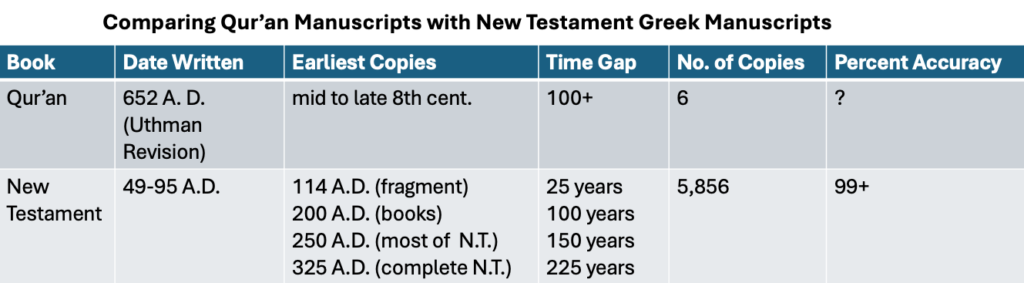
Because of the amount of complexity in comparing Islam’s sacred book (the Qur’an) and Christianity’s sacred book (the Bible), I am dividing Part 2 into four different articles. In the first two articles we looked at the manuscript evidence and the documentary evidence for both Scriptures. 

By far, the Bible has more manuscript evidence compared to the Qur’an (see above chart)Christianity can claim more than 5,850 known early Greek manuscripts of the New Testament, most of which were written between 25-225 years after the death of Christ. The New Testament also has over 18,130 early versions and translations, adding up to nearly 24,000 confirmed New Testament manuscripts still in existence (see chart below). In addition, we also have 42,300 Old Testament Scrolls and Codices, which means the Bible has 66,286 manuscript evidences.
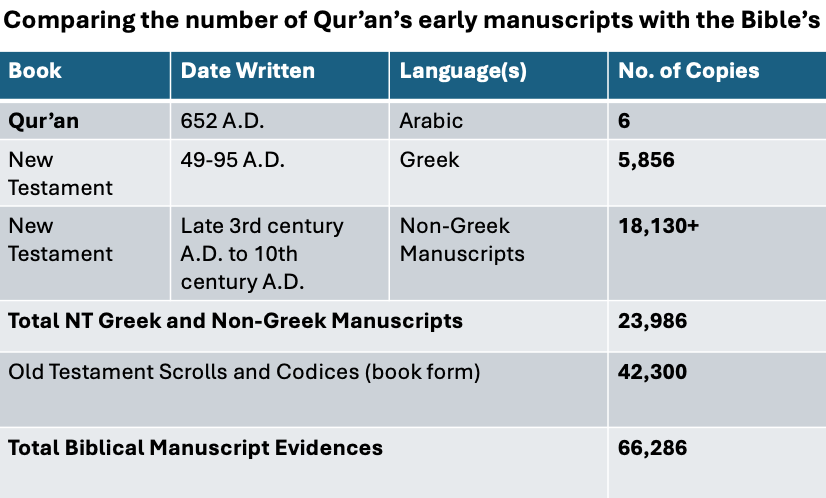
But Islam cannot provide a single manuscript until well into the eighth century, over 100 years after its supposed original compilation. And even then, Islam only has 6 early manuscripts of the Qur’an, and none of them are from the 7th century. None of them are complete. None of them completely agree with each other. None of them completely agree with the current 1924 ‘Hafs’ text which is memorized by 93% of Muslims. All of them have hundreds and even thousands of subsequent manuscript variants. [1]

If the Christians could retain so many thousands of ancient manuscripts, all of which were written long before the Qur’an, at a time when paper had not yet been introduced, forcing the dependency on papyrus which disintegrated with age, then one wonders why the Muslims are not able to forward a single manuscript from this much later period, during which the Qur’an was supposedly revealed? This indeed gives the Bible a much stronger claim for reliability than the Qur’an.

Furthermore, while the earliest New Testament manuscripts as well as the earliest letters from the church fathers correspond with the New Testament which we have in our hands, providing us with some certainty that they have not been unduly added to or tampered with, the Qur’anic material which we have in our possession abounds with stories whose origins we can now trace to second century fictional Jewish and Christian apocryphal literature. We know in some cases who wrote them, when exactly they were written and at times even why they were written; and that none of them were from a divine source, as they were written by the most human of Rabbis and storytellers over the intervening centuries after the Bible had been canonized.
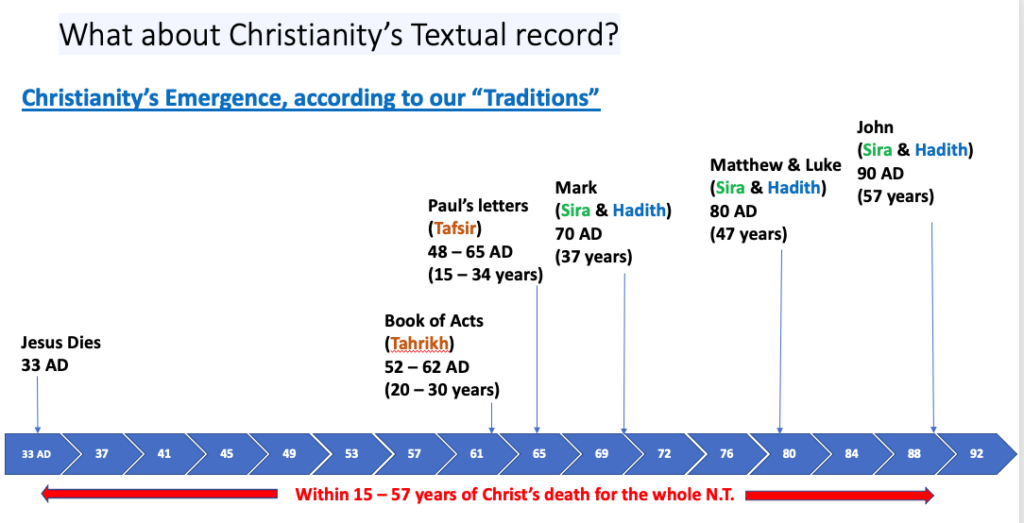
When we compared the historical documentary evidence of the Qur’an and the Bible, we discovered when the earliest biographies and sayings for both faiths were written. For Christianity (see above chart)they were written 16-57 years after Jesus’ death on the cross by those from the same area. But for Islam, they were written 400-900 years later, and by those who were hundreds of miles too far north (see chart below). Thus, the documentary evidence substantiates that the New Testament has more reliability and authority than the Qur’an.    
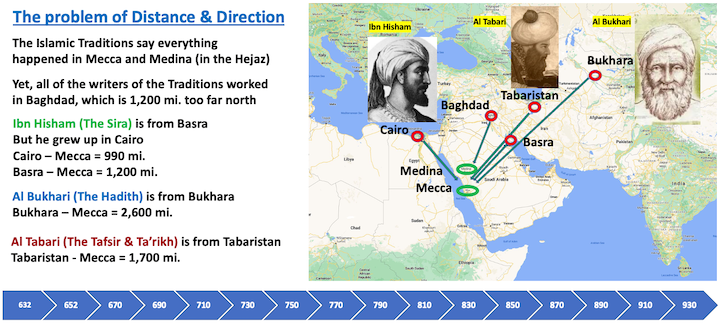
In this article, we will examine the archaeological evidence for both the Bible and the Qur’an. Since both the Bible and the Qur’an speak of history, we will see if archaeology confirms what both books say about people, places, and times. To begin, we will see what archaeology tells us about the Qur’an.

The Qur’an’s Archaeological Evidence

As with the manuscript and documentary evidence, there is not much archaeological information to which we can turn to substantiate what the Qur’an says. What we can do, however, is look at the claims the Qur’an makes and find out if they can be corroborated by archaeology. We will begin with the Qibla, or direction of prayer.

1) The Qibla: According to the Qur’an (Surah 2:144, 149-150), the Qibla or direction of prayer was finalized towards Mecca for all Muslims approximately two years after the Hijra (migration to Medina) around 624 A.D. and has remained in that direction to the present! [2]
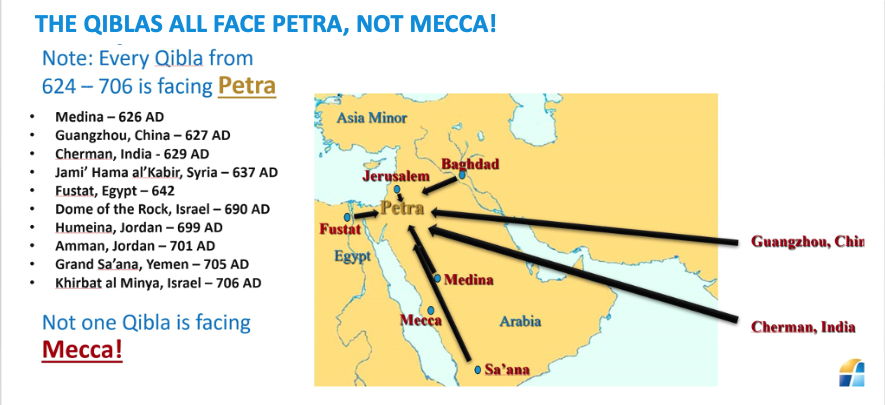
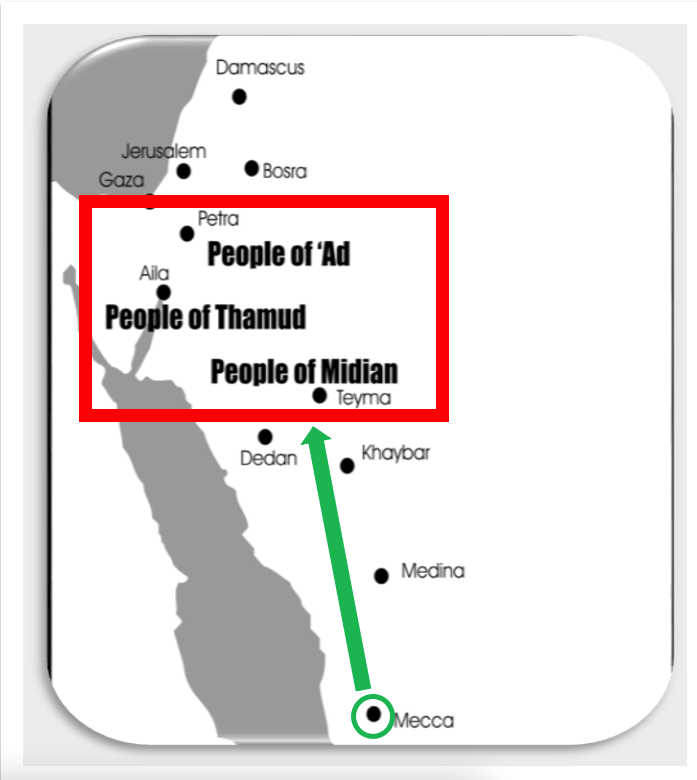
Yet, the earliest evidence from outside Islamic tradition regarding the direction in which Muslims prayed, and by implication the location of their sanctuary, points to an area much farther north than Mecca, in fact somewhere in northwest Arabia. [3] Middle Eastern archaeologist Dan Gibson has done the most extensive work on the Qiblas and found that every Qibla from 624-706 A.D. is facing Petra, and none are facing Mecca (see above map).

Gibson’s “archaeological examinations of the mosques from the first 100 years of Islam indicate that the qibla, or the direction of prayer, did not face toward Mecca, but rather to a more northern location, the Nabataean area around Petra where the people of ‘Ad, Midian, and Thamud all resided. Due to this archaeological evidence, Gibson does not support Mecca as the birthplace of Islam. Instead, based on his research Gibson concludes that ‘Islam was founded in northern Arabia in the city of Petra. It was there that the first parts of the Qur’an were revealed before the faithful were forced to flee to Medina. Thus, the prophet Muhammad never visited Mecca, nor did any of the first four rightly guided caliphs. Mecca was never a center of worship in ancient times, and was not part of the ancient trade routes in Arabia.’” [4] [emphasis added]

In addition, Gibson mentions that at a 2002 conference on Nabataean Studies held in Petra he had the opportunity to speak to several Jordanian and Saudi archaeologists who admitted that “the archeological record at Mecca was basically non-existent before 900 AD. [5] [emphasis added] Perhaps this is why the Saudi government is destroying most of the ancient buildings and sites in Mecca. [6] They may be trying to cover up something that was “not there” before the 9th century. [7]

Smith notes that an additional substantiation for this direction of prayer is found “by the Christian writer and traveler Jacob of Edessa, who, writing as late as 705 A.D. was a contemporary eyewitness in Egypt. He maintained that the Mahgraye’ (Greek name for Arabs) in Egypt prayed facing east which was towards their Ka’ba.” [8] [emphasis added] His letter (which can be found in the British Museum), reveals that as late as 705 A.D. the direction of prayer towards Mecca had not yet been finalized. [9]

Why are all of the 7th century Qiblas facing Petra or Jerusalem up to 705 A.D., and not Mecca until 715 A.D.? [10] Some Islamists argue that the early Muslims did not know the direction of Mecca. Yet these were desert traders! Their livelihood was dependent on travelling the desert, which has few landmarks, and, because of the sandstorms, no roads. They especially knew how to follow the stars. Their lives depended on it. Surely, they knew the difference between the north and the south. [11]

In addition, Smith says, “Furthermore, the mosques in Iraq and Egypt were built in civilized urban areas, amongst a sophisticated people who were well adept at finding directions. It is highly unlikely that they would miscalculate their qiblas by so many degrees. How else did they perform the obligatory Hajj [pilgrimage], which we are told was also canonized at this time? And why are so many of the mosques facing in the direction of northern Arabia, or possibly Jerusalem?” [12] [brackets and emphasis added]

Smith argues that a plausible answer may be found by examining the archaeological evidence in Jerusalem itself.       

 2) The Dome of the Rock: [13] 
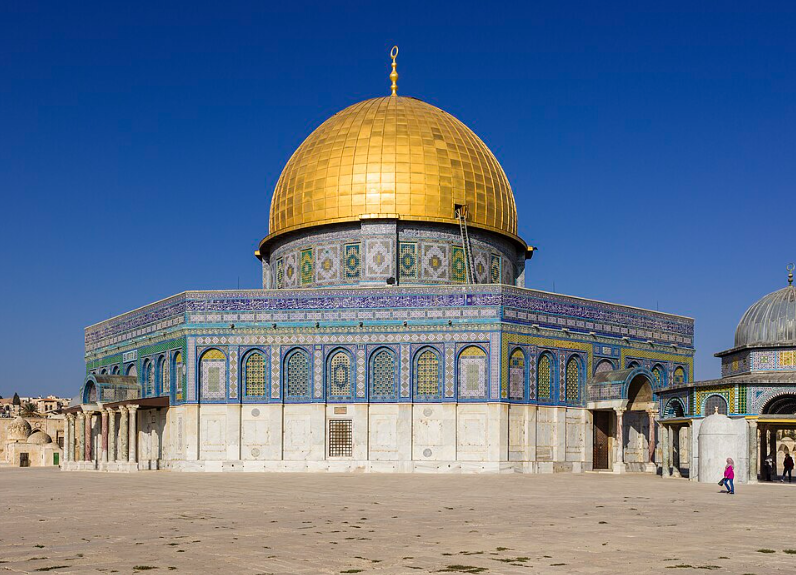
In the center of Jerusalem stands an imposing structure (even today) called the Dome of the Rock (see above pic), built by Caliph Abd al-Malik “in 691 A.D., after seeing the magnificent Christian cathedral of the Church of the Holy Sepulchre.” Al-Malik built this structure “of equal splendor over the rock in Jerusalem believed to be where Abraham was about to sacrifice his son Isaac.” [14]

The Dome of the Rock was built in the shape of an octagon with eight pillars [15] suggesting it was used for circumambulation (to walk around). Thus, it seems to have been built as a sanctuary[16] Today it is considered to be the third most holy site in Islam, after Mecca and Medina. Islamists insist that it was built to commemorate the night when Mohammed went up to heaven to speak with Moses and Allah concerning the number of prayers required of the believers (known as the Mi’raj in Arabic). [17]

But when the inscriptions on the walls of the Dome of the Rock were examined, they said nothing of the Mi’raj. This is substantiated further by the absence of a Qibla (no direction for prayer). Why was there no Qibla? The fact that such an imposing structure was built so early suggests that Jerusalem, and not Mecca, became the sanctuary and the center of an emerging Islam up until at least the late seventh century! [18]

According to Islamic tradition, the caliph Suleyman, who reigned as late as 715-717 A.D., went to Mecca to ask about the Hajj (annual pilgrimage). He was not satisfied with the response he received there, and so chose to follow Abd al-Malik (i.e. travelling to the Dome of the Rock). This fact alone, according to Dr. Hawting at the School of Oriental and African Studies (as part of London University) points out that there was still some confusion as to where the sanctuary was to be located as late as the early eighth century. It seems that Mecca was only now (sixty years after Mohammed’s death) taking on the role as the religious center of Islam. One can therefore understand why, according to tradition, Al-Walid I, who reigned as Caliph between 705 and 715 A.D., wrote to all the regions ordering the demolition and enlargement of the mosques. [19] This suggests that at this time the Qiblas were then aligned towards Mecca.

Hence, archaeology tells us that the Qur’an introduced the Qibla in Mecca too early. This points to a glaring contradiction in the Qur’an which established Mecca as the sanctuary and thus direction for prayer during the lifetime of Mohammed some eighty to ninety years earlier (Qur’an 2:144, 149-150). 

And that is not all, for we have other archaeological evidence which point to differences with that which we read in the Qur’an.

3) Dirham Coins: 
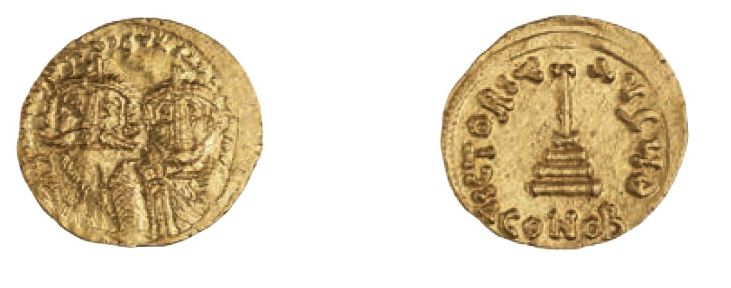
The Qur’an mentions that Joseph was sold by travelers (not Joseph’s brothers, as recorded in Genesis 37:28) for “a lesser price than a numbered dirham” (Qur’an 12:20). [20] Dirhams did not exist until the 7thcentury A.D., evolving from the Greek drachma. There were no dirhams during the time of Joseph (1915-1805 B.C.) [21] in ancient Egypt. Hence, the Qur’an introduces dirham coins hundreds of years too early. [22]

4) Samaritans: 
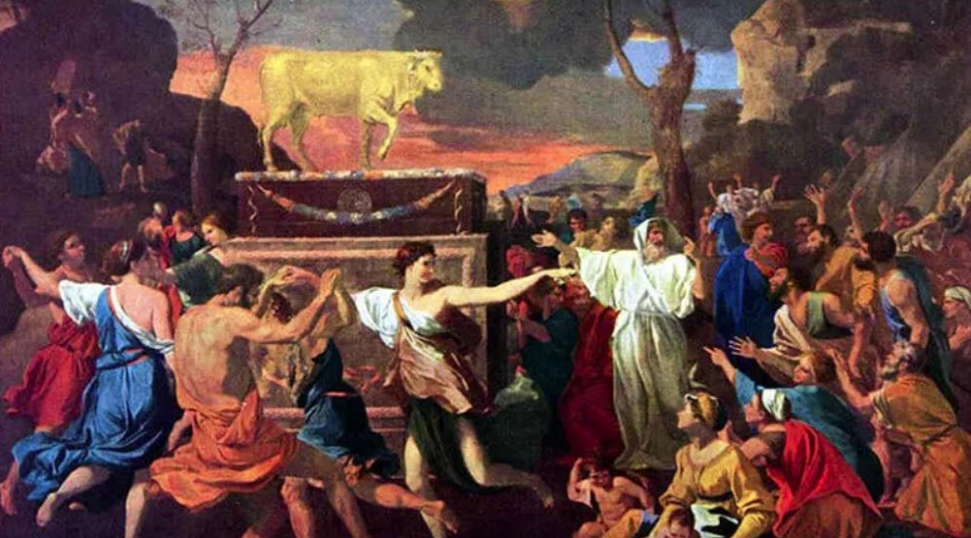
We learn from the Qur’an that a “Sāmirī [Samaritan, a non-Arabic word of Hebrew/Syriac origin], [23] not Aaron, as recorded in Exodus 32, “led them astray” (Qur’an 20:85) [24] to fashion a golden calf (Qur’an 20:86-88, 95-97). Mentioning a Samaritan in the time of Moses (1525-1405 B.C) [25] conflicts with history because Samaritans were not known as a people until 722 B.C. [26] Once again, the Qur’an introduces something hundreds of years too early. In addition, the Qur’an confuses Hosea 8:5-6 with the calf of the Exodus rebellion! [27]  

5) Chainmail: 
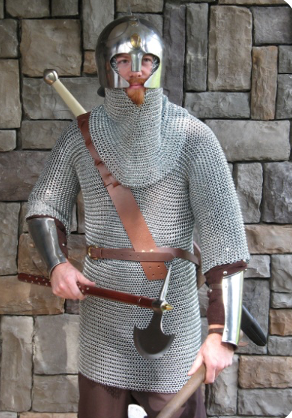
According to the Qur’an, Allah taught King David how to make chain mail: 10 And indeed, we gave David a bounty from us: ‘O mountains, sing praises with him and the birds.’ And we softened the iron to him. 11 That, ‘Make suitable coats of sard [chain armor, non-Arabic word of Persian/Syriac origin] and measure the length. And do a good deed. Surely, I see what you do.” (Qur’an 34:10-11). [28] Hence, the Qur’an is saying that chainmail existed during the reign of King David in ancient Israel (1011 B.C. – 971 B.C.). [29] But coats of chainmail were not invented until around 400-300 B.C. by Celtic tribes in eastern Europe. [30] Hence the technology for chainmail did not exist until hundreds of years later than the Qur’an’s reference. 

6) Crucifixion: 
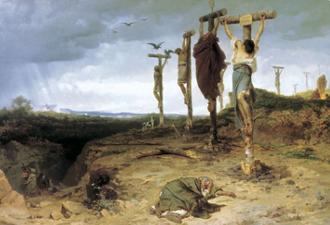
According to the Qur’an, Pharaoh threatened to “cut off” the “hands” and “legs” of his sorcerers on opposite sides and “crucify” them “on trunks of the palm tree”  when they chose to believe in the God of Moses (Qur’an 20:71; 7:121). [31] Joseph tells one of his fellow prisoners that “ he will be crucified, so the birds will eat from his head.” (Qur’an 12:41).[32] The earliest historical record of crucifixion dates to 519 B.C. when King Darius I of Persia crucified 3,000 of his political enemies in Babylon. [33] Thus, the Qur’an places crucifixion at times (Joseph: 1915-1805 B.C. and Moses: 1525-1405 B.C) which are hundreds of years before history records when crucifixion was invented.        

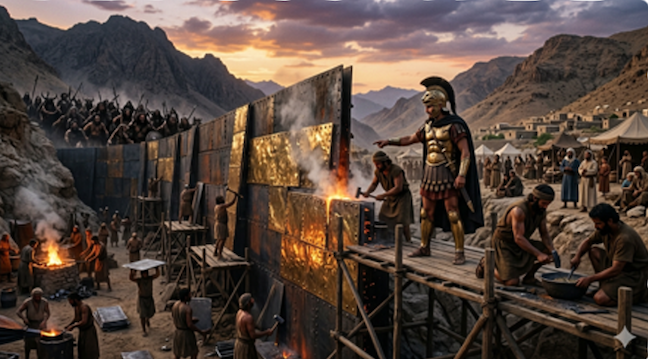
7) Alexander the Great (see AI generated pic below)

The Qur’an states, “They ask you about Ze Al Qarnain [the one with two horns]. Say, ‘I will recite to you an account of him.’” (Qur’an 18:83). [34] Dakdok explains that “the reason this verse was given was because the Jews of Quraish asked to examine the knowledge of Mohammed. That is why Allah sent down the story of Zu Al Qarnain” [35] otherwise known as Alexander the Great. [36]

We read of Alexander the Great,  92 Then he followed a way, 93 until he came between the two mountains under which he found a people who could not understand a saying. 94 They said, ‘O Za Al Qarnain, surely Ya’juj [Gog] and Ma’juj [Magog] are vandalizing in the land. Shall we make to you a tribute that you make between us and them a barrier?’ 95 He said, ‘That in which my lord has established me is better, so assist me with strength. I will make a barrier between you and them. 96 Bring me blocks of iron,” until it equalizes between the two sides. He said, ‘Blow,’ until when he made it a fire. He said, ‘Bring me brass that I may pour over it.’ 97 And they were not able to scale it, neither were they able to dig through it.’ 98 He said, ‘This is a mercy from my lord. So, when the promise of my lord comes to pass, he will make it dust. And the promise of my lord was true.” (Qur’an 18:92-98). [37] [emphasis added]

Ibn Kathir, a 14th century Muslim historian, scholar, and Qur’anic exegete, interpreted these verses by stating that these people between the two mountains were Turkish and the cousins of Gog and Magog (Qur’an 18:92-94ba). They mentioned to Alexander the Great that Gog and Magog had vandalized them, so they offered to pay him a great tribute to help them build a barrier between them and Gog and Magog (Qur’an 18:94b). But Alexander the Great refused to receive their tribute because he was satisfied with what Allah had given him (Qur’an 18:95a). Kathir also interpreted these verses to say that Alexander the Great, with the assistance of these men, built a great barrier made of iron and brass so it was smooth on the outside, making it difficult to go above it with ladders and through it with shovels (Qur’an 18:95b-97). Kathir claimed that the barrier was the same height as the tallest mountain, to the point that there was not one building on the earth that was stronger or more useful to the people than it. The building of this great barrier showed the mercy of Allah to his servants to prevent the aggression of Gog and Magog against these people (Qur’an 18:98a). Kathir also stated that this barrier which Alexander the Great built would become dust in the day of resurrection; this must be done, for the promise of his lord is true (Qur’an 18:98b). [38]

Al Bukhari (d. 870 A.D.) wrote down the actions and saying of Mohammed in the Hadith, and he said a man came to Mohammed and said, ‘O messenger of Allah, indeed I saw the barrier of Gog and Magog.’ Mohammed said, ‘Describe it to me.’ The man said, ‘It was like striped hail with black and red stripes.’ Mohammed said, ‘Indeed, you have seen it.’ That means Mohammed agreed with this man because Mohammed had seen this barrier. [39]

Dakdok concludes, “It is amazing… that there is no evidence of the existence of such a barrier. Alexander the Great did not build any barrier; and if there was such a barrier with this description, it should still exist, especially when we read that the Qur’an said that it will be there until the day of resurrection (Qur’an 18:95-101) which has not taken place yet. Such a barrier does not exist, nor is there any archaeological evidence to prove its existence. Moreover, there is not any biblical reference to such a barrier. The only barrier or wall that is known to the world is the Great Wall of China, which still exists today and is very well documented in history. This proves that these men in this hadith and Mohammed are liars.” [40] [emphasis added]

9) Coins: [41]
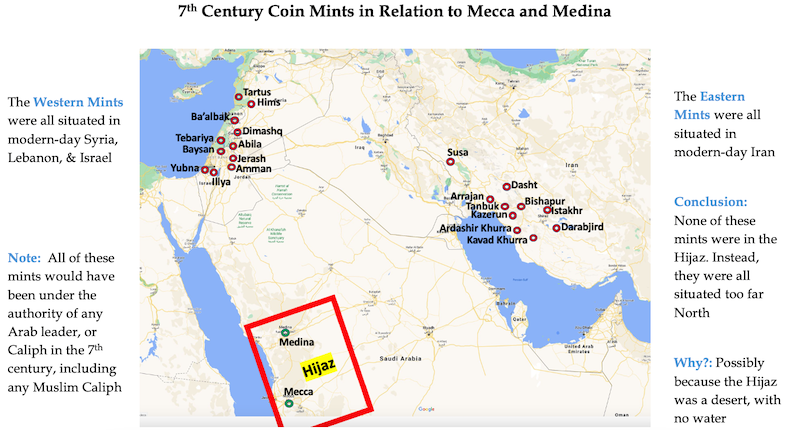
In ancient days when a king or Caliph (Muslim leader) came to power, one of the first things he did was mint a coin with his name and image on it and what religion he belonged to along with the date of the coin. Since they didn’t have modern communication like we do today (e.g. newspapers, radio, TV, or internet), they minted coins to inform others of their identity and jurisdiction. Dr. Jay Smith shows that there are no Islamic coins minted during the supposed lifetime of the prophet Mohammed (570 – 632 A.D.) nor during the Rashidun period (624-661 A.D.). The coins that were minted during that time were too far north to be related to Mohammed or the Qur’an (see above chart). The western mints were situated in modern day Syria, Lebanon, and Israel, and the eastern mints were located in modern day Iran. All of these mints would have been under the authority of any Arab leader or Caliph in the 7th century, including any Muslim Caliph (successor to Mohammed). In addition, none of these mints were in the Hijaz where Islam supposedly began. It is possible that these mints were too far north because the Hijaz was a desert with no water, and where there is no water, there is no civilization.
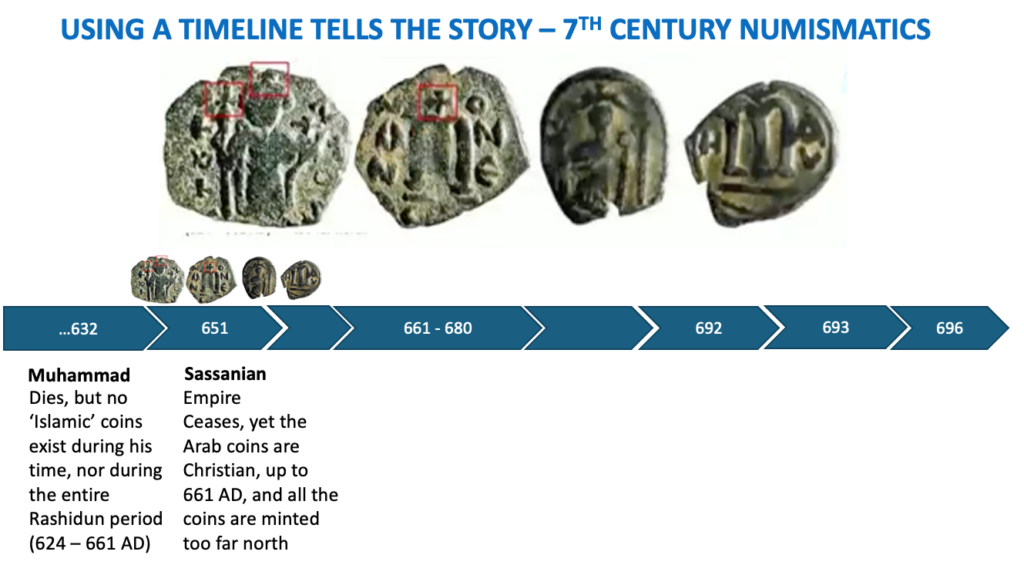
When you examine the coins minted in the early 7th century up to 661 A.D, almost all the coins are Christian, possessing a cross on them (see above pic). None of the coins from that time had anything to do with Mohammed, Islam, the Qur’an, or Mecca. 
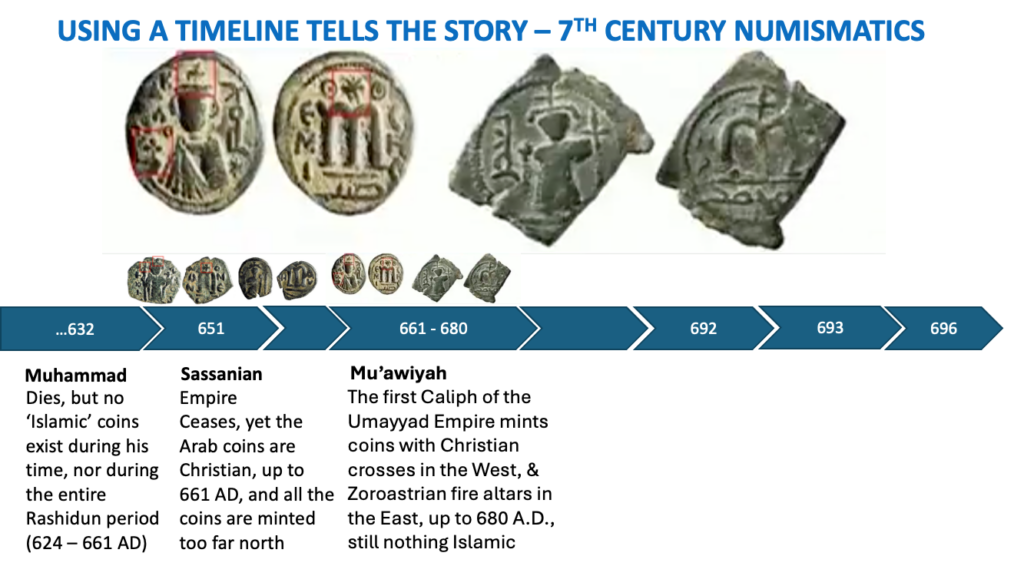
For example (see above pic), when you look at the first Muslim Caliph of the Umayyad Empire, Mu’awiyah, he minted coins with Christian crosses on them. Notice the two coins in the lower right of the picture. The first coin has a cross above the Caliph’s head and in his hand. And on the back side of the coin, it has the Arabic name Mahmad which some believe refers to the prophet Muhammad. If that is the case, it would be the first reference to Muhammad anywhere, and that was in 663 A.D.        

Some scholars argue that the Arabic word “Mahmad” later translated Muhammad word “Mahmad” later translated Muhammad on these early coins may refer to Jesus Christ, and not the prophet of Islam. This is because the root of the term “mu-hammad” is “Ahmad,” which means “praise.” Hence, the term Muhammad could be translated as “the one (mu-) who is praised (Ahmad),” or the “chosen one.” [42] Since the coins picture the Muslim leader with a cross on his head and in his hand, scholars conclude that Jesus Christ must be the “one who is praised.”   
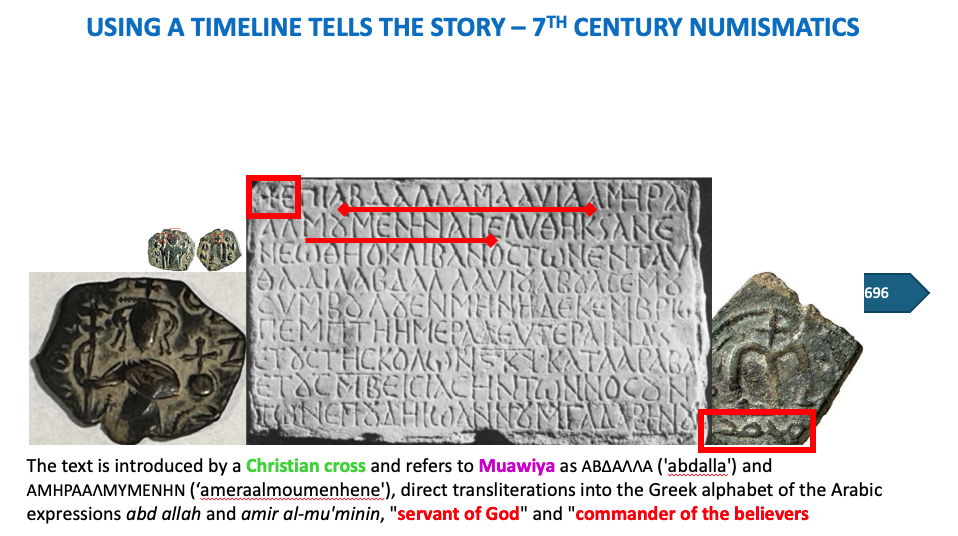
This is substantiated further in an inscription by Mu’awiyah (see above pic). He introduces the inscription with a cross in the upper left corner and refers to himself as “abdalla,” a “servant of God” and “ameraalmoumenhene,” a “commander of the believers.” Smith concludes that this first Caliph was a believer in the Jesus of the Bible who was a commander of Christians. Mu’awiyah ruled until 680 A.D. and then Abd Al-Malik came to power in 685 A.D.   
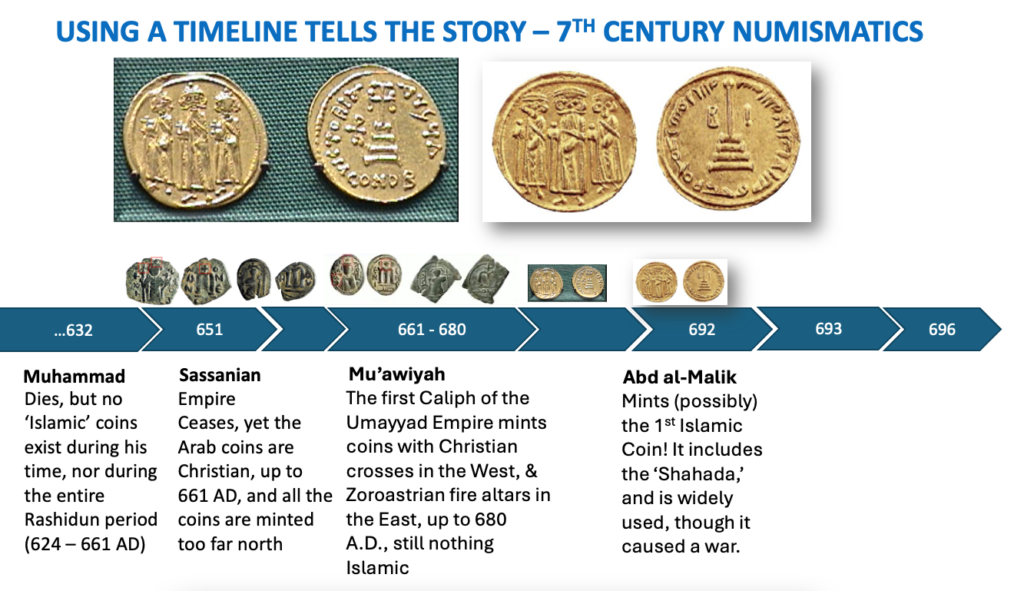
Abd Al-Malik introduces new coins that contain the shahada (see above pic) which says, “There is no god but Allah, and Muhammad is his prophet (rasul).” This is perhaps the first Islamic coin. After minting this coin, Abd Al-Malik goes to battle against Justinian, the Byzantine Emperor, and defeats him. He then mints this coin with an image of himself holding a sword in victory (see pic below). 
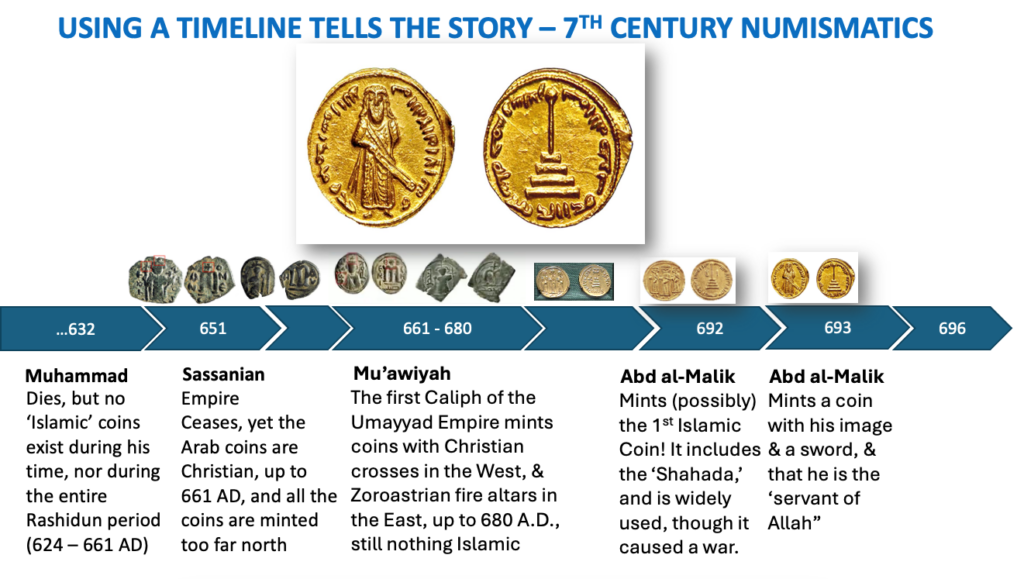
Abd Al-Malik had inscriptions written on the Dome of the Rock which he built in 691 A.D. which attacked Jesus as the Son of God (e.g., Allah “hath not taken unto Himself a son, and Who hath no partner” – Qur’an 25:2; Allah “has no associate” – Qur’an 112:3) as well as the Trinity (e.g., “say not ‘three’” – Qur’an 4:171). [43] 
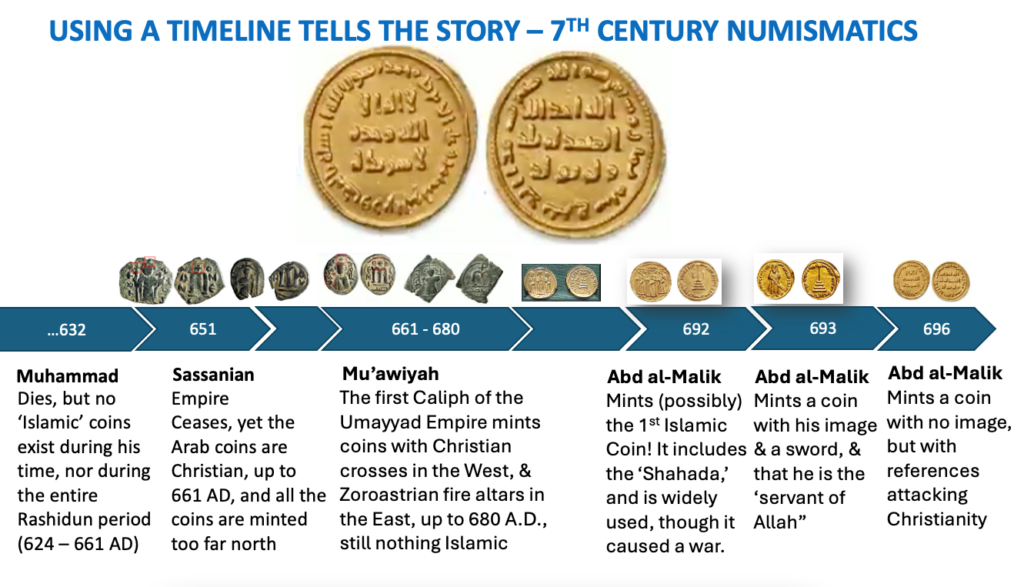
He also minted coins attacking Christianity (see above pic). Smith concludes that this is the beginning of what later became Islam. [44]

10) Arabic Rock inscriptions: 
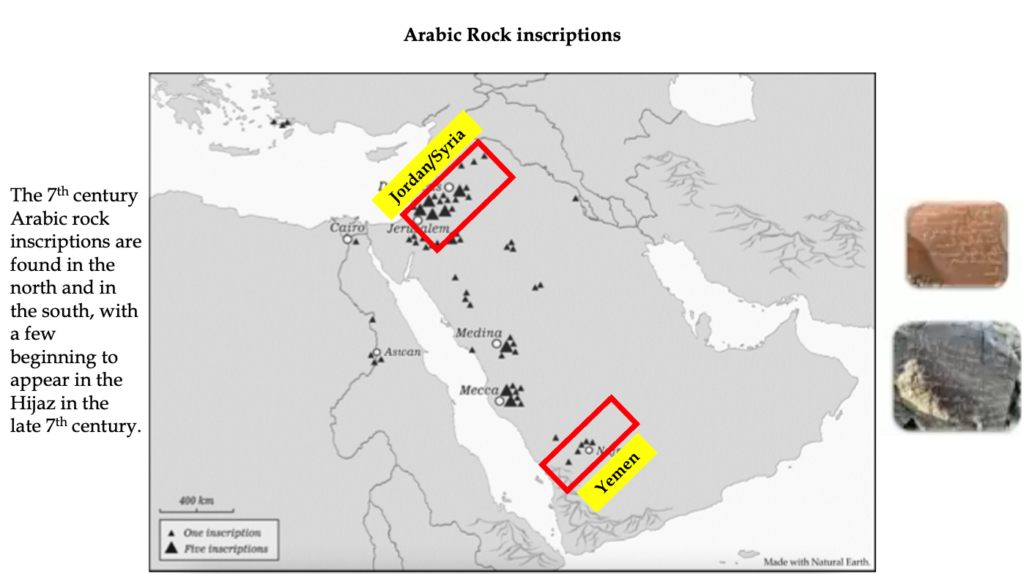
Notice that the 7th century Arabic rock inscriptions are all found in the north and in the south (see above pic), but not in the Hijaz where Islam supposedly began. Ilkka Juhani Lindstedt [45] analyzed approximately 100 Arabic rock inscriptions during a 100-year period (640-740 A.D.) and discovered that prior to 690 A.D., there was no evidence of anything Islamic on the inscriptions. Instead, they are merely pious formulae related more to Christianity. It is not until 690-710 A.D. that the prophet Muhammad is introduced in these inscriptions. Muslim rites (e.g., pilgrimage, prayer, fasting, etc.) appear from 710-720 A.D. From 720-730 A.D., the terms “Muslim” and “Islam” emerge in these inscriptions referring to a specific group in contradistinction to Christianity. This is 100 years after Muhammad’s death. It was only in the  730s A.D. onward that popular devotion was given to a man named Muhammad as a prophet and messenger of Allah, which calls into question the  traditional Islamic narrative presented in the Qur’an. Smith concludes that this 100-year silence indicates that Islam did not exist as a distinct religion until long after the time of Mohammed (570-632 A.D.) which casts doubt that he had any part in starting Islam.  

11) Qur’anic Quotations: [46] The quotations from the Qur’an on both the coins and the Dome of the Rock differ in detail from that which we find in the Qur’an today. [47]  Two etymologists, Van Berchem and Grohmann, have done extensive research on the Dome of the Rock inscriptions, and they state that the inscriptions contain “variant verbal forms, extensive deviances, as well as omissions from the text which we have today.” [48]

If these inscriptions had been derived from the Qur’an, with the variants which they contain, then how could the Qur’an have been canonized prior to this time (late seventh century)? One can only conclude that there was a gradual evolution in the transmission of the Qur’an through the years (if indeed they were originally taken from the Qur’an).

The sources also seem to suggest that the Qur’an was put together rather hurriedly. Dr. John Wansbrough maintains that “the book is strikingly lacking in overall structure, frequently obscure and inconsequential in both language and content, perfunctory in its linking of disparate materials, and given to the repetition of whole passages in variant versions. On this basis it can plausibly be argued that the book is the product of the belated and imperfect editing of materials from a plurality of traditions.” [49] Hence, Crone and Cook believe that because of the inadequacy of the editing, the emergence of the Qur’an must have been a sudden and late event. [50]

The Bible’s Archaeological Evidence

 We will begin with the archaeological evidence for the Old Testament. Since Abraham is esteemed by both Christianity and Islam, we will look at where archaeology places him.    

Abraham: Abraham was the first and greatest of the Hebrew patriarchs. His story is recorded in Genesis 11:26-25:10. “Abraham” appeared as a personal name in Babylonia during the time of the Patriarchal period (2296 -1806 B.C.). [51] Early and late twentieth-century excavations in Mesopotamia have uncovered documented names, including  Abram (later changed to Abraham – Gen. 17:5) [52] and his relatives, such as his great-grandfather Serug, his grandfather Nahor, and his father Terah (Gen. 11:22-26). These men all have names that have been confirmed in documents and reports as coming from the Euphrates-Habur region of Upper Mesopotamia from the time period of the early second millennium. [53]
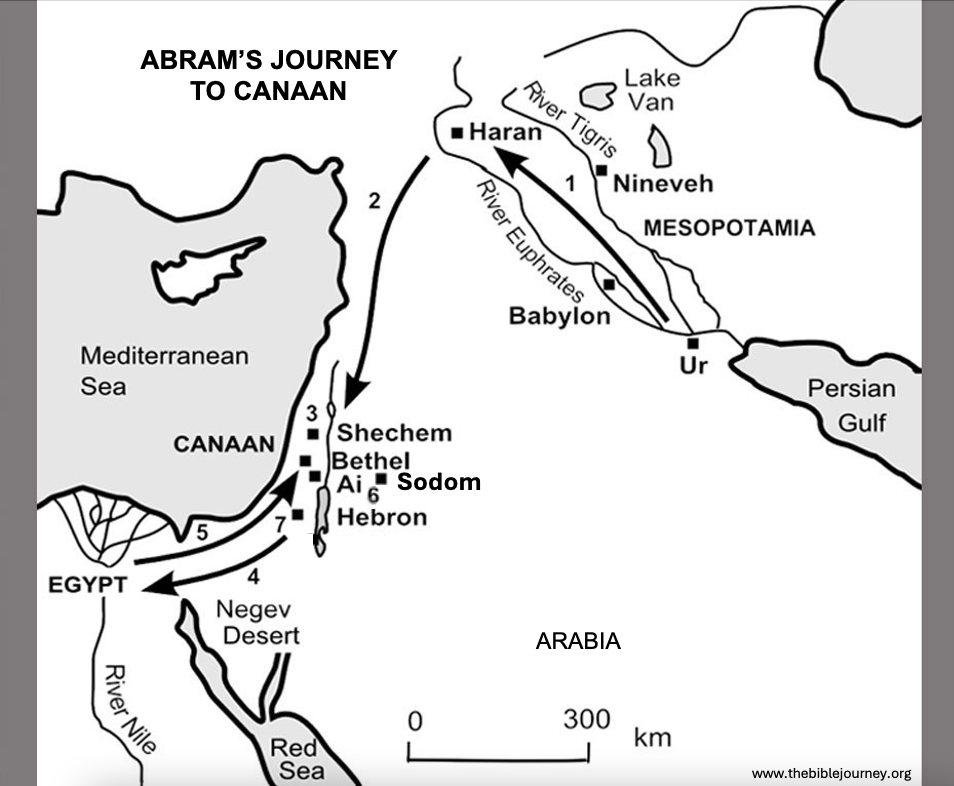
When we look at Abram’s journey from Ur to Canaan (see above map), we learn that archaeology confirms the names of places related to his journey from the Patriarchal period: 

1) Terah and his family (including his sons Abram and Nahor, and his grandson Lot) lived at Ur, the capital of Sumer, in southern Mesopotamia (modern-day Iraq). [54] While still living in Ur, God calls Abram to “Get out of your country… to a land I will show you.” (Gen. 12:1; cf. 15:7; Neh. 9:7; Acts 7:2). [55] They decide to move from Ur and follow the Euphrates River upstream about 600 miles possibly to avoid the harsh central Arabian desert [56] to Haran in what is now modern-day southern Turkey [57] (Gen. 11:27-32). Excavations at this site have unearthed a large mudbrick building that dates to the end of the third millennium B.C., which some believe may have been a predecessor to the Temple of the moon-god, Sin, [58] which is significant because Terah’s name means “moon” [59] and Scripture informs us that he came from an idolatrous background whereby he “served other gods” (Josh. 24:2). 

2) After Terah died in Haran (Gen. 11:32), Abram and his nephew Lot set out for Canaan with their tents and flocks (Gen. 12:1-5). 

3) Abram arrives in Canaan and builds an altar by the sacred tree of Moreh at Shechem about 30 miles north of Salem (later called Jerusalem) [60] where God revealed Himself to Abram for the first time in the Promised Land (Gen. 12:6-7). Archaeological excavations at Tell Balata (ancient Shechem) confirm that it was a “place” (Gen. 12:6) with no walls when Abram arrived (~2090 B.C.), but approximately 180 years later when Jacob arrived (~1910 B.C.), [61] it had become a “city” (Gen. 33:18). [62] 

4) Abram moves to the hill country between Bethel and Ai, [63] then moves south towards the Negev Desert. Driven by drought and famine, Abram and Sarai (Abram’s wife) journey along the Way of Shur to the well-watered lands of the Nile Delta in Egypt (Gen. 12:8-20). 

5) Abram and Sarai are forced to flee from Egypt to the hill country near Bethel (Gen. 13:1-9). 

6) Abram and Lot decide to separate. Lot chooses the fertile, well-watered Jordan Valley to the east and pitches his tents near Sodom (Gen. 13:10-13).  
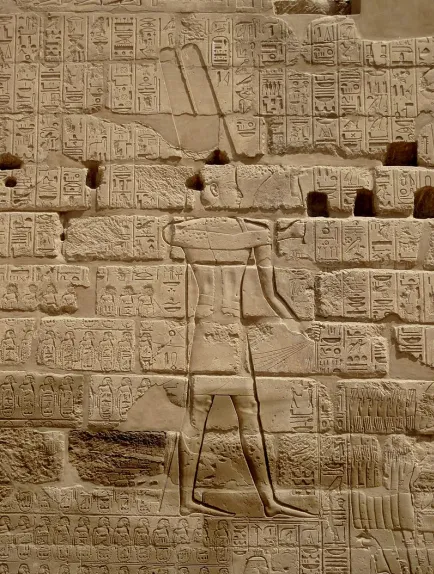
7) Abram moves to the great oaks of Mamre near Hebron and builds an altar there (Gen. 13:18). After the Egyptian Pharaoh Shishak (Shoshenq I) invaded the lands of Judah and Israel in 926 BC., he returned to Egypt and had a record of his victories inscribed on a wall of the Great Temple of Amun-Re at Karnak. One of the ovals, located just below and to the left of Shishak’s right foot (see above photo), reads, “the Fort / Enclosure of Abram.” [64]  This is the only nonbiblical written reference to Abraham, [65] proving that even at this early date Abraham was known not in Arabia, as Islam contends (Qur’an 2:124-131; 6:75-83; 19:41-48; 21:51-70; 26:69-83; 29:16-27; and 37:83-113) [66] but in Palestine, the land where the Bible places him. [67]

Sodom and Gomorrah (Gen. 13:1-13; 19:21-25; see photos below [68]):
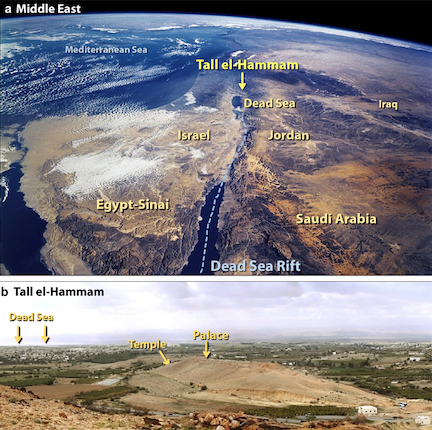
Since 2005 when Dr. Steven Collins began directing excavations in Tall el-Hammam, a fortified Middle-Bronze-Age city in modern day Jordan northeast of the Dead Sea, evidence was found that led scientists to believe it was destroyed by an extraordinary high energy event in 1650 B.C.  [69] Some archaeologists believe this could be the site of the biblical city of Sodom. Under the hill pictured in the base picture above, archaeologists found remains that indicate exposure to super intense heat over a short period of time which would have been much greater than exposure to wildfires, lightning, volcanism, earthquakes, or warfare. [70]

The entire city was capped by a five-foot thick charcoal and ash rich destruction layer containing shocked quartz, melted mudbrick, melted pottery, melted roofing clay, fragmented and scorched human bones, and other mysterious debris such as a ceramic shard with a glaze that would have been exposed to super-intense heat lasting a very short period. [71]
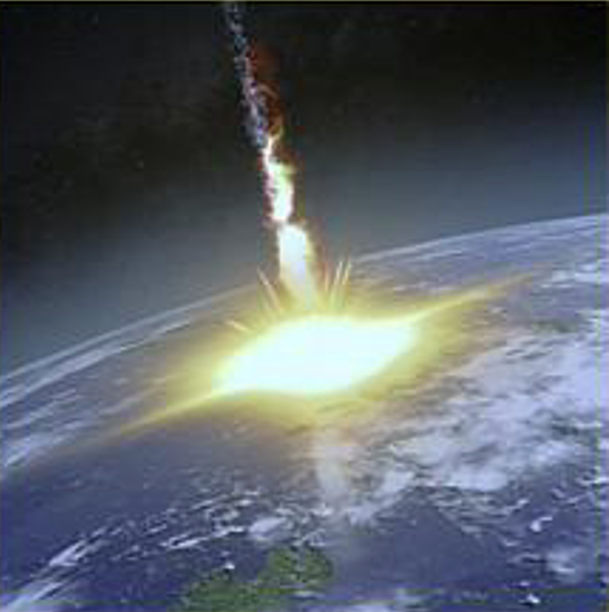
Scientists believe this represents a “cosmic airburst / impact event” (see above photo) similar to the asteroid explosion in Tunguska, Siberia in 1908, which had the equivalent explosive power of 1,000 Hiroshima bombs. [72]

The contents of the 5-foot destruction layer uncovered by scientists include (see pics below): [73]
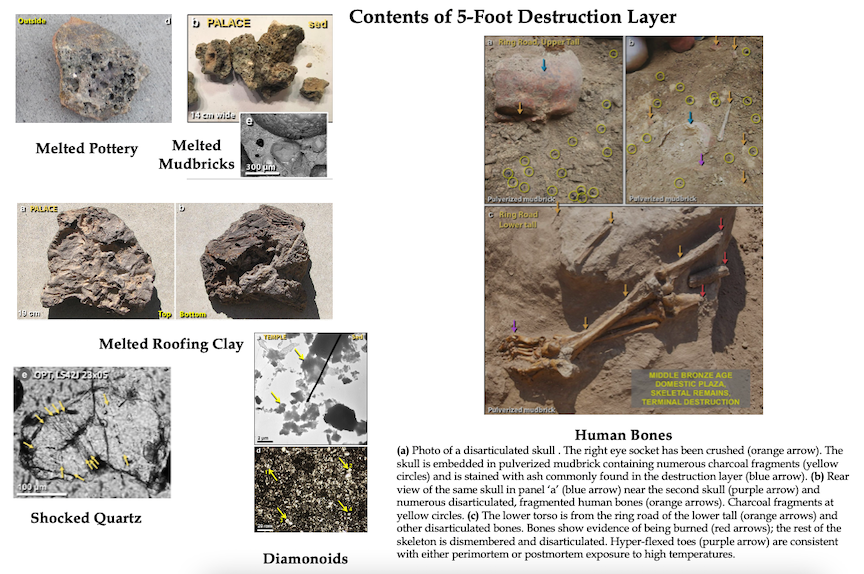
–       Melted construction materials such as pottery, mudbricks, roofing clay. 

–       High temperature melted minerals such as shocked quartz whereby sand grains are cracked due to high pressure.

–       Presence of diamonoids (indicators of cosmic impacts).

–       Disarticulated, fragmented, and scorched human bones.

–       High salt concentrations up to 6 times that of the Dead Sea. 

These amazing findings substantiate what the Bible describes as the destruction of Sodom and Gomorrah. We read, 24 Then the Lord rained brimstone and fire on Sodom and Gomorrah, from the Lord out of the heavens. 25 So He overthrew those cities, all the plain, all the inhabitants of the cities, and what grew on the ground. 26 But his [Lot’s] wife looked back behind him, and she became a pillar of salt.” (Gen. 19:24-26). Afterwards, the soil around Sodom and Gomorrah could not be used for 700 years because of this catastrophic event which exposed it to such super intense heat. [74]

Jericho Walls (Josh. 6:20-24): 
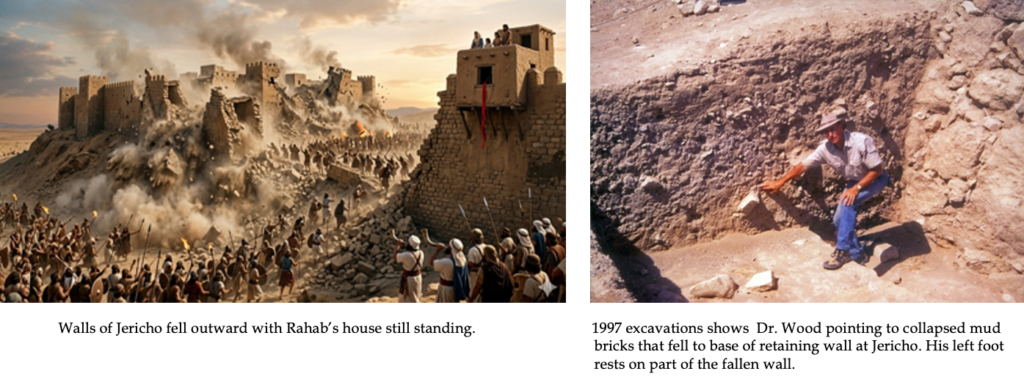
Recent analysis of archaeological research confirms that the city of Jericho was destroyed in approximately 1400 B.C. [75] and its city walls fell outward as the Bible states. [76]

King David: 
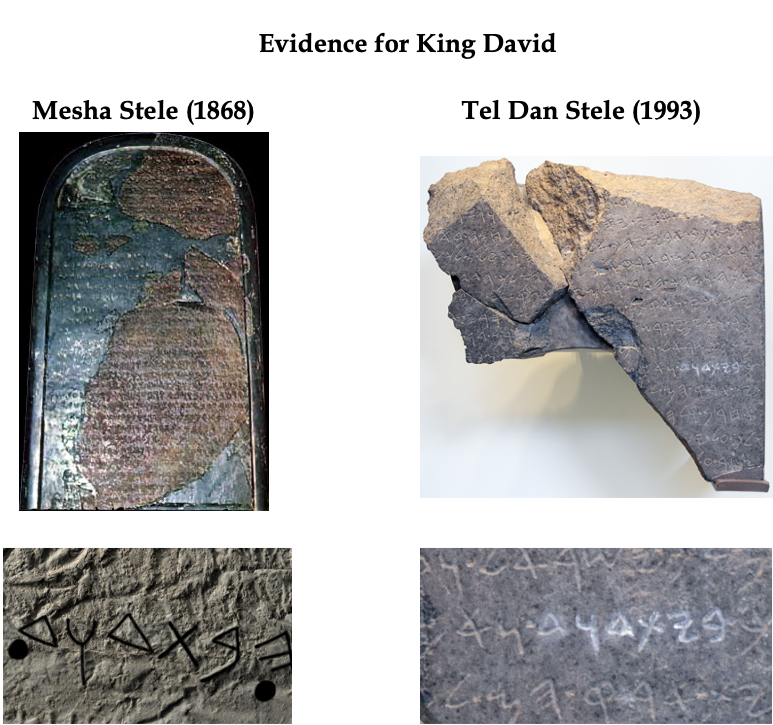
Skeptics claimed that King David never existed because his name had never been found outside of the Bible. But two archaeological findings came to the rescue at Dibon in Moab (1868) and at Tell Dan (1993-1994). In 1868 at Dibon, in Moab (20 miles east of the Dead Sea), the Mesha Stele was found and dated to 850 B.C. [77] It mentioned “Israel,” “Yahweh,” and the “House of David” (bytdwd). [78]In 1993 the Tell Dan Stele was discovered at Tel Dan (northern Israel) containing a Canaanite inscription that dates from the late 9th century B.C. [79] It was probably erected by Hazael, an Aramean king. The inscription reads, “I killed Jehoram son of Ahab king of Israel, and I killed Ahaziahu son of Jehoram king of the house of David (bytdwd). [80] The Bible tells us, “Mesha, king of Moab rebelled against the king of Israel…” (2 Kgs. 3:5).  
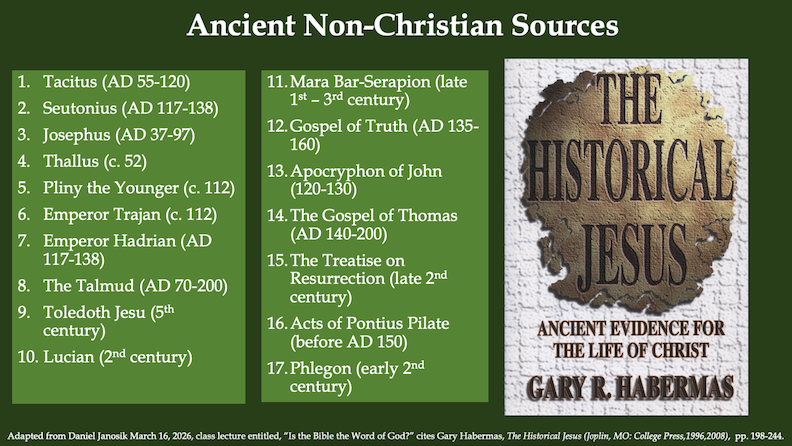
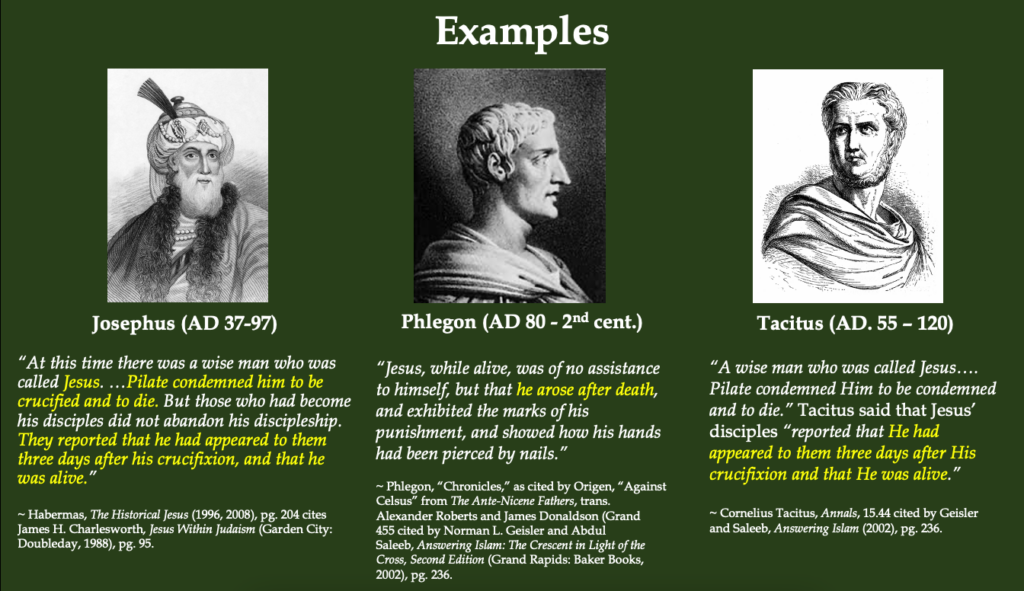
Let’s look at the archaeological evidence for the New Testament. Some people believe there is no historical evidence supporting that Jesus Christ actually existed. But in his book, The Historical Jesus, Gary Habermas cites 17 ancient non-Christian sources (see above pic) that testify to the historicity of Christ and early Christianity. [81] These are real people who testified of the death and resurrection of Jesus Christ. Examples (see pic below) include the Jewish historian, Josephus, the Greek historian Phlegon, and the Roman historian Tacitus.
Skeptics have harshly criticized Luke’s writings because more than any other New Testament writer he has mentioned specific people and places. Luke began his gospel of Jesus Christ, Inasmuch as many have taken in hand to set in order a narrative of those things which have been fulfilled among us, just as those who from the beginning were eyewitnesses and ministers of the word delivered them to us, it seemed good to me also, having had perfect understanding of all things from the very first, to write to you an orderly account, most excellent Theophilus, that you may know the certainty of those things in which you were instructed.” (Luke 1:1-4). 

Luke’s mention of Quirinius as the governor of Syria during the birth of Jesus (Luke 2:2) has been disputed by skeptics because Matthew’s account says Christ’s birth took place during the reign of Herod (Matt. 2:1, 16). Christ was born (6-4 B.C.) before King Herod died in 4 B.C. But critics argue that Josephus (Flavius Josephus, Antiquities of the Jews, 18:1:1; 18:2:1) places Quirinius’ reign in 6 A.D., ten years after Herod’s death. And Acts 5:37 seems to reference a census by Quirinius at that time. Did Luke get the historical placement of Quirinius wrong?    

A grammatical possibility is that the Greek word translated “first” (prōtē) can mean “before” or “earlier” (Luke 2:2; cf. John 15:18). [82] Hence, the verse could be translated as “This census took place before Quirinius was governing Syria.” (Luke 2:2). The Greek verb translated “governing” (hēgemoneuō) does not necessarily mean Quirinius was holding the specific office of governor. It simply means Quirinius was exercising authority in some capacity. [83] Hence, Luke’s meaning would then be that the census that took Mary and Joseph to Bethlehem was the one that Augustus made “before” the one he took when Quirinius was governing Syria in some capacity (in 6 A.D.), implying that another census was taken during another period when Quirinius was exercising authority in Syria. [84]
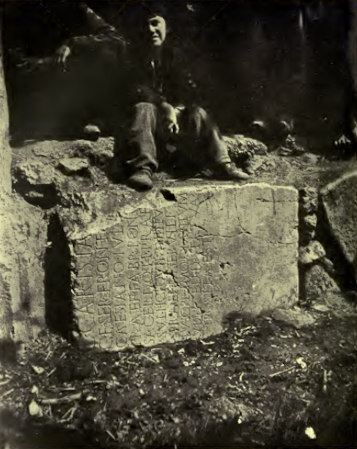
Archaeological discoveries confirm that Quirinius was proconsul of Syria twice. In 1764, a Latin inscription was discovered near Tivoli, located about twenty miles east of Rome, and it is understood to refer to Quirinius governing Syria on two separate occasions. [85] The first time was from 12–2 B.C. to conduct military action against the Homonadensians and then a second time in 6-7 A.D. [86] In addition, a statue dedicated to Quirinius was found by Sir William Ramsay at Pisidian Antioch (see above photo) showing that Quirinius was active in the region and held administrative authority around 12 to 2 B.C. [87] Hence, Quirinius exercised authority over the Roman province of Syria in some capacity twice (12-2 B.C. and A.D. 6-7) and took two separate censuses. [88] This is consistent with Luke’s account. In Luke 2:2, Luke writes, “This census first took place while Quirinius was governing Syria” (describing Quirinius’ rule as the governor’s procurator), and in Acts 5:37, Luke describes a second census taken most likely between 6-7 A.D. (as described by Josephus) when Quirinius was the formal governor of the region. Both Josephus and Luke link this second census to an uprising under Judas of Galilee. Only Luke’s sources were present during the actual events; as a result, Luke’s description of two separate censuses is reasonable. [89]

Repeatedly secular historians have accused Luke of historical inaccuracies only to retract their criticisms after archaeology confirmed Luke’s accounts. Examples include: 

–       Luke’s use of the Greek word meris to maintain that Philippi was a “district” of Macedonia (Acts 16:12) was doubted until inscriptions were found which use this very word to describe divisions of a district. [90]

–       Luke’s usage of the Greek word Politarchēs to denote the civil authority of Thessalonica (Acts 17:6) was questioned, until some 19 inscriptions have been found that make use of this title, 5 of which are in reference to Thessalonica. [91]
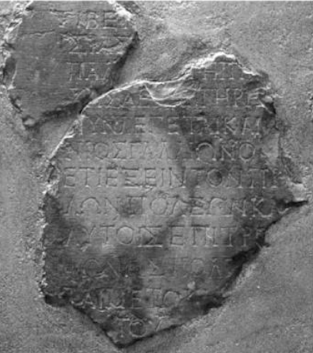
–       Luke’s usage of Proconsul as the title for Gallio in Acts 18:12 has come under much criticism by secular historians, as the later traveler and writer Pliny never referred to Gallio as a Proconsul. This fact alone, they said, proved that the writer of Acts wrote his account much later as he was not aware of Gallio’s true position. In 1908 the Delphi Inscription, dated to 52 A.D. was uncovered (see above photo) and proved that Luke was correct. This inscription states, “As Lusius Junius Gallio, my friend, and the proconsul of Achaia…” [92]

–       When Luke says Paul and Barnabas fled from Iconium (Acts 14:1-5) to Lystra and Derbe, cities in Lycaonia (Acts 14:6), he was implying that Iconium was not in Lycaonia. This was rejected by critical archaeologists who based their belief on the writings of Romans such as Cicero who indicated Iconium was in Lycaonia. [93] But in 1910 Sir William Ramsay found a monument that showed Iconium was a Phrygian city. [94]
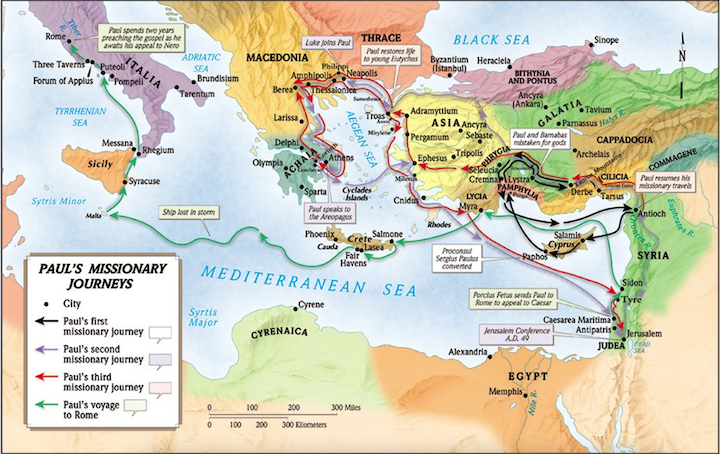
Luke recorded 32 countries, 54 cities, 9 Mediterranean islands, and 95 people in the book of Acts (see above pic), and he did not get any of them wrong. [95] Compare Luke’s historical accuracy with the Qur’an which places fifty-four of its sixty-five geographic references (see pic below) 600 – 1,000 miles too far north of Mecca (Ad = 23 times, Thamud = 24 times, and Midian = 7 times). [96]
Archaeologist and former Lukan skeptic, Sir William Ramsay investigated the archaeological discoveries relevant to Luke’s account in order to disprove the Bible as the inspired Word of God. After 30 years of archaeological research in the Middle East, Ramsay concluded that “Luke is a historian of the first rank; not merely are his statements of fact trustworthy … this author should be placed along with the very greatest historians [97]… Luke’s history is unsurpassed in respect of its trustworthiness.” [98] He later wrote a book on the trustworthiness of the Bible based on his discoveries and converted to Christianity. Sir Ramsay found no historical or geographical mistakes in the book of Acts. [99]

Unlike the Qur’an, archaeology repeatedly confirms the historical reliability of the New Testament. Smith writes, “We have no reason to fear archaeology. In fact, it is this very science which has done more to authenticate our scriptures than any other. Thus, we encourage the secular archaeologists to dig, for as they dig, we know they will only come closer to that which our scriptures have long considered to be the truth and give us reason to claim that indeed our Bible has the right to claim true authority as the only historically verified Word of God. This is why so many eminent archaeologists are standing resolutely behind the Biblical accounts.” [100]

Conclusion

From this brief survey we can conclude that the archaeological evidence for the historicity of the Qur’an proves to be the most damaging. The glaring historical inaccuracies involving the direction of prayer (Qibla), dirham coins in the time of Joseph, Samaritans in the time of Moses, chain mail in the time of David, crucifixions in the times of Joseph and Moses, and Alexander the Great’s making of an impregnable barrier, cannot be from a divine source. Not only do the seventh and eighth century ruins and inscriptions from the area seem to contradict the notion that Muhammad canonized a direction of prayer during his lifetime, or that he had formulated a scripture known as the Qur’an, but the idea of his universal prophethood, that he was the final “seal” of all prophets is brought into question. This indeed is significant and troublesome.

If the Qur’an was truly from an all-knowing God (Allah), it would not contain so many historical inaccuracies. Instead, these inaccuracies suggest that the Qur’an is not from a divine source, but from a human source. Whoever wrote the Qur’an either did not know their history well or they borrowed these stories from other sources with little discretion on their parts. Hence, the Qur’an is a manmade book that is not to be taken seriously. 

As for the Bible, we have learned from archaeology that the names, places, and events mentioned in the Bible have been recorded accurately so that what we have is the representation of what God said and did. The historical events and people in the Bible do not confuse names, dates and events, and in fact, continue to coincide with current archaeological findings. This is very significant, since with each successive year, ongoing archaeological discoveries fail to reveal any historical contradictions in our Scriptures. Instead, they continue to substantiate what the Bible has been saying for 2,000-4,000 years.

 Earlier we learned that Islam makes four claims for the authority of the Qur’an (see chart below): [101]
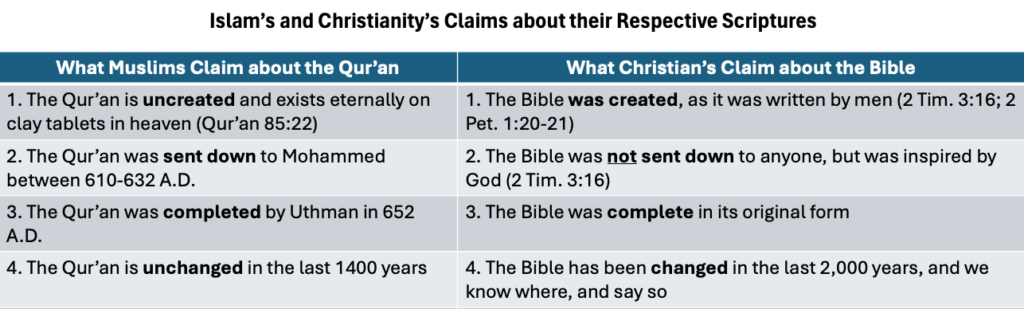
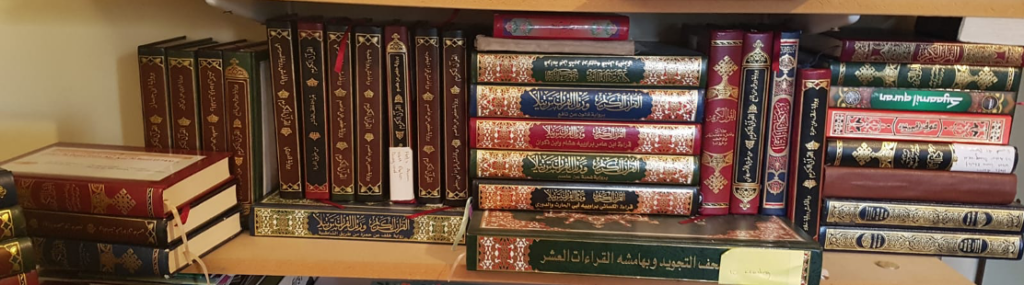
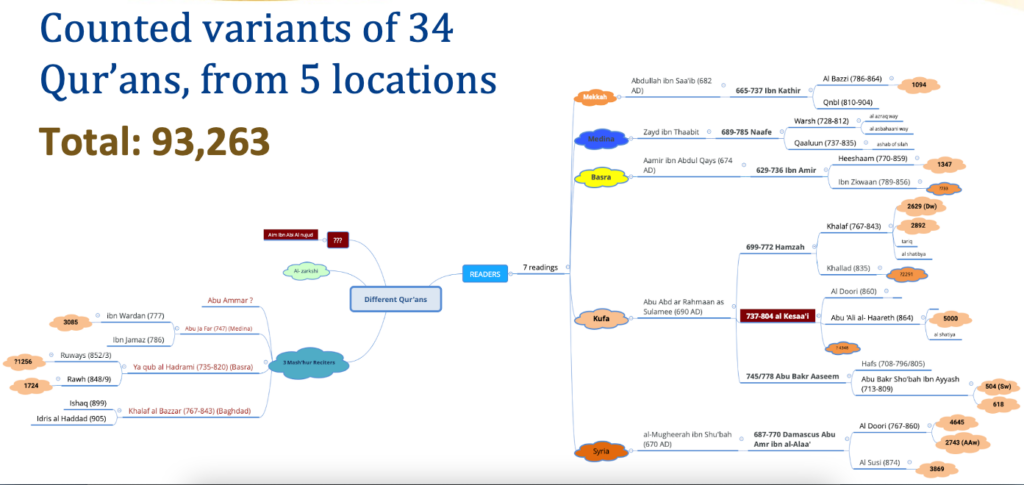
 1. It must be eternal (Qur’an 85:21-22; cf. 10:15; 18:27). The Qur’an was uncreated and existed eternally written on clay tablets in heaven. Hence, no human being can touch it or alter it. Why? Because Allah will guard it (Qur’an 15:9). Yet we have seen in our survey of the Qur’an, that it has been handled and altered numerous times so that even today there are at least 34 different Qur’ans in the world (see photo below).  
2. It must be sent down (Qur’an 39:41). The Qur’an was sent down from Allah through the angel Gabriel to Mohammed from 610 – 632 A.D. Yet, Mohammed did not write these revelations down. He had 23 years to write down the Qur’an, but he never did. The Qur’an was not written down until Mohammed’s secretary, Zayd ibn Thabit, [102] finally wrote it down (632-634 A.D.), and gave it to Hafsah, the daughter of Umar (the second Caliph), who stored the Qur’an under her bed for twenty years. [103] If this truly was the final revelation from God that was supposed to have corrected that which had been corrupted, then why would they put it under a bed for twenty years?  

3. It must be complete. The Qur’an was completed by 632 A.D. when Mohammed received the last revelation from Allah. But it wasn’t written down until after Mohammed died. After Caliph Uthman heard that there were several different versions of the Qur’an being used by Muslim communities, he had the copy of the Qur’an given to Hafsah revised by Zayd, along with Az-Zubair, Al-As, and bin Hisham, into an official revised version of the Qur’an in the “Quraishi” dialect (in 652 A.D.). [104] Islam does not have one Qur’anic manuscript from the 7th century when the Qur’an was supposedly written down. 

4. It must be unchanged (Qur’an 10:15; 15:9; 18:27). Islam claims that the Qur’an is unchanged in the last 1,400 years. But we have learned that the six earliest extant manuscripts of the Qur’an are from the 8th century, and not one of them agrees with the other. [105] Dr. Daniel Brubaker has found thousands of corrections (corruptions) in these six early manuscripts and others soon after them, [106] which undermines Islam’s claim that the Qur’an has been unchanged or uncorrupted the last 1,400 years. One of the team members of Dr. Jay Smith has found 34 different Qur’ans with a total of 93,263 variants/corruptions (see photo below).  [107]
Christians would not say these 4 same things about our Bible which is the Written Word of God. But we need to remember that the Bible is not our only Word of God. We also have the Living Word of God or Logos, Who is Jesus Christ (John 1:1-18).
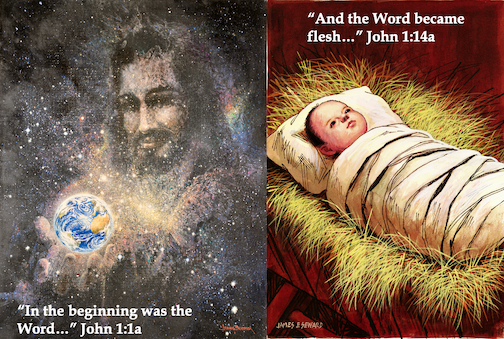
Let’s apply Islam’s four criteria to Jesus:

1. Is Jesus Christ eternal? Yes. The Bible says, “We are in Him who is true, in His Son Jesus Christ. This is the true God and eternal life.” (I John 5:20). Jesus has no beginning and no end because of His eternality. Jesus said, “I am the Alpha and the Omega… who is and who was and who is to come, the Almighty.’” (Rev. 1:8).  

2. Was Jesus Christ sent down? Certainly. Jesus said, “For I have come down from heaven, not to do My own will, but the will of Him who sent Me.” (John 6:38). 

3. Is Jesus Christ complete? Yes, He is complete in His Person, being fully God (John 1:1; Tit. 2:13; I John 5:20) and fully Man (John 1:14), and in His Work (John 19:30). 

4. Is Jesus Christ unchanged? Absolutely. The Bible says, “Jesus Christ is the same yesterday, today, and forever.” (Heb. 13:8).  

Everything that the Muslims need and seek can be found in the Person of Jesus Christ. Hence, the four criteria that Muslims are searching for in their Qur’an, their “Primary Revelation,” Christians already have in Jesus Christ, our “Primary Revelation” (Heb. 1:2). Therefore, we must present Jesus Christ, a much better and greater Revelation, to our Muslim friends. 

God has not given human governments to do this. He has not given secular humanists to do this. Nor has God given atheists and other religious people to do this. The Lord has entrusted His church consisting of believers in Jesus Christ to bring the Living Word to our lost Muslim friends (Mark 16:15; Acts 1:8), so “whoever believes in Him should not perish [in hell] but have everlasting life [both now and forever]” (John 3:16). 

In my next article, Lord willing, we will look at why Muslims and Christians believe their Scriptures are true.

ENDNOTES:

[1] Dr. Jay Smith’s September 15, 2023, video entitled, “Investigating Islam with Dr. Jay Smith (2 Corinthians 10:5),” at www.youtube.com or at this LINK . 

[2] Jay Smith, “The Bible and The Qur’an – An Historical Comparison,” at www.pfandercenter.org.

[3] Ibid., cites Patricia Crone and Michael Cook, Hagarism (Cambridge: Cambridge University Press, 1977), pg. 23. 

[4] Daniel Janosik, THE GUIDE TO ANSWERING ISLAM: What Every Christian Needs to Know About Islam and the Rise of Radical Islam(Cambridge, OH: Christian Publishing House, 2019 Kindle Edition), pg. 56 cites Dan Gibson, Qur’anic Geography: A Survey and Evaluation of the Geographical References in the Qur’an with Suggested Solutions for Various Problems and Issues (Canada: Independent Scholars Press, 2011), pg. 379. 

[5] Ibid., cites Gibson, Qur’anic Geography (2011), pg. 223. 

[6] Ibid., pp. 56-57 cites “Destruction of early Islamic heritage sites in Saudi Arabia,” https://en.wikipedia.org/wiki/Destruction_of_early_Islamic_heritage_sites_in_Saudi_Arabia.

[7] Ibid., pg. 57.

[8] Smith, “The Bible and The Qur’an – An Historical Comparison,” at www.pfandercenter.org cites Crone and Cook, Hagarism (1977), pg. 24. 

[9] Ibid. 

[10] Smith, “Investigating Islam with Dr. Jay Smith (2 Corinthians 10:5),” at www.youtube.com

[11] Smith, “The Bible and The Qur’an – An Historical Comparison,” at www.pfandercenter.org.

[12] Ibid. 

[13] Much of this section is adapted from Ibid., unless otherwise noted. 

[14] William J. Federer, What Every American Needs to Know about the Qur’an – A History of Islam & the United States (William J. Federer, 2007; 2016 Kindle Edition), pg. 96. 

[15] Smith, “The Bible and The Qur’an – An Historical Comparison,” at www.pfandercenter.org, cites Yahuda Nevo, “Towards a Prehistory of Islam,” Jerusalem Studies in Arabic and Islam, vol.17 (Hebrew University of Jerusalem, 1994), pg. 113. 

[16] Ibid., cites Cyril Glasse , The Concise Encyclopedia of Islam (San Francisco, CA: HarperSanFrancisco, 1991), pg. 102.

[17] Ibid., cites Glasse, The Concise Encyclopedia of Islam (1991), pg. 102.

[18] Ibid., cites Van Bercham 1927:217. 

[19] Ibid., cites ‘Kitab al-‘uyun wa’l-hada’iq,’ edited by M. de Goeje and P. de Jong 1869:4

[20] Verse taken from Usama K. Dakdok,  THE GENEROUS QUR’AN: An Accurate, Modern English Translation of the Qur’an, Islam’s Holiest Book (Venice, FL: Usama Dakdok Publishing, LLC, 2009 Smashwords Edition), pg. 443. Used by permission of Usama Dakdok Publishing, LLC.

[21] “Joseph,” at www.thebiblicaltimeline.org.

[22] Andrew Vargo, “’Dirham’ In The Time Of Joseph?” at www.answering-islam.org.

[23] Excerpt from Dakdok, THE GENEROUS QUR’AN, 2009 Smashwords Edition, pg. 499. 

[24] Verse taken from Dakdok, THE GENEROUS QUR’AN, 2009 Smashwords Edition, pg. 443. Used by permission of Usama Dakdok Publishing, LLC.

[25] Tom Constable, Dr. Constable’s Notes on Genesis, 2025 Edition, pg. 2. 

[26] Jochen Katz, “The ‘Samaritan’ Error In The Qur’an,” at www.answering-islam.org.

[27] Excerpt from Dakdok, THE GENEROUS QUR’AN, 2009 Smashwords Edition, pg. 443. 

[28] Verses taken from Dakdok, THE GENEROUS QUR’AN, 2009 Smashwords Edition, pp. 590, 596. Used by permission of Usama Dakdok Publishing, LLC.

[29] Tom Constable, Dr. Constable’s Notes on 1 Samuel, 2026 Edition, pp. 2-4. 

[30] “Chain Mail” article at www.en.wikipedia.org

[31] Verses taken from Dakdok, THE GENEROUS QUR’AN, 2009 Smashwords Edition, pp. 441-442. Used by permission of Usama Dakdok Publishing, LLC.

[32] Verse taken from Ibid., pg. 341. Used by permission of Usama Dakdok Publishing, LLC.

[33] L. Cilliers and F. P. Retief, “The History and Pathology of Crucifixion,” South African Medical Journal (Suid-Afrikannse tydskrif via geneeskunde) 93, no. 12 (December 2003), pp. 938–941. 

[34] Verse taken from Dakdok, THE GENEROUS QUR’AN, 2009 Smashwords Edition, pg. 422. Used by permission of Usama Dakdok Publishing, LLC.

[35] Usama K. Dakdok, Exposing the Truth about the Qur’an: The Revelation of Error, Volume 2 (Usama Dakdok Publishing LLC, 2013 Smashwords Edition), pp. 497-498. 

[36] Article entitled, “Alexander the Great in Islamic tradition,” at www.en.wikipedia.org cites Sidney Griffith, “The Narratives of ‘the Companions of the Cave,’ Moses and His Servant, and Dhū ’l-Qarnayn in Sūrat al-Kahf,” Journal of the International Qur’anic Studies Association ,Vol. 6, No. 1 (2021): 146–147; Christine Chism, “Facing The Land Of Darkness: Alexander, Islam, And The Quest For The Secrets Of God,” Alexander the Great in the Middle Ages (University of Toronto Press, 2016), pp. 51–75; Majid Daneshgar (2020), Studying the Qur’ān in the Muslim Academy, AAR reflection and theory in the study of religion (New York (N.Y.): Oxford University Press, 2020), pg. 77.

[37] Verse taken from Dakdok, THE GENEROUS QUR’AN, 2009 Smashwords Edition, pg. 423. Used by permission of Usama Dakdok Publishing, LLC.

[38] Dakdok, Exposing the Truth about the Qur’an: The Revelation of Error, Volume 2, 2013 Smashwords Edition, pp. 503-505 cites Ibn Kathir, Stories of the Prophets, vol. 2, Abo Al Fida Ishamail Ibn Kathir Al Kurashi Al Damashce (Beirut: Dar Al-Arab Heritage, 1408 AH, 1988), pp. 129-133. 

[39] Ibid., pg. 516. 

[40] Ibid., pp. 516-517. 

[41] Much of this section is adapted from Smith’s September 15, 2023, video entitled, “Investigating Islam with Dr. Jay Smith (2 Corinthians 10:5),” at www.youtube.com, unless otherwise noted.

[42] Janosik, THE GUIDE TO ANSWERING ISLAM, 2019 Kindle Edition, pg. 26 cites Karl-Heinz Ohlig and Gerd R. Puin, eds. The Hidden Origins of Islam: New Research into its Early History (NY: Prometheus Books, 2010), pp. 63-63; Robert Spencer, Did Muhammad Exist? An Inquiry into Islam’s Obscure Origins (Wilmington, Delaware: ISI Books, 2012), pp. 45-46, 55-56.

[43] Ibid., pg. 26 cites Yehuda Nevo, and Judith Koren, Crossroads to Islam: The Origins of the Arab Religion and the Arab State (NY: Prometheus Books, 2003), pp. 258-267.

[44] Smith (2023), “Investigating Islam with Dr. Jay Smith (2 Corinthians 10:5),” at www.youtube.com

[45] Ibid., cites Ilkka Juhani Lendstedt, “Who is in, who is out? Early Muslim Identity Through Epigraphy and Theory,” 2019; cf. Ilkka Juhani Lenstedt, Arabic Rock Inscriptions Up To 750 CE in A Marsham (ed.), The Umayyad World., 20, Routledge, Abingdon (University of Helsinki, 2020), pp. 411-437. 

[46] Much of this section is adapted from Smith, “The Bible and The Qur’an – An Historical Comparison,” at www.pfandercenter.org, unless otherwise noted.

[47] Ibid., cites Michael Cook, Muhammad (Oxford University Press, 1983), pg. 74.

[48] Ibid., cites Cook, Muhammad (1983), pg. 74;  Patricia Crone and Michael Cook, Hagarism (Cambridge: Cambridge University Press, 1977), pp. 167-168; see M. Van Berchem, Materiaux pour un Corpus Inscriptionum Arabicarum, part two, vol. ii (Cairo, 1927), pp. 215-217 and Adolph Grohmann, Arabic Papyri from Hirbet el-Mird (1963),  no. 72 to delineate where these variances are.

[49] Ibid., cites Crone and Cook, Hagarism (1977), pp. 18, 167.

[50] Ibid.

[51] Tom Constable, Dr. Constable’s Notes on Genesis, 2026 Edition, pp. 192-194 cites Eugene H. Merrill, “Fixed Dates in Patriarchal Chronology,” Bibliotheca Sacra 137:547 (July- September 1980), pg. 248; Leon J. Wood, A Survey of Israel’s History (Grand Rapids: Zondervan Publishing House, 1970), pp. 30-38. 

[52] Joseph M. Holden and Norman Geisler, The Popular Handbook of Archaeology and the Bible: Discoveries That Confirm the Reliability of Scripture (Eugene, OR: Harvest House Publishers, 2013 Kindle Locations 2095-2096 cites , K.A. Kitchen, “The Patriarchal Age: Myth or History?” Biblical Archaeology Review, March/April 1995, pg. 48ff. 

[53] Josh McDowell and Sean McDowell, Evidence That Demands a Verdict: Life-Changing Truth for a Skeptical World (Nashville, TN: Thomas Nelson, 2017 Kindle Edition), pg. 451 cites K. A. Kitchen, On the Reliability of the Old Testament (Grand Rapids, MI: W. B. Eerdmans, 2003), pp. 341-342; cf. John D. Currid, “Genesis,” The ESV Archaeology Study Bible, Edited by John D. Currid and David W. Chapman (Wheaton: Crossway, 2017), pg. 13. 

[54] Constable, Dr. Constable’s Notes on Genesis, 2026 Edition, pg. 200 cites Kyle M. Yates, “Genesis,” The Wycliffe Bible Commentary, Edited by Charles F. Pfeiffer and Everett F. Harrison (Chicago: Moody Press, 1962), pg. 16.  

[55] Constable, Dr. Constable’s Notes on Genesis, 2026 Edition, pg. 202; Allen P. Ross, “Genesis,” The Bible Knowledge Commentary Law, 2018 Kindle Edition, pg. 75.

[56] Allen P. Ross, “Genesis,” The Bible Knowledge Commentary Law, 2018 Kindle Edition, pg. 75.

[57] Retrieved on April 26, 2026, from Bryan Windle, July 16, 2021, article entitled, “Top Ten Discoveries Related to Abraham,” at https://biblearchaeologyreport.com/2021/07/16/top-ten-discoveries-related-to-abraham/

[58] Retrieved on April 26, 2026, from Todd Bolen, “Haran,” at https://www.bibleplaces.com/haran/; cf. McDowell Evidence That Demands a Verdict, 2017 Kindle Edition, pg. 453 cites Daniel E. Fleming, “Genesis in History and Tradition: The Syrian Background of Israel’s Ancestors, Reprise,”in The Future of Biblical Archaeology: Reassessing Methodologies and Assumptions, edited by James K. Hoffmeier and Alan Millard (Grand Rapids, MI: Eerdmans, 2004), pg. 216.

[59] Constable, Dr. Constable’s Notes on Genesis, 2026 Edition, pg. 204 cites Tremper Longman. III, “Genesis,” The Baker Illustrated Bible Background Commentary, edited by J. Scott Duvall and J. Daniel Hays (Grand Rapids: Baker Books, 2020), pg. 93.

[60] Constable, Dr. Constable’s Notes on Genesis, 2026 Edition, pg. 215. 

[61] McDowell, Evidence That Demands a Verdict, 2017 Kindle Edition, pg. 454 cites Eugene H. Merrill, Kingdom of Priests: A History of Old Testament Israel (Grand Rapids, MI: Baker Academic, 1998), pg. 63.

[62] Retrieved on April 27, 2026, from “Shechem: Its Archaeological and Contextual Significance,” at www.biblearchaeology.org. or at this LINK.

[63] More recent archaeological research places Bethel at el-Bira, about 10.3 miles north of Jerusalem and Ai at Khirbet el-Maqatir about 1 mile southeast of el-Bira – see Bryan Windle, April 12, 2019, “Biblical Sites: The Lost City of Ai… Found,” at www.biblearchaeologyreport.com cites Bryant G. Wood, “The Search for Joshua’s Ai,” in Critical Issues in Early Israelite History, edited by Richard S. Hess, Gerald A. Klingbeil, and Paul J. Ray Jr. (Winona Lake: Eisenbrauns 2008), pp. 210-240;  Bryant G. Wood, “Excavations at Khirbet el-Maqatir: 1995 to 2000 and 2009 to 2011,” Associates for Biblical Research, April 4, 2012; Scott Stripling, “2014 Excavations at Kh. el-Maqatir: A Proposed New Location for Ai and Ephraim,” Associates for Biblical Research, March 9, 2015; cf. McDowell Evidence That Demands a Verdict, 2017 Kindle Edition, pp. 500 -501.

[64] Windle, July 16, 2021, article entitled, “Top Ten Discoveries Related to Abraham,” at www.biblearchaeologyreport.com  cites Kenneth A. Kitchen,” Shishak’s Military Campaign in Israel Confirmed,” at www.library.biblicalarchaeology.orgMcDowell, Evidence That Demands a Verdict, 2017 Kindle Edition, pg. 452 cites Kitchen, On the Reliability of the Old Testament (2003), pg. 313.

[65] Ibid.

[66] Excerpt from Dakdok, THE GENEROUS QUR’AN, 2009 Smashwords Edition, pp. 57-58; Excerpt from Usama K. Dakdok, Exposing the Truth about the Qur’an: The Revelation of Error, Volume 1 (Usama Dakdok Publishing LLC, 2013 Smashwords Edition), pp. 194-314.

[67] Smith, “The Bible and The Qur’an – An Historical Comparison,” at www.pfandercenter.org.

[68] Location of Tall el-Hammam. (a) Photo of the southern Levant, looking north, showing the Dead Sea, the site location (TeH), and nearby countries. The Dead Sea Rift, the fault line marking a major tectonic plate boundary, runs through the area. Source of base (b) Photo: NASA, Space Shuttle. “The Sinai Peninsula and the Dead Sea Rift”. Photo: sts109-708-024, taken 12/16/2009. From the NASA Langley Research Center Atmospheric Science Data Center (nasa.gov/topics/earth/features/astronauts_eyes/sts109-708-024.html). Adapted from Daniel Janosik March 16, 2026, class lecture entitled, “Is the Bible the Word of God?” 

[69] Holden and Geisler, The Popular Handbook of Archaeology and the Bible, 2013 Kindle Locations 2509-2514 cite Steve Collins, “Where is Sodom? The Case for Tall el-Hammam,” Biblical Archaeology Review, March/April 2013; Malcolm A. LeCompte, Steven Collins, Phillip J. Silvia, Gunther Kletetschka, Timothy Witwer, Robert E. Hermes, Christopher R. Moore, Wendy S. Wolbach, George A. Howard, A. Victor Adedeji, Charles Mooney, James P. Kennett, Allen West, Ted E. Bunch, May 24, 2025, research article entitled, “A Tunguska Sized Airburst Destroyed Tall el-Hammam a Middle Bronze Age City in the Jordan Valley Near the Dead Sea (Expanded),” at www.scienceopen.com or at this LINK.

[70] LeCompte, Collins, Silvia, Kletetschka, Witwer, Hermes, Moore, Wolbach, Howard, Adedeji, Mooney, Kennett, West, Bunch, May 24, 2025, research article entitled, “A Tunguska Sized Airburst Destroyed Tall el-Hammam a Middle Bronze Age City in the Jordan Valley Near the Dead Sea (Expanded),” at www.scienceopen.com.

[71] Ibid.

[72] Ibid., cites Mark Boslough, Airburst Modeling in First International Workshop on Potentially Hazardous Asteroids Characterization, Atmospheric Entry and Risk Assessment. (Sandia National Lab. (SNL-NM), Albuquerque, NM, 2015, (United States)).

[73] LeCompte, Collins, Silvia, Kletetschka, Witwer, Hermes, Moore, Wolbach, Howard, Adedeji, Mooney, Kennett, West, Bunch, May 24, 2025, research article entitled, “A Tunguska Sized Airburst Destroyed Tall el-Hammam a Middle Bronze Age City in the Jordan Valley Near the Dead Sea (Expanded),” at www.scienceopen.com.

[74] Holden and Geisler, The Popular Handbook of Archaeology and the Bible, 2013 Kindle Locations 2509-2514 cite Steve Collins, “Where is Sodom? The Case for Tall el-Hammam,” Biblical Archaeology Review, March/April 2013.

[75] McDowell, Evidence That Demands a Verdict, 2017 Kindle Edition, pg. 497 cites Bryant Wood, “Did the Israelites Conquer Jericho? A New Look at the Archaeological Evidence,” Biblical Archaeology Review 16, no.2 (Mar/Apr 1990), pp. 10-12.

[76] Bryant G. Wood, June 9, 2008, research article, “The Walls of Jericho,” at www.biblearchaeology.org or at this LINK ; Bryant Wood, March 1, 1999, “The Walls of Jericho,” at www.answersingenesis.org cites Ernst Sellin and Carl Watzinger, Jericho die Ergebnisse der Ausgrabungen, Osnabrück, Otto Zeller Verlag (1973), pg. 58, (reprint of the 1913 edition), and Kathleen M. Kenyon, Excavations at Jericho (London, British School of Archaeology in Jerusalem, 1981), Vol. 3, pp. 110, 370. 

[77] McDowell, Evidence That Demands a Verdict, 2017 Kindle Edition, pg. 516. 

[78] Ibid., cites André Lemaire, “‘House of David’ Restored in Moabite Inscription,” Biblical Archaeology Review 20, no. 3 (1994), pg. 36; Holden and Geisler, The Popular Handbook of Archaeology and the Bible, 2013 Kindle Locations 3031-3045.

[79] Holden and Geisler, The Popular Handbook of Archaeology and the Bible, 2013 Kindle Locations 3006-3012.

[80] McDowell, Evidence That Demands a Verdict, 2017 Kindle Edition, pg. 516 cites George Athas, The Tel Dan Inscription: A Reappraisal and a New Interpretation (London: T&T Clark, 2003), pg. 281 and Steven L. McKenzie, King David: A Biography (Oxford University Press, 2000, E-book), pg. 13; Holden and Geisler, The Popular Handbook of Archaeology and the Bible, 2013 Kindle Locations 3012-3017 cites Alan Millard, “The Tell Dan Stele,” in William W. Hallo and K. Lawson Younger, eds., The Context of Scripture: Canonical Compositions from the Biblical World, Vol. 1 (Leiden, the Netherlands Brill, 2003), pp. 161-162. Also see Holden and Geisler’s helpful discussion responding to critics of Tell Dan Find at 2013 Kindle Locations 3017-3031.  

[81] Gary Habermas, The Historical Jesus (Joplin, MO: College Press, 1996, 2008), pp. 198-224.

[82] Walter Bauer, A Greek-English Lexicon of the New Testament and Other Early Christian Literature, 2000 Kindle Edition, pg. 893. 

[83] Bryan Windle, December 19, 2019, “Quirinius: An Archaeological Biography,” at www.biblearchaeologyreport.com cites Andrew E. Steinmann, From Abraham To Paul: A Biblical Chronology (St. Louis: Concordia Publishing House, 2011), pg. 239; cf. Bauer, A Greek-English Lexicon of the New Testament and Other Early Christian Literature, 2000 Kindle Edition, pg. 433.

[84] Holden and Geisler, The Popular Handbook of Archaeology and the Bible, 2013 Kindle Locations 1739-1741.

[85] William A. Ramsay, Was Christ Born at Bethlehem? A Study on the Credibility of St. Luke (Originally published Paternoster Row, London: Hodder and Stoughton, 1898; Seattle, WA: re:Source Digital Publishing, 2018 Kindle Edition), pg. 160.

[86] Holden and Geisler, The Popular Handbook of Archaeology and the Bible, 2013 Kindle Locations 1741-1743; cf. Ramsay, Was Christ Born at Bethlehem?, 2018 Kindle Edition, pg. 161; Jack Finegan, Handbook of Biblical Chronology: Principles of Time Reckoning in the Ancient World and Problems of Chronology in the Bible, Revised Edition (Peabody, MA: Hendrickson Publishers, 1998), pg. 304.

[87] William Mitchell Ramsay, The Bearing of Recent Discovery on the Trustworthiness of the New Testament (Originally published in London: Hodder & Stoughton, 1915; 2021 Kindle Edition), pp. 283-290.

[88] Tom Constable, Dr. Constable’s Notes on Luke, 2026 Edition, pg. 58 cites Harold W. Hoehner, Chronological Aspects of the Life of Christ, Contemporary Evangelical Perspectives series (Grand Rapids: Zondervan Publishing House, 1977), pg. 22;  cf. Flavius Josephus, Antiquities of the Jews, 18:1:1; 18:2:1; Eusebius, The Ecclesiastical History of Eusebius Pamphilus Twin Brooks series. Popular ed. (Grand Rapids: Baker Book House, 1974), 1:5:28; Jack Finegan, Light from the Ancient PastThe Archeological Background of Judaism and Christianity 2nd edition (Princeton University Press. London: Oxford University Press, 1959), pp. 258-261; Joseph P. Free, Archaeology and Bible History 6th ed. (Wheaton: Scripture Press, 1950, 1959), pp. 285-286.

[89] J. Warner Wallace, August 16, 2017, “Unbelievable? Is Luke’s Description Of Quirinius Historically Inaccurate?” at www.coldcasechristianity.com

[90] McDowell, Evidence That Demands a Verdict, 2017 Kindle Edition, pg. 88 cites Free, Archaeology and Bible History 6th ed. (1950, 1959), pg. 320.

[91] Ibid. cites F. F. Bruce, “Archaeological Confirmation of the New Testament,” in Revelation and the Bible, edited Carl Henry (Grand Rapids, MI: Baker Book House, 1969), pp. 325, 360 and David E. Graves, Biblical Archaeology: An Introduction with Recent Discoveries That Support the Reliability of the Bible (Moncton, New Brunswick, Canada: Electronic Christian Media, 2014), pp. 215-216.

[92] Ibid. cites Howard F. Vos ed. Can I Trust the Bible? (Chicago, IL: Moody Press, 1963), 180 and Graves, Biblical Archaeology (2104), pp. 215-216.

[93] Ramsay, The Bearing of Recent Discovery on the Trustworthiness of the New Testament (1915), 2021 Kindle Edition, pp. 37-40; Holden and Geisler, The Popular Handbook of Archaeology and the Bible, 2013 Kindle Locations 4026-4037.

[94] Ibid., pp. 67-76; cf. McDowell, Evidence That Demands a Verdict, 2017 Kindle Edition, pg. 88 cites Free, Archaeology and Bible History 6th ed. (1950, 1959), pg. 317.

[95] Norman L. Geisler and Thomas Howe, The Big Book of Bible Difficulties: Clear and Concise Answers from Genesis to Revelation (Grand Rapids, MI: Baker Books, 2008), pg. 47.

[96] Janosik, THE GUIDE TO ANSWERING ISLAM, 2019 Kindle Edition, pg. 56 cites Peter Townsend, The Mecca Mystery: Probing the Black Hole at the Heart of Muslim History (Peter Townsend, 2018), pg. 104 and Dan Gibson, Qur’anic Geography: A Survey and Evaluation of the Geographical References in the Qur’an with Suggested Solutions for Various Problems and Issues (Canada: Independent Scholars Press, 2011), pg. 137.

[97] Ramsay, The Bearing of Recent Discovery on the Trustworthiness of the New Testament (1915), 2021 Kindle Edition, pg. 220. 

[98] Ibid., pg. 79.

[99] Janosik, March 16, 2026, class lecture entitled, “Is the Bible the Word of God?”

[100] Smith, “The Bible and The Qur’an – An Historical Comparison,” at www.pfandercenter.org.

[101] Much of this section is adapted from Smith (2023) video entitled, “Investigating Islam with Dr. Jay Smith (2 Corinthians 10:5),” at www.youtube.com, unless otherwise noted.

[102] Norman L. Geisler and Abdul Saleeb, Answering Islam: The Crescent in Light of the Cross Second Ed. (Grand Rapids, MI: Baker Books, 1993, 2002), pp. 92-93 cites Al-Bukhari, The Translation of the Meanings of Sahih Al-Bukhari, Vol. 6, pp. 477-478.

[103] Janosik, THE GUIDE TO ANSWERING ISLAM, 2019 Kindle Edition, pg. 321; cf. Jay Smith, November 24, 2019, video entitled, “Jay Smith Historical Critique Quran Origins 1,” at www.youtube.com

[104] Geisler and Saleeb, Answering Islam (2002), pg. 93 cites Al-Bukhari, The Translation of the Meanings of Sahih Al-Bukhari, Vol. 6, pp. 478-479. 

[105] Smith, March 9, 2026, class lecture entitled, “Manuscript Evidence for the Qur’an,” cites Dr. Tayyar Altıkulaç, Al-Muṣḥaf Al-Sharif: Attributed To ʿUthmān Bin ʿAffān (IRICA, 2007), pp. 23, 36 – footnote 14a, 41f, 65, 71-72, 81; François Déroche, La transmission écrite du Coran dans les débuts de l’islam. Le codex Parisino-petropolitanus (Brill, 2009), pp. 172-177; cf. Jay Smith, “The Bible and The Qur’an – An Historical Comparison,” at www.pfandercenter.org where he cites Martin Lings and Yasin Hamid Safadi, The Qur’an: Catalogue of an Exhibition of Quran Manuscripts at the British Library3 April  – 15 August, 1976 (British Library, World of Islam Pub. Co., 1976), pp. 11-20.

[106] Daniel Brubaker, Corrections in Early Qurʾān Manuscripts: Twenty Examples (FULL COLOR EDITION) (Quran Manuscript Change Studies Book 1), 2019 Kindle Locations 168-169.

 [107] Retrieved on May 11, 2026 from the March 23, 2026, powerpoint entitled, “In Search of the Book – the Qur’an,” at  www.pfandercenter.org.

John 4 – Part 1: “From an Empty Life to Eternal Life”

“Jesus answered and said to her, ‘If you knew the gift of God, and who it is who says to you, ‘Give Me a drink,’ you would have asked Him, and He would have given you living water.’” John 4:10

In the fall of 2019, I began to realize that I had some life-controlling problems that I could not overcome on my own.  So, I began a process of recovery to overcome trauma-based addictions that were destroying my life and my relationships with those closest to me.    

Much of my battle with these addictions involves shame. Many people confuse shame with guilt. Guilt is the conviction we experience when we have violated God’s standard of holiness. In short, guilt says, “I have done wrong.” For example, when a person covets, hates, lies, lusts, murders, steals, or commits adultery, he or she has a sense of guilt for having done wrong (cf. Ps. 32:1-5; Rom. 3:1-20; James 2:10). The Bible teaches us that sin and its subsequent guilt can lead an unsaved person to believe or trust in Christ alone as his or her Savior, resulting in cleansing and forgiveness (cf. John 16:8-11; Acts 10:43; Rom. 3:20; Gal. 3:22-24). God uses our guilt to convict us of our need for Him.

The Hebrew word for “ashamed” (cf. Gen. 2:25) is bosh, which means to fall into disgrace, to be embarrassed or humiliated. [1] The Greek word for “shame” (Heb. 12:2) is aischynēs which also refers to disgrace. [2] According to some theologians and psychologists, shame is a feeling (or belief) that we are bad, defective, flawed, and worthless.

Guilt says, “I have done wrong,” but shame says, “I am wrong.” [3] Instead of focusing on what a person has done (guilt), shame focuses on who the person is. It says that at the core of our being we are bad, flawed, inferior, unacceptable, and unworthy. One author says, “Shame is a strong sense of being uniquely and hopelessly different and less than other human beings.” [4] Satan uses shame to condemn us and isolate us from God and one another.

Let me illustrate the difference between guilt and shame. When I say, “I feel bad about yelling at my children when they misbehave,” that is guilt. But when I say, “I am a bad father,” that is shame.

We can feel guilt and shame at the same time. But shame is more relational. We can feel shame because of our own actions and the actions of others. There are two types of shame: true shame and false shame.

True shame is that feeling of disgrace or embarrassment when we have sinned. This is what Adam and Eve experienced when they disobeyed God in the garden of Eden (Gen. 3:7-8, 10).

False shame is that same feeling of disgrace or embarrassment about our personhood, not our actions. We can experience shame when we have done nothing wrong, but because of the actions of others we are ashamed. False shame says, “because of what was done to you, you are now bad,” or “this happened to you because you are bad.” [5] For example, a child who was sexually abused may internalize what was done to him or her and conclude, “I am bad because that happened to me.” Or “because I am bad that was done to me.”       

When God created the first man and woman, Adam and Eve, and joined them together as husband and wife, the Bible tells us “they were both naked, the man and his wife, and were not ashamed.” (Gen. 2:25; cf. Mark 10:6-9). Before Adam and Eve sinned, they did not experience shame. Therefore, shame was not part of God’s original design for humankind. To be “naked” and “not ashamed” suggests something more than not wearing any clothes. These words describe Adam and Eve’s relationship with God and with one another. They were able to be completely open with the Lord and each other without holding anything back or hiding their true selves. Adam and Eve were fully known by God and each other and they were okay with this. This enabled them to experience uninhibited fellowship with God and with one another. [6] They knew that they were totally accepted and loved by God. There was nothing to fear and nothing to hide from the Lord and each other.

Prior to the Fall, they did not experience any self-consciousness regarding the uniqueness of their personhood as man and woman. For example, Adam probably did not doubt his masculinity or his ability to impress Eve as a man. He was not concerned about his biceps being big enough or being a good enough lover for Eve. Nor did Eve wonder if her beauty was enough to attract Adam or if her ideas were as significant as his. With an unwavering assurance, both knew that who they were and what they offered to one another was more than just good enough – it was “very good” (Gen. 1:31). [7]

When Adam and Eve disobeyed God by eating the fruit from the tree of the knowledge of good and evil (Gen. 2:16-17; 3:1-6), they experienced shame for the first time. The complete innocence and vulnerability they once had with God and one another were now lost. “Then the eyes of both of them were opened, and they knew that they were naked; and they sewed fig leaves together and made themselves coverings” (Gen. 3:7). They were now self-conscious and ashamed of their nakedness before one another, so they tried to remove their shame by covering themselves with fig leaves. They went from holding nothing back from one another to hiding and covering their true selves.

When they put their own desires ahead of God’s will for their lives, they may have realized they could also put their own interests ahead of the other’s. Would Adam be able to trust Eve after she violated God’s trust? Would Eve be able to trust Adam after he did the same thing? Once transparent and vulnerable with each other, Adam and Eve now covered their physical nakedness and the nakedness of their souls with fig leaves. Instead of trusting each other, they were afraid of being hurt by one another, so they chose to protect themselves by hiding under the cover of fig leaves.

But their sin and shame also adversely affected their closeness with God. “And they heard the sound of the Lord God walking in the garden in the cool of the day, and Adam and his wife hid themselves from the presence of the Lord God among the trees of the garden” (Gen. 3:8). Instead of being open and vulnerable before God, they now hid themselves from His presence when He pursued them. God is presented in this verse as pursuing His fallen children by walking in the garden in the cool of the day as if this was something He had always done to connect with them.      

We might assume that God came to them to punish and shame Adam and Eve for the wrong they had done but notice that God does not seek to shame His fallen children. He seeks to restore them. “Then the Lord God called to Adam and said to him, ‘Where are you?’” (Gen. 3:9). Why would an all-knowing God ask Adam a question to which He already knows the answer? Because the Lord wanted a confession from Adam. “Where are you in relation to Me?” God asks. God knew where Adam was, but did Adam know where he was in relation to the Lord? Do we know where we are in relation to God?

When Adam told God, “I was afraid because I was naked” (Gen. 3:10), God replied, “Who told you that you were naked? Have you eaten from the tree of which I commanded you that you should not eat” (Gen. 3:11)? God never told Adam and Eve they were naked. This was the natural consequence of their sin. Satan also reveals our shame to us when we sin (true shame) or don’t sin (false shame). His accusations against believers produce shame in their lives. The Devil uses shame to isolate Christians from God and one another. Like a roaring lion who focuses on those who are isolated and weak, Satan focuses on believers who are alone and weak (cf. 1 Peter 5:8).

Would Adam and Eve believe God is still the same loving and merciful God that He had always been prior to their disobedience? Or would they believe the lie of the serpent who implied that God could not really be trusted (cf. Gen. 3:1-5)? The Lord did not abandon Adam and Eve when they sinned and felt ashamed. He sought them out to restore them to fellowship with Himself.

But instead of trusting the Lord, Adam and Eve were now afraid of Him. “So he said, ‘I heard Your voice in the garden, and I was afraid because I was naked; and I hid myself’” (Gen. 3:10). Their sin and shame now became a barrier to His loving and merciful pursuit of them. Not only were they self-conscious of their nakedness before one another, they were now self-conscious of their nakedness before God. By covering themselves with fig leaves and hiding themselves among the trees of the garden, Adam and Eve removed themselves from being able to receive God’s love, grace, and mercy which He was freely offering to them. Their faith in God had now changed to fear. Unfortunately, their shame pushed them away from the Lord instead of drawing them near to Him. And shame can do the same to us today.

Like Adam and Eve, we also try to hide our shame from the Lord with modern-day fig leaves. [8] We may hide behind expensive cars, motorcycles, or homes. Some of us may take refuge behind our vast theological knowledge, ministries, or positions of leadership. We may hide behind our busyness, hobbies, humor, sarcasm, sports, or superficial interactions. Others may try to cover their shame with religious efforts and rituals like Nicodemus did (John 3:1-21). Whatever fig leaves we choose to hide behind, we are going against God’s design for us by refusing to present our true selves to Him and to one another. This never leads to the abundant life God meant for us to experience. What fig leaves are you hiding behind?

In the first part of John 4, the Lord Jesus will encounter a hurting woman at a well of water who tried to cover her shame with the fig leaf of romantic relationships. We may see God as this woman may have seen Him – as a distant and impersonable Being Who does not care about us. So, we try to medicate our loneliness and pain with romantic or sexual relationships which only intensifies our shame. These relationships may be with real or imaginary people. By imaginary I am referring to online pornography which is destroying lives today.

A man is chained to computer late at night.

Pornography is one of the most destructive practices in the church today and most churches do not know how to address it in a way that offers hope and healing for those enslaved to it. The majority of churches preach against the problem of pornography without providing a safe environment in which to address the real problem which is a deeper hurt in the hearts of those hooked on porn. Pornography is simply a surface coping mechanism for a deeper wound. Statistics indicate that 60-70 percent of men, 50-58 percent of pastors, and 20-30 percent of women in evangelical churches are sexually addicted. [9]

 “Pornography is the number one addiction for men. One out of two internet hits have to do with sex and pornography. Pornography can ruin normal sexual relationships because no real person can live up to pornographic images and fantasies. Research has shown that the limbic system bonds with whatever you are visualizing at the time of orgasm, so the next time you have sexual cravings they will be focused on that image or fantasy. This is why pornography is so addicting. Pornography is not really about sex; it is about zoning out, getting high on your own neurochemicals. Sex addicts report having withdrawal symptoms similar to cocaine withdrawal.” [10]       

Pornography is not just an adult addiction. Young people are also struggling with watching pornography online as young as four years of age and older because it is so accessible, addictive, aggressive, anonymous, and appealing. If you don’t think it’s possible for your children to get hooked on porn, you need to listen to Christian apologist and author Josh McDowell’s videos. [11]

In his book, “The Freedom Fight: The New Drug and the Truths that Set Us Free,” Ted Shimer notes the following about pornography in America in a chapter entitled “Sexualized Society”: [12]

It might come as no surprise that there is virtually no difference in monthly porn use among non-Christian men (65%) versus Christian men (64%). [13] In fact, it might even be worse than the published statistics indicate. The Freedom Fight recently conducted a survey of over 750 Christian college men from over thirty different campuses across the country. Each of the men we surveyed was involved in a campus ministry, and each considered their faith to be a vital element in their lives. Many of them were leaders in their ministries. What we found was alarming – 89% of the growing Christian men we surveyed watch porn, at least occasionally. More than six in ten view it at least weekly. More than half of these practicing Christian men say they are addicted to pornography. [14]

“The Freedom Fight’s recent survey of over 550 Christian women in ministry from over thirty university campuses across the US showed that 51% are watching porn at least occasionally. These aren’t just any college women either. These women are practicing Christians, involved in campus ministry, and many of them are in leadership positions. Though their faith is important to them, pornography remains a part of their lives.” [15]

“Two out of three Christian men watch porn regularly. [16] Many of them feel bad about it, but few of them have an urgency and commitment to break free. In fact, less than one in ten of these men seek meaningful help. [17]How can so many Christians seem content to live in sin? The answer is shame and self-deception. [18]

What kind of impact does pornography have on people? Shimer notes the following: Those who watch more and more porn do not see it as harmful and place a decreased value on the institution of marriage, the desire for children, and the need for faithfulness in marriage. [19] Research shows that the more porn someone watches, the more likely they are to be bisexual. [20] Pornography encourages behavior by producing permission-giving beliefs that say, “What I am doing is normal, doesn’t hurt anyone, and everyone is doing it.” [21] Shimer states that “this … is why many porn users – including Christians – find themselves experimenting with sexual behavior that goes against their morals, values, and even their sexual preferences.” [22]       

In addition to the psychological and spiritual repercussions, pornography consumption is also wreaking havoc on society. It rewires the brain, causing teenagers and twenty-something young men to experience porn-induced erectile dysfunction (PIED). [23] It replaces a desire for sex with real women with a desire for images and fantasy so that men are having less sex with a real person. [24] Those who view porn regularly are more likely to view hookup sex in a positive light [25] and display violence towards women. [26]        

Viewing child pornography has increased drastically in the last decade, with the FBI reporting that child porn arrests increased by 2,500%! [27] This is tragic because viewing child pornography leads to the abuse of children. [28]

This deviance that can result from porn consumption has impacted the church. In 2019, a headline in the Houston Chronicle read, “More than 100 Southern Baptist Youth Pastors Convicted or Charged in Sex Crimes.” [29]

Pornography is one of the leading contributors to human sex trafficking, which is a form of modern-day slavery. In the United States, up to 300,000 Americans under the age of eighteen are lured into the commercial sex trade every year. [30] The Rescue:Freedom organization’s survey showed that forty-nine percent of women rescued from sex trafficking in nine countries said their traffickers made pornographic videos of them while they were being raped. [31]

“One underage girl was missing for almost a year before her mother learned that sixty pornographic videos of her had been posted to multiple pornography platforms, including Pornhub and Snapchat. Pornhub described the minor girl as a ‘verified model with valid ID.’” [32]

As pornography use grows so does sex trafficking. “Reported cases of human sex trafficking in the US increased 842% in the past ten years.” [33] “The average age of a trafficked victim to begin to be sold in the United States is thirteen.” [34] “The collective billions of porn clicks per year help fuel the demand of sex traffickers who make money selling videos to porn sites.” [35]

Sociologist, Mark Regnerus says he believes the reason why never-marrieds outnumbered marrieds by 2015 is because for American men, the quality of porn and masturbation is enough to satisfy them in place of the pursuit of real sex with women. And women today expect little in return for sex in terms of time, attention, commitment, or fidelity. [36]

Porn use among women makes them more likely to cheat on a romantic partner and less likely to support traditional marriage. [37]

Researchers are forecasting that a third of Americans now in their twenties will never wed. This is more than triple the historic norm. [38]

The more porn Christians view the less will be their spiritual disciplines and the more doubts they will have about their faith. They are less likely to read their Bibles, attend church, pray, and participate in Christian service. [39]

Dr. Samuel Perry, sociology professor at the University of Oklahoma, did extensive research on the effects of porn use on a person’s religious commitments. He summarized his conclusions: “Any porn use… is associated with declines in religious commitment and behavior (i.e., attending services, prayer, etc.) and an increase in religious doubts.” [40]

While many Christian leaders are understandably calling porn the greatest threat to the Church, [41] less than 7% of pastors provide solutions to help their people break free from porn. [42]Shimer believes the reasons pastors don’t address this issue is because they are either addicted to porn themselves, [43] they are unaware of the significance of the issue, [44]or because it is such an uncomfortable topic to address. [45]

If you are struggling with pornography, contact Pure Desire at www.puredesire.org, The Genesis Process at www.genesisprocess.org, The Freedom Fight at www.thefreedomfight.org, or 423 Communities at www.423communities.org to obtain hope and healing from your addiction.         

To help us become more effective in reaching hurting and ashamed people who are addicted to porn and sex (or anything other than God) , we are going to see how Jesus presents the gospel to a hurting and ashamed woman in John 4:1-26. Let’s see HOW CAN WE CAN REACH THE HURTING SEX ADDICT FOR CHRIST.

1. CROSS OVER THE BARRIER OF PREJUDICE (4:1-7a). 4:1: The word “therefore” connects the humble and selfless service of John the Baptist (3:22-36) with Jesus making and baptizing “more disciples than John.” Jesus is referred to as “the Lord” (ho Kurios) for the first time in the gospel of John to emphasize His superiority in view of what both Johns had just established (3:28-30, 31-36). [46] Christ “knew that the Pharisees” wanted to stir up division between His disciples and those of John the Baptist (cf. 3:25-26). [47] 

4:2: John informs us that “Jesus Himself did not baptize, but His disciples” did (4:2) to downplay the spiritual significance of water baptism in a book written to tell non-Christians how to get to heaven. [48] Water baptism has nothing to do with going to heaven.   

This is also why the apostle Paul downplayed water baptism when he wrote, “For Christ did not send me to baptize, but to preach the gospel, not with wisdom of words, lest the cross of Christ should be made of no effect.” (I Cor. 1:17). He distinguishes preaching the gospel from water baptism. Water baptism is not part of the gospel message because it is not  necessary for justification before God.

 4:3: Jesus “left Judea” to go “to Galilee” to avoid trouble with the Pharisees who “heard” of His growing popularity (4:1). Jesus “wanted to avoid unnecessary premature conflict with them—not for fear of them, but because they would interfere with His ministry and schedule. John never referred to the Sadducees or the Herodians by name in his gospel, because he viewed the Pharisees as the true representativesof the unbelieving nation of Israel.” [49]      

4:4: The most popular and direct route from Judea to Galilee went straight through Samaria. [50]“Even though the Jews and the Samaritans did not get along, most Galilean Jews chose to travel through Samaria rather than taking the longer route through Perea, east of the Jordan River, which Judean Jews preferred.” [51]“The trip from Galilee to Jerusalem via Samaria normally took three days.” [52]

Instead of the normal route that Judean Jews took around Samaria by crossing the Jordan River, traveling north, and then crossing the Jordan into Galilee, Jesus went straight north into “Samaria” (see map above). Such a course was direct and shorter, but Judean Jews did not go that way because they hated Samaritans. “The Jews disliked the Samaritans, considering them an unclean race. Originally, the name Samaria applied to the capital city of the northern kingdom of Israel, which was founded by King Omri (cf. 1 Kgs. 16:23-24). But eventually the entire northern kingdom was referred to by this name. When the Assyrians conquered it, they deported many Israelites, but left others in the land. Then the Assyrians settled other conquered peoples there, who intermarried with the remaining Israelites. This mixture of peoples also involved the worship of various false gods (see 2 Kgs. 17:24-41). The Samaritans of Jesus’s day were their descendants, a people of mixed ancestry and syncretistic religious practices. Thus, the Jews despised them.” [53]

But Jesus “needed to go through Samaria.” Why did Jesus have to go through Samaria when the alternate route was available? Because He had a divine appointment there with someone. Christ did not let cultural or racial divisions keep Him from addressing the spiritual needs of hurting people and nor should we. Jesus’ love for the lost led Him to cross over the barriers that people had created to seek and to save a lost woman in Samaria (Luke 19:10).

Does our love for unsaved people motivate us to cross over man-made barriers? Are we willing to despise shame as Jesus did (Heb. 12:2) whether it be our own or the shame of another, so we can help them find lasting freedom from shame? Today there seems to be more of a stigma attached to porn and sex addictions than any other addictions (e.g., alcohol and drug addiction, etc.). Are we willing to cross over the barriers established by our secular and religious cultures  to show Christ’s love to the porn and sex addict?

4:5: As Jesus and His disciples journeyed across Samaria, they came to the village of “Sychar” [54] which means “drunken or lying-town.” [55] John locates the Samaritan city of Sychar not in terms of its geographic location, but by its historic relevance [56]near the plot of ground that Jacob gave to his son Joseph.” “This parcel of land was significant in Israel’s history as a place purchased by Jacob (who was later renamed ‘Israel’) and given to his sons (Gen. 33:18-21). This was also the place where the bones of Joseph were laid to rest after Israel’s exodus from Egypt (Josh. 24:32). John’s mention of the well is no accident either. Samaria had no major rivers to supply water, only wadis (natural drainage channels), which brought seasonal rains and then dried up for months at a time. Jeremiah used the wadi as an image of deceit (Jer. 15:18). The historic location and the presence of Jacob’s well gave Jesus (and therefore John) another perfect opportunity to draw upon the familiar symbol of life: water.” [57]

4:6: John uses two Greek words to describe “Jacob’s well.” The first was pēgē in verse 6, which means “a spring or fountain,” [58] and the second is phrear in verses 11 and 12, which means “a construction consisting of a vertical shaft, covered with a stone, for water supply” [59] or “a cistern.” [60] Hence, “Jacob’s well” was both a spring and a well. “It was a deep hole that someone had dug in the ground, that was fed by a spring. The site is still a popular tourist attraction, and the deep spring still flows. Edersheim estimated (in 1886) that the well was originally about 150 feet deep.” [61]

Being weary from His journey, Jesus rested at Jacob’s well at the “sixth hour” or noon in Jewish time while the disciples went into the city for food (4:8). While fully God (1:1), Jesus was also fully man (1:14) and experienced the thirst and fatigue that all weary travelers feel so He can understand when we are parched and tired (cf. Heb. 4:15). 

“Notice that John emphasizes the full deity (‘the Word was God, 1:1) and the full humanity (He was ‘worn out,’ 4:6) of Jesus. In theological terminology, the uniting of two distinct natures (divine and human) in one Person (Jesus Christ) is known as the hypostatic union. Jesus Christ was, is, and ever will be the God-Man (see Phil. 2:6-11). It is also important to note that Jacob’s well represents common ground, since both Jews and Samaritans revered Jacob.”[62]

4:7: While Jesus was resting, a Samaritan woman came to the well to draw water. Jesus “needed to go through Samaria” (4:4) because He had a divine appointment with a hurting woman whom God would eventually use to transform an entire community. Christ was willing to cross over the barriers of prejudice to reach her.   

Who represents your Samaria? One way to find out is to ask yourself, “Who do I dislike the most? Who do I try to avoid the most?” Are we willing to do whatever it takes to reach people that no one else wants to reach? That person at work or in our neighborhood that is the subject of jokes and gossip? That person whose values and lifestyle are the opposite of our own? The person who has so many problems and needs that the only thing they can give you is a list of complaints? Ask the Lord to show you who represents your Samaria. Then surrender to His will.

Peter modeled surrender when, after a night of failed fishing, Jesus told him to try again: “Master, we have toiled all night and caught nothing; nevertheless at Your word I will let down the net.” (Luke 5:5). Surrendered people obey God’s word, even when it doesn’t make sense. Jesus “needed” to go through Samaria. You and I NEED to go through Samaria too. We need to surrender to Jesus and go to the hurting and the despised even if it doesn’t make sense to us. If we don’t tell these hurting people about Jesus, who will?

These people are not going to come to Christ on their own. Their shame has isolated them from God and other people. They are already feeling unworthy and unwanted because of their shame. They must be approached with love and grace where they feel safe. The second way to reach the hurting for Christ is to 2. CULTIVATE THE HURTING WITH LOVE (4:7b-9). How do we do this? Listen to them. In John 3, Jesus did most of the talking in His conversation with Nicodemus. He was confrontive with Nicodemus. But in John 4, Christ listened. He was compassionate. He cultivated the Samaritan woman with His love. In John 3, only three verses record what Nicodemus says. In John 4, seven verses cover what the Samaritan woman said to Jesus. God both speaks and listens. As the hurting person begins to open up, ask questions about his or her problem. Then listen. Ask more questions. Then listen some more. 

4:7b-9: Christ said to the woman, “Give Me a drink” (4:7b). His request is most effective since water is what she has come to the well for. By asking her for a drink, He goes from the problem of an empty bucket to her greater problem of an empty life.

You can do the same thing most effectively. When talking to someone who has marriage problems, you might begin by talking about marriage in general. Then mention how you and your spouse have been helped by the teachings on marriage in the Bible. Explain how you have discovered that it is the One who created marriage that knows best how to make it work. Once the person sees the need for Christ in a marriage, you can then begin at step one: the need to know Christ personally and have the assurance of eternal life. Let’s look at this woman’s empty life.

He had come to redeem this woman and He knew how to reach her. She wore the emotional armor of a woman beaten down by the morality of the righteous. He honored her closely guarded vulnerability by appealing to her kindness.” [63]

4:8: Jesus was alone at Jacob’s well because “His disciples had gone away into the city to buy food.” Their absence suggests that Jesus knew He could not be as effective ministering to this woman with the presence of the racial and gender biases of the disciples. [64]

THIS WOMAN HAD MANY PRESSING PROBLEMS:

1. SHE WAS HATED BY JEWS BECAUSE SHE WAS RACIALLY MIXED as a “Samaritan” (4:9a). When Assyria conquered the Northern Kingdom seven hundred years before Christ, many of the Jews were exported, and many foreigners were imported. The Jews who stayed and the Gentiles who came intermarried. The offspring were half-breeds called Samaritans. The Jews hated them and would have nothing to do with them.

2. AS “A WOMAN” SHE WAS SCORNED BY JEWISH MEN (4:9b). Jesus evidently asked the woman for a drink both because she was drawing water, and to initiate conversation with her.

“The normal prejudices of the day prohibited public conversation between men and women, between Jews and Samaritans, and especially between strangers. A Jewish Rabbi would rather go thirsty than violate these proprieties.” [65]

Can you imagine not being able to talk with your own husband in public? This was wrong, but socially accepted and expected. Rabbinic Law stated that “the daughters of the Samaritans are menstruants from their cradle” [66] and therefore viewed them as continually unclean. Her water bucket would be ceremonially unclean. Imagine no one wanting to touch your things because they thought it would make them dirty if they did?                

Unfortunately, churches may treat porn and sex addicts this way. They avoid eye contact with them or even avoid asking them how they are doing. Their intentions may be good, but the addict feels unwanted and unloved much like this Samaritan woman did.

3. SHE WAS DIVORCED. As a matter of fact, she was not only divorced, but she had been through five broken marriages, and now the man she was living with was not even her husband (4:17-18). All this woman knew was an unending sense of dissatisfaction. She “had five husbands,” but none of her marriages worked. They may have left for different reasons, but she was left with the same results – loneliness and emptiness inside. She tried to quench her spiritual thirst with men, but it did not work. Many addicts today who try to medicate their pain with porn and sex end up experiencing more loneliness and shame as a result.

4. SHE WAS A SOCIAL OUTCAST. She came to the well alone at“the sixth hour” (noon – Jewish time) in the heat of the day, when it was so hot she knew no one else would be there (4:6). Normally the women came later and together. Because of her divorces and her living with a man who was not her husband, she was alienated. She probably didn’t have a female friend. She was probably the subject of jokes and gossip. They laughed behind her back and maybe to her face. Like many porn and sex addicts today, she felt unloved, unwanted, unworthy, hated, and rejected. No doubt, she hated herself. But Jesus went beyond the barriers of prejudice and reached out to this woman in love. After you’ve listened to a hurting person’s problems, you will have to speak.

3. COMMUNICATE THE GOSPEL WITH RELEVANCE (4:10-26). Jesus did not take months to get to know this woman before He shared how she could have eternal life. He shared the gospel with her during His first conversation with her. The idea that you must build a friendship with someone over a long period of time before you can share Christ with them is not always true. Jesus’ conversations with Nicodemus and this woman at the well remind us that God has some people ready to hear and believe the gospel the very first time you meet them. The truth is the longer you know a person before sharing Christ with them, the harder it becomes. If I wait five years to tell someone about the most important Person in my life, they have every right to ask me why I waited five years to mention it to him.

Christ now moves from the water that could not satisfy her thirst, to the water that could. In other words, Jesus is being relevant by communicating what this woman needs to hear in a way she could understand it. They were at a well, so He talks to her about living waters (John 4:1-26). When Christ was with the fishermen, He talked about fishing for men (Matt. 4:18-20). When He was with farmers, He talked about sowing seed (Luke 8:4-15). Jesus used methods and words they would understand and value. If we are going to be effective in reaching non-Christians, we must also minister to them in ways that they value and understand.       

Evans also notes “that Jesus did not give up His cultural and racial identity to minister to someone of a different race and culture. His willingness to engage her socially by drinking water from her cup opened the door for Him to reach her spiritually. We should never ignore or reject the humanity of different people as we seek to share with them the good news of the gospel.” [67]

What does Christ say she needs to know to quench her spiritual thirst? 4:10: She needs to know “the gift of God” (4:10-15) and the Giver (“who it is who says to you, ‘Give Me a drink,’”) of the gift (4:16-26). The word that Jesus used for “gift” (dōrean) occurs only here in the gospels. [68] It emphasizes the freeness of God’s gift. [69]

Did Jesus tell her to stop living with her boyfriend to be saved? No. Did He tell her to start centering her life around God or to be baptized? No. Does He tell her to turn from her sin and follow Him the rest of her life? No. He says to ask for the gift of God and He would freely give it to her. That is grace – getting what we do not deserve.

A friend of mine had lunch with his friend at a restaurant, and at the end of their time together my friend went to the restroom. When he left the restroom, he absentmindedly went to his car without paying for his lunch. A half mile down the road he realized this and felt terrible, so he went back. When he walked into the restaurant, he expected justice – surely the staff had called the cops, or at least gotten very angry. He hoped for mercy – that they would accept his apology and let him pay them. But he was surprised by grace – they told him that his friend had secretly paid for his lunch before he left! The woman at the well was so surprised by Jesus’ offer of grace she says…

4:11-12: The woman thinks Jesus is talking about physical water which is understandable because the phrase Jesus used in 4:10, “living water,” can refer to “flowing water.” [70]  The woman asks Jesus how He could draw water from this well since He has “nothing to draw with, and the well is deep” (4:11). Today Jacob’s well is identified by archaeologists as one of the deepest in Palestine [71] – over seventy-five feet deep. [72] In her mind, such a feat would be “greater than our father Jacob” digging the well (4:12). “Jacob gave us a well” which two thousand years later still produced good water. Could this Stranger give even better water, from a well that would never run dry? She may have thought to herself.  [73]

By mentioning Jacob as “our father,” she was reminding this Jew that Jacob was as much an ancestor of the Samaritans as he was of the Jews. [74] The Samaritans traced their ancestry from Jacob through Joseph and his sons Ephraim and Manasseh. [75]

4:13: Jesus reminds her that “this water” from Jacob’s well will only quench her “thirst” temporarily so she will have to return again and again for more. Her focus on physical water reminds us of how many times we have tried and tried to quench our spiritual thirst from the same things that no longer work – relationships, drugs, our work, pornography – but they leave us feeling emptier. The old ways don’t work any longer. We need the real thing – a permanent thirst quencher. It is seen in the next verse.

4:14a: The word “drinks” means to “believe.” Jesus said, “I am the bread of life. He who comes to Me shall never hunger, and he who believes in Me shall never thirst” (John 6:35). “To drink” means “to believe” – because both drinking and believing permanently quench our spiritual thirst. The spiritual need that Jesus’ water meets can never reoccur. One drink of His water will satisfy our need for eternal life forever. The phrase “will never thirst” [76] literally means “will by no means thirst forever!” One drink is all it takes for this living water to permanently quench one’s spiritual thirst.       

“The emphasis of the Gospel of John is on that initial act of faith that produces this permanent and unchangeable result in the person who has believed… God gives eternal life even to those who only have a temporary faith. That’s enough to get them saved.” [77]

It cannot be undone. This negates the idea that faith must be continuous to be “true saving faith.” Since drinking symbolizes believing (cf. John 6:35), one drink, that is, one act of believing in Jesus, results in eternal life. Christ specifically denies that one must keep on drinking to receive or have everlasting life. [78]

“If you receive a drink from Jesus, you don’t have to come back for another. His living water becomes its own everlasting well. Thirst no more.” [79]

Eternal life is a forever gift because it is eternal – without end. Eternal life cannot be lost because the believer can never thirst again for it. How is this possible?

4:14b: Jesus is truly greater than Jacob because when a person believes in Him, “the water that” He “shall give him will become in him a fountain of water springing up into everlasting life.” The word “fountain” (pēgē) was translated as “well” earlier (4:6) and means “a spring or fountain.” [80] The word translated “springs up” (hallomai) can mean to “bubble up” [81] or “leap up.” [82] Christ digs a well in the human heart that continuously meets the spiritual needs of the one who drinks from it, but Jacob’s well was in the earth and the drinker of it must return again and again. Men dig wells in the earth, only Jesus Christ can dig a well in the human heart that gushes up into everlasting life [83] and constantly nourishes and satisfies the human soul. [84] Jesus’ well never runs dry.

“The living water is the saving message which once received (once drunk) springs up into everlasting life. As Jesus makes clear in the following verses, the living water is the truth that Jesus is the Messiah who guarantees everlasting life to all who believe in Him. Believing in Jesus results in eternal life taking up residence in the recipient so that he or she actually has an eternal living water fountain within.” [85]

The living water that Jesus promised provided eternal satisfaction without hard work, in contrast to the physical water this woman had to draw out of a deep well by hand. [86] Christ’s living water was absolutely free! The water this woman came to the well to obtain required human effort.

This contrast between living water as a free gift and physical water as something you must work hard for is seen today among the different views of salvation within Christianity. Some say that believing in Jesus is not enough to receive eternal life. One must also work for it by submitting or surrendering to God and obeying His commands to receive eternal life. [87]

This is contrary to what Jesus taught at the well in Samaria. Eternal life is an absolutely free gift that is received forever by taking one drink, one act of believing in Jesus alone (John 4:10-14; 6:35). [88] The one who teaches anything different than what Christ and the apostles taught is preaching “a different gospel” and is “accursed” (cf. Gal. 1:6-9).        

You may say, “I believed in Jesus for eternal life some time ago but my well seems dry. My soul is parched. Why is that?” Perhaps you have plugged up your well. The sediment of unforgiveness or bitterness has stopped up your well. Perhaps your love for work or sex outside of marriage has plugged up your well. You need to unplug your well by confessing your sin to the Lord with the intent of never going back to it (I John 1:9). Confession and repentance will let the waters of eternal life bubble up again in your heart. I’m not suggesting you have lost eternal life, because that can never happen. But I am suggesting that your experience of eternal life has been hindered by unconfessed sin. Let God restore your closeness or fellowship with Him by confessing your sin to Him so you can experience the abundant life Christ wants you to have.

4:15: Thinking of the daily burden of carrying water from the well to her home, the woman cried out for the water that Jesus offered. “Sir, give me this water, that I may not thirst, nor come here to draw.” She saw His offer as a provision that would release her from a physical burden and asked for that water. Jesus had created a desire for the gift of eternal life in her heart. She saw its desirability. Now, the woman must recognize her need for this gift of God [89] and the One Who can give it to her.

Swindoll writes, “Either the woman was spiritually tone-deaf, or she was deliberately avoiding the real issue. Very often people avoid talking about spiritual matters because physical needs are easier to satisfy and frequently provide the illusion of deeper satisfaction. That’s what drives all sorts of compulsions and addictions. People also avoid spiritual discussions because they are too painfully personal. They have learned to cope with their hopelessness; they don’t want anyone upsetting the delicate balance they have worked so hard to achieve. So, the woman took the conversation back into the shallows, where she was more comfortable.” [90]

 So, Jesus confronts her with the truth to help her connect her spiritual “thirst” with her living arrangements. [91] Christ wants to shift her focus from the “gift of God” (4:10-14) to the Giver of that gift (4:15-26). 4:16: The command, “Go, call your husband, and come here,” was not intended to reveal her sinfulness to her because she was already highly aware of that. Christ’s intent was to move her towards His identity. [92]

“The woman believes that the Messiah, when He comes, will reveal all things (4:25, 29). He knows what she believes about the Messiah, and since He knows her past (and her future), He reveals His knowledge of her to make her begin to wonder if He might be the Messiah.” [93]

Constable notes, “Jesus’ instruction to call her husband was proper, because if He was really going to give her something valuable, her husband needed to be present. This was necessary to avoid any misunderstanding about the reason for the gift, especially in view of Samaritan/ Jewish tensions. In that culture giving a gift to someone implied that the recipient would give something back to the giver. If Jesus had not told the woman to call her husband, she might have suspected that He wanted sexual favors in return for His gift.” [94]

When Jesus mentions her “husband,” He was approaching the most sensitive area in her life… the area where she had experienced the most hurt and shame… the area where she had the highest and thickest walls of self-protection. Like many porn and sex addicts, she felt flawed and unworthy of love. Every fiber in her body wanted to run from this Man. At this point, she could have turned away and left (as many do), but she didn’t.

Somewhat embarrassed, she blurted out. 4:17: “I have no husband” in the traditional sense of the word. [95] 4:18: Jesus knew of her promiscuous life, which was like a Hollywood movie star’s life today, having “had five” former “husbands” and nowa live-in partner who was not her husband. [96] We do not know if her previous marriages had ended in physical death or divorce. It would have been very unusual for all her marriages to have ended in death. [97] Regardless of how they ended, Jesus was not condemning or shaming her or trying to exploit her sinfulness. He merely stated the truth and let it stand on its own. He found a way to commend half of her half-truth [98] when He said, “You have well said… and in that you spoke truly” (4:17b, 18b). How did He know all of this? She was both curious and uncomfortable. How could she pursue this conversation in a manner less painful to her? Then a thought struck her. Could He resolve an ancient dispute? Like many of us when God’s light starts to shine on a painful part of our lives, we try to change the subject.

“The woman obviously didn’t feel so threatened as to run away. Exposing the source of someone’s shame too quickly leaves him or her feeling emotionally stripped naked, and the only natural response is to run for cover. But Jesus’ timing was perfect. He had already established a rapport. He allowed the woman to see His genuine concern for her as a person, not an object. He treated her with uncommon dignity and spoke compassionately to her spiritual need. He didn’t allow her to distract Him from the real issues involved, including her attempt to flatter Him and then engage in a pointless theological debate.” [99]

4:19: A tactic that had worked with other men who got a little too close for comfort was flattery. So, she says, “Sir, I perceive that You are a prophet.” On the surface this may seem like mere flattery. But she is also starting to think more about Jesus in spiritual terms. To her “a prophet” was a messenger from God. [100] The Old Testament spoke of a Messianic “Prophet” Who would be like Moses (Deut. 18:15-18). Her reference to Jesus as “a prophet” indicates that she is focusing more on Christ’s identity now than her own sinfulness. And not just because of His insight into her private life, but because of the gracious way He talked about it with her (cf. 4:28-29). This is what Christ intended at this point in His conversation with her. He brings up her sinful arrangements with men NOT so she can become more aware of her sinfulness, but so she can understand Who Jesus truly is.  

“The Samaritans acknowledged no prophet after Moses other than the One spoken of in Deuteronomy 18:18, and Him they regarded as the Messiah … For her to speak of Jesus as a prophet was thus to move into the area of messianic speculation.” [101]

I often hear evangelistic messages today where the Christian speaker spends more time talking about the sinfulness of the lost than about the marvelous gift of God and the Giver of that gift (John 4:10-14). The importance of the cross is being deemphasized and the corruption of the sinner is being overemphasized. Such an approach magnifies sin more than the infinite Son of God and His sacrifice for all our sins!

Like the apostle Paul, I must again plead with Christians to stop embracing the wisdom of this world which perceives the message of the cross to be foolishness and human wisdom to be appealing (I Cor. 1:18-25). We think that by emphasizing the sinfulness of humanity, people will work harder (repent or turn from their sins) to get to heaven instead of resting by faith alone in the finished work of Christ alone! We must return to the centrality of the cross so our boasting will be in the Lord and His wisdom, not in our own accomplishments or our own wisdom (I Cor. 1:26-31).

Is it risky to preach the message of the cross? Absolutely. People may abuse it and live like the devil after they believe in Christ alone for His permanent and unchanging gift of eternal life (John 4:10-14). But that risk in no way justifies changing the message of the cross. God’s wisdom is expressed in the message of the cross, not in human wisdom that emphasizes our works more than God’s.

Continuing to focus on spiritual terms, the Samaritan woman brings up a spiritual concern that caused tension between her people and the Jews. 4:20: The Jews and Samaritans were like a lot of Christians today. They thought the worship of an omniscient God centered around a place. The Samaritans (“our fathers”)insisted that God was to be worshiped in the Samaritan temple on “this mountain” (Mt. Gerizim) whereas the “Jews” insisted that God was to be worshiped in the temple “in Jerusalem” on Mount Zion.      

Jesus keeps the focus on His identity, not the ancient debate between the Samaritans and the Jews. 4:21: Christ’s command, “believe Me” [102] may be more than a call to believe what He is about to say about worship. It is probably also a call to believe His claim that “salvation (everlasting life) is of the Jews” (4:22) and that He is “the Messiah” (4:25-26). Jesus announces that “the hour is coming” (a reference to the church age which will begin at Pentecost – Acts. 2:1ff), when the worship of the Father will no longer take place on Mount Gerizim or in Jerusalem. Instead, each believer in the Messiah will be a temple of the Holy Spirit (cf. 4:23-24; I Cor. 3:16; 6:19-20). [103]

4:22: The word “you” in this verse is plural and refers to the Samaritan people in general not just the Samaritan woman. Christ is saying that the Samaritans’ worship is based on ignorance (“You worship what you do not know”). Why would He say this?

“She did not know that the Messiah would be Jewish, though she knew He was coming (4:25). As a result, she did not know that ‘salvation is of the Jews.’ This is the only use of salvation (sōtēria) in John. The Lord likely is referring to the deliverance of the world from its bondage to sin. Surely, she expected a coming age in which Messiah would rule. That age, that salvation, is ‘of the Jews.’ Jesus is saying that salvation is through the Messiah—Who is Jewish—and is found in the (Old Testament) Scriptures, which are also Jewish (cf. Gen. 15:6; Isa. 53; Hab. 2:4).” [104]

The reason the Samaritans were ignorant of these truths was because they rejected all but the first five books of the Old Testament (Pentateuch) whereas the Jews accepted all the Old Testament revelation given to them by God. [105]

“Jesus insisted that her ancestral understanding of worship was flawed, and that salvation is from the Jews (4:22) because the Messiah would be of Jewish lineage, descended from the tribe of Judah. Jesus made it clear that truth trumps race and culture.” [106] 

4:23: Jesus says, “the hour is coming” after His death and resurrection, “and now is,” because the Messiah is present with her at that moment, [107] “when the true worshipers will worship the Father in spirit and truth.” God the Father “is seeking” people of all ethnicities, not just the Jews or Samaritans, to “worship Him” with their hearts (“in spirit”) and with their heads (“in truth”). Both the Jews and Samaritans of Jesus’ day paid close attention to detail and form in worship but neglected to nurture a heart attitude towards the Lord. [108] 4:24: We were created to have our spirits connect with “God” Who “is Spirit.”  To worship God “in truth” is to worship Him the way His Word instructs us (John 17:17) – through the One Who is “the truth” (John 14:6; cf. 5:23). God is seeking those who will connect with Him spiritually through His Son, Jesus Christ, based on the truth of His Word.

Today it is difficult to find a church that maintains a healthy balance in the worship of God with their hearts (“in spirit) and with their heads (“in truth”). The tendency is to lean more toward one of these approaches instead of both. Favoring either to an extreme can result in the chaos of emotionalism and sensationalism (“in spirit) or the coldness of cerebralism and stoicism (“in truth”). Finding and maintaining a healthy balance requires focusing on both the Holy Spirit and God’s Word (cf. John 14:17; 15:26; 16:13; 17:17; Ephes. 5:9, 18-20; Col. 3:16-17).

“Many people today associate worship primarily with going to church, as the Jews did with going to Jerusalem. Jesus clarified that true worship transcends any particular time or place. We can and should worship God twenty-four hours a day as we set aside (sanctify) every activity as an expression of our love and service for the Lord.” [109]       

This Prophet-like Man Who was all too familiar with her sin-stained life spoke of worship as if it pertained to her and her fellow Samaritans. The woman may have thought, “Could I be one of those whom God seeks to worship Him? But how could I ever approach the infinite and eternal Spirit Who desires my worship? My own spirit is soiled by the sinfulness of my life. And it is hopelessly dried up by the emptiness of dissatisfying relationships.”

Then she remembered: “He offered me living water that gushes up into eternal life. Life that will bring me into contact with the living God, washing away the emptiness of my life. Now she had to ask Him a question. He had said that ‘Salvation was of the Jews.’ And He was a Jew and He had offered me eternal life if I would ask Him for it. Could He be …? Was He the Messiah?” [110]

4:25a: She hesitated to put the question directly, but Jesus’ words and wisdom caused her to think of the“Messiah … who is called the Christ.”  4:25b: Her words, “He will tell us all things” suggest that she is wondering if “that Messiah” could tell her more than this Man about her life and worship? She was asking Him for the living water (4:10). She was ready for the answer and Jesus gave it to her.

4:26: “Jesus said to her, ‘I who speak to you am He.’” In the Greek language, it literally reads,“I am [He] the [One] speaking to you.” [111] The phrase “I am” (Egō eimi) is emphatic in this statement and it connects us to God’s self-identification to Moses. “I AM WHO I AM.” (Exod. 3:14).

“Both Jews and Samaritans understood Jesus’ meaning. In fact, the religious leaders accused Jesus of blasphemy for claiming to be God because of His repeated use of the ‘I am’ formula (6:48; 8:18, 24, 28, 58; 10:7, 11; 11:25; 13:19; 14:6; 15:1-3; 18:5-8).” [112]

Yes, the light of truth flooded the Samaritan woman’s soul. She had arrived at the well empty, but now she departed full of life – life with God forever. She now knew the Gift and the Giver. And that is all she needed to know. That is all anyone needs to know. And when they do, an eternal transaction occurs. Without a word or prayer, her heart had asked, and He had given her eternal life.

This tells us that no one is too bad to receive the gift of God. Perhaps you can relate to the Samaritan woman. Your life is empty and parched. You have tried to fill it with substitutes – relationships, alcohol, drugs, pornography, your work, special projects, etc., but they leave you feeling emptier. You need the real thing – a permanent thirst quencher. Ask Jesus for the gift of eternal life and He will give it to you right now.

Although the Samaritan woman sought romantic relationships with men to avoid her shame, Jesus graciously spoke the truth to her in a way that gave her dignity, not more shame. How do we know this? Because after her conversation with Jesus, she goes back to her village and says to the people, “Come, see a Man who told me all things that I ever did. Could this be the Christ?”(4:29). Would she have invited people to come see Jesus if He had shamed her or bullied her? No. Jesus knew all about the shameful things she had done, yet He still loved her. No one ever treated her with such dignity. Jesus spoke to her in a way that brought healing and hope to her heart. He spoke to her in a way that removed her shame and filled her with His love.

And He wants to do the same with you and with me. Are you willing to invite Jesus to come in to the dark and wounded parts of your soul to shine His light of love and heal your brokenness? You may have shameful secrets deep in your soul that you have shared with no one. Jesus already knows what those secrets are, and He is not upset with you.      

Jesus tells us that His heart is “gentle and lowly” (Matt. 11:29). When in the temple, Jesus read Isaiah 42:3 which described the coming Messiah: “A bruised reed He will not break, and smoking flax He will not quench.” (Matt. 12:20). Jesus, the Messiah, will not treat those of us who are “bruised” with sin and shame harshly (“break” them). He comes along side of us to strengthen and heal us with His presence rather than step on us to advance His own plans. He will not “quench” what little hope (“smoking flax”) we have left inside of us. He wants to rekindle our love and passion for Him and for life itself. He does this with His gentle and gracious presence in our lives which heals our wounds and replaces our shame with dignity. The woman at the well experienced this when she met Jesus, and her life was forever changed as we shall see in the next chapter.

Prayer: Dear Lord Jesus, I come to You now as a broken sinner who has been deeply hurt by my own sinful choices and the sinful choices of others. I have tried to satisfy my spiritual thirst with so many substitutes that have only made my life worse. I realize today that You still love me despite all of the pain I have caused You and others. I believe You died in my place for all my sins on a cross and rose from the dead. Right now I am asking You, Lord Jesus, to give me everlasting life as a free gift. Thank You for the everlasting life I now have which satisfies my spiritual thirst forever. Thank You that I can never lose this precious gift. Please help me to cross over man-made barriers to share Your life-giving gospel message with people regardless of their culture, color of skin, country, or condition. Please lead me to my Samaria – to those people no one else wants to reach with Your gospel message. I pray for Your boldness, clarity, and compassion as I communicate Your life-giving message to them. In Your mighty name I pray, Lord Jesus. Amen.

FOOTNOTES:

[1] Francis Brown, S. R. Driver, Charles A. Briggs, A Hebrew and English Lexicon of the Old Testament (Omaha, NE: Patristic Publishing, 2020 Kindle Edition), pp. 381-383.

[2] Walter Bauer, A Greek-English Lexicon of the New Testament and Other Early Christian Literature: Third Edition revised and edited by Frederick William Danker (Chicago: University of Chicago Press, 2000 Kindle Edition), pg. 30.

[3] Michael John Cusick, Surfing for God (Nashville: Thomas Nelson, 2012), pg. 67.

[4] Sandra D. Wilson, Released from Shame: Revised Edition (Downers Grove, IL: InterVarsity Press, 2002), pg. 23.

[5] https://www.ibelieve.com/faith/the-important-difference-between-guilt-and-shame.html.

[6] Cusick, Surfing for God, pg. 68.

[7] Ibid., pg. 69.

[8] Ibid., pg. 71.

[9] Jeremy & Tiana Wiles, Conquer Series Study Guide Volume 1 (Stuart, FL: KindgomWorks Studios, 2017), pg. 21.

[10] Michael Dye, The Genesis Process: For Change Groups Books 1 and 2 Individual Workbook (Michael Dye/Double Eagle Industries, 2012), pp. 206-207.

[11] See Christian apologist and author Josh McDowell’s very informative and staggering videos on October 7, 2018 at Denton Bible Church entitled, “Breaking Free from the Porn Epidemic w/ Josh McDowell” at https://vimeo.com/294241982 and on August 3, 2021 with Pure Desire Ministries entitled, “The Effects of Pornography with Josh McDowell” at https://www.youtube.com/watch?v=y3sRmLFarZc .

[12] Adapted from Ted Shimer, The Freedom Fight: The New Drug and the Truths that Set Us Free (Houston: High Bridge Books, 2020), pp. 122ff.

[13] Ibid., pg. 20 cites Proven Men Porn Survey (conducted by Barna Group), located at https://provenmen.org/2014PornSurvey/

[14] Ibid., pg. 21 cites 2019 Freedom Fight national Christian student survey involving over 550 women and 750 men from over 30 Universities across the U.S.

[15] Ibid.

[16] Ibid., pg. 58 cites 2014 Barna Group Survey at https://wwwprovenmen.org/pornography-survey-statistics-2014/

[17] Ibid., pg. 58, also Shimer states on pg. 334, footnote #2, “Dr. Ted Roberts, the Founder of Pure Desire ministry and Host of the Conquer Series, who had helped people for over thirty years find freedom from pornography, in a correspondence on July 5, 2019, estimated that less than 10% of Christian men who are struggling with porn are seeking recovery in a meaningful way. He believes shame is the biggest factor keeping believers in the shadows.”

[18] Ibid., pg. 58. Shimer also cites Dr. Samuel Perry who said in his July 3, 2019, email correspondence that his research led him to believe that Christian women under-report their porn use because of shame (pg. 334).

[19] Ibid., pg. 22-25 cites Dolf Zillman and Jennings Bryant (1988) Pornography’s impact on sexual satisfaction. Journal of Applied Social Psychology, 18, 438-453. Doi: 10.1111/j.1559-1988.tb00027.x https://profiles.nlm.nih.gov/ps/access/nnbckv.pdf Effects of Prolonged Consumption of Pornography Dolf Zillman Layden, M. A. (2010); Pornography And Violence: A New Look At The Research, in J. Stoner & D. Huges (eds.); Dr. Mary Layden, Presentation at the Set Free Summit, April 2016; The Porn Phenomenon, Barna Group, https://www.barna.com/research/porn-in-the-digital-age-new-research-reveals-10-trends/

[20] Ibid., pp. 24-25 cites The Report on Digital Sexuality 2019, https://www. yourbrainonporn.com/rebooting-porn-use-faqs/is-my-fetish-porn-induced/the-more-porn-you-watch-the-more-likely-you-are-to-be-bisexual-study-2019.

[21] Ibid., pg. 25 cites Layden, Presentation at the Set Free Summit, April 2016.

[22] Ibid.

[23] Ibid., pp. 27-29 cites inability to climax a result of porn, https://www.ncbi.nlm.nih.gov/pmc/articles/PMC5039517/, Behav Sci (Basel). 2016 Set; 6(3): 17, Published online 2016 Aug 5. doi:10.3390/bs6030017, Is internet Pornography Causing Sexual Dysfunctions? A review with Clinical Reports; TIME, April 2016, Why young men who grew up on internet porn are becoming advocates of turning it off; Dr. Abraham Morgentaler, who’s the clinical professor of urology at Harvard Medical School, says that many young men today suffer from what he calls porn-induced erectile dysfunction. These men are young, healthy men that can’t maintain an erection with the person that they’re with sexually. But they can get an erection watching porn, https:www.covenanteyes.com/2015/02/27/porn-cause-erectile-dysfunction/?_ga=2.193688685.1717636998.158773822-929581036.1558531859; A 2016 study on Canadian adolescents showed that 45.3% admitted to problems in erectile functioning, https://www.jahonline.org/article/S1054-139X(16)30056-8/fulltext

[24] Ibid., pp. 28-29 cites survey showing Americans not having sex tripled in the last 10 years, https://www.washingtonpost.com/business/2019/03/29/share-americans-not-having-sex-has-reached-record-high/?utm_term=.4d7d002bb327; Playboy, Interview, John Mayer, February 10, 2010.

[25] Ibid., pg. 29 cites D. Zillman & J. Bryant (1988), Pornography’s impact on sexual satisfaction, Journal of Applied Social Psychology, 18, 438-453; Mark Regnerus, Cheap Sex: The Transformation of Men, Marriage, and Monogamy., (New York, NY: Oxford University Press, 2017), pp. 95-98 (sexual hookups).

[26] Ibid., pp. 32-33 cites The Brain That Changes Itself, Renowned psychiatrist Dr. Norman Doide says of one of his porn-addicted patients, “His feeling that sexual intercourse was a violent act upset him greatly, yet excited him. Thoughts of sexual intercourse immediately led to thoughts of violence and thoughts of violence to sex.”; Anna Bridges, A study of the twenty-five most popular pornographic movies; Foubert, over one hundred studies have shown pornography use increases the likelihood that a man will commit violence against a woman, Malamuth, N. M; Addison, T.; & Koss, M. P. (200), Pornography and sexual aggression: Are there reliable effects and can we understand them? Annual Review of Sex Research, 11, 26-91; increase in sexual violence, https://www.nbcchicago.com/news/national-international/FBI-Report-Shows-Almost-20-Percent-Increase-in-Rape-Reports-495065881.html

[27] Ibid., pg. 33 cites https://www.thetrumpet.com/17188-pedophilia-is-more-common-than-you-think

[28] Ibid., cites 85% of those arrested for Child porn admit to abusing children, https://innocentjustice.org/know-more/

[29]Ibid., cites https://www.houstonchronicle.com/news/investigations/article/All-too-often-Southern-Baptist-youth-pastors-13588292.php

[30] Ibid., pg. 35 cites https://arkofhopeforchildrenorg/child-trafficking/child-trafficking-statistics

[31] Ibid., https://fightthenewdrug.org/by-the-numbers-porn-sex-trafficking-connected/

[32] Ibid., cites Anti-Pornhub petition gains steam, accuses adult video giant of facilitating sex trafficking, https://www.foxnews.com/faith-values/anti-pornhub-petition-sex-trafficking

[33] Ibid., cites https://www.washingtonexaminer.com/washington-secrets/human-sex-trafficking-up-842-california-leads

[34] Ibid., cites http://fortune.com/2019/04/14/human-sex-trafficking-us-slavery

[35] Ibid., pg. 36 cites https://fightthenewdrug.org/by-the-numbers-porn-sex-trafficking-connected/

[36] Ibid., pp. 36-37 cites https://www.wsj.com/articles/cheap-sex-and-the-deline-of-marriage-1506690454?mod=djcm_OBV1_092216&Paid&nan_pid=1864075905&ad_id=8030479

[37] Ibid., pg. 37 cites Regnerus, Cheap Sex, pg. 128.

[38] Ibid., cites Regnerus, Cheap Sex, pg. 121.

[39] Ibid. pp. 62-66.

[40] Ibid., pg. 62 cites Seeing is (Not) Believing: How Viewing Pornography Shapes the Religious Lives of Young Americans, Samuel L. Perry, George M. Hayward, https://academic.oup.com/sf/article/95/4/1757/2877697

[41] Ibid., pg. 87. Shimer also states that over half of pastors say porn addiction is the most damaging issue in their congregation, citing https://www.charismnews.com/us/73208-15-statistics-about-the-church-and-pornography-that-will-blow-your-mind (pg. 338).

[42] Ibid., pg. 89 cites Barna Survey at  https://www.charismnews.com/us/73208-15-statistics-about-the-church-and-pornography-that-will-blow-your-mind

[43] Shimer notes that two separate anonymous surveys showed half of pastors struggle with pornography (pg. 89). He cites on pg. 338 that a 2002 Pastors.com anonymous survey of over 1,300 pastors showed that 54% viewed porn in the last 12 months and 30% last month. He also cites Samuel L. Perry’s 2019 book Addicted to Lust (pg. 30), where Perry states that an anonymous survey by Promise Keepers showed that 54% of pastors had viewed porn in the last seven days.

[44] Ibid., pp. 89-91.

[45] Ibid., pp. 91-92. It must be noted that Shimer does an excellent job addressing how to overcome these obstacles on pages 92-99. This is well worth your time to look over especially if you are wanting to see your church be part of the solution and not part of the problem concerning pornography.

[46] Tom Constable, Dr. Constable’s Notes on John, 2023 Edition, pg. 119.

[47] J. Dwight Pentecost, The Words and  Works of Jesus Christ (Grand Rapids: Zondervan, 1981), pg. 131.

[48] Zane C. Hodges, Faith in His Name: Listening to the gospel of John (Corinth, TX: Grace Evangelical Society, 2015), pg. 74.

[49] Constable, Dr. Constable’s Notes on John, pg. 118.

[50] Ibid., pg. 119 cites Jack Finegan, Light from the Ancient Past: The Archeological Background of Judaism and Christianity. 2nd ed. (Princeton University Press. London: Oxford University Press, 1959), pp. 309-311.

[51] Ibid., cites Flavius Josephus, Antiquities of the Jews, 20:6:1; Edersheim, The Life and Times of Jesus the Messiah, Vol. 1, pg. 394.

[52] Ibid., cites Flavius Josephus, The Life of Flavius Josephus, par. 52.

[53] Tony Evans, CSB Bibles by Holman, The Tony Evans Bible Commentary (B&H Publishing Group, 2019 Kindle Edition), pp. 2210-2211.

[54] Sychar

[55] Archibald Thomas Robertson,. A. T. Robertson’s Word Pictures in the New Testament [with Bible and Strong’s Numbers Added!], 6 Volumes E4 Group, 2014 Kindle Edition), Kindle Location 53954.

[56] Charles R. Swindoll, Insights on John, Swindoll’s Living Insights New Testament Commentary Book 4 (Tyndale House Publishers, 2014 Kindle Edition), pg. 89.

[57] Ibid.

[58] Bauer, A Greek-English Lexicon of the New Testament, pg. 810.

[59] Ibid., pg. 1065;

[60] Constable, Dr. Constable’s Notes on John, pg. 120.

[61] Ibid., pp. 120-121 cites Edersheim, The Life and Times of Jesus the Messiah, Vol. 1, pg. 404. 

[62] Evans, The Tony Evans Bible Commentary, pg. 2211.

[63] Swindoll, Insights on John, pg. 90.

[64] Evans, The Tony Evans Bible Commentary, pg. 2211.

[65] Edwin A. Blum, The Bible Knowledge Commentary Gospels Editors John F. Walvoord and  Roy B. Zuck (David C Cook, 2018 Kindle Edition), pg. 573.

[66] Constable, Dr. Constable’s Notes on John, pg. 121 cites the Mishnah Niddah 4:1.

[67] Evans, The Tony Evans Bible Commentary, pg. 2212.

[68] Constable, Dr. Constable’s Notes on John, pg. 122.

[69] Zane C. Hodges, The Hungry Inherit: Winning the Wealth of the World to Come (Corinth, TX: Grace Evangelical Society, 2016 Kindle Edition), pp. 6-14.

[70] J. Carl Laney, Moody Gospel John Commentary (Chicago: Moody Press, 1992), pg. 93.

[71] Blum, The Bible Knowledge Commentary Gospels, pg. 575.

[72] Constable, Dr. Constable’s Notes on John, pg. 124.

[73] Robert Wilkin, Bond, J.; Derickson, Gary; Doskocil, Brad; Hodges, Zane; Hunt, Dwight; Leach, Shawn. “John.” The Grace New Testament Commentary: Revised Edition (Grace Evangelical Society, 2019 Kindle Edition), pg. 188.

[74] Constable, Dr. Constable’s Notes on John, pg. 124.

[75] Robertson, A. T. Robertson’s Word Pictures, Kindle Location 54300.

[76] ou mē dipsēsē eis ton aiōna

[77] Zane C. Hodges with Robert N. Wilkin, Tough Texts: Did Jesus Teach Salvation by Works? (Denton, TX: Grace Evangelical Society, 2017 Kindle Edition), pp. 106-107.

[78] Wilkin, The Grace New Testament Commentary, Kindle Edition, pg. 188.

[79] Evans, The Tony Evans Bible Commentary, pg. 2212.

[80] Bauer, A Greek-English Lexicon of the New Testament, pg. 810.

[81] Ibid., pg. 46.

[82] Robertson, A. T. Robertson’s Word Pictures, Kindle Location 54361 to 54384.

[83] Hodges, The Hungry Inherit, pg. 8.

[84] Pentecost, The Words and Works of Jesus Christ, pg. 133.

[85] Wilkin, The Grace New Testament Commentary, Kindle Edition, pg. 188.

[86] Constable, Dr. Constable’s Notes on John, pp. 124-125.

[87] John F. MacArthur, Hard to Believe: The High Cost and Infinite Value of Following Jesus (Nashville: Thomas Nelson, 2003), pg. 93; John Piper, Beyond the Gold, Desiring God Radio, May 14, 2006.

[88] See Zane C. Hodges excellent book, Absolutely Free! A Biblical Reply to Lordship Salvation (Dallas: Redencion Viva, and Grand Rapids: Zondervan Publishing House, Academie Books, 1989).

[89] Pentecost, The Words and Works of Jesus Christ, pg. 133.

[90]  Swindoll, Insights on John, pg. 92.

[91] Ibid.

[92] Wilkin, The Grace New Testament Commentary, Kindle Edition, pg. 188.

[93] Ibid.

[94] Constable, Dr. Constable’s Notes on John, pg. 125.

[95] Ibid.

[96] Wilkin, The Grace New Testament Commentary, Kindle Edition, pg. 188.

[97] Constable, Dr. Constable’s Notes on John, pg. 125.

[98] Swindoll, Insights on John, pg. 92.

[99] Ibid., pg. 93.

[100] Pentecost, The Words and Works of Jesus Christ, pg. 133.

[101] Constable, Dr. Constable’s Notes on John, pg. 126 cites Morris, The Gospel According to John, pg. 236. Cf. Edersheim, The Life and Times of Jesus the Messiah Vol. 1, pg. 414.

[102] pisteuson Moi 

[103] Wilkin, The Grace New Testament Commentary, Kindle Edition, pg. 188.

[104] Ibid., pp. 188-189.

[105] Constable, Dr. Constable’s Notes on John, pp. 127-128; cf. Laney, Moody Gospel John Commentary, pg. 96.  

[106] Evans, The Tony Evans Bible Commentary, pg. 2213.

[107] Ibid.

[108] Wilkin, The Grace New Testament Commentary, Kindle Edition, pg. 189.

[109] Constable, Dr. Constable’s Notes on John, pg. 130 cites Rick Warren, The Purpose-Driven Life: What on Earth Am I Here For? (Grand Rapids: Zondervan Publishing House, 2002), pp. 77-84.

[110] Hodges, The Hungry Inherit, pp. 10-11.

[111] Egō eimi, ho lalōn soi.

[112] Swindoll, Insights on John, pg. 94.