COMPARING ISLAM WITH CHRISTIANITY – Part 2c 

The Qur’an or the Bible? (Two different Scriptures)
Introduction

Because of the amount of complexity in comparing Islam’s sacred book (the Qur’an) and Christianity’s sacred book (the Bible), I am dividing Part 2 into four different articles. In the first two articles we looked at the manuscript evidence and the documentary evidence for both Scriptures. 

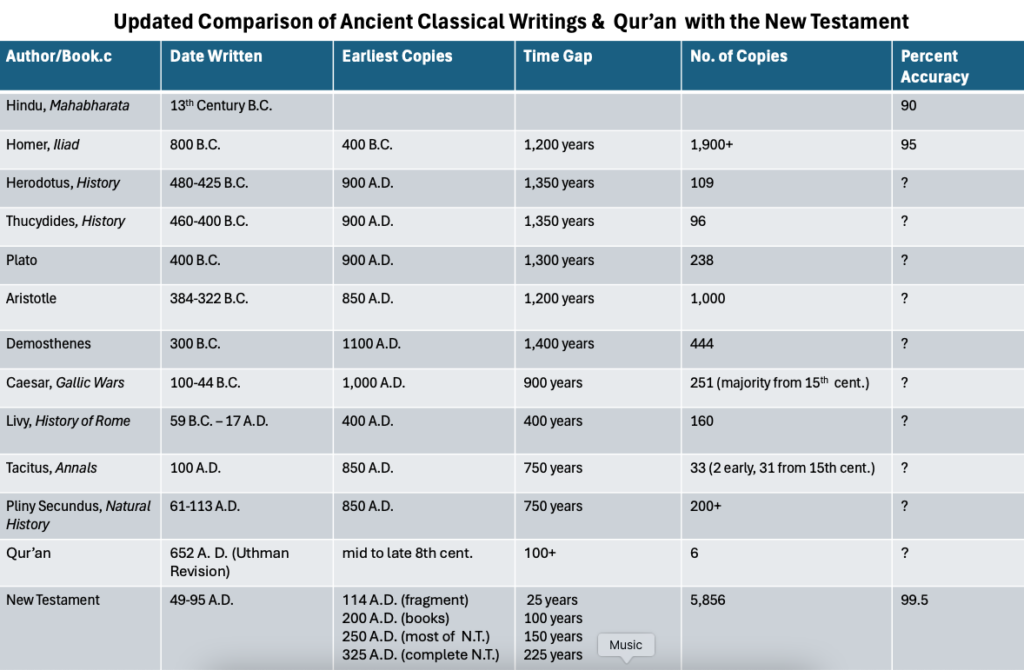
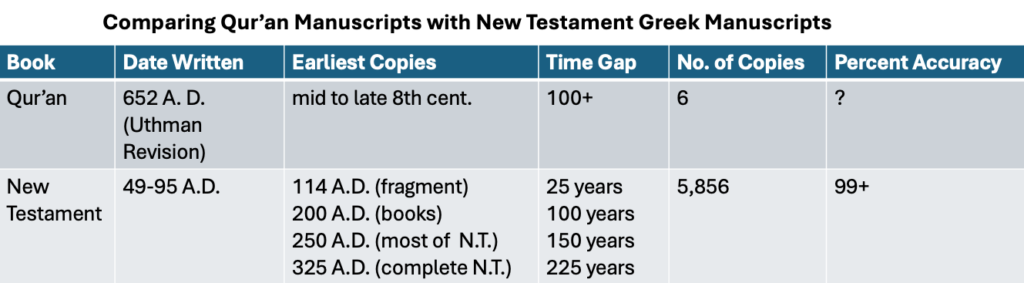
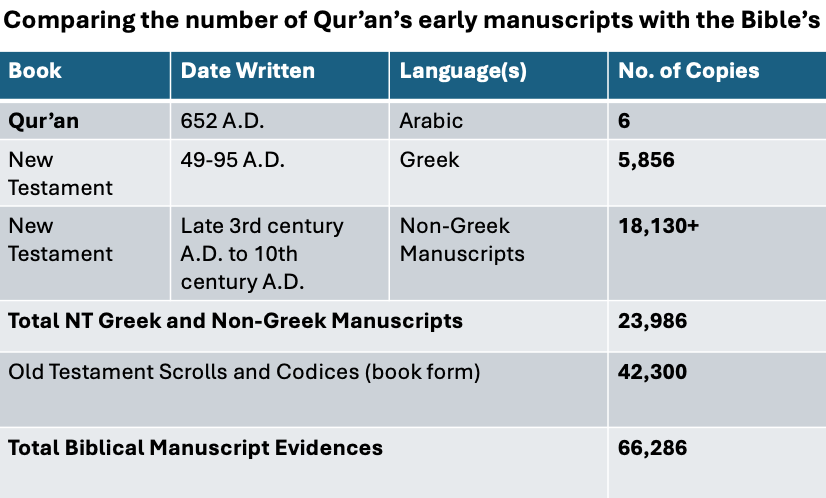
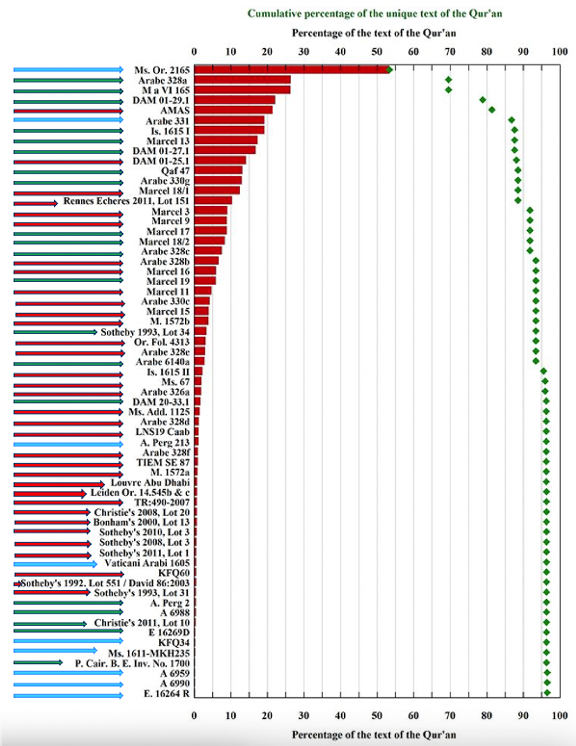
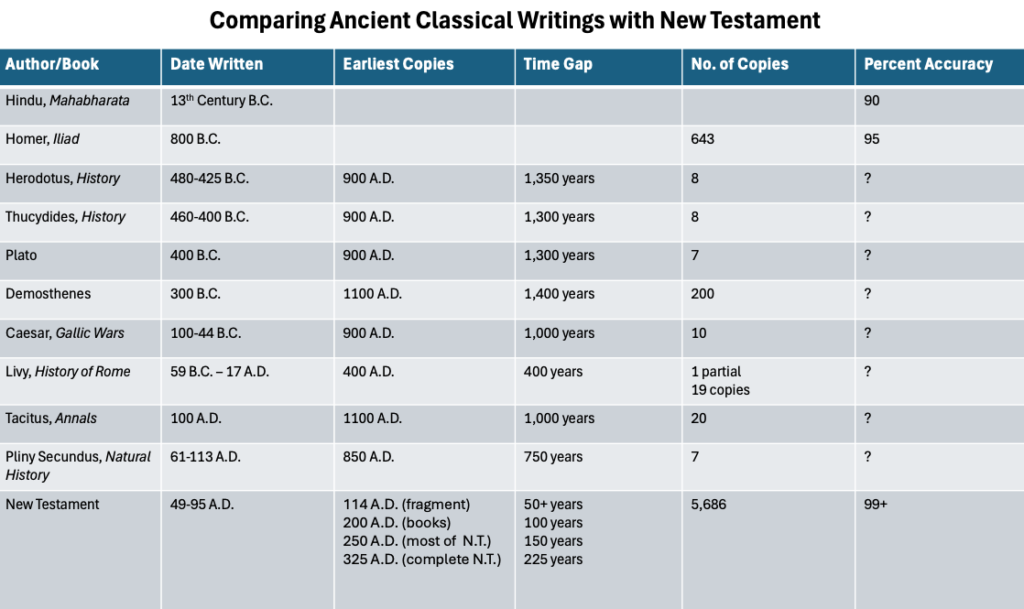
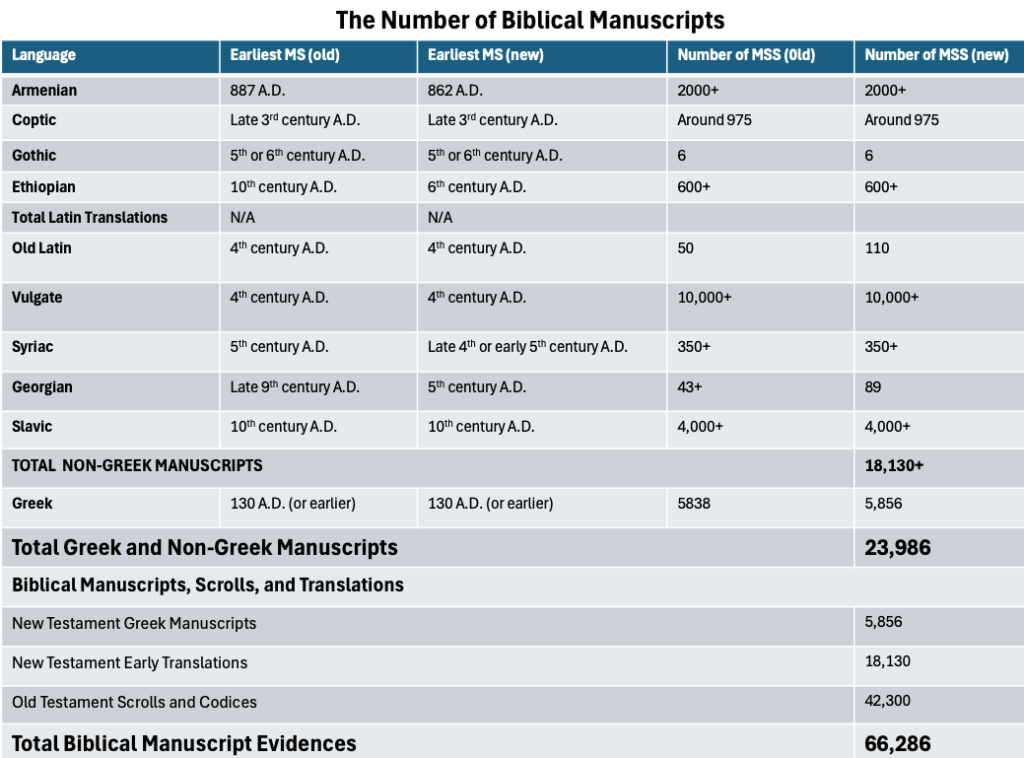
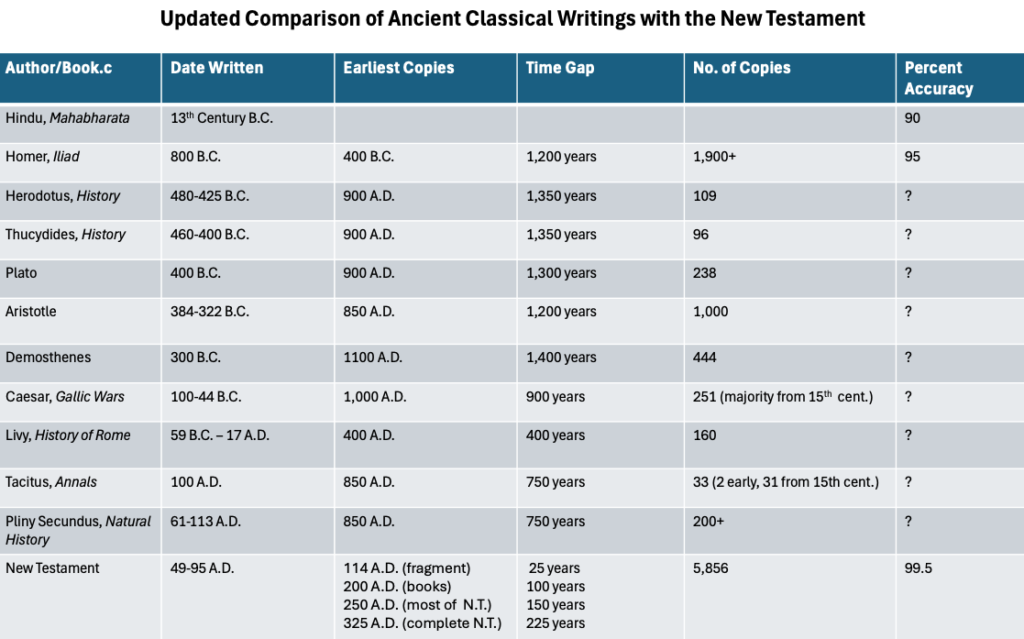
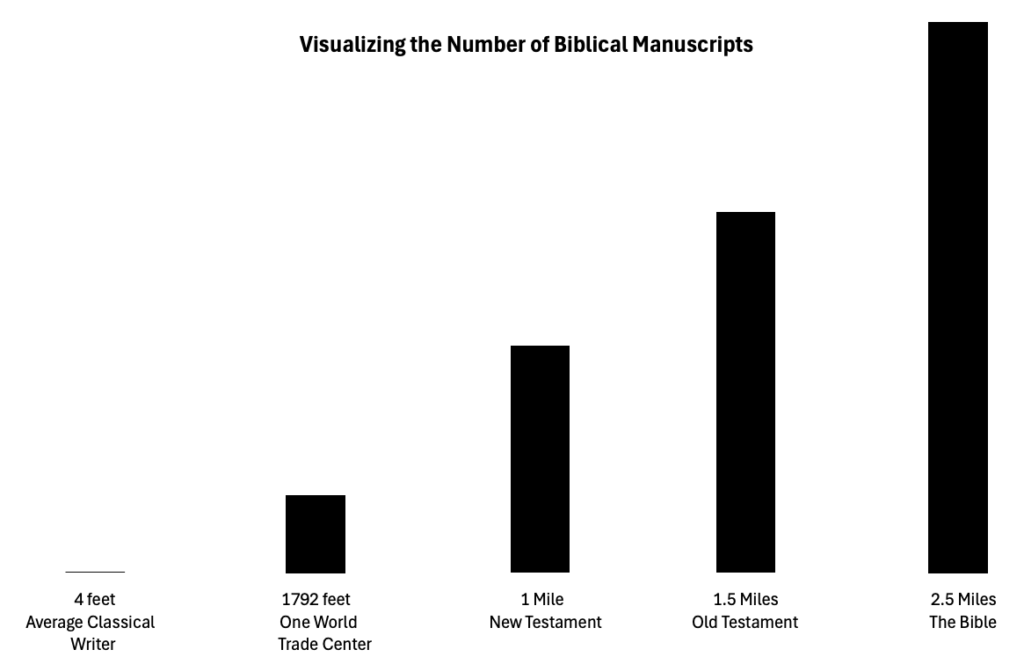
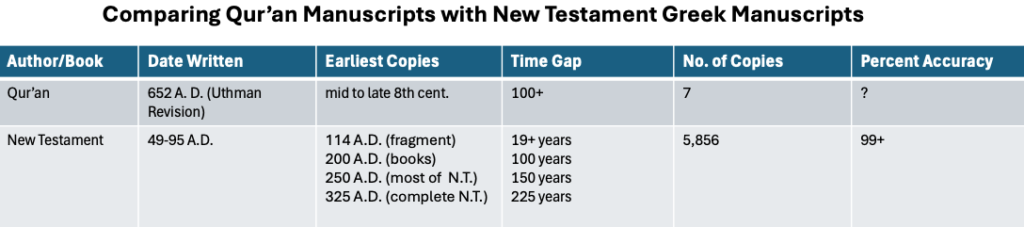
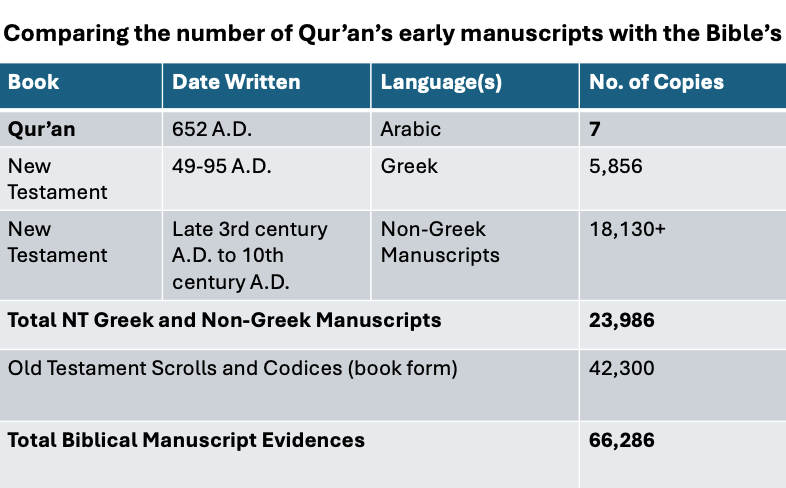
By far, the Bible has more manuscript evidence compared to the Qur’an (see above chart)Christianity can claim more than 5,850 known early Greek manuscripts of the New Testament, most of which were written between 25-225 years after the death of Christ. The New Testament also has over 18,130 early versions and translations, adding up to nearly 24,000 confirmed New Testament manuscripts still in existence (see chart below). In addition, we also have 42,300 Old Testament Scrolls and Codices, which means the Bible has 66,286 manuscript evidences.

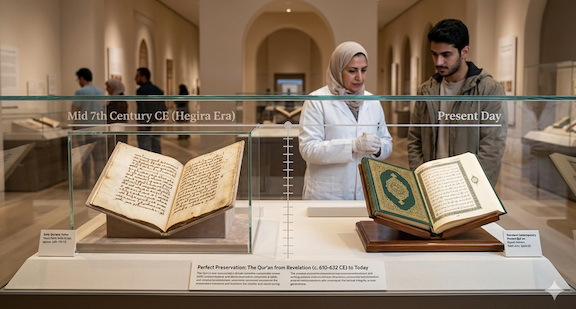
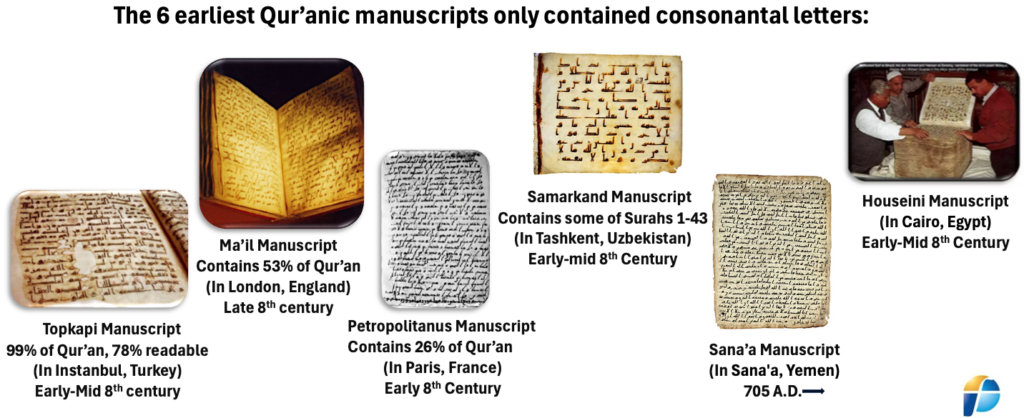
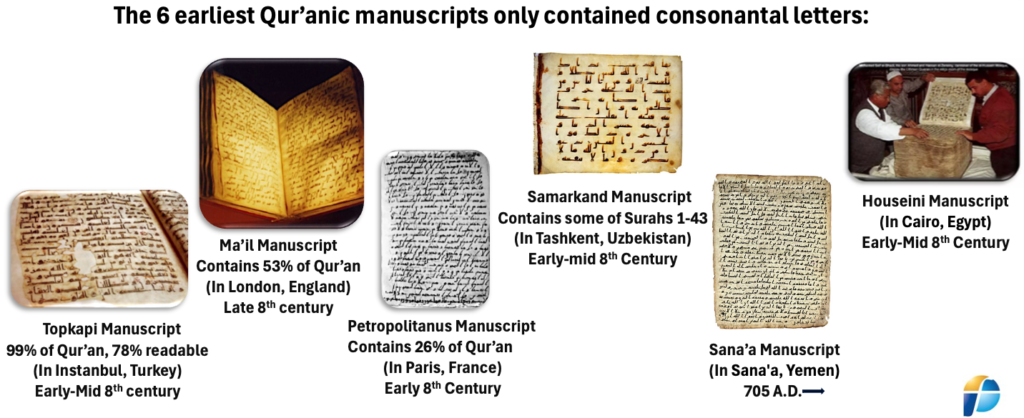
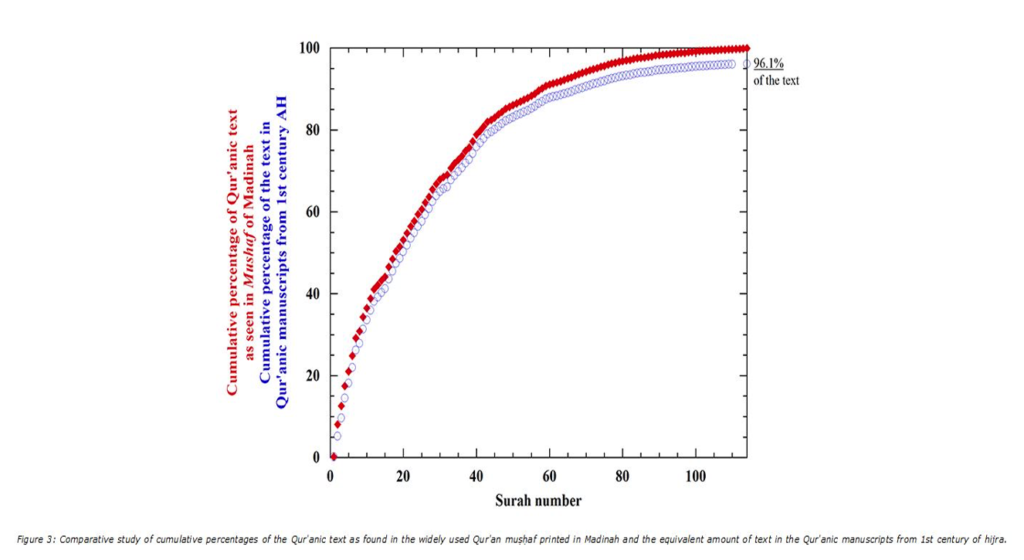
But Islam cannot provide a single manuscript until well into the eighth century, over 100 years after its supposed original compilation. And even then, Islam only has 6 early manuscripts of the Qur’an, and none of them are from the 7th century. None of them are complete. None of them completely agree with each other. None of them completely agree with the current 1924 ‘Hafs’ text which is memorized by 93% of Muslims. All of them have hundreds and even thousands of subsequent manuscript variants. [1]

If the Christians could retain so many thousands of ancient manuscripts, all of which were written long before the Qur’an, at a time when paper had not yet been introduced, forcing the dependency on papyrus which disintegrated with age, then one wonders why the Muslims are not able to forward a single manuscript from this much later period, during which the Qur’an was supposedly revealed? This indeed gives the Bible a much stronger claim for reliability than the Qur’an.

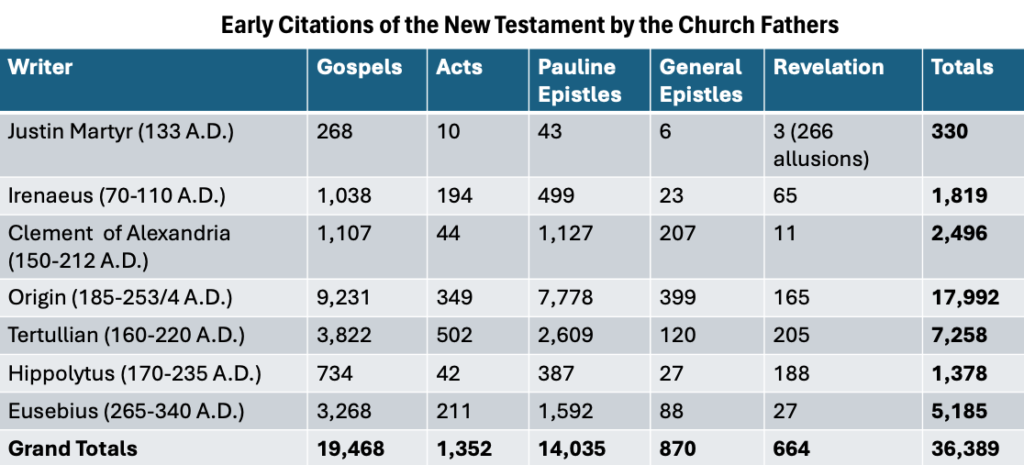
Furthermore, while the earliest New Testament manuscripts as well as the earliest letters from the church fathers correspond with the New Testament which we have in our hands, providing us with some certainty that they have not been unduly added to or tampered with, the Qur’anic material which we have in our possession abounds with stories whose origins we can now trace to second century fictional Jewish and Christian apocryphal literature. We know in some cases who wrote them, when exactly they were written and at times even why they were written; and that none of them were from a divine source, as they were written by the most human of Rabbis and storytellers over the intervening centuries after the Bible had been canonized.

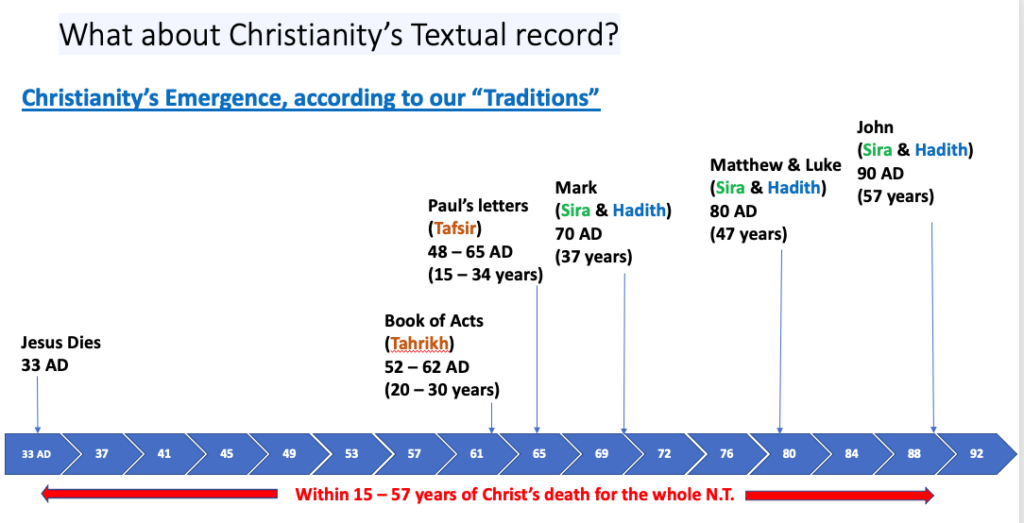
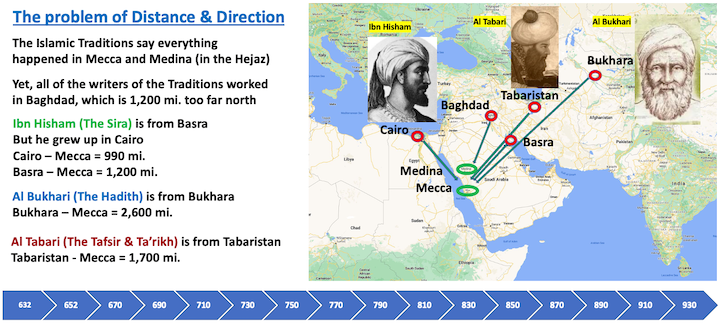
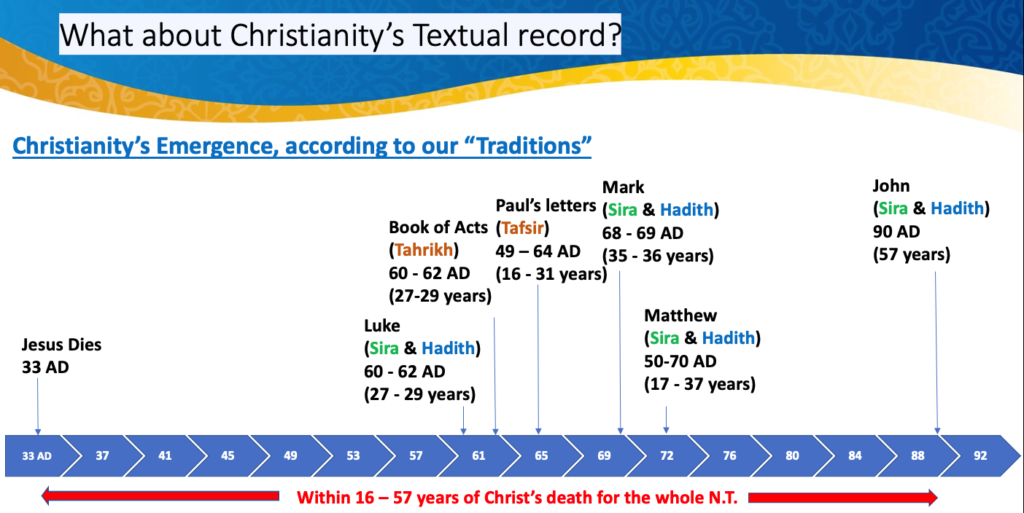
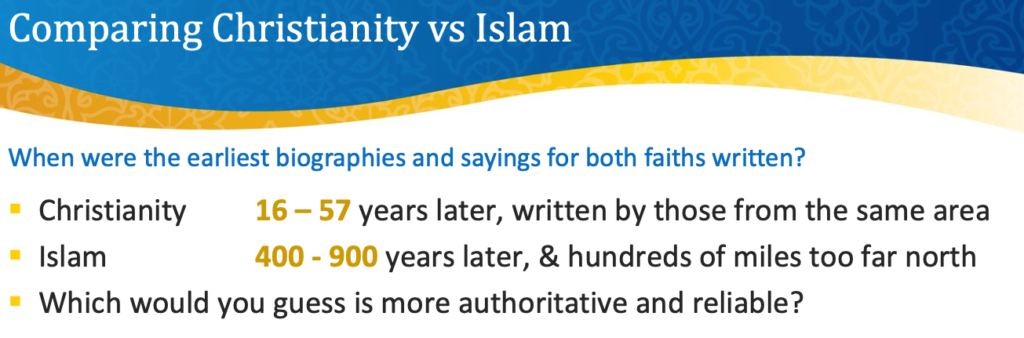
When we compared the historical documentary evidence of the Qur’an and the Bible, we discovered when the earliest biographies and sayings for both faiths were written. For Christianity (see above chart)they were written 16-57 years after Jesus’ death on the cross by those from the same area. But for Islam, they were written 400-900 years later, and by those who were hundreds of miles too far north (see chart below). Thus, the documentary evidence substantiates that the New Testament has more reliability and authority than the Qur’an.    

In this article, we will examine the archaeological evidence for both the Bible and the Qur’an. Since both the Bible and the Qur’an speak of history, we will see if archaeology confirms what both books say about people, places, and times. To begin, we will see what archaeology tells us about the Qur’an.

The Qur’an’s Archaeological Evidence

As with the manuscript and documentary evidence, there is not much archaeological information to which we can turn to substantiate what the Qur’an says. What we can do, however, is look at the claims the Qur’an makes and find out if they can be corroborated by archaeology. We will begin with the Qibla, or direction of prayer.

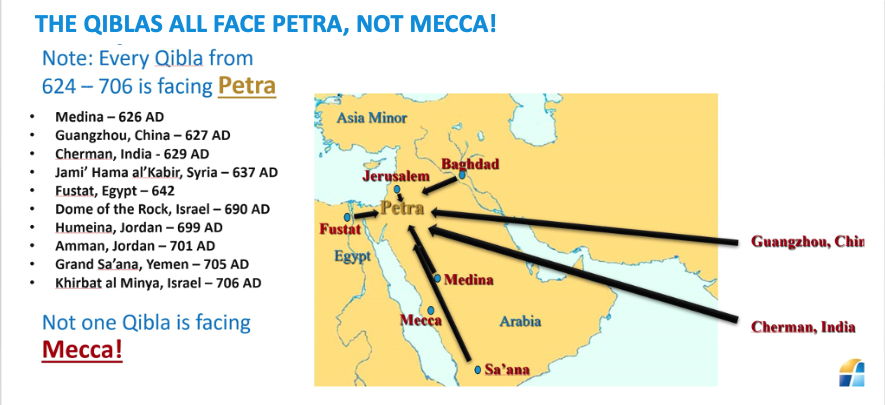
1) The Qibla: According to the Qur’an (Surah 2:144, 149-150), the Qibla or direction of prayer was finalized towards Mecca for all Muslims approximately two years after the Hijra (migration to Medina) around 624 A.D. and has remained in that direction to the present! [2]

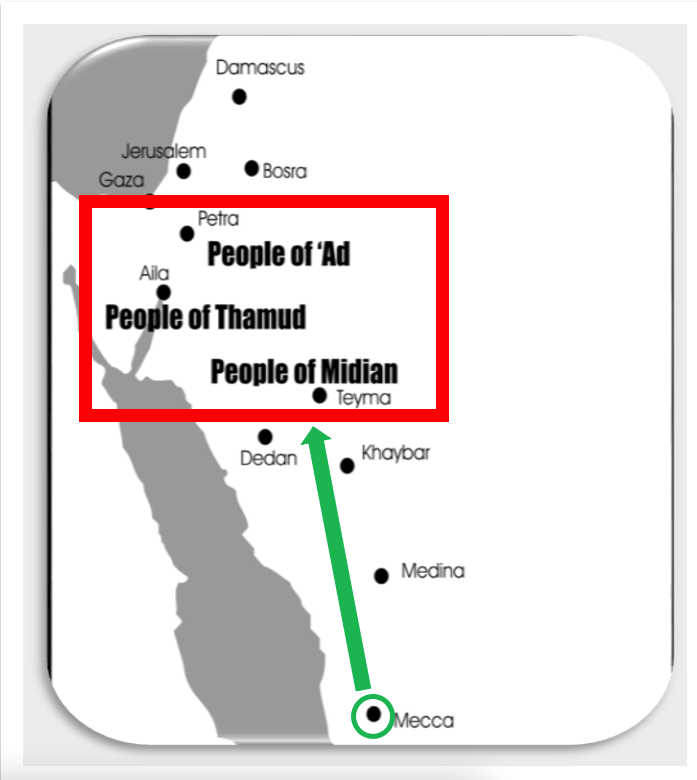
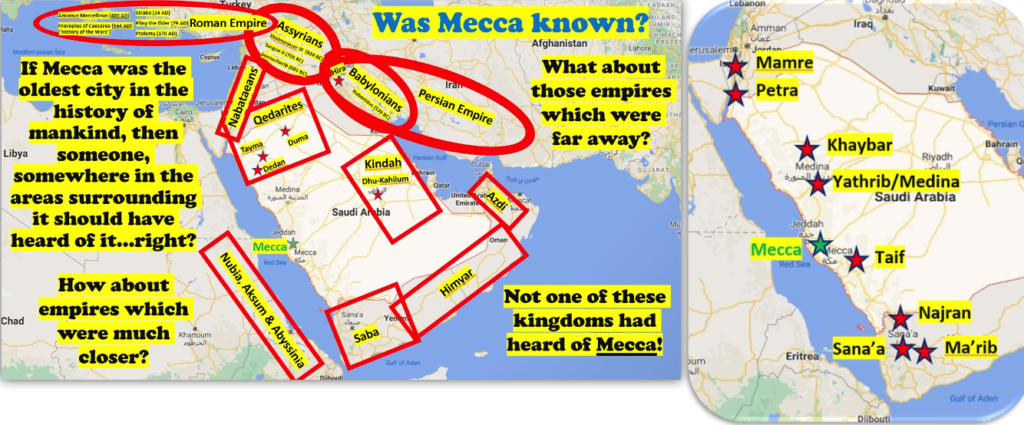
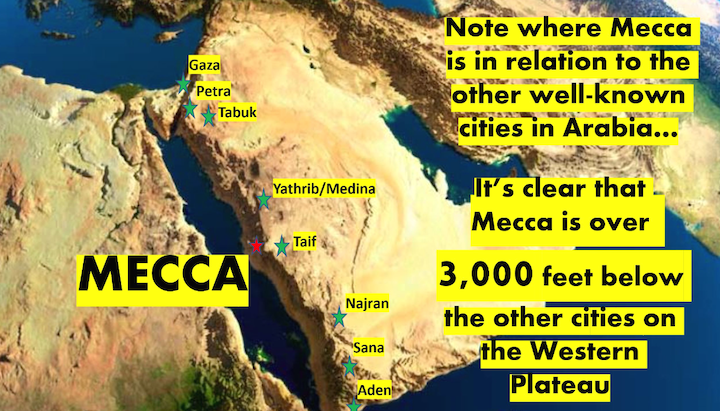
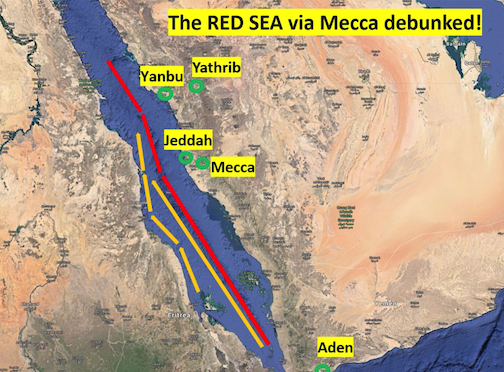
Yet, the earliest evidence from outside Islamic tradition regarding the direction in which Muslims prayed, and by implication the location of their sanctuary, points to an area much farther north than Mecca, in fact somewhere in northwest Arabia. [3] Middle Eastern archaeologist Dan Gibson has done the most extensive work on the Qiblas and found that every Qibla from 624-706 A.D. is facing Petra, and none are facing Mecca (see above map).

Gibson’s “archaeological examinations of the mosques from the first 100 years of Islam indicate that the qibla, or the direction of prayer, did not face toward Mecca, but rather to a more northern location, the Nabataean area around Petra where the people of ‘Ad, Midian, and Thamud all resided. Due to this archaeological evidence, Gibson does not support Mecca as the birthplace of Islam. Instead, based on his research Gibson concludes that ‘Islam was founded in northern Arabia in the city of Petra. It was there that the first parts of the Qur’an were revealed before the faithful were forced to flee to Medina. Thus, the prophet Muhammad never visited Mecca, nor did any of the first four rightly guided caliphs. Mecca was never a center of worship in ancient times, and was not part of the ancient trade routes in Arabia.’” [4] [emphasis added]

In addition, Gibson mentions that at a 2002 conference on Nabataean Studies held in Petra he had the opportunity to speak to several Jordanian and Saudi archaeologists who admitted that “the archeological record at Mecca was basically non-existent before 900 AD. [5] [emphasis added] Perhaps this is why the Saudi government is destroying most of the ancient buildings and sites in Mecca. [6] They may be trying to cover up something that was “not there” before the 9th century. [7]

Smith notes that an additional substantiation for this direction of prayer is found “by the Christian writer and traveler Jacob of Edessa, who, writing as late as 705 A.D. was a contemporary eyewitness in Egypt. He maintained that the Mahgraye’ (Greek name for Arabs) in Egypt prayed facing east which was towards their Ka’ba.” [8] [emphasis added] His letter (which can be found in the British Museum), reveals that as late as 705 A.D. the direction of prayer towards Mecca had not yet been finalized. [9]

Why are all of the 7th century Qiblas facing Petra or Jerusalem up to 705 A.D., and not Mecca until 715 A.D.? [10] Some Islamists argue that the early Muslims did not know the direction of Mecca. Yet these were desert traders! Their livelihood was dependent on travelling the desert, which has few landmarks, and, because of the sandstorms, no roads. They especially knew how to follow the stars. Their lives depended on it. Surely, they knew the difference between the north and the south. [11]

In addition, Smith says, “Furthermore, the mosques in Iraq and Egypt were built in civilized urban areas, amongst a sophisticated people who were well adept at finding directions. It is highly unlikely that they would miscalculate their qiblas by so many degrees. How else did they perform the obligatory Hajj [pilgrimage], which we are told was also canonized at this time? And why are so many of the mosques facing in the direction of northern Arabia, or possibly Jerusalem?” [12] [brackets and emphasis added]

Smith argues that a plausible answer may be found by examining the archaeological evidence in Jerusalem itself.       

 2) The Dome of the Rock: [13] 

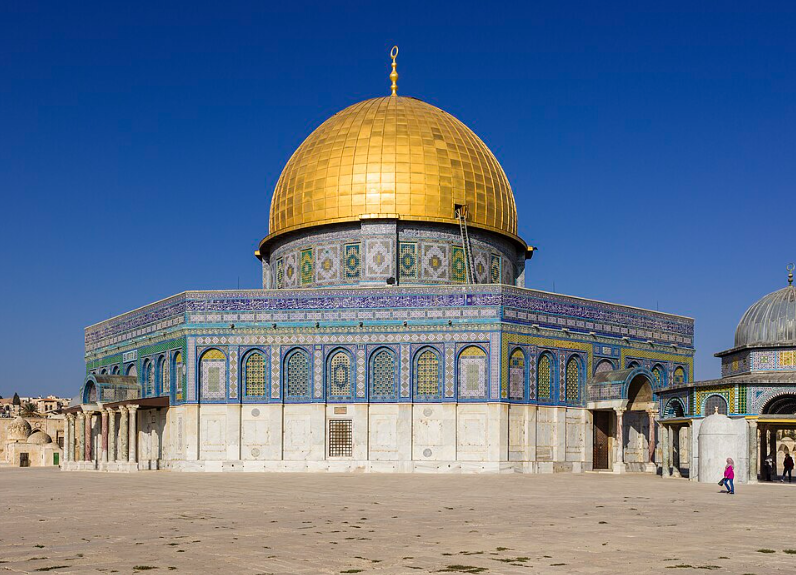
In the center of Jerusalem stands an imposing structure (even today) called the Dome of the Rock (see above pic), built by Caliph Abd al-Malik “in 691 A.D., after seeing the magnificent Christian cathedral of the Church of the Holy Sepulchre.” Al-Malik built this structure “of equal splendor over the rock in Jerusalem believed to be where Abraham was about to sacrifice his son Isaac.” [14]

The Dome of the Rock was built in the shape of an octagon with eight pillars [15] suggesting it was used for circumambulation (to walk around). Thus, it seems to have been built as a sanctuary[16] Today it is considered to be the third most holy site in Islam, after Mecca and Medina. Islamists insist that it was built to commemorate the night when Mohammed went up to heaven to speak with Moses and Allah concerning the number of prayers required of the believers (known as the Mi’raj in Arabic). [17]

But when the inscriptions on the walls of the Dome of the Rock were examined, they said nothing of the Mi’raj. This is substantiated further by the absence of a Qibla (no direction for prayer). Why was there no Qibla? The fact that such an imposing structure was built so early suggests that Jerusalem, and not Mecca, became the sanctuary and the center of an emerging Islam up until at least the late seventh century! [18]

According to Islamic tradition, the caliph Suleyman, who reigned as late as 715-717 A.D., went to Mecca to ask about the Hajj (annual pilgrimage). He was not satisfied with the response he received there, and so chose to follow Abd al-Malik (i.e. travelling to the Dome of the Rock). This fact alone, according to Dr. Hawting at the School of Oriental and African Studies (as part of London University) points out that there was still some confusion as to where the sanctuary was to be located as late as the early eighth century. It seems that Mecca was only now (sixty years after Mohammed’s death) taking on the role as the religious center of Islam. One can therefore understand why, according to tradition, Al-Walid I, who reigned as Caliph between 705 and 715 A.D., wrote to all the regions ordering the demolition and enlargement of the mosques. [19] This suggests that at this time the Qiblas were then aligned towards Mecca.

Hence, archaeology tells us that the Qur’an introduced the Qibla in Mecca too early. This points to a glaring contradiction in the Qur’an which established Mecca as the sanctuary and thus direction for prayer during the lifetime of Mohammed some eighty to ninety years earlier (Qur’an 2:144, 149-150). 

And that is not all, for we have other archaeological evidence which point to differences with that which we read in the Qur’an.

3) Dirham Coins: 

The Qur’an mentions that Joseph was sold by travelers (not Joseph’s brothers, as recorded in Genesis 37:28) for “a lesser price than a numbered dirham” (Qur’an 12:20). [20] Dirhams did not exist until the 7thcentury A.D., evolving from the Greek drachma. There were no dirhams during the time of Joseph (1915-1805 B.C.) [21] in ancient Egypt. Hence, the Qur’an introduces dirham coins hundreds of years too early. [22]

4) Samaritans: 

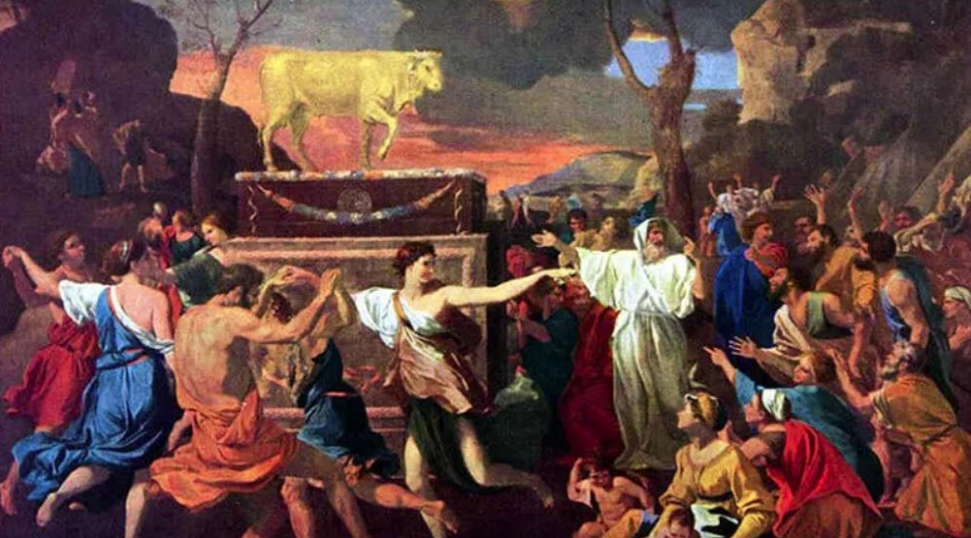
We learn from the Qur’an that a “Sāmirī [Samaritan, a non-Arabic word of Hebrew/Syriac origin], [23] not Aaron, as recorded in Exodus 32, “led them astray” (Qur’an 20:85) [24] to fashion a golden calf (Qur’an 20:86-88, 95-97). Mentioning a Samaritan in the time of Moses (1525-1405 B.C) [25] conflicts with history because Samaritans were not known as a people until 722 B.C. [26] Once again, the Qur’an introduces something hundreds of years too early. In addition, the Qur’an confuses Hosea 8:5-6 with the calf of the Exodus rebellion! [27]  

5) Chainmail: 

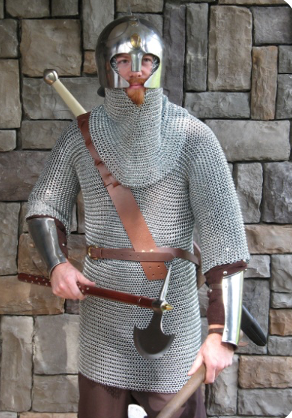
According to the Qur’an, Allah taught King David how to make chain mail: 10 And indeed, we gave David a bounty from us: ‘O mountains, sing praises with him and the birds.’ And we softened the iron to him. 11 That, ‘Make suitable coats of sard [chain armor, non-Arabic word of Persian/Syriac origin] and measure the length. And do a good deed. Surely, I see what you do.” (Qur’an 34:10-11). [28] Hence, the Qur’an is saying that chainmail existed during the reign of King David in ancient Israel (1011 B.C. – 971 B.C.). [29] But coats of chainmail were not invented until around 400-300 B.C. by Celtic tribes in eastern Europe. [30] Hence the technology for chainmail did not exist until hundreds of years later than the Qur’an’s reference. 

6) Crucifixion: 

According to the Qur’an, Pharaoh threatened to “cut off” the “hands” and “legs” of his sorcerers on opposite sides and “crucify” them “on trunks of the palm tree”  when they chose to believe in the God of Moses (Qur’an 20:71; 7:121). [31] Joseph tells one of his fellow prisoners that “ he will be crucified, so the birds will eat from his head.” (Qur’an 12:41).[32] The earliest historical record of crucifixion dates to 519 B.C. when King Darius I of Persia crucified 3,000 of his political enemies in Babylon. [33] Thus, the Qur’an places crucifixion at times (Joseph: 1915-1805 B.C. and Moses: 1525-1405 B.C) which are hundreds of years before history records when crucifixion was invented.        

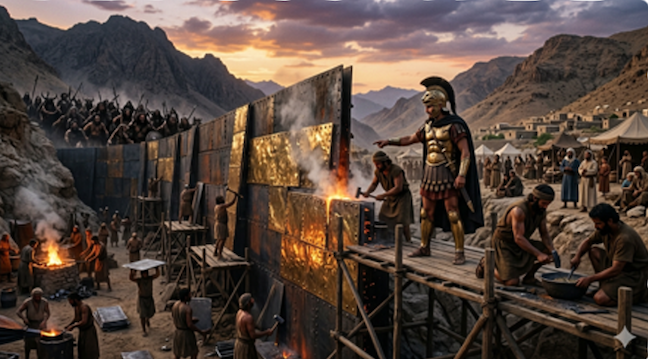
7) Alexander the Great (see AI generated pic below)

The Qur’an states, “They ask you about Ze Al Qarnain [the one with two horns]. Say, ‘I will recite to you an account of him.’” (Qur’an 18:83). [34] Dakdok explains that “the reason this verse was given was because the Jews of Quraish asked to examine the knowledge of Mohammed. That is why Allah sent down the story of Zu Al Qarnain” [35] otherwise known as Alexander the Great. [36]

We read of Alexander the Great,  92 Then he followed a way, 93 until he came between the two mountains under which he found a people who could not understand a saying. 94 They said, ‘O Za Al Qarnain, surely Ya’juj [Gog] and Ma’juj [Magog] are vandalizing in the land. Shall we make to you a tribute that you make between us and them a barrier?’ 95 He said, ‘That in which my lord has established me is better, so assist me with strength. I will make a barrier between you and them. 96 Bring me blocks of iron,” until it equalizes between the two sides. He said, ‘Blow,’ until when he made it a fire. He said, ‘Bring me brass that I may pour over it.’ 97 And they were not able to scale it, neither were they able to dig through it.’ 98 He said, ‘This is a mercy from my lord. So, when the promise of my lord comes to pass, he will make it dust. And the promise of my lord was true.” (Qur’an 18:92-98). [37] [emphasis added]

Ibn Kathir, a 14th century Muslim historian, scholar, and Qur’anic exegete, interpreted these verses by stating that these people between the two mountains were Turkish and the cousins of Gog and Magog (Qur’an 18:92-94ba). They mentioned to Alexander the Great that Gog and Magog had vandalized them, so they offered to pay him a great tribute to help them build a barrier between them and Gog and Magog (Qur’an 18:94b). But Alexander the Great refused to receive their tribute because he was satisfied with what Allah had given him (Qur’an 18:95a). Kathir also interpreted these verses to say that Alexander the Great, with the assistance of these men, built a great barrier made of iron and brass so it was smooth on the outside, making it difficult to go above it with ladders and through it with shovels (Qur’an 18:95b-97). Kathir claimed that the barrier was the same height as the tallest mountain, to the point that there was not one building on the earth that was stronger or more useful to the people than it. The building of this great barrier showed the mercy of Allah to his servants to prevent the aggression of Gog and Magog against these people (Qur’an 18:98a). Kathir also stated that this barrier which Alexander the Great built would become dust in the day of resurrection; this must be done, for the promise of his lord is true (Qur’an 18:98b). [38]

Al Bukhari (d. 870 A.D.) wrote down the actions and saying of Mohammed in the Hadith, and he said a man came to Mohammed and said, ‘O messenger of Allah, indeed I saw the barrier of Gog and Magog.’ Mohammed said, ‘Describe it to me.’ The man said, ‘It was like striped hail with black and red stripes.’ Mohammed said, ‘Indeed, you have seen it.’ That means Mohammed agreed with this man because Mohammed had seen this barrier. [39]

Dakdok concludes, “It is amazing… that there is no evidence of the existence of such a barrier. Alexander the Great did not build any barrier; and if there was such a barrier with this description, it should still exist, especially when we read that the Qur’an said that it will be there until the day of resurrection (Qur’an 18:95-101) which has not taken place yet. Such a barrier does not exist, nor is there any archaeological evidence to prove its existence. Moreover, there is not any biblical reference to such a barrier. The only barrier or wall that is known to the world is the Great Wall of China, which still exists today and is very well documented in history. This proves that these men in this hadith and Mohammed are liars.” [40] [emphasis added]

9) Coins: [41]

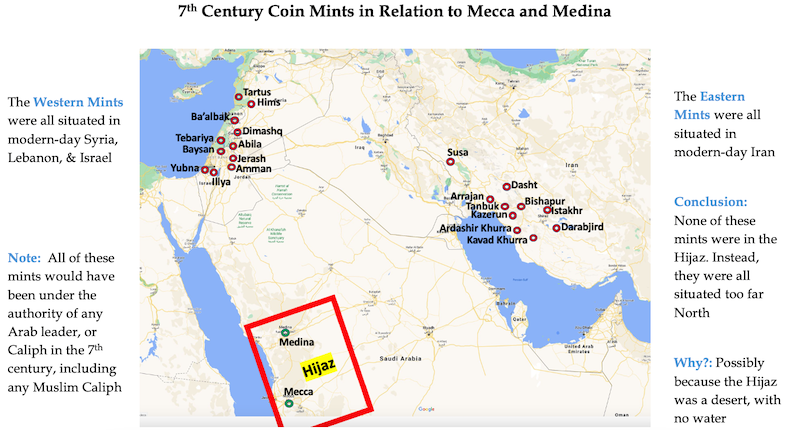
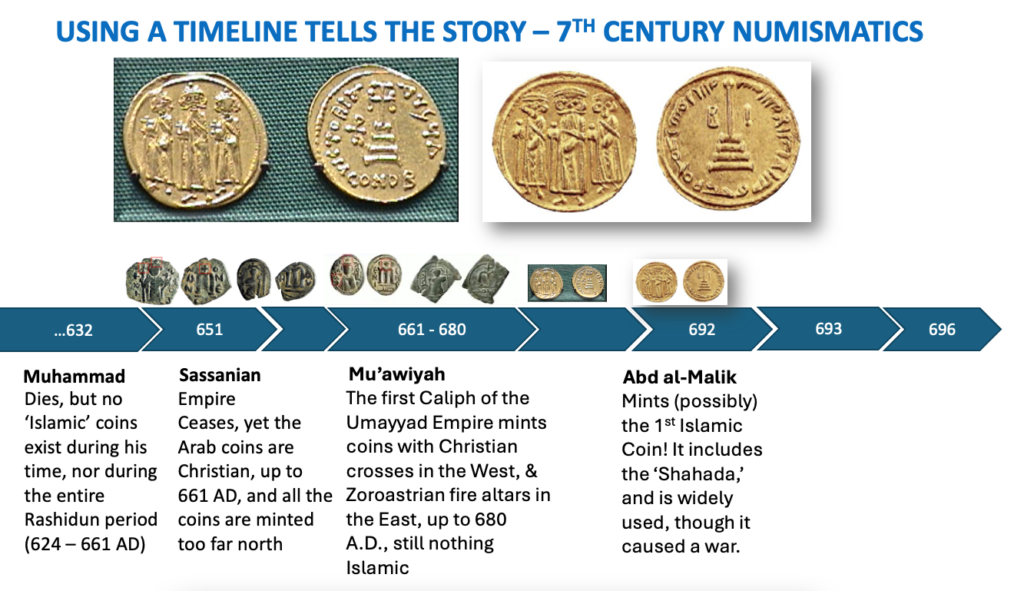
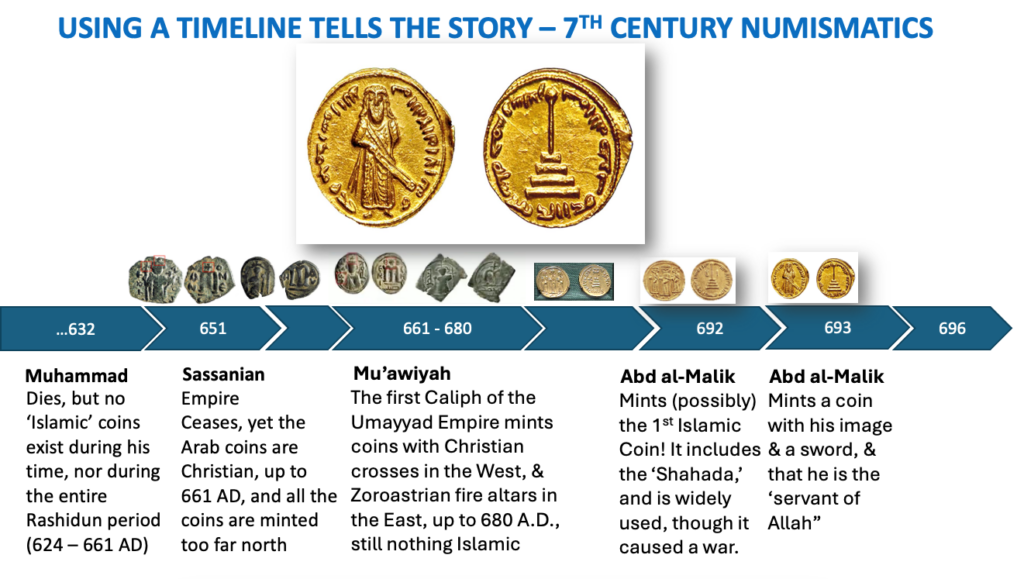
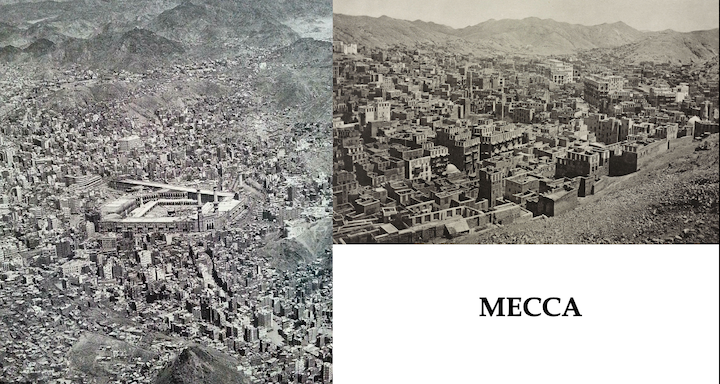
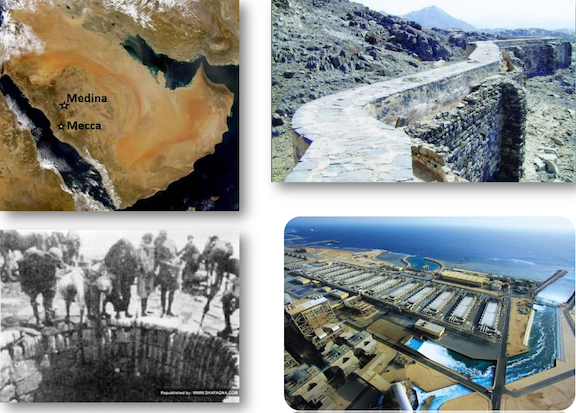
In ancient days when a king or Caliph (Muslim leader) came to power, one of the first things he did was mint a coin with his name and image on it and what religion he belonged to along with the date of the coin. Since they didn’t have modern communication like we do today (e.g. newspapers, radio, TV, or internet), they minted coins to inform others of their identity and jurisdiction. Dr. Jay Smith shows that there are no Islamic coins minted during the supposed lifetime of the prophet Mohammed (570 – 632 A.D.) nor during the Rashidun period (624-661 A.D.). The coins that were minted during that time were too far north to be related to Mohammed or the Qur’an (see above chart). The western mints were situated in modern day Syria, Lebanon, and Israel, and the eastern mints were located in modern day Iran. All of these mints would have been under the authority of any Arab leader or Caliph in the 7th century, including any Muslim Caliph (successor to Mohammed). In addition, none of these mints were in the Hijaz where Islam supposedly began. It is possible that these mints were too far north because the Hijaz was a desert with no water, and where there is no water, there is no civilization.

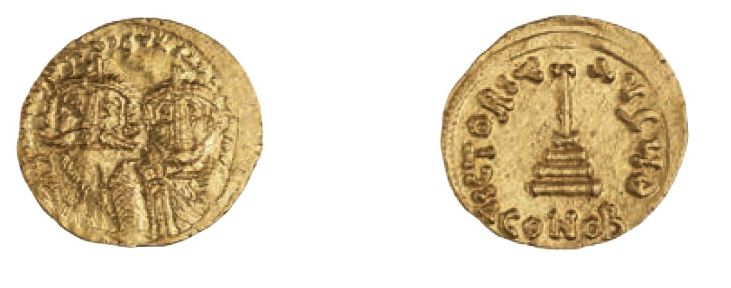
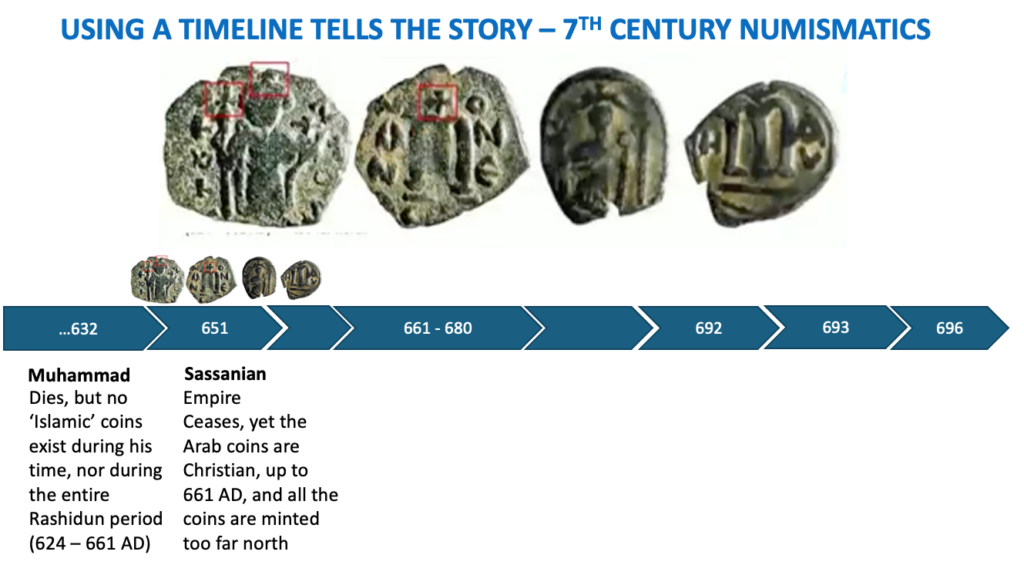
When you examine the coins minted in the early 7th century up to 661 A.D, almost all the coins are Christian, possessing a cross on them (see above pic). None of the coins from that time had anything to do with Mohammed, Islam, the Qur’an, or Mecca. 

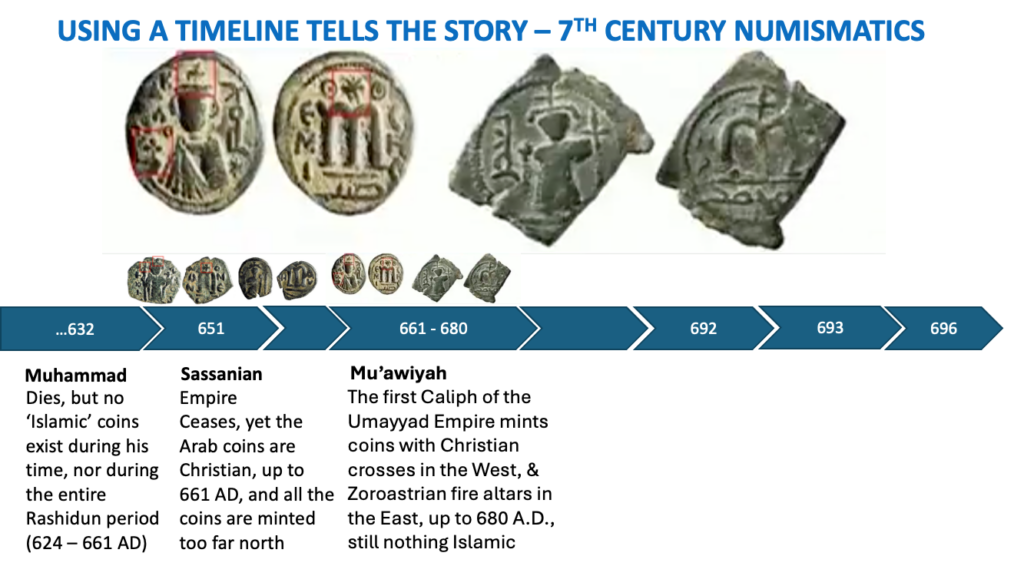
For example (see above pic), when you look at the first Muslim Caliph of the Umayyad Empire, Mu’awiyah, he minted coins with Christian crosses on them. Notice the two coins in the lower right of the picture. The first coin has a cross above the Caliph’s head and in his hand. And on the back side of the coin, it has the Arabic name Mahmad which some believe refers to the prophet Muhammad. If that is the case, it would be the first reference to Muhammad anywhere, and that was in 663 A.D.        

Some scholars argue that the Arabic word “Mahmad” later translated Muhammad word “Mahmad” later translated Muhammad on these early coins may refer to Jesus Christ, and not the prophet of Islam. This is because the root of the term “mu-hammad” is “Ahmad,” which means “praise.” Hence, the term Muhammad could be translated as “the one (mu-) who is praised (Ahmad),” or the “chosen one.” [42] Since the coins picture the Muslim leader with a cross on his head and in his hand, scholars conclude that Jesus Christ must be the “one who is praised.”   

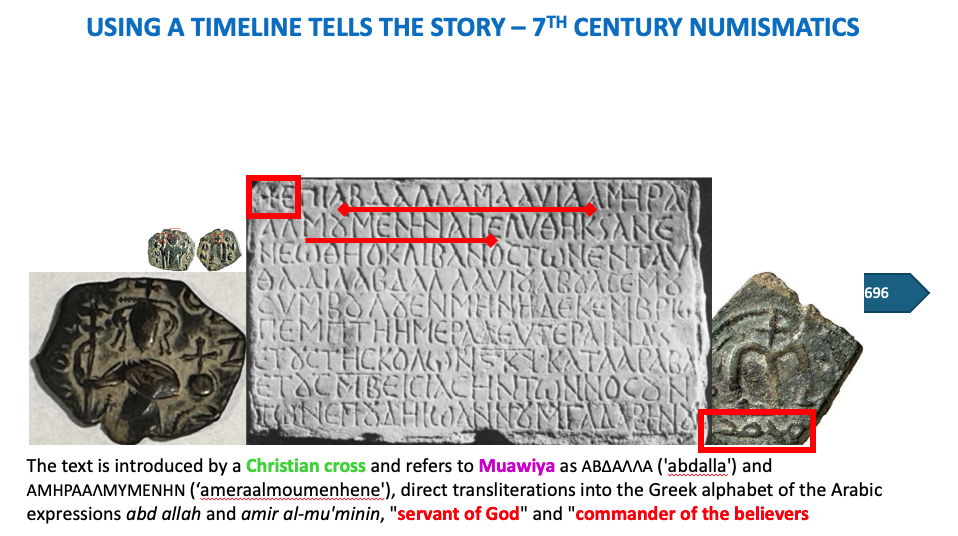
This is substantiated further in an inscription by Mu’awiyah (see above pic). He introduces the inscription with a cross in the upper left corner and refers to himself as “abdalla,” a “servant of God” and “ameraalmoumenhene,” a “commander of the believers.” Smith concludes that this first Caliph was a believer in the Jesus of the Bible who was a commander of Christians. Mu’awiyah ruled until 680 A.D. and then Abd Al-Malik came to power in 685 A.D.   

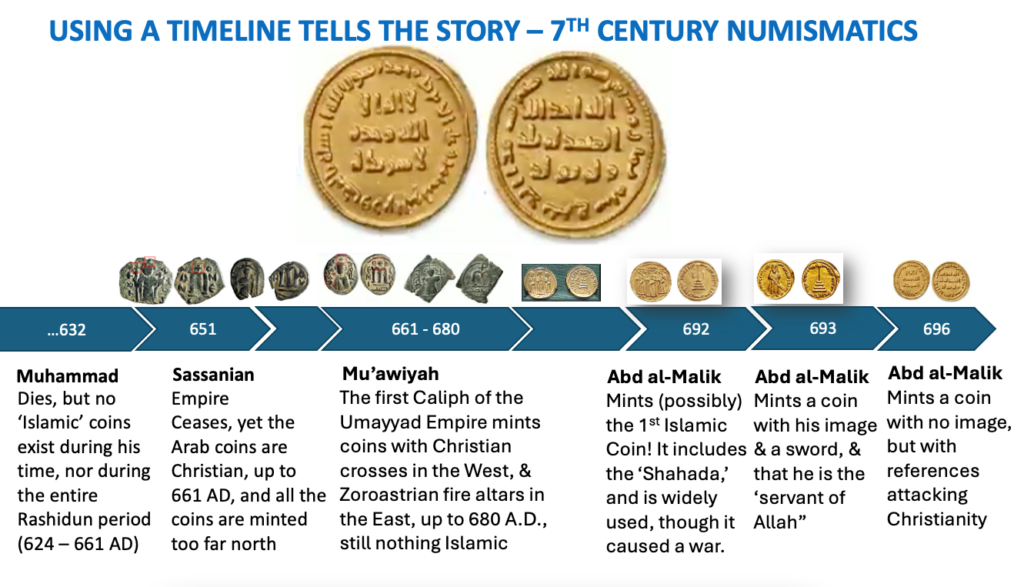
Abd Al-Malik introduces new coins that contain the shahada (see above pic) which says, “There is no god but Allah, and Muhammad is his prophet (rasul).” This is perhaps the first Islamic coin. After minting this coin, Abd Al-Malik goes to battle against Justinian, the Byzantine Emperor, and defeats him. He then mints this coin with an image of himself holding a sword in victory (see pic below). 

Abd Al-Malik had inscriptions written on the Dome of the Rock which he built in 691 A.D. which attacked Jesus as the Son of God (e.g., Allah “hath not taken unto Himself a son, and Who hath no partner” – Qur’an 25:2; Allah “has no associate” – Qur’an 112:3) as well as the Trinity (e.g., “say not ‘three’” – Qur’an 4:171). [43] 

He also minted coins attacking Christianity (see above pic). Smith concludes that this is the beginning of what later became Islam. [44]

10) Arabic Rock inscriptions: 

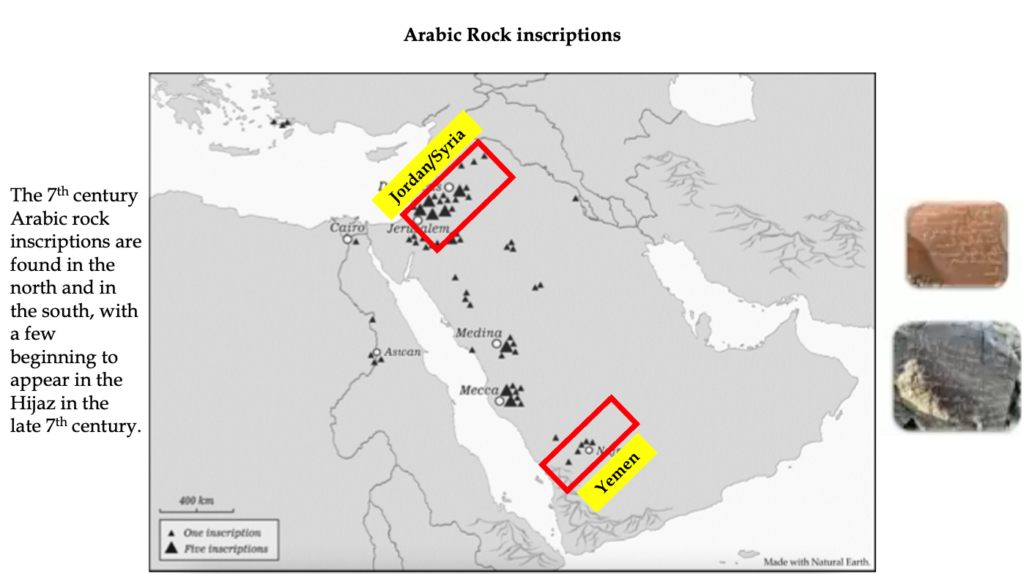
Notice that the 7th century Arabic rock inscriptions are all found in the north and in the south (see above pic), but not in the Hijaz where Islam supposedly began. Ilkka Juhani Lindstedt [45] analyzed approximately 100 Arabic rock inscriptions during a 100-year period (640-740 A.D.) and discovered that prior to 690 A.D., there was no evidence of anything Islamic on the inscriptions. Instead, they are merely pious formulae related more to Christianity. It is not until 690-710 A.D. that the prophet Muhammad is introduced in these inscriptions. Muslim rites (e.g., pilgrimage, prayer, fasting, etc.) appear from 710-720 A.D. From 720-730 A.D., the terms “Muslim” and “Islam” emerge in these inscriptions referring to a specific group in contradistinction to Christianity. This is 100 years after Muhammad’s death. It was only in the  730s A.D. onward that popular devotion was given to a man named Muhammad as a prophet and messenger of Allah, which calls into question the  traditional Islamic narrative presented in the Qur’an. Smith concludes that this 100-year silence indicates that Islam did not exist as a distinct religion until long after the time of Mohammed (570-632 A.D.) which casts doubt that he had any part in starting Islam.  

11) Qur’anic Quotations: [46] The quotations from the Qur’an on both the coins and the Dome of the Rock differ in detail from that which we find in the Qur’an today. [47]  Two etymologists, Van Berchem and Grohmann, have done extensive research on the Dome of the Rock inscriptions, and they state that the inscriptions contain “variant verbal forms, extensive deviances, as well as omissions from the text which we have today.” [48]

If these inscriptions had been derived from the Qur’an, with the variants which they contain, then how could the Qur’an have been canonized prior to this time (late seventh century)? One can only conclude that there was a gradual evolution in the transmission of the Qur’an through the years (if indeed they were originally taken from the Qur’an).

The sources also seem to suggest that the Qur’an was put together rather hurriedly. Dr. John Wansbrough maintains that “the book is strikingly lacking in overall structure, frequently obscure and inconsequential in both language and content, perfunctory in its linking of disparate materials, and given to the repetition of whole passages in variant versions. On this basis it can plausibly be argued that the book is the product of the belated and imperfect editing of materials from a plurality of traditions.” [49] Hence, Crone and Cook believe that because of the inadequacy of the editing, the emergence of the Qur’an must have been a sudden and late event. [50]

The Bible’s Archaeological Evidence

 We will begin with the archaeological evidence for the Old Testament. Since Abraham is esteemed by both Christianity and Islam, we will look at where archaeology places him.    

Abraham: Abraham was the first and greatest of the Hebrew patriarchs. His story is recorded in Genesis 11:26-25:10. “Abraham” appeared as a personal name in Babylonia during the time of the Patriarchal period (2296 -1806 B.C.). [51] Early and late twentieth-century excavations in Mesopotamia have uncovered documented names, including  Abram (later changed to Abraham – Gen. 17:5) [52] and his relatives, such as his great-grandfather Serug, his grandfather Nahor, and his father Terah (Gen. 11:22-26). These men all have names that have been confirmed in documents and reports as coming from the Euphrates-Habur region of Upper Mesopotamia from the time period of the early second millennium. [53]

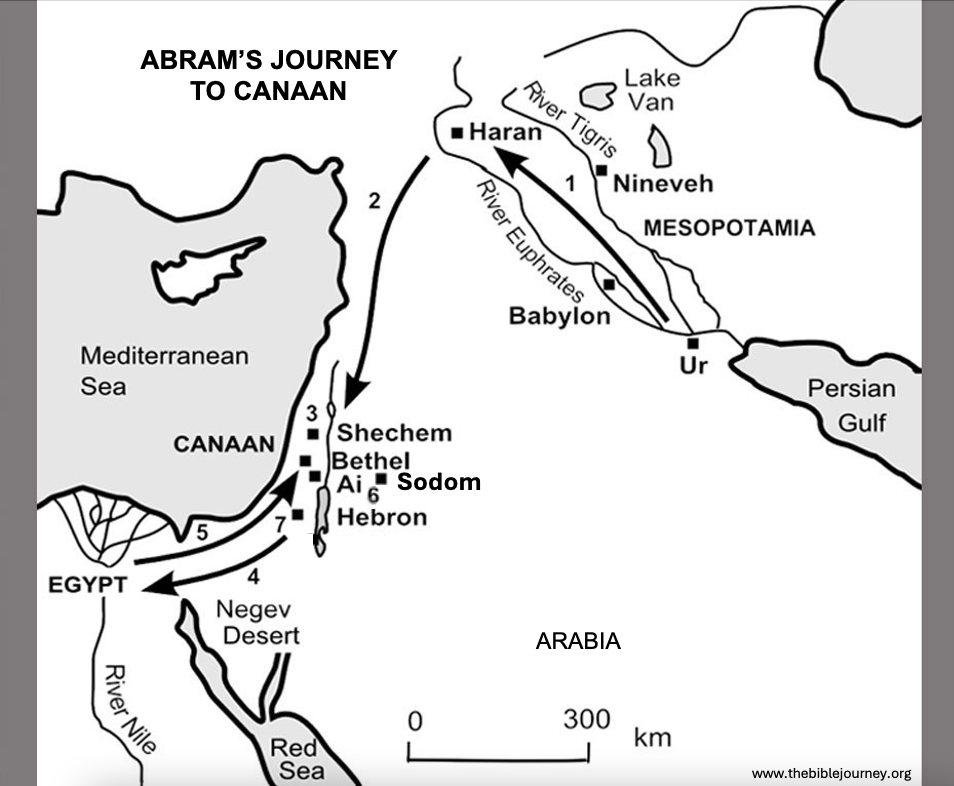
When we look at Abram’s journey from Ur to Canaan (see above map), we learn that archaeology confirms the names of places related to his journey from the Patriarchal period: 

1) Terah and his family (including his sons Abram and Nahor, and his grandson Lot) lived at Ur, the capital of Sumer, in southern Mesopotamia (modern-day Iraq). [54] While still living in Ur, God calls Abram to “Get out of your country… to a land I will show you.” (Gen. 12:1; cf. 15:7; Neh. 9:7; Acts 7:2). [55] They decide to move from Ur and follow the Euphrates River upstream about 600 miles possibly to avoid the harsh central Arabian desert [56] to Haran in what is now modern-day southern Turkey [57] (Gen. 11:27-32). Excavations at this site have unearthed a large mudbrick building that dates to the end of the third millennium B.C., which some believe may have been a predecessor to the Temple of the moon-god, Sin, [58] which is significant because Terah’s name means “moon” [59] and Scripture informs us that he came from an idolatrous background whereby he “served other gods” (Josh. 24:2). 

2) After Terah died in Haran (Gen. 11:32), Abram and his nephew Lot set out for Canaan with their tents and flocks (Gen. 12:1-5). 

3) Abram arrives in Canaan and builds an altar by the sacred tree of Moreh at Shechem about 30 miles north of Salem (later called Jerusalem) [60] where God revealed Himself to Abram for the first time in the Promised Land (Gen. 12:6-7). Archaeological excavations at Tell Balata (ancient Shechem) confirm that it was a “place” (Gen. 12:6) with no walls when Abram arrived (~2090 B.C.), but approximately 180 years later when Jacob arrived (~1910 B.C.), [61] it had become a “city” (Gen. 33:18). [62] 

4) Abram moves to the hill country between Bethel and Ai, [63] then moves south towards the Negev Desert. Driven by drought and famine, Abram and Sarai (Abram’s wife) journey along the Way of Shur to the well-watered lands of the Nile Delta in Egypt (Gen. 12:8-20). 

5) Abram and Sarai are forced to flee from Egypt to the hill country near Bethel (Gen. 13:1-9). 

6) Abram and Lot decide to separate. Lot chooses the fertile, well-watered Jordan Valley to the east and pitches his tents near Sodom (Gen. 13:10-13).  

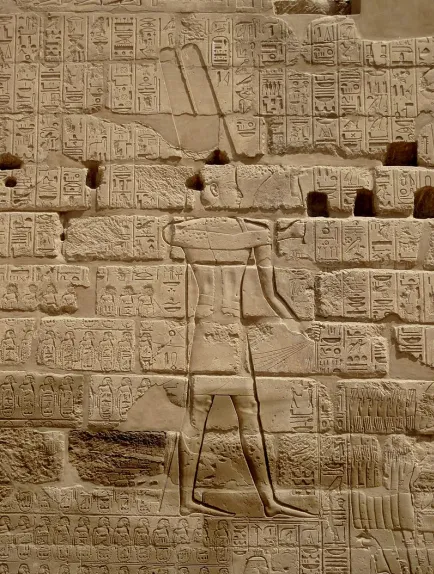
7) Abram moves to the great oaks of Mamre near Hebron and builds an altar there (Gen. 13:18). After the Egyptian Pharaoh Shishak (Shoshenq I) invaded the lands of Judah and Israel in 926 BC., he returned to Egypt and had a record of his victories inscribed on a wall of the Great Temple of Amun-Re at Karnak. One of the ovals, located just below and to the left of Shishak’s right foot (see above photo), reads, “the Fort / Enclosure of Abram.” [64]  This is the only nonbiblical written reference to Abraham, [65] proving that even at this early date Abraham was known not in Arabia, as Islam contends (Qur’an 2:124-131; 6:75-83; 19:41-48; 21:51-70; 26:69-83; 29:16-27; and 37:83-113) [66] but in Palestine, the land where the Bible places him. [67]

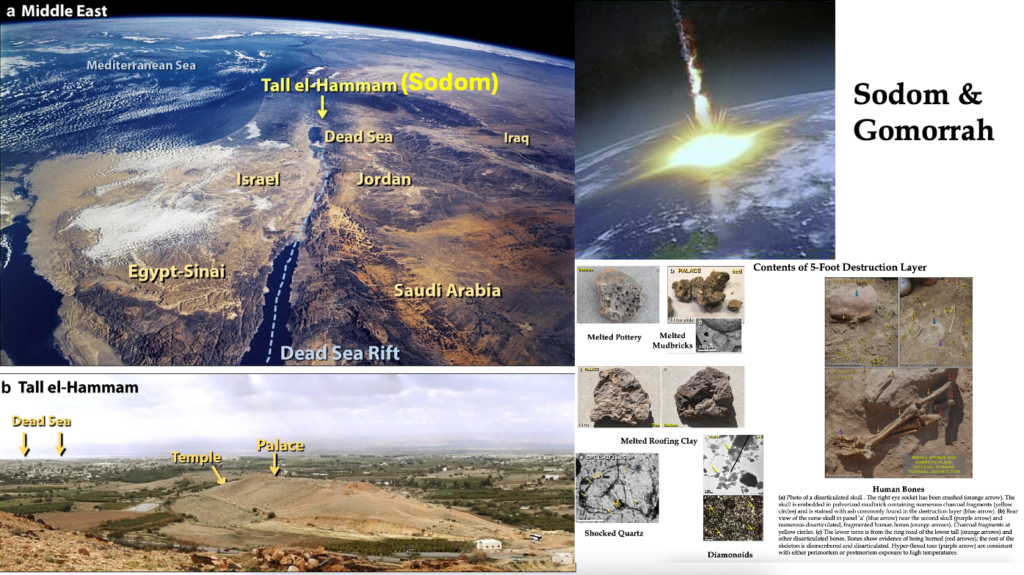
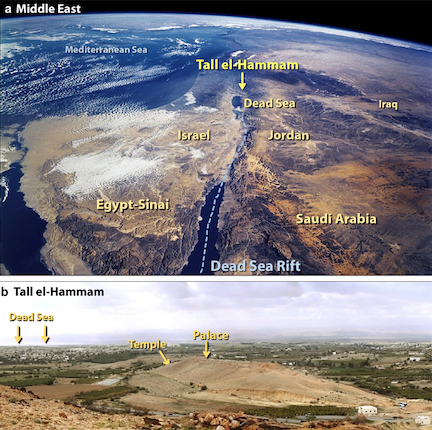
Sodom and Gomorrah (Gen. 13:1-13; 19:21-25; see photos below [68]):

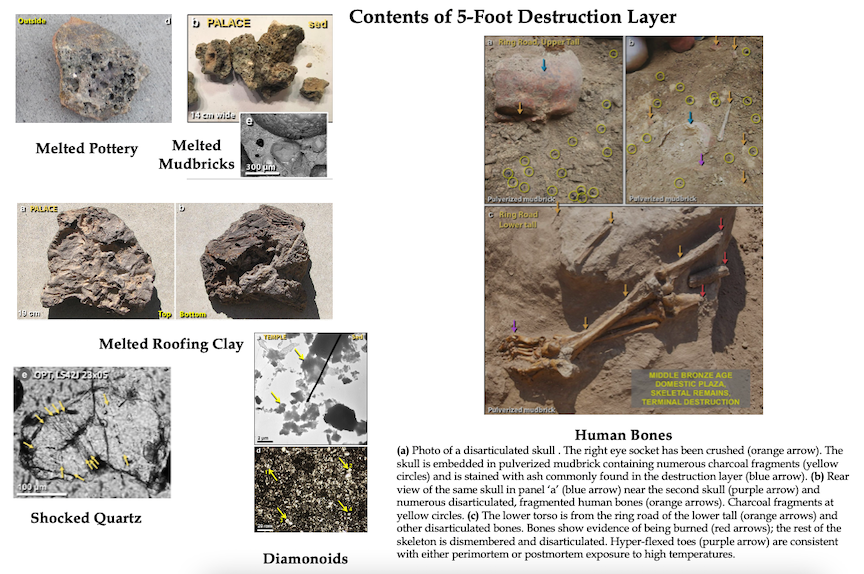
Since 2005 when Dr. Steven Collins began directing excavations in Tall el-Hammam, a fortified Middle-Bronze-Age city in modern day Jordan northeast of the Dead Sea, evidence was found that led scientists to believe it was destroyed by an extraordinary high energy event in 1650 B.C.  [69] Some archaeologists believe this could be the site of the biblical city of Sodom. Under the hill pictured in the base picture above, archaeologists found remains that indicate exposure to super intense heat over a short period of time which would have been much greater than exposure to wildfires, lightning, volcanism, earthquakes, or warfare. [70]

The entire city was capped by a five-foot thick charcoal and ash rich destruction layer containing shocked quartz, melted mudbrick, melted pottery, melted roofing clay, fragmented and scorched human bones, and other mysterious debris such as a ceramic shard with a glaze that would have been exposed to super-intense heat lasting a very short period. [71]

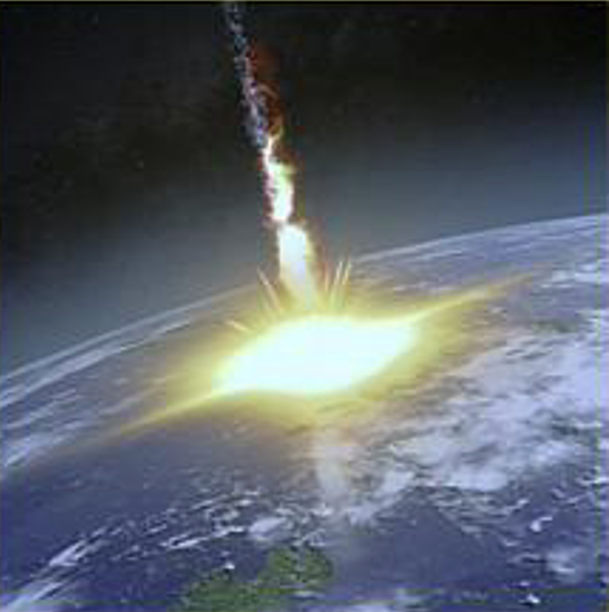
Scientists believe this represents a “cosmic airburst / impact event” (see above photo) similar to the asteroid explosion in Tunguska, Siberia in 1908, which had the equivalent explosive power of 1,000 Hiroshima bombs. [72]

The contents of the 5-foot destruction layer uncovered by scientists include (see pics below): [73]

–       Melted construction materials such as pottery, mudbricks, roofing clay. 

–       High temperature melted minerals such as shocked quartz whereby sand grains are cracked due to high pressure.

–       Presence of diamonoids (indicators of cosmic impacts).

–       Disarticulated, fragmented, and scorched human bones.

–       High salt concentrations up to 6 times that of the Dead Sea. 

These amazing findings substantiate what the Bible describes as the destruction of Sodom and Gomorrah. We read, 24 Then the Lord rained brimstone and fire on Sodom and Gomorrah, from the Lord out of the heavens. 25 So He overthrew those cities, all the plain, all the inhabitants of the cities, and what grew on the ground. 26 But his [Lot’s] wife looked back behind him, and she became a pillar of salt.” (Gen. 19:24-26). Afterwards, the soil around Sodom and Gomorrah could not be used for 700 years because of this catastrophic event which exposed it to such super intense heat. [74]

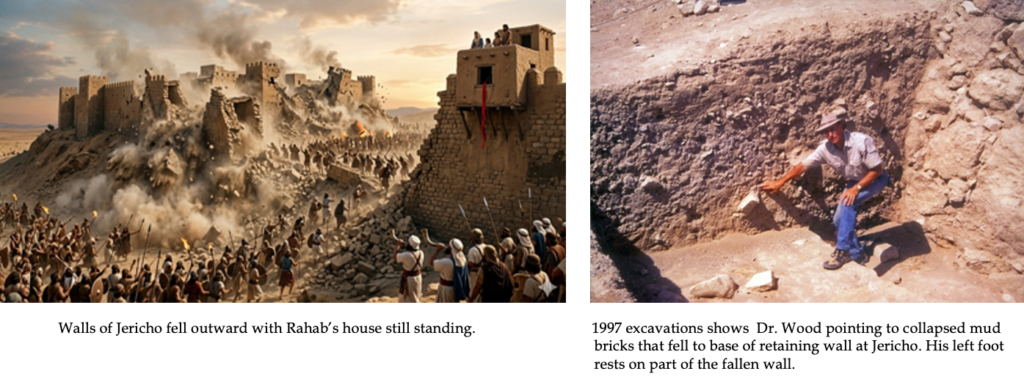
Jericho Walls (Josh. 6:20-24): 

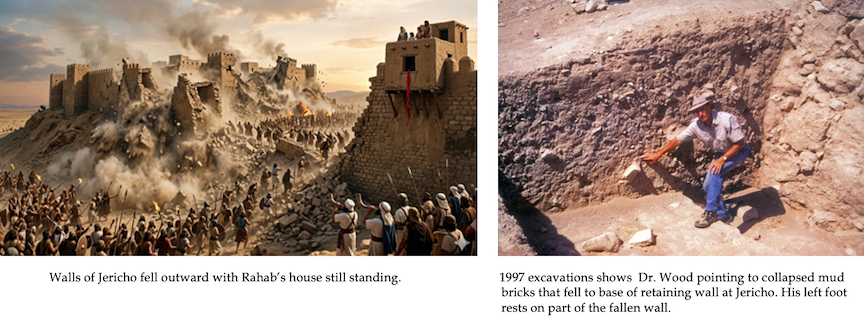
Recent analysis of archaeological research confirms that the city of Jericho was destroyed in approximately 1400 B.C. [75] and its city walls fell outward as the Bible states. [76]

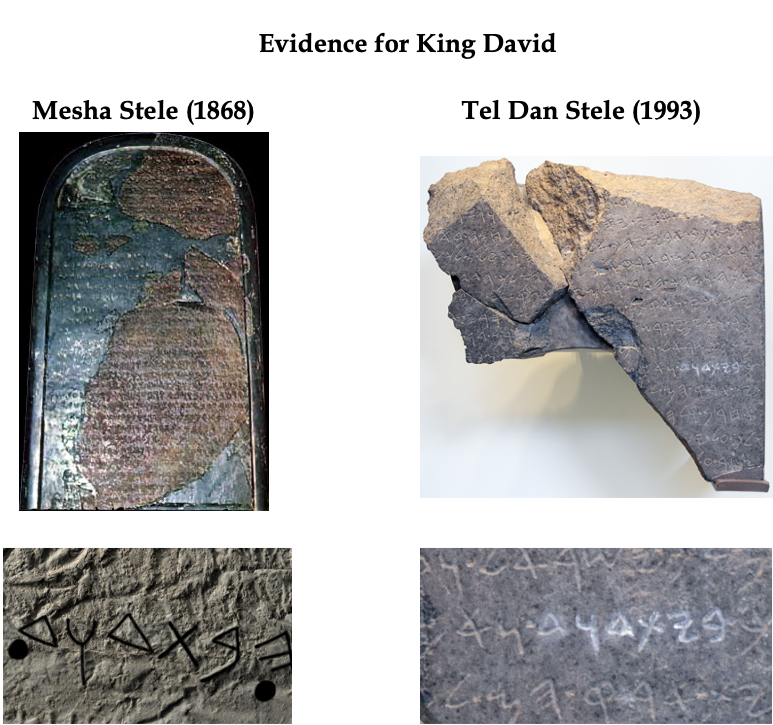
King David: 

Skeptics claimed that King David never existed because his name had never been found outside of the Bible. But two archaeological findings came to the rescue at Dibon in Moab (1868) and at Tell Dan (1993-1994). In 1868 at Dibon, in Moab (20 miles east of the Dead Sea), the Mesha Stele was found and dated to 850 B.C. [77] It mentioned “Israel,” “Yahweh,” and the “House of David” (bytdwd). [78]In 1993 the Tell Dan Stele was discovered at Tel Dan (northern Israel) containing a Canaanite inscription that dates from the late 9th century B.C. [79] It was probably erected by Hazael, an Aramean king. The inscription reads, “I killed Jehoram son of Ahab king of Israel, and I killed Ahaziahu son of Jehoram king of the house of David (bytdwd). [80] The Bible tells us, “Mesha, king of Moab rebelled against the king of Israel…” (2 Kgs. 3:5).  

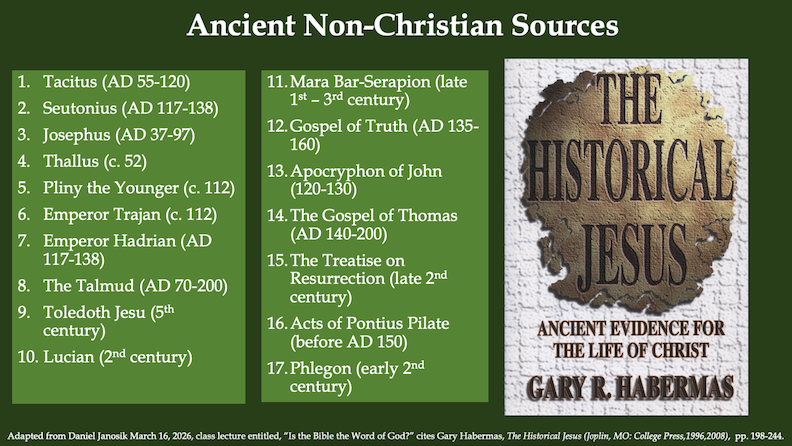
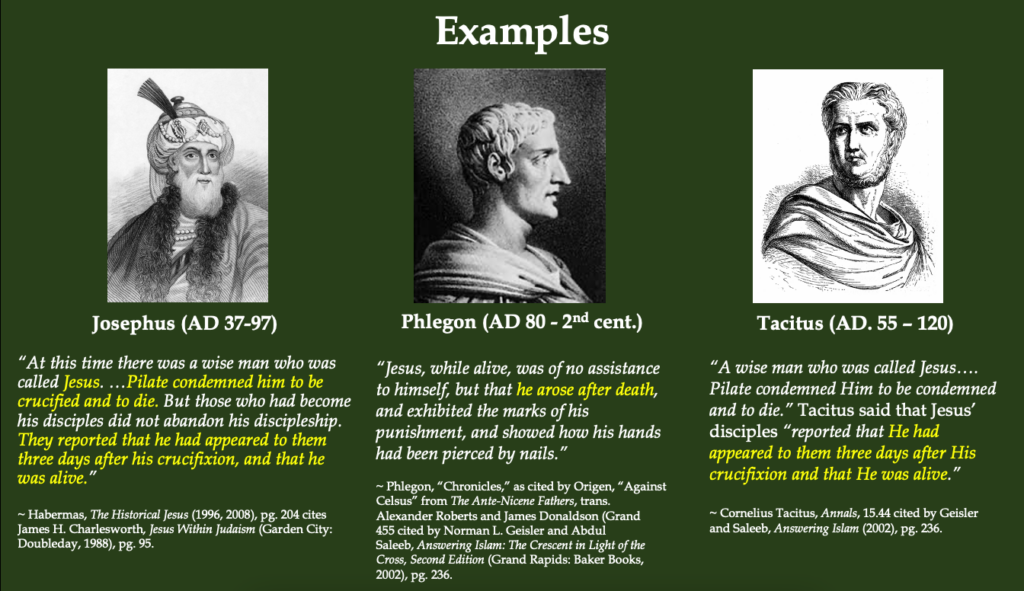
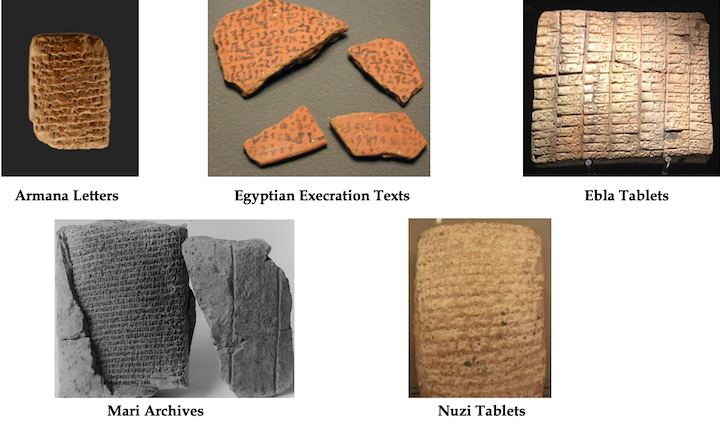
Let’s look at the archaeological evidence for the New Testament. Some people believe there is no historical evidence supporting that Jesus Christ actually existed. But in his book, The Historical Jesus, Gary Habermas cites 17 ancient non-Christian sources (see above pic) that testify to the historicity of Christ and early Christianity. [81] These are real people who testified of the death and resurrection of Jesus Christ. Examples (see pic below) include the Jewish historian, Josephus, the Greek historian Phlegon, and the Roman historian Tacitus.

Skeptics have harshly criticized Luke’s writings because more than any other New Testament writer he has mentioned specific people and places. Luke began his gospel of Jesus Christ, Inasmuch as many have taken in hand to set in order a narrative of those things which have been fulfilled among us, just as those who from the beginning were eyewitnesses and ministers of the word delivered them to us, it seemed good to me also, having had perfect understanding of all things from the very first, to write to you an orderly account, most excellent Theophilus, that you may know the certainty of those things in which you were instructed.” (Luke 1:1-4). 

Luke’s mention of Quirinius as the governor of Syria during the birth of Jesus (Luke 2:2) has been disputed by skeptics because Matthew’s account says Christ’s birth took place during the reign of Herod (Matt. 2:1, 16). Christ was born (6-4 B.C.) before King Herod died in 4 B.C. But critics argue that Josephus (Flavius Josephus, Antiquities of the Jews, 18:1:1; 18:2:1) places Quirinius’ reign in 6 A.D., ten years after Herod’s death. And Acts 5:37 seems to reference a census by Quirinius at that time. Did Luke get the historical placement of Quirinius wrong?    

A grammatical possibility is that the Greek word translated “first” (prōtē) can mean “before” or “earlier” (Luke 2:2; cf. John 15:18). [82] Hence, the verse could be translated as “This census took place before Quirinius was governing Syria.” (Luke 2:2). The Greek verb translated “governing” (hēgemoneuō) does not necessarily mean Quirinius was holding the specific office of governor. It simply means Quirinius was exercising authority in some capacity. [83] Hence, Luke’s meaning would then be that the census that took Mary and Joseph to Bethlehem was the one that Augustus made “before” the one he took when Quirinius was governing Syria in some capacity (in 6 A.D.), implying that another census was taken during another period when Quirinius was exercising authority in Syria. [84]

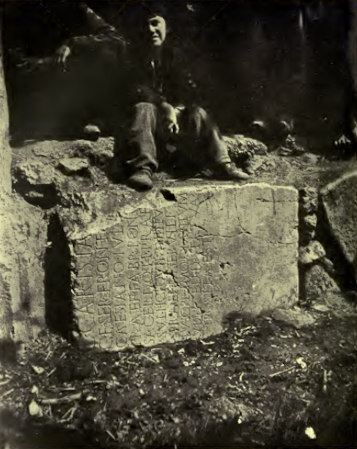
Archaeological discoveries confirm that Quirinius was proconsul of Syria twice. In 1764, a Latin inscription was discovered near Tivoli, located about twenty miles east of Rome, and it is understood to refer to Quirinius governing Syria on two separate occasions. [85] The first time was from 12–2 B.C. to conduct military action against the Homonadensians and then a second time in 6-7 A.D. [86] In addition, a statue dedicated to Quirinius was found by Sir William Ramsay at Pisidian Antioch (see above photo) showing that Quirinius was active in the region and held administrative authority around 12 to 2 B.C. [87] Hence, Quirinius exercised authority over the Roman province of Syria in some capacity twice (12-2 B.C. and A.D. 6-7) and took two separate censuses. [88] This is consistent with Luke’s account. In Luke 2:2, Luke writes, “This census first took place while Quirinius was governing Syria” (describing Quirinius’ rule as the governor’s procurator), and in Acts 5:37, Luke describes a second census taken most likely between 6-7 A.D. (as described by Josephus) when Quirinius was the formal governor of the region. Both Josephus and Luke link this second census to an uprising under Judas of Galilee. Only Luke’s sources were present during the actual events; as a result, Luke’s description of two separate censuses is reasonable. [89]

Repeatedly secular historians have accused Luke of historical inaccuracies only to retract their criticisms after archaeology confirmed Luke’s accounts. Examples include: 

–       Luke’s use of the Greek word meris to maintain that Philippi was a “district” of Macedonia (Acts 16:12) was doubted until inscriptions were found which use this very word to describe divisions of a district. [90]

–       Luke’s usage of the Greek word Politarchēs to denote the civil authority of Thessalonica (Acts 17:6) was questioned, until some 19 inscriptions have been found that make use of this title, 5 of which are in reference to Thessalonica. [91]

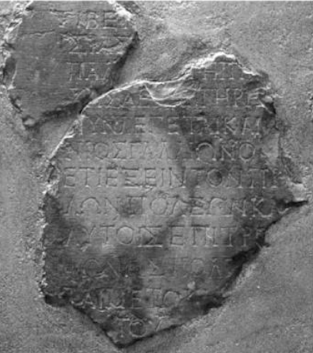
–       Luke’s usage of Proconsul as the title for Gallio in Acts 18:12 has come under much criticism by secular historians, as the later traveler and writer Pliny never referred to Gallio as a Proconsul. This fact alone, they said, proved that the writer of Acts wrote his account much later as he was not aware of Gallio’s true position. In 1908 the Delphi Inscription, dated to 52 A.D. was uncovered (see above photo) and proved that Luke was correct. This inscription states, “As Lusius Junius Gallio, my friend, and the proconsul of Achaia…” [92]

–       When Luke says Paul and Barnabas fled from Iconium (Acts 14:1-5) to Lystra and Derbe, cities in Lycaonia (Acts 14:6), he was implying that Iconium was not in Lycaonia. This was rejected by critical archaeologists who based their belief on the writings of Romans such as Cicero who indicated Iconium was in Lycaonia. [93] But in 1910 Sir William Ramsay found a monument that showed Iconium was a Phrygian city. [94]

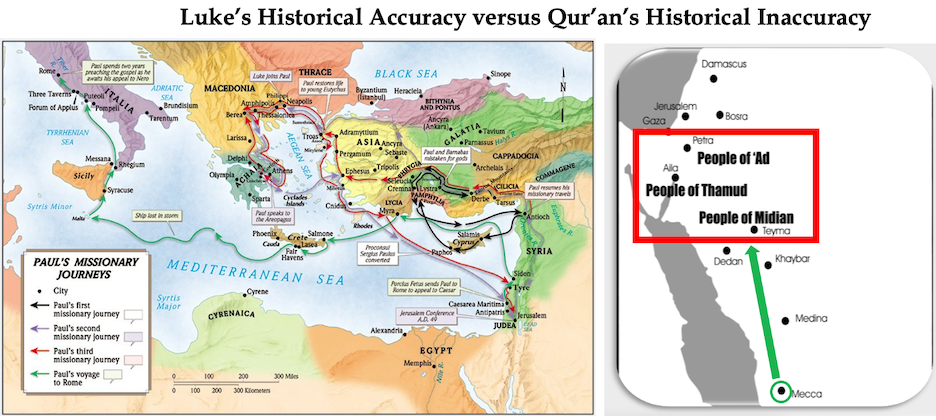
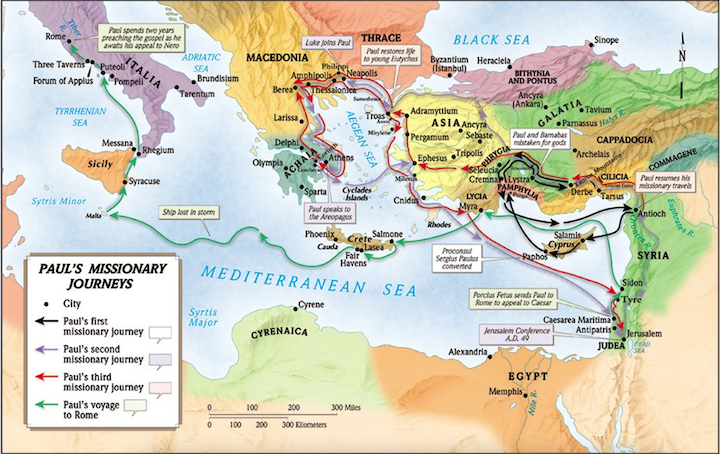
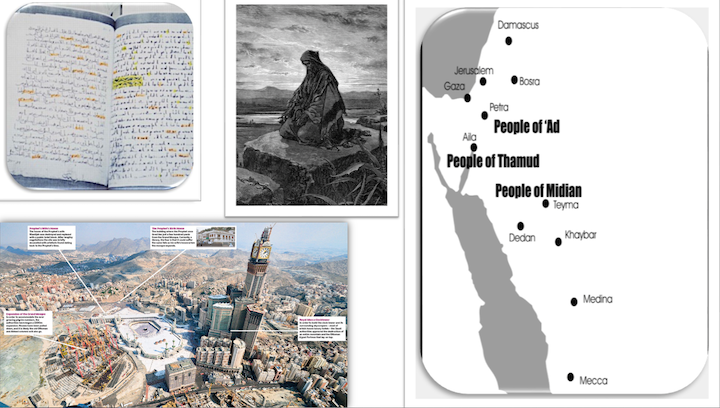
Luke recorded 32 countries, 54 cities, 9 Mediterranean islands, and 95 people in the book of Acts (see above pic), and he did not get any of them wrong. [95] Compare Luke’s historical accuracy with the Qur’an which places fifty-four of its sixty-five geographic references (see pic below) 600 – 1,000 miles too far north of Mecca (Ad = 23 times, Thamud = 24 times, and Midian = 7 times). [96]

Archaeologist and former Lukan skeptic, Sir William Ramsay investigated the archaeological discoveries relevant to Luke’s account in order to disprove the Bible as the inspired Word of God. After 30 years of archaeological research in the Middle East, Ramsay concluded that “Luke is a historian of the first rank; not merely are his statements of fact trustworthy … this author should be placed along with the very greatest historians [97]… Luke’s history is unsurpassed in respect of its trustworthiness.” [98] He later wrote a book on the trustworthiness of the Bible based on his discoveries and converted to Christianity. Sir Ramsay found no historical or geographical mistakes in the book of Acts. [99]

Unlike the Qur’an, archaeology repeatedly confirms the historical reliability of the New Testament. Smith writes, “We have no reason to fear archaeology. In fact, it is this very science which has done more to authenticate our scriptures than any other. Thus, we encourage the secular archaeologists to dig, for as they dig, we know they will only come closer to that which our scriptures have long considered to be the truth and give us reason to claim that indeed our Bible has the right to claim true authority as the only historically verified Word of God. This is why so many eminent archaeologists are standing resolutely behind the Biblical accounts.” [100]

Conclusion

From this brief survey we can conclude that the archaeological evidence for the historicity of the Qur’an proves to be the most damaging. The glaring historical inaccuracies involving the direction of prayer (Qibla), dirham coins in the time of Joseph, Samaritans in the time of Moses, chain mail in the time of David, crucifixions in the times of Joseph and Moses, and Alexander the Great’s making of an impregnable barrier, cannot be from a divine source. Not only do the seventh and eighth century ruins and inscriptions from the area seem to contradict the notion that Muhammad canonized a direction of prayer during his lifetime, or that he had formulated a scripture known as the Qur’an, but the idea of his universal prophethood, that he was the final “seal” of all prophets is brought into question. This indeed is significant and troublesome.

If the Qur’an was truly from an all-knowing God (Allah), it would not contain so many historical inaccuracies. Instead, these inaccuracies suggest that the Qur’an is not from a divine source, but from a human source. Whoever wrote the Qur’an either did not know their history well or they borrowed these stories from other sources with little discretion on their parts. Hence, the Qur’an is a manmade book that is not to be taken seriously. 

As for the Bible, we have learned from archaeology that the names, places, and events mentioned in the Bible have been recorded accurately so that what we have is the representation of what God said and did. The historical events and people in the Bible do not confuse names, dates and events, and in fact, continue to coincide with current archaeological findings. This is very significant, since with each successive year, ongoing archaeological discoveries fail to reveal any historical contradictions in our Scriptures. Instead, they continue to substantiate what the Bible has been saying for 2,000-4,000 years.

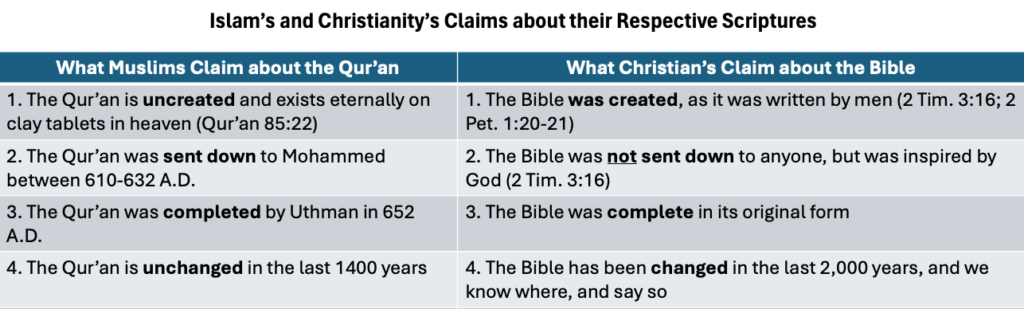
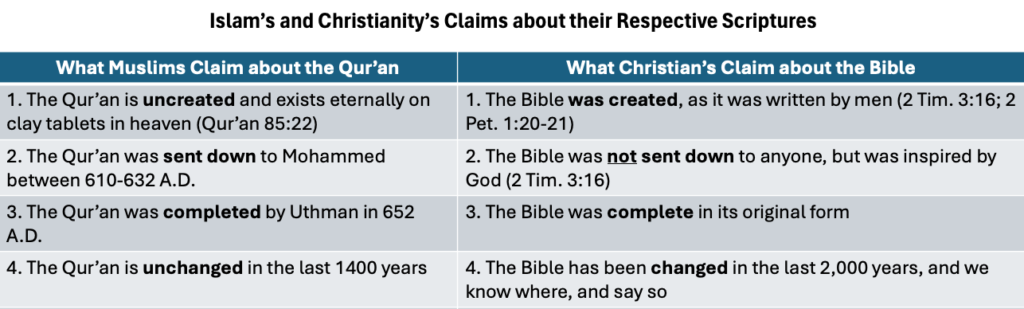
 Earlier we learned that Islam makes four claims for the authority of the Qur’an (see chart below): [101]

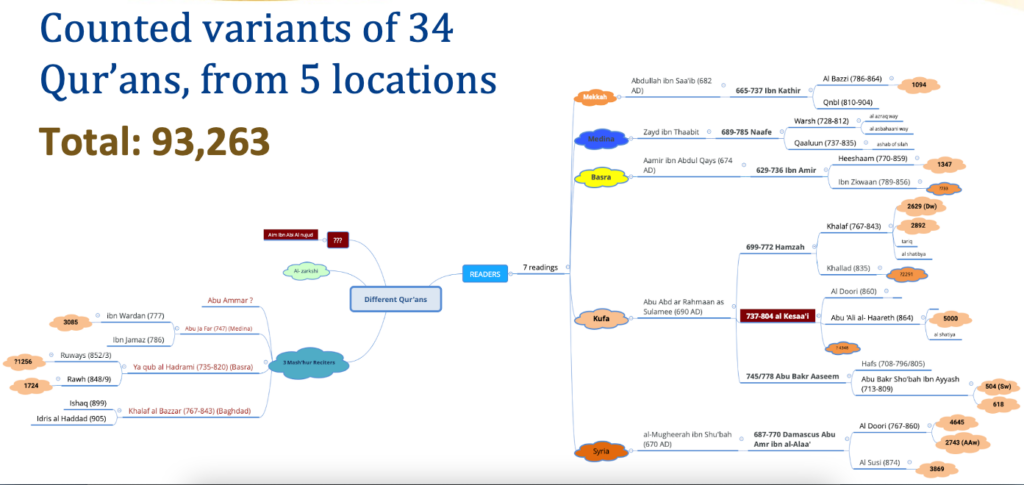
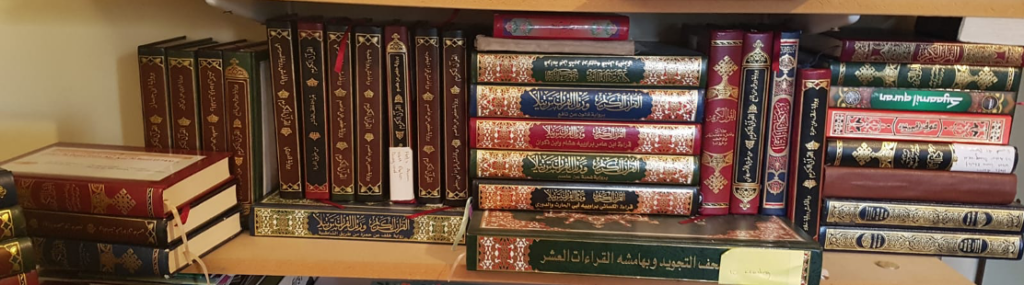
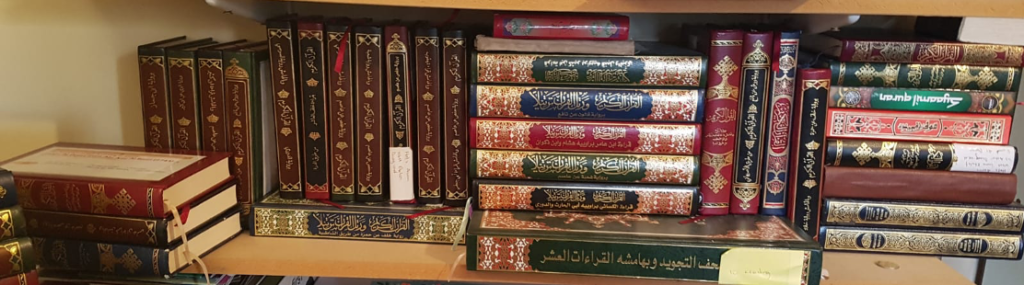
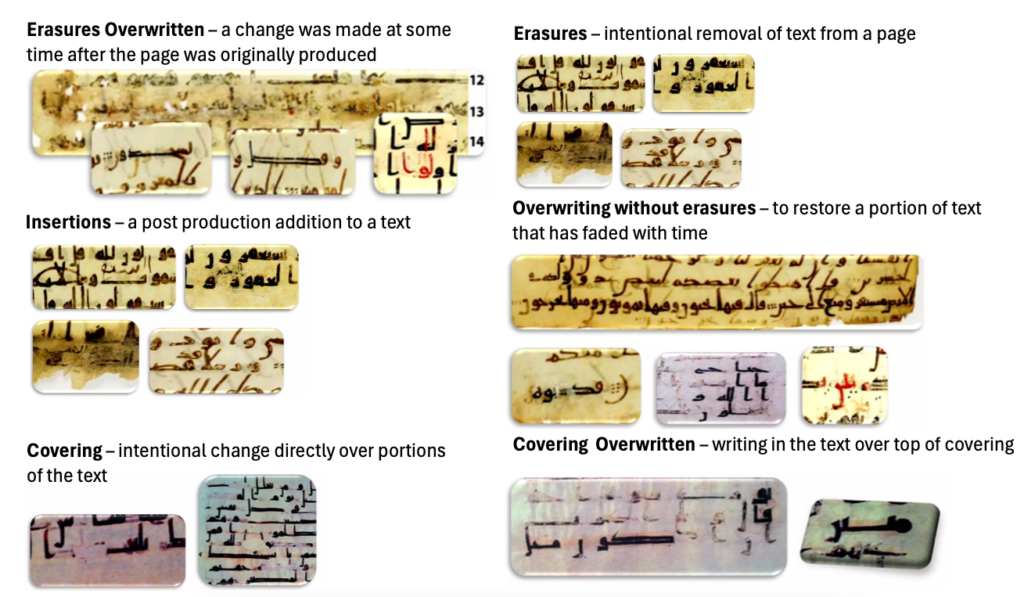
 1. It must be eternal (Qur’an 85:21-22; cf. 10:15; 18:27). The Qur’an was uncreated and existed eternally written on clay tablets in heaven. Hence, no human being can touch it or alter it. Why? Because Allah will guard it (Qur’an 15:9). Yet we have seen in our survey of the Qur’an, that it has been handled and altered numerous times so that even today there are at least 34 different Qur’ans in the world (see photo below).  

2. It must be sent down (Qur’an 39:41). The Qur’an was sent down from Allah through the angel Gabriel to Mohammed from 610 – 632 A.D. Yet, Mohammed did not write these revelations down. He had 23 years to write down the Qur’an, but he never did. The Qur’an was not written down until Mohammed’s secretary, Zayd ibn Thabit, [102] finally wrote it down (632-634 A.D.), and gave it to Hafsah, the daughter of Umar (the second Caliph), who stored the Qur’an under her bed for twenty years. [103] If this truly was the final revelation from God that was supposed to have corrected that which had been corrupted, then why would they put it under a bed for twenty years?  

3. It must be complete. The Qur’an was completed by 632 A.D. when Mohammed received the last revelation from Allah. But it wasn’t written down until after Mohammed died. After Caliph Uthman heard that there were several different versions of the Qur’an being used by Muslim communities, he had the copy of the Qur’an given to Hafsah revised by Zayd, along with Az-Zubair, Al-As, and bin Hisham, into an official revised version of the Qur’an in the “Quraishi” dialect (in 652 A.D.). [104] Islam does not have one Qur’anic manuscript from the 7th century when the Qur’an was supposedly written down. 

4. It must be unchanged (Qur’an 10:15; 15:9; 18:27). Islam claims that the Qur’an is unchanged in the last 1,400 years. But we have learned that the six earliest extant manuscripts of the Qur’an are from the 8th century, and not one of them agrees with the other. [105] Dr. Daniel Brubaker has found thousands of corrections (corruptions) in these six early manuscripts and others soon after them, [106] which undermines Islam’s claim that the Qur’an has been unchanged or uncorrupted the last 1,400 years. One of the team members of Dr. Jay Smith has found 34 different Qur’ans with a total of 93,263 variants/corruptions (see photo below).  [107]
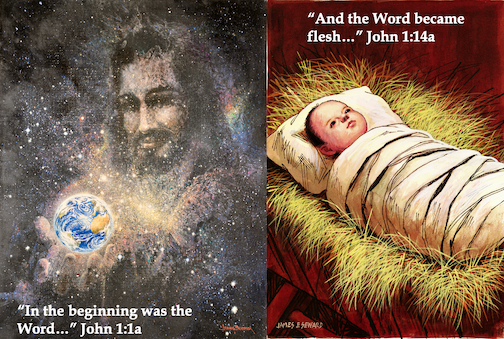
Christians would not say these 4 same things about our Bible which is the Written Word of God. But we need to remember that the Bible is not our only Word of God. We also have the Living Word of God or Logos, Who is Jesus Christ (John 1:1-18).

Let’s apply Islam’s four criteria to Jesus:

1. Is Jesus Christ eternal? Yes. The Bible says, “We are in Him who is true, in His Son Jesus Christ. This is the true God and eternal life.” (I John 5:20). Jesus has no beginning and no end because of His eternality. Jesus said, “I am the Alpha and the Omega… who is and who was and who is to come, the Almighty.’” (Rev. 1:8).  

2. Was Jesus Christ sent down? Certainly. Jesus said, “For I have come down from heaven, not to do My own will, but the will of Him who sent Me.” (John 6:38). 

3. Is Jesus Christ complete? Yes, He is complete in His Person, being fully God (John 1:1; Tit. 2:13; I John 5:20) and fully Man (John 1:14), and in His Work (John 19:30). 

4. Is Jesus Christ unchanged? Absolutely. The Bible says, “Jesus Christ is the same yesterday, today, and forever.” (Heb. 13:8).  

Everything that the Muslims need and seek can be found in the Person of Jesus Christ. Hence, the four criteria that Muslims are searching for in their Qur’an, their “Primary Revelation,” Christians already have in Jesus Christ, our “Primary Revelation” (Heb. 1:2). Therefore, we must present Jesus Christ, a much better and greater Revelation, to our Muslim friends. 

God has not given human governments to do this. He has not given secular humanists to do this. Nor has God given atheists and other religious people to do this. The Lord has entrusted His church consisting of believers in Jesus Christ to bring the Living Word to our lost Muslim friends (Mark 16:15; Acts 1:8), so “whoever believes in Him should not perish [in hell] but have everlasting life [both now and forever]” (John 3:16). 

In my next article, Lord willing, we will look at why Muslims and Christians believe their Scriptures are true.

ENDNOTES:

[1] Dr. Jay Smith’s September 15, 2023, video entitled, “Investigating Islam with Dr. Jay Smith (2 Corinthians 10:5),” at www.youtube.com or at this LINK . 

[2] Jay Smith, “The Bible and The Qur’an – An Historical Comparison,” at www.pfandercenter.org.

[3] Ibid., cites Patricia Crone and Michael Cook, Hagarism (Cambridge: Cambridge University Press, 1977), pg. 23. 

[4] Daniel Janosik, THE GUIDE TO ANSWERING ISLAM: What Every Christian Needs to Know About Islam and the Rise of Radical Islam(Cambridge, OH: Christian Publishing House, 2019 Kindle Edition), pg. 56 cites Dan Gibson, Qur’anic Geography: A Survey and Evaluation of the Geographical References in the Qur’an with Suggested Solutions for Various Problems and Issues (Canada: Independent Scholars Press, 2011), pg. 379. 

[5] Ibid., cites Gibson, Qur’anic Geography (2011), pg. 223. 

[6] Ibid., pp. 56-57 cites “Destruction of early Islamic heritage sites in Saudi Arabia,” https://en.wikipedia.org/wiki/Destruction_of_early_Islamic_heritage_sites_in_Saudi_Arabia.

[7] Ibid., pg. 57.

[8] Smith, “The Bible and The Qur’an – An Historical Comparison,” at www.pfandercenter.org cites Crone and Cook, Hagarism (1977), pg. 24. 

[9] Ibid. 

[10] Smith, “Investigating Islam with Dr. Jay Smith (2 Corinthians 10:5),” at www.youtube.com

[11] Smith, “The Bible and The Qur’an – An Historical Comparison,” at www.pfandercenter.org.

[12] Ibid. 

[13] Much of this section is adapted from Ibid., unless otherwise noted. 

[14] William J. Federer, What Every American Needs to Know about the Qur’an – A History of Islam & the United States (William J. Federer, 2007; 2016 Kindle Edition), pg. 96. 

[15] Smith, “The Bible and The Qur’an – An Historical Comparison,” at www.pfandercenter.org, cites Yahuda Nevo, “Towards a Prehistory of Islam,” Jerusalem Studies in Arabic and Islam, vol.17 (Hebrew University of Jerusalem, 1994), pg. 113. 

[16] Ibid., cites Cyril Glasse , The Concise Encyclopedia of Islam (San Francisco, CA: HarperSanFrancisco, 1991), pg. 102.

[17] Ibid., cites Glasse, The Concise Encyclopedia of Islam (1991), pg. 102.

[18] Ibid., cites Van Bercham 1927:217. 

[19] Ibid., cites ‘Kitab al-‘uyun wa’l-hada’iq,’ edited by M. de Goeje and P. de Jong 1869:4

[20] Verse taken from Usama K. Dakdok,  THE GENEROUS QUR’AN: An Accurate, Modern English Translation of the Qur’an, Islam’s Holiest Book (Venice, FL: Usama Dakdok Publishing, LLC, 2009 Smashwords Edition), pg. 443. Used by permission of Usama Dakdok Publishing, LLC.

[21] “Joseph,” at www.thebiblicaltimeline.org.

[22] Andrew Vargo, “’Dirham’ In The Time Of Joseph?” at www.answering-islam.org.

[23] Excerpt from Dakdok, THE GENEROUS QUR’AN, 2009 Smashwords Edition, pg. 499. 

[24] Verse taken from Dakdok, THE GENEROUS QUR’AN, 2009 Smashwords Edition, pg. 443. Used by permission of Usama Dakdok Publishing, LLC.

[25] Tom Constable, Dr. Constable’s Notes on Genesis, 2025 Edition, pg. 2. 

[26] Jochen Katz, “The ‘Samaritan’ Error In The Qur’an,” at www.answering-islam.org.

[27] Excerpt from Dakdok, THE GENEROUS QUR’AN, 2009 Smashwords Edition, pg. 443. 

[28] Verses taken from Dakdok, THE GENEROUS QUR’AN, 2009 Smashwords Edition, pp. 590, 596. Used by permission of Usama Dakdok Publishing, LLC.

[29] Tom Constable, Dr. Constable’s Notes on 1 Samuel, 2026 Edition, pp. 2-4. 

[30] “Chain Mail” article at www.en.wikipedia.org

[31] Verses taken from Dakdok, THE GENEROUS QUR’AN, 2009 Smashwords Edition, pp. 441-442. Used by permission of Usama Dakdok Publishing, LLC.

[32] Verse taken from Ibid., pg. 341. Used by permission of Usama Dakdok Publishing, LLC.

[33] L. Cilliers and F. P. Retief, “The History and Pathology of Crucifixion,” South African Medical Journal (Suid-Afrikannse tydskrif via geneeskunde) 93, no. 12 (December 2003), pp. 938–941. 

[34] Verse taken from Dakdok, THE GENEROUS QUR’AN, 2009 Smashwords Edition, pg. 422. Used by permission of Usama Dakdok Publishing, LLC.

[35] Usama K. Dakdok, Exposing the Truth about the Qur’an: The Revelation of Error, Volume 2 (Usama Dakdok Publishing LLC, 2013 Smashwords Edition), pp. 497-498. 

[36] Article entitled, “Alexander the Great in Islamic tradition,” at www.en.wikipedia.org cites Sidney Griffith, “The Narratives of ‘the Companions of the Cave,’ Moses and His Servant, and Dhū ’l-Qarnayn in Sūrat al-Kahf,” Journal of the International Qur’anic Studies Association ,Vol. 6, No. 1 (2021): 146–147; Christine Chism, “Facing The Land Of Darkness: Alexander, Islam, And The Quest For The Secrets Of God,” Alexander the Great in the Middle Ages (University of Toronto Press, 2016), pp. 51–75; Majid Daneshgar (2020), Studying the Qur’ān in the Muslim Academy, AAR reflection and theory in the study of religion (New York (N.Y.): Oxford University Press, 2020), pg. 77.

[37] Verse taken from Dakdok, THE GENEROUS QUR’AN, 2009 Smashwords Edition, pg. 423. Used by permission of Usama Dakdok Publishing, LLC.

[38] Dakdok, Exposing the Truth about the Qur’an: The Revelation of Error, Volume 2, 2013 Smashwords Edition, pp. 503-505 cites Ibn Kathir, Stories of the Prophets, vol. 2, Abo Al Fida Ishamail Ibn Kathir Al Kurashi Al Damashce (Beirut: Dar Al-Arab Heritage, 1408 AH, 1988), pp. 129-133. 

[39] Ibid., pg. 516. 

[40] Ibid., pp. 516-517. 

[41] Much of this section is adapted from Smith’s September 15, 2023, video entitled, “Investigating Islam with Dr. Jay Smith (2 Corinthians 10:5),” at www.youtube.com, unless otherwise noted.

[42] Janosik, THE GUIDE TO ANSWERING ISLAM, 2019 Kindle Edition, pg. 26 cites Karl-Heinz Ohlig and Gerd R. Puin, eds. The Hidden Origins of Islam: New Research into its Early History (NY: Prometheus Books, 2010), pp. 63-63; Robert Spencer, Did Muhammad Exist? An Inquiry into Islam’s Obscure Origins (Wilmington, Delaware: ISI Books, 2012), pp. 45-46, 55-56.

[43] Ibid., pg. 26 cites Yehuda Nevo, and Judith Koren, Crossroads to Islam: The Origins of the Arab Religion and the Arab State (NY: Prometheus Books, 2003), pp. 258-267.

[44] Smith (2023), “Investigating Islam with Dr. Jay Smith (2 Corinthians 10:5),” at www.youtube.com

[45] Ibid., cites Ilkka Juhani Lendstedt, “Who is in, who is out? Early Muslim Identity Through Epigraphy and Theory,” 2019; cf. Ilkka Juhani Lenstedt, Arabic Rock Inscriptions Up To 750 CE in A Marsham (ed.), The Umayyad World., 20, Routledge, Abingdon (University of Helsinki, 2020), pp. 411-437. 

[46] Much of this section is adapted from Smith, “The Bible and The Qur’an – An Historical Comparison,” at www.pfandercenter.org, unless otherwise noted.

[47] Ibid., cites Michael Cook, Muhammad (Oxford University Press, 1983), pg. 74.

[48] Ibid., cites Cook, Muhammad (1983), pg. 74;  Patricia Crone and Michael Cook, Hagarism (Cambridge: Cambridge University Press, 1977), pp. 167-168; see M. Van Berchem, Materiaux pour un Corpus Inscriptionum Arabicarum, part two, vol. ii (Cairo, 1927), pp. 215-217 and Adolph Grohmann, Arabic Papyri from Hirbet el-Mird (1963),  no. 72 to delineate where these variances are.

[49] Ibid., cites Crone and Cook, Hagarism (1977), pp. 18, 167.

[50] Ibid.

[51] Tom Constable, Dr. Constable’s Notes on Genesis, 2026 Edition, pp. 192-194 cites Eugene H. Merrill, “Fixed Dates in Patriarchal Chronology,” Bibliotheca Sacra 137:547 (July- September 1980), pg. 248; Leon J. Wood, A Survey of Israel’s History (Grand Rapids: Zondervan Publishing House, 1970), pp. 30-38. 

[52] Joseph M. Holden and Norman Geisler, The Popular Handbook of Archaeology and the Bible: Discoveries That Confirm the Reliability of Scripture (Eugene, OR: Harvest House Publishers, 2013 Kindle Locations 2095-2096 cites , K.A. Kitchen, “The Patriarchal Age: Myth or History?” Biblical Archaeology Review, March/April 1995, pg. 48ff. 

[53] Josh McDowell and Sean McDowell, Evidence That Demands a Verdict: Life-Changing Truth for a Skeptical World (Nashville, TN: Thomas Nelson, 2017 Kindle Edition), pg. 451 cites K. A. Kitchen, On the Reliability of the Old Testament (Grand Rapids, MI: W. B. Eerdmans, 2003), pp. 341-342; cf. John D. Currid, “Genesis,” The ESV Archaeology Study Bible, Edited by John D. Currid and David W. Chapman (Wheaton: Crossway, 2017), pg. 13. 

[54] Constable, Dr. Constable’s Notes on Genesis, 2026 Edition, pg. 200 cites Kyle M. Yates, “Genesis,” The Wycliffe Bible Commentary, Edited by Charles F. Pfeiffer and Everett F. Harrison (Chicago: Moody Press, 1962), pg. 16.  

[55] Constable, Dr. Constable’s Notes on Genesis, 2026 Edition, pg. 202; Allen P. Ross, “Genesis,” The Bible Knowledge Commentary Law, 2018 Kindle Edition, pg. 75.

[56] Allen P. Ross, “Genesis,” The Bible Knowledge Commentary Law, 2018 Kindle Edition, pg. 75.

[57] Retrieved on April 26, 2026, from Bryan Windle, July 16, 2021, article entitled, “Top Ten Discoveries Related to Abraham,” at https://biblearchaeologyreport.com/2021/07/16/top-ten-discoveries-related-to-abraham/

[58] Retrieved on April 26, 2026, from Todd Bolen, “Haran,” at https://www.bibleplaces.com/haran/; cf. McDowell Evidence That Demands a Verdict, 2017 Kindle Edition, pg. 453 cites Daniel E. Fleming, “Genesis in History and Tradition: The Syrian Background of Israel’s Ancestors, Reprise,”in The Future of Biblical Archaeology: Reassessing Methodologies and Assumptions, edited by James K. Hoffmeier and Alan Millard (Grand Rapids, MI: Eerdmans, 2004), pg. 216.

[59] Constable, Dr. Constable’s Notes on Genesis, 2026 Edition, pg. 204 cites Tremper Longman. III, “Genesis,” The Baker Illustrated Bible Background Commentary, edited by J. Scott Duvall and J. Daniel Hays (Grand Rapids: Baker Books, 2020), pg. 93.

[60] Constable, Dr. Constable’s Notes on Genesis, 2026 Edition, pg. 215. 

[61] McDowell, Evidence That Demands a Verdict, 2017 Kindle Edition, pg. 454 cites Eugene H. Merrill, Kingdom of Priests: A History of Old Testament Israel (Grand Rapids, MI: Baker Academic, 1998), pg. 63.

[62] Retrieved on April 27, 2026, from “Shechem: Its Archaeological and Contextual Significance,” at www.biblearchaeology.org. or at this LINK.

[63] More recent archaeological research places Bethel at el-Bira, about 10.3 miles north of Jerusalem and Ai at Khirbet el-Maqatir about 1 mile southeast of el-Bira – see Bryan Windle, April 12, 2019, “Biblical Sites: The Lost City of Ai… Found,” at www.biblearchaeologyreport.com cites Bryant G. Wood, “The Search for Joshua’s Ai,” in Critical Issues in Early Israelite History, edited by Richard S. Hess, Gerald A. Klingbeil, and Paul J. Ray Jr. (Winona Lake: Eisenbrauns 2008), pp. 210-240;  Bryant G. Wood, “Excavations at Khirbet el-Maqatir: 1995 to 2000 and 2009 to 2011,” Associates for Biblical Research, April 4, 2012; Scott Stripling, “2014 Excavations at Kh. el-Maqatir: A Proposed New Location for Ai and Ephraim,” Associates for Biblical Research, March 9, 2015; cf. McDowell Evidence That Demands a Verdict, 2017 Kindle Edition, pp. 500 -501.

[64] Windle, July 16, 2021, article entitled, “Top Ten Discoveries Related to Abraham,” at www.biblearchaeologyreport.com  cites Kenneth A. Kitchen,” Shishak’s Military Campaign in Israel Confirmed,” at www.library.biblicalarchaeology.orgMcDowell, Evidence That Demands a Verdict, 2017 Kindle Edition, pg. 452 cites Kitchen, On the Reliability of the Old Testament (2003), pg. 313.

[65] Ibid.

[66] Excerpt from Dakdok, THE GENEROUS QUR’AN, 2009 Smashwords Edition, pp. 57-58; Excerpt from Usama K. Dakdok, Exposing the Truth about the Qur’an: The Revelation of Error, Volume 1 (Usama Dakdok Publishing LLC, 2013 Smashwords Edition), pp. 194-314.

[67] Smith, “The Bible and The Qur’an – An Historical Comparison,” at www.pfandercenter.org.

[68] Location of Tall el-Hammam. (a) Photo of the southern Levant, looking north, showing the Dead Sea, the site location (TeH), and nearby countries. The Dead Sea Rift, the fault line marking a major tectonic plate boundary, runs through the area. Source of base (b) Photo: NASA, Space Shuttle. “The Sinai Peninsula and the Dead Sea Rift”. Photo: sts109-708-024, taken 12/16/2009. From the NASA Langley Research Center Atmospheric Science Data Center (nasa.gov/topics/earth/features/astronauts_eyes/sts109-708-024.html). Adapted from Daniel Janosik March 16, 2026, class lecture entitled, “Is the Bible the Word of God?” 

[69] Holden and Geisler, The Popular Handbook of Archaeology and the Bible, 2013 Kindle Locations 2509-2514 cite Steve Collins, “Where is Sodom? The Case for Tall el-Hammam,” Biblical Archaeology Review, March/April 2013; Malcolm A. LeCompte, Steven Collins, Phillip J. Silvia, Gunther Kletetschka, Timothy Witwer, Robert E. Hermes, Christopher R. Moore, Wendy S. Wolbach, George A. Howard, A. Victor Adedeji, Charles Mooney, James P. Kennett, Allen West, Ted E. Bunch, May 24, 2025, research article entitled, “A Tunguska Sized Airburst Destroyed Tall el-Hammam a Middle Bronze Age City in the Jordan Valley Near the Dead Sea (Expanded),” at www.scienceopen.com or at this LINK.

[70] LeCompte, Collins, Silvia, Kletetschka, Witwer, Hermes, Moore, Wolbach, Howard, Adedeji, Mooney, Kennett, West, Bunch, May 24, 2025, research article entitled, “A Tunguska Sized Airburst Destroyed Tall el-Hammam a Middle Bronze Age City in the Jordan Valley Near the Dead Sea (Expanded),” at www.scienceopen.com.

[71] Ibid.

[72] Ibid., cites Mark Boslough, Airburst Modeling in First International Workshop on Potentially Hazardous Asteroids Characterization, Atmospheric Entry and Risk Assessment. (Sandia National Lab. (SNL-NM), Albuquerque, NM, 2015, (United States)).

[73] LeCompte, Collins, Silvia, Kletetschka, Witwer, Hermes, Moore, Wolbach, Howard, Adedeji, Mooney, Kennett, West, Bunch, May 24, 2025, research article entitled, “A Tunguska Sized Airburst Destroyed Tall el-Hammam a Middle Bronze Age City in the Jordan Valley Near the Dead Sea (Expanded),” at www.scienceopen.com.

[74] Holden and Geisler, The Popular Handbook of Archaeology and the Bible, 2013 Kindle Locations 2509-2514 cite Steve Collins, “Where is Sodom? The Case for Tall el-Hammam,” Biblical Archaeology Review, March/April 2013.

[75] McDowell, Evidence That Demands a Verdict, 2017 Kindle Edition, pg. 497 cites Bryant Wood, “Did the Israelites Conquer Jericho? A New Look at the Archaeological Evidence,” Biblical Archaeology Review 16, no.2 (Mar/Apr 1990), pp. 10-12.

[76] Bryant G. Wood, June 9, 2008, research article, “The Walls of Jericho,” at www.biblearchaeology.org or at this LINK ; Bryant Wood, March 1, 1999, “The Walls of Jericho,” at www.answersingenesis.org cites Ernst Sellin and Carl Watzinger, Jericho die Ergebnisse der Ausgrabungen, Osnabrück, Otto Zeller Verlag (1973), pg. 58, (reprint of the 1913 edition), and Kathleen M. Kenyon, Excavations at Jericho (London, British School of Archaeology in Jerusalem, 1981), Vol. 3, pp. 110, 370. 

[77] McDowell, Evidence That Demands a Verdict, 2017 Kindle Edition, pg. 516. 

[78] Ibid., cites André Lemaire, “‘House of David’ Restored in Moabite Inscription,” Biblical Archaeology Review 20, no. 3 (1994), pg. 36; Holden and Geisler, The Popular Handbook of Archaeology and the Bible, 2013 Kindle Locations 3031-3045.

[79] Holden and Geisler, The Popular Handbook of Archaeology and the Bible, 2013 Kindle Locations 3006-3012.

[80] McDowell, Evidence That Demands a Verdict, 2017 Kindle Edition, pg. 516 cites George Athas, The Tel Dan Inscription: A Reappraisal and a New Interpretation (London: T&T Clark, 2003), pg. 281 and Steven L. McKenzie, King David: A Biography (Oxford University Press, 2000, E-book), pg. 13; Holden and Geisler, The Popular Handbook of Archaeology and the Bible, 2013 Kindle Locations 3012-3017 cites Alan Millard, “The Tell Dan Stele,” in William W. Hallo and K. Lawson Younger, eds., The Context of Scripture: Canonical Compositions from the Biblical World, Vol. 1 (Leiden, the Netherlands Brill, 2003), pp. 161-162. Also see Holden and Geisler’s helpful discussion responding to critics of Tell Dan Find at 2013 Kindle Locations 3017-3031.  

[81] Gary Habermas, The Historical Jesus (Joplin, MO: College Press, 1996, 2008), pp. 198-224.

[82] Walter Bauer, A Greek-English Lexicon of the New Testament and Other Early Christian Literature, 2000 Kindle Edition, pg. 893. 

[83] Bryan Windle, December 19, 2019, “Quirinius: An Archaeological Biography,” at www.biblearchaeologyreport.com cites Andrew E. Steinmann, From Abraham To Paul: A Biblical Chronology (St. Louis: Concordia Publishing House, 2011), pg. 239; cf. Bauer, A Greek-English Lexicon of the New Testament and Other Early Christian Literature, 2000 Kindle Edition, pg. 433.

[84] Holden and Geisler, The Popular Handbook of Archaeology and the Bible, 2013 Kindle Locations 1739-1741.

[85] William A. Ramsay, Was Christ Born at Bethlehem? A Study on the Credibility of St. Luke (Originally published Paternoster Row, London: Hodder and Stoughton, 1898; Seattle, WA: re:Source Digital Publishing, 2018 Kindle Edition), pg. 160.

[86] Holden and Geisler, The Popular Handbook of Archaeology and the Bible, 2013 Kindle Locations 1741-1743; cf. Ramsay, Was Christ Born at Bethlehem?, 2018 Kindle Edition, pg. 161; Jack Finegan, Handbook of Biblical Chronology: Principles of Time Reckoning in the Ancient World and Problems of Chronology in the Bible, Revised Edition (Peabody, MA: Hendrickson Publishers, 1998), pg. 304.

[87] William Mitchell Ramsay, The Bearing of Recent Discovery on the Trustworthiness of the New Testament (Originally published in London: Hodder & Stoughton, 1915; 2021 Kindle Edition), pp. 283-290.

[88] Tom Constable, Dr. Constable’s Notes on Luke, 2026 Edition, pg. 58 cites Harold W. Hoehner, Chronological Aspects of the Life of Christ, Contemporary Evangelical Perspectives series (Grand Rapids: Zondervan Publishing House, 1977), pg. 22;  cf. Flavius Josephus, Antiquities of the Jews, 18:1:1; 18:2:1; Eusebius, The Ecclesiastical History of Eusebius Pamphilus Twin Brooks series. Popular ed. (Grand Rapids: Baker Book House, 1974), 1:5:28; Jack Finegan, Light from the Ancient PastThe Archeological Background of Judaism and Christianity 2nd edition (Princeton University Press. London: Oxford University Press, 1959), pp. 258-261; Joseph P. Free, Archaeology and Bible History 6th ed. (Wheaton: Scripture Press, 1950, 1959), pp. 285-286.

[89] J. Warner Wallace, August 16, 2017, “Unbelievable? Is Luke’s Description Of Quirinius Historically Inaccurate?” at www.coldcasechristianity.com

[90] McDowell, Evidence That Demands a Verdict, 2017 Kindle Edition, pg. 88 cites Free, Archaeology and Bible History 6th ed. (1950, 1959), pg. 320.

[91] Ibid. cites F. F. Bruce, “Archaeological Confirmation of the New Testament,” in Revelation and the Bible, edited Carl Henry (Grand Rapids, MI: Baker Book House, 1969), pp. 325, 360 and David E. Graves, Biblical Archaeology: An Introduction with Recent Discoveries That Support the Reliability of the Bible (Moncton, New Brunswick, Canada: Electronic Christian Media, 2014), pp. 215-216.

[92] Ibid. cites Howard F. Vos ed. Can I Trust the Bible? (Chicago, IL: Moody Press, 1963), 180 and Graves, Biblical Archaeology (2104), pp. 215-216.

[93] Ramsay, The Bearing of Recent Discovery on the Trustworthiness of the New Testament (1915), 2021 Kindle Edition, pp. 37-40; Holden and Geisler, The Popular Handbook of Archaeology and the Bible, 2013 Kindle Locations 4026-4037.

[94] Ibid., pp. 67-76; cf. McDowell, Evidence That Demands a Verdict, 2017 Kindle Edition, pg. 88 cites Free, Archaeology and Bible History 6th ed. (1950, 1959), pg. 317.

[95] Norman L. Geisler and Thomas Howe, The Big Book of Bible Difficulties: Clear and Concise Answers from Genesis to Revelation (Grand Rapids, MI: Baker Books, 2008), pg. 47.

[96] Janosik, THE GUIDE TO ANSWERING ISLAM, 2019 Kindle Edition, pg. 56 cites Peter Townsend, The Mecca Mystery: Probing the Black Hole at the Heart of Muslim History (Peter Townsend, 2018), pg. 104 and Dan Gibson, Qur’anic Geography: A Survey and Evaluation of the Geographical References in the Qur’an with Suggested Solutions for Various Problems and Issues (Canada: Independent Scholars Press, 2011), pg. 137.

[97] Ramsay, The Bearing of Recent Discovery on the Trustworthiness of the New Testament (1915), 2021 Kindle Edition, pg. 220. 

[98] Ibid., pg. 79.

[99] Janosik, March 16, 2026, class lecture entitled, “Is the Bible the Word of God?”

[100] Smith, “The Bible and The Qur’an – An Historical Comparison,” at www.pfandercenter.org.

[101] Much of this section is adapted from Smith (2023) video entitled, “Investigating Islam with Dr. Jay Smith (2 Corinthians 10:5),” at www.youtube.com, unless otherwise noted.

[102] Norman L. Geisler and Abdul Saleeb, Answering Islam: The Crescent in Light of the Cross Second Ed. (Grand Rapids, MI: Baker Books, 1993, 2002), pp. 92-93 cites Al-Bukhari, The Translation of the Meanings of Sahih Al-Bukhari, Vol. 6, pp. 477-478.

[103] Janosik, THE GUIDE TO ANSWERING ISLAM, 2019 Kindle Edition, pg. 321; cf. Jay Smith, November 24, 2019, video entitled, “Jay Smith Historical Critique Quran Origins 1,” at www.youtube.com

[104] Geisler and Saleeb, Answering Islam (2002), pg. 93 cites Al-Bukhari, The Translation of the Meanings of Sahih Al-Bukhari, Vol. 6, pp. 478-479. 

[105] Smith, March 9, 2026, class lecture entitled, “Manuscript Evidence for the Qur’an,” cites Dr. Tayyar Altıkulaç, Al-Muṣḥaf Al-Sharif: Attributed To ʿUthmān Bin ʿAffān (IRICA, 2007), pp. 23, 36 – footnote 14a, 41f, 65, 71-72, 81; François Déroche, La transmission écrite du Coran dans les débuts de l’islam. Le codex Parisino-petropolitanus (Brill, 2009), pp. 172-177; cf. Jay Smith, “The Bible and The Qur’an – An Historical Comparison,” at www.pfandercenter.org where he cites Martin Lings and Yasin Hamid Safadi, The Qur’an: Catalogue of an Exhibition of Quran Manuscripts at the British Library3 April  – 15 August, 1976 (British Library, World of Islam Pub. Co., 1976), pp. 11-20.

[106] Daniel Brubaker, Corrections in Early Qurʾān Manuscripts: Twenty Examples (FULL COLOR EDITION) (Quran Manuscript Change Studies Book 1), 2019 Kindle Locations 168-169.

 [107] Retrieved on May 11, 2026 from the March 23, 2026, powerpoint entitled, “In Search of the Book – the Qur’an,” at  www.pfandercenter.org.

IS JESUS CHRIST ALIVE TODAY? (Video)

This video is about the everlasting hope that is found in the risen Lord Jesus Christ. Why do millions of people around the world celebrate Easter? What evidence is there that Jesus Christ is alive today? Discover the answers to these questions and much more. Please share this video with those you want to see in heaven. 

Scriptures are from the New King James Version unless otherwise noted. Pictures are used with permission from Good News Productions International and College Press Publishing/ www.Freebibleimages.org, www.Goodsalt.com, or they are creative common licenses.

COMPARING ISLAM WITH CHRISTIANITY – Part 2b

The Qur’an or the Bible? (Two different Scriptures)

Introduction

       In our last article we began to compare the sacred writings of Islam (the Qur’an) with the sacred writings of Christianity (the Bible). Both the Bible and the Qur’an claim to have been revealed at a certain place, and over a period of time. They speak of people, places, and events. If they are true, then we would expect to find evidence for their claims, and especially verification for what they say in the period in which they themselves claim they were revealed. 

       We learned that the standard Christian narrative says that the Bible, a collection of sixty-six books, was written by about forty people in three different languages – Hebrew (most of the Old Testament), Aramaic (Ezra 4:8-6:18; 7:12-26; Jer. 10:11; Dan. 2:4-7:28), [1] and Koine Greek (all the New Testament) – on three different continents (Asia, Africa, Europe) over a period of about two thousand years, from the time the book of Job was written during the patriarchal period (2100-1900 B.C.) [2]to the writing of the last book of the New Testament (Revelation) by the apostle John (95 A.D). [3]The first thirty-nine books are called the Old Testament and record the anticipation of the coming of Christ. The final twenty-seven books are called the New Testament and record Jesus’ life, death, resurrection, final victory, and rule on earth. 

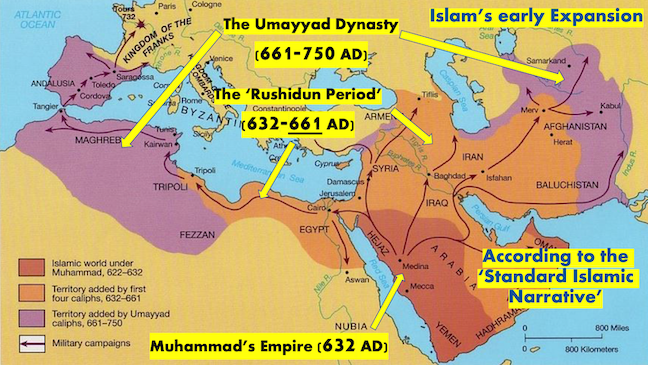
       The standard Islamic narrative [4] teaches that the Qur’an, is uncreated and exists eternally on clay tablets in heaven (Qur’an 85:22). This uncreated Qur’an was sent down from Allah (the god of Islam) to one person only, the prophet Mohammed (Qur’an 39:41), through the angel Gabriel, in one language (Arabic), over a period of twenty-three years in two different locations – Mecca (610-622 A.D.) and Medina (622-632 A.D.) [5] – in central western Arabia (see above map). [6] Islam claims that Mohammed’s empire is represented by the brown area on the above map where Mecca and Medina are located. When Mohammed died in 632 A.D., that is how large Islam’s empire was. 

       After Mohammed died, then you have the next four successors to Mohammed called Caliphs who came to power: Abu Bakr (632-644 A.D.), Umar (634-644 A.D.), Uthman (644-656 A.D), and Ali (656-661 A.D.). These rulers expanded the Islamic Empire (lighter brown area) west to Tripoli, North Africa, north to Turkey, east to Afghanistan, and south down to Yemen and Oman. This time period is called the Rushidun Period (632-661 A.D.). And then during the Umayyad Dynasty (661-750 A.D.) established by Caliph Mu’awiya, and others after him, Islam expanded all the way west to Spain and northwestern Africa, further east to northwestern India and central Asia as represented by the purple area on the map. 

       Let’s look at the timeline for Islam’s emergence according to the standard Islamic narrative (see above timeline). Mohammed was born in 570 A.D and started to receive his revelations in a place called Mecca in 610 A.D. In 621 A.D., the Mi’raj took place whereby Mohammed is suddenly awakened in the middle of the night and told to get on the back of a winged horse called a Buraq, which transported him from Mecca to Jerusalem where he ascended through the seven heavens and visited all the previous prophets (Jesus was found in the second heaven, Moses in the sixth, and Abraham in the seventh). [7] Finally, Mohammed was taken into the presence of Allah where he bargained Allah down in his command to pray fifty times to five times a day. [8]

       In 622 A.D., Mohammed fled from Mecca 200 miles north up to Medina when he heard that leaders of Meccan tribes and clans vowed to assassinate him. This migration is known as the Hijra. [9] As Mohammed grows in strength and numbers, he takes over Medina and then returns to Mecca in 630 A.D. and takes it over and is therefore in control of both Mecca and Medina. In 632 A.D., Mohammed dies after being poisoned by one of his wives. 

       After Mohammed’s death, the first Caliph (successor to Mohammed) Abu Bakr reigned for two years (632-634 A.D.) and died peacefully. The second Caliph, Umar, ruled 10 years (634-644 A.D.) and was killed. Then Uthman reigned 12 years (644-656 A.D.) as the third Caliph before he was killed. It is during his rule that the Qur’an was compiled and completed in 652 A.D. Then Ali, the first cousin and son-in-law of Mohammed, reigns as the 4th Caliph from 656-661 A.D. and was assassinated. [10]

        Thus, Islam was fully formed by 661 A.D. (mid 7th century) according to the standard Islamic narrative. But how do we know these people, places, and times in Islam’s history? Where did they come from? This leads us to discuss the documentary evidence. 

The Qur’an’s Documentary Evidence 

       Smith states, “When anyone asks Muslims how they can be sure that the story they have of Muhammad is true, they point to numerous books on their bookshelves and claim that they were written by those who knew Muhammad; that they saw what he did and heard what he said. But they never show us their original ‘extant’ codices or manuscripts, nor do they ever give us any forensically tested dates concerning when exactly those books were originally written. To be valid witnesses for Muhammad we must have these traditional writer’s original ‘extant’ manuscripts to look at, in order to know whether they really wrote what they are purported to have written.

       “Remember, the compilers of the prophet’s life and sayings all worked under the authority of the Muslim Caliphs. So, they would have had access to durable writing material, such as Parchments and Vellum (i.e. using animal skins), unlike our earliest Christian writings, which were all written on Papyrus (non-durable leaves). So, the Muslim written texts should still be in existence even today, a mere 1400 years later. Consequently, there is no excuse not to have the original manuscripts.

       “Let’s find out what we now know about the ‘extant’ manuscripts of the Sira [Mohammed’s biography], the Hadith[Mohammed’s sayings], the Sahaba’s codices [Mohammed’s companions] and the Tabi’un’s codices (the 2nd generation), as well as the Ta’rikh [Mohammed’s history] and the Tafsir [Mohammed’s commentaries].” [11] [brackets and emphasis added]

       1) Available Muslim documents: Look with me at the above chart entitled “Sources for the ‘Islamic Traditions’ according to Islam.” [12] Islam claims that what we know about Mohammed and the Qur’an comes from several sources. First, it comes from the Sahaba or the eyewitnesses/companions of Mohammed and the Tabi’unthe second generation who received what they knew from the Sahaba, shown in red print above. Islam claims that these sources were written in the late 7th century to early 8th century, by Muwatta ibn Malik, Sahifa Hamman B. MunabbihMusnad ibn Hanbal, Musanaf Abdul RazzaqMusnad al-Tayalisi, Abi Shaybah. [13]

       The second primary Muslim source is the Sira or biography of Mohammed shown in green print above. According to Islamic tradition, Ibn Ishaq (d. 767 A.D.) wrote Mohammed’s biography. [14] But notice that Ishaq died in 767A.D., over 130 years after Mohammed’s death. Did Ishaq know Mohammed or hear his teachings or observe his actions? No. So how could he have known Mohammed’s biography? We do not have any of Ishaq’s writings today. Hence, where did the biography of Mohammed come from? 

       Islamic tradition says Ibn Hisham wrote down what Ishaq said about the life of Mohammed, but Hisham died in 827 A.D, [15] almost 200 years after Mohammed’s death. And Hisham left out what he didn’t like about Ishaq’s portrayal of Mohammed. [16] Then another man, Al Waqidi (d. 835 A.D.) wrote down the military campaigns of Mohammed, but he also died 233 years after Mohammed’s death. [17] Thus, Ibn Hisham and Al-Waqidi actually give us the biography of Mohammed, not Ishaq. So, this is the first genre.

       The third Muslim primary source is called the Hadith or sayings of Mohammed pictured in blue print in the above chart. These Muslim writers include Sahih Bukhari (d. 870 A.D.) who is considered the most important of all the other hadith contributors. He “admitted that of the 300,000 hadith he collected, he considered only 100,00 might be true. He then narrowed this number down to 7,275, many of which are repetitions so that the total number is in fact near 3,000. That means that even he admitted there were errors in over 295,000 [98%] of the hadith. [18]  [brackets and emphasis added] Other hadith contributors include Sahih Muslim (d. 875 A.D.), At-Tirmidhi (d. 892 A.D.), Ibn Maja(d. 886 A.D.), Abu Dawud (d. 899 A.D.), and An-Nisa’i (d. 915 A.D.). Notice that there is a gap of over 238+ years between the times Mohammed allegedly spoke these words and the first copies that are currently known by writers of the hadith[19] Did any of these men know Mohammed or hear what he said? No. But Islam claims they wrote down what Mohammed said. 

       The fourth Muslim source is the tafsir or commentaries on the Qur’an pictured in light brown print in the chart above. Smith notes that 25% of the Qur’an is not even understood by Muslim scholars. [20] As I read the Qur’an, I find it difficult to comprehend. Some stories don’t have beginnings or endings, or they seem to begin in the middle of the story. There are no transitional phrases between stories to help you follow the author’s train of thought. 

       The fifth Muslim source is the Tarikh or the histories of Mohammed also pictured in light brown print in the above chart. Both the tafsir and tarikh contributions were first written down by Al Tabari who died in 923 A.D., [21] almost 300 years after Mohammed. Did Al Tabari know Mohammed or witness his words and actions? No, of course not. 

       Thus, according to the standard Islamic narrative, everything we know about Mohammed from Muslim documents – who he was and what he said and did – comes 50-300 years after Mohammed died. 

       But more recent research shows that these Islamic documents are not nearly as old as Muslim scholars believe. Look at the timeline above for extant (existing) Manuscripts for everything we know about Islam’s origins. [22] From left to right, Islam claims that the Sahaba and the Tabi’un, the first and second generation of eyewitnesses to Mohammed and the Qur’an, were written in the late 7th to early 8th centuries, and yet there is no 7th – 8th century documents for these writings. They do not appear in writing until the 9th to 13th centuries: Muwatta ibn Malik:9th century (200 years later)Sahifa Hamman B. Munabbih: 12th century (500 years later)Musnad ibn Hanbal:13th century (600 years later)Musanaf Abdul Razzaq:13th century (600 years later)Musnad al-Tayalisi:13th century (600 years later)Abi Shaybah:13th century (600 years later) – this suggests they were all written by others over 200-600 years later and redacted or attributed back to the 7th – 8th centuries! Thus, they are most likely all fraudulent. [23]

       Islam maintains that the Sira (biography of Mohammed), the Hadith (the sayings of Mohammed), the Tafsir(commentaries on the Qur’an) and the Tarikh (histories of Mohammed) all were written 200-300 years after Mohammed. However, Dr. Jay Smith has demonstrated that these supporting documents were written much later (11th-16th centuries), 400-900 years after Mohammed presumably lived, and then redacted or attributed back to the 7th-10th centuries. [24] Most of these documents were not canonized into written form until 1,200 – 1,270 years later than Mohammed.

        For example, the Sira (biography of Mohammed), was comprised of 36 different biographies written down in the last few hundred years. But who wrote the standard work which Islam depends upon today? It was Heinrich Ferdinand Wustenfeld (1808 – 1899), who between 1858 – 1860 compiled the Sira taken from libraries and museums in six mostly European cities (Fez, London, Oxford, Dublin, Paris and London). [25] It was then translated into French and English, and “sanitized” by Alfred Guillaume [26] and others later on. Hence, the man whom Muslims are dependent on to know who their prophet is or what he did, is an elderly German linguist who wrote Mohammed’s story over 160 years ago. [27]

        Furthermore, Islam claims that the Hadith (sayings of Mohammed) were created in the 9th-10th centuries, but this does not align with history. Their earliest extant manuscripts were actually created much later: [28] Abu Dawud: 11thcentury (400 years after Mohammed); An-Nasai: 12th century (500 years after Mohammed); Ibn Majah: 13th century (600 years after Mohammed); Jami’ At-Tirmidhi: 14th century (700 years after Mohammed); Sahih Muslim: 14thcentury (700 years Mohammed); Sahih Bukhari: 14th – 15th centuries (700-800 years after Mohammed). Not one of the Hadith was compiled in the 9th – 10th centuries. Their final extant manuscripts were not created until the 11th -15th centuries, which is 400 – 800 years later! Thus, not one of them ever heard a word Mohammed said!

       What about Al Tabari’s Tafsir (commentaries on the Qur’an) and Ta’rikh (histories of Mohammed)? The edition of Al Tabari which everyone uses today was compiled by Michael Jan De Geoje, the professor of Arabic at Leiden University, Holland, between 1879 – 1901, and is known as the “Leiden Edition.” Yet, De Goeje used two 13th century Arabic manuscripts from Turkey as his model. So, even Al Tabari’s Ta’rikh and his Tafsir are not 10th century originals but are much later 13th century compilations which were merely redacted or attributed back to Al Tabari 300 years earlier. Yet, they are still 600 years later than Mohammed! What’s more, it took a Dutch scholar to compile them 1,200 years later! [29]

        Another problem with the Muslim documentary evidence for the Qur’an has to do with distance and direction (see above map). [30] The Islamic Traditions say that everything happened in Mecca and Medina (circled in green on the map above), in west central Arabia. Mohammed was born in Mecca and lived there 52 years before he moved to Medina in 622 A.D. It was while he lived in Mecca and Medina that he received the Qur’an from 610 – 632 A.D. Yet everything we know about Mohammed did not come from those cities, it came from Baghdad, which is 1200 miles too far north.

       Ibn Hisham, who wrote Mohammed’s biography (the Sira), is from Basra, but he grew up in Cairo and wrote in Baghdad. Cairo is 990 miles from Mecca. And Basra is 1200 miles from Mecca as is Baghdad. Sahih Bukhari who wrote down the sayings of Mohammed (the Hadith), is from Bukhara which is 2,6000 miles from Mecca. Al Tabariwho wrote down the commentaries of the Qur’an and the histories of Mohammed (The Tafsir & Tarikh) is from Tabaristan (northern Iran today) which is 1,7000 miles from Mecca. None of these traditional writers lived or worked in Mecca or Medina. They were too far to the north from Mecca and came from east and west of Baghdad.

       Since these Muslim sources are much too late and too far away to provide confirmation of the reliability of the Qur’an, we must go back to the seventh century when Mohammed lived to determine what documents are available which can substantiate the reliability of the Qur’an. 

       2) The Doctrina Iacobi and 661 Chronicler: There are two seventh century documents outside the Islamic Traditions which are available for us to examine today which are helpful for our purposes here. Both of these documents deal with the relationship between the Arabs and the Jews. The first is the Doctrina Iacobi, the earliest witness of Mohammed and his “movement” available to us outside Islamic tradition. It is a Greek Christian polemical tract, from Carthage (Tunis), but written in Palestine, by a Christian apologist between 634 and 640 A.D. [31] The second is a chronicle supposedly written by the historian Bishop Sebeos in 660 A.D. [32]

       The Qur’an implies that Mohammed’s relationship with the Jews was becoming unfavorable in 624 A.D. (or soon after the Hijra in 622 A.D.), and thus moved the direction of prayer, the Qibla at that time, from Jerusalem to Mecca, “144 Indeed, we have seen you turning your face toward the heaven. So we will have you turn to a direction which will please you. So turn your face toward the forbidden mosque [Masjid ul Haraam at Mecca]… 149 And from whatever place you come out, so turn your face toward the forbidden mosque and surely to the truth from your lord. And Allah is not unaware of what you do. 150 And from whatever place you come out, so turn your face toward the forbidden mosque, and wherever you were, to that part so turn your faces lest people have an excuse against you except those who are unjust among them. So do not fear them. And fear me that I may complete my grace on you, and perhaps you may be guided.” (Qur’an 2:144, 149-150). [33] In these verses Allah instructs Mohammed and his followers to turn toward the forbidden mosque in Mecca away from the mosque in Jerusalem, implying that relations between the Jews and Arabs were severed or at the least, strained. 

       In contrast to this, an early non-Muslim source describes a healthy relationship between the Muslims and Jews at the time of the first conquests (late 620s A.D.), and even later. Yet the Doctrina Iacobi warns of the Jews who mixed with the Saracens (Arabs), and the danger of falling into the hands of these Jews and Saracens(Arabs). [34] In fact, this relationship seems to continue on into the conquest of Palestine as an early Armenian source mentions that the governor of Jerusalem in the aftermath of the conquest was a Jew. [35] It is plausible that the Jews and Arabs (Saracens) seem to be allied together during the time of the conquest of Palestine and even for a short time after. [36] If these witnesses are correct, then one must ask how it is that the Jews and Saracens (Arabs) are allies as late as 640 A.D., when, according to the Qur’an, Mohammed dissolved his ties with the Jews as early as 624 A.D., more than 15 years earlier?

       To answer that we need to refer to the earliest connected account of the career of Mohammed that is found in an Armenian chronicle from around 660 A.D., which is attributed by some to Bishop Sebeos. [37] The chronicler describes how Mohammed established a community which comprised both Ishmaelites (i.e. Arabs) and Jews, and that their unifying motivation was their common descent from Abraham: the Arabs through Ishmael, and the Jews through Isaac. [38] The chronicler believed Mohammed had bestowed both communities with a birthright to the Holy Land, while concurrently providing them with a monotheist genealogy. [39]

       Hence, we find non-Muslim documentary sources contradicting the Qur’an, maintaining that there was a good relationship between the Arabs and Jews for at least an additional 15 years beyond that which the Qur’an alleges. Also, if Palestine was the focus for the Arabs, then the city of Mecca comes into question, and additional documentary evidence concerning Mecca may prove to be the most detrimental proof against the reliability of the Qur’an which we have to date.

       3) Mecca: [40] 

Islam maintains that Mecca is the oldest and best-known city in history. The Qur’an makes inferences to Mecca on its pages. The word “Mecca” is not mentioned in the following Qur’anic verses, but Islam understands them to refer to the city.Meccais where Adam and Eve were thrown down from heaven after they ate from the tree (Qur’an 7:24). We cannot find a city older than Adam and Eve, so Mecca is believed by Islam to be the oldest city. The first sanctuary appointed for humankind was that at “Becca,” understood by Islam to refer to Mecca (Qur’an 3:96). Mecca is the “mother of the villages” (Qur’an 6:92; 42:7). According to the Qur’an it was Abraham and Ishmael who built the Meccan Ka’aba (Qur’an 2:125-127). Mecca is where Abraham lived in 1900 B.C. when he destroyed the idols within the Ka’aba (Qur’an 21:51-71). Much of Mohammed’s story revolves around Mecca. He was born there in 570 A.D. and spent his formative years there until 622 A.D. when he fled to Medina. He returned to Mecca in 630 A.D. and took control of it. Mecca became the center for the Qibla (direction of prayer) in 624 A.D. (Qur’an 2:149-150). And Mecca is the center of trade North, South, East and West. [41] These all suggest that people have lived in Mecca from the very beginning of humankind. 

       Yet, the only clear reference to the word “Mecca” in the Qur’an is in one verse: “And he is who holds back their hands from you and your hands from them in the belly [valley] of Mecca after he had given you triumph over them, and Allah was seer of what you do.” (Qur’an 48:24). [42] [emphasis added] If Mecca is such an important place, why is it only mentioned once in the Qur’an? Doesn’t this signify that Mecca either was not that important to the author(s) of the Qur’an or it did not come into existence until later on?

       However, when we look at the 9th and 10th century Islamic Traditions (which are actually 11th – 15th century), we see many references to the city of Mecca because they are written much later. [43] Mecca was in a valley and a parallel valley (Ibn Hisham; Al Bukhari 2:645, 2:685, 3:891, 2:815, 2:820, 4:227) with a stream (Al Bukhari 2:685), fields, (Al Bukhari 9:337), trees (Sahih al-Tirmidhi 1535), grass (Al Bukhari 9:337), fruit (Al Bukhari 4:281), clay and loam (Al Tabari VI 1079 p. 6), grain, palm trees, dates, olives, pomegranates (Qur’an 6:99, 141; 16:11, 67), with mountains overlooking the Ka’aba (Ibn Hisham; Al Bukhari 2:645, 2:685, 3:891, 2:815, 2:820, 4:227), where the pagans raised livestock (Qur’an 4:119). Mecca is described as a very fertile place in the Islamic Traditions and in the Qur’an. 

       Yet, Townsend states that the physical and geographical features of Mecca do not line up with the Qur’an or the Hadith. [44] For example, “the mountains of Safa and Marwah, which mark the journey of Hagar in her quest for water, do not fit with the description in the Hadith. They are too small and close to each other. Also, the Hadith references to Mecca describe a place where the soil is suitable to grow fields of grain, trees, and grapevines. However, Mecca does not have olive trees, and it cannot even support the growth of food for camels and sheep. The Hadith also talks about two parallel valleys with a stream in between, but Mecca does not have these features. However, all of these features are found in the ancient city of Petra,” [45] much farther north from Mecca. Mecca is in a desert (see above pics), so it is too arid and dry to support the descriptions of fertility found in the Qur’an and Hadith, according to modern soil studies!  [46] Mecca has never had the kind of fertility that these Islamic traditions claim. 

       From research carried out by both Crone and Cook, except for an inference to a city called “Makoraba” by the Greco-Egyptian geographer Ptolemy in the mid-2nd century A.D. (though it is not certain this allusion by Ptolemy referred to Mecca, as he only mentioned the name in passing), there is absolutely no other report of Mecca or its Ka’bain any authenticated ancient document; that is until the mid-eighth century, [47] when Mecca is mentioned in the Continuatio Byzantia Arabica, which is a source dating around 741 A.D. [48] In addition, Mecca is not even found on a map until around 900 A.D. [49]      

       Dr. Crone visited several surrounding civilizations such as the Assyrian, Babylonian, Persian, Roman, Nabataeans, Qedarite, Himyarite, and Nubian civilizations, etc. (see red circle and rectangle areas on above map), and read their ancient documents and she could not find one reference to Mecca. [50] So, Crone visited the lesser-known towns closer to Mecca on the Arabian Western Plateau which were oases, and she found they were well-known and well documented all the way back to 300 B.C., yet she did not find one mention of Mecca (see above map). [51] Townsend agreed with Crone’s findings, stating that there is no primary source evidence of the existence of an ancient city in the present location of Mecca. [52] He observed that there are numerous mentions of Ta’if, just 70 miles away, as well as Najran, Sana’a, Medina, and Petra  – but no mention of Mecca. There is even an absence of the name of Mecca in the ancient inscriptions found in the records of cities that occupied the Arabian Peninsula. [53] If Mecca was known as the “mother of the villages [cities] as the Qur’an states (Qur’an 6:92; 42:7), then surely there would be documents from the 7th century, or earlier, that would mention the city as well as the people.      

       Even more problematic for Islam which claims that Mecca was the center of trading routes for Arabia in the 7th century and before, is that there is not any reference to trade with Mecca in the records of that time. [54] Patricia Crone did extensive research on the Meccan trade routes, and she learned that the ancient trading documents of that time referred to less significant towns close to Mecca, including Ta’if (which is south-east of Mecca), Yathrib (later Medina), as well as Khaybar, Petra, and Mamre in the north and Ma’rib, Sana’a, and Najran in the south (see above map), but no mention is made of Mecca from the 2nd to 8th centuries. [55] 

When we note the trade route through these towns (which were oases), we find that they are all located on the Western Plateau of the Arabian Peninsula, while Mecca is over 3,000 feet down below it in a desert, proving it was not on any trade route (see map above). [56]

       In addition, when Dr. Crone went to the Red Sea trade routes, she found that it was all along the East African coast, but not on the Arabian coast (see above map), proving none of the trade went through Mecca at all, confronting the notion that it was the center of trade. 

       Mecca, before 741 A.D. (which is considered the earliest documentary evidence for it anywhere), simply has no history, and even that reference is in Southern Turkey, which is too far north. When Ptolemy in the 2nd century wrote his book on Arabian geography, he never listed Mecca, so that none of the earliest 15th-16th century European maps of Arabia have Mecca listed on them either. 

       The reason for this is because Mecca was in the middle of a dessert and had no water. Trade needs people, and people need water, food and towns, all of which never existed in Mecca until the mid 8th century, over 100 years after Islam was supposedly created. Because of Mecca’s water problem, Queen Zubaydah’s Aqueduct was built in 801 A.D. (see upper left pic above), which then had to be refurbished 9 times in the subsequent 974 years due to the overbearing need for drinkable water; and then finally it was replaced with desalination plants after 1926 A.D. [57]

       Islam claims that Allah miraculously provides “inexhaustible water” for 2 billion Muslims through the ZamZam well, which is currently only 3-9 feet across and 100 feet deep, and about 66 feet east of the Ka’aba in Mecca (see above middle pic). [58] But what they don’t tell you is that the ZamZam well gets all its water from desalination plants built by American and European companies. (see lower right pic above) [59]

      Linguists have observed that the Arabic word endings used in the Qur’an do not come from Mecca, but from Nabataean Aramaic, which is situated 600 miles farther north around the city of Petra (see above pic). [60]Geographically speaking, the Qur’an places fifty-four of its sixty-five referenced areas 600 – 1,000 miles farther north from Mecca (Ad = 23 times, Thamud = 24 times, and Midian = 7 times) suggesting the authors of the Qur’an came from much farther north in northern Arabia closer to the city of Petra (see above map). [61] Whoever wrote the Qur’an wrote from farther north where these places existed. 

       Islam contends that between 70 – 300 prophets were buried in Mecca in a kneeling position so they could keep praying, so we should be able to find them today. Yet, with all the skyscrapers being constructed there in recent years, requiring deep foundations, they have not yet dug up one prophet’s body. Smith concludes that it seems the Saudi Arabians, because of Mecca’s lack of history, are cementing up all the evidence, suggesting even they are either skeptical of its history or they don’t want the rest of the world to find out the truth about Islam’s origin (see above pic). [62]

       Conclusion: Townsend, the author of The Mecca Mystery, concludes, “To put it as bluntly as possible: there is not a single shred of uncontested primary source evidence confirming the existence of an ancient city at the spot where the modern city of Mecca is located.” [63]

       The documentary evidence not only contradicts the Qur’an’s dating on the split between the Arabs and the Jews, but it also contradicts both the Qur’an and the Hadith’s description of the city it identifies as the birthplace and cornerstone for Islam. The standard Islamic tradition refers to Mecca as a place with much vegetation, existing since Adam and Eve, and with up to 300 prophets buried there. Yet, it is not referred to until 741 A.D., and none of the early maps show Mecca at all. Not one prophet’s body has been discovered buried in Mecca. Scholars such as Patricia Crone examined the ancient historical and trading documents, and Mecca was not the great commercial center the later Muslim traditions would have us believe, as it was not known by the people who lived and wrote from that period of time. In fact, history shows that what the Qur’an and Hadith describe could not even qualify as a viable city during the time of Mohammed, and it certainly could not have been the center of the Muslim world at that time. In addition, research has debunked the Red Sea Trade via Arabia, proving it was all via Africa, because it had water and Mecca did not. None of the surrounding empires ever heard of Mecca, most likely because it lacked WATER

       How then can we believe that the Qur’an is reliable? Do these same types of problems exist with the Bible? Let’s turn our attention to…

The Bible’s Documentary Evidence 

      For the last several decades the documentary evidence for the reliability of the Bible has been an area of research which has increased rapidly. But this hasn’t always been so. The assumption by many former archaeologists was that the Old Testament was not written in the 10th – 14th centuries B.C. by the authors described within its text, but by later Jewish historians during the much later 2nd – 6th centuries B.C., and that the stories were then redacted or attributed back onto the great prophets such as Moses and David, etc. Yet, an enormous quantity of historical data has been uncovered and is continuing to be uncovered, as well as the new forensic research methods being employed to study them, so that many of these preconceived notions of authorship are simply no longer valid. For instance:

       1) The oldest book of the Bible is considered to be Job which conservative scholars believe was written during the Patriarchal period of Abraham, Isaac, and Jacob (2100 -1900 B.C.). The following internal evidence confirms that Job was written during this period of time: [64]

a. Job’s wealth was reckoned in livestock (Job 1:3; 42:12), which was also true of Abraham (Gen. 12:16; 13:2) and Jacob (Gen. 30:43; 32:5). 

b. The Sabeans and Chaldeans (Job 1:15, 17) were nomads in Abraham’s time, but in later years they were not nomadic. 

c. The Hebrew word qeśîtâh, translated “piece of silver” (Job 42:11), is used elsewhere only twice (Gen. 33:19; Josh. 24:32), both times in reference to Jacob. 

d. Job’s daughters were heirs of his estate along with their brothers (Job 42:15). This, however, was not possible later under the Mosaic Law if a daughter’s brothers were still living (Num. 27:8).  

e. Literary works similar in some ways to the Book of Job were written in Egypt and Mesopotamia around the time of the patriarchs. 

f. Several names of people and places in the book of Job were also associated with the patriarchal age. Examples include (Sheba, a grandson of Abraham (Gen. 25:3), and the Sabeans from Sheba (Job 1:15; 6:19); Tema, another grandson of Abraham (Gen. 25:15), and Tema, a location in Arabia (Job 6:19); Eliphaz, a son of Esau (Gen. 36:4), and Eliphaz, one of Job’s companions (Job 2:11); Uz, a nephew of Abraham (Gen. 22:21), and Uz, where Job lived (Job 1:1). 

       The documentary evidence for the Patriarchal period includes four sets of tablets which have been and are continuing to be uncovered from that area of the world. They demonstrate that the Biblical account is indeed historically reliable. Let’s briefly look at all five sets of tablets (see above pics): [65]

       Armana Letters: (from Egypt) mention the Habiru or Apiru in Hebrew, which was first applied to Abraham in Genesis 14:13 and the name “Job” (Ayyabum).

      Egyptian Execration Texts: These mention the names of people and places found in the book of Job: Sheba (Job 6:19), Tema and Eliphaz (Job 2:11; 4:1; 15:1; 22:1; 42:7, 9); Uz and Job (Job 1:1).  

       Ebla tablets: 1,800 tablets from Tel Mardikh (Northern Syria), dating from 2500-2250 B.C., [66] shows us that a thousand years before Moses, laws, customs and events were recorded in writing in that part of the world, and that the judicial proceedings and case laws were very similar to the Deuteronomy law code (i.e., Deuteronomy 22:22-30 codes on punishment for sex offenses). One tablet mentions and lists the five cities of Sodom, Gomorrah, Admah, Zeboiimand Zoar in the exact sequence which we find in Genesis 14:8! Until these tablets were uncovered, the existence of Sodom and Gomorrah had always been in doubt by historians.

       Mari Archives: (from the Euphrates) mentions king Arriyuk, or Arioch of Genesis 14, and lists the towns of Nahor and Haran (from Genesis 24:10), as well as the names Benjamin and Habiru. They also mention the names Sheba, Eliphaz, Uz, and Job in the book of Job.

       Nuzi tablets: (from Iraq) speaks about a number of customs which we find in the Pentateuch (i.e., Genesis – Deuteronomy) such as:

1.     a barren wife giving a handmaiden to her husband (i.e., Hagar)

2.     a bride chosen for the son by the father (i.e., Rebekah)

3.     a dowry paid to the father-in-law (i.e., Jacob)

4.     work done to pay a dowry (i.e., Jacob)

5.     the unchanging oral will of a father (i.e., Isaac)

6.     a father giving his daughter a slave-girl (i.e., Leah, Rachel)

7.     the sentence of death for stealing a cult god (i.e., Jacob).

       2) The Pentateuch (i.e. Genesis – Deuteronomy): In years past, skeptics contended that the Pentateuch could not have been written by Moses during his lifetime (ca. 1525-1405 B.C.), [67] because there was no evidence of any writing that early. Then the Black Stele was found in Susa (modern Iran) in 1901 with the detailed laws of Babylonian King Hammurabi which were written approximately 300 years before Moses, and in the same region. [68]

       3) The Masoretic Text: There was also a lot of doubt about the reliability of the Old Testament documents, since the oldest manuscript in our possession was the Masoretic Text, written in 916 A.D. Skeptics asked how we can depend on a collection of writings whose earliest manuscripts are so recent? Then in 1947 came the amazing discoveries of the Dead Sea Scrolls in the caves of Qumran and along the Dead Sea written around 125 B.C. These scrolls show us that outside of minute copying errors it is identical to the Masoretic Text and yet it predates it by over 1,000 years! [69] We have further substantiation in the Septuagint, the Greek translation of the Hebrew text, which was composed around 250-150 B.C. [70]

       4) Available Christian documents: When we analyzed the Qur’an’s documentary evidence, we looked first at the Muslim documents. In the same manner, I want to look at the Christian documents now. In the above chart, [71] we list Christianity’s emergence according to our Traditions. When we look at the documentary evidence for Jesus, we start with the first Sira (biography of Jesus) and Hadith (sayings of Jesus) written by Luke from 60-62 A.D., [72] just 27-29 years after Jesus died. Then the book of Acts which is our Tahrikh or early histories of the church also written by Luke between 60-62 A.D., [73] likewise 27-29 years after the death of Christ. The apostle Paul’s letters to the churches are the Tafsir or commentaries on the life of Jesus between 49-64 A.D., [74] only 16-31 years after Jesus’ death. Next, we have the second Sira (biography of Jesus) and Hadith (sayings of Jesus) written by Mark (68-69 A.D.), [75] just 35-36 years after Christ’s death. Then we have Matthew’s Sira (biographies of Jesus) and Hadith (sayings of Jesus) written between 50-70 A.D, [76] only 17 – 37 years after the crucifixion of Jesus. And finally, we have the last Sira and Hadith written by John in 90 A.D., [77] just 57 years after the death of Jesus. Hence, within 16-57 years after Christ’s death, we have the entire New Testament. All of the New Testament writers lived in the same place Jesus lived, and they either knew Him personally, or they got their material from others who saw what He did and heard what He said. 

       5) Available non-Christian documents: As an example, let’s look at the crucifixion of Christ, the most important event in history (see chart above). [78] The Qur’an, which Islam claims was written in the mid-7th century, says, “And their saying, ‘Surely we killed the Christ ‘Isā, son of Mary, the messenger of Allah.’ And they did not kill him, and they did not salaba [crucify] him; but it was made to appear to them, and surely those who disagree about him are in doubt of him. They do not have any knowledge of him except following the conjecture, and they did not kill him for certain.(Qur’an 4:157). [79] [emphasis added] The Qur’an denies that their Jesus (‘Isā) actually died on the cross. It says it was made to appear he died by having another man take Christ’s place on the cross. Is the Qur’an’s claim supported by the historical documentary evidence from the 1st and 2nd centuries A.D. outside of Christianity? No. 

      Thallus, a Greek Samaritan historian writing about 52 A.D. spoke of the “darkness which accompanied the crucifixion of Christ.” [80] Josephus, the first-century Jewish historian (37-100 A.D.), [81] wrote that “there was a wise man who was called Jesus…. Pilate condemned him to be crucified and to die.” [82]Lucian, a Greek Satirist from the 2nd century A.D., “without using Jesus’ name he writes of that one whom they still worship today, the man in Palestine who was crucified because he brought this new form of initiation into the world.” [83]There is also a Syriac manuscript in the British Museum by a Syrian and probably Stoic philosopher, Mara Bar Serapion(sometime after 70 A.D), that asks, “What advantage did the Jews gain from executing their king? It was just after that their kingdom was abolished.” [84] The Roman historian, Tacitus (56-120 A.D.), spoke in his Annals of “Christ who was executed under Pontius Pilate in the reign of Tiberias.” [85]Most of these Greek, Roman, and Jewish 1st and 2nd century historians were opposed to Christianity, yet they all agree that Jesus Christ was crucified on a cross. 

       Who are we going to believe? The Qur’an, which Islam claims was written in the mid-7th century, over 600 years after Jesus walked on the earth, or these 1st and 2nd century Greek, Roman, and Jewish writers who lived much closer to the time of Jesus? We can see from this one example that Christianity has a much better historical record than does Islam. 

Conclusion: 

       When we compare the historical documentary evidence of the Qur’an and the Bible (see above chart), we discover when the earliest biographies and sayings for both faiths were written. For Christianity, they were written 16-57 years after Jesus’ death on the cross by those from the same area. But for Islam, they were written 400-900 years later, and by those who were hundreds of miles too far north. Which do you think has more authority and reliability? 

       A former Muslim who became a Christian, writes, “After thoroughly investigating the truth claims of slam and Christianity, even while a Muslim, there was no avoiding the obvious truth: The evidence in favor of Christianity was far, far stronger than the evidence for Islam….

       “The traditional Islamic narrative is incompatible with both the history of Christianity and even with its own historical records. To believe in the Islamic account of Christian origins while taking the historical records seriously, we would have to conclude that Jesus was an utterly incompetent Messiah and Allah is a deceptive God. The historical record of Islamic origins makes many scholars wonder whether Muhammad existed, and it makes scholars think the Quran was originally far more fluid and indeed a very different kind of book than it is today. 

       “The Islamic narratives of Christian origins, and even of Islamic origins, are incompatible with history. In other words, to believe the truth of Islam is to ignore the historical evidence. 

       “As a Muslim, I wanted to base my beliefs not on blind faith, not on what appealed to me, and not even on my family’s heritage. I wanted to ground my faith in reality. If I wanted to take the records of history seriously, I had to abandon my Islamic faith and accept the gospel.” [86] [emphasis added]

       As Christians, we have the evidence to boldly and clearly proclaim Christ crucified to our Muslim friends. For centuries, the truth of Christianity has withstood criticism. In the first century, when one of Jesus’ disciples, Thomas, doubted the eyewitness testimony of Jesus’ resurrection (John 20:25) and demanded tangible evidence that Christ was alive before he would believe it. Jesus did not come to Thomas and tell him not to doubt or question such an important event. Instead, Christ says to Thomas, “Reach your finger here, and look at My hands; and reach your hand here, and put it into My side. Do not be unbelieving, but believing.” (John 20:27). Knowing full well the struggles going on in Thomas’ heart, Jesus invites him to explore with his hands (“Reach your finger here”) and his eyes (“look at My hands”) the reality of His resurrection body.

       When Jesus said, “reach your hand here, and put it into My side,” He was referring to a literal hole in His side that was left by the spear. It had healed over but it left an obvious impression. Jesus did not condemn Thomas for his unbelief. He didn’t say, “You should not ask questions like that Thomas!” Christ gave Thomas undeniable evidence that He rose from the dead to answer his objection and then invites him to believe.

       In our Judeo-Christian America, we are taught to think critically and question truth claims. Truth does not pull away from scrutiny. It stands up to it. 

       But in an Islamic community, you are to respect the Qur’an and not question it. The Qur’an encourages Muslims not to question it, lest they become “infidels” (non-Muslims): 101 O you who have believed, do not ask about things which, if they were revealed to you, it would be harmful to you. And if you ask of it when the Qur’an is sent down, it will be revealed to you. Allah will pardon you for this. And Allah is forgiving, forbearing. 102 The people before you asked such questions, and by them they became infidels.” (Qur’an 5:101-102).[87]

       Dakdok comments about these verses, What a way to understand the Qur’an! Just don’t ask questions because, if you ask, perhaps you won’t find an answer. On the other hand, if you do find the answer and it contradicts the teaching of the Qur’an, then perhaps you will become an infidel (unbeliever).

       “Christians, on the other hand, are encouraged to ask questions and seek further understanding, which is one of the primary reasons that we have Bible study classes. In them, we can investigate and search for answers to all kinds of questions, and these answers are in the Word of God. Perhaps the greatest problem that Muslims face is the necessity to believe in a book, which in many cases they have not read, but whether they have or not, they simply cannot understand. As it is even written in its own pages, no one can even interpret it, except Allah himself!” [88] [emphasis added]

       As Islam spreads throughout the U.S., it is essential that Christians speak the truth in love to Muslims about Islam and Christianity. When western scholars and followers of Christ ask questions about the Qur’an, Mohammed, and Mecca, Islamists will be confronted with the truth about their faith and its incompatibility with history. It is then, that we must share the good news of Jesus’ death and resurrection with them so they “may believe that Jesus is the Christ, the Son of God, and that believing [they]… may have life in His name.” (John 20:31).

ENDNOTES: 

[1] Tom Constable, Dr. Constable’s Notes on Daniel, 2025 Edition, pp. 6, 40.  

[2] Conservative scholars believe Job was written during the Patriarchal period (2100 -1900 B.C.). See Roy B. Zuck, “Job,” The Bible Knowledge Commentary Wisdom, 2018 Kindle Edition, pp. 15-16.; Tom Constable, Notes on Job, 2025 Edition, pp. 1-2.

[3] Robert Vacendak, “Revelation,” The Grace New Testament Commentary: Revised Edition, 2019 Kindle Edition, pp. 1944-1945; John F. Walvoord, “Revelation,” The Bible Knowledge Commentary Epistles and Prophecy, 2018 Kindle locations 4701 to 4707; Archibald Thomas Robertson, A. T. Robertson’s Word Pictures in the New Testament, 2014 Kindle Locations 211099 -211108.

[4] Much of this section is adapted from Dr. Jay Smith’s July 9, 2025, video presentation at Calvary Chapel Chino Hills, entitled, “Two New Findings That Mohammed Didn’t Exist,” at www.youtube.com, unless otherwise noted. View video at this LINK .

[5] Norman L. Geisler and Abdul Saleeb, Answering Islam: The Crescent in Light of the Cross Second Ed. (Grand Rapids, MI: Baker Books, 1993, 2002), pg. 94; Daniel Janosik, THE GUIDE TO ANSWERING ISLAM: What Every Christian Needs to Know About Islam and the Rise of Radical Islam (Cambridge, OH: Christian Publishing House, 2019 Kindle Edition, pp. 33-34 cites Ali Dashti, Twenty-Three Years: A Study of the Prophetic Career of Mohammad (Mazda, 1994), pp. 47-58. Usama Dakdok, THE GENEROUS QUR’AN, 2009 Smashwords Edition, pp. 5-10. Dakdok notes that the surahs written in Mecca include surahs 1, 6- 7, 10-12, 14-21, 23, 25-32, 34-46, 50-54, 56, 67-75, 77-97, 100-109, 111-114. The surahs written in Medina include surahs 2-5, 8-9, 13, 22, 24, 33, 47-49, 55, 57-66, 76, 98-99, 110.

[6] Map is adapted from Smith,  July 9, 2025, “Two New Findings That Mohammed Didn’t Exist,” at www.youtube.com

[7] Geisler and Saleeb, Answering Islam, pg. 75 cites Andrew Rippin and Jan Knappert, eds. and trans., Textual Sources for the Study of Islam(Manchester: University Press, 1986)), pp. 68-72; Arthur Jeffery, Islam: Muhammad and His Religion (Indianapolis and New York: The Bobbs-Merrill Company, Inc., 1958), pp. 35-46; and John Alden Williams, Islam (New York: George Braziller, 1962), pp. 66-69. 

[8] Geisler and Saleeb, Answering Islam, pg. 164. 

[9] Walter Martin, The Kingdom of the Cults: The Definitive Work on the Subject 6th Edition (Bloomington, MN: Bethany House Publishers, 2019 Kindle Edition), pp. 523-524. 

[10] Smith, July 9, 2025, “Two New Findings That Mohammed Didn’t Exist,” at www.youtube.com.

[11] Ibid.

[12] Chart is adapted from Ibid.

[13] Ibid. 

[14] Daniel Janosik, THE GUIDE TO ANSWERING ISLAM: What Every Christian Needs to Know About Islam and the Rise of Radical Islam (Cambridge, OH: Christian Publishing House, 2019 Kindle Edition), pg. 21.

[15] Ibid.

[16] Ibid., pp. 21-22; cf. Nabeel Qureshi, No God but One: Allah or Jesus? A Former Muslim Investigates the Evidence For Islam And Christianity (Grand Rapids, MI: Zondervan, 2016 Kindle Edition), pp. 261, 312 cites Ibn Hisham’s notes in The Life of Muhammad: A Translation of Ibn Ishaq’s Sirat Rasul Allah, trans. Alfred Guillaume (Oxford: Oxford Univ. Press, 2002), pg. 691. 

[17] Smith, July 9, 2025, “Two New Findings That Mohammed Didn’t Exist,” at www.youtube.com.

[18] Geisler and Saleeb, Answering Islam, pg. 170 

[19] Janosik, THE GUIDE TO ANSWERING ISLAM, 2019 Kindle Edition, pg. 23.

[20] Smith, July 9, 2025, “Two New Findings That Mohammed Didn’t Exist,” at www.youtube.com.

[21] Geisler and Saleeb, Answering Islam, pg. 62. 

[22] Adapted from Smith, July 9, 2025, “Two New Findings That Mohammed Didn’t Exist,” at www.youtube.com.

[23] Ibid. 

[24] Smith, July 9, 2025, “Two New Findings That Mohammed Didn’t Exist,” at www.youtube.com.

[25] Ibid. 

[26] Alfred Guillaume, The Life of Muhammad: A Translation of Ibn Ishaq’s Sirat Rasul Allah (London: Oxford Univ. Press, 1955). 

[27] Smith, July 9, 2025, “Two New Findings That Mohammed Didn’t Exist,” at www.youtube.com.

[28] Ibid. 

[29] Ibid.

[30] Adapted from Ibid.

[31] S. P. Brock, “Syriac Views of Emergent Islam,” Studies on the First Century of Islamic Society, edited by G.H.A. Juynboll (Carbondale, So. Ill. Univ. Press, 1982), pg. 9; Patricia Crone and Michael Cook, Hagarism (Cambridge: Cambridge University Press, 1977), pg. 3.  

[32] Crone and Cook, Hagarism (1977), pg. 6; Bishop Sebeos, Histoire d’Heraclius, tr. F. Macler (Paris, 1904), pp. 94-96. 

[33] Verses taken from Usama K. Dakdok, THE GENEROUS QUR’ANAn Accurate, Modern English Translation of the Qur’an, Islam’s Holiest Book (Venice, FL: Usama Dakdok Publishing, LLC, 2009 Smashwords Edition), pp. 60-61. Used by permission of Usama Dakdok Publishing, LLC.

[34] N. Bonwetsch, (ed.), “Doctrina Iacobi nuper baptizati,” in Abhandlungen der Koniglichen Gesellschaft der Wissenschaften zu Gottingen,Philologisch-historische Klasse N.s., vol. xii (Berlin, 1910), pg. 88; Michael Cook, Muhammad (Oxford, Oxford University Press, 1983), pg. 75. 

[35] K.R. Patkanean (ed.), Patmout’iun Sebeosi Episkoposi i Herakln (St. Petersburg, 1879), pg. 111; Bishop Sebeos, Histoire d’Heraclius, tr. F. Macler (Paris, 1904), pg. 103.  

[36] Crone and Cook, Hagarism (1977), pg. 6.

[37] Ibid., and  Sebeos, Histoire d’Heraclius (1904), pp. 94-96.

[38] Ibid., pg. 8; Sebeos, Histoire d’Heraclius (1904), pp. 94-96; Cook, Muhammad (1983), pg. 75.

[39] Ibid.

[40]  Much of this section is adapted from Smith, July 9, 2025, “Two New Findings That Mohammed Didn’t Exist,” at www.youtube.com, unless otherwise noted. 

[41] W. Montgomery Watt, Muhammad at Mecca (London: Oxford University Press, 1953), pp. 2-4. 

[42] Verse taken from Usama K. Dakdok, THE GENEROUS QUR’ANAn Accurate, Modern English Translation of the Qur’an, Islam’s Holiest Book (Venice, FL: Usama Dakdok Publishing, LLC, 2009 Smashwords Edition), pg. 700. Used by permission of Usama Dakdok Publishing, LLC.

[43] Adapted from Smith, July 9, 2025, “Two New Findings That Mohammed Didn’t Exist,” at www.youtube.com.

[44] Janosik, THE GUIDE TO ANSWERING ISLAM, 2019 Kindle Edition, pg. 321 cites Peter Townsend, The Mecca Mystery: Probing the Black Hole at the Heart of Muslim History (Peter Townsend, 2018), pg. 50.

[45] Ibid., pp. 55-56 cites Townsend, The Mecca Mystery (2018),pp. 110-113. 

[46] Dan Gibson, Qur’anic Geography: A Survey and Evaluation of the Geographical References in the Qur’an with Suggested Solutions for Various Problems and Issues (Canada: Independent Scholars Press, 2011), pg. 233. 

[47] Cook, Muhammad (1983), pg. 74; Crone and Cook, Hagarism (1977), pg. 22.

[48] Ibid., pp. 54-55 cites Robert Hoyland, Seeing Islam as Others Saw It (Princeton, NJ: Darwin Press, 1997), pp. 43-44;

cf. Crone and Cook, Hagarism (1977), pp. 22, 171. 

[49] Ibid., pg. 55 cites Townsend, The Mecca Mystery (2018), pg. 48.

[50] Smith, July 9, 2025, “Two New Findings That Mohammed Didn’t Exist,” at www.youtube.com.

[51]  Ibid.

[52] Janosik, THE GUIDE TO ANSWERING ISLAM, 2019 Kindle Edition, pg. 54 cites Townsend, The Mecca Mystery (2018), pg. 48.

[53] Ibid., cites Townsend, The Mecca Mystery (2018), pg. 49. 

[54] Ibid., pg. 55 cites Townsend, The Mecca Mystery (2018), pg. 53. 

[55] Patricia Crone, Meccan Trade and the Rise of Islam (Princeton University Press, 1987), pp. 7, 11, 41-42; cf. Townsend, The Mecca Mystery (2018), pg. 49.

[56] Jay Smith, “The Bible and The Qur’an – An Historical Comparison,” at www.pfandercenter.org cites R.W. Bulliet, The Camel and the Wheel (Cambridge, Mass., 1975), pg. 105; N. Groom, Frankincense and Myrrh, a Study of the Arabian Incense Trade  (London, 1981), pg. 193; W.W. Muller, “Weibrauch…,” off-print: Pauly-Wissowa, Realencyclopadie, Supplement and 15 (Munich, 1978), pg. 723. You can view Smith’s article at this Link.

[57] Smith, July 9, 2025, “Two New Findings That Mohammed Didn’t Exist,” at www.youtube.com.

[58] Retrieved on December 7, 2025, from a Wikipedia article entitled, “ZamZam Well,” at www.en.wikipedia.org.

[59] Smith, July 9, 2025, “Two New Findings That Mohammed Didn’t Exist,” at www.youtube.com.

[60] Janosik, THE GUIDE TO ANSWERING ISLAM, 2019 Kindle Edition, pg. 57 cites Robert Kerr, “The Language of the Koran,” Tingis Magazine, February 18, 2013 at https://www.tingismagazine.com/articles/the-language-of-the-koran/ and Mark Durie, The Qur’an and its Biblical reflexes: Investigations into the Genesis of a Religion (Rowman and Littlefield, 2018).

[61] Ibid., pg. 56 cites Townsend, The Mecca Mystery (2018), pg. 104 and Gibson, Qur’anic Geography (2011), pg. 137.

[62] Smith, July 9, 2025, “Two New Findings That Mohammed Didn’t Exist,” at www.youtube.com.

[63] Janosik, THE GUIDE TO ANSWERING ISLAM, 2019 Kindle Edition, pg. 321 cites Peter Townsend, The Mecca Mystery (2018), pg. 48.

[64] The following is retrieved from Roy Zuck, “Job,” The Bible Knowledge Commentary Wisdom, 2018 Kindle Edition, pp. 15-16; cf. Tom Constable, Dr. Constable’s Notes on Job, 2025 Edition, pp. 1-2.  

[65] Adapted from Smith, “The Bible and The Qur’an – An Historical Comparison,” at www.pfandercenter.org, unless otherwise noted. 

[66] Norman Geisler and William E. Nix, From God To Us Revised and Expanded: How We Got Our Bible (Chicago, IL: Moody Publishers, 1974, 2012 Kindle Edition), pg. 177. 

[67] Tom Constable, Dr. Constable’s Notes on Genesis, 2025 Edition, pg. 2. 

[68] Retrieved on December 6, 2025, from the article entitled, “Code of Hammurabi,” at www.history.com.

[69] Josh McDowell and Sean McDowell, Evidence That Demands a Verdict: Life-Changing Truth for a Skeptical World (Nashville, TN: Thomas Nelson, 2017 Kindle Edition), pp. 102-106; Geisler and Nix, From God To Us Revised and Expanded, 2012 Kindle Edition, pp. 201-203.

[70] Geisler and Nix, From God To Us Revised and Expanded, 2012 Kindle Edition, pp. 198-199.

[71] Adapted from Smith, July 9, 2025, “Two New Findings That Mohammed Didn’t Exist,” at www.youtube.com.

[72] Alberto Samuel Valdez, “Luke,” The Grace New Testament Commentary: Revised Edition, 2019 Kindle Edition, pg. 340.

[73] Alberto Samuel Valdez, “Acts,” The Grace New Testament Commentary: Revised Edition, 2019 Kindle Edition, pg. 747.

[74] Robert Wilkin, “Galatians,” The Grace New Testament Commentary: Revised Edition, 2019 Kindle Edition, pp. 1292-1293; Robert Wilkin, “2 Timothy,” The Grace New Testament Commentary: Revised Edition, 2019 Kindle Edition, pg. 1557. 

[75] Barry K. Mershon, “Mark,” The Grace New Testament Commentary: Revised Edition, 2019 Kindle Edition, pp. 216-217.

[76] Hal Haller, Jr., “Matthew,” The Grace New Testament Commentary: Revised Edition, 2019 Kindle Edition, pg. 14. 

[77] Tom Constable, Dr. Constable’s Notes on John, 2025 Edition, pp. 3-4. 

[78] Adapted from Smith, July 9, 2025, “Two New Findings That Mohammed Didn’t Exist,” at www.youtube.com.

[79] Verse taken from Dakdok, THE GENEROUS QUR’ANAn Accurate, Modern English Translation of the Qur’an, Islam’s Holiest Book, 2009 Smashwords Edition, pg. 167. Used by permission of Usama Dakdok Publishing, LLC.

[80] Geisler and Saleeb, Answering Islam, pg. 288 cite F.F. Bruce, The New Testament Documents: Are They Reliable? (Chicago: Intervarsity Press, 1968), pg. 30

[81] McDowell, Evidence That Demands a Verdict: Life-Changing Truth for a Skeptical World, 2017 Kindle Edition, pg. 84. 

[82] Geisler and Saleeb, Answering Islam, pg. 288 cite Josephus, Antiquities, 18:63; See discussion in McDowell, Evidence That Demands a Verdict: Life-Changing Truth for a Skeptical World, 2017 Kindle Edition, pp. 155-157. 

[83] McDowell, Evidence That Demands a Verdict: Life-Changing Truth for a Skeptical World, 2017 Kindle Edition, pg. 148 cites Robert E. Van Voorst, Jesus Outside the New Testament: An Introduction to the Ancient Evidence (Grand Rapids, MI: Eerdmans, 2000), pg. 59.

[84] Geisler and Saleeb, Answering Islam, pg. 288 cite Bruce, The New Testament Documents: Are They Reliable (1968), pg. 31; for a more comprehensive treatment see, McDowell, Evidence That Demands a Verdict: Life-Changing Truth for a Skeptical World, 2017 Kindle Edition, pp. 149-150 cite Darrell L. Bock, Studying the Historical Jesus (Grand Rapids, MI: Baker Academic, 2002), pg. 53.

[85] Geisler and Saleeb, Answering Islam, pg. 288 cites Tacitus, Annals 15:44 cited by Bruce, The New Testament Documents: Are They Reliable (1968), pg. 22; for a more comprehensive treatment see, McDowell, Evidence That Demands a Verdict: Life-Changing Truth for a Skeptical World, 2017 Kindle Edition, pp. 150-153. 

[86] Qureshi, No God but One: Allah or Jesus? 2016 Kindle Edition, pp. 290-291. 

[87] Verses taken from Dakdok, THE GENEROUS QUR’ANAn Accurate, Modern English Translation of the Qur’an, Islam’s Holiest Book, 2009 Smashwords Edition, pg. 196.

[88] Excerpt from Usama K. Dakdok, Exposing the Truth about the Qur’an: The Revelation of Error, Volume 1 (Venice, FL: Usama Dakdok Publishing, LLC, 2013 Smashwords Edition), pg. 15. 

Comparing Islam with Christianity – Part 2a

The Qur’an or the Bible? (Two different Scriptures)

Introduction

       In our first article comparing Islam with Christianity, we observed the rise of Islam in America. [1] As Islam slowly infiltrates (not immigrates into) our country, it is imperative that Christians understand the differences between Islam and Christianity and be equipped to answer Islamists. God has brought Muslims into America so we can reach them with the gospel of Jesus Christ.

       In the next few articles, we are going to compare the sacred writings of Islam (the Qur’an) with the sacred writings of Christianity (the Bible). Both Christianity and Islam get their beliefs from their holy scriptures, the Bible and the Qur’an, yet we find that they disagree on a number of areas. For example, when you compare how each scripture describes the Person of Jesus, His death, and resurrection, you will understand that there are opposing assertions held by both. Hence, it is important to discern which scripture can best make the claim to be the final and perfect Word of God.

       When two documents which claim to be true are in contradiction, one must determine whether the contradictions can be explained adequately using criteria which a non-believer, or a third party, can accept; in other words, using measures which go beyond the believers’ personal faith commitment to their revelation. Essentially one must ask whether the Qur’an or the Bible can withstand an external critical analysis for their authenticity. Since both Islam and Christianity claim to receive their beliefs from the revealed truth which they find in their respective scriptures, it is essential to see if there is historical data or evidence to verify that what each scripture claims are true. [2]

       I do want to note that this is an immensely complex and difficult subject which I did not anticipate when I first began this study. The more I researched this topic, the more I realized that there was no way I would be able to cover this subject in the space of one article. 

       For example, manuscript research for the Qur’an is in its infancy because Islamists do not consider it to be valid. [3] Unlike the Bible, textual criticism is unknown in classical, or even modern Islam. It is problematic to do the research because Muslims don’t consider old Quranic manuscripts important. Old manuscripts are discarded in mosques, or burned, so few have survived. Access to earliest manuscripts is difficult and requires introductions and time. It is also dangerous to do any research on manuscripts because Islam considers the Qur’an to be “above criticism.” What Western scholars usually find will close the doors to them. And what they find may cost them their lives. An example of this is John Wansbrough and Patricia Crone who both received death threats because of their findings which cast doubt on the reliability of the Qur’an. So, they had to relocate to safer locations. 

       Both the Bible and the Qur’an claim to have been revealed at a certain place, and over a period of time. They speak of people, places, and events. If they are true, then we would expect to find evidence for their claims, and especially verification for what they say in the period in which they themselves claim they were revealed. 

       Christianity teaches that the Bible, a collection of sixty-six books, was written by about forty people in three different languages – Hebrew (most of the Old Testament), Aramaic (Ezra 4:8-6:18; 7:12-26; Jer. 10:11. Dan. 2:4-7:28), [4] and Koine Greek (all the New Testament) – on three different continents (Asia, Africa, Europe) over a period of about two thousand years, from the time the book of Job was written during the patriarchal period (2100-1900 B.C.) [5] to the writing of the last book of the New Testament (Revelation) by the apostle John (95 A.D). [6] The first thirty-nine books are called the Old Testament and record the anticipation of the coming of Christ. The final twenty-seven books are called the New Testament and record Jesus’ life, death, resurrection, final victory, and rule on earth. 

       The standard Islamic narrative today teaches that the Qur’an, is uncreated and exists eternally on clay tablets in heaven (Qur’an 85:22). This uncreated Qur’an was sent down from Allah (non-Arabic word of Syriac or Hebrew origin meaning “the god”[7] to one person only, the prophet Mohammed (Qur’an 39:41), through the angel Gabriel, in one language (Arabic), over a period of twenty-three years in two different locations – Mecca (610-622 A.D.) and Medina (622-632 A.D.)  [8] – in west central Arabia (see above map). After each revelation from Allah through the angel Gabriel, since Mohammed could not read or write, he would recite the words of revelation to those present (thus the Arabic word “Qur’an,” which means reading or reciting). [9] Many of the devout Muslims would recite these verses in their prayers and commit them to memory. [10] Hence, unlike the Bible, which was a written text, the Qur’an began as an oral text.

       About a year after Mohammed’s death (June 632 A.D.), many of those who could recite the Qur’an from memory (Hafiz/Qurra) were killed in the battle of Yamamah (633 A.D.). Umar (who would later become the second Caliph or successor to Mohammed) said, “I am afraid that more heavy casualties may take place among the Qurra’ on other battlefields, whereby a large part of the Qur’an may be lost.” [11] Qureshi wisely asks, if the Qur’an was already written down at this time, why would Umar be afraid of it being lost by the death of its reciters? [12]

      Hence, it was deemed necessary by Islamic leaders to collect all of the prophet’s revelations into one book for use in the Islamic community lest a large part of the Qur’an be lost in future battles involving their Hafiz[13] This demonstrates that memorization of the Qur’an was not good enough to preserve the Qur’an. It needed to be written down. 

        The compilation of the Qur’an (see above diagram) was initiated by Umar bin Al-Khattab who later became the second Caliph of Islam (successor to Mohammed), [14] when he ordered Zayd ibn Thabit, one of Mohammed’s most trusted secretaries, to collect all of the Qur’an in written and oral form. [15] At this point whatever Qur’anic verses were written down on scraps of bone, leaves, and cloth would be combined with those verses recorded from the ones who had memorized portions of the Qur’an. [16] After this first manuscript or canon of the Qur’an was completed (632-634 A.D.), it was given to Hafsah, the daughter of Umar, the second Caliph, who stored the Qur’an under her bed for twenty years. [17]

       Later during the reign of Caliph Uthman over the entire Islamic Empire (644-655 A.D.), [18] it was reported to him that several Muslim communities were using different versions of the Qur’an, so he ordered that Zayd, along with Az-Zubair, Al-As, and bin Hisham, rewrite the first Qur’an copy given to Hafsah into an official revised version of the Qur’an in the “Quraishi” dialect (652 A.D.). [19]  

      Dr. Jay Smith, a Christian apologist (defends truth), polemicist (confronts opponents with truth), and missionary (sent to proclaim truth to unbelievers) experienced in evangelizing Muslims, points out that there would have been no Quraishi dialect in 652 A.D. because there were no dots (vowels) or diacritical marks (signs placed above or below letters to change their pronunciation) in the early Arabic to distinguish dialects until the 8th – 9th centuries. [20] Early Arabic only had 16 consonantal letters with no vowels or diacritical marks. This is referred to as the rasm of the Qur’an. [21] The earliest Qur’anic manuscripts prove this point (see above pic). [22] Today Arabic has 28 consonantal letters along with vowels and diacritical marks. Smith notes that Bukhari, an 8th century traditionalist in Islam, must not have viewed the earliest manuscripts which were consonantal with no dots (vowels) or diacritical marks in the 7thcentury when the Qur’an was supposedly composed and compiled. [23]

       Why would God choose a language that could not accommodate the Qur’an? The earliest Arabic manuscripts of the Qur’an were consonantal with no vowels or diacritical marks. After the production of this revised version in 652 A.D., [24] all the other copies of the Qur’an that disagreed with this revised version were recalled and burned by the express order of the Uthman. [25] Then, under the guidance of Uthman, Zayd ibn Thabit was summoned again to take this revised Qur’an and, together with some other companions, make copies to deliver to every province, [26] including Basra, Baghdad, Damascus, Jerusalem, Cairo, Alexandria, Aden, Herat, and Nishapur. [27] This was to be the standardized Qur’anic text for all of Islam.

       The Qur’an is slightly shorter than the New Testament, consisting of 114 surahs (the equivalent of a chapter), 86 of which were revealed to Mohammed in Mecca (610 – 622 A.D) and 28 revealed to him in Medina (622 – 632 A.D.). [28] Each chapter is divided into verses (ayat). Each surah contains a title that is usually derived from a word or phrase within the chapter (such as, “The Cow,” “The Spoils,” “Joseph,” “He Frowned,” etc.). But in most cases, these titles do not describe the theme of the entire chapter. [29]

        Islam claims that the Uthmanic version of the Qur’an (like the 1924 Cairo Hafs’ text used today) has been unchanged in the last 1400 years, [30] claiming that Allah would perfectly preserve (Qur’an 15:9; [31] 85:21-22) his eternal book without corruption or “crookedness” (Qur’an 18:1; 4:82). Today Islam claims that the Qur’an is the greatest, the only perfectly preserved, and final revelation. It corrects all previous revelations, [32] including the Bible. 

        Here is a chart summarizing Islam’s and Christianity’s claims about their sacred books (see above chart). [33] The purpose of the next few articles is to look at the historical data which exists in these periods and determine whether it supports or denies the claims for the historicity of both the Bible and the Qur’an. I will attempt to do this by looking at three areas of evidence: manuscripts, documents, and archaeological facts from the periods mentioned above. If the manuscript, documentary and archaeological evidence supports the claims for the Bible or the Qur’an, then we can assume their reliability. However, if the evidence denies their historicity, then we have to doubt their authenticity. [34] I will give more space for Islam in these sections since the majority of Christians, like this author, are not very familiar with its history and distinctives. 

       Also, due to lack of space, I will also look at the documentary evidence and archaeological facts in my next two articles, Lord willing.

I. The Manuscript Evidence 

       When comparing the manuscript evidence of the Qur’an with the Bible, it is important to understand that during the time period for its composition (2000 B.C.– 95 A.D.), the Bible’s manuscripts were typically written on less durable material called papyrus (a paper-like material made from the papyrus reed stalk and leaves), [35] which would typically disintegrate within 100-200 years. Whereas by the 7th century A.D. when sources tell us Mohammed received revelations from Allah through the angel Gabriel (610-632 A.D.), the Qur’an manuscripts were written on parchment or vellum (i.e. animal skins) which can endure for thousands of years. [36]

A. The Qur’an’s Manuscript Evidence [37]

       When conducting an analysis of the Qur’an’s manuscripts, there are some unique problems one must address that are not encountered with the Bible. Smith writes, “While we can find multiple manuscripts for the Bible written 700-900 years earlier, at a time when durable paper was not even used, the manuscripts for the Qur’an within the century in which it was purported to have been compiled, the seventh century, simply do not exist. Prior to 750 A.D. (thus for 100 years after Muhammad’s death) we have no verifiable Muslim documents which can give us a window into this formative period of Islam.” [38]

        The fact of the matter is the primary sources which we possess are from 150-300 years after the events which they describe, and therefore are quite distant from those events. [39] For that reason, they are, for all practical purposes, secondary sources, as they rely on other material, much of which no longer exists. We simply do not have any “account from the Islamic’ community during the [initial] 150 years or so, between the first Arab conquests [the early 7th century] and the appearance, with the sira-maghazi narratives, of the earliest Islamic literature” [the late 8th century]. [40]

       One would expect to find in those intervening 150 years, at least remnants of evidence for the development of the old Arab religion towards Islam (i.e. Muslim traditions); yet nothing is found. [41] The available documentary evidence prior to 752 A.D. “consists almost entirely of rather dubious citations in later compilations.” [42] Hence, we have no reliable proof that the later Muslim traditions speak truly of the life of Mohammed, or even of the Qur’an. [43] In addition, there is no evidence for the original Qur’anic text within the first century of Islam.[44] Nor do we have any of the original alleged nine copies which were made of the Uthman revised Qur’an sent to Basra, Baghdad, Damascus, Jerusalem, Cairo, Alexandria, Aden, Herat, and Nishapur. [45]

        Even if these copies had somehow disintegrated with age (as some Muslims now allege), there would surely be some fragments of the documents at our disposal. By the end of the seventh century, Islam had expanded from Spain in the west to India in the east. According to Muslim tradition, the Qur’an was the centerpiece of their faith. Surely within that enormous sphere of influence there would be some Qur’anic documents or manuscripts which still exist till this day. Yet, there is nothing anywhere from that period at all. [46]

       With the immense number of manuscripts available for the Christian scriptures, all compiled long before the time Mohammed was born, it is incredible that Islam cannot provide a single substantiated manuscript of their most holy book from within 100 years of their founder’s birth (570 – 670 A.D.). 

       However, some Muslims claim they do have the original copies of the revised Qur’an from Uthman (652 A.D.) in their possession. They refer to six early Arabic manuscripts (see above chart). The two documents which do hold some credibility to which many Muslims mention are the Samarkand Manuscript in Tashkent library in Uzbekistan (southern part of the former Soviet Union), and the Topkapi Manuscript, which is in the Topkapi Museum, in Istanbul, Turkey. 

       What Muslims may not know is that these two manuscripts are written in the Kufic Script, a script which according to modern Qur’anic manuscript experts, did not appear until late into the eighth century, and was not in use at all in Mecca and Medina in the seventh century. [47] Since both the Topkapi and Samarkand Manuscripts are written in the Kufic script, neither one could have been written earlier than 150 years after the Uthmanic revision was supposedly compiled; at the earliest the late 700s or early 800s. [48]  

      Two leading Muslim scholars, Dr. Ekmeleddin İhsanoğlu and Dr. Tayyar Altıkulaç, conducted five years of research (2002-2007) on the six early Arabic manuscripts and concluded that they are from the early to mid 8th century and are not Uthmanic nor sent by him. [49]

       In addition, a more recent review examining the 2,270 variants and paleography of the Topkapi manuscript by a leading scholar of that manuscript, Dr. Rami Hussein Halaseh, shows that up to the second century [AH – Anno Hegirae or in the year of the Hijrah in 622 A.D.] (816 AD) the qur’anic text was still being edited.” [50] [brackets and emphasis added] He concludes that the Topkapi manuscript was written from 750-900 A.D. [51]

B. Corrections in Early Qur’an Manuscripts

       While Islam claims that the Uthman revised Qur’an (652 A.D.) has been perfectly preserved and not been changed in the last nearly 1400 years, there are recent discoveries that confirm the textual corruption of the Qur’an. For his doctoral thesis, Dr. Daniel Brubaker examined the 6 earliest Qur’anic manuscripts, as well as other manuscripts which appeared soon after. He documented just how extensive these corrections or corruptions have been, thus undermining the traditional Islamic claim of an uncorrupted version of the Qur’an. [52]

       For example, Brubaker states, In a correction, something is added (insertion), removed (erasure), replaced (erasure overwritten, taping overwritten, or overwriting without erasure), or (perhaps) hidden… Because each correction is different in nature and significance, it would be a mistake to draw conclusions from raw numbers, but for general information, here is a rough breakdown of the relative number of instances so far:” [53] [800 physical corrections documented in his 2014 doctoral dissertation] [54]

Erasure overwritten — about 30% 

Insertion — about 24% 

Overwriting without erasure — about 18% 

Simple erasure — about 10% 

Covering overwritten — about 2% 

Covering — about 16% [55]

        Since his doctoral dissertation in 2014, Brubaker has found over 4,000 (and counting) additional physical corrections in the early manuscripts of the Qur’an. [56] He presents several possible explanations for these corrections, one of which was that some of these corrections were made following a campaign to standardize the text such as Uthman’s revised Qur’anic text in 652 A.D. [57]    

       He also notes that there are partial corrections which he says indicates “a movement toward a standard over time, a gradual process rather than a sudden complete standardization. By partial correction, I mean places where one aspect of the writing on a page was brought to conformity with the 1924 Cairo rasm [consonantal text with no vowels or diacritical marks] but another part of the writing remained uncorrected.” [58] [brackets added]

       It is important to know how the 1924 Cairo Qur’an was chosen. In 1924, in the city of Cairo, Egypt, high schools were noticing that students were coming with different answers to test questions about the Qur’anic text because they were using 37 variant Qur’ans. So, it was impossible to come up with a standardized religious test for all the students. Because of this, it was decided to have one man choose one Qur’an from among the 37 Qur’ans to be the standardized one. That man was Muhammad b. ‘Ali al-Husayni al-Haddad from Al Azhar University and he chose the 796 A.D. ‘Hafs’ Qur’an for all high schools in Cairo. 

       Hafs was from Iraq and died in 796 A.D. He had never met Mohammed. He had never seen the original Qur’an. He lived 144 years after the prophet. So, al-Haddad only chose what he thought was Hafs’ Qur’an. The educational authorities of Cairo gathered all the other Qur’ans (36 of them) that disagreed with Hafs’ and put them in a boat, taking them out into the middle of the Nile River, and dumped them (see above pic). [59] But that did not remove all those variants. Dr. Smith’s team have collected 37 different Qira’at Arabic Qur’ans in various marketplaces around the Arabic speaking world in recent years (see pic below). [60]

      In 1936, when the government of Egypt realized how successful the 1924 Cairo Hafs’ Qur’an was in all of its schools, they decided to make the Hafs’ Qur’an standard for all Qur’ans in Egyptian schools. But that was only in Egypt. 

       Finally, in 1985, when King Fahd of Saudi Arabia realized how impactful the 1924 Cairo Hafs’ Qur’an was in Egypt, he decided to make this the standard Qur’an for the entire world. It became known as the “Faruq Edition,” named after King Faruq, who came to power in 1982. The Qur’an that is being used today, has only been standardized for the entire world for 41 years! And it comes from one student who created his own Qur’an in 796 A.D., 144 years after Mohammed. 

       Smith argues that the reason Brubaker has found over 4000 corrections (and counting) to the earliest manuscripts of the Qur’an is because those texts did not align with the much later Cairo Hafs’ text. Every time they inserted a word, erased a word or phrase, or covered a word or phrase, what was left was the Hafs’ standardized text.

C. The 63 Earliest Extant Fragments of the Qur’an.

       On the Islamic Awareness website (islamic-awareness.org) developed by Mansur Ahmed, they claim that within the first century of Islam (622 A.D. – 719 A.D.) they had 96% of the Qur’anic text (see above chart). [61] This figure is obtained from 63 different Qur’anic manuscripts, most of which are fragments or parts of manuscripts (see chart below). 

       Dr. Smith’s team investigated these different manuscripts and found that 20 of the 63 manuscripts are tentatively dated, with disagreements between scholars (green arrows). No one has come to any conclusions about these. Notice that 3 of the top 5 manuscripts fall into this category. Then we see that 9 manuscripts are dated after 719 A.D. (blue arrows) and should not even be on the list. This includes the very top manuscript which is the most important one. The remaining 34 manuscripts (red arrows) are not dated because no one has done any work on them. So, they are pure speculation by the Muslims. Thus, we can conclude that none of these manuscripts are valid because all of them are either later, or tentatively dated, or have no supporting evidence!  [62]

D. Pre-Islamic Sources in the Qur’an

       Another difficulty with manuscript evidence for the Qur’an is that of the accounts involving many characters from the Bible, but they bear little similarity to the Biblical accounts. The Qur’anic stories include many distortions, amendments, and some bizarre additions to the familiar stories we have known and learned in the Bible. So, we ask, where did these stories come from, if not from the previous scriptures?

       Many of these accounts come from other pre-Islamic Jewish and Christian apocryphal writings (some of it from the Jewish Talmud and Midrash)which appeared from 100 A.D. to 500 A.D., [63] and were not recognized by the Jews or the church to be authoritative or part of the canon of the Bible. [64]

       When we compare some of the familiar sounding stories in the Qur’an with Jewish and Christian apocryphal literature, we find incredible similarities between these fictional apocryphal stories  and the stories that are described in the Qur’an. Examples include the murder of Abel by Cain (Qur’an 5:31-32) borrowed from the Targum of Jonathan ben Uzziah, a second century writing, and the Jewish Mishnah Sanhedrin 4:5, a 5th century writing; [65] or the story of Abraham, the idols and the fiery furnace (Qur’an 21:51-71) taken from the Midrash Rabbah, a second century Jewish fable;[66] or the amusing story of Solomon, his talking Hoopoe bird, and the queen of Sheba who lifts her skirt when mistaking a mirrored floor for water (Qur’an 27:17-44), taken from the 2nd Targum of Esther, a second century writing. [67]

      There are other instances where we find both apocryphal Jewish and Christian writings within the Qur’anic text. The account of Mt. Sinai being lifted up and held over the heads of the Jews as a threat for rejecting the law (Qur’an 7:171) comes from the second century Jewish apocryphal book, The Abodah Sarah[68] The odd accounts of the early childhood of Jesus in the Qur’an can be traced to a number of Christian apocryphal writings which were rejected by the early church: the Palm tree which provides for the anguish of Mary after Jesus’s birth (Qur’an 19:22-26) and the baby Jesus talking from the cradle (Qur’an 19:29-33) both come from the second century false book, The Story of the Baby of Mary and the Childhood of the Savior; [69]the account of the infant Jesus creating birds from clay (Qur’an 3:49) was influenced by Chapter 2 in the second century Greek book, The Gospel of Thomas and also by Chapter 36 of the Arabic book, The Gospel of a Childhood. [70]

       The descriptions of Hell in the Qur’an look a lot like the descriptions of hell in the Homilies of Ephraim, a Nestorian preacher of the sixth century. [71] Smith suggests that the author of the Qur’an in suras 42:17 and 101:6-9 was influenced by a fictitious book, The Testament of Abraham, written around 200 B.C. in Egypt, and later translated into Arabic and Greek, to teach that a scale or balance will be used on the day of judgment to weigh good and bad deeds in order to determine whether one goes to heaven or to hell. [72]

       Additional borrowed Jewish, Christian, and other sources include: the angels Harut and Marut (Qur’an 2:102), from the Midrash Yalzut, Chapter 44; the 7 Heavens and 7 Hells (Qur’an 15:43-44; 17:44), from the traditions of Jagigah and Zuhal; the Mi’raj and Buraq, the winged horse (Quran 17:1), from the Testament of Abraham (200 B.C.); the Cave of the 7 Sleepers from the Story of the Martyrs (Gregory of Tours, or Diogenes Laertius); the Sirat Bridge (Qur’an 19:71) from the Chinavad from the Zoroastrian book Dinkart; Paradise, Houris, eyes like pearls (Qur’an 55:56-58; 56:22-24, 35-37), taken from Zoroastrian writings about Paaris, et al. [73] Smith states that some scholars think 30-60% of the Qur’an is borrowed from other sources, most of which were written between the 2nd – 5th centuries, suggesting that the creators of the Qur’an borrowed from the wrong sources!

       The reason they borrowed from these other sources is because the Old and New Testaments of the Bible were not written in Arabic in the 7th – mid 8th centuries when the Qur’an was allegedly being compiled and completed. [74] Smith explains that many Jews lived in Arabia in the 7th-8th centuries, having fled Jerusalem after its destruction in 70 A.D. Several of the Jewish traditions were passed down orally from generation to generation. They would be retold around campfires to Arab traders, using the local vernacular. A lot of these stories would then be embellished. Others would be used as “bedtime” tales for the Jewish children. But the authentic Old Testament was never translated into Arabic until the late 8th century A.D., and the New Testament until the late 9th century A.D., thus, much too late to make it into the Qur’an. [75]

       These accounts derived from Jewish and Christian apocryphal writings and other questionable sources have always been considered heretical by Christian and Jewish orthodox believers alike. How then did these sources make their way into a book that claims to be the final revelation from God? Shouldn’t this cause us to seriously question the divine origin of the Qur’an? It seems to this author that the Qur’an is a man-made book rather than a divine revelation from God. 

       Let’s now turn our attention to the manuscript evidence for the Bible and determine whether the Bible which we read today is historically accurate?

E. The Bible’s Manuscript Evidence 

       The Old Testament has survived in few complete manuscripts, most of which date from the ninth century A.D. or later. There are, however, abundant reasons for believing that these copies are reliable. Geisler and Nix note, “Several lines of evidence support this contention including: (1) the few variants existing in the Masoretic manuscripts; (2) the almost literal agreement of most of the Septuagint [the Greek translation of the Hebrew canon] with the Hebrew of the Masoretic Text (MT); (3) the scrupulous rules of the scribes who copied the manuscripts; (4) the similarity of parallel Old Testament passages; (5) archaeological confirmation of historical details of the text; (6) the agreement, by and large, of the Samaritan Pentateuch (SamP); (7) the thousands of Cairo Genezah manuscripts; and (8) the phenomenal confirmation of the Hebrew text by the Dead Sea Scroll (DSS) and Documents in the Judean Desert (DJD) discoveries.” [76] [brackets added]

       In contrast to the Qur’an, the sheer number of New Testament manuscripts (MSS) which are existent today are astounding! Yet, Muslims argue that since we do not have the original manuscripts of the Bible, the reliability of the copies we do have is therefore in doubt. But this argument could also be directed at the Qur’an as recent discoveries have brought into question whether or not the earliest manuscripts of the Qur’an are close to the original Qur’anic text which Muslims claim was written down within 20 years of Mohammed’s death (see discussion above).

       Because the Bible is a book, it was initially made up of manuscripts (handwritten copies). Subsequently, a primary means for determining its historical reliability today is the number of copies from those original manuscripts which are currently in one’s possession and the time interval between the original and earliest copy. This is known as the bibliographical test. [77] More copies of the original were made to preserve the original manuscript and to distribute the original to more and more people. Hence, the more copies we have the better we can compare between them and thus know if the document we now read corresponds with the original manuscript. Smith explains it like this: “It is much like a witness to an event. If we have only one witness to the event, there is the possibility that the witness’s agenda or even an exaggeration of the event has crept in, and we would never know the full truth. But if we have many witnesses, the probability that they all got it wrong becomes minute [small].” [78] [brackets added]

       Also, the shorter the time interval between the original manuscript and the earliest copy, the greater the historical reliability of the document. Why? Because history has shown that the closer the copies are to the original, it usually means the fewer times it has been copied and therefore, the less chance it has of human error creeping in. 

       When comparing the New Testament, which was originally written in Koine Greek, with other credible ancient writings, the New Testament has far more manuscript authority than any other credible ancient literature as shown in the chart below. [79]

       A more recent chart based on additional discoveries and new technologies (see below) called, “The Number of Biblical Manuscripts,” [80] shows an increase in manuscripts for the New Testament and includes Old Testament scrolls and codices [i.e., book form]. McDowell writes, “In the chart… the second and third columns compare both ‘old’ and ‘new’ dates determined for the earliest manuscript in each language. The two columns at the far right compare the ‘old’ and ‘new’ number of manuscripts estimated to be catalogued for that language. For each language, the data labeled ‘old’ was tabulated in 2012. The columns labeled ‘new’ show the data for each language as of August 2014—with the exception of the new number of Greek manuscripts which reflects the official number as of January 2017. 

       “This comparison reveals the change, if any, in dating and numbers of manuscripts that have occurred in that two-year interval, through the discovery of earlier manuscripts in a particular language or by the addition of newly discovered or catalogued manuscripts. Current research continues to change these totals. And we must realize that every day, marvelous new discoveries are being made. That is why the numbers of scroll and manuscript discoveries are out-of-date as soon as you print them. We recognize how astonishingly rapid is the increase of information and even the development of new methods to recover that data from manuscripts that had been thought to be forever illegible.” [81] [emphasis added]

       In an updated chart showing an increase in manuscripts of major classical works and the New Testament based on additional discoveries and new technologies (see chart below), we still see that the New Testament is by far more reliable than any other ancient classical writing. [82]

       To help us visualize how many Biblical manuscripts exist today (see diagram below), McDowell states, “How high do you think the stack of New Testament manuscripts would be? Think about this: of just the 5,800+ Greek New Testament manuscripts, there are more than 2.6 million pages. Combining both the Old and New Testament, there are more than 66,000 manuscripts and scrolls. 

       “A stack of extant manuscripts for the average classical writer would measure about four feet high; this just cannot compare to the more than one mile of New Testament manuscripts and two-and-a-half miles for the entire Bible.” [83] [emphasis added] 

       While Muslims insist that the Qur’an has been perfectly preserved (which is highly suspect as shown previously), they miss the strength of this argument for the New Testament’s reliability, “since the Qur’an is only a medieval book (7th century A.D.). But most Muslims are totally unaware that for an ancient book (1st century A.D.), the New Testament is the most accurately copied book in the world. [84] [emphasis added]

F. The Early Versions and Translations of the New Testament

       Since Christianity has been a “going” faith from its beginning (cf. “Go… and make disciples of all the nations…” – Matt. 28:19; “Go into all the world and preach the gospel to everyone…” – Mark 16:15; “repentance and remission [forgiveness] of sins should be preached in His name to all nations” – Luke 24:46-48; “you shall be witnesses to me in Jerusalem… all Judea and Samaria, and to the end of the earth” – Acts. 1:8), the Scriptures were soon translated into the known languages of that period, some of which were written as early as 150 A.D., such as the Syriac Peshitta. [85] For that reason, other written translations or versions appeared over time such as Coptic translations (late 3rd century), Old Latin (4th century A.D.), Latin Vulgate (4th century A.D.), Syriac (late 4th century A.D.), Georgian (5th century A.D.), Gothic (5th or 6th century A.D.), Ethiopian (6th century A.D.), Armenian (mid 9th century A.D.), and Slavic (10th century A.D.), totally an additional 18,130+ existing manuscripts. [86] (see “The Number of Biblical Manuscripts” chart above). Smith writes, “The fact that we have so many translations of the New Testament points to its authenticity, as it would have been almost impossible, had the disciples or later followers wanted to corrupt or forge its contents, for them to have amassed all of the translations from the outlying areas and changed each one so that there would have been the uniformity which we find witnessed in these translations today.” [87]

G. Early Church Father’s Quotations of the New Testament

       Another great attestation for the historical reliability of the New Testament manuscripts is the mass number of quotations taken from its pages by the early fathers (leaders) of the church (see chart above). [88] Geisler and Nix correctly conclude, “Not only did the early Fathers cite all twenty-seven books of the New Testament, they also quoted virtually all of the verses in all of these twenty-seven books. Five Fathers alone from Irenaeus to Eusebius possess almost 36,000 quotations from the New Testament… We know of no other book from the ancient world that exists largely in [total] by way of thousands of individual and selected quotations of it. It is an amazing fact that the New Testament could be reconstructed simply from quotations made within two hundred years of its composition.”  [89] [brackets and emphasis added]

H. What the Qur’an says about the Bible [90]

       Islam claims that the Bible has been corrupted because the Qur’an contradicts the Bible on many (if not all) of the Bible’s important teachings, events, and people which were recorded much earlier than the Qur’an. Therefore, for the Qur’an to be true, a person must be led to believe that it is the Bible that is false and has been corrupted. But where in the Qur’an does it say that the Bible has been corrupted? The truth is, the Qur’an declares just the opposite. 

       What does the Qur’an teach about the Bible? When we read the Qur’an, Allah and his prophet Mohammed give credit to the Bible as being preserved and perfect without any corruption. “O you who have believed, believe in Allah and his messenger [Mohammed] and the book [Qur’an], which he has sent down on his messenger, and the book[the Bible], which he has sent down before. Whoever becomes an infidel in Allah and his angels and his books and his messengers and the last day, so indeed, he has strayed far away astray.” (Qur’an 4:136). [91] [emphasis added] The Qur’an commands Muslims to believe in the Bible and its prophets. This is proof that the Bible was correct at the time of Mohammed.

       Allah claims that he is the “guardian” over the “books” when he says to Mohammed, “And to you [Mohammed] we have sent down the book [the Qur’an] with the truth, confirming what is between his hands of the book [Bible] and as guardian over it.” (Qur’an 5:48a). [92] The Qur’an confirms the previous books of the Bible are and will be true as long as the Qur’an exists. [93] Since Muslims believe Allah is all-powerful, wouldn’t he be powerful enough to preserve the “book” (Bible) he claims to have authored which was in existence hundreds of years before Mohammed and the Qur’an? 

      The Qur’an says there is “guidance” and “light” in the Bible and the gospel of ‘Isā (the name of Islam’s Jesus). “Surely we have sent down the Torah, in it is guidance and light.” (Qur’an 5:44a). [94] 46 And in their footsteps, we sent ‘Isā, son of Mary, confirming what is between his hands of the Torah, and we gave him the Gospel, in it is guidance and light, and confirming what was between his hands from the Torah, and a guidance and a sermon to the fearer. 47 And that the people of the Gospel judge by what Allah has sent down in it. And whoever does not judge by what Allah has sent down, so those are the transgressors.” (Qur’an 5:46-47). [95] The Qur’an confirms in these verses that the Gospel is from God and is correct in Mohammed’s time. [96]

       Allah declares that all the writers of the Bible were inspired. This proves that the Bible is the Word of God. “And we did not send before you any except men that we inspired, so ask the people of the reminder [Jews and Christians], if you were not knowing.” (Qur’an 16:43). [97]

       Allah also told Mohammed to ask Jews and Christians about the truth of the Bible: “So, if you were in doubt concerning what we have sent down to you, so ask those who are reading the book before you; indeed, the truth came to you from your lord, so do not be of the doubters.” (Qur’an 10:94). [98] We learn two important facts in this one verse: First, we know from this verse that Christians and Jews had the Bible in their hands during the lifetime of Mohammed, because how could they read a book they do not have? Second, the Bible is perfect, for how could Allah command Mohammed to check his Qur’an with a corrupt book when he was “in doubt” about his own revelations? This is further proof that the Bible existed and was true in Mohammed’s day. 

       When Muslims say the Bible has been corrupted, then they are contradicting their Allah and their Qur’an because we have just read several verses in the Qur’an (Allah’s words) that confirm the Bible and its perfection, truthfulness, and preservation. Allah declares, “…And no one can change the words of Allah. ” (Quran 6:34; cf. 10;64; 18:27). [99]

       If a Muslim still believes the Bible is corrupted, they are contradicting their own Qur’an, proving that there are inconsistencies in it and that the Qur’an cannot be from Allah: “Do they not consider the Qur’an? If it was from other than Allah, they would have found in it many inconsistencies.” (Qur’an 4:82). [100]

       In summary, the manuscript evidence at our disposal today for the New Testament gives us nearly 24,000 Greek and non-Greek manuscripts with which to substantiate the historical accuracy of our current New Testament. The earliest of these manuscripts have now been dated at 117-138 A.D., [101] only 50+ years since the original. No other credible book from the ancient world has as small a time gap between the original composition and the earliest manuscript copies as the New Testament. [102] In addition, we have over 18,136 early translations of the New Testament which underscore the historical accuracy of the early manuscripts. We have scriptural quotations in the letters of the early Church fathers with which we could almost reproduce the New Testament if we so wished. This indeed is substantial manuscript evidence for the New Testament. But if this is not enough evidence, the Qur’an itself confirms the Bible and its perfection, truthfulness, and preservation without corruption. 

II. Conclusion

       So what comparisons are there between the manuscript evidence for the Qur’an and the Bible? We know from the historical record that by the end of the seventh century that Arabs had expanded right across North Africa and up into Spain, and east as far as India. The Qur’an (according to later Islamic tradition) was supposedly the centerpiece of their faith and practice at that time. Certainly, within that enormous sphere of influence there should therefore be some Qur’anic manuscripts which still exist to this day. Yet, there is nothing from that period at all. The only manuscripts which Islam provides turn out to have been compiled in the ninth century, while the earliest substantiated manuscript is dated 790 A.D., written not 1400 years ago as Muslims claim but a mere 1,200 years ago.

       Look at the chart above comparing the Qur’an early manuscripts with the New Testament Greek manuscripts. [103] Notice the enormous difference between the number of early manuscripts for both books. We have learned that the accuracy of the Qur’an’s manuscripts has also been brought into question by Daniel Brubaker’s research. The thousands of manuscript variants of the Qur’an’s early manuscripts reveal a much less reliable book than what we possess in the New Testament. 

       While Christianity can claim more than 5,850 known Greek manuscripts of the New Testament, over 18,130 early New Testament versions and translations, adding up to nearly 24,000 confirmed New Testament manuscripts still in existence, most of which were written between 25-400 years after the death of Christ, Islam cannot provide a single manuscript until well into the eighth century over 100 years after its supposed original compilation (see above chart comparing the two books). [104]  If the Christians could retain so many thousands of ancient manuscripts, all of which were written long before the Qur’an, at a time when paper had not yet been introduced, forcing the dependency on papyrus which disintegrated with age, then one wonders why the Muslims are not able to forward a single manuscript from this much later period, during which the Qur’an was supposedly revealed? This indeed gives the Bible a much stronger claim for reliability than the Qur’an. 

       Furthermore, while the earliest New Testament manuscripts as well as the earliest letters from the church fathers correspond with the New Testament which we have in our hands, providing us with some certainty that they have not been unduly added to or tampered with, the Qur’anic material which we have in our possession abounds with stories whose origins we can now trace to second century Jewish and Christian apocryphal literature. We know in some cases who wrote them, when exactly they were written and at times even why they were written; and that none of them were from a divine source, as they were written by the most human of Rabbis and storytellers over the intervening centuries after the Bible had been canonized.

       In addition, when the Bible’s total number of early manuscripts is compared to the Qur’an’s (see above chart), [105] the superiority of the Bible’s historical reliability is accentuated even more. Contrary to the standard Islamic narrative, the Qur’an is not complete nor unchanged as we have learned in this historical assessment. What our Muslim friends need is a better book which can give them guidance and light.

Usama Dakdok writes, “Many Muslim scholars who have had deep knowledge of Islam, some of whom even served as imams and professors in Al-Azhar University and other universities around the world, have become Christians. They have something in common which astonished me when I first discovered it. They reported that they had become Christians because they studied the Qur’an and discovered the falsehoods and the errors in it as they read the Bible. They saw the light and truth of the original account, not as it was copied and corrupted in the Qur’an.” [106] [emphasis added]

 ENDNOTES: 

[1] See the article posted by Pam Geller on July 1, 2009, entitled, “ISLAMIC INVASION OF AMERICA: THE 20 POINT PLAN,” at this LINK. Notice the references to the Qur’an in points 7 and 10. This 20-point plan originated from a refugee from the Muslim Middle East named Anis Shorrosh, author of ”Islam Revealed” and ”The True Furqan.” Anis is a Christian Arab American who emigrated from Arab-controlled Jerusalem in January 1967. Shorrosh says, “The following [20-point plan] is my analysis of Islamic invasion of America, the agenda of Islamists and visible methods to take over America by the year 2020.”

[2] Adapted from Jay Smith, “The Bible and The Qur’an – An Historical Comparison,” at www.pfandercenter.org. You can view this comparison at this Link.

[3] This paragraph is adapted from Dr. Jay Smith, March 9, 2026, class lecture entitled, “Manuscript Evidence for the Qur’an.”

[4] Tom Constable, Dr. Constable’s Notes on Daniel, 2025 Edition, pp. 6, 40.  

[5] Conservative scholars believe Job was written during the Patriarchal period (2100 -1900 B.C.). See Roy B. Zuck, “Job,” The Bible Knowledge Commentary Wisdom, 2018 Kindle Edition, pp. 15-16.; Tom Constable, Notes on Job, 2025 Edition, pp. 1-2.

[6] Robert Vacendak, “Revelation,” The Grace New Testament Commentary: Revised Edition, 2019 Kindle Edition, pp. 1944-1945; John F. Walvoord, “Revelation,” The Bible Knowledge Commentary Epistles and Prophecy, 2018 Kindle locations 4701 to 4707; Archibald Thomas Robertson, A. T. Robertson’s Word Pictures in the New Testament, 2014 Kindle Locations 211099 -211108.

[7] Usama K. Dakdok, THE GENEROUS QUR’ANAn Accurate, Modern English Translation of the Qur’an, Islam’s Holiest Book (Venice, FL: Usama Dakdok Publishing, LLC, 2009 Smashwords Edition), pg. 36-37; cf. Dr. Jay Smith’s July 6, 2025, presentation entitled “Dismantling Islam Historically,” at Calvary Chapel Chino Hills. See the video of his presentation at this LINK. See also Jay Smith’s November 24, 2019, video presentation entitled, “Jay Smith Historical Critique Quran Origins 1,” at www.youtube.com. You can view this second video at this LINK.

[8] Norman L. Geisler and Abdul Saleeb, Answering Islam: The Crescent in Light of the Cross Second Ed. (Grand Rapids, MI: Baker Books, 1993, 2002), pg. 94; Daniel Janosik, THE GUIDE TO ANSWERING ISLAM: What Every Christian Needs to Know About Islam and the Rise of Radical Islam (Cambridge, OH: Christian Publishing House, 2019 Kindle Edition, pp. 33-34 cites Ali Dashti, Twenty-Three Years: A Study of the Prophetic Career of Mohammad (Mazda, 1994), pp. 47-58. Dakdok, THE GENEROUS QUR’AN, 2009 Smashwords Edition, pp. 5-10. Dakdok notes that the surahs written in Mecca include surahs 1, 6- 7, 10-12, 14-21, 23, 25-32, 34-46, 50-54, 56, 67-75, 77-97, 100-109, 111-114. The surahs written in Medina include surahs 2-5, 8-9, 13, 22, 24, 33, 47-49, 55, 57-66, 76, 98-99, 110.

[9] Geisler and Saleeb, Answering Islam, pg. 92 cites Michael Nazir-Ali, Frontiers in Muslim-Christian Encounter (Oxford: Regnum Books, 1987), pg. 124. 

[10] Nabeel Qureshi, No God but One: Allah or Jesus? A Former Muslim Investigates the Evidence For Islam And Christianity (Grand Rapids, MI: Zondervan, 2016 Kindle Edition), pg. 107. 

[11] Ibid., pg. 281 cites Sahih Bukhari 6.61.509.

[12] Ibid.

[13] Geisler and Saleeb, Answering Islam, 2002, pp. 92-93 cites Al-Bukhari (d. 870 A.D.), The Translation of the Meanings of Sahih Al-Bukhari, translated by Muhammad Muhsin Khan, Al-Medina: Islamic University, Vol. 6, pp. 477-478; Qureshi, No God but One: Allah or Jesus, 2016 Kindle Edition, pg. 281.  

[14] Qureshi, No God but One: Allah or Jesus, 2016 Kindle Edition, pg. 49.

[15] Geisler and Saleeb, Answering Islam, pp. 92-93 cites Al-Bukhari, The Translation of the Meanings of Sahih Al-Bukhari, Vol. 6, pp. 477-478.

[16] Janosik, THE GUIDE TO ANSWERING ISLAM, 2019 Kindle Edition, pg. 34. 

[17] Ibid., pg. 321; cf. Jay Smith, November 24, 2019, video entitled, “Jay Smith Historical Critique Quran Origins 1,” at www.youtube.com

[18] Qureshi, No God but One: Allah or Jesus, 2016 Kindle Edition, pg. 119.

[19] Geisler and Saleeb, Answering Islam, 2002, pg. 93 cites Al-Bukhari, The Translation of the Meanings of Sahih Al-Bukhari, Vol. 6, pp. 478-479. 

[20] Smith’s July 6, 2025, video presentation entitled, “Dismantling Islam Historically,” at www.youtube.com.

[21] Daniel Brubaker, Corrections in Early Quran Manuscripts: Twenty Examples (FULL COLOR EDITION) (Quran Manuscript Change Studies Book 1) (Lovettsville: Think and Tell Press,2019 Kindle Edition), pp. 1, 8; Qureshi, No God but One: Allah or Jesus, 2016 Kindle Edition, pg. 314.

[22] Smith’s July 6, 2025, video presentation entitled, “Dismantling Islam Historically,” at  www.youtube.com.

[23] Jay Smith, November 24, 2019, video entitled, “Jay Smith Historical Critique Quran Origins 1,” at www.youtube.com

[24] Ibid., cites Sahih Bukhari, Vol. 6, pg. 510.

[25] Geisler and Saleeb, Answering Islam, 2002, pg. 93 cites Al-Bukhari, The Translation of the Meanings of Sahih Al-Bukhari, Vol. 6, pp. 478-479.

[26] Smith, November 24, 2019, video entitled, “Jay Smith Historical Critique Quran Origins 1,” at www.youtube.com.

[27] Janosik, THE GUIDE TO ANSWERING ISLAM, 2019 Kindle Edition, pg. 321. 

[28] Geisler and Saleeb, Answering Islam, 2002, pg. 94; Dakdok, THE GENEROUS QUR’AN, 2009 Smashwords Edition, pp. 5-10. Dakdok notes that the surahs written in Mecca include surahs 1, 6- 7, 10-12, 14-21, 23, 25-32, 34-46, 50-54, 56, 67-75, 77-97, 100-109, 111-114. The surahs written in Medina include surahs 2-5, 8-9, 13, 22, 24, 33, 47-49, 55, 57-66, 76, 98-99, 110. 

[29] Geisler and Saleeb, Answering Islam, 2002, pg. 94.

[30] Ibid.

[31] Dakdok demonstrates that Qur’an 15:9 is referring to the Bible, not the Qur’an – see Usama K. Dakdok, Exposing the Truth about the Qur’an: The Revelation of Error, Volume 2 (Venice, FL: Usama Dakdok Publishing, LLC, 2013 Smashwords Edition), pp. 650-651. 

[32] Smith’s July 6, 2025, presentation entitled “Dismantling Islam Historically,” at Calvary Chapel Chino Hills at www.youtube.com.

[33] Adapted from Smith, “Jay Smith Historical Critique Quran Origins 1,” at www.youtube.com.

[34] This approach is adapted from Smith, “The Bible and The Qur’an – An Historical Comparison,” at www.pfandercenter.org.

[35] Retrieved on November 1, 2025, from the September 25, 2022, article entitled “What is Papyrus?” at www.museumofthebible.org; Norman Geisler and William E. Nix, From God To Us Revised and Expanded: How We Got Our Bible (Chicago, IL: Moody Publishers, 1974, 2012 Kindle Edition), pg. 13.

[36] Brubaker, Corrections in Early Quran Manuscripts, 2019 Kindle Edition, pg. 2. 

[37] Much of this section is retrieved from Smith, “The Bible and The Qur’an – An Historical Comparison,” at www.pfandercenter.org, unless otherwise noted. 

[38] Ibid., cites John Wansbrough, The Sectarian Milieu: Content and Composition of Islamic Salvation History (Oxford: Oxford University Press, 1978), pp. 58-59. 

[39] Ibid., cites Yahuda Nevo, “Towards a Prehistory of Islam,” Jerusalem Studies in Arabic and Islam, vol.17 (Hebrew University of Jerusalem, 1994), pg. 108; Wansbrough, The Sectarian Milieu, pg.119; Patricia Crone, The Meccan Trade and the Rise of Islam (Princeton University Press, 1987), pg. 204. 

[40] Ibid., cites Wansbrough, The Sectarian Milieu, pg.119.

[41] Ibid., cites Nevo, “Towards a Prehistory of Islam,” Jerusalem Studies in Arabic and Islam, 1994, vol. 17, pg. 108; Patricia Crone, Slaves on Horses (Cambridge: Cambridge University Press, 1980), pp. 5-8.

[42] Ibid., cites R.S. Humphreys, Islamic History, a framework for Enquiry (Princeton, 1991), pg. 80. 

[43] Ibid., cites Joseph Schacht, “A Revaluation of Islamic Traditions,” Journal of the Royal Asiatic Society of Great Britain (Hertford: Stephen Austin, 1949), pp. 143-154. 

[44] Ibid., cites Annemarie Schimmel, Calligraphy and Islamic Culture (New York: New York University Press, 1984), pg. 4.

[45] Ibid., cites John Gilchrist, Jam’ Al-Qur’an (Jesus to the Muslims, 1989), pp. 140-154; Martin Lings and Yasin Hamid Safadi, The Qur’an: Catalogue of an Exhibition of Quran Manuscripts at the British Library3 April  – 15 August 1976 (British Library, World of Islam Pub. Co., 1976), pp. 11-17. 

[46] Ibid.

[47] Ibid., cites Lings and Safadi, The Qur’an, 1976, pp. 12-13, 17; Gilchrist, Jam’ Al-Qur’an, 1989, pp. 145-146; 152-153

[48] Ibid., cites Gilchrist, Jam’ Al-Qur’an, 1989, pp. 144-147.

[49] Smith, March 9, 2026, class lecture entitled, “Manuscript Evidence for the Qur’an,”cites Dr. Tayyar Altıkulaç, Al-Muṣḥaf Al-Sharif: Attributed To ʿUthmān Bin ʿAffān (IRICA, 2007), pp. 23, 36 – footnote 14a, 41f, 65, 71-72, 81; François Déroche, La transmission écrite du Coran dans les débuts de l’islam. Le codex Parisino-petropolitanus (Brill, 2009), pp. 172-177; cf. Jay Smith, “The Bible and The Qur’an – An Historical Comparison,” at www.pfandercenter.org where he cites Martin Lings and Yasin Hamid Safadi, The Qur’an: Catalogue of an Exhibition of Quran Manuscripts at the British Library3 April  – 15 August, 1976 (British Library, World of Islam Pub. Co., 1976), pp. 11-20.

[50] Ibid., cites Rami Hussein Halaseh, The Topkapı Qurʾān Manuscript H.S. 32History, Text, and Variants (De Gruyter, 2024), pg. 149.

[51]  Ibid., cites Halaseh, The Topkapı Qurʾān Manuscript H.S. 32 (2024), pg. 83 and François Déroche, Qurʾans of the Umayyads: A First Overview (Brill, 2013), pg. 131.

[52] Brubaker, Corrections in Early Quran Manuscripts, 2019 Kindle Edition; see also David Wood’s August 12, 2022, video entitled, “The Corruption of the Quran (Jay Smith and David Wood),” at www.youtube.com . You can view the video at this Link. This video claims to prove conclusively that the Qur’an is corrupt. 

[53] Brubaker, Corrections in Early Quran Manuscripts, 2019 Kindle Edition, pg. 10.

[54] Ibid., 2019 Kindle Locations 163 to 169. 

[55] Ibid., pg. 10-11. 

[56] Jay Smith, November 25, 2019, video presentation entitled, “Jay Smith Historical Critique Quran Origins 2,” at www.youtube.com. You can view the video at this LINK.

[57] Brubaker, Corrections in Early Quran Manuscripts, 2019 Kindle Edition, pg. 95. 

[58] Ibid., pg. 96. 

[59] Smith, November 25, 2019, video presentation entitled, “Jay Smith Historical Critique Quran Origins 2 at www.youtube.com cites Gabriel Said Reynolds (Ed.), The Qur’an in its historical context (London & New York: Routlege, 2008), pp. 2-3; Angelika Neuwirth & Nicholas Sinai (Eds.), The Qur’an in Context: Historical and Literary Investigations into the Qur’anic Milieu (Leiden/  Boston: Brill, 2010), pg. 1.

[60] Smith, November 25, 2019, video presentation entitled, “Jay Smith Historical Critique Quran Origins 2 at www.youtube.com .

[61] See charts at this LINK.

[62] Smith, March 9, 2026, class lecture entitled, “Manuscript Evidence for the Qur’an.”

[63] Norman Geisler and William E. Nix, From God To Us Revised and Expanded: How We Got Our Bible, 2012 Kindle Edition, pp. 124-125, 264-265. 

[64] Ibid., pp. 124-128. 

[65] Jay Smith’s April 3, 2022, video presentation entitled, “Jay Smith- Historical Critique Quran Origins,” at www.youtube.com. You can view the video at this LINK.; See also Dakdok, THE GENEROUS QUR’AN, 2009 Smashwords Edition, pg. 182.

[66] Dakdok, THE GENEROUS QUR’AN, 2009 Smashwords Edition, pg. 57; Smith’s April 3, 2022,  “Jay Smith- Historical Critique Quran Origins,” at www.youtube.com.

[67] Ibid., pg. 523; Smith’s April 3, 2022,  “Jay Smith- Historical Critique Quran Origins,” at www.youtube.com

[68] Smith, “The Bible and The Qur’an – An Historical Comparison,” at www.pfandercenter.org.

[69] Dakdok, THE GENEROUS QUR’AN, 2009 Smashwords Edition, pg. 429. 

[70] Ibid., pg. 109. 

[71] Smith, “The Bible and The Qur’an – An Historical Comparison,” at www.pfandercenter.org cites John Glubb, The Life and Times of Muhammad (New York, Stein and Day, 1971), pg. 36.

[72] Ibid.

[73] Smith’s April 3, 2022, video presentation entitled, “Jay Smith – Historical Critique Quran Origins,” at www.youtube.com.

[74] Ibid.

[75] Ibid.

[76] Geisler and Nix, From God To Us Revised and Expanded, 2012 Kindle Edition, pg. 241; cf. see a more detailed discussion in pp. 193- 203.

[77] Josh McDowell and Sean McDowell, Evidence That Demands a Verdict: Life-Changing Truth for a Skeptical World (Nashville, TN: Thomas Nelson, 2017 Kindle Edition), pg. 46 cites John Warwick Montgomery, History and Christianity (Downers Grove, IL: InterVarsity Press, 1971), pg. 26. 

[78] Smith, “The Bible and The Qur’an – An Historical Comparison,” at www.pfandercenter.org.

[79] From Norman L. Geisler and William E. Nix, A General Introduction to the Bible, rev. ed. (Chicago: Moody, 1986), pg. 408.

[80] McDowell, Evidence That Demands a Verdict: Life-Changing Truth for a Skeptical World, 2017 Kindle Edition, pg. 53 states that chart is adapted from Peter S. Cowe, “The Armenian Version of the New Testament,” in The Text of the New Testament in Contemporary Research: Essays on the Status Quaestionis, 2nd Ed., edited by Bart D. Ehrman and Michael W. Holmes (Leiden: Brill, 2013), pg. 256.

[81] McDowell, Evidence That Demands a Verdict: Life-Changing Truth for a Skeptical World, 2017 Kindle Edition, pp. 52-53. 

[82] Adapted from Ibid.

[83] Ibid., pg. 53 cites Daniel B. Wallace, Lecture at Discover the Evidence, Dallas, TX, December 3–4, 2013.

[84] Geisler and Saleeb, Answering Islam, 2002, pg. 238. 

[85] McDowell, Evidence That Demands a Verdict: Life-Changing Truth for a Skeptical World, 2017 Kindle Edition, pg. 50 cites Geisler and Nix, A General Introduction to the Bible, revised and expanded edition, 1986, pg. 317.

[86] Ibid., pp. 48-51.  

[87] Smith, “The Bible and The Qur’an – An Historical Comparison,” at www.pfandercenter.org.

[88] Adapted from Geisler and Nix, From God To Us Revised and Expanded, 2012 Kindle Edition, pp. 60-64, 138; McDowell, Evidence That Demands a Verdict: Life-Changing Truth for a Skeptical World, 2017 Kindle Edition, pp. 64-65; and Dr. Daniel Janosik, March 2, 2026, class lecture entitled, “Manuscript Evidence for the Bible.” 

[89] Geisler and Nix, From God To Us Revised and Expanded, 2012 Kindle Edition, pp. 217-220. 

[90] Much of this section is adapted from the gospel tract entitled, “The Straight Way to Eternal Life,” by the Straightway of Grace Ministries, unless otherwise noted.You can learn more about this ministry to Muslims at www.TheStraightWay.org.

[91] Verse taken from Dakdok, THE GENEROUS QUR’AN, 2009 Smashwords Edition, pg. 164. All Qur’anic quotes are used by permission of Usama Dakdok Publishing, LLC.

[92] Ibid., pg. 186.

[93]  Dakdok, THE GENEROUS QUR’AN, 2009 Smashwords Edition, pg. 186. 

[94] Verse taken from Dakdok, THE GENEROUS QUR’AN, 2009 Smashwords Edition, pg. 185. All Qur’anic quotes are used by permission of Usama Dakdok Publishing, LLC.

[95] Verse taken from Ibid., pg. 186. All Qur’anic quotes are used by permission of Usama Dakdok Publishing, LLC.

[96] Dakdok, THE GENEROUS QUR’AN, 2009 Smashwords Edition, pg. 185.

[97] Verse taken from Ibid., pg. 383. All Qur’anic quotes are used by permission of Usama Dakdok Publishing, LLC.
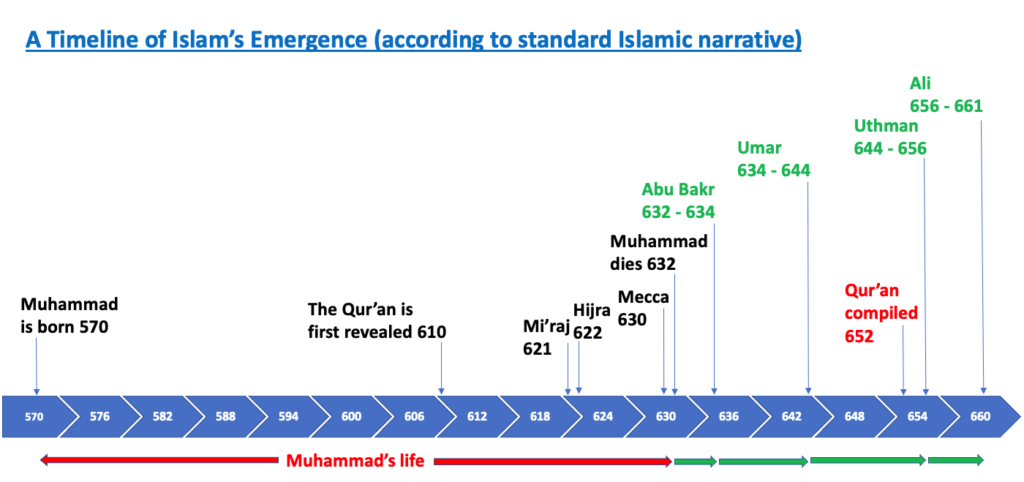
[98] Ibid., pg. 315. 

[99] Verse taken from Dakdok, THE GENEROUS QUR’AN, 2009 Smashwords Edition, pg. 208. All Qur’anic quotes are used by permission of Usama Dakdok Publishing, LLC.

[100] Verse taken from Ibid., pg. 154. All Qur’anic quotes are used by permission of Usama Dakdok Publishing, LLC.

[101] Geisler and Nix, From God To Us Revised and Expanded, 2012 Kindle Edition., pg. 204 refers to John Ryland’s Papyrus P52 fragment, the oldest New Testament Greek text (117-138 A.D.).

[102] Geisler and Saleeb, Answering Islam, 2002, pg. 238. Note: We do not include the Qur’an in this comparison, because it is only a medieval book (7th century A.D.)., whereas the New Testament is classified as an ancient book (1st century A.D.) – see Geisler and Saleeb, Answering Islam, 2002, pg. 238. 

[103] Adapted from Geisler and Nix, From God To Us Revised and Expanded, 2012 Kindle Edition, pp. 60-64, 138; McDowell, Evidence That Demands a Verdict: Life-Changing Truth for a Skeptical World, 2017 Kindle Edition, pp. 64-65; and Janosik, March 2, 2026, class lecture entitled, “Manuscript Evidence for the Bible.” 

[104] Adapted from McDowell, Evidence That Demands a Verdict: Life-Changing Truth for a Skeptical World, 2017 Kindle Edition, pg. 53 states that chart is adapted from Peter S. Cowe, “The Armenian Version of the New Testament,” in The Text of the New Testament in Contemporary Research: Essays on the Status Quaestionis, 2nd Ed., edited by Bart D. Ehrman and Michael W. Holmes (Leiden: Brill, 2013), pg. 256 and Janosik, March 2, 2026, class lecture entitled, “Manuscript Evidence for the Bible.” 

[105] Ibid. 

[106] Dakdok, Exposing the Truth about the Qur’an: The Revelation of Error, Volume 1, 2013 Smashwords Edition, pp. 20-21.


Spiritual Warfare – Part 4

A man walks with his Bible for a spiritual battle, represented by the verse Ephesians 6:12

Introduction

       Last time we observed that the apostle Paul prepared his Christians readers at Ephesus (and us) for spiritual warfare by talking about the spiritual blessings or resources we have in Christ (Eph. 1:3-14). Next, he prayed for us to understand and experience God’s great power in raising Christ from the dead (Eph. 1:15-23) and then spoke of the authority we have in Jesus (Eph. 2:1-6). After praying for his readers to be rooted in the unlimited love of Christ (Eph. 3:17-19), Paul advises us not to grieve the Holy Spirit by giving “place” or ground to the devil through unresolved anger (Eph. 4:25-31). Instead, we are to be “filled” or controlled by the Holy Spirit (Eph. 5:18) in all our relationships, including relations with church members (Eph. 5:19-21), our spouses (Eph. 5:22-33), our children (Eph. 6:1-4), and our work relationships (Eph. 6:5-9). 

       After talking about all these relationships with different people, Paul wants us to understand that people are not our primary problem. Our primary struggle is in the spiritual realm. Hence, the apostle writes, “Put on the whole armor of God, that you may be able to stand against the wiles of the devil.” (Eph. 6:11). The Ephesian believers are commanded to “put on the whole armor of God,” not just some of His armor. For what purpose? That they “may be able to stand against the wiles of the devil.” The battle that Christians face every day is “against the wiles of the devil.” The Greek word translated “wiles” (methodeias) refers to the methods or strategies of “the devil” that he employs to deceive or trick us. [1]

       It is not just “the devil” we are fighting against (Eph. 6:11). We are fighting “against the wiles of the devil” which permeate the whole kingdom of darkness. The apostle writes, “For we do not wrestle against flesh and blood, but against principalities, against powers, against the rulers of the darkness of this age, against spiritual hosts of wickedness in the heavenly places.” (Eph. 6:12). Last time we looked at the four groupings of demonic spirits in this verse. I won’t take the time to review them in this article. But the main thing to understand is that our battle is not just with the Devil, but with his entire kingdom of darkness consisting of various demonic spirits under different levels of authority, all of which are under Satan, who is “the prince” (Eph. 2:2) of this kingdom, “the god of this age” (2 Cor. 4:4), and “the ruler of this world” (John 12:31; 14:30; 16:11; cf. Matt. 4:8-9).

The Whole Armor of God [2]

       Before we look in depth at the first piece of armor, the belt of truth today, we will look briefly at the “whole armor of God” (Eph. 6:11) because each piece of armor will describe some of the various ways the Devil tries to deceive or trick us. He will tempt us to think in a way that is contrary to God. So, keep this in mind as we look at each part of the armor of God in the months to come, Lord willing. 

       God is the One Who gives us the armor we need to stand victoriously against the enemy. But we must choose to use it. It is like a doctor giving us medicine, but it will not benefit us until we take it. If we do not use the armor God has given us, we will have no authority from heaven (Eph. 1:19-21; 2:5-6) with which to exercise here on earth against the wiles (trickery) of the Devil (Eph. 6:13). [3]   

       The six pieces of armor that Paul presents are divided into two categories of three. He introduces each of these two categories with different verbs. The first three are introduced with the verb “to be.” The last three are introduced with the verb “to take.” Why does Paul switch verbs halfway through the armament? He wants us to understand two specific, distinct orientations to the six pieces of armor. The first three relate to a state we should always be in. The last three are what we use on an as needed basis. [4]

      It is like a baseball player who has his uniform on during the entire game because that is the state he is in. But he only picks up the bat when it is time for him to go to the plate to play offense. And he only picks up his glove when it is time for him to go to the field to play defense. [5]

        The first three pieces of armor we have with us all of the time [6] (“having girded… put on… shod…” – Eph. 6:14-15). [7] This is the state we are always to be in. But the last three pieces of armor we are called to take and use as needed [8] (“taking … take…” Eph. 6:16-17). [9]

     The first piece of armor is the belt of truth (Eph. 6:14a). It teaches us that Satan wants to deceive us or make us be deceptive ourselves. [10] Either one is deadly. The New Age movement is part of his deception. Even evolution, which is so openly taught as science in our country’s educational system, has decreased peoples’ sensitivity to God and to what is right and wrong. 

       For example, years ago if people had mentioned casino gambling, horse track or dog track racing, or the lottery, the people of Iowa would have risen up in moral indignation. And yet subtly, the enemy of our souls has been able to persuade our state government to legislate such activities which say you really can gain something for nothing. You can get rich quickly so just gamble. Thousands of people are being deceived into gambling and are being robbed of their funds. Such behavior is addictive. But it doesn’t stop there, does it?

       There are also things like methamphetamine, cocaine, alcohol, pornography, sexual perversion, and occult experimentation – all of which are part of the Devil’s deception. Jesus reminds us that the Devil “is a liar and the father of it.” (John 8:44b). And one of the ways Satan wants to bring us into bondage is through his lies. This is why we need the belt of truth.

       Satan also wants to accuse us of wrongdoing and get us to compromise. He wants to point out our faults and weaknesses in addition to our sins so we will get so focused on our failures and problems, we won’t look to Jesus. He also wants us to lower our standards of righteousness by tempting us to open our lives to a little sinfulness or worldliness. It won’t hurt you to try that. Everyone else is doing it. Go ahead and do it. It’s fun. This is why we need the protection of the breastplate of righteousness (Eph. 6:14b). 

      The next piece of armor teaches us about that which will rob us of our peace – anxiety and worry. Hence, we need the sandals of the gospel of peace (Eph. 6:15) –  peace with God, peace of God, the God of peace, and the Person of peace. This piece of armor teaches us that Satan wants us to live in fear and anxiety. 

       The fourth piece of armor addresses unbelief. Hence, we are to take up the shield of faith (Eph. 6:16) which extinguishes all the fiery darts or arrows of the enemy. What is that talking about? It involves Satan’s temptation to get you to question God or to act independently of God. That is the way he approached Eve in the Garden of Eden (Gen. 3:1-5). Satan got Eve to question God and what He had said and what would happen if she were to partake of the forbidden fruit. 

       The fifth piece of armor deals with mind or thought control. Satan tries to put thoughts in our minds to make us think that his thoughts are our thoughts. And so, we are to wear the helmet of salvation (Eph. 6:17a). This is the one of the ways he primarily attacks the thoughts of believers. When he begins to move violently in a believer’s life, one of the first things they begin to be tormented with is that maybe they are not saved. Sometimes all manner of hideous thoughts projected into the believer’s mind are Satan’s way of putting his thoughts into our thoughts, making it so confusing that we conclude that his thoughts are really ours. Then he taunts us with, “How could anyone who claims to be a Christian have such sinful thoughts as that?” 

      The sixth and final piece of armor addresses the Devil’s attempt to get us to neglect the Bible. The last piece of armor is “the sword of the Spirit, the word of God” (Eph. 6:17b). Have you ever wondered why it is so difficult for you to read the Bible? Why is it so challenging to set aside time to study God’s Word and meditate on it? Why do you never get around to memorizing the Scripture? The Devil is behind this. He wants to keep you from being in the Word of God because it will expose him as a liar and deceiver. 

        We have an enemy who is very versatile and subtle, and he has schemes that if we are not aware of them, he will soon bring us into his bondage. Thankfully God has given us spiritual pieces of armor that are strong and powerful. Let’s begin now with the first piece of armor. 

The Importance of the Belt of Truth

       When the apostle Paul wrote the book of Ephesians, he was a prisoner (Eph. 3:1; 4:1) under house arrest in guarded rental quarters (Acts 28:30), chained to a Roman soldier (Eph. 6:20). [11] As he looks at this Roman soldier, he begins to draw a comparison between the soldier’s armor and the spiritual armor of God. He will talk about each piece of armor in the order that a Roman soldier put it on.

       The first piece of armor was extremely important to a soldier. The soldier first put on over his tunic (a loose, sleeveless shirt that reached to his knees), a belt that would hold both the breastplate and sheathe for his sword in place. [12] He would be able to tuck his long clothes into the belt so he could run and be ready to fight. [13] Without this belt on, a soldier would be less mobile and more vulnerable to attack on the battlefield. 

       Likewise, Paul emphasizes the importance of this piece of armor by mentioning it first. “Stand therefore, having girded your waist with truth…” (Eph. 6:14a). This shows us how important the truth is in our battle against Satan and his demonic armies (Eph. 6:12). Since Satan “is a liar and the father of it” (John 8:44b), it is essential that Christians wear this piece of armor to overcome his deceptions. 

The Ruthless Nature of Satan [14]

       The Greek word translated “waist” (osphus) in Ephesians 6:14a can refer to “the place where a belt… is worn, waist” or to “the place of the reproductive organs, the loins.” [15] Some translations say, “having girded your loins with truth.” (ASV; LSB; NASB1995; RSV). By mentioning the belt first and in this way, Paul emphasizes the ruthless nature of Satan’s attack. This belt buckled around the waist and covered the soldier’s vital organs from his belt line down to his mid thighs. [16] It protected him from the violent and ruthless actions of an enemy who tried to destroy him. 

       The Psalmist had an awareness of the ruthless nature of Satan. David writes, 3b Let those be ashamed who deal treacherously without cause… 19 Consider my enemies, for they are many; and they hate me with cruel hatred.” (Psa. 25:3b, 19). The Devil never fights fair and is extremely cruel. He has no problem hitting us below the belt. Satan will try to hit us when we are most vulnerable, doing whatever it takes to incapacitate and eventually destroy us. 

       For example, when we are weakened by an illness or experiencing tremendous grief due to the loss of a loved one, the Devil will attack us with the purpose of destroying us. He shows no mercy to a suffering person.

       We also see the brutal, cruel, and violent ways of Satan in his appearances in Scripture. For example, the man in the country of the Gadarenes was so violently oppressed by the powers of darkness that “always, night and day, he was in the mountains and in the tombs, crying out and cutting himself with stones.” (Mark 5:5). Satan’s torment of this man was so severe that the man constantly endured self-inflicted agony. 

       On another occasion when the Lord Jesus came down from the Mount of Transfiguration with Peter, James, and John, He met a desperate father whose son had a ruthless demon. The father said to Jesus, “Lord, have mercy on my son, for he is an epileptic and suffers severely; for he often falls into the fire and often into the water. So, I brought him to Your disciples, but they could not cure him.” (Matt. 17:15-16). This wicked spirit would often come upon this man’s son when he was near “the fire” or “the water.” Why would this demon do that? Because he wanted to throw him into the fire so that violent burning would happen to this boy during his seizures. He wanted to throw him into the water so he could drown this boy. It was not enough for this little boy to have violent seizures. Satan wanted to add to his sufferings by throwing him into the fire or the water. This is how brutal and cruel the kingdom of darkness is toward suffering people. 

       What do these examples say about the kingdom of darkness? It says that Satan’s kingdom always has as its purpose to violently hurt, wound, and destroy (cf. John 10:10a). Most people who have had experiences with the kingdom of darkness have no doubt about the cruelty and ruthlessness of this kingdom. 

       This is why Christians must always be on guard against the lies of the enemy. Deception and lies always bring us into the realm of the kingdom of darkness. Satan always speaks his native language when he lies. Jesus said of the Devil, “He was a murderer from the beginning, and does not stand in the truth, because there is no truth in him. When he speaks a lie, he speaks from his own resources, for he is a liar and the father of it.” (John 8:44). At first, Satan’s lies may seem very appealing and even pleasurable. And when we are tempted to lie, we are never more yielding to Satan’s deceptive ways than in that moment. But in that moment, we must remember that the Devil always intends to brutalize us, oppress us, torment us, destroy us, and take away our freedom in Christ. 

The Subtle Nature of Satan’s Schemes 

        By mentioning the belt of truth first, Paul also calls attention to the subtle nature of Satan’s schemes. Not only in John 8:44 is Satan called “a liar and father of it,” but the very last picture of Satan in the Bible also points to his subtle nature. Now when the thousand years have expired, Satan will be released from his prison and will go out to deceive the nations which are in the four corners of the earth, Gog and Magog, to gather them together to battle, whose number is as the sand of the sea. They went up on the breadth of the earth and surrounded the camp of the saints and the beloved city. And fire came down from God out of heaven and devoured them. 10 The devil, who deceived them, was cast into the lake of fire and brimstone where the beast and the false prophet are. And they will be tormented day and night forever and ever.” (Rev. 20:7-10). At the end of King Jesus’ “thousand years” reign, “Satan will be released from his prison” in the abyss and will “deceive the nations” which are over all the earth “to gather them together to battle” against King Jesus and His people [“the saints”] in Jerusalem (“the beloved city”](Rev. 20:7-9a). The unbelievers in this battle led by their earthly leader “Gog” from the land of “Magog” (Rev. 20:8; cf. Ezekiel 38:2-3) will be as numerous “as the sand of the sea” and will be the offspring or descendants of the infants or children who survived Armageddon because they were below the age of accountability (Rev. 20:9b). God will intervene with “fire … out of heaven” and destroy them (Rev. 20:9c). Then “the devil, who deceived them, was cast into the lake of fire … where the beast the false prophet are. And they will be tormented day and night forever and ever” (Rev. 20:10). Satan concluded his career by doing what was most natural for him to do. He “deceived” the nations (Rev. 20:8a, 10a). 

      The Greek word translated “deceived” (planaō) means “to lead astray, mislead, to cause someone to wander from the right way.” [17] This is Satan’s main tactic – to get us to believe his lies so he can bring us under his control. 

       We see Satan’s lies working constantly in the world, especially in the political scene. For example, under communism, the lie is the truth. According to the dogma of communism, as long as it advances the cause of communism it is the truth. [18] We also see this kind of deception in our own government here in the USA. During this presidential election year, we see candidates making promises that are contrary to their past political decisions. They present lies as though they were the truth and sadly, much of the American public believes those lies. 

        Satan’s deceptions are also evident among the religions of the world. Having worked with those steeped in Islam, I have observed that if a lie supports the cause of Allah, then it must be true. A Muslim does not hesitate to lie if it advances the cause of Islam. 

       Janosik writes, “The Islamic practice of taqiyya [deception], which allows Muslims to mislead non-believers in regard to the nature of a Muslim’s own belief in order to avoid persecution. This practice allows Muslims, both Shia and Sunni, to lie to non-Muslims in a time of war, persecution, or even minority status if the lie will protect Muslims and further the goals of Islam. In his article on taqiyya, Raymond Ibrahim quotes a Muslim authority, Sami Mukaram, who says,” [emphasis and brackets added] [19] “Taqiyya is of fundamental importance in Islam. Practically every Islamic sect agrees to it and practices it … We can go so far as to say that the practice of taqiyya is mainstream in Islam, and that those few sects not practicing it diverge from the mainstream … Taqiyya is very prevalent in Islamic politics, especially in the modern era.” [20]

       Mormonism initially claims to embrace Christianity. But what they don’t tell you is Jesus Christ and Satan, like the rest of us, were spirit brothers and sons of God before the spirit of Jesus was given a body by Mary in Bethlehem. The Mormon ‘Book of Moses’ presents Satan and Jesus as contending for the privilege of taking a body of flesh in order to become the redeemer, with Jesus winning the contest. [See Joseph Smith, Pearl of Great Price, Book of Moses 4:1-4.]” [21]  [emphasis added] 

       Mormonism also believes “all human beings and spirits, including Jesus and Satan, existed as spirit beings before being born. Physical birth gives bodies to these spirits, and an opportunity to choose right or wrong. Thus, the present life is a period of probation. The way a person lives in this life determines their status in the life after the resurrection. If the deeds of this life have been satisfactory and all temple obligations have been fulfilled, the individual becomes a god and is considered eligible to create ‘spirit children’ as God the Father did and populate a world of his own.” [22][emphasis added]

       We also see Satan’s deceptions in the world’s educational scene in such things as evolution that is so ardently taught today. Anyone who knows the truth of God (Gen. 1-2; Exod. 20:8-11; Psa. 33:6-9; Rom. 1:18-23; 2 Pet. 3:1-7; et al.), knows that evolution is a lie. [23] But still it is taught as the truth.

       We also see that schools are teaching Critical Race Theory (CRT) which says that negative stereotypes are being assigned to members of minority groups to benefit white people and increase racial oppression. [24]

       Neil Shenvi defines critical race theory as “an ideology that divides the world into oppressed groups and their oppressors and aims to liberate the oppressed.” [25] Sometimes called “Cultural Marxism,” CRT borrows concepts from classical Marxism dividing the world into the “haves” and the “have nots” and attempts to right the wrongs of previous generations through a redistribution of wealth and power. Unfortunately, CRT is pitting ethnic groups against each other in hopes of correcting historic inequalities. [26]

       Biblically speaking, racism is the sin of ethnic partiality or prejudice (Jas. 2:8-9; Lev. 19:15). Racism is wrong because there is only one race, and it is the human race which is in Adam (Acts 17:26). Racism has not only caused division, but it has caused great pain and suffering throughout history. Since racism is a real sin, we should repudiate it and address it from a biblical perspective. 

       Unfortunately, CRT advocates that truth is not determined objectively outside of oneself. Instead, CRT says that truth is determined experientially by historically oppressed groups of people; thus, different groups of people can have different “truths” according to this view. 

       But truth does not work that way. Truth is true outside of anyone’s perspective. For example, two plus two equals four no matter what your skin color or any of your past experiences. Bowling balls fall from airplanes regardless of what anyone believes about gravity. 

       Christians must remember where truth comes from: the Bible (John 17:17) and Jesus Christ (John 14:6; 1:14). Truth resides in God’s Word and the Person of Jesus Christ, not in oppressed groups of people. It does not matter if older white males in a so-called domineering culture believe it, or a young black lesbian doesn’t believe it. Believing or not believing the Bible or Jesus has no bearing on the truthfulness of either. The reason for this is because truth does not reside in a person’s perspective: truth resides outside any group’s shared experience. Ultimately, truth resides in the Person of the Lord Jesus Christ. [27]

       Jesus did not focus on the education, ethnicity, gender, income, social identity, or the sexual orientation of a person. His love excluded no one. Jesus Christ desires “all” people to be saved regardless of their education, ethnicity, gender, income, social identities, or sexual orientations. The apostle Paul exhorts us to pray for “all” people because Jesus desires “all” people to be saved and He died for “all” people (I Tim. 2:3-6). Jesus’ love is inclusive, not exclusive. But Satan wants to deceive us into thinking otherwise.

       Satan has a subtle strategy of using deception and lies to bring us under his control. He seeks to mislead us into bondage. This is why it is so important to put on the belt of truth.

What is the Truth? [28]

       The belt Christians are to put on is “truth” (alētheia). But what is the truth? Truth is the absolute standard by which reality is measured. It’s not something that changes based on feelings or perspective. A person can deny that gravity is true, but if he decides to jump off a building to prove it, he’s going to find that truth doesn’t care about his feelings or perspective. Truth exists whether you embrace it or not.” [29] [emphasis added]

     Truth is simply God’s view on any subject on the front end. But often what happens is people start with man’s view and wind up with truth (God’s view) when man’s view has failed. 

       This is why the Bible speaks so much about first. “Seek FIRST the kingdom of God.” (Matt. 6:33). “He [Christ] is FIRST in everything.” (Col. 1:18 NLT). “You have left your FIRST love.” (Rev. 2:4). We always need to start first with God’s view on any subject.

       Truth is more than feelings because feelings can fluctuate. Truth is also more than facts. You can have facts and not have the truth. For example, I can say, “I have a headache. My head is really hurting me.” So, I go to Walmart and purchase some extra strength Tylenol because the fact is my head is hurting. But the Tylenol is not working. I still have my headache. So, I go to my doctor, and he does a head scan and discovers I have a brain tumor. I was treating the fact without knowing the truth. The truth was my head was hurting because of a brain tumor. Which means I was trying to solve the fact with an insufficient medication. 

       Truth is God’s view on any subject. God has spoken, He has not stuttered. There are two answers to every question: God’s answer and everyone else’s. And everyone else’s answer is wrong all the time. People can be so preoccupied with facts that they never arrive at truth. And thus, they never get solutions. 

      It is not the truth that sets us free. It is the truth that we know that sets us free. Jesus said, “You shall know the truth, and the truth shall make you free.” (John 8:32). So, if it is truth, and you do not know it, you are still in bondage. 

      In January of 1863, President Lincoln signed and issued his famous Emancipation Proclamation, freeing all slaves throughout the Confederacy. But the slaves in Texas were not told until June 19, 1865. The information of the signing was true, but it was not passed on to everyone. African Americans in Texas did not discover this truth until a year and a half later. So, during those eighteen months, they lived in bondage with no authority to exercise their freedom because they did not know the truth. 

       The reason this is so critical in spiritual warfare is because our enemy is a liar. That is all that he does. Satan is a liar (John 8:44) and a deceiver (Rev. 12:9). And if he can use facts to trick us, he will. If we do not start with the truth, that is, God’s view on a subject, then we will automatically be in bondage. And the Devil will even use religion to keep us there. Nothing holds more people hostage than religion. 

       When Satan went to Eve in the garden of Eden, the first thing he said to her was, “Let’s talk about God.” “Has God indeed said…?” (Gen. 3:1). But do you know an important word that the Devil left out when he tempted Eve? In Genesis 2, we read over and over again, the phrase, “the Lord God (’Elōhîm Yahweh) …” (Gen. 2:4-5, 7-9, 15-16, 18-19, 21-22). When Satan spoke to Eve, he left out God’s relational name “Lord” (Yahweh). This indicates that he doesn’t mind religion as long as there is no relationship with the Lord God driving it. [30]

Defeating Satan with the Truth [31]

       How do we defeat Satan with the truth? We daily reach out and put on the truth. The Bible gives us four expressions or citadels of truth. The first is THE PERSON OF TRUTH. The Lord Jesus Christ is “the truth” (John 14:6) and is “full of truth” (John 1:14). Hence, Jesus is the Person of truth.

       When we clothe ourselves with truth, we are putting on the Lord Jesus. “But put on the Lord Jesus Christ, and make no provision for the flesh, to fulfill its lusts.” (Rom. 13:14). The Greek compound word translated “put on” is enduō = en (in) [32] + dunō (go down, set) [33] and thus means “to clothe in the sense of sinking into a garment.” We can “put on the Lord Jesus Christ” by focusing our minds and morality on Him. When we live by faith in Him (2 Cor. 5:7; Gal. 2:20), studying His Word (Josh. 1:8; John 8:31-32; 15:7a; 2 Tim. 2:15; 3:16-17), talking to Him in prayer (John 15:7b; Phil. 4:6-7), and seeking to reflect Him in our actions (Col. 3:23-24; I John 2:6), we are putting on the Lord Jesus. 

       At the moment of faith in Jesus for His gift of eternal life, we are given a new nature (cf. Eph. 4:24; I John 3:9) and identity (2 Cor. 5:17), much like being given a brand-new tuxedo. Paul exhorts us to conduct ourselves according to this new nature and identity. 

       When he says not to make any “provision for the flesh” (Rom. 13:14b), it helps to ask ourselves, “Would I climb through a garbage dumpster while wearing a brand-new tuxedo?” No, that filthy environment would contaminate our pristine suit. Yet that is what we are doing when we make plans to gratify the sinful desires of our “flesh.” Instead, we are to put on Christ’s purity and avoid climbing through the dumpsters of sin. [34]

       However, if we have been making plans to gratify our sinful desires or we have actually been climbing through the dumpsters of sin, it is time to take our brand-new tuxedo to the cleaners and let the Lord Jesus completely cleanse it with His blood. Come back into the light by confessing our sins to God (I John 1:7, 9) and to safe brothers or sisters in Christ (Jas. 5:16), so God can heal us and restore us to fellowship with Him. 

       The second expression or citadel of truth in the Bible is God the Holy Spirit, Who is called THE SPIRIT OF TRUTH. Jesus said, 13 However, when He, the Spirit of truth, has come, He will guide you into all truth; for He will not speak on His own authority, but whatever He hears He will speak; and He will tell you things to come. 14 He will glorify Me, for He will take of what is Mine and declare it to you.” (John 16:13-14). What does it mean to put on the Holy Spirit? It means that we look to the Holy Spirit to lead us in accord with the truth (God’s view on a subject) of what Jesus taught (John 14:26) and what the Bible teaches us. The Spirit of God will never lead us in a way that contradicts what Jesus taught or what the Bible says. As we read the Word of God, we ask the Holy Spirit to enable us to understand the truth as God intended (I John 2:20-27). We measure everything by whether or not it aligns with what the Holy Spirit has already revealed in the Bible. 

       And we are to be very careful to honor the Spirit of God. When we have difficulty understanding a Bible passage, we ask the Holy Spirit to guide us into the truth (John 16:13) and to protect us from error (I John 2:20-27; 4:1-6). Instead of rushing into things, especially religious things that may seem overly ecstatic and exciting, we step back and take time to measure things to see if they are in accord with what God’s Spirit has already said in the Word because He is the Spirit of truth. He always guides us into truth (John 16:13) which is always in harmony with Who the Lord Jesus Christ is (John 15:26; 16:14; cf. I John 2:20-27; 4:1-6) and what He has done (I Cor. 12:3; 15:3-6) because Jesus is the truth (John 14:6). The Spirit of truth can show us the lies we believe that have kept us in bondage to sin and shame and replace them with the liberating truth of God’s Word (cf. Psa. 119:28-29). 

       The third expression or citadel of truth is THE WORD OF TRUTH, THE BIBLE. Jesus prayed to His heavenly Father, “Sanctify them by Your truth. Your word is truth.” (John 17:17). When we put on the belt of truth, we are putting on the Scripture. That means we understand that the Bible is the “word of truth” as it is called so many times throughout the Bible (cf. Psa. 119:43, 160;  Acts. 26:25; 2 Cor. 6:7; 2 Tim. 2:15; Jas. 1:18; et al.). This is why I believe that inerrancy [35] is an essential part of our Christian faith. We can trust what the Bible says in all things. It is the Word of truth, not the Word of error. We can build our lives upon the stable foundation of the Word of truth so we can endure the storms of life (Matt. 7:24-27). 

       The word “sanctify” (hagiazō) in John 17:17, literally means to “set apart” [36] from the world or “to make holy.”[37] This is not referring to sinless perfection. It is referring to spiritual growth or maturity – progressively becoming more like Christ. How? 

       We are to be “set apart” from the world’s influence and its values “by” the Father’s “truth” which is His “word,”the Bible. Throughout the Bible we see that God’s Word is true. It is not full of errors as many claim today. We cannot grow spiritually apart from God’s Word. So, the way we grow in holiness is by renewing our minds in accordance with the truth of God’s Word (cf. Rom. 12:1-2). Disciples of Jesus must abide in His word if they are to know the truth of His word and be set free from Satan’s lies that enslave their lives to sin (cf. John 8:31-36, 44). We must feed upon God’s word to experience the victory Jesus has already won for us (John 16:33). 

       At a meeting, a Native American Indian said a black wolf lived in his heart, but when Christ became his Savior, a white wolf came to live in his heart, and the two wolves were then fighting all the time. After the meeting, someone approached him and asked, “Which wolf wins, the white one or the black one?” The Indian replied, “The one I feed the most.” If we feed upon God’s Word and do it, we are going to experience more victory over the world and Satan in our Christian lives.  But if we feed upon the lies of Satan, we will experience more defeat in our Christian lives and be conformed to the world. I like what D.L. Moody wrote on the flyleaf of his Bible. “This book will keep you from sin or sin will keep you from this book.” That is the truth. If I let this book become more and more a part of my life it will keep me away from sin (Psa. 119:9, 11, 28-29). Or sin can keep me away from reading His word. 

       The final expression or citadel of truth in the Bible is the Church, THE PILLAR AND FOUNDATION OF TRUTH. Paul writes, “I write so that you may know how you ought to conduct yourself in the house of God, which is the church of the living God, the pillar and ground of the truth.“ (I Tim. 3:15). Paul describes the church as “the pillar and ground of the truth.“  

       “Much as a pillar supports a roof, the local church is to hold up the truth. Without the church, there would be nothing on earth to hold up God’s truth. 

       “The ground is that on which things are built. Thus, the church is the foundation on which the truth is built. Without the church, the truth would not have a foundation on which to stand. The church protects the truth in the face of all who attack it. 

       “Biblically sound churches bless those in their location by being there. Such churches shine the truth into a dark and dying world.” [38] [emphasis added]

       This is a great reason to stay close to a local church that embraces God’s truth. We need God’s perspective especially as it relates to spiritual warfare. And a local church that is biblically sound is a great source of encouragement and protection for every Christian. 

Conclusion

       How do we put on the belt of truth? The same way we are to put on all the pieces of God’s spiritual armor – by means of prayer. Paul concluded his teaching on the armor of God by inviting his readers to pray: “Praying always with all prayer and supplication in the Spirit, being watchful to this end with all perseverance and supplication for all the saints.” (Eph. 6:18). How often are we to pray the armor of God? “Always.” Prayer is to be woven into all of our lives. Satan and his demonic armies never take a day off, so it would be best that we don’t take a day off from praying the armor of God. 

       “We need to stay in regular communication with God and pray in the Spirit in order to access heaven’s authority for intervention on earth (6:18). In other words, we must be on the same page as the Spirit, utilizing spiritual wisdom. The most powerful way to do that is to pray God’s Word back to Him and apply it to your situation.” [39]

       Praying the belt of truth back to God can become a wonderful worship experience. We can express appreciation for the Lord Jesus, Who is the Person of Truth, and the Holy Spirit, Who is the Spirit of Truth, and the Bible, the Word of Truth, and the Local Church, the Pillar and Foundation of Truth.

       Prayer: In the name of the Lord Jesus Christ, I pray the protection of the belt of truth described in Ephesians 6:14a. I pray its protection over my personal life, my home, my family, and the ministry You, Lord, have appointed for my life. I use the belt of truth directly against Satan and his kingdom of darkness. I thank You heavenly Father for the Person of the Truth, the Lord Jesus Christ. I cling to Him Who is the truth and is full of truth, as my strength and protection from all of Satan’s deceptions. Thank You Father God for the Holy Spirit Who is the Spirit of truth. I look to You, Holy Spirit, to lead me in accord with the truth of what Jesus taught and what the Bible teaches. I ask You, Spirit of truth, to warn me before I deceive anyone and to protect me always from believing Satan’s lies. Forgive me, Lord, for not speaking the truth. Show me any way in which I am being deceived. I desire that the Bible, the Word of truth, shall constantly gain a deeper place in my life. I pray that the truth of the Word of God may be my heart’s delight to study and memorize. Thank You, Lord God, for making my local church a pillar and foundation for Your truth in my life. Help me relate to my church and give protection to others as well as receive it myself. Thank You, Lord Jesus, for showing me that my ability to be strong and to do Your will requires the stabilizing power of the belt of truth. Thank You for providing this part of the armor of God. In Your mighty name, I pray, Lord Jesus. Amen. [40]

FOOTNOTES:

[1] Walter Bauer,  A Greek-English Lexicon of the New Testament, 2000 Kindle Edition, pg. 625.

[2] Much of this section is adapted from Mark Bubeck’s video message entitled, “4. The Wholeness of the Armor: Ephesians 6 Series,” on the BRMinistry app, unless otherwise noted. 

[3] Tony Evan’s video message at Dallas Theological Seminary (DTS) entitled, “The Armor of God,” on YouTube.

[4] Ibid.

[5] Ibid. 

[6] Tony Evans, The Tony Evans Bible Commentary, 2019 Kindle Edition, pg. 2665. 

[7] The first three verbs in Greek (perizōsamenoi… endysamenoi… hypodēsamenoi… ) are aorist middle participles which means they have already been put on by the soldier or Christian.  

[8] Evans, The Tony Evans Bible Commentary, 2019 Kindle Edition, pg. 2665.

[9] The Greek verb translated “taking…” (analabontes) is an aorist active participle, meaning the Christian is taking the shield of faith as needed and the last Greek verb translated “take…” (dexasthe) is an aorist middle imperative which is used of the last two pieces of armor and means for oneself to take them up as needed. 

[10]  The next several paragraphs are adopted from Mark Bubeck’s video message entitled, “4. The Wholeness of the Armor: Ephesians 6 Series,” on the BRMinistry app, unless otherwise noted. 

[11] Evans, The Tony Evans Bible Commentary, 2019 Kindle Edition, pg. 2629.

[12] Tom Constable, Dr. Constable’s Notes on Ephesians, 2024 Edition, pg. 146.

[13] J.B. Bond, “Ephesians,” Grace New Testament Commentary: Revised Edition, 2019 Kindle Edition, pg. 1399.

[14] Much of this section is adapted from Mark Bubeck’s video message, “5. Belted Against Satan’s Belt: Ephesians 6 Series,” on BRMinistry app, unless otherwise noted. 

[15] Walter Bauer,  A Greek-English Lexicon of the New Testament and Other Early Christian Literature, 2000 Kindle Edition, pg.  730.

[16] Bubeck, “5. Belted Against Satan’s Belt: Ephesians 6 Series,” on BRMinistry app. 

[17] Bauer, A Greek-English Lexicon of the New Testament, 2000 Kindle Edition, pp. 821-822.

[18] Bubeck, “5. Belted Against Satan’s Belt: Ephesians 6 Series,” on BRMinistry app.

[19] Daniel Janosik, THE GUIDE TO ANSWERING ISLAM: What Every Christian Needs to Know About Islam and the Rise of Radical Islam (Cambridge, OH: Christian Publishing House, 2019 Kindle Edition), pg. 172. 

[20] Ibid., pp. 172, 321 cites Sami Mukaram, At-Taqiyya fi ‘l-Islam (London: Mu’assisat at-Turath ad-Druzi, 2004), 7, quoted in Raymond Ibrahim, Beware Islam’s Doctrine of Deception, PJ Media, September 24, 2015: http://www.meforum.org/5522/ben-carson-taqiyya.

[21] Retrieved on October 27, 2024, from the article entitled, “Mormonism – Does it truly follow Jesus Christ?” at www.christiananswers.net

[22] Ibid. 

[23] See the following helpful articles or books exposing the deceptions of evolution – Simon Turpin, “How the Apostle Peter Relates to the Age of the Earth Debate: Analyzing 2 Peter 3:1-7,” at www.answersingenesis.org; Harold Dressler, “Evolution – Still an Option?” at www.answersingenesis.org; Ken Ham, The Lie: Unraveling the Myth: Evolution/Millions of Years, Updated Edition (Green Forest, AR: Master Books, 1987, 2024); Roger G. Gallop, Evolution: The Greatest Deception in Modern History (Scientific Evidence for Divine Creation), Second Edition (Ponte Vedra Beach, FL: Red Butte Press, Inc., 2011, 2014). 

[24] Retrieved on June 2, 2024, from Wikipedia article entitled, “Critical Race Theory” at en.m.wikipedia.org.

[25] Retrieved on June 2, 2024, from Brandon Clay and Frost Smith’s September 29, 2020, article entitled “Critical Race Theory in the Church,” at www.answersingenesis.org.

[26] Ibid. 

[27] The previous four paragraphs were adapted from Ibid.

[28] Much of this section is adapted from Tony Evan’s video message at DTS entitled, “The Armor of God,” on Youtube, unless otherwise noted. 

[29] Evans, The Tony Evans Bible Commentary, 2019 Kindle Edition, pp. 1820-1821.

[30] Ibid., pg. 137. 

[31] Much of this section is adapted from Bubeck, “5. Belted Against Satan’s Belt: Ephesians 6 Series,” on BRMinistryapp, unless otherwise noted. 

[32] Bauer, A Greek-English Lexicon of the New Testament, 2000 Kindle Edition, pg. 327.

[33] Ibid., pg. 264. 

[34] Adapted from Evans, The Tony Evans Bible Commentary, 2019 Kindle Edition, pp. 2465-2466.

[35] Inerrancy states that the Bible is the inspired Word of God, without error in the original autographs, accurate in all areas it touches, and true in all it says (Psa. 119:86, 151, 160, 172; Prov. 30:5-6; Matt. 5:18; John 17:17; 2 Tim. 2:15; 3:16-17; 2 Pet. 1:20, 21). The Bible is God’s complete written revelation to humankind and is the final authority for guidance in living the Christian life (Deut. 4:2; 12:32; Prov. 30:5-6; I Cor. 13:8-13; Heb. 4:12; Rev. 22:18). As the Scriptures in their entirety point to Jesus Christ and His death for the sins of the world on the cross, they are a complete and trustworthy guide to reveal God’s plan of salvation for all humankind (Luke 24:27, 44-48; John 5:39; 2 Tim. 3:15).  

[36] J. Carl Laney, Moody Gospel John Commentary (Chicago: Moody Press, 1992), pg. 307.

[37] Bauer, A Greek-English Lexicon of the New Testament, 2000 Kindle Edition, pp. 9-10.

[38] Robert Wilkin, “I Timothy,” The Grace New Testament Commentary: Revised Edition, 2019 Kindle Edition, pg. 1531.

[39] Evans, The Tony Evans Bible Commentary, 2019 Kindle Edition, pg. 2667.

[40] Adapted from Mark I. Bubeck, a prayer entitled “Prayer to Know and Speak Truth,” from Spiritual Warfare Prayers pamphlet (Chicago: Moody Publishers, 1997).

IF YOU ONLY HAVE 60 SECONDS TO LIVE, WHAT DOES GOD SAY YOU MUST DO TO GET TO HEAVEN? (Video)

With tensions escalating in our world today, you may be wondering how much longer you will be able to live here on earth. This VIDEO explains from the Bible what you must do to go to heaven, whether you have 60 seconds or 60 years to live. Please share this video with those you want to see in heaven. Thank you.

Note: The Acts 16 pictures belong to Sweet Publishing / FreeBibleimages.org. The movie clip of hell is used with permission from the makers of The Free Gift movie.

WHO AM I?

God wants us to know that we are far more than what we have been told by Satan and other people. No one has the power to define us but the One Who created us and redeemed us. God takes a lot of time in the Bible to tell us who we are when we become His children through faith in Jesus (John 1:12; I John 5:1). The phrase “in Christ” or “in Him” is used 120 times in the New Testament and refers to how God sees us after we become children of God by believing in Jesus.

Who am I after I come to faith in Jesus?

I am never alone (Deut. 31:6, 8; Isa. 41:10; Matt. 28:20; Heb. 13:5)

I am the apple of my Father’s eye (Ps. 17:8; Matt. 6:26; 10:29-31)

I am a delight to God (Ps. 18:19; Zeph. 3:17)

I am cherished and loved by God (Ps. 27:10)

I am hope-filled (Ps. 27:13; Jer. 29:11; Rom. 5:5)

I am helped, not helpless (Isa. 41:10, 13)

I am redeemed by God and therefore, I belong to Him (Isa. 43:1b).

I am always loved by God no matter what (Jer. 31:3; Rom. 5:8; 8:37-39)

I am the salt of the earth (Matt. 5:13)

I am the light of the world (Matt. 5:14)

I am a child of rest, no longer having to work for my salvation (Matt. 11:28)

I am precious to Jesus Who gave up everything to redeem or purchase me (Matt. 13:45-46; I Cor. 6:19-20; I Pet. 1:18-19)

I am given authority over all the power of the enemy (Luke 10:17, 19-20)

I am given everlasting life and will not be judged for my sins in the future (John 5:24)

I am free from bondage to sin positionally (John 8:31-36)

I am part of the True Vine, a channel of Christ’s life (John 15:1, 5)

I am chosen and appointed by Christ to produce lasting fruit (John 15:16)

I am given the power of the Holy Spirit inside me (Acts 1:8; Rom. 8:11; Gal. 5:22-23)

I am given peace with God through faith in Jesus (Rom. 5:1)

I am given hope because the love of God was poured out in my heart through the Holy Spirit (Rom. 5:5)

I am dead to sin (Rom. 6:2, 11; I Pet. 2:24)

I am set free from the power of sin (Rom. 6:2-11)

I am a slave of righteousness (Rom. 6:18)

I am slave of God (Rom. 6:22)

I have the Spirit of adoption by whom I cry out to God, ‘Abba (Daddy/Papa), Father.’” (Rom. 8:15)

I am free from accusation in Christ (Rom. 8:33)

I am free from condemnation in Christ (Rom. 8:34)

I have an eternal inheritance from God (glorified resurrection body/eternal dwelling on the New Earth) that cannot be taken from me (Rom. 8:17a; Gal. 3:26, 29; Eph. 1:14; cf. John 14:1-3; I Cor. 15:35-58; Phil. 3:21; Rev. 21-22)

I am more than a conqueror through Christ Who loved me (Rom. 8:37)

I can never be separated from God’s love (Rom. 8:38-39)

I have the mind of Christ (I Cor. 2:16)

I am a holy temple where the Holy Spirit now lives (I Cor. 3:16; 6:19; Eph. 2:21-22)

I am united to the Lord and am one spirit with Him (I Cor. 6:17)

I am a member of Christ’s body (I Cor. 12:27; Eph. 5:30)

I am not the great “I AM” (Exod. 3:14; John 8:24, 28, 58), but by the grace of God, I am what I am (I Cor. 15:10)

I am a new creation (2 Cor. 5:17)

I am reconciled to God (2 Cor. 5:18a)

I am a minister of reconciliation (2 Cor. 5:18b-19)

I am an ambassador for Christ (2 Cor. 5:20)

I am good enough in Christ (2 Cor. 5:21)

I am a bondservant of Christ (Gal. 1:10)

I can change because Jesus now lives inside me through His Spirit (Gal. 2:20; cf. Rom. 8:11)

I am redeemed from the curse of the Law (Gal. 3:13; I Pet. 1:18-19)

I am a son of God through faith in Jesus and am one in Christ (Gal. 3:26, 28)

I am a saint (one declared totally righteous) at the core of my being, not a sinner (Eph. 1:1; I John 3:9)

I am chosen or wanted by God (Eph. 1:4a; Col. 3:12a)

I am holy and without blame before God (Eph. 1:4b)

I am totally accepted by God in Christ (Eph. 1:6)

I am totally forgiven in Christ (Eph. 1:7; Col. 2:13-14)

I am sealed by the Holy Spirit Who guarantees my safe and secure delivery to God in heaven (Eph. 1:13-14)

I am God’s precious inheritance (Eph. 1:18)

I am seated in a position of authority and victory next to Jesus in the heavenly places far above all other authorities (Eph. 1:20-21; 2:5-6)

I am God’s masterpiece, not a mistake (Eph. 2:10)

I have been brought closer to God through the blood of Christ (Eph. 2:13)

I have instant access to the Father by one Spirit (Eph. 2:18)

I am a fellow-citizen with the rest of God’s family (Eph. 2:19)

I am a prisoner of Christ (Eph. 3:1; 4:1)

I am a new man created according to God, in true righteousness and holiness (Eph. 4:24)

I am a child of light, defined by the light of Jesus Christ, not by the darkness of my sin (Eph. 5:8; cf. John 12:36)

I am a citizen of heaven, seated in heaven right now (Phil. 3:20; Eph. 2:6)

I have what it takes in Christ (Phil. 4:13)

I am delivered from the power of darkness into the kingdom of the Son of His love (Col. 1:13)

I am complete in Christ, lacking nothing (Col. 2:10)

I am safely and securely hidden with Christ in God (Col. 3:3)

I am an expression of the life of Christ because He is my life (Col 3:4; Deut. 30:20).

I am deeply loved by God (Col. 3:12a; I John 3:1)

I am credited with Christ’s holiness and therefore I am accepted by God (Col. 3:12a)

I am a son of light and not of darkness (I Thess. 5:5)

I am a perfected worshiper of Christ through His once and for all sacrifice (Heb. 10:10, 14)

I am God’s child born again of the incorruptible seed of the Word of God that stands forever (I Pet. 1:3, 23)

I am one of God’s living stones being built up in Christ as a spiritual house (I Pet. 2:5)

I am a member of a chosen generation, a royal priesthood, and a holy nation (I Pet. 2:9a)

I am a special person to God (I Pet. 2:9b)

I am an alien and stranger to this world in which I temporarily live (I Pet. 2:11a)

I am cared for by God (I Pet. 5:7)

I am an enemy to the devil (I Pet. 5:8)

I am a child of God and will resemble Jesus when He returns (I John 3:1-2)

I am an overcomer because greater is He who is in me than he who is in the world (I John 4:4)

I overcame the world’s opposition when I believed in Jesus (I John 5:1, 4)

I am born of God and the wicked one cannot touch or harm my born-again nature (I John 5:18)

If you only have 60 seconds to live, what does God say you must do to get to heaven? (Video)

This video explains from the Bible what you must do to go heaven whether you have 60 seconds or 60 years to live. Please share this video with those you want to see in heaven. Thank you.

The Acts 16 pictures belong to Sweet Publishing / FreeBibleimages.org. The movie clip of hell is used with permission from the makers of The Free Gift movie.

Revelation 22 – Part 3

“Behold, I am coming quickly! Blessed is he who keeps the words of the prophecy of this book.” Revelation 22:7

Chuck Swindoll quotes Ravi Zaharias, “Our society is walking through a maze of cultural land mines, and the heaviest price is exacted as we send our children on ahead.” 1

Swindoll continues, “Mazes, land mines, and exuberant youth who rarely watch where they’re going or look before they leap: That about sums up the present world.

“The twentieth century saw the rise of a generation that not only rejected much of what their elders held as unassailable truth but even began to doubt the concept of ‘truth’ itself! The tragic result has been a philosophical system known as ‘relativism’ or ‘postmodernism.’ It’s the belief that truth should be defined as merely the commonly held beliefs of a particular culture or society. As such, the belief systems that individuals or groups use to make sense of their world aren’t necessarily valid for another person or group.

“Through the media, academia, and other opinion formers, this idea continues to shape the thinking of most people in the twenty-first century. Younger generations are left to grope aimlessly through the relativistic maze, feeling insecure, fearful, and overwhelmed. They don’t realize that land mines await them around every turn – destructive deceptions and immoral acts that can bring calamity, even an early death.

“Paul the apostle warned his young protégé Timothy that a primary characteristic of the latter days would be the widespread rejection of truth (I Timothy 4:1-2; 2 Timothy 4:3-4). In light of this warning, the book of Revelation provides exactly what the coming end-times generation – and every generation – needs: objective, certified, reliable truth. When armed with this truth, people can face their fallen world with greater security, deeper faith, and stronger courage.” 2

All the visions that the apostle John had received from Revelation 4:1-22:5 had now ended. In the conclusion of the book of Revelation (22:6-21), the Lord Jesus Christ personally emphasizes some essential truths that He wants His listeners in the local churches to hear and embrace. 3

“Then he said to me, ‘These words are faithful and true.’ And the Lord God of the spirits of the prophets sent His angel to show His servants the things which must shortly take place.” (Revelation 22:6). Since the visions of the future ended with 22:5, the angel who now speaks to John is probably the original angel whom Jesus sent to John at the beginning of the book of Revelation (cf. 1:1). 4 This angel assures John that “the things” prophesied to “shortly take place” (4:1-22:5), which John had just seen, were “faithful and true.” 5The purpose of the book of Revelation is not to bewilder and confuse but to reveal many certainties about future events. 6

“This directly contradicts the point of view of many scholars that the Book of Revelation is an imponderable mystery for which no key is available today. This book is the Word of God and not the imaginations of John. In addition, it is intended to describe future events. When taken in its literal, ordinary meaning, this is exactly what it does… The Word of God was not given to be obscure. It was given to be understood by those taught by the Spirit.” 7

The reason why these prophecies are “faithful and true” is because “the Lord God of the spirits of the prophets,” the Lord Jesus Christ, “sent His angel to show His servants,” of whom one is the apostle John, “the things which must shortly take place.” The book of Revelation records future events, which, from God’s point of view, will come upon humankind very soon. 8

In our confused culture, believers in Jesus are to anchor their souls in what is “faithful and true.” Since the book of Revelation comes from the Lord Jesus Christ Who is “the truth” (John 14:6) and cannot lie (Titus 1:2; Hebrews 6:18), it is very reliable. This inspired source of truth can be fully trusted. 9

The Lord Jesus Christ Himself speaks next! “Behold, I am coming quickly! Blessed is he who keeps the words of the prophecy of this book.” (Revelation 22:7). When the Lord Jesus says, “Behold…” He is telling us to stop what we are doing and pay attention to what He is about to say because it is extremely important. Jesus then announces, “I am coming quickly!” The Greek word translated “quickly” (tachy) means “soon, in a short time.” 10 The words “quickly” and “soon” both convey God’s perspective about His return for His church. His coming is always “soon” from “the standpoint of the saints’ foreview of the future, and when it occurs, it will come suddenly or quickly.” 11

The events of the Rapture of the church, the next event on God’s prophetic calendar (Revelation 4:1-4; cf. John 14:1-3; I Corinthians 15:50-57; I Thessalonians 4:13-18), will take place very quickly, “in a moment, in the twinkling of an eye,” the apostle Paul tells us in I Corinthians 15:52.

The Greek word for ‘moment’ is atomos, from which we get our English word atom. Atomos refers to something that is indivisible, that cannot be divided. When Paul wrote these words, no one could imagine splitting the atomos. Today, we would translate this ‘in an instant,’ ‘in a split second,’ or ‘in a flash.’

“The second phrase that describes the duration of the Rapture is ‘in the twinkling of an eye.’ The Greek word for twinkling is rhipe. This might refer to the time it takes for light to reflect in the human eye. Others believe that it refers to the time it takes to blink your eye – ‘in the blink of an eye.’ Blinking is the quickest movement in the human body. People everywhere understand what ‘in the blink of an eye’ means.

“The main point is clear. All the events of this Rapture will happen instantaneously. In a flash. It will all happen so quickly that it will be completely unobservable to the human eye. Like replaying in slow motion a split-second catch in a football game, the Lord slows down the Rapture film for us so we can see exactly what will happen” 12 in I Thessalonians 4:13-18.

A brief outline of the events of the Rapture from I Thessalonians 4 includes:

  • The Return of Christ in the air with Christians who have died– “For if we believe that Jesus died and rose again, even so God will bring with Him those who sleep in Jesus.” (4:14)
  • The Resurrection of the bodies of Christians who have died –15 For this we say to you by the word of the Lord, that we who are alive and remain until the coming of the Lord will by no means precede those who are asleep… 16 And the dead in Christ will rise first.” (4:15, 16b)
  • The Rapture of living Christians – “Then we who are alive and remain shall be caught up…” (4:17a).
  • The Reunion of both living and dead believers with the Lord in the air– “Then we who are alive and remain shall be caught up together with them in the clouds to meet the Lord in the air. And thus we shall always be with the Lord.” (4:17). 
  • The Reassurance from this truth – “Therefore comfort one another with these words” (4:18).

“But don’t let God’s slow-motion version of Rapture in I Thessalonians fool you. The Rapture will occur in a split second. Suddenly, corpses all over the world will be raised and reunited with perfected spirits, and living believers everywhere will be caught up to heaven [with] transformed body, soul, and spirit. The Rapture will shock the world. It will change everything.” 13

Jesus’ announcement of His soon coming in Revelation 22:7a is a message that both nonbelievers and believers must hear and respond to. For the non-Christian, he or she is to get right with God by believing in Jesus. The Bible says, “Believe on the Lord Jesus Christ, and you will be saved” (Acts 16:31). The word “believe” (pisteuō) in the New Testament means “to consider something to be true and therefore worthy of one’s trust.” 14

God is inviting all of us to “believe on the Lord Jesus Christ” alone to save us from the penalty of our sins because all of us have sinned against God with our thoughts, words, and actions (Romans 3:23). The penalty for our sins is “death” (Romans 6:23a) or separation from God. Because God is holy, righteous, and perfect, He cannot be around our sin (Habakkuk 1:13; Isaiah 59:2). The Bible tells us that the final punishment for our sin is death in the lake of fire (Mark 9:43-44; Revelation 20:15).

God does not want any human being to die forever in the lake of fire so out of love for us, He sent His only perfect Son, Jesus Christ (John 3:16), to earth to live a perfect life (since He is God – John 1:1; I John 5:20; 2 Corinthians 5:21; Hebrews 4:15; I Peter 3:18), and then die on a cross in our place and rise from the dead (I Corinthians 15:3-6; Romans 5:8), proving His claims to be God are true (Romans 1:3-4). Jesus Christ is alive today and He invites you to believe or trust in Him alone to save you from sin’s penalty and give you eternal life so you can enter His heaven in the future (Acts 16:31; John 3:16; Revelation 21-22).

Those of you who are reading this article need to ask yourself, “What am I trusting to get me into God’s heaven?” Are you trusting your works to get you into His heaven? Are you trusting Christ plus your works? Or are you trusting in Christ alone to get you into God’s heaven? The Bible tells us in Acts 16:31 to “believe” or trust in the Lord Jesus Christ alone (not our works or Christ plus our works) to save us from the penalty of sin so we can enter God’s heaven when we die or are Raptured, whichever takes place first.

If you have never understood and believed this before, and now you do, you can tell God this through prayer.

Prayer: Dear Lord Jesus, thank You for showing me that You are coming soon to remove Your church from the earth. Before today, I was not prepared to hear this. I did not understand that I am a sinner who deserves to be separated from You forever. I thought if I lived a good life and treated people like I want to be treated, I might make it into Your heaven. But Your Word reveals to me that I am a sinner who deserves to be punished for my sins forever separated from You in the lake of fire. However, my sin does not keep You from loving me and wanting to be in a personal relationship with me. I now believe You died in my place for my sins and rose from the dead. Right now, as best I know how, I am trusting You Lord Jesus to save me from sin’s penalty and give me everlasting life as a free gift. Thank You for the salvation I now have and for the future home I will have with You in Your heaven. Please help me to share this good news with others who do not know You so they can be ready for Your soon return. In Your precious name I pray, Lord Jesus. Amen.

Those of us who believe in Jesus for His gift of salvation are to respond to His announcement of coming soon by keeping His commands (cf. 22:9, 14). Jesus said, “Blessed is he who keeps the words of the prophecy of this book.” (Revelation 22:7b). God has given us “the words of the prophecy of this book” [Revelation], not only so we might learn about future events, but so we may also prepare (“keeps”) for them and be “blessed.”

In view of Jesus’ soon return, believers in Jesus are to take the words of the book Revelation seriously and act on them. 15 We are to anticipate what God has predicted. People today often doubt whether we can know anything for certain about the present and the past, much less about the future. 16 There is so much fake news in our world today, that we are prone to doubt nearly everything we hear. However, as believers in the God of truth, we can trust what He has said about the future: “Indeed I have spoken it; I will also bring it to pass. I have purposed it; I will also do it.” (Isaiah 46:11).

We are to live in a constant state of readiness, not neglecting our duties or failing to prepare for the future, but always looking forward to the soon-coming of Christ to take us home.” 17

It is tragic that this last book of the Bible which promises a blessing to those who read it, hear it, and keep what is written in it (Revelation 1:3; cf. 22:7), is often neglected by churches and individual Christians alike more than any other book of the Bible. This is so ironic because of all the books in the Bible, the book of Revelation contains more promises of blessing than any other book. 18 Perhaps Satan is behind this avoidance of this profound prophetic book because he does not want God’s people to receive God’s blessings nor be prepared for what is coming.

Prayer: Glorious Lord God, thank You for the book of Revelation which informs us of many future certainties so we can prepare for what is coming and receive Your many blessings. Every word in the book of Revelation is faithful and true. Help us to read and keep the words of this prophetic book so we can face a world that has rejected Your truth and is spiraling out of control as a result. May we be armed with Your truth so we can face this broken world with more security, unwavering faith, and greater courage in the days ahead. In the mighty name of Jesus Christ, we pray. Amen.

ENDNOTES:

1. Charles Swindoll, Insights on Revelation (Swindoll’s Living Insights New Testament Commentary Book 15, Tyndale House Publishers, Inc., 2014 Kindle Edition), pg. 397 cites Ravi Zacharias, Recapture the Wonder (Brentwood, TN: Integrity Publishers, 2003), pg. 27.

2. Swindoll, pp. 397-398.

3. Bob Vacendak; Robert Wilkin; J. Bond; Gary Derickson; Brad Doskocil; Zane Hodges; Dwight Hunt; Shawn Leach; The Grace New Testament Commentary: Revised Edition (Grace Evangelical Society, Kindle Edition, 2019), pg. 1588.
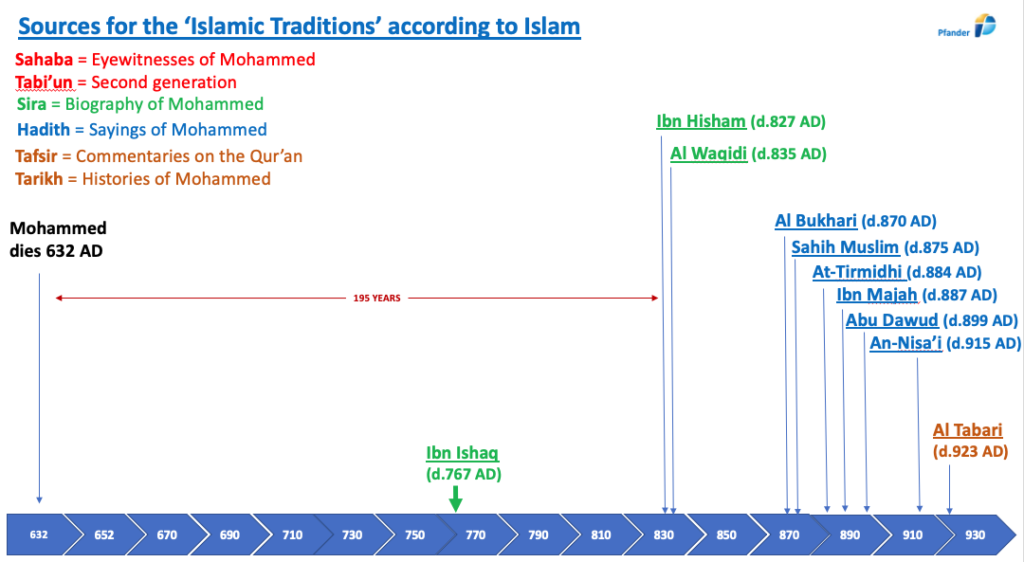
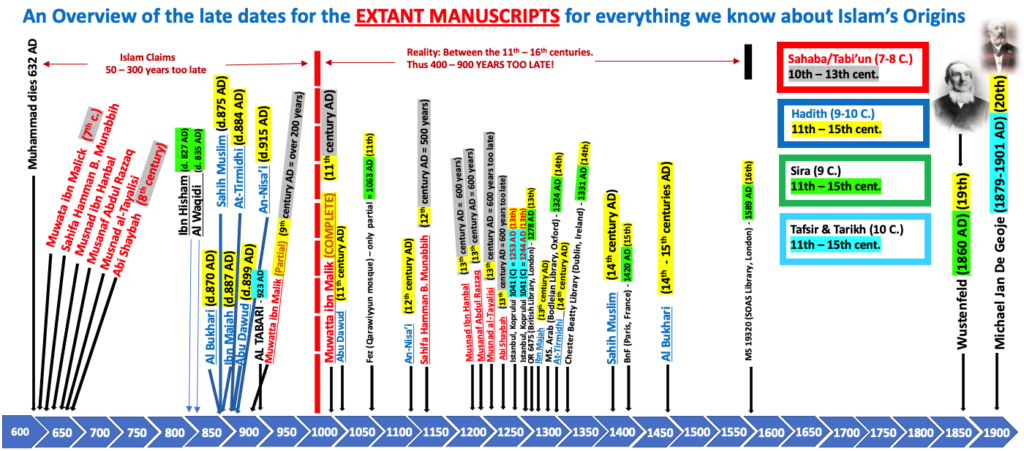
4. Ibid., pg. 1589.

5. Tom Constable, Notes on Revelation, 2017 Edition, pg. 251.

6. John F. Walvoord, The Bible Knowledge Commentary Epistles and Prophecy, Editors John F. Walvoord and Roy B. Zuck (David C. Cook, 2018 Kindle Edition), Kindle Location 6644 to 6649.

7. Ibid.

8. Vacendak, pg. 1589.

9. Swindoll, pg. 398.

10. Walter Bauer, A Greek-English Lexicon of the New Testament and Other Early Christian Literature: Third Edition (BDAG) revised and edited by Frederick William Danker (Chicago: University of Chicago Press, 2000 Kindle Edition), pg. 993.

11. Walvoord, Kindle Location 6654.

12. Mark Hitchcock, The End: A Complete Overview of Bible Prophecy and the End of Days (Carol Stream, IL: Tyndale House Publishers, Inc., 2012 Kindle Edition), pg. 129.

13. Ibid., pp. 129-130.

14. Bauer, pg. 816.

15. Tony Evans, CSB Bible by Holman, The Tony Evans Study Commentary (B & H Publishing Group, Kindle Edition 2019), pg. 2424.

16. Swindoll, pg. 398.

17. Ibid.

18. Constable, pg. 252; cf. Walvoord, Kindle Location 6656.

HOW CAN I OVERCOME CONDEMNATION? (Video) Real Solutions to Real Problems – Part 5

This is the fifth video in a series entitled, “Real Solutions to Real Problems.” In this presentation you will learn from the Bible several transforming principles for overcoming condemnation.

All Scriptures are from the New King James Version Bible unless otherwise noted. Digital images areused with permission from Arabs for Christ / FreeBibleimages.org, Goodsalt.com, Good News Productions International and College Press Publishing, LumoProject.com, or they are creative common licenses.