

Spiritual Warfare – Part 6

Introduction

       As the celebration of Jesus’ birth approaches, I am reminded of that first Christmas which is recorded from a human perspective in Matthew’s and Luke’s gospels (Matt. 1:21-2:12; Luke 2:1-20). It is presented as a very peaceful event involving Mary and Joseph, some angels, shepherds, wise men, and the baby Jesus. The angels praised God saying, “Glory to God in the highest, and on earth peace, goodwill toward men!” (Luke 2:14). Hence, most Christmas celebrations today focus on the peace that surrounded the birth of Jesus, assuming He would bring peace “on earth” during His First Coming. 

        But at the beginning of the week before Jesus’ crucifixion when Christ triumphantly entered Jerusalem, a multitude of His followers praised God, saying: “Blessed is the King who comes in the name of the Lord! Peace in heaven and glory in the highest!” (Luke 19:38). Notice they say, “Peace in heaven,” not “peace on earth.” The first coming of Christ would establish spiritual peace “in heaven” between God and humankind (Rom. 5:1; Eph. 2:16-18). But it won’t be until Jesus’ Second Coming to earth that universal peace “on earth” will be established by King Jesus during His thousand-year reign on earth (Rev 20:4-6; Isa. 2:1-4; 9:6b-7; Mic. 4:1-5). 

       In Revelation 12:1-5, the apostle John shares a version of the Christmas story that is from heaven’s perspective, and it is the opposite of peace (see above picture). This version of the Christmas story involves three main characters: the woman, representing the nation of Israel who endured much pain in bringing the Messiah into the world (Rev. 12:1-2; cf. Gen. 37:9-11); the Child, representing the Lord Jesus Christ (Rev. 12:2, 5); and the dragon, representing the Devil (Rev. 12:3-4a, 9).

       When Jesus is born into the world, Satan is there with his army of demons represented by “a third of the stars of heaven” (Rev. 12:4a), waiting to destroy Him: “And the dragon (Satan) stood before the woman who was ready to give birth, to devour her Child (Jesus) as soon as it was born” (Rev. 12:4b – parenthesis added). While shepherds are watching, angels are singing, and wise men are worshipping, Satan is waiting to make his move. The attempt to kill the Child John sees in this vision is probably a reference to king Herod’s brutal attempt to kill Jesus (cf. Matt. 2:16).

       The next verse says, “She bore a male Child who was to rule all nations with a rod of iron. And her Child was caught up to God and His throne.” (Rev. 12:5). In this version of the Christmas story Jesus goes from being born at Bethlehem, to ruling on the throne of the universe. John uses this one verse to summarize the birth, life, death, resurrection, ascension, and future reign of the Lord Jesus Christ. Satan not only used Herod in an attempt to kill the baby Jesus, but He would later use Judas to betray Him, Pilate to condemn Him, and the Roman soldiers to crucify Him. All the fury of hell would be released against the Child born on that silent night.

      The rest of Revelation 12 talks about the last half of the Tribulation period when Satan and his fallen angels are cast down from heaven and persecute the people of God – the nation of Israel (cf. 12:7-17). Since Satan could not destroy the Christ Child Who is now on His throne in heaven, he is going to go after what is dearest to the Child – His own people. This is why there is so much opposition against God’s people today, especially His Jewish people, and it will only intensify as the Second Coming of Christ to earth draws near. If the Devil can destroy Israel before Jesus returns to earth with His Bride, the Church (Rev. 19:7-21), then there can be no triumphant return of Christ and Satan will rule the earth.

       John’s version of the Christmas story reminds us we are in a struggle with a dragon. It is a struggle we can’t win; it is a struggle Jesus already won. You see, if you are a child of God through faith in Jesus Christ, Satan is going to attack you. “Satan” means adversary. During this Christmas season (and all our lives), he wants to rob us of the joy and peace of Christmas by reminding us of our sins and shortcomings. He will accuse us of the times we have lied and been unfaithful, of the times we’ve lost our temper and broken our promises.

The Armor of God
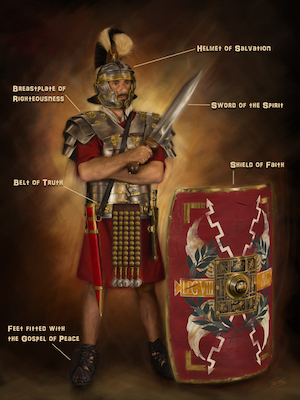
       How can we deal with this intense spiritual battle whereby the enemy seeks to rob us of God’s peace? The apostle Paul instructs his Christian readers (including you and me) to “put on the whole armor of God” so we may stand against the “wiles” or trickery of the Devil (Eph. 6:11). Paul describes the armor that Roman infantrymen wore in the order they would put it on.

       The soldier first puts on his belt which represents the Christian’s belt of truth (Eph. 6:14a). Since Satan is the father of lies (John 8:44), this first piece of armor is essential to protecting us from Satan’s deceptions and lies. We learned that truth is God’s viewpoint on a subject. It is the absolute standard by which reality is measured in its original form.Truth points us in the direction that God wants to lead us.

       After putting on his belt, the soldier then puts on his breastplate which protects his vital organs in his chest region. “The breastplate” we are to put on is “righteousness” (dikaiosunē) which refers to the quality of “being right.” [1] God’s truth is the informational base that tells us the right thing to do. The truth points our heart in the direction of God’s righteousness. The breastplate of righteousness is our response to God’s truth or viewpoint on a matter.

       When God’s truth and righteousness are operative in our lives, it will lead to the next piece of armor which has to with our feet or shoes (Eph. 6:15). Why is this so important?

The Importance of Our Feet

      In the 21st century, we have shoes for every occasion. There are dress shoes, casual shoes, work shoes, and many kinds of athletic shoes. There are shoes for cold weather, warm weather, and rainy weather. We have indoor shoes and outdoor shoes. There are specialty shoes like dance shoes (ballet,  tap, etc.), work boots (steel-toe, waterproof, etc.), and orthopedic shoes. Some of you may have a closet full of shoes that are designed to adorn your feet. The fact that we have so many varieties of shoes today demonstrates the importance of our feet. [2]

      It is also a very serious thing to have feet that hurt. Have you ever noticed how difficult it is to focus on an objective when your feet are hurting? When your feet hurt, you hurt are over. When our feet hurt, we do not make a good soldier. This is why our military places great emphasis on examining the feet of a soldier. They understand that a person’s feet need to be comfortable to be a good soldier. God understands this more than anyone. [3]

The Soldier’s Sandals

       God wants His people to wear a certain kind of shoes all the time because they will address an important issue regarding spiritual warfare in our lives. After a Roman soldier put on his belt and breastplate (Eph. 6:14), he then puts on his sandals: “And having shod your feet with the preparation of the gospel of peace.” (Eph. 6:15). The Greek word translated “shod” (hupodeō) is a compound word meaning “under” (hupo) plus “to bind/tie” (deō)or “to bind/tie under or beneath” [4](sandals). [5] It refers here to what you are wearing on your feet at all times. [6]

       The word translated “preparation” (hetoimasia) refers to the state of “readiness.” [7] If we are wearing these shoes, we will be ready for the Devil’s attacks against us. We will be prepared to deal with our enemy’s methods of deception.

        To properly understand this piece of armor, we need to realize that the Roman soldier had what modern-day American football players have. They had cleats or spikes coming out of the bottom of their shoes. “Roman soldiers wore sandals with cleats built in to help them have firm footing and to stand their ground under attack.” [8] These spikes on the bottom of a soldier’s sandals gave him stability and mobility on the battlefield. They kept him from slipping and sliding when he was under attack.

       If we were in a battle in Paul’s day, we had better be well-shod. There would be nothing worse than losing our footing with an enemy standing over us with a sword in his hand. [9]

       Paul has already emphasized the need to be stationary in battle by using the word “stand” (stēnai) or a form of this word (antistēnai/stēte) four times (Eph. 6:11, 13-14). Why? Because the Devil wants to knock us off our feet. He wants to knock us to the ground and keep us there. He desires to remove us from our place of stability.

       When Paul says to have our feet “shod,” he is talking about placing ourselves in a stationary position so that when all hell breaks loose “in the evil day” (Eph. 6:13), Satan cannot knock us down or knock us out. Why? Because what we are wearing on our feet gives us stability and sure-footedness.

       If you are like me, you know what it is like to be knocked over by the evil one. Our circumstances have knocked us over. Our finances have knocked us over. Our relationships with certain people have knocked us over. Our jobs have knocked us over. Our feet have slipped, and we are going down.

       So, what this third piece of armor teaches us is that God wants to create stability or sure-footedness for us so that when we face a Satanic full-frontal attack, we can stand firm. Evans explains, “Through the cross and resurrection of Christ, victory is already won. The devil has lost. The only power he has is the power you give him. We are to stand firm in Christ’s victory. Paul tells the Ephesians over and over: stand (6:11, 13-14). In other words, stay in the area where victory has been achieved under the cover of God’s armor. When you stand under an umbrella, it doesn’t stop the rain. But it does stop you from getting wet. You have to dress for success in this thing called the Christian life.” [10] [emphasis added]

The Purpose of Satan’s Attack

       Remember that the Devil is a thief (John 10:10a). He knows he cannot take away our salvation because we are secure forever in Christ after we believe in Him for His free gift of eternal life which can never be lost (cf. John 3:16; 6:35-40; 10:28-29; Rom. 8:38-39; Eph. 1:13-14; I John 5:13). Since the evil one cannot keep us out of heaven, he wants to make us experience hell on earth. [11] How does he do this?

       This third piece of armor teaches us that Satan wants to rob us of God’s “peace.” The opposite of “peace” is anxiety. The Devil wants God’s children to live with anxiety and fear. He knows that whatever we fear, we give control to. Hence, the purpose of the enemy’s attacks is to keep God from controlling our lives, so our salvation is not manifested through us. He wants to keep us defeated and discouraged.

       But God wants His people to have feet that are not hurting in the area of “peace.” The Lord understands that one of the Devil’s strategies is to rob God’s people of His peace. Satan wants to promise us peace through his “wiles” or trickery. He will promise us peace through counterfeit religions, drugs, education, entertainment, materialism, the occult, and sex outside of marriage. Often times we discover that we have less peace than we did before we pursued the enemy’s counterfeit peace. It is that way with everything Satan promises to use to give us peace. Instead of giving us peace, Satan’s ways lead us into bondage and death.

What is Peace?

       But God’s “peace” is real, and it protects us from the activities of the kingdom of darkness. But what is this “peace” God wants us to wear all the time? The Greek word for “peace” (eirēnē) in Ephesian 6:15 refers to a “state of concord, harmony, or well-being” [12] between Jews and Gentiles (Eph. 2:14-15) and between God and humankind (Eph. 2:16-18).

       Jesus used this word for “peace” (eirēnē) twice in John 14:27 when He referred to two types of peace. The first kind refers to His work on the cross. “Peace I leave with you.” (John 14:27a). The word “leave” (aphiēmi) implies something that Jesus does. Christ’s death on the cross would provide eternal “peace with God” (Rom. 5:1) for us because all our sins would be forgiven (Acts 10:43; Col. 2:13-14). The meaning of “peace” in this case “is the spiritual well-being that results from being rightly related to God through Jesus Christ.” [13]

       The second type of peace in verse 27 is the kind that Jesus enjoyed on earth. He says, “My peace I give to you” (John 14:27b). In the context (cf. John 14:21, 23), this peace of Christ’s is given to obedient believers. It arises from a life of faith in God. It refers to a calmness “that would come to their hearts from trusting God and from knowing that He was in control of all events that touched their lives.” [14]

       Christ distinguishes His peace from the kind of peace the world can give – “not as the world gives do I give to you.” (John 14:27c). The world cannot offer eternal peace with God. The world denies that people need to be reconciled to God. The world says that people are inherently good because they are created in the image of God. “Because God loves everyone,” the world says, “There is no need for reconciliation with God.” The world offers a false peace to people. Sin has distorted God’s image in people. Some churches deny this because the world has influenced them to believe that people are inherently good and do not need a Savior.

       The peace the world offers depends on one’s circumstances and is temporary. Itis deceptive and misleading. But the peace Jesus offers is the calm and tranquility of the soul that is independent of our external situation. [15]

       This peace is much like the painting above. [16] The sky is black with storm clouds. The waves are violently billowing up and down against the rocky shore. There is turmoil and chaos all around. 

       But on the right side of this portrait about halfway up the rocky cliff at the edge of this horrific circumstance of life, was a mother bird sitting on her nest protecting her young. One little light piercing the darkness of the clouds was shining down on the bird as it sat peacefully on its nest. 

       This picture portrays biblical peace. Biblical peace is not the absence of problems. It is not “when nothing is wrong, I am calm.” Biblical peace is when everything is wrong, and we are still calm. It is when circumstances or situations are not conducive to rest, but we are able to chill. Biblical peace is when there is calm on the inside while there is nothing but chaos on the outside. We do not know we have biblical peace until circumstances are not peaceful.

       When Jesus spoke of His peace in John 14:27, it was the night before His crucifixion. There was nothing peaceful about Jesus’ situation. He knew it would involve terrible darkness when all hell would break loose against Him and He would experience separation from His heavenly Father for the first and last time when the sin of the world would be placed upon Christ as our Substitute for sin (cf. 2 Cor. 5:21; I Pet. 3:18). Yet Jesus could speak with confidence about giving His peace to His disciples the night before His brutal death on a cross. Christ lived this peace, and He wants to empower us to do the same.

Where Do We Find this Peace?
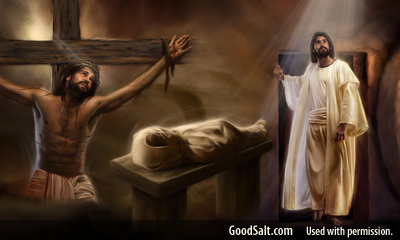
       This third piece of armor speaks of standing in “the preparation of the gospel of peace” (Eph. 6:15). The “peace” that Jesus gives us is found in “the gospel.” This peace is not found in a pill or an injection or in entertainment or in the accumulation of wealth. It is not found in our favorite television program or movie. Nor is it found on a vacation or in an image on the computer screen. This peace is not found in a better job or in a counseling session. That’s the world’s kind of peace which is momentary.

       The peace that God wants us to continually wear on our feet is found in “the gospel.” To understand the “peace” that the apostle Paul is talking about, we need to understand the gospel. The Greek word for “gospel” is euangelion, which means “good news.” [17] So, what is the good news?

       The apostle Paul defines the “gospel” or good news by which we are saved today when he writes, that Christ died for our sin according to the Scriptures, and that He was buried, and that He rose again the third day according to the Scriptures, and that He was seen by Cephas, then by the twelve. After that He was seen by over five hundred brethren at once…” (I Cor. 15:3-6). The gospel is that Christ died for our sins and rose from the dead. We are saved from an eternity in hell when we believe in the good news of Jesus’ death and resurrection as our Substitute for our sins (Acts 16:31). At that moment of faith in Christ, we receive both the complete forgiveness of all our sins (Acts 10:43; Col. 2:13-14) and the gift of eternal life (John 3:14-16). Jesus says we are born again (John 3:3). But you may say, “I am born again but I still have anxiety and worry – the opposite of peace.” 

       One reason we may still have worry after we are born again is because we do not understand or believe the gospel. Most Christians apply the gospel only to what it takes to get to heaven. But that is just part of the gospel. The gospel also has a lot to do with living a victorious life on earth. [18]

       The apostle Paul writes, “For if when we were enemies we were reconciled to God through the death of His Son, much more, having been reconciled, we shall be saved by His life.” (Rom. 5:10). Notice that “the death of” Jesus “reconciled” (past tense) us to God so we could go to heaven (justification), but Jesus’ “life” “shall” (future tense) save us from the power of sin and its consequences (sanctification) on earth (cf. Rom. 1:18-32; 5:9). [19] Most of us know the gospel because of Jesus’ death, but we have missed the gospel of His life which progressively gives us victory over the power of sin as we learn to walk in the Spirit (cf. Rom. 6:1-8:39).

       Evans writes, “The death of Jesus reconciled us to God, but Jesus didn’t stay dead. He’s alive right now. And He’s interceding for us (see Heb. 7:25) in order to give us victory over the power of sin and its consequences. Think about it. If Jesus could take you from hell to heaven by dying, what He can do for you by living is even more exciting. Many believers who have accepted the saving death of Christ have yet to understand and access the saving life of Christ, which gives us victory in history. [20] [emphasis added]

       Let’s look now at what our sandals of peace include. [21]

Our Position that Protects our Mental Peace

       These sandals of peace include our POSITION THAT PROTECTS OUR MENTAL PEACE: “Therefore, having been justified by faith, we have peace with God through our Lord Jesus Christ.” (Rom. 5:1). The Greek word translated “justified” (diakaioō) means to be declared totally righteous [22] by our holy God [23] in heaven’s courtroom.  The perfect righteousness of Christ in us has been imputed or credited to our account in heaven by virtue of our position in Jesus.[24] 

        “Justification is a legal concept meaning that in God’s courtroom, He pronounced us innocent of all charges. He does this through what theologians call ‘imputation’—taking Jesus’s perfect record and crediting it to our accounts.” [25] [emphasis added]

       Notice in Romans 5:1 that we are “justified” not by our good life, prayers, or religion, but “by faith.” Peace with God is “through our Lord Jesus Christ.” The moment we believe in Jesus Christ and His death on the cross for all our sins, we are “justified” or declared totally righteous before God as if we had never sinned.

       The preposition “with” (pros) in the phrase “peace with God” (pros ton Theon) is very important  (Rom. 5:1). This preposition used with the accusative case (ton Theon) refers to being “friendly with” God. [26] It is the promise that through justification by faith in Jesus, the enmity and hostility that existed between a holy God and a sinful people is totally removed. The war has ended between the Christian and his or her God! And we have peace “with God.”

       How does the Christian know he has peace “with” God? There is only one way to know this, and it is through faith in God’s promise. Justification before God is not a feeling or experience. It is a judicial, legal declaration from a holy God.

       The nature of this peace is of course judicial, since justification is the act of God as our Judge. We should avoid understanding the idea as inner tranquility. The peace involved here is like that which results when two warring nations are no longer in a hostile relationship to each other.” [27] [emphasis added]

       That is why Romans 5:1 begins with the word “Therefore…” It is as though God is pointing His finger back to the finished work of Jesus Christ on the cross (cf. Rom. 4:24-25). “Therefore,” because of what Jesus has done, you have “been justified by faith” and you “have peace with God.” The war with God is over! The battle has ended!

       But Satan will try to rob Christians of this peace. He will attempt to make us think that God is angry with us. That God could never forgive us. That God is against us. He may whisper in our ears, “The reason you have so many troubles is because God is mad at you. He keeps punishing you because He is against you.”

       While it is true that God disciplines His wayward children (Heb. 12:5-11), His discipline of us is not evidence that He hates us or is mad at us. It is evidence that He loves us: My son, do not despise the chastening of the Lord, nor be discouraged when you are rebuked by Him; for whom the Lord loves He chastens.” (Heb. 12:5-6).

       Thus, putting on the sandals of peace means we have an intellectual understanding of what God’s Word says – that the believer in Jesus has “peace with God.” If we are to “stand” against the wiles of the devil (Eph. 6:11), we must know this positional truth, review it, and abide in it daily, never turning aside from it even during Satan’s most vicious or subtle attacks.

The Possession of Peace

       But our sandals of peace also include our POSSESSION OF PEACE. This can be seen in Philippians 4. Be anxious for nothing, but in everything by prayer and supplication, with thanksgiving, let your requests be made known to God; 7 and the peace of God, which surpasses all understanding, will guard your hearts and minds through Christ Jesus.” (Phil. 4:6-7). This aspect of our sandals of peace protects our emotional peace (“anxious”). God wants the Christian to not only have legal or mental peace (“peace with God”), but to also have emotional peace (“peace of God”).

      How do we gain this relationship of peace? It comes through the practice of prayer. When Paul writes in Philippians 4:6, “Be anxious for nothing…” (Phil. 4:6a), he is saying not to lose your emotional peace even though you may be facing a worrisome situation. Don’t try to resolve your anxiety by worrying about the situation. Instead, he says to resolve this worrisome situation with “prayer” (Phil. 4:6b). Talk to God about what makes you anxious. When was the last time we got alone with God and talked to Him about what we are worried about? Talking about it helps to diffuse the power of worry. But it does not stop there.

       Then God says, “in everything by… supplication” (Phil. 4:6c). The word “supplication” means to tell God what you need. Few people ever identify what they need because they are so busy worrying.

       For example, some of us may be worried about our health. So, we talk to the Lord about that. And as we do that, ask God to help us identify the underlying need. Perhaps we need protection from illness especially during the aftermath of COVID. Or perhaps we are afraid of death because we are not prepared for it. So, we need assurance of life after death. Ask God to give you the assurance that there is everlasting life both now and after death through believing in Jesus (cf. John 11:25-26). Thus, talk to the Lord about what you need from Him.

       Next, God says, “with thanksgiving, let your requests be made known to God” (Phil. 4:6d). One of my mentors taught me that the word “requests” refers to our heart’s desires which align with God’s will. Psalm 37:4 says, “Delight yourself also in the Lord, and He shall give you the desires of your heart.” The Hebrew word for “delight” (anog) can mean “to be soft” [28] or lean toward God. Just as a house plant leans in toward the sunlight coming through a window to get nutrients from the sun, so we need to lean into God during these challenging times to nourish our souls, and He promises to give us the desires or dreams of our hearts. So, talk to God about your desires or dreams. Ask God what He wants to do in your life.

       Notice that God wants us to pray with “thanksgiving.” He wants us to have a thankful heart. Why? Because when we trust God to supply our needs and wants in advance during difficult times, we can accept those circumstances and respond more appropriately. Also, gratitude stimulates the release of dopamine (happy chemical) in our brain which decreases our stress and enhances our sleep.

       As we talk to God about our anxiety, needs, and desires with thanksgiving, He promises that “the peace of God, which surpasses all understanding, will guard your hearts and minds through Christ Jesus” (Phil. 4:7). The “peace of God” is like a deep calmness in the midst of life’s storms. For example, the water underneath the surface of the ocean remains calm during a storm (see above pic). We can experience a deep-seeded calmness in our souls when we surrender to God in prayer as we face these challenging times.

       The phrase “will guard,” pictures an armed soldier walking back and forth in front of the city gate, protecting the occupants inside the city from intruders. God’s peace constantly protects those who choose to talk to Him about their worries and ask Him for what they need and want.

       Do we know this experientially? Are we practicing this kind of prayer? We live in a day of cell phones. If someone wants to get a hold of us, they send us a text or call us on our phones. Our phones alert us through vibration or a distinct sound that someone wants to talk to us.

       This illustrates how God sometimes wants us to talk to Him in prayer. One of the ways God may alert us to His desire for us to talk to Him is by allowing us to feel uneasy or anxious about something. This may be His way of inviting us to spend time alone with Him in prayer. Putting on the sandals of peace includes practicing this kind of prayer.

The Protection of Peace

       Our sandals of peace also include THE PROTECTION OF PEACE. The apostle Paul writes, “The things which you learned and received and heard and saw in me, these do, and the God of peace will be with you.” (Phil. 4:9). Paul is not talking about the “peace of God” in this verse, but “the God of peace.” This aspect of peace results when believers walk in obedience to God (“The things which you learned and received and heard and saw in me, these do…”). Paul says that when we follow the godly example of another believer, we can experience “the God of peace” being with us.

       Bubeck suggests that “the God of peace” refers to the protection of our will. The strong powerful nearness of God to us (“the God of peace will be with you”) will protect our will. It is that “peace” which God brings to us when our enemies greatly outnumber us and are about to destroy us, and the God of peace says, “No more! You cannot touch him! He is mine!” [29] 

       There are many examples of this in the Old Testament when God’s people, Israel, are surrounded by their enemies who greatly outnumbered them and were about to destroy them with no apparent way of escape. And God’s people cried out to Him, and “the God of peace” showed up and put their enemies to flight or destroyed them. Sometimes He did this with hornets or sounds in the treetops (or heavens) which frightened them and caused confusion or fear, so they fled and were defeated (cf. Exod. 23:22-28; Deut. 7:17-22; Josh. 24:11-12; I Sam. 7:10-11; 2 Sam. 5:22-25; 2 Kgs. 6:8-23; 18:1-19:37; I Chron. 14:13-17; 2 Chron. 31:1-22). And at other times God caused Israel’s enemies to turn against each other so they could be defeated (cf. 2 Chron. 20:1-24).

       God is so powerful that “when a man’s ways please the Lord, He makes even his enemies to be at peace with him.” (Prov. 16:7). God is able to make our enemies be at peace with us quickly when we live in a way that pleases Him. They will have to flee simply because of Who God is.

       It is not surprising that the phrase “the God of peace” is used in the New Testament in the context of obedience and Christian growth (cf. Rom. 15:33; 16:20; 2 Cor. 13:11; Phil. 4:9; I Thess. 5:23; Heb. 13:20-21). If we are hurting in our peace, it is important to examine our obedience to God. Are we trying to walk our own way instead of God’s way? Are we seeking our own pleasure instead of God’s?

       The Lord may let us walk our own way, but please know that “the God of peace will be with” us. He wants us to be near to Him but that cannot be our experience if we are walking our own way instead of His way.

The Person of Peace

       These sandals of peace also include THE PERSON OF PEACE. 13 But now in Christ Jesus you who once were far off have been brought near by the blood of Christ. 14 For He Himself is our peace, who has made both one, and has broken down the middle wall of separation.” (Eph. 2:13-14). Our sin not only separates us from God, but it also separates us from the people of God. The Ephesians were Gentiles who were called “Uncircumcision” by the Jews who are referred to as “the Circumcision” (Eph. 2:11).

       In their unsaved condition before the Cross, Ephesians 2:12 tells us that Gentiles “were without Christ,” having no corporate national hope centered on the promise of a coming Messiah, as the Jews did. They were “aliens from the commonwealth of Israel” in that God excluded them in having a part in what He planned to do in and through the nation of Israel. The Gentiles were “aliens” from Israel in this sense. [30] Nor did Gentiles have a direct part in the “promises” of God to Israel contained in the biblical covenants (e.g., Abrahamic – Gen. 12:1-3; 13:15-17; 15:17-21; 17:1-22; Mosaic – Exod. 19:1-24:8; and Davidic – 2 Sam. 7:12-17; I Chron. 17:3-14; 2 Chron. 7:17-18; 13:5; 21:7;  Psa. 89:1-4; et al.). As a race of people, the Gentiles had “no hope” of a corporate future promised by God to which they could look and in which they could hope, as Israel did. [31] And worst of all, they were “without God in the world.” The Greek word translated “without God” (atheos) is where we get our English word “atheist” from. Before the cross, Gentile unbelievers may have worshiped many gods, but they were without the one and only true God. [32]

       “But… the blood of Christ” not only brought us “near” to God, but it also brings Jews and Gentiles (“you who once were far off”) near to one another (Eph. 2:13). How did this take place? “For He Himself is our peace, who has made both one, and has broken down the middle wall of separation.” (Eph. 2:14). Jesus is “our peace” Whose atoning sacrifice on the cross has made Jew and Gentile “both one,” having “broken down the middle wall of separation.”

       What is this “middle wall of separation”? The next verse tells us: “…Having abolished in His flesh the enmity, that is, the law of commandments contained in ordinances, so as to create in Himself one new man from the two, thus making peace.” (Eph. 2:15). Jesus “abolished in His flesh” by dying on the cross “the enmity” or hostility that was created by the Jewish “law of commandments contained in ordinances.”

       The Mosaic Law had been the cause of the hostility between Jews and Gentiles. It was the “barrier” that separated Jews and Gentiles. Its dietary distinctions, and laws requiring separation in particular, created hostility between Jews and Gentiles. Jesus Christ broke down the barrier and the hostility that resulted from it by terminating the Mosaic Law. When Jesus Christ died, He fulfilled all the demands of the Mosaic Law (cf. Col. 2:14). When He did that, God ended the Mosaic Law as His rule of life for the Jews. The word “abolished” (katargeō) means to “cause something to come to an end or to be no longer in existence, wipe out.” [33] The Mosaic Law ceased to be God’s standard for regulating the life of His people when Christ died (Rom. 10:4; Gal. 3:24-25; et al.). [34]

       God did this through His shed blood on the cross to “create in Himself one new man from the two, thus making peace.” Christ died in our place “to make one body out of the two very distant groups. When a Jew or Gentile trusts in Christ for eternal life, he is placed in union with other believers in the Body of Christ. Jesus Christ by His death removed the barrier that separated Jews and Gentiles. By faith they become one new man, the Body of Christ, the Church. Christ is the end of the Law to all who believe (Rom. 10:4). 

       “God reconciled both Jews and Gentiles to Himself in one body through the cross, thereby putting to death the enmity (between Gentiles and Jews who believe in Christ). The Law that divided is removed, and Jews and Gentiles are in one body together.” [35] [emphasis added]

       Christ, Who is “our peace,” died “that He might reconcile” Jews and Gentiles “to God in one body,” the church, “through the cross, thereby putting to death the enmity” created by the Jewish Law (Eph. 2:16).

       This Person of peace protects our spirit. It has to do with our spiritual relationship with Jesus. [36] Our Christian faith is not primarily a system of dogmas and doctrines. It is primarily a relationship with a Person – Jesus Christ. This is a relationship that we enter into through faith alone in Christ alone (Eph. 1:13-14; 2:8-9). As we grow closer to Jesus, the more we can experience Him as “our peace” and the more we can live peaceably with other Christians. Satan seeks to divide Christians, so they do not express the image of God by living peacefully in unity with one another. But Jesus Christ is “our peace” and He is the source of reconciliation and restoration of peace within His body, the church.

Conclusion [37]
       God wants His peace to be the norm for His children on the battlefield. When God’s truth is operative in our lives, it will point us in the direction of His righteousness. We are faced with a myriad of choices and decisions in life, but how do we know we have made the right choices or decisions? How do we know we are moving in the right direction? How do we know we have the right perspective on a matter? God’s peace will confirm it. The Lord will give us a deep-seeded calm to move forward (“feet” suggest movement) with a decision even though hell may be breaking loose in our lives.   

      But if anxiety or worry is our normal way of operating, then we are not wearing the shoes God has given us. Please note that I am not talking about certain times of worry because we all battle that in our flesh. But if worry is normative for us then these shoes or sandals of peace are not being worn on our feet.

       Are we wearing our sandals of peace every day? Do we take time to put them on? Are we taking time to remember and review that we have “peace with God” now because God has declared us (not made us) to be totally righteous (“justified”) the moment we believed in Jesus (Rom. 5:1)? Are we experiencing the emotional “peace of God” through prayer and the fullness of the Holy Spirit’s presence in our lives (Phil. 4:6-7)? Through obedience, are we experiencing “the God of peace” (Phil. 4:9) Who makes even our enemies to be at peace with us (Prov. 16:7)? And are we getting to know the Person of “our peace” (Eph. 2:13-17) more intimately, so we can live more peaceably with our brothers and sisters in Christ? In the midst of war, God wants us to stand victoriously in “the gospel of peace.”

       Submarine crewmen do not get nervous when there is a storm at sea because they can go deep down where the waters are calm. Fish do not have anxiety attacks when it is storming because they know that severe storms will only reach approximately three hundred feet below sea level, [38] so they go down three hundred and one feet where it is peaceful.

       When our world gets chaotic, it is time for us to go deep into the spiritual realm where God says there is peace and calm. God will give us “perfect peace” when our mind is focused on Him (Isa. 26:3). Instead of retreating to the world for its false sense of peace, we need to redirect our attention to the mind of God. When our thoughts agree with God’s, we will experience His peace.

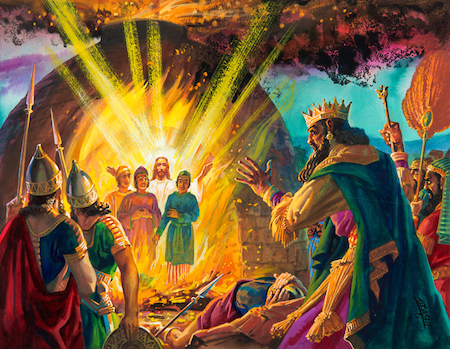
       For example, [39] when the three Hebrew young men, Shadrach, Meshach, and Abednego, who had  been promoted “over the affairs of the province of Babylon where they were captives” (Dan. 3:49), refused to serve the gods of Babylon and worship the ninety-foot-tall gold statue (Dan. 3:1) of king Nebuchadnezzar, they were told by the king they would be “cast immediately into the midst of a burning fiery furnace” (Dan. 3:15). When these three young men heard this news that they were about to be burned alive – which, by the way, would normally obliterate anyone’s sense of peace – they responded to Nebuchadnezzar saying, 16 O Nebuchadnezzar, we have no need to answer you in this matter. 17 If that is the case, our God whom we serve is able to deliver us from the burning fiery furnace, and He will deliver us from your hand, O king. 18 If not, let it be known to you, O king, that we do not serve your gods, nor will we worship the gold image which you have set up.” (Dan. 3:16b-18).

       Their response infuriated Nebuchadnezzar, so he commanded his servants to “heat the furnace seven time more than it was usually heated” (Dan. 3:19b). The king was extremely upset that these Hebrew men feared their God more than the king’s death threat, so he had them tied up and thrown “into the midst of the burning fiery furnace” (Dan. 3:20-21). The flames of the furnace were so intense that the mighty men carrying them were “killed” (Dan. 3:22). Keep in mind that these three men were wearing several layers of clothing (Dan. 3:21) which were most likely flammable, so there appeared to be no hope of their survival. 

       After a while, the king looked into the furnace and he was shocked to “see four men loose, walking in the midst of the fire” (Dan. 3:25a) because they had only thrown three men into the furnace. And now he sees four of them, and the three men  were no longer tied up. They were “walking” around in the midst of these intense flames full of peace and calm, “and they are not hurt” (Dan. 3:25b). How was this possible? Because there was a fourth Person with them in the fire and the kings says He had “the form…  like the Son of God.” (Dan. 3:25c). This was the pre-incarnate Lord Jesus Christ Who joined them in this terrible circumstance. God’s presence protected them from the fire (cf. Isa. 43:2). 

       It is important to understand that God is not going to join the world to help us out if we retreat to the world to find peace. If we are conforming to the world’s values and allurements and get into a bad situation as a result, and then cry out to God, He is not going to join the world because then He would be compromising His peace to join the world’s peace. These men did not bow to the king of Babylon. They remained faithful to God even though they did not know for sure if He would deliver them from this terrible situation.  

       Instead of looking to the world for peace, God wants us to take a stand in this pagan world with our minds focused on the God of peace. When we do this, the God of peace will show up in the fiery trials of life and give us His peacewhich surpasses human understanding. His presence will remove the chains or ropes that bind us so we can move freely. His presence will deliver us from the intense fires of life.

       Some of us may be facing some very significant fiery trials right now. Maybe we have lost our job or lost our health. Perhaps we have lost a relationship with a loved one. God wants us to go deep into the spiritual realm to connect with His mind so His peace can be ours. He wants us to wear these shoes of peace at all times. 

       How do we do this? As with the other pieces of armor, we can put on our shoes of peace through prayer (Eph. 6:18).  

Prayer: Lord Jesus, we are living in an increasingly chaotic world that lacks Your peace. We praise You because You not only brought us peace, but You are also our peace. Protect us from anything that would rob us of Your peace. Please help us to wear our sandals of peace every day so we may stand victoriously against the trickery of the Devil. We claim the peace with God that is ours through justification by faith alone in Jesus alone (Rom. 5:1). We desire the peace of God that touches our emotions and feelings through prayer (Phil. 4:6-7). Through our obedience, we seek the God of peace (Phil 4:9) Who makes even our enemies to live at peace with us. And we want to grow closer to You Jesus, because You are our peace. Satan and his kingdom of darkness are relentless in their efforts to keep believers divisive toward one another. As the accuser of believers, the Devil continually plants suspicions in our hearts. In the authority and name of the Lord Jesus Christ, we pull down that work of darkness and bind our enemy that he might not succeed. We ask the Holy Spirit to bring to a stop all divisive works active in our lives and in all the lives of other believers. The diversity of Your body, Lord Jesus, is part of its beauty and appeal to the lost. It adds to Your glory. Help us to love one another in our diversity. In Your precious and mighty name, we pray, Lord Jesus. Amen. [40]

FOOTNOTES:

[1] Walter Bauer, A Greek-English Lexicon of the New Testament, 2000 Kindle Edition, pp. 247-248.

[2] Adapted from Tony Evans’ video message entitled “The Shoes of Peace” on youtube.com.

[3] Adapted from Mark Bubeck’s video message, “7. Peace in the Midst of War: Ephesians 6 Series,” on the BRMinistry app.

[4] Bauer, A Greek-English Lexicon of the New Testament, 2000 Kindle Edition, pg. 1037. 

[5] Archibald Thomas Robertson, A. T. Robertson’s Word Pictures in the New Testament, 2014 Kindle Location 154992.

[6] The Greek verb hupodēsamenoi is in the aorist or past tense, meaning “having shod.” As with the first two pieces of armor, this refers to the state we should always be in.

[7] Bauer, A Greek-English Lexicon of the New Testament, 2000 Kindle Edition, pg. 401.

[8] Tony Evans, The Tony Evans Bible Commentary, 2019 Kindle Edition, pg. 2666.

[9] Jim Logan, Reclaiming Surrendered Ground (Chicago: Moody Press, 1995), pg. 182.

[10] Evans, The Tony Evans Bible Commentary, 2019 Kindle Edition, pg. 2665.

[11] Evans’ video message entitled “The Shoes of Peace” on youtube.com.

[12] Bauer, A Greek-English Lexicon of the New Testament, 2000 Kindle Edition, pp. 287-288.

[13] J. Carl Laney, Moody Gospel John Commentary (Chicago: Moody Press, 1992), pg. 265.

[14] J. Dwight Pentecost, The Words and Works of Jesus Christ (Grand Rapids: Zondervan, 1981), pg. 440.

[15] Evans’ video message entitled “The Shoes of Peace” on youtube.com.

[16] This portrait is used with permission from the artist, Katrina Case (see  katrinacaseart.com). 

[17] Bauer, A Greek-English Lexicon of the New Testament, 2000 Kindle Edition, pg. 402.

[18] Adapted from Evans’ video message entitled “The Shoes of Peace” on youtube.com.

[19] The theme of the book of Romans is the “salvation” or deliverance from God’s present-day wrath introduced in Romans 1:16-32. This deliverance includes justification through faith in Christ’s death (Rom. 2:1-5:9a, 10a) and sanctification through faith in Christ’s life (Rom. 5:9b, 10b-8:39). See Zane C. Hodges, “Romans,” The Grace New Testament Commentary, 2019 Kindle Edition, pg. 966ff; Evans, The Tony Evans Bible Commentary, 2019 Kindle Edition, pg. 2416ff; Joseph Dillow, Final Destiny: The Future Reign of The Servant Kings: Fourth Revised Edition (Grace Theology Press. 2018 Kindle Edition), pp. 198-199.

[20] Evans, The Tony Evans Bible Commentary, 2019 Kindle Edition, pg. 2430.

[21] Much of these next four sections are adapted from Bubeck’s video message, “7. Peace in the Midst of War: Ephesians 6 Series,” on the BRMinistry app, unless otherwise noted.

[22] Tom Constable, Dr. Constable’s Notes on Romans, 2023 Edition, pg. 77.

[23] The Greek word translated “justified” (dikaiōthentes) is in the passive voice, indicating that God is the One Who justifies the believing sinner.

[24] David R. Anderson, Free Grace Soteriology: Third Edition (Grace Theology Press, 2018 Kindle Edition), pp. 115-116.

[25] Evans, The Tony Evans Bible Commentary, 2019 Kindle Edition, pp. 2424-2425.

[26] Bauer, A Greek-English Lexicon of the New Testament, 2000 Kindle Edition, pg. 874.

[27] Hodges, The Grace New Testament Commentary, 2019 Kindle Edition, pg. 1012.

[28] Francis Brown, Samuel R. Driver, and Charles A. Briggs, A Hebrew and English Lexicon of the Old Testament (Omaha, NE: Patristic Publishing, 2020 Kindle Edition), pg. 2564.

[29] Bubeck’s video message, “7. Peace in the Midst of War: Ephesians 6 Series,” on the BRMinistry app.

[30] Tom Constable, Dr. Constable’s Notes on Ephesians, 2024 Edition, pg. 59. 

[31] Ibid.

[32] J. B. Bond, “Ephesians,” The Grace New Testament Commentary, 2019 Kindle Edition, pg. 1367.

[33] Bauer, A Greek-English Lexicon of the New Testament, 2000 Kindle Edition, pg. 525.

[34] Constable, Dr. Constable’s Notes on Ephesians, 2024 Edition, pg. 63.

[35] Bond, “Ephesians,” The Grace New Testament Commentary, 2019 Kindle Edition, pg. 1368.

[36] Bubeck, “7. Peace in the Midst of War: Ephesians 6 Series,” on the BRMinistry app.

[37] Much of this section is adapted from Evans’ video message entitled “The Shoes of Peace” on youtube.com, unless otherwise noted.

[38] Retrieved on December 14, 2024, from “How do hurricanes impact the deep ocean?” at www.oceanexplorer.noaa.gov.

[39] Adapted from Evans’ video message entitled “The Shoes of Peace” on youtube.com.

[40] Adapted from Mark Bubeck’s prayers entitled, “Prayer for Christian Unity” and “Prayer to Wear the Armor of God,” from Spiritual Warfare Prayers pamphlet (Chicago, IL: Moody Publishers, 1997). 

Spiritual Warfare – Part 4

A man walks with his Bible for a spiritual battle, represented by the verse Ephesians 6:12

Introduction

       Last time we observed that the apostle Paul prepared his Christians readers at Ephesus (and us) for spiritual warfare by talking about the spiritual blessings or resources we have in Christ (Eph. 1:3-14). Next, he prayed for us to understand and experience God’s great power in raising Christ from the dead (Eph. 1:15-23) and then spoke of the authority we have in Jesus (Eph. 2:1-6). After praying for his readers to be rooted in the unlimited love of Christ (Eph. 3:17-19), Paul advises us not to grieve the Holy Spirit by giving “place” or ground to the devil through unresolved anger (Eph. 4:25-31). Instead, we are to be “filled” or controlled by the Holy Spirit (Eph. 5:18) in all our relationships, including relations with church members (Eph. 5:19-21), our spouses (Eph. 5:22-33), our children (Eph. 6:1-4), and our work relationships (Eph. 6:5-9). 

       After talking about all these relationships with different people, Paul wants us to understand that people are not our primary problem. Our primary struggle is in the spiritual realm. Hence, the apostle writes, “Put on the whole armor of God, that you may be able to stand against the wiles of the devil.” (Eph. 6:11). The Ephesian believers are commanded to “put on the whole armor of God,” not just some of His armor. For what purpose? That they “may be able to stand against the wiles of the devil.” The battle that Christians face every day is “against the wiles of the devil.” The Greek word translated “wiles” (methodeias) refers to the methods or strategies of “the devil” that he employs to deceive or trick us. [1]

       It is not just “the devil” we are fighting against (Eph. 6:11). We are fighting “against the wiles of the devil” which permeate the whole kingdom of darkness. The apostle writes, “For we do not wrestle against flesh and blood, but against principalities, against powers, against the rulers of the darkness of this age, against spiritual hosts of wickedness in the heavenly places.” (Eph. 6:12). Last time we looked at the four groupings of demonic spirits in this verse. I won’t take the time to review them in this article. But the main thing to understand is that our battle is not just with the Devil, but with his entire kingdom of darkness consisting of various demonic spirits under different levels of authority, all of which are under Satan, who is “the prince” (Eph. 2:2) of this kingdom, “the god of this age” (2 Cor. 4:4), and “the ruler of this world” (John 12:31; 14:30; 16:11; cf. Matt. 4:8-9).

The Whole Armor of God [2]

       Before we look in depth at the first piece of armor, the belt of truth today, we will look briefly at the “whole armor of God” (Eph. 6:11) because each piece of armor will describe some of the various ways the Devil tries to deceive or trick us. He will tempt us to think in a way that is contrary to God. So, keep this in mind as we look at each part of the armor of God in the months to come, Lord willing. 

       God is the One Who gives us the armor we need to stand victoriously against the enemy. But we must choose to use it. It is like a doctor giving us medicine, but it will not benefit us until we take it. If we do not use the armor God has given us, we will have no authority from heaven (Eph. 1:19-21; 2:5-6) with which to exercise here on earth against the wiles (trickery) of the Devil (Eph. 6:13). [3]   

       The six pieces of armor that Paul presents are divided into two categories of three. He introduces each of these two categories with different verbs. The first three are introduced with the verb “to be.” The last three are introduced with the verb “to take.” Why does Paul switch verbs halfway through the armament? He wants us to understand two specific, distinct orientations to the six pieces of armor. The first three relate to a state we should always be in. The last three are what we use on an as needed basis. [4]

      It is like a baseball player who has his uniform on during the entire game because that is the state he is in. But he only picks up the bat when it is time for him to go to the plate to play offense. And he only picks up his glove when it is time for him to go to the field to play defense. [5]

        The first three pieces of armor we have with us all of the time [6] (“having girded… put on… shod…” – Eph. 6:14-15). [7] This is the state we are always to be in. But the last three pieces of armor we are called to take and use as needed [8] (“taking … take…” Eph. 6:16-17). [9]

     The first piece of armor is the belt of truth (Eph. 6:14a). It teaches us that Satan wants to deceive us or make us be deceptive ourselves. [10] Either one is deadly. The New Age movement is part of his deception. Even evolution, which is so openly taught as science in our country’s educational system, has decreased peoples’ sensitivity to God and to what is right and wrong. 

       For example, years ago if people had mentioned casino gambling, horse track or dog track racing, or the lottery, the people of Iowa would have risen up in moral indignation. And yet subtly, the enemy of our souls has been able to persuade our state government to legislate such activities which say you really can gain something for nothing. You can get rich quickly so just gamble. Thousands of people are being deceived into gambling and are being robbed of their funds. Such behavior is addictive. But it doesn’t stop there, does it?

       There are also things like methamphetamine, cocaine, alcohol, pornography, sexual perversion, and occult experimentation – all of which are part of the Devil’s deception. Jesus reminds us that the Devil “is a liar and the father of it.” (John 8:44b). And one of the ways Satan wants to bring us into bondage is through his lies. This is why we need the belt of truth.

       Satan also wants to accuse us of wrongdoing and get us to compromise. He wants to point out our faults and weaknesses in addition to our sins so we will get so focused on our failures and problems, we won’t look to Jesus. He also wants us to lower our standards of righteousness by tempting us to open our lives to a little sinfulness or worldliness. It won’t hurt you to try that. Everyone else is doing it. Go ahead and do it. It’s fun. This is why we need the protection of the breastplate of righteousness (Eph. 6:14b). 

      The next piece of armor teaches us about that which will rob us of our peace – anxiety and worry. Hence, we need the sandals of the gospel of peace (Eph. 6:15) –  peace with God, peace of God, the God of peace, and the Person of peace. This piece of armor teaches us that Satan wants us to live in fear and anxiety. 

       The fourth piece of armor addresses unbelief. Hence, we are to take up the shield of faith (Eph. 6:16) which extinguishes all the fiery darts or arrows of the enemy. What is that talking about? It involves Satan’s temptation to get you to question God or to act independently of God. That is the way he approached Eve in the Garden of Eden (Gen. 3:1-5). Satan got Eve to question God and what He had said and what would happen if she were to partake of the forbidden fruit. 

       The fifth piece of armor deals with mind or thought control. Satan tries to put thoughts in our minds to make us think that his thoughts are our thoughts. And so, we are to wear the helmet of salvation (Eph. 6:17a). This is the one of the ways he primarily attacks the thoughts of believers. When he begins to move violently in a believer’s life, one of the first things they begin to be tormented with is that maybe they are not saved. Sometimes all manner of hideous thoughts projected into the believer’s mind are Satan’s way of putting his thoughts into our thoughts, making it so confusing that we conclude that his thoughts are really ours. Then he taunts us with, “How could anyone who claims to be a Christian have such sinful thoughts as that?” 

      The sixth and final piece of armor addresses the Devil’s attempt to get us to neglect the Bible. The last piece of armor is “the sword of the Spirit, the word of God” (Eph. 6:17b). Have you ever wondered why it is so difficult for you to read the Bible? Why is it so challenging to set aside time to study God’s Word and meditate on it? Why do you never get around to memorizing the Scripture? The Devil is behind this. He wants to keep you from being in the Word of God because it will expose him as a liar and deceiver. 

        We have an enemy who is very versatile and subtle, and he has schemes that if we are not aware of them, he will soon bring us into his bondage. Thankfully God has given us spiritual pieces of armor that are strong and powerful. Let’s begin now with the first piece of armor. 

The Importance of the Belt of Truth

       When the apostle Paul wrote the book of Ephesians, he was a prisoner (Eph. 3:1; 4:1) under house arrest in guarded rental quarters (Acts 28:30), chained to a Roman soldier (Eph. 6:20). [11] As he looks at this Roman soldier, he begins to draw a comparison between the soldier’s armor and the spiritual armor of God. He will talk about each piece of armor in the order that a Roman soldier put it on.

       The first piece of armor was extremely important to a soldier. The soldier first put on over his tunic (a loose, sleeveless shirt that reached to his knees), a belt that would hold both the breastplate and sheathe for his sword in place. [12] He would be able to tuck his long clothes into the belt so he could run and be ready to fight. [13] Without this belt on, a soldier would be less mobile and more vulnerable to attack on the battlefield. 

       Likewise, Paul emphasizes the importance of this piece of armor by mentioning it first. “Stand therefore, having girded your waist with truth…” (Eph. 6:14a). This shows us how important the truth is in our battle against Satan and his demonic armies (Eph. 6:12). Since Satan “is a liar and the father of it” (John 8:44b), it is essential that Christians wear this piece of armor to overcome his deceptions. 

The Ruthless Nature of Satan [14]

       The Greek word translated “waist” (osphus) in Ephesians 6:14a can refer to “the place where a belt… is worn, waist” or to “the place of the reproductive organs, the loins.” [15] Some translations say, “having girded your loins with truth.” (ASV; LSB; NASB1995; RSV). By mentioning the belt first and in this way, Paul emphasizes the ruthless nature of Satan’s attack. This belt buckled around the waist and covered the soldier’s vital organs from his belt line down to his mid thighs. [16] It protected him from the violent and ruthless actions of an enemy who tried to destroy him. 

       The Psalmist had an awareness of the ruthless nature of Satan. David writes, 3b Let those be ashamed who deal treacherously without cause… 19 Consider my enemies, for they are many; and they hate me with cruel hatred.” (Psa. 25:3b, 19). The Devil never fights fair and is extremely cruel. He has no problem hitting us below the belt. Satan will try to hit us when we are most vulnerable, doing whatever it takes to incapacitate and eventually destroy us. 

       For example, when we are weakened by an illness or experiencing tremendous grief due to the loss of a loved one, the Devil will attack us with the purpose of destroying us. He shows no mercy to a suffering person.

       We also see the brutal, cruel, and violent ways of Satan in his appearances in Scripture. For example, the man in the country of the Gadarenes was so violently oppressed by the powers of darkness that “always, night and day, he was in the mountains and in the tombs, crying out and cutting himself with stones.” (Mark 5:5). Satan’s torment of this man was so severe that the man constantly endured self-inflicted agony. 

       On another occasion when the Lord Jesus came down from the Mount of Transfiguration with Peter, James, and John, He met a desperate father whose son had a ruthless demon. The father said to Jesus, “Lord, have mercy on my son, for he is an epileptic and suffers severely; for he often falls into the fire and often into the water. So, I brought him to Your disciples, but they could not cure him.” (Matt. 17:15-16). This wicked spirit would often come upon this man’s son when he was near “the fire” or “the water.” Why would this demon do that? Because he wanted to throw him into the fire so that violent burning would happen to this boy during his seizures. He wanted to throw him into the water so he could drown this boy. It was not enough for this little boy to have violent seizures. Satan wanted to add to his sufferings by throwing him into the fire or the water. This is how brutal and cruel the kingdom of darkness is toward suffering people. 

       What do these examples say about the kingdom of darkness? It says that Satan’s kingdom always has as its purpose to violently hurt, wound, and destroy (cf. John 10:10a). Most people who have had experiences with the kingdom of darkness have no doubt about the cruelty and ruthlessness of this kingdom. 

       This is why Christians must always be on guard against the lies of the enemy. Deception and lies always bring us into the realm of the kingdom of darkness. Satan always speaks his native language when he lies. Jesus said of the Devil, “He was a murderer from the beginning, and does not stand in the truth, because there is no truth in him. When he speaks a lie, he speaks from his own resources, for he is a liar and the father of it.” (John 8:44). At first, Satan’s lies may seem very appealing and even pleasurable. And when we are tempted to lie, we are never more yielding to Satan’s deceptive ways than in that moment. But in that moment, we must remember that the Devil always intends to brutalize us, oppress us, torment us, destroy us, and take away our freedom in Christ. 

The Subtle Nature of Satan’s Schemes 

        By mentioning the belt of truth first, Paul also calls attention to the subtle nature of Satan’s schemes. Not only in John 8:44 is Satan called “a liar and father of it,” but the very last picture of Satan in the Bible also points to his subtle nature. Now when the thousand years have expired, Satan will be released from his prison and will go out to deceive the nations which are in the four corners of the earth, Gog and Magog, to gather them together to battle, whose number is as the sand of the sea. They went up on the breadth of the earth and surrounded the camp of the saints and the beloved city. And fire came down from God out of heaven and devoured them. 10 The devil, who deceived them, was cast into the lake of fire and brimstone where the beast and the false prophet are. And they will be tormented day and night forever and ever.” (Rev. 20:7-10). At the end of King Jesus’ “thousand years” reign, “Satan will be released from his prison” in the abyss and will “deceive the nations” which are over all the earth “to gather them together to battle” against King Jesus and His people [“the saints”] in Jerusalem (“the beloved city”](Rev. 20:7-9a). The unbelievers in this battle led by their earthly leader “Gog” from the land of “Magog” (Rev. 20:8; cf. Ezekiel 38:2-3) will be as numerous “as the sand of the sea” and will be the offspring or descendants of the infants or children who survived Armageddon because they were below the age of accountability (Rev. 20:9b). God will intervene with “fire … out of heaven” and destroy them (Rev. 20:9c). Then “the devil, who deceived them, was cast into the lake of fire … where the beast the false prophet are. And they will be tormented day and night forever and ever” (Rev. 20:10). Satan concluded his career by doing what was most natural for him to do. He “deceived” the nations (Rev. 20:8a, 10a). 

      The Greek word translated “deceived” (planaō) means “to lead astray, mislead, to cause someone to wander from the right way.” [17] This is Satan’s main tactic – to get us to believe his lies so he can bring us under his control. 

       We see Satan’s lies working constantly in the world, especially in the political scene. For example, under communism, the lie is the truth. According to the dogma of communism, as long as it advances the cause of communism it is the truth. [18] We also see this kind of deception in our own government here in the USA. During this presidential election year, we see candidates making promises that are contrary to their past political decisions. They present lies as though they were the truth and sadly, much of the American public believes those lies. 

        Satan’s deceptions are also evident among the religions of the world. Having worked with those steeped in Islam, I have observed that if a lie supports the cause of Allah, then it must be true. A Muslim does not hesitate to lie if it advances the cause of Islam. 

       Janosik writes, “The Islamic practice of taqiyya [deception], which allows Muslims to mislead non-believers in regard to the nature of a Muslim’s own belief in order to avoid persecution. This practice allows Muslims, both Shia and Sunni, to lie to non-Muslims in a time of war, persecution, or even minority status if the lie will protect Muslims and further the goals of Islam. In his article on taqiyya, Raymond Ibrahim quotes a Muslim authority, Sami Mukaram, who says,” [emphasis and brackets added] [19] “Taqiyya is of fundamental importance in Islam. Practically every Islamic sect agrees to it and practices it … We can go so far as to say that the practice of taqiyya is mainstream in Islam, and that those few sects not practicing it diverge from the mainstream … Taqiyya is very prevalent in Islamic politics, especially in the modern era.” [20]

       Mormonism initially claims to embrace Christianity. But what they don’t tell you is Jesus Christ and Satan, like the rest of us, were spirit brothers and sons of God before the spirit of Jesus was given a body by Mary in Bethlehem. The Mormon ‘Book of Moses’ presents Satan and Jesus as contending for the privilege of taking a body of flesh in order to become the redeemer, with Jesus winning the contest. [See Joseph Smith, Pearl of Great Price, Book of Moses 4:1-4.]” [21]  [emphasis added] 

       Mormonism also believes “all human beings and spirits, including Jesus and Satan, existed as spirit beings before being born. Physical birth gives bodies to these spirits, and an opportunity to choose right or wrong. Thus, the present life is a period of probation. The way a person lives in this life determines their status in the life after the resurrection. If the deeds of this life have been satisfactory and all temple obligations have been fulfilled, the individual becomes a god and is considered eligible to create ‘spirit children’ as God the Father did and populate a world of his own.” [22][emphasis added]

       We also see Satan’s deceptions in the world’s educational scene in such things as evolution that is so ardently taught today. Anyone who knows the truth of God (Gen. 1-2; Exod. 20:8-11; Psa. 33:6-9; Rom. 1:18-23; 2 Pet. 3:1-7; et al.), knows that evolution is a lie. [23] But still it is taught as the truth.

       We also see that schools are teaching Critical Race Theory (CRT) which says that negative stereotypes are being assigned to members of minority groups to benefit white people and increase racial oppression. [24]

       Neil Shenvi defines critical race theory as “an ideology that divides the world into oppressed groups and their oppressors and aims to liberate the oppressed.” [25] Sometimes called “Cultural Marxism,” CRT borrows concepts from classical Marxism dividing the world into the “haves” and the “have nots” and attempts to right the wrongs of previous generations through a redistribution of wealth and power. Unfortunately, CRT is pitting ethnic groups against each other in hopes of correcting historic inequalities. [26]

       Biblically speaking, racism is the sin of ethnic partiality or prejudice (Jas. 2:8-9; Lev. 19:15). Racism is wrong because there is only one race, and it is the human race which is in Adam (Acts 17:26). Racism has not only caused division, but it has caused great pain and suffering throughout history. Since racism is a real sin, we should repudiate it and address it from a biblical perspective. 

       Unfortunately, CRT advocates that truth is not determined objectively outside of oneself. Instead, CRT says that truth is determined experientially by historically oppressed groups of people; thus, different groups of people can have different “truths” according to this view. 

       But truth does not work that way. Truth is true outside of anyone’s perspective. For example, two plus two equals four no matter what your skin color or any of your past experiences. Bowling balls fall from airplanes regardless of what anyone believes about gravity. 

       Christians must remember where truth comes from: the Bible (John 17:17) and Jesus Christ (John 14:6; 1:14). Truth resides in God’s Word and the Person of Jesus Christ, not in oppressed groups of people. It does not matter if older white males in a so-called domineering culture believe it, or a young black lesbian doesn’t believe it. Believing or not believing the Bible or Jesus has no bearing on the truthfulness of either. The reason for this is because truth does not reside in a person’s perspective: truth resides outside any group’s shared experience. Ultimately, truth resides in the Person of the Lord Jesus Christ. [27]

       Jesus did not focus on the education, ethnicity, gender, income, social identity, or the sexual orientation of a person. His love excluded no one. Jesus Christ desires “all” people to be saved regardless of their education, ethnicity, gender, income, social identities, or sexual orientations. The apostle Paul exhorts us to pray for “all” people because Jesus desires “all” people to be saved and He died for “all” people (I Tim. 2:3-6). Jesus’ love is inclusive, not exclusive. But Satan wants to deceive us into thinking otherwise.

       Satan has a subtle strategy of using deception and lies to bring us under his control. He seeks to mislead us into bondage. This is why it is so important to put on the belt of truth.

What is the Truth? [28]

       The belt Christians are to put on is “truth” (alētheia). But what is the truth? Truth is the absolute standard by which reality is measured. It’s not something that changes based on feelings or perspective. A person can deny that gravity is true, but if he decides to jump off a building to prove it, he’s going to find that truth doesn’t care about his feelings or perspective. Truth exists whether you embrace it or not.” [29] [emphasis added]

     Truth is simply God’s view on any subject on the front end. But often what happens is people start with man’s view and wind up with truth (God’s view) when man’s view has failed. 

       This is why the Bible speaks so much about first. “Seek FIRST the kingdom of God.” (Matt. 6:33). “He [Christ] is FIRST in everything.” (Col. 1:18 NLT). “You have left your FIRST love.” (Rev. 2:4). We always need to start first with God’s view on any subject.

       Truth is more than feelings because feelings can fluctuate. Truth is also more than facts. You can have facts and not have the truth. For example, I can say, “I have a headache. My head is really hurting me.” So, I go to Walmart and purchase some extra strength Tylenol because the fact is my head is hurting. But the Tylenol is not working. I still have my headache. So, I go to my doctor, and he does a head scan and discovers I have a brain tumor. I was treating the fact without knowing the truth. The truth was my head was hurting because of a brain tumor. Which means I was trying to solve the fact with an insufficient medication. 

       Truth is God’s view on any subject. God has spoken, He has not stuttered. There are two answers to every question: God’s answer and everyone else’s. And everyone else’s answer is wrong all the time. People can be so preoccupied with facts that they never arrive at truth. And thus, they never get solutions. 

      It is not the truth that sets us free. It is the truth that we know that sets us free. Jesus said, “You shall know the truth, and the truth shall make you free.” (John 8:32). So, if it is truth, and you do not know it, you are still in bondage. 

      In January of 1863, President Lincoln signed and issued his famous Emancipation Proclamation, freeing all slaves throughout the Confederacy. But the slaves in Texas were not told until June 19, 1865. The information of the signing was true, but it was not passed on to everyone. African Americans in Texas did not discover this truth until a year and a half later. So, during those eighteen months, they lived in bondage with no authority to exercise their freedom because they did not know the truth. 

       The reason this is so critical in spiritual warfare is because our enemy is a liar. That is all that he does. Satan is a liar (John 8:44) and a deceiver (Rev. 12:9). And if he can use facts to trick us, he will. If we do not start with the truth, that is, God’s view on a subject, then we will automatically be in bondage. And the Devil will even use religion to keep us there. Nothing holds more people hostage than religion. 

       When Satan went to Eve in the garden of Eden, the first thing he said to her was, “Let’s talk about God.” “Has God indeed said…?” (Gen. 3:1). But do you know an important word that the Devil left out when he tempted Eve? In Genesis 2, we read over and over again, the phrase, “the Lord God (’Elōhîm Yahweh) …” (Gen. 2:4-5, 7-9, 15-16, 18-19, 21-22). When Satan spoke to Eve, he left out God’s relational name “Lord” (Yahweh). This indicates that he doesn’t mind religion as long as there is no relationship with the Lord God driving it. [30]

Defeating Satan with the Truth [31]

       How do we defeat Satan with the truth? We daily reach out and put on the truth. The Bible gives us four expressions or citadels of truth. The first is THE PERSON OF TRUTH. The Lord Jesus Christ is “the truth” (John 14:6) and is “full of truth” (John 1:14). Hence, Jesus is the Person of truth.

       When we clothe ourselves with truth, we are putting on the Lord Jesus. “But put on the Lord Jesus Christ, and make no provision for the flesh, to fulfill its lusts.” (Rom. 13:14). The Greek compound word translated “put on” is enduō = en (in) [32] + dunō (go down, set) [33] and thus means “to clothe in the sense of sinking into a garment.” We can “put on the Lord Jesus Christ” by focusing our minds and morality on Him. When we live by faith in Him (2 Cor. 5:7; Gal. 2:20), studying His Word (Josh. 1:8; John 8:31-32; 15:7a; 2 Tim. 2:15; 3:16-17), talking to Him in prayer (John 15:7b; Phil. 4:6-7), and seeking to reflect Him in our actions (Col. 3:23-24; I John 2:6), we are putting on the Lord Jesus. 

       At the moment of faith in Jesus for His gift of eternal life, we are given a new nature (cf. Eph. 4:24; I John 3:9) and identity (2 Cor. 5:17), much like being given a brand-new tuxedo. Paul exhorts us to conduct ourselves according to this new nature and identity. 

       When he says not to make any “provision for the flesh” (Rom. 13:14b), it helps to ask ourselves, “Would I climb through a garbage dumpster while wearing a brand-new tuxedo?” No, that filthy environment would contaminate our pristine suit. Yet that is what we are doing when we make plans to gratify the sinful desires of our “flesh.” Instead, we are to put on Christ’s purity and avoid climbing through the dumpsters of sin. [34]

       However, if we have been making plans to gratify our sinful desires or we have actually been climbing through the dumpsters of sin, it is time to take our brand-new tuxedo to the cleaners and let the Lord Jesus completely cleanse it with His blood. Come back into the light by confessing our sins to God (I John 1:7, 9) and to safe brothers or sisters in Christ (Jas. 5:16), so God can heal us and restore us to fellowship with Him. 

       The second expression or citadel of truth in the Bible is God the Holy Spirit, Who is called THE SPIRIT OF TRUTH. Jesus said, 13 However, when He, the Spirit of truth, has come, He will guide you into all truth; for He will not speak on His own authority, but whatever He hears He will speak; and He will tell you things to come. 14 He will glorify Me, for He will take of what is Mine and declare it to you.” (John 16:13-14). What does it mean to put on the Holy Spirit? It means that we look to the Holy Spirit to lead us in accord with the truth (God’s view on a subject) of what Jesus taught (John 14:26) and what the Bible teaches us. The Spirit of God will never lead us in a way that contradicts what Jesus taught or what the Bible says. As we read the Word of God, we ask the Holy Spirit to enable us to understand the truth as God intended (I John 2:20-27). We measure everything by whether or not it aligns with what the Holy Spirit has already revealed in the Bible. 

       And we are to be very careful to honor the Spirit of God. When we have difficulty understanding a Bible passage, we ask the Holy Spirit to guide us into the truth (John 16:13) and to protect us from error (I John 2:20-27; 4:1-6). Instead of rushing into things, especially religious things that may seem overly ecstatic and exciting, we step back and take time to measure things to see if they are in accord with what God’s Spirit has already said in the Word because He is the Spirit of truth. He always guides us into truth (John 16:13) which is always in harmony with Who the Lord Jesus Christ is (John 15:26; 16:14; cf. I John 2:20-27; 4:1-6) and what He has done (I Cor. 12:3; 15:3-6) because Jesus is the truth (John 14:6). The Spirit of truth can show us the lies we believe that have kept us in bondage to sin and shame and replace them with the liberating truth of God’s Word (cf. Psa. 119:28-29). 

       The third expression or citadel of truth is THE WORD OF TRUTH, THE BIBLE. Jesus prayed to His heavenly Father, “Sanctify them by Your truth. Your word is truth.” (John 17:17). When we put on the belt of truth, we are putting on the Scripture. That means we understand that the Bible is the “word of truth” as it is called so many times throughout the Bible (cf. Psa. 119:43, 160;  Acts. 26:25; 2 Cor. 6:7; 2 Tim. 2:15; Jas. 1:18; et al.). This is why I believe that inerrancy [35] is an essential part of our Christian faith. We can trust what the Bible says in all things. It is the Word of truth, not the Word of error. We can build our lives upon the stable foundation of the Word of truth so we can endure the storms of life (Matt. 7:24-27). 

       The word “sanctify” (hagiazō) in John 17:17, literally means to “set apart” [36] from the world or “to make holy.”[37] This is not referring to sinless perfection. It is referring to spiritual growth or maturity – progressively becoming more like Christ. How? 

       We are to be “set apart” from the world’s influence and its values “by” the Father’s “truth” which is His “word,”the Bible. Throughout the Bible we see that God’s Word is true. It is not full of errors as many claim today. We cannot grow spiritually apart from God’s Word. So, the way we grow in holiness is by renewing our minds in accordance with the truth of God’s Word (cf. Rom. 12:1-2). Disciples of Jesus must abide in His word if they are to know the truth of His word and be set free from Satan’s lies that enslave their lives to sin (cf. John 8:31-36, 44). We must feed upon God’s word to experience the victory Jesus has already won for us (John 16:33). 

       At a meeting, a Native American Indian said a black wolf lived in his heart, but when Christ became his Savior, a white wolf came to live in his heart, and the two wolves were then fighting all the time. After the meeting, someone approached him and asked, “Which wolf wins, the white one or the black one?” The Indian replied, “The one I feed the most.” If we feed upon God’s Word and do it, we are going to experience more victory over the world and Satan in our Christian lives.  But if we feed upon the lies of Satan, we will experience more defeat in our Christian lives and be conformed to the world. I like what D.L. Moody wrote on the flyleaf of his Bible. “This book will keep you from sin or sin will keep you from this book.” That is the truth. If I let this book become more and more a part of my life it will keep me away from sin (Psa. 119:9, 11, 28-29). Or sin can keep me away from reading His word. 

       The final expression or citadel of truth in the Bible is the Church, THE PILLAR AND FOUNDATION OF TRUTH. Paul writes, “I write so that you may know how you ought to conduct yourself in the house of God, which is the church of the living God, the pillar and ground of the truth.“ (I Tim. 3:15). Paul describes the church as “the pillar and ground of the truth.“  

       “Much as a pillar supports a roof, the local church is to hold up the truth. Without the church, there would be nothing on earth to hold up God’s truth. 

       “The ground is that on which things are built. Thus, the church is the foundation on which the truth is built. Without the church, the truth would not have a foundation on which to stand. The church protects the truth in the face of all who attack it. 

       “Biblically sound churches bless those in their location by being there. Such churches shine the truth into a dark and dying world.” [38] [emphasis added]

       This is a great reason to stay close to a local church that embraces God’s truth. We need God’s perspective especially as it relates to spiritual warfare. And a local church that is biblically sound is a great source of encouragement and protection for every Christian. 

Conclusion

       How do we put on the belt of truth? The same way we are to put on all the pieces of God’s spiritual armor – by means of prayer. Paul concluded his teaching on the armor of God by inviting his readers to pray: “Praying always with all prayer and supplication in the Spirit, being watchful to this end with all perseverance and supplication for all the saints.” (Eph. 6:18). How often are we to pray the armor of God? “Always.” Prayer is to be woven into all of our lives. Satan and his demonic armies never take a day off, so it would be best that we don’t take a day off from praying the armor of God. 

       “We need to stay in regular communication with God and pray in the Spirit in order to access heaven’s authority for intervention on earth (6:18). In other words, we must be on the same page as the Spirit, utilizing spiritual wisdom. The most powerful way to do that is to pray God’s Word back to Him and apply it to your situation.” [39]

       Praying the belt of truth back to God can become a wonderful worship experience. We can express appreciation for the Lord Jesus, Who is the Person of Truth, and the Holy Spirit, Who is the Spirit of Truth, and the Bible, the Word of Truth, and the Local Church, the Pillar and Foundation of Truth.

       Prayer: In the name of the Lord Jesus Christ, I pray the protection of the belt of truth described in Ephesians 6:14a. I pray its protection over my personal life, my home, my family, and the ministry You, Lord, have appointed for my life. I use the belt of truth directly against Satan and his kingdom of darkness. I thank You heavenly Father for the Person of the Truth, the Lord Jesus Christ. I cling to Him Who is the truth and is full of truth, as my strength and protection from all of Satan’s deceptions. Thank You Father God for the Holy Spirit Who is the Spirit of truth. I look to You, Holy Spirit, to lead me in accord with the truth of what Jesus taught and what the Bible teaches. I ask You, Spirit of truth, to warn me before I deceive anyone and to protect me always from believing Satan’s lies. Forgive me, Lord, for not speaking the truth. Show me any way in which I am being deceived. I desire that the Bible, the Word of truth, shall constantly gain a deeper place in my life. I pray that the truth of the Word of God may be my heart’s delight to study and memorize. Thank You, Lord God, for making my local church a pillar and foundation for Your truth in my life. Help me relate to my church and give protection to others as well as receive it myself. Thank You, Lord Jesus, for showing me that my ability to be strong and to do Your will requires the stabilizing power of the belt of truth. Thank You for providing this part of the armor of God. In Your mighty name, I pray, Lord Jesus. Amen. [40]

FOOTNOTES:

[1] Walter Bauer,  A Greek-English Lexicon of the New Testament, 2000 Kindle Edition, pg. 625.

[2] Much of this section is adapted from Mark Bubeck’s video message entitled, “4. The Wholeness of the Armor: Ephesians 6 Series,” on the BRMinistry app, unless otherwise noted. 

[3] Tony Evan’s video message at Dallas Theological Seminary (DTS) entitled, “The Armor of God,” on YouTube.

[4] Ibid.

[5] Ibid. 

[6] Tony Evans, The Tony Evans Bible Commentary, 2019 Kindle Edition, pg. 2665. 

[7] The first three verbs in Greek (perizōsamenoi… endysamenoi… hypodēsamenoi… ) are aorist middle participles which means they have already been put on by the soldier or Christian.  

[8] Evans, The Tony Evans Bible Commentary, 2019 Kindle Edition, pg. 2665.

[9] The Greek verb translated “taking…” (analabontes) is an aorist active participle, meaning the Christian is taking the shield of faith as needed and the last Greek verb translated “take…” (dexasthe) is an aorist middle imperative which is used of the last two pieces of armor and means for oneself to take them up as needed. 

[10]  The next several paragraphs are adopted from Mark Bubeck’s video message entitled, “4. The Wholeness of the Armor: Ephesians 6 Series,” on the BRMinistry app, unless otherwise noted. 

[11] Evans, The Tony Evans Bible Commentary, 2019 Kindle Edition, pg. 2629.

[12] Tom Constable, Dr. Constable’s Notes on Ephesians, 2024 Edition, pg. 146.

[13] J.B. Bond, “Ephesians,” Grace New Testament Commentary: Revised Edition, 2019 Kindle Edition, pg. 1399.

[14] Much of this section is adapted from Mark Bubeck’s video message, “5. Belted Against Satan’s Belt: Ephesians 6 Series,” on BRMinistry app, unless otherwise noted. 

[15] Walter Bauer,  A Greek-English Lexicon of the New Testament and Other Early Christian Literature, 2000 Kindle Edition, pg.  730.

[16] Bubeck, “5. Belted Against Satan’s Belt: Ephesians 6 Series,” on BRMinistry app. 

[17] Bauer, A Greek-English Lexicon of the New Testament, 2000 Kindle Edition, pp. 821-822.

[18] Bubeck, “5. Belted Against Satan’s Belt: Ephesians 6 Series,” on BRMinistry app.

[19] Daniel Janosik, THE GUIDE TO ANSWERING ISLAM: What Every Christian Needs to Know About Islam and the Rise of Radical Islam (Cambridge, OH: Christian Publishing House, 2019 Kindle Edition), pg. 172. 

[20] Ibid., pp. 172, 321 cites Sami Mukaram, At-Taqiyya fi ‘l-Islam (London: Mu’assisat at-Turath ad-Druzi, 2004), 7, quoted in Raymond Ibrahim, Beware Islam’s Doctrine of Deception, PJ Media, September 24, 2015: http://www.meforum.org/5522/ben-carson-taqiyya.

[21] Retrieved on October 27, 2024, from the article entitled, “Mormonism – Does it truly follow Jesus Christ?” at www.christiananswers.net

[22] Ibid. 

[23] See the following helpful articles or books exposing the deceptions of evolution – Simon Turpin, “How the Apostle Peter Relates to the Age of the Earth Debate: Analyzing 2 Peter 3:1-7,” at www.answersingenesis.org; Harold Dressler, “Evolution – Still an Option?” at www.answersingenesis.org; Ken Ham, The Lie: Unraveling the Myth: Evolution/Millions of Years, Updated Edition (Green Forest, AR: Master Books, 1987, 2024); Roger G. Gallop, Evolution: The Greatest Deception in Modern History (Scientific Evidence for Divine Creation), Second Edition (Ponte Vedra Beach, FL: Red Butte Press, Inc., 2011, 2014). 

[24] Retrieved on June 2, 2024, from Wikipedia article entitled, “Critical Race Theory” at en.m.wikipedia.org.

[25] Retrieved on June 2, 2024, from Brandon Clay and Frost Smith’s September 29, 2020, article entitled “Critical Race Theory in the Church,” at www.answersingenesis.org.

[26] Ibid. 

[27] The previous four paragraphs were adapted from Ibid.

[28] Much of this section is adapted from Tony Evan’s video message at DTS entitled, “The Armor of God,” on Youtube, unless otherwise noted. 

[29] Evans, The Tony Evans Bible Commentary, 2019 Kindle Edition, pp. 1820-1821.

[30] Ibid., pg. 137. 

[31] Much of this section is adapted from Bubeck, “5. Belted Against Satan’s Belt: Ephesians 6 Series,” on BRMinistryapp, unless otherwise noted. 

[32] Bauer, A Greek-English Lexicon of the New Testament, 2000 Kindle Edition, pg. 327.

[33] Ibid., pg. 264. 

[34] Adapted from Evans, The Tony Evans Bible Commentary, 2019 Kindle Edition, pp. 2465-2466.

[35] Inerrancy states that the Bible is the inspired Word of God, without error in the original autographs, accurate in all areas it touches, and true in all it says (Psa. 119:86, 151, 160, 172; Prov. 30:5-6; Matt. 5:18; John 17:17; 2 Tim. 2:15; 3:16-17; 2 Pet. 1:20, 21). The Bible is God’s complete written revelation to humankind and is the final authority for guidance in living the Christian life (Deut. 4:2; 12:32; Prov. 30:5-6; I Cor. 13:8-13; Heb. 4:12; Rev. 22:18). As the Scriptures in their entirety point to Jesus Christ and His death for the sins of the world on the cross, they are a complete and trustworthy guide to reveal God’s plan of salvation for all humankind (Luke 24:27, 44-48; John 5:39; 2 Tim. 3:15).  

[36] J. Carl Laney, Moody Gospel John Commentary (Chicago: Moody Press, 1992), pg. 307.

[37] Bauer, A Greek-English Lexicon of the New Testament, 2000 Kindle Edition, pp. 9-10.

[38] Robert Wilkin, “I Timothy,” The Grace New Testament Commentary: Revised Edition, 2019 Kindle Edition, pg. 1531.

[39] Evans, The Tony Evans Bible Commentary, 2019 Kindle Edition, pg. 2667.

[40] Adapted from Mark I. Bubeck, a prayer entitled “Prayer to Know and Speak Truth,” from Spiritual Warfare Prayers pamphlet (Chicago: Moody Publishers, 1997).

IF YOU ONLY HAVE 60 SECONDS TO LIVE, WHAT DOES GOD SAY YOU MUST DO TO GET TO HEAVEN? (Video)

With tensions escalating in our world today, you may be wondering how much longer you will be able to live here on earth. This VIDEO explains from the Bible what you must do to go to heaven, whether you have 60 seconds or 60 years to live. Please share this video with those you want to see in heaven. Thank you.

Note: The Acts 16 pictures belong to Sweet Publishing / FreeBibleimages.org. The movie clip of hell is used with permission from the makers of The Free Gift movie.

WHO AM I?

God wants us to know that we are far more than what we have been told by Satan and other people. No one has the power to define us but the One Who created us and redeemed us. God takes a lot of time in the Bible to tell us who we are when we become His children through faith in Jesus (John 1:12; I John 5:1). The phrase “in Christ” or “in Him” is used 120 times in the New Testament and refers to how God sees us after we become children of God by believing in Jesus.

Who am I after I come to faith in Jesus?

I am never alone (Deut. 31:6, 8; Isa. 41:10; Matt. 28:20; Heb. 13:5)

I am the apple of my Father’s eye (Ps. 17:8; Matt. 6:26; 10:29-31)

I am a delight to God (Ps. 18:19; Zeph. 3:17)

I am cherished and loved by God (Ps. 27:10)

I am hope-filled (Ps. 27:13; Jer. 29:11; Rom. 5:5)

I am helped, not helpless (Isa. 41:10, 13)

I am redeemed by God and therefore, I belong to Him (Isa. 43:1b).

I am always loved by God no matter what (Jer. 31:3; Rom. 5:8; 8:37-39)

I am the salt of the earth (Matt. 5:13)

I am the light of the world (Matt. 5:14)

I am a child of rest, no longer having to work for my salvation (Matt. 11:28)

I am precious to Jesus Who gave up everything to redeem or purchase me (Matt. 13:45-46; I Cor. 6:19-20; I Pet. 1:18-19)

I am given authority over all the power of the enemy (Luke 10:17, 19-20)

I am given everlasting life and will not be judged for my sins in the future (John 5:24)

I am free from bondage to sin positionally (John 8:31-36)

I am part of the True Vine, a channel of Christ’s life (John 15:1, 5)

I am chosen and appointed by Christ to produce lasting fruit (John 15:16)

I am given the power of the Holy Spirit inside me (Acts 1:8; Rom. 8:11; Gal. 5:22-23)

I am given peace with God through faith in Jesus (Rom. 5:1)

I am given hope because the love of God was poured out in my heart through the Holy Spirit (Rom. 5:5)

I am dead to sin (Rom. 6:2, 11; I Pet. 2:24)

I am set free from the power of sin (Rom. 6:2-11)

I am a slave of righteousness (Rom. 6:18)

I am slave of God (Rom. 6:22)

I have the Spirit of adoption by whom I cry out to God, ‘Abba (Daddy/Papa), Father.’” (Rom. 8:15)

I am free from accusation in Christ (Rom. 8:33)

I am free from condemnation in Christ (Rom. 8:34)

I have an eternal inheritance from God (glorified resurrection body/eternal dwelling on the New Earth) that cannot be taken from me (Rom. 8:17a; Gal. 3:26, 29; Eph. 1:14; cf. John 14:1-3; I Cor. 15:35-58; Phil. 3:21; Rev. 21-22)

I am more than a conqueror through Christ Who loved me (Rom. 8:37)

I can never be separated from God’s love (Rom. 8:38-39)

I have the mind of Christ (I Cor. 2:16)

I am a holy temple where the Holy Spirit now lives (I Cor. 3:16; 6:19; Eph. 2:21-22)

I am united to the Lord and am one spirit with Him (I Cor. 6:17)

I am a member of Christ’s body (I Cor. 12:27; Eph. 5:30)

I am not the great “I AM” (Exod. 3:14; John 8:24, 28, 58), but by the grace of God, I am what I am (I Cor. 15:10)

I am a new creation (2 Cor. 5:17)

I am reconciled to God (2 Cor. 5:18a)

I am a minister of reconciliation (2 Cor. 5:18b-19)

I am an ambassador for Christ (2 Cor. 5:20)

I am good enough in Christ (2 Cor. 5:21)

I am a bondservant of Christ (Gal. 1:10)

I can change because Jesus now lives inside me through His Spirit (Gal. 2:20; cf. Rom. 8:11)

I am redeemed from the curse of the Law (Gal. 3:13; I Pet. 1:18-19)

I am a son of God through faith in Jesus and am one in Christ (Gal. 3:26, 28)

I am a saint (one declared totally righteous) at the core of my being, not a sinner (Eph. 1:1; I John 3:9)

I am chosen or wanted by God (Eph. 1:4a; Col. 3:12a)

I am holy and without blame before God (Eph. 1:4b)

I am totally accepted by God in Christ (Eph. 1:6)

I am totally forgiven in Christ (Eph. 1:7; Col. 2:13-14)

I am sealed by the Holy Spirit Who guarantees my safe and secure delivery to God in heaven (Eph. 1:13-14)

I am God’s precious inheritance (Eph. 1:18)

I am seated in a position of authority and victory next to Jesus in the heavenly places far above all other authorities (Eph. 1:20-21; 2:5-6)

I am God’s masterpiece, not a mistake (Eph. 2:10)

I have been brought closer to God through the blood of Christ (Eph. 2:13)

I have instant access to the Father by one Spirit (Eph. 2:18)

I am a fellow-citizen with the rest of God’s family (Eph. 2:19)

I am a prisoner of Christ (Eph. 3:1; 4:1)

I am a new man created according to God, in true righteousness and holiness (Eph. 4:24)

I am a child of light, defined by the light of Jesus Christ, not by the darkness of my sin (Eph. 5:8; cf. John 12:36)

I am a citizen of heaven, seated in heaven right now (Phil. 3:20; Eph. 2:6)

I have what it takes in Christ (Phil. 4:13)

I am delivered from the power of darkness into the kingdom of the Son of His love (Col. 1:13)

I am complete in Christ, lacking nothing (Col. 2:10)

I am safely and securely hidden with Christ in God (Col. 3:3)

I am an expression of the life of Christ because He is my life (Col 3:4; Deut. 30:20).

I am deeply loved by God (Col. 3:12a; I John 3:1)

I am credited with Christ’s holiness and therefore I am accepted by God (Col. 3:12a)

I am a son of light and not of darkness (I Thess. 5:5)

I am a perfected worshiper of Christ through His once and for all sacrifice (Heb. 10:10, 14)

I am God’s child born again of the incorruptible seed of the Word of God that stands forever (I Pet. 1:3, 23)

I am one of God’s living stones being built up in Christ as a spiritual house (I Pet. 2:5)

I am a member of a chosen generation, a royal priesthood, and a holy nation (I Pet. 2:9a)

I am a special person to God (I Pet. 2:9b)

I am an alien and stranger to this world in which I temporarily live (I Pet. 2:11a)

I am cared for by God (I Pet. 5:7)

I am an enemy to the devil (I Pet. 5:8)

I am a child of God and will resemble Jesus when He returns (I John 3:1-2)

I am an overcomer because greater is He who is in me than he who is in the world (I John 4:4)

I overcame the world’s opposition when I believed in Jesus (I John 5:1, 4)

I am born of God and the wicked one cannot touch or harm my born-again nature (I John 5:18)

John 3 – Part 4: “More of Him and Less of Me”

“He must increase, but I must decrease.” John 3:30

Muhammad Ali once said to Mark McCormack, “I’m more famous than Jesus Christ.” Recounting the incident in his book, What They Don’t Teach You at Harvard Business School, McCormack remarked, “I was appalled at the statement, dismissed it as braggadocio, and let it go at that. But months later for some reason I got to thinking about it and started counting up all the Muslim, Hindu, and other non-Christian countries in which Ali was extremely well known. The statement was still braggadocio, but I realized it was also probably true.” [1] The tragedy was not just that Muhammad Ali was arrogant, but it’s that he was probably accurate.

What about in the region where you live? Is Jesus more popular among the people of your town, city, or state than the Mormons, Jehovah Witnesses, Muslims, or Hindus? Is He more popular than your governor or favorite celebrity or athlete?

In this chapter, we are going to talk more about vision. Vision is a picture of what God wants us to be and do. In this year, I believe God wants Jesus Christ to become more well-known where you and I are living. So, we are going to talk about how Jesus Christ can become more popular where we live. In doing so, we will discover three ways in John 3:22-36 how Christ can grow in prominence in our area. THE FIRST WAY FOR JESUS TO BECOME MORE POPULAR is for us to…

RESPOND TO GOD’S BLESSING ON OTHERS WITH HUMILITY (3:22-27). 3:22: “After these things” refers to Christ’s conversation with a religious leader named Nicodemus where He stressed that faith alone in Christ alone is the only way to heaven (3:5-18). If Jesus’ conversation with Nicodemus took place in Jerusalem, then the reference to Christ coming “into the land of Judea” probably refers to the Judean countryside. [2] While in this remote place, Jesus begins to develop new believers into His disciples. A disciple is a devoted follower of Jesus. Once a person believes in Christ to get to heaven, he is then initiated into the discipleship process through water baptism (Matt. 28:19-20; Mark 16:15).

Look at the phrase, “He remained with them.” This was an unhurried period that Jesus had with these new believers. They are getting to know each other. Being the Lord’s disciple meant you were with Him. You spent time with Him. New birth or getting to heaven is by believing in Christ alone (3:5-18), but discipleship involves being “baptized” with water and instruction (3:22; cf. Matt. 28:19-20). In all nations, God wants to expand His church through the discipleship process whereby older Christians meet with younger Christians one on one or in small groups to reproduce devoted followers of Christ. This is God’s only plan for increasing Jesus’ popularity around the world (cf. Matt. 28:19-20; 2 Tim. 2:2).

Jesus was not the only one baptizing. 3:23: While Jesus baptized downstream, “John“ the Baptist was baptizing “in Aenon” (Ainōn) which means “springs” [3] “near Salim,” a Hebrew and Arabic term meaning “peace.” [4] At this location there were seven springs within a quarter mile radius which meant there was plenty of water to baptize by immersion. [5] The exact location of “Aenon” is not known today. [6]     

“The best evidence seems to point to a site just south of Scythopolis (Old Testament Bethshan) … about 15 miles south of the Sea of Galilee.” [7]

“The other possible site was a few miles east of Sychar (near Old Testament ‘Shechem’) … approximately midway between the Sea of Galilee and the Dead Sea. Both plausible sites are only a few miles west of the Jordan River.” [8]

While the exact location of John’s baptizing ministry cannot be determined today, it is important to recognize that the Baptist moved from the south to the north, leaving Jesus to baptize closer to Jerusalem [9] (see map).

3:24: John notes that John the Baptist “had not yet been thrown into prison” yet. The apostle John is the only gospel writer to inform us that “between Jesus’ temptation and John the Baptist’s arrest, John and Jesus baptized at the same time. His reference to John the Baptist’s imprisonment is important because it helps the reader to see that John’s account does not contradict the Synoptics. Yet his primary concern was John the Baptist’s witness for Jesus.” [10]

John’s baptism of repentance prepared people to believe in Jesus. “Then Paul said, ‘John indeed baptized with a baptism of repentance, saying to the people that they should believe on Him who would come after him, that is, on Christ Jesus’” (Acts 19:4; cf.John 3:36).

3:25: John the Baptist’s disciples found themselves at a disadvantage in “a dispute” with “the Jews about purification.” These “Jews” were asking why they should participate in John’s ceremonial washing (baptism) when Christ’s following was larger. [11] It seems as those these interrogators sought to generate a division between John the Baptist and Jesus. Both ministries were inviting people to believe in Jesus as the promised Messiah (cf. John 1:7, 41, 49-51; 2:11; 3:15-18, 36; cf. Matt. 21:25, 31-32; Mark 1:15). The Judeans feared that if these two ministries remained united, their message would sweep through the entire nation. The ones who sought to divide these ministries directed their attack towards John the Baptist. [12]

3:26: The “they” may refer to the Baptist’s disciples [13] or to the Judeans who disputed with them. [14] In the context, it makes more sense to me that the Baptist’s disciples “came to John” expressing jealousy towards Jesus’ growing popularity. John’s ministry was dwindling, and Jesus’ ministry was advancing. Notice that they don’t refer to Jesus by name. They say, “He who was with you… to whom you testified… He is baptizing… all are coming to Him.” They are complaining. “John, you did Him a favor by telling others about Him and now He is taking all of your followers.” These men were loyal followers of John the Baptist. They longed for the former days when everyone was coming to listen to their leader. Now this new guy comes into town, and they didn’t like it one bit. To them it was competition.

Can you relate to John’s disciples? When God blesses another ministry near you, do you ever find yourself asking God why they have more people coming to Christ than you do? Do you find yourself comparing the size of your church with other churches? Instead of thanking God for their growth, you wish you had that many people! Or when God blesses an individual believer in your church, do you find yourself feeling jealous of that person? You compare yourself to him or her and think you should have more blessings than them because you are more deserving? If we are honest with ourselves, we have all had these kinds of thoughts and feelings.

How did John the Baptist respond to Jesus’ growing popularity? 3:27: John’s pride was not wounded like his disciples’ were. [15] He understood that any ministry comes “from heaven,” whether it be his or Jesus’ ministry. He realizes that heaven determined that Jesus’ ministry would grow and his would decrease now. More people were coming to Christ because God was bringing them. It was God’s plan for John to prepare the way for Christ and that was all. John humbly accepted God’s plan for him to decrease in popularity and for Jesus to increase in popularity now.

“Everything belongs to the Lord and He has the sovereign right to give or take as He desires, including authority to lead. Because all authority derives from God’s sovereign choosing, no leader can legitimately claim any entitlement to his or her position. Those who claim to exercise authority by ‘divine right’ fail to acknowledge their duty to God and become guilty of pride.” [16]

God is the One who determines the size of a ministry. Therefore, there is no basis for jealousy over another’s opportunity or ministry. Our responsibility is to be faithful to what God has called us to do (cf. I Cor. 4:2). You and I can receive nothing unless it has been given to us from heaven. So, we don’t have to concern ourselves with the size or popularity of our church or our ministries. Thank God for using all kinds of churches and individual believers to reach the lost for Christ!

If we are going to see Jesus become more popular where we live, we must not allow any room for jealousy or competition among different churches or ministries. The spirit of competition causes Christians to compare themselves with what God is doing in another person’s life. No one in our community wants to be a part of that. People in our community want to be a part of churches that are working together and praying for each other. After all, we are on the same team and we want to see God bless all the Bible-believing churches in our area and beyond because it is not about us, it is about Jesus Christ and seeing Him grow in popularity. So, Jesus will become more popular where we live as churches and individuals respond to God’s blessings on others with humility. The second way for Jesus to grow in popularity is to…

REJOICE IN ATTRACTING OTHERS TO JESUS EVEN AT YOUR OWN EXPENSE (3:28-30). 3:28: John reminds his disciples that they already heard him explain that he was only a forerunner (“I have been sent before Him”), and not the Messiah himself (“I am not the Christ”; cf. 1:7-8, 15, 20, 23).God’s plan for John was to prepare people for Jesus’ ministry (cf. Acts 19:4). It was God’s plan now for Jesus to increase in prominence and for John to decrease in prominence. Jesus’ growing popularity was in part due to John doing his job so well. Rather than seek the limelight for himself, John was content to be an instrument to glorify Christ.

The Baptist then refers to the wedding customs of his day to support this fulfillment of his joy. 3:29: In the first century, “the friend of the bridegroom” was an assistant, not the main participant in a wedding. He was responsible for making wedding arrangements and waiting for the groom to return with his bride to the groom’s house for the wedding banquet. The friend of the bridegroom did not expect to take center stage.

“The ‘friend of the bridegroom’ in ancient Near East culture held considerably more responsibility than the ‘best man’ today. In addition to helping the bridegroom prepare his home for the eventual day when the bride would come to stay, he helped direct the wedding feast at the end of the betrothal period. His most significant duty was to guard the bridal chamber during the feast, especially after the bride had slipped into the room unnoticed by the guests. No one except for the groom was allowed to go near the bridal chamber. When the ‘friend of the groom’ heard the groom’s voice, he stood aside. His joy was complete when the groom arrived.” [17]

With this comparison in mind, John rejoiced fully in Jesus’ success. John was simply the “friend of the bridegroom,” but Jesus is “the bridegroom.” [18] In effect John says, “When I see crowds of people leaving me and going to Jesus I am thrilled because Jesus can do for them what I could never do. For their sakes and His, I rejoice!” He says, “It fills my heart with joy to see them leaving me and going to Jesus.” And a heart full of joy has no room for jealousy. [19]

3:30:  Some have misunderstood this verse to mean that you must die to yourself and that there be less and less of you so that there can be more and more of Christ in you. But in the context, what John means here is that Jesus “must increase” in popularity and he “must decrease” in popularity. After all, John was the forerunner; Christ was the promised Messiah-God. If he was preparing the way for the Messiah, then surely the Messiah would need to be better known than the forerunner.

“John was simply the opening act, expected to warm up the crowd and then get off the stage. Jesus was the main event, the star attraction. John’s job was to point to and glorify the Messiah. And that’s our job too. John was content with and grateful for his role. Are you?” [20]

Don’t we want to see this where we live? Don’t we want to see Christ grow in popularity in our communities? Don’t we want to see more people in our community talking about Jesus Christ and what He is doing in and through our churches? Don’t we want to hear our neighbors and co-workers talking more about Jesus? Are we willing to set aside our own preferences to attract more unbelievers to Jesus? With God, all things are possible. The third way Jesus can become more popular where you live is to…

REVEAL JESUS’ GREATNESS TO OTHERS (3:31-36). The reason why Jesus must increase in popularity is because He is far greater than any other person who has ever walked on this earth. HIS GREATNESS IS SEEN IN…

1. HIS ORIGIN. 3:31: The apostle John’s purpose in writing his gospel was to show that Jesus is the Christ, the Son of God (John 20:31) partially by emphasizing Jesus was “from above.” Being born “from above” (3:3, 5-6) can only take place by believing in Jesus (3:15-16) Who is “from above.” [21] Christ comes “from heaven.” His origin was heavenly. Finite people like John the Baptist have an “earthly” origin. They can only reveal things about their experience on earth. But Jesus can reveal things about His experiences in heaven because that is where He is from. Every human teacher has limited knowledge about heaven, but Jesus knows all about heaven and how to get there because He lived there before coming to earth. Because of His heavenly origin, Jesus is “above all” others. Other religious leaders and teachers are trying to tell us how to go where they have never been. But Jesus is unlike any other teacher – He has lived in heaven and can teach us about it as we shall now see…

2. HIS TEACHING. 3:32: Jesus can teach with authority about heaven because He has firsthand experience and observation of it. He teaches what He had previously “seen and heard” while fellowshipping with God the Father in heaven, and therefore His teaching is trustworthy. In a court of law, second and thirdhand information is not nearly as reliable as firsthand information. But even though Jesus’ teaching is reliable, “no one” from the Jewish authorities who came to question Jesus “receives His testimony.” [22]

But some people did receive Jesus’ message. 3:33: Every time someone “received” Christ’s (God’s) “testimony,” they have “certified” or attested that God’s Word is reliable and “true.” The verb translated “certified” (esphragisen) is used of seals in John’s day.

“Seals indicated a personal guarantee, as well as denoting ownership (cf. 6:27). They also made secure (Matt. 27:66) and concealed (Rev. 22:10) things. Jesus so exactly revealed God’s words, that to believe Jesus is to believe God, and to disbelieve Jesus is to disbelieve God (cf. 1 John 5:10).” [23]

The reason the words Jesus spoke were “true” and trustworthy is given in the next verse. 3:34: Jesus is referred to by the apostle John as the One “whom God has sent.” Thirty-nine times the gospel of John refers to Jesus being sent from God [24] to demonstrate that Jesus is God and has a heavenly origin. [25]

In the past, God’s messengers had a limited “measure” of God’s Spirit. “Old Testament prophets had the Spirit only for limited times and for limited purposes.” [26] But God has given Jesus “the Spirit” without limits which guarantees that Christ’s words are precisely “the words of God.” [27]

“The Spirit descended on Jesus at His baptism and remained on Him (1:32-33; cf. Isa. 11:2; 42:1; 61:1). God gave His Spirit without measure only to Jesus (cf. 1 Cor. 12:4- 11).” [28] Hence, Jesus’ words are God’s words and therefore they are authoritative and trustworthy because He has the full endowment of the Spirit.        

Historian Philip Schaff described the overwhelming influence which Jesus had on subsequent history and culture of the world.  “This Jesus of Nazareth, without money and arms, conquered more millions than Alexander, Caesar, Muhammad, and Napoleon; without science… He shed more light on things human and divine than all philosophers and scholars combined; without the eloquence of schools, He spoke such words of life as were never spoken before or since, and produced effects which lie beyond the reach of orator or poet; without writing a single line, He set more pens in motion, and furnished themes for more sermons, orations, discussions, learned volumes, works of art, and songs of praise than the whole army of great men of ancient and modern times.” [29] There has never been a greater teacher than Jesus Christ. Christ’s greatness is also seen in…

3. HIS GIFT. Why has God the Father given Christ the Spirit without limit? 3:35: Because “the Father loves the Son, and has given all things into His hand.” The Father’s love for His Son which was declared at Jesus’ baptism (Matt. 3:17), guarantees Jesus’ authority to give eternal life. Because of the exalted position (“whom God has sent… given all things”) and Person (“from heaven… above all”) of His Son (3:31-35), the Father expects people to believe in Him, and when they don’t, the consequences are permanent.

 3:36: We see two very different eternal destinies in this one verse. Those who “believe in the Son” have “everlasting life.” Those who do “not believe the Son shall not see life.” What does it mean to “believe”? The word “believe” (pisteuō) means to be “persuaded something is true and therefore worthy of one’s trust.” [30] Are you persuaded that John the Baptist was speaking the truth when he said, “He who believes in the Son has everlasting life; and he who does not believe the Son shall not see life, but the wrath of God abides on him”? If you now believe in the Son, Jesus Christ, then according to God’s Word, you now have “everlasting life.” You can experience “life”with Jesus both now and forever.

The phrase “he who does not believe the Son,”[31] could also be translated,“he who does not obey the Son.” [32] Refusal to believe the Son’s testimony about Himself is a refusal to “obey” the Father Who sent Him and Who expects people to believe in Him. To disbelieve God’s Son is to disobey the commandment to believe in Him (cf. I John 3:23a). “One cannot refuse the testimony of an Exalted Person like Jesus without rejecting the very words of God.” [33] Disobeying God’s command to believe in His Son for eternal life is the only unforgiveable sin and therefore deserves the greatest consequence – God’s “wrath” (orgē) or anger abiding on him or her forever.  

“A God of love must also have the capacity for anger. However, the wrath of God is not the kind of bellowing anger we have come to associate with abusive people. Paul described the Creator’s response to sin using the Greek word orgē, which means ‘upsurging.’ When used to describe wrath, it is a passionate expression of outrage against wrongdoing. In this context, it pictures the passionate righteous anger of God cresting the walls of heaven and spilling over onto earth. And while it is indeed a passionate, upsurging response, it is completely consistent with God’s character, which is also love. Without question, His wrath is fearsome, yet it is also controlled, deliberate, measured, and utterly just. His wrath is nothing less than a reasonable expression of His righteous character and His unfailing love when confronted with evil.

“No Jew would admit to disbelieving God. However, because Jesus is the Word of God, failing to trust Him is the same as choosing to disbelieve God. And Hebrew history is replete with warnings and illustrations of people falling under the wrath of God for failure to believe. John said to his students, in effect, ‘Don’t forget that this “Rival” you are prepared to oppose is none other than God in human flesh; to oppose Him is to rebel against the Almighty.” [34]

A few years ago when we were living on the south side of Des Moines, I spoke with a friend’s neighbor. He told me that several months ago they discovered a massive tumor attached to his heart and the doctor recommended surgery. Did he accept as true that the doctor could remove the tumor? Yes. But he did not believe or trust the doctor to remove the tumor until he climbed up on the operating table. Christ is asking us to come to Him as sinners, recognizing that He died for our sins and rose again, and then believe or trust in Him alone to get us to heaven. Christ is not inviting us to depend upon our good life, religion, or prayers to get us to heaven, but to depend on Him alone to get us there.

Think about this incredible gift that Christ wants to give us – this eternal life. This is life with God that never ends. What makes eternal life so amazing is that it is absolutely free because Jesus Christ paid the full price when He died in our place on a cross and declared, “It is finished” (John 19:30). Trusting Christ alone, we are forever accepted by God, not based on what we have done or will do for Him, but based upon what He has done for us.

This concept of a free gift is often compromised today. Some say God only gives eternal life to those who obey God or promise to obey. Others say eternal life is given only to those who prove they are Christians by their works. These faulty concepts about eternal life rob God of all the glory because if we can get to heaven based on our obedience or works, then we have something to boast about. But if eternal life is absolutely free (and it is), then all the glory goes to God, which is where it belongs (Ephes. 2:8-9).

Jesus’ gift is eternal, and it is absolutely free. So, if my wife, children, close friends, co-workers, and neighbors have believed in Christ, we are going to live together forever! What could be a better message than the one surrounding this gift?

The Bible is telling us that Jesus Christ is the only One who has the ability to give us the greatest gift imaginable – eternal life. Therefore, we must do whatever it takes to tell others about Christ and what He has done for them so they can believe in Him alone to get them to heaven. After all, since eternal life is the greatest gift, why not pass it on to others? According to 3:36b, what happens to those who don’t believe in Jesus? They “shall not see life.” They won’t be with Jesus in heaven because God’s “wrath” will remain on them in a terrible place of suffering called the lake of fire (cf. Mark 9:47-48; Rev. 20:15).

If you had the cure for cancer and didn’t share it, would that be criminal? Yes. If you had the cure for HIV or AIDS and didn’t share it, would that be criminal? Yes. If you knew the only way to get to heaven and you didn’t tell it to the people who lived by you, would that be criminal? Yes. A thousand times YES!!! The Bible says, “For Christ’s love compels us, because we are convinced that one died for all.” (2 Cor. 5:14).  Circle “Christ’s love.” God has never made a person that He didn’t love. Everybody matters to God. And because God cares about people, we must care, too.  Doesn’t this compel you to tell others? It does me. How much more should we want to share the greatest gift of all with others? But you may say, “Well I don’t know how or I’m afraid.”

Jesus said, “Follow Me, and I will make you fishers of men.” (Matt. 4:19). About a year after believing in Jesus (cf. Matt. 4:12; John 1:35-4:35), Simon Peter and his brother, Andrew, are casting their fishing net into the sea when Jesus approaches them (Matt. 4:18). Christ invites them to follow Him and promises that He will make them fishers of men. How could Jesus use these men with no formal education or ministry experience to make a difference for eternity? Simple. Their responsibility was to follow Jesus. Christ’s responsibility was to make them fishers of men.

Do you feel inadequate to evangelize the lost? Do you ever think that you do not know enough to share the gospel with non-Christians? Ask the Lord Jesus to help you follow Him daily and He will teach you all you need to know about evangelism. The best way to learn to talk to unbelievers is to walk and talk with Jesus.

When we examine the gospels, we see that Jesus did not have one standard approach to evangelism. He simply started wherever people were at. When He was with the Samaritan woman at the well, He talked about living waters (John 4:1-26). When He was with the fishermen, He talked about fishing for men (Matt. 4:18-20). When He was with farmers, He talked about sowing seed (Luke 8:4-15). In other words, Jesus was being relevant to the people He was with. He used methods and words they would understand and value.

If you have ever fished for an entire day, you know that sometimes you must change bait as the day progresses. What bait worked in the morning may not attract the same fish in the afternoon or evening. Likewise, some Christians and churches are failing to reach the unchurched in the twenty-first century because they are using the same bait that worked in the 1950s and 1960s. The problem is the unbelievers are not biting on that bait any longer. We cannot expect to reach the lost if we are not using methods that best ministers to their needs.

God wants to see Jesus become more popular where you live.  He wants to see Jesus’ name become more famous than our names. God may be placing something on your heart right now that He wants to use to increase Jesus’ popularity in your community or around the world. Your first response may be, “Lord, I can’t do that.” You are right, you cannot, but God can do it through you if you will respond in faith instead of fear. With God, all things are possible. And it starts when you respond to God’s blessing on others with humility, then rejoice in attracting others to Jesus even at your own expense and reveal Jesus’ greatness to others.

Prayer: Lord Jesus, this planet is Your stage to show Your grace and truth off. Please forgive us for wanting the attention that belongs only to You. Thank You for the grace that enables us to be Your voices with the understanding that You are the living Word Who changes peoples’ lives. Nothing is more thrilling than seeing people come to You in faith for Your incredible gift of everlasting life. You are the most amazing Person in the universe! Please show us today how we can make You more well-known in this fallen world. In Your matchless name we pray, Lord Jesus. Amen.

FOOTNOTES:

[1] Mark H. McCormack, What They Don’t Teach You at Harvard Business School (London: Profile Books LTD, 2014 edition), pg. ?  

[2] Robert Wilkin, The Grace New Testament Commentary, Kindle Edition, pg. 187. Constable, Dr. Constable’s Notes on John, pg. 110.

[3] Tom Constable, Dr. Constable’s Notes on John, pg. 110.

[4] Chuck Swindoll, Insights on John, pg. 79.

[5] J. Dwight Pentecost, The Words and Works of Jesus Christ, (Grand Rapids: Zondervan, 1981), pg. 128 cites William Hendriksen, Exposition of the Gospel According to John, 2 Vols. (Grand Rapids: Baker Book House, 1953), Vol.1, pg. 147.

[6] Edward Blum, The Bible Knowledge Commentary Gospels, pg. 568.

[7] Constable, Dr. Constable’s Notes on John, pg. 110 cites Tenney, “John,” in John—Acts. Vol. 9 of The Expositor’s Bible Commentary, pg. 52.

[8] Ibid., pg. 110 cites Alfred Edersheim, The Life and Times of Jesus the Messiah. Vol. 2 (New York: Longmans, Green, 1912), pp. 767-769.

[9] Ibid., pg. 111 cites Beasley-Murray, John, pg. 52.

[10] Ibid.

[11] Blum, The Bible Knowledge Commentary Gospels, pg. 568.

[12] Pentecost, The Words and Works of Jesus Christ, pg. 129.

[13] Ibid.; Constable, Dr. Constable’s Notes on John, pg. 111.

[14] Wilkin, The Grace New Testament Commentary, Kindle Edition, pg. 187.

[15] Tony Evans, The Tony Evans Study Commentary, pg. 2209.

[16] Swindoll, Insights on John, pg. 79.

[17] Ibid., pg. 80.

[18] Blum, The Bible Knowledge Commentary Gospels, pg. 569.

[19] J. Carl Laney, Moody Gospel John Commentary, pg. 86.

[20] Evans, The Tony Evans Study Commentary, pg. 2210.

[21] Constable, Dr. Constable’s Notes on John, pg. 114.

[22] Wilkin, The Grace New Testament Commentary, Kindle Edition, pg. 187.

[23] Constable, Dr. Constable’s Notes on John, pg. 114; cf. Bauer, A Greek-English Lexicon of the New Testament, pg. 980.

[24] John 3:17, 34; 4:34; 5:23-24, 30, 36-38; 6:29, 38-39, 44, 57; 7:16, 28-29; 8:16, 18, 26, 29, 42; 9:4; 10:36; 11:42; 12:44-45, 49; 13:16, 20; 14:24; 15:21; 16:5; 17:3, 18, 21, 23, 25; 20:21.

[25] Blum, The Bible Knowledge Commentary Gospels, pg. 570.

[26] Ibid.

[27] The phrase translated “for God does not give the Spirit by measure” (ou gar ek metrou didōsin to Pneuma), “does not mean that all believers are equally gifted or equally spiritual (cf. 1 Cor. 3:1-15; 12:1-31). Rather, it means that if God is speaking through someone (a true prophet), then whatever he says is absolutely true. There is no such thing as a person who speaks falsely under the power of the Spirit.” (Wilkin, The Grace New Testament Commentary, Kindle Edition, pg. 187).

[28] Constable, Dr. Constable’s Notes on John, pg. 115.

[29] Sujo John, Do You Know Where You Are Going? (New York: Lantern Books, 2002), pg. 98.

[30] Walter Bauer, A Greek-English Lexicon of the New Testament, pp. 816-817.

[31] ho de apeithōn tō Huiō

[32] The verb apeithōn means “to disbelieve, disobey” (Bauer, A Greek-English Lexicon of the New Testament, pg. 99). 

[33] Zane C. Hodges, Faith in His name, pg. 72.

[34] Swindoll, Insights on John, pp. 80-81.

John 3 – Part 2: “Everyone Needs John 3:16”

“For God so loved the world that He gave His only begotten Son, that whoever believes in Him should not perish but have everlasting life.” John 3:16

The world often evaluates people by their outward appearance. When we become Christians, God wants us to start to look more at the spiritual part of people rather than how they look on the outside. After all, that is how God looks at us. The Bible says, “The Lord said to Samuel, ‘Do not look at his appearance or at the height of his stature…for the Lord does not see as man sees; for man looks at the outward appearance, but the Lord looks at the heart’” (1 Sam. 16:7).

We are to be more concerned about where people are going to spend eternity. As we grow in the Lord, we start thinking, “I wonder where this person is at spiritually? I wonder if he or she knows Jesus?” Let me ask you, “Do you see yourself as an ambassador for Christ or a customer for Christ? Do your see yourself as a giver or a taker?” God wants every one of us who are believers to give others the best news on planet earth regarding His Son, Jesus Christ. 

We meet different kinds of people every day, don’t we? There are boxing, basketball, and volleyball fans. There are little, big, older, younger, middle-aged, married, single, and divorced people. There are educated, illiterate, working, and unemployed people. There are farmers, businessmen, housewives, or househusbands. There are black, brown, and white people – all these many kinds of people in the world.

Some of you can talk computers, internet, Facebook, blogs,  Twitter, Instagram, Snapchat, Tik Tok, Skype, Google Chat, etc. Others of you can talk guns, hunting, and fishing. Some of you can talk cars and mechanics. Some can talk agriculture or administration, schools and education, healthcare and insurance, music and sound equipment, fashion or health foods, basketball. You can talk to your friends and peers. Some of you like to talk about the good ole days when you grew up. And on and on and on. I cannot talk intelligently about all those subjects. A couple of them, yes. But not all of them. But many of you can and do. This is why it is so important that you realize that God wants to use you in those people’s lives to help populate heaven.

Every Christ-centered church supports missions. When I speak of missions I am referring tothe sending of authorized believers to people of non-faith or other faiths for the purpose of making disciples of Jesus Christ.”Why does a local church have missions? Let’s look at John 3:16. This is one of the most familiar verses in all the Bible. It has been used by God to lead millions of people to Christ. It has sparked revivals around the world.

This verse falls in the middle of a conversation between Jesus and a religious ruler named Nicodemus (John 3:1-21). Nicodemus thinks the way to heaven is by living a good life. But Jesus confronts him with the truth that he must be born again by believing in Christ alone for eternal life. It is not what you do or don’t do that gets you to heaven, it is what Christ has already done for you on the cross and simply believing or trusting Him alone to get you to heaven. Jesus explains further.

3:16: We are going to break this verse down to look at the individual parts to show WHY EVERYONE NEEDS JOHN 3:16. Jesus tells Nicodemus (and us) that the first reason we need John 3:16 is because GOD LOVED EVERYONE. “For God so loved the world…” The first two words, “For God,” refer to the Creator of the heavens and earth (Gen. 1:1), the Alpha and Omega, the Beginning and the End (Rev. 1:8, 17; 22:13), the Great I Am (Exod. 3:14), the God of Abraham, Isaac, and Jacob (Exod. 3:6) – “so loved the world.”

No one has ever loved to the degree that God has loved. Look at the extent of His love. He loved “the world.” God did not limit His love to one country, culture or color. His love extends beyond Filipinos to Americans, Africans, Australians, Chinese, Russians, Europeans, and Brazilians.

God loved everyone. Red and yellow, black and white, we are all precious in His sight! No one can love like God loves. His love is unlimited. His love is no respecter or rejecter of persons. He loves black skin as much as white skin, tattooed skin as much as freckled skin, shaven as much as bearded, long hair as much as no hair, poor as much as rich, boxing fans as much as basketball fans, rap music fans as much as ballroom dancing fans.

This first phrase, “For God so loved the world…” has motivated people to leave their families and their homes to share God’s love on the other side of the world. Why? Because God loves everyone. His love cannot be earned. God loves us now, not when we get better. He loves us regardless of what we have done or not done. Do you realize that nothing you do can make God love you any less? He loves us even when we offend Him. God has designed us to be loved by Him. Only His love can meet our deepest needs. Unfortunately, we often look in the wrong places for this love, don’t we? We look for it in our occupation, a paycheck, in athletics, a bottle of booze or a dose of drugs, on a computer or phone, or in a brief romantic relationship. God’s love isn’t found in these things. His love is found in the Person of Jesus Christ.

The second reason why everyone needs John 3:16 is because GOD GAVE HIS ONLY PERFECT SON FOR EVERYONE“that He gave His only begotten Son.” God’s love gives. It doesn’t take. It gives sacrificially. What did He give? He gave what was most precious to Him – His only begotten Son to die in our place on the cross.

The phrase “only begotten Son” does not mean Jesus had a beginning like a baby that is birthed by his parents, as many false religions teach today. The compound Greek word translated “only begotten” is monogenē, which literally means “one (monos) of a kind (genos).” [1] Jesus Christ is the only One of His kind. He is fully God (John 1:1-3) and fully Man (John 1:14). There has never been anyone like Him nor will there be. This is the message of the gospel of John.

Could you kill your only child to save others? Our love is pale compared to God’s love for us. Somebody might say to you, “I love you. Here’s my house. I’ll give it to you.” But how do you know that person doesn’t own ten homes so that giving up one is no sacrifice? Another person could say to you, “I love you. Here’s a million dollars.” But how do you know he does not have a billion dollars? When God says, “I love you. Here’s My perfect and only Son,” that is love. The greatest proof of His love is that He would allow His only begotten Son, Jesus Christ, to die in our place for our sins (Rom. 5:8; I John 4:9-10).

Did Jesus die for one country, culture or color? No! Did He die only for the elect? No! His death was for “all” nations of the world and “all” people (Matt. 28:19; Mark 16:15; John 1:29; 4:42; I Tim. 2:3-6; I John 2:2). Jesus died for all people groups everywhere. Does that include drug addicts and prostitutes? Yes. Does that include Atheists, Hindus, Muslims, Catholics, and Protestants? Yes.He died for the worst of people and the best of people, and everyone in between. Jesus died for all of them, including you and me!

The third reason everyone needs John 3:16 is because HIS INVITATION IS FOR EVERYONE“that whoever…” When we hear that God loves the world we may think, “Wow, that’s over 8 billion people according to the United Nations.[2] God may lose sight of me among that many people in the world today.” “Sure,” we say, “God loves the world in general, but what about me? What’s to keep Him from forgetting about me?” This is why God has placed the word “whoever” in this verse. When God looks at the world, He sees individuals, including you and me. Thank God for that word “whoever.” If this verse read, “For God so loved the world that He gave His only begotten Son, that when Jeff Ropp believes in Him, he should not perish, but have everlasting life,” I might be inclined to think He was talking about some other Jeff Ropp, because this Jeff Ropp is such a filthy sinner; but “whoever” means this Jeff Ropp and that Jeff Ropp, and all the other Jeff Ropps in the world, and everyone else, whatever his or her name may be. This invitation is for everyone.

When Jesus says “whoever,” does that include Manny Pacquiao, and other professional athletes? What about billionaire Henry Sy and everyone like him? ISIS and all other terrorists? Does Jesus’ invitation include evangelist Billy Graham and other dedicated servants of God? President Marcos or President Biden? Pope Francis? Actress Kris Aquino? Or rock star Marilyn Manson and everyone like him?  When Jesus says, “whoever,” does He include Ellen DeGeneres and others like her? What about Adolf Hitler and other leaders who have tortured and killed millions of people? Yes. His invitation is for everyone, including you and me. What is Jesus inviting everyone to do?

This leads to the fourth reason why everyone needs John 3:16: Because EVERYONE NEEDS SUCH SIMPLICITY. Jesus said, “believes in Him.” He is inviting us to believe in Him for everlasting life. Yet, we are notorious for taking something simple and making it confusing. For example, if you ask someone from China for some tea, within five minutes, he will bring you a simple cup of hot tea. But if you ask an American for some tea, he will ask you several questions. Do you want hot tea or cold tea? Sweetened or unsweetened tea? Do you want sugar or Sweet and Low? Do you want one teaspoon or two? Do you want it with lemon or without lemon? A person from China said, “Those Americans are so confusing. They first boil their tea to make it hot, and then they put ice in it to make it cold. Then they put sugar in it to make it sweet, and then they put lemon in it to make it sour.” We take simple things and make them complicated.

But God is an Expert when it comes to keeping things simple. He simply says, “Whoever believes in Him…” This is so simple even children can understand this and believe it.

What does it mean to believe? The word “believe” (pisteuō) means to be “persuaded something is true and therefore worthy of one’s trust.” [3] The moment you are persuaded Jesus was speaking the truth in John 3:16 and is therefore worthy of your trust to give you eternal life – you have eternal life. It is so simple a child can do it, yet, as adults, we have made it difficult.

Jesus says the person “believes” and “have.” You have what you take, correct? Jesus asks us to take the eternal life that He is freely offering to us.

For example, if I were to say to you, “This $100 bill is yours if you will take it.” You cannot enjoy that $100 until you take it from my hand. If you take it, you have believed my promise to give it to you. Jesus asks us to take by faith the eternal life that He is freely offering to us. The moment you believe His promise to give everlasting live to all who believe in Him, you “have” everlasting life. Jesus guarantees that you will “not perish” in hell, but “have” everlasting life both now and forever. This is so simple that children often believe it much sooner than adults.

Jesus is saying, “I love you. I died for you and rose from the dead. Will you trust Me to give you the never-ending life I bought for you with My own blood?” This is an invitation to believe in Jesus Christ and Him alone – not ourselves, our good works, or some mystical new age Christ. But to believe in the Jesus of the Bible.

Jesus did not say, “Whoever is a committed Catholic” or a “behaving Baptist.” No, He says, “Whoever believes in Him.” That means, whoever believes or trusts in Christ alone to get them to heaven, “shall not perish” in hell “but have everlasting life” both now and forever!

Jesus is not asking you, Have you lived a good life?” because the text does not say, “Whoever lives a good life should not perish.” He is not asking, “Have you been baptized with water?” because the text does not say, “Whoever is baptized with water should not perish.” Nor is Christ asking, “Have you turned from your sins?” because He does not say, “Whoever turns from his sins should not perish.” Jesus is not asking, “Have you asked me to be the Leader of your life?” because He does not say, “Whoever asks Me to be the Leader of his life should not perish.” Christ is not asking, “Have you taken the sacraments offered by your church?” because the text does not say, “Whoever takes the sacraments should not perish.” He is not asking, “Have you prayed five times a day facing the east?” because the text does not say, “Whoever prays five times a day facing the east should not perish.” Nor is Jesus asking, “Do believe there is a God?” because the text does not say, “Whoever believes there is a God should not perish.”

Instead, all Jesus is asking is, “DO YOU BELIEVE IN ME?” Because the text says, “Whoever believes in Him should not perish but have everlasting life.” God cannot make it any simpler than that! Every person in the world needs such simplicity!

But someone may say, “But Pastor Jeff, believing in Christ is not enough because even the demons believe in God, and they will not be in heaven because they have not submitted to God or obeyed Him (James 2:19).” It is important to understand the following simple observations about James 2:19: [4]

1. THIS VERSE IS NOT ABOUT SALVATION FROM HELL BECAUSE JESUS DID NOT DIE FOR DEMONS, HE DIED FOR PEOPLE (Rom. 5:8; Heb. 2:16). Therefore, demons are not savable. Demons are unsaved because they willfully rebelled with Lucifer against God (Isa. 14:13-15; Ezek. 28:11-19) and are condemned to everlasting fire in hell prepared for the devil and his demons (Matt. 25:41; cf. Matt. 8:29; Jude 1:6). This is why demons “tremble” when they think about God. Their trembling has nothing to do with lacking  insufficient faith. Jesus’ work on the cross did not save demons. His work on the cross destroyed the devil and his power (Heb. 2:14-15). Nowhere in the Bible does God offer demons eternal life because demons are not savable.

 2. BELIEF THAT GOD IS ONE IS NOT SAVING. What makes faith saving is the object of faith, not the amount or duration of faith. Demons really do believe there is only one God which is monotheism. But believing that God is one does not get anyone to heaven. Therefore, this verse is not to be used evangelistically. There are many world religions (Islam and Judaism, etc.) that believe God is one, but you will not see them in heaven because they have missed the object of saving faith – believing in Jesus Christ alone, Who died for their sins and rose from the dead, to give them everlasting life (I Cor. 15:1-6; John 3:14-18; 6:47; 14:6 20:31; Acts 4:10-12). What makes saving faith saving, is the object, not some special kind of faith. Not all facts about God are saving. Believing in Christ for eternal life is a saving fact. Believing that God is one is not a saving fact.

3. SINCE THE WORDS OF JAMES 2:19 BELONG TO A SKEPTIC, THEY SHOULD NOT BE USED TO PROVE SUCH AN IMPORTANT THEOLOGICAL POINT. Bing writes, “a quick survey of commentaries shows the difficulty of properly interpreting this verse in the context of James 2:16-20. At question is when James’ words end, and the objector’s words begin and end. If, as some argue, verse 19 is spoken by an objector to James, should it be used to prove a crucial theological point? Also, if it is from such a difficult passage to interpret, should it be used as a primary text to prove or disprove anyone’s salvation? Much clearer passages dismiss works as necessary for obtaining eternal salvation (e.g., Rom. 4:4-5; Eph. 2:8-10; Titus 3:4-5).” [5] Using this verse to redefine the meaning of the word “believe” or to dismiss the use of the word “believe” in gospel presentations misunderstands the author’s intended meaning and leads to misapplication.

 The fifth reason everyone needs John 3:16 is because EVERYONE NEEDS TO BE RESCUED. Jesus says that the person who believes in Him, “should not perish.” When we believe in Jesus, He guarantees the greatest rescue. The word “perish,”[6] refers to eternal destruction, ruin, or condemnation in hell or the lake of fire (cf. John 3:18, 36). [7] When Jesus speaks of perishing, He is not talking about physical death or temporary suffering. He is talking about eternal suffering because he is talking about eternal consequences (“perish” vs. “everlasting life”), not temporal ones. All of us are sinners who deserve eternal punishment. When a person refuses to believe in Jesus, he not only misses the joy of being with God forever, but he will be tormented forever along with the devil and his companions: “The devil, who deceived them, was cast into the lake of fire and brimstone where the beast and the false prophet are. And they will be tormented day and night forever and ever” (Rev. 20:10).

The Bible is clear, “And anyone not found written in the Book of Life was cast into the lake of fire” (Rev. 20:15). Eternal condemnation in the lake of fire is not based on a person’s behavior, but on whether his or her name is written in “the book of life.” Those who believe in Jesus Christ alone for His gift of eternal life will be found to have their names written in the book of life permanently (cf. John 3:16, 36; 5:24; et al.). [8] They have been credited with God’s imputed righteousness because of their faith in Jesus, not because of their good works (Rom. 4:5). No one will receive eternal life based on what is written in a book of deeds because everyone has sinned and fallen short of God’s perfect standard of righteousness (Rom. 3:23; 6:23). [9] Hence, all nonbelievers, will not have their names written in the book of life because they were never saved by grace through faith alone in Christ alone for His gift of salvation (Ephes. 2:8-9).

Many people don’t believe in hell today, but they need to realize that Jesus spoke about hell more than anyone else in the Bible (cf. Matt. 5:22, 29-30; 10:28; 13:40, 42, 50; 18:8-9; 23:14-15, 33; 25:41, 46; Mark 3:29; 9:43-48; 12:40;  Luke 12:5; 16:19-31; 20:47; John 3:15-18; 5:29; 10:28; et al.). For example, Jesus said, 47 And if your eye causes you to sin, pluck it out. It is better for you to enter the kingdom of God with one eye, rather than having two eyes, to be cast into hell fire— 48 where ‘Their worm does not die and the fire is not quenched.’” (Mark 9:47-48). In these two verses, we learn the following from God the Son: [10]

1. JESUS CONSIDERED HELL TO BE A REAL PLACE, NOT A FIGMENT OF ONE’S IMAGINATION. He spoke of the reality of being “cast into hell fire.” Many people today deny the existence of hell, but their claims are contrary to the authoritative teaching of Jesus Christ.

2. HELL IS A PLACE OF AGONIZING SUFFERING, BOTH INWARDLY AND OUTWARDLY. We must remember when nonbelievers are resurrected prior to standing before the Great White Throne Judgment (Rev. 20:5, 11-15), their resurrection bodies will be indestructible which means their agony and suffering will never cease. Just as our earthly bodies are suitable for our current temporal existence on earth, so our resurrection bodies will be suitable for our eternal existence whether it be in heaven (cf. John 5:28-29a; I Cor. 15:35-58; Phil. 3:20-21; I John 3:2-3) or in hell (cf. John 5:28, 29b; Matt. 10:28; Mark 9:43-48; Rev. 20:5, 11-15).     

The “worm” signifies the source of the internal pain – like the gnawing of a parasite within one’s body. Imagine being eaten from the inside out forever! The “fire” symbolizes the source of the external suffering, whereby one’s flesh burns forever without any decrease in the excruciating pain. A person’s bodily tissue in hell would be perpetually burning and regenerating to be burned again without any loss of sensitivity to pain (cf. Luke 16:23-25). The agony and torment of such an eternal existence is unimaginable to our finite minds.

3. CHRIST ALSO TEACHES THAT HELL IS ETERNAL. Some teach that nonbelievers are “annihilated” after death, but Jesus says their “worm does not die” and “the fire is not quenched.” The torment of hell, therefore, is never-ending. What makes the good news of Jesus Christ so good is that the bad news of hell is so bad!

The reality of hell is not only based on what Jesus said, but also on what the apostles said about it (James 3:6; 2 Pet. 2:17; Jude 1:13; Rev. 14:9-11; 19:20; 20:10, 14-15; 21:8). In addition, the reality of hell is also based on the reality of sin and death (Rom. 5:12; 6:23). Death is the consequence of humanity’s sin. Physical death is the temporal consequence of sin and eternal death in hell is the eternal consequence of sin.

Those who say that eternal punishment in hell is contrary to the love of God, are defining the love of God on their terms, instead of God’s terms. The fact that God is love is why you and I have the freedom to choose heaven or hell. God has warned us about how He has provided an escape from hell through the death and resurrection of His Son, so you do have a choice. You can choose to believe in Jesus Christ and escape hell (John 3:36a), or you can choose not to believe in Jesus Christ, and go to hell (John 3:36b). The existence of hell does not violate the love of God. It is actually the logical reality based on God’s love. We must also understand that God‘s love is not His only attribute. He is also a God of holiness and justice which demands that sin be punished. But out of love God sent His Son to take our punishment, so that those who believe in Christ will not face that eternal punishment.

Those who deny hell’s existence better be sure they are right because no one can afford to be wrong on this issue. When you believe in Christ, you are rescued from eternal punishment. Everyone needs to be rescued because “all have sinned…” (Rom. 3:23).

A famous story is told of an old man who was walking along the beach at dawn and noticed a young man ahead of him picking up starfish and flinging them into the sea. Catching up with the youth, he asked him what he was doing. The youth replied, “I’m throwing these starfish back into the ocean. They will die from the heat of the morning sun if left up here.” “I understand,” the old man replied, “but there must be thousands of starfish on this beach. You can’t possibly get to all of them. There are simply too many. And don’t you realize this is probably happening on hundreds of beaches all up and down this coast? Can’t you see that you can’t possibly make a difference?” The young man smiled, bent down and picked up yet another starfish, and as he threw it back into the sea, he replied. “Made a difference to that one!”

Some people may say I can’t possibly make much difference in a world of over 8 billion people, since I am only one person. But as long as there is at least one person without Jesus in the world, I must do whatever it takes to reach them with the gospel.

The sixth reason why everyone needs John 3:16 is because EVERYONE NEEDS TO HEAR THIS ETERNAL CONTRAST“but…” This is the greatest difference. This little word “but” contrasts eternal death and torment with eternal life and enjoyment. Jesus is acknowledging that there is a place of eternal ruin where people will be in agony forever. “But,” He says, “You can have the opposite of death, agony and torment – you can have eternal life.” All people exist forever, the question is where will you live when you die – heaven or hell?

The seventh reason everyone needs Joh 3:16 is because EVERYONE NEEDS THE GREATEST CERTAINTY. Jesus says, “have…” Jesus did not say, “might have” or “may have” or “hope to have.” He simply says, “have,” which expresses absolute certainty. You can be absolutely sure about possessing what Jesus offers. And in a postmodern world which denies absolute truth, that is refreshing. Let’s realize that the denial of absolute truth has infiltrated churches around the world. There are many people in churches today who are not 100% sure they are going to heaven. Many people in churches today doubt their salvation. 

WHY DO PEOPLE DOUBT THEIR SALVATION? [11]

1. THEY’RE DOUBTERS AT HEART. In other words, some people doubt everything. They doubt whether their mates love them or whether their children respect them. They doubt they’ll reach the age of retirement, or that their plane will reach its destination. Such people have issues they must deal with that are far different than eternal salvation.

2. THEY CAN’T POINT TO A SPECIFIC TIME AND PLACE WHEN THEY TRUSTED CHRIST. They know that Christ alone is their only way to heaven, but they don’t remember the exact moment they met their Savior. They wonder, “Could that mean I’m not saved?” They may have been told, “If you don’t know the date you were saved, you’re not saved.” Let me ask you, did Jesus say, “Whoever believes in Him and knows the date they were saved has everlasting life?” No. The real question is, “Whom am I trusting right now to give me eternal life?” Our salvation is established by WHOM we place our trust in, not WHEN we trusted Him.

3. THEY ARE VICTIMS OF TEACHING THAT CONFUSES ENTERING THE CHRISTIAN LIFE WITH LIVING IT. For example, a few years ago I listened to a preacher on the radio say that the book of I John was written to provide tests to see if you are saved. He said to ask yourself, “do I have fellowship with the Father… am I abiding in Him… do I practice sin habitually … do I love other Christians…  am I overcoming sin?” If you couldn’t answer “yes” to these questions, then he said you cannot be certain you are saved.

The purpose of I John is NOT to tell you how to become a Christian. Rather, it tells us how to have fellowship or closeness with Christ (I John 1:3-4). The gospel of John tells you how to receive the gift of eternal life, mentioning the word “believe” ninety-nine times (see comments on 1:7b). The book of I John tells us how to get close to the One you have believed in, using the word “abide (menō) – which means “to remain, stay, dwell, continue” [12] in fellowship with God – twenty-four times in I John (2:6, 10, 14, 17, 19, 24 [3], 27 [2], 28; 3:6, 9, 14, 15, 17 24 [2]; 4:12, 13, 15, 16 [3]. Therefore, closeness to Christ is discussed in I John, not salvation. People who don’t act like a Christian or a disciple may not be a believer. But to use characteristics of a disciple to determine if you’re a Christian isn’t helpful. Some people might live a good moral life without being a Christian. It could be that those people are trusting in their works instead of Christ’s finished work on the cross to get them to heaven.

What, then, should a doubter do? [13] IF YOU DOUBT YOUR SALVATION…

1. ASK YOURSELF, “DO I UNDERSTAND THE SIMPLICITY OF THE GOSPEL? Since Christ made the full payment for my sins when He died on the cross and rose from the dead (John 19:30), God can now forgive me based on what He has done for me, not what I do for Him. His forgiveness isn’t based on anything we have done for Him. As sinners, we must recognize that He alone is the only basis upon which God can receive us.

2. ASK YOURSELF, “HAVE I BELIEVED OR TRUSTED CHRIST ALONE FOR MY SALVATION?” We appropriate Christ’s death on the cross by coming to Him as sinners, recognizing that He made the full payment for sin on our behalf, and “believing.” Jesus promised, “Whoever believe in Him should not perish but have everlasting life” (John 3:16). The word “believe” means to be persuaded that Jesus is speaking the truth and is therefore worthy of our trust (see comments on 1:5). If you are persuaded Jesus is speaking the truth in John 3:16, and are trusting Him alone to give you everlasting life, you are forever God’s child regardless of when or where that occurred.

3. ASK YOURSELF, “AM I TAKING GOD AT HIS WORD?” Once we trust Christ, we must trust His Word. That means accepting God’s promise that, having believed in Christ, we are forever His. If you were to ask me whose son I am, I would say, “I am the son of Allen and Shirley Ropp.” I have proof that would stand up in a court of law – a birth certificate. A piece of paper assures me that I am their son. God has given us a piece of paper – the inspired Word of God, the Bible. It assures us that once we have believed in Christ, we have everlasting life. We are His forever. If you could lose your salvation, then Jesus just lied to us in John 3:16. Our salvation is based upon a promise that cannot be broken. It comes from a God Who cannot lie.

The eighth reason everyone needs John 3:16 is because EVERYONE NEEDS THE GREATEST POSSESSION “everlasting life.” Eternal life is defined by Jesus, “And this is eternal life, that they may know You, the only true God, and Jesus Christ whom You have sent.” (John 17:3). Eternal life is knowing God the Father and Jesus Christ forever. It is not knowing about them; it is knowing them personally. Eternal life begins when you believe in Him… not when you die or after you die. We can enjoy eternal life three hundred sixty-five days a year, seven days per week, and twenty-four hours per day! What could possibly be greater than that?

Some Bible interpreters insist that the present tense of “believes” (pisteuōn) means a person must continue to believe in Christ until the end of life to go to heaven. If at some point in time they stop believing in Christ, they lose eternal life. But this is not supported by the Greek grammar. [14]

For example, Moulton and Turner state, “Thus in Greek, one seldom knows apart from the context whether the present indicative means, I walk or I am walking.” [15] Often the present tense has a punctiliar meaning. “For example, Matthew 5:22, 28; 9:2 (‘Your sins are forgiven’); 14:8; 26:63; Mark 2:5; Luke 7:8; 12:44; John 5:24; 9:25; Acts 8:23; 9:34 (‘He heals you,’ not ‘is continually healing you’); 16:18; 26:1).” [16]

“Moulton and Turner call attention to the fact that the personal present articular participle ‘the one who believes’ is often used ‘where we would expect aorist.’” [17] “When used that way, they say ‘Action (time or variety) is irrelevant, and the participle has become a proper name.’” [18] “Wallace illustrates from Matthew, ‘Thus, for example, in Matthew 5:28, ‘everyone who looks at a woman’ with lust in his heart does not mean ‘continually looking’ or ‘habitually looking,’ any more than four verses later ‘everyone who divorces his wife’ means ‘repeatedly divorces!’” [19]

Dillow continues by saying, “Perhaps 1 Thessalonians 1:10, ‘Jesus who delivers us from the wrath to come,’ is relevant here. The intent is to describe deliverance from the tribulation wrath. He is not saying that Jesus is the One who continually delivers us from the tribulation wrath. A deliverance once accomplished does not need to be habitually repeated.” [20]      

Even if you stop believing in Christ, it does not result in the loss of salvation because that would be contrary to the nature of God’s gift. If everlasting life could be lost, it would no longer be everlasting. The results of believing in Christ are permanent. This is why Jesus said the one who comes to Him or believes in Him “shall never” hunger or thirst for everlasting life (John 6:35). The one who comes to Him in faith “shall be no means be cast out” by Him (John 6:37). Jesus came down to earth to do “the will of Him who sent” Christ (John 6:38). The will of God the Father is “that of all” the believers “He has given” to Jesus, Jesus “should lose nothing” (John 6:39). If any Christian lost his or her salvation, then Jesus would have failed to do His Father’s will. Staying saved is a matter of Jesus doing the Father’s will, not a Christian doing God’s will. The one who believes in Him “shall never perish” nor shall “anyone snatch them out of” His or the Father’s hands (John 10:28-29). Christ guarantees that those who believe in Him “shall never die” (John 11:26). How long is “never”? It is forever. Jesus makes it very clear that the result of believing in Him is permanent. It cannot be undone. If any believer in Jesus Christ ever lost eternal life then Jesus would be a liar.

Dillow illustrates what Jesus is saying in John 3:16: “We might say, ‘Whoever believes that Rockefeller is a philanthropist will receive a million dollars.’ At the point in time a person believes this, he is a millionaire. However, if ten years later, he ceases to believe, he is still in possession of the million dollars. Similarly, if a man has believed in Christ, he is regenerate and in possession of eternal life, even if he ceases to believe in God in the future.” [21]

The Bible assures us, “If we are faithless, He remains faithful; He cannot deny Himself.” (2 Tim. 2:13). God remains faithful to His promise of eternal life to all who believe in Jesus, even if they stop believing or become “faithless.” Why? Because God “cannot deny Himself.” Christ is “full of truth” (John 1:14) and is “the truth” (John 14:6) and cannot deny what He has already promised. To do so would make Him a liar. “His promise is independent of our continued faith or of anything we may do or not do.” [22]

When a person believes in Christ for eternal life, God the Holy Spirit places him or her into the body of Christ the Church, via Spirit baptism (Acts 10:43-48; I Cor. 12:13; Gal. 3:26-27; Ephes. 1:13-14). Hence, Jesus will never deny or reject His own body (cf. John 6:37). Our placement in the body of Christ is permanent.

Charles Stanley writes: “Faith is simply the way we say yes to God’s free gift of eternal life. Faith and salvation are not one and the same any more than a gift and the hand that receives it are the same. Salvation or justification or adoption- whatever you wish to call it – stands independently of faith. Consequently, God does not require a constant attitude of faith in order to be saved-only an act of faith… You and I are not saved because we have an enduring faith. We are saved because at a moment in time we expressed faith in our enduring Lord. [23]

Charles Peace was sentenced to die for being a career criminal. On the morning of his execution, a group of prison officials met at Charles’ cell to take him on his final walk to the gallows. Among them was a sleepy prison chaplain whose job it was to prepare the condemned man’s soul for the hereafter. But the chaplain didn’t say a word to Charles. He just yawned and mumbled as he read a religious book.

Charles then tapped him on the shoulder and asked him, “What are you reading?” “The Consolations of Religion” he replied. Charles: “Do you believe what you are reading?” Chaplain: “Well, yes, I guess I do.” Charles stared at the chaplain stunned. Here Charles was going to his death, knowing that his earthly deeds utterly condemned him before the Ultimate Judge, and this chaplain was mouthing words about heaven and hell as if they were a boring chore. Charles said to the chaplain, “Sir, I do not share your faith. But if I did – if I believed what you say you believe – then although England were covered with broken glass from coast to coast, I would crawl the length and breadth of it on hand and knee and think the pain worthwhile just to save a single soul from this eternal hell of which you speak.[24]

“For God so loved the world that He gave His only begotten Son, that whoever believes in Him should not perish but have everlasting life.” If we believe this verse is true, what are we willing to do to place it in the hands of those who are perishing without Jesus Christ? Are we willing to do whatever it takes for others to trust in Jesus for eternal life?

Prayer: Father God, thank You for John 3:16. Truly everyone needs this one verse because with great simplicity and power it addresses humanity’s greatest needs. Make me willing to do whatever it takes to get this one verse to those who don’t know You so they can enjoy eternity in Your presence forever. In Jesus’ mighty name, I pray. Amen.

FOOTNOTES:

[1] Bauer, A Greek-English Lexicon of the New Testament, pg. 658.

[2] Taken from http://www.worldometers.info/world-population/ on July 2, 2023.

[3] Bauer, A Greek-English Lexicon of the New Testament, pp. 816-817.

[4] Adapted from Charlie Bing, “Demon Faith and the Misuse of James 2:19,” GraceNotes – no. 47 at gracelife.org.

[5] Ibid.

[6] apolētai

[7] Bauer, A Greek-English Lexicon of the New Testament, pg. 116.

[8] Some interpreters believe Revelation 3:5 teaches that unfaithful believers will have their names erased from the book of life. Since Jesus taught that eternal life can never be lost when we believe in Him (cf. John 5:24; 6:35-40, 47; 10:28-29; 11:25-27; et al.), it best to understand the phrase “I will not blot out his name from the Book of Life” to be a figure of speech called a litotes which is an understatement in which a positive affirmation is expressed by negating the opposite. A litotes cannot be read in reverse. That is, if a Christian does not remain faithful to Christ, this statement by Jesus does not mean they would lose their salvation. Christ is speaking about eternal rewards for the faithful Christian. In essence, Jesus is saying, “If you remain faithful to Me to the end of your life, I will reward you with the opposite of having your name blotted out of the Book of Life. You will be given an honored name that is supremely secure and confessed or honored before God the Father and His angels throughout eternity. See “What does Revelation 3:5 Means?” or “Revelation 3 – Part 1” at www.seeyouinheaven.life for more detailed explanations.

[9] Evans, The Tony Evans Study Bible, pg. 2419.

[10] Adapted from Evans, The Tony Evans Study Bible, pp. 1611-1612.

[11] Adapted from R. Larry Moyer, 21 Things God Never Said: Correcting Our Misconceptions About Evangelism (Grand Rapids: Kregel Publications, 2004), pp. 79-81.

[12] Bauer, A Greek-English Lexicon of the New Testament, pp. 630-631.

[13] Moyer, 21 Things God Never Said, pp. 81-83. 

[14] Dillow, Final Destiny, pg. 390 cites Fred Chay and John P. Correia, The Faith That Saves: The Nature of Faith in the New Testament (Haysville, NC: Schoettle Publishing Co.), 2008, pp. 45-53.

[15] Ibid., cites James H. Moulton and Nigel Turner, A Grammar of New Testament Greek, Volume 3: Syntax, reprint ed. (Edinburgh: T. & T. Clark, 1963), Vol. 3, pg. 60.

[16] Ibid., footnote 1330.

[17] Ibid., cites Moulton, A Grammar of New Testament Greek, pg. 150. See especially Mark 5:15-16, ho daimonizomenos, even after his healing.

[18] Ibid., cites Moulton, A Grammar of New Testament Greek, pg. 150 and states in footnote 1332: “See also Philippians 3:6 and Hebrews 7:9. Moulton and Turner cite several examples of this aoristic punctiliar used of the articular present participle: Matthew 26:46; 27:40; Mark 1:4; 6:14, 24; John 1:29 (the sin bearer); 6:63; 8:18; Acts 17:17; Romans 8:34; Ephesians 4:28; Galatians 1:23).”

[19] Ibid., cites Daniel Wallace, Greek Grammar Beyond the Basics (Grand Rapids: Zondervan Publishing House, 1996), pg. 616. In footnote 1333, Dillow states, “In spite of Wallace’s recognition that with gnomic present articular participles ‘we would be hard-pressed to make something more out of them – such as a progressive idea,’ he allows his theology to intervene in the case of ho pisteuōn in John (see Wallace, pp. 616, 620-621).”

[20] Ibid.

[21] Ibid.

[22] Robert N. Wilkin, J. Bond; Gary Derickson; Brad,Doskocil; Zane Hodges; Dwight Hunt; Shawn Leach; “2 Timothy,” The Grace New Testament Commentary: Revised Edition (Grace Evangelical Society, 2019 Kindle Edition), pg. 492.

[23] Charles Stanley, Eternal Security, Can You Be Sure? (Nashville: Oliver Nelson, 1990), pg. 80.

[24] Roy B. Zuck, The Speaker’s Quote Book (Grand Rapids: Kregel Publications, 1997, 2009), pg. 251.

Overcoming the Weight of Shame (Revised)

27 Make me understand the way of Your precepts; so shall I meditate on Your wonderful works. 28 My soul melts from heaviness; strengthen me according to Your word. 29 Remove from me the way of lying, and grant me Your law graciously.” Psalm 119:27-29

The Lord has been teaching me a lot about shame the past few years. Having grown up with shame-based lies in America and having served as a missionary in a shame-based country for several years, this issue of shame has weighed heavily on my soul. In this devotion I will address shame in a Christian’s life.

It is important to understand that shame is not from God. When God made the first man and woman, they were naked and unashamed before the Lord and one another (Gen. 2:25). Even after Adam and Eve sinned, God did not come to condemn them with shame, He came to cover their sin and shame (Gen. 3:9-21). For example, when Adam told God, “I was afraid because I was naked” (3:10). God replied, “Who told you that you were naked? Have you eaten from the tree of which I commanded you that you should not eat” (3:11)? God never told Adam and Eve they were naked. This was the natural consequence of their sin. Satan also reveals our shame to us when we sin (true shame) or don’t sin (false shame). His accusations against believers produce shame in their lives. The Devil uses shame to isolate Christians from God and one another. Like a roaring lion who focuses on those who are isolated and weak, Satan focuses on believers who are alone and weak (cf. I Peter 5:8).

Guilt says, “You did something wrong.” Shame says, “You are wrong.” Satan uses shame to condemn us and keep us from drawing near to God and one another. 

In my devotions this morning, the Lord led me to revisit some verses I wrote about 3.5 years ago to help me overcome my battle with shame. The Psalmist writes, “Make me understand the way of Your precepts; so shall I meditate on Your wonderful works” (119:27). We need God to help us “understand” or discern the pattern (“way”) of His commands (“precepts”). Take time to invite God to help you understand how to apply His Word to your deep struggle with shame. The Lord wants us to focus (“meditate”) on the “wonderful works” He is doing deep inside of us rather than on our sin and shame. Shame tends to focus on behavior and external reformation. God’s grace and truth focus on the heart and inward transformation. Before God can change our behavior, He must change our hearts (cf. Mark 7:14-23). 

As God leads me to deal more deeply with my shame, I discover that my “soul melts from heaviness” (119:28a). The word “melts” (dalaph) means “to drip or leak because cracks are not mended.” The idea is that our soul is broken and unable to retain what God gives us. Shame keeps us from believing the truth about God’s love and acceptance of us. As a result, our soul is broken and weighed down with the “heaviness” of sadness and shame. And a cycle of shame develops whereby we mess up, confess our sins, and then try harder, only to repeat the same sin because we continue to believe the shame-based lies that fuel our shame. And we stay bound to this cycle of shame. We cannot break this shame cycle until we deal with the wounds that the shame-based lies are attached to. It takes God’s Spirit to heal these wounds to our souls.  

Few things are more unbearable than the heaviness of shame. It is a burden that God never intended for people to bear. Yet Satan will use shame to keep us from becoming the people God  intended us to be. What is God’s remedy for this weight of shame in a Christian’s life?

“Strengthen me according to Your word” (119:28b). We do not have the strength to overcome this weight of shame on our own. Only God has the power necessary to win this battle. The word “strengthen” (qum) means “to arise or stand up.” In the context, this refers to God giving us the ability to arise from the depths of our sadness and shame by means of His “word.” The strength we need to overcome shame comes from the truth of God’s Word. If we do not make our home in God’s Word (cf. John 8:31-32), we will not win this battle with shame. No amount of determination, willpower, or “trying harder” will overcome the weight of shame. We must invite God’s Word to do that for us. How?

“Remove from me the way of lying, and grant me Your law graciously” (119:29). Shame is based on lies the enemy has attached to past wounds in our lives. Lies that say:

• “I am bad or unworthy.”

• “No one could love me as I am.”

• “I cannot depend on others to help me.”

• “I am defined by my sin and shame.”

We must ask the Lord to expose and remove the pattern (“way”) of lies that keep us enslaved to the weight of shame. And then ask Him to “grant me Your law graciously,” not harshly. The only verse of the Bible where Jesus specifically describes His heart reads, “Take My yoke upon you and learn from Me, for I am gentle and lowly in heart, and you will find rest for your souls.” (Matt. 11:29). Jesus says His heart is “gentle and lowly” (humble), not harsh and proud. Our pride can lead us to deal harshly with ourselves and others. But Christ invites us to “learn from”Him how to deal gently and humbly with ourselves and others so we “will find rest for” our “souls” in our discipleship relationship with Him. So, ask the Lord Jesus to gently replace the shame-based lies in your soul with His liberating truth. Truths that say:

• “I am loved and cherished by God.” Psalm 27:10

• “I am totally loved by Jesus just as I am.” Romans 5:6, 8

• “I can depend on others to help me through Christ who strengthens me.” Philippians 4:13

• “I am defined by the Light and Love of Jesus Christ.” Ephesians 5:2, 8

I want to share a “Lies versus Truth” exercise that is adapted from Michael’s Dye, The Genesis Process: For Change Groups Books 1 and 2 Individual Workbook (Michael Dye/Double Eagle Industries, 2012), pp. 222 -228. 

With your mentor or with a group of accountability partners, review some of the most common false beliefs or lies listed below and their corresponding truths. There are blank spaces at the end where you can write in the lies you believe and their corresponding truths that are not on the list. Say each lie to yourself and only focus on the ones that FEEL true. You will know if your heart believes it is true because it will feel true. Even if it doesn’t make sense, go with the feeling. Replacing the lies with the truth is how real healing takes place. The truth is a Person, Jesus Christ (John 1:14; 14:6), not a concept or a Book. Jesus can supernaturally speak truth into our limbic system (right brain where lies are inserted) in a way that no one else can because He is full of truth and is the truth (John 1:14; 14:6; Heb. 4:12-13). Faith in Jesus’ truth produces healing, and faith comes from hearing a personal word from God (Rom. 10:17).  

For each lie your heart believes, say the lie to Jesus. Ask Jesus to tell you what is true. He may bring to your mind a Scripture with which to replace the lie. Meditate on that truth until the lie does not feel true anymore. Ask Jesus if there is anything else He wants to share with you. Say the lie again and see how true it feels. If it still feels true, you may need to meditate on the truth some more or even ask for help. Pray and ask the Lord to heal and seal off any wounds, demonic influences, and behaviors that the lie created. God may show you that you need to forgive the person who caused this lie to be attached to the wound he or she gave you.

LieTruth
1. God cannot be trustedGod cannot lie and is always faithful (2 Tim. 2:13; Tit. 1:2; Heb. 6:18) 
2. God is out of control with His angerGod is slow to anger and gracious (Ps. 145:8)
3. I am alone and unlovedI am cherished and loved by God the Father (Ps. 27:10)
4. God could never love meGod has always loved me (Jer. 31:3)
5. Nobody would love me as I amGod loves me just as I am (Rom. 5:6, 8)
6. I am bad because of what was done to meI am precious to Jesus because of what was done to Him (Matt. 13:44-45; I Cor. 6:19-20) 
7. I am unwantedI am chosen by God (Ephes. 1:4)
8. God is against meGod is for me, not against me (Rom. 8:31-32)
9. Someone has or will condemn meIn Christ I am free from condemnation (Rom. 8:1, 34)
10. I am going to be separated from the love of Christ because I’m so unworthyNo one and nothing can separate me from God’s love in Christ Jesus (Rom. 8:35, 37-39)
11. I do not have what it takesI can do all things through Christ who strengthens me (Phil. 4:13)
12. I am defined by my sin and brokenness I am defined by the light of Jesus Christ (Ephes. 5:8)
13. My past is a hitching postMy past is a guidepost (Ezek. 18:14, 17)
14. I am what I do or what others say about meI am what God says about me (I John 3:1-2; 5:1)
15. I am a sinner because I sinI am a saint (one declared righteous by God) who sins (Ephes. 1:1; I John 1:8, 10)
16. My behavior tells me what to believe about myselfMy belief about myself determines my behavior (Prov. 23:7)
17. Whatever I do, it will never be good enoughIn Christ, I am good enough (2 Cor. 5:21; Ephes. 1:6)
18. I must be perfect to be safe I am hidden with Christ in God, forever safe and secure (Col. 3:3)
19. I am a disappointmentI am a delight to God (Ps. 17:8; Zeph. 3:17)
20. God won’t be there when I need HimGod is always available to help me (Ps. 121:1-4; Isa. 41:10, 13)
21. I should never be angry, anxious, depressed, or lonely Anger, anxiety, depression, and loneliness are signals to draw close to God. (Ps. 4:4-5; 42:5; 72:21- 26; 2 Tim. 4:16-17)
22. Failure is the end of the world Failure is an opportunity to learn (Ps. 37:23-24; Luke 22:31-34; Heb. 12:11)
23. No one understands meJesus understands me because He made me (Ps. 139) and walked in my shoes (Heb. 4:15)
24. I could never be forgivenI am totally forgiven in Christ (Ephes. 1:7; Col. 2:13-14)
25. I am a loserI am a winner seated next to Christ (Ephes. 1:20-21; 2:5-6)
26. I am a mistakeI am God’s masterpiece (Ephes. 2:10)
26. I cannot changeAll things are possible with God (Matt. 19:26)
27. If I am not in control, something bad will happenWhen I yield to Christ’s control, I can have peace (John 16:33; Phil. 4:6-7; cf. Isa. 26:3)
28. I cannot cope without alcohol/anxiety/chemicals/food/sex/ shoppingI can cope through Christ who strengthens me (Phil. 4:13)
29. I need people’s affection and approval to be completeI am complete in Christ, lacking nothing (Col. 2:10)
30. Christians cannot be trustedI can learn to trust Christians who are safe (John 13:34-35; Gal 6:1-2)
31. I must be liked and loved by everyoneI am likeable and loveable, but not to everyone (Isa. 53:3; John 15:18-19)
32. Sex with a beautiful woman is the greatest sign I am loved Christ’s dying in my place for all my sin is the greatest sign I am loved (Rom. 5:8; I John 4:9-10)
33. I am worthless I am worth fighting for (Exod. 14:13-14; 2 Chron. 20:15, 17)


Prayer: Precious Father God, please give me the understanding and discernment to permit Your Word to speak to my deep struggle with shame. Help me focus on the wonderful work You are doing inside of me rather than on my failings and shortcomings. I confess that my soul melts from the heaviness of my sadness and shame. Please strengthen me as only You can with Your Word so I may arise out of this pit of shame. I pray Your Holy Spirit will expose and remove the shame-based lies that keep me bound to this cycle of shame and replace them graciously with Your liberating truths from Your Word so I may become the person You created me to be. Replace my false identity that is based upon shame-based lies with my new identity in Christ that is based upon Your Word. In Jesus’ name. Amen.

What does Revelation 3:5 mean?

When the ascended Lord Jesus Christ addressed the fifth church in Asia Minor he offered eternal rewards to the faithful “few” in Sardis. “You have a few names even in Sardis who have not defiled their garments; and they shall walk with Me in white, for they are worthy.” (Rev. 3:4). The all-knowing Judge knew of a “few names… in Sardis who” had “not defiled their garments” and “shall walk with”Christ “in white” because they are “worthy” or deserving. This cannot refer to salvation because no one deserves to be saved from hell. The Bible clearly says that salvation is a free gift apart from any works (John 4:10-14; Rom. 6:23b; 4:5; Ephes. 2:8-9; Rev. 21:6; 22:17). Instead, walking with Christ in white is a privilege reserved for the faithful believer who is undefiled in his Christian life. 

Then the Lord Jesus says, “He who overcomes shall be clothed in white garments, and I will not blot out his name from the Book of Life; but I will confess his name before My Father and before Hisangels.” (Rev. 3:5). The risen Lord Jesus promises to the “overcomer” who is “worthy” (3:4) to be honored, the following eternal rewards:

– “Clothed in white garments.”  “White garments” are symbolic of one’s works (cf. 19:8) and are pure and free of defilement (cf. Rev. 7:9, 13; 19:14; Matt. 22:11-12). In the ancient world, white robes also connoted festivity and victory. Sardis boasted of her trade in woolen goods and dyed stuffs. Only the believers who remained faithful to Jesus Christ until the end of their lives on earth could enjoy His intimate fellowship in His coming Kingdom (“walk with Me”; cf. Rev. 7:14;22:14). 

Bob Wilkin writes, “Would you not want to be identified as closely as possible with the Lord Jesus and glorify Him, even in your clothing? The quality of your eternal garments will be determined by what you do in this life. Once this life is over, it will be too late to influence your worthiness to walk with Christ in white.” (Robert Wilkin, The Road to Reward: A Biblical Theology of Eternal Rewards Second Edition [Grace Evangelical Society, 2014 Kindle Edition], pg. 46). 

– An honored name that is supremely secure. When Jesus says He will “not blot out his name from the Book of Life,” Arminians teach that Jesus is saying a non-overcoming (unfaithful) believer will lose his salvation. (see J. B. Smith, A Revelation of Jesus Christ [Scottsdale, PA: Mennonite Publishing House, 1961], pp. 329-331). But this would contradict Jesus’ clear teachings in John’s writings elsewhere.

For example, Jesus taught, “I am the bread of life. He who comes to Me shall never hunger, and he who believes in Me shall never thirst.” (John 6:35; cf. 6:38-40; 10:28-29). Christ guarantees that those who come to Him in faith “shall never hunger” or “thirst” for eternal life again because the need He met can never reoccur. The results of believing in Christ are permanent even if we are unfaithful to Christ (cf. 2 Tim. 2:13). 

Christ also said, 38 For I have come down from heaven, not to do My own will, but the will of Him who sent Me. 39 This is the will of the Father who sent Me, that of all He has given Me I should lose nothing, but should raise it up at the last day.” (John 6:38-39). Jesus came down from heaven to do His Father’s will which was that all whom the Father had given Him should lose nothing, including their salvation. If Jesus failed to keep believers from losing their salvation, He would have failed to do His Father’s will. And that presents a moral dilemma. For if Jesus failed to do His Father’s will, then He would have sinned and could no longer be God. But Jesus Christ has never lost one believer and He never will because He is God (John 1:1; Titus 2:13) and He always does the will of His Father.

If a believer ever lost his or her salvation, Christ would have failed to keep this promise and many more (John 3:15-18; 4:10-14; 5:24; 6:35-40, 47; 11:25-26; et al.). To properly understand Jesus’ words, “and I will not blot out his name from the Book of Life” (Rev. 3:5), it is important to answer an important question.

What is the Book of Life? There appear to be several “books” or records that God keeps in heaven (cf. Rev. 20:12). Since God is all-knowing, He does not need to record things in books. People keep books for later recollection, so the figure of a “book” is an example of contextualization: giving revelation in terms the recipients can easily understand. 

There is the “Book of the Living,” namely, those who are presently alive on the earth, including the unsaved (Exod. 32:32-33; Deut. 29:20; Ps. 69:28; Isa. 4:3). To have one’s name removed from this book refers to physical death. But the “Book of Life” in Revelation refers to all those who have believed in Jesus for everlasting life (Rev. 3:5; 13:8; 17:8; 20:15; 21:27; cf. Luke 10:20; Phil 4:3). 

Since Jesus taught that eternal life can never be lost (John 3:15-18; 4:10-14; 5:24; 6:35-40; 10:28-29; 11:25-26; et al.), it is best to understand Jesus’ words, “and I will not blot out his name from the Book of Life” (3:5), as a figure of speech called a litotes (cf. 2:11) which is an understatement in which a positive affirmation is expressed by negating the opposite. If it is true that one who overcomes (i.e., remains faithful to Christ) will not have his name blotted out from the Book of Life, then what happens if one does not overcome or remain faithful to Christ? Would it not follow that he would have his name blotted out from the Book of Life? If this is truly a litotes, then the answer is, “No.”

For example, if we say, “Michael Jordan is not a bad basketball player,” we mean he is a very good basketball player. However, the reverse does not follow, “If you are not Michael Jordan, you are definitely not a good basketball player.” A litotes cannot be read in reverse (see Joseph Dillow, Final Destiny: The Future Reign of The Servant Kings: Fourth Revised Edition [GraceTheology Press, 2018 Kindle Edition], pp. 684-688, 962-963).

Jesus is saying in Revelation 3:5, “If you remain undefiled to the end of your life, I will reward you with the opposite of having your name blotted out of the Book of Life. You will be given an honored name that is supremely secure.” Such an honored name will be forever cherished by Jesus throughout eternity, which leads to the third reward. 

– A name that is publicly confessed or honored before God the Father and His angels. Christ said, “I will confess his name before My Father and before His angels” (3:5b; cf. Matt. 10:32-33; 25:21, 23; Luke 12:8; 19:17, 19). Only worthy or faithful believers will have their name publicly confessed or honored before God the Father and His angels. Having one’s name acknowledged is not the same as being declared saved. Rather, it refers to the public testimony by the Son of God to the faithful life of the obedient Christian. Conversely, not having one’s name acknowledged is to forfeit the Master’s “Well done” (cf. Matt. 25:21, 23; Luke 19:17, 19).

The Bible teaches that believers in Jesus during this church age will appear before the Judgment Seat of Christ in heaven to receive rewards according to their works (I Cor. 3:8-15; 2 Cor. 5:10; Rev. 22:12) during the Tribulation period on earth. Believers who lived in disobedience and failed to grow spiritually, like the believers in Sardis, “will be saved, yet so as through fire” (ICor. 3:15). Although they have eternal life by believing in Jesus, they will suffer the loss of rewards and be denied the praise that Christ could have given them before His heavenly Father and the holy angels if they had been faithful to the Lord’s calling in their lives. 

Imagine being on the new earth with King Jesus in the future (Rev. 21-22), and He publicly honors you by acknowledging your name before God the Father and His angels throughout eternity. If you are the kind of person who likes to receive approval, praise, and recognition before others, this acknowledgement or confession of your eternally honored name in the future by the glorified Lord Jesus Christ, will greatly motivate you to persevere in faithfulness to the risen Lord Jesus now, no matter what the cost. Jesus knows us better than we know ourselves. He understands our hearts and what will motivate us to live faithfully for Him, even when people dishonor or forget our names on earth now. 

Praise Jesus for offering us eternal rewards in the future that consist of dazzling eternal clothes and an eternally honored name which will be publicly praised by Him before God the Father and His angels throughout eternity to motivate us to remain faithful to Jesus now no matter what the cost. To hear Jesus’ praise in eternity is far greater than any praise we could ever receive on earth.

Prayer: Precious Lord Jesus, only You are qualified to judge Your church. Thank You for warning us of the loss of reward and for giving us the remedy for our spiritually immature condition. Lord Jesus, we do not want to compromise our faith and waste our Christian lives by living selfishly. Please help us to stay spiritually alert and remember what we have been taught by godly teachers in the past. Thank You for offering us eternal rewards in the future that consist of dazzling eternal clothes and an eternally honored name which will be publicly praised by You before God the Father and His angels throughout eternity to motivate us to remain faithful to You now no matter what the cost. To hear Your praise, Lord Jesus, in eternity, is far greater than any praise we could ever receive on earth. May we hear and practice what Your Spirit says to us so You will receive maximum honor and glory in eternity. In Your mighty and most honorable name we pray, Lord Jesus. Amen.

John 1 – Part 4: “How to be greatly used by God”

22 Then they said to him, ‘Who are you, that we may give an answer to those who sent us? What do you say about yourself?’ 23 He said: “I am ‘The voice of one crying in the wilderness: ‘Make straight the way of the Lord,’ as the prophet Isaiah said.” John 1:22-23

 “A remarkable religious phenomenon broke out in the United States in the year 1948. It started in a tent near the Hollywood area of Los Angeles, under the preaching of a young evangelist by the name of Billy Graham. The crowds were a little sparse in that tent at first, but as the preaching went on, they began to grow. Finally, certain rather prominent Hollywood celebrities came to the meetings and were converted. At first, as often happens with gatherings of that sort, the press totally ignored them. But when some of the well-known names of Hollywood became involved, the media began to take an interest in what was happening. Eventually reporters were sent to investigate and to interview this rather strange young preacher, who dressed in pistachio-colored suits, wore flaming red ties, spoke with a pronounced Southern accent, and yet had incredible appeal to the masses. It was evident that God was doing something there. That was the beginning of Billy Graham’s career. As news of those meetings spread across the country, other cities invited him to come and preach. He went on to Boston, where all of New England seemed to turn out to hear him. Thus began the great Crusades that swept across America in the latter part of the ’40’s and ’50’s under Billy Graham’s ministry.

 “As it was with Billy the Baptist in 1948, so it was with John the Baptist in the late ’20’s of the first century. He, too, was a young man, in his early ’30’s, six months older than Jesus. He, too, dressed rather strangely, even for that day. He did not wear green suits; he wore animal skins and ate a strange diet of grasshoppers and wild honey. This young man had a very powerful message, which seemed to have great attraction to people. At first, they came out by dozens, then by scores. and finally, hundreds and thousands forsook the cities of Judah and Galilee to hear this remarkable preacher out in desert places. Finally, the response was so tremendous. and this man became so popular, that even the religious establishment of Jerusalem had to take note. They sent a delegation to investigate this remarkable preacher.” [1]

John records the event for us in his gospel. From this event, we will discover how we too, like John the Baptist, can be used greatly by God. To be greatly used by God we are to…

RECOGNIZE WHO WE ARE NOT (1:19-21). Drawing such a large following, John the Baptist naturally attracted the attention of the religious leaders of Jerusalem, who sent a delegation to question this desert preacher. They could not ignore someone who attracted such a large gathering. John was an enigma. He did not conform, so they wanted to know more about him. Whenever God begins to use someone greatly for Him, it gets the attention of the religious establishment. They are suspicious and want to control what is going on. They are also threatened.

1:19: The apostle John begins this new section with “Now this is the testimony of John” (1:19a). Earlier the apostle wrote that “John” the Baptist was “sent from God… to bear witness of the Light,” Jesus Christ, “that all through him might believe” (1:6-8). Now the apostle gives more detail about the Baptist’s “witness” or “testimony” (1:19-34).The term “the Jews” (hoi Ioudaioi) is used sixty-eight times in John’s gospel and refers to the Judean Jews. The apostle John was a Galilean Jew, so when he addresses opposition to Jesus, he uses this term. [2] In 1:19, the use of hoi Ioudaioi probably refers to the Sanhedrin, Israel’s highest religious/political court, who sent this delegation of “priests and Levites from Jerusalem” to investigate this preacher. [3]

“The priests were descendants of Aaron who took the leadership in matters of theological and practical orthodoxy, including ritual purity. The Levites descended from Levi, one of Aaron’s ancestors, and assisted the priests in their ministry, mainly in the areas of temple music and security.” [4]

When this delegation asks John, “Who are you?” the Baptist responds by vigorously telling them who he is not. 1:20: In John’s day, everyone was looking for the promised Messiah, so naturally

John’s actions and message created a lot of speculation as to who he was. Might he be the promised Messiah? John denounces any speculation regarding these messianic expectations. “I am not the Christ,” he asserts. Whatever John was, he was certainly not the Christ. There was a Christ, but he was not him.

We all need to be reminded that we are not the Messiah-God. We have limitations. We are only here because God spoke us into existence. Like John the Baptist, we need to know who we are not.

1:21a: The Old Testament prophesied that Elijah would precede the Messiah (Mal. 4:5). Perhaps John is the reincarnated Elijah. After all, his appearance is similar. His message is similar. Elijah did not die. Was this the great Elijah? People who believe in reincarnation say here is an example of it. They hold that here is a man who once lived on the earth appearing again as another man — Elijah reincarnated. But if you look closely at this text, you will see there is no substance to that claim. John says very plainly, “I am not.” His was not a reincarnate appearance. The Bible tells us that people die once and then they face God. “As it is appointed for men to die once, but after this the judgment.” (Heb. 9:27).  This is the only chance you have on earth to get right with God. While John did fulfill the preliminary ministry of which the prophets spoke (in the form of Elijah, he was not the actual prophet himself).

1:21b: Deuteronomy 18.15-19 speaks of a great prophet like Moses who would come and restore Israel. “The Jews” thought John the Baptist must be this “great prophet.” They failed to understand that this “great prophet” was the same as the Messiah (cf. John 1:24; 6:14; 7:40-41). To correct this misunderstanding, the apostle Peter would contend that the Prophet was equivalent to the Messiah (cf. Acts 3:22-26). [5] Again, with an emphatic, “No,” John the Baptist denounces this title. He was not the long-awaited Prophet any more than he was the Messiah or Elijah. [6]As a proper witness, John recognized who he was not. His three-fold denial makes his witness clear.

We see that the Baptist was not comfortable talking about himself. For he was here to bear witness to Another Who was far greater and superior to him (cf. 1:1-5, 15). The increasing shortness of John’s successive answers cannot be missed here:

“I am not the Christ.”

“I am not.”

“No.”

The Baptist seems to have a dislike for answering questions about himself. His mission was not to bear witness to himself. He was not comfortable talking more about himself than Jesus. His mission was to bear witness to the Light (1:6-8). He recognized who he was not. He was not the Messiah. He was not Elijah. He was not the great Prophet.

If we are going to be greatly used by God, we must recognize who we are not. We are not the Messiah. We are not the great Prophet. We are not Elijah. We cannot think of ourselves as more than what we are. It is not our glory, but His, we are to seek. We need to remember that we are not Jesus. We are not God. Nor can we meet needs that only God can meet. We are only witnesses. God did not call us to be someone else. He called us to be the person He made us to be. To be greatly used by God you must recognize who you are not. John knew who he was not.

Secondly, we must REALIZE WHO WE ARE (1:22-23). This religious delegation was not content with John’s denials. They must have some response to take back to their leaders, so they questioned him further 1:22: “Give us a break! Tell us something we can take back to Jerusalem. If you are not any of these people, then who are you? What do you have to say about yourself? Show us your résumé.” They turn the matter over to John.

Wow! What an opportunity. At this point, John could have said anything. He could have said, “I am the great forerunner or prophet or preacher! Look at how many baptisms I have performed. Look at how many people I have attracted. Wow! I must be awesome. I need to be leading church growth seminars or teaching preaching classes. I need to be invited to preach at evangelism conferences.”

But John did not flash his credentials. He did not flatter himself or promote his own name. He did not attempt to make himself great. John knew who he was. Look at his reply taken from Isaiah 40:3. 1:23: John says, “If you want to know who I am read the prophet Isaiah. It’s written there for you.” This indicates that John himself had learned about who he was and what he was to do by reading and studying God’s Word. Most likely when John asked himself, as he must have as a young boy, “Who am I?” he found the answer in the Word of God: “I am to be a highway builder. I am to prepare a highway in the desert for our God.” Not for people to get to God, but for God to get to people.

When John the Baptist was asked, “Who are you?” (1:22), he turned to the Word of God to reveal his identity (1:23). The only reliable and accurate source of information about us is God’s Word (cf. Heb. 4:12). The Bible tells us that our identity is determined by what God says about us, not what others say about us or even by what we do. Our spiritual birth determines who we are (I Pet. 1:3, 23), not our actions. We are who we are because we were born into God’s family through faith alone in Christ alone (John 1:12-13), not because we worked our way into God’s family.

The Bible tells us, “If anyone is in Christ, he is a new creation, all things have passed away; behold, all things have become new” (2 Cor. 5:17). When we believe in Christ, we become a new person. We are now part of a royal family—God’s family—the church (John 1:12; Ephes. 1:22-23; 3:14-15; I Pet. 2:9-10). Learning what that means takes time. We have been seeing ourselves through one set of eyes for so long, that it is hard for us to believe we are a child of the King. But God now says to you, “You are MY CHILD through Jesus and that makes you royalty.” God now says, “I not only want to be in a relationship with you, but I also want to change the way you see yourself; because if I can change the way you see yourself, you will live a radically transformed life.”

 We are not the same person we were before we became a Christian. Some of you may ask, “If I am not the same person I used to be, why do I still practice the same old ways and habits?” Because the enemy of your soul, Satan, has deceived you into believing you are the same person you were before you came to Christ (Rev. 12:9-10). And we act in the way we perceive ourselves to be.

The Bible tells us, “For as he thinks in his heart, so is he” (Prov. 23:7). Our behavior does not determine who we are. How we see ourselves determines how we will behave. God tells us in His Word we become His child the moment we believe in His Son’s name (John 1:12; I John 3:1), and God wants us to learn to start acting in a way that is consistent with who you are. Changing our actions starts with clarifying our identity.  

From the beginning of time, Satan has fought against us, knowing who we truly are in Christ. He does not want us to see ourselves as God sees us. He knows that if we start to see ourselves through God’s eyes, we will begin to live out God’s purposes for our lives which pose the greatest threat to Satan’s plan to “steal, kill, and destroy” us (John 10:10a; Ephes. 6:11-13; I Pet. 5:8; Rev. 12:9-10).

Many of us have been told we are not enough, not doing enough, or not as valuable as others. We have been defined by lies that say, “You can never be free from your past,” or “You will always be stuck in a shame cycle that leads to more bondage and shame.”

God wants us to know that we are far more than what we have been told by Satan and other people. No one has the power to define us but the One Who created us and redeemed us. [7] God takes a lot of time in the Bible to tell us who we are when we become His children through faith in Jesus (John 1:12; I John 5:1). The phrase “in Christ” or “in Him” is used 120 times in the New Testament and refers to how God sees us after we become children of God by believing in Jesus. Seeing ourselves through God’s eyes is what I will refer to as our new identity in Christ. To begin to understand your new identity in Christ, please see My New Identity in Christ post on this website.

John the Baptist discovered his identity as a highway builder in Isaiah 40:3. Isaiah goes on to explain how highways are built: “Every valley shall be exalted, and every mountain and hill brought low; the crooked places shall be made straight and the rough places smooth” (Isa. 40:4). Check with a modern road builder and he will tell you that is exactly how a highway is built: the low spots are filled in, the high spots are leveled, the crooked ones are straightened out, and the rough ones are made smooth.

This beautiful description of John’s ministry to people is still the way repentance works in the human heart today. If you feel low and worthless, depressed, insignificant, your life is meaningless, you are in a valley — then transfer your trust to Christ and He will lift you up: “Every valley shall be exalted.” That is where Jesus will meet you. If you feel proud and self-sufficient, able to handle your own affairs, then come down: “Every mountain and hill brought low.” That is where Christ will meet you, and nowhere else.

If you are handling things in a crooked manner, if you are devious in your business dealings and untrustworthy in your relationships with others, then realize there is only One who can forgive your crooked ways – Jesus. “The crooked places shall be made straight.” That is what John the Baptist preached: “Repent”(Matt. 3:2, Mark 1:4; Luke 3:4). When John the Baptist preached a baptism of repentance for the forgiveness of sins, and the people came to him confessing their sins (Matt. 3:5; Mark 1:4- 5), this was to prepare these self-righteous and self-reliant Jews to believe or rely on the coming Messiah for eternal life instead of themselves (John 1:6-7, 19-34; 3:22-36; cf. Acts 19:4). The verb “repent” means a change of mind (see comments on 1:7b). Hence, repentance in an evangelistic context is simply changing your mind about whatever is keeping you from believing in Christ and then believing in Him alone for eternal life (cf. Mark 1:15). Christ will meet you right there.

If you are given to riding roughshod over people, your life is filled with a lot of rough, tough situations, repent, change your mind and trust Christ to save you; decide to smooth out those places, deal with those things, and Jesus will meet you right there.

“And the rough places smooth.” That is a highway for God to come to you. That was John’s ministry all through his life.

John the Baptist knew that he was merely a “voice” (1:23). He is not an important person, like a prophet or the Messiah. He is a voice. Unlike the eternal Word of 1:1, a voice is temporary. A voice is fleeting. A voice is fading. And that is John’s view of himself. I am merely a fading voice that is crying in the wilderness.

John’s message is one of preparation: “Make straight the way of the Lord.” John summons the people to be ready for the coming Messiah. He is the one preparing the way for the coming King (an important role in ancient times involved leveling the land and clearing the road). He saw his role as the voice preparing the way.     

When I played football in high school and college, some teams ran the single wing offense. One of the positions in the backfield was the blocking back. He never carried the ball, but just blocked for the ball carrier. He never received any glory, but he did it because he was a team player. That is what John was. John was like the old-time telephone operator – when they connected you to your party, they just got out of the way.

Even so, we are called to be voices. We are the temporary voice chosen to prepare the way in our generation. Each generation has a voice, and we are the voice for this time and this place. Our role is temporary, but it is essential. Without the voice, the people will not hear. And if they do not hear, they won’t be able to believe in Jesus for eternal life (cf. Rom. 10:14-15).      .

We are to speak and live the message of Jesus before a watching world. So, if God is going to greatly use us, we must recognize who we are not and who we are. We are not Jesus. We are voices. We are to prepare people to believe in Christ. The final way to be greatly used by God is to…

POINT PEOPLE TO JESUS (1:24-34). John’s examiners are still not satisfied with his responses, so they question him further. 1:24: The apostle John informs us that this delegation was sent “from the Pharisees” to question John the Baptist.

“The ‘Pharisees’ were an important sect of Judaism. They numbered about 6,000 and were most influential. They held a strict interpretation of the Law and embraced many oral traditions. The Pharisees were the only minor group to survive the Jewish war of A.D. 66-70, and their teachings formed the basis for Talmudic Judaism. Their question to the Baptizer was, in essence, ‘Since you have no official title, why are you baptizing?’” [8]

By mentioning “the Pharisees” here, the apostle seems to be preparing his readers for future interactions between the Pharisees and Jesus [9] (cf. 7:32, 45-48; 8:3, 13; 9:40; 11:46-47, 57; 12:19, 42; 18:3). 1:25: The Pharisees’ interest lay in John’s authority. “Since you are not the Christ, the Prophet, or Elijah, why are you baptizing? Who gives you the right to baptize?”     

“Their question implied that it was inappropriate for John to baptize. The Jews practiced baptism for ritual cleansing, but in all cases the baptismal candidates baptized themselves.” [10]

“There was no precedent for John to baptize other people, and the Jewish leaders did not regard themselves as needing to repent. This was something Gentiles needed to do when they converted to Judaism. Evidently, when Gentiles converted to Judaism the males of the family underwent circumcision, and all the members of the family, of both sexes, were baptized.” [11]

John’s response clearly reveals the role of the proper witness. What does John do when these men question by what authority he is baptizing all these people? The Baptist points them to Jesus. In essence John says, “This is not about me. It is not about the rite of baptism. It is all about Jesus.” John’s interest is in Christ and Christ alone. In accordance with the gospel’s purpose, John the Baptist’s testimony tells us who Jesus is.

HOW DO WE POINT OTHERS TO CHRIST? First, we must TELL OTHERS OF JESUS’ SUPERIOR AUTHORITY (1:26-28). 1:26-27: John informs these interrogators that there is One Who “stands among” them Whom they “do not know…, Whose sandal strap” he is “not worthy to” unlace. Loosing another’s sandal was the most menial of tasks. Only the lowest slaves would loosen sandals. Even disciples were not asked to loosen the sandals of their teachers. Yet John says, “I am unworthy to do the single most humbling task—loosen His sandals.” Why? Because of Jesus’ superiority.

John’s response implies that his authority to baptize others comes from an authoritative Figure Who was unknown among these Jewish religious leaders. This authoritative Figure possessed authority that is far superior to John’s or that of the religious leaders. This initial response by John the Baptist infers that he himself baptized with water under Christ’s authority. He stressed the superior authority of Jesus, by saying that he himself was unworthy to do even the most menial service for Him. [12]      

Throughout this passage we see John’s humility. As the introducer to Jesus, John possessed a tremendous privilege, yet he did not let it go to his head.

“Those who become ‘successful’ in ministry, specifically those who attract a great following, face a particular danger. If they are not careful, they begin to believe their own press; that is, they allow the well-intentioned encouragement of others to become the basis of their own perspective. And it isn’t long before they believe they are indispensable to the Lord’s work…

“What about you? Are you serving on a committee and feel that it cannot function without you? Are you leading others and feel that the goals will not be met without your direct involvement? Must you have a hand in everything that occurs around you for fear that nothing will be done ‘right’ otherwise? Are you that controlling? How comfortable are you allowing subordinates to have a vision for your organization that is greater than your own? Are you one of those who justifies a non-stop schedule with the old excuse, ‘I’d rather burn out than rust out’?…

“John effectively fulfilled the role for which he was called by God, and he knew he was successful in completing the task given to him, yet he remained humble.

“Humility does not lead us to feel inferior or to doubt our own worth. Self-loathing is not the path to humility. Thinking too little of ourselves is actually a form of pride. On the contrary, humility is seeing ourselves as God sees us. Humility is understanding our place in the Lord’s plan while giving preference to the welfare of others over self. Mostly, humility is recognizing the Lord as the one and only worthy object of worship.” [13]

God trusts the humble with great privileges because He knows they will not receive any glory for themselves. They will give God the glory. If you want God to use you greatly, you must get out of His way and humbly follow Him.

No one has greater authority than the risen Lord Jesus Christ. He possesses “all authority… in heaven and on earth” (Matt. 28:18). The Greek word translated “authority” (exousia) in 28:18 refers to both the right and the power to do something. [14] This word is not merely power or might (dunamis), but the authority or right to use this power (exousia). [15]

For example, a 6’ 5” man weighing 300 pounds walks into a bank and steals over $5 million dollars. He has the ability or power (dunamis) to do this, but he does not have the right to do this. However, a 6’ 5” policeman weighing 300 pounds runs after this robber and tackles him to the ground and puts handcuffs on him. This police officer has both the power and the right (exousia) to subdue this bank robber.

In the context of Matthew 28, after Jesus rose from the dead, the Father gave His risen Son “all authority” to fulfill the making of disciples among all the nations. Jesus has both the power and the right to use that power (exousia) “in heaven and on earth” to advance the going, baptizing, and teaching involved in making His disciples among all the nations (Matt. 28:18-20). If we do not like to be told what to do, we are going to be resistant to Christ’s authority. Jesus not only has the power to command us to make disciples, He also has every right to do so.

The church must learn to appeal to Jesus’ absolute authority “in heaven and on earth” to open hearts and homes if we are going to fulfill the mission He has entrusted to us (Matt. 28:18-20). Satan is the ruler of this world, and he will use this world system to desensitize unsaved people to their need for the Savior (John 12:31; 2 Cor. 4:3-4; 11:3-4; Ephes. 2:2). But the powers of darkness are no match for the absolute authority of the risen Lord Jesus. Christ has the authority to remove kings and raise them up (Dan. 2:21). He can open doors and slam them shut (Acts 16:6-7; 28:31; Col. 4:3). For Jesus to say that “all authority” has been given to Him “in heaven and on earth” is an astonishing claim – it is a claim only God could make.

Christ’s vision for the church involving His authority was stated earlier in the book of Matthew: 18 And I also say to you that you are Peter, and on this rock I will build My church, and the gates of Hades shall not prevail against it. 19 And I will give you the keys of the kingdom of heaven, and whatever you bind on earth will be bound in heaven, and whatever you loose on earth will be loosed in heaven.” (Matt. 16:18-19). When Jesus asked His disciples who they say He is, Peter replied, “You are the Christ, the Son of the living God” (16:15-16). Peter refers to Jesus as the promised Messiah (“the Christ”) – God (“Son of God”) Who would eventually save Israel and the entire world (John 1:29; Rom. 11:26) and bring them all under His reign (cf. Ps. 2; Rev. 19:11-20:6). Jesus concludes that His Father revealed this insight to Peter (16:17).

Then Jesus said, “And I also say to you [singular] that you [singular] are Peter, and on this rock I will build My church, and the gates of Hades shall not prevail against it” (16:18). When Jesus said, “on this rock I will build My church,” He was not saying He would build His church on Peter and his successors, since the word Christ used to describe Peter is a different Greek word (Petros which is masculine) than He used to describe the church’s foundation (Petra which is feminine). Jesus called Peter by the word, Petros, which means a “single rock or stone;” [16] but to describe the foundation of the church, He used the word, Petra which means a “bedrock or massive rock formations,” [17] “a collection of rocks knitted together to form a larger slab.” [18] A petros would simply be a small portion of a petra. If Jesus meant Peter, He could have easily said,  “…you are Petros, and on this petros I will build My church…” Instead, He said, “…you are Petros, and on this Petra I will build My Church. So, Peter was not the “rock” on which the church was to be built.

The Rock on which Jesus would build His church was the revelation God the Father gave Peter, namely that Jesus is “the Christ, the Son of the living God” (16:16-17). Peter and the other apostles are little stones in the Church’s foundation, but Jesus is the Rock, the Chief Cornerstone, on and around which everything else is built as Peter’s and Paul’s later writings teach (I Pet. 2:4-8; cf. I Cor. 3:10-15; Ephes. 2:20). Hence, Jesus’ Church will be built on the solid foundation (Matt. 7:24) of Himself (Matt. 16:16, 18).

Jesus’s church, then, would be comprised of His unified followers who confess Him as the Christ, the Son of the living God, as Peter did.” [19]

The word “Church” comes from the Greek word ekklēsia which means “an assembly or gathering of people.” [20] To have a church, God’s people must gather. Technically, the word comes from two Greek words. First, ek, which is “out” and kalleō, which means “to call.” God’s people are called out from the world and called together around Jesus Christ.

Christ promises that “the gates of Hades shall not prevail against” His church (16:18b). Gates are defensive weapons used in battle, not offensive weapons. No army carries its city gates into battle. So, the church is on the offensive and “Hades” or hell is on the defensive. Christ guarantees that hell shall not “prevail” or be victorious against the expansion of the church that Jesus is building. Hell cannot successfully resist the building of Jesus’ church. Christ envisioned an unstoppable church that would flatten the gates of hell and rescue people from an eternity separated from God through the preaching of the gospel. Jesus is not trying to stop the forces of Satan and hell; hell is trying to stop Him!

The church is like an embassy. The U.S. has embassies throughout the world, and the people working at an embassy are to live out the values and laws of the U.S. as they represent their homeland in a foreign country. Each embassy, then, is a little bit of America a long way from home. Similarly, the church of the Lord Jesus is to adopt the agenda of its heavenly King and enact it on earth. Christ’s church is a little bit of heaven a long way from home, designed to withstand the authority of hell (its gates) (16:18). Hell’s attempt to stop the church’s progress in history is thwarted as the church executes heaven’s authority on earth.” [21]

Christ then said to Peter, “And I will give you [singular] the keys of the kingdom of heaven, and whatever you [singular] bind on earth will be bound in heaven, and whatever you [singular] loose on earth will be loosed in heaven” (16:19). “Keys” permit access or entrance into something. Beginning on the day of Pentecost, Peter preached the gospel of Jesus’ death and resurrection (Ac. 2:14-47), which gave access to Christ’s kingdom authority to everyone who believed in Jesus. Later Peter used these “keys” to open the door to Christ’s kingdom when he preached the gospel to Cornelius and his household (Ac. 10:34-48). The truth is, not only Peter, but all the apostles and all believers have these “keys” to open Christ’s kingdom to the lost by preaching the gospel to them (cf. Mark 16:15). Binding and loosing refers to decisions that the early church leaders would make that would permit (“loose”) or prohibit (“bind”) certain teachings and practices in the building of Christ’s Church (16:19b; cf. Acts 19:39-41).

“God doesn’t leave his church powerless. The problem is that we frequently don’t understand who we are and don’t access the resources available. Even though an American embassy is a small outpost surrounded by a foreign nation, it can be confident that America stands behind it because it’s connected to something that exerts a powerful influence. And though the church often seems small and weak, it’s connected to the ultimate power in the universe.

“What are these ‘keys of the kingdom of heaven’? They’re divinely authorized resources that grant us authority and access (see Isa. 22:22). Christians, through the church, have access to heaven’s kingdom rule. Your world isn’t supposed to be ruling you; you are supposed to be ruling your world. You’re supposed to be regularly utilizing heaven to help you live on earth—not merely visiting church on Sunday mornings. Believers are to study the Bible and gather with the church for a reason: to learn how to access the divine viewpoint and live out God’s kingdom rule in the world. You will never rule your world of relationships, emotions, employment, or finances if you continue to employ the keys the world offers you, or if you’re not connected to a local church that possesses and operates with the keys of the kingdom.       

“Note that the word ‘keys’ is plural in this passage; that’s because the word gates is plural (16:18). For every hellish gate (the exercise of Satanic authority), there is a corresponding kingdom key designed to give the church access to heaven’s kingdom authority.

 “To ‘bind’ and ‘loose’ is to restrain and to set free. The church is to use heaven’s keys (heaven’s viewpoint and spiritual resources on a matter), operate according to that perspective, and then call on heaven’s authority to bind and loose. It’s critical to understand that heaven is waiting on the church to act in the matter of permitting and releasing before heaven’s authority gets activated in history. Binding and loosing don’t imply you can make God do whatever you want. First, it must be in accordance with God’s will. You can only bind and loose what ‘will have been’ already bound and loosed in heaven. Second, know that answers to prayer are not for your sole benefit. They’re to benefit others. God calls his people to be a blessing.” [22]

The test of the church’s authority and power is whether hell backs up when the church shows up. If hell is winning, then we are not allowing Jesus to build His church. Instead, we are building our church using Christ’s name. Too many Christians are saying, “Well, I’m just trying to keep Satan from defeating me.” That’s “Backward, Christian Soldiers!” The church is to be on the offensive in the world.

So, we go to those gates in the power of the Holy Spirit. We challenge them. We storm them. And we tell the prisoners of death the good news of Jesus’ death and resurrection (I Cor. 15:1-8). Understand this… the gospel message is true! It is powerful (Rom. 1:16) and it cannot be overpowered! No matter how bad the news is in this world, the good news of Christ is the most powerful!

For generations we have taken the rest of what Jesus said in Matthew 16:18 to say that God’s little church will be beaten and battered. Satan will kick it around and have his way with it at times, but in the end if we hold on long enough, God will come back and rescue His bruised and abused little church. Folks, Jesus did not die to buy a powerless church! Instead, He has brought together a people for God, a people who are designed to be strong, mighty, and victorious in Christ. Christ’s Church can meet Satan head on in battle and win so long as Jesus and His power is in their midst.      

In summary, Christ wants to build His Church through the disciple-making process which He described in Matthew 28:18-20. On the basis of the Rock’s (Jesus’) all-encompassing “authority… in heaven and on earth” (28:18), we are to “go” into all the world and preach the gospel to the lost (28:19a; cf. Mark 16:15). Then we are to “baptize” with water those who believe the gospel, so they can express their commitment to follow Jesus as His disciple no matter what the cost (28:19b; cf. Luke 14:25-33). Then we are to “teach” them to “observe” or obey (not just hear) all of Christ’s commands (28:20; cf. James 1:22). This is Christ’s one and only plan to build His Church and reach all the world with His gospel message. Will we join Him?

Look at the following chart that contrasts a church on the offensive with a church on the defensive:

A Church on the Offensive…A Church on the Defensive
Invades Satan’s territoryProtects its own territory.
Takes risks.Plays it safe.
Takes the gospel to the world.Expects the world to come to them.
Asks, “What can be?”Asks, “What can go wrong?”
Asks, “What can we do next?”Asks, “What have we done in the past?”
Views failure as a steppingstone.Views failure as a tombstone.
Views opposition as an opportunityViews opposition as an obstacle. 
Expects conversions.Is not thinking about conversions.
Sacrifices to reach the lost.Is satisfied without the lost.
Measures success by its sending capacity.Measures success by its seating capacity.
Embraces change.Resists change.
Walks by faith.Only talks about faith.

The apostle John now tells us where the exchange between John the Baptist and the religious delegation took place in John 1. 1:28: The majority of original manuscripts read “Bethany”instead of the New King James’ “Bethabara.” The word “Bethany”[23] may come from bet aniyyah, meaning “house of the boat/ship.” [24] This reference to “Bethany beyond the Jordan” would be a very suitable name for a small ford community on the east bank of the Jordan River where John the Baptist started his ministry. It was known as a refreshing place for weary travelers. [25] This was not the “Bethany” near Jerusalem, but the Bethany of Perea which was east of the Jordan River (see map).

TELL OTHERS OF JESUS’ SACRIFICE (1:29). John’s public testimony continues the following day (“the next day”). As the Baptizer ministers, he sees Jesus coming toward him and makes one of the great statements of the New Testament. 1:29: The word translated “Behold” [26] is a favorite expression of the apostle John’s. It means “to point out something to which the speaker wishes to draw attention. Look! See! Pay attention!” [27]  Of its twenty-nine New Testament occurrences, [28] John uses it fourteen times in his gospel (cf. John 1:29, 36; 3:26; 5:14; 7:26, 52; 11:3, 36; 16:29; 18:21; 19:4, 14, 26-27). [29]

What is John the Baptist saying here? If you read through the Old Testament, you will find it is filled with many blood sacrifices which were all foreshadows of the substitutionary death of Jesus Christ. God graciously provided the proper covering for Adam and Eve when He “made tunics of skin” through the death of an innocent animal (Gen. 3:21). By providing a covering with animal skins, God provided forgiveness through the “shedding of blood” (Heb. 9:22). Abel, the son of Adam, offered a lamb to God and God smiled upon that sacrifice (Gen. 4:2-4). Later Abraham made offerings to God (Gen. 22:13; et al.). Then the children of Israel were instructed to sacrifice a lamb and sprinkle its blood on their doorposts, so the angel of death would pass over their family without killing the firstborn (Exod 12:3-28). Israelites were also taught at the foot of Mount Sinai to bring certain animals to slay and to offer the blood and meat of those animals to God (Exod. 24:1-8; cf. 29:1-46; 30:10; Lev. 1:1-17; 3:1-7:21; et al.).

Many are offended by the fact that the Old Testament is replete with animal sacrifices, of actual blood being spilled. Every morning and every evening there were animals slain in the temple in Jerusalem. On the great feast days of Israel thousands of animals were sacrificed. A stream of blood runs all through the Old Testament.

Every Old Testament blood sacrifice was a foreshadowing of Jesus Christ, “the Lamb of God” (John 1:29). Like that first animal that was sacrificed for Adam and Eve (Gen. 3:21), Jesus would also be innocent and without sin because He was and is God (John 1:1, 14, 17; 2 Cor. 5:21; Heb. 4:15; I Pet. 3:18). And like that first sacrificial animal, Jesus was born to die in the place of others, the just for the unjust, the Sinless for the sinful (John 1:29; Matt. 1:21; Rom. 5:8; 2 Cor. 5:21; I Pet. 318; I John 4:9), so that “whoever believes in Him should not perish but have everlasting life” (John 3:16).

Since God is always “righteous” and “just,” His judgments are always an expression of His righteous and just standards (Rev. 16:5-6; cf. Rom. 6:23). And because God is eternal, He never lowers those standards. We must either meet God’s righteous and just standards ourselves or have a Substitute who meets those standards. Since none of us can live up to God’s standards (Rom. 3:9-23), God provided a Substitute for us in the Person of Jesus Christ Who lived up to God’s standards because He Himself is God. When a person believes in Jesus Christ for His gift of salvation, God imputes His righteous life to that believing person’s account; thus, that person is counted as having met God’s standard (Rom. 4:5). Those who refuse to believe in Christ as their Substitute on the cross, will get what they deserve for their decisions and actions. [30]

Every Old Testament sacrifice was a testimony that Someone was coming Who would supply the explanation for all the blood sacrifices in the Old Testament. Now, at last, there is an answer to the cry of Isaac, as Abraham his father was taking him upon the mountain to offer him, “Where is the lamb?” and Abraham replied, “God will provide for Himself the lamb” (Gen. 22:7-8). Centuries later, as John the Baptist sees Jesus coming toward him, knowing Who He was, having baptized Him six weeks earlier, he says to the crowd, “Behold, the Lamb of God, who takes away the sin of the world.” Here is the One Who will satisfy God’s demand to punish our sins.

“The question in the Old Testament is, ‘Where is the lamb?’ (Gen. 22:7). In the four Gospels, the emphasis is ‘Behold the Lamb of God!’ Here He is! After you have trusted Him, you sing with the heavenly choir, ‘Worthy is the Lamb!’ (Rev. 5:12).” [31]

John states that the sacrifice of this Lamb “takes away” [32] the sin of the world, not just the Jews. [33] The verb used here symbolizes more than just “covering” (to cover something means it is still there). When John says the Lamb of God takes away the sin of the world, it means that He removes it.

The writer of Hebrews informs us that the Old Testament blood sacrifices could not perfect the worshiper because they could not “take away sins” (Heb. 10:1-4; cf. 9:11-15), but only cover them. Only the sufficient sacrifice of the perfect God-Man could remove sins once and for all (Heb. 7:26-28; 9:11-15, 24-28; 10:10-18). The perfect Lamb of God was the only One qualified to address the sin of the whole world (I John 2:2).

Before Jesus died on the cross, believers in Jesus went to a place called “Paradise” or “Abraham’s bosom” (Luke 16:22; 23:43) and unbelievers went to a place called “Torments” in Hades (Luke 16:23), both of which were in the underworld. When Jesus died on the cross, He released the souls and spirits of believers in Abraham’s bosom (Ephes. 4:8-10) to go to God’s home in the third heaven (2 Cor. 12:2-4; cf. John 14:2-3; 2 Cor. 5:6-8; Phil. 1:21-23; Rev. 4:1-5:14).

Just before Jesus died on the cross, He cried out with a loud voice, “Father, into Your hands I commit My spirit.” Then “He breathed His last” (Luke 23:46). John writes, “bowing His head, He gave up His spirit” (John 19:30). Jesus’ spirit went to His Father in heaven when He died, and so does a believer’s spirit after the death and resurrection of Jesus Christ. For example, while he was being stoned in Acts 7, Stephen prayed, “‘Lord Jesus, receive my spirit.’ Then he knelt down and cried out with a loud voice, ‘Lord, do not charge them with this sin.’ And when he had said this, he fell asleep. Now Saul was consenting to his death.” (Acts 7:59-8:1). When Stephen died, he understood that his spirit would go to be with the Lord Jesus who was standing at the right hand of God the Father in heaven (Acts 7:55), not in Abraham’s bosom. After Jesus’ death and resurrection, the Bible says, Jesus was “taken up … toward heaven” (Acts 1:9-10), not down toward Abraham’s bosom in the underworld.

Prior to Jesus’ death on the cross, Old Testament believers could not go to the third heaven because Jesus’ blood had not removed all their sins yet. The Old Testament sacrifices had only covered their sins, not removed their sins (cf. Heb. 10:1-4; cf. 9:11-15). Only the blood of the Lamb of God could take away their sins forever (John 1:29; Ephes. 1:7; 2:13-18; Col. 2:13-14; Heb. 9:11-15; 10:10-22). After Christ’s death and resurrection, when a believer in Jesus dies, his spirit and soul go to the third heaven to be with Jesus (2 Cor. 5:6-8; Phil. 1:21-23) while his physical body sleeps in the grave (cf. John 11:11-13; I Thess. 4:14, 16). But after Jesus’ death and resurrection, all believers who died prior to Christ’s crucifixion were released from Abraham’s Bosom and taken up to the third heaven where Christ currently lives (2 Cor. 12:1-4; cf. John 14:1-3; Acts 7:55-59; Ephes. 4:8-10).       

When I shared this message in a church in South Des Moines, Iowa, we had an individual wearing a T-shirt with the word “SIN” taped on it. They tried praying and reading their Bible, but the “SIN” label was still there. The person tried to wear a jacket to cover the sin. Others may not see his sin, but God still sees it. Another person came representing Jesus. The “SIN” label was then placed on him. Only Jesus’ blood can remove the stain of sin in our lives. No amount of good living on our part can remove the stain. Only Jesus can do that. Have you believed in Him; trusted Him to forgive all your sins? If you have, you are now God’s child.

Furthermore, this sacrifice is sufficient for “the sin,” not sins “of the world,” by which the apostle meant the totality of the world’s sin (all human rebellion against God), rather than a number of individual sins. [34] It is comprehensive in its nature. In other words, when Jesus died, His sacrifice was completely adequate for the needs of “all” people (I Tim. 2:4-6; I John 2:2). It was sufficient for all.

Jesus at the cross actually took away the judicial barrier which made it impossible otherwise for sinners to have eternal life. The basis of eternal condemnation is thus not one’s sins, but one’s rejection of the life of God (cf. Rev 20:15; see also John 3:18; 5:24). This does not mean that all sins are forgiven (cf. Acts 10:43; 1 John 1:9). It means that sin is no longer a barrier, and all are now savable.” [35]

Christ’s death makes all people savable. But only those who believe in Him for His gift of eternal life can truly be saved (Acts 16:31; John 3:15-18) or benefit from His death. No further sacrifice is required. Christ’s sacrifice was all that is needed. Thus, we are to tell others of Christ’s sacrifice, a sacrifice that is both substitutionary and sufficient.

“He is a very great Savior for He is the Lamb of God. He is the complete Savior because He takes away sin. He is the Almighty Savior because He takes away the sin of the world. He is the perpetual Savior because He ‘taketh’ away— present tense. Anyone can come to Him at any time.” [36]

TELL OTHERS OF JESUS’ PRE-EXISTENCE (1:30). 1:30: John returns to a statement made earlier in the first part of the book regarding the pre-existence of the Son of God (1:15). Jesus is greater than John because He has always existed. He is the eternal Word. And because Christ is eternal, without beginning or end (Rev. 1:8; 21:6; 22:13), He alone can freely offer life that never ends to those who believe in Him (John 11:25-26).

TELL OTHERS OF JESUS’ DEITY (31-34). 1:31-33: While the apostle John does not record Jesus’ baptism in his gospel, he does refer to John the Baptist’s testimony which states that Jesus was reavealed to him as the chosen Messiah-God when the Baptist baptized Christ in the Jordan River. Why would John the Baptist say he “did not know” Jesus (1:31)? 

“Though John and Jesus were related, as Mary and Elizabeth were relatives (Luke 1:36), nothing is known of any contacts between them in their years of childhood and adolescence. John did not know that Jesus was the coming One until He was revealed by the Father. All John knew was that he was to prepare the way for Him by baptizing with water. God would send His Man to Israel in His good time.” [37]

Do you remember what happened at Jesus’ baptism? The Father testified from heaven, “This is my beloved Son in whom I am well pleased” and the Spirit descended in the form of a dove upon Jesus to confirm Him as the Messiah (Matt. 3:16-17). God approved the ministry of Jesus. When John “saw the Spirit descending from heaven like a dove” at Jesus’ baptism, he notes twice that the Spirit “remained upon” Jesus (1:32-33). God’s Spirit would continually empower Jesus for His ministry as the prophet Isaiah foretold (Isa. 11:2; 42:1). Thus, while John would “baptize with water,” Jesus would baptize “with the Holy Spirit” (1:33). He is the Giver of the Spirit. Jesus came that people might be brought into contact with God the Holy Spirit.

Since the fall of man in Genesis 3, people have longed to be free from the struggle with evil. Some of us today wish we could eliminate our struggle with sin, selfishness, and self-centeredness. There have been times when I wished I could have had a surgical operation to remove my tendency to be stubborn, critical, and selfish. When I saw the hurt I caused, I wished somehow to be able to stop doing those kinds of things.

The Bible tells us that it takes God Himself to do that. The work of the Spirit is to do that very thing. What John is saying is, “I deal with the external (water)… that is as far as I can go. But, when I baptized Jesus, I saw the Spirit coming down like a dove and lighting on His shoulder. The One Who sent me to baptize had said to me, ‘When you see that happening, that is the One Who will not only change men on the outside, but will also change them on the inside, by the baptism of the Holy Spirit.’ When that happened, I knew Who He was. My own cousin, Jesus of Nazareth, was the One Who would baptize with the Holy Spirit.”

When we believe in Jesus, God the Holy Spirit places us in the body of Christ, the Church (Acts 1:5; 10:43-48; 11:16; I Cor. 12:13; Gal. 3:26-27). That is Spirit Baptism. He comes to live inside us forever and wash us clean (John 7:37-39; 14:16-17; Tit. 3:4-7). He gives us the power to overcome sin in our lives as we depend upon Him (Rom. 8:10-11; Gal. 5:16-23). Water baptism, however, does not cleanse us spiritually.

When we baptize believers, we do it by immersion because Jesus was baptized that way. In fact, every water baptism in the New Testament was by immersion. The Greek verb John uses for water baptism [38] in these verses means “to plunge, dip” [39] or “submerge” completely under water. The Greek word for sprinkling [40] is never used of water baptism.

This is significant. Water baptism by immersion best pictures the death, burial, and resurrection of Jesus Christ (I Cor. 15:3-6). When a believer stands in the water, it pictures Jesus hanging on the cross (Rom. 6:3). When he is submerged under the water, it pictures Christ’s burial (Rom. 6:4a). And when the believer is brought up out of the water, it pictures Jesus’ resurrection (Rom. 6:4b).

Why was Jesus baptized in the Jordan River? Did He need to be saved? No. He was perfect. When John the Baptist tried to prevent Jesus from being baptized by him, Jesus said to John, “Permit it to be so now, for thus it is fitting for us to fulfill all righteousness.” (Matt. 3:15). Christ’s water baptism fulfilled “righteousness” in several ways: [41]

1. By His baptism, Jesus was identifying with the righteous remnant of Israel. This is a reference to experiential righteousness.

2. Jesus was identifying Himself with the sinfulness of His people even though He was not sinful (cf. 2 Cor. 5:21; Heb. 4:15; I Pet. 3:18). In this case the righteousness spoken of is positional and anticipates the cross. When Jesus died on the cross, He took away the sin barrier (John 1:29) and made it possible for all who believe in Him to have eternal life and positional righteousness (2 Cor 5:21; Rom. 4:5).

3. By His baptism, Jesus confirmed the righteous ministry of John the Baptist.

4. The event provided a true public testimony to the sinless character of Christ with the divine witnesses of God the Holy Spirit and God the Father present (cf. Matt. 3:16-17).

The Lord Jesus was baptized because it pleased His Father in heaven and provided an example for us to follow. Christ’s water baptism launched Jesus into His public ministry (cf. Matt. 3:13-17ff; Mark 1:9-15; Luke 3:21-23). Likewise, when a believer is baptized with water, it is meant to launch him or her into their public minstry. So, every time a believer is baptized by water, it puts a smile on God’s face.

1:34: John’s public testimony climaxes in his identification of Jesus as “the Son of God.” Jesus is God in human flesh (John 1:1, 14). He is fully human and fully God. He is the One Who was “with God” and who “was God” (John 1:1-2).

“Nowhere in the Fourth Gospel is the term son (huios) used to refer to believers (though see Gal. 4:6-7; 1 Thess. 5:5; see also Rev. 21:7, used of overcomers). Rather they are called children (tekna) of God (1:12). Jesus alone is called the Son of God in John’s Gospel.

The Jewish people expected the Messiah to be the final and ultimate Son of God. All the kings of Israel were called sons (representatives) of God at their inauguration (cf. 2 Sam. 7:14). Of course, the ultimate fulfillment of those sons was the one and only Son (Ps. 2:7).” [42]

What a testimony! What a witness! What a voice! John points people to Jesus. He recognizes that it is not about him. He understands both who he is not (the Christ) and who he is (a voice). He understands his role: point people to Jesus.

Understand who Jesus is, so that you might believe on Him, and believing you might have life in His name (John 20:31). Recognize who you are not. This takes humility. Also recognize who you are. This takes confidence. You are a voice, a highway builder. Tell others of Jesus. Do not be ashamed. You and I are to be like bird dogs. Just as they point to a group of birds, we are to point people to Jesus, Who is the Lamb of God.

A father and his small son strolled down the street in Chicago past the place where a skyscraper was being constructed. Glancing up, they saw men at work on a high story of the building. “Father,” said the little boy, “What are those little boys doing up there?” “Those are not little boys, son. They’re grown men.” “But why do they look so small?” “Because they’re so high,” his father answered. After a pause the boy asked, “Then, Father, when they get to heaven there won’t be anything left of them, will there?” It is so true, the closer we get to Christ, the less others see of us and the more they see of Him. Point them to Jesus.

Prayer: Heavenly Father, we praise You for revealing through John the Baptist who we are not. Help us to humbly accept that we are not more or less than what You say about us. Thank You for revealing who we are in Christ. May Your Holy Spirit give us confidence to be Your voice to this generation of lost people who need to hear of the greatness of Jesus Christ, the Lamb of God, Who takes away the sin of the world. Lord Jesus, You have absolute authority in heaven and on earth to empower Your church to storm the gates of hell and rescue people who are bound for hell without Christ. Lead us in the power of the Holy Spirit to point others to Jesus with our lives and our lips so they may believe that Jesus is the Christ, the Son of God, that believing they may have life in His name. In the mighty name of Jesus we pray. Amen.

FOOTNOTES:

[1] https://www.raystedman.org/new-testament/john/call-the-first-witness.

[2] Wilkin, The Grace New Testament Commentary, Kindle Edition, pg. 178.

[3] Constable, Dr. Constable’s Notes on John, pg. 48.

[4] Ibid.

[5] Constable, Dr. Constable’s Notes on John, pp. 49-50.

[6] Ibid., pg. 50.

[7] Retrieved on June 13, 2023, from Hanna Wong’s excellent devotional, “Greatly Loved,” on the YouVersion Bible app (www.youversion.com). Download Hanna’s excellent 5-day plan entitled “Greatly Loved” at https://www.hosannawong.com/greatlyloved to unlock who you truly are in Christ.

[8] Blum, The Bible Knowledge Commentary Gospels, Kindle Edition, pg. 549.

[9] Wilkin, The Grace New Testament Commentary, Kindle Edition, pg. 181.

[10] Constable, Dr. Constable’s Notes on John, pg. 50 cites Donald A. Carson and Douglas J. Moo, An Introduction to the New Testament. 2nd ed. (Grand Rapids: Zondervan, 2005), pg. 145.

[11] Ibid., pp. 50-51 cites Morris, The Gospel According to John, pg. 123.

[12] Ibid.,pg. 51.

[13] Swindoll, Insights on John, pp. 42-43.

[14] Bauer, A Greek-English Lexicon of the New Testament, pg. 353.

[15] Tom Constable, Dr. Constable’s Notes on Matthew, 2023 Edition, pg. 711.

[16] Bauer, A Greek-English Lexicon of the New Testament, pp. 809-810.

[17] Ibid., pg. 809.

[18] Evans, The Tony Evans Bible Commentary, pg. 1923.

[19] Ibid., pp. 1923-1924.

[20] Bauer, A Greek-English Lexicon of the New Testament, pp. 303-304.

[21] Evans, The Tony Evans Bible Commentary, pg. 1924.

[22] Ibid., 1924-1925.

[23] Bēthania

[24] Laney, Moody Gospel John Commentary, pg. 50.

[25] Ibid.

[26] Ide

[27] Bauer, A Greek-English Lexicon of the New Testament, pg. 466.

[28] Constable, Dr. Constable’s Notes on John, pg. 52.

[29] Bauer, A Greek-English Lexicon of the New Testament, pg. 466.

[30] Evans, The Tony Evans Study Commentary, pp. 2406-2407.

[31] Constable, Dr. Constable’s Notes on John, pg. 53 cites Warren W. Wiersbe, The Bible Exposition Commentary. Vol 1 (Wheaton: Scripture Press, Victor Books,1989), pg. 287.

[32] airōn

[33] Constable, Dr. Constable’s Notes on John, pg. 53 cites Christopher W. Skinner, “Another Look at ‘the Lamb of God’,” Bibliotheca Sacra 161:641 (January-March 2004):89-104, for a review of nine views of the referent behind the “Lamb.”

[34] Constable, Dr. Constable’s Notes on John, pg. 53 cites Morris, The Gospel According to John, pg. 130.

[35] Wilkin, The Grace New Testament Commentary, Kindle Edition, pg. 181.

[36] Constable, Dr. Constable’s Notes on John, pg. 54 cites J. Vernon McGee, Thru the Bible with J. Vernon McGee. Vol. 4 (Pasadena, Calif.: Thru The Bible Radio; and Nashville: Thomas Nelson, Inc., 1983), pg. 375

[37] Blum, The Bible Knowledge Commentary Gospels, pg. 550.

[38] baptízō

[39] Bauer, A Greek-English Lexicon of the New Testament, pp. 164-165.

[40] rhatinzō

[41] Hal Haller, Jr., Robert Wilkin; J. Bond; Gary Derickson; Brad Doskocil; Zane Hodges; Dwight Hunt; Shawn Leach. “Matthew,” The Grace New Testament Commentary: Revised Edition (Grace Evangelical Society, Kindle Edition, 2019), pp. 17-18.

[42] Wilkin, The Grace New Testament Commentary, Kindle Edition, pp. 181-182.

John 1 – Part 3: “What is God Like?”

“And the Word became flesh and dwelt among us, and we beheld His glory, the glory as of the only begotten of the Father, full of grace and truth.” John 1:14

What is God like? Let’s see what some fifth graders said when their teacher at a Christian school asked her class to look at TV commercials and see if they could use them in some way to communicate ideas about God. God is like BAYER ASPIRIN. He works miracles. God is like a FORD. He’s got a better idea. God is like COKE. He’s the real thing. God is like HALLMARK CARDS. He cares enough to send His very best. God is like TIDE. He gets the stains out that others leave behind. God is like GENERAL ELECTRIC. He brings good things to life. God is like SEARS. He has everything. God is like ALKA-SELTZER. Try Him, you’ll like Him. God is like SCOTCH TAPE. You can’t see Him, but you know He’s there. God is like DELTA. He’s ready when you are. [1]

In John 1:14-18 we are going to see that God became a man to show us what He is like. In the first five verses of John, we saw that the Word, Jesus Christ, is our Creator God. Thus, when we look at Jesus, we are looking at our Creator God in human flesh. He made you and me to have a relationship with Him. So, what is God like?

GOD IS APPROACHABLE. 1:14a: John returns to the use of the “Word” [2] that he introduced in verse 1 when he writes, “And the Word became flesh.” The most amazing fact of history is that the eternal Logos, God Himself (1:1), voluntarily “became flesh” or a human being without ceasing to be God (1:14a). The word for “flesh” [3] here does not refer to humanity’s sinful flesh or desires (cf. Rom. 8:4-5; Gal. 5:16-17, 19-21), but to Jesus’ sinless human nature (cf. Rom. 1:3; 9:5; 2 Cor. 5:21; I Tim. 3:16; Heb. 2:14; 4:15; I Pet. 3:18). [4]

Unlike Adam and all his descendants before and after Christ who were born as sinners (Rom. 5:12; Ps. 51:5), Christ is the only Person to be born with a sinless human nature. The best explanation I have heard for this is that Jesus had a sinless Father in God the Holy Spirit (Matt. 1:20), whereas all other human beings had a sinful father. The sin nature seems to be passed on through the human father. “Therefore, just as through one man sin entered the world, and death through sin, and thus death spread to all men, because all sinned” (cf. Rom. 5:18).Although Eve sinned first in the Garden of Eden (Gen. 3:1-6), Adam is held accountable for sin’s entrance into the world.

The Bible also teaches that God visits “the iniquity of the fathers upon the children to the third and fourth generations” (Exod. 20:5; cf. Deut. 5:9). Generational sins are passed on through the fathers, not the mothers.This implies that the sin nature is transmitted through the fathers, not the mothers or both parents.

Hence, Christ possesses a sinless human nature because He was conceived by God the Holy Spirit in the womb of Mary (Matt. 1:20).

When John says “the Word became flesh (1:14a), he is emphasizing that Christ did not merely “appear” like a man; He became an actual man (cf. Phil. 2:5-9). [5]

In John’s day there were false teachers who taught that God could not become a man because all human flesh is inherently evil, and God is inherently good or perfect. Therefore, Jesus only appeared to be a human being.

Swindoll explains: “In our day, the influence of naturalism has so permeated culture that we have trouble accepting the deity of Christ. In John’s day, most people had no problem accepting Christ’s deity. They were more troubled by His humanity. The influence of Plato permeated every aspect of religion and philosophy so that anything tangible came to be seen as inherently evil. The great hope of Greek philosophers was to escape the foul, obnoxious material realm in order to commune with the divine mind, which existed only in the realm of pure ideas. In life, they tried to deny the body as a means of connecting with what they conceived of as god. They saw death as the liberation of the soul (the good aspect of man) from the prison of the body (the evil aspect of man). So, naturally, they recoiled from the notion that God would become anything genuinely physical.

“To preserve the sinlessness of God, philosophers invented all kinds of myths to explain how Christ could appear human without actually having earthly material be a part of His nature. The most common, Docetism, suggested that He only seemed to be tangible, but was in fact a heavenly apparition. The so-called ‘Gnostic Gospels’ tell stories of how Jesus created the illusion of eating food while never actually digesting it or needing to relieve Himself.” [6]

When John states “the Word became flesh,” his choice of words were very offensive to the false teachers of his day. “Flesh” meant something inherently evil to them. In essence, John is saying that “The Word became meat.” [7]

When John says the eternal Word “dwelt among us” the word translated “dwelt” [8] means “to tabernacle, take up residence.” [9] Just as God’s presence dwelt among the Israelites in the tabernacle (cf. Exod. 25:8-9; 33:7, 11), so He lived among people in the Person of Jesus Christ. King Solomon thought it incredible that God would dwell on the earth (1 Kings 8:27), but that is precisely what He did in Jesus.

While the docetistic false teachers in John’s day were resistant to the truth of Christ’s tangible human nature, John skillfully refuted their heresies with great skill under the guidance of the Holy Spirit. In his epistle he spoke of the Word of Life, Jesus Christ, as being “heard… seen with our eyes… looked upon, and our hands have handled.” (I John 1:1). Christ did not merely “appear “to be human. He became a tangible human being Who was “heard… seen…” and touched. To deny that Christ became tangible human flesh was “antichrist” and to be refuted (cf. I John 4:2-3).

“Conceived by the Holy Spirit in the womb of Mary (see Matt. 1:20), the divine Son of God became a man. He is thus the God-Man—not half man and half God, but one Person with a fully divine nature and a fully human nature. He is deity poured into humanity. He is fully human, so He cried as an infant, but He is fully divine and gave life to His mother! He is fully human so He had to sleep, but He is fully divine and can raise the dead back to life. Our God fully experienced what it is to be human—yet without sinning (see Heb. 4:15). He faced hunger, pain, temptation, grief, hardship, and rejection. You face no category of human experience that your Savior has not endured.” [10]

Religions seek to know how we as humans can get to God. Yet the Bible tells us that God came to us. The Word became flesh. Why did God become a man? So, we could approach Him and trust Him.

A construction company was once building a road through some mountainous country, using dynamite to build a roadbed. Steve, who worked for the company, was placing the dynamite charges. One day as he was getting ready to detonate a charge, he noticed that several little chipmunks had come out of the underbrush, playing around the hole where he had installed the explosives. Steve, being a tenderhearted guy, didn’t want to see those little chipmunks blown to bits, so he began trying to shew the chipmunks away. Each time however, they just came right back to the location. His supervisor, Charlie, came out to see what was holding up the blasting. Steve, exasperated, explained that those chipmunks would not get out of the danger area. Charlie chuckled, and then used the incident to talk about Jesus Christ.

He explained to Steve that the only way one of them could communicate with those chipmunks, was if one of them became a chipmunk, and yet at the same time, kept all the characteristics of a man. [11] Chipmunks are afraid of humans because we are twenty times their size. But if you become a chipmunk, they would be able to trust you and relate to you, because you would be able to communicate the great danger caused by the dynamite. This is exactly what God had to do too – He became a man to communicate with the human race what God is really like and to warn them of the incredible danger facing them if they rejected Christ. If God came to us in the fullness of His glory, we would be too frightened of Him to trust Him like a chipmunk would be too scared to trust us.

Jesus became a human being so that you and I could relate to Him and He to us. Therefore, we are to trust Him at all times because He understands us. “Since we do not have a High Priest who cannot sympathize with our weaknesses, but was in all points tempted as we are yet without sin; Therefore, let us boldly come to the throne of grace.” (Heb. 4:15-16). He voluntarily became one of us so that you and I would believe that our Savior knows how we feel.

Perhaps you have viewed God as some distant impersonal force who does not care about you or your circumstances. You may say to yourself, “How could God let COVID-19 happen? I have lost my income, my health, and my friends! What kind of God is this?” Please understand that the God of the Bible is not some distant dictator who delights in punishing people.

Christian author Max Lucado writes, “From the funeral to the factory to the frustration of a demanding schedule, Jesus Christ understands. When you tell God that you’ve reached your limit, He knows what you mean. When you shake your head at impossible deadlines, He shakes His, too. When your plans are interrupted by people who have other plans, He nods in empathy. He has been there. He knows how you feel… Rejection? He felt it. Temptation? He knew it. Loneliness? He experienced it. Death? He tasted it. And stress? He could write a best-selling book about it. Why did He do it? One reason. So that when you hurt, you will go to Him… and let Him heal you.” [12]

GOD IS FULL OF GRACE AND TRUTH. 1:14b: Now we are getting to the heart of this passage. John and the other disciples “beheld” Jesus’ “glory.” They were eyewitnesses to this.

“They saw His glory at the Mount of Transfiguration, in the signs Jesus did, and in His sinless life.” [13]

Christ’s glory was filled with “grace and truth.” Jesus maintained a perfect balance between these two attributes. Of all the phrases that God could have used to describe Jesus Christ, He chose “grace and truth.” “Grace “ [14] refers to “graciousness, favor, help, or goodwill.” [15] Theologians describe “grace” as God’s unmerited favor or getting what we do not deserve. We do not deserve eternal life, forgiveness, or salvation from hell, but Jesus Christ can freely offer this to us apart from any of our works because of His “grace” (John 4:10-14; Rom. 3:24; 4:4-5; 6:23b; 11:6; Ephes. 2:8-9). In the context, “grace” refers to the graciousness of Christ. [16]

The word for “truth” [17] means “truthfulness, dependability, uprightness in thought and deed, reality.” [18] “Truth” is the perfect standard of God’s holiness.Truth says there is a right way, a best way. Grace gives us the encouragement to get there.

In life, some things are true which makes other things false. We do reap what we sow. There are consequences to our actions. Truth is true. It is unbendable and unbreakable and unyielding. Jesus came full of truth. Every word that He spoke was truth. Christ never told a lie. Every action and every thought were true. When Satan came against Jesus tempting Him by perverting the Word of God just a little (Matt. 4:1-11), how did Jesus respond? It is written in God’s Word. Here’s the truth.” He always countered falsehood with truth.

Near the end of His life before Pilate, Jesus said, “Everyone who is of the truth hears My voice” (John 18:37). Pilate said to Him, “What is truth” (John 18:37-38)? Then Pilate walked away. That was a big mistake, because the One Who is “the way, the truth, and the life” (John 14:6) was right in front of him. The One Who is and knows all truth is there. So, truth must be included in grace or grace is merely tolerance.

Truth without grace is just as destructive as grace without truth. Truth without grace is unbearable. Only the arrogant, proud hypocrite thinks all he needs is truth, because he thinks he has it all together. In the Sermon on the Mount in Matthew 5-7, Jesus outlines the perfect life. In the middle of that sermon Jesus says, “Therefore you shall be perfect, just as your Father in heaven is perfect” (Matt. 5:48).  Jesus means what He says here. When I read the expectations of God on my life and I hear His call to be perfect, I say, “Lord I can’t do it. Have mercy on me a sinner, because I fall way too short. The bar is too high.” That’s the demand of truth all by itself and it overwhelms us. God says, “I didn’t just come in truth, I came in grace.”

Why are grace and truth so important? As humans, we tend to err on one side or the other of grace and truth. Grace without truth is wishy washy. It is a farce. It is called tolerance. There are no absolutes… no right or wrong… no consequences for our actions. Anything goes, resulting in lives without direction. There is nothing we can know for sure which is tolerance. For grace to be real, it must be based on truth.

For example, grace without truth is like taking your car to the body shop to get rid of the rust. You get the car back and it looks great. But a year later the rust appears again. The mechanic didn’t remove the rust, he just covered it up to make it look good. Eventually, the rust keeps coming back. That’s how it is when you try to ignore truth. You can ignore truth for a while, but it keeps coming back. I can ignore the law of gravity and step off a cliff – and the law of gravity still applies to me. It doesn’t matter what you believe in that case. If you ignore it, it bites you.

Without grace the shepherd says, “That stupid sheep is the one who wandered away. He is on his own now.” But grace causes him to leave the ninety-nine to find that sheep and bring him home so there is rejoicing (Luke 15:1-7).

Without grace the prodigal son stays in the pig pen and never comes home because he knows there is no forgiveness. He’s gone too far without grace. But grace sets him on the road home (Luke 15:11-32).

Without grace the truth demands that Peter who denied Jesus three times be done being an apostle. But Jesus comes to him in grace and says, “Feed My sheep. I’m not done with you yet Peter” (John 21:15-19).

Without grace the wedding feast is over because the family should have planned better, so they did not run out of wine. But Jesus stepped in with grace and transformed the water into wine (John 2:1-11).

Without grace the Samaritan woman, who had been married five times and divorced and was now living with a man who was not her husband, wouldn’t have even received a look much less a word from Jesus (John 4:1-26). But He spoke to her because of His grace, and her life was transformed.

Without grace, Matthew, the tax collector who was ripping everyone off, never gets called to follow Jesus. But Jesus comes to Him and says, “Follow Me” (Matt. 9:9-13).

Without grace, the thief on the cross dies in his sin and goes to hell. But with grace, Jesus says, “Today you will be with Me in Paradise” (Luke 23:39-43).

Praise God that Jesus came not just full of truth, but full of grace. The truth is as a Christian, you are not supposed to worry. But I thank God for His grace because I am so prone to worry.

The truth is God hates divorce (Mal. 2:16), but God comes to us in our brokenness and heals us.

The truth is sexual impurity degrades our bodies (I Cor. 6:12-20), but grace comes in and washes us clean.

The truth is that God calls homosexual and lesbian activity an abomination (Lev. 18:22; 20:13; Rom. 1:26-27), but God comes in with His grace and changes people.

The truth is God detests gossip and slander (Prov. 6:14, 19; 10:18;). But God comes in with His grace and washes us clean.          

The truth is our addictions and yielding to temptations reveal that we don’t have the faith that we should, but God with His grace gives us that strength.

The truth is our attachment to material things is idolatry. But God comes in with His grace and rescues us from the power of things.

 The truth is we should never get depressed as Christians – we should choose the joy of the Lord. But many of us struggle with this. But God comes in with His grace and lifts us up. You can take truths and swing them like a sword and do damage. But with grace we see God bring healing.

Do you remember the woman in John 8? The religious leaders were ready to stone her because the law (the truth) said you should (cf. Lev. 20:10). She was caught in the act of adultery, and they came to Jesus saying, “The law says she should die. What do you say, Jesus?” For a few moments, Jesus wrote on the ground, while they pestered Him. Then Jesus stood up and looked them in the eye and said, “He who is without sin among you, let him throw a stone at her first” (John 8:7).One by one, starting with the oldest, they all walked away. Jesus kept writing on the ground.

After a while there was no one left except Jesus and the woman. Jesus looked up at her and said, “Woman, where are those accusers of yours? Has no one condemned you?” (John 8:10). She said, “No one, Lord” (John 8:11a). Here’s the thing. On that day, there was somebody there Who could condemn her… Who could have thrown the first stone… there was someone Who was sinless – Jesus (cf. John 18:38b; 2 Cor. 5:21; Heb. 4:15; I Peter 3:18). He could have done it. Instead, Christ said to her, “Neither do I condemn you. Go and sin no more” (John 8:11b). That is grace and truth.

Grace and truth. Don’t keep living like that. That is a path of destruction. Here is the grace. Here is a new start for you. And here is the truth – there is a better way. I love what Max Lucado says: “God loves you just the way you are [that’s grace], but He refuses to leave you there [that’s truth].“ [19]

Truth expresses God’s righteous character and demands punishment for all our sins (Rom. 3:9-23). Jesus Christ was a perfect display of God’s truth. He is “the truth” (John 14:6). He was perfect and sinless (cf. 2 Cor. 5:21; Heb. 4:15; I Pet. 3:18). Even the political leaders could “find no fault in Him at all” (John 18:38; cf. Luke 23:4, 14-15, 22; John 19:4, 6). God’s judgment of sin fell on Jesus instead of us when He died on the cross in our place (Is. 53:5-6; Matt. 27:45-56; Rom. 5:8; I Cor. 15:3; 2 Cor. 5:21; I Peter 3:18). That is truth.

But grace is seen while Jesus was hanging on the cross. After His enemies physically and verbally abused Him, and nailed Him to a cross, Jesus prayed, “Father, forgive them, for they do not know what they do” (Luke 23:34). Did they deserve Christ’s forgiveness. No, none of us do. But grace offers forgiveness freely. Jesus also said to the thief hanging next to Him, “Today you will be with Me in Paradise” (Luke 23:43). Without grace, the thief on that cross dies in his sin and goes to hell.

Christ is full of grace and truth. He has the perfect ability to tell us the awful truth about ourselves, while holding us up by His grace. Because He is full of truth, He was the perfect sacrifice to pay the penalty for our sin (2 Cor. 5:21; I Pet. 3:18). Because He is full of grace, you can come to Him just as you are, without having to clean up your life first. And because He is full of truth, you can come in complete confidence knowing that He will keep His promise to forgive you and grant you eternal life the moment you believe in Him. Jesus promised, “He who believes in Me has everlasting life” (John 6:47).

That is grace and that’s truth. Jesus was full of both. Therefore, we are to seek to be gracious and truthful with one another (Ephes. 4:15). We are called to forgive others as Christ has forgiven us (Ephes. 4:32; Col. 3:13). Is there someone in your life that needs not just truth, but grace? Something has come between you and your relationship? They need to hear from you that the past is gone. It has been wiped out. That is the power of grace.

We also see that GOD IS ETERNAL. In addition to the apostle John’s and other disciples’ witness of Jesus,John now records the testimony of John the Baptist (1:15-18). [20]1:15: We are told that John the Baptist “bore witness” of Jesus. The Greek word translated “bore witness” martureō [21] is used in a courtroom setting (see comments on 1:7). And it means “to testify, give evidence, or speak the truth.” [22]

When John the Baptist testifies about Jesus, he is not speaking softly. The Bible says he “cried out.” The Greek word translated “cried out” [23] is imitative of a raven’s piercing cry or shriek. [24] It expresses an urgent scream or shout from someone who has deep emotions about their message. John was extremely passionate regarding what he was about to say. Why? Because he understood Who Jesus is and he also understood his purpose. John the Baptist was “sent from God… to bear witness of the Light,” Jesus Christ (John 1:6-7; 8:12). He understood his identity as “the voice of one crying in the wilderness: ‘Make straight the way of the Lord’” (John 1:23; cf. Is. 40:3). John’s purpose was to prepare the people of Israel “that all through him might believe” in their coming Messiah-God for His gift of everlasting life (John 1:7b; 3:36; cf. Acts 19:4). John’s voice was temporary, but his message was eternal.

The Baptist’s message centered around an eternal Person. He cried out, “This was He of whom I said, ‘He who comes after me is preferred before me, for He was before me’” (1:15b). The word translated “preferred” [25] denotes having greater dignity or rank than another (cf. Gen. 48:20; John 1:30). [26]

 In Bible times, chronological priority meant superiority (those who were born first were considered superior). John is saying that Jesus is superior to him because Christ came before him. John the Baptist recognized the preexistence of the Word, Jesus Christ, as God (John 1:1-2). Even though John the Baptist was born six months prior to Jesus (Luke 1:26, 36), John says “He was before me.”How could John the Baptist say this? He could say this because Jesus was always before John in His preexistent state as God.

In the Old Testament, the Lord God of the universe said, “This is what the Lord says— Israel’s King and Redeemer, the Lord Almighty: ‘I am the first and I am the last; apart from Me there is no God’” (Is. 44:6; cf. 41:4; 48:12). The God of the universe has no beginning and no end because He is eternal. This is what makes Him uniquely God.

In the last book of the Bible, the exalted Lord Jesus Christ said, “I am the Alpha and the Omega,” says the Lord God, “Who is, and Who was, and Who is to come, the Almighty” (Rev. 1:8). The apostle John shares Jesus’ testimony, “When I saw Him, I fell at His feet as though dead. Then He placed His right hand on me and said: ‘Do not be afraid. I am the First and the Last’” (Rev. 1:17; cf. 1:13). At the end of the Book of Revelation the exalted Lord Jesus Christ said, “I am the Alpha and the Omega, the First and the Last, the Beginning and the End” (Rev. 22:13). Make no mistake, the Lord God of the Old Testament is the same as the Lord Jesus Christ in the New Testament. This is John the Baptist’s message. He is acknowledging Jesus’ superiority as the eternal God with no beginning and no end when He says, “He was before me” (1:15b).

When the Coronavirus was in the news a lot, all of us are confronted with the frailty of humanity. None of us are promised life on earth tomorrow. God used COVID-19 to persuade people to think about what is eternal.

Since Jesus has no beginning and no end, we are to invest our lives in what lasts. What two things on this planet last for eternity? It is not your bank account… cell phone… video games… house… car… job… or your achievements. I have done a lot of funerals, and I have never seen anyone pull a U-Haul behind a hearse. What lasts forever on earth is people (Matt. 25:46) and the Word of God (I Pet. 1:23-24). We have an incredible opportunity to invest in both by preaching the gospel of Jesus Christ to the unsaved (Mark 16:15) and then training those who believe in Christ through the discipleship process (Matt. 28:19-20).             

With whom are you sharing the gospel and training in discipleship? If we are not evangelizing and then discipling those who believe the gospel, we are failing to invest our lives in what is lasting. But this need not continue. Today, you can decide to invest your life in what lasts forever. Ask God to show you whom He wants you to disciple or be discipled by. He enjoys answering that prayer.

1:16:  If John the Baptist is still speaking here, then the “we”refers to all Israelites. The phrase “grace for grace” [27] means “grace after grace.”[28]Like the waves along a beach, one wave of grace after another has been repeatedly manifested in Israel’s history. Everything the nation of Israel had received was based on the grace of Jesus Christ. Israel’s existence today (and ours) is a testimony of God’s grace.

An example of God’s grace in Israel’s history is seen the next verse. 1:17a: When the law was given through Moses, Israel stood in great need of God’s grace. While Moses was on Mount Sinai receiving the Law from God, Israel was down below sinning against the Lord by making a golden calf to worship (Exod. 32:1-6). For such a sin, the Law required only condemnation and judgment. Hence, God’s anger burned against His people (Exod. 32:7-10). But Moses prayed to God and God spared the nation by His grace (Exod. 32:14). A purifying judgment ensued (Exod. 32:15-29).

Moses then sought reassurance that God would forgive and accept the nation as His own. So “the Lord passed before him and proclaimed, ‘The lord, the Lord God, merciful and gracious, longsuffering, and abounding in goodness and truth, keeping mercy for thousands, forgiving iniquity and transgression and sin, by no means clearing the guilty, visiting the iniquity of the fathers upon the children and the children’s children to the third and the fourth generation’” (Exod. 34:6-7). We see a definite clash between God’s grace and truth here. How can God forgive “iniquity and transgression and sin” and yet “by no means clearing the guilty?” The solution is finally found in Jesus Christ.       

1:17b: Through Christ and His sacrifice as the Lamb of God, the dilemma is resolved. Truth expresses God’s righteous character and demands punishment for our sins. Christ was a perfect display of God’s truth. He was perfect and sinless. God’s judgment fell on Jesus instead of us. Grace is seen because of Christ’s death. We can cross over to God by faith in Jesus. God is now free to be gracious to all who receive that grace by faith in Christ.

Out of the “fullness” of His grace, Jesus blesses us with one wave of grace after another (John 1:16). One wave of grace is constantly replaced by a new one each day. “Blessed be the Lord, Who daily loads us with benefits.” (Psalm 68:19). Although we may be feeling bombarded with a multitude of challenges these days, God still has an endless variety of ways to bless us.

He may bless us with a friendly smile from a worker at a drive through window or from someone standing in line at a bus stop. And the truth of the matter is if we would smile more, we will encounter more people who are smiling back at us. Jesus’ grace also enriches our lives with natural beauty all around us. It may be in the form of a ray of sunshine on a cloudy day or blossoms on a flowering tree. In the morning it may be a bird’s beautiful song or in the evening it may be the splendor of the moon and the stars. All of God’s creation is there for us to enjoy.

When I look back on my life, the one word that stands out to me is “grace.” By God’s grace He has brought me through disappointment and pain, some of which was caused by others and much of which I brought on myself. At the age of nineteen, by His grace the Lord Jesus saved me from the penalty of all my sins and gave me everlasting life the moment I believed in Him. By His grace I was enabled to serve Him for over three decades. And by His grace He will lead me forward one day at a time.

1:18: John begins by saying, “No one has seen God at any time” (1:18a). You may wonder, “How can this be true when the Bible speaks of people seeing God?” (e.g., Exod. 33:21-23; Isa. 6:1-5; Rev. 1:10-18). Those encounters with God did not reveal the fullness of His glory or His unveiled divine essence. If people saw God’s unveiled glory or divine essence, they would not live (cf. Exod. 33:20).

The only One Who can and has seen God in the fullness of His glory and divine essence without dying, is His Son, Jesus Christ (John 6:46). The reason Jesus could do this is because He also is God. He has the same divine nature as God the Father. For example, when people say of a man named Clarence Smith, “He is the son of John Smith,” they are acknowledging that he has the same human nature as his father. Likewise, when the Bible says that Jesus is “the Son of God” (John 20:31), it is affirming that Jesus has the same divine nature as His Father in heaven.

Therefore, we can discover what God is like by knowing His “only begotten Son, who is in the bosom of the Father” (1:18b). The phrase “only begotten Son” does not mean Jesus had a beginning like a baby that is birthed by his parents, as many false religions teach today. The compound Greek word translated “only begotten” is monogenḗs, which literally means “one (monos) of a kind (genos).” [29] Jesus Christ is the only One of His kind. He is fully God (John 1:1-3) and fully Man (John 1:14). There has never been anyone like Him before or since. This is the message of the gospel of John.

The writer of this gospel, the apostle John, goes to great lengths to show Jesus’ deity (John 1:1, 34, 49; 5:16-47; 6:69; 8:57-59; 10:30-33; 11:27; 20:28; et. al). Jesus was unlike any other Person who has walked on this earth. In the Old Testament, the phrase “I Am” is how God identified Himself to Moses at the burning bush (Exod. 3:13-14). “I Am” is also how Jesus identified Himself to the people of Israel. He makes several “I AM” statements in the gospel of John: “I am the bread of life” (John 6:35), “I am the door” (John 10:9), “I am the Good Shepherd” (John 10:14), “I am the Resurrection and the Life” (John 11:25), “I am the Way, the Truth and the Life” (John 14:6), “I am the true Vine” (15:1). Each one of these staggering statements attested to the fact that Jesus was and is God.

Jesus also claimed to be equal with God and to be God Himself (John 5:17-18; John 10:10-33). This is why His enemies wanted to kill Jesus for blasphemy (Lev. 20:10; cf. John 5:18; 8:59; 10:31-33; 11:8). For example, when Jesus said, “He and the Father are one” (John 10:30), the Jews understood Him to claim to be God. They said, “For a good work we do not stone You, but for blasphemy, and because You, being a Man, make Yourself God” (John 10:33).

Did Muhammed, the founder of Islam, Buddha, the founder of Buddhism, Joseph Smith, the founder of Mormonism, or Charles Taze Russell, the founder of Jehovah Witnesses, claim to be equal with God? Jesus Christ not only claimed to be God, He proved He was God through His works (John 1-12), the greatest of which was His resurrection from the dead (John 20:1-18; cf. Romans 1:3-4)! Hallelujah, brothers and sisters in Christ! What a precious Lord and Savior we have in Jesus!

John also goes to great lengths to show Jesus’ humanity (John 1:14; 4:6; 11:35; 12:27; 19:28; et. al). Jesus had brothers and sisters like you and me (John 2:12; 7:3, 5; cf: Mark 6:3). Christ ate food and got thirsty just like you and me (John 19:28; 21:12, 15; cf. Matt. 9:11; 11:19; Mark 2:16; Luke 7:34). He experienced physical fatigue and even slept (John 4:6; cf. Matt. 8:24; Mark 4:38; Luke 8:23). Why? He became a man without ceasing to be God so He could understand what it is like for you and me to have family, food, and fatigue. The God of the Bible is not some distant uncaring deity like the religions of the world. He understands our needs and He came to earth to meet our most fundamental needs to be seen, safe, soothed, and secure.

When John says that Jesus was “in the bosom of the Father” (1:18b), he is referring to Christ’s very close and intimate relationship with God the Father. The word “bosom” [30] refers to the upper part of the chest where a garment naturally folded to form a pocket. [31] The picture here is that of a son resting his head on the chest of his father, experiencing a very close and intimate relationship with him. Jesus had the closest and most intimate relationship with God the Father. He knows the heart of God the Father better than anyone because His head often rested upon His Father’s chest in eternity past.

Who better to tell others what a Person is like than the One who is closest to that Person and has known Him the longest in an intimate relationship!?! There is no one more qualified to tell us what God is like than the only begotten Son of God who has known God the Father forever in the closest of relationships with Him.

This is why John then says, “He has declared Him” (1:18c). The word “declared” [32] is where we get our English words, “exegete” and “exegesis” from. It means to “set forth in great detail, to expound” [33] or “to lead out, to draw out in narrative, to recount.” [34] In seminary, we learned to “exegete” or explain God’s Word, the Bible. We were taught to “read out” of the Bible God’s intended meaning through a grammatical, historical, and literal interpretation instead of “reading into” the Bible our own biases and assumptions.

God the Son, Jesus Christ, has “exegeted” or “set forth in great deal” what God the Father is like. Jesus is more qualified than anyone else to explain what God the Father is like because He, being God, knows God the Father longer and more intimately than anyone else.

For some of you reading this, it may be very difficult for you to perceive God as your Father because you have been deeply wounded by your own earthly father through his absence or even his abuse towards you. You may detest the thought of God being a Father because your own earthly father caused you a lot of pain. Hence, you want nothing to do with fathers.

Please understand that God the Father is nothing like your absent or abusive father on earth. God wants you to know Him for Who He truly is. And there is no one more qualified to reveal God the Father to you than Jesus Christ.

Therefore, Jesus said, “He who sees Me sees Him [the Father] who sent Me” (John 12:45). He also said, “If you had known Me, you would have known My Father also; and from now on you know Him and have seen Him” (John 14:7). Christ said, “He who has seen Me has seen the Father” (John 14:9b) because Jesus is the perfect reflection of the Father.

If you want to know God the Father, get to know His only begotten Son, Jesus Christ, because He is God in human flesh (John 1:1, 14; Tit. 2:13; I Tim. 3:16; Heb. 1:8; I John 5:20). You can begin a relationship with God the Son and God the Father through faith. Jesus said, “Most assuredly, I say to you, he who hears My word and believes in Him who sent Me has everlasting life, and shall not come into judgment, but has passed from death into life” (John 5:24).

To believe in the Father Who sent Jesus is the same as believing in Jesus because Christ is the perfect reflection of the Father, being God Himself. Therefore, Jesus could say, “He who believes in Me, believes not in Me but in Him who sent Me” (John 12:44).

Jesus said, “he who hears My word and believes…” (John 5:24a). Have you heard Jesus’ promise of everlasting life and believed it? If so, Jesus guarantees the person who has heard and believed that he now “has [present tense] everlasting life” (John 5:24b). You do not have to wait until you die to experience everlasting life. If you have heard Jesus’ promise of everlasting life (John 3:16) and believed it, you can now experience His forever life every day of your life on earth and beyond!!!

Christ also guarantees to the one who has heard and believed His promise of eternal life that he “shall not [future tense] come into judgment” for his sins in the future (John 5:24c). Why?

Because Jesus was judged on the cross for all our sins when He died, and God the Father was satisfied with Jesus’ full payment for our sins (John 19:30; I John 2:2). Therefore, we will never be eternally punished for our sins if we have heard and believed Jesus’ promise of everlasting life.

Lastly, Jesus promises that the one who has heard and believed His promise of everlasting life “has passed [past tense] from death into life” (John 5:24d). This means that eternal death is behind you, not ahead of you. It is past, not present or future. You are now in the sphere of “life” or relationship with God. When God looks at our life after we believe in Christ, what does He see? He sees only the blood of His Son and His goodness in our lives (Ephes. 1:7; Rev. 1:5; 12:11). In the sphere of “life,” God has no charge against the believer (Rom. 8:33). The believer is “justified” (“declared totally righteous”) of all things based on his or her faith in Christ (Rom. 4:5). All our sin has been covered by the goodness of Jesus Christ (2 Cor. 5:21). We are seen by God as completely holy and perfect because of His grace (Ephes. 1:4). That is why God can let us into His heaven when we die if we have believed in Christ as our Savior.

We can know what God is like by looking at Jesus. He came to make the Father known. Christ is full of grace and truth. He has the perfect ability to tell us the awful truth about ourselves, while holding us up by His grace. Because He is full of truth, He was the perfect sacrifice to pay the penalty for our sin. Because He is full of grace, you can come to Him just as you are, without having to clean up your life first. And because He is full of truth, you can come in complete confidence knowing that He will keep His promise to forgive you and grant you eternal life the moment you believe in Him. Jesus promised, “He who believes in Me has everlasting life” (John 6:47). Do you believe this?

If someone asks you, “What is God like?” Encourage them to get to know Jesus Christ because to know Him is to know God since Jesus is fully God.

Prayer: Precious Lord Jesus, thank You for coming to earth to explain what God the Father is like so we may have a close and intimate relationship with Him and You. Please help us to see the Father as full of grace and truth like You, Lord. Renew our minds so we may see You both as You truly are – abounding in goodness, grace, love, mercy, and truth. Use us to point the unsaved to You by reflecting Your grace by being gracious to them and Your truth by being truthful with them. May those without eternal life be convinced that Your grace and truth guarantees them everlasting life the moment they believe in You alone, Lord Jesus. Please bring healing to those who have been deeply wounded by their earthly fathers or father figures so they may approach our Father in heaven as a good good Father who infinitely and unconditionally loves them. In Your mighty name we pray, Lord Jesus. Amen.

FOOTNOTES:

[1] http://www.christianforumsite.com/threads/kids-communicate-ideas-about-god.5430/.

[2] Logos

[3] sarx

[4] Bauer, A Greek-English Lexicon of the New Testament, pp. 914-16; cf. Constable, Dr. Constable’s Notes on John, pp. 36-37 cites Lewis S. Chafer, Systematic Theology, 1:382-96, 3:33-34, for discussions of Christ’s hypostatic union (the union of His divine and human natures in the Incarnation).

[5] Blum, The Bible Knowledge Commentary Gospels, Kindle Edition, pg. 546.

[6] Swindoll, Insights on John, pp. 25-26.

[7] Ibid., pg. 26.

[8] skēnoō

[9] Bauer, A Greek-English Lexicon of the New Testament, pg. 929.

[10] Evans, The Tony Evans Bible Commentary, pg. 2198.

[11] Haddon Robinson, Larry Moyer, Michael Cocoris, Nancy Hardin, Eight Vital Relationships for the Growing Christian (Dallas: EvanTell, Inc., 1982), Chapter 2, pg. 6. 

[12] Max Lucado, In the Eye of the Storm: A Day in the Life of Jesus, (Nashville: Thomas Nelson, Inc., 1991), pp. 16-18.

[13] Wilkin, The Grace New Testament Commentary, Kindle Edition, pg. 180.

[14] charitos

[15] Bauer, A Greek-English Lexicon of the New Testament, pp. 1079-1080.

[16] Constable, Dr. Constable’s Notes on John, pg. 40.

[17] alētheias

[18] Bauer, A Greek-English Lexicon of the New Testament, pp. 42-43.

[19] https://maxlucado.com/products/just-like-jesus/.

[20] Zane C. Hodges, “Grace after Grace—John 1:16,” Bibliotheca Sacra 135:537 (January- March 1978):34-45.

[21] martureō

[22] Bauer, A Greek-English Lexicon of the New Testament, pp. 617-618.

[23] krazō

[24] Bauer, A Greek-English Lexicon of the New Testament, pp. 563-564.

[25] emprosthen

[26] Bauer, A Greek-English Lexicon of the New Testament, pg. 325.

[27] charin anti charitos

[28] Constable, Dr. Constable’s Notes on John, pg. 42 cites those who hold to this view: F. F. Bruce, The Gospel of John: Introduction, Exposition and Notes (Grand Rapids: Wm. B. Eerdmans Publishing Co., 1983), pg. 42; Morris, The Gospel According to John, pg. 98; Hodges, “Grace after Grace” Bibliotheca Sacra, pp. 34-45; see also Robertson, A. T. Robertson’s Word Pictures in the New Testament, Kindle Location 50210 to 50228.  

[29] Bauer, A Greek-English Lexicon of the New Testament, pg. 658.

[30] kolpos

[31] Bauer, A Greek-English Lexicon of the New Testament, pp. 556-557.

[32] exēgēsato

[33] Bauer, A Greek-English Lexicon of the New Testament, pg. 349.

[34] Robertson, A. T. Robertson’s Word Pictures in the New Testament, Kindle Location 50363.