COMPARING ISLAM WITH CHRISTIANITY – Part 2c 

The Qur’an or the Bible? (Two different Scriptures)

Introduction
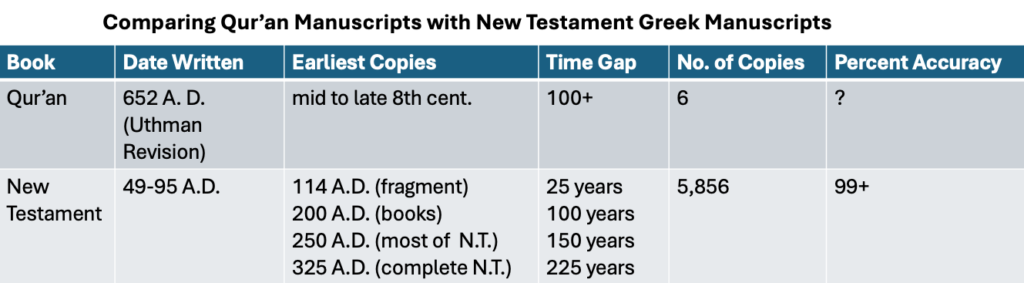
Because of the amount of complexity in comparing Islam’s sacred book (the Qur’an) and Christianity’s sacred book (the Bible), I am dividing Part 2 into four different articles. In the first two articles we looked at the manuscript evidence and the documentary evidence for both Scriptures. 

By far, the Bible has more manuscript evidence compared to the Qur’an (see above chart)Christianity can claim more than 5,850 known early Greek manuscripts of the New Testament, most of which were written between 25-225 years after the death of Christ. The New Testament also has over 18,130 early versions and translations, adding up to nearly 24,000 confirmed New Testament manuscripts still in existence (see chart below). In addition, we also have 42,300 Old Testament Scrolls and Codices, which means the Bible has 66,286 manuscript evidences.
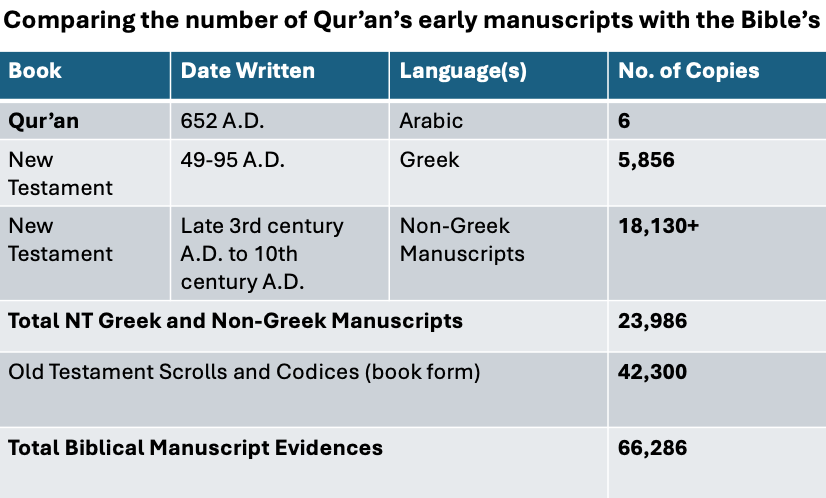
But Islam cannot provide a single manuscript until well into the eighth century, over 100 years after its supposed original compilation. And even then, Islam only has 6 early manuscripts of the Qur’an, and none of them are from the 7th century. None of them are complete. None of them completely agree with each other. None of them completely agree with the current 1924 ‘Hafs’ text which is memorized by 93% of Muslims. All of them have hundreds and even thousands of subsequent manuscript variants. [1]

If the Christians could retain so many thousands of ancient manuscripts, all of which were written long before the Qur’an, at a time when paper had not yet been introduced, forcing the dependency on papyrus which disintegrated with age, then one wonders why the Muslims are not able to forward a single manuscript from this much later period, during which the Qur’an was supposedly revealed? This indeed gives the Bible a much stronger claim for reliability than the Qur’an.

Furthermore, while the earliest New Testament manuscripts as well as the earliest letters from the church fathers correspond with the New Testament which we have in our hands, providing us with some certainty that they have not been unduly added to or tampered with, the Qur’anic material which we have in our possession abounds with stories whose origins we can now trace to second century fictional Jewish and Christian apocryphal literature. We know in some cases who wrote them, when exactly they were written and at times even why they were written; and that none of them were from a divine source, as they were written by the most human of Rabbis and storytellers over the intervening centuries after the Bible had been canonized.
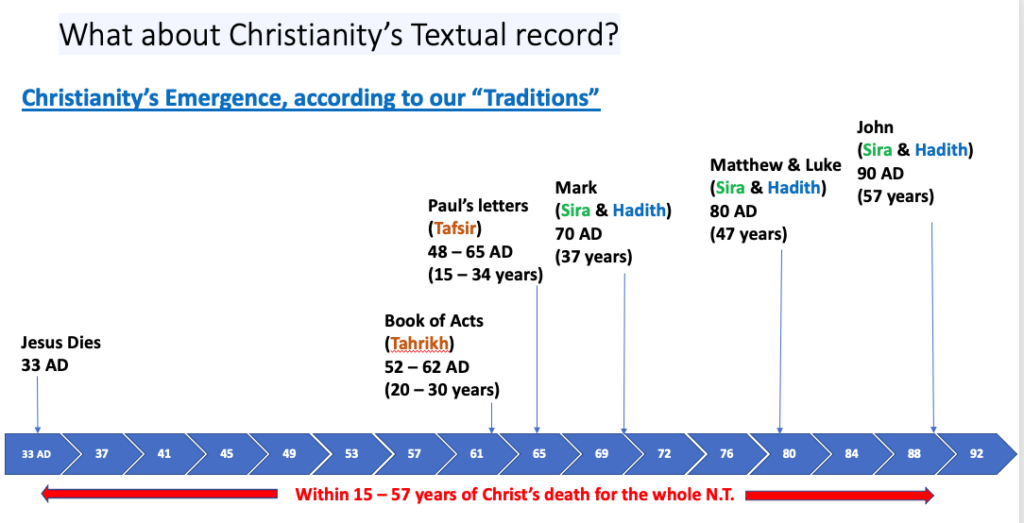
When we compared the historical documentary evidence of the Qur’an and the Bible, we discovered when the earliest biographies and sayings for both faiths were written. For Christianity (see above chart)they were written 16-57 years after Jesus’ death on the cross by those from the same area. But for Islam, they were written 400-900 years later, and by those who were hundreds of miles too far north (see chart below). Thus, the documentary evidence substantiates that the New Testament has more reliability and authority than the Qur’an.    
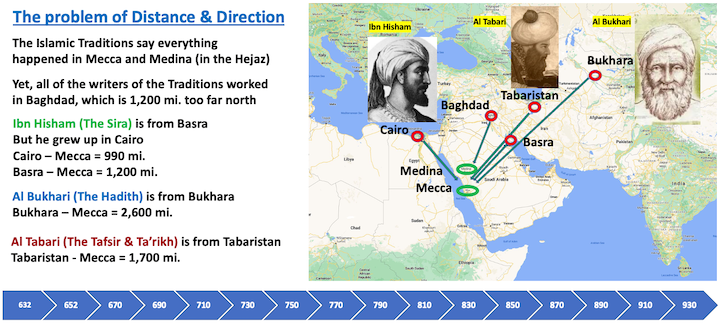
In this article, we will examine the archaeological evidence for both the Bible and the Qur’an. Since both the Bible and the Qur’an speak of history, we will see if archaeology confirms what both books say about people, places, and times. To begin, we will see what archaeology tells us about the Qur’an.

The Qur’an’s Archaeological Evidence

As with the manuscript and documentary evidence, there is not much archaeological information to which we can turn to substantiate what the Qur’an says. What we can do, however, is look at the claims the Qur’an makes and find out if they can be corroborated by archaeology. We will begin with the Qibla, or direction of prayer.

1) The Qibla: According to the Qur’an (Surah 2:144, 149-150), the Qibla or direction of prayer was finalized towards Mecca for all Muslims approximately two years after the Hijra (migration to Medina) around 624 A.D. and has remained in that direction to the present! [2]
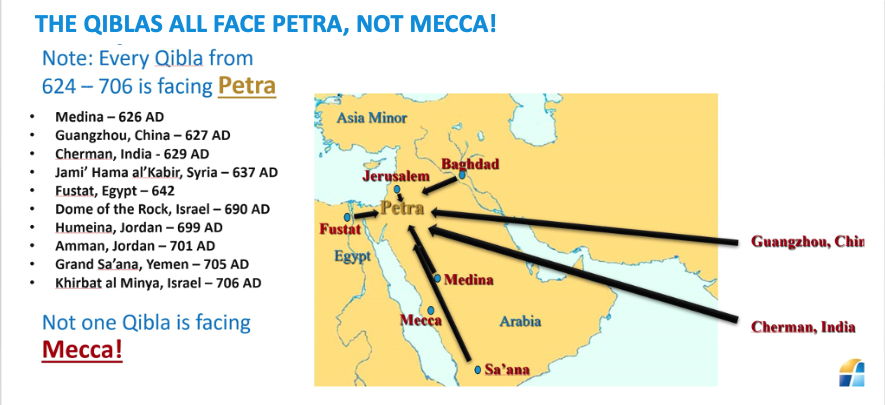
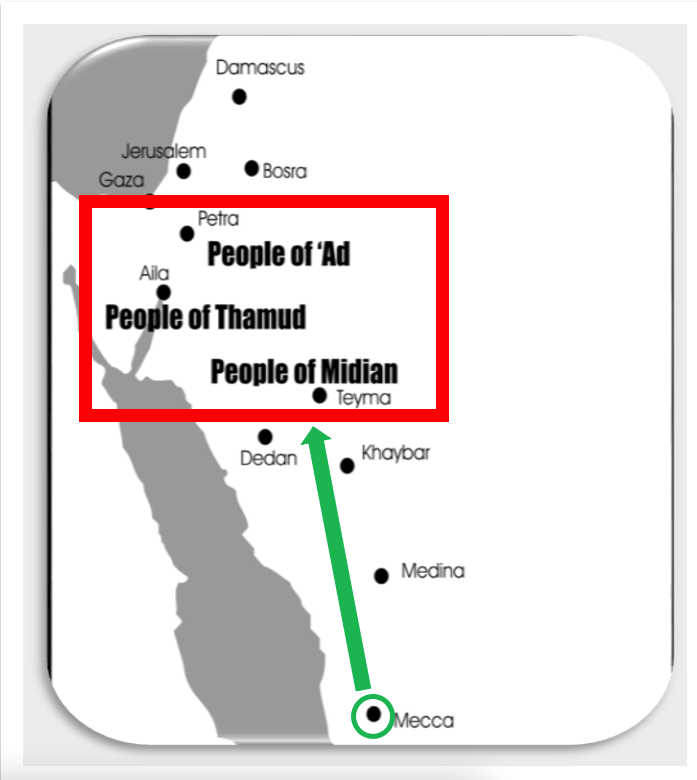
Yet, the earliest evidence from outside Islamic tradition regarding the direction in which Muslims prayed, and by implication the location of their sanctuary, points to an area much farther north than Mecca, in fact somewhere in northwest Arabia. [3] Middle Eastern archaeologist Dan Gibson has done the most extensive work on the Qiblas and found that every Qibla from 624-706 A.D. is facing Petra, and none are facing Mecca (see above map).

Gibson’s “archaeological examinations of the mosques from the first 100 years of Islam indicate that the qibla, or the direction of prayer, did not face toward Mecca, but rather to a more northern location, the Nabataean area around Petra where the people of ‘Ad, Midian, and Thamud all resided. Due to this archaeological evidence, Gibson does not support Mecca as the birthplace of Islam. Instead, based on his research Gibson concludes that ‘Islam was founded in northern Arabia in the city of Petra. It was there that the first parts of the Qur’an were revealed before the faithful were forced to flee to Medina. Thus, the prophet Muhammad never visited Mecca, nor did any of the first four rightly guided caliphs. Mecca was never a center of worship in ancient times, and was not part of the ancient trade routes in Arabia.’” [4] [emphasis added]

In addition, Gibson mentions that at a 2002 conference on Nabataean Studies held in Petra he had the opportunity to speak to several Jordanian and Saudi archaeologists who admitted that “the archeological record at Mecca was basically non-existent before 900 AD. [5] [emphasis added] Perhaps this is why the Saudi government is destroying most of the ancient buildings and sites in Mecca. [6] They may be trying to cover up something that was “not there” before the 9th century. [7]

Smith notes that an additional substantiation for this direction of prayer is found “by the Christian writer and traveler Jacob of Edessa, who, writing as late as 705 A.D. was a contemporary eyewitness in Egypt. He maintained that the Mahgraye’ (Greek name for Arabs) in Egypt prayed facing east which was towards their Ka’ba.” [8] [emphasis added] His letter (which can be found in the British Museum), reveals that as late as 705 A.D. the direction of prayer towards Mecca had not yet been finalized. [9]

Why are all of the 7th century Qiblas facing Petra or Jerusalem up to 705 A.D., and not Mecca until 715 A.D.? [10] Some Islamists argue that the early Muslims did not know the direction of Mecca. Yet these were desert traders! Their livelihood was dependent on travelling the desert, which has few landmarks, and, because of the sandstorms, no roads. They especially knew how to follow the stars. Their lives depended on it. Surely, they knew the difference between the north and the south. [11]

In addition, Smith says, “Furthermore, the mosques in Iraq and Egypt were built in civilized urban areas, amongst a sophisticated people who were well adept at finding directions. It is highly unlikely that they would miscalculate their qiblas by so many degrees. How else did they perform the obligatory Hajj [pilgrimage], which we are told was also canonized at this time? And why are so many of the mosques facing in the direction of northern Arabia, or possibly Jerusalem?” [12] [brackets and emphasis added]

Smith argues that a plausible answer may be found by examining the archaeological evidence in Jerusalem itself.       

 2) The Dome of the Rock: [13] 
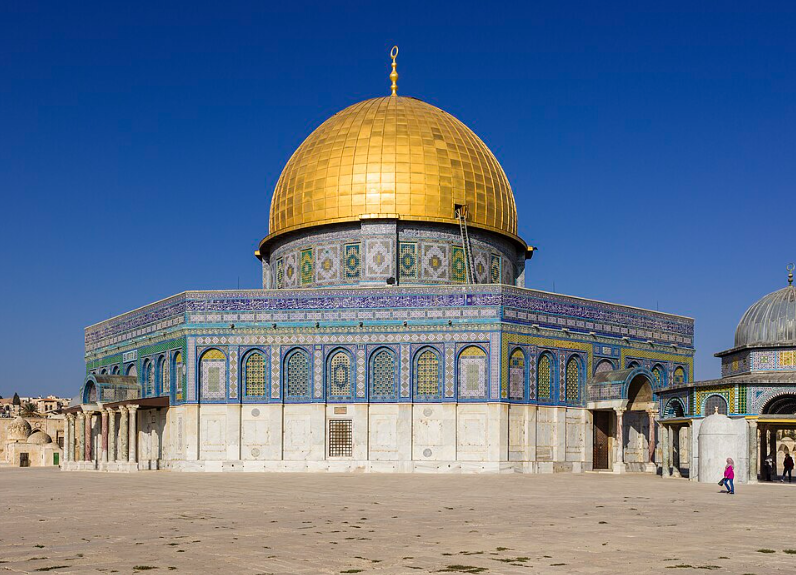
In the center of Jerusalem stands an imposing structure (even today) called the Dome of the Rock (see above pic), built by Caliph Abd al-Malik “in 691 A.D., after seeing the magnificent Christian cathedral of the Church of the Holy Sepulchre.” Al-Malik built this structure “of equal splendor over the rock in Jerusalem believed to be where Abraham was about to sacrifice his son Isaac.” [14]

The Dome of the Rock was built in the shape of an octagon with eight pillars [15] suggesting it was used for circumambulation (to walk around). Thus, it seems to have been built as a sanctuary[16] Today it is considered to be the third most holy site in Islam, after Mecca and Medina. Islamists insist that it was built to commemorate the night when Mohammed went up to heaven to speak with Moses and Allah concerning the number of prayers required of the believers (known as the Mi’raj in Arabic). [17]

But when the inscriptions on the walls of the Dome of the Rock were examined, they said nothing of the Mi’raj. This is substantiated further by the absence of a Qibla (no direction for prayer). Why was there no Qibla? The fact that such an imposing structure was built so early suggests that Jerusalem, and not Mecca, became the sanctuary and the center of an emerging Islam up until at least the late seventh century! [18]

According to Islamic tradition, the caliph Suleyman, who reigned as late as 715-717 A.D., went to Mecca to ask about the Hajj (annual pilgrimage). He was not satisfied with the response he received there, and so chose to follow Abd al-Malik (i.e. travelling to the Dome of the Rock). This fact alone, according to Dr. Hawting at the School of Oriental and African Studies (as part of London University) points out that there was still some confusion as to where the sanctuary was to be located as late as the early eighth century. It seems that Mecca was only now (sixty years after Mohammed’s death) taking on the role as the religious center of Islam. One can therefore understand why, according to tradition, Al-Walid I, who reigned as Caliph between 705 and 715 A.D., wrote to all the regions ordering the demolition and enlargement of the mosques. [19] This suggests that at this time the Qiblas were then aligned towards Mecca.

Hence, archaeology tells us that the Qur’an introduced the Qibla in Mecca too early. This points to a glaring contradiction in the Qur’an which established Mecca as the sanctuary and thus direction for prayer during the lifetime of Mohammed some eighty to ninety years earlier (Qur’an 2:144, 149-150). 

And that is not all, for we have other archaeological evidence which point to differences with that which we read in the Qur’an.

3) Dirham Coins: 
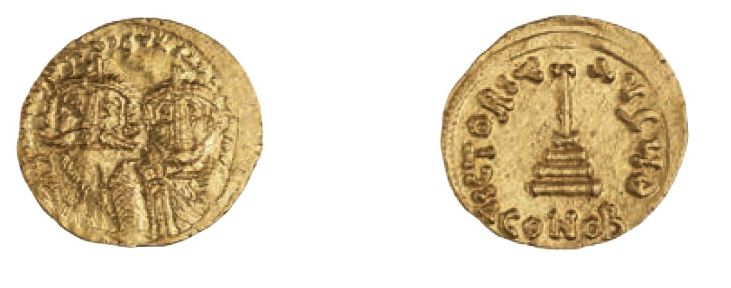
The Qur’an mentions that Joseph was sold by travelers (not Joseph’s brothers, as recorded in Genesis 37:28) for “a lesser price than a numbered dirham” (Qur’an 12:20). [20] Dirhams did not exist until the 7thcentury A.D., evolving from the Greek drachma. There were no dirhams during the time of Joseph (1915-1805 B.C.) [21] in ancient Egypt. Hence, the Qur’an introduces dirham coins hundreds of years too early. [22]

4) Samaritans: 
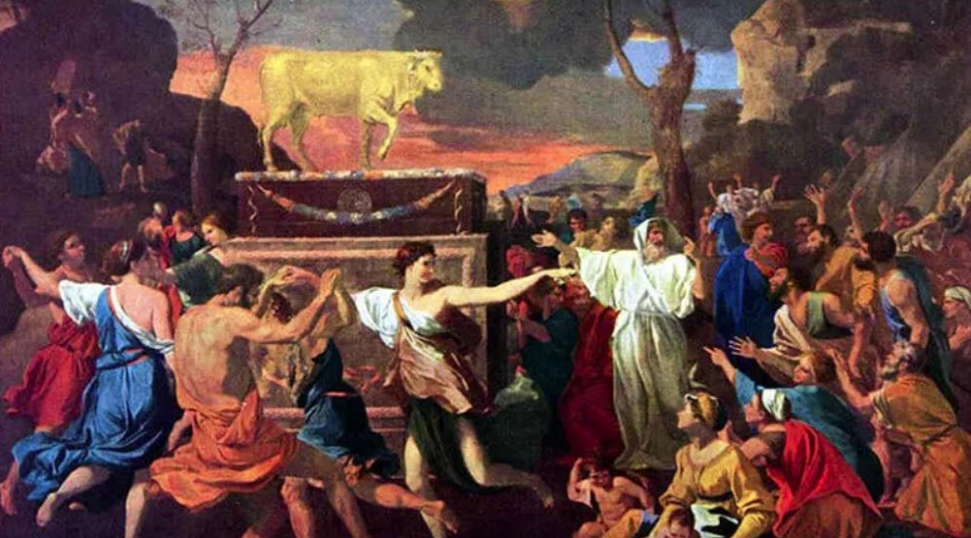
We learn from the Qur’an that a “Sāmirī [Samaritan, a non-Arabic word of Hebrew/Syriac origin], [23] not Aaron, as recorded in Exodus 32, “led them astray” (Qur’an 20:85) [24] to fashion a golden calf (Qur’an 20:86-88, 95-97). Mentioning a Samaritan in the time of Moses (1525-1405 B.C) [25] conflicts with history because Samaritans were not known as a people until 722 B.C. [26] Once again, the Qur’an introduces something hundreds of years too early. In addition, the Qur’an confuses Hosea 8:5-6 with the calf of the Exodus rebellion! [27]  

5) Chainmail: 

According to the Qur’an, Allah taught King David how to make chain mail: 10 And indeed, we gave David a bounty from us: ‘O mountains, sing praises with him and the birds.’ And we softened the iron to him. 11 That, ‘Make suitable coats of sard [chain armor, non-Arabic word of Persian/Syriac origin] and measure the length. And do a good deed. Surely, I see what you do.” (Qur’an 34:10-11). [28] Hence, the Qur’an is saying that chainmail existed during the reign of King David in ancient Israel (1011 B.C. – 971 B.C.). [29] But coats of chainmail were not invented until around 400-300 B.C. by Celtic tribes in eastern Europe. [30] Hence the technology for chainmail did not exist until hundreds of years later than the Qur’an’s reference. 

6) Crucifixion: 
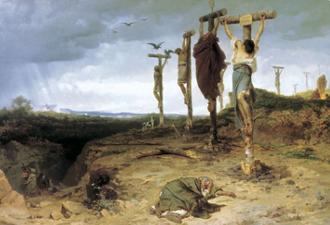
According to the Qur’an, Pharaoh threatened to “cut off” the “hands” and “legs” of his sorcerers on opposite sides and “crucify” them “on trunks of the palm tree”  when they chose to believe in the God of Moses (Qur’an 20:71; 7:121). [31] Joseph tells one of his fellow prisoners that “ he will be crucified, so the birds will eat from his head.” (Qur’an 12:41).[32] The earliest historical record of crucifixion dates to 519 B.C. when King Darius I of Persia crucified 3,000 of his political enemies in Babylon. [33] Thus, the Qur’an places crucifixion at times (Joseph: 1915-1805 B.C. and Moses: 1525-1405 B.C) which are hundreds of years before history records when crucifixion was invented.        

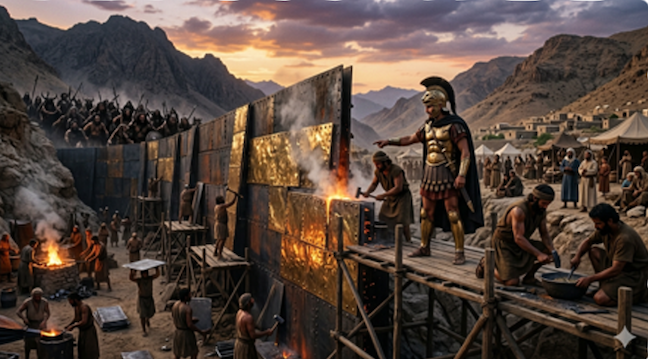
7) Alexander the Great (see AI generated pic below)

The Qur’an states, “They ask you about Ze Al Qarnain [the one with two horns]. Say, ‘I will recite to you an account of him.’” (Qur’an 18:83). [34] Dakdok explains that “the reason this verse was given was because the Jews of Quraish asked to examine the knowledge of Mohammed. That is why Allah sent down the story of Zu Al Qarnain” [35] otherwise known as Alexander the Great. [36]

We read of Alexander the Great,  92 Then he followed a way, 93 until he came between the two mountains under which he found a people who could not understand a saying. 94 They said, ‘O Za Al Qarnain, surely Ya’juj [Gog] and Ma’juj [Magog] are vandalizing in the land. Shall we make to you a tribute that you make between us and them a barrier?’ 95 He said, ‘That in which my lord has established me is better, so assist me with strength. I will make a barrier between you and them. 96 Bring me blocks of iron,” until it equalizes between the two sides. He said, ‘Blow,’ until when he made it a fire. He said, ‘Bring me brass that I may pour over it.’ 97 And they were not able to scale it, neither were they able to dig through it.’ 98 He said, ‘This is a mercy from my lord. So, when the promise of my lord comes to pass, he will make it dust. And the promise of my lord was true.” (Qur’an 18:92-98). [37] [emphasis added]

Ibn Kathir, a 14th century Muslim historian, scholar, and Qur’anic exegete, interpreted these verses by stating that these people between the two mountains were Turkish and the cousins of Gog and Magog (Qur’an 18:92-94ba). They mentioned to Alexander the Great that Gog and Magog had vandalized them, so they offered to pay him a great tribute to help them build a barrier between them and Gog and Magog (Qur’an 18:94b). But Alexander the Great refused to receive their tribute because he was satisfied with what Allah had given him (Qur’an 18:95a). Kathir also interpreted these verses to say that Alexander the Great, with the assistance of these men, built a great barrier made of iron and brass so it was smooth on the outside, making it difficult to go above it with ladders and through it with shovels (Qur’an 18:95b-97). Kathir claimed that the barrier was the same height as the tallest mountain, to the point that there was not one building on the earth that was stronger or more useful to the people than it. The building of this great barrier showed the mercy of Allah to his servants to prevent the aggression of Gog and Magog against these people (Qur’an 18:98a). Kathir also stated that this barrier which Alexander the Great built would become dust in the day of resurrection; this must be done, for the promise of his lord is true (Qur’an 18:98b). [38]

Al Bukhari (d. 870 A.D.) wrote down the actions and saying of Mohammed in the Hadith, and he said a man came to Mohammed and said, ‘O messenger of Allah, indeed I saw the barrier of Gog and Magog.’ Mohammed said, ‘Describe it to me.’ The man said, ‘It was like striped hail with black and red stripes.’ Mohammed said, ‘Indeed, you have seen it.’ That means Mohammed agreed with this man because Mohammed had seen this barrier. [39]

Dakdok concludes, “It is amazing… that there is no evidence of the existence of such a barrier. Alexander the Great did not build any barrier; and if there was such a barrier with this description, it should still exist, especially when we read that the Qur’an said that it will be there until the day of resurrection (Qur’an 18:95-101) which has not taken place yet. Such a barrier does not exist, nor is there any archaeological evidence to prove its existence. Moreover, there is not any biblical reference to such a barrier. The only barrier or wall that is known to the world is the Great Wall of China, which still exists today and is very well documented in history. This proves that these men in this hadith and Mohammed are liars.” [40] [emphasis added]

9) Coins: [41]
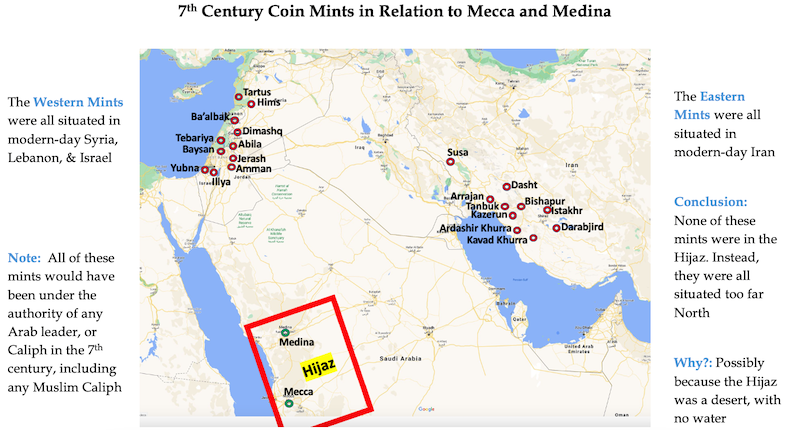
In ancient days when a king or Caliph (Muslim leader) came to power, one of the first things he did was mint a coin with his name and image on it and what religion he belonged to along with the date of the coin. Since they didn’t have modern communication like we do today (e.g. newspapers, radio, TV, or internet), they minted coins to inform others of their identity and jurisdiction. Dr. Jay Smith shows that there are no Islamic coins minted during the supposed lifetime of the prophet Mohammed (570 – 632 A.D.) nor during the Rashidun period (624-661 A.D.). The coins that were minted during that time were too far north to be related to Mohammed or the Qur’an (see above chart). The western mints were situated in modern day Syria, Lebanon, and Israel, and the eastern mints were located in modern day Iran. All of these mints would have been under the authority of any Arab leader or Caliph in the 7th century, including any Muslim Caliph (successor to Mohammed). In addition, none of these mints were in the Hijaz where Islam supposedly began. It is possible that these mints were too far north because the Hijaz was a desert with no water, and where there is no water, there is no civilization.
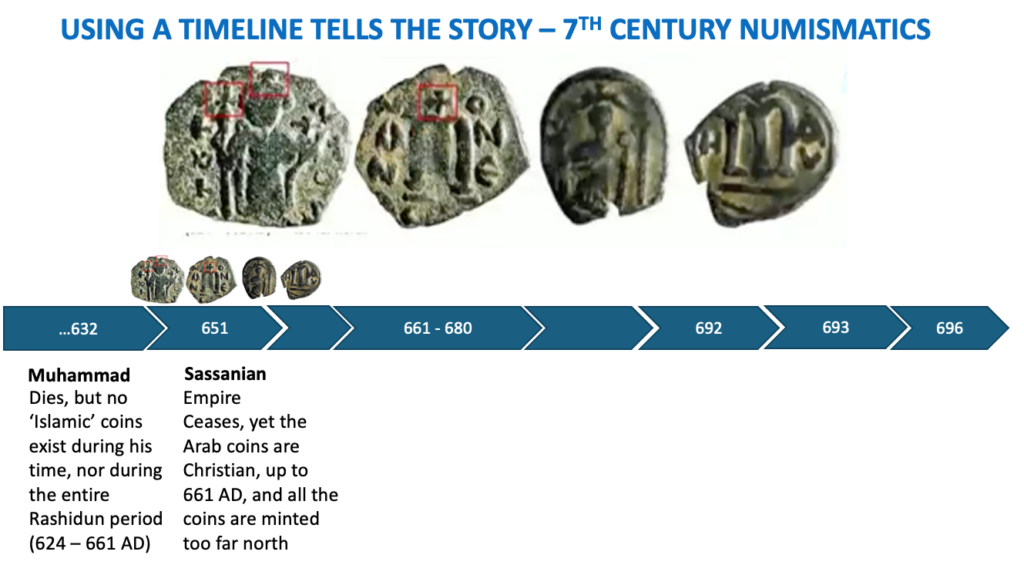
When you examine the coins minted in the early 7th century up to 661 A.D, almost all the coins are Christian, possessing a cross on them (see above pic). None of the coins from that time had anything to do with Mohammed, Islam, the Qur’an, or Mecca. 
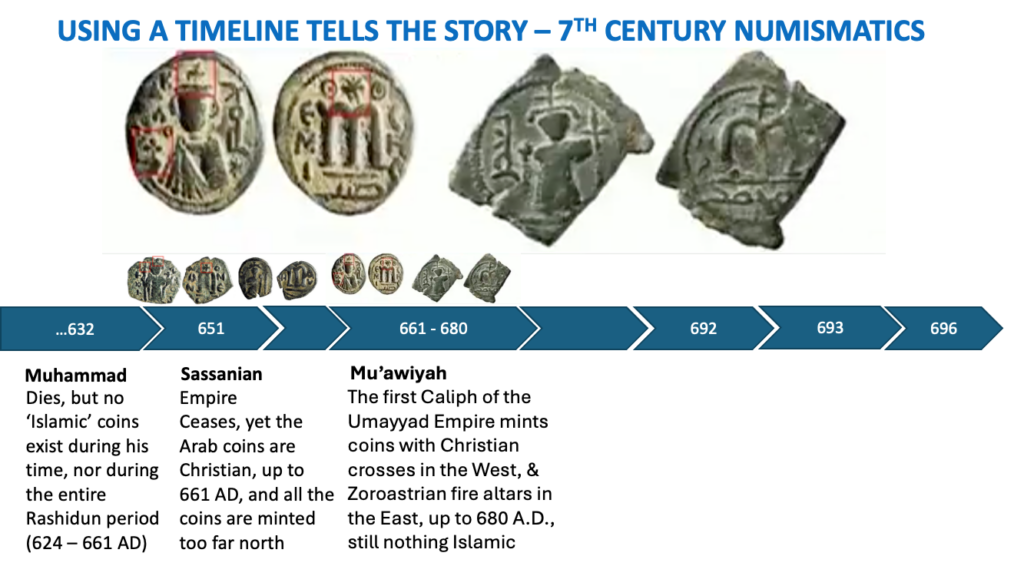
For example (see above pic), when you look at the first Muslim Caliph of the Umayyad Empire, Mu’awiyah, he minted coins with Christian crosses on them. Notice the two coins in the lower right of the picture. The first coin has a cross above the Caliph’s head and in his hand. And on the back side of the coin, it has the Arabic name Mahmad which some believe refers to the prophet Muhammad. If that is the case, it would be the first reference to Muhammad anywhere, and that was in 663 A.D.        

Some scholars argue that the Arabic word “Mahmad” later translated Muhammad word “Mahmad” later translated Muhammad on these early coins may refer to Jesus Christ, and not the prophet of Islam. This is because the root of the term “mu-hammad” is “Ahmad,” which means “praise.” Hence, the term Muhammad could be translated as “the one (mu-) who is praised (Ahmad),” or the “chosen one.” [42] Since the coins picture the Muslim leader with a cross on his head and in his hand, scholars conclude that Jesus Christ must be the “one who is praised.”   
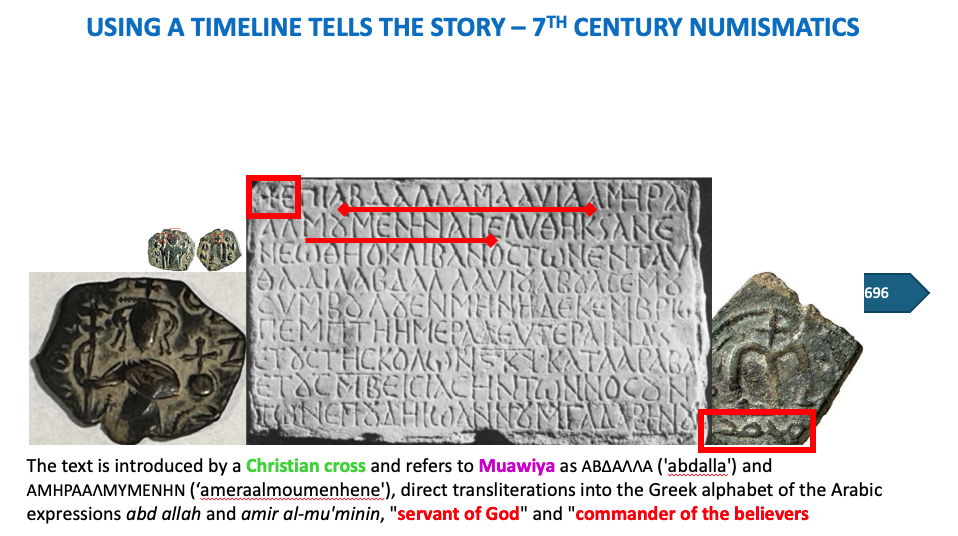
This is substantiated further in an inscription by Mu’awiyah (see above pic). He introduces the inscription with a cross in the upper left corner and refers to himself as “abdalla,” a “servant of God” and “ameraalmoumenhene,” a “commander of the believers.” Smith concludes that this first Caliph was a believer in the Jesus of the Bible who was a commander of Christians. Mu’awiyah ruled until 680 A.D. and then Abd Al-Malik came to power in 685 A.D.   
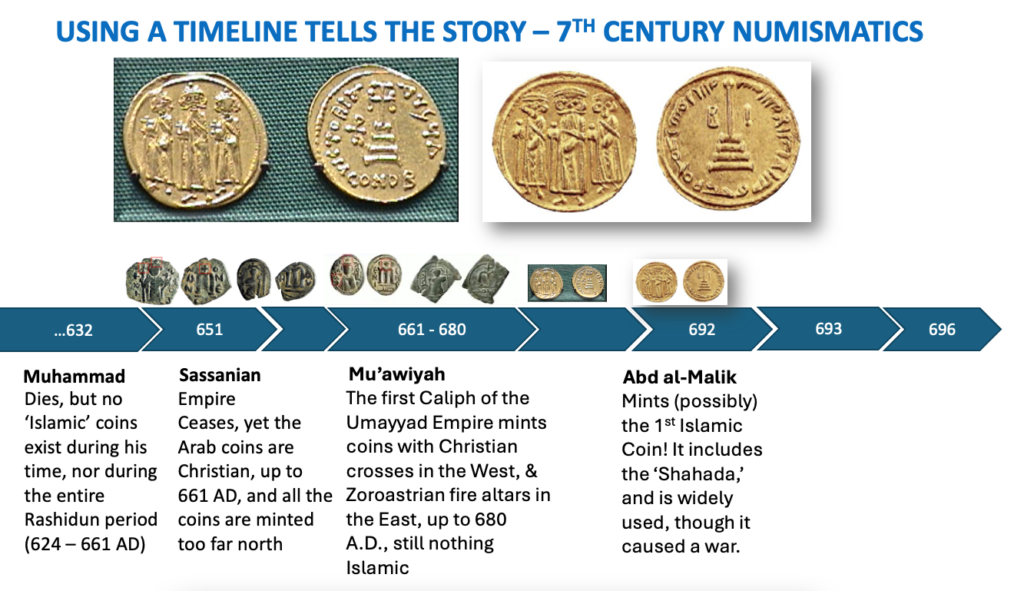
Abd Al-Malik introduces new coins that contain the shahada (see above pic) which says, “There is no god but Allah, and Muhammad is his prophet (rasul).” This is perhaps the first Islamic coin. After minting this coin, Abd Al-Malik goes to battle against Justinian, the Byzantine Emperor, and defeats him. He then mints this coin with an image of himself holding a sword in victory (see pic below). 
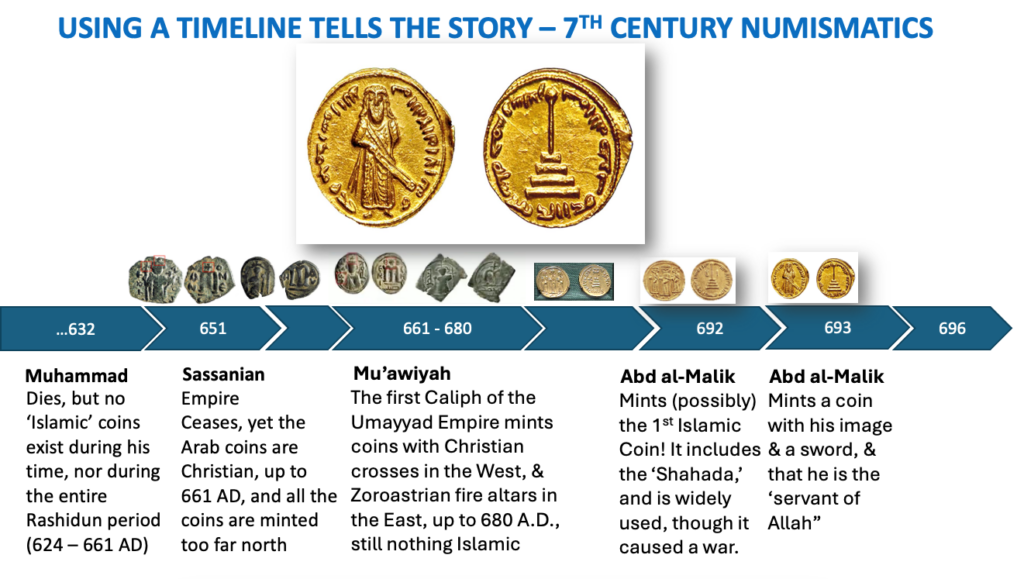
Abd Al-Malik had inscriptions written on the Dome of the Rock which he built in 691 A.D. which attacked Jesus as the Son of God (e.g., Allah “hath not taken unto Himself a son, and Who hath no partner” – Qur’an 25:2; Allah “has no associate” – Qur’an 112:3) as well as the Trinity (e.g., “say not ‘three’” – Qur’an 4:171). [43] 
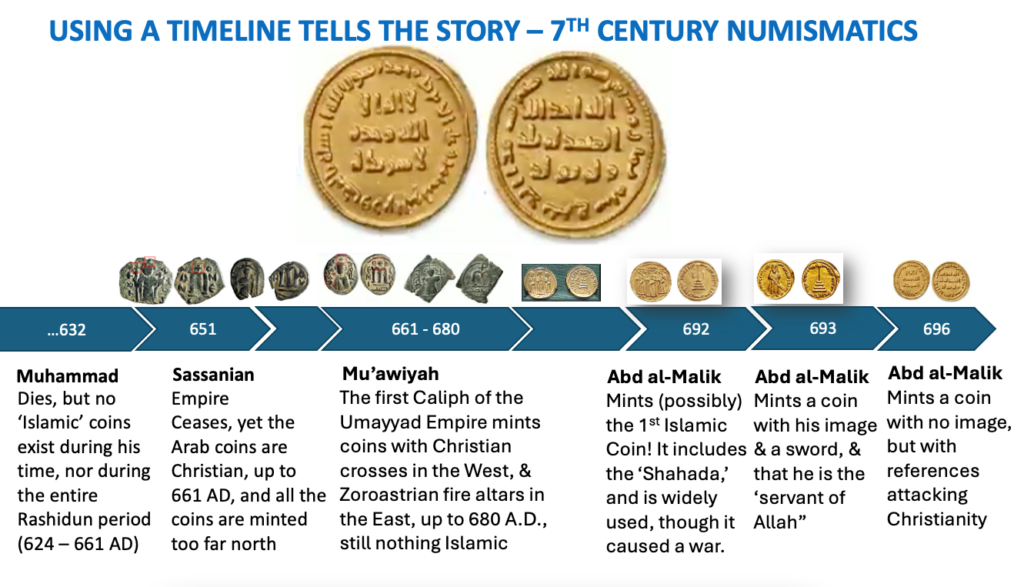
He also minted coins attacking Christianity (see above pic). Smith concludes that this is the beginning of what later became Islam. [44]

10) Arabic Rock inscriptions: 
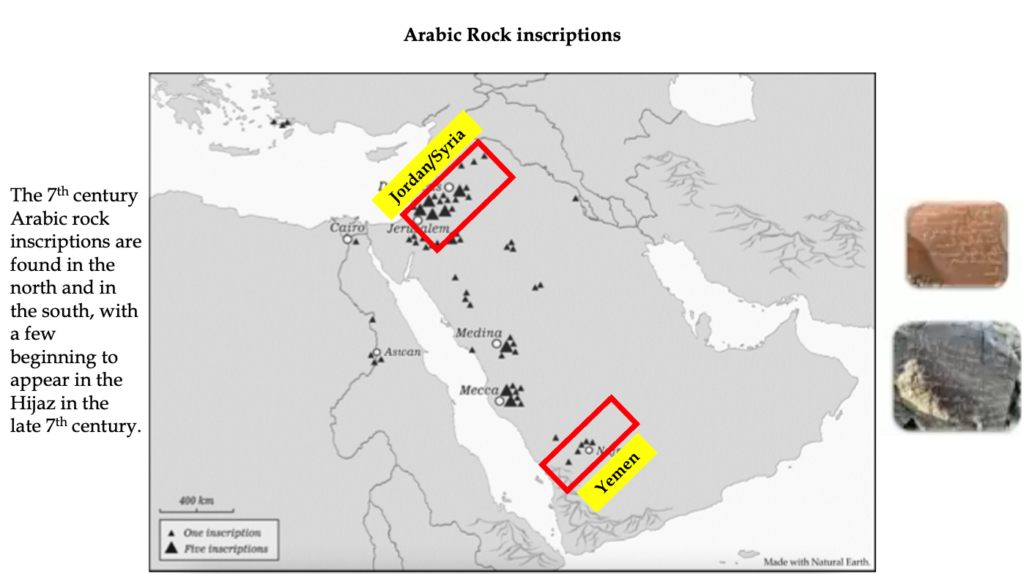
Notice that the 7th century Arabic rock inscriptions are all found in the north and in the south (see above pic), but not in the Hijaz where Islam supposedly began. Ilkka Juhani Lindstedt [45] analyzed approximately 100 Arabic rock inscriptions during a 100-year period (640-740 A.D.) and discovered that prior to 690 A.D., there was no evidence of anything Islamic on the inscriptions. Instead, they are merely pious formulae related more to Christianity. It is not until 690-710 A.D. that the prophet Muhammad is introduced in these inscriptions. Muslim rites (e.g., pilgrimage, prayer, fasting, etc.) appear from 710-720 A.D. From 720-730 A.D., the terms “Muslim” and “Islam” emerge in these inscriptions referring to a specific group in contradistinction to Christianity. This is 100 years after Muhammad’s death. It was only in the  730s A.D. onward that popular devotion was given to a man named Muhammad as a prophet and messenger of Allah, which calls into question the  traditional Islamic narrative presented in the Qur’an. Smith concludes that this 100-year silence indicates that Islam did not exist as a distinct religion until long after the time of Mohammed (570-632 A.D.) which casts doubt that he had any part in starting Islam.  

11) Qur’anic Quotations: [46] The quotations from the Qur’an on both the coins and the Dome of the Rock differ in detail from that which we find in the Qur’an today. [47]  Two etymologists, Van Berchem and Grohmann, have done extensive research on the Dome of the Rock inscriptions, and they state that the inscriptions contain “variant verbal forms, extensive deviances, as well as omissions from the text which we have today.” [48]

If these inscriptions had been derived from the Qur’an, with the variants which they contain, then how could the Qur’an have been canonized prior to this time (late seventh century)? One can only conclude that there was a gradual evolution in the transmission of the Qur’an through the years (if indeed they were originally taken from the Qur’an).

The sources also seem to suggest that the Qur’an was put together rather hurriedly. Dr. John Wansbrough maintains that “the book is strikingly lacking in overall structure, frequently obscure and inconsequential in both language and content, perfunctory in its linking of disparate materials, and given to the repetition of whole passages in variant versions. On this basis it can plausibly be argued that the book is the product of the belated and imperfect editing of materials from a plurality of traditions.” [49] Hence, Crone and Cook believe that because of the inadequacy of the editing, the emergence of the Qur’an must have been a sudden and late event. [50]

The Bible’s Archaeological Evidence

 We will begin with the archaeological evidence for the Old Testament. Since Abraham is esteemed by both Christianity and Islam, we will look at where archaeology places him.    

Abraham: Abraham was the first and greatest of the Hebrew patriarchs. His story is recorded in Genesis 11:26-25:10. “Abraham” appeared as a personal name in Babylonia during the time of the Patriarchal period (2296 -1806 B.C.). [51] Early and late twentieth-century excavations in Mesopotamia have uncovered documented names, including  Abram (later changed to Abraham – Gen. 17:5) [52] and his relatives, such as his great-grandfather Serug, his grandfather Nahor, and his father Terah (Gen. 11:22-26). These men all have names that have been confirmed in documents and reports as coming from the Euphrates-Habur region of Upper Mesopotamia from the time period of the early second millennium. [53]
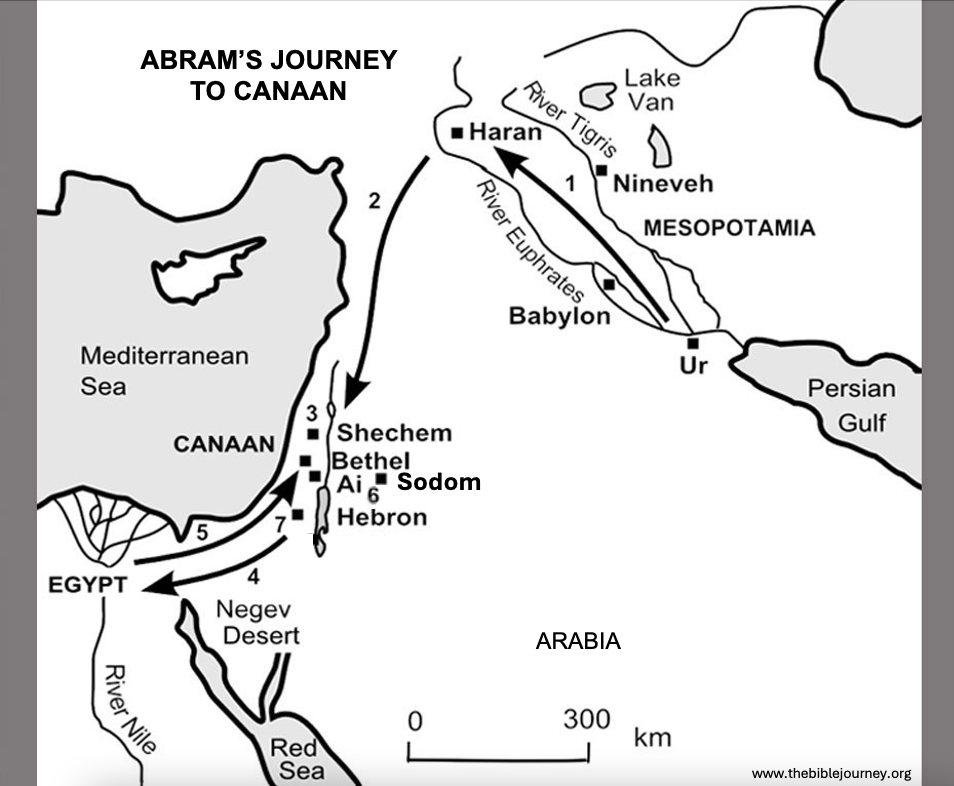
When we look at Abram’s journey from Ur to Canaan (see above map), we learn that archaeology confirms the names of places related to his journey from the Patriarchal period: 

1) Terah and his family (including his sons Abram and Nahor, and his grandson Lot) lived at Ur, the capital of Sumer, in southern Mesopotamia (modern-day Iraq). [54] While still living in Ur, God calls Abram to “Get out of your country… to a land I will show you.” (Gen. 12:1; cf. 15:7; Neh. 9:7; Acts 7:2). [55] They decide to move from Ur and follow the Euphrates River upstream about 600 miles possibly to avoid the harsh central Arabian desert [56] to Haran in what is now modern-day southern Turkey [57] (Gen. 11:27-32). Excavations at this site have unearthed a large mudbrick building that dates to the end of the third millennium B.C., which some believe may have been a predecessor to the Temple of the moon-god, Sin, [58] which is significant because Terah’s name means “moon” [59] and Scripture informs us that he came from an idolatrous background whereby he “served other gods” (Josh. 24:2). 

2) After Terah died in Haran (Gen. 11:32), Abram and his nephew Lot set out for Canaan with their tents and flocks (Gen. 12:1-5). 

3) Abram arrives in Canaan and builds an altar by the sacred tree of Moreh at Shechem about 30 miles north of Salem (later called Jerusalem) [60] where God revealed Himself to Abram for the first time in the Promised Land (Gen. 12:6-7). Archaeological excavations at Tell Balata (ancient Shechem) confirm that it was a “place” (Gen. 12:6) with no walls when Abram arrived (~2090 B.C.), but approximately 180 years later when Jacob arrived (~1910 B.C.), [61] it had become a “city” (Gen. 33:18). [62] 

4) Abram moves to the hill country between Bethel and Ai, [63] then moves south towards the Negev Desert. Driven by drought and famine, Abram and Sarai (Abram’s wife) journey along the Way of Shur to the well-watered lands of the Nile Delta in Egypt (Gen. 12:8-20). 

5) Abram and Sarai are forced to flee from Egypt to the hill country near Bethel (Gen. 13:1-9). 

6) Abram and Lot decide to separate. Lot chooses the fertile, well-watered Jordan Valley to the east and pitches his tents near Sodom (Gen. 13:10-13).  
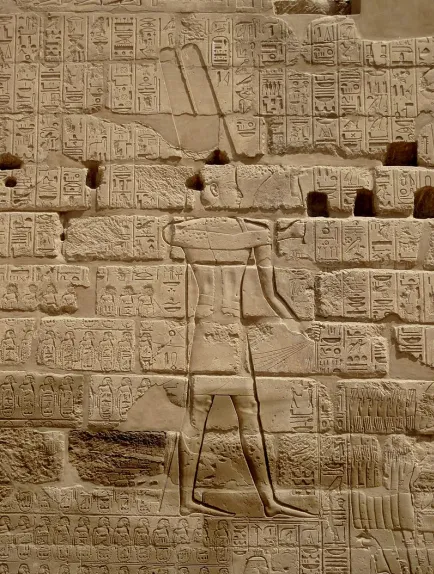
7) Abram moves to the great oaks of Mamre near Hebron and builds an altar there (Gen. 13:18). After the Egyptian Pharaoh Shishak (Shoshenq I) invaded the lands of Judah and Israel in 926 BC., he returned to Egypt and had a record of his victories inscribed on a wall of the Great Temple of Amun-Re at Karnak. One of the ovals, located just below and to the left of Shishak’s right foot (see above photo), reads, “the Fort / Enclosure of Abram.” [64]  This is the only nonbiblical written reference to Abraham, [65] proving that even at this early date Abraham was known not in Arabia, as Islam contends (Qur’an 2:124-131; 6:75-83; 19:41-48; 21:51-70; 26:69-83; 29:16-27; and 37:83-113) [66] but in Palestine, the land where the Bible places him. [67]

Sodom and Gomorrah (Gen. 13:1-13; 19:21-25; see photos below [68]):
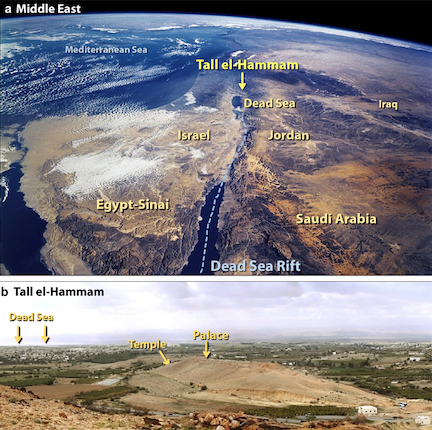
Since 2005 when Dr. Steven Collins began directing excavations in Tall el-Hammam, a fortified Middle-Bronze-Age city in modern day Jordan northeast of the Dead Sea, evidence was found that led scientists to believe it was destroyed by an extraordinary high energy event in 1650 B.C.  [69] Some archaeologists believe this could be the site of the biblical city of Sodom. Under the hill pictured in the base picture above, archaeologists found remains that indicate exposure to super intense heat over a short period of time which would have been much greater than exposure to wildfires, lightning, volcanism, earthquakes, or warfare. [70]

The entire city was capped by a five-foot thick charcoal and ash rich destruction layer containing shocked quartz, melted mudbrick, melted pottery, melted roofing clay, fragmented and scorched human bones, and other mysterious debris such as a ceramic shard with a glaze that would have been exposed to super-intense heat lasting a very short period. [71]
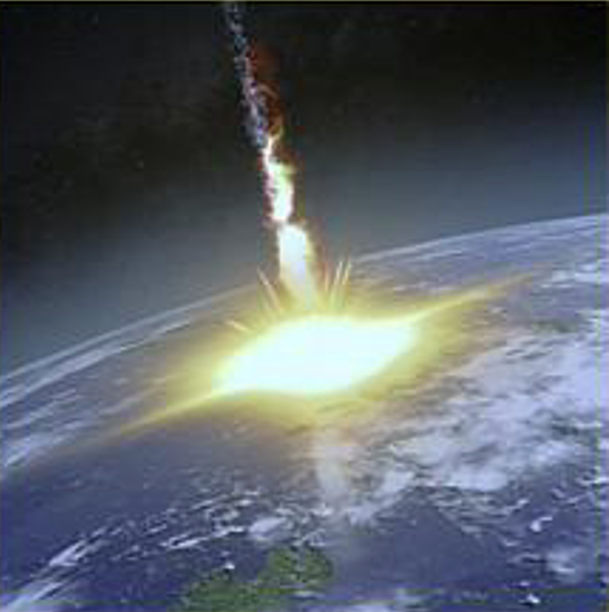
Scientists believe this represents a “cosmic airburst / impact event” (see above photo) similar to the asteroid explosion in Tunguska, Siberia in 1908, which had the equivalent explosive power of 1,000 Hiroshima bombs. [72]

The contents of the 5-foot destruction layer uncovered by scientists include (see pics below): [73]
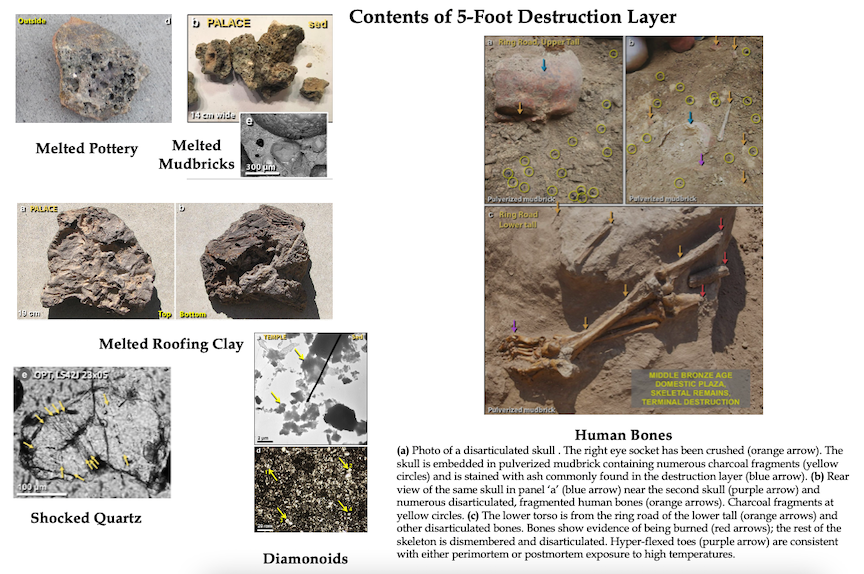
–       Melted construction materials such as pottery, mudbricks, roofing clay. 

–       High temperature melted minerals such as shocked quartz whereby sand grains are cracked due to high pressure.

–       Presence of diamonoids (indicators of cosmic impacts).

–       Disarticulated, fragmented, and scorched human bones.

–       High salt concentrations up to 6 times that of the Dead Sea. 

These amazing findings substantiate what the Bible describes as the destruction of Sodom and Gomorrah. We read, 24 Then the Lord rained brimstone and fire on Sodom and Gomorrah, from the Lord out of the heavens. 25 So He overthrew those cities, all the plain, all the inhabitants of the cities, and what grew on the ground. 26 But his [Lot’s] wife looked back behind him, and she became a pillar of salt.” (Gen. 19:24-26). Afterwards, the soil around Sodom and Gomorrah could not be used for 700 years because of this catastrophic event which exposed it to such super intense heat. [74]

Jericho Walls (Josh. 6:20-24): 
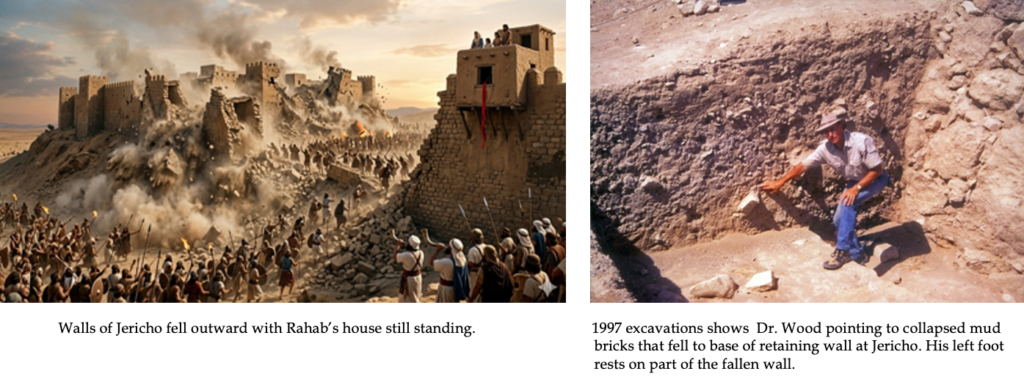
Recent analysis of archaeological research confirms that the city of Jericho was destroyed in approximately 1400 B.C. [75] and its city walls fell outward as the Bible states. [76]

King David: 
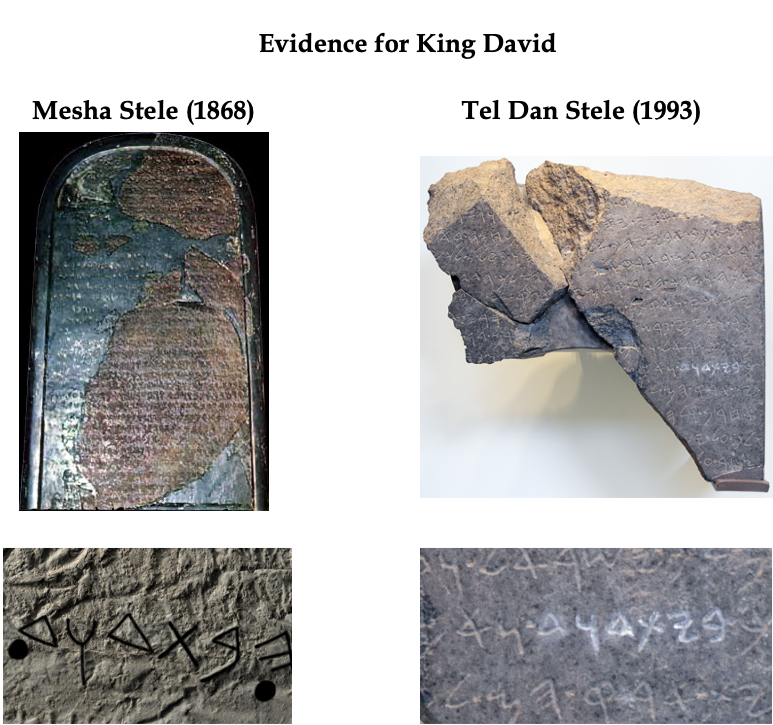
Skeptics claimed that King David never existed because his name had never been found outside of the Bible. But two archaeological findings came to the rescue at Dibon in Moab (1868) and at Tell Dan (1993-1994). In 1868 at Dibon, in Moab (20 miles east of the Dead Sea), the Mesha Stele was found and dated to 850 B.C. [77] It mentioned “Israel,” “Yahweh,” and the “House of David” (bytdwd). [78]In 1993 the Tell Dan Stele was discovered at Tel Dan (northern Israel) containing a Canaanite inscription that dates from the late 9th century B.C. [79] It was probably erected by Hazael, an Aramean king. The inscription reads, “I killed Jehoram son of Ahab king of Israel, and I killed Ahaziahu son of Jehoram king of the house of David (bytdwd). [80] The Bible tells us, “Mesha, king of Moab rebelled against the king of Israel…” (2 Kgs. 3:5).  
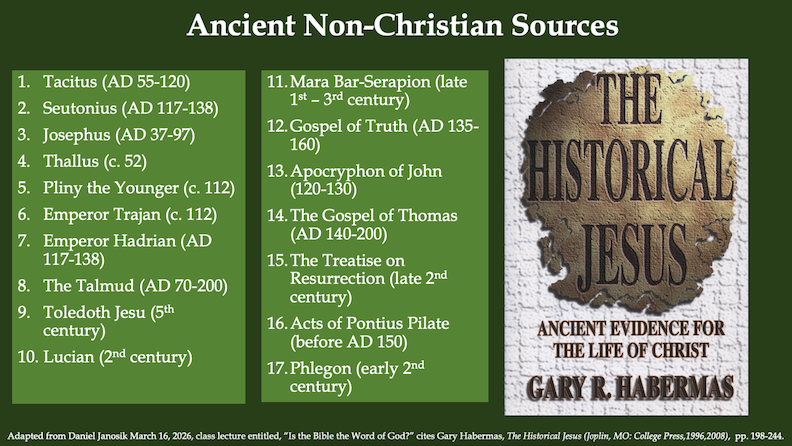
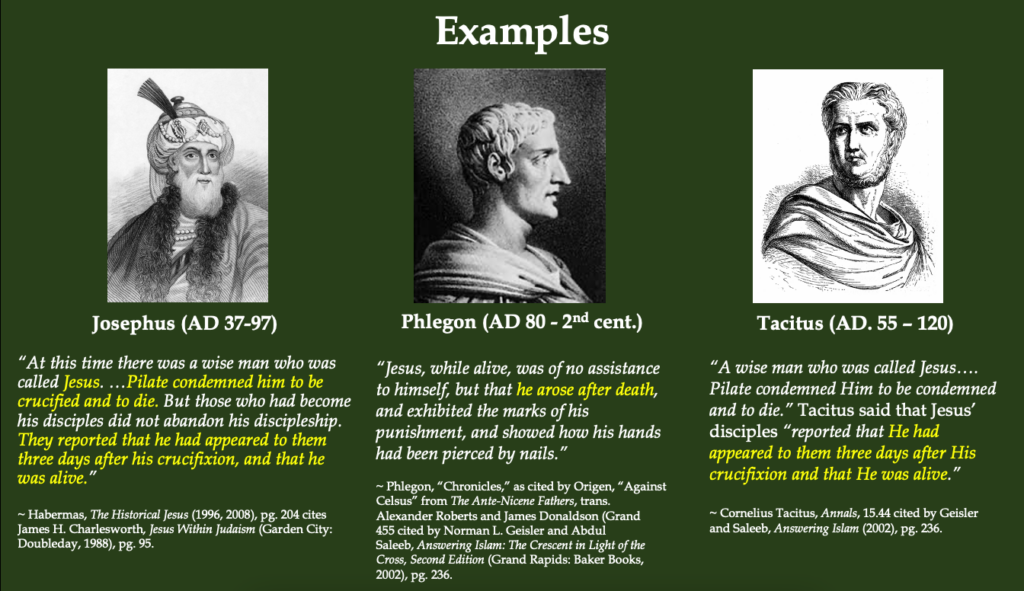
Let’s look at the archaeological evidence for the New Testament. Some people believe there is no historical evidence supporting that Jesus Christ actually existed. But in his book, The Historical Jesus, Gary Habermas cites 17 ancient non-Christian sources (see above pic) that testify to the historicity of Christ and early Christianity. [81] These are real people who testified of the death and resurrection of Jesus Christ. Examples (see pic below) include the Jewish historian, Josephus, the Greek historian Phlegon, and the Roman historian Tacitus.
Skeptics have harshly criticized Luke’s writings because more than any other New Testament writer he has mentioned specific people and places. Luke began his gospel of Jesus Christ, Inasmuch as many have taken in hand to set in order a narrative of those things which have been fulfilled among us, just as those who from the beginning were eyewitnesses and ministers of the word delivered them to us, it seemed good to me also, having had perfect understanding of all things from the very first, to write to you an orderly account, most excellent Theophilus, that you may know the certainty of those things in which you were instructed.” (Luke 1:1-4). 

Luke’s mention of Quirinius as the governor of Syria during the birth of Jesus (Luke 2:2) has been disputed by skeptics because Matthew’s account says Christ’s birth took place during the reign of Herod (Matt. 2:1, 16). Christ was born (6-4 B.C.) before King Herod died in 4 B.C. But critics argue that Josephus (Flavius Josephus, Antiquities of the Jews, 18:1:1; 18:2:1) places Quirinius’ reign in 6 A.D., ten years after Herod’s death. And Acts 5:37 seems to reference a census by Quirinius at that time. Did Luke get the historical placement of Quirinius wrong?    

A grammatical possibility is that the Greek word translated “first” (prōtē) can mean “before” or “earlier” (Luke 2:2; cf. John 15:18). [82] Hence, the verse could be translated as “This census took place before Quirinius was governing Syria.” (Luke 2:2). The Greek verb translated “governing” (hēgemoneuō) does not necessarily mean Quirinius was holding the specific office of governor. It simply means Quirinius was exercising authority in some capacity. [83] Hence, Luke’s meaning would then be that the census that took Mary and Joseph to Bethlehem was the one that Augustus made “before” the one he took when Quirinius was governing Syria in some capacity (in 6 A.D.), implying that another census was taken during another period when Quirinius was exercising authority in Syria. [84]
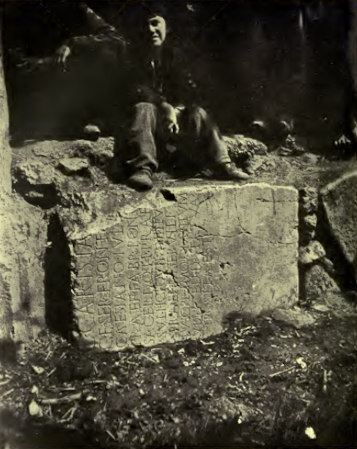
Archaeological discoveries confirm that Quirinius was proconsul of Syria twice. In 1764, a Latin inscription was discovered near Tivoli, located about twenty miles east of Rome, and it is understood to refer to Quirinius governing Syria on two separate occasions. [85] The first time was from 12–2 B.C. to conduct military action against the Homonadensians and then a second time in 6-7 A.D. [86] In addition, a statue dedicated to Quirinius was found by Sir William Ramsay at Pisidian Antioch (see above photo) showing that Quirinius was active in the region and held administrative authority around 12 to 2 B.C. [87] Hence, Quirinius exercised authority over the Roman province of Syria in some capacity twice (12-2 B.C. and A.D. 6-7) and took two separate censuses. [88] This is consistent with Luke’s account. In Luke 2:2, Luke writes, “This census first took place while Quirinius was governing Syria” (describing Quirinius’ rule as the governor’s procurator), and in Acts 5:37, Luke describes a second census taken most likely between 6-7 A.D. (as described by Josephus) when Quirinius was the formal governor of the region. Both Josephus and Luke link this second census to an uprising under Judas of Galilee. Only Luke’s sources were present during the actual events; as a result, Luke’s description of two separate censuses is reasonable. [89]

Repeatedly secular historians have accused Luke of historical inaccuracies only to retract their criticisms after archaeology confirmed Luke’s accounts. Examples include: 

–       Luke’s use of the Greek word meris to maintain that Philippi was a “district” of Macedonia (Acts 16:12) was doubted until inscriptions were found which use this very word to describe divisions of a district. [90]

–       Luke’s usage of the Greek word Politarchēs to denote the civil authority of Thessalonica (Acts 17:6) was questioned, until some 19 inscriptions have been found that make use of this title, 5 of which are in reference to Thessalonica. [91]
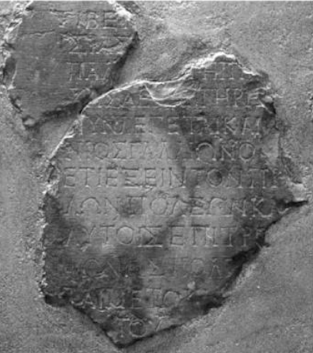
–       Luke’s usage of Proconsul as the title for Gallio in Acts 18:12 has come under much criticism by secular historians, as the later traveler and writer Pliny never referred to Gallio as a Proconsul. This fact alone, they said, proved that the writer of Acts wrote his account much later as he was not aware of Gallio’s true position. In 1908 the Delphi Inscription, dated to 52 A.D. was uncovered (see above photo) and proved that Luke was correct. This inscription states, “As Lusius Junius Gallio, my friend, and the proconsul of Achaia…” [92]

–       When Luke says Paul and Barnabas fled from Iconium (Acts 14:1-5) to Lystra and Derbe, cities in Lycaonia (Acts 14:6), he was implying that Iconium was not in Lycaonia. This was rejected by critical archaeologists who based their belief on the writings of Romans such as Cicero who indicated Iconium was in Lycaonia. [93] But in 1910 Sir William Ramsay found a monument that showed Iconium was a Phrygian city. [94]
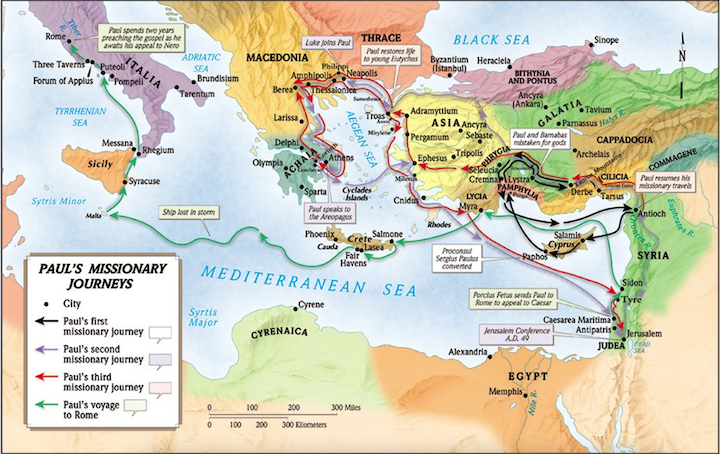
Luke recorded 32 countries, 54 cities, 9 Mediterranean islands, and 95 people in the book of Acts (see above pic), and he did not get any of them wrong. [95] Compare Luke’s historical accuracy with the Qur’an which places fifty-four of its sixty-five geographic references (see pic below) 600 – 1,000 miles too far north of Mecca (Ad = 23 times, Thamud = 24 times, and Midian = 7 times). [96]
Archaeologist and former Lukan skeptic, Sir William Ramsay investigated the archaeological discoveries relevant to Luke’s account in order to disprove the Bible as the inspired Word of God. After 30 years of archaeological research in the Middle East, Ramsay concluded that “Luke is a historian of the first rank; not merely are his statements of fact trustworthy … this author should be placed along with the very greatest historians [97]… Luke’s history is unsurpassed in respect of its trustworthiness.” [98] He later wrote a book on the trustworthiness of the Bible based on his discoveries and converted to Christianity. Sir Ramsay found no historical or geographical mistakes in the book of Acts. [99]

Unlike the Qur’an, archaeology repeatedly confirms the historical reliability of the New Testament. Smith writes, “We have no reason to fear archaeology. In fact, it is this very science which has done more to authenticate our scriptures than any other. Thus, we encourage the secular archaeologists to dig, for as they dig, we know they will only come closer to that which our scriptures have long considered to be the truth and give us reason to claim that indeed our Bible has the right to claim true authority as the only historically verified Word of God. This is why so many eminent archaeologists are standing resolutely behind the Biblical accounts.” [100]

Conclusion

From this brief survey we can conclude that the archaeological evidence for the historicity of the Qur’an proves to be the most damaging. The glaring historical inaccuracies involving the direction of prayer (Qibla), dirham coins in the time of Joseph, Samaritans in the time of Moses, chain mail in the time of David, crucifixions in the times of Joseph and Moses, and Alexander the Great’s making of an impregnable barrier, cannot be from a divine source. Not only do the seventh and eighth century ruins and inscriptions from the area seem to contradict the notion that Muhammad canonized a direction of prayer during his lifetime, or that he had formulated a scripture known as the Qur’an, but the idea of his universal prophethood, that he was the final “seal” of all prophets is brought into question. This indeed is significant and troublesome.

If the Qur’an was truly from an all-knowing God (Allah), it would not contain so many historical inaccuracies. Instead, these inaccuracies suggest that the Qur’an is not from a divine source, but from a human source. Whoever wrote the Qur’an either did not know their history well or they borrowed these stories from other sources with little discretion on their parts. Hence, the Qur’an is a manmade book that is not to be taken seriously. 

As for the Bible, we have learned from archaeology that the names, places, and events mentioned in the Bible have been recorded accurately so that what we have is the representation of what God said and did. The historical events and people in the Bible do not confuse names, dates and events, and in fact, continue to coincide with current archaeological findings. This is very significant, since with each successive year, ongoing archaeological discoveries fail to reveal any historical contradictions in our Scriptures. Instead, they continue to substantiate what the Bible has been saying for 2,000-4,000 years.

 Earlier we learned that Islam makes four claims for the authority of the Qur’an (see chart below): [101]
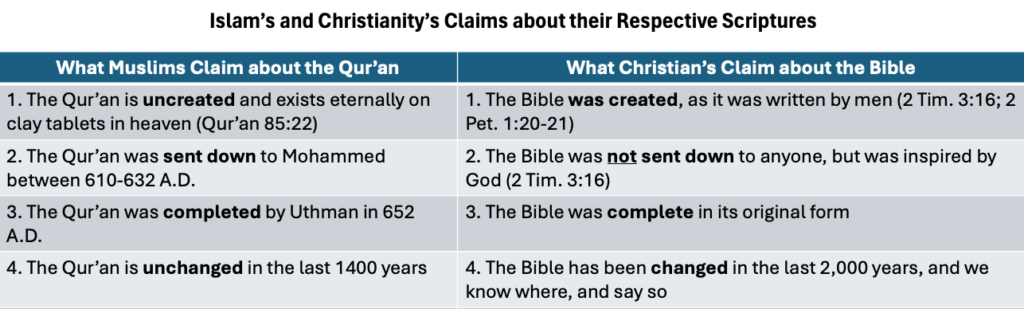
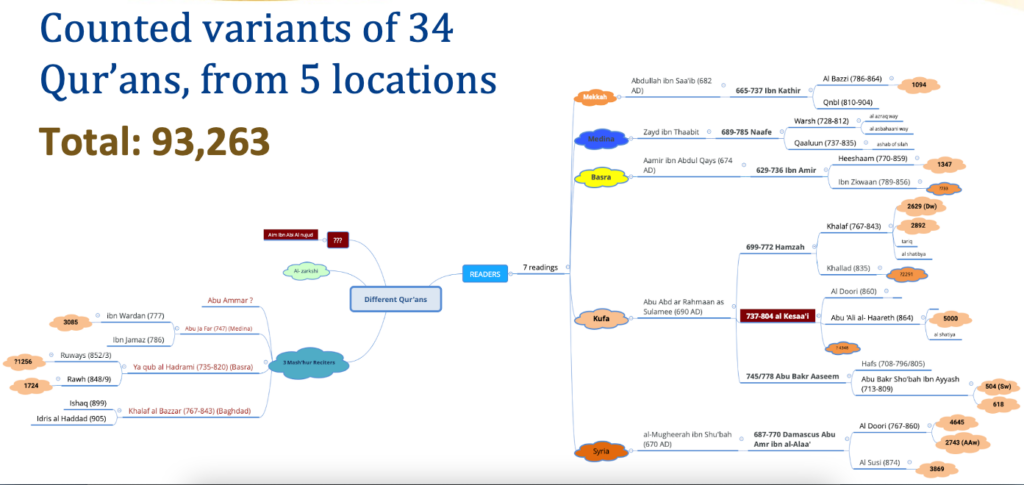
 1. It must be eternal (Qur’an 85:21-22; cf. 10:15; 18:27). The Qur’an was uncreated and existed eternally written on clay tablets in heaven. Hence, no human being can touch it or alter it. Why? Because Allah will guard it (Qur’an 15:9). Yet we have seen in our survey of the Qur’an, that it has been handled and altered numerous times so that even today there are at least 34 different Qur’ans in the world (see photo below).  

2. It must be sent down (Qur’an 39:41). The Qur’an was sent down from Allah through the angel Gabriel to Mohammed from 610 – 632 A.D. Yet, Mohammed did not write these revelations down. He had 23 years to write down the Qur’an, but he never did. The Qur’an was not written down until Mohammed’s secretary, Zayd ibn Thabit, [102] finally wrote it down (632-634 A.D.), and gave it to Hafsah, the daughter of Umar (the second Caliph), who stored the Qur’an under her bed for twenty years. [103] If this truly was the final revelation from God that was supposed to have corrected that which had been corrupted, then why would they put it under a bed for twenty years?  

3. It must be complete. The Qur’an was completed by 632 A.D. when Mohammed received the last revelation from Allah. But it wasn’t written down until after Mohammed died. After Caliph Uthman heard that there were several different versions of the Qur’an being used by Muslim communities, he had the copy of the Qur’an given to Hafsah revised by Zayd, along with Az-Zubair, Al-As, and bin Hisham, into an official revised version of the Qur’an in the “Quraishi” dialect (in 652 A.D.). [104] Islam does not have one Qur’anic manuscript from the 7th century when the Qur’an was supposedly written down. 

4. It must be unchanged (Qur’an 10:15; 15:9; 18:27). Islam claims that the Qur’an is unchanged in the last 1,400 years. But we have learned that the six earliest extant manuscripts of the Qur’an are from the 8th century, and not one of them agrees with the other. [105] Dr. Daniel Brubaker has found thousands of corrections (corruptions) in these six early manuscripts and others soon after them, [106] which undermines Islam’s claim that the Qur’an has been unchanged or uncorrupted the last 1,400 years. One of the team members of Dr. Jay Smith has found 34 different Qur’ans with a total of 93,263 variants/corruptions (see photo below).  [107]
Christians would not say these 4 same things about our Bible which is the Written Word of God. But we need to remember that the Bible is not our only Word of God. We also have the Living Word of God or Logos, Who is Jesus Christ (John 1:1-18).
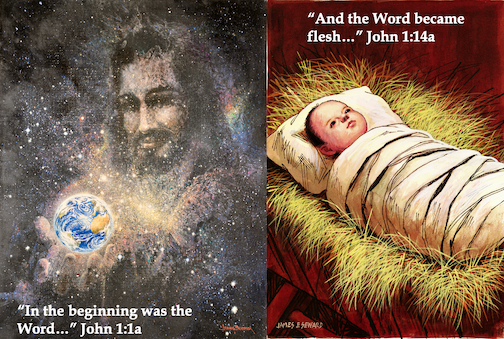
Let’s apply Islam’s four criteria to Jesus:

1. Is Jesus Christ eternal? Yes. The Bible says, “We are in Him who is true, in His Son Jesus Christ. This is the true God and eternal life.” (I John 5:20). Jesus has no beginning and no end because of His eternality. Jesus said, “I am the Alpha and the Omega… who is and who was and who is to come, the Almighty.’” (Rev. 1:8).  

2. Was Jesus Christ sent down? Certainly. Jesus said, “For I have come down from heaven, not to do My own will, but the will of Him who sent Me.” (John 6:38). 

3. Is Jesus Christ complete? Yes, He is complete in His Person, being fully God (John 1:1; Tit. 2:13; I John 5:20) and fully Man (John 1:14), and in His Work (John 19:30). 

4. Is Jesus Christ unchanged? Absolutely. The Bible says, “Jesus Christ is the same yesterday, today, and forever.” (Heb. 13:8).  

Everything that the Muslims need and seek can be found in the Person of Jesus Christ. Hence, the four criteria that Muslims are searching for in their Qur’an, their “Primary Revelation,” Christians already have in Jesus Christ, our “Primary Revelation” (Heb. 1:2). Therefore, we must present Jesus Christ, a much better and greater Revelation, to our Muslim friends. 

God has not given human governments to do this. He has not given secular humanists to do this. Nor has God given atheists and other religious people to do this. The Lord has entrusted His church consisting of believers in Jesus Christ to bring the Living Word to our lost Muslim friends (Mark 16:15; Acts 1:8), so “whoever believes in Him should not perish [in hell] but have everlasting life [both now and forever]” (John 3:16). 

In my next article, Lord willing, we will look at why Muslims and Christians believe their Scriptures are true.

ENDNOTES:

[1] Dr. Jay Smith’s September 15, 2023, video entitled, “Investigating Islam with Dr. Jay Smith (2 Corinthians 10:5),” at www.youtube.com or at this LINK . 

[2] Jay Smith, “The Bible and The Qur’an – An Historical Comparison,” at www.pfandercenter.org.

[3] Ibid., cites Patricia Crone and Michael Cook, Hagarism (Cambridge: Cambridge University Press, 1977), pg. 23. 

[4] Daniel Janosik, THE GUIDE TO ANSWERING ISLAM: What Every Christian Needs to Know About Islam and the Rise of Radical Islam(Cambridge, OH: Christian Publishing House, 2019 Kindle Edition), pg. 56 cites Dan Gibson, Qur’anic Geography: A Survey and Evaluation of the Geographical References in the Qur’an with Suggested Solutions for Various Problems and Issues (Canada: Independent Scholars Press, 2011), pg. 379. 

[5] Ibid., cites Gibson, Qur’anic Geography (2011), pg. 223. 

[6] Ibid., pp. 56-57 cites “Destruction of early Islamic heritage sites in Saudi Arabia,” https://en.wikipedia.org/wiki/Destruction_of_early_Islamic_heritage_sites_in_Saudi_Arabia.

[7] Ibid., pg. 57.

[8] Smith, “The Bible and The Qur’an – An Historical Comparison,” at www.pfandercenter.org cites Crone and Cook, Hagarism (1977), pg. 24. 

[9] Ibid. 

[10] Smith, “Investigating Islam with Dr. Jay Smith (2 Corinthians 10:5),” at www.youtube.com

[11] Smith, “The Bible and The Qur’an – An Historical Comparison,” at www.pfandercenter.org.

[12] Ibid. 

[13] Much of this section is adapted from Ibid., unless otherwise noted. 

[14] William J. Federer, What Every American Needs to Know about the Qur’an – A History of Islam & the United States (William J. Federer, 2007; 2016 Kindle Edition), pg. 96. 

[15] Smith, “The Bible and The Qur’an – An Historical Comparison,” at www.pfandercenter.org, cites Yahuda Nevo, “Towards a Prehistory of Islam,” Jerusalem Studies in Arabic and Islam, vol.17 (Hebrew University of Jerusalem, 1994), pg. 113. 

[16] Ibid., cites Cyril Glasse , The Concise Encyclopedia of Islam (San Francisco, CA: HarperSanFrancisco, 1991), pg. 102.

[17] Ibid., cites Glasse, The Concise Encyclopedia of Islam (1991), pg. 102.

[18] Ibid., cites Van Bercham 1927:217. 

[19] Ibid., cites ‘Kitab al-‘uyun wa’l-hada’iq,’ edited by M. de Goeje and P. de Jong 1869:4

[20] Verse taken from Usama K. Dakdok,  THE GENEROUS QUR’AN: An Accurate, Modern English Translation of the Qur’an, Islam’s Holiest Book (Venice, FL: Usama Dakdok Publishing, LLC, 2009 Smashwords Edition), pg. 443. Used by permission of Usama Dakdok Publishing, LLC.

[21] “Joseph,” at www.thebiblicaltimeline.org.

[22] Andrew Vargo, “’Dirham’ In The Time Of Joseph?” at www.answering-islam.org.

[23] Excerpt from Dakdok, THE GENEROUS QUR’AN, 2009 Smashwords Edition, pg. 499. 

[24] Verse taken from Dakdok, THE GENEROUS QUR’AN, 2009 Smashwords Edition, pg. 443. Used by permission of Usama Dakdok Publishing, LLC.

[25] Tom Constable, Dr. Constable’s Notes on Genesis, 2025 Edition, pg. 2. 

[26] Jochen Katz, “The ‘Samaritan’ Error In The Qur’an,” at www.answering-islam.org.

[27] Excerpt from Dakdok, THE GENEROUS QUR’AN, 2009 Smashwords Edition, pg. 443. 

[28] Verses taken from Dakdok, THE GENEROUS QUR’AN, 2009 Smashwords Edition, pp. 590, 596. Used by permission of Usama Dakdok Publishing, LLC.

[29] Tom Constable, Dr. Constable’s Notes on 1 Samuel, 2026 Edition, pp. 2-4. 

[30] “Chain Mail” article at www.en.wikipedia.org

[31] Verses taken from Dakdok, THE GENEROUS QUR’AN, 2009 Smashwords Edition, pp. 441-442. Used by permission of Usama Dakdok Publishing, LLC.

[32] Verse taken from Ibid., pg. 341. Used by permission of Usama Dakdok Publishing, LLC.

[33] L. Cilliers and F. P. Retief, “The History and Pathology of Crucifixion,” South African Medical Journal (Suid-Afrikannse tydskrif via geneeskunde) 93, no. 12 (December 2003), pp. 938–941. 

[34] Verse taken from Dakdok, THE GENEROUS QUR’AN, 2009 Smashwords Edition, pg. 422. Used by permission of Usama Dakdok Publishing, LLC.

[35] Usama K. Dakdok, Exposing the Truth about the Qur’an: The Revelation of Error, Volume 2 (Usama Dakdok Publishing LLC, 2013 Smashwords Edition), pp. 497-498. 

[36] Article entitled, “Alexander the Great in Islamic tradition,” at www.en.wikipedia.org cites Sidney Griffith, “The Narratives of ‘the Companions of the Cave,’ Moses and His Servant, and Dhū ’l-Qarnayn in Sūrat al-Kahf,” Journal of the International Qur’anic Studies Association ,Vol. 6, No. 1 (2021): 146–147; Christine Chism, “Facing The Land Of Darkness: Alexander, Islam, And The Quest For The Secrets Of God,” Alexander the Great in the Middle Ages (University of Toronto Press, 2016), pp. 51–75; Majid Daneshgar (2020), Studying the Qur’ān in the Muslim Academy, AAR reflection and theory in the study of religion (New York (N.Y.): Oxford University Press, 2020), pg. 77.

[37] Verse taken from Dakdok, THE GENEROUS QUR’AN, 2009 Smashwords Edition, pg. 423. Used by permission of Usama Dakdok Publishing, LLC.

[38] Dakdok, Exposing the Truth about the Qur’an: The Revelation of Error, Volume 2, 2013 Smashwords Edition, pp. 503-505 cites Ibn Kathir, Stories of the Prophets, vol. 2, Abo Al Fida Ishamail Ibn Kathir Al Kurashi Al Damashce (Beirut: Dar Al-Arab Heritage, 1408 AH, 1988), pp. 129-133. 

[39] Ibid., pg. 516. 

[40] Ibid., pp. 516-517. 

[41] Much of this section is adapted from Smith’s September 15, 2023, video entitled, “Investigating Islam with Dr. Jay Smith (2 Corinthians 10:5),” at www.youtube.com, unless otherwise noted.

[42] Janosik, THE GUIDE TO ANSWERING ISLAM, 2019 Kindle Edition, pg. 26 cites Karl-Heinz Ohlig and Gerd R. Puin, eds. The Hidden Origins of Islam: New Research into its Early History (NY: Prometheus Books, 2010), pp. 63-63; Robert Spencer, Did Muhammad Exist? An Inquiry into Islam’s Obscure Origins (Wilmington, Delaware: ISI Books, 2012), pp. 45-46, 55-56.

[43] Ibid., pg. 26 cites Yehuda Nevo, and Judith Koren, Crossroads to Islam: The Origins of the Arab Religion and the Arab State (NY: Prometheus Books, 2003), pp. 258-267.

[44] Smith (2023), “Investigating Islam with Dr. Jay Smith (2 Corinthians 10:5),” at www.youtube.com

[45] Ibid., cites Ilkka Juhani Lendstedt, “Who is in, who is out? Early Muslim Identity Through Epigraphy and Theory,” 2019; cf. Ilkka Juhani Lenstedt, Arabic Rock Inscriptions Up To 750 CE in A Marsham (ed.), The Umayyad World., 20, Routledge, Abingdon (University of Helsinki, 2020), pp. 411-437. 

[46] Much of this section is adapted from Smith, “The Bible and The Qur’an – An Historical Comparison,” at www.pfandercenter.org, unless otherwise noted.

[47] Ibid., cites Michael Cook, Muhammad (Oxford University Press, 1983), pg. 74.

[48] Ibid., cites Cook, Muhammad (1983), pg. 74;  Patricia Crone and Michael Cook, Hagarism (Cambridge: Cambridge University Press, 1977), pp. 167-168; see M. Van Berchem, Materiaux pour un Corpus Inscriptionum Arabicarum, part two, vol. ii (Cairo, 1927), pp. 215-217 and Adolph Grohmann, Arabic Papyri from Hirbet el-Mird (1963),  no. 72 to delineate where these variances are.

[49] Ibid., cites Crone and Cook, Hagarism (1977), pp. 18, 167.

[50] Ibid.

[51] Tom Constable, Dr. Constable’s Notes on Genesis, 2026 Edition, pp. 192-194 cites Eugene H. Merrill, “Fixed Dates in Patriarchal Chronology,” Bibliotheca Sacra 137:547 (July- September 1980), pg. 248; Leon J. Wood, A Survey of Israel’s History (Grand Rapids: Zondervan Publishing House, 1970), pp. 30-38. 

[52] Joseph M. Holden and Norman Geisler, The Popular Handbook of Archaeology and the Bible: Discoveries That Confirm the Reliability of Scripture (Eugene, OR: Harvest House Publishers, 2013 Kindle Locations 2095-2096 cites , K.A. Kitchen, “The Patriarchal Age: Myth or History?” Biblical Archaeology Review, March/April 1995, pg. 48ff. 

[53] Josh McDowell and Sean McDowell, Evidence That Demands a Verdict: Life-Changing Truth for a Skeptical World (Nashville, TN: Thomas Nelson, 2017 Kindle Edition), pg. 451 cites K. A. Kitchen, On the Reliability of the Old Testament (Grand Rapids, MI: W. B. Eerdmans, 2003), pp. 341-342; cf. John D. Currid, “Genesis,” The ESV Archaeology Study Bible, Edited by John D. Currid and David W. Chapman (Wheaton: Crossway, 2017), pg. 13. 

[54] Constable, Dr. Constable’s Notes on Genesis, 2026 Edition, pg. 200 cites Kyle M. Yates, “Genesis,” The Wycliffe Bible Commentary, Edited by Charles F. Pfeiffer and Everett F. Harrison (Chicago: Moody Press, 1962), pg. 16.  

[55] Constable, Dr. Constable’s Notes on Genesis, 2026 Edition, pg. 202; Allen P. Ross, “Genesis,” The Bible Knowledge Commentary Law, 2018 Kindle Edition, pg. 75.

[56] Allen P. Ross, “Genesis,” The Bible Knowledge Commentary Law, 2018 Kindle Edition, pg. 75.

[57] Retrieved on April 26, 2026, from Bryan Windle, July 16, 2021, article entitled, “Top Ten Discoveries Related to Abraham,” at https://biblearchaeologyreport.com/2021/07/16/top-ten-discoveries-related-to-abraham/

[58] Retrieved on April 26, 2026, from Todd Bolen, “Haran,” at https://www.bibleplaces.com/haran/; cf. McDowell Evidence That Demands a Verdict, 2017 Kindle Edition, pg. 453 cites Daniel E. Fleming, “Genesis in History and Tradition: The Syrian Background of Israel’s Ancestors, Reprise,”in The Future of Biblical Archaeology: Reassessing Methodologies and Assumptions, edited by James K. Hoffmeier and Alan Millard (Grand Rapids, MI: Eerdmans, 2004), pg. 216.

[59] Constable, Dr. Constable’s Notes on Genesis, 2026 Edition, pg. 204 cites Tremper Longman. III, “Genesis,” The Baker Illustrated Bible Background Commentary, edited by J. Scott Duvall and J. Daniel Hays (Grand Rapids: Baker Books, 2020), pg. 93.

[60] Constable, Dr. Constable’s Notes on Genesis, 2026 Edition, pg. 215. 

[61] McDowell, Evidence That Demands a Verdict, 2017 Kindle Edition, pg. 454 cites Eugene H. Merrill, Kingdom of Priests: A History of Old Testament Israel (Grand Rapids, MI: Baker Academic, 1998), pg. 63.

[62] Retrieved on April 27, 2026, from “Shechem: Its Archaeological and Contextual Significance,” at www.biblearchaeology.org. or at this LINK.

[63] More recent archaeological research places Bethel at el-Bira, about 10.3 miles north of Jerusalem and Ai at Khirbet el-Maqatir about 1 mile southeast of el-Bira – see Bryan Windle, April 12, 2019, “Biblical Sites: The Lost City of Ai… Found,” at www.biblearchaeologyreport.com cites Bryant G. Wood, “The Search for Joshua’s Ai,” in Critical Issues in Early Israelite History, edited by Richard S. Hess, Gerald A. Klingbeil, and Paul J. Ray Jr. (Winona Lake: Eisenbrauns 2008), pp. 210-240;  Bryant G. Wood, “Excavations at Khirbet el-Maqatir: 1995 to 2000 and 2009 to 2011,” Associates for Biblical Research, April 4, 2012; Scott Stripling, “2014 Excavations at Kh. el-Maqatir: A Proposed New Location for Ai and Ephraim,” Associates for Biblical Research, March 9, 2015; cf. McDowell Evidence That Demands a Verdict, 2017 Kindle Edition, pp. 500 -501.

[64] Windle, July 16, 2021, article entitled, “Top Ten Discoveries Related to Abraham,” at www.biblearchaeologyreport.com  cites Kenneth A. Kitchen,” Shishak’s Military Campaign in Israel Confirmed,” at www.library.biblicalarchaeology.orgMcDowell, Evidence That Demands a Verdict, 2017 Kindle Edition, pg. 452 cites Kitchen, On the Reliability of the Old Testament (2003), pg. 313.

[65] Ibid.

[66] Excerpt from Dakdok, THE GENEROUS QUR’AN, 2009 Smashwords Edition, pp. 57-58; Excerpt from Usama K. Dakdok, Exposing the Truth about the Qur’an: The Revelation of Error, Volume 1 (Usama Dakdok Publishing LLC, 2013 Smashwords Edition), pp. 194-314.

[67] Smith, “The Bible and The Qur’an – An Historical Comparison,” at www.pfandercenter.org.

[68] Location of Tall el-Hammam. (a) Photo of the southern Levant, looking north, showing the Dead Sea, the site location (TeH), and nearby countries. The Dead Sea Rift, the fault line marking a major tectonic plate boundary, runs through the area. Source of base (b) Photo: NASA, Space Shuttle. “The Sinai Peninsula and the Dead Sea Rift”. Photo: sts109-708-024, taken 12/16/2009. From the NASA Langley Research Center Atmospheric Science Data Center (nasa.gov/topics/earth/features/astronauts_eyes/sts109-708-024.html). Adapted from Daniel Janosik March 16, 2026, class lecture entitled, “Is the Bible the Word of God?” 

[69] Holden and Geisler, The Popular Handbook of Archaeology and the Bible, 2013 Kindle Locations 2509-2514 cite Steve Collins, “Where is Sodom? The Case for Tall el-Hammam,” Biblical Archaeology Review, March/April 2013; Malcolm A. LeCompte, Steven Collins, Phillip J. Silvia, Gunther Kletetschka, Timothy Witwer, Robert E. Hermes, Christopher R. Moore, Wendy S. Wolbach, George A. Howard, A. Victor Adedeji, Charles Mooney, James P. Kennett, Allen West, Ted E. Bunch, May 24, 2025, research article entitled, “A Tunguska Sized Airburst Destroyed Tall el-Hammam a Middle Bronze Age City in the Jordan Valley Near the Dead Sea (Expanded),” at www.scienceopen.com or at this LINK.

[70] LeCompte, Collins, Silvia, Kletetschka, Witwer, Hermes, Moore, Wolbach, Howard, Adedeji, Mooney, Kennett, West, Bunch, May 24, 2025, research article entitled, “A Tunguska Sized Airburst Destroyed Tall el-Hammam a Middle Bronze Age City in the Jordan Valley Near the Dead Sea (Expanded),” at www.scienceopen.com.

[71] Ibid.

[72] Ibid., cites Mark Boslough, Airburst Modeling in First International Workshop on Potentially Hazardous Asteroids Characterization, Atmospheric Entry and Risk Assessment. (Sandia National Lab. (SNL-NM), Albuquerque, NM, 2015, (United States)).

[73] LeCompte, Collins, Silvia, Kletetschka, Witwer, Hermes, Moore, Wolbach, Howard, Adedeji, Mooney, Kennett, West, Bunch, May 24, 2025, research article entitled, “A Tunguska Sized Airburst Destroyed Tall el-Hammam a Middle Bronze Age City in the Jordan Valley Near the Dead Sea (Expanded),” at www.scienceopen.com.

[74] Holden and Geisler, The Popular Handbook of Archaeology and the Bible, 2013 Kindle Locations 2509-2514 cite Steve Collins, “Where is Sodom? The Case for Tall el-Hammam,” Biblical Archaeology Review, March/April 2013.

[75] McDowell, Evidence That Demands a Verdict, 2017 Kindle Edition, pg. 497 cites Bryant Wood, “Did the Israelites Conquer Jericho? A New Look at the Archaeological Evidence,” Biblical Archaeology Review 16, no.2 (Mar/Apr 1990), pp. 10-12.

[76] Bryant G. Wood, June 9, 2008, research article, “The Walls of Jericho,” at www.biblearchaeology.org or at this LINK ; Bryant Wood, March 1, 1999, “The Walls of Jericho,” at www.answersingenesis.org cites Ernst Sellin and Carl Watzinger, Jericho die Ergebnisse der Ausgrabungen, Osnabrück, Otto Zeller Verlag (1973), pg. 58, (reprint of the 1913 edition), and Kathleen M. Kenyon, Excavations at Jericho (London, British School of Archaeology in Jerusalem, 1981), Vol. 3, pp. 110, 370. 

[77] McDowell, Evidence That Demands a Verdict, 2017 Kindle Edition, pg. 516. 

[78] Ibid., cites André Lemaire, “‘House of David’ Restored in Moabite Inscription,” Biblical Archaeology Review 20, no. 3 (1994), pg. 36; Holden and Geisler, The Popular Handbook of Archaeology and the Bible, 2013 Kindle Locations 3031-3045.

[79] Holden and Geisler, The Popular Handbook of Archaeology and the Bible, 2013 Kindle Locations 3006-3012.

[80] McDowell, Evidence That Demands a Verdict, 2017 Kindle Edition, pg. 516 cites George Athas, The Tel Dan Inscription: A Reappraisal and a New Interpretation (London: T&T Clark, 2003), pg. 281 and Steven L. McKenzie, King David: A Biography (Oxford University Press, 2000, E-book), pg. 13; Holden and Geisler, The Popular Handbook of Archaeology and the Bible, 2013 Kindle Locations 3012-3017 cites Alan Millard, “The Tell Dan Stele,” in William W. Hallo and K. Lawson Younger, eds., The Context of Scripture: Canonical Compositions from the Biblical World, Vol. 1 (Leiden, the Netherlands Brill, 2003), pp. 161-162. Also see Holden and Geisler’s helpful discussion responding to critics of Tell Dan Find at 2013 Kindle Locations 3017-3031.  

[81] Gary Habermas, The Historical Jesus (Joplin, MO: College Press, 1996, 2008), pp. 198-224.

[82] Walter Bauer, A Greek-English Lexicon of the New Testament and Other Early Christian Literature, 2000 Kindle Edition, pg. 893. 

[83] Bryan Windle, December 19, 2019, “Quirinius: An Archaeological Biography,” at www.biblearchaeologyreport.com cites Andrew E. Steinmann, From Abraham To Paul: A Biblical Chronology (St. Louis: Concordia Publishing House, 2011), pg. 239; cf. Bauer, A Greek-English Lexicon of the New Testament and Other Early Christian Literature, 2000 Kindle Edition, pg. 433.

[84] Holden and Geisler, The Popular Handbook of Archaeology and the Bible, 2013 Kindle Locations 1739-1741.

[85] William A. Ramsay, Was Christ Born at Bethlehem? A Study on the Credibility of St. Luke (Originally published Paternoster Row, London: Hodder and Stoughton, 1898; Seattle, WA: re:Source Digital Publishing, 2018 Kindle Edition), pg. 160.

[86] Holden and Geisler, The Popular Handbook of Archaeology and the Bible, 2013 Kindle Locations 1741-1743; cf. Ramsay, Was Christ Born at Bethlehem?, 2018 Kindle Edition, pg. 161; Jack Finegan, Handbook of Biblical Chronology: Principles of Time Reckoning in the Ancient World and Problems of Chronology in the Bible, Revised Edition (Peabody, MA: Hendrickson Publishers, 1998), pg. 304.

[87] William Mitchell Ramsay, The Bearing of Recent Discovery on the Trustworthiness of the New Testament (Originally published in London: Hodder & Stoughton, 1915; 2021 Kindle Edition), pp. 283-290.

[88] Tom Constable, Dr. Constable’s Notes on Luke, 2026 Edition, pg. 58 cites Harold W. Hoehner, Chronological Aspects of the Life of Christ, Contemporary Evangelical Perspectives series (Grand Rapids: Zondervan Publishing House, 1977), pg. 22;  cf. Flavius Josephus, Antiquities of the Jews, 18:1:1; 18:2:1; Eusebius, The Ecclesiastical History of Eusebius Pamphilus Twin Brooks series. Popular ed. (Grand Rapids: Baker Book House, 1974), 1:5:28; Jack Finegan, Light from the Ancient PastThe Archeological Background of Judaism and Christianity 2nd edition (Princeton University Press. London: Oxford University Press, 1959), pp. 258-261; Joseph P. Free, Archaeology and Bible History 6th ed. (Wheaton: Scripture Press, 1950, 1959), pp. 285-286.

[89] J. Warner Wallace, August 16, 2017, “Unbelievable? Is Luke’s Description Of Quirinius Historically Inaccurate?” at www.coldcasechristianity.com

[90] McDowell, Evidence That Demands a Verdict, 2017 Kindle Edition, pg. 88 cites Free, Archaeology and Bible History 6th ed. (1950, 1959), pg. 320.

[91] Ibid. cites F. F. Bruce, “Archaeological Confirmation of the New Testament,” in Revelation and the Bible, edited Carl Henry (Grand Rapids, MI: Baker Book House, 1969), pp. 325, 360 and David E. Graves, Biblical Archaeology: An Introduction with Recent Discoveries That Support the Reliability of the Bible (Moncton, New Brunswick, Canada: Electronic Christian Media, 2014), pp. 215-216.

[92] Ibid. cites Howard F. Vos ed. Can I Trust the Bible? (Chicago, IL: Moody Press, 1963), 180 and Graves, Biblical Archaeology (2104), pp. 215-216.

[93] Ramsay, The Bearing of Recent Discovery on the Trustworthiness of the New Testament (1915), 2021 Kindle Edition, pp. 37-40; Holden and Geisler, The Popular Handbook of Archaeology and the Bible, 2013 Kindle Locations 4026-4037.

[94] Ibid., pp. 67-76; cf. McDowell, Evidence That Demands a Verdict, 2017 Kindle Edition, pg. 88 cites Free, Archaeology and Bible History 6th ed. (1950, 1959), pg. 317.

[95] Norman L. Geisler and Thomas Howe, The Big Book of Bible Difficulties: Clear and Concise Answers from Genesis to Revelation (Grand Rapids, MI: Baker Books, 2008), pg. 47.

[96] Janosik, THE GUIDE TO ANSWERING ISLAM, 2019 Kindle Edition, pg. 56 cites Peter Townsend, The Mecca Mystery: Probing the Black Hole at the Heart of Muslim History (Peter Townsend, 2018), pg. 104 and Dan Gibson, Qur’anic Geography: A Survey and Evaluation of the Geographical References in the Qur’an with Suggested Solutions for Various Problems and Issues (Canada: Independent Scholars Press, 2011), pg. 137.

[97] Ramsay, The Bearing of Recent Discovery on the Trustworthiness of the New Testament (1915), 2021 Kindle Edition, pg. 220. 

[98] Ibid., pg. 79.

[99] Janosik, March 16, 2026, class lecture entitled, “Is the Bible the Word of God?”

[100] Smith, “The Bible and The Qur’an – An Historical Comparison,” at www.pfandercenter.org.

[101] Much of this section is adapted from Smith (2023) video entitled, “Investigating Islam with Dr. Jay Smith (2 Corinthians 10:5),” at www.youtube.com, unless otherwise noted.

[102] Norman L. Geisler and Abdul Saleeb, Answering Islam: The Crescent in Light of the Cross Second Ed. (Grand Rapids, MI: Baker Books, 1993, 2002), pp. 92-93 cites Al-Bukhari, The Translation of the Meanings of Sahih Al-Bukhari, Vol. 6, pp. 477-478.

[103] Janosik, THE GUIDE TO ANSWERING ISLAM, 2019 Kindle Edition, pg. 321; cf. Jay Smith, November 24, 2019, video entitled, “Jay Smith Historical Critique Quran Origins 1,” at www.youtube.com

[104] Geisler and Saleeb, Answering Islam (2002), pg. 93 cites Al-Bukhari, The Translation of the Meanings of Sahih Al-Bukhari, Vol. 6, pp. 478-479. 

[105] Smith, March 9, 2026, class lecture entitled, “Manuscript Evidence for the Qur’an,” cites Dr. Tayyar Altıkulaç, Al-Muṣḥaf Al-Sharif: Attributed To ʿUthmān Bin ʿAffān (IRICA, 2007), pp. 23, 36 – footnote 14a, 41f, 65, 71-72, 81; François Déroche, La transmission écrite du Coran dans les débuts de l’islam. Le codex Parisino-petropolitanus (Brill, 2009), pp. 172-177; cf. Jay Smith, “The Bible and The Qur’an – An Historical Comparison,” at www.pfandercenter.org where he cites Martin Lings and Yasin Hamid Safadi, The Qur’an: Catalogue of an Exhibition of Quran Manuscripts at the British Library3 April  – 15 August, 1976 (British Library, World of Islam Pub. Co., 1976), pp. 11-20.

[106] Daniel Brubaker, Corrections in Early Qurʾān Manuscripts: Twenty Examples (FULL COLOR EDITION) (Quran Manuscript Change Studies Book 1), 2019 Kindle Locations 168-169.

 [107] Retrieved on May 11, 2026 from the March 23, 2026, powerpoint entitled, “In Search of the Book – the Qur’an,” at  www.pfandercenter.org.

John 1 – Part 1: “Who is Jesus Christ?”

“In the beginning was the Word, and the Word was with God, and the Word was God.” John 1:1

From the opening section of the gospel, John addresses this question, “Who is Jesus Christ?” John focuses upon the central fact of our Christian faith: Christianity is not about philosophy; it is about a Person.

While other world religions focus upon rules and regulations, Christianity focuses on a personal relationship with Christ. That is why Jesus Christ is the most widely acclaimed individual in human history. More books have been written, music composed, pictures painted, and dramas performed about Jesus than any other person. Why?

Why did other great figures come and go? Why do others fade into the annals of history but Jesus Christ looms as large in modern society as He did two thousand years ago? Why is He the most powerful Personality to ever appear on this planet? That is the question John answers in these first few verses: Who is Jesus Christ?

We are going to examine the first five verses of John’s gospel in this chapter, and in so doing, we will answer the question, “Who is Jesus?” in these verses and as we uncover who Jesus is, we will be challenged as to why we should believe in Him. Let’s examine three reasons why we should believe in Jesus for eternal life; why we should trust in Him alone to get us to heaven.

BELIEVE ON JESUS BECAUSE HE IS GOD (1:1-2). John begins his gospel in an unusual way. Unlike the writers of Matthew, Mark, and Luke, who begin their accounts of Jesus in an historical context, John opens his gospel in eternity. Unlike Matthew who begins his gospel with the genealogy of Abraham and Mark who begins with the story of John the Baptist, or Luke who starts with a description of John and Jesus’ birth. John moves beyond human history. 1:1a: Do the words, “In the beginning” sound familiar to you? They take us back to Genesis 1:1: “In the beginning, God created the heavens and the earth.” John starts with God. In the Bible, you cannot go any further back than God, and that is where John begins, in eternity past with God’s eternal purpose.

And what does he tell us? 1:1ab: “In the beginning was the Word.” The term “Word” [1] is used by John to refer to the Person of Jesus Christ (John 1:14, 17). A Word expresses a message. Jesus was God’s message to the world.  He was and is the perfect expression of God.

What does the Bible tell us about the Word? 1:1ab: HE IS ETERNAL. In the beginning of time and space, the Word already “was.” [2]  The Word really had no beginning. There has never been a time when “the Word” was not, because He is eternal. The Word has existed from all eternity. At creation, the Word was already present. He is not a created being as some false religions teach. He has no beginning because He is eternal.

1:1c, 2: HE IS RELATIONAL. The phrase “and the Word was with God” refers to the Word being “with” God the Father in a “face-to-face” relationship. 1:2: “He was in the beginning with God.” Jesus Christ has always enjoyed a personal relationship with His Father. They had perfect fellowship with one another. The word “with[3] also distinguishes the Word from God the Father. Jesus is separate and distinct from His Father. He has a separate identity. Jesus is a Person, not a principle or Star War’s force. Because Christ is eternal and relational, we can conclude that He desires eternal relationships with those He created.

1:1d: “and the Word was God.” [4] The Word was not “a god” as some false religions mistranslate. The Greek grammar does not allow this. [5] The Word is GOD. These last five words are some of the most important words in all the Bible concerning who Jesus is. He was and is God. Whatever God the Father was, the Word was. Everything that makes God-God, the Word possesses. Jesus Christ is the visible image of the invisible God. When you look at Jesus Christ, you are looking at God in human flesh. Only God can give us life that never ends.

 “In other words, the Father and Son are not two distinct gods. Rather, the Son shares the divine nature. Theologically speaking, the Father, Son, and Spirit are co-equal members of the Trinity. Our one God (see Deut. 6:4; 1 Cor. 8:6) exists in three co-equal Persons (see Matt. 28:19).”[6]

Christianity has always taught and believed there is only one God. The difference between our monotheism and other monotheists is not on the number of gods, but on the concept of God’s Personhood. The doctrine of the Trinity teaches that the one God exists as three Persons. This is not a self-contradiction as some charge because person is not the same as being. Your being is the quality that makes you what you are, but your person is the quality that makes you who you are. For example, we are humans. That is what we are. That is why we are called human beings. But what we are is not the same as who we are. If someone asks, “Who are you?” I would not respond by saying, “A human.” That answers the question of what I am, not who I am. Who I am is Jeff; that is my person. What I am is a human; that is my being. Being and person are separate. [7]

Unlike a human being, which has only one person, God has three Persons. He is one being, Yahweh, in three Persons: Father, Son, and Spirit. He is more than able to exist like that because He is God. If we say God must have only one Person, like humans, then we are making God in our image. Who are we to limit God? It is up to God to tell us who He is, and He has in the Bible. [8]

Our human reason alone cannot dictate or even decipher the nature of God. God is far greater than we can possibly conceive and more complex than we could ever hope to grasp. We are in no position to determine the intricacies of God’s nature. If He were to inform us He is one Being in one Person, we are obligated to believe Him. If He tells us, “I am one Being in three Persons,” who are we to say no to God? As believers in revelation, we must turn to divine Scripture to learn about God. [9]      

Both the Old Testament (Gen. 1:2, 26; Deut. 32:6; Psalm 2:6-7, 12; 45:6-7; 139:7-12; Isaiah 9:6; 11:2-3; 63:10, 16; Zech. 4:6; Mal. 2:10) and the New Testament (Matt. 3:16-17; John 14:16-17, 26; 2 Cor. 13:14) teach about the distinction between God the Father, God the Son, and God the Holy Spirit. Each Person of the Trinity is equal in every way having the same divine nature, yet distinct in their tasks and relations to humanity.

We see in the chart above that the Father is God, but He is not the Son nor the Holy Spirit. Likewise, the Son is God, but He is neither the Father nor the Holy Spirit. And the Holy Spirit is God, but He is not the Father nor the Son. All three Persons of the Trinity have the same divine nature. They are one being, yet they exist eternally as Father, Son, and Holy Spirit.

Constable writes, “There is probably no fully adequate illustration of the Trinity in the natural world. An egg consists of three parts: shell, yolk, and white. Each part is fully egg, yet each has its own identity that distinguishes it from the other parts. The human family is another illustration. Father, mother, and child are all separate entities—yet each one is fully a member of his or her own family. Each may have a different first name, but all bear the same family name. Light, when passed through a prism, is seen to be composed of three primary colors: red, yellow, and blue. Similarly, the person of God, when revealed in Scripture, is seen to consist of Father, Son, and Holy Spirit. Hydrogen dioxide can be water, ice, and steam and still be H2O.” [10]

Another example of the Trinity is seen in every human being. First Thessalonians 5:23 tells us that every human is comprised of three parts: “spirit, soul, and body.” While each part is fully human, each part is separate and distinct from the others.

The Word is “with” God (separate from Him), yet at the same time, He is fully God. So, John informs us that the Word is God. If we cannot or do not believe this basic truth, we will not have enough faith to trust our eternal destiny to Him. Who is Jesus? He is God. Believe in Him. He wants you to spend eternity with Him in His heaven (cf. John 14:1-3).

BELIEVE ON JESUS BECAUSE HE IS THE CREATOR (1:3). Not only was the Word present at creation, He was also the agent of creation. 1:3: “All things were made through Him.”  Does John say that all things were made through evolution? (Pause). No! All things were made through Christ (cf. Col. 1:16; Heb. 1:2)! Everything that exists owes its existence to the Word. He is the Creator. Apart from Him, there is no existence. Jesus Christ created this universe. I believe in the Big Bang alright. God spoke (BOOM) and the universe came into being (Gen. 1-2).

Through Jesus all things “were made,” [11] but He always “was.” [12] Any being “not made or created” or not brought into being because He already existed is God. Three times John uses the word “made” (1:3). Anything that is made has a beginning. At some point in time it did not exist, and then it began to exist. John wants to establish that the Word already existed when He made all things. The Word never had a beginning because He is God. [13]

This is very important to understand because in John’s day to the present, there have been many false religions and teachers who insist that Jesus Christ is not God because He had a beginning. They teach that Christ was the first created being by God who then created everything else. For example, Arius, a third century false teacher, was fond of saying, “There was a time when He [Jesus] was not.” [14]

Swindoll notes that “this teaching continues today as official doctrine for the Church of Jesus Christ of Latter-day Saints (the Mormons) and the Jehovah’s Witnesses, and both organizations have translated John’s prologue to suit their theologies.” [15]

John refutes these false teachings at the beginning of his gospel. But the apostle also wants to emphasize that the Creator knows our inner workings better than anyone; He knows our needs and what it will take to reach us.

A doctor had hired a new secretary. She was pretty and thin. Part of her responsibilities was mailing out the bills to all the doctor’s patients. The doctor began to notice that it was taking more time than should be necessary for her to fulfill this task, and so he observed her one day. He discovered that rather than using the wet sponge to seal the envelopes, she was licking each one. This took a long time. The doctor asked her to use the sponge instead of licking each one, but the new secretary said that she would rather do it the other way. The doctor tried all kinds of motivations to try and convince her to do things his way. He tried telling her how much quicker it would be, he told her that her mouth wouldn’t get so dry. He even tried switching the type of envelopes that he used to one of those kind that had nasty-tasting glue. Nothing worked.

One day, a patient came to her window to pay her bill and noticed that the secretary was licking the envelopes. She said to her, “Did you know that each envelope has about 1 ½ calories?” The secretary immediately stopped and began using a wet sponge. Sometimes it takes a woman to communicate in a woman’s language. Likewise, it takes the Creator to communicate in His creation’s language. Christ spoke to us with love when He took our place and punishment on the cross for our sins (cf. Rom. 5:8; I John 4:9-10).

BELIEVE ON JESUS BECAUSE HE IS THE ONLY SOURCE OF ETERNAL LIFE (1:4-5). John moves now from creation in general to the most significant element of creation – people. 1:4: “In Him was life, and the life was the light of men.” Christ created you and me so that we could enjoy a personal relationship with Him. The word “life” [16] in the gospel of John can refer to physical life (1:3) and spiritual life (1:12). Most often it refers to eternal life in John (3:15-16,36; 4:14, 36; 5:24, 39; 6:27, 40, 47, 54, 58, 68; 10:28; 12:25, 50; 17:2-3). Jesus defines eternal life as knowing the only true God and His Son, Jesus Christ personally in a forever relationship (17:3). Jesus was God’s way of meeting us where we were to take us where we could never go.

Before we come to know Jesus Christ, we are merely existing. We get up, eat breakfast, go to work, come home from work, eat supper, watch TV, and go to bed. Then we repeat the same cycle the next day. That is merely existing. We don’t start living until we enter a personal relationship with Jesus Christ by believing or trusting in Him alone for His gift of eternal life.

When the Bible says, “the life was the light of men” (1:4), it is referring to the hope (“light”) that Christ’s message of eternal (“life”) brings to people in darkness. Also, when we enter a relationship with God (“life”), we become aware of God’s holiness and righteousness (“light”). Life is the foundation for growth in the light (cf. I John 1:5-10).

1:5: John contrasts “the light” of God with “the darkness” of sinful humanity. The word “comprehend,” [17] can also mean “overtake.”[18] The darkness of this world cannot overcome or extinguish the light of Jesus Christ. This contrast between light and darkness represents spiritual conflict. The light of Christ has and will overcome the darkness of sinful people.

“John did not view the world as a stage on which two equal and opposing forces engage in battle; he was not a philosophical dualist. He viewed Jesus as superior to the forces of darkness that sought to overcome Him but could not. This gives humankind hope. The forces of Light are stronger than the forces of Darkness. John was here anticipating the outcome of the story that he would tell, specifically, Calvary. Though darkness continues to prevail, the Light will overcome it.” [19]

“Because of the temptation of Satan, humankind has fallen into the darkness of sin (see Gen. 3). He has blinded the minds of people to keep them from seeing the glory of Christ (see 2 Cor. 4:4). But Jesus has come to bring illumination so that people can see things as they truly are. John’s Gospel shows us how Jesus was continually rejected; nevertheless, the darkness did not overcome His light (1:5). Though His enemies crucified Him, He was actually glorified in His death on the cross (see 13:31-32) and victorious in His resurrection, resulting in the provision of salvation for all people (see John 3:16; Rom. 5:18; 1 Tim. 2:6; Heb. 2:9; 1 John 2:2).” [20]

Remember, John is writing this gospel after the resurrection. He knows that Jesus Christ could not be overcome by the spiritual darkness of this world. He is the winner. The light shines (continually) in the darkness, and the darkness cannot overcome it. A single light penetrates fifty miles of darkness. Darkness cannot overcome light.

Christian author Max Lucado tells the story about a tribe of people who lived in a dark, cold cave: “The cave dwellers would huddle together and cry against the chill. Loud and long, they wailed. It was all they did. It was all they knew to do. The sounds in the cave were mournful, but the people didn’t know it, for they had never known life.

But then, one day, they heard a different voice. “I have heard your cries,” it announced. “I have felt your chill and seen your darkness. I have come to help.”

The cave people grew quiet. They had never heard this voice. Hope sounded strange to their ears. “How can we know you have come to help?”

“Trust me,” he answered. “I have what you need.”

The cave people peered through the darkness at the figure of the stranger. He was stacking something, then stooping and stacking more.

“What are you doing?” one cried, nervous.

 The stranger didn’t answer.

 “What are you making?” one shouted even louder.

 Still no response.

“Tell us!” demanded a third.

The visitor stood and spoke in the direction of the voices. “I have what you need.” With that he turned to the pile at his feet and lit it. Wood ignited, flames erupted, and light filled the cavern.

The cave people turned away in fear. “Put it out!” they cried. “It hurts to see it.”

“Light always hurts before it helps,” he answered. “Step closer. The pain will soon pass.”

“Not I,” declared a voice.

 “Nor I,” agreed a second.

“Only a fool would risk exposing his eyes to such light.”

The stranger stood next to the fire. “Would you prefer the darkness? Would you prefer the cold? Don’t consult your fears. Take a step of faith.”

For a long time, no one spoke. The people hovered in groups covering their eyes. The fire builder stood next to the fire. “It’s warm here,” he invited.

“He’s right,” one from behind him announced. “It’s warmer.” The stranger turned and saw a figure slowly stepping toward the fire. “I can open my eyes now,” she proclaimed. “I can see.”

“Come closer,” invited the fire builder.

 She did. She stepped into the ring of light. “It’s so warm!” She extended her hands and sighed as her chill began to pass. “Come, everyone! Feel the warmth,” she invited.

“Silence, woman!” cried one of the cave dwellers. “Dare you lead us into your folly? Leave us and take your light with you.”

She turned to the stranger. “Why won’t they come?”

“They choose the chill, for though it’s cold, it’s what they know. They’d rather be cold than change.”

“And live in the dark?”

“And live in the dark.”

 The now-warm woman stood silent. Looking first at the dark, then at the man.

“Will you leave the fire?” he asked.

She paused, then answered, “I cannot. I cannot bear the cold.” Then she spoke again. “But nor can I bear the thought of my people in darkness.”

“You don’t have to,” he responded, reaching into the fire and removing a stick. “Carry this to your people. Tell them the light is here, and the light is warm. Tell them the light is for all who desire it.”

And so, she took the small flame and stepped into the shadows.”[21]

Why should I believe on Jesus? Because He is the only source of eternal life. He gives forgiveness instead of fear… grace instead of guilt… cleansing instead of condemnation… mercy instead of misery… life instead of death… hope instead of despair.

One thing we will be constantly reminded of in John’s gospel is that the message of Jesus demands a response: a response of belief or unbelief. Ninety-nine times in the Greek Majority Text John uses the word “believe.” [22] The biblical meaning of the word “believe” conveys absolute certainty. When studying the gospel of John, we discover that saving faith consists of three components: [23]

1. KNOWING THE GIFT OF GOD AND THE GIVER OF THAT GIFT. I cannot receive a gift until I know about that gift and the giver of that gift. This is why Jesus told the Samaritan woman, “If you knew the gift of God, and who it is who says to you, ‘Give Me a drink,’ you would have asked Him, and He would have given you living water” (John 4:10). Before she could ask for the gift of God from the Giver of that gift, she needed to know what the gift was and the identity of the Giver. What is it that the apostle John wants a lost person to know about the gift of God?

a. The gift of God is eternal life (4:14a).

b. Eternal life is knowing God personally forever through Jesus Christ (17:3).

c. Eternal life cannot be lost because the believer can never thirst again for it (4:14b). How is this possible? When a person believes in Jesus, He digs a well in the human heart that continuously meets the needs of the one who drinks from it. But Jacob’s well was in the earth and the drinker of it must return again and again (4:12). Men dig wells in the earth, only Jesus Christ can dig a well in the human heart so that it gushes up into everlasting life. Jesus’ well never runs dry.

What is it that the apostle John wants a lost person to know about the Giver of the gift of God?

a.  He is Jesus Christ (4:16-26).

b.  He is fully God (John 1:1, 34, 49; 5:16-47; 6:69; 8:57-59; 11:27; 20:28)

c.  He is fully man (John 1:14; 4:6; 11:35; 12:27; 19:28)

d.  His death and resurrection (John 2:19, 22; 3:14-15; 12:23-24, 27-33; 10:11, 17). Jesus’ death and resurrection are called the gospel in I Corinthians 15:1-8. His death and resurrection make it possible for Him to offer eternal life as a free gift.

2. A CONVICTION ABOUT CHRIST’S PERSON AND WORK. The information received about Jesus must be accepted as true. “Jesus said to her, ‘I am the resurrection and the life. He who believes in Me, though he may die, he shall live. And whoever lives and believes in Me shall never die. Do you believe this?’ She said to Him, ‘Yes, Lord, I believe that You are the Christ, the Son of God, who is to come into the world’” (John 11:25-27). Martha believed – she was convinced Jesus was speaking the truth. The most basic meaning of the Greek word translated “believe” [24] is “to consider or be persuaded something is true and therefore worthy of one’s trust” [25]  and the word translated “faith” [26] is the “state of believing on the basis of the reliability of the one trusted, trust, confidence, faith.” [27]

Charles Pittman, a trial lawyer for over 40 years writes:

I dealt with evidence all the time; I know something about evidence. I have examined the evidence: Jesus died – He was killed by professional executioners; He was buried in a tomb which was sealed, guarded and made secure as possible on Pilate’s orders; the tomb was empty which is undisputed; no dead body was ever produced; Jesus was seen alive by many people at different times and places over the next 40 days. The evidence convinces my mind that Jesus is God, He died taking the punishment for my sins, and God raised Him from the dead. Based on that truth, I chose or exercised my will to believe in Jesus and to trust Jesus and Jesus alone to forgive my sins and grant me eternal life in heaven.” [28]

Unlike Pittman, however, many people have heard of Jesus’ death and resurrection, but they are not convinced that they really happened.

3. TRUSTING IN JESUS ALONE FOR EVERLASTING LIFE. The two Greek words translated “believe” [29] and “faith” [30] include the idea of “trust.” [31] The gospel of John emphasizes this often by placing a preposition after the word “believe.” [32]  For example:

“Whoever believes in Him should not perish but have everlasting life.” John 3:16

“He who believes in the Son has everlasting life.” John 3:36

“Everyone who sees the Son and believes in Him may have everlasting life.” John 6:40

“He who believes in Me has everlasting life.” John 6:47

“Whoever lives and believes in Me shall never die.” John 11:26 

When an unsaved person understands that Christ died for his sins and rose from the dead and even accepts it as being true, yet still trusts in his good works to get him to heaven, his faith is not saving. Saving faith understands that Christ died for your sins and rose from the dead, is convinced that this is true, and personally chooses to believe or trust in Christ alone for the free gift of eternal life.

For example, I remember a woman, named, Michelle, in our church plant in Des Moines, Iowa, having her car break down during the summer on her way to work. It looked like she would be late for work. But then along came a lady from Missouri who offered her a ride. What did Michelle do? She was convinced this woman could get her to work, so she trusted that woman, a person, to get her to work. When Michelle offered to pay her, she refused to take her money. Michelle’s trip to work was free.

Likewise, God is asking us to believe or trust a Person – His Son, Jesus Christ, to give us a free ride to heaven. It is free to you and me, but it cost God the life of His Son. That is what believe means. When you believe in Jesus to get you to His heaven, you are telling God you are depending on His Son alone to get you to His heaven.

John’s gospel demands a response to Jesus Christ. Will I believe in Christ alone to get me to heaven, or will I reject Him and spend eternity separated from God? To reject Christ is to turn from God Himself, the Creator of the world. To deny Christ is to continue in spiritual darkness and death. Only Jesus Christ offers everlasting life freely. Do you have a personal relationship with the Creator God… the only One who guarantees eternal life to those who believe in Him? If not, why not begin a never-ending relationship with Him today? Simply take Christ at His Word when He says in John 5:24: “Most assuredly I say to you, he who hears My word and believes Him who sent Me, has everlasting life and shall not come into judgment, but has passed from death into life.” What does Jesus say you must do to obtain eternal life? “Hears … and believes.” Hear His promise of eternal life and believe Him to give it to you. You will never regret doing this.  

If you believed or trusted in Jesus alone to give you everlasting life, you can tell God this through prayer. But remember, praying a prayer is not what gets you to heaven. Only believing in Jesus gets us to heaven. This prayer is a way of telling God you are now believing or trusting in His Son alone. You can say this to God:

Prayer: Dear Jesus, I come to you now as a sinner. I cannot save myself. Nothing I am or do makes me deserving of heaven. I believe You died for me on the cross and rose from the dead. I believe You alone can guarantee me everlasting life, a judgment free future, and passage from death into life. I am now trusting in You alone Jesus (not my good life, my prayers, or my religion), to save me from hell forever and give me everlasting life. Thank You for the eternal life I now have and future home I will have in Your heaven. In Jesus’ name. Amen.

When you believed in Jesus, the Bible says you can “know” that you have eternal life. “These things I have written to you who believe in the name of the Son of God, that you may know that you have eternal life” (I John 5:13). The Bible does not say you may “think” or “hope” that you have eternal life. It says you can “know” with absolute certainty that eternal life is yours.

Prayer of thanksgiving: Precious Lord Jesus, thank You for revealing that You are the eternal God, the Creator God, and the only Source of life that never ends. Therefore, we can trust You not only to get us to heaven, but to meet our needs here on earth. Because You are our Creator God, You have the power to take care of all of our needs. You have the ability to change us from the inside out as we learn to trust and obey You. Thank You for walking with us on this journey called life. You are an amazing Friend! Always full of grace and truth. Always faithful and trustworthy. There is no one like You in the whole universe! We bow our hearts before You and worship You, our Lord and our God! We love You, Jesus. Thank You for loving us more than we ever thought possible! In Your name we pray, Lord Jesus. Amen.

ENDNOTES:


[1] Logos

[2] ēn

[3] pros

[4] kai Theós ēn ho Lógos

[5] The translation of John 1:1c, “And the Word was God” (kai Theós ēn ho Lógos), is based on the Greek rule of grammar (Colwell’s rule) which states that the definite predicate nominative, “God” (Theós), in front of the verb “was” (ēn), will not have the article. See E. C. Colwell, “A Definite Rule for the Use of the Article in the Greek New Testament,” Journal of Biblical Literature 52 (1933), pp. 12-21. In Koine Greek, word endings determine the subject. But since both “Word” (Logos) and “God” (Theos) have the same ending, John added the article (ho) to Logos to identify it as the subject of the sentence.

[6] Tony Evans, CSB Bibles by Holman. The Tony Evans Bible Commentary (B&H Publishing Group, Kindle Edition, 2019), pg. 1746.

[7] Adapted from Nabeel Qureshi, No God but One: Allah or Jesus? (Grand Rapids: Zondervan, 2016 Kindle Edition), pp. 55-56.

[8] Ibid., pg. 56.

[9] Ibid.

[10] Constable, Dr. Constable’s Notes on John, 2023 Edition, pp. 23-24.

[11] egeneto

[12] ēn

[13] Charles R. Swindoll, Insights on John, Swindoll’s Living Insights New Testament Commentary Book 4 (Tyndale House Publishers, 2014 Kindle Edition), pp. 20-22.

[14] Ibid.

[15] Ibid., pg. 21.

[16] zōē

[17] katalambanō

[18] Walter Bauer, A Greek-English Lexicon of the New Testament and Other Early Christian Literature: Third Edition revised and edited by Frederick William Danker (Chicago: University of Chicago Press, 2000 Kindle Edition), pp. 519-520; cf. Robert Wilkin; J. Bond; Gary Derickson; Brad Doskocil; Zane Hodges; Dwight Hunt; Shawn Leach. The Grace New Testament Commentary: Revised Edition (Grace Evangelical Society, Kindle Edition, 2019), pg. 179.

[19] Constable, Dr. Constable’s Notes on John, pg. 27 cites David J. MacLeod, “The Creation of the Universe by the Word: John 1:3-5,” Bibliotheca Sacra 160:638 (April-June 2003):187-201.

[20] Tony Evans, The Tony Evans Bible Commentary, pg. 1747.

[21] Taken from https://maxlucado.com/woodcutters-wisdom-and-other-favorite-stories/.

[22] pisteuō – John 1:7, 12, 50; 2:11, 22, 23; 3:12(2), 15, 16, 18(3), 36; 4:21, 39, 41, 42, 48, 50, 53; 5:24, 38, 44, 46(2), 47(2); 6:29, 30, 35, 36, 40, 47,  64(2), 69; 7:5, 31, 38, 39, 48; 8:24, 30, 31, 45, 46; 9:18, 35, 36, 38; 10:25, 26, 37, 38(3), 42; 11:15, 25, 26(2), 27, 40, 42, 45, 48; 12:11, 36, 37, 38, 39, 42, 44(2), 46, 47; 13:19; 14:1(2), 10, 11(2), 12, 29; 16:9, 27, 30, 31; 17:8, 20, 21; 19:35; 20:8, 25, 29(2), 31(2).

[23] R. Larry Moyer, You Can Tell It! Seminar On Personal Evangelism Instructor Manual, EvanTell, Inc., 2003, pp. 13-17.

[24] pisteuō

[25] Bauer, A Greek-English Lexicon of the New Testament, pp. 816-817.

[26] pistis

[27] Bauer, A Greek-English Lexicon of the New Testament, pp. 818-819.

[28] Used with permission from an email from Charles Pittman on November 6, 2012.

[29] pisteuō

[30] pistis

[31] Bauer, A Greek-English Lexicon of the New Testament, pp. 816-19.

[32] Ibid. Bing states that “after noting every use of pisteuō in the gospel of John (pisteuō eis with accusative –  John 1:12; 2:11, 23; 3:15,16, 18a, 18c, 36; 4:39; 6:29, 35, 40, 47; 7:5, 31, 38, 39, 48; 8:30; 9:35, 36; 10:42; 11:25, 26a, 45,48; 12:11, 36, 37, 42,44 [twice], 46; 14:12; 16:9; 17:20), pisteuō with dative – John 2:22; 4:21, 50; 5:24, 38, 46 [twice], 47 [twice]; 6:30; 8:31, 45, 46; 10:37, 38 [twice]; 12:38; 14:11a),  pisteuō hoti – John 4:21; 6:69; 8:24; 11:27, 42; 13:19; 14:10; 11a; 16:27, 30; 17:8, 21; 20:31a, pisteuō absolutely – John 1:7, 50; 3:12 [twice], 15, 18b 4:41, 42, 48, 53; 5:44; 6:36,47, 64 [twice]; 9:38; 10:25, 26; 11:15, 40; 12:39; 14:11b, 29; 16:31; 19:35; 20:8, 25, 29 [twice], 31b), pisteuō with neuter accusative (John 11:26b),  Schnackenburg concludes, ‘In many texts, pisteuō eis is on the same footing as a hoti-clause…’ and ‘Often the absolute pisteuein means the Johannine faith in the fullest sense…’ Thus one should not so easily delete the soteriological significance of pisteuō plus hoti – in John. This is the construction found in clear salvation verses like John 8:24, ‘believe that I am He,’ and 20:31, ‘believe that Jesus is the Christ’. Likewise, pisteuō plus the dative without a preposition is used in a clear salvation verse, John 5:24, “believes him who sent me” (NIV).’” (Dr. Charlie Bing, “Lordship Salvation: A Biblical Evaluation and Response. GraceLife Edition, 1992, pp. 18-19). The Biblical evidence shows that to “believe in” and to “believe that” are used interchangeably by John for saving faith.

I John 5 – Part 7

“And we know that the Son of God has come and has given us an understanding, that we may know Him who is true; and we are in Him who is true, in His Son Jesus Christ. This is the true God and eternal life.” I John 5:20.

This will be our last lesson on the book of I John. As we have stated several times before, this book is about fellowship with God (1:3-4). Being in fellowship with God depends on walking in the light as He is in the light (1:7), confessing our sins (1:9), keeping God’s commandments (2:3-5; 3:24), loving one another (2:9-11; 3:11-23; 4:7-5:3), hating the world (2:15-17), acknowledging Jesus is God’s Son (2:23; 4:2-3, 4:15), practicing righteousness (2:29-3:10), listening to and obeying apostolic teaching (4:6), and avoiding idolatry (5:21).

As the apostle John concludes his letter, he is seeking to encourage his Christian readers (2:12-14; 5:13) who may be moving deeper into darkness along the path of sin or they may know of other Christians who are, and therefore, may be in danger of a premature physical death (5:16-17; cf. Acts 5:5-10; I Cor. 3:16-17; 5:5; 11:30). John already presented two unchanging certainties in 5:18-19 beginning with the phrase “we know that…” (oidamen hoti). He wants his readers to know that no matter how far down into darkness a Christian brother or sister has traveled, they are still God’s child at the core of their being because His sinless seed remains in them (5:18; cf. 3:9) and he or she is on God’s side whether they consciously sense that or not, and will therefore feel like a foreigner in this Satanically controlled world (5:19; 2:16-17). 1

We are now ready to look at the third encouragement from the apostle in 5:20. This is one of the clearest verses in the Bible concerning the deity of Jesus Christ. “And we know that the Son of God has come and has given us an understanding, that we may know Him who is true; and we are in Him who is true, in His Son Jesus Christ. This is the true God and eternal life.” (I John 5:20). Again, we see the phrase, “we know that…” which reminds us that what John is about to say is absolute truth from God the Holy Spirit.

What is it we can know with certainty? “That the Son of God has come…” (5:20a). John and the other apostles were eyewitnesses to the coming of God’s Son in the first century (cf. 1:1-5; 2:7; 4:14). Jesus is not some mythical person. History attests to the fact that Jesus Christ was a real Person Who was born before King Herod’s death.

Luke 2:1 states that Jesus was born in the reign of Caesar Augustus (who reigned from March 15, 44 B.C. to August 19, A.D 14). Matthew 2:1 and Luke 1:5 inform us that Christ’s birth came before King Herod’s death. Herod’s death can be determined with certainty. According to the Jewish historian, Josephus (Antiquities 17.6.4), an eclipse of the moon occurred on March 12/13, 4 B.C. before Herod’s death. 2 Josephus also records (Antiquities 17.9.3; The Jewish War 2.1.30) that the Passover celebration that took place after King Herod’s death occurred on April 11, 4 B.C. 3 Hence, Herod must have died between March 12 and April 11, 4 B.C. Therefore, for these reasons Christ could not have been born later than March/April of 4 B.C.

Every time we write down today’s date, it goes back to Jesus. Today is May 11, 2023. Two thousand twenty-three years from what? From A.D. which stands for Anno Domini, which is Latin for “year of our Lord,” and it means the number of years since the birth of Jesus Christ.

“It might sound strange to suggest that Jesus Christ was born no later than 4 B.C. since B.C. means ‘before Christ.’ But our modern calendar which splits time between B.C. and A.D. was not invented until A.D. 525. At that time, Pope John the First asked a monk named Dionysius to prepare a standardized calendar for the western Church. Unfortunately, poor Dionysius missed the real B.C./A.D. division by at least four years!” 4

In addition to the historicity of Christ’s birth, there is also ample historical evidence for the death and resurrection of Jesus Christ. Josephus also wrote of Jesus’ death, “Pilate, at the suggestion of the principal men among us, had condemned him to the cross.” 5 Roman historian, Cornelius Tacitus, wrote, “a wise man who was called Jesus…. Pilate condemned Him to be condemned and to die.” In addition, he said that Jesus’ disciples “reported that He had appeared to them three days after His crucifixion and that He was alive.” 6  

A Roman writer, Phlegon, referred to Christ’s death and resurrection in his Chronicles, saying, “Jesus, while alive, was of no assistance to himself, but that he arose after death, and exhibited the marks of his punishment, and showed how his hands had been pierced by nails.” 7

In addition, Phlegon spoke of “the eclipse in the time of Tiberius Caesar, in whose reign Jesus appears to have been crucified, and the great earthquakes which then took place.” 8

The historical evidence for Jesus’ death is so overwhelming that even a Muslim scholar, Reza Aslan, who wrote the book, Zealot, was persuaded to conclude Jesus “was most definitely crucified.” 9 Despite the fact that the Quran denies Christ’s death (Sura 4:157),the historical evidence persuaded Aslan to conclude that Christ truly did die on the cross. “He believes so strongly in Jesus’ death by crucifixion that he uses it as the foundation for his entire theory of Jesus’ life.” 10

Just as history proclaims that George Washington was the first President of the USA, so history proclaims that Jesus Christ was born in 4 B.C., and thirty-three years later died and rose from the dead. The resurrection of Christ is the most attested fact of ancient history. Thomas Arnold authored a three-volume history of Rome and was appointed to Oxford’s Chair of Modern History. Concerning the evidence behind the resurrection of Jesus Christ, he said, “I have been used for years to study the histories of other times, and to examine and weigh the evidence of those who have written about them, and I know of no one fact in the history of mankind which is proved by better and fuller evidence of every sort, to the understanding of a fair inquirer, than that Christ died and rose from the dead.” 11

Frank Morison, a British trial lawyer, vowed to write a book disproving Christianity and committed to base his book on a collection of facts. Using a critical method of evaluation and despite his initial beliefs, he concluded that Christianity is true. The resurrection convinced him, and he wrote a book entitled, Who Moved the Stone? which begins with the chapter, “The Book that Refused to Be Written.”

Former atheists Josh McDowell and Lee Strobel set out to disprove the resurrection of Christ only to be persuaded by the historical evidence that Jesus did indeed rise from the dead. You can read about the evidence that persuaded them to believe in Jesus in their books: McDowell ‘s The New Evidence that Demands a Verdict (1999) and The Resurrection Factor (1981); Strobel’s The Case for Christ Revised (2013) and The Case for Easter (2004).

John states that Christ came “and has given us an understanding” (5:20b). The Greek word for “understanding” (dianoian) refers to “comprehending,” or “insight, intelligence.” 12 This is the only time John uses this word in his epistle. Christ’s coming provided the giving of the Holy Spirit or “the anointing” (2:21-20, 27) to all who believe in Jesus (John 7:37-39; Acts 10:43-48; 11:15-17; 15:7-11; Rom. 5:5; 8:9; I Cor. 12:13; Gal. 3:2-3; Ephes. 1:13-14; et al.).

In his gospel, John records that the night before His crucifixion, Jesus promised His disciples that the Holy Spirit would “dwell… in” them (John 14:16-17; cf. I Cor. 3:16; 6:19), “teach” them and bring to “remembrance all” that He taught (John 14:26), and “guide” them into “all truth” to “glorify” Jesus (John 16:13-14).

John informs us that this “understanding” the Holy Spirit gives believers (cf. I Cor. 2:9-16) enables them to “know Him who is true” (5:20c). The word “know” (ginōskōmen) refers to experiential knowledge (see comments on 2:3-4, 12-14). The coming of the Son of God has given believers the comprehension or intelligence necessary to “know Him” experientially “who is true.” This experiential knowledge is the result of obedience to God’s commands (2:3-4; c. John 14:21, 23). 13

“Christian love (obedience) is never absent where God is truly known (cf. comments on 4:7-8). There could be no true understanding of love or of God had not the Son of God come and died to reveal God’s love. Through His death the Son has given us an understanding (an intelligence) by means of which we may know God. The obedient Christian possesses the necessary spiritual capacity to know God.” 14

When John states “and we are in Him who is true” (5:20d), we are reminded that he equated being “in Him” (God) to “abiding” in Him (cf. 2:5-6), just as Jesus taught the branch is to abide in the vine (cf. John 15:1-8).Christ said that “abiding” is necessary to be a “disciple” who “bears fruit,” experiences answered prayer and “joy,” and glorifies “the Father” (John 15:1-11). To be “in Him” is equated to having fellowship with God. 15 Hence, John is not talking about our position or salvation in I John 5:20 when he speaks of being “in Him,” he is talking about our condition or fellowship with God. Being “in Him” refers to “abiding” in Him. 16

John then identifies the One “who is true” when he writes, “in His Son Jesus Christ” (5:20e). John heard Christ say the night before His crucifixion, “I am… the truth” (John 14:6). There is nothing false or misleading about Jesus Christ. He is the truth.Some suggest that the first “Him” in 5:20 refers to God the Father (“that we know Him who is true”) and the second “Him” refers to Christ(“and we are in Him who is true, in His Son Jesus Christ”).

“But to be in Him, that is, to abide in Him, is not only to abide in Him who is true (as John has just described God), but it is also to be in His Son Jesus Christ. There is no and between the phrases in Him and in His Son. To abide in God and to abide in Christ are the same thing.” 17

John then makes one of the clearest proclamations of the deity of Christ in all the Bible in the last part of the verse. “This is the true God and eternal life.” (5:20f). Clearly the nearest antecedent in 5:20 for the pronoun “this” (houtos) is Jesus Christ (Iēsou Christō) which agrees in gender (masculine) and number (singular). Christ is the main focus of this verse. John clearly states that Jesus Christ is “the true God and eternal life.” There is no other possible antecedent in this verse.

Someone might ask, “Didn’t Jesus deny that He was the true God when He prayed to His Father in heaven and addressed Him as the only true God in John 17:3?” Christ prayed to His Father in heaven, “And this is eternal life, that they may know You, the only true God, and Jesus Christ whom You have sent.” (John 17:3). Jesus was not denying He was the “true God,” but was praising His Father as such.

The very next words after this verse are: “I have glorified You on the earth. I have finished the work which You have given Me to do. And now, O Father, glorify Me together with Yourself, with the glory which I had with You before the world was.” (John 17:4-5). Jesus said He shared the glory of God the Father before the world was. But the Yahweh of the Old Testament says, “I am the Lord, that is My name; and My glory I will not give to another.” (Isaiah 42:8). How can Jesus claim to have the glory of His Father before the world was if Yahweh says He will not give His glory to another?

Because Jesus is the Yahweh of the Old Testament. He has the same divine nature as His Father. Jesus identifies Himself with the Father. Jesus “is in” the Father, and the Father “is in” Jesus (John 10:38). Jesus is “one” with the Father (John 10:30). They are not divided in essence. So, in one sense Jesus is in the Father; and if the Father is the only true God, then Jesus is also the true God.

The Greek word translated “only” (monos) in John 17:3 does not always refer to absolute exclusivity. For example, monos is used in Jude 1:4 of “the only” Lordship of Jesus Christ, “For certain men have crept in unnoticed, who long ago were marked out for this condemnation, ungodly men, who turn the grace of our God into lewdness and deny the only [monos] Lord God and our Lord Jesus Christ.” Jude is not excluding God the Father when he refers to “the only” Lordship of Jesus Christ. Other verses in the Bible confirm the Lordship of God the Father (Psalm 2:7; 110:1; Isaiah 63:16; Mark 13:20; Luke 10:21-22) and God the Son, Jesus Christ (Psalm 110:2; Luke 6:5; 19:31; John 13:13; 20:28; Acts 2:36; 10:36; 16:31; Romans 10:9; Philippians 2:11; Revelation 17:14).

To say that Jesus denies He is God in John 17:3 would contradict the entire message of the gospel of John which begins (John 1:1-18) and ends (John 20:28-31) with the fact that Jesus is God.

In John 17:3, Jesus was not creating a point of distinction between Himself and the Father in the expression, “only true God”, but between the Father and any other “so called god” such as idols. Christ had lived among the Romans with their many competing gods and Jesus was addressing the Father with these idols in mind.

This understanding is substantiated further by John in his epistle when he identifies Christ as “the true God” (5:20f). John clearly states that Jesus Christ is the true God. He then writes, “Little children, keep yourselves from idols. Amen.” (I John 5:21). John affirms that Jesus “is the true God” and then immediately warns his readers to guard themselves “from idols” or false gods.

In I John 5:20 the apostle also declares that Jesus Christ is “eternal life,” which connects back to the prologue (1:1-4) where the subject matter of John’s epistle was identified as “that eternal life which was with the Father and was manifested to us.” (1:2b). This supports the final statement in verse 20 as a reference to Jesus Christ. Taken together, 1:2 and 5:20 provide bookends for what John wrote. By saying Jesus is the “eternal life,” John has fulfilled his intention to “declare” to his readers this “eternal life” (1:2). 18

He has shown them that by ‘abiding’ in Him who is true (which is also to abide in His Son Jesus Christ), they can experience eternal life. That life, expressed in love toward their Christian brothers and sisters, springs out of the sinless inner self (5:18). It marks their life and experience as being of God rather than of the world (5:19), and expresses the spiritual understanding that the Son of God came to give them (5:20a).” 19

As we mentioned in our previous lesson, some of you may have a Christian spouse or child who has pursued the lusts of this passing world (2:16-17). They have been so twisted by the godless values of this world system that they are doing things that are contrary to their Christian beliefs and values. Because of their prolonged plunge into the deep darkness of sin, you have lost hope that they will ever return to fellowship with God and His people.

John wants to encourage us in 5:20 with this “spiritual radar system or search light the Holy Spirit uses to direct us to the true God. There are many false gods in the world (as the next verse warns), which can lead us far from the path of God. This internal guidance system can help bring us home. It’s what Paul would call the ‘mind of Christ’ (1 Cor 2:15-16).” 20

In stark contrast to the Lord Jesus Christ who is “the true God and eternal life” (5:20), John concludes his epistle with a final admonition to avoid false gods: “Little children, keep yourselves from idols. Amen.” (I John 5:21). John begins this verse with “Little children” (teknia, “born-ones”; cf. 2:1, 12, 28; 3:7, 18; 4:4) 21 which expresses his fatherly love and concern for these believers.

This concluding verse may seem out of place to us at first, but in view of John’s previous discussion on prayer for a sinning believer (5:16-17) and his three encouragements (5:18-20), the last of which uses the word “true” three times to describe our “God” (5:20), this is a very pertinent conclusion to the apostle’s epistle on fellowship with God and other believers.

The opposite of true is false. Our God is true (5:20), but “idols” are false gods (5:21). “There is no need to take ‘idols’ in a figurative sense. In the Greco-Roman world of John’s day, any moral compromise with worldly perspectives was likely to lead to some involvement with idolatry, since idolatry permeated pagan life at every level.” 22

Our spiritual radar system (intelligence given to us by the Holy Spirit – 5:20), can help us recognize the true God (Jesus Christ) in contrast to the false gods of this world. False gods can destroy our fellowship or closeness with God and other Christians. 23

Anderson observes that “we don’t have to study the Old Testament long to see that while kings ruled in Israel, idolatry reigned in the temple more years than Yahweh. God used the Assyrians and the Babylonians to purify His people from their idols. And since it was King Solomon who introduced idolatry into Israel through his intermarriage with foreign wives, we see how easily idolatry can creep into the life of a wise man who was even used by God to write inspired revelation.

“Idols are usually good things. The bronze serpent (Num. 21:4-9) was initially used by God to heal the Israelites from snake bites. But eight centuries later (2 Kgs. 18:4) Hezekiah had to destroy the bronze serpent, for it had become an idol called Nehushtan (piece of bronze) to which they burned incense. Our idols are usually not evil things, but rather good things: our possessions (cars, houses, even yards), our retirement accounts, our bodies, our success—you name it.” 24

How do we identify an idol? It has been said that “an idol is like an eclipse of the sun— the moon gets in the way. When something gets between us and God’s light, then darkness creeps in and whatever is blocking that light is an idol. Beware! Solomon was no dummy. He thought he was doing something good by expanding the land of Israel out to the borders promised by God to Abraham. But he had to compromise the guidelines laid down by God for a king (Deut. 17:17) in order to do it.” 25

Ask yourself the following questions:

  • Is it taking the place of God in my life? Is it becoming more important to me than spending time with the Lord Jesus?
  • Is it more important to me than my family, my Christian friends, and my ministry?
  • What do I turn to other than God to medicate my feelings of anxiety, boredom, depression, exhaustion, loneliness, self-doubts, or stress?
  • What do I turn to other than God to celebrate or reward myself for an accomplishment or achievement?

If you answered these questions honestly, you probably have a good idea of some idols in your life. An idol could be alcohol, your cell phone, drugs, entertainment, fame, feelings, intellectualism, novels, pleasure, possessions, power, sex, social media, sports, success, work, etc.

I believe one of the most dangerous and destructive idols for believers of all ages in the church today is pornography. 26 Yet most churches do not know how to address it in a way that offers hope and healing for those enslaved to it. 27 Churches often preach against the problem of pornography without providing a safe environment to address the real problem which is a deeper hurt in the hearts of those hooked on porn. Pornography is simply a surface coping mechanism for a deeper wound. Unresolved pain or trauma from our past is often what drives addictions of any kind.

The solution to overcoming pornography or any addiction for that matter, is to look to Jesus Christ, the true God and eternal life, to heal the pain that drives the addiction (I John 5:20). This is done through the discipleship process whereby a believer in Jesus learns to abide in Jesus’ word along with other believers so they can know the truth that sets them free from the lies that drive their bondage to sin and shame (John 8:31-36). As a believer identifies the lies that drive their addiction, they can learn to replace those lies in the power of the Holy Spirit with the truth of God’s Word that brings freedom from bondage to sin (cf. Psalm 119:28-29). This is to be done in the context of a loving community of like-minded believers who can encourage and empower each other on their journey to freedom (2 Tim. 2:22).

If you do not know for sure you have eternal life and a future home in Jesus’ heaven, you need to start with understanding that Jesus Christ is the only source of eternal life. The bookends of I John (1:1-3; 5:20) have informed us of this. To have eternal life in one’s life, you must have Jesus Christ, Who is eternal life (5:20), in your life (5:11-12). How do you get Christ in your life? John wrote, “These things I have written to you who believe in the name of the Son of God, that you may know that you have eternal life.” (I John 5:13). To “know” with absolute certainty, not guess, or hope that you “have eternal life,” you must “believe in the name of the Son of God.” There is no mention of having fruit, obedience, or a changed life to know you have eternal life. The only condition is to “believe in the name of the Son of God.” This is so simple that many adults miss it.

In this context, to “believe in” (pisteúō eis) the name of the Son of God means to be convinced or persuaded that Jesus Christ is the true God and eternal life (5:20) Who will give you eternal life as a free gift the moment you believe in His name. 28 Are you convinced or persuaded that this promise of God is true?  If so, then you can “know” with absolutely certainty that you now have eternal life. And you can be just as certain of heaven as the people who are already there. Knowing we are going to heaven is not a guess; it is a guarantee from Jesus Christ Who is the true God and eternal life (I John 5:1, 13, 20; cf. John 14:1-6). Christ cannot lie (Titus 1:2; Heb. 6:18). His promise is as true as He is true.

If you or a fellow believer close to you find yourselves moving deeper into darkness on the pathway of sin and there seems to be no hope of returning to fellowship with God and His people, I pray that God’s encouraging promises in John’s final words in his letter (5:18-21) will give you the assurance and guidance you need. These promises include… 29

1. God’s sinless seed (divine nature) remains in you or your loved one so that you (or he/she) are still the same holy child of God who remains untouched or harmed by evil or the evil one no matter how badly or long you (or he/she) have sinned (5:18; 3:9). This unchanged seed remains a base from which the Holy Spirit can work within you (or him/her) to bring healing to you (or him/her) so you can return to fellowship with God and His people.

2. You (or he/she) are on God’s side and will never be completely comfortable living for this world (5:19). As a child of God, you (or he/she) are totally separate from the whole world that lies under the influence of Satan, and to some degree you will never feel completely comfortable in this sin sick world. God can turn your (or his/her) discomfort into disgust so you (or he/she) will turn towards home (God).

3. God’s search light (inner, spiritual intelligence) within you (or him/her) can be used by the Holy Spirit to guide you (or him/her) back to the true God and eternal life, Jesus Christ (5:20-21). God’s Spirit can whisper what is right in the ear of a wayward believer whose fellowship with God and other Christians has been cut off by their focus on the idols of this world, so he or she will return to the only true God Who alone can give them fullness of joy as they resume fellowship with Him and His people.

Prayer: Heavenly Father, thank You for the book of I John which was written to help believers experience the joy of close fellowship with You and Your eternal Son, Jesus Christ. Unfortunately, there are many false gods or idols in the world that seek to draw us away from You and Your Word. Some of us or those we love, have become enslaved to these idols and we are in desperate need of Your Spirit to turn our discomfort in this sin sick world into disgust so we may return to the true God and eternal life, Jesus Christ. Forgive us Father for turning to the things of this world to medicate our pain instead of looking to Jesus, Who can heal us and satisfy our deepest needs. Thank You for the encouraging promises You have given us at the end of John’s epistle which offer us assurance and guidance. Help us to express our new nature and separateness from this Satanically controlled world system by guarding ourselves from the false gods of this world. Rescue us, restore us, and renew us, we pray. In the mighty name of the Lord Jesus Christ. Amen.

ENDNOTES:

1. David R. Anderson, Maximum Joy: I John – Relationship or Fellowship? (Grace Theology Press, 2013 Kindle Edition), pg. 265.

2. Retrieved on May 11, 2023, from Daniel B. Wallace’s article entitled “The Birth of Jesus Christ,” at bible.org and from the Biblical Archaeology Society Staff’s December 15, 2022, article entitled “Herod’s Death, Jesus’ Birth, and a Lunar Eclipse at biblicalarchaeology.org.

3. Ibid.

4. Wallace, “The Birth of Jesus Christ,” at bible.org.

5. Norman L. Geisler and Abdul Saleeb, Answering Islam: The Crescent in Light of the Cross, Second Edition (Grand Rapids: Baker Books, 2002), pg. 236 cites Flavius Josephus, “Antiquities of the Jews,” 18:3; trans. William Whiston, Josephus: Complete Works (Grand Rapids: Kregel, 1963), pg. 379.

6. Ibid. cites Cornelius Tacitus (A.D. 55? – after 117), Annals, 15.44.

7. Ibid., cites Phlegon, “Chronicles,” as cited by Origen, “Against Celsus” from The Ante-Nicene Fathers, trans. Alexander Roberts and James Donaldson (Grand Rapids: Eerdmans, 1976), vol. 4, pg. 455.

8. Ibid.

9. Nabeel Qureshi, No God but One: Allah or Jesus? (Grand Rapids: Zondervan, 2016 Kindle Edition), pg. 179 cites interview with Lauren Green.

10. Ibid.

11. Thomas Arnold, Christian Life, Its Hopes, Its Fears, and Its Close, 6th ed. (London: T. Fellowes, 1859), pp. 14-16.

12. Walter Bauer, A Greek-English Lexicon of the New Testament and Other Early Christian Literature: Third Edition (BDAG) revised and edited by Frederick William Danker (Chicago: University of Chicago Press, 2000 Kindle Edition), pg. 234.

13. Zane C. Hodges; Robert Wilkin; J. Bond; Gary Derickson; Brad Doskocil; Dwight Hunt; Shawn Leach; The Grace New Testament Commentary: Revised Edition (Grace Evangelical Society, Kindle Edition, 2019), pg. 604.

14. Ibid., pg. 606.

15. See Dillow’s thorough discussion of John 15 in Joseph Dillow, Final Destiny: The Future Reign of The Servant Kings: Fourth Revised Edition (Grace Theology Press, 2018 Kindle Edition), pp. 611-626.

16. Anderson, Maximum Joy, pg. 265.

17. Hodges, The Grace New Testament Commentary, pg. 606.

18. Ibid.

19. Ibid.

20. Anderson, Maximum Joy, pg. 265.

21. Zane C. Hodges, The Bible Knowledge Commentary Epistles and Prophecy, Editors John F. Walvoord and Roy B. Zuck (David C. Cook, 2018 Kindle Edition), Kindle Location 4130.

22. Ibid., Kindle Location 4130 to 4135.

23. Anderson, Maximum Joy, pg. 266.

24. Ibid.

25. Ibid., pp. 266-267.

26. Statistics indicate that 60-70 percent of men, 50-58 percent of pastors, and 20-30 percent of women in evangelical churches are sexually addicted – see Jeremy & Tiana Wiles, Conquer Series: The Battle Plan For Purity Study Guide, Vol. 1 (Stuart FL: KingdomWorks Studio, 2017), pg. 21; young people are also struggling with watching pornography online as young as four years of age and older because it is so accessible, addictive, aggressive, anonymous, and appealing (see Christian apologist and author Josh McDowell’s very informative and staggering videos on October 7, 2018 at Denton Bible Church entitled, “Breaking Free from the Porn Epidemic w/ Josh McDowell” at https://vimeo.com/294241982 and on August 3, 2021 with Pure Desire Ministries entitled, “The Effects of Pornography with Josh McDowell” at https://www.youtube.com/watch?v=y3sRmLFarZc .” Christians who are hooked on pornography have less spiritual interest in attending church, reading their Bibles, prayer, and hanging out with other Christians.

27. Less than 7% of pastors in America provide solutions to help their people break free from porn (see Ted Shimer, The Freedom Fight: The New Drug and the Truths that Set Us Free (Houston: High Bridge Books, 2020), pg. 89 cites Barna Survey at  https://www.charismnews.com/us/73208-15-statistics-about-the-church-and-pornography-that-will-blow-your-mind. However, Shimer also provides practical suggestions in his book on how churches can overcome the obstacles that keep them from addressing pornography in helpful and healthy ways (pp. 91-99).

28. The phrase to “believe in” (pisteúō eis) basically means to be convinced or persuaded that something is true and therefore is worthy of your trust – see Bauer, A Greek-English Lexicon of the New Testament, pp. 816-817.

29. Adapted from Anderson, Maximum Joy, pg. 267.

I John 5 – Part 2

“This is He who came by water and blood—Jesus Christ; not only by water, but by water and blood. And it is the Spirit who bears witness because the Spirit is truth.” I John 5:6

Like lung cancer which attacks the body’s air supply, the two primary lungs that the enemies of Christ or antichrists have attacked in the body of Christ are God’s Work (I John 5:6-9) and God’s Word (I John 5:10-13). 1 Today in our study of I John we will look at the attack on God’s Work.

Last time in our study we looked at the single act of faith in Christ at the moment of our salvation which is the victory that has overcome the world that is blinded to the gospel and opposed to people getting saved (I John 5:1-5; cf. 2 Cor. 4:3-6; 11:2-3). Just as faith provided our first victory over the world at our conversion, it can also continue to provide victory in our daily Christian lives as we rely on Christ Who lives in us through His Spirit (Gal. 2:20).

John then expounds upon the object of saving faith, namely “Jesus… the Son of God” (5:5b). The Person and Work of Jesus was vehemently attacked by false teachers during the time of John’s writings. One of those false teachings that the apostle John had to deal with was spread by Cerinthus who taught that Jesus was merely a man and the divine Christ descended on the human Jesus at His baptism but left Him when He hung on the cross to die. Thus, according to Cerinthus, only the human Jesus died and rose from the dead, not the divine Christ. 2

The apostle John refers to “Jesus… the Son of God“ (5:5b) in verse 6: This is He who came by water and blood—Jesus Christ; not only by water, but by water and blood. And it is the Spirit who bears witness because the Spirit is truth.” (I John 5:6). The “water” refers to the baptism of Jesus Christ by John the Baptist in the Jordan River which inaugurated the public ministry of the Messiah-God (cf. Matt. 3:13-17; Mark 1:9-11; Luke 3:21-22). 3 The “blood” represents the sacrificial death of Christ on the cross when darkness covered the land, the earth quaked, and the temple veil split in two (Matt. 27:45, 51). 4

When John says, “it is the Spirit who bears witness” he is referring to the role that God the Holy Spirit had at Christ’s baptism. Matthew informs us that when Jesus came up out of the water, John the Baptist saw “the Spirit of God descending like a dove and alighting upon” Jesus (Matt. 3:16). John wants his readers to understand that the Spirit of God is not the same as the divine Christ. The Holy Spirit was a “witness” to Jesus at His baptism (I John 5:6b), but He remains a distinct Person not to be identified as the Christ. 5

In addition, the Holy Spirit’s “witness” is reliable “because the Spirit is truth”(5:6c), much like the statement, “God is love.” The very nature and character of the Spirit is to be truthful so His testimony can be trusted. 6 John affirms that the Spirit is reliable—He “is truth” – and this is because His testimony follows the Biblical law of verification which required two or three witnesses (cf. Deut. 17:6; 19:15; Matt. 18:16; John 8:17-18). 7

We also know from Matthew’s account of Jesus’ baptism that God the Father spoke from heaven, saying, “This is My beloved Son, in whom I am well pleased.” (3:16-17). Not only did the God the Holy Spirit testify at Christ’s baptism, but so did God the Father.

“The Holy Spirit was not the divine Christ coming upon Jesus, the man. The Spirit was distinct from Christ and came upon the God-Man, Jesus Christ.” 8

Considering I John 5:6 and other verses in I John, we can ascertain what the antichrists believed about Jesus. They claimed that Jesus was not the “Christ,” the Messiah-God (cf. I John 2:22). They may have taught that He was a spirit being, rather than fully God and fully human, who descended upon Jesus at His baptism but abandoned Him to die alone on the cross (I John 5:6). Hence, according to these false teachers, the work of the Cross was not a sufficient sacrifice offered up by God’s Son, but the death of a mere man which had no saving value. 9

According to this false teaching, those who believed that Jesus is the Christ would then be believing a falsehood. Hence, they were not born of God, as the apostles taught that they were (I John 5:1). This was a serious challenge to Christianity. If the false teachers believed Jesus is not the Son of God (cf. 5:5), then there was no victory over the world through faith at conversion (cf. 5:4-5). Nor was there any hope of continued victory over the world in their Christian lives. 10

John refutes such false notions and establishes that saving faith is found in one Person, “Jesus Christ,” Whose public ministry began at His “water” baptism and ended when His “blood” was shed on a cross for all the sins of the world. The apostle then writes, “For there are three that bear witness: 8 the Spirit, the water, and the blood; and these three agree as one.” (I John 5:7-8). 11 Through Christ’s baptism (“the water”) and His death on the cross (“the blood”),God gave testimony to the truthfulness of His Son and His mission. The third witness is “the Spirit,” Who confirms on the inside what God does on the outside. 12

The Spirit’s witness may be thought of as coming through the prophets (including John the Baptist). The Spirit’s witness, then, was augmented by the historical realities involved in ‘the water’ and ‘the blood.’ Both the baptism and the crucifixion of Jesus are strongly attested historical facts (cf. John 1:32-34; 19:33-37). All three witnesses (‘water’ and ‘blood’ are personified) ‘are in agreement’ that a single divine Person, Jesus Christ, was involved in these events.” 13

“Behind John’s words stands the fact that at the baptism God declared, ‘This is My beloved Son, in whom I am well pleased’ (Matt. 3:17). John the Baptist personally ‘bore witness’ to this event (cf. John 1:32-34). In addition, the crucifixion was foreseen by the Scriptures (cf. John 13:18; 19:24, 28, 36, 37) and was attested by apostolic witnesses (John 19:35; 21:24, note the words ‘we know). Thus, the water and the blood are fully attested in their own right, both by divine testimony and by witnesses.” 14

“In a court of law, the Holy Spirit would be put on the stand as a character witness; the water and the blood would be entered as Exhibit A and Exhibit B. All three gave credibility to the Person and Work of our Lord and Savior Jesus Christ. If a case among men is established by the word of two or three witnesses (Matt. 18:16), then two or three divine witnesses should be even more reliable: the Spirit, the water, and the blood.” 15

In the next verse John will look back at the testimony mentioned in 5:7-8 and forward to the witness of God in 5:11-12: “If we receive the witness of men, the witness of God is greater; for this is the witness of God which He has testified of His Son.” (I John 5:9). The phrase, “If we receive the witness of men,” refers back to the requirement of two or three witnesses for the statement to be considered valid (5:7-8). The idea is since we do receive human testimony as valid under certain conditions, how much more are we to receive “the witness of God” which is far “greater.” 16

“A basic principle of God’s Word is that a ‘matter must be established by the testimony of two or three witnesses’ (2 Cor. 13:1; see Deut. 19:15). The tragic truth is that in spite of the threefold testimony God has provided (5:6-8), too many believe man rather than God.” 17

In John’s day (and ours) many people believe the false teachers’ witness (man’s) instead of God’s witness (the Spirit, water, and blood) concerning the Person and Work of Jesus Christ. Through Christ’s baptism (“the water”) and His death on the cross (“the blood”),God’s “Spirit” bore witness to the identity of God’s Son, Jesus Christ, so that whoever believes in Him may have everlasting life and complete forgiveness of their sins (I John 5:10-13; cf. John 3:14-16; 20:31; Acts 10:43; Ephes. 1:7; Col. 2:13-14).

Unfortunately, today we have many teachers who deny that Jesus is the Christ, the Son of God (I John 2:22; 5:5-8) or they deny He paid the full penalty for all our sins (John 19:30). Regarding the latter, there are people who trust their good works alone to get them to heaven and basically are saying that Christ failed to pay any of their sin debt when He died on the cross, so they must pay it all with their good works. There are others who trust Christ plus their good works who are saying that Jesus only paid part of their sin debt, but they must pay the remainder. Those who fall in these two categories are listening to the testimonies of humans instead of the testimony of God.

God testifies that Christ paid our sin debt in full so all we must do is believe or trust in Jesus alone (not our good works, good life, or religion) for His gift of eternal life (I John 5:1, 9-13; cf. John 3:14-16; 19:30; 20:31). John writes, “And He Himself is the propitiation for our sins, and not for ours only but also for the whole world.” (I John 2:2). The word “propitiation” refers to the satisfaction God the Father felt when Jesus paid the penalty for all our sins (John 19:30). God’s holy demands were satisfied when He looked at the “Righteous” One’s nail-pierced hands on the cross. Jesus paid the penalty we deserved (“death” – Rom. 6:23b) in full when He took our place on the cross.

Those who are trusting in their good works or in Christ plus their good works to get them to heaven, are telling God the Father that Jesus’ death on the cross failed to pay their sin debt in full. However, since God was forever satisfied with His perfect Son’s payment for the sin of the world (Isaiah 53:11; John 19:30; I John 2:2), we must also be satisfied with what satisfies God. God cannot accept anything we do as payment for our sins because He has already accepted His Son’s payment for all our sins when He died in our place on the cross.

Please understand that although Jesus Christ died for all people (I John 2:2; I Tim. 2:5-6), not all people will be saved and go to heaven. We must believe the gospel of Jesus Christ which says Christ died for our sins, was buried, and rose from the dead so that “whoever believes in Him should not perish but have everlasting life.” (John 3:16b; I Cor. 15:3-6). If you are not sure you have eternal life and a future home in Jesus’ heaven, Christ invites you right now to believe in Him alone for His free gift of eternal life.

To “believe in” (pisteuōn eis) Jesus means to be persuaded that He is speaking the truth and is therefore worthy of your trust. 18 If you are convinced Jesus is telling truth in John 3:16 and is therefore worthy of your trust, then believe or trust Christ alone (not your good life, prayers, or religion) to give you His gift of everlasting life. When you believe in Christ for His free gift of eternal life, you can be just as certain of heaven as the people who are already there. Knowing we are going to heaven is not a guess; it is a guarantee from Jesus Christ (John 14:1-3).

Another way the enemies of Christ attack God’s work is seen in its assault on God’s work in creation. The world teaches that we arrived by chance into this world and only the evolutionary forces of the natural world created human beings.

Anderson writes, “It’s interesting, but the Ph.D.’s in biology on our university campuses won’t even come to the debates on evolution anymore because they realize their theory is more religion than science.” 19

“It always amused me that they call evolution a theory and treat it like a fact. According to the scientific method, it doesn’t even qualify as a good hypothesis. Why? Because in the scientific method we must begin with an observation. And the most important observation for evolutionary theory has never been made—a positive mutation from a lower species to a higher. Of course, for evolution from the primordial mess to human mass we need tentontrillion positive mutations going from lower to higher. We have never observed even one. For Newton to come up with his law of gravity, he first observed the apple falling from the tree. Positive mutations, which are very rare, within a species do not count.” 20

But the Bible is clear that God created the heavens and the earth (Gen. 1:1), including human beings (Gen. 1:26-27). We know that Jesus believed in the Genesis creation account (Matt. 19:4-5) and so did the prophet Malachi (Mal. 2:15) and the apostle Peter (2 Pet. 3:4-5).

The day is coming when there will be an unprecedented judgment by God upon the world known as the Tribulation period (Rev. 6-19). Prior to John’s description of this severe judgment, there is a parenthetical break in heaven where we discover why the Lord will judge the earth. “You are worthy, our Lord and God, to receive glory and honor and power; for You created all things, and by Your will they existed and were created.” (Rev. 4:11). God’s severe judgment of the earth will be just because everything belongs to the Lord Who created the earth and all its inhabitants. The Creator has every right to do with His creation as He desires, especially if it has rejected Him. 21

You do not have to face this severe judgment on the earth. God promises to remove His church consisting of all who believed in Christ for eternal life prior to the Tribulation period (Rev. 4:1-4; cf. I Thess. 1:10; 4:13-5:11; John 14:1-3; et al.).

If you do not know for sure you have eternal life, take God at His Word when He says, “These things I have written to you who believe in the name of the Son of God, that you may know that you have eternal life.” (I John 5:13). This one verse is written to “you who believe in the name of the Son of God.” Do you believe in the name of God’s Son, Jesus Christ, Who died for all your sins and rose from the dead, proving His claims to be God are true (cf. John 20:31; Romans 1:3-4; I Corinthians 15:3-6)? If you do, the Bible guarantees “you may know that you have eternal life.” It does not say you may “think” or “hope” or “guess” you have eternal life. It says you may “know” with absolute certainty that eternal life is yours. Because Jesus Christ is “the truth” (John 14:6) and cannot lie (Titus 1:2; Hebrews 6:18), you can be confident He will keep His promise of eternal life to all who believe in Him (cf. John 3:15-16).

Do you now know for sure you have eternal life and a future home in Jesus’ heaven? If you do, you can tell God this through prayer.

Prayer: Dear Lord God, thank You so much for providing a threefold witness to Your Son, Jesus Christ, through the Holy Spirit, Christ’s water baptism, and His shed blood on the cross for all my sins. I acknowledge that I have been deceived by false teachers in the past regarding Jesus’ true identity and the way to heaven. Thank You for revealing the truth to me about Your Son. I now come to You as a sinner who cannot save himself. I believe Jesus is the Christ, the Son of God, Who died in my place on the cross and rose from the dead. As best I know how, I am now believing or trusting in the Son of God, Jesus Christ alone (not my good life, my religion, or my prayers), to give me everlasting life and a future home in His heaven. Thank You for the everlasting life I now have and that I will not have to face the terrible judgment that is coming upon the world during the Tribulation period. Please use me now to tell others about Jesus and His free offer of everlasting life so they may also escape the coming Tribulation judgment and the horrific eternal judgment that will follow. In the mighty name of the Lord Jesus Christ, I pray. Amen.

ENDNOTES:

1. David R. Anderson, Maximum Joy: I John – Relationship or Fellowship? (Grace Theology Press, 2013 Kindle Edition), pg. 238.

2. See Zane C. Hodges; Robert Wilkin; J. Bond; Gary Derickson; Brad Doskocil; Dwight Hunt; Shawn Leach; The Grace New Testament Commentary: Revised Edition (Grace Evangelical Society, Kindle Edition, 2019), pg. 602; Tom Constable, Dr. Constable’s Notes on 1 John, 2022 Edition, pg. 109 cites Zane C. Hodges, The Epistles of John: Walking in the Light of God’s Love (Irving, Tex.: Grace Evangelical Society, 1999), pg. 219, footnote 10.

3. Hodges, The Grace New Testament Commentary, pg. 602; Zane C. Hodges, The Bible Knowledge Commentary Epistles and Prophecy, Editors John F. Walvoord and Roy B. Zuck (David C. Cook, 2018 Kindle Edition), Kindle Location 4045 to 4050.

4. Tony Evans, CSB Bibles by Holman, The Tony Evans Bible Commentary (B & H Publishing Group, Kindle Edition, 2019, pg. 2951.

5. Hodges, The Grace New Testament Commentary, pg. 602.

6. Ibid.

7. Ibid.

8. Anderson, Maximum Joy, pg. 238.

9. Hodges, The Grace New Testament Commentary, pg. 602.

10. Ibid.

11. The NKJV of I John 5:7-8 reads, For there are three that bear witness in heaven: the Father, the Word, and the Holy Spirit; and these three are one. And there are three that bear witness on earth: the Spirit, the water, and the blood; and these three agree as one.It is important to acknowledge that the words from “in heaven” (5:7) to “on earth” (5:8) are “well known because they were first introduced into an early printed edition of the Greek New Testament by Erasmus. They then became part of the KJV, but they are not found in the vast majority of the surviving Greek manuscripts of 1 John,” (Hodges, The Grace New Testament Commentary, pg. 602). Hence, these words are omitted in the text.

12. Evans, The Tony Evans Bible Commentary, pg. 2951.

13. Hodges, The Bible Knowledge Commentary Epistles and Prophecy, Kindle Location 4054 to 4059.

14. Hodges, The Grace New Testament Commentary, pg. 603.

15. Anderson, Maximum Joy, pg. 239.

16. Hodges, The Grace New Testament Commentary, pg. 603.

17. Evans, The Tony Evans Bible Commentary, pg. 2951.

18. Walter Bauer, A Greek-English Lexicon of the New Testament and Other Early Christian Literature: Third Edition (BDAG) revised and edited by Frederick William Danker (Chicago: University of Chicago Press, 2000 Kindle Edition), pg. 816.

19. Anderson, Maximum Joy, pg. 239 cites personal interview with Kirby Anderson, Trinity Pines, TX, November 17, 2001.

20. Anderson, Maximum Joy, pg. 239. 21. Ibid., pp. 239-240.

I John 2 – Part 11

“Little children, it is the last hour; and as you have heard that the Antichrist is coming, even now many antichrists have come, by which we know that it is the last hour.” I John 2:18

A few years ago, when I was at a travel agency’s office in a mall near Metro Manila in the Philippines, I met a Muslim man who was also there to purchase plane tickets. As I conversed with him, he made a statement that shocked me. He told me that America’s government leaders orchestrated the 9/11 bombings of the World Trade Center in New York City to cause the rest of the world to turn against Islam and its leaders. When he said this, I thought at first that he was joking. But he wasn’t. He was serious. He told me that there was no evidence whatsoever that the bombings of the WTC were linked to Osama Bin Laden and Islam. At that time, I did not understand how extensively Islam brainwashes its followers from an early age to believe such things.

Anderson illustrates this from the life of former NBA star Chris Jackson, now known as Mahmoud Abdul-Rauf: “He had broken the single game scoring record of Pistol Pete Maravich at LSU and went on to lead the Denver Nuggets for several years. Then he converted to Islam, changed his name, and refused to stand during our national anthem. He walked over and sat on the bench in protest. After several trades he is out of the NBA. He has built his own mosque in Louisiana where he leads prayer to Allah five times a day. In an interview he claimed there is no evidence that Osama is responsible for the New York tragedy. He said, ‘As a matter of fact, there were thirteen Jews found standing on top of a building filming the event, and I think the Jews are responsible.’ The interviewer looked at Chris Jackson and said, ‘You know, you’re crazy.’ And this American citizen said, ‘Well, that’s what they said of our great prophet Mohammed, and I am glad to identify with him.’” 1

With Islam growing in popularity around the world, we will see more people sharing Chris Jackson’s views. 2 Please understand I am not just talking about the refusal to stand for our national anthem or attributing the terrorism of 9/11 to America or the Jews. I am also speaking of Islamic teachings which reject three of the most important fundamentals of the Christian faith:

1. The Bible is the inerrant Word of God (Matt. 5:18; 2 Tim. 3:16-17; 2 Pet. 1:20-21). Islam teaches that the Judeo-Christian Bible is corrupt and untrustworthy except for the portions which support Islam. 3 The reason Muslims make this accusation is “because the Qur’an says it teaches the same thing as the Bible, confirming the Torah and the gospel, yet the teachings of the Bible are clearly different.” 4

2. The deity of Jesus Christ. Islam’s sacred Scripture, the Qur’an, denies that Jesus is the Son of God or God Himself. According to the Qur’an: “No son did Allah beget, nor is there any god along with Him” (Sura 23:91; cf. 25:2); it is blasphemous to say that Allah (God) is the Christ (Sura 5:19, 75); Allah cannot have a son because he has no consort or partner (Sura 4:171; 5:101). “Say: He is Allah, the One and Only; Allah, the Eternal, Absolute; He begetteth not, nor is He begotten; And there is none like unto Him.” (Sura 112:1-4). The Qur’an also teaches that anyone who says Allah has begotten a son will be driven to hell (Sura 19:86-88). According to Islam, since God cannot have a Son, He cannot be a Father. So, Islam also rejects the Trinity – one God in three Persons. 5

3. Christ’s death and resurrection. The Qur’an rejects that Jesus died on the cross and therefore rejects His resurrection. “That they said [in boast], ‘We killed Christ Jesus the son of Mary, the Messenger of Allah’; but they killed him not, nor crucified him, but so it was made to appear to them, and those who differ therein are full of doubts, with no [certain] knowledge, but only conjecture to follow, for of a surety they killed him not:” (Sura 4:157). 6

Should these Islamic teachings surprise us? Not if we have read the apostle John’s first century letter known as I John. We have already learned in our study of this epistle that there are different barriers to our fellowship with God: personal sin (1:5-2:2), an example of which is hatred for our Christian brothers or sisters (2:3-11), and the world (2:15-17). Now we will begin to look at a third major barrier to our fellowship: the Devil and his false teachers (2:18-27).

It is not surprising that John’s warning against the enticements of the world (2:15-17) is followed by a warning against the antichrists (2:18-27). These antichrists or false teachers were promoting a worldly lifestyle which would entice his readers no matter how spiritual they may have been (2:12-14).

John writes, “Little children, it is the last hour; and as you have heard that theAntichrist is coming, even now many antichrists have come, by which we know that it is the last hour.” (I John 2:18). Once again John addresses his readers as “little children” (paidia) which means “taught ones” 7 and can refer to “one who is open to instruction.” 8 His readers need to learn what he is about to reveal.

One of the signs that “the world is passing away” (2:17) is the appearance of false teaching or “antichrists” and “the Antichrist” (2:18). While the Greek word for “hour” (hōra)can refer to a part of a day (e.g., John 1:39; 4:6; 11:9), it also is used in reference to an undetermined length of time (e.g., John 2:4; 4:21, 23; 5:25, 28; 16:25; etc.). 9 The phrase “the last hour” refers to a climactic era in history between the First and Second Comings of Jesus Christ.

Throughout the New Testament the writers regarded the present inter-advent age, after the Incarnation and before the Lord’s return for His own, as the last hour or the last days. This is the final period before the Lord Himself breaks into history again and raptures the church. Then the first stage of the new era will be judgment (the Tribulation), and the second stage, blessing. In the second stage, Jesus Christ will rule directly over human beings, first in the Millennium, and then in the new heavens and the new earth.” 10

John and the other authors of the New Testament believed Jesus Christ would return for His own in their lifetime (cf. Matt. 24:36-51; Luke 12:39-40; I Cor. 1:7; 15:51-52; Phil. 3:20; I Thess. 1:10; 4:13-5:11; Titus 2:13; Heb. 9:28; I Pet. 1:13; 2 Pet. 3:10; Jude 1:21), thus John refers to this period of time before Christ’s return as “the last hour.” Two thousand years later Christ still has not returned for His church. Does this mean the Bible has errors because the writers of the New Testament believed Jesus would return in their lifetimes, and they were obviously wrong?

Zane Hodges points out in his commentary on 1 John, that the Bible predicted that scoffers would come “in the last days” who would deride believers for their doctrine that Christ could come at any moment 11 like “a thief in the night” (2 Pet 3:3-4, 10). 3 Knowing this first: that scoffers will come in the last days, walking according to their own lusts, 4 and saying, ‘Where is the promise of His coming? For since the fathers fell asleep, all things continue as they were from the beginning of creation.’” (2 Pet. 3:3-4). Peter notes that the coming of “scoffers” is a sign of “the last days.” This is similar to what John is saying in I John 2:18-19. The appearance of “antichrists” or false teachers is indicative of “the last hour” leading up to the manifestation of the ultimate “Antichrist” who will claim to be God and rule the world during the last three and a half years of the Tribulation period (Dan. 9:27; Matt. 24:15-22; 2 Thess. 2:3-4; Rev. 13:1-10).

The skeptics Peter mentions erroneously assume that “all” the processes we observe in our present world are the way “things” have always been (2 Pet. 3:4). This is also known as uniformitarianism. Such false assumptions overlook the fact that God has supernaturally intervened in the past when He spoke the universe into existence (2 Pet. 3:5; cf. Gen 1-2) and judged humanity through a global flood (2 Pet. 3:6; Gen. 6-8). The “same word” that supernaturally intervened in the past will also intervene in the future when God destroys the present heavens and earth with fire (3 Pet. 3:7).

Peter responds to these skeptics who doubted Christ’s coming by saying God does not view time as we do. “But, beloved, do not forget this one thing, that with the Lord one day is as a thousand years, and a thousand years as one day.” (2 Pet. 3:8). God is not limited to our linear view of time since He created time. Time for God may be a different dimension. 12 So, when Peter refers to “the last days” and John speaks of “the last hour,” they are not in conflict with God’s view of time. An hour or day to God may be two thousand years for us.  

John and his readers knew that “the Antichrist” was destined to appear on the world stage more than three-and one-half years prior to Christ’s return to earth to set up His kingdom. His readers now needed to be aware of the “many antichrists” who had already appeared. The Greek compound word translated “antichrist” (antichristos)means “against” (anti) + “Christ” (christos). These are people who oppose Jesus Christ and His teachings, or they claim to be the Christ or Messiah. 13

“An ‘antichrist’ opposes and replaces Christ with the goal of distracting and derailing Christians from pursuing Christ.” 14

Speaking of these antichrists, John writes, “They went out from us, but they were not of us; for if they had been of us, they would have continued with us; but they went out that they might be made manifest, that none of them were of us.” (I John 2:19). The word “us” (hēmōn) is used four times in this verse and most likely refers to the apostolic eyewitnesses (cf. 1:4-5; 4:6). It stands in contrast to the “you” in I John 2:20-21 which refers to John’s readers. Here we see for the first time the “we”“you”“us” contrast (cf. I John 4:4-6). 15 John wants his readers to know that these false teachers defected from the apostolic churches of Jerusalem and Judea (“They went out from us”) and sought to spread deception among John’s Gentile readers.

“It does not make sense that the false teachers had left the churches to which the readers belonged. If they had, how were they still a problem? On the other hand, if, like the legalists of Acts 15, they had seceded from the apostolic churches of Jerusalem and Judea, then they were a particular threat to the readers because they came to them claiming roots in the soil out of which Christianity arose. Thus, John was eager to deny any connection with them.” 16

John wants his readers to know the antichrists were not in agreement with apostolic teaching (“they were not of us… none of them were of us”). If they had agreed (“if they had been of us”), they “would have continued with the” apostles (“us”) and their teaching. But since God’s truth could not be changed among the apostles, these false teachers departed. They were unwilling to submit to the final authority of God’s Word, so they went out to deceive John’s readers by claiming to be from the same fellowship as the apostles. John wants his readers to know this so they will not listen to them and be deceived.

Were these antichrists believers in Jesus? It is possible they were saved and then denied the truth they once believed (cf. I Tim. 1:18-20; 2 Tim. 2:17-18). A person can still be saved after falling away from the faith. We can lose our faith, but God never loses us. If He did, then Jesus would have failed to do the Father’s will (John 6:38-39).

John’s readers were not defenseless against these antichrists: “But you have an anointing from the Holy One, and you know all things.” (I John 2:20). The “anointing from the Holy One” is God the Holy Spirit since we are told that the anointing “teaches” (I John 2:27). This strongly suggests that the anointing is a Person. 17 Christ promised that the Person of the Holy Spirit would “teach” His disciples “all things” (John 14:26; cf. 16:13-14).

“’The anointing’ is not some special gift shared by only elite clergy. John is addressing spiritual ‘children’ (2:18). Every Christian has the anointing: the internal teaching ministry of the Holy Spirit who illuminates the believer’s mind to understand and apply God’s truth, as well as to detect deception. Paul refers to it as having the ‘mind of Christ’ (1 Cor 2:16).” 18

When does one receive this anointing? The moment he or she believes in Jesus for His gift of eternal life (John 7:37-39; cf. Acts 10:43-45; 19:2; I Cor. 12:13; Gal. 3:2, 26-27; Ephes. 1:13-14). God the Holy Spirit takes up residence in a person’s body when he or she comes to faith in Christ (I Cor. 6:19-20).

The result of this anointing is “you know all things.” The Holy Spirit enables believers to adequately know and understand Christian truth. The antichrists may have told John’s readers that they or their church leaders lacked a special knowledge which only they could give them.

John assures them they had adequate instruction in the truth of God. “I have not written to you because you do not know the truth, but because you know it, and that no lie is of the truth.” (I John 2:21). John does not write to his readers because they are ignorant of the truth as the antichrists may have told them. The apostle writes to them precisely because they do “know” the truth and they know “that no lie is of the truth.” This suggests that the false teachers may have told John’s readers or the church leaders that their understanding of the truth was inadequate, and they needed to be enlightened by them. But John says, “You already know all things. You know the truth. And you know that the truth is never to be confused with a lie. So, there is no need for any of you to listen to these false teachers. Your church leaders are competent to teach the whole body of Christian truth.” 19

It is important to recognize that the word John uses for “know” (oida) in I John 2:20-21 is different than the experiential knowledge (ginōskō) he spoke of earlier (2:3-4, 12-14). In the New Testament the word oida almost always refers to “direct insight into spiritual or divine truth” although it may not be truth that has been experienced yet. 20 This truth is the result of the teaching and convicting ministry of the Holy Spirit.” 21

The key to resisting false teaching is to “know the truth” of God’s Word and depend upon the Holy Spirit to do what the Word says. Jesus said, “However, when He, the Spirit of truth, has come, He will guide you into all truth; for He will not speak on His own authority, but whatever He hears He will speak; and He will tell you things to come.” (John 16:13). God the Holy Spirit gives us direction from the Word of God. “The Spirit of truth” guides us “into all truth.” The Spirit communicates to us through the written Word which is the truth (John 17:17). Walking in the Spirit (Gal. 5:16) means to depend on the Spirit to do what the Word says. We are to depend upon the anointing of the Holy Spirit to help us understand the Word and obey it as we expose ourselves to it. So, as we become more familiar with the truth of the Bible, we can detect the deceptions of the antichrists by contrast.

There are some who try to cast doubt on the truth of the Bible to make the church more open to doctrinal deviations. For example, Islam does this by telling Christians that the New Testament was corrupted by the apostle Paul and therefore is no longer trustworthy. 22 The Jehovah Witnesses have retranslated John 1:1 in their New World Translation to say that the Word, Jesus Christ, is “a god” instead of “God.” 23 John would have had zero tolerance with anyone who praises a false idea as “insightful” or “worthy of dialogue” no matter how far it is from the truth of God’s Word. 24 Christians today also need to have the same zero tolerance for anyone who rejects or distorts the truth of God’s Word.

What lies will these antichrists teach? 22 Who is a liar but he who denies that Jesus is the Christ? He is antichrist who denies the Father and the Son. 23 Whoever denies the Son does not have the Father either; he who acknowledges the Son has the Father also.” (I John 2:22-23). The main lie that John has in mind is the denial “that Jesus is the Christ.” For the apostle John, belief “that Jesus is the Christ” is saving: “Whoever believes that Jesus is the Christ is born of God.” (I John 5:1a; cf. John 20:30-31).

Believing “that Jesus is the Christ” in John’s thought means to believe that Jesus is the One Who guarantees a future resurrection and never-ending life to all who believe in Him (John 11:25-27). The person who denies this truth about Jesus “is a liar” who undermines the very basis on which anyone is saved. 25 Hence, these false teachers were denying that John’s readers had eternal life (cf. I John 2:25). If Jesus is not the Christ, as the antichrists taught, then John’s readers had no assurance that they possessed eternal life by believing in Christ. If their assurance disintegrated, so would their fellowship with God. 26

Denying that Jesus is the Christ is also a denial of “the Father and the Son” (2:22b) because “whoever denies the Son does not have the Father either; he who acknowledges the Son has the Father also.” (2:23). To deny One is to deny the other and to acknowledge One is to acknowledge the other because Jesus perfectly reflects God the Father. Both the Father and the Son are God.

If we apply this lie detector test to Islam, we can quickly see that Islam denies that Jesus is the Christ, the Son of God, and it also denies that God is the Father (see previous comments). According to I John 2:18-23, what do we learn about any religious system that denies Jesus is the Christ, the Son of God, and denies God is the Father? First, we learn that it is a lie. And second, it is from the Antichrist. To put it bluntly, any religious system that denies Jesus is the Christ, the Son of God, and denies God is the Father is from the Devil. 27

Prayer: Heavenly Father, thank You for providing tests to help us discern truth from error. We are living in a world that is filled with deception and false teachers who claim to be Christians but deny that Jesus is the Christ Who guarantees a future resurrection and never-ending life to all who believe in Him. Thank You for the anointing of the Holy Spirit which enables us to understand and apply the truth of Your Word, and to detect deception. Any religious system that denies Jesus is the Christ, the Son of God, and denies God is the Father is a lie and is from Satan. Grant us the courage and discernment to apply these truths from I John to our daily lives. In the mighty name of the Lord Jesus Christ, we pray. Amen.

ENDNOTES:

1. David R. Anderson, Maximum Joy: I John – Relationship or Fellowship? (Grace Theology Press, 2013 Kindle Edition), pg. 119.

2. An April 2, 2015, Pew Research Report entitled, “The Future of World Religions: Population Growth Projections, 2010-2050” at https://www.pewresearch.org states that Islam is projected to grow faster than any other religion. “Between 2010 and 2050, the world’s total population is expected to rise to 9.3 billion, a 35% increase. Over that same period, Muslims – a comparatively youthful population with high fertility rates – are projected to increase by 73%. The number of Christians also is projected to rise, but more slowly, at about the same rate (35%) as the global population overall. As a result, according to the Pew Research projections, by 2050 there will be near parity between Muslims (2.8 billion, or 30% of the population) and Christians (2.9 billion, or 31%), possibly for the first time in history.”

3. See Nabeel Qureshi, No God but One: Allah or Jesus? (Grand Rapids: Zondervan, 2016 Kindle Edition), pp. 117-118 and Daniel Janosik, THE GUIDE TO ANSWERING ISLAM: What Every Christian Needs to Know About Islam and the Rise of Radical Islam (Christian Publishing House, 2019 Kindle Edition), pp. 7, 34.  When witnessing to a Muslim, show them that the Bible claims to be the perfect Word of God (Matthew 5:18; 2 Timothy 3:16-17; 2 Peter 1:20-21), encouraging them to read it. If Muslims say they cannot read the Bible because it is corrupted, remind them that the Quran promises, “there is no change to the word of God” (Sura 10:64). If God can preserve the Qur’an, He can preserve the Bible which the Qur’an encourages Muslims to read (cf. Sura 3:3; 5:36-38, 66; 12:111; 20:37; 29:46; 35:31; and 10:94). Surely Allah would not command his people to read the Bible if it was corrupted. In Sura 10:94, the Qur’an tells Muslims that if they are in doubt about anything in the Scriptures, they should ask those who have received the book that was given before, such as the Tauret (the books of Moses), the Zabur (the psalms of David), and the Injil (the Gospels). – See Janosik, pg. 44.

4. Qureshi, pg. 117.

5. When witnessing to a Muslim about the deity of Christ, explain to them what the term “Son of God” means in its historic and biblical context. Never does it mean that God has a wife and produces offspring as Muslims believe. “Son of God” is an analogical term that indicates the relationship that the Second Person of the Trinity has with the Father and the Holy Spirit. Jesus is not inferior to the Father; for He claims that He and the Father are one (John 10:30), as well as if they have seen the Son then they have also seen the Father (John 14:9). Jesus also performed unique miracles that confirmed that He was the Son of God (John 20:31). Thus, the Son is not “another” god, but rather the second Person of the One God. In addition, Christians should realize that the reference to Jesus as the “Christ” is a title given to the heavenly, eternal Son Who is equal to God the Father (John 5:18-24). Christians should also explain the limitations that the Son took on Himself in order to become a Man. If He did not become fully Man (John 1:14; I Timothy 2:5), then He could not truly die in our place and bring us redemption from our sins (Phil. 2:5-8) (Janosik, pg. 271).

6. When witnessing to a Muslim about the death and resurrection of Christ, Christians need to understand that from an historical point of view, the claim by Muslims that Jesus Christ was not crucified was made 600 years after the event and has no historical support from the first century. (Janosik, pg. 284). Perhaps one of the best ways to help Muslims understand the historicity of the resurrection of Jesus Christ would be to use Dr. Gary Habermas’ “minimal facts” argument (Janosik, pg. 284 cites Gary Habermas and Mike Licona, The Case for the Resurrection [Kregel, 2004]). The five essential facts to relate are:

a. Jesus died by crucifixion. Most historians accept the fact that a man named Jesus Christ lived in the first century and died by crucifixion.

b. His disciples believed that He rose and appeared to them. Whether or not Jesus actually rose from the dead, His disciples were so persuaded of this fact that they spent the rest of their lives telling this story. None of them ever denied what they had witnessed firsthand.

c. The church persecutor Paul was suddenly changed. The apostle Paul first tried to destroy the early church, but after his encounter with the risen Jesus Christ he became the chief evangelist for the church.

d. The skeptic James, brother of Jesus, was suddenly changed. Something transforming happened to James that turned him completely around so that he became one of the great leaders of the early church. Experiencing his half-brother, Jesus, resurrected from the dead could do this.

e. The tomb was empty. There have been many attempts to discount this fact, but they all fall far short of the simple explanation that Jesus, who had been crucified and died, had risen from the dead and exited the tomb (Janosik, pg. 284). 

7. Tom Constable, Notes on I John, 2022 Edition, pp. 45, 55.

8. Walter Bauer, A Greek-English Lexicon of the New Testament and Other Early Christian Literature: Third Edition (BDAG) revised and edited by Frederick William Danker (Chicago: University of Chicago Press, 2000 Kindle Edition), pg. 749.

9. Zane C. Hodges; Robert Wilkin; J. Bond; Gary Derickson; Brad Doskocil; Dwight Hunt; Shawn Leach; The Grace New Testament Commentary: Revised Edition (Grace Evangelical Society, Kindle Edition, 2019), pg. 592.

10. Constable, pp. 55-56.

11. Anderson, pg. 121 cites Zane C. Hodges, The Epistles of John: Walking in the Light of God’s Love (Irving, TX: Grace Evangelical Society, 1999), pp. 106-107.

12. Anderson, pp. 122-123 cites Hugh Ross, The Creator and the Comos (Colorado Springs: NavPress, 1993), pg. 76. 

13. Constable, pg. 56.

14. Tony Evans, CSB Bibles by Holman, The Tony Evans Bible Commentary (B & H Publishing Group, Kindle Edition, 2019), pg. 2940.

15. Hodges, The Grace New Testament Commentary, pg. 593.

16. Zane C. Hodges, The Bible Knowledge Commentary Epistles and Prophecy, Editors John F. Walvoord and Roy B. Zuck (David C. Cook, 2018 Kindle Edition), Kindle Location 3719 to 3723.

17. Ibid., Kindle Location 3728.

18. Evans, pg. 2940.

19. Hodges, The Grace New Testament Commentary, pg. 593.

20. Anderson, pg. 124.

21. Ibid.

22. Qureshi, pp. 196-198.

23. The translation of John 1:1c, “And the Word was God” (kai Theós ēn ho Lógos), is based on the Greek rule of grammar (Colwell’s rule) which states that the definite predicate nominative, “God” (Theós), in front of the verb “was” (ēn) will not have the article. See E. C. Colwell, “A Definite Rule for the Use of the Article in the Greek New Testament,” Journal of Biblical Literature 52 (1933), pp. 12-21. In Greek, word endings determine the subject. But since both “Word” (Logos) and “God” (Theos) have the same ending, John added the article (ho) to Logos to identify it as the subject of the sentence.

24. Hodges, The Grace New Testament Commentary, pg. 593.

25. Ibid.

26. Ibid.

27. Anderson, pp. 124-15.

Receiving Life Freely – Part 8 (Video)

This is the eighth video in a series about the gospel of John – the only book of the Bible whose primary purpose is to tell non-Christians how to obtain eternal life and a future home in heaven (John 20:31). This video looks at the eighth and greatest miraculous sign recorded in the gospel of John involving the raising of Jesus Christ from the dead (John 19:1-20:31).

The movie clip subtitles are from the Good News Translation. All other Scripture are from the New King James Version of the Bible unless otherwise noted. Gospel of John pictures are used with permission from www.GoodSalt.com, Brooklyn Museum / FreeBibleimages.org, www.fishnetbiblestories.com, Good News Productions International and College Press Publishing, Sweet Publishing / FreeBibleimages.org, or they are creative common licenses. The copyrights of the images of the movie belong to Jesus.net. The Gospel of John movie clip is used with permission from Jesus.net. You may view the entire Life of Jesus movie at https://jesus.net/the-life-of-jesus/.

How do I overcome doubt? Part 3

“The other disciples therefore said to him, ‘We have seen the Lord.’ So he said to them, ‘Unless I see in His hands the print of the nails, and put my finger into the print of the nails, and put my hand into His side, I WILL NOT BELIEVE.’ ” John 20:25 (Emphasis added)

In John 20:24-29, we are learning how to overcome doubt. So far we have discovered we can overcome doubt when we…

– Restore our fellowship with other Christians (John 20:24).

– Readjust our unrealistic requirements for belief (John 20:25a).

Let’s remember that Thomas was already a believer in Jesus for everlasting life (cf. John 2:11; 11:15 13:10; 14:5) when he struggled with doubts about Jesus’ resurrection. Likewise, as believers in Jesus, we will all have doubts in our lives. There are many different kinds of doubts that we will face. 1

One kind of a doubt is what is called the sudden kind of doubt. You are driving down the highway and all of a sudden this thought jumps into your mind that says, “None of these things about Jesus are real.” Or, “No one is really going to heaven. What if this is all a lie?”  Have you ever had those kind of thoughts? Where do those thoughts come from?  They come from Satan, the evil one. These kind of thoughts will just pop into your mind. You can just throw them out like trash as quickly as possible. Don’t be concerned about these. 

But another kind of doubt is called circumstantial doubts. These doubts come into our lives because of certain circumstances that we face. Doubts that come because of certain relationships or disappointments. These are longer lasting doubts. They come into our lives when circumstances do not turn out like we expected God was going to do.

When these circumstantial doubts take place, we have to decide how we are going to deal with them. How are we going to trust God in this? The way to do this is the same way Thomas needed to do it.

Thomas was not among the disciples the first time Jesus appeared to the ten disciples the day He rose from the dead (John 20:19-23). After Jesus’ appearance to them, the disciples came to Thomas, saying, “We have seen the Lord.” Thomas then said to them, “Unless I see in His hands the print of the nails, and put my finger into the print of the nails, and put my hand into His side, I will not believe.” (John 20:25). The disciples are encouraging Thomas to have faith that Jesus is alive. But Thomas says, “I will not believe.”

Thomas is telling us, “I am choosing not to believe.” He is making a choice not to believe Jesus is alive. It is a matter of his will. Those who deny that faith is a choice are ignoring the truth of the Scriptures. God makes it very clear that faith is a matter of the will.

Jesus amplifies this when He comes to His disciples eight days after His resurrection. 26 Jesus came, the doors being shut, and stood in the midst, and said, ‘Peace to you!’ 27 Then He said to Thomas, ‘Reach your finger here, and look at My hands; and reach your hand here, and put it into My side. Do not be unbelieving, but believing.’ ” (John 20:26-27). Although the doors were locked, Jesus materialized in front of the disciples and said, “Peace to you.” Then Christ turned directly to Thomas, as if He had come for his sole benefit. Knowing full well the struggles going on in Thomas’ heart, Jesus invites him to explore with his hands (“Reach your finger here”) and his eyes (“look at My hands”) the reality of His resurrection body.

When Jesus said, “reach your hand here, and put it into My side,” he was referring to a literal hole in His side that was left by the spear. It had healed over but it left an obvious impression. Jesus did not condemn Thomas for his unbelief. He didn’t say, “You should not ask questions like that Thomas!” Christ gave Thomas undeniable evidence that He rose from the dead to answer his objection and then invites him to believe.

Christ began with Thomas’ objection and then gave him evidence. Peter taught the same thing in principle when he wrote, “But sanctify the Lord God in your hearts, and always be ready to give a defense to everyone who asks you a reason for the hope that is in you, with meekness and fear.” (I Peter 3:15).

When sharing the gospel with an intellectual skeptic, they may say to you, “Where did Cain get his wife?” The answer is he married his sister. But we can go beyond that and show the reasonableness of that answer. Granted, there are some problems with that answer. The first problem is we know that Adam had sons – Cain, Abe, and Seth (Genesis 4:1-2, 25), but we cannot name any of his daughters. Now if Adam did not have any daughters, how could Cain marry his sister? The answer to that difficulty is that Adam did have daughters. Genesis 5:4 says, “After he begot Seth, the days of Adam were eight hundred years; and he had sons and daughters.”

But this brings up a second problem. Today we cannot marry a sister because if a brother marries his sister the mathematical possibilities of the weakness of their genes coming up in their children is great. That is why this is called incest and is forbidden today.

The only way to solve that problem is to have genetically perfect parents. That is exactly the case with Cain and his sister. Adam and Eve were created directly by God so Cain and his sister had perfect heredity. Their children would have had few harmful mutations. When sin entered the world at the fall (Genesis 3; Romans 5:12), it brought with it mutations in the DNA resulting in disease, death, and destruction. The gene pool would gradually become corrupt. At first no harm would result from marrying a brother or sister, but as generations passed harmful genetic mutations along, those harmful mutations and defective genes would increase and accumulate. Eventually, it became too dangerous to marry a close relative because of the increased likelihood of inherited disease. This is why God forbid marrying a close relative in the time of Moses, about 2,500 years after the creation of Adam and Eve (Leviticus 18:6-8).

But there was no prohibition against marrying a close relative in the beginning because there was no need for it. So the point is that there is a reasonable answer to the question, “Where did Cain get his wife?”

Some of us may conclude that we could never witness because we will not be able to come up with all those intellectual answers. But often times, non-Christians do not ask the questions Christians ask. Those of us who are believers in Jesus hear the Bible discussed and explained and we expect non-Christians to ask the same questions we do. But more and more non-Christians in the world are biblical illiterates. They usually don’t ask the questions we do.

Most non-Christians ask very basic questions: What about those who have never heard? Is Christ the only way to God? How can you be sure Jesus is God? Why do the innocent suffer? How can miracles be possible? Isn’t the Bible full of errors? Isn’t the Christian experience psychological? Won’t a good moral life get me to heaven?

Rather than worry about non-Christians asking difficult questions, simply share the gospel with those who will listen. If you do not know the answer to their questions, be honest and tell them you do not know. I find it helps to say to them, “Thanks so much for a great question. I do not have an answer to that right now, but I will do some research and get back to you with an answer.” The internet has many helpful Christian websites that can help you answer tough questions. 2 Ask your pastor for some help if you don’t find any on the internet.

When an intellectual objection is given to you by someone, start out by giving a reasonable answer to the stated objection. Some people do have honest intellectual questions. They want answers. They will usually accept reasonable answers, or at least the reasonableness of an answer.

But when a person objects to Christianity and does not accept the reasonableness of an answer, his or her problem is moral, not intellectual. These people tend to argue rather than listen to the reasonableness of your answers. So pursue the moral issue.

Perhaps they are struggling with guilt. For example, an evangelist was having a rap session with high school teenagers. One girl who sat in the back had been quiet. Near the end of the session, she said, “The Bible says God loves everyone. Then it says God sends people to hell. How can a loving God do that?” The evangelist gave reasonable answers but she kept coming back with arguments. He didn’t convince her nor did she convince him. Soon the session was dismissed.

Afterward, the evangelist approached the girl and said, “I owe you an apology. I really should not have allowed our discussion to become so argumentative.” Then he said, “May I share something with you?” “Yes,” she said. So he began to present the gospel to her. When he got to Romans 3:23, he said, “We are all sinners.” Then she began to cry. She then admitted to having an affair with a married man. The one thing she needed was forgiveness. After the gospel presentation, she trusted Christ alone for the forgiveness of all her sin and received the gift of eternal life. The reason she had not believed in hell was because she was going there. Rather than face her guilt, she denied there was any future hell.

Others we may witness to may struggle with bitterness. Many non-Christians have been turned off by Christians or Christianity. They have had Christianity crammed down their throats or they have been stabbed in the back by a Christian. Their response was bitterness. They have been wounded and they are hurting. They need to hear and see the grace of Jesus Christ.

Another moral issue that can hinder a non-Christian from hearing reasonable answers to their questions is a sinful self-will. After hearing the gospel presentation, one student said, “I can’t answer your presentation, but it is reasonable. It is just that I refuse to accept it.”

This is what kept many religious leaders from believing in Jesus when Christ walked the earth. Christ said to those who refused to believe in Him as the Christ, the Son of God, 39You search the Scriptures, for in them you think you have eternal life; and these are they which testify of Me. 40 But you are not willing to come to Me that you may have life.” (John 5:39-40). These religious leaders devoted their lives to studying the Scriptures “which testify of” Jesus, but they never found Him. Why? Because they were “not willing to come to” Him that they “may have life.” They were unwilling to believe in Jesus even though the Bible testifies of Him from cover to cover.

When witnessing to intellectuals, we must avoid two extremes:

1) Anti-intellectualism which says, “Don’t bother me with intellectual questions. Just let me present the simple gospel.” The result is the thinking non-Christian will conclude that his honest questions have no answers and he won’t listen to the gospel.

2) Intellectualism that says answers will win the person to Christ. So we rely on intellectual answers and not on God. Keep in mind that it was not the disciples who convinced Thomas (John 20:25a), it was Jesus Himself who convinced this skeptic. Giving people the gospel will often do what all the intellectual arguments fail to do – break down the barriers. There is only one way to God – the gospel or good news of Jesus and His death and resurrection. But there are many ways to the gospel. The road may be straight, or it may contain curves. You have to travel the road the person is on when you find him or her. No matter where you find him or how many roads he takes, or how many rest stops he insists on, guide him gently toward the gospel of Jesus Christ. Rely on the Holy Spirit instead of reasonable answers to persuade the person to believe in Christ alone as his or her only hope of heaven.

After Jesus gave Thomas the evidence to answer to his objection, Christ commands him, Do not be unbelieving, but believing.” 3  It is a matter of the will. It is a choice to stop doubting and to believe.

When Thomas said, “I will not believe” (John 20:25b), in the Greek language he used a double negative. 4  Literally, he is saying, “I will no not believe.” We might translate it, “I will positively not believe.” At least Thomas is being honest. He is making it clear that the reason he will not believe Jesus is alive is because he has made the choice not to believe it. He is choosing not to believe.

Some people think that having faith is a matter of the intellect or logic. Others view faith as being based on emotions. So which is it? Logic or feelings? Neither is true. Faith is volitional. It is not based upon the intellect or feelings. It is based upon the will.

There are people who are waiting for their mind to inform them or their emotions to lead them into the kind of faith in God that they see other people having. It is not going to happen. Yes, information or emotions can influence our decisions. But simply having enough information in our minds or enough emotions in our hearts is not going to automatically give us faith in God. Faith is a matter of the will.

When I choose to believe, then my emotions will follow and my mind will start to understand more and more of Who God truly is. It is a matter of the will.

When Jesus told Thomas, Do not be unbelieving, but believing” (John 20:27b), He was telling him to choose to stop moving in the direction of unbelief and to decide to start moving in the direction of belief. So the third way to overcome doubts is to REDIRECT OUR WILLS TOWARD BELIEVING (John 20:25b-27). We are either moving in the direction of belief or we are moving in the direction of unbelief. We either decide to accept God’s Word is true or we decide to reject His Word is true. We either decide that God is a Promise-Keeper or God is a Promise-Breaker. We decide that God is either a Truth-Teller or a Liar.

Please understand that Thomas still had eternal life even though he had doubts. When you believe in Jesus for eternal life, you can never lose eternal life. That is why Jesus says you “shall never perish” after you believe in Him (John 10:28a). The word “never” means forever. If you could “perish” in hell after believing in Jesus, then Christ told a lie in John 10:28a. But Christ will not break His promise of eternal life to those who believe in Him because He is “full of truth” (John 1:14) and is “the truth” (John 14:6). He always keeps His promises.

But you may ask, “If I doubt my salvation, does that mean I am not saved?” It is possible. Those who doubt their salvation fall into one of three categories: 5

– You may be a doubter at heart. In other words, some people doubt everything. They doubt whether their mates love them or whether their children respect them. They doubt they will reach the age of retirement, or that their plane will reach its destination. Such people have issues they must deal with that are far different than eternal salvation.

– You may not understand the gospel and are not saved. Perhaps you are trusting in Christ plus your works or just your works alone, instead of trusting in Christ’s finished work on the cross (John 3:15-16; 19:30). Therefore, you don’t have any certainty of going to heaven. Or you may have been taught that if you cannot remember the date you became a Christian, then you are not saved. So you wonder, “Could that mean I’m not saved?” Let me ask you, did Jesus say, “Whoever believes in Him and knows the date they were saved has everlasting life?” No. The real question is, “Whom am I trusting right now to give me eternal life?” Our salvation is established by Whom we place our trust in, not when we trusted Him.

– You have trusted Christ and are saved, but you have confused entering the Christian life (John 3:16; 5:24) with living it (I John 1:4-10; 2:3-6; 3:6-15; 4:20:21). When a believer takes his or her focus off of Christ and His promise of eternal life, he or she may begin to doubt their salvation. When you listen to teaching that confuses entering the Christian life with living it, you are going to have doubts that you are saved.

For example, a few years ago I listened to a famous preacher on the radio in America say that the book of I John was written to provide tests to see if you are saved. He said to ask yourself, “do I have fellowship with the Father?… am I abiding in Him?… do I keep God’s commandments?… do I love other Christians?…  am I overcoming sin?” If you couldn’t answer “yes” to all these questions, then he said you cannot be certain you are saved.

But this preacher failed to observe the purpose of I John is not to tell you how to become a Christian or how to know you are a Christian. First John was written to tell us how to have fellowship (closeness) with Christ or how to know you have fellowship with Christ. The author of I John, the same author of the gospel of John, writes, 3 That which we have seen and heard we declare to you, that you also may have fellowship with us; and truly our fellowship is with the Father and with His Son Jesus Christ. 4 And these things we write to you that your joy may be full.”  (I John 1:3-4).

The gospel of John tells you how to receive the gift of eternal life, mentioning the word “believe” ninety-nine times. 6  The book of I John tells us how to get close to the One you have believed in, using the word for “abide” (menō) twenty-three times. 7

Therefore, closeness to Christ is discussed in I John, not salvation. People who don’t act like a Christian or a disciple may not be a believer. But to use characteristics of a disciple to determine if you are a Christian is not helpful. Some people might live a good moral life without being a Christian. It could be that those people are trusting in their works instead of Christ’s finished work on the cross to get them to heaven.

Losing your assurance of salvation is not the same as losing your salvation. As we have seen in the gospel of John, when you believe in Christ for eternal life, you are eternally secure at the moment of faith because of Christ’s performance and promise (John 3:14-18; 5:24; 6:35-40, 47; 10:28-29; 11:25-27; 19:30), not your performance or feelings.

However, being certain of your salvation can waver if you start looking to someone or something else other that Christ and His promise of eternal life. If you doubt your salvation, ask yourself: 8

Do I understand the simplicity of the Gospel? Since Christ paid the full penalty for my sins when He died on the cross and rose from the dead (John 19:30; I Corinthians 15:3-6), God can now forgive me based on what He has done for me, not what I do for Him (Acts 10:43; Ephesians 1:7; Colossians 1:13-14).

– Have I trusted Christ alone for my salvation? We appropriate Christ’s death on the cross by coming to Him as sinners, recognizing that He made the full payment for sin on our behalf, and “believing.” Jesus promised, “He who believes in Me has everlasting life” (John 6:47). The word “believe” means to place our trust in Christ alone as our only basis for living eternally with God. If you are trusting Christ alone to get to heaven, you are forever God’s child regardless of when or where that occurred.

Am I taking God at His Word? Once you trust in Christ, you must trust His Word. That means accepting God’s promise that, having trusted Christ, we are forever His. Jesus assures us: “And I give them  eternal life, and they shall never perish; neither shall anyone snatch them out of My hand.” (John 10:28).

If I were to ask you whose child you are, you would say, “I am the child of …” You have proof that would stand up in a court of law – a birth certificate. A piece of paper assures you that you are their child. God has given us a piece of paper – the inspired Word of  God, the Bible. It assures us that once we have believed in Christ, we have everlasting life. We are His forever. If you could lose your salvation, then Jesus just lied to us in John 3:16 when He said, “Whoever believes in Him should not perish but have everlasting life.” Our salvation is based upon a promise that cannot be broken. It comes from a God who cannot lie.

In closing, Jesus looked at Thomas and said, “Do not be unbelieving, but believing” (John 20:27b). This meant it was a matter of Thomas’ will. This was something he could choose. And Thomas did. His decision teaches us our next way to overcome doubt. But that is for our next time together.

Prayer: Precious Lord Jesus, thank You for showing me that it is my decision to move toward doubting or believing. I cannot blame my doubts on my circumstances, my past, my parents, my personality, or my peers. I am responsible for whether or not I choose to doubt or believe. Simply having more information in my mind or more emotion in my heart is not going to automatically give me faith in You. It is a matter of my will. This day I am deciding to move in the direction of believing, not doubting. Whether I feel like believing or not, I will choose to move toward believing. Whether I have more or less information, I will decide to move toward believing. When I doubt my salvation, I will refocus upon You and Your unchanging promises. Please help those who doubt Your resurrection to realize it is their choice to do this. Just as You gave Thomas evidence to answer his objection, please give others what they need to come to faith in You. They can choose to believe or not believe. The choice is theirs. But that choice has eternal consequences. In Your name I pray, my Lord and my God. Amen.

ENDNOTES:

1. Adapted from Tom Holladay’s August 28, 1996 sermon entitled, “How to Have Faith.”

2. See www.answersingenesis.org ; www.josh.org ; www.probe.org ; www.carm.org ; www.christiananswers.net .

3. The verb (ginou) in the phrase, “do not be unbelieving” (mē ginou apistos) is a present imperative.

4. Ou mē pisteusō.

5. Adapted from R. Larry Moyer, 21 Things God Never Said: Correcting Our Misconceptions About Evangelism (Grand Rapids: Kregel Publications, 2004) pp. 79-81.

6. In the Greek Majority Text John uses the word for “believe” (pisteuō) ninety-nine times: John 1:7, 12, 50; 2:11, 22, 23; 3:12(2), 15, 16, 18(3), 36; 4:21, 39, 41, 42, 48, 50, 53; 5:24, 38, 44, 46(2), 47(2); 6:29, 30, 35, 36, 40, 47,  64(2), 69; 7:5, 31, 38, 39, 48; 8:24, 30, 31, 45, 46; 9:18, 35, 36, 38; 10:25, 26, 37, 38(3), 42; 11:15, 25, 26(2), 27, 40, 42, 45, 48; 12:11, 36, 37, 38, 39, 42, 44(2), 46, 47; 13:19; 14:1(2), 10, 11(2), 12, 29; 16:9, 27, 30, 31; 17:8, 20, 21; 19:35; 20:8, 25, 29(2), 31(2).

7. In the Greek Majority Text, John uses the word for “abide” (menō) twenty-three times: I John 2:6, 10, 14, 17, 24(3), 27(2), 28; 3:6, 9, 14, 15, 17, 24(2); 4:12, 13, 15, 16 (3).

8. Moyer, 21 Things God Never Said, pp. 81-83.

How can Jesus’ resurrection make a difference in our daily lives? Part 2

“Then the other disciple, who came to the tomb first, went in also; and he saw and believed.” John 20:8

Today we will continue to look at how the empty tomb of Jesus challenged the life of Mary Magdalene. From this we will see how Jesus’ resurrection can make a difference in our daily lives. We discovered last time that Jesus will dispel the darkness in our lives with the light of His resurrection (John 20:1). The next way Christ can make a difference in our daily lives isto PROVIDE EVIDENCE OF HIS RESURRECTION FOR OUR MINDS (John 20:2-9).

As we celebrated Jesus’ resurrection last month, those of us who believe in Jesus as our Savior were filled with joy as we sang and worshiped our risen Lord! However, it may be difficult for us to realize what it was like for those who discovered the empty tomb on that first resurrection Sunday. When Mary Magdalene saw that the tomb was empty, she wasted no time and “ran” to Peter and John, “the other disciple, whom Jesus loved” to tell them that “they [the religious leaders] have taken away the Lord out of the tomb” (John 20:2b).

Why didn’t Mary remember Jesus’ promise that He made before His crucifixion, saying He would rise from the dead on the third day (Matthew 16:21; 20:19)? Why didn’t Mary relay the message of the angel announced to her (and the other women) earlier that morning, that Jesus had risen (cf. Matthew 28:1-8; Luke 24:1-10)? Mark’s account tells us that fear had overcome Mary, so she said nothing to anyone (Mark 16:8). Since Mary was a former demon possessed person, she may have feared people would easily suspect her of having hallucinations (cf. Mark 16:9; Luke 8:2). She may have thought that the angels were actually men who took Jesus’ body. What would that be like to conclude that the body of the One you followed and revered was stolen from His grave?

In 1876, a gang of counterfeiters from Chicago attempted to steal the dead body of President Abraham Lincoln and hold it for ransom.  Even though their attempt to steal Lincoln’s remains failed, it led to Lincoln’s corpse being buried again in Springfield, Illinois, in a steel cage under tons of cement so that it would not happen again. When the rest of the nation found out about this failed attempt to steal the President’s remains, it was in shock that a leader like that would be defiled in that kind of way. 1

That is probably how Mary and the disciples of Jesus must have felt. Their response is not uncommon. Even for us, when we first discover the shocking truth of the resurrection of Christ, we may have more confusion or doubt than we have joy or hope. For example, when we attempt to apply the truth of Christ’s resurrection to our lives, we may have confusion –  “How does Jesus’ resurrection apply to my situation?” Or we may have fear“I’m afraid of what this power might do in my life.” Or we may even have doubt– “I don’t know if this power will work in my life.” For Mary it was confusion (John 20:2). For the disciples in the Upper Room it was fear (John 20:19). For Thomas it was doubt (John 20:24-25).

Notice Mary said, “They have taken away the Lord out of the tomb” (John 20:2b). Often when it comes to the resurrection of Jesus and how that resurrection can apply to our lives, the hope is right there in front of us. We just cannot see it yet. How can I start to see the resurrected Jesus there where I am confused? 

When Mary informed Peter and John of the empty tomb, they wasted no time talking. They ran toward the tomb. “Peter therefore went out, and the other disciple, and were going to the tomb. So they both ran together, and the other disciple outran Peter and came to the tomb first” (John 20:3-4). These verses are captivating because of their eyewitness nature. John probably wrote these verses thirty-five years after it happened, before A. D. 70. 2  But as we read this almost two thousand years later, it reads like it happened today. Like he just saw it. If this happened to me, I would not forget it either. It is almost funny to read this eyewitness account because it is so fresh and real to John. Even though it is thirty-five years later, John wants his readers to know he was faster than Simon Peter. That sounds like someone else I know – me!

Even though John arrived at the empty tomb first, he does not go into the tomb. “And he, stooping down and looking in, saw the linen cloths lying there; yet he did not go in.” (John 20:5). John seems to wait at the entrance to process what he sees as quickly as possible. “Why would the linen wrappings be here without the body? Is there any sign of forced entry? Any indication of foul play? Where is the body? What has happened here?” 3

“Then Simon Peter came, following him, and went into the tomb; and he saw the linen cloths lying there, and the handkerchief that had been around His head, not lying with the linen cloths, but folded together in a place by itself.” (John 20:6-7). Peter pushes his way past John, as if to say, “Out of the way John. I’ve got to go in there to see what has happened.” That’s just the way Peter was. Peter also saw thestrips of “linen cloths lying there” where the body of Jesus had been placed and he also saw “the handkerchief that had been around His head.” Instead of being tossed aside, it was “folded together in a place by itself.” The fact that this head piece was “not lying with the linen cloths” suggests that Jesus first unwrapped the face cloth and folded it, set it down, and then unwrapped the rest of His grave clothes. The fact that the grave clothes were not in disarray and that the headpiece was neatly folded, demonstrates that the body was not stolen. Grave robbers would have been in a hurry and either taken the body with the wrappings or would have ripped and scattered them. Thieves would not have been this careful. Neither would friends who might have removed the body done this; they would have hurried away from the tomb as quickly as possible to avoid being apprehended.” 5

Carson observes, “The description is powerful and vivid, not the sort of thing that would have been dreamed up; and the fact that two men saw it (v. 8) makes their evidence admissible in a Jewish court (Dt. 19:15).” 6

Also this eyewitness description refutes the attempt to explain away Jesus’ resurrection (The Swoon Theory) by saying Jesus did not really die on the cross, He merely fainted and then was later revived in the tomb. This theory proposes that after enduring the intense brutality of being beaten and crucified, Jesus was revived by the cool interior of the tomb. But this doesn’t explain why a half-dead man would remove his head cloth, neatly fold it, and place it separate from his intact linen wrappings! Nor does it explain how he could have had the strength to move the heavy stone blocking the entrance. As with other attempts by unbelievers to deny the resurrection, this one fails to adequately explain the evidence. One thing is clear: When the disciples saw Jesus later (see 20:19-23), he didn’t look like a man who had been merely resuscitated from a near death experience!” 7

John now goes into the tomb. “Then the other disciple, who came to the tomb first, went in also; and he saw and believed.” (John 20:8).What did John “believe?” Mary’s report that the tomb was empty? Doubtful. When John saw that Jesus’ body was missing and the position of His grave clothes, he believed Jesus had risen from the dead. The evidence persuaded him to believe Christ was alive. Earlier in John’s gospel after Jesus had cleansed the temple and said, “Destroy this temple, and in three days I will raise it up” (John 2:19), John wrote, “But He was speaking of the temple of His body. Therefore, when He had risen from the dead, His disciples remembered that He had said this to them; and they believed the Scripture and the word which Jesus had said.” (John 2:21-22). John had already believed Jesus was the Christ, the Son of God, that believing he may have eternal life in Jesus’ name (John 2:11; 6:69; 13:10; cf. 20:31). But when he saw the empty tomb and the arrangement of Jesus’ grave clothes, he believed Jesus rose from the dead. The evidence of Jesus’ resurrection convinced John even before he encountered the risen Lord Jesus. People since John can believe in Christ because of this evidence, too, even though they have not yet seen the risen Jesus (cf. John 20:29; 1 John 1:1- 4). 8

If you and I are going to see Jesus’ resurrection in our daily lives, we need evidence for our minds. For example, when you say, “I believe Jesus Christ rose from the dead,” how do I know you are not making that up? What makes that statement any different than saying, “I believe that the scrambled eggs I ate this morning have the power to change my life?” What makes it any different? Evidence. Something amazing happened in that tomb.

There are three different Greek words used for “saw” in these verses (John 20:5-6, 8). When we are told that John bent down and “looked in” the tomb, the word for “saw” [blépō, βλέπω] is used which is a common Greek word meaning to “perceive with the eye” (John 20:5). In this context, it conveys the idea of John bending down to glance or look quickly into the tomb. 10 When Peter entered the tomb, the word John uses for “saw” [theōréō, θεωρέω] refers “to observing something with sustained attention” 11  or “careful observation” 12(John 20:6). Peter carefully observed the contents inside the tomb. This is the word that we get the English word “theorize” from. When Peter saw the linen cloths lying there, he was thinking it through, wondering what was happening. He was coming up with a theory. The third word John used for “saw” [horáō, ὁράω] means to be mentally or spiritually perceptive,”(John 20:8). 13  Peter saw more after entering the tomb than John did in his first glance from outside the tomb, but John saw into the meaning of it all better than Peter. 14  Peter had more sight, but John had more insight. The evidence of Christ’s resurrection convinced John even before he met the resurrected Jesus.

These verses describe three different ways of seeing the truth of Jesus’ resurrection. I can take the truth of Jesus’ resurrection and just glance at it as I run by. Or I can gaze at it and try to figure it out. But the third way, the way John saw, is I can get it. John looks at the evidence and sees what has happened, and is persuaded to believe Jesus rose from the dead. We have had this happen with spiritual truth. It is when the truth is perceived in our minds so that it becomes real in our lives.

Hebrews 11:1 says, “Now faith is the substance of things hoped for, the evidence of things not seen.” Faith is defined as “the substance” or confident assurance “of things hoped for.” It is “the evidence” or conviction about “things not seen.” Through faith, the unseen becomes seen. The invisible become visible. John did not have to see the risen Lord Jesus to be convinced He was alive. He saw the evidence and was persuaded that Christ had come back to life.

Some people think that to have faith means you stop thinking. But we cannot believe in something that our mind rejects. Christianity is reasonable because it is based on historical facts. The resurrection of Christ makes sense when you start to look at what really happened. It is not true that there is no evidence for our faith. There are a number of very strong evidences for the resurrection of Jesus Christ.

First, we have the historical record. The historical reliability of an ancient document is determined by the number of manuscripts and the time interval between the original and earliest copy. The more manuscripts and the shorter the time gap between the original and earliest copy, the greater the historical reliability of the document. When comparing the New Testament with other famous ancient writings, the New Testament has far more manuscript authority than any other ancient literature. For example, the New Testament has 5,686 surviving Greek manuscripts compared to the most documented secular work from the ancient world, Homer’s Iliad, which has 643 surviving manuscript copies. 15  Most books from the ancient world have surviving manuscript copies about one thousand years after they were originally composed, with the Odyssey having one manuscript copied five hundred years after the original. But the New Testament survives in complete books from a little over 150 years after the original. 16  No other book from the ancient world has a smaller time gap between the original and the earliest copies as the New Testament. 17

Most (if not all) of the New Testament books were written by eyewitnesses and contemporaries of Jesus and His ministry (A.D. 29-33). For example, the gospel writers include, Matthew, who was accustomed to taking accurate records as a tax collector (Matthew 9:9), and was a disciple and observer who provides long and direct quotes from Jesus (cf. Matthew 5-7; 13; 23-25). Mark was a disciple of Peter (I Peter 5:13) who was an eyewitness of Christ (2 Peter 1:16). Luke was an educated contemporary of Christ who said, “Just as those who from the beginning were eyewitnesses and ministers of the word delivered them to us, it seems good to me also, having had perfect understanding of all things from the very first, to write to you an orderly account” (Luke 1:2-3). John the apostle was a direct eyewitness of Jesus (John 19:35; 21:24; cf. I John 1:1-4). In addition to the gospel writers, Peter was also a direct eyewitness (2 Peter 1:16) and Paul was a contemporary of Christ and a witness of Jesus’ resurrection (I Corinthians 15:8). 18

The early dating of the New Testament manuscripts supports their truthfulness. The most knowledgeable scholars date the New Testament books within the lifetime of the eyewitness writers and contemporary authors. Noted Archaeologist Nelson Glueck wrote, “We can already say emphatically that there is no longer any solid basis for dating any book of the New Testament after about A.D. 80.” 19  William F. Albright, the distinguished paleographer, said that “every book of the New Testament was written by a baptized Jew between the forties and the eighties of the first century A.D. (very probably between about A.D. 50 and 75).” 20

Luke claims to be a careful contemporary historian of the events he records, saying, “having had perfect understanding of all things from the very first, to write to you an orderly account… that you may know the certainty of those things in which you were instructed.” (Luke 1:3-4). “After spending many years researching the area, the noted expert on the first-century Near East, Sir William Ramsay, concluded that Luke was a first-rate historian. For in reference to thirty-twocountries, fifty-four cities and nine islands he did not make a single mistake!” 21

“The New Testament writers were honest men who willingly died for what they believed. And they were careful to distinguish their words from those of Jesus, revealing that they were not inventing them but reporting them (Acts 20:35; I Cor. 7:10, 12, 25; Rev. 1:17-20; 2:1f; 3:1f; 22:16-20). The New Testament is markedly different from Christian folklore, such as is found in the second- and third-century Christian apocryphal books. Noted Oxford expert on literature and myths, C.S. Lewis, insightfully notes about New Testament critics: 22

“’I distrust them as critics. They seem to me to lack literary judgment, to be imperceptive about the very quality of the texts they are reading… If he tells me something in a Gospel is legend or romance, I want to know how many legends and romances he has read. I  have been reading poems, romances, vision-literature, legends, myths all my life. I know what they are like. I know that not one of them is like this [the Gospels].” 23

Although some skeptics claim the New Testament is dependent on earlier sources, the evidence shows the New Testament is “clearly a firsthand, first-century account by disciples and contemporaries of Jesus. And contrary to widely believed liberal myths, each account is independent. Everyone acknowledges the difference between and independence of John and Luke, which is all that is necessary to manifest their authenticity. And even though it is unnecessary for the overall argument in defense of the authenticity of the basic life and words of Christ, a good case can be made for the independence of the Synoptic Gospels (Matthew, Mark, and Luke) as well.” 24 

The science of archaeology has verified the historical accuracy of the Gospel records as well. Renowned Archaeologist, Nelson Glueck concluded, “It may be stated categorically that no archaeological discovery has ever controverted a Biblical reference. Scores of archaeological findings have been made which confirm in clear outline or exact detail historical statements in the Bible.” 25

Sir William Ramsay, whose change from a skeptical view of the New Testament to a converted view was supported by a lifetime of research in the Near Eastern world. He writes, “I began with a mind unfavorable to it [Acts], for the ingenuity and apparent completeness of the Tubingen theory had at one time quite convinced me. It did not lie then in my line of life to investigate the subject minutely; but more recently I found myself often brought in contact with the book of Acts as an authority for the topography, antiquities, and society of Asia Minor. It was gradually borne in upon me that in various details the narrative showed marvelous truth.” 26

Renowned historian Colin Hemer has demonstrated the historical accuracy and authenticity of the New Testament in an amazing way. His research shows: “1) that the Book of Acts was written no later than A.D. 62; 2) that it is minutely accurate history written by an eyewitness and contemporary of the events of Jesus’ life; 3) that the same highly accurate contemporary historian, Dr. Luke, also wrote a Gospel (cf. Acts 1:1 and Luke 1:1) which tells the same basic story as the other Gospels, namely, that Jesus claimed to be and proved to be the Son of God by numerous incredible miracles, and that He died on the Cross and rose from the grave three days later. This is of course a strong confirmation of the central Christian message…  So Luke’s narrative of the life and miracles of Christ must likewise be accepted as authentic. And since Luke’s narration of Christ’s life and miracles in it accord with that of the other Gospels, we have here an archaeological confirmation of the Gospels that record the miracles and resurrection of Christ. In brief, from a strictly historical point of view, we could not have better evidence for the authenticity of events than we possess for the events in the life of Christ recorded in the New Testament.” 27

Having established the historical reliability of the New Testament, let’s listen to Its testimony regarding Jesus’ resurrection. “Concerning His Son Jesus Christ our Lord, who was … declared to be the Son of God with power… by the resurrection from the dead.” (Romans 1:3-4). The proof that Jesus rose from the dead was that He was seen alive after His death by over five hundred eyewitnesses (I Corinthians 15:5-8). Listen to what a former persecutor of Christianity, named Paul, wrote in the Bible. 3 That Christ died for our sins according to the Scriptures, 4 and that He was buried, and that He rose again the third day according to the Scriptures, 5 and that He was seen by Cephas, then by the twelve. 6 After that He was seen by over five hundred brethren at once, of whom the greater part remain to the present, but some have fallen asleep.” (I Corinthians 15:3-6).

The reason these facts are so significant is because of who Christ is and what his death accomplished. Jesus Christ is the God-man. He is the Word of God who became flesh (John 1:14). He is the Son of God, the second Person of the Godhead, who became a man without giving up his deity (see Phil 2:5-8). He is the one and only person with both a divine nature and a human nature, unmixed forever. Therefore, he could serve as a perfect substitutionary sacrifice for sinners because as God he is without sin, and as a man he could die in our place. By bearing our sins on the cross, he suffered the wrath of God that we deserved so that we might be forgiven, receive eternal life, and be saved (see, e.g., 2 Cor 5:21; 1 Pet 2:24).” 28

Notice the phrase “Christ died for our sins according to the Scriptures.” Hundreds of years before Jesus came to earth, the prophet Isaiah predicted in the Old Testament Scripture that the Messiah would die for our sins when he wrote, “He was wounded for our transgressions, He was bruised for our iniquities.” (Isaiah 53:5). When Jesus died on the cross, He fulfilled Isaiah’s prophecy. The proof that Jesus died was “that He was buried.” Christ did not merely swoon or faint on the cross. He died on that cross. We do not bury a living person, we bury a dead person.

Next, we see that Jesus “rose again the third day according to the Scriptures.” The verb “rose” (egēgertai) is in the perfect tense in the original language, and it means Jesus rose from the dead in the past and He remains risen today. You will never hear a news report today that says Jesus’ dead body has been found. Why? Because He is risen and He remains alive today!

“Jesus suffered and died on our behalf; he made payment for our sins. Was this payment accepted? We can be certain that it was because God raised him from the dead. This is the clear and consistent testimony of the early church (see, e.g., Acts 2:24-32; 3:15; 5:30; 10:39-41; 13:29-37; 17:31). Jesus has risen from the grave, and the apostles and many others were eyewitnesses to this. The resurrection, then, is your receipt that God accepted Christ’s payment for your sins and mine.” 29

Notice the phrase, “according to the Scriptures.” Jesus’ resurrection also fulfilled Old Testament Scriptures written hundreds of years before Christ came to earth. In Psalm 16:10, King David wrote, “For You will not leave my soul in Sheol, nor will You allow Your Holy One to see corruption.” On the day of Pentecost in Acts 2, a follower of Jesus named, Peter, said that when Jesus rose from the dead, He fulfilled what David wrote hundreds of years before. “Men and brethren, let me speak freely to you of the patriarch David, that he is both dead and buried, and his tomb is with us to this day. Therefore, being a prophet, and knowing that God had sworn with an oath to him that of the fruit of his body, according to the flesh, He would raise up the Christ to sit on his throne, he, foreseeing this, spoke concerning the resurrection of the Christ, that His soul was not left in Hades, nor did His flesh see corruption. This Jesus God has raised up, of which we are all witnesses.” (Acts 2:29-32).

Keep in mind that the Old Testament not only predicted the death and resurrection of Christ, but Jesus also predicted His own death and resurrection on several occasions. In the earliest part of His ministry He said,  “Destroy this temple, and in three days I will raise it up.” (John 2:19). John explains, “But He was speaking of the temple of His body. Therefore, when He had risen from the dead, His disciples remembered that He had said this to them; and they believed the Scripture and the word which Jesus had said.” (John 2:21-22). Later in Matthew 12:40, Jesus said, “For as Jonah was three days and three nights in the belly of a great fish, so will the Son of Man be three days and three nights in the heart of the earth.” To those who had witnessed His miracles and stubbornly refused to believe in Him as the Messiah, He said more than once, “An evil and adulterous generation seeks after a sign, and no sign will be given to it except the sign of the prophet Jonah” (Matthew 12:39; 16:4). After Peter’s confession of Jesus as “the Christ” (Mark 8:29), Jesus “began to teach them that the Son of Man must suffer many things, and be rejected by the elders and chief priests and scribes, and be killed, and after three days rise again.” (Mark 8:31). This became a primary part of Jesus’ teaching from that point until His death (Mark 9:31; 10:33-34; 14:58; Matthew 27:63). In addition Jesus taught that He would raise Himself from the dead, saying of His life, “No one takes it from Me, but I lay it down of Myself. I have power to lay it down, and I have power to take it again.” (John 10:18). 30 

“Famous philosopher of science, Karl Popper, argued that whenever a ‘risky prediction’ is fulfilled, it counts as confirmation of the theory that comes with it. If so, then the fulfillment of Jesus’ prediction of His own resurrection is confirmation of His claim to be God. For what could be riskier than predicting your own resurrection? If a person will not accept that as evidence of a truth claim, then he has a bias that will not accept anything as evidence.” 31

Finally, in I Corinthians 15, we see the proof that Jesus rose from the dead was that He was “seen” by “over five hundred” eyewitnesses “at once, of whom the greater part remain to the present.” Most of these eyewitnesses were still alive when Paul wrote this two decades after Jesus’ resurrection,  so they could verify the reliability of the evidence for Jesus’ resurrection. 32  This was not a conspiracy invented by a small group of people! Hundreds of people saw Jesus alive after His crucifixion!

While Jesus appeared to this crowd of over five hundred people in His resurrected body on one occasion, the historical record also shows that Jesus appeared in His resurrection body to people on twelve different occasions over a forty-day period (Acts 1:3). Luke writes of Jesus, “He through the Holy Spirit had given commandments to the apostles whom He had chosen, to whom He also presented Himself alive after His suffering by many infallible proofs, being seen by them during forty days and speaking of the things pertaining to the kingdom of God.” (Acts 1:2b-3).

The disciples didn’t have a corporate delusion. Nor did they see a ghost. Jesus proved to them that he was the same flesh and blood man who had been crucified and buried—though he’d since gained a glorified body (see Luke 24:36-43).” 33

When the twelve different appearances of Jesus in His resurrection body are examined, we discover that Christ was seen and heard with the natural senses of the observer – Mary Magdalene (John 20:10-18), Mary and the women (Matthew 28:1-10), Peter (I Corinthians 15:5), the two disciples on the road to Emmaus (Luke 24:13-25), the ten apostles (Luke 24:36-49; John 20:19-23), the eleven apostles (John 20:24-31), the seven apostles (John 21), all the apostles (Matthew 28:16-20; Mark 16:14-18), the five hundred brethren (I Corinthians 15:6), James (I Corinthians 15:7), all the apostles (Acts 1:4-8), and Paul (Acts 9:1-9; I Corinthians 15:8). On four different occasions He was either touched (John 20:10-18; Matthew 28:1-10) or offered to be touched (Luke 24:36-49; John 20:19-23; 24-31). Four times Jesus ate physical food with His disciples (Luke 24:13-35; 36-49; John 20:19-23; 21:1-15). Four times they saw Jesus’ empty tomb (John 20:1-18; Matthew 28:1-10; I Corinthians 15:5) and two times He showed them His crucifixion scars (Luke 24:36-49; John 20:19-23; 24-31). 34  Jesus “literally exhausted the ways possible to prove that He rose bodily from the grave. No event in the ancient world has more eyewitness verification than does the resurrection of Jesus.” 35

Those who question the reliability of the New Testament writers and eyewitnesses concerning the resurrection of Christ because they assume they were predisposed to believe the resurrection events to which they gave testimony, need to consider the following:

“First, the apostles themselves did not believe the testimony of others that Christ had risen from the dead. When the women reported it, ‘their words seemed to them like idle tales, and they did not believe them’ (Luke 24:11). Even when some of the disciples saw Christ themselves they were ‘slow of heart to believe ‘ (Luke 24:25). Indeed, when Jesus appeared to ten apostles and showed them his crucifixion scars, ‘they still did not believe for joy, and marveled’ (Luke 24:41). And even after they were convinced by Jesus’ eating of food, their absent colleague Thomas protested that he would not believe unless he could put his finger in Jesus’ hand (John 20:25).

“Second, Jesus not only appeared to believers; he also appeared to unbelievers. He appeared to his unbelieving half-brother James (John 7:5; I Corinthians 15:7). Indeed, he appeared to the greatest unbeliever of the day – a Jewish Pharisee named Saul of Tarsus (Acts 9). If Jesus had only appeared to those who were either believers or with the propensity to believe, then there might be some legitimacy to the charge that the witnesses were prejudiced. But just the opposite is the case.

“Third, the witnesses to the resurrection had nothing to gain personally for their witness to the resurrection. They were persecuted and threatened with death for their stand (Acts 4, 5, 8). As a matter of fact, most of the apostles were martyred for their belief. Certainly, it would have been much more profitable personally for them to deny the resurrection. Rather, they proclaimed and defended it in the face of death.

“Fourth, to discount their testimonies because they believe in the resurrected Christ is like discounting an eyewitness of a murder because he actually saw it occur! The prejudice in this case is not with the witnesses but with those who reject their testimony.” 36

So far we have talked about the historical record of the New Testament regarding the death and resurrection of Christ. What do non-Christian historians and writers from the first and second centuries say about the death and resurrection of Christ? Jewish historian, Josephus, wrote of Jesus’ death, “Pilate, at the suggestion of the principal men among us, had condemned him to the cross.” 37  Roman historian, Cornelius Tacitus, wrote, “a wise man who was called Jesus…. Pilate condemned Him to be condemned and to die.” In addition he said that Jesus’ disciples “reported that He had appeared to them three days after His crucifixion and that He was alive.” 38  A Roman writer, Phlegon, referred to Christ’s death and resurrection in his Chronicles, saying, “Jesus, while alive, was of no assistance to himself, but that he arose after death, and exhibited the marks of his punishment, and showed how his hands had been pierced by nails.” 39  In addition, Phlegon spoke of “the eclipse in the time of Tiberius Caesar, in whose reign Jesus appears to have been crucified, and the great earthquakes which then took place.” 40

The historical evidence for Jesus’ death is so overwhelming that even a Muslim scholar,Reza Aslan, who wrote the book, Zealot, was persuaded to conclude Jesus “was most definitely crucified.” 41  Despite what the Quran teaches, the historical evidence persuaded Aslan to conclude that Christ truly did die on the cross.He believes so strongly in Jesus’ death by crucifixion that he uses it as the foundation for his entire theory of Jesus’ life.” 42

Just as history proclaims that George Washington was the first President of the USA, so history proclaims that Jesus Christ died and was resurrected from the dead. The resurrection of Christ is the most attested fact of ancient history. Thomas Arnold authored a three-volume history of Rome and was appointed to Oxford’s Chair of Modern History. Concerning the evidence behind the resurrection of Jesus Christ, he said, “I have been used for years to study the histories of other times, and to examine and weigh the evidence of those who have written about them, and I know of no one fact in the history of mankind which is proved by better and fuller evidence of every sort, to the understanding of a fair inquirer, than that Christ died and rose from the dead.” 43

Frank Morison, a British trial lawyer, vowed to write a book disproving Christianity and committed to base his book on a collection of facts. Using a critical method of evaluation and despite his initial beliefs, he concluded that Christianity is true. The resurrection convinced him, and he wrote a book entitled, Who Moved the Stone? which begins with the chapter, “The Book that Refused to Be Written.”

Former atheists Josh McDowell and Lee Strobel set out to disprove the resurrection of Christ only to be persuaded by the historical evidence that Jesus did indeed rise from the dead. You can read about the evidence that persuaded them to believe in Jesus in their books: McDowell ‘s  The New Evidence that Demands a Verdict (1999) and The Resurrection Factor (1981); Strobel’s The Case for Christ Revised (2013) and The Case for Easter (2004).

The second evidence of Jesus’ resurrection is the change in the lives of His followers. His disciples were not shrewd men who figured out some weird way to start a new religion. They did not say, “Let’s get our Leader killed off. Then we’ll go hide out in an upper room and then all of a sudden we will have a new hope.” No. After Jesus’ death, these men were discouraged. They were hiding for fear of the Jews (John 20:19). And all of a sudden their lives were changed overnight! And they went out preaching the message of Jesus Christ without fear. They were not afraid of being arrested or of being put to death (Acts 3, 4, 5, 8, et al.). What happened to them? The resurrection of Jesus Christ. 

The third proof of Jesus’ resurrection is the silence of Jesus’ enemies. If you were one of Jesus’ enemies (the Romans or Jewish religious leaders), and you have the disciples going around saying Jesus is alive and it is bringing people away from your faith to a new faith, what would you do to stop them? Go find the dead body! If you could find the dead body of Jesus Christ, it would bring this entire movement to a stop. But they couldn’t find the body. Why? Because there was no dead body to be found. They tried to make sure that the body would stay there in the tomb. They sealed the tomb and had Roman soldiers guard it to keep somebody from trying to get in to the tomb (Matthew 27:62-66). But they forgot that somebody would be getting out. And when Jesus burst out of that tomb in resurrection, there was no body there.

The final proof of Jesus’ resurrection is the changed lives of people today. Look at what the risen Lord Jesus is doing in the lives of people from every nation today! Former atheists and God-haters are coming to faith in Christ. Headlines read, “Life under ISIS led these Muslims to Christianity” (NBC News on February 3, 2019) and “Muslims Converting to Christianity in Unprecedented Numbers” (Open Doors on June 28, 2017). People who once hated the God of the Bible, are now loving Him because of the risen Lord Jesus Christ. People from all walks of life are coming to faith in the resurrected Lord Jesus Christ. And I am one of them!

You may say,“I believe in another religion. It has changed my life just like your belief in Jesus Christ. What’s the difference?” The difference is an empty tomb. The difference is Christians have a reality behind their faith. Their faith is based upon historical facts. It is not a man-made philosophy or superstition. We have evidence for our minds.

For the apostle John that evidence was very powerful. What did he see that made him believe? Was it the stone that was cast aside? No. Was it an angel? No. He saw the grave clothes lying there and he believed. There was something about the arrangement of the grave clothes. A lot of people say they were lying there as if Jesus had just evaporated out of them immediately. And because they were folded so neatly, not torn aside. Remember, the strips of linen would have been wrapped around the body. You couldn’t get a body out of that and leave it just lying there undisturbed. So when John saw that he believed. That evidence persuaded him to believe that Jesus rose from the dead.

I find verse nine to be very significant. “For as yet they did not know the Scripture, that He must rise again from the dead.” (John 20:9). The disciples did not yet understand the prophecies of Old Testament Scripture that indicated Jesus would rise from the dead. Their belief in the resurrection preceded their understanding that the resurrection was foretold in Scripture. The first believers did not manufacture a resurrection story to agree with their interpretation of Bible prophecy. 45  Instead, they were first convinced that Christ had risen from the dead based upon the evidence, and then they came to an understanding of the Scriptural teaching of this truth.

I wonder. What if we had stopped at the empty tomb that morning? What if this were all we had of the resurrection account? They went in and the clothes were there, and the linen was there undisturbed. I think if that were true there would be some of us who would say, “Wow, Jesus must be alive for His clothes to be arranged that way!” Others of us may say, “Maybe I can believe.” Others of us would say, “There’s just not enough evidence.”  When it comes to seeing the resurrected Lord, some of us may need more than just evidence for our minds. We will talk more about that next time, Lord willing.

Prayer: My precious risen Lord Jesus, thank You for providing evidence for our minds that You truly died on a cross and rose from the dead. When John looked in that tomb and saw Your body was missing and the position of Your grave clothes, he believed You were alive. One of the things I love the most about You, Lord Jesus, is You meet us where we are at. Many people today are confused about Your resurrection. To them You give evidence for their minds. Please reveal more of Yourself to them so that their confusion is changed into confidence that You are alive and You can give them everlasting life when they believe in You. Thank You, my risen God and Lord. In Your name I pray. Amen.

ENDNOTES:

1. Adapted from Thomas J. Craughwell’s June 24, 2007 article at https://www.usnews.com/news/articles/2007/06/24/a-plot-to-steal-lincolns-body on May 11, 2021. Craughwell is the author of Stealing Lincoln’s Body (Harvard University Press, 2007).

2.  Robert Wilkin; J. Bond; Gary Derickson; Brad Doskocil; Zane Hodges; Dwight Hunt; Shawn Leach. The Grace New Testament Commentary: Revised Edition (Grace Evangelical Society, Kindle Edition, 2019), pg. 424; Leon Morris, The Gospel According to John, NICNT (Grand Rapids: Eerdmans, 1971), pg. pg. 30; Daniel B. Wallace, Greek Grammar Beyond the Basics: An Exegetical Syntax of the New Testament (Grand Rapids: Zondervan Publishing House, 1996), pp. 177-205, 531.

3. J. Carl Laney, Moody Gospel John Commentary (Chicago: Moody Press, 1992), pg. 359.

4. Ibid., pg. 360; Tom Constable, Notes on John, 2017 Edition, pg. 368.

5. Constable, pg. 368.

6. Donald A. Carson, The Gospel According to John (Leicester, England: Inter-Varsity Press, and Grand Rapids: Wm. B. Eerdmans Publishing Co., 1991), pp. 637-638.

7. Tony Evans, CSB Bibles by Holman. The Tony Evans Bible Commentary (B & H Publishing Group, Kindle Edition, 2019), pp. 1826-1827.

8. Constable, pg. 368.

9. Walter Bauer, A Greek-English Lexicon of the New Testament and Other Early Christian Literature: Third Edition (BDAG) revised and edited by Frederick William Danker (Chicago: University of Chicago Press, 2000 Kindle Edition), pg. 179.

10. Laney, pg. 359 cites A. T. Robertson, Word Pictures in the New Testament (Nashville: Broadman, 1932), Vol. 5, pg. 309.

11. Bauer, pg. 454.

12. Laney, pg. 359.

13. Ibid., pg. 720.

14. Laney, pg. 360 cites Robertson, Word Pictures in the New Testament, Vol. 5, pg. 310.

15. N. L. Geisler and W. E. Nix, General Introduction to the Bible, (Chicago: Moody Press, 1968), pg. 408.

16. Norman L. Geisler and Abdul Saleeb, Answering Islam: The Crescent in Light of the Cross, Second Edition (Grand Rapids: Baker Books, 2002), pg. 238.

17. Ibid.

18. Adapted from Ibid., pg. 243.

19. Ibid., pg. 242 cites Nelson Glueck, Rivers in the Desert: A History of the Negev (Philadelphia: Jewish Publication Society, 1969), pg. 130.

20. Ibid., pg. 242 cites interview with William F. Albright, Christianity Today, January 18, 1953, 359.

21. Ibid., pg. 243-244 cites Sir William Ramsay, St. Paul the Traveller and the Roman Citizen (New York: G. Putnam’s Sons, 1896), esp. pg. 8.

22. Ibid., pg. 244.

23. Ibid., pg. 244 cites C. S. Lewis, Christian Reflections (Grand Rapids: Eerdmans, 1967), pp. 154-155.

24. Ibid., pg. 244.

25. Ibid., pg. 247 cites Glueck, pg. 31.

26. Ibid., pp. 244-245 cites Sir William Ramsay, St. Paul the Traveller and the Roman Citizen, pg. 8.

27. Ibid., pg. 245 cites Colin Hemer, Acts in the Setting of Hellenic History (Winona Lake, IN: Eisenbrauns, 1990).

28. Evans, pg. 2016.

29. Ibid.

30. Geisler and Saleeb, pg. 260

31. Ibid., note 59.

32. Ibid., pg. 246.

33. Evans, pg. 1838.

34. Adapted from Geisler and Saleeb, pp. 258-259.

35. Ibid., pg. 259.

36. Ibid., pp. 247-248.

37. Ibid., pg. 236 cites Flavius Josephus, “Antiquities of the Jews,” 18:3; trans. William Whiston, Josephus: Complete Works (Grand Rapids: Kregel, 1963), 379.

38. Ibid. cites Cornelius Tacitus (A.D. 55? – after 117), Annals, 15.44.

39. Ibid., cites Phlegon, “Chronicles,” as cited by Origen, “Against Celsus” from The Ante-Nicene Fathers, trans. Alexander Roberts and James Donaldson (Grand Rapids: Eerdmans, 1976), vol. 4, 455.

40. Ibid.

41. Nabeel Qureshi, No God but One: Allah or Jesus? (Grand Rapids: Zondervan, 2016 Kindle Edition), pg. 179 cites interview with Lauren Green.

42. Ibid.

43. Thomas Arnold, Christian Life, Its Hopes, Its Fears, and Its Close, 6th ed. (London: T. Fellowes, 1859), pp. 14-16.

44. Laney, pg. 361 cites Leon Morris, The Gospel According to John, NICNT (Grand Rapids: Eerdmans, 1971), pg. 835.