The Qur’an or the Bible? (Two different Scriptures)

Introduction
In part 2 of our study, we are comparing the Scriptures of Islam (Qur’an) and Christianity (Bible). We have divided this part into four articles. In the first three articles, we discovered that the Bible has far more manuscript (Part 2a), documentary (Part 2b), and archaeological evidence (Part 2c) than the Qur’an.
In this fourth article comparing the sacred writings of Islam and Christianity, we will address why both faiths believe their sacred book is true. Since many Christians do not know how to respond to Islam’s reasons for believing the Qur’an is true, I will provide some common Christian responses to each argument.
Why Do Muslims Believe the Qur’an is True?
Muslim apologists present several arguments for the divine origin and reliability of the Qur’an. Most of the major ones fit under one or more of the following arguments:
THE UNIQUE LITERARY STYLE: This argument states that the Qur’an “is wonderfully arranged, and marvelously composed, and so exalted in its literary elegance as to be beyond what any mere creature could attain.” [1]Mohammed states, “And this Qur’an was not forged without Allah, but it confirms what was between his hands and is an exposition of the book; there is no doubt in it from the lord of the worlds.” (Qur’an 10:37). [2] The prophet boasts, “Surely if the humans and the jinn [supernatural beings] gathered so that they might bring forth the likeness of this Qur’an, they cannot bring forth the likeness of it, even if they were backing one another.”(Qur’an 17:88). [3] [brackets added] Mohammed even challenges opponents to produce a chapter like the Qur’an’s: “So bring a portion of a revelation like it, and call on whom you can rather than Allah, if you were truthful.” (Qur’an 10:38; [4]cf. 2:23; 11:13; 17:88; 52:33-34). One Muslim apologist states, “The challenge has been unanswered to this day.” [5] Muslims contend that this is proof that the Qur’an is the very Word of Allah.
MOHAMMED’S ILLITERACY: This argument supports the former one. While Muslims marvel that such a literary wonder as the Qur’an was produced at all, they consider it even more marvelous that it was produced by someone who was illiterate. Muslims argue that while Mohammed could neither read nor write, [6] the only way such a literary masterpiece as the Qur’an could be produced was by supernatural revelation. [7]
FULFILLED PROPHECIES: Muslims argue that the Qur’an must be of divine origin due to the accurate predictions of events in advance. For example, Mohammed states, “2 The Rūm [Byzantines] are defeated. 3 In a near part of the land and after having been defeated, they will be victorious. 4 Within a few years, to Allah is the affair, before and after and on that day, the believers will rejoice.” (Qur’an 30:2-4). [8] These verses mention a recent loss of the Roman Empire, predicting that the Romans would ultimately regroup, defeating their enemies within the next few years. This is exactly what happened. The Persians defeated the Romans in 614 A.D., but Emperor Heraclius ultimately defeated the Persians in 622 A.D. [9] A more long-term prediction is found in another verse: “Until when they came to it, their ears and their eyes and their skins will bear witness against them of what they were doing.” (Qur’an 41:20). [10] Modern-day Muslims understand the reference to their “skins” bearing witness against them to refer to fingerprint analysis. [11] There was no way Mohammed would have known about fingerprint analysis fourteen hundred years ago, except by supernatural revelation.
MIRACULOUS SCIENTIFIC KNOWLEDGE: Muslims argue that Mohammed had accurate scientific knowledge that he could only know through supernatural revelation. Some examples include, the Qur’an describing the developmental stages of an embryo (Qur’an 23:12-14) [12] which was unknown in Mohammed’s day. The Qur’an also relayed miraculous geological truth about mountains (Qur’an 78:6-7) whereby mountains are referred to as “pegs,”indicating that they have roots which go beneath the surface of the earth. Only in modern times has science uncovered the existence of such roots. In addition, the Qur’an teaches that these mountain roots stabilize the earth, which the science of plate tectonics has only recently established. [13] In addition, Muslims often argue that the Quran speaks of the Big Bang, “Or have not those who became infidels seen that the heavens and the earth were a solid mass, so we parted them, and we made every living thing from the water? Do they not believe?” (Qur’an 21:30). [14] In addition to the miraculous astronomic insight, the verse goes on to show miraculous biological insight: “We made every living thing from the water.” Mohammed could not have known about the big bang nor about the fact that water is essential to all forms of life. The best explanation of this miraculous scientific knowledge is that the Qur’an must have come from Allah. [15]
AMAZING MATHEMATICAL STRUCTURE: Muslims argue that the Qur’an displays mathematical marvels that could only be the result of a divine origin. For example, “one kind of mathematical marvel is numerical parallels: the word month appears twelve times in the Quran, the word day appears 365 times, the words man and woman appear an equal number of times, the words angels and Satan appear an equal number of times, and the words this world and the hereafter appear an equal number of times.” [16] In addition, it is argued that a hidden code is in the following verse: “Over it are nineteen.” (Qur’an 74:30). When Muslims analyzed the text of the Qur’an for patterns, they found the number nineteen everywhere. “For just a few examples, the total number of chapters in the Qur’an is divisible by nineteen; the first revelation of the Qur’an had nineteen words; and the first chapter chronologically revealed has nineteen verses and a total number of words divisible by nineteen. Dozens of such examples can be found, and the number nineteen is not a small prime number, making it very difficult for a text to exhibit this as a common pattern. Given the Quranic verse about the number nineteen, the oddity of the number, and the prevalence of the pattern, we can be confident that Allah is the author of this text.” [17]
PERFECT PRESERVATION (see AI generated photo below):
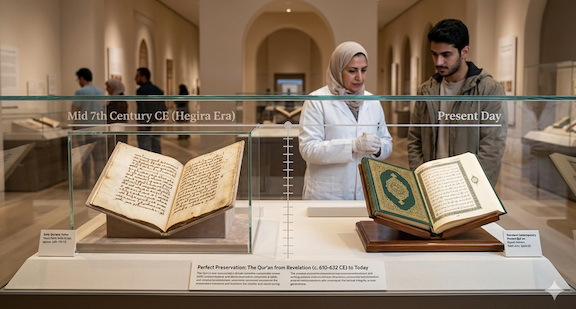
Qureshi believes this argument is more essential to the Muslim faith than all the others. Muslims believe that every single word, every single letter, every single stroke of the Qur’an remains exactly as it was revealed, from Allah to Mohammed down to the present. “It is an essential belief because of the view of the Quran in Islam: It is the eternal expression of Allah, so it can never change. Its immutability is also necessary because it is the foundation of sharia, a law for all time.” [18] “In addition to the internal evidence and the careful compilation process, the Qur’an is considered to be above all error because it is the latest and the most correct of all scriptures.” [19]Muslim scholars point out that, in contrast to other holy books, “the Holy Qur’an is the only divinely revealed scripture in the history of mankind which has been preserved to the present time in its exact original form.” [20]
CHANGED LIVES: This final argument states that changed lives and cultures are a direct result of the Qur’an’s influence. “The transformation wrought by the Holy Qur’an is unparalleled in the history of the world and thus its claim to being unique stands as unchallenged today as it did thirteen centuries ago… No faith ever imparted such a new life to its votaries [devoted followers] on such a wide scale – a life affecting all branches of human activity; a transformation of the individual, of the family, of the society, of the country; and awakening material as well as moral, intellectual as well as spiritual. The Qur’an affected a transformation of humanity from the lowest depth of degradation to the highest pinnacle of civilization within an incredibly short time where centuries of reformation work had proved fruitless.” [21][brackets added]
Christianity’s Response to These Arguments
The Islamic claim that the Qur’an is unrivaled by any major religion needs to be examined. In the following sections, we will respond to each Islamic argument in the order they were presented above.
THE UNIQUE LITERARY STYLE: Does the literary excellence or uniqueness of the Qur’an prove it originated from God? Is literary eloquence a miracle, that is, an act of God that cannot be reproduced by a human being? Mohammed claimed it was, and most Muslims believe it was the only miracle that provided proof of Mohammed’s claim to be Allah’s prophet.
If literary eloquence was a valid test for divine inspiration, then a case could be made for Homer’s Iliad and Odyssey, John Milton’s Paradise Lost, Herman Melville’s Moby Dick, or Shakespeare’s Romeo and Juliet. Does their eloquence also make them divine inspiration? Clearly, eloquence, even if true (and it is debatable that the Qur’an is stylistically elegant), is not at all relevant. [22]
Muslim scholars have acknowledged that the Qur’an is not superior to other Arabic literature. For example, Islamic scholar C.G. Pfander, states that “it is by no means the universal opinion of unprejudiced Arabic scholars that the literary style of the Qur’an is superior to that of all other books in the Arabic language… Some doubt whether in eloquence and poetry it surpasses the Mu’allaqat, or the Magamat or Hariri, though in Muslim lands few people are courageous enough to express such an opinion.” [23]
Islamic scholars have shown that there are several literary flaws in the Qur’an. For example, Iranian Shi’ite scholar Ali Dashti argues that the Qur’an possess numerous grammatical irregularities. He notes, “The Quran contains sentences which are incomplete and not fully intelligible without the aid of commentaries; foreign words, unfamiliar Arabic words, and words used with other than normal meaning; adjectives and verbs inflected without observance of the concord of gender and number; illogical and ungrammatically applied pronouns which sometimes have no referent; and predicates which in rhymed passages are often remote from the subjects.” He adds that “these and other such aberrations in the language have given scope to critics who deny the Quran’s eloquence.“ [24] Dashti concludes: “to sum up, more than one hundred Quranic aberrations from the normal rules and structure of Arabic have been noted…” [25] [emphasis added]
Even if the Qur’an was shown to be the most elegant book in the Arabic language, it would still not prove it is of divine origin. Qureshi shares, “People who had specifically set out to respond to the Quran’s challenge had already composed a book of Christian teachings in Arabic called the Furqan al-Haqq, ‘The True Discernment.’ They included many teachings of the Psalms in this Arabic book, writing them in the style of the Quran. Their results were so convincing that they read the text aloud, chanting it in Quranic style, in the middle of Arab Muslim cities. Many who passed would hear the recitation and, confusing it for the Quran, thank the readers for reciting it. Clearly, then, the test did not work for Arabic speakers either, not even Arab Muslims.” [26][emphasis added] For those of you who are unfamiliar with the Qur’an, I will cite a favorite surah (chapter) [27]among Muslims and place it next to a favorite Psalm[28]among Christians to let you decide which text possesses more literary excellence or beauty:
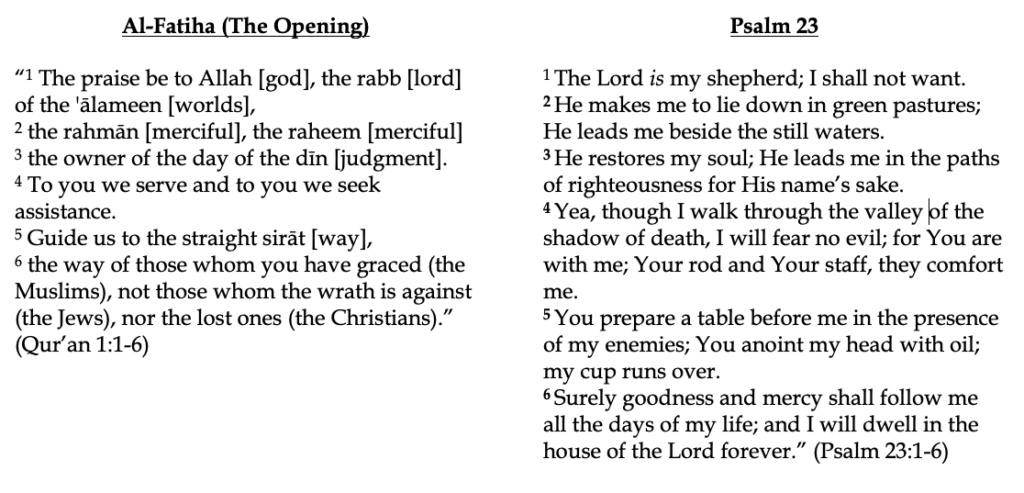
According to scholars, the Qur’an contains many literary defects: [29]
– Not chronological
– Endless repetitions
– Jumps from one topic to the next
– Inconsistencies in grammar, law, and theology
– Verbs left out
It becomes clear that literary excellence is highly subjective and is therefore, a questionable proof of divine authorship.
MOHAMMED’S ILLITERACY: There are some scholars who question whether Mohammed was actually illiterate, as the Arabic words al umni, translated “the unlettered” prophet in some English translations of the Qur’an (Qur’an 7:157), [30] may be rendered “heathen” or “Gentile,” [31] and thus not imply illiteracy. [32]
There is also evidence that Mohammed may not have been completely illiterate. One scholar notes that “it is known that many Meccans were able to read and write, and there is therefore a presumption that an efficient merchant like Muhammad was, knew something of the arts.” [33] There are some Muslim scholars who also refer to Mohammed as being “perfect in intellect.” [34]
Even if we assume Mohammed was illiterate, that does not mean that the Qur’an was dictated to him by Allah. There are other possible explanations. Even if he was not formally trained and could not read or write, Mohammed was a gifted individual possessing great skills. In addition, his scribe could have stylized Mohammed’s recitations. [35]Some critics argue that Mohammed’s first impression was correct, that he received recitations from a superintelligent evil spirit. [36] The Bible reminds us that Satan can transform himself into an angel of light and so can his ministers who deceive people to believe in another Jesus and a different gospel (2 Cor. 11:3-4, 14-15).
FULFILLED PROPHECIES: Qureshi points out that the prophecy about the Roman victory (Qur’an 30:2-4) has “two minor problems with considering this a fulfilled prophecy, and two major problems. Briefly, the first minor problem is the nature of the prophecy; it is not much of a prediction. Given the ongoing nature of the Byzantine-Persian conflicts at the time, there was bound to be a Byzantine victory at some point. It is almost like saying, ‘The Chicago Bulls have just lost to the LA Lakers, but the Bulls will be ultimately victorious.’
“The second minor problem is the number of years it took for the Byzantines to be victorious; the verse of the Quran uses a word that implies ten years or less, but it took seventeen years for the Romans to ultimately defeat the Byzantines.
“There are two much more significant problems with using this as prophetic fulfillment. First, Quranic verses were regularly abrogated, and the Byzantine victory came during Muhammad’s lifetime. Had it looked as if it were not going to happen, the text could easily have been abrogated.
“Second, and along the same vein, the Quran was not collected in a book until even later. Had this prophecy failed, it could have been left out of the final collection of the text, as other verses had…. and if we consider the text literally, it appears that it did not come true anyway, as the Byzantines did not defeat the Persians until after the prophesied time had elapsed.” [37] [emphasis added]
Regarding Qur’an 41:20 being a prediction about fingerprint analysis, Qureshi shows that in context (Qur’an 41:19-21), this verse is talking about the apocalyptical day of judgment when a person’s skin will speak with a voice, along with eyes and ears. Hence, this verse is not a prophecy about fingerprint analysis. He concludes, “Only by wrenching this verse from its context and forcing a contrived meaning upon it can this verse be made to sound like a prophecy for our time.” [38]
MIRACULOUS SCIENTIFIC KNOWLEDGE: The Islamic claim that the description of the developmental stages of a human embryo in Qur’an 23:12-14 are scientifically accurate are shown by an expert of Islam, Usama Dakdok, to be false. He points out that there are four errors concerning human reproduction in the main verse: [39] “Then we created the nutfah into a clot. So we created the clot into a piece of flesh, so we created the piece of flesh into bones, so we clothed the bones with flesh. Then we made it another creature. So blessed be Allah, the best of the creators.”(Qur’an 23:14). [40]
The first error is the Muslim understanding of “nutfah” (23:14a). According to the Qur’an, “nutfah” is the combination of fluids coming from “the backbones [of the male] and breasts [of the female]” (Qur’an 86:5-7). [41]Dakdok explains, “Females do not produce any fluid from their breasts for conception. Conception involves an egg which has nothing to do with the breasts. Man’s sperm does not come from the backbone. Sperm do not mutate into blood cells. The cells in the embryo which form blood, much less blood-clotting agents, do not begin formation until the fourth week of pregnancy. During this first month, many other cell types have to form prior to blood and clotting.” [42]
The second error is: “so we created the clot into a piece of flesh” (23:14b).It is scientifically inaccurate to say that “human life is grown from a clot into a later collection of other cells (‘piece of flesh’). As mentioned above, that is not the case.” [43]
The third error is: “so we created the piece of flesh into bones, so we clothed the bones with flesh.” (23:14c).“The order presented in the Qur’an is fertilization, blood (or cell) formation, bones, and then flesh. This is absolutely false. Cells for organs and flesh actually begin formation before bone development. Later, as the fetus grows, bone structures begin to develop along with organs and flesh.” [44]
The fourth and final error is: “then we made it another creature.” (23:14d). “As mentioned above, cellular division which forms bone tissue takes place after flesh and organs begin developing.” [45] Hence, the Qur’an’s description of fetal development is contrary to modern scientific observation.
In response to the Qur’an speaking of the Big Bang and water being essential to life when it reads, “Or have not those who became infidels seen that the heavens and the earth were a solid mass, so we parted them, and we made every living thing from the water? Do they not believe?” (Qur’an 21:30), Qureshi says, “It does not say that the universe was a singularity, but rather that the heavens and earth were joined and God separated them. This is actually just an approximation of what God was doing in Genesis 1:6 – nothing new or specific to the Quran. Similarly, the notion that all living creatures are made of water is not that difficult to postulate, as humans and animals all drink water, and very little survives in the desert where there is not much water. Finally, it might be worth knowing that the Quran frequently asserts that jinn were made from fire, not water, and some would consider this a contradiction within the Quran [cf. Qur’an 7:12; 15:27; 38:76; 55:15]. [46]
Geisler and Saleeb conclude, “Even if the Qur’an were proven to be scientifically accurate [which it is not as shown above], it would not thereby make it divinely authoritative. All it would prove is that the Qur’an made no scientific blunders. This would not be unparalleled. Some Jewish scholars claim the same for the Torah, and many Christians claim exactly the same thing for the Bible, using very similar arguments.” [47][brackets and emphasis added]
AMAZING MATHEMATICAL STRUCTURE: Muslims argue that the Qur’an displays mathematical marvels that could only be the result of a divine origin. Qureshi responds by saying that the Muslim scholar who “discovered” the pattern of nineteen in the Qur’an, Rashad Khalifa, [48] was doing what anyone can do: “If you look hard enough, and if you can fudge the parameters, you will find patterns.” [49]Qureshi then cites Muslim scholar, Bilal Philips, who wrote an entire treatise against Khalifa’s findings called, “The Qur’an’s Numerical Miracle,” and says, “The Theory of Nineteen is a shoddily concocted hoax unable to withstand serious scientific scrutiny.” [50] Philips concluded that Khalifa had, “fabricated data in order to artificially create letter totals which are multiples of nineteen.” [51]Khalifa was willing to alter the Qur’anic text to make the date fit.
Geisler and Saleeb observe that this same kind of argument Islam makes for numeric patterns could also be used to prove the inspiration of the Bible (only based on the number seven). They refer to Genesis 1:1: “In the beginning God created the heavens and the earth.” [52] Muslim theologian Gerhard Nehls observes from this one verse: “The verse consists of 7 Hebrew words and 28 letters (7X4). There are three nouns: ‘God, heavens, earth’… their total numeric values … is 777 (7X11). The verb ‘created’ has the value 203 (7X29). The object is contained in the first three words – with 14 letters (7X2). The other four words contain the subject – also with 14 letters (7X2) [and so on]. [53]
Would a Muslim allow this argument to support the divine inspiration of the Bible? Not at all. At best the argument is obscure and unconvincing and avoided by most Muslim scholars. [54]
PERFECT PRESERVATION: This essential Muslim argument is not above scrutiny. Qureshi, a former Muslim, states, “Though, we had firm faith in the perfect preservation of the Quran, the fact is that it is impossible to prove. When Uthman [644-655 A.D.] produced an official, edited copy of the Quran and destroyed all the other copies, he left future historians no means to determine whether today’s Quran actually goes back to Muhammad.” [55] “ Uthman destroyed all the evidence, and it appears he did so precisely because there were variants.” [56][brackets and emphasis added] Noted European archaeologist Arthur Jeffrey, author of Materials for the History of the Text of the Qur’an, confirms this when heconcludesthat “there can be little doubt that the text canonized by Uthman was only one among several types of text in existence at the time.” [57][emphasis added]
We need to remember that the Qur’anic text was an oral text and not always written, but sometimes just known by memory. Qureshi notes that “it was for this reason that Umar [the second Caliph] convinced Abu Bakr [the first Caliph] to collect a copy of the Quran in the first place. Many Qurra (reciters of the Quran) were dying on battlefields, and Umar said, ‘I am afraid that more heavy casualties may take place among the Qurra’ on other battlefields, whereby a large part of the Qur’an may be lost.’” [58][brackets added] “If the Quran had been written, why would he fear its loss by the death of its reciters?” [59]
Janosik’s summary of the lack of proof for the perfect preservation of the Qur’an is noteworthy: “There are a number of reasons to doubt the idea that the Qur’an was written all at once and compiled in its final form only a few years after Muhammad’s death. Only fragments and portions of manuscripts of what is now the Qur’an are known to exist before the late 8th century, and there is inadequate evidence of where those fragmentary manuscripts came from. The text of the fragments does bear witness overall to a clear monotheistic faith, but that does not necessarily mean that they are Islamic texts. There are also literary considerations to bear in mind, as Arabic as a written language was developing in key ways during the 7th and 8th centuries. This casts doubt on the truth of the Qur’an being such a literary marvel, and instead supports the gradual culmination theory. Finally, the fact that only fragmented source material exists from the century in which the Qur’an was supposed to have been written suggests that the traditional date may be inaccurate. One plausible explanation is that the Qur’an is made up of many different texts, some Christian and Jewish, that were gradually transliterated into Arabic as the script and alphabet developed. Later, after Muhammad’s death, scholars working under the caliph Abd al-Malik, around 700 A.D., could have compiled these documents. There are indications that corrections continued to be made until a final version was completed somewhere around the latter half of the 8th century.” [60]
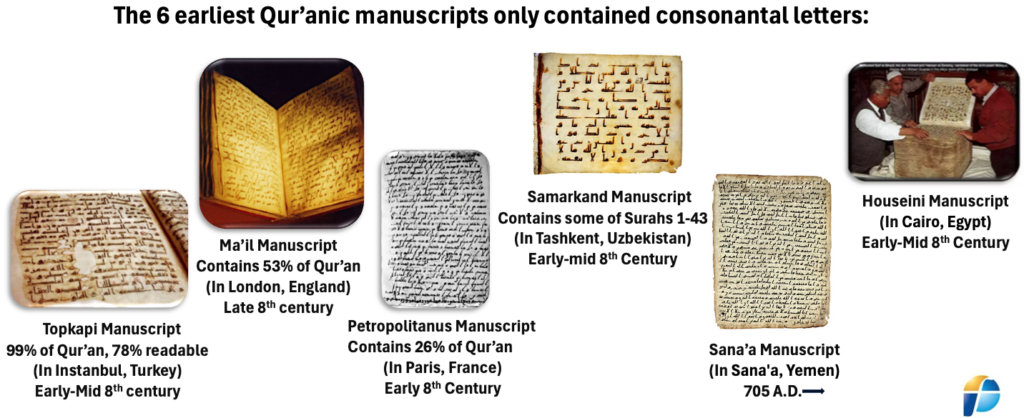
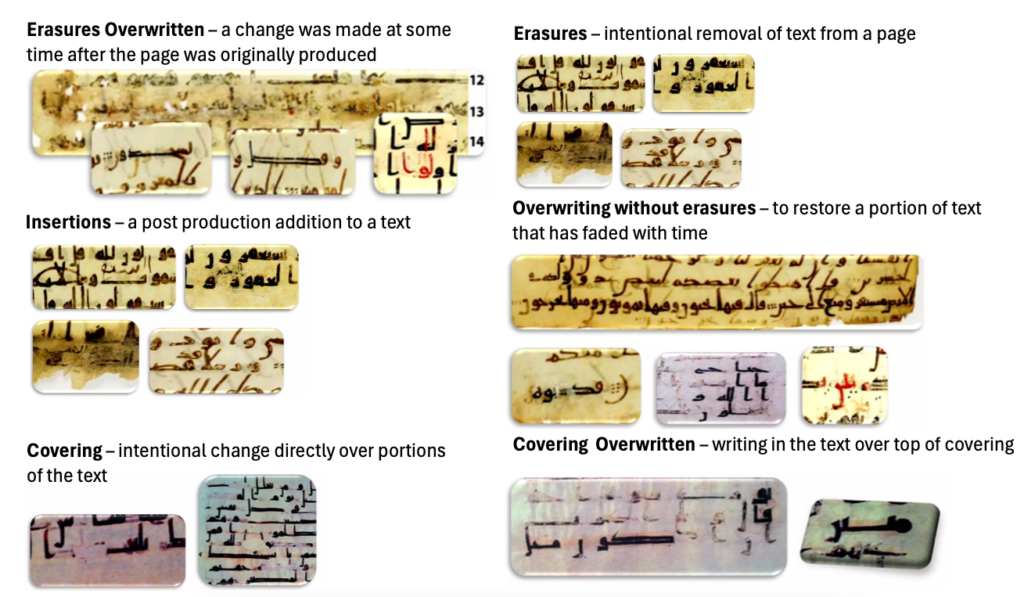
Recent discoveries confirm the textual corruption of the Qur’an. We have learned that the six earliest extant manuscripts of the Qur’an are from the 8th century, and not one of them agrees with the other. [61] Dr. Daniel Brubaker has found thousands of corrections (corruptions) in these six early manuscripts and others soon after them (see photo below), [62] which undermines Islam’s claim that the Qur’an has been unchanged or uncorrupted the last 1,400 years.
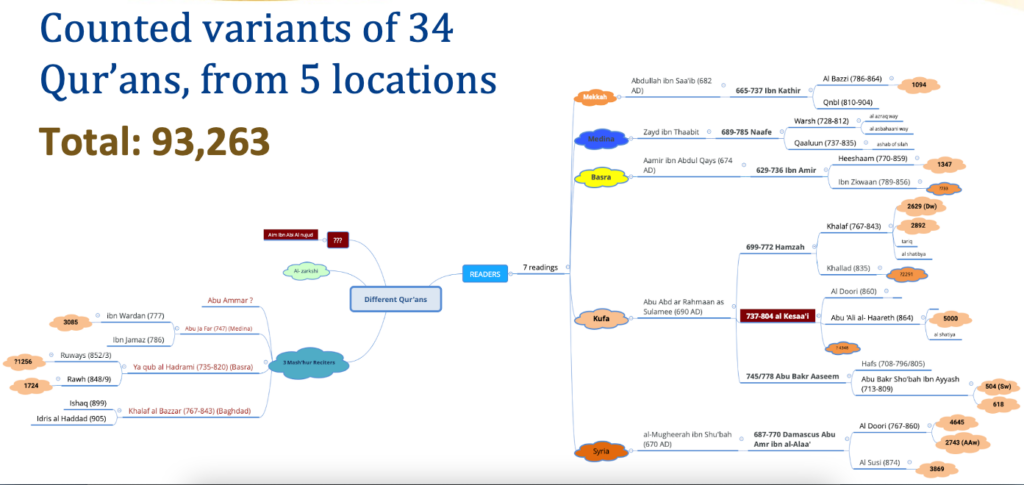
One of the team members of Dr. Jay Smith has found 34 different Qur’ans with a total of 93,263 variants or corruptions (see photo below). [63]
CHANGED LIVES: Muslim apologists claim that the divine origin of the Qur’an is proven by the transformation of lives and cultures. But critics point out that any set of ideas fervently believed and applied will transform believers and their cultures. This is true whether the ideas are Buddhist, Christian, Hindu, Islamic, or Jewish. But this does not mean all their sacred writings are inspired by God. Would Muslims support the argument that Karl Marx’s Das Capital is inspired by God simply because it changed millions of lives and cultures? [64] It is doubtful.
Furthermore, one would expect many people to convert to Islam when those who did were promised the rewards of Paradise, beautiful virgin women (Qur’an 2:25; 4:57), and the spoils (movable goods, women and children to be slaves) of their conquered enemies (Qur’an 4:73-74; 8:67-69; 9:5; 33:26-27), and those who did not convert were threatened with punishment including cutting off their hands and feet, decapitation (Qur’an 5:36; 8:12), and paying heavy taxes if they were Christians or Jews (Qur’an 2:83; 9:5, 18, 29). [65]
CONCLUSION: The Qur’an claims to be the Word of God, but it lacks sufficient evidence to prove it is the Word of God. Many Muslim apologists insist the Qur’an is the final revelation from God and is therefore superior to all others. But their arguments in support of this are not convincing. Each contain errors. Of course, a person can continue to believe in the divine origin of the Qur’an even though it lacks evidence to support it. But those who are seeking a reasonable faith are encouraged to investigate Judaism and Christianity both of which Islam believes possess supernatural confirmation from God. [66]
Why Do Christians Believe the Bible is True?
THE EVIDENCE OF CONSISTENCY:
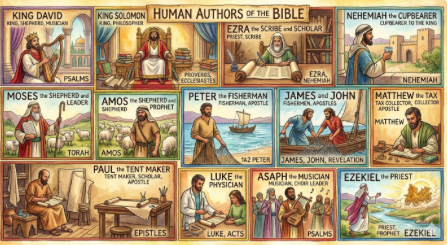
The Bible is a collection of sixty-six books written by about forty people in three different languages – Hebrew (most of the Old Testament), Aramaic (Ezra 4:8-6:18; 7:12-26; Jer. 10:11. Dan. 2:4-7:28), [67] and Koine Greek (all the New Testament) – on three different continents (Asia, Africa, Europe) over a period of about two thousand years, from the time the book of Job was written during the patriarchal period (2100-1900 B.C.) [68] to the writing of the last book of the New Testament (Revelation) by the apostle John (95 A.D). [69] The human authors of the Bible (see above photo) ranged from kings (David, Solomon, etc.) to tent makers (Paul), shepherds (Moses, Amos) to tax collectors (Matthew), fishermen (Peter, James, John) to scholars (Ezra), cupbearers (Nehemiah) to physicians (Luke), and musicians (Asaph) to priests (Ezekiel). Yet all these authors who wrote on three different continents using three different languages wrote with agreement on what are some of the most controversial subjects in our world today.
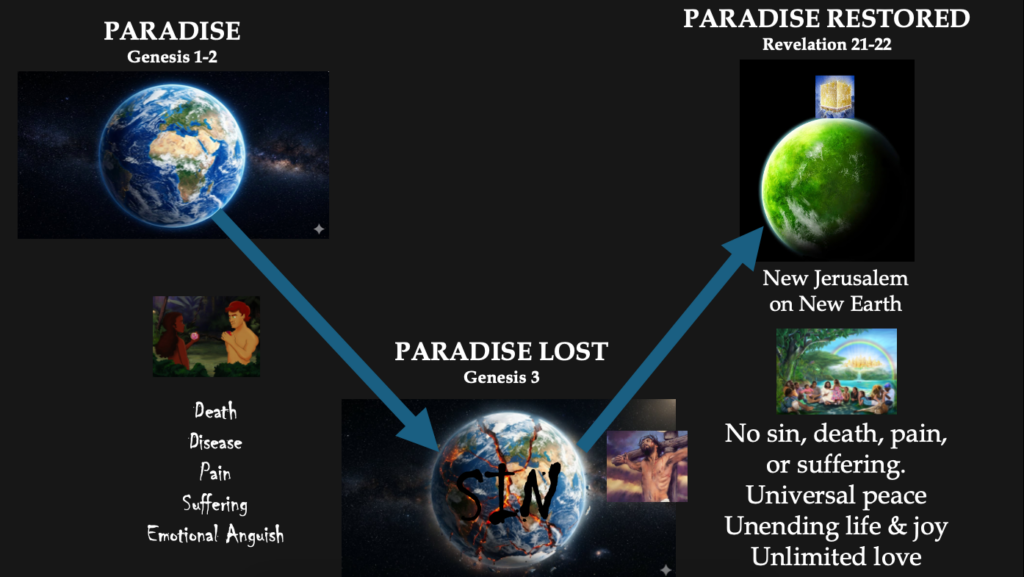
For example (see above pic), the first book of the Bible talks about “Paradise Lost” (Gen. 1-3) and the last book of the Bible talks about “Paradise Restored” (Rev. 21-22). [70] How do you get forty people in a room to agree on anything? Yet they agreed on these things. How can this be?
The Bible says, “16 For we did not follow cunningly devised fables when we made known to you the power and coming of our Lord Jesus Christ, but were eyewitnesses of His majesty. 17 For He received from God the Father honor and glory when such a voice came to Him from the Excellent Glory: ‘This is My beloved Son, in whom I am well pleased.’ 18 And we heard this voice which came from heaven when we were with Him on the holy mountain. 19 And so we have the prophetic word confirmed, which you do well to heed as a light that shines in a dark place, until the day dawns and the morning star rises in your hearts; 20 knowing this first, that no prophecy of Scripture is of any private interpretation, 21 for prophecy never came by the will of man, but holy men of God spoke as they were moved by the Holy Spirit.” (2 Pet. 1:16-21).
These verses teach five important facts:
1) The Bible is a reliable collection of historical documents (1:16).
2) The Bible was written by eyewitnesses during the lifetime of other eyewitnesses (1:16b).
3) The Bible reports supernatural events (1:17-18) that took place to fulfill specific prophecies (1:19).
4)The Bible did not originate from men (1:21a).
5) The Holy Spirit directed (“moved” [71]) these different authors to write each word down without error (1:21b) in the original text. [72]
In addition, the Bible says, “All Scripture is given by inspiration of God, and is profitable for doctrine, for reproof, for correction, for instruction in righteousness.” (2 Tim 3:16). The Greek word translated “inspiration” (theopneustos) means “God-breathed.” [73] Both the Old and New Testaments of the Bible (“all Scripture”) were “breathed-out” by God, since by the time the apostle Paul wrote this epistle (~64 A.D.) most of the New Testament was already written. [74]
There are many additional descriptions of inspiration in the Bible. [75] King David wrote, “The Spirit of the Lord spoke by me, and His word was on my tongue.” (2 Sam. 23:2). David also wrote,“The law of the Lord is perfect…” (Psa. 19:7a). Agur stated, “Every word of God is pure” (Prov. 30:5) or flawless. [76] Jesus referred to the Old Testament when He said, “every word that proceeds from the mouth of God.” (Matt. 4:4). Jesus also referred to the written Old Testament Scripture as the “word of God” when He said, “34 Is it not written in your law, ‘I said, “You are gods”’? 35 If He called them gods, to whom the word of God came (and the Scripture cannot be broken).” (John 10:34-35). Paul makes a similar point when he wrote, “These things we also speak, not in words which man’s wisdom teaches but which the Holy Spirit teaches, comparing spiritual things with spiritual.” (I Cor.2:13). Thus, the entire Bible is God-breathed in the original text.
Christianity claims that only the original texts of the Bible themselves (or perfect copies of them) are without error. Every other copy is inspired only insofar as it is an accurate reproduction of the original. [77] But how do we know the original text of the Bible was without error if we do not have it in our hands today?
Geisler and Nix state, “The answer is found in two Bible teachings: (1) God cannot lie (Heb. 6:18; Titus 1:2), and (2) the Bible is the written Word of God (John 10:35). Therefore, the Bible is without error. Since inspiration means the Bible was ‘breathed-out by God’ (2 Tim. 3:16) and God cannot breathe-out error, then it must be errorless. Since the Scriptures are ‘every word that comes from the mouth of God’ (Matt. 4:4), and no error can proceed out of Him who is truth itself, it follows that the original text—which was breathed out by God—is perfect (Psa. 19:7).
“The Bible claims to be an utterance of God who cannot make mistakes. And even though no originals have ever been discovered, neither has anyone ever discovered a fallible autograph that could falsify the claim for infallible autographs. What we do have are very accurately copied manuscripts that have been adequately translated into English. Hence, for all matters of doctrine and duty, today’s Bible is an adequate representation of the authoritative Word of God.
“But if we do not have the original texts of the Bible, then how can we know what it says? The simple answer is that it can be reconstructed accurately from the copies we have. For example, suppose a teacher read a statement from a piece of paper and asked her class to copy it down. From these copies she could reconstruct the original because where they differed would reflect the different errors that different students made. But where they agreed, they would reflect what the original said. Although it is more complicated than this, the process is called the science of textual criticism.” [78] [emphasis added]
THE EVIDENCE OF MANUSCRIPT COMPARISONS:
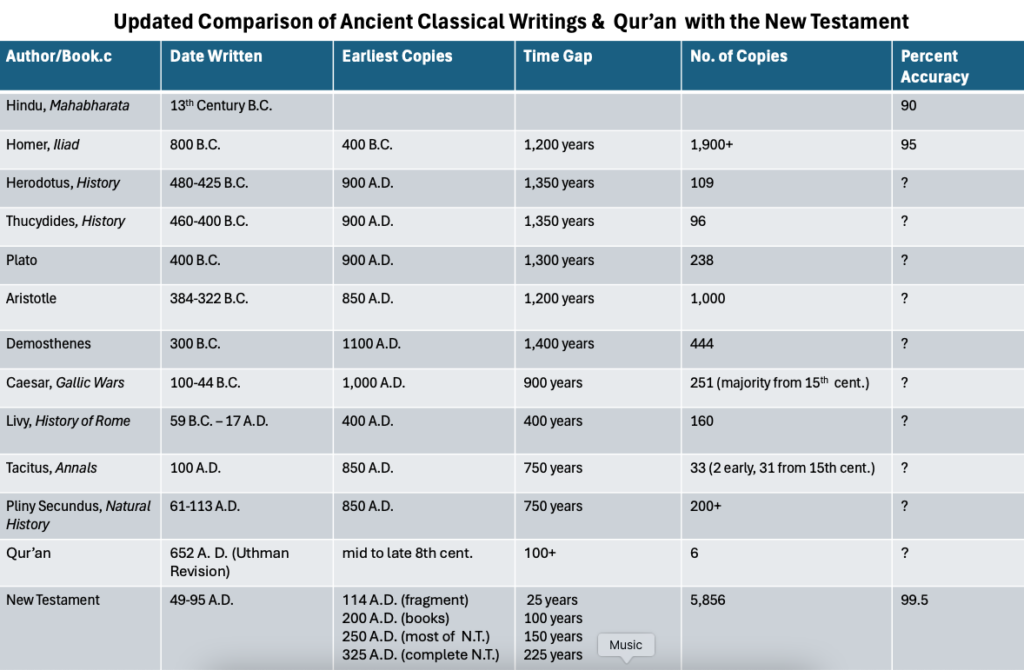
Because the Bible is a book, it was initially made up of manuscripts (handwritten copies). Subsequently, a primary means for determining its historical reliability today is the number of copies from those original manuscripts which are currently in one’s possession and the time interval between the original and earliest copy. This is known as the bibliographical test. [79] More copies of the original were made to preserve the original manuscript and to distribute the original to more and more people. Hence, the more copies we have the better we can compare between them and thus know if the document we now read corresponds with the original manuscript. Smith explains it like this: “It is much like a witness to an event. If we have only one witness to the event, there is the possibility that the witness’s agenda or even an exaggeration of the event has crept in, and we would never know the full truth. But if we have many witnesses, the probability that they all got it wrong becomes minute [small].” [80] [brackets added]
Also, the shorter the time interval between the original manuscript and the earliest copy, the greater the historical reliability of the document. Why? Because history has shown that the closer the copies are to the original, it usually means the fewer times it has been copied and therefore, the less chance it has of human error creeping in.
When comparing the New Testament, which was originally written in Koine Greek, with other credible ancient writings, including the Qur’an, the New Testament has far more manuscript authority than any other credible ancient literature, including the Qur’an (see above chart). [81]
THE EVIDENCE OF ARCHAEOLOGY:
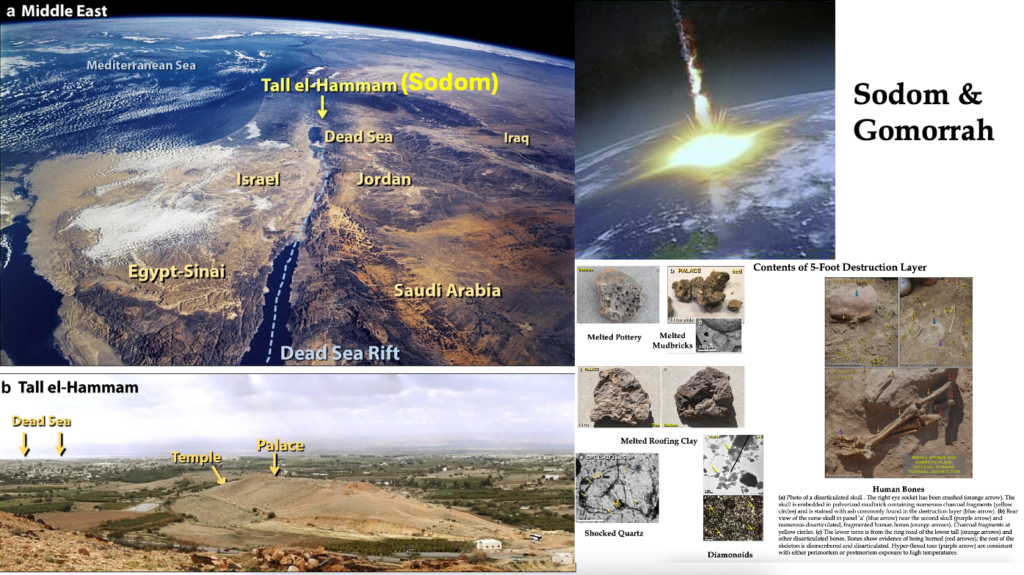
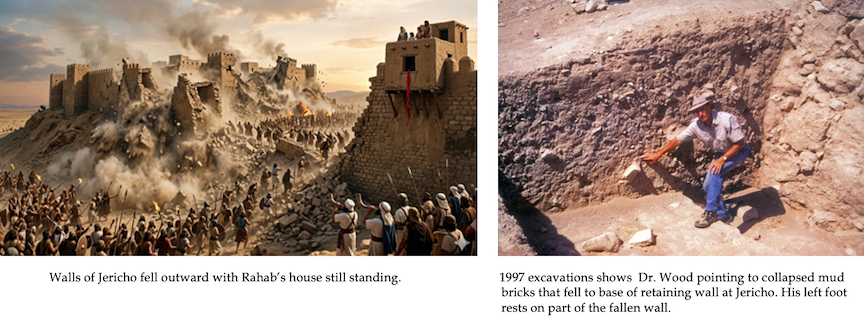
Over and over again archaeology demonstrates that the people and places in the Bible actually existed when and where the Bible says they did. In our last article, we cited many archaeological findings confirming the people, places, and times recorded in the Bible. These included people like Abram (later named Abraham), [82] King David,[83] Quirinius, [84] Jesus, [85] Gallio [86] and places like Ur, [87] Haran, [88] Shechem, [89] Bethel and Ai, [90] Sodom (see above pic), [91] Jericho’s walls (see pic below), [92] and Iconium. [93]
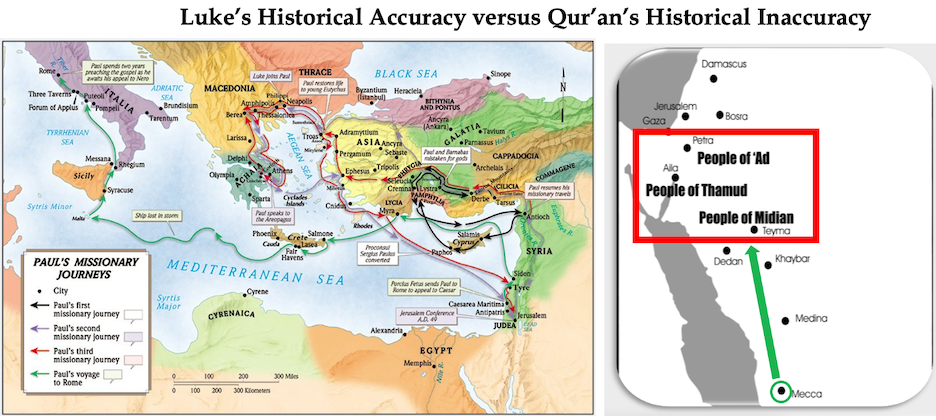
Luke recorded 32 countries, 54 cities, 9 Mediterranean islands, and 95 people in the book of Acts (see left pic below), and he did not get any of them wrong. [94] Compare Luke’s historical accuracy with the Qur’an’s which places fifty-four of its sixty-five (see right pic below) geographic references 600 – 1,000 miles too far north of Mecca (Ad = 23 times, Thamud = 24 times, and Midian = 7 times). [95]
Again and again the Bible has shown itself to be rooted in history. We count our history by it. Every time you write down a date, you write down the date from Jesus’ appearance on this earth. Thus, the Bible is a book that is rooted in history.
THE EVIDENCE OF BIBLE PROPHECY:
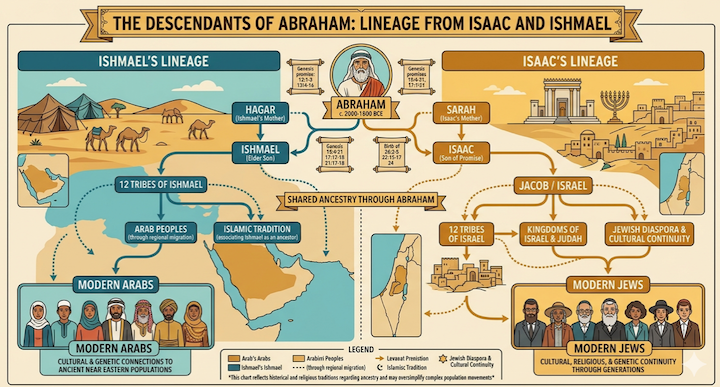
The Old Testament predicted what would happen to certain nations, cities, and people, all of which happened or are happening just the way the Bible said. The book of Genesis records God’s promise to Abraham that his descendants would never be wiped out (Gen. 12:1-3; 13:14-16; 15:4-21; 17:1-21; 21:17-18; 22:15-17; 26:2-5, 24; et al.). Today the Jews and Arabs, descendants of Abraham’s first two children, Isaac and Ishmael, are still with us as distinct peoples (see AI generated photo above). Yet there are no more Canaanites, Amorites, Hittites, Babylonians, or Medes.
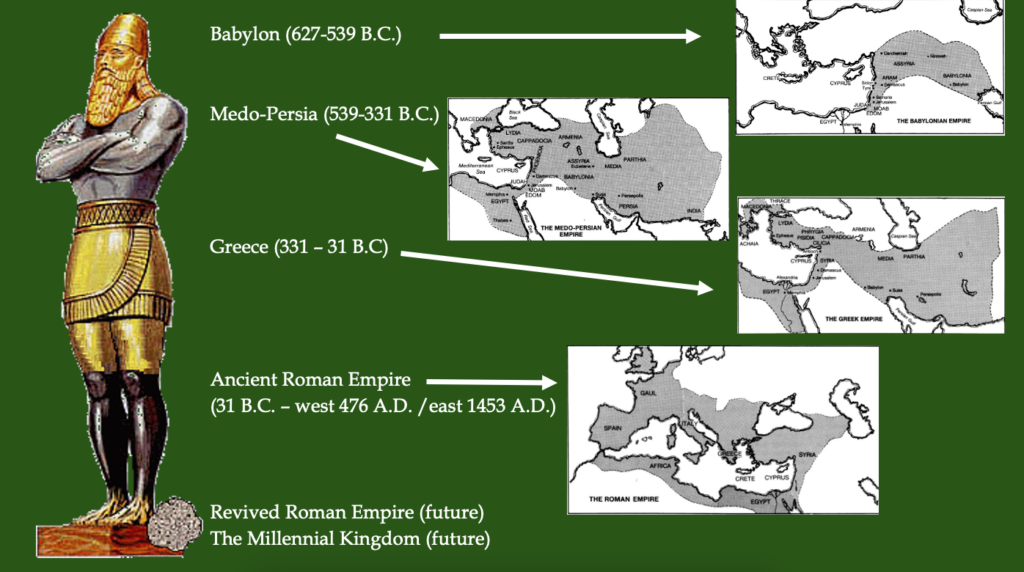
Babylon, Medo-Persia, Greece, and Rome all rose and fell just the way the book of Daniel said they would (see above pic). [96] In Daniel 2, Babylonian King Nebuchadnezzar had a dream of a statue. God told Daniel that the statue represented six kingdoms. The head of gold represented the Kingdom of Nebuchadnezzar or Babylon (Dan. 2:31-32a, 36-38; cf. Dan. 7:4). The chest of silver represented the inferior kingdom to follow called Medo-Persia (Dan. 2:32b, 39a; cf. Dan. 5:28-31; 6:8; 7:5; 8:3-4, 20). The belly and thighs of bronze represented the third kingdom to rule called Greece (Dan. 2:32c, 39b; cf. Dan. 7:6; 8:5-14, 21-26). The two legs of iron represented the fourth kingdom that crushes and eventually is divided known as ancient Rome (Dan. 2:33a, 40; cf. Dan. 7:7a). The two feet and ten toes of iron mixed with clay represented the fifth kingdom mixed with strength and weakness known as the Revived Roman Empire (Dan. 2:33b, 41-43; cf. Dan. 7:7b, 19-28; Rev. 13:1-10). [97] The Stone that grows into a mountain and crushes the kingdom of iron and clay represents the sixth kingdom that is established by God and shall replace all human kingdoms (Dan. 2:34-35, 44-45; cf. Dan. 7:13-14, 26-27). This is the Millennial (1,000 years) Kingdom of Christ (Rev. 20:1-6).
Just as those first four kingdoms were literal and historical, so the last two kingdoms – the revived Roman Empire during the future seven years Tribulation (Dan 2:33b, 41-43; Dan. 7:7b, 19-28; cf. Rev. 13:1-18; 17:1-18; 18:1-24) and the Millennial Kingdom of Jesus Christ (Dan. 2:44-45; 7:22, 26-27; cf. Rev. 11:15; 19:11-20:6) will be literal as well.
There are several hundred predictions about the first coming of the Messiah that were perfectly fulfilled in Jesus Christ. For example, Psalm 22 describes the crucifixion of Jesus in vivid detail. The amazing deal is that Psalm 22 was written hundreds of years before Roman crucifixion was even established. A glimpse at a few of these prophecies shows that they were given and fulfilled in great detail (see diagram below).
| Old Testament Prophecy | New Testament Fulfillment | Event in Jesus’ Life |
| “My God, My God, why have You forsaken Me?” Psalm 22:1a | “And about the ninth hour Jesus cried out with a loud voice, saying, ‘Eli, Eli, lama sabachthani?’ that is, ‘My God, My God, why have You forsaken Me?’” Matthew 27:46 | Jesus asked His Father why He had forsaken Him |
| “7 All those who see Me ridicule Me; they shoot out the lip, they shake the head, saying, 8‘ He trusted in the Lord, let Him rescue Him.’” Psalm 22:7-8 | “41 Likewise the chief priests also, mocking with the scribes and elders, said, 42 ‘He saved others; Himself He cannot save. If He is the King of Israel, let Him now come down from the cross, and we will believe Him. 43 He trusted in God; let Him deliver Him now if He will have Him.’” Matthew 27:41-43 | Jewish religious leaders hurled insults at Jesus and mocked His faith because God was not rescuing Him. |
| “My strength is dried up like a potsherd, and My tongue clings to My jaws.” Psalm 22:15 | “After this, Jesus, knowing that all things were now accomplished, that the Scripture might be fulfilled, said, ‘I thirst!’” John 19:28 | Jesus was thirsty and weak |
| “They pierced My hands and My feet.” Psalm 22:16 | “24 Now Thomas… 25 said to them, ‘Unless I see in His hands the print of the nails, and put my finger into the print of the nails, and put my hand into His side, I will not believe.’” John 20:24-25; cf. Luke 24:39-40 | Jesus’ hands and feet were nailed to the cross |
| “They divide My garments among them, and for My clothing they cast lots.” Psalm 22:18 | “Then they crucified Him, and divided His garments, casting lots, that it might be fulfilled which was spoken by the prophet: ‘They divided My garments among them, and for My clothing they cast lots.’” Matthew 27:35 | Soldiers divided Jesus’ garments & cast lots for them |
| “He guards all his bones; not one of them is broken.” Psalm 34:20 | “33But when they came to Jesus and saw that He was already dead, they did not break His legs… 36 For these things were done that the Scripture should be fulfilled, ‘Not one of His bones shall be broken.’” John 19:33, 36 | Jesus bones were not broken |
| “And I will pour on the house of David and on the inhabitants of Jerusalem the Spirit of grace and supplication; then they will look on Me whom they pierced.” Zechariah 12:10 | “34 But one of the soldiers pierced His side with a spear, and immediately blood and water came out… 37 And again another Scripture says, “They shall look on Him whom they pierced.” John 19:34, 37 | Jesus’ side was pierced |
THE EVIDENCE OF CHANGED LIVES:
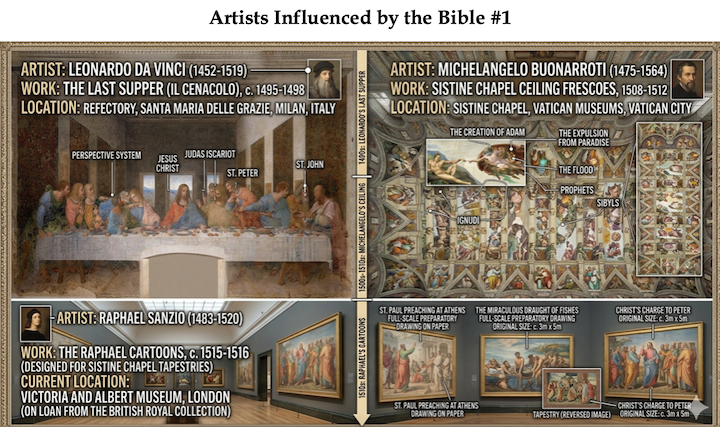
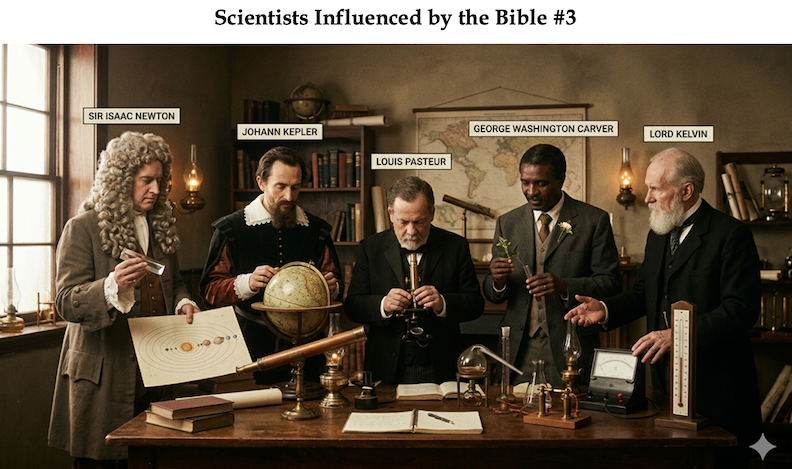
No book has impacted the lives of people and the course of world events more than the Bible. The Bible has been translated into more languages [98], has influenced more thought, [99] inspired more art (see above AI generated pic #1) [100] and music (see AI generated pic #2 below), [101]
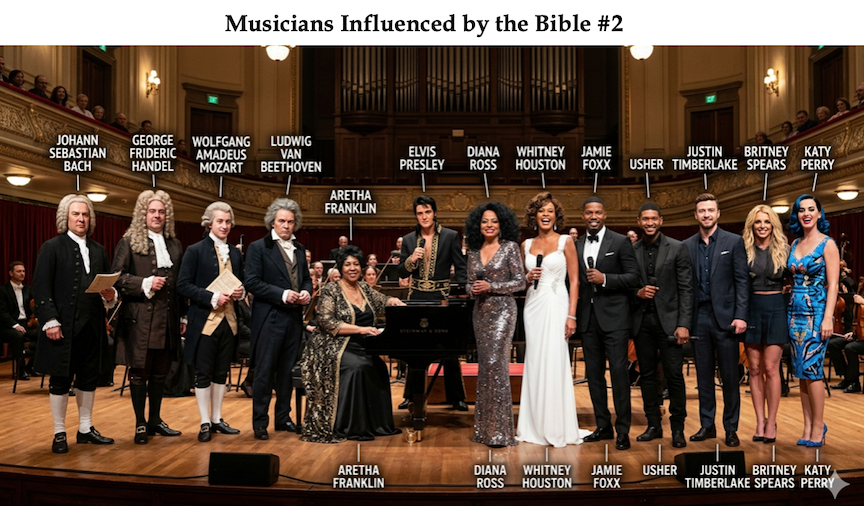
and motivated more discoveries (see AI generated pic below #3), [102] than any other book. The Bible has always been at the top of the all-time best-seller list. Its power is surpassed by none: “For the word of God is living and powerful, and sharper than any two-edged sword, piercing even to the division of soul and spirit, and of joints and marrow, and is a discerner of the thoughts and intents of the heart.” (Heb. 4:12).
The Bible is able to transform the sinner into a saint; the guilty into the forgiven; the hateful into the helpful; the promiscuous into the pure; the greedy into the generous. God’s Word changes lives. However, we must be careful not to defend the Bible from personal experience. For example, a Muslim could argue that the Qur’an has changed his life, or a Mormon could argue that the Book of Mormon changed his life. People have false experiences all the time – drugs can cause hallucinations, dreams can seem real, and mental illness can alter a person’s perception. Experiences can be deceiving. All experiences, no matter how real they may seem, must be measured by some other criteria. Hence, we must understand that personal experience does not validate the Bible; the Bible validates personal experience. This is why Christians should question their own experiences if they do not line up with God’s Word.
THE EVIDENCE OF INDESTRUCTIBILITY:
The Bible says, “The words of the Lord are pure words, like silver tried in a furnace of earth, purified seven times. You shall keep them, O Lord, You shall preserve them from this generation forever.” (Psa. 12:6-7). Jesus said, “Heaven and earth will pass away, but My words will by no means pass away.” (Matt. 24:35).
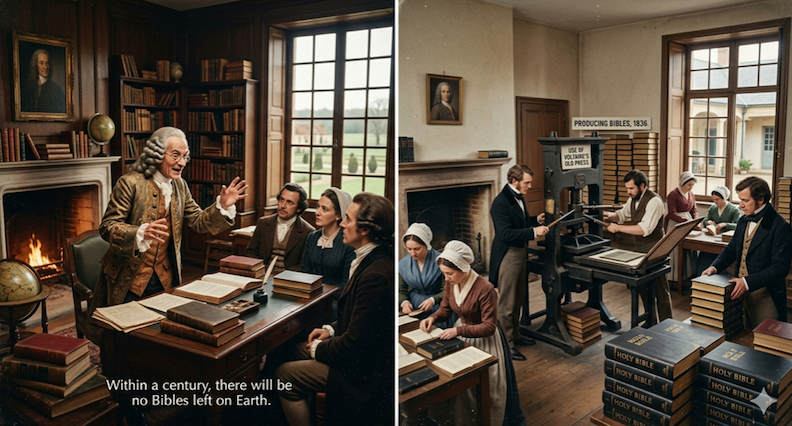
Skeptics have tried for centuries to destroy the authority of the Bible. For example, in the 18th century, the noted French infidel Voltaire forecast that within a century there would be no Bibles left on earth. Ironically, 58 years after he died, a Bible Society used his old printing press and his house to produce stacks of Bibles (see above AI generated pic). [103] The Bible has been banned, burned, and outlawed, yet it has outlasted all of its opponents. It remains the all-time best-seller in history, estimated to have between 5-7 billion copies sold. [104] The Bible continues to be scrutinized today by archaeology, science, psychology, political movements, Hollywood, Islam, and computers. Yet the Bible remains undaunted. It proves Itself to be true over and over again despite these many attacks.
THE EVIDENCE OF SELF-TESTIMONY:
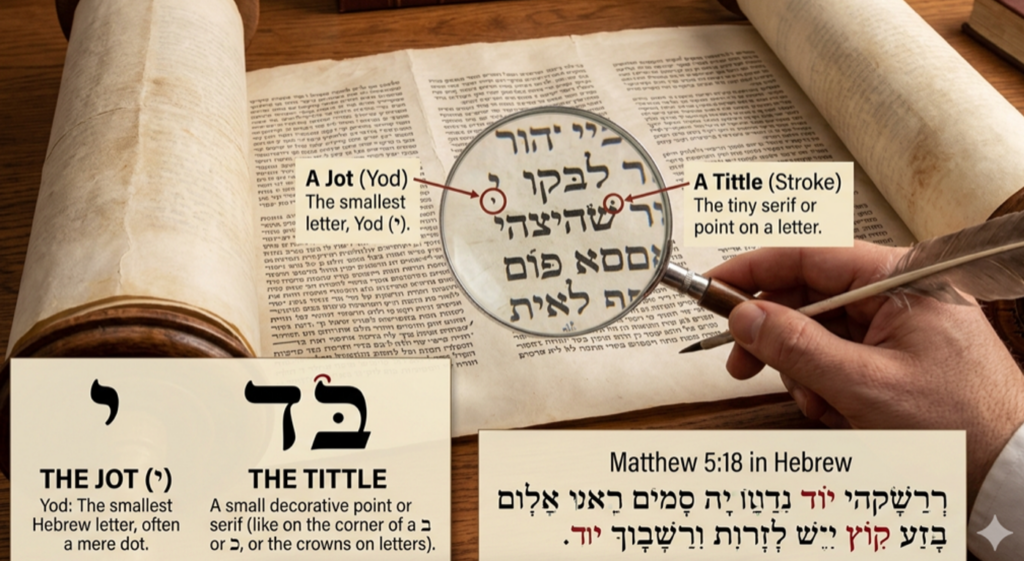
Self-testimony is valid evidence in a court of law. The Old Testament authors often made claims like, “The Lord spoke to me, saying…” (cf. Gen. 24:7; Lev. 1:1; 10:3; Num. 1:1; Deut. 2:2, 17; 9:13; Josh. 4:1; I Kgs. 2:4; Isa. 8:5, 11; Jer. 28:1-2; et al.)or “The word of the Lord came to me, saying…” (I Kgs. 18:1; I Chron. 22:8; Jer. 1:4, 11, 13; 2:1; 13:3, 8; Ezek. 3:16; 6:1; Zech. 4:8; 6:9; et al.). Henry Morris in his book Many Infallible Proofs states that there are 2,600 such claims of divine inspiration in the Old Testament. [105] The New Testament also claims to be inspired word-for-word by God (see comments above on 2 Tim. 3:16; 2 Pet. 1:20-21). Jesus said, “17 Do not think that I came to destroy the Law or the Prophets. I did not come to destroy but to fulfill. 18 For assuredly, I say to you, till heaven and earth pass away, one jot or one tittle will by no means pass from the law till all is fulfilled.” (Matt. 5:17-18). Christ is saying that the Bible is accurate down to the smallest letter of a Hebrew word (“jot” – yôd) and even to the smallest stroke of a Hebrew letter (“tittle”) (see AI generated pic above).
THE EVIDENCE OF SCIENCE: A literal understanding of Genesis 1-11 is supported by science:
a. Anthropology:
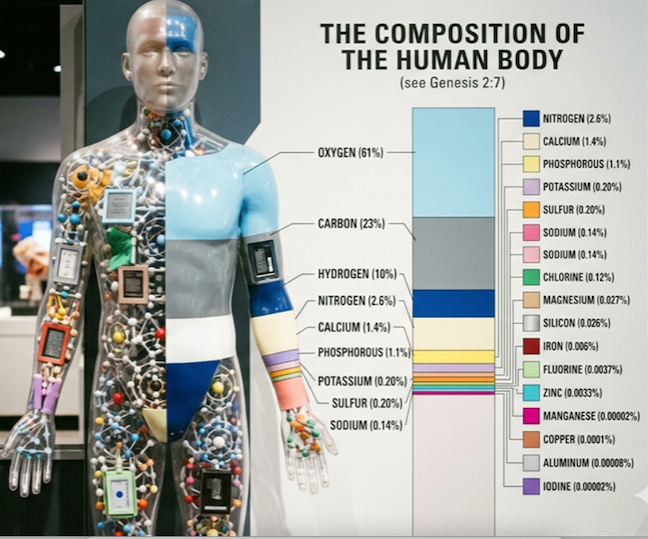
The Bible teaches that God made the first man (Adam) from “the dust of the ground” (Gen. 2:7), not from other forms of life (i.e., apes or chimpanzees) over millions of years as evolution teaches. It is possible God used water which was present to form Adam, “but a mist went up from the earth and watered the whole face of the ground.” (Gen. 2:6). From a chemical and physical standpoint, human beings literally come from the “dust”(‘āp̄ār) [106] of the ground. When we break down the basic chemical components of human beings, we can see that they literally come from the dust (and crust) of the earth (see AI generated photo above). [107] But it is not just these chemical components found in the dust of the earth that make us human, it is the way they are “put together with purposeful design and complex organization” [108] But more importantly, humans were given the spiritual breath of God: “And the Lord God formed man of the dust of the ground, and breathed into his nostrils the breath of life; and man became a living being.” (Gen. 2:7). Plants were not given this “breath” (neshama) from God, but animals have “breath” (Gen. 1:20-21, 24). [109] Evans observes,“This combination is astounding: Adam was, at one and the same time, a piece of dirt and the bearer of God’s own breath. This should keep us from thinking of ourselves either too highly or too lowly. God made us out of the most mundane material imaginable, so we shouldn’t be conceited. But God also infused us with His Spirit, which gives us tremendous value. Like Adam, we are all a fusion of the divine and the dusty.” [110][emphasis added]
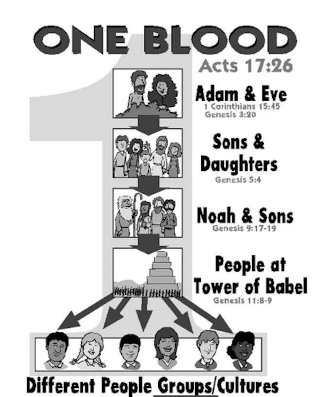
The Bible teaches that all people are descendants of one man, Adam (see above pic [111])—thus there is only one human race (Gen. 1:26-28; 2:7-25; cf. Acts 17:24-26; I Cor. 15:45). The Bible tells us that the population that descended from Noah’s three sons after the global Flood had one language and disobeyed God’s command to “fill the earth” (Gen. 9:1) and built a tower for themselves (Gen. 11:1-4). As a result, God confused their language, causing the population to break up into smaller linguistic groups, which scattered over the earth (Gen. 11:7-9; cf. Gen. 10:1-32 [112]). Modern genetics show how, following such a break-up of a population, variations in physical appearance, such as skin color and eye shape, can develop in only a few generations. [113] Linguistic [114] and biological evidence support the genetic closeness of all human ethnic groups, consistent with a recent origin from a small population source like that described in Genesis 1-11. [115] Evidence that all peoples on earth have come from Noah are found in the flood stories from many cultures around the world. [116] All of these findings are consistent with biblical creation.
b. Astronomy:
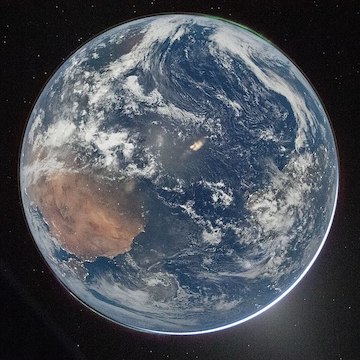
The Bible teaches that the earth is round. [117] It refers to “the circle of the earth” (Isa. 40:22a). From outer space, the earth always appears as a circle since it is round (see above pic [118]). The Bible also says that God “drew a circular horizon on the face of the waters, at the boundary of light and darkness.” (Joh 26:10). The boundary between light and darkness is where evening and morning occur. This boundary is “circular” since the earth is round. Another verse states that God “hangs the earth on nothing.” (Job 26:7b), which suggests that the earth floats in space. We now have photos taken from space that show the earth floating in our solar system.The Bible also indicates that the universe has been stretched out or expanded: God “stretches out the heavens like a curtain, and spreads them out like a tent to dwell in.” (Isa. 40:22c). This verse implies that the universe (“heavens”) has actually increased in size since its creation. God is stretching or spreading it out, causing it to expand. “In the 1920s, astronomers discovered that virtually all clusters of galaxies appear to be moving away from all other clusters; this indicates that the entire universe is expanding.” [119]
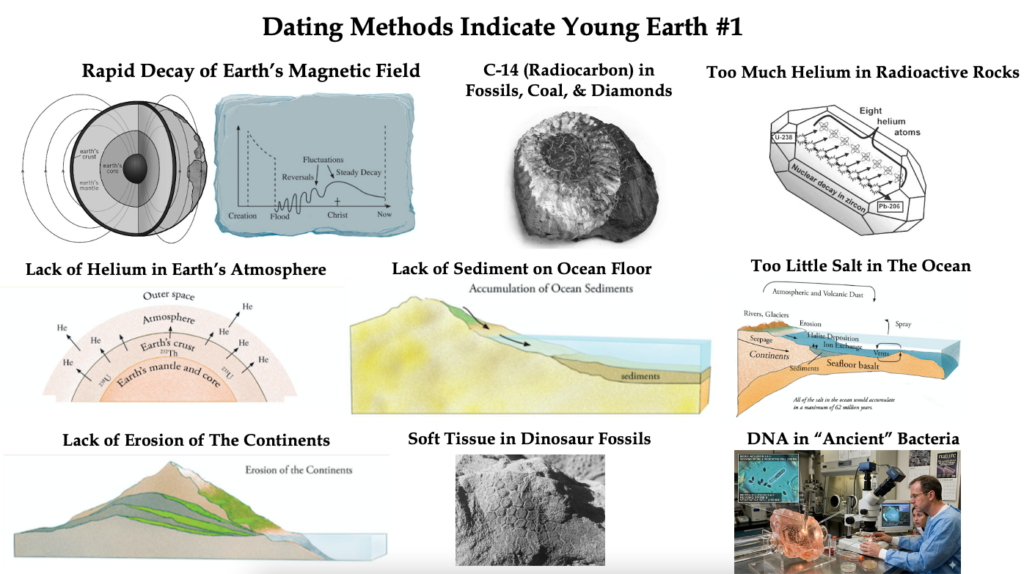
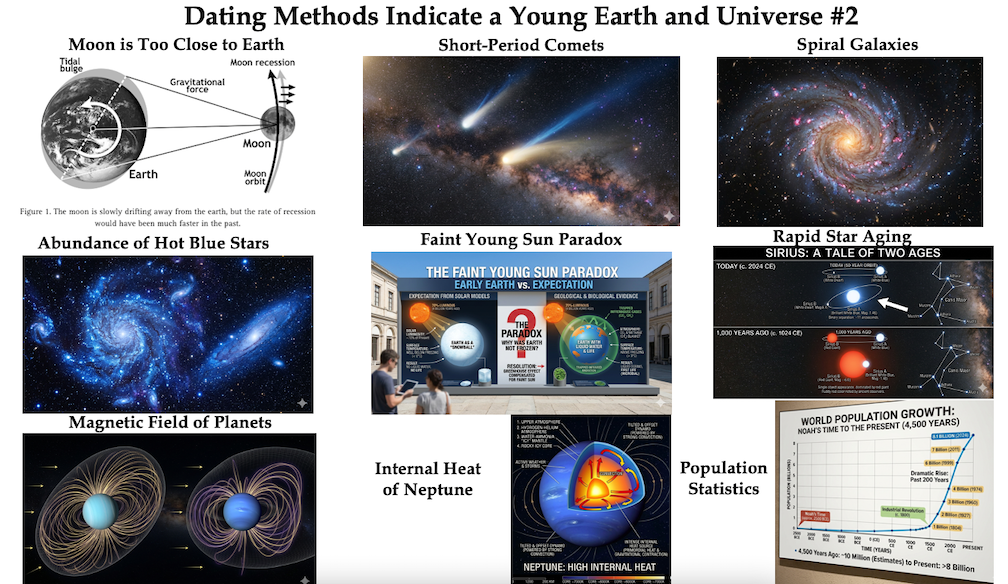
According to a literal understanding of Genesis 1 (and Exodus 20:11) and the genealogies of the Bible (assuming there are no gaps), the week of creation took place about 6000 years ago. [120] Therefore, the earth, sun, moon and stars are just a few thousand years old. The media and evolutionists contest this age by pointing to the billions of years derived from rocks by radioisotope dating which is based upon questionable assumptions. [121] What they do not tell the general public is that there are many other dating methods which indicate that the earth is much too young for evolution to occur (see above photo collage #1). These include the earth’s rapidly decaying magnetic field, [122] too much helium in radioactive rocks, [123] lack of helium in the atmosphere, [124] lack of sediment on the ocean floor, [125] too little salt in the ocean, [126] lack of erosion of the continents, [127] too much carbon 14 in fossils, coal, and diamonds, [128] soft tissue in dinosaur fossils, [129] DNA in “ancient” bacteria, [130] the moon is too close (see photo collage below #2), [131] young short-period comets, [132] spiral galaxies, [133] abundance of young blue stars, [134] faint young sun paradox, [135] rapid star aging, [136] magnetic fields of planets, [137] internal heat of giant planets, [138] and population statistics, [139] all point to a young earth and universe. [140]
c. Biology:
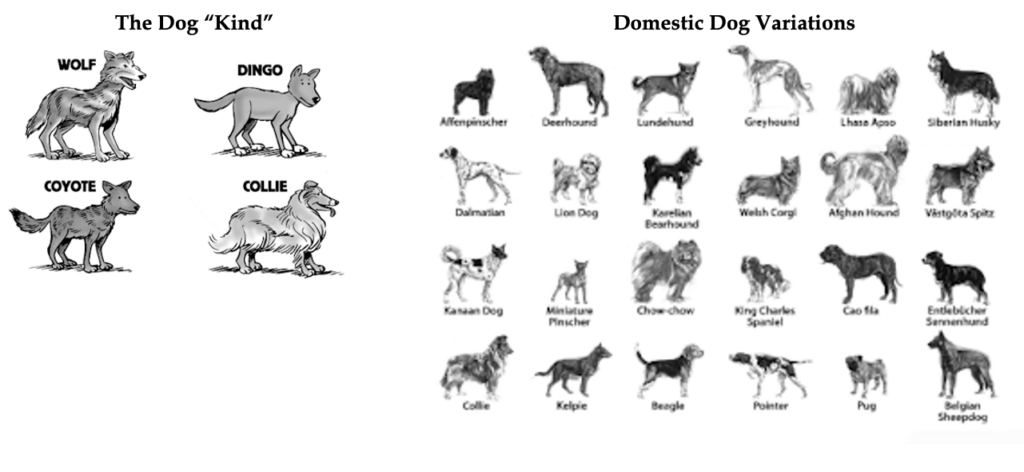
The Bible teaches that God created distinct kinds of animals and plants to reproduce within the boundaries of their own created “kind” (Gen. 1:11-12, 21, 24-25; cf. 6:18-20; 7:13-16). [141] There can be many variations within a created “kind.” For example, dogs can easily breed with one another, whether wolves, dingoes, coyotes, or domestic dogs. When dogs breed together, you get dogs; so, there is a dog created kind (see above pics). [142] There are two laws of biology that support this. They state like can only come from like, and life always gives rise to life (biogenesis). [143] The first is obviously true – fruit flies always give rise to fruit flies and dogs always give birth to dogs, and humans always have babies that are human. The Bible tells us that life always comes from pre-existing life …God is alive and from Him life was created. Each living thing reproduces after its kind, [144] so we see that biology supports what the Bible teaches. “Notice that molecules-to-man evolution violates the law of biogenesis. Evolutionists believe that life (at least once) spontaneously formed from non-living chemicals. But this is inconsistent with the law of biogenesis. Real science confirms the Bible.” [145]
d. Geology:
The Bible informs us that death entered the world after sin (Gen. 3:1-21; Rom. 5:12). This has a bearing on geology and paleontology, as the Earth is covered with rocks full of fossils—dead things. Thus, the fossil-containing rocks could not have formed before sin. The Bible records the catastrophic event of a global Flood (Gen. 6-8) which has a great bearing on correctly interpreting the surface of the Earth and the massive quantity of sedimentary rocks, as well as explaining the formation of most fossils.
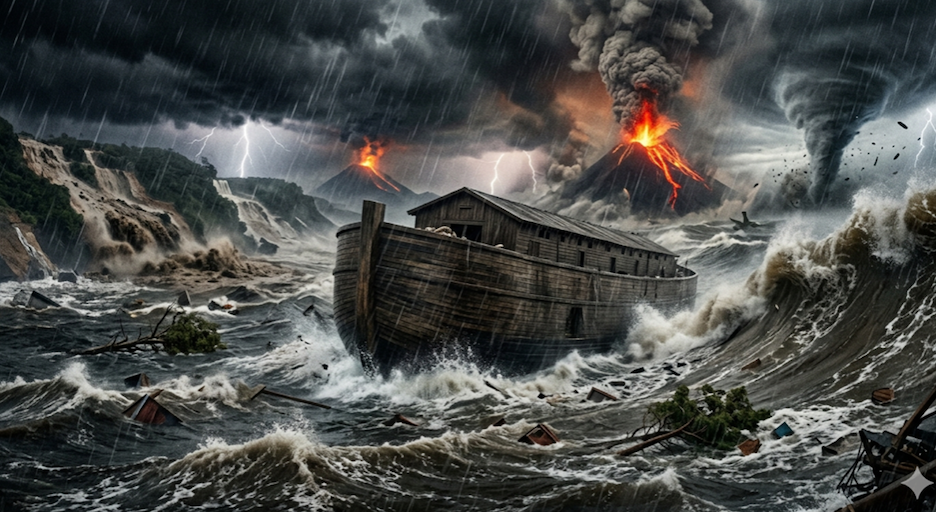
The Bible tells us that there were two sources of the global flood waters: “11 In the six hundredth year of Noah’s life, in the second month, the seventeenth day of the month, on that day all the fountains of the great deep were broken up, and the windows of heaven were opened. 12 And the rain was on the earth forty days and forty nights.” (Gen. 7:11-12). Water came from below the earth’s surface (“fountains of the great deep”) and above the earth (“the windows of heaven were opened”). The source for water below the ground was in great subterranean pools (“fountains”) of fresh water, which were “broken” open by volcanic and seismic activity [146] for 150 days, resulting in volcanoes, earthquakes, and tsunamis [147] (see AI generated photo above). The catastrophic nature of the Flood is also “seen in the nonstop rain for at least 40 days, which would have produced massive erosion, mud slides, hurricanes, etc.” [148]
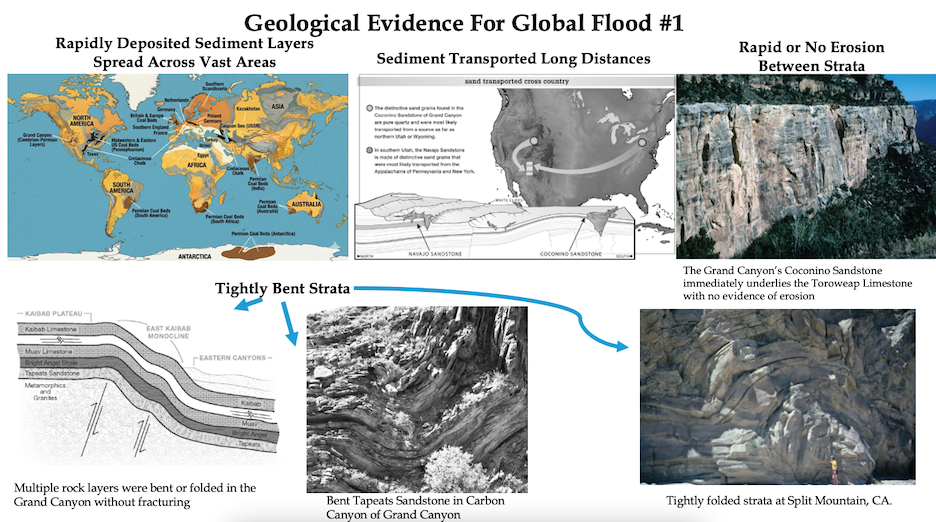
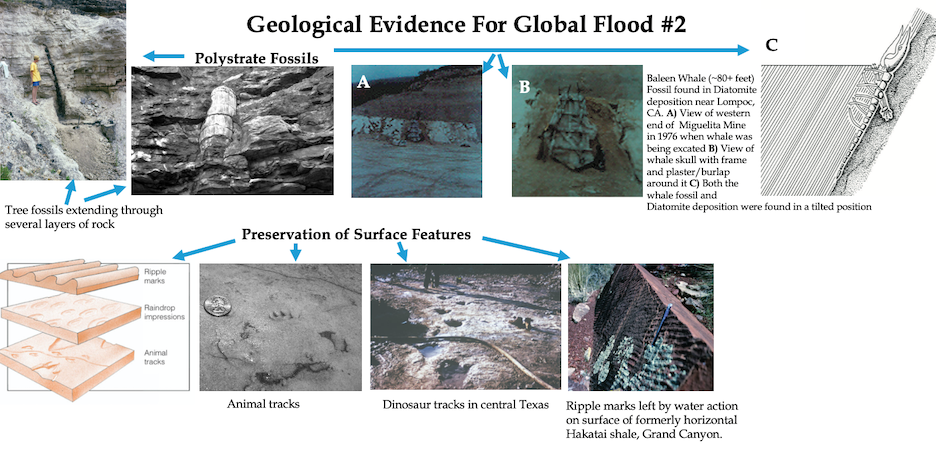
Evidence for rapid deposition of geological strata as in the biblical global flood includes (see photo collage #1 above) rapidly deposited sediment layers spread across vast areas on every continent, [149] sediment transported long distances, [150] rapid or no erosion between fossil-bearing strata, [151] many tightly bent (“folded”) strata without evidence of melting or fracturing, [152] polystrate fossils (which traverse several rock layers vertically (see photo collage #2 below) [153] – these could not have stood vertically for thousands of years while they slowly got buried), lack of soil layers between rock layers, [154] preservation of surface features (i.e. ripple marks, raindrop impressions, animal tracks).[155]
Evidence from Mount St. Helens (see photo collage below) tells us that canyons and layers of rock can be formed in a short period of time by catastrophic events. Since the first eruption of Mount St. Helens on May 18, 1980, up to 600 feet of new strata have formed. [156] A mudflow on March 18, 1982, eroded a canyon system over 100 feet deep in these sediment layers, resulting in a one-fortieth scale model of the real Grand Canyon. [157] Two hundred million cubic yards (153 million cubic meters) of material was catastrophically deposited by these volcanic flows at the base of the mountain in just a matter of hours. [158] Could it be that the Grand Canyon was carved out by rapid catastrophic erosion on an enormous scale by blockaded waters left over from the global Genesis Flood? [159]
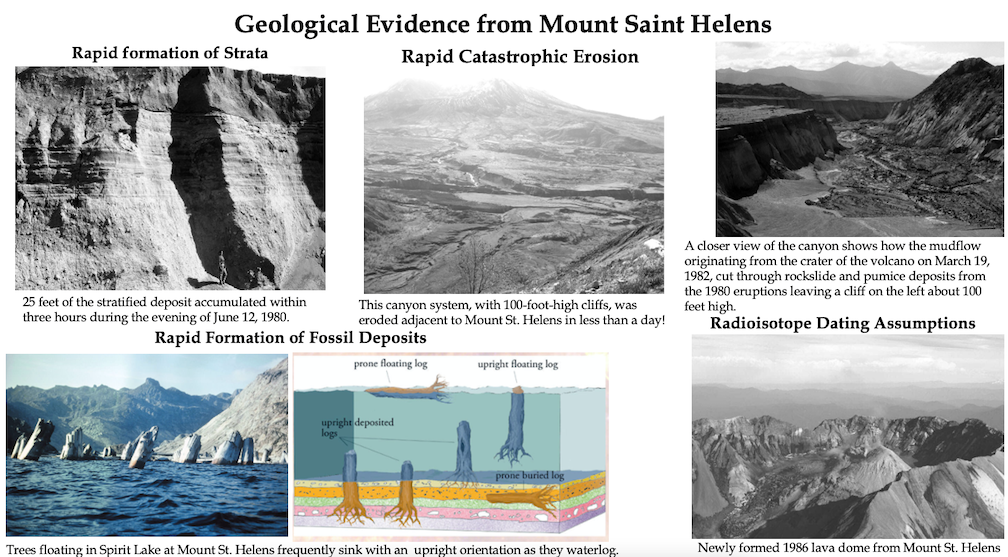
In 1997, a team of eight research scientists known as the RATE group (Radioisotopes and the Age of The Earth) set out to scrutinize the assumptions commonly made in standard radioisotope dating practices (both single-sample and multiple-samples radioisotope dating). Their findings were very important and directly impact the evolutionary dates of millions of years. [160] When a rock sample from the newly formed 1986 lava dome from Mount St. Helens was dated using Potassium-Argon dating, the newly formed rock gave ages for the different minerals in it of between 0.5 and 2.8 million years. [161] These dates show that significant argon (daughter element) was present when the rock solidified, so the first assumption of radioisotope dating, namely that the original rock condition is accurately known, is false. [162]
In addition, when Mount St. Helens erupted on May 18, 1980, one million logs floated on Spirit Lake, after they were uprooted and washed into the basin by 860-foot-high water waves. Careful observation of the floating conifer logs in the lake indicated that such logs showed a strong tendency to float upright. It was estimated using sidescan sonar and scuba divers that 20,000 upright stumps existed on the floor of the lake in August 1985. It also appeared that about ten percent of the deposited logs were in an upright position. If Spirit Lake were drained, the bottom would look like a forest of trees. Scuba investigation of the upright-deposited logs showed that some are already solidly buried by sedimentation with more than three feet of sediment around their bases. Others, however, have none. This proves that the upright logs were deposited at different times, with their roots buried at different levels. If found buried in the rock strata, logs such as the ones in Spirit Lake might be interpreted as multiple forests that grew on different levels over periods of many thousands of years. The Spirit Lake upright-deposited logs, therefore, have considerable implications for interpreting “petrified forests” in the strata record. Direct application of the Spirit Lake logs may be made to the Yellowstone petrified forests. [163] Morris notes that the findings at Spirit Lake and Mount St. Helens have led many geologists to conclude that the Yellowstone petrified forest trees are from the same standing forest. Amazingly, the evolution lesson along the roadside there has been removed. [164]
e. Paleontology (study of fossils): The order and distribution of fossils in the geological record is best explained by the global flood of Noah’s day (Gen. 7-9). [165] The description of the Flood in Genesis 6–8 informs us that the “fountains of the great deep” (Gen. 7:11-12) burst open and poured water out onto the earth’s surface for 150 days or five months (Gen. 7:24). Simultaneously, and for the same length of time, the “the windows of heaven were opened” (Gen. 711-12), producing torrential global rainfall. [166] The combined result was that the waters destructively rose across the face of the earth to eventually cover “all the high hills under the whole heaven” and eventually “the mountains” as well (Gen. 7:19-20).
Hence, based on this clear biblical description of a real historical global flood, we would expect the fossil record to show evidence today of billions of dead animals (marine and land animals) and plants rapidly buried in rock layers composed of water-deposited sand, lime, and mud all around the earth. Not surprisingly, the fossil record confirms what the Bible clearly teaches. It shows billions of animal and plant fossils rapidly buried [167] in sedimentary rock layers stretching across every continent all around the globe. [168]
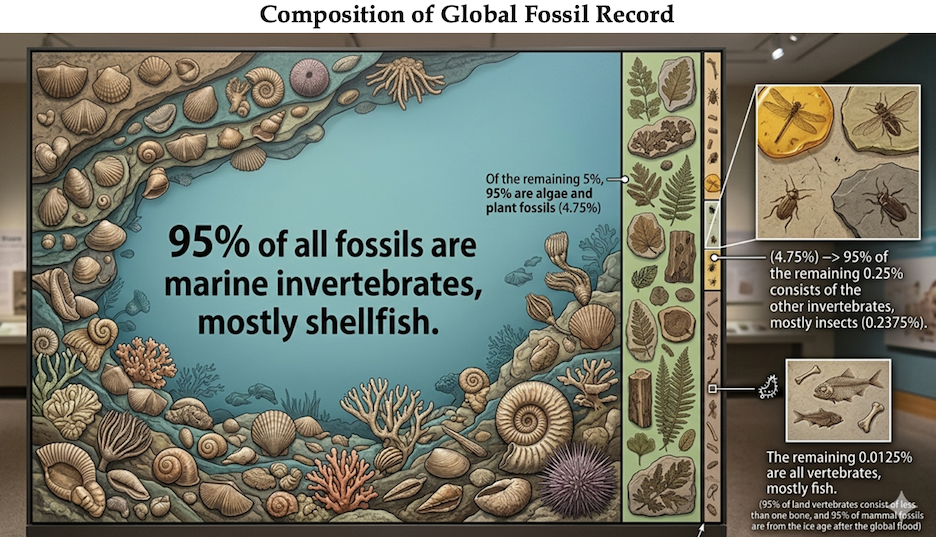
When we examine the fossil record, we discover the following composition percentages (see AI generated photo above): [169]
• 95% of all fossils are marine invertebrates, mostly shellfish.
• Of the remaining 5%, 95% are algae and plant fossils (4.75%).
• 95% of the remaining 0.25% consists of the other invertebrates, mostly insects (0.2375%).
• The remaining 0.0125% are all vertebrates, mostly fish. (95% of land vertebrates consist of less than one bone, and 95% of mammal fossils are from the Ice Age after the Global Flood)
These percentages are what we would expect from a global flood as in the days of Noah (Gen. 6-8). Since the global flood was a marine catastrophe, we would expect marine fossils to be dominant in the fossil record, and that is exactly what we find. [170] Fossil formation requires a sudden burial. When an animal dies, it usually gets eaten or decays until there is nothing left. Thus, to form a fossil, unique conditions are required to preserve the animal and replace it with minerals, etc. Evolutionists once claimed that the fossil record was formed slowly as animals died and were gradually covered by sediment. But they have acknowledged more recently that the fossil record must involve catastrophic processes. [171]
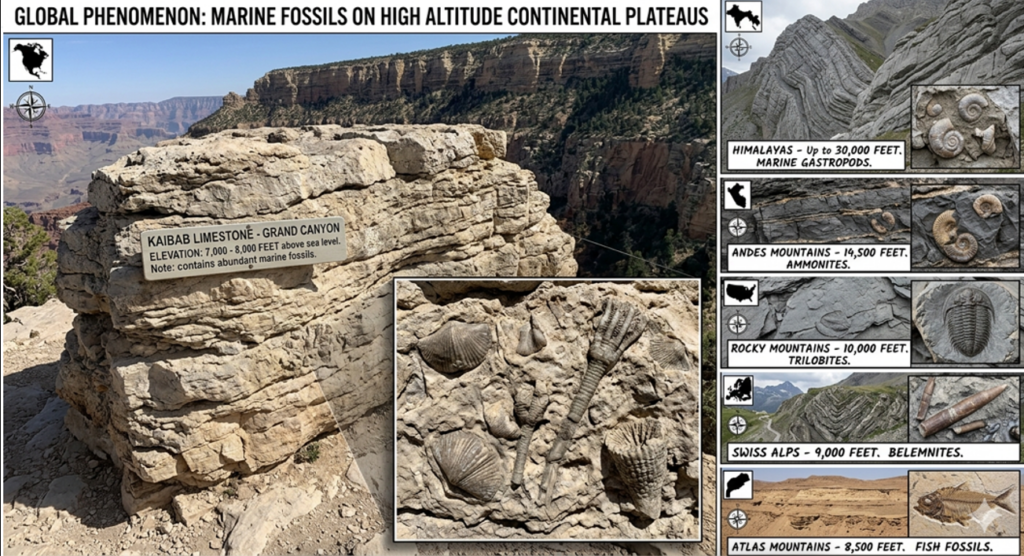
In addition, fossil evidence includes fossils of sea creatures high above sea level (see above AI photo), [172] rapid burial of plants and animals on every continent (see AI photo below), [173]
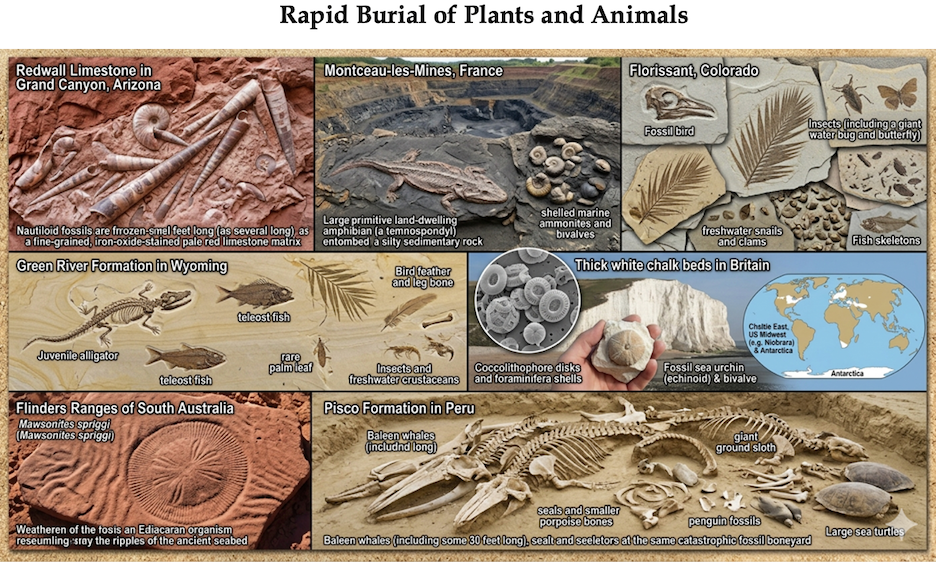
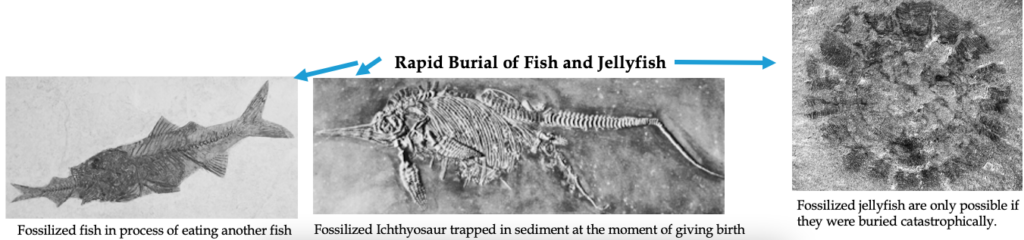
including sea creatures buried alive in the act of eating another fish or giving birth (see photo below), [174] and the order of the fossil record in rock layers. [175]
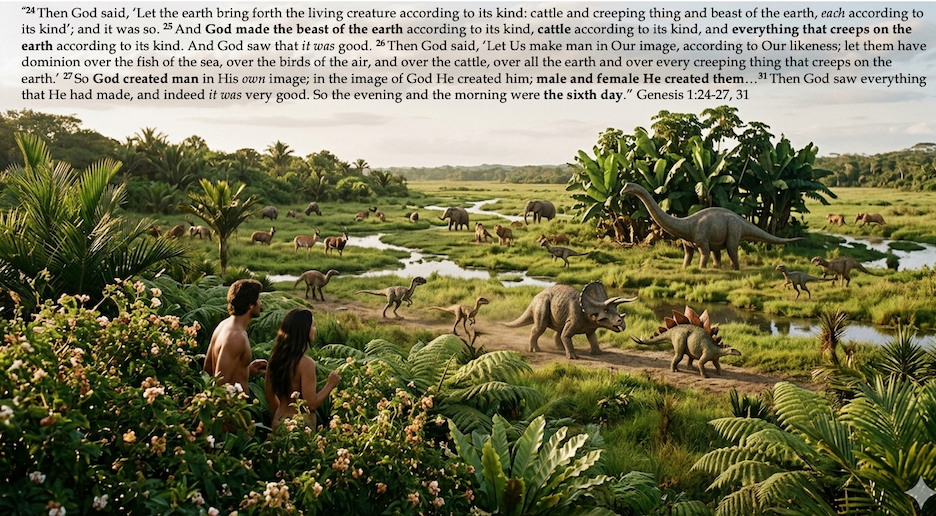
A literal understanding of the Bible teaches that humans and dinosaurs lived at the same time (see AI photo below) since God created the dinosaurs along with the other land animals on Day 6 of creation (Gen 1:24-25; cf. Job 40:15-24; 41:1-34), [176] the same day He created humans (Gen 1:26-27, 31). [177]
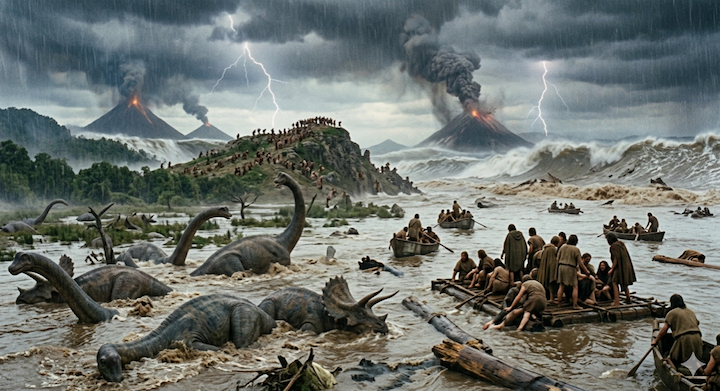
Why then, don’t we find human and dinosaur fossils together? The primary reasons given by creationists (see AI photo below) are the differences between their physical composition (dinosaurs had greater bone density and size, and tougher and thicker skin), their habitats (dinosaurs in swampy lowlands and humans in highlands), their mobility (humans have greater resilience and mobility), and their intelligence (humans sought higher ground, clung to floating debris, or used boats). [178]
It is possible that humans and dinosaurs never crossed paths. [179] Have Iowans ever seen a panda or tiger in their backyards? No, of course not! Yet, we live on the earth at the same time.
The most logical and plausible explanation for these fossil findings is a catastrophic global flood as described in the Bible (Gen. 6-8; 2 Pet. 3:6).
Conclusion
When quoting what Moses wrote in the Old Testament, Jesus referred to it as what “God said” in Matthew 15:4. Peter refers to the apostle Paul’s writings and then to “the other Scriptures,”indicating that Paul’s writings were authoritative Scripture (2 Pet. 3:16). The apostle Paul wrote to Timothy that “All Scripture is given by inspiration of God” (2 Tim. 3:16). The writers of the New Testament claimed that the Bible is the very Word of God. If we insist that the Bible is not true, then we are saying that we know more than Moses, David, Peter, Paul, and the Lord Jesus Christ did. None of are in a position to do that.
After comparing the Qur’an of Islam and the Bible of Christianity, we discover that by far the Bible has far more manuscript, documentary, and archaeological evidence than does the Qur’an. In addition, when we looked at the reasons why Muslims and Christians believe their sacred writings are true, Christians have far more reasonable and persuasive arguments to support the reliability of their Scripture than do Muslims.

As we conclude this portion of our comparative study, my heart is filled with compassion for our Muslim friends. They have placed their faith in a book that is clearly manmade. Unfortunately, this book is leading millions of people away from a saving knowledge of the Lord Jesus Christ of the Bible. God wants to use us to share His Word with the people of Islam. God alone (John 16:7-11) can remove the Satanic blinders which have deceived them and led them away from the truth of the gospel of Jesus Christ (cf. 2 Cor. 4:3-6; 11:3-4, 13-15; I John 2:22-23; 4:1-6; et al.). May God the Holy Spirit grant us the courage (Acts 4:29-31), clarity (Col. 4:4), opportunities (Col. 4:3), protection (2 Thess. 3:1-3), and wisdom (Matt. 10:16; Eph. 5:15-17; Col. 4:5-6), to point our Islamic friends to Jesus, Who alone can give them eternal life when they believe He is the Christ, the Son of God (John 20:31).
ENDNOTES:
[1] Norman L. Geisler and Abdul Saleeb, Answering Islam: The Crescent in Light of the Cross Second Ed. (Grand Rapids, MI: Baker Books, 1993, 2002), pg. 106 cites Al-Baqullani, Ijaz al-Qur’an (The Miracle of the Qur’an), pg. 38, as cited by Arthur Jeffery, Islam: Muhammad and His Religion (Indianapolis and New York: The Bobbs-Merrill Company, Inc., 1958), pg. 57.
[2] Verse taken from Usama K. Dakdok, THE GENEROUS QUR’AN: An Accurate, Modern English Translation of the Qur’an, Islam’s Holiest Book (Venice, FL: Usama Dakdok Publishing, LLC, 2009 Smashwords Edition), pg. 308. Used by permission of Usama Dakdok Publishing, LLC. Note: All Qur’an verses will come from this translation, unless otherwise noted.
[3] Ibid., pg. 406.
[4] Ibid., pg. 308.
[5] Geisler and Saleeb, Answering Islam (2002), pg. 186 cites Alhaj Ajijola, The Essence of Faith in Islam (Lahore, Pakistan: Islamic Publications, Ltd., 1978), pg. 90.
[6] Daniel Janosik, THE GUIDE TO ANSWERING ISLAM: What Every Christian Needs to Know About Islam and the Rise of Radical Islam(Cambridge, OH: Christian Publishing House, 2019 Kindle Edition), pp. 20-21, cites Ziauddin Sardar and Zafar Abbas Malik, Introducing Islam (Cambridge: Icon Books, 2001), pg. 30.
[7] Geisler and Saleeb, Answering Islam (2002), pg. 187.
[8] Verses taken from Usama K. Dakdok, THE GENEROUS QUR’AN, 2009 Smashwords Edition, pg. 556. Used by permission of Usama Dakdok Publishing, LLC.
[9] Nabeel Qureshi, No God but One: Allah or Jesus? A Former Muslim Investigates the Evidence for Islam and Christianity (Grand Rapids, MI: Zondervan, 2016 Kindle Edition), pg. 270.
[10] Verse taken from Usama K. Dakdok, THE GENEROUS QUR’AN, 2009 Smashwords Edition, pg. 652. Used by permission of Usama Dakdok Publishing, LLC.
[11] Qureshi, No God but One: Allah or Jesus, 2016 Kindle Edition, pp. 270-271.
[12] Dakdok shows this is inaccurate information about the development of the fetus – see Usama K. Dakdok, Exposing the Truth about the Qur’an: The Revelation of Error, Volume 2 (Venice, FL: Usama Dakdok Publishing, LLC, 2013 Smashwords Edition),pp. 269-272.
[13] Qureshi, No God but One: Allah or Jesus, 2016 Kindle Edition, pg. 247.
[14] See Dakdok’s comments exposing the error of this verse – Usama K. Dakdok, Exposing the Truth about the Qur’an: The Revelation of Error, Volume 1 (Venice, FL: Usama Dakdok Publishing, LLC, 2013 Smashwords Edition), pp. 49-50.
[15] Qureshi, No God but One: Allah or Jesus, 2016 Kindle Edition, pg. 271.
[16] Ibid.
[17] Ibid., pp. 271-272; cf. Geisler and Saleeb, Answering Islam (2002), pg.190 cites Rashad Khalifa, The Computer Speaks: God’s Message to the World (Tuscon: Iman, Mosque of Tuscon, Arizona, U.S.A., 1981), pp. 198-200.
[18] Ibid., pg. 272.
[19] Janosik, THE GUIDE TO ANSWERING ISLAM, 2019 Kindle Edition, pg. 36.
[20] Geisler and Saleeb, Answering Islam (2002), pp. 187-188 cites Suzanne Haneef, What Everyone Should Know About Islam and Muslims (Chicago: Kazi Publications, 1979), pp. 18-19.
[21] Geisler and Saleeb, Answering Islam (2002), pp. 190-191 cite Ajijola, The Essence of Faith in Islam, pp. 100—101.
[22] Walter Martin, The Kingdom of the Cults: The Definitive Work on the Subject, 6th Edition (Bloomington, MN: Bethany House Publishers, 2019 Kindle Edition), pg. 533.
[23] Ibid., cites C. G. Pfander, The Mizanu’l Haqq (Austria: Light of Life, 1986), pg. 264.
[24] Ibid., pg. 192 cites Ali Dashti, Twenty Three Years: A Study of the Prophetic Career of Mohammad (London: George Allen & Unwin, 1985), pp. 48-49.
[25] Ibid., pg. 193 cites Dashti, Twenty Three Years: A Study of the Prophetic Career of Mohammad (1985), pg. 50.
[26] Qureshi, No God but One: Allah or Jesus, 2016 Kindle Edition, pp. 274-275.
[27] Verses taken from Usama K. Dakdok, THE GENEROUS QUR’AN: An Accurate, Modern English Translation of the Qur’an, Islam’s Holiest Book (Venice, FL: Usama Dakdok Publishing, LLC, 2009 Smashwords Edition), pp. 36-37. Used by permission of Usama Dakdok Publishing, LLC.
[28] Verses taken from the New King James Version.
[29] Dr. Jay Smith, January 26, 2026, class lecture entitled, “Does the Qur’an Supersede the Bible?” cites Thomas Muir, A Treatise On The Theory Of Determinants (Macmillan and Co., 1882), pp. 18-19, 28; Theodore Nöldeke’s essay entitled, “The Quran,” in The Origins of the Koran: Classic Essays on Islam’s Holy Book, edited by Ibn Warraq(Prometheus Books, 1998), pp. 36, 44-47; Salmon Reinach, Orpheus: A History of Religions (1932), pg. 176.
[30] The Qur’an, English Translation by Abdullah Yusuf Ali (Goodword Books, Kindle Edition), pg. 161.
[31] Dakdok, THE GENEROUS QUR’AN, 2009 Smashwords Edition, pg. 255.
[32] Geisler and Saleeb, Answering Islam (2002), pg. 195 cites Pfander, The Mizanu’l Haqq, pg. 254.
[33] Ibid. pg. 196 cites W. Montgomery Watt, Muhammad: Prophet and Statesman (reprint: London: Oxford University Press, 1967), pg. 40.
[34] Ibid., pg. 196 cites Joseph P. Gudel, To Every Muslim An Answer (unpublished thesis at Simon Greenleaf School of Law, 1982), pg. 72.
[35] Ibid.
[36] Ibid., pp. 159-161, cites Tor Andrae, Mohammed: The Man and His Faith (Rev. ed. New York: Harper & Row, 1955), pp. 43-44; Muhammad Husayn Haykal, The Life of Muhammad (Indianapolis: North American Trust Publications, 1976), pp. 74-75, 231, 337, 496.
[37] Qureshi, No God but One: Allah or Jesus, 2016 Kindle Edition, pp. 277-278.
[38] Ibid., pg. 276.
[39] Dakdok, Exposing the Truth about the Qur’an: The Revelation of Error, Volume 2, 2013 Smashwords Edition,pp. 270-272.
[40] Verse taken from Dakdok, The Generous Qur’an, 2009 Smashwords Edition, pg. 476 with permission of Usama Dakdok Publishing, LLC.
[41] Dakdok, Exposing the Truth about the Qur’an: The Revelation of Error, Volume 2, 2013 Smashwords Edition,pg. 270.
[42] Ibid., pp. 270-271.
[43] Ibid., pg. 271.
[44] Ibid.
[45] Ibid., pp. 271-272.
[46] Qureshi, No God but One: Allah or Jesus, 2016 Kindle Edition, pg. 278.
[47] Geisler and Saleeb, Answering Islam (2002), pg. 205.
[48] Rashad Khalifa, The Computer Speaks: God’s Message to the World (Tuscon: Iman, Mosque of Tuscon, Arizona, U.S.A., 1981).
[49] Qureshi, No God but One: Allah or Jesus, 2016 Kindle Edition, pg. 279.
[50] Ibid., cites Abu Ameenah Bilal Philips, The Qur’an’s Numerical Miracle.
[51] Ibid., pg. 280 cites Bilal Philips, The Qur’an’s Numerical Miracle.
[52] Geisler and Saleeb, Answering Islam (2002), pg. 206.
[53] Ibid., cites Gerhard Nehls, Christians Ask Muslims (SIM International Life Challenge, 1987), pg. 127.
[54] Ibid.
[55] Qureshi, No God but One: Allah or Jesus, 2016 Kindle Edition, pg. 281 cites Sahih Bukhari 6.61.510 in the Hadith.
[56] Ibid., Qureshi notes that “some Muslims argue here that the variants were only in the vocalization of the Quran, but the vocalizations were not yet recorded in the text. In other words, there would be no reason to destroy the manuscripts because of variant vocalizations. The difference must have been in the rasm, the consonantal text itself.”
[57] Geisler and Saleeb, Answering Islam (2002), pg. 197 cite Arthur Jeffrey, Materials For the History of the Text of the Qur’an (New York: AMS Press, Inc., 1975), pp. 7-8.
[58] Qureshi, No God but One: Allah or Jesus, 2016 Kindle Edition, pg. 281 cites Sahih Bukhari 6:61.509 in the Hadith.
[59] Ibid.
[60] Janosik, THE GUIDE TO ANSWERING ISLAM, 2019 Kindle Edition, pp. 41-42 cites John Wansbrough, Quranic Studies: Sources and Methods of Scriptural Interpretation (New York: Prometheus Books, 2004), XV; Yehuda Nevo and Judith Koren, Crossroads to Islam: The Origins of the Arab Religion and the Arab State (New York: Prometheus Books, 2003), pg. 11.
[61] Dr. Jay Smith, March 9, 2026, class lecture entitled, “Manuscript Evidence for the Qur’an,” cites Dr. Tayyar Altıkulaç, Al-Muṣḥaf Al-Sharif: Attributed To ʿUthmān Bin ʿAffān (IRICA, 2007), pp. 23, 36 – footnote 14a, 41f, 65, 71-72, 81; François Déroche, La transmission écrite du Coran dans les débuts de l’islam. Le codex Parisino-petropolitanus (Brill, 2009), pp. 172-177; cf. Jay Smith, “The Bible and The Qur’an – An Historical Comparison,” at www.pfandercenter.org where he cites Martin Lings and Yasin Hamid Safadi, The Qur’an: Catalogue of an Exhibition of Quran Manuscripts at the British Library, 3 April – 15 August, 1976 (British Library, World of Islam Pub. Co., 1976), pp. 11-20.
[62] Daniel Brubaker, Corrections in Early Qurʾān Manuscripts: Twenty Examples (FULL COLOR EDITION) (Quran Manuscript Change Studies Book 1), 2019 Kindle Locations 168-169.
[63] Retrieved on May 11, 2026, from the March 23, 2026, PowerPoint entitled, “In Search of the Book – the Qur’an,” at www.pfandercenter.org.
[64] Geisler and Saleeb, Answering Islam (2002), pp. 206-207.
[65] Ibid., pg. 207.
[66] Ibid., pg. 210.
[67] Tom Constable, Dr. Constable’s Notes on Daniel, 2025 Edition, pp. 6, 40.
[68] Conservative scholars believe Job was written during the Patriarchal period (2100 -1900 B.C.). See Roy B. Zuck, “Job,” The Bible Knowledge Commentary Wisdom, 2018 Kindle Edition, pp. 15-16; Tom Constable, Notes on Job, 2025 Edition, pp. 1-2.
[69] Robert Vacendak, “Revelation,” The Grace New Testament Commentary: Revised Edition, 2019 Kindle Edition, pp. 1944-1945; John F. Walvoord, “Revelation,” The Bible Knowledge Commentary Epistles and Prophecy, 2018 Kindle locations 4701 to 4707; Archibald Thomas Robertson, A. T. Robertson’s Word Pictures in the New Testament, 2014 Kindle Locations 211099 -211108.
[70] Tommy Mitchell, The New Answers Book 1 Gen. Ed. Ken Ham and Bodie Hodge (Green Forest, AR: Master Books, 2006 Kindle Edition), pp. 325-338.
[71] The Greek word translated “moved” (pheromenoi / pherō) means to be “directed, driven, or moved” when in the middle or passive voice. See Walter Bauer, A Greek-English Lexicon of the New Testament and Other Early Christian Literature, 2000 Kindle Edition, pg. 1051.
[72] Christianity teaches that the Bible is without error in the original text of the Bible, not in the subsequent copies or translations.
[73] Robertson, A. T. Robertson’s Word Pictures in the New Testament, 2014 Kindle Locations 174792-174795); Tom Constable, Dr Constable’s Notes on 2 Timothy, 2026 Edition, pg. 48.
[74] Robert Wilkin, “2 Timothy,” The Grace New Testament Commentary: Revised Edition, 2019 Kindle Edition, pp. 1557, 1578-1579.
[75] Adapted from Norman Geisler and William E. Nix, From God To Us Revised and Expanded: How We Got Our Bible (Chicago, IL: Moody Publishers, 1974, 2012 Kindle Edition), pp. 16-18, unless otherwise noted.
[76] Sid S. Buzzell, “Proverbs,” The Bible Knowledge Commentary Wisdom, 2018 Kindle Edition, pg. 597.
[77] Geisler and Nix, From God To Us Revised and Expanded, 2012 Kindle Edition, pg. 18.
[78] Ibid., pp. 19-20. For a more detailed discussion of textual criticism, see chapter 14, “The Development of Textual Criticism,” in see Geisler and Nix, From God To Us Revised and Expanded, 2012 Kindle Edition, pp. 221-238.
[79] Josh McDowell and Sean McDowell, Evidence That Demands a Verdict: Life-Changing Truth for a Skeptical World (Nashville, TN: Thomas Nelson, 2017 Kindle Edition), pg. 46 cites John Warwick Montgomery, History and Christianity (Downers Grove, IL: InterVarsity Press, 1971), pg. 26.
[80] Smith, “The Bible and The Qur’an – An Historical Comparison,” at www.pfandercenter.org.
[81] Chart adapted from McDowell, Evidence That Demands a Verdict: Life-Changing Truth for a Skeptical World, 2017 Kindle Edition, pp. 55-63 and from Smith, March 9, 2026, class lecture entitled, “Manuscript Evidence for the Qur’an.”
[82] Bryan Windle, July 16, 2021, article entitled, “Top Ten Discoveries Related to Abraham,” at www.biblearchaeologyreport.com cites Kenneth A. Kitchen,” Shishak’s Military Campaign in Israel Confirmed,” at www.library.biblicalarchaeology.org; McDowell, Evidence That Demands a Verdict, 2017 Kindle Edition, pg. 452 cites Kitchen, On the Reliability of the Old Testament (2003), pg. 313.
[83] McDowell, Evidence That Demands a Verdict, 2017 Kindle Edition, pg. 516 cites André Lemaire, “‘House of David’ Restored in Moabite Inscription,” Biblical Archaeology Review 20, no. 3 (1994), pg. 36 and George Athas, The Tel Dan Inscription: A Reappraisal and a New Interpretation (London: T&T Clark, 2003), pg. 281 and Steven L. McKenzie, King David: A Biography (Oxford University Press, 2000, E-book), pg. 13; Joseph M. Holden and Norman Geisler, The Popular Handbook of Archaeology and the Bible, 2013 Kindle Locations 3006-3045.
[84] William A. Ramsay, Was Christ Born at Bethlehem? A Study on the Credibility of St. Luke (Originally published Paternoster Row, London: Hodder and Stoughton, 1898; Seattle, WA: re:Source Digital Publishing, 2018 Kindle Edition), pp. 160-161; Holden and Geisler, The Popular Handbook of Archaeology and the Bible, 2013 Kindle Locations 1741-1743; Jack Finegan, Handbook of Biblical Chronology: Principles of Time Reckoning in the Ancient World and Problems of Chronology in the Bible, Revised Edition (Peabody, MA: Hendrickson Publishers, 1998), pg. 304; William Mitchell Ramsay, The Bearing of Recent Discovery on the Trustworthiness of the New Testament (Originally published in London: Hodder & Stoughton, 1915; 2021 Kindle Edition), pp. 283-290; Tom Constable, Dr. Constable’s Notes on Luke, 2026 Edition, pg. 58 cites Harold W. Hoehner, Chronological Aspects of the Life of Christ, Contemporary Evangelical Perspectives series (Grand Rapids: Zondervan Publishing House, 1977), pg. 22; cf. Flavius Josephus, Antiquities of the Jews, 18:1:1; 18:2:1; Eusebius, The Ecclesiastical History of Eusebius Pamphilus Twin Brooks series. Popular ed. (Grand Rapids: Baker Book House, 1974), 1:5:28; Jack Finegan, Light from the Ancient Past: The Archeological Background of Judaism and Christianity 2nd edition (Princeton University Press. London: Oxford University Press, 1959), pp. 258-261; Joseph P. Free, Archaeology and Bible History 6th ed. (Wheaton: Scripture Press, 1950, 1959), pp. 285-286; J. Warner Wallace, August 16, 2017, “Unbelievable? Is Luke’s Description Of Quirinius Historically Inaccurate?” at www.coldcasechristianity.com.
[85] Gary Habermas, The Historical Jesus (Joplin, MO: College Press, 1996, 2008), pp. 198-224; Daniel Janosik, March 16, 2026, class lecture entitled, “Is the Bible the Word of God?”
[86] McDowell, Evidence That Demands a Verdict, 2017 Kindle Edition, pg. 88 cites Howard F. Vos ed. Can I Trust the Bible? (Chicago, IL: Moody Press, 1963), 180 and David E. Graves, Biblical Archaeology: An Introduction with Recent Discoveries That Support the Reliability of the Bible (Moncton, New Brunswick, Canada: Electronic Christian Media, 2014), pp. 215-216.
[87] Tom Constable, Dr. Constable’s Notes on Genesis, 2026 Edition, pg. 200 cites Kyle M. Yates, “Genesis,” The Wycliffe Bible Commentary, Edited by Charles F. Pfeiffer and Everett F. Harrison (Chicago: Moody Press, 1962), pg. 16.
[88] Retrieved on April 26, 2026, from Bryan Windle, July 16, 2021, article entitled, “Top Ten Discoveries Related to Abraham,” at https://biblearchaeologyreport.com/2021/07/16/top-ten-discoveries-related-to-abraham/
[89] Constable, Dr. Constable’s Notes on Genesis, 2026 Edition, pg. 215.
[90] More recent archaeological research places Bethel at el-Bira, about 10.3 miles north of Jerusalem and Ai at Khirbet el-Maqatir about 1 mile southeast of el-Bira – see Bryan Windle, April 12, 2019, “Biblical Sites: The Lost City of Ai… Found,” at www.biblearchaeologyreport.com cites Bryant G. Wood, “The Search for Joshua’s Ai,” in Critical Issues in Early Israelite History, edited by Richard S. Hess, Gerald A. Klingbeil, and Paul J. Ray Jr. (Winona Lake: Eisenbrauns 2008), pp. 210-240; Bryant G. Wood, “Excavations at Khirbet el-Maqatir: 1995 to 2000 and 2009 to 2011,” Associates for Biblical Research, April 4, 2012; Scott Stripling, “2014 Excavations at Kh. el-Maqatir: A Proposed New Location for Ai and Ephraim,” Associates for Biblical Research, March 9, 2015; cf. McDowell Evidence That Demands a Verdict, 2017 Kindle Edition, pp. 500 -501.
[91] Location of Tall el-Hammam. (a) Photo of the southern Levant, looking north, showing the Dead Sea, the site location (TeH), and nearby countries. The Dead Sea Rift, the fault line marking a major tectonic plate boundary, runs through the area. Source of base (b) Photo: NASA, Space Shuttle. “The Sinai Peninsula and the Dead Sea Rift”. Photo: sts109-708-024, taken 12/16/2009. From the NASA Langley Research Center Atmospheric Science Data Center (nasa.gov/topics/earth/features/astronauts_eyes/sts109-708-024.html). Adapted from Daniel Janosik March 16, 2026, class lecture entitled, “Is the Bible the Word of God?”; Holden and Geisler, The Popular Handbook of Archaeology and the Bible, 2013 Kindle Locations 2509-2514 cite Steve Collins, “Where is Sodom? The Case for Tall el-Hammam,” Biblical Archaeology Review, March/April 2013; Malcolm A. LeCompte, Steven Collins, Phillip J. Silvia, Gunther Kletetschka, Timothy Witwer, Robert E. Hermes, Christopher R. Moore, Wendy S. Wolbach, George A. Howard, A. Victor Adedeji, Charles Mooney, James P. Kennett, Allen West, Ted E. Bunch, May 24, 2025, research article entitled, “A Tunguska Sized Airburst Destroyed Tall el-Hammam a Middle Bronze Age City in the Jordan Valley Near the Dead Sea (Expanded),” at www.scienceopen.com or at this LINK.
[92] McDowell, Evidence That Demands a Verdict, 2017 Kindle Edition, pg. 497 cites Bryant Wood, “Did the Israelites Conquer Jericho? A New Look at the Archaeological Evidence,” Biblical Archaeology Review 16, no.2 (Mar/Apr 1990), pp. 10-12; Bryant G. Wood, June 9, 2008, research article, “The Walls of Jericho,” at www.biblearchaeology.org or at this LINK; Bryant Wood, March 1, 1999, “The Walls of Jericho,” at www.answersingenesis.org cites Ernst Sellin and Carl Watzinger, Jericho die Ergebnisse der Ausgrabungen, Osnabrück, Otto Zeller Verlag (1973), pg. 58, (reprint of the 1913 edition), and Kathleen M. Kenyon, Excavations at Jericho (London, British School of Archaeology in Jerusalem, 1981), Vol. 3, pp. 110, 370.
[93] Ramsay, The Bearing of Recent Discovery on the Trustworthiness of the New Testament (1915), 2021 Kindle Edition, pp. 67-76; cf. McDowell, Evidence That Demands a Verdict, 2017 Kindle Edition, pg. 88 cites Free, Archaeology and Bible History 6th ed. (1950, 1959), pg. 317.
[94] Norman L. Geisler and Thomas Howe, The Big Book of Bible Difficulties: Clear and Concise Answers from Genesis to Revelation (Grand Rapids, MI: Baker Books, 2008), pg. 47
[95] Janosik, THE GUIDE TO ANSWERING ISLAM, 2019 Kindle Edition, pg. 56 cites Peter Townsend, The Mecca Mystery: Probing the Black Hole at the Heart of Muslim History (Peter Townsend, 2018), pg. 104 and Dan Gibson, Qur’anic Geography: A Survey and Evaluation of the Geographical References in the Qur’an with Suggested Solutions for Various Problems and Issues (Canada: Independent Scholars Press, 2011), pg. 137.
[96] Dates for each of the first four kingdoms are taken from Tom Constable, Dr. Constable’s Notes on Daniel, 2026 Edition, pp. 49-51; cf. J. Dwight Pentecost, “Daniel,” The Bible Knowledge Commentary Major Prophets, 2018 Kindle Edition, pp. 706-709, 740-750.
[97] Constable, Dr. Constable’s Notes on Daniel, 2026 Edition, pp. 56-57 cites John F. Walvoord, Daniel: The Key to Prophetic Revelation. Chicago: Moody Press, 1971), pp. 72-73. I see the two iron legs referring to ancient Rome (Dan. 2:40) and the ten-toes form (Dan. 2:41-43) referring to the revived Roman Empire in the Tribulation period whereby the “little horn” (antichrist) will rule the world (Dan. 7:7b, 19-28; cf. Rev. 13:1-10).
[98] The entireBible has been translated into 799 different languages, the New Testament into 1,832different languages, and portions of Scriptureinto 1,514 languages (each language only included in one category), totaling 4145 different languages – retrieved on May 22, 2026, from May 4, 2026, update from Wycliffe Bible Translators (www.wycliffe.org.uk) which cites statistics from ProgressBible Snapshot (May 2026).
[99] The Bible has influenced multiple areas of human culture, including government, education, literature, music, law, art, history, and religion. For a list of articles demonstrating these influences, go to this SITE.
[100] In the early church when few people could read, art helped people encounter God through paintings and sculptures placed into stone or glass and on canvas, walls or ceilings. Iconic artistic creations, such as Leonardo da Vinci’s The Last Supper, Michelangelo’s ceiling in the Sistine Chapel, and Raphael’s Cartoons are direct products of biblical narratives and were meant to communicate the gospel (see Jeremy Norton’s article entitled, “Are and Music Shaped by the Gospel,” at www.leadbiblically.com).
[101] Norton writes, “From ancient Israel’s songs to the early church’s hymns, music has carried faith forward. Western composers like Vivaldi, Bach, Handel, Mozart, and Beethoven all began in the church” and were influenced by the Bible. When we survey history, we discover that “Gospel songs shaped entire genres. Hymns were sung in fields and factories, on trains and in chapels. The roots of rock, blues, country, and even hip-hop trace back to songs about grace, freedom, and redemption… Even now, many musicians first learn to play or sing in a church context, discovering their gifts by praising God before ever stepping on a stage.” (Ibid.). Examples include Aretha Franklin, Britney Spears, Diana Ross, Elvis Presley, Jamie Foxx, Justin Timberlake, Kate Perry, Lou Rawls, Marvin Gaye, Usher, and Whitney Houston (see December 24, 2018, article entitled, “11 pop stars you’d never believe used to be choristers,” at www.classicfm.com and Sunny Morgan, December 10, 2023, article entitled, “13 R&B singers who started in the church,” atwww.revolt.tv).
[102] Examples include Isaac Newton (Calculus, Dynamics, Law of Gravity, Reflecting Telescope), Louis Pasteur (Bacteriology, Biogenesis Law, Fermentation Control, Pasteurization, Vaccination & Immunization),Joseph Lister (antiseptic surgery), Johann Kepler (Celestial Mechanics, Physical Astronomy, Ephemeris Tables), Robert Boyle (Chemistry, Gas Dynamics), Georges Cuvier (Comparative Anatomy, Vertebrate Paleontology), Lord Rayleigh (Dimensional Analysis, Model Analysis), John Ambrose Fleming (Electronics, Thermionic Valve), Michael Faraday (Electro-magnetics, Electric Generator), Lord Kelvin (Energetics, Thermodynamics, Absolute Temperature Scale, Trans-Atlantic Cable), George Stokes (Fluid Mechanics), Gregor Mendel (Genetics), Lous Agassiz (Glacial Geology, Ichthyology), Leonardo Da Vinci (Hydraulics), William Ramsay (Isotopic Chemistry, Inert Gases), Matthew Maury (Hydrography, Oceanography), John Woodward (Paleontology), Francis Bacon (Scientific Method), Samuel F.B. Morse (Telegraph) – retrieved on May 22, 2026, from Henry M. Morris, January 1, 1982, article entitled, “Bible-Believing Scientists of the Past,” at www.icr.org; George Washington Carver (Botany) – see David B. Calhoun, June 4, 2013, article entitled, “George Washington Carver (1860-1943),” at www.cslewisinstitute.org; Christopher Columbus’ search for the New World was motivated most by his faith in the God of the Bible, not gold – see May 29, 2023, article entitled, “Columbus: God Over Gold,” at www.wallbuilders.com.
[103] Daniel Merritt, August 18, 2019, article entitled, “Voltaire’s Prediction, Home, and the Bible Society: Truth or Myth? Further Evidence of Verification,” at www.crossexamined.org.
[104] See article entitled, “Best-Selling Book,” at www.guinnessworldrecords.com which cites The British and Foreign Bible Society 2021 research.
[105] Henry M. Morris III, Many Infallible Proofs: Evidences for the Christian Faith (The Henry Morris Signature Collection), (Green Forest, AR: Master Books, First Printing 1974; Revised and Expanded 2021 Kindle Edition), pp. 191-192.
[106] The Hebrew word ‘āp̄ār refers to “dry, loose dirt, earth… specifically as material of human body,” seeFrancis Brown, S.R. Driver, Charles A. Briggs, A Hebrew and English Lexicon Of The Old Testament: With An Appendix Containing The Biblical Aramaic (Omaha, NE: Patristic Publishing, 2020 Kindle Edition), pg. 3376.
[107] Ginger Allen, February 15, 2012, article entitled, “From Dust to Dust,” at www.answersingenesis.org cites The Role of Elements in Life Processes at http://www.mii.org/periodic/LifeElement.html and Frederick K. Lutgens, and Edward J. Tarbuck, Essentials of Geology, 7th Ed. (Upper Saddle River, New Jersey: Prentice Hall, 2000).
[108] Ibid.
[109] Mitchell, The New Answers Book 1, Gen. Ed. Ken Ham and Bodie Hodge, 2006 Kindle Edition, pp. 327-328; cf. John D. Morris, The Young Earth: The Real History of the Earth – Past, Present, and Future (Revised and Expanded First Printing 2007, 2021 Kindle Edition), pg. 132. Morris writes, “By way of explanation, plants are biologically alive, but have no ‘breath of life’ (Gen. 2:7). Furthermore, ‘The life of the flesh is in the blood’ (Lev. 17:11). Plants have no consciousness, no breath, and no blood, and thus are not living in the biblical sense of living. They were created specifically to nourish living things. Their biological death (and perhaps also that of many of the lesser forms of life technically classed as animals) does not constitute the death of a biblically living, breathing, blood-filled creature.” While animals also received the “breath” (neshama – Gen. 7:22), they do not possess “the image of God” which gives man the authority and ability to exercise dominion over creation, including animals (Gen. 1:26-28).
[110] Tony Evans, The Tony Evans Bible Commentary, 2019 Kindle Edition, pg. 134.
[111] Photo from Ken Ham, The New Answers Book 1, Gen. Ed. Ken Ham and Bodie Hodge, 2006 Kindle Edition, pg. 223.
[112] The Tower of Babel (Gen. 11:1-9) explains how the nations came to be scattered across the ancient world according to their languages (Gen. 10:1-32) – see Allen P. Ross, “Genesis,” The Bible Knowledge Commentary Law, 2018 Kindle Edition, pg. 70; Tom Constable, Dr. Constable’s Notes on Genesis, 2026 Edition, pp. 176-178. .
[113] Ham, The New Answers Book 1, Gen. Ed. Ken Ham and Bodie Hodge, 2006 Kindle Edition, pp. 225-232; cf. Morris, Many Infallible Proofs, 2021 Kindle Edition, pp. 368-373.
[114] Bodie Hodge, The New Answers Book 2 Gen. Ed. Ken Ham and Bodie Hodge (Green Forest, AR: Master Books, First Printing 2008, 2024 Kindle Edition), pp. 401-404 cites Vistawide, “World Language Families,” www.vistawide.com/languages/language_families_statistics1.htm , Ethnologue, “Statistical Summaries,” www.ethnologue.com/ethno_docs/distribution.asp?by=family, Comparison of Matthew 6:9, Mansfield University, www.faculty.mansfield.edu/bholtman/holtman/101/GmcVaterunser.pdf, and Pam Sheppard, “Tongue-Twisting Tales,” Answers, April–June 2008, pp. 56–57.
[115] Ham, The New Answers Book 1, Gen. Ed. Ken Ham and Bodie Hodge, 2006 Kindle Edition, pp. 220-231; Stacia McKeever and Ken Ham, The New Answers Book 2 Gen. Ed. Ken Ham and Bodie Hodge, 2024 Kindle Edition, pp. 13-18.
[116] Troy Lacey (with Bodie Hodge), The New Answers Book 4, Gen. Ed. Ken Ham and Bodie Hodge, 2023 Kindle Edition, pp. 309-317 cite Pam Sheppard, “Tongue Twisting Tales,” Answers in Genesis, http://www.answersingenesis.org/articles/am/v3/n2/tongue-twisting-tales; Charles Martin, Flood Legends: Global Clues of a Common Event (Green Forest, AR: Master Books, 2009), pp. 126–129, 131–143; James George Frazier, Folklore in the Old Testament: Studies in Comparative Religion (Whitefish, MT: Kessinger Publishing, 2010), pp. 310–312.
McKeever and Ham, The New Answers Book 2, Gen. Ed. Ken Ham and Bodie Hodge, 2024 Kindle Edition, pg. 18.
[117] This paragraph is adapted from Dr. Jason Lisle, The New Answers Book 2, Gen. Ed. Ken Ham and Bodie Hodge, 2024 Kindle Edition, pp. 119-122.
[118] Wikimedia Commons Photo taken from Artemis II mission.
[119] Lisle, The New Answers Book 2, Gen. Ed. Ken Ham and Bodie Hodge, 2024 Kindle Edition, pg. 122.
[120] Larry Pierce and Ken Ham, The Answers Book 2, Gen. Ed. Ken Ham and Bodie Hodge, 2024 Kindle Edition, pp. 64-76.
[121] Mike Riddle, The New Answers Book 1, Gen. Ed. Ken Ham and Bodie Hodge, 2006 Kindle Edition, pp. 114-124.
[122] Dr. Andrew A. Snelling, Dr. David Menton, Dr. Danny R. Faulkner, and Dr. Georgia Purdom, The New Answers Book 4 Gen. Ed. Ken Ham and Bodie Hodge (Green Forest, AR: Master Books, First Printing 2013, 2023 Kindle Edition), pp.177-180 cite A.L. McDonald and R.H. Gunst, “An Analysis of the Earth’s Magnetic Field from 1835 to 1965,” ESSA Technical Report, IER 46-IES 1 (Washington, DC: U.S. Government Printing Office, 1967); R.T. Merrill and M.W. McElhinney, The Earth’s Magnetic Field (London: Academic Press, 1983), pp. 101–106; D. Russell Humphreys, “The Earth’s Magnetic Field Is Still Losing Energy,” Creation Research Society Quarterly 39, no. 1 (2002): pp. 1–11; Thomas G. Barnes, “Decay of the Earth’s Magnetic Field and the Geochronological Implications,” Creation Research Society Quarterly 8, no. 1 (1971): pp. 24–29; Thomas G. Barnes, Origin and Destiny of the Earth’s Magnetic Field, Technical Monograph no. 4, 2nd edition (Santee, CA: Institute for Creation Research, 1983); D. Russell Humphreys, “Reversals of the Earth’s Magnetic Field During the Genesis Flood,” in Proceedings of the First International Conference on Creationism, vol. 2, R.E. Walsh, C.L. Brooks, and R.S. Crowell, eds. (Pittsburgh, PA: Creation Science Fellowship, 1986), pp. 113–126. For a fuller treatment and further information see John D. Morris, The Young Earth: The Real History of the Earth – Past, Present, and Future (Revised and Expanded First Printing, 2007, 2021 Kindle Edition), pp. 79-87; Andrew A. Snelling, Earth’s Catastrophic Past: Geology, Creation and the Flood (Dallas, TX: Institute for Creation Research, 2009), pp. 873–877.
[123] Snelling, Menton, Faulkner, Purdom, The New Answers Book 4 Gen. Ed. Ken Ham and Bodie Hodge, 2023 Kindle Edition, pp. 181-182 cites R.V. Gentry, G.L. Glish, and E.H. McBay, “Differential Helium Retention in Zircons: Implications for Nuclear Waste Containment,” Geophysical Research Letters 9, no. 10 (1982): pp. 1129–1130; S.W. Reiners, K.A. Farley, and H.J. Hicks, “He Diffusion and (U-Th)/He Thermochronometry of Zircon: Initial Results from Fish Canyon Tuff and Gold Butte, Nevada,” Tectonophysics 349, no. 1–4 (2002): pp. 297–308; D. Russell Humphreys et al., “Helium Diffusion Rates Support Accelerated Nuclear Decay,” in Proceedings of the Fifth International Conference on Creationism, R.L. Ivey Jr., ed. (Pittsburgh, PA: Creation Science Fellowship, 2003), pp. 175–196; D. Russell Humphreys, “Young Helium Diffusion Age of Zircons Supports Accelerated Nuclear Decay,” in Radioisotopes and the Age of the Earth: Results of a Young-Earth Creationist Research Initiative, L. Vardiman, A.A. Snelling, and E.F. Chaffin, eds. (El Cajon, CA: Institute for Creation Research, and Chino Valley, AZ: Creation Research Society, 2005), pp. 25–100; Humphreys et al., “Helium Diffusion Rates Support Accelerated Nuclear Decay”; Humphreys, “Young Helium Diffusion Age of Zircons Supports Accelerated Nuclear Decay”; Andrew A. Snelling, “Radiometric Dating: Back to Basics,” Answers 4, no. 3 (July–Sept. 2009): pp. 72–75; Andrew A. Snelling, “Radiometric Dating: Problems With the Assumptions,” Answers 4, no. 4 (Oct.–Dec. 2009): pp. 70–73; Don DeYoung, (research by Russell Humphrey), Thousands…Not Billions (Green Forest, AR: Master Books First Printing 2005, 2024 Kindle Edition, pp. 51-66.
[124] Snelling, Menton, Faulkner, Purdom, The New Answers Book 4 Gen. Ed. Ken Ham and Bodie Hodge, 2023 Kindle Edition, pp. 182-183 cite G.E. Hutchinson, “Marginalia,” American Scientist 35 (1947): pg. 118; Melvin A. Cook, “Where Is the Earth’s Radiogenic Helium?” Nature 179, no. 4557 (1957): pg. 213; J.C.G. Walker, Evolution of the Atmosphere (London: Macmillan, 1977); J.W. Chamberlain and D.M. Hunten, Theory of Planetary Atmospheres, 2nd edition (London: Academic Press, 1987); Larry Vardiman, The Age of the Earth’s Atmosphere: A Study of the Helium Flux Through the Atmosphere (El Cajon, CA: Institute for Creation Research, 1990). For a fuller treatment and further information see Morris, The Young Earth (Revised and Expanded), 2021 Kindle Edition, pp. 87-89; Snelling, Earth’s Catastrophic Past: Geology, Creation and the Flood (2009), pp. 887–890.
[125] Snelling, Menton, Faulkner, Purdom, The New Answers Book 4 Gen. Ed. Ken Ham and Bodie Hodge, 2023 Kindle Edition, pp. 166-167 cite John D. Milliman and James P. N. Syvitski, “Geomorphic/Tectonic Control of Sediment Discharge to the Ocean: The Importance of Small Mountainous Rivers,” The Journal of Geology 100 (1992): pp. 525–544; William W. Hay, James L. Sloan II, and Christopher N. Wold, “Mass/Age Distribution and Composition of Sediments on the Ocean Floor and the Global Rate of Sediment Subduction,” Journal of Geophysical Research 93, no. B12 (1998): pp. 14, 933–14,940. For a fuller treatment and further information see Morris, The Young Earth (Revised and Expanded), 2021 Kindle Edition, pp. 93-94; Snelling, Earth’s Catastrophic Past: Geology, Creation and the Flood (2009), pp. 881–884.
[126] Snelling, Menton, Faulkner, Purdom, The New Answers Book 4 Gen. Ed. Ken Ham and Bodie Hodge, 2023 Kindle Edition, pp. 187-189 cite M. Meybeck, “Concentrations des eaux fluvials en majeurs et apports en solution aux oceans,” Revue de Géologie Dynamique et de Géographie Physique 21, no. 3 (1979): pg. 215; F.L. Sayles and P.C. Mangelsdorf, “Cation-Exchange Characteristics of Amazon with Suspended Sediment and Its Reaction with Seawater,” Geochimica et Cosmochimica Acta 43 (1979): pp. 767–779; Steven A. Austin and D. Russell Humphreys, “The Sea’s Missing Salt: A Dilemma for Evolutionists,” in Proceedings of the Second International Conference on Creationism, pp. 17–33. For a fuller treatment and further information see Morris, The Young Earth (Revised and Expanded), 2021 Kindle Edition, pp. 89-91; Snelling, Earth’s Catastrophic Past: Geology, Creation and the Flood (2009), pp. 879–881.
[127] Morris, The Young Earth (Revised and Expanded), 2021 Kindle Edition, pp. 92-93.
[128] Snelling, Menton, Faulkner, Purdom, The New Answers Book 4 Gen. Ed. Ken Ham and Bodie Hodge, 2023 Kindle Edition, pp. 183-185 cite Robert L. Whitelaw, “Time, Life, and History in the Light of 15,000 Radiocarbon Dates,” Creation Research Society Quarterly 7, no. 1 (1970): pp. 56–71; Paul Giem, “Carbon-14 Content of Fossil Carbon,” Origins 51 (2001): pp. 6–30; John R. Baumgardner et al., “Measurable 14C in Fossilized Organic Materials: Confirming the Young Earth Creation-Flood Model,” in Proceedings of the Fifth International Conference on Creationism, R.L. Ivey, Jr., ed. (Pittsburgh, PA: Creation Science Fellowship, 2003), pp. 127–142; John R. Baumgardner, “14C Evidence for a Recent Global Flood and a Young Earth,” in Radioisotopes and the Age of the Earth: Results of a Young-Earth Creationist Research Initiative (2005), pp. 587–630; For a fuller treatment and further information see Don DeYoung, Thousands . . . Not Billions, 2024 Kindle Edition, pp. 45–62; Snelling, Earth’s Catastrophic Past: Geology, Creation and the Flood (2009), pp. 855–864; Andrew A. Snelling, “Carbon-14 Dating — Understanding the Basics,” Answers 5, no. 4 (Oct.–Dec. 2010): pp. 72–75; Andrew A. Snelling, “Carbon-14 in Fossils and Diamonds — an Evolution Dilemma” Answers 6, no. 1 (Jan.–Mar. 2011): pp. 72–75; Andrew A. Snelling, “50,000-Year-Old Fossils — A Creationist Puzzle,” Answers 6, no. 2 (April–June 2011): pp. 70–73.
[129] Snelling, Menton, Faulkner, Purdom, The New Answers Book 4 Gen. Ed. Ken Ham and Bodie Hodge, 2023 Kindle Edition, pp. 173-176 cite Dr. Mary Schweitzer’s review article, “Blood from Stone,” Scientific American (December 2010): pp. 62–69; Marcus Ross, “Those Not-So-Dry Bones,” Answers (Jan–Mar 2010): pp. 43–45.
[130] Ibid., pp. 189-190.
[131] Dr. Don B. DeYoung and Dr. Jason Lisle, The New Answers Book 3 Gen. Ed. Ken Ham and Bodie Hodge (Green Forest, AR: Master Books, First Printing 2010, 2024 Kindle Edition), pp. 189-190; Lisle, The New Answers Book 2, Gen. Ed. Ken Ham and Bodie Hodge, 2024 Kindle Edition, pp. 124-125 cites David Wright, August 11, 2006 article entitled, “Lunar Recession,” at www.answersingenesis.org/home/area/feedback/2006/0811.asp/.
[132] DeYoung and Lisle, The New Answers Book 3 Gen. Ed. Ken Ham and Bodie Hodge, 2024 Kindle Edition, pp. 190-192; Snelling, Menton, Faulkner, Purdom, The New Answers Book 4 Gen. Ed. Ken Ham and Bodie Hodge, 2023 Kindle Edition, pp. 186-187; Lisle, The New Answers Book 2, Gen. Ed. Ken Ham and Bodie Hodge, 2024 Kindle Edition, pp. 126-127; Morris, The Young Earth (Revised and Expanded), 2021 Kindle Edition, pp. 20-21.
[133] Lisle, The New Answers Book 2, Gen. Ed. Ken Ham and Bodie Hodge, 2024 Kindle Edition, pp. 125-126; DeYoung and Lisle, The New Answers Book 3, Gen. Ed. Ken Ham and Bodie Hodge, 2024 Kindle Edition, pp. 193-194; .
[134] Brian Thomas, June 9, 2011, article entitled, “Young Blue Stars Found in Milky Way,” at www.icr.org, Dany R. Faulkner, January 1, 2010, “Blue Stars,” at www.answersingenesis.org; Jason Lisle, The New Answers Book 1, Gen. Ed. Ken Ham and Bodie Hodge, 2006 Kindle Edition, pg.254.
[135] DeYoung and Lisle, The New Answers Book 3 Gen. Ed. Ken Ham and Bodie Hodge, 2024 Kindle Edition, pg. 192; Snelling, Menton, Faulkner, Purdom, The New Answers Book 4 Gen. Ed. Ken Ham and Bodie Hodge, 2023 Kindle Edition, pp. 176-177.
[136] Ken Ham, January 6, 2026, “Do Stars Take Millions of Years to Age?” at www.answersingenesis.org; DeYoung and Lisle, The New Answers Book 3 Gen. Ed. Ken Ham and Bodie Hodge, 2024 Kindle Edition, pp. 192-193.
[137] The presence of magnetic fields on Uranus and Neptune, which should be “dead” according to evolutionary long-age beliefs. Assuming a solar system age of thousands of years, physicist Russell Humphreys accurately predicted the strengths of the magnetic fields of Uranus and Neptune – Spike Psarris, December 1, 2002, article entitled, “Neptune: Monument to Creation,” at www.answeringenesis.org cites Russell Humphreys, “Beyond Neptune: Voyager II supports creation,” Impact 203, 1990, and Russell Humphreys, “The Creation of Planetary Magnetic Fields,” Creation Research Society Quarterly 21 (3):140–149, 1984. His published predictions in 1984 on the field strength were 100,000 times greater than the evolutionary ones, and his article said it would be a good test of his theory. The results were squarely in the middle of Humphreys” prediction; Lisle, The New Answers Book 2, Gen. Ed. Ken Ham and Bodie Hodge, 2024 Kindle Edition, pg. 125.
[138] Spike Psarris, December 1, 2002, article entitled, “Neptune: Monument to Creation,” at www.answeringenesis.org.
[139] Dr. Don Batten, January 9, 2013 (updated February 24, 2023), “Where are all the people?” at www.creation.com; Morris, The Young Earth (Revised and Expanded), 2021 Kindle Edition, pp. 73-74.
[140] For more evidence of a young earth and universe see Dr. Don Batten, “Age of the Earth,” at this LINK.
[141] Dr. Georgia Purdom and Bodie Hodge, The New Answers Book 3 Gen. Ed. Ken Ham and Bodie Hodge, 2024 Kindle Edition, pp. 39-40.
[142] Ibid., pg. 40.
[143] Jason Lisle, The New Answers Book 1, Gen. Ed. Ken Ham and Bodie Hodge, 2006 Kindle Edition, pp. 39-40.
[144] The absence of transitional stages in the fossil record supports the Bible’s teaching on the distinct kinds of God’s creation taught in the Bible – see Dr. David Menton, The New Answers Book 4 Gen. Ed. Ken Ham and Bodie Hodge, 2023 Kindle Edition, pp. 250-262; Dr. Elizabeth Mitchell, The New Answers Book 4 Ed. Ken Ham and Bodie Hodge, 2023 Kindle Edition, pp. 483-507; Dr. Stuart Burgess, The New Answers Book 4 Ed. Ken Ham and Bodie Hodge, 2023 Kindle Edition, pp. 549-567; Ken Ham, The New Answers Book 1 Gen. Ed. Ken Ham and Bodie Hodge, 2006 Kindle Edition, pp.149-177; A. J. Monty White, The New Answers Book 1 Gen. Ed. Ken Ham and Bodie Hodge, 2006 Kindle Edition, pp. 283-295.
[145] Lisle, The New Answers Book 1, Gen. Ed. Ken Ham and Bodie Hodge, 2006 Kindle Edition, pg. 40.
[146] Ken Ham and Tim Lovett, The New Answers Book 1 Gen. Ed. Ken Ham and Bodie Hodge, 2006 Kindle Edition, pg. 135 cites Nozomi Osanai, “A Comparative Study of the Flood Accounts in the Gilgamesh Epic and Genesis,” www.answersingenesis.org/go/gilgamesh .
[147] Terry Mortenson, The New Answers Book 1 Gen. Ed. Ken Ham and Bodie Hodge, 2006 Kindle Edition pp. 27-28.
[148] Ibid.
[149] Dr Andrew A. Snelling, The New Answers Book 3, Gen. Ed. Ken Ham and Bodie Hodge, 2024 Kindle Edition, pp. 288-289 cites L.L. Sloss, “Sequences in the Cratonic Interior of North America,” Geological Society of America Bulletin 74 (1963): 93–114; D.V. Ager, The Nature of the Stratigraphical Record (London: Macmillan, 1973), pp. 1–2, 6–7; D.L. Baars, “Permian System of Colorado Plateau,” American Association of Petroleum Geologists Bulletin 46 (1962): 200–201; J.M. Hills and F.E. Kottlowski, Correlation of Stratigraphic Units of North America-Southwest/Southwest Mid-Continent Region (Tulsa, OK: American Association of Petroleum Geologists, 1983); R.C. Blakey and R. Knepp, “Pennsylvanian and Permian Geology of Arizona,” in J.P. Jenney and S.J. Reynolds, eds., “Geologic Evolution of Arizona,” Arizona Geological Society Digest 17 (1989): 313–347; A.A. Snelling and S.A. Austin, “Startling Evidence of Noah’s Flood,” Creation Ex Nihilo 15 no. 1 (1992): 46–50; S.A. Austin, ed., Grand Canyon: Monument to Catastrophe (Santee, CA: Institute for Creation Research, 1994), pp. 28–36; Ager, The Nature of the Stratigraphical Record, pp. 1–13.
[150] Snelling, The New Answers Book 3, Gen. Ed. Ken Ham and Bodie Hodge, 2024 Kindle Edition, pp. 289-292 cites D.L. Baars, “Permian System of Colorado Plateau,” American Association of Petroleum Geologists Bulletin 46 (1962): 200–201; J.M. Hills and F.E. Kottlowski, Correlation of Stratigraphic Units of North America-Southwest/Southwest Mid-Continent Region (Tulsa, OK: American Association of Petroleum Geologists, 1983); R.C. Blakey and R. Knepp, “Pennsylvanian and Permian Geology of Arizona,” in J.P. Jenney and S.J. Reynolds, eds., “Geologic Evolution of Arizona,” Arizona Geological Society Digest 17 (1989): 313–347; Austin, Grand Canyon: Monument to Catastrophe (1994), pg. 36; J.S. Shelton, Geology Illustrated (San Francisco, CA: WH Freeman, 1966), pg. 280; R.C. Blakey, “Stratigraphy of the Supai Group (Pennsylvanian-Permian), Mogollon Rim, Arizona,” in S.S. Beus and R.R. Rawson, eds., Carboniferous Stratigraphy in the Grand Canyon Country, Northern Arizona and Southern Nevada (Falls Church, VA: American Geological Institute, 1979), pg. 102; J.M. Rahl et al., “Combined Single-grain (U-Th)/He and U/Pb Dating of Detrital Zircons from the Navajo Sandstone, Utah,” Geology 31 no. 9 (2003): 761–764; S.R. Dickinson and G.E. Gehrels, “U-Pb Ages of Detrital Zircons from Permian and Jurassic Eolian Sandstones of the Colorado Plateau, USA: Paleogeographic Implications,” Sedimentary Geology 163 (2003): 29–66; A.V. Chadwick, “Megatrends in North American Paleocurrents,” www.origins.swau.edu/papers/global/paleocurrents/default.html.
[151] Snelling, The New Answers Book 3 Gen. Ed. Ken Ham and Bodie Hodge, 2024 Kindle Edition, pp. 292-295 cites Austin, Grand Canyon: Monument to Catastrophe (1994), pp. 42–52. 28; N.E.A. Hinds, “Ep-Archean and Ep-Algonkian Intervals in Western North America,” Carnegie Institution of Washington Publication 463, vol. 1, 1935; A.V. Chadwick, “Megabreccias: Evidence for catastrophism,” Origins 5 (1978): 39–46; A.A. Snelling, “The Case of the ‘Missing’ Geologic Time,” Creation Ex Nihilo 14, no. 3 (1992): 30–35; L.T. Middleton and D.K. Elliott, “Tonto Group,” in S.S. Beus and M. Morales, eds., Grand Canyon Geology, 2nd edition (New York, NY: Oxford University Press, 2003), pp. 90–106; S.S. Beus, “Temple Butte Formation,” in S.S. Beus and M. Morales, eds., Grand Canyon Geology, 2nd edition (New York, NY: Oxford University Press, 2003), pp. 107–114; S.S. Beus, “Redwall Limestone and Surprise Canyon Formation,” in S.S. Beus and M. Morales, eds., Grand Canyon Geology, 2nd edition (New York, NY: Oxford University Press, 2003), pp. 115–135; L.F. Noble, “A Section of Paleozoic Formations of the Grand Canyon at the Bass Trail,” U.S. Geological Survey Professional Paper 131-B, 1923, pp. 63–64; E.D. McKee, “The Supai Group of Grand Canyon,” U.S. Geological Survey Professional Paper 1173, 1982, pp. 169–202; R.C. Blakey, “Stratigraphy and Geologic History of Pennsylvanian and Permian rocks, Mogollon Rim Region, Central Arizona and Vicinity,” Geological Society of America Bulletin 102 (1990): 1189–1217; R.C. Blakey, “Supai Group and Hermit Formation,” in S.S. Beus and M. Morales, eds., Grand Canyon Geology, 2nd edition (New York, NY: Oxford University Press, 2003), pp. 136–162; Morris, The Young Earth (Revised and Expanded), 2021 Kindle Edition, pp. 100-102.
[152] Snelling, The New Answers Book 3, Gen. Ed. Ken Ham and Bodie Hodge, 2024 Kindle Edition, pp. 295-298 cites E.S. Hills, “Physics of Deformation,” Elements of Structural Geology (London: Methuen & Co., 1970), pp. 77–103; G.H. Davis and S.J. Reynolds, “Kinematic Analysis,” Structural Geology of Rocks and Regions, 2nd edition (New York, NY: John Wiley & Sons, 1996), pp. 38–97; Z.L. Sujkowski, “Diagenesis,” Bulletin of the American Association of Petroleum Geologists 42 (1958): 2694–2697; H. Blatt, Sedimentary Petrology, 2nd edition (New York, NY: W.H. Freeman and Company, 1992); L.T. Middleton and D.K. Elliott, “Tonto Group,” in S.S. Beus and M. Morales, eds., Grand Canyon Geology, 2nd edition (New York, NY: Oxford University Press, 2003), pp. 90–106; S.S. Beus, “Redwall Limestone and Surprise Canyon Formation,” in S.S. Beus and M. Morales, eds., Grand Canyon Geology, 2nd edition (New York, NY: Oxford University Press, 2003), pp. 115–135; R.L. Hopkins and K.L. Thompson, “Kaibab Formation,” in S.S. Beus and M. Morales, eds., Grand Canyon Geology, 2nd edition (New York, NY: Oxford University Press, 2003), pp. 196–211; P.W. Huntoon, “Post-Precambrian Tectonism in the Grand Canyon Region,” in S.S. Beus and M. Morales, eds., Grand Canyon Geology, 2nd edition (New York, NY: Oxford University Press, 2003), pp. 222–259; E.S. Hills, “Environment, Time and Material,” Elements of Structural Geology (London: Methuen & Co., 1970), pp. 104–139; G.H. Davis and S.J. Reynolds, “Dynamic Analysis,” Structural Geology of Rocks and Regions, 2nd edition (New York, NY: John Wiley & Sons, 1996), pp. 98–149; R.H. Vernon, Metamorphic Processes: Reactions and Microstructure Development (London: George Allen & Unwin, 1976); K. Bucher and M. Frey, Petrogenesis of Metamorphic Rocks, 7th edition (Berlin: Springer-Verlag, 2002); Vernon, Metamorphic Processes: Reactions and Microstructure Development; G.H. Davis and S.J. Reynolds, “Deformation Mechanisms and Microstructures,” Structural Geology of Rocks and Regions, 2nd edition (New York, NY: John Wiley & Sons, 1996), pp. 150–202; Morris, The Young Earth (Revised and Expanded), 2021 Kindle Edition, pp. 108-112.
[153] Morris, The Young Earth (Revised and Expanded), 2021 Kindle Edition, pp. 102-107; Dr. John D. Morris, The New Answers Book 3 Gen. Ed. Ken Ham and Bodie Hodge, 2024 Kindle Edition, pp. 95-96 cites Andrew A. Snelling, “The Whale Fossil in Diatomite, Lompoc, California,” Technical Journal 9 no. 2 (1995): 244–258. While many creationists believe the Lompoc whale fossil is not from the global flood era, it still provides evidence for a rapid, catastrophic burial.
[154] Morris, The Young Earth (Revised and Expanded), 2021 Kindle Edition, pp. 99-100.
[155] Morris, The Young Earth (Revised and Expanded), 2021 Kindle Edition, pp. 97-98; Dr. John D. Morris, The New Answers Book 3, Gen. Ed. Ken Ham and Bodie Hodge, 2024 Kindle Edition, pp. 96-98; Henry Morris III, Many Infallible Proofs, 2021 Kindle Edition, pp. 333-334.
[156] Dr. Steven A. Austin, The New Answers Book 3 Gen. Ed. Ken Ham and Bodie Hodge, 2024 Kindle Edition, pp. 253-260.
[157] Snelling, The New Answers Book 3, Gen. Ed. Ken Ham and Bodie Hodge, 2024 Kindle Edition, pg. 146; Dr. John Whitmore, The New Answers Book 2 Gen. Ed. Ken Ham and Bodie Hodge, 2024 Kindle Edition, pp. 301-303.
[158] Dr. Andrew Snelling and Tom Vail, The New Answers Book 3, Gen. Ed. Ken Ham and Bodie Hodge, 2024 Kindle Edition, pp. 181-182 cite S.A. Austin, “Rapid Erosion at Mount St. Helens,” Origins 11 (1984): 90–98.
[159] Ibid., cites S.A. Austin, “Mount St. Helens and Catastrophism,” Proceedings of the First International Conference on Creationism , vol. 1(Pittsburgh, PA: Creation Science Fellowship, 1986), pp. 3–9.
[160] Mike Riddle, The New Answers Book 1, Gen. Ed. Ken Ham and Bodie Hodge, 2006 Kindle Edition, pp. 117-118 cites L. Vardiman, A.A. Snelling and E.F. Chaffin (eds.), Radioisotopes and the Age of the Earth: A Young-Earth Creationist Research Initiative, Institute for Creation Research, Santee, California, and Creation Research Society, St. Joseph, Missouri, 2000; L. Vardiman, A.A. Snelling and E.F. Chaffin (eds.), Radioisotopes and the Age of the Earth: Results of a Young-Earth Creationist Research Initiative, Institute for Creation Research, Santee, California, and Creation Research Society, Chino Valley, Arizona, 2005; D. Don DeYoung, Thousands … Not Billions (Grenn Forest, AR: Originally published 2005).
[161] Riddle, The New Answers Book 1, Gen. Ed. Ken Ham and Bodie Hodge, 2006 Kindle Edition, pg. 118 cites S.A. Austin, Excess argon within mineral concentrates from the new dacite lava dome at Mount St Helens volcano, Creation Ex Nihilo Technical Journal 10(3): 335–343, 1996.
[162] Riddle, The New Answers Book 1, Gen. Ed. Ken Ham and Bodie Hodge, 2006 Kindle Edition, pp. 117-118.
[163] Austin, The New Answers Book 3 Gen. Ed. Ken Ham and Bodie Hodge, 2024 Kindle Edition pp. 258-259; cf. Morris, The Young Earth(Revised and Expanded), 2021 Kindle Edition, pp. 106-107, 117-118 cites Steven A. Austin and John D. Morris, Footprints in the Ash (Green Forest, AR: Master Books, 2004).
[164] Morris, The Young Earth (Revised and Expanded), 2021 Kindle Edition, pg. 118.
[165] Dr Andrew A. Snelling, The New Answers Book 2 Gen. Ed. Ken Ham and Bodie Hodge, 2024 Kindle Edition, pp. 443-460.
[166] Ham and Snelling explain, “The reference to 40 days and 40 nights (Genesis 7:12, 17) appears to be telling us how long it was before the ark started to float, for the windows of heaven were closed on the same day (150th) as the fountains of the deep were (Genesis 7:24–8:3).” (see Ken Ham and Dr. Andrew Snelling, The New Answers Book 3, Gen. Ed. Ken Ham and Bodie Hodge, 2024 Kindle Edition, pg. 68 cite William Barrick, “Noah’s Flood and its Geological Implications,” in Terry Mortenson and Thane H. Ury, eds., Coming to Grips with Genesis (Green Forest, AR: Master Books, 2008), pp. 251–282.
[167] Creation scientists acknowledge that “some localized fossil-bearing deposits may have formed after the Fall of Adam and Eve in sin and before Noah’s Flood, and some of the localized fossiliferous rock layers at the top of the geological record were formed in post-Flood events. But creationist geologists are in general agreement that most of the fossil-bearing sedimentary rock record is a result of Noah’s Flood.” – Ham and Snelling, The New Answers Book 3, Gen. Ed. Ken Ham and Bodie Hodge, 2024 Kindle Edition, pg. 68.
[168] Ham and Snelling, The New Answers Book 3, Gen. Ed. Ken Ham and Bodie Hodge, 2024 Kindle Edition, pp. 60-61; cf. Snelling, The New Answers Book 3, Gen. Ed. Ken Ham and Bodie Hodge, 2024 Kindle Edition, pp. 283-298.
[169] Morris, The Young Earth (Revised and Expanded), 2021 Kindle Edition, pg. 74; cf. Bodie Hodge, The New Answers Book 1, Gen. Ed. Ken Ham and Bodie Hodge, 2006 Kindle Edition, pp. 179-180 cites A. Snelling, “Where are all the human fossils?” Creation 14(1):28–33, December 1991; J. Morris, The Young Earth, Master Books, Green Forest, Arkansas, 2002, pg. 71.
[170] Bodie Hodge, The New Answers Book 1 Gen. Ed. Ken Ham and Bodie Hodge, 2006 Kindle Edition, pg. 179; Snelling, The New Answers Book 2 Gen. Ed. Ken Ham and Bodie Hodge, 2024 Kindle Edition, pp. 454-455 cites K.P. Wise, quoted in J.D. Morris, The Young Earth (Green Forest, AR: Master Books, 1994), pg. 70; S.M. Stanley, Earth and Life Through Time, second edition (New York: W.H. Freeman and Company, 1989); R. Cowen, History of Life, third edition (Oxford, England: Blackwell Scientific Publications, 2000).
[171] Ken Ham, The New Answers Book 1 Gen. Ed. Ken Ham and Bodie Hodge, 2006 Kindle Edition, pg. 166 cites the example of D. Ager, The New Catastrophism (Cambridge University Press, Cambridge, UK, 1993).
[172] On every continent we find marine fossils in rock layers that today are high above sea level, ranging from the Kaibob Limestone at the top of the Grand Canyon strata sequence, which today is 7,000–8,000 feet above sea level, and the coiled marine gastropods in the limestone beds high in the Himalayas, reaching up to 30,000 feet above sea level – see Dr Andrew A. Snelling, The New Answers Book 3, Gen. Ed. Ken Ham and Bodie Hodge, 2024 Kindle Edition, pp. 284-285 cites R.L. Hopkins and K.L. Thompson, “Kaibab Formation,” in S.S. Beus and M. Morales, eds., Grand Canyon Geology, 2nd edition (New York, NY: Oxford University Press, 2003), pp. 196–211; S.S. Beus, “Redwall Limestone and Surprise Canyon Formation,” in S.S. Beus and M. Morales, eds., Grand Canyon Geology, 2nd edition (New York, NY: Oxford University Press, New York, 2003), pp. 115–135; J.P. Davidson, W.E. Reed, and P.M. Davis, “The Rise and Fall of Mountain Ranges,” in Exploring Earth: An Introduction to Physical Geology (Upper Saddle River, NJ: Prentice Hall, 1997), pp. 242–247; J.P. Davidson, W.E. Reed, and P.M. Davis, “Isostasy,” in Exploring Earth: An Introduction to Physical Geology (Upper Saddle River, NJ: Prentice Hall, 1997), pp. 124–129; A.A. Snelling, “A Catastrophic Breakup: A Scientific Look at Catastrophic Plate Tectonics,” Answers April–June 2007, pp. 44–48; A.A. Snelling, “Can Catastrophic Plate Tectonics Explain Flood Geology?” in Ken Ham, ed., The New Answers Book 1 (2006), pp. 186–197.
[173] Snelling, The New Answers Book 3, Gen. Ed. Ken Ham and Bodie Hodge, 2024 Kindle Edition, pp. 285-288, cites S.A. Austin, “Nautiloid Mass Kill and Burial Event, Redwall Limestone (Lower Mississippian), Grand Canyon Region, Arizona and Nevada,” in Proceedings of the Fifth International Conference on Creationism, R.L. Ivey, ed., (Pittsburgh, PA: Creation Science Fellowship, 2003), p. 55–99; B. Heyler and C.M. Poplin, “The Fossils of Montceau-les-Mines,” Scientific American, September 1988, pp. 70–76; T.D.A. Cockerell, “The Fossil Flora and Fauna of the Florissant Shales,” University of Colorado Studies 3 (1906): 157–176; L. Grande, “Paleontology of the Green River Formation with a Review of the Fish Fauna,” The Geological Survey of Wyoming Bulletin 63 (1984); J.M. Hancock, “The Petrology of the Chalk,” Proceedings of the Geologists’ Association 86 (1975): 499–536; B. Smith and D.J. Batten, “Fossils of the Chalk,” Field Guides to Fossils, no. 2, 2nd edition (London: The Palaeontological Association, 2002); R.C. Sprigg, “Early Cambrian (?) Jellyfishes from the Flinders Ranges, South Australia,” Transactions of the Royal Society of South Australia 71 no. 2 (1947): 212–224; M.F. Glaessner and M. Wade, “The Late Precambrian Fossils from Ediacara, South Australia,” Palaeontology 9 (1966): 599–628; D.J. Bottjer et al., eds., Exceptional Fossil Preservation: A Unique View on the Evolution of Marine Life (New York, NY: Columbia University Press, 2002); Michael J. Oard, September 1, 2004, “Dead Whales: Telling Tales,” at www.anwersingenesis.org cites Whale fossils in the desert, Scope, Loma Linda University, www.llu.edu/news/scope/sum00/fossils.htm, April 27, 2004; L.R. Brand, R. Esperante, A.V. Chadwick, O.P. Porras, and M. Alomia, “Fossil whale preservation implies high diatom accumulation rate in the Miocene-Pliocene Pisco Formation of Peru,” Geology 32(2):165–168, 2004; R. Esperante, L. Brand, A. Chadwick, and O. Poma, “Taphonomy of fossil whales in the diatomaceous sediments of the Miocene/Pliocene Pisco Formation, Peru,” in: De Renzi, J. et al. (Eds.), Current Topics on Taphonomy and Fossilization, Ajuntament de Valencia, International Conference, Valencia, Spain, pp. 337–343, 2002.
[174] John D. Morris, , The New Answers Book 3 Gen. Ed. Ken Ham and Bodie Hodge, 2024 Kindle Edition, pp. 93-95.
[175] Snelling, The New Answers Book 2 Gen. Ed. Ken Ham and Bodie Hodge, 2024 Kindle Edition, pp. 443-460.
[176] Job lived during the time of two dinosaurs: the “behemoth” (Job 40:15-24), a reference to a large dinosaur like a Brachiosauras which moves its tail like a large “cedar” tree (40:17) and “Leviathan” (Job 41:1-34 ), a large fire-breathing reptile (41:18-21) that lived in the sea, much like a Mosasaurus – see Ken Ham, The New Answers Book 1 Gen. Ed. Ken Ham and Bodie Hodge, 2006 Kindle Edition, pp 159-161.
[177] Ken Ham, The New Answers Book 1 Gen. Ed. Ken Ham and Bodie Hodge, 2006 Kindle Edition, pg. 150.
[178] Bodie Hodge, The New Answers Book 1 Gen. Ed. Ken Ham and Bodie Hodge, 2006 Kindle Edition, pp. 180-181; Troy Lacey and Avery Foley, August 7, 2018, article entitled, “Where Are All the Pre-flood Human Fossils?’ at www.answersingenesis.org; David Rives, “I Believe in The Flood… But Why No Human Fossils?” at www.thecreationclub.com; Calvin Smith, May 10, 2024, video entitled, “Why Haven’t We Found Dinosaur and Huma Fossils Together?” at this LINK ; see Genesis Apologetics video entitled, “Human Fossils: Why don’t we find them with the Dinosaurs?” at this LINK. [179] Hodge, The New Answers Book 1 Gen. Ed. Ken Ham and Bodie Hodge, 2006 Kindle Edition, pg. 183.


