The Qur’an or the Bible? (Two different Scriptures)
Introduction
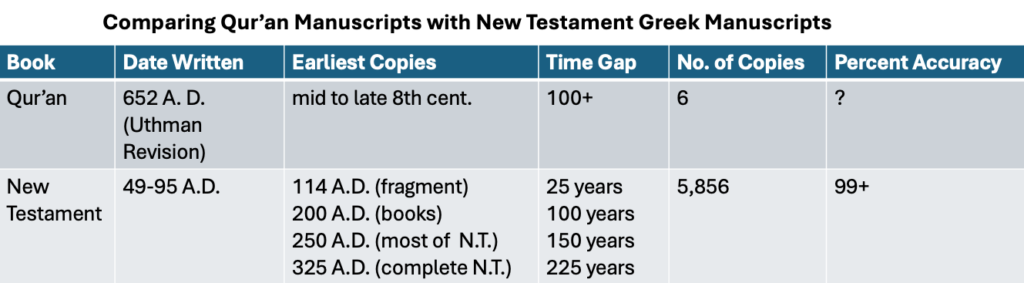
Because of the amount of complexity in comparing Islam’s sacred book (the Qur’an) and Christianity’s sacred book (the Bible), I am dividing Part 2 into four different articles. In the first two articles we looked at the manuscript evidence and the documentary evidence for both Scriptures.
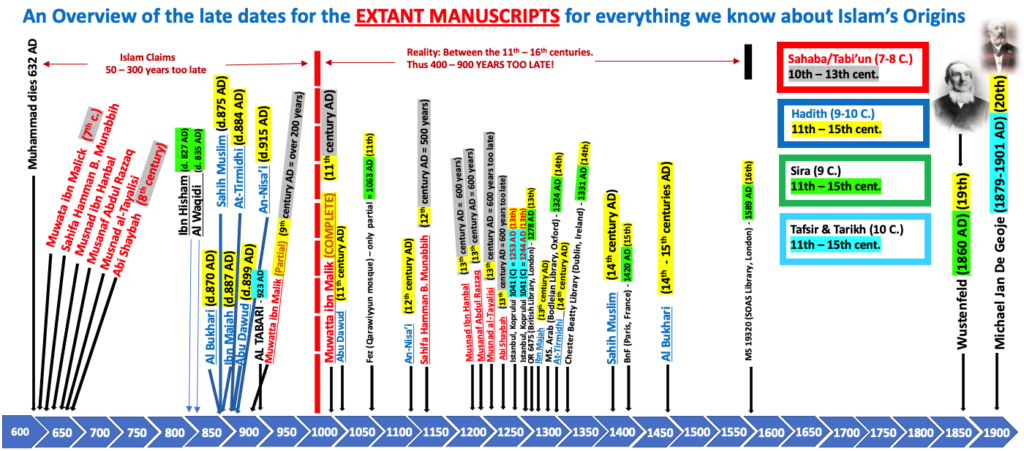
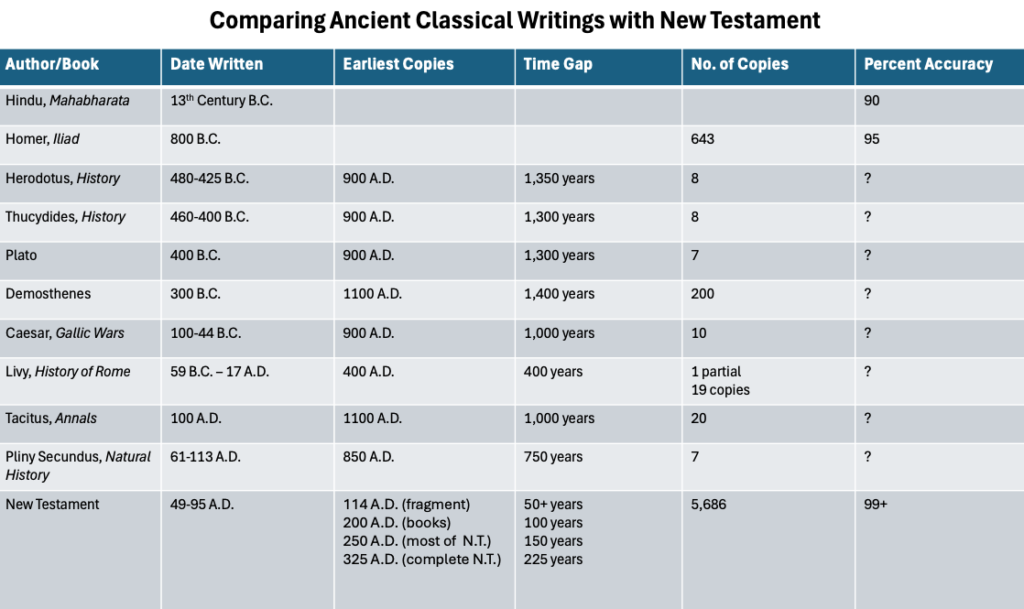
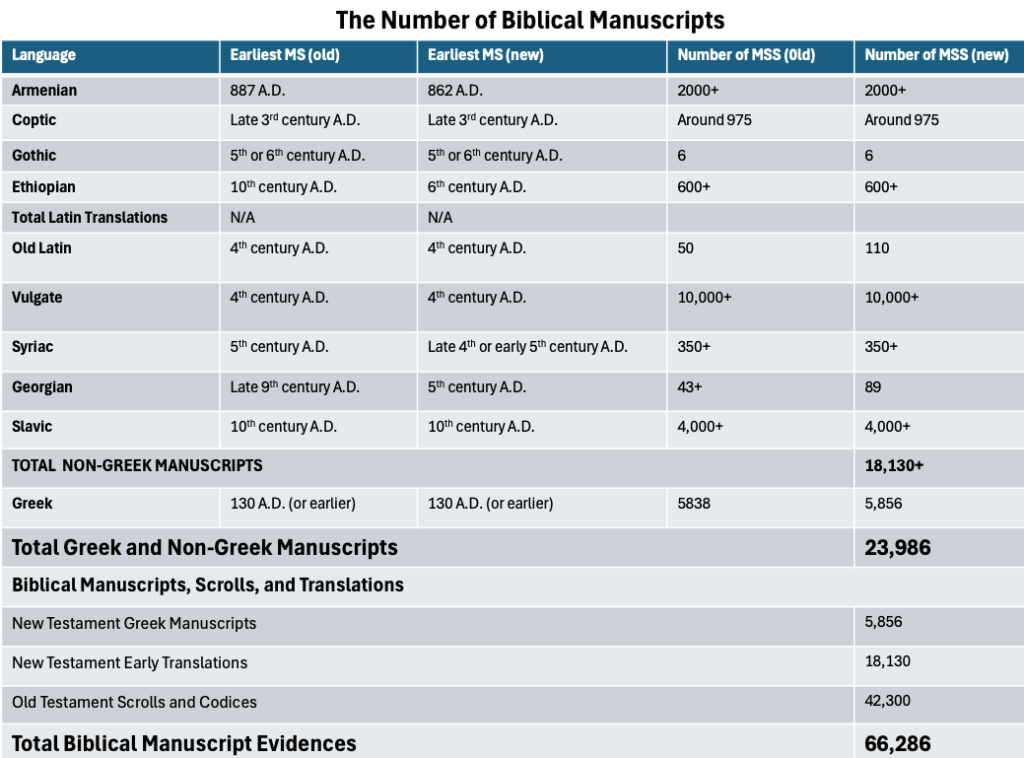
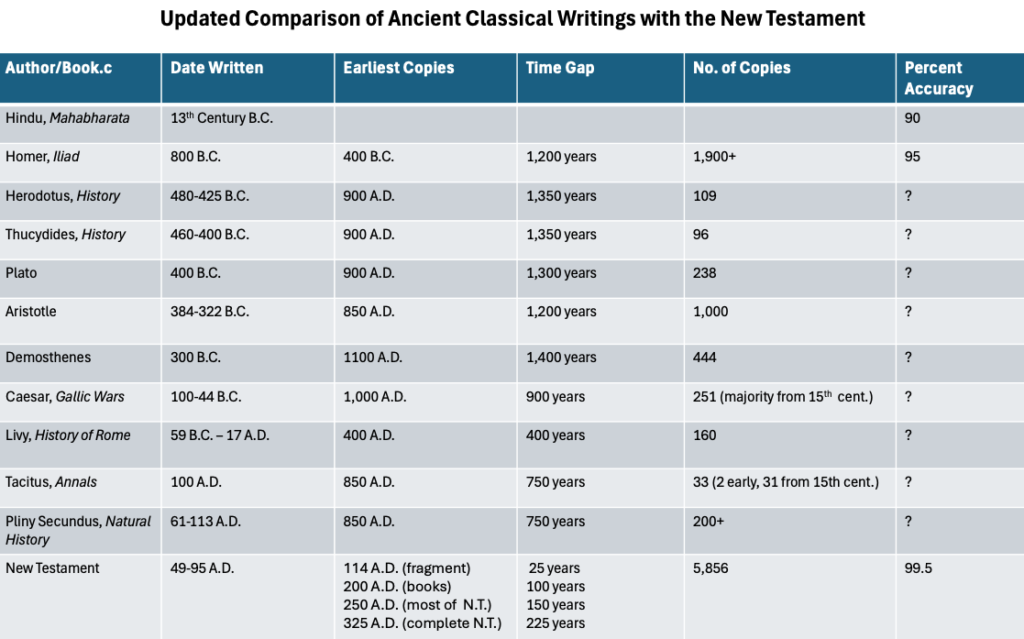
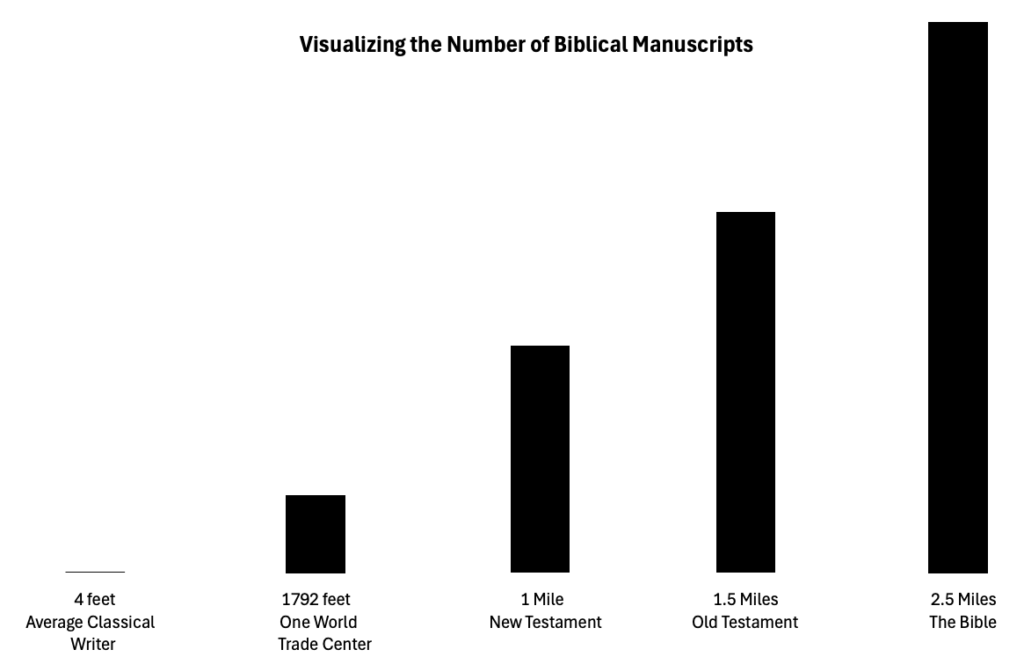
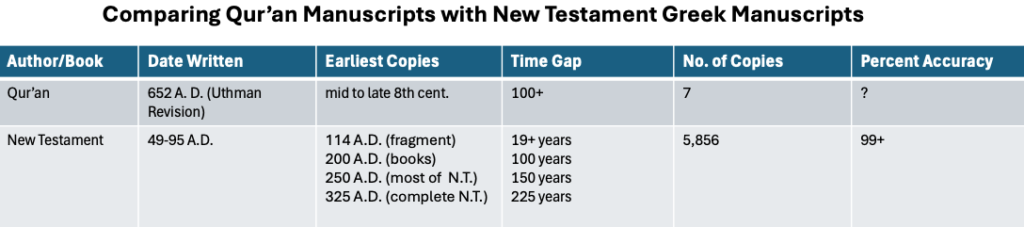
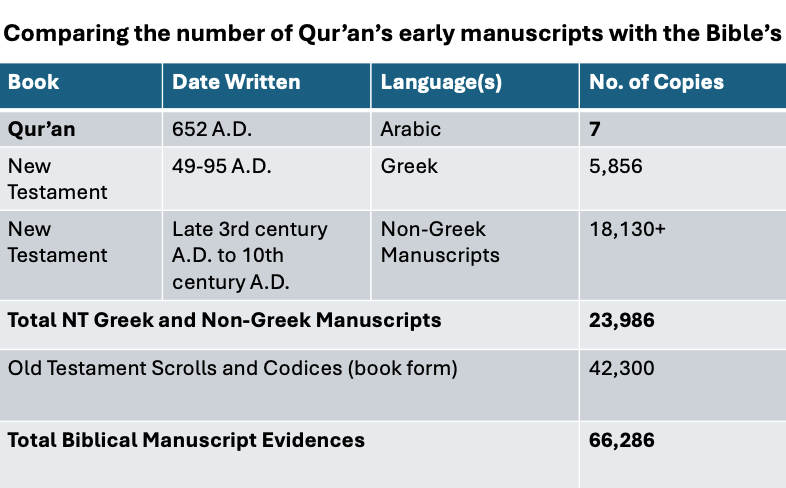
By far, the Bible has more manuscript evidence compared to the Qur’an (see above chart). Christianity can claim more than 5,850 known early Greek manuscripts of the New Testament, most of which were written between 25-225 years after the death of Christ. The New Testament also has over 18,130 early versions and translations, adding up to nearly 24,000 confirmed New Testament manuscripts still in existence (see chart below). In addition, we also have 42,300 Old Testament Scrolls and Codices, which means the Bible has 66,286 manuscript evidences.
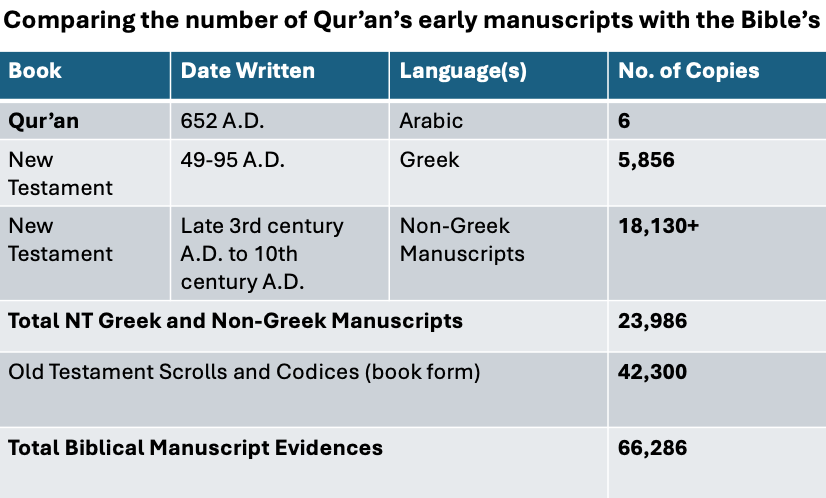
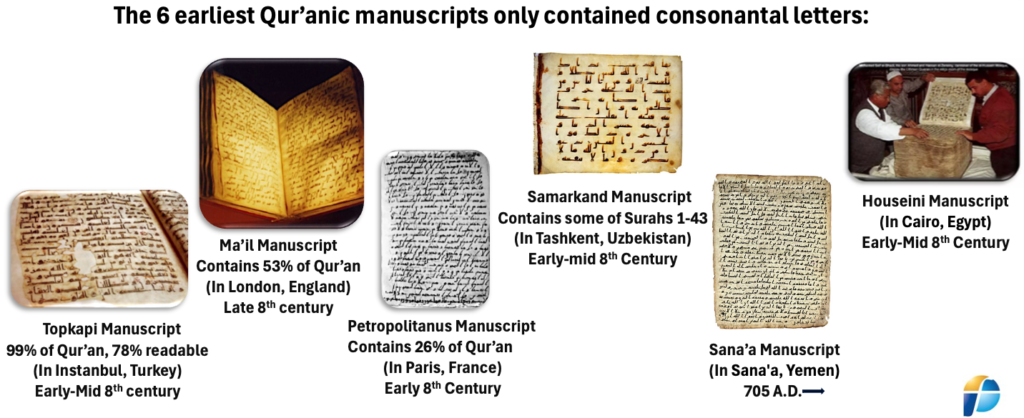
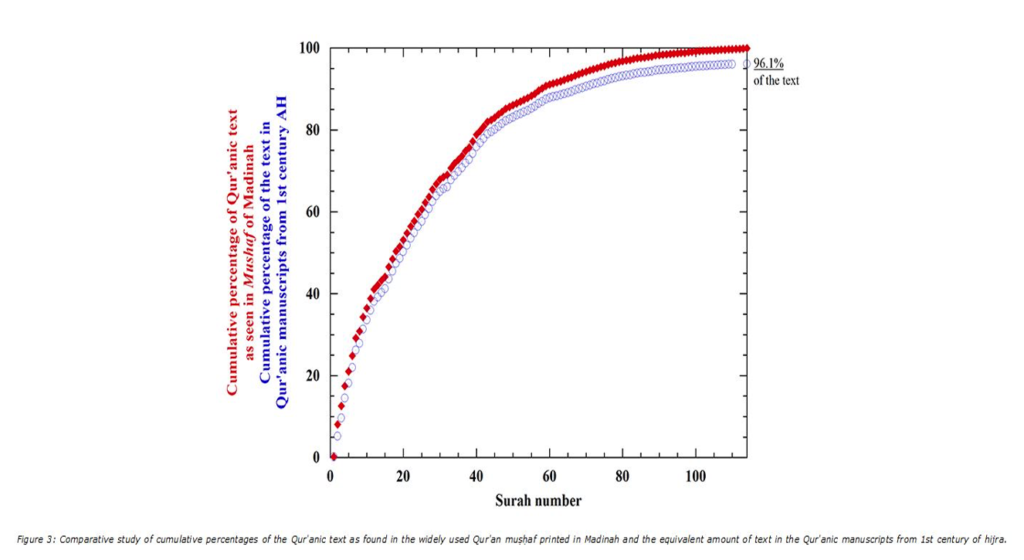
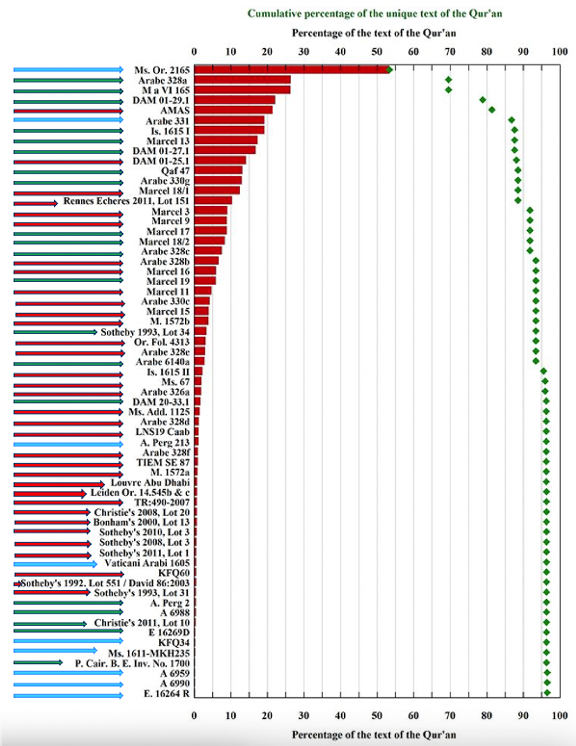
But Islam cannot provide a single manuscript until well into the eighth century, over 100 years after its supposed original compilation. And even then, Islam only has 6 early manuscripts of the Qur’an, and none of them are from the 7th century. None of them are complete. None of them completely agree with each other. None of them completely agree with the current 1924 ‘Hafs’ text which is memorized by 93% of Muslims. All of them have hundreds and even thousands of subsequent manuscript variants. [1]
If the Christians could retain so many thousands of ancient manuscripts, all of which were written long before the Qur’an, at a time when paper had not yet been introduced, forcing the dependency on papyrus which disintegrated with age, then one wonders why the Muslims are not able to forward a single manuscript from this much later period, during which the Qur’an was supposedly revealed? This indeed gives the Bible a much stronger claim for reliability than the Qur’an.
Furthermore, while the earliest New Testament manuscripts as well as the earliest letters from the church fathers correspond with the New Testament which we have in our hands, providing us with some certainty that they have not been unduly added to or tampered with, the Qur’anic material which we have in our possession abounds with stories whose origins we can now trace to second century fictional Jewish and Christian apocryphal literature. We know in some cases who wrote them, when exactly they were written and at times even why they were written; and that none of them were from a divine source, as they were written by the most human of Rabbis and storytellers over the intervening centuries after the Bible had been canonized.
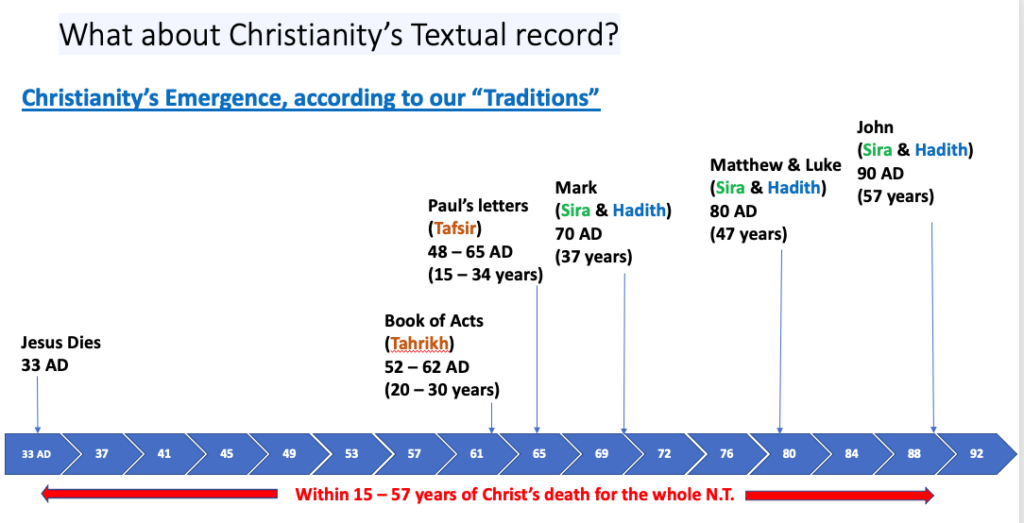
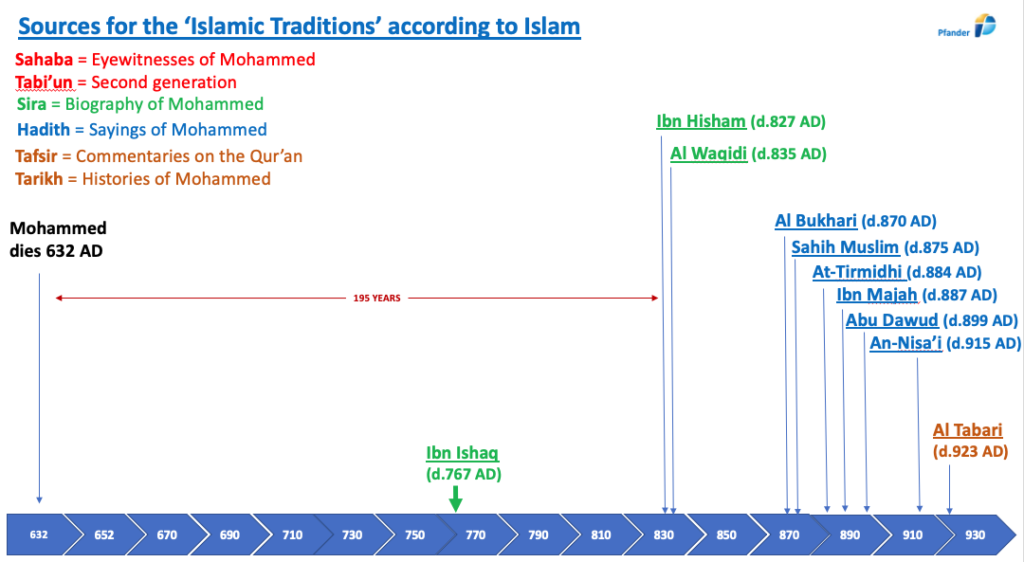
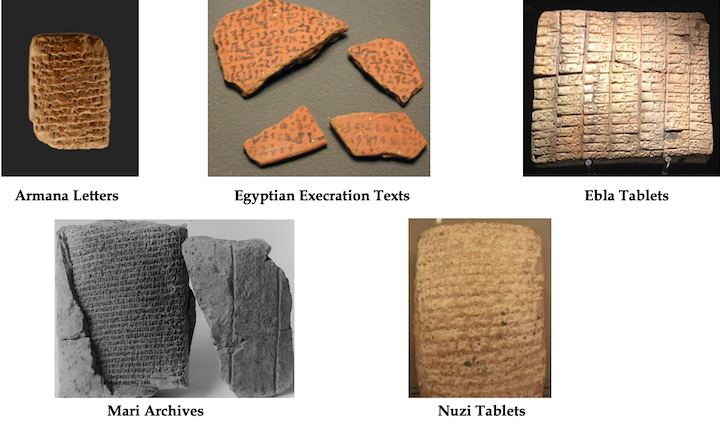
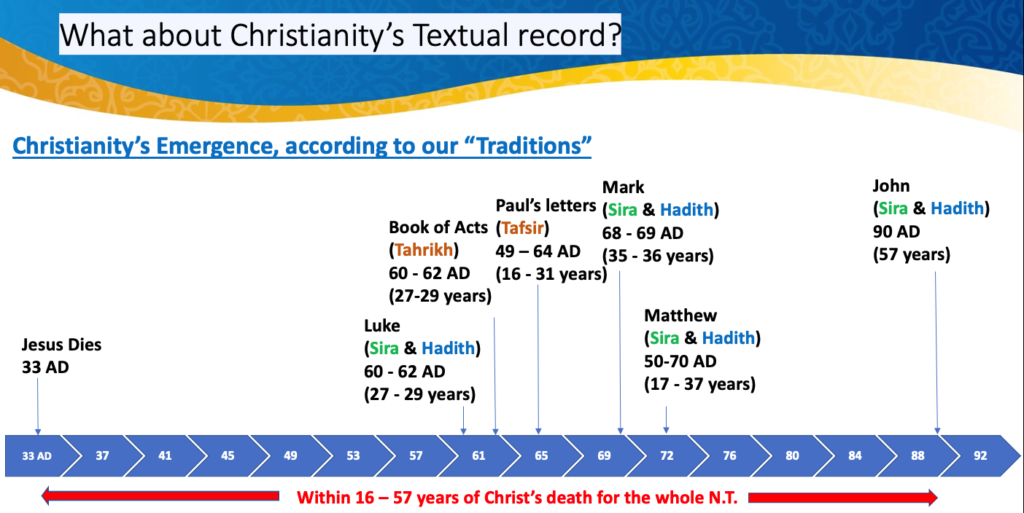
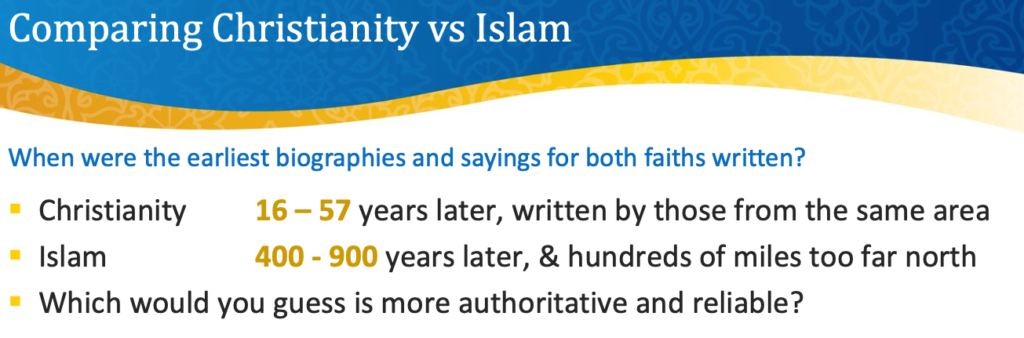
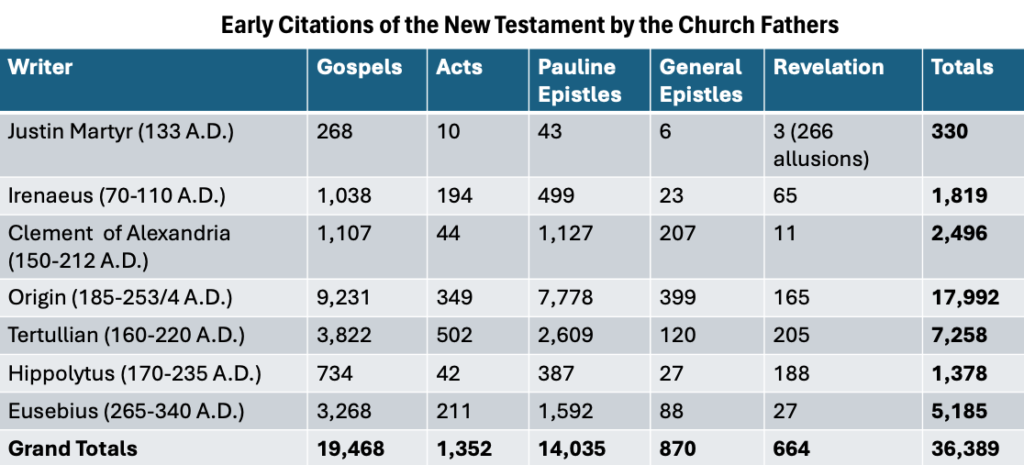
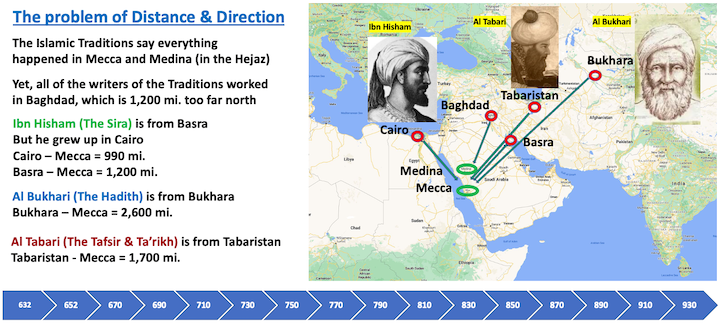
When we compared the historical documentary evidence of the Qur’an and the Bible, we discovered when the earliest biographies and sayings for both faiths were written. For Christianity (see above chart), they were written 16-57 years after Jesus’ death on the cross by those from the same area. But for Islam, they were written 400-900 years later, and by those who were hundreds of miles too far north (see chart below). Thus, the documentary evidence substantiates that the New Testament has more reliability and authority than the Qur’an.
In this article, we will examine the archaeological evidence for both the Bible and the Qur’an. Since both the Bible and the Qur’an speak of history, we will see if archaeology confirms what both books say about people, places, and times. To begin, we will see what archaeology tells us about the Qur’an.
The Qur’an’s Archaeological Evidence
As with the manuscript and documentary evidence, there is not much archaeological information to which we can turn to substantiate what the Qur’an says. What we can do, however, is look at the claims the Qur’an makes and find out if they can be corroborated by archaeology. We will begin with the Qibla, or direction of prayer.
1) The Qibla: According to the Qur’an (Surah 2:144, 149-150), the Qibla or direction of prayer was finalized towards Mecca for all Muslims approximately two years after the Hijra (migration to Medina) around 624 A.D. and has remained in that direction to the present! [2]
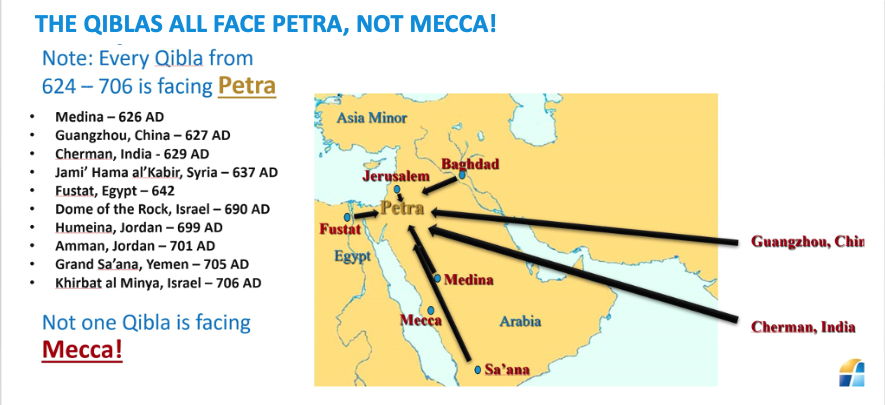
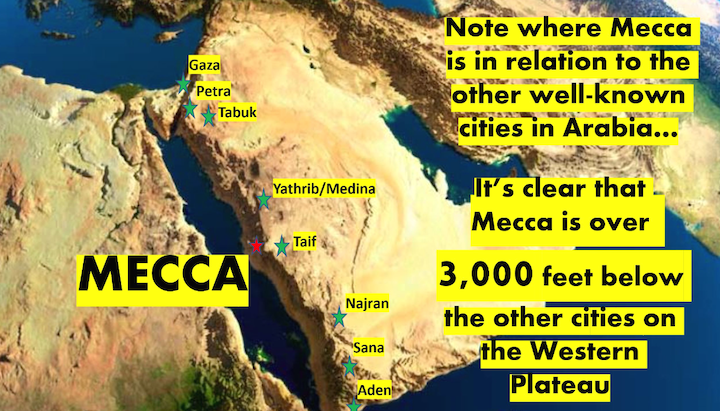
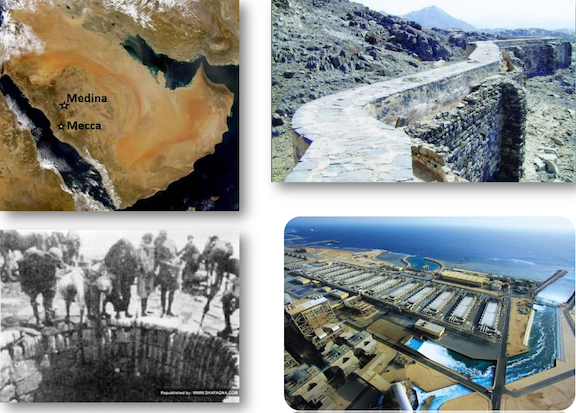
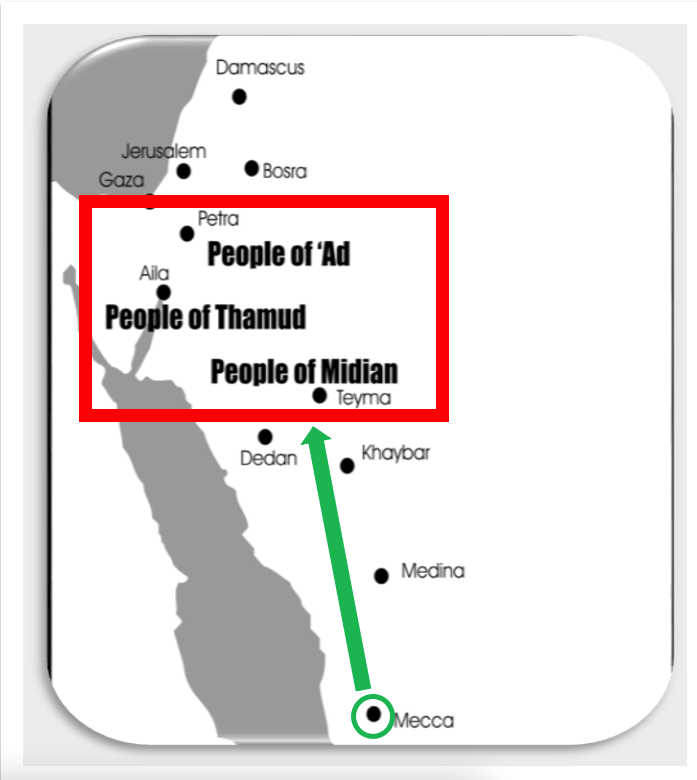
Yet, the earliest evidence from outside Islamic tradition regarding the direction in which Muslims prayed, and by implication the location of their sanctuary, points to an area much farther north than Mecca, in fact somewhere in northwest Arabia. [3] Middle Eastern archaeologist Dan Gibson has done the most extensive work on the Qiblas and found that every Qibla from 624-706 A.D. is facing Petra, and none are facing Mecca (see above map).
Gibson’s “archaeological examinations of the mosques from the first 100 years of Islam indicate that the qibla, or the direction of prayer, did not face toward Mecca, but rather to a more northern location, the Nabataean area around Petra where the people of ‘Ad, Midian, and Thamud all resided. Due to this archaeological evidence, Gibson does not support Mecca as the birthplace of Islam. Instead, based on his research Gibson concludes that ‘Islam was founded in northern Arabia in the city of Petra. It was there that the first parts of the Qur’an were revealed before the faithful were forced to flee to Medina. Thus, the prophet Muhammad never visited Mecca, nor did any of the first four rightly guided caliphs. Mecca was never a center of worship in ancient times, and was not part of the ancient trade routes in Arabia.’” [4] [emphasis added]
In addition, Gibson mentions that at a 2002 conference on Nabataean Studies held in Petra he had the opportunity to speak to several Jordanian and Saudi archaeologists who admitted that “the archeological record at Mecca was basically non-existent before 900 AD.” [5] [emphasis added] Perhaps this is why the Saudi government is destroying most of the ancient buildings and sites in Mecca. [6] They may be trying to cover up something that was “not there” before the 9th century. [7]
Smith notes that an additional substantiation for this direction of prayer is found “by the Christian writer and traveler Jacob of Edessa, who, writing as late as 705 A.D. was a contemporary eyewitness in Egypt. He maintained that the Mahgraye’ (Greek name for Arabs) in Egypt prayed facing east which was towards their Ka’ba.” [8] [emphasis added] His letter (which can be found in the British Museum), reveals that as late as 705 A.D. the direction of prayer towards Mecca had not yet been finalized. [9]
Why are all of the 7th century Qiblas facing Petra or Jerusalem up to 705 A.D., and not Mecca until 715 A.D.? [10] Some Islamists argue that the early Muslims did not know the direction of Mecca. Yet these were desert traders! Their livelihood was dependent on travelling the desert, which has few landmarks, and, because of the sandstorms, no roads. They especially knew how to follow the stars. Their lives depended on it. Surely, they knew the difference between the north and the south. [11]
In addition, Smith says, “Furthermore, the mosques in Iraq and Egypt were built in civilized urban areas, amongst a sophisticated people who were well adept at finding directions. It is highly unlikely that they would miscalculate their qiblas by so many degrees. How else did they perform the obligatory Hajj [pilgrimage], which we are told was also canonized at this time? And why are so many of the mosques facing in the direction of northern Arabia, or possibly Jerusalem?” [12] [brackets and emphasis added]
Smith argues that a plausible answer may be found by examining the archaeological evidence in Jerusalem itself.
2) The Dome of the Rock: [13]
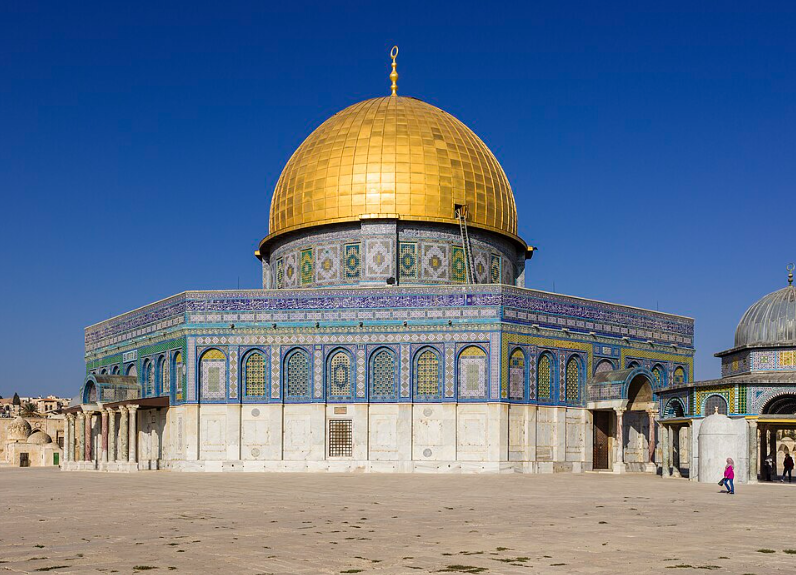
In the center of Jerusalem stands an imposing structure (even today) called the Dome of the Rock (see above pic), built by Caliph Abd al-Malik “in 691 A.D., after seeing the magnificent Christian cathedral of the Church of the Holy Sepulchre.” Al-Malik built this structure “of equal splendor over the rock in Jerusalem believed to be where Abraham was about to sacrifice his son Isaac.” [14]
The Dome of the Rock was built in the shape of an octagon with eight pillars [15] suggesting it was used for circumambulation (to walk around). Thus, it seems to have been built as a sanctuary. [16] Today it is considered to be the third most holy site in Islam, after Mecca and Medina. Islamists insist that it was built to commemorate the night when Mohammed went up to heaven to speak with Moses and Allah concerning the number of prayers required of the believers (known as the Mi’raj in Arabic). [17]
But when the inscriptions on the walls of the Dome of the Rock were examined, they said nothing of the Mi’raj. This is substantiated further by the absence of a Qibla (no direction for prayer). Why was there no Qibla? The fact that such an imposing structure was built so early suggests that Jerusalem, and not Mecca, became the sanctuary and the center of an emerging Islam up until at least the late seventh century! [18]
According to Islamic tradition, the caliph Suleyman, who reigned as late as 715-717 A.D., went to Mecca to ask about the Hajj (annual pilgrimage). He was not satisfied with the response he received there, and so chose to follow Abd al-Malik (i.e. travelling to the Dome of the Rock). This fact alone, according to Dr. Hawting at the School of Oriental and African Studies (as part of London University) points out that there was still some confusion as to where the sanctuary was to be located as late as the early eighth century. It seems that Mecca was only now (sixty years after Mohammed’s death) taking on the role as the religious center of Islam. One can therefore understand why, according to tradition, Al-Walid I, who reigned as Caliph between 705 and 715 A.D., wrote to all the regions ordering the demolition and enlargement of the mosques. [19] This suggests that at this time the Qiblas were then aligned towards Mecca.
Hence, archaeology tells us that the Qur’an introduced the Qibla in Mecca too early. This points to a glaring contradiction in the Qur’an which established Mecca as the sanctuary and thus direction for prayer during the lifetime of Mohammed some eighty to ninety years earlier (Qur’an 2:144, 149-150).
And that is not all, for we have other archaeological evidence which point to differences with that which we read in the Qur’an.
3) Dirham Coins:
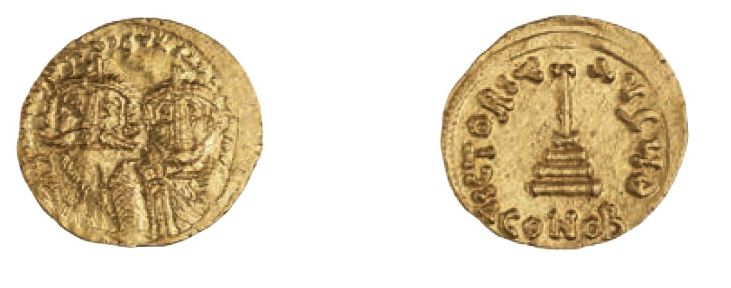
The Qur’an mentions that Joseph was sold by travelers (not Joseph’s brothers, as recorded in Genesis 37:28) for “a lesser price than a numbered dirham” (Qur’an 12:20). [20] Dirhams did not exist until the 7thcentury A.D., evolving from the Greek drachma. There were no dirhams during the time of Joseph (1915-1805 B.C.) [21] in ancient Egypt. Hence, the Qur’an introduces dirham coins hundreds of years too early. [22]
4) Samaritans:
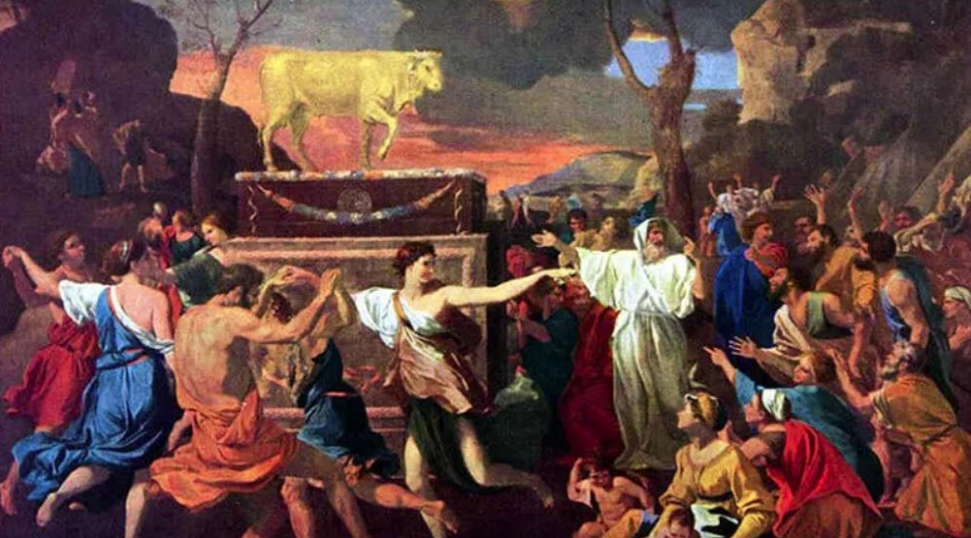
We learn from the Qur’an that a “Sāmirī [Samaritan, a non-Arabic word of Hebrew/Syriac origin], [23] not Aaron, as recorded in Exodus 32, “led them astray” (Qur’an 20:85) [24] to fashion a golden calf (Qur’an 20:86-88, 95-97). Mentioning a Samaritan in the time of Moses (1525-1405 B.C) [25] conflicts with history because Samaritans were not known as a people until 722 B.C. [26] Once again, the Qur’an introduces something hundreds of years too early. In addition, the Qur’an confuses Hosea 8:5-6 with the calf of the Exodus rebellion! [27]
5) Chainmail:
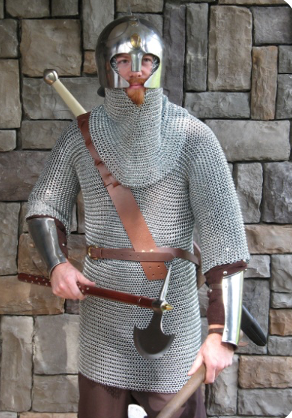
According to the Qur’an, Allah taught King David how to make chain mail: “10 And indeed, we gave David a bounty from us: ‘O mountains, sing praises with him and the birds.’ And we softened the iron to him. 11 That, ‘Make suitable coats of sard [chain armor, non-Arabic word of Persian/Syriac origin] and measure the length. And do a good deed. Surely, I see what you do.” (Qur’an 34:10-11). [28] Hence, the Qur’an is saying that chainmail existed during the reign of King David in ancient Israel (1011 B.C. – 971 B.C.). [29] But coats of chainmail were not invented until around 400-300 B.C. by Celtic tribes in eastern Europe. [30] Hence the technology for chainmail did not exist until hundreds of years later than the Qur’an’s reference.
6) Crucifixion:
According to the Qur’an, Pharaoh threatened to “cut off” the “hands” and “legs” of his sorcerers on opposite sides and “crucify” them “on trunks of the palm tree” when they chose to believe in the God of Moses (Qur’an 20:71; 7:121). [31] Joseph tells one of his fellow prisoners that “ he will be crucified, so the birds will eat from his head.” (Qur’an 12:41).[32] The earliest historical record of crucifixion dates to 519 B.C. when King Darius I of Persia crucified 3,000 of his political enemies in Babylon. [33] Thus, the Qur’an places crucifixion at times (Joseph: 1915-1805 B.C. and Moses: 1525-1405 B.C) which are hundreds of years before history records when crucifixion was invented.
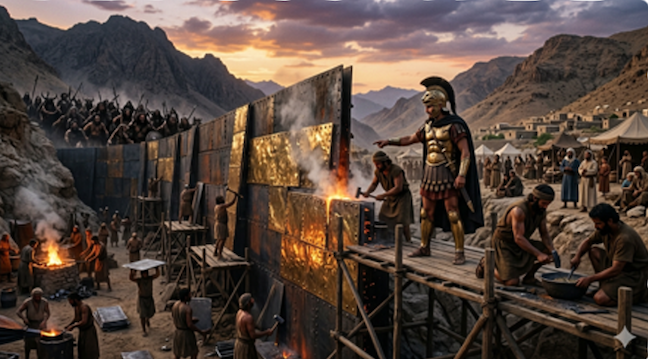
7) Alexander the Great (see AI generated pic below):
The Qur’an states, “They ask you about Ze Al Qarnain [the one with two horns]. Say, ‘I will recite to you an account of him.’” (Qur’an 18:83). [34] Dakdok explains that “the reason this verse was given was because the Jews of Quraish asked to examine the knowledge of Mohammed. That is why Allah sent down the story of Zu Al Qarnain” [35] otherwise known as Alexander the Great. [36]
We read of Alexander the Great, “92 Then he followed a way, 93 until he came between the two mountains under which he found a people who could not understand a saying. 94 They said, ‘O Za Al Qarnain, surely Ya’juj [Gog] and Ma’juj [Magog] are vandalizing in the land. Shall we make to you a tribute that you make between us and them a barrier?’ 95 He said, ‘That in which my lord has established me is better, so assist me with strength. I will make a barrier between you and them. 96 Bring me blocks of iron,” until it equalizes between the two sides. He said, ‘Blow,’ until when he made it a fire. He said, ‘Bring me brass that I may pour over it.’ 97 And they were not able to scale it, neither were they able to dig through it.’ 98 He said, ‘This is a mercy from my lord. So, when the promise of my lord comes to pass, he will make it dust. And the promise of my lord was true.” (Qur’an 18:92-98). [37] [emphasis added]
Ibn Kathir, a 14th century Muslim historian, scholar, and Qur’anic exegete, interpreted these verses by stating that these people between the two mountains were Turkish and the cousins of Gog and Magog (Qur’an 18:92-94ba). They mentioned to Alexander the Great that Gog and Magog had vandalized them, so they offered to pay him a great tribute to help them build a barrier between them and Gog and Magog (Qur’an 18:94b). But Alexander the Great refused to receive their tribute because he was satisfied with what Allah had given him (Qur’an 18:95a). Kathir also interpreted these verses to say that Alexander the Great, with the assistance of these men, built a great barrier made of iron and brass so it was smooth on the outside, making it difficult to go above it with ladders and through it with shovels (Qur’an 18:95b-97). Kathir claimed that the barrier was the same height as the tallest mountain, to the point that there was not one building on the earth that was stronger or more useful to the people than it. The building of this great barrier showed the mercy of Allah to his servants to prevent the aggression of Gog and Magog against these people (Qur’an 18:98a). Kathir also stated that this barrier which Alexander the Great built would become dust in the day of resurrection; this must be done, for the promise of his lord is true (Qur’an 18:98b). [38]
Al Bukhari (d. 870 A.D.) wrote down the actions and saying of Mohammed in the Hadith, and he said a man came to Mohammed and said, ‘O messenger of Allah, indeed I saw the barrier of Gog and Magog.’ Mohammed said, ‘Describe it to me.’ The man said, ‘It was like striped hail with black and red stripes.’ Mohammed said, ‘Indeed, you have seen it.’ That means Mohammed agreed with this man because Mohammed had seen this barrier. [39]
Dakdok concludes, “It is amazing… that there is no evidence of the existence of such a barrier. Alexander the Great did not build any barrier; and if there was such a barrier with this description, it should still exist, especially when we read that the Qur’an said that it will be there until the day of resurrection (Qur’an 18:95-101) which has not taken place yet. Such a barrier does not exist, nor is there any archaeological evidence to prove its existence. Moreover, there is not any biblical reference to such a barrier. The only barrier or wall that is known to the world is the Great Wall of China, which still exists today and is very well documented in history. This proves that these men in this hadith and Mohammed are liars.” [40] [emphasis added]
9) Coins: [41]
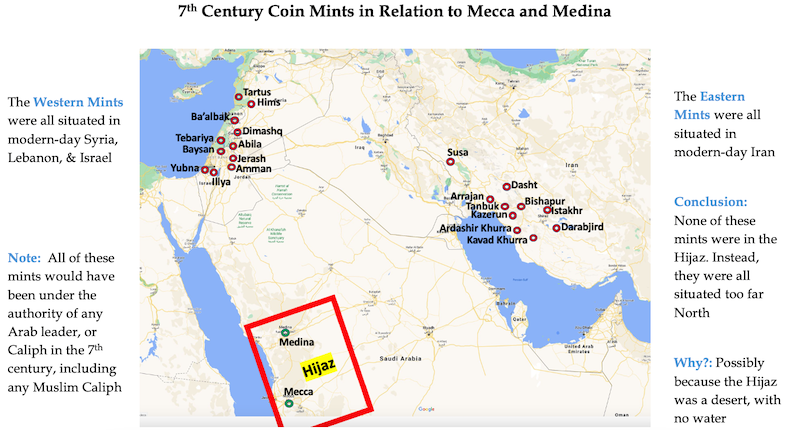
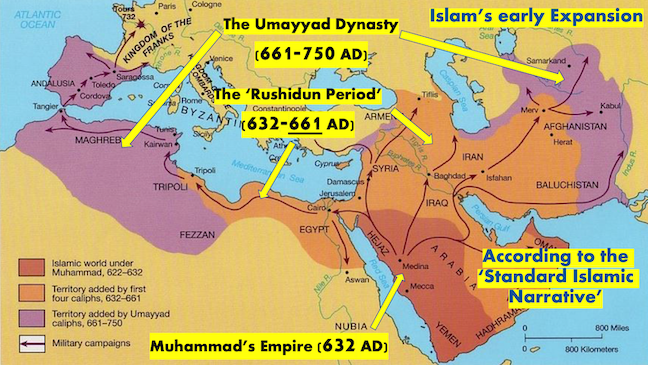
In ancient days when a king or Caliph (Muslim leader) came to power, one of the first things he did was mint a coin with his name and image on it and what religion he belonged to along with the date of the coin. Since they didn’t have modern communication like we do today (e.g. newspapers, radio, TV, or internet), they minted coins to inform others of their identity and jurisdiction. Dr. Jay Smith shows that there are no Islamic coins minted during the supposed lifetime of the prophet Mohammed (570 – 632 A.D.) nor during the Rashidun period (624-661 A.D.). The coins that were minted during that time were too far north to be related to Mohammed or the Qur’an (see above chart). The western mints were situated in modern day Syria, Lebanon, and Israel, and the eastern mints were located in modern day Iran. All of these mints would have been under the authority of any Arab leader or Caliph in the 7th century, including any Muslim Caliph (successor to Mohammed). In addition, none of these mints were in the Hijaz where Islam supposedly began. It is possible that these mints were too far north because the Hijaz was a desert with no water, and where there is no water, there is no civilization.
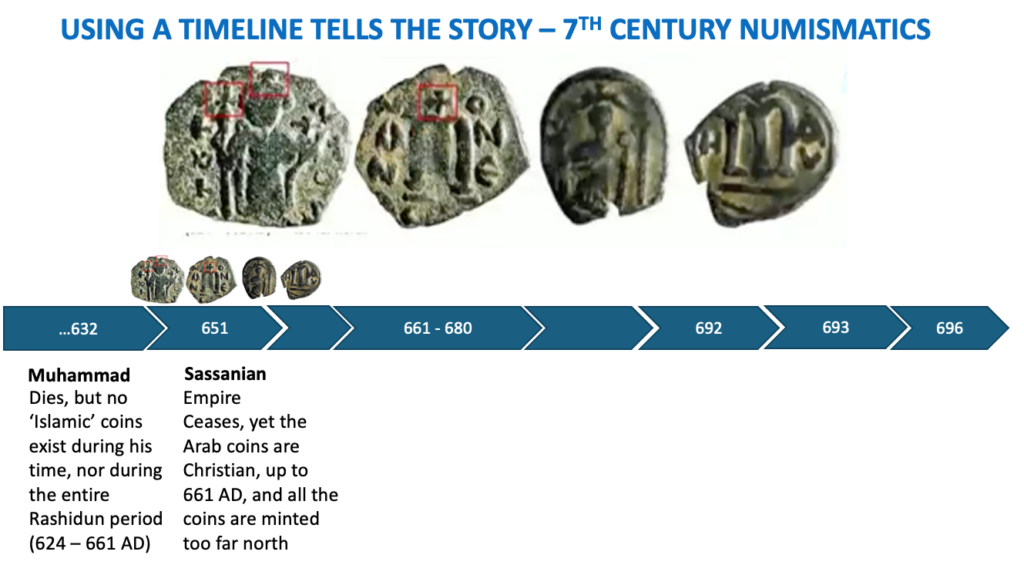
When you examine the coins minted in the early 7th century up to 661 A.D, almost all the coins are Christian, possessing a cross on them (see above pic). None of the coins from that time had anything to do with Mohammed, Islam, the Qur’an, or Mecca.
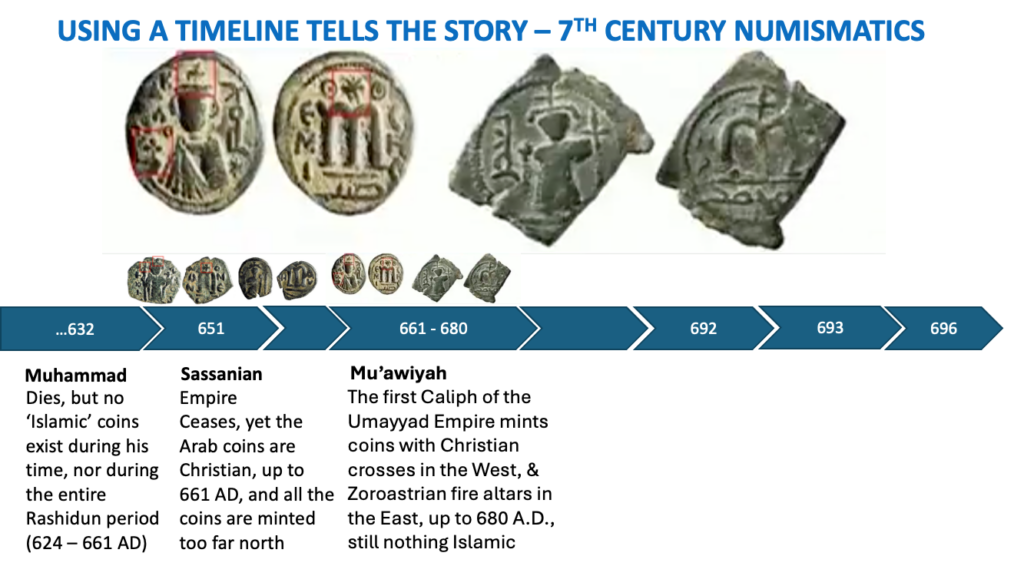
For example (see above pic), when you look at the first Muslim Caliph of the Umayyad Empire, Mu’awiyah, he minted coins with Christian crosses on them. Notice the two coins in the lower right of the picture. The first coin has a cross above the Caliph’s head and in his hand. And on the back side of the coin, it has the Arabic name Mahmad which some believe refers to the prophet Muhammad. If that is the case, it would be the first reference to Muhammad anywhere, and that was in 663 A.D.
Some scholars argue that the Arabic word “Mahmad” later translated Muhammad word “Mahmad” later translated Muhammad on these early coins may refer to Jesus Christ, and not the prophet of Islam. This is because the root of the term “mu-hammad” is “Ahmad,” which means “praise.” Hence, the term Muhammad could be translated as “the one (mu-) who is praised (Ahmad),” or the “chosen one.” [42] Since the coins picture the Muslim leader with a cross on his head and in his hand, scholars conclude that Jesus Christ must be the “one who is praised.”
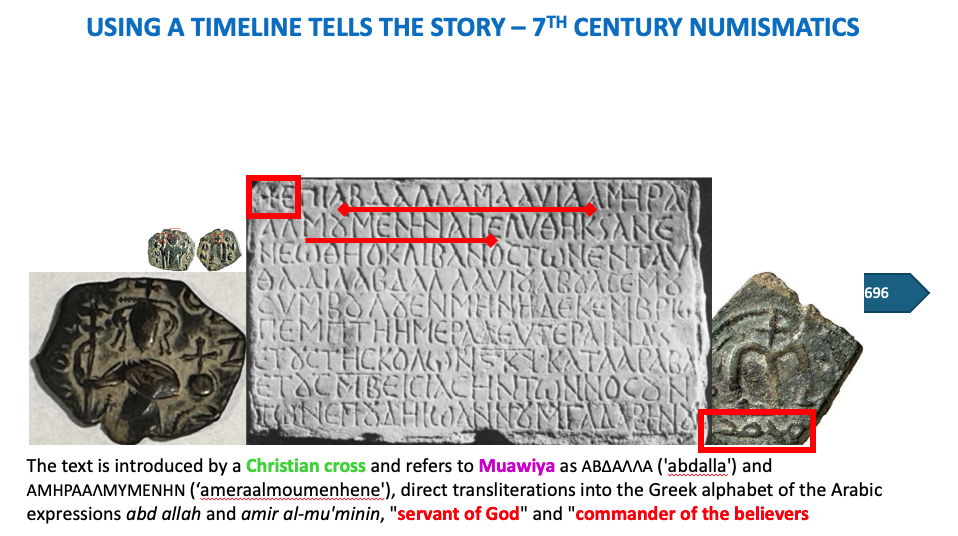
This is substantiated further in an inscription by Mu’awiyah (see above pic). He introduces the inscription with a cross in the upper left corner and refers to himself as “abdalla,” a “servant of God” and “ameraalmoumenhene,” a “commander of the believers.” Smith concludes that this first Caliph was a believer in the Jesus of the Bible who was a commander of Christians. Mu’awiyah ruled until 680 A.D. and then Abd Al-Malik came to power in 685 A.D.
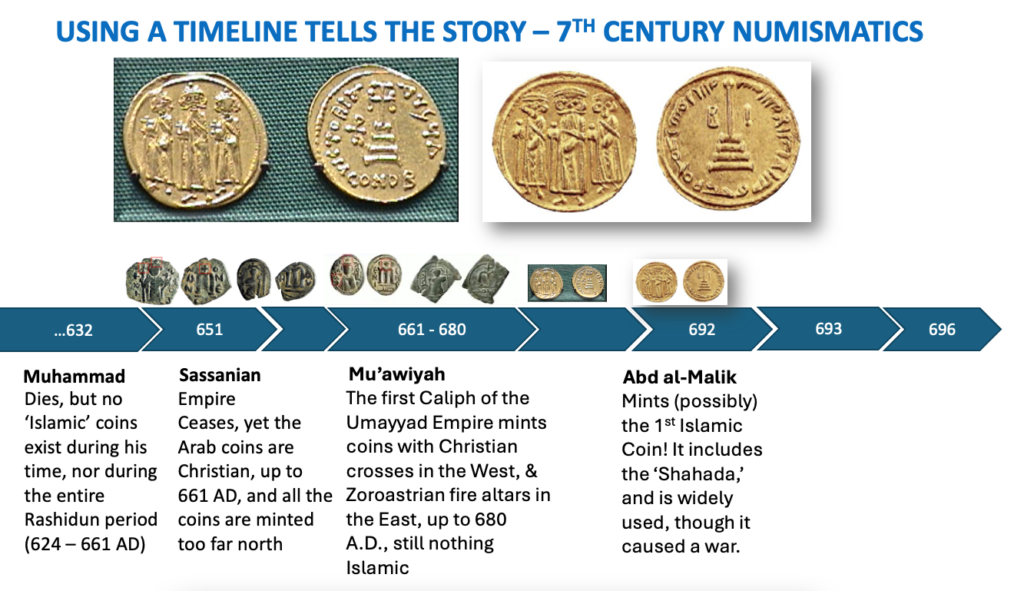
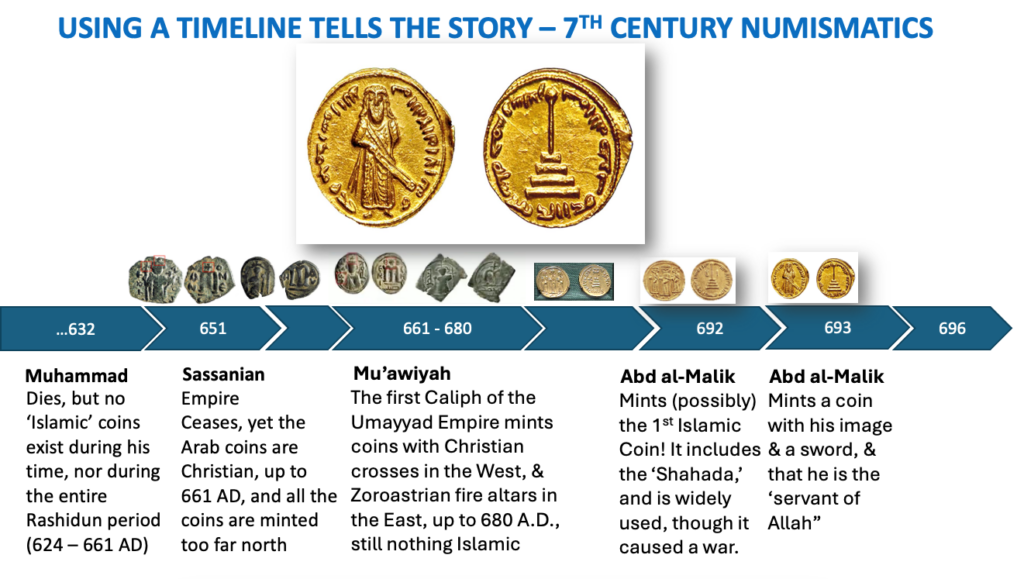
Abd Al-Malik introduces new coins that contain the shahada (see above pic) which says, “There is no god but Allah, and Muhammad is his prophet (rasul).” This is perhaps the first Islamic coin. After minting this coin, Abd Al-Malik goes to battle against Justinian, the Byzantine Emperor, and defeats him. He then mints this coin with an image of himself holding a sword in victory (see pic below).
Abd Al-Malik had inscriptions written on the Dome of the Rock which he built in 691 A.D. which attacked Jesus as the Son of God (e.g., Allah “hath not taken unto Himself a son, and Who hath no partner” – Qur’an 25:2; Allah “has no associate” – Qur’an 112:3) as well as the Trinity (e.g., “say not ‘three’” – Qur’an 4:171). [43]
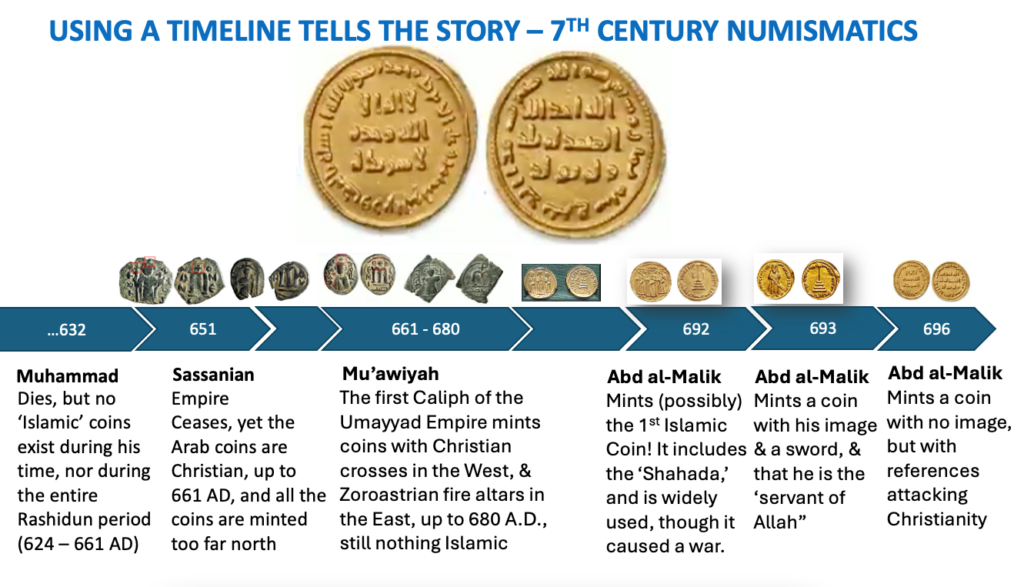
He also minted coins attacking Christianity (see above pic). Smith concludes that this is the beginning of what later became Islam. [44]
10) Arabic Rock inscriptions:
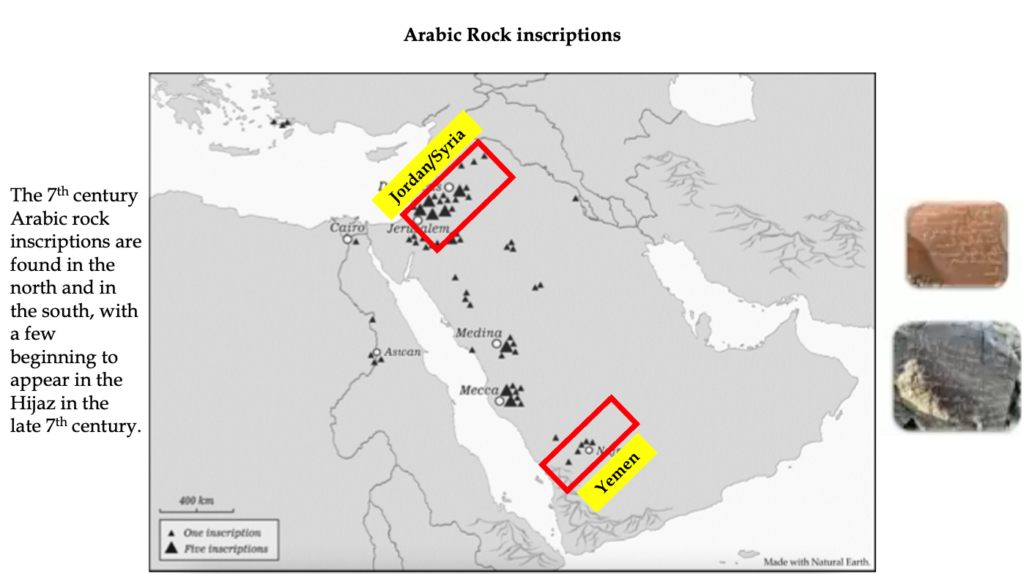
Notice that the 7th century Arabic rock inscriptions are all found in the north and in the south (see above pic), but not in the Hijaz where Islam supposedly began. Ilkka Juhani Lindstedt [45] analyzed approximately 100 Arabic rock inscriptions during a 100-year period (640-740 A.D.) and discovered that prior to 690 A.D., there was no evidence of anything Islamic on the inscriptions. Instead, they are merely pious formulae related more to Christianity. It is not until 690-710 A.D. that the prophet Muhammad is introduced in these inscriptions. Muslim rites (e.g., pilgrimage, prayer, fasting, etc.) appear from 710-720 A.D. From 720-730 A.D., the terms “Muslim” and “Islam” emerge in these inscriptions referring to a specific group in contradistinction to Christianity. This is 100 years after Muhammad’s death. It was only in the 730s A.D. onward that popular devotion was given to a man named Muhammad as a prophet and messenger of Allah, which calls into question the traditional Islamic narrative presented in the Qur’an. Smith concludes that this 100-year silence indicates that Islam did not exist as a distinct religion until long after the time of Mohammed (570-632 A.D.) which casts doubt that he had any part in starting Islam.
11) Qur’anic Quotations: [46] The quotations from the Qur’an on both the coins and the Dome of the Rock differ in detail from that which we find in the Qur’an today. [47] Two etymologists, Van Berchem and Grohmann, have done extensive research on the Dome of the Rock inscriptions, and they state that the inscriptions contain “variant verbal forms, extensive deviances, as well as omissions from the text which we have today.” [48]
If these inscriptions had been derived from the Qur’an, with the variants which they contain, then how could the Qur’an have been canonized prior to this time (late seventh century)? One can only conclude that there was a gradual evolution in the transmission of the Qur’an through the years (if indeed they were originally taken from the Qur’an).
The sources also seem to suggest that the Qur’an was put together rather hurriedly. Dr. John Wansbrough maintains that “the book is strikingly lacking in overall structure, frequently obscure and inconsequential in both language and content, perfunctory in its linking of disparate materials, and given to the repetition of whole passages in variant versions. On this basis it can plausibly be argued that the book is the product of the belated and imperfect editing of materials from a plurality of traditions.” [49] Hence, Crone and Cook believe that because of the inadequacy of the editing, the emergence of the Qur’an must have been a sudden and late event. [50]
The Bible’s Archaeological Evidence
We will begin with the archaeological evidence for the Old Testament. Since Abraham is esteemed by both Christianity and Islam, we will look at where archaeology places him.
Abraham: Abraham was the first and greatest of the Hebrew patriarchs. His story is recorded in Genesis 11:26-25:10. “Abraham” appeared as a personal name in Babylonia during the time of the Patriarchal period (2296 -1806 B.C.). [51] Early and late twentieth-century excavations in Mesopotamia have uncovered documented names, including Abram (later changed to Abraham – Gen. 17:5) [52] and his relatives, such as his great-grandfather Serug, his grandfather Nahor, and his father Terah (Gen. 11:22-26). These men all have names that have been confirmed in documents and reports as coming from the Euphrates-Habur region of Upper Mesopotamia from the time period of the early second millennium. [53]
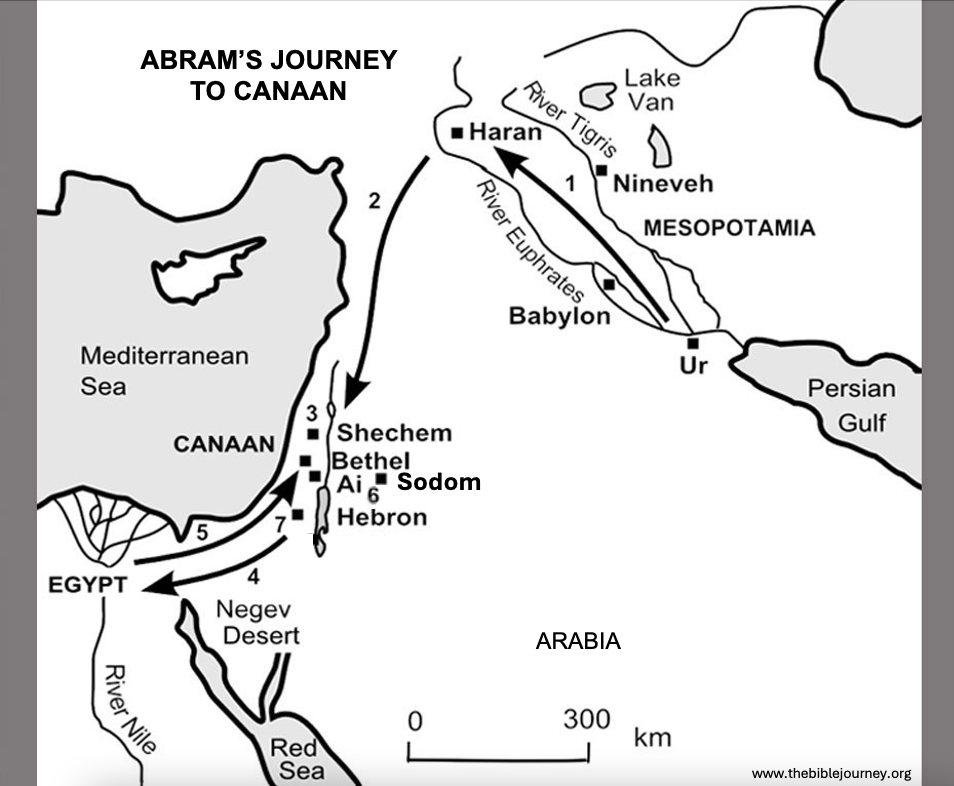
When we look at Abram’s journey from Ur to Canaan (see above map), we learn that archaeology confirms the names of places related to his journey from the Patriarchal period:
1) Terah and his family (including his sons Abram and Nahor, and his grandson Lot) lived at Ur, the capital of Sumer, in southern Mesopotamia (modern-day Iraq). [54] While still living in Ur, God calls Abram to “Get out of your country… to a land I will show you.” (Gen. 12:1; cf. 15:7; Neh. 9:7; Acts 7:2). [55] They decide to move from Ur and follow the Euphrates River upstream about 600 miles possibly to avoid the harsh central Arabian desert [56] to Haran in what is now modern-day southern Turkey [57] (Gen. 11:27-32). Excavations at this site have unearthed a large mudbrick building that dates to the end of the third millennium B.C., which some believe may have been a predecessor to the Temple of the moon-god, Sin, [58] which is significant because Terah’s name means “moon” [59] and Scripture informs us that he came from an idolatrous background whereby he “served other gods” (Josh. 24:2).
2) After Terah died in Haran (Gen. 11:32), Abram and his nephew Lot set out for Canaan with their tents and flocks (Gen. 12:1-5).
3) Abram arrives in Canaan and builds an altar by the sacred tree of Moreh at Shechem about 30 miles north of Salem (later called Jerusalem) [60] where God revealed Himself to Abram for the first time in the Promised Land (Gen. 12:6-7). Archaeological excavations at Tell Balata (ancient Shechem) confirm that it was a “place” (Gen. 12:6) with no walls when Abram arrived (~2090 B.C.), but approximately 180 years later when Jacob arrived (~1910 B.C.), [61] it had become a “city” (Gen. 33:18). [62]
4) Abram moves to the hill country between Bethel and Ai, [63] then moves south towards the Negev Desert. Driven by drought and famine, Abram and Sarai (Abram’s wife) journey along the Way of Shur to the well-watered lands of the Nile Delta in Egypt (Gen. 12:8-20).
5) Abram and Sarai are forced to flee from Egypt to the hill country near Bethel (Gen. 13:1-9).
6) Abram and Lot decide to separate. Lot chooses the fertile, well-watered Jordan Valley to the east and pitches his tents near Sodom (Gen. 13:10-13).
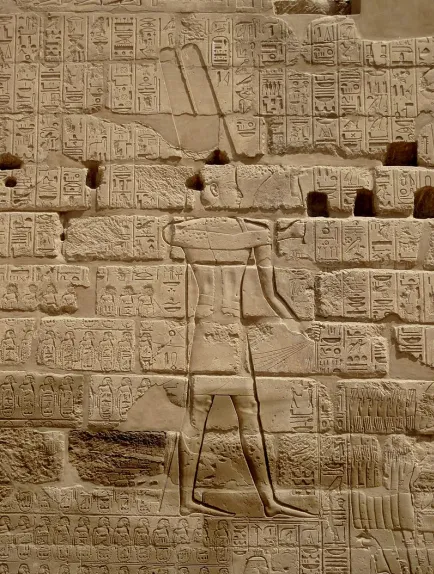
7) Abram moves to the great oaks of Mamre near Hebron and builds an altar there (Gen. 13:18). After the Egyptian Pharaoh Shishak (Shoshenq I) invaded the lands of Judah and Israel in 926 BC., he returned to Egypt and had a record of his victories inscribed on a wall of the Great Temple of Amun-Re at Karnak. One of the ovals, located just below and to the left of Shishak’s right foot (see above photo), reads, “the Fort / Enclosure of Abram.” [64] This is the only nonbiblical written reference to Abraham, [65] proving that even at this early date Abraham was known not in Arabia, as Islam contends (Qur’an 2:124-131; 6:75-83; 19:41-48; 21:51-70; 26:69-83; 29:16-27; and 37:83-113) [66] but in Palestine, the land where the Bible places him. [67]
Sodom and Gomorrah (Gen. 13:1-13; 19:21-25; see photos below [68]):
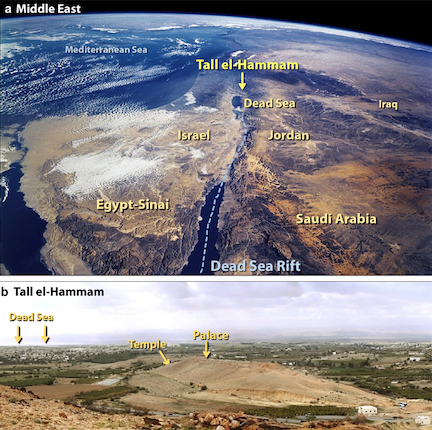
Since 2005 when Dr. Steven Collins began directing excavations in Tall el-Hammam, a fortified Middle-Bronze-Age city in modern day Jordan northeast of the Dead Sea, evidence was found that led scientists to believe it was destroyed by an extraordinary high energy event in 1650 B.C. [69] Some archaeologists believe this could be the site of the biblical city of Sodom. Under the hill pictured in the base picture above, archaeologists found remains that indicate exposure to super intense heat over a short period of time which would have been much greater than exposure to wildfires, lightning, volcanism, earthquakes, or warfare. [70]
The entire city was capped by a five-foot thick charcoal and ash rich destruction layer containing shocked quartz, melted mudbrick, melted pottery, melted roofing clay, fragmented and scorched human bones, and other mysterious debris such as a ceramic shard with a glaze that would have been exposed to super-intense heat lasting a very short period. [71]
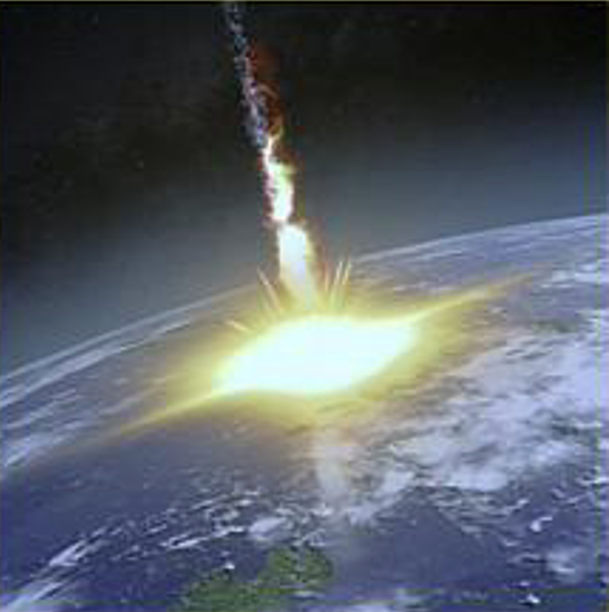
Scientists believe this represents a “cosmic airburst / impact event” (see above photo) similar to the asteroid explosion in Tunguska, Siberia in 1908, which had the equivalent explosive power of 1,000 Hiroshima bombs. [72]
The contents of the 5-foot destruction layer uncovered by scientists include (see pics below): [73]
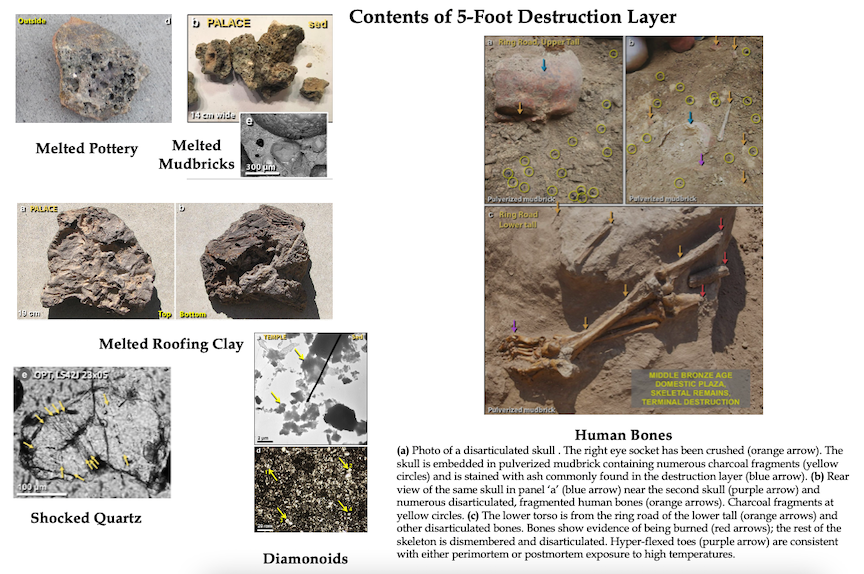
– Melted construction materials such as pottery, mudbricks, roofing clay.
– High temperature melted minerals such as shocked quartz whereby sand grains are cracked due to high pressure.
– Presence of diamonoids (indicators of cosmic impacts).
– Disarticulated, fragmented, and scorched human bones.
– High salt concentrations up to 6 times that of the Dead Sea.
These amazing findings substantiate what the Bible describes as the destruction of Sodom and Gomorrah. We read, “24 Then the Lord rained brimstone and fire on Sodom and Gomorrah, from the Lord out of the heavens. 25 So He overthrew those cities, all the plain, all the inhabitants of the cities, and what grew on the ground. 26 But his [Lot’s] wife looked back behind him, and she became a pillar of salt.” (Gen. 19:24-26). Afterwards, the soil around Sodom and Gomorrah could not be used for 700 years because of this catastrophic event which exposed it to such super intense heat. [74]
Jericho Walls (Josh. 6:20-24):
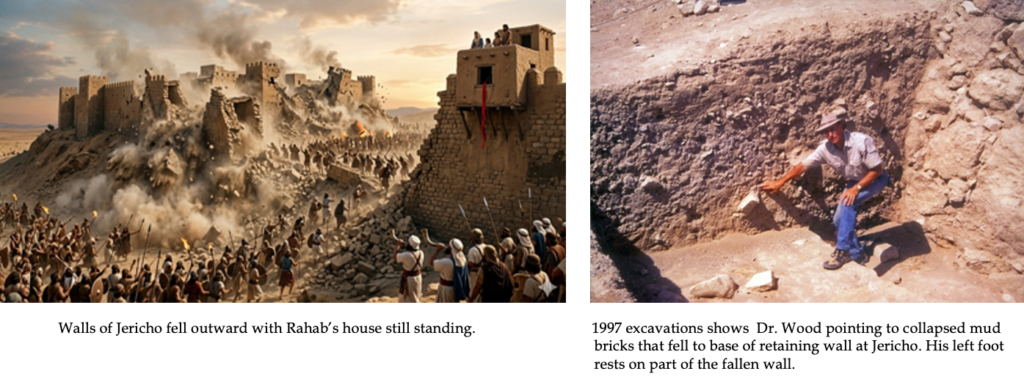
Recent analysis of archaeological research confirms that the city of Jericho was destroyed in approximately 1400 B.C. [75] and its city walls fell outward as the Bible states. [76]
King David:
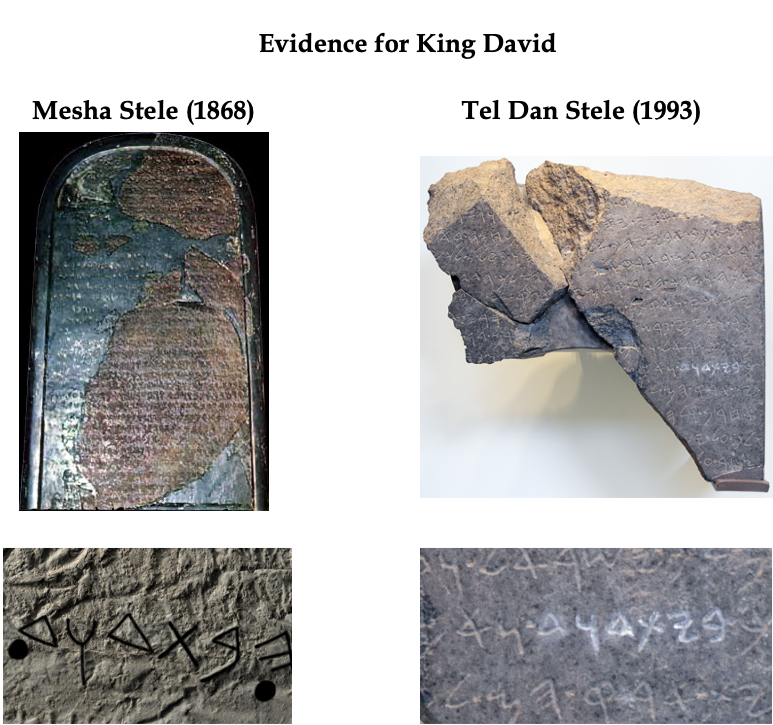
Skeptics claimed that King David never existed because his name had never been found outside of the Bible. But two archaeological findings came to the rescue at Dibon in Moab (1868) and at Tell Dan (1993-1994). In 1868 at Dibon, in Moab (20 miles east of the Dead Sea), the Mesha Stele was found and dated to 850 B.C. [77] It mentioned “Israel,” “Yahweh,” and the “House of David” (bytdwd). [78]In 1993 the Tell Dan Stele was discovered at Tel Dan (northern Israel) containing a Canaanite inscription that dates from the late 9th century B.C. [79] It was probably erected by Hazael, an Aramean king. The inscription reads, “I killed Jehoram son of Ahab king of Israel, and I killed Ahaziahu son of Jehoram king of the house of David” (bytdwd). [80] The Bible tells us, “Mesha, king of Moab rebelled against the king of Israel…” (2 Kgs. 3:5).
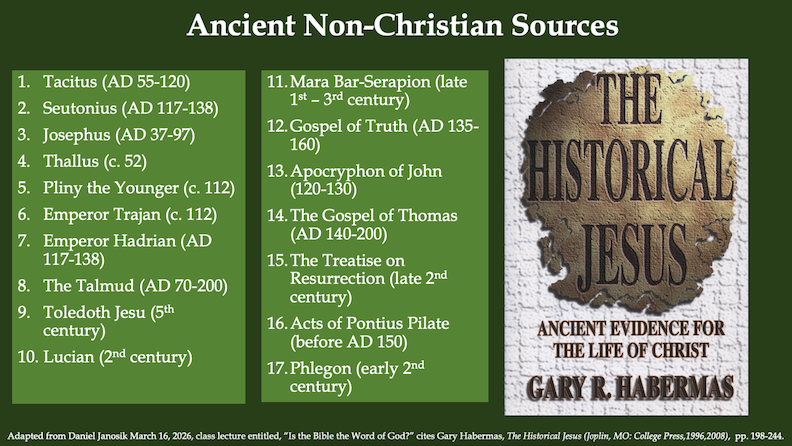
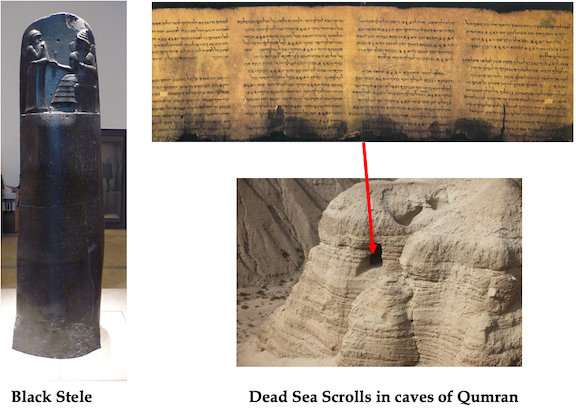
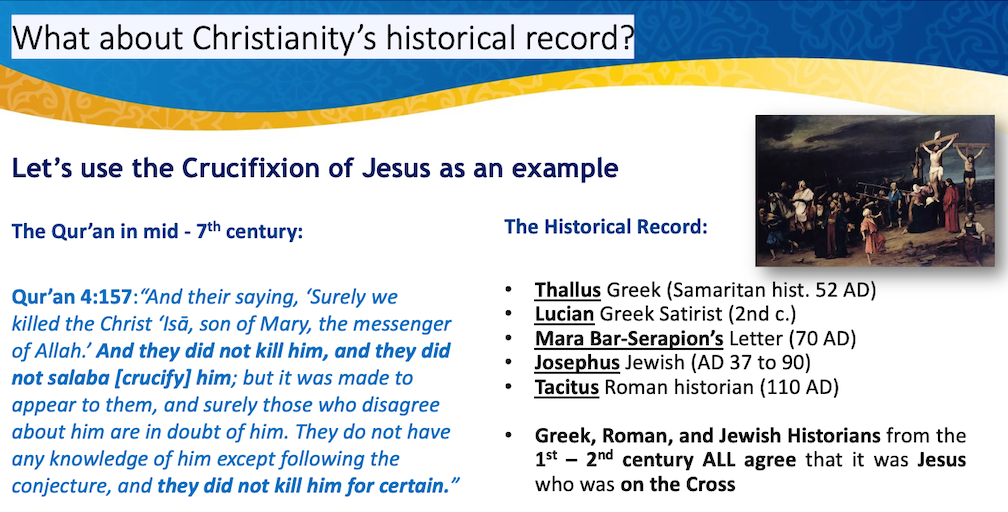
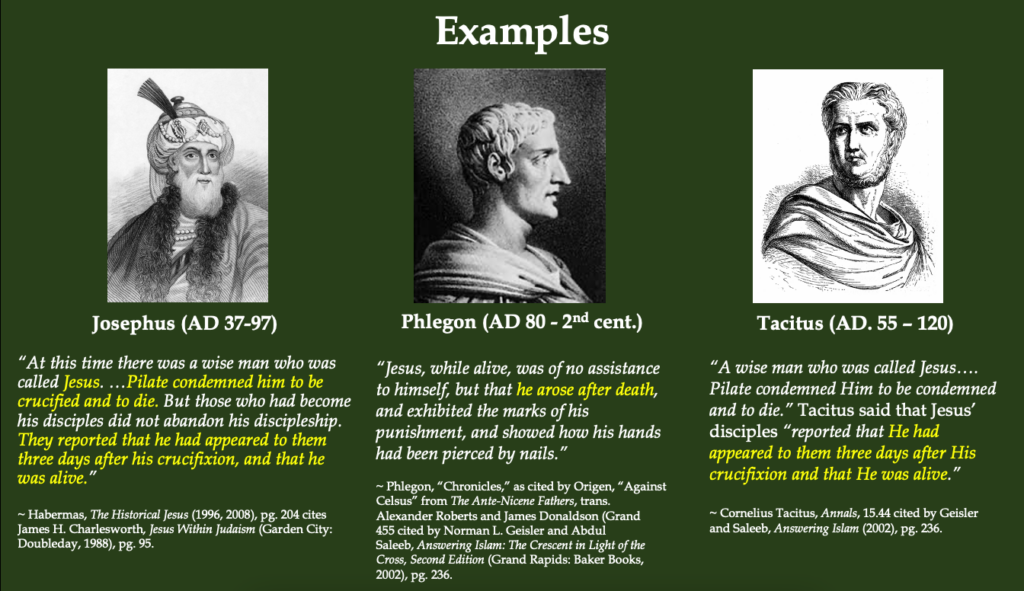
Let’s look at the archaeological evidence for the New Testament. Some people believe there is no historical evidence supporting that Jesus Christ actually existed. But in his book, The Historical Jesus, Gary Habermas cites 17 ancient non-Christian sources (see above pic) that testify to the historicity of Christ and early Christianity. [81] These are real people who testified of the death and resurrection of Jesus Christ. Examples (see pic below) include the Jewish historian, Josephus, the Greek historian Phlegon, and the Roman historian Tacitus.
Skeptics have harshly criticized Luke’s writings because more than any other New Testament writer he has mentioned specific people and places. Luke began his gospel of Jesus Christ, “1 Inasmuch as many have taken in hand to set in order a narrative of those things which have been fulfilled among us, 2 just as those who from the beginning were eyewitnesses and ministers of the word delivered them to us, 3 it seemed good to me also, having had perfect understanding of all things from the very first, to write to you an orderly account, most excellent Theophilus, 4 that you may know the certainty of those things in which you were instructed.” (Luke 1:1-4).
Luke’s mention of Quirinius as the governor of Syria during the birth of Jesus (Luke 2:2) has been disputed by skeptics because Matthew’s account says Christ’s birth took place during the reign of Herod (Matt. 2:1, 16). Christ was born (6-4 B.C.) before King Herod died in 4 B.C. But critics argue that Josephus (Flavius Josephus, Antiquities of the Jews, 18:1:1; 18:2:1) places Quirinius’ reign in 6 A.D., ten years after Herod’s death. And Acts 5:37 seems to reference a census by Quirinius at that time. Did Luke get the historical placement of Quirinius wrong?
A grammatical possibility is that the Greek word translated “first” (prōtē) can mean “before” or “earlier” (Luke 2:2; cf. John 15:18). [82] Hence, the verse could be translated as “This census took place before Quirinius was governing Syria.” (Luke 2:2). The Greek verb translated “governing” (hēgemoneuō) does not necessarily mean Quirinius was holding the specific office of governor. It simply means Quirinius was exercising authority in some capacity. [83] Hence, Luke’s meaning would then be that the census that took Mary and Joseph to Bethlehem was the one that Augustus made “before” the one he took when Quirinius was governing Syria in some capacity (in 6 A.D.), implying that another census was taken during another period when Quirinius was exercising authority in Syria. [84]
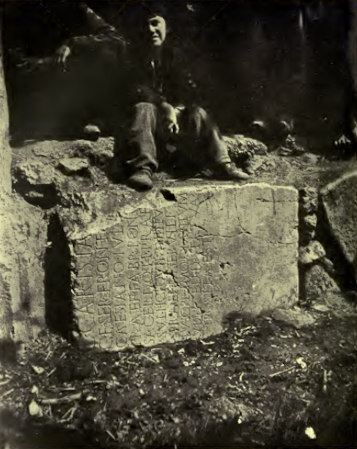
Archaeological discoveries confirm that Quirinius was proconsul of Syria twice. In 1764, a Latin inscription was discovered near Tivoli, located about twenty miles east of Rome, and it is understood to refer to Quirinius governing Syria on two separate occasions. [85] The first time was from 12–2 B.C. to conduct military action against the Homonadensians and then a second time in 6-7 A.D. [86] In addition, a statue dedicated to Quirinius was found by Sir William Ramsay at Pisidian Antioch (see above photo) showing that Quirinius was active in the region and held administrative authority around 12 to 2 B.C. [87] Hence, Quirinius exercised authority over the Roman province of Syria in some capacity twice (12-2 B.C. and A.D. 6-7) and took two separate censuses. [88] This is consistent with Luke’s account. In Luke 2:2, Luke writes, “This census first took place while Quirinius was governing Syria” (describing Quirinius’ rule as the governor’s procurator), and in Acts 5:37, Luke describes a second census taken most likely between 6-7 A.D. (as described by Josephus) when Quirinius was the formal governor of the region. Both Josephus and Luke link this second census to an uprising under Judas of Galilee. Only Luke’s sources were present during the actual events; as a result, Luke’s description of two separate censuses is reasonable. [89]
Repeatedly secular historians have accused Luke of historical inaccuracies only to retract their criticisms after archaeology confirmed Luke’s accounts. Examples include:
– Luke’s use of the Greek word meris to maintain that Philippi was a “district” of Macedonia (Acts 16:12) was doubted until inscriptions were found which use this very word to describe divisions of a district. [90]
– Luke’s usage of the Greek word Politarchēs to denote the civil authority of Thessalonica (Acts 17:6) was questioned, until some 19 inscriptions have been found that make use of this title, 5 of which are in reference to Thessalonica. [91]
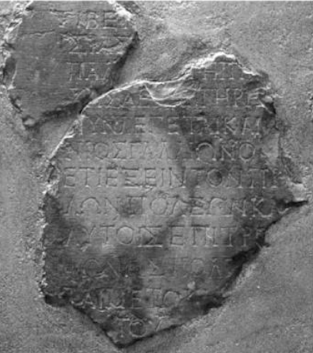
– Luke’s usage of Proconsul as the title for Gallio in Acts 18:12 has come under much criticism by secular historians, as the later traveler and writer Pliny never referred to Gallio as a Proconsul. This fact alone, they said, proved that the writer of Acts wrote his account much later as he was not aware of Gallio’s true position. In 1908 the Delphi Inscription, dated to 52 A.D. was uncovered (see above photo) and proved that Luke was correct. This inscription states, “As Lusius Junius Gallio, my friend, and the proconsul of Achaia…” [92]
– When Luke says Paul and Barnabas fled from Iconium (Acts 14:1-5) to Lystra and Derbe, cities in Lycaonia (Acts 14:6), he was implying that Iconium was not in Lycaonia. This was rejected by critical archaeologists who based their belief on the writings of Romans such as Cicero who indicated Iconium was in Lycaonia. [93] But in 1910 Sir William Ramsay found a monument that showed Iconium was a Phrygian city. [94]
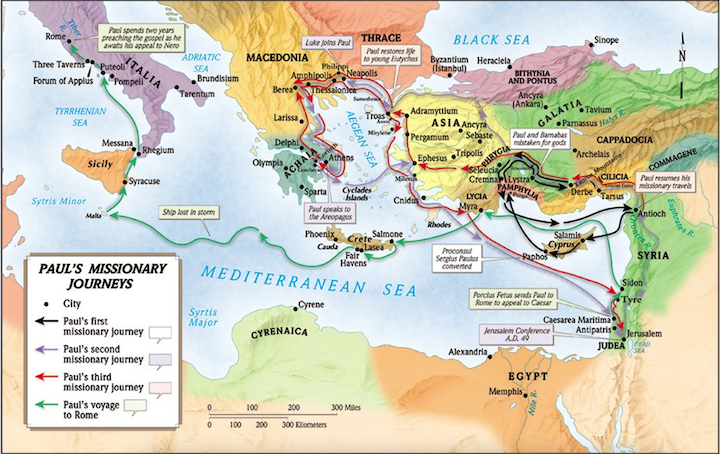
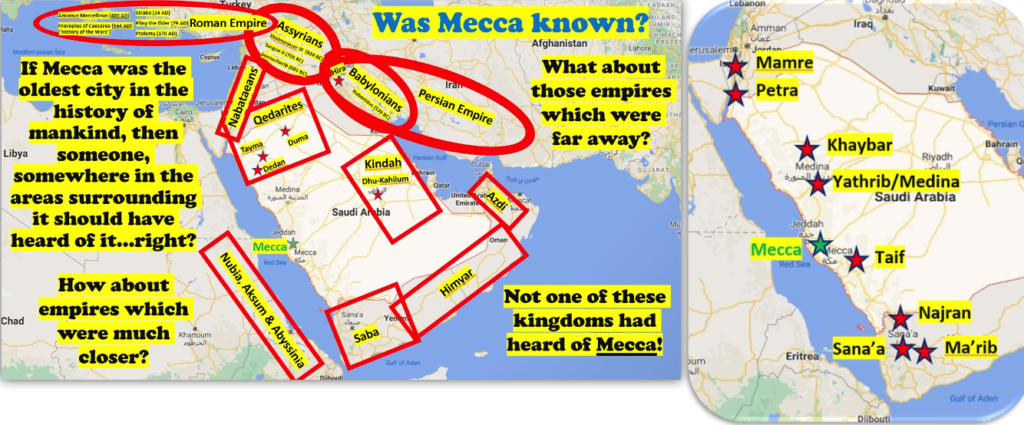
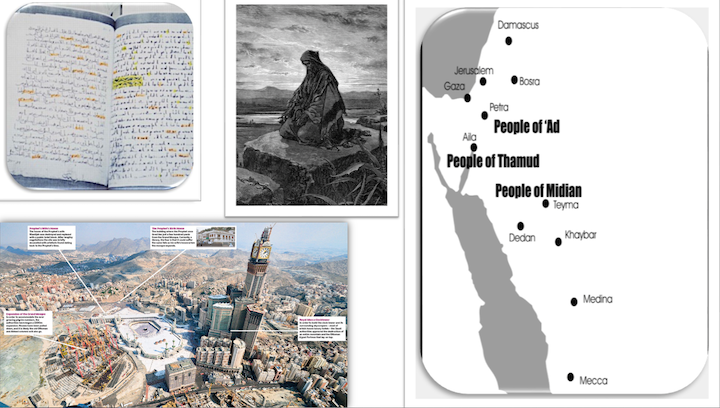
Luke recorded 32 countries, 54 cities, 9 Mediterranean islands, and 95 people in the book of Acts (see above pic), and he did not get any of them wrong. [95] Compare Luke’s historical accuracy with the Qur’an which places fifty-four of its sixty-five geographic references (see pic below) 600 – 1,000 miles too far north of Mecca (Ad = 23 times, Thamud = 24 times, and Midian = 7 times). [96]
Archaeologist and former Lukan skeptic, Sir William Ramsay investigated the archaeological discoveries relevant to Luke’s account in order to disprove the Bible as the inspired Word of God. After 30 years of archaeological research in the Middle East, Ramsay concluded that “Luke is a historian of the first rank; not merely are his statements of fact trustworthy … this author should be placed along with the very greatest historians [97]… Luke’s history is unsurpassed in respect of its trustworthiness.” [98] He later wrote a book on the trustworthiness of the Bible based on his discoveries and converted to Christianity. Sir Ramsay found no historical or geographical mistakes in the book of Acts. [99]
Unlike the Qur’an, archaeology repeatedly confirms the historical reliability of the New Testament. Smith writes, “We have no reason to fear archaeology. In fact, it is this very science which has done more to authenticate our scriptures than any other. Thus, we encourage the secular archaeologists to dig, for as they dig, we know they will only come closer to that which our scriptures have long considered to be the truth and give us reason to claim that indeed our Bible has the right to claim true authority as the only historically verified Word of God. This is why so many eminent archaeologists are standing resolutely behind the Biblical accounts.” [100]
Conclusion
From this brief survey we can conclude that the archaeological evidence for the historicity of the Qur’an proves to be the most damaging. The glaring historical inaccuracies involving the direction of prayer (Qibla), dirham coins in the time of Joseph, Samaritans in the time of Moses, chain mail in the time of David, crucifixions in the times of Joseph and Moses, and Alexander the Great’s making of an impregnable barrier, cannot be from a divine source. Not only do the seventh and eighth century ruins and inscriptions from the area seem to contradict the notion that Muhammad canonized a direction of prayer during his lifetime, or that he had formulated a scripture known as the Qur’an, but the idea of his universal prophethood, that he was the final “seal” of all prophets is brought into question. This indeed is significant and troublesome.
If the Qur’an was truly from an all-knowing God (Allah), it would not contain so many historical inaccuracies. Instead, these inaccuracies suggest that the Qur’an is not from a divine source, but from a human source. Whoever wrote the Qur’an either did not know their history well or they borrowed these stories from other sources with little discretion on their parts. Hence, the Qur’an is a manmade book that is not to be taken seriously.
As for the Bible, we have learned from archaeology that the names, places, and events mentioned in the Bible have been recorded accurately so that what we have is the representation of what God said and did. The historical events and people in the Bible do not confuse names, dates and events, and in fact, continue to coincide with current archaeological findings. This is very significant, since with each successive year, ongoing archaeological discoveries fail to reveal any historical contradictions in our Scriptures. Instead, they continue to substantiate what the Bible has been saying for 2,000-4,000 years.
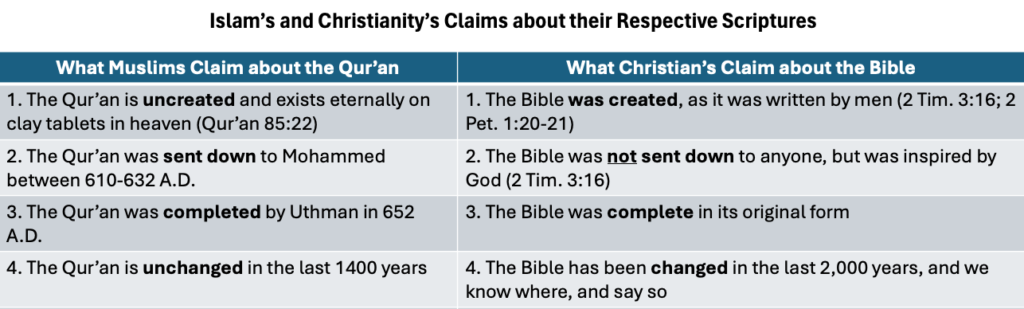
Earlier we learned that Islam makes four claims for the authority of the Qur’an (see chart below): [101]
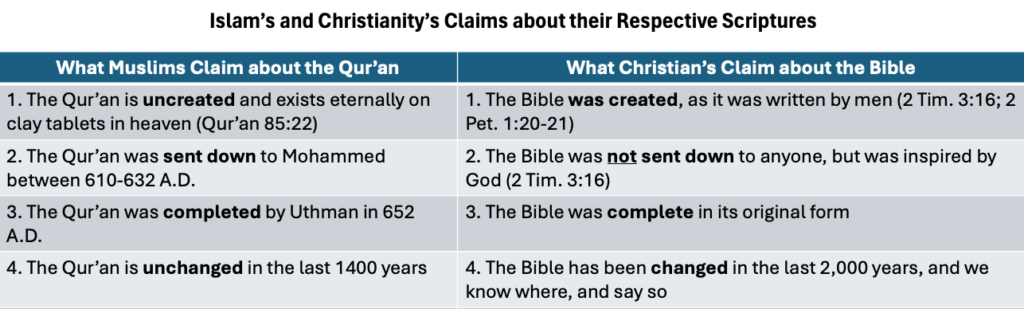
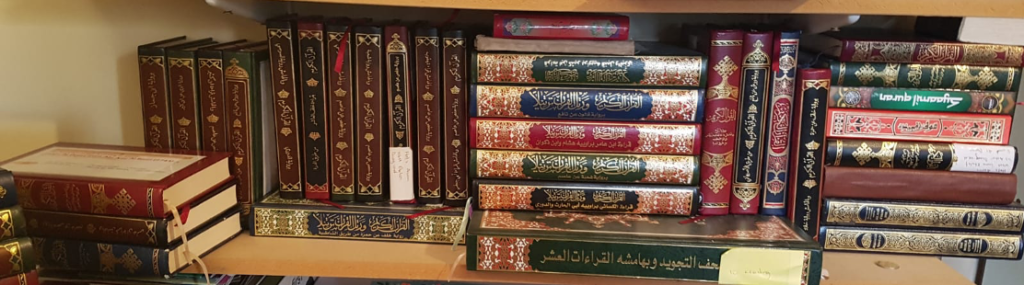
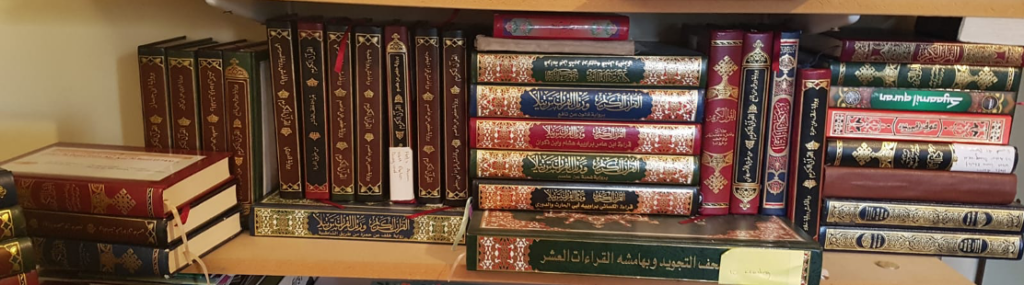
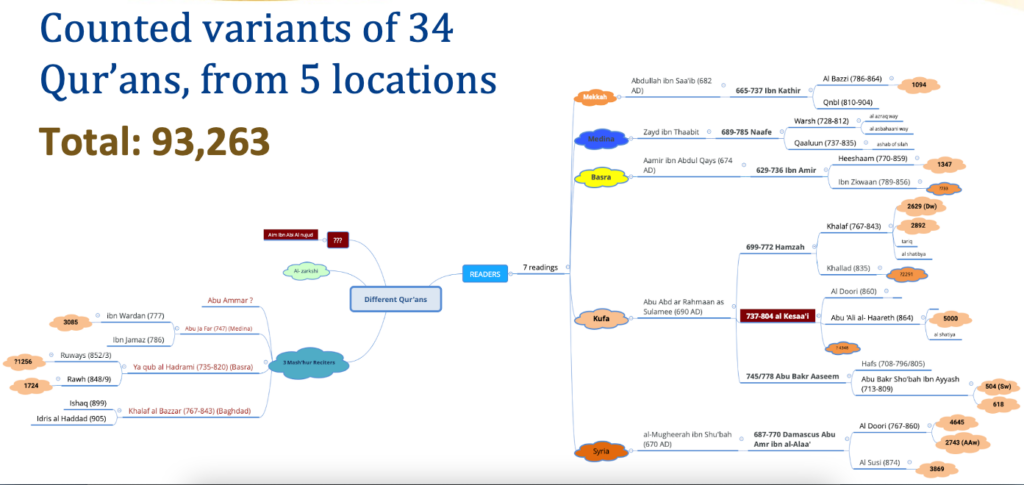
1. It must be eternal (Qur’an 85:21-22; cf. 10:15; 18:27). The Qur’an was uncreated and existed eternally written on clay tablets in heaven. Hence, no human being can touch it or alter it. Why? Because Allah will guard it (Qur’an 15:9). Yet we have seen in our survey of the Qur’an, that it has been handled and altered numerous times so that even today there are at least 34 different Qur’ans in the world (see photo below).
2. It must be sent down (Qur’an 39:41). The Qur’an was sent down from Allah through the angel Gabriel to Mohammed from 610 – 632 A.D. Yet, Mohammed did not write these revelations down. He had 23 years to write down the Qur’an, but he never did. The Qur’an was not written down until Mohammed’s secretary, Zayd ibn Thabit, [102] finally wrote it down (632-634 A.D.), and gave it to Hafsah, the daughter of Umar (the second Caliph), who stored the Qur’an under her bed for twenty years. [103] If this truly was the final revelation from God that was supposed to have corrected that which had been corrupted, then why would they put it under a bed for twenty years?
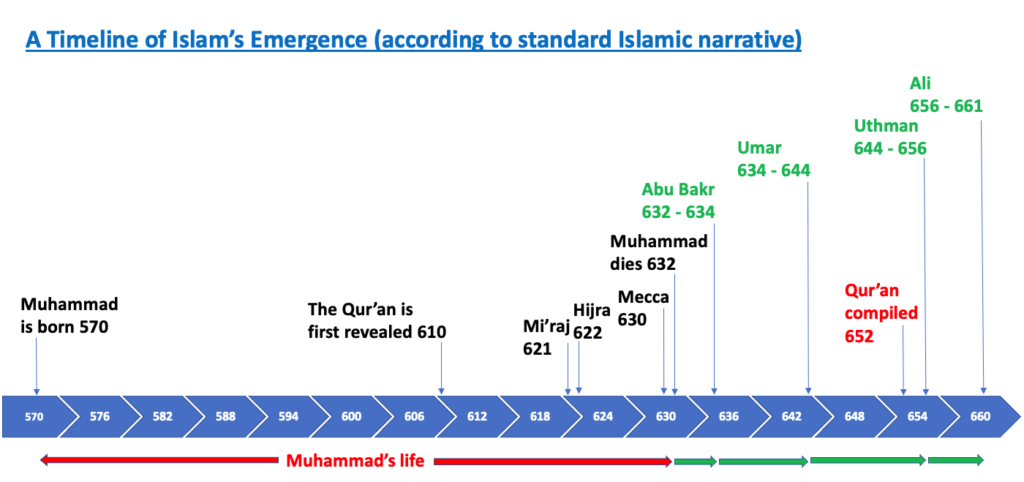
3. It must be complete. The Qur’an was completed by 632 A.D. when Mohammed received the last revelation from Allah. But it wasn’t written down until after Mohammed died. After Caliph Uthman heard that there were several different versions of the Qur’an being used by Muslim communities, he had the copy of the Qur’an given to Hafsah revised by Zayd, along with Az-Zubair, Al-As, and bin Hisham, into an official revised version of the Qur’an in the “Quraishi” dialect (in 652 A.D.). [104] Islam does not have one Qur’anic manuscript from the 7th century when the Qur’an was supposedly written down.
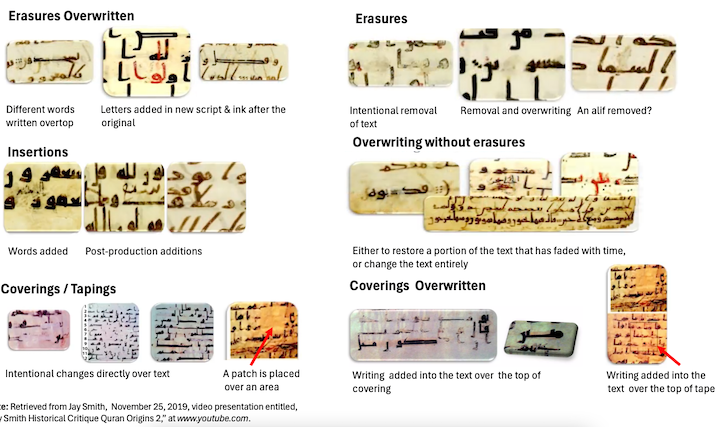
4. It must be unchanged (Qur’an 10:15; 15:9; 18:27). Islam claims that the Qur’an is unchanged in the last 1,400 years. But we have learned that the six earliest extant manuscripts of the Qur’an are from the 8th century, and not one of them agrees with the other. [105] Dr. Daniel Brubaker has found thousands of corrections (corruptions) in these six early manuscripts and others soon after them, [106] which undermines Islam’s claim that the Qur’an has been unchanged or uncorrupted the last 1,400 years. One of the team members of Dr. Jay Smith has found 34 different Qur’ans with a total of 93,263 variants/corruptions (see photo below). [107]
Christians would not say these 4 same things about our Bible which is the Written Word of God. But we need to remember that the Bible is not our only Word of God. We also have the Living Word of God or Logos, Who is Jesus Christ (John 1:1-18).
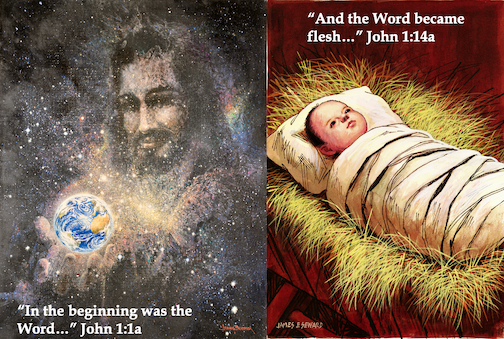
Let’s apply Islam’s four criteria to Jesus:
1. Is Jesus Christ eternal? Yes. The Bible says, “We are in Him who is true, in His Son Jesus Christ. This is the true God and eternal life.” (I John 5:20). Jesus has no beginning and no end because of His eternality. Jesus said, “I am the Alpha and the Omega… who is and who was and who is to come, the Almighty.’” (Rev. 1:8).
2. Was Jesus Christ sent down? Certainly. Jesus said, “For I have come down from heaven, not to do My own will, but the will of Him who sent Me.” (John 6:38).
3. Is Jesus Christ complete? Yes, He is complete in His Person, being fully God (John 1:1; Tit. 2:13; I John 5:20) and fully Man (John 1:14), and in His Work (John 19:30).
4. Is Jesus Christ unchanged? Absolutely. The Bible says, “Jesus Christ is the same yesterday, today, and forever.” (Heb. 13:8).
Everything that the Muslims need and seek can be found in the Person of Jesus Christ. Hence, the four criteria that Muslims are searching for in their Qur’an, their “Primary Revelation,” Christians already have in Jesus Christ, our “Primary Revelation” (Heb. 1:2). Therefore, we must present Jesus Christ, a much better and greater Revelation, to our Muslim friends.
God has not given human governments to do this. He has not given secular humanists to do this. Nor has God given atheists and other religious people to do this. The Lord has entrusted His church consisting of believers in Jesus Christ to bring the Living Word to our lost Muslim friends (Mark 16:15; Acts 1:8), so “whoever believes in Him should not perish [in hell] but have everlasting life [both now and forever]” (John 3:16).
In my next article, Lord willing, we will look at why Muslims and Christians believe their Scriptures are true.
ENDNOTES:
[1] Dr. Jay Smith’s September 15, 2023, video entitled, “Investigating Islam with Dr. Jay Smith (2 Corinthians 10:5),” at www.youtube.com or at this LINK .
[2] Jay Smith, “The Bible and The Qur’an – An Historical Comparison,” at www.pfandercenter.org.
[3] Ibid., cites Patricia Crone and Michael Cook, Hagarism (Cambridge: Cambridge University Press, 1977), pg. 23.
[4] Daniel Janosik, THE GUIDE TO ANSWERING ISLAM: What Every Christian Needs to Know About Islam and the Rise of Radical Islam(Cambridge, OH: Christian Publishing House, 2019 Kindle Edition), pg. 56 cites Dan Gibson, Qur’anic Geography: A Survey and Evaluation of the Geographical References in the Qur’an with Suggested Solutions for Various Problems and Issues (Canada: Independent Scholars Press, 2011), pg. 379.
[5] Ibid., cites Gibson, Qur’anic Geography (2011), pg. 223.
[6] Ibid., pp. 56-57 cites “Destruction of early Islamic heritage sites in Saudi Arabia,” https://en.wikipedia.org/wiki/Destruction_of_early_Islamic_heritage_sites_in_Saudi_Arabia.
[7] Ibid., pg. 57.
[8] Smith, “The Bible and The Qur’an – An Historical Comparison,” at www.pfandercenter.org cites Crone and Cook, Hagarism (1977), pg. 24.
[9] Ibid.
[10] Smith, “Investigating Islam with Dr. Jay Smith (2 Corinthians 10:5),” at www.youtube.com.
[11] Smith, “The Bible and The Qur’an – An Historical Comparison,” at www.pfandercenter.org.
[12] Ibid.
[13] Much of this section is adapted from Ibid., unless otherwise noted.
[14] William J. Federer, What Every American Needs to Know about the Qur’an – A History of Islam & the United States (William J. Federer, 2007; 2016 Kindle Edition), pg. 96.
[15] Smith, “The Bible and The Qur’an – An Historical Comparison,” at www.pfandercenter.org, cites Yahuda Nevo, “Towards a Prehistory of Islam,” Jerusalem Studies in Arabic and Islam, vol.17 (Hebrew University of Jerusalem, 1994), pg. 113.
[16] Ibid., cites Cyril Glasse , The Concise Encyclopedia of Islam (San Francisco, CA: HarperSanFrancisco, 1991), pg. 102.
[17] Ibid., cites Glasse, The Concise Encyclopedia of Islam (1991), pg. 102.
[18] Ibid., cites Van Bercham 1927:217.
[19] Ibid., cites ‘Kitab al-‘uyun wa’l-hada’iq,’ edited by M. de Goeje and P. de Jong 1869:4
[20] Verse taken from Usama K. Dakdok, THE GENEROUS QUR’AN: An Accurate, Modern English Translation of the Qur’an, Islam’s Holiest Book (Venice, FL: Usama Dakdok Publishing, LLC, 2009 Smashwords Edition), pg. 443. Used by permission of Usama Dakdok Publishing, LLC.
[21] “Joseph,” at www.thebiblicaltimeline.org.
[22] Andrew Vargo, “’Dirham’ In The Time Of Joseph?” at www.answering-islam.org.
[23] Excerpt from Dakdok, THE GENEROUS QUR’AN, 2009 Smashwords Edition, pg. 499.
[24] Verse taken from Dakdok, THE GENEROUS QUR’AN, 2009 Smashwords Edition, pg. 443. Used by permission of Usama Dakdok Publishing, LLC.
[25] Tom Constable, Dr. Constable’s Notes on Genesis, 2025 Edition, pg. 2.
[26] Jochen Katz, “The ‘Samaritan’ Error In The Qur’an,” at www.answering-islam.org.
[27] Excerpt from Dakdok, THE GENEROUS QUR’AN, 2009 Smashwords Edition, pg. 443.
[28] Verses taken from Dakdok, THE GENEROUS QUR’AN, 2009 Smashwords Edition, pp. 590, 596. Used by permission of Usama Dakdok Publishing, LLC.
[29] Tom Constable, Dr. Constable’s Notes on 1 Samuel, 2026 Edition, pp. 2-4.
[30] “Chain Mail” article at www.en.wikipedia.org.
[31] Verses taken from Dakdok, THE GENEROUS QUR’AN, 2009 Smashwords Edition, pp. 441-442. Used by permission of Usama Dakdok Publishing, LLC.
[32] Verse taken from Ibid., pg. 341. Used by permission of Usama Dakdok Publishing, LLC.
[33] L. Cilliers and F. P. Retief, “The History and Pathology of Crucifixion,” South African Medical Journal (Suid-Afrikannse tydskrif via geneeskunde) 93, no. 12 (December 2003), pp. 938–941.
[34] Verse taken from Dakdok, THE GENEROUS QUR’AN, 2009 Smashwords Edition, pg. 422. Used by permission of Usama Dakdok Publishing, LLC.
[35] Usama K. Dakdok, Exposing the Truth about the Qur’an: The Revelation of Error, Volume 2 (Usama Dakdok Publishing LLC, 2013 Smashwords Edition), pp. 497-498.
[36] Article entitled, “Alexander the Great in Islamic tradition,” at www.en.wikipedia.org cites Sidney Griffith, “The Narratives of ‘the Companions of the Cave,’ Moses and His Servant, and Dhū ’l-Qarnayn in Sūrat al-Kahf,” Journal of the International Qur’anic Studies Association ,Vol. 6, No. 1 (2021): 146–147; Christine Chism, “Facing The Land Of Darkness: Alexander, Islam, And The Quest For The Secrets Of God,” Alexander the Great in the Middle Ages (University of Toronto Press, 2016), pp. 51–75; Majid Daneshgar (2020), Studying the Qur’ān in the Muslim Academy, AAR reflection and theory in the study of religion (New York (N.Y.): Oxford University Press, 2020), pg. 77.
[37] Verse taken from Dakdok, THE GENEROUS QUR’AN, 2009 Smashwords Edition, pg. 423. Used by permission of Usama Dakdok Publishing, LLC.
[38] Dakdok, Exposing the Truth about the Qur’an: The Revelation of Error, Volume 2, 2013 Smashwords Edition, pp. 503-505 cites Ibn Kathir, Stories of the Prophets, vol. 2, Abo Al Fida Ishamail Ibn Kathir Al Kurashi Al Damashce (Beirut: Dar Al-Arab Heritage, 1408 AH, 1988), pp. 129-133.
[39] Ibid., pg. 516.
[40] Ibid., pp. 516-517.
[41] Much of this section is adapted from Smith’s September 15, 2023, video entitled, “Investigating Islam with Dr. Jay Smith (2 Corinthians 10:5),” at www.youtube.com, unless otherwise noted.
[42] Janosik, THE GUIDE TO ANSWERING ISLAM, 2019 Kindle Edition, pg. 26 cites Karl-Heinz Ohlig and Gerd R. Puin, eds. The Hidden Origins of Islam: New Research into its Early History (NY: Prometheus Books, 2010), pp. 63-63; Robert Spencer, Did Muhammad Exist? An Inquiry into Islam’s Obscure Origins (Wilmington, Delaware: ISI Books, 2012), pp. 45-46, 55-56.
[43] Ibid., pg. 26 cites Yehuda Nevo, and Judith Koren, Crossroads to Islam: The Origins of the Arab Religion and the Arab State (NY: Prometheus Books, 2003), pp. 258-267.
[44] Smith (2023), “Investigating Islam with Dr. Jay Smith (2 Corinthians 10:5),” at www.youtube.com
[45] Ibid., cites Ilkka Juhani Lendstedt, “Who is in, who is out? Early Muslim Identity Through Epigraphy and Theory,” 2019; cf. Ilkka Juhani Lenstedt, Arabic Rock Inscriptions Up To 750 CE in A Marsham (ed.), The Umayyad World., 20, Routledge, Abingdon (University of Helsinki, 2020), pp. 411-437.
[46] Much of this section is adapted from Smith, “The Bible and The Qur’an – An Historical Comparison,” at www.pfandercenter.org, unless otherwise noted.
[47] Ibid., cites Michael Cook, Muhammad (Oxford University Press, 1983), pg. 74.
[48] Ibid., cites Cook, Muhammad (1983), pg. 74; Patricia Crone and Michael Cook, Hagarism (Cambridge: Cambridge University Press, 1977), pp. 167-168; see M. Van Berchem, Materiaux pour un Corpus Inscriptionum Arabicarum, part two, vol. ii (Cairo, 1927), pp. 215-217 and Adolph Grohmann, Arabic Papyri from Hirbet el-Mird (1963), no. 72 to delineate where these variances are.
[49] Ibid., cites Crone and Cook, Hagarism (1977), pp. 18, 167.
[50] Ibid.
[51] Tom Constable, Dr. Constable’s Notes on Genesis, 2026 Edition, pp. 192-194 cites Eugene H. Merrill, “Fixed Dates in Patriarchal Chronology,” Bibliotheca Sacra 137:547 (July- September 1980), pg. 248; Leon J. Wood, A Survey of Israel’s History (Grand Rapids: Zondervan Publishing House, 1970), pp. 30-38.
[52] Joseph M. Holden and Norman Geisler, The Popular Handbook of Archaeology and the Bible: Discoveries That Confirm the Reliability of Scripture (Eugene, OR: Harvest House Publishers, 2013 Kindle Locations 2095-2096 cites , K.A. Kitchen, “The Patriarchal Age: Myth or History?” Biblical Archaeology Review, March/April 1995, pg. 48ff.
[53] Josh McDowell and Sean McDowell, Evidence That Demands a Verdict: Life-Changing Truth for a Skeptical World (Nashville, TN: Thomas Nelson, 2017 Kindle Edition), pg. 451 cites K. A. Kitchen, On the Reliability of the Old Testament (Grand Rapids, MI: W. B. Eerdmans, 2003), pp. 341-342; cf. John D. Currid, “Genesis,” The ESV Archaeology Study Bible, Edited by John D. Currid and David W. Chapman (Wheaton: Crossway, 2017), pg. 13.
[54] Constable, Dr. Constable’s Notes on Genesis, 2026 Edition, pg. 200 cites Kyle M. Yates, “Genesis,” The Wycliffe Bible Commentary, Edited by Charles F. Pfeiffer and Everett F. Harrison (Chicago: Moody Press, 1962), pg. 16.
[55] Constable, Dr. Constable’s Notes on Genesis, 2026 Edition, pg. 202; Allen P. Ross, “Genesis,” The Bible Knowledge Commentary Law, 2018 Kindle Edition, pg. 75.
[56] Allen P. Ross, “Genesis,” The Bible Knowledge Commentary Law, 2018 Kindle Edition, pg. 75.
[57] Retrieved on April 26, 2026, from Bryan Windle, July 16, 2021, article entitled, “Top Ten Discoveries Related to Abraham,” at https://biblearchaeologyreport.com/2021/07/16/top-ten-discoveries-related-to-abraham/
[58] Retrieved on April 26, 2026, from Todd Bolen, “Haran,” at https://www.bibleplaces.com/haran/; cf. McDowell Evidence That Demands a Verdict, 2017 Kindle Edition, pg. 453 cites Daniel E. Fleming, “Genesis in History and Tradition: The Syrian Background of Israel’s Ancestors, Reprise,”in The Future of Biblical Archaeology: Reassessing Methodologies and Assumptions, edited by James K. Hoffmeier and Alan Millard (Grand Rapids, MI: Eerdmans, 2004), pg. 216.
[59] Constable, Dr. Constable’s Notes on Genesis, 2026 Edition, pg. 204 cites Tremper Longman. III, “Genesis,” The Baker Illustrated Bible Background Commentary, edited by J. Scott Duvall and J. Daniel Hays (Grand Rapids: Baker Books, 2020), pg. 93.
[60] Constable, Dr. Constable’s Notes on Genesis, 2026 Edition, pg. 215.
[61] McDowell, Evidence That Demands a Verdict, 2017 Kindle Edition, pg. 454 cites Eugene H. Merrill, Kingdom of Priests: A History of Old Testament Israel (Grand Rapids, MI: Baker Academic, 1998), pg. 63.
[62] Retrieved on April 27, 2026, from “Shechem: Its Archaeological and Contextual Significance,” at www.biblearchaeology.org. or at this LINK.
[63] More recent archaeological research places Bethel at el-Bira, about 10.3 miles north of Jerusalem and Ai at Khirbet el-Maqatir about 1 mile southeast of el-Bira – see Bryan Windle, April 12, 2019, “Biblical Sites: The Lost City of Ai… Found,” at www.biblearchaeologyreport.com cites Bryant G. Wood, “The Search for Joshua’s Ai,” in Critical Issues in Early Israelite History, edited by Richard S. Hess, Gerald A. Klingbeil, and Paul J. Ray Jr. (Winona Lake: Eisenbrauns 2008), pp. 210-240; Bryant G. Wood, “Excavations at Khirbet el-Maqatir: 1995 to 2000 and 2009 to 2011,” Associates for Biblical Research, April 4, 2012; Scott Stripling, “2014 Excavations at Kh. el-Maqatir: A Proposed New Location for Ai and Ephraim,” Associates for Biblical Research, March 9, 2015; cf. McDowell Evidence That Demands a Verdict, 2017 Kindle Edition, pp. 500 -501.
[64] Windle, July 16, 2021, article entitled, “Top Ten Discoveries Related to Abraham,” at www.biblearchaeologyreport.com cites Kenneth A. Kitchen,” Shishak’s Military Campaign in Israel Confirmed,” at www.library.biblicalarchaeology.org; McDowell, Evidence That Demands a Verdict, 2017 Kindle Edition, pg. 452 cites Kitchen, On the Reliability of the Old Testament (2003), pg. 313.
[65] Ibid.
[66] Excerpt from Dakdok, THE GENEROUS QUR’AN, 2009 Smashwords Edition, pp. 57-58; Excerpt from Usama K. Dakdok, Exposing the Truth about the Qur’an: The Revelation of Error, Volume 1 (Usama Dakdok Publishing LLC, 2013 Smashwords Edition), pp. 194-314.
[67] Smith, “The Bible and The Qur’an – An Historical Comparison,” at www.pfandercenter.org.
[68] Location of Tall el-Hammam. (a) Photo of the southern Levant, looking north, showing the Dead Sea, the site location (TeH), and nearby countries. The Dead Sea Rift, the fault line marking a major tectonic plate boundary, runs through the area. Source of base (b) Photo: NASA, Space Shuttle. “The Sinai Peninsula and the Dead Sea Rift”. Photo: sts109-708-024, taken 12/16/2009. From the NASA Langley Research Center Atmospheric Science Data Center (nasa.gov/topics/earth/features/astronauts_eyes/sts109-708-024.html). Adapted from Daniel Janosik March 16, 2026, class lecture entitled, “Is the Bible the Word of God?”
[69] Holden and Geisler, The Popular Handbook of Archaeology and the Bible, 2013 Kindle Locations 2509-2514 cite Steve Collins, “Where is Sodom? The Case for Tall el-Hammam,” Biblical Archaeology Review, March/April 2013; Malcolm A. LeCompte, Steven Collins, Phillip J. Silvia, Gunther Kletetschka, Timothy Witwer, Robert E. Hermes, Christopher R. Moore, Wendy S. Wolbach, George A. Howard, A. Victor Adedeji, Charles Mooney, James P. Kennett, Allen West, Ted E. Bunch, May 24, 2025, research article entitled, “A Tunguska Sized Airburst Destroyed Tall el-Hammam a Middle Bronze Age City in the Jordan Valley Near the Dead Sea (Expanded),” at www.scienceopen.com or at this LINK.
[70] LeCompte, Collins, Silvia, Kletetschka, Witwer, Hermes, Moore, Wolbach, Howard, Adedeji, Mooney, Kennett, West, Bunch, May 24, 2025, research article entitled, “A Tunguska Sized Airburst Destroyed Tall el-Hammam a Middle Bronze Age City in the Jordan Valley Near the Dead Sea (Expanded),” at www.scienceopen.com.
[71] Ibid.
[72] Ibid., cites Mark Boslough, Airburst Modeling in First International Workshop on Potentially Hazardous Asteroids Characterization, Atmospheric Entry and Risk Assessment. (Sandia National Lab. (SNL-NM), Albuquerque, NM, 2015, (United States)).
[73] LeCompte, Collins, Silvia, Kletetschka, Witwer, Hermes, Moore, Wolbach, Howard, Adedeji, Mooney, Kennett, West, Bunch, May 24, 2025, research article entitled, “A Tunguska Sized Airburst Destroyed Tall el-Hammam a Middle Bronze Age City in the Jordan Valley Near the Dead Sea (Expanded),” at www.scienceopen.com.
[74] Holden and Geisler, The Popular Handbook of Archaeology and the Bible, 2013 Kindle Locations 2509-2514 cite Steve Collins, “Where is Sodom? The Case for Tall el-Hammam,” Biblical Archaeology Review, March/April 2013.
[75] McDowell, Evidence That Demands a Verdict, 2017 Kindle Edition, pg. 497 cites Bryant Wood, “Did the Israelites Conquer Jericho? A New Look at the Archaeological Evidence,” Biblical Archaeology Review 16, no.2 (Mar/Apr 1990), pp. 10-12.
[76] Bryant G. Wood, June 9, 2008, research article, “The Walls of Jericho,” at www.biblearchaeology.org or at this LINK ; Bryant Wood, March 1, 1999, “The Walls of Jericho,” at www.answersingenesis.org cites Ernst Sellin and Carl Watzinger, Jericho die Ergebnisse der Ausgrabungen, Osnabrück, Otto Zeller Verlag (1973), pg. 58, (reprint of the 1913 edition), and Kathleen M. Kenyon, Excavations at Jericho (London, British School of Archaeology in Jerusalem, 1981), Vol. 3, pp. 110, 370.
[77] McDowell, Evidence That Demands a Verdict, 2017 Kindle Edition, pg. 516.
[78] Ibid., cites André Lemaire, “‘House of David’ Restored in Moabite Inscription,” Biblical Archaeology Review 20, no. 3 (1994), pg. 36; Holden and Geisler, The Popular Handbook of Archaeology and the Bible, 2013 Kindle Locations 3031-3045.
[79] Holden and Geisler, The Popular Handbook of Archaeology and the Bible, 2013 Kindle Locations 3006-3012.
[80] McDowell, Evidence That Demands a Verdict, 2017 Kindle Edition, pg. 516 cites George Athas, The Tel Dan Inscription: A Reappraisal and a New Interpretation (London: T&T Clark, 2003), pg. 281 and Steven L. McKenzie, King David: A Biography (Oxford University Press, 2000, E-book), pg. 13; Holden and Geisler, The Popular Handbook of Archaeology and the Bible, 2013 Kindle Locations 3012-3017 cites Alan Millard, “The Tell Dan Stele,” in William W. Hallo and K. Lawson Younger, eds., The Context of Scripture: Canonical Compositions from the Biblical World, Vol. 1 (Leiden, the Netherlands Brill, 2003), pp. 161-162. Also see Holden and Geisler’s helpful discussion responding to critics of Tell Dan Find at 2013 Kindle Locations 3017-3031.
[81] Gary Habermas, The Historical Jesus (Joplin, MO: College Press, 1996, 2008), pp. 198-224.
[82] Walter Bauer, A Greek-English Lexicon of the New Testament and Other Early Christian Literature, 2000 Kindle Edition, pg. 893.
[83] Bryan Windle, December 19, 2019, “Quirinius: An Archaeological Biography,” at www.biblearchaeologyreport.com cites Andrew E. Steinmann, From Abraham To Paul: A Biblical Chronology (St. Louis: Concordia Publishing House, 2011), pg. 239; cf. Bauer, A Greek-English Lexicon of the New Testament and Other Early Christian Literature, 2000 Kindle Edition, pg. 433.
[84] Holden and Geisler, The Popular Handbook of Archaeology and the Bible, 2013 Kindle Locations 1739-1741.
[85] William A. Ramsay, Was Christ Born at Bethlehem? A Study on the Credibility of St. Luke (Originally published Paternoster Row, London: Hodder and Stoughton, 1898; Seattle, WA: re:Source Digital Publishing, 2018 Kindle Edition), pg. 160.
[86] Holden and Geisler, The Popular Handbook of Archaeology and the Bible, 2013 Kindle Locations 1741-1743; cf. Ramsay, Was Christ Born at Bethlehem?, 2018 Kindle Edition, pg. 161; Jack Finegan, Handbook of Biblical Chronology: Principles of Time Reckoning in the Ancient World and Problems of Chronology in the Bible, Revised Edition (Peabody, MA: Hendrickson Publishers, 1998), pg. 304.
[87] William Mitchell Ramsay, The Bearing of Recent Discovery on the Trustworthiness of the New Testament (Originally published in London: Hodder & Stoughton, 1915; 2021 Kindle Edition), pp. 283-290.
[88] Tom Constable, Dr. Constable’s Notes on Luke, 2026 Edition, pg. 58 cites Harold W. Hoehner, Chronological Aspects of the Life of Christ, Contemporary Evangelical Perspectives series (Grand Rapids: Zondervan Publishing House, 1977), pg. 22; cf. Flavius Josephus, Antiquities of the Jews, 18:1:1; 18:2:1; Eusebius, The Ecclesiastical History of Eusebius Pamphilus Twin Brooks series. Popular ed. (Grand Rapids: Baker Book House, 1974), 1:5:28; Jack Finegan, Light from the Ancient Past: The Archeological Background of Judaism and Christianity 2nd edition (Princeton University Press. London: Oxford University Press, 1959), pp. 258-261; Joseph P. Free, Archaeology and Bible History 6th ed. (Wheaton: Scripture Press, 1950, 1959), pp. 285-286.
[89] J. Warner Wallace, August 16, 2017, “Unbelievable? Is Luke’s Description Of Quirinius Historically Inaccurate?” at www.coldcasechristianity.com.
[90] McDowell, Evidence That Demands a Verdict, 2017 Kindle Edition, pg. 88 cites Free, Archaeology and Bible History 6th ed. (1950, 1959), pg. 320.
[91] Ibid. cites F. F. Bruce, “Archaeological Confirmation of the New Testament,” in Revelation and the Bible, edited Carl Henry (Grand Rapids, MI: Baker Book House, 1969), pp. 325, 360 and David E. Graves, Biblical Archaeology: An Introduction with Recent Discoveries That Support the Reliability of the Bible (Moncton, New Brunswick, Canada: Electronic Christian Media, 2014), pp. 215-216.
[92] Ibid. cites Howard F. Vos ed. Can I Trust the Bible? (Chicago, IL: Moody Press, 1963), 180 and Graves, Biblical Archaeology (2104), pp. 215-216.
[93] Ramsay, The Bearing of Recent Discovery on the Trustworthiness of the New Testament (1915), 2021 Kindle Edition, pp. 37-40; Holden and Geisler, The Popular Handbook of Archaeology and the Bible, 2013 Kindle Locations 4026-4037.
[94] Ibid., pp. 67-76; cf. McDowell, Evidence That Demands a Verdict, 2017 Kindle Edition, pg. 88 cites Free, Archaeology and Bible History 6th ed. (1950, 1959), pg. 317.
[95] Norman L. Geisler and Thomas Howe, The Big Book of Bible Difficulties: Clear and Concise Answers from Genesis to Revelation (Grand Rapids, MI: Baker Books, 2008), pg. 47.
[96] Janosik, THE GUIDE TO ANSWERING ISLAM, 2019 Kindle Edition, pg. 56 cites Peter Townsend, The Mecca Mystery: Probing the Black Hole at the Heart of Muslim History (Peter Townsend, 2018), pg. 104 and Dan Gibson, Qur’anic Geography: A Survey and Evaluation of the Geographical References in the Qur’an with Suggested Solutions for Various Problems and Issues (Canada: Independent Scholars Press, 2011), pg. 137.
[97] Ramsay, The Bearing of Recent Discovery on the Trustworthiness of the New Testament (1915), 2021 Kindle Edition, pg. 220.
[98] Ibid., pg. 79.
[99] Janosik, March 16, 2026, class lecture entitled, “Is the Bible the Word of God?”
[100] Smith, “The Bible and The Qur’an – An Historical Comparison,” at www.pfandercenter.org.
[101] Much of this section is adapted from Smith (2023) video entitled, “Investigating Islam with Dr. Jay Smith (2 Corinthians 10:5),” at www.youtube.com, unless otherwise noted.
[102] Norman L. Geisler and Abdul Saleeb, Answering Islam: The Crescent in Light of the Cross Second Ed. (Grand Rapids, MI: Baker Books, 1993, 2002), pp. 92-93 cites Al-Bukhari, The Translation of the Meanings of Sahih Al-Bukhari, Vol. 6, pp. 477-478.
[103] Janosik, THE GUIDE TO ANSWERING ISLAM, 2019 Kindle Edition, pg. 321; cf. Jay Smith, November 24, 2019, video entitled, “Jay Smith Historical Critique Quran Origins 1,” at www.youtube.com.
[104] Geisler and Saleeb, Answering Islam (2002), pg. 93 cites Al-Bukhari, The Translation of the Meanings of Sahih Al-Bukhari, Vol. 6, pp. 478-479.
[105] Smith, March 9, 2026, class lecture entitled, “Manuscript Evidence for the Qur’an,” cites Dr. Tayyar Altıkulaç, Al-Muṣḥaf Al-Sharif: Attributed To ʿUthmān Bin ʿAffān (IRICA, 2007), pp. 23, 36 – footnote 14a, 41f, 65, 71-72, 81; François Déroche, La transmission écrite du Coran dans les débuts de l’islam. Le codex Parisino-petropolitanus (Brill, 2009), pp. 172-177; cf. Jay Smith, “The Bible and The Qur’an – An Historical Comparison,” at www.pfandercenter.org where he cites Martin Lings and Yasin Hamid Safadi, The Qur’an: Catalogue of an Exhibition of Quran Manuscripts at the British Library, 3 April – 15 August, 1976 (British Library, World of Islam Pub. Co., 1976), pp. 11-20.
[106] Daniel Brubaker, Corrections in Early Qurʾān Manuscripts: Twenty Examples (FULL COLOR EDITION) (Quran Manuscript Change Studies Book 1), 2019 Kindle Locations 168-169.
[107] Retrieved on May 11, 2026 from the March 23, 2026, powerpoint entitled, “In Search of the Book – the Qur’an,” at www.pfandercenter.org.