The Qur’an or the Bible? (Two different Scriptures)
Introduction
In our first article comparing Islam with Christianity, we observed the rise of Islam in America. [1] As Islam slowly infiltrates (not immigrates into) our country, it is imperative that Christians understand the differences between Islam and Christianity and be equipped to answer Islamists. God has brought Muslims into America so we can reach them with the gospel of Jesus Christ.
In the next few articles, we are going to compare the sacred writings of Islam (the Qur’an) with the sacred writings of Christianity (the Bible). Both Christianity and Islam get their beliefs from their holy scriptures, the Bible and the Qur’an, yet we find that they disagree on a number of areas. For example, when you compare how each scripture describes the Person of Jesus, His death, and resurrection, you will understand that there are opposing assertions held by both. Hence, it is important to discern which scripture can best make the claim to be the final and perfect Word of God.
When two documents which claim to be true are in contradiction, one must determine whether the contradictions can be explained adequately using criteria which a non-believer, or a third party, can accept; in other words, using measures which go beyond the believers’ personal faith commitment to their revelation. Essentially one must ask whether the Qur’an or the Bible can withstand an external critical analysis for their authenticity. Since both Islam and Christianity claim to receive their beliefs from the revealed truth which they find in their respective scriptures, it is essential to see if there is historical data or evidence to verify that what each scripture claims are true. [2]
I do want to note that this is an immensely complex and difficult subject which I did not anticipate when I first began this study. The more I researched this topic, the more I realized that there was no way I would be able to cover this subject in the space of one article.
For example, manuscript research for the Qur’an is in its infancy because Islamists do not consider it to be valid. [3] Unlike the Bible, textual criticism is unknown in classical, or even modern Islam. It is problematic to do the research because Muslims don’t consider old Quranic manuscripts important. Old manuscripts are discarded in mosques, or burned, so few have survived. Access to earliest manuscripts is difficult and requires introductions and time. It is also dangerous to do any research on manuscripts because Islam considers the Qur’an to be “above criticism.” What Western scholars usually find will close the doors to them. And what they find may cost them their lives. An example of this is John Wansbrough and Patricia Crone who both received death threats because of their findings which cast doubt on the reliability of the Qur’an. So, they had to relocate to safer locations.
Both the Bible and the Qur’an claim to have been revealed at a certain place, and over a period of time. They speak of people, places, and events. If they are true, then we would expect to find evidence for their claims, and especially verification for what they say in the period in which they themselves claim they were revealed.
Christianity teaches that the Bible, a collection of sixty-six books, was written by about forty people in three different languages – Hebrew (most of the Old Testament), Aramaic (Ezra 4:8-6:18; 7:12-26; Jer. 10:11. Dan. 2:4-7:28), [4] and Koine Greek (all the New Testament) – on three different continents (Asia, Africa, Europe) over a period of about two thousand years, from the time the book of Job was written during the patriarchal period (2100-1900 B.C.) [5] to the writing of the last book of the New Testament (Revelation) by the apostle John (95 A.D). [6] The first thirty-nine books are called the Old Testament and record the anticipation of the coming of Christ. The final twenty-seven books are called the New Testament and record Jesus’ life, death, resurrection, final victory, and rule on earth.
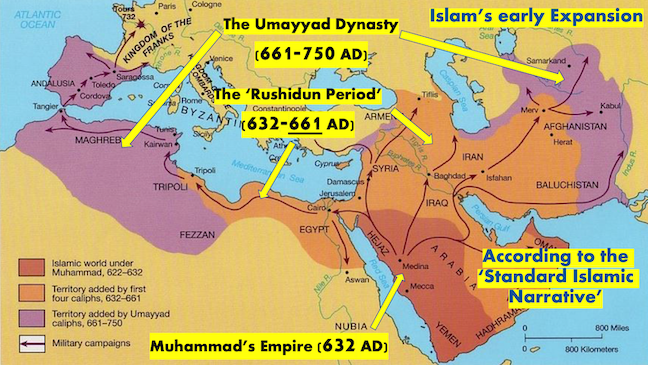
The standard Islamic narrative today teaches that the Qur’an, is uncreated and exists eternally on clay tablets in heaven (Qur’an 85:22). This uncreated Qur’an was sent down from Allah (non-Arabic word of Syriac or Hebrew origin meaning “the god”) [7] to one person only, the prophet Mohammed (Qur’an 39:41), through the angel Gabriel, in one language (Arabic), over a period of twenty-three years in two different locations – Mecca (610-622 A.D.) and Medina (622-632 A.D.) [8] – in west central Arabia (see above map). After each revelation from Allah through the angel Gabriel, since Mohammed could not read or write, he would recite the words of revelation to those present (thus the Arabic word “Qur’an,” which means reading or reciting). [9] Many of the devout Muslims would recite these verses in their prayers and commit them to memory. [10] Hence, unlike the Bible, which was a written text, the Qur’an began as an oral text.
About a year after Mohammed’s death (June 632 A.D.), many of those who could recite the Qur’an from memory (Hafiz/Qurra) were killed in the battle of Yamamah (633 A.D.). Umar (who would later become the second Caliph or successor to Mohammed) said, “I am afraid that more heavy casualties may take place among the Qurra’ on other battlefields, whereby a large part of the Qur’an may be lost.” [11] Qureshi wisely asks, if the Qur’an was already written down at this time, why would Umar be afraid of it being lost by the death of its reciters? [12]
Hence, it was deemed necessary by Islamic leaders to collect all of the prophet’s revelations into one book for use in the Islamic community lest a large part of the Qur’an be lost in future battles involving their Hafiz. [13] This demonstrates that memorization of the Qur’an was not good enough to preserve the Qur’an. It needed to be written down.
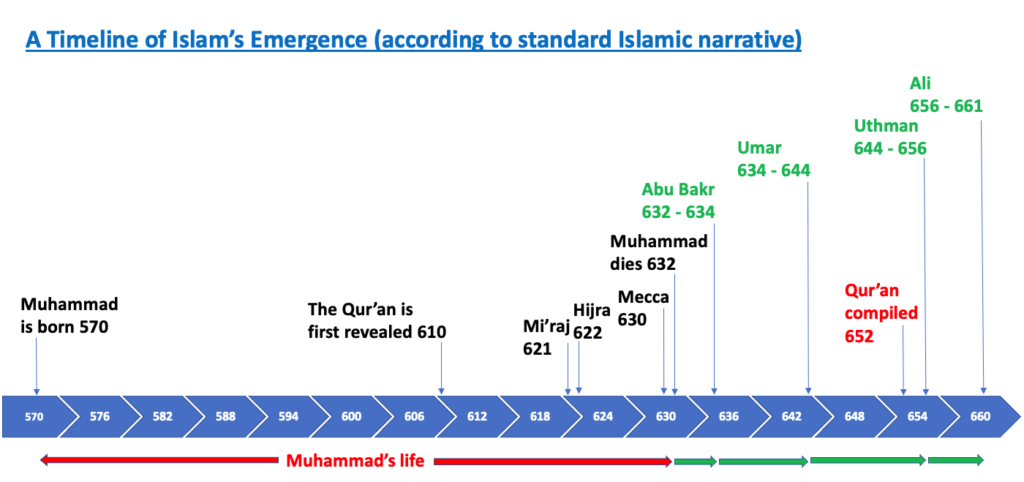
The compilation of the Qur’an (see above diagram) was initiated by Umar bin Al-Khattab who later became the second Caliph of Islam (successor to Mohammed), [14] when he ordered Zayd ibn Thabit, one of Mohammed’s most trusted secretaries, to collect all of the Qur’an in written and oral form. [15] At this point whatever Qur’anic verses were written down on scraps of bone, leaves, and cloth would be combined with those verses recorded from the ones who had memorized portions of the Qur’an. [16] After this first manuscript or canon of the Qur’an was completed (632-634 A.D.), it was given to Hafsah, the daughter of Umar, the second Caliph, who stored the Qur’an under her bed for twenty years. [17]
Later during the reign of Caliph Uthman over the entire Islamic Empire (644-655 A.D.), [18] it was reported to him that several Muslim communities were using different versions of the Qur’an, so he ordered that Zayd, along with Az-Zubair, Al-As, and bin Hisham, rewrite the first Qur’an copy given to Hafsah into an official revised version of the Qur’an in the “Quraishi” dialect (652 A.D.). [19]
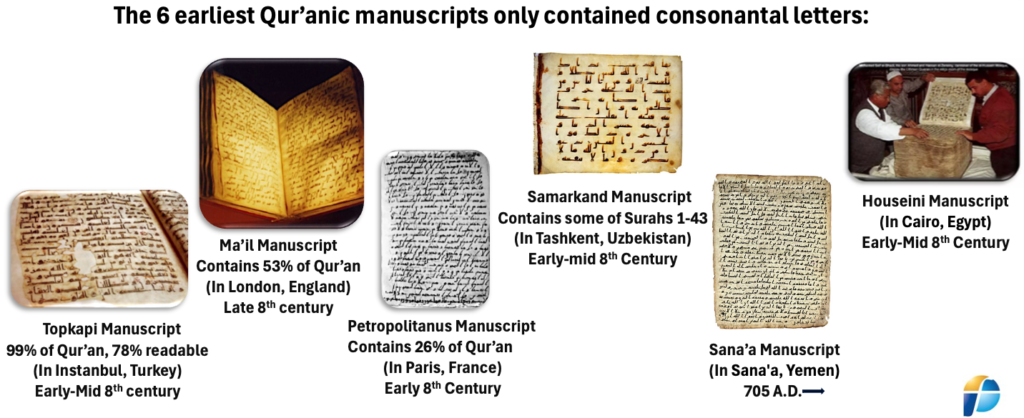
Dr. Jay Smith, a Christian apologist (defends truth), polemicist (confronts opponents with truth), and missionary (sent to proclaim truth to unbelievers) experienced in evangelizing Muslims, points out that there would have been no Quraishi dialect in 652 A.D. because there were no dots (vowels) or diacritical marks (signs placed above or below letters to change their pronunciation) in the early Arabic to distinguish dialects until the 8th – 9th centuries. [20] Early Arabic only had 16 consonantal letters with no vowels or diacritical marks. This is referred to as the rasm of the Qur’an. [21] The earliest Qur’anic manuscripts prove this point (see above pic). [22] Today Arabic has 28 consonantal letters along with vowels and diacritical marks. Smith notes that Bukhari, an 8th century traditionalist in Islam, must not have viewed the earliest manuscripts which were consonantal with no dots (vowels) or diacritical marks in the 7thcentury when the Qur’an was supposedly composed and compiled. [23]
Why would God choose a language that could not accommodate the Qur’an? The earliest Arabic manuscripts of the Qur’an were consonantal with no vowels or diacritical marks. After the production of this revised version in 652 A.D., [24] all the other copies of the Qur’an that disagreed with this revised version were recalled and burned by the express order of the Uthman. [25] Then, under the guidance of Uthman, Zayd ibn Thabit was summoned again to take this revised Qur’an and, together with some other companions, make copies to deliver to every province, [26] including Basra, Baghdad, Damascus, Jerusalem, Cairo, Alexandria, Aden, Herat, and Nishapur. [27] This was to be the standardized Qur’anic text for all of Islam.
The Qur’an is slightly shorter than the New Testament, consisting of 114 surahs (the equivalent of a chapter), 86 of which were revealed to Mohammed in Mecca (610 – 622 A.D) and 28 revealed to him in Medina (622 – 632 A.D.). [28] Each chapter is divided into verses (ayat). Each surah contains a title that is usually derived from a word or phrase within the chapter (such as, “The Cow,” “The Spoils,” “Joseph,” “He Frowned,” etc.). But in most cases, these titles do not describe the theme of the entire chapter. [29]
Islam claims that the Uthmanic version of the Qur’an (like the 1924 Cairo Hafs’ text used today) has been unchanged in the last 1400 years, [30] claiming that Allah would perfectly preserve (Qur’an 15:9; [31] 85:21-22) his eternal book without corruption or “crookedness” (Qur’an 18:1; 4:82). Today Islam claims that the Qur’an is the greatest, the only perfectly preserved, and final revelation. It corrects all previous revelations, [32] including the Bible.
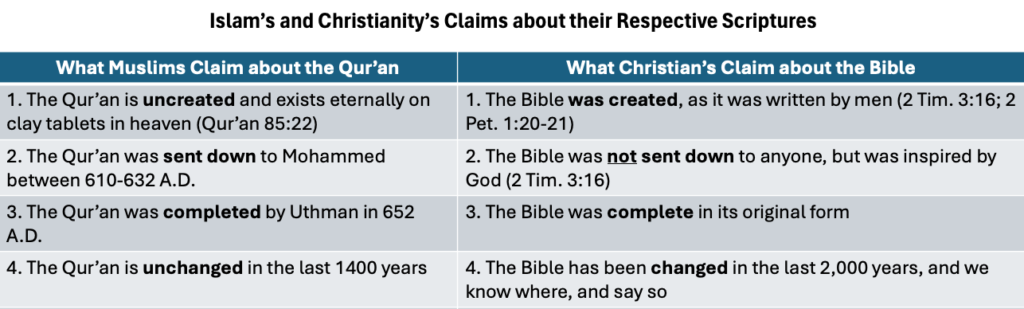
Here is a chart summarizing Islam’s and Christianity’s claims about their sacred books (see above chart). [33] The purpose of the next few articles is to look at the historical data which exists in these periods and determine whether it supports or denies the claims for the historicity of both the Bible and the Qur’an. I will attempt to do this by looking at three areas of evidence: manuscripts, documents, and archaeological facts from the periods mentioned above. If the manuscript, documentary and archaeological evidence supports the claims for the Bible or the Qur’an, then we can assume their reliability. However, if the evidence denies their historicity, then we have to doubt their authenticity. [34] I will give more space for Islam in these sections since the majority of Christians, like this author, are not very familiar with its history and distinctives.
Also, due to lack of space, I will also look at the documentary evidence and archaeological facts in my next two articles, Lord willing.
I. The Manuscript Evidence
When comparing the manuscript evidence of the Qur’an with the Bible, it is important to understand that during the time period for its composition (2000 B.C.– 95 A.D.), the Bible’s manuscripts were typically written on less durable material called papyrus (a paper-like material made from the papyrus reed stalk and leaves), [35] which would typically disintegrate within 100-200 years. Whereas by the 7th century A.D. when sources tell us Mohammed received revelations from Allah through the angel Gabriel (610-632 A.D.), the Qur’an manuscripts were written on parchment or vellum (i.e. animal skins) which can endure for thousands of years. [36]
A. The Qur’an’s Manuscript Evidence [37]
When conducting an analysis of the Qur’an’s manuscripts, there are some unique problems one must address that are not encountered with the Bible. Smith writes, “While we can find multiple manuscripts for the Bible written 700-900 years earlier, at a time when durable paper was not even used, the manuscripts for the Qur’an within the century in which it was purported to have been compiled, the seventh century, simply do not exist. Prior to 750 A.D. (thus for 100 years after Muhammad’s death) we have no verifiable Muslim documents which can give us a window into this formative period of Islam.” [38]
The fact of the matter is the primary sources which we possess are from 150-300 years after the events which they describe, and therefore are quite distant from those events. [39] For that reason, they are, for all practical purposes, secondary sources, as they rely on other material, much of which no longer exists. We simply do not have any “account from the Islamic’ community during the [initial] 150 years or so, between the first Arab conquests [the early 7th century] and the appearance, with the sira-maghazi narratives, of the earliest Islamic literature” [the late 8th century]. [40]
One would expect to find in those intervening 150 years, at least remnants of evidence for the development of the old Arab religion towards Islam (i.e. Muslim traditions); yet nothing is found. [41] The available documentary evidence prior to 752 A.D. “consists almost entirely of rather dubious citations in later compilations.” [42] Hence, we have no reliable proof that the later Muslim traditions speak truly of the life of Mohammed, or even of the Qur’an. [43] In addition, there is no evidence for the original Qur’anic text within the first century of Islam.[44] Nor do we have any of the original alleged nine copies which were made of the Uthman revised Qur’an sent to Basra, Baghdad, Damascus, Jerusalem, Cairo, Alexandria, Aden, Herat, and Nishapur. [45]
Even if these copies had somehow disintegrated with age (as some Muslims now allege), there would surely be some fragments of the documents at our disposal. By the end of the seventh century, Islam had expanded from Spain in the west to India in the east. According to Muslim tradition, the Qur’an was the centerpiece of their faith. Surely within that enormous sphere of influence there would be some Qur’anic documents or manuscripts which still exist till this day. Yet, there is nothing anywhere from that period at all. [46]
With the immense number of manuscripts available for the Christian scriptures, all compiled long before the time Mohammed was born, it is incredible that Islam cannot provide a single substantiated manuscript of their most holy book from within 100 years of their founder’s birth (570 – 670 A.D.).
However, some Muslims claim they do have the original copies of the revised Qur’an from Uthman (652 A.D.) in their possession. They refer to six early Arabic manuscripts (see above chart). The two documents which do hold some credibility to which many Muslims mention are the Samarkand Manuscript in Tashkent library in Uzbekistan (southern part of the former Soviet Union), and the Topkapi Manuscript, which is in the Topkapi Museum, in Istanbul, Turkey.
What Muslims may not know is that these two manuscripts are written in the Kufic Script, a script which according to modern Qur’anic manuscript experts, did not appear until late into the eighth century, and was not in use at all in Mecca and Medina in the seventh century. [47] Since both the Topkapi and Samarkand Manuscripts are written in the Kufic script, neither one could have been written earlier than 150 years after the Uthmanic revision was supposedly compiled; at the earliest the late 700s or early 800s. [48]
Two leading Muslim scholars, Dr. Ekmeleddin İhsanoğlu and Dr. Tayyar Altıkulaç, conducted five years of research (2002-2007) on the six early Arabic manuscripts and concluded that they are from the early to mid 8th century and are not Uthmanic nor sent by him. [49]
In addition, a more recent review examining the 2,270 variants and paleography of the Topkapi manuscript by a leading scholar of that manuscript, Dr. Rami Hussein Halaseh, shows that “up to the second century [AH – Anno Hegirae or in the year of the Hijrah in 622 A.D.] (816 AD) the qur’anic text was still being edited.” [50] [brackets and emphasis added] He concludes that the Topkapi manuscript was written from 750-900 A.D. [51]
B. Corrections in Early Qur’an Manuscripts
While Islam claims that the Uthman revised Qur’an (652 A.D.) has been perfectly preserved and not been changed in the last nearly 1400 years, there are recent discoveries that confirm the textual corruption of the Qur’an. For his doctoral thesis, Dr. Daniel Brubaker examined the 6 earliest Qur’anic manuscripts, as well as other manuscripts which appeared soon after. He documented just how extensive these corrections or corruptions have been, thus undermining the traditional Islamic claim of an uncorrupted version of the Qur’an. [52]
For example, Brubaker states, “In a correction, something is added (insertion), removed (erasure), replaced (erasure overwritten, taping overwritten, or overwriting without erasure), or (perhaps) hidden… Because each correction is different in nature and significance, it would be a mistake to draw conclusions from raw numbers, but for general information, here is a rough breakdown of the relative number of instances so far:” [53] [800 physical corrections documented in his 2014 doctoral dissertation] [54]
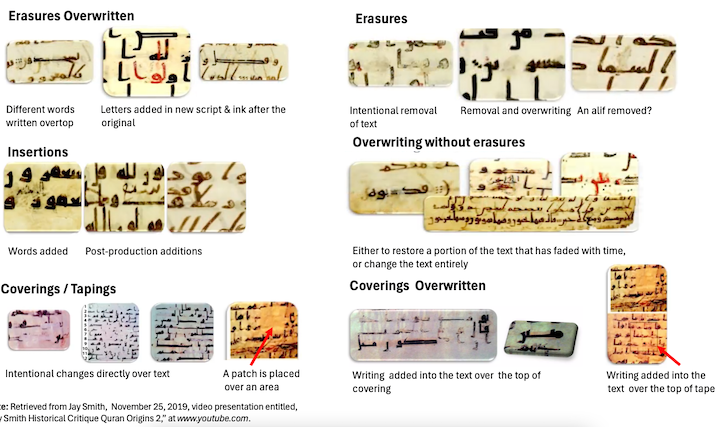
Erasure overwritten — about 30%
Insertion — about 24%
Overwriting without erasure — about 18%
Simple erasure — about 10%
Covering overwritten — about 2%
Covering — about 16% [55]
Since his doctoral dissertation in 2014, Brubaker has found over 4,000 (and counting) additional physical corrections in the early manuscripts of the Qur’an. [56] He presents several possible explanations for these corrections, one of which was that some of these corrections were made following a campaign to standardize the text such as Uthman’s revised Qur’anic text in 652 A.D. [57]
He also notes that there are partial corrections which he says indicates “a movement toward a standard over time, a gradual process rather than a sudden complete standardization. By partial correction, I mean places where one aspect of the writing on a page was brought to conformity with the 1924 Cairo rasm [consonantal text with no vowels or diacritical marks] but another part of the writing remained uncorrected.” [58] [brackets added]
It is important to know how the 1924 Cairo Qur’an was chosen. In 1924, in the city of Cairo, Egypt, high schools were noticing that students were coming with different answers to test questions about the Qur’anic text because they were using 37 variant Qur’ans. So, it was impossible to come up with a standardized religious test for all the students. Because of this, it was decided to have one man choose one Qur’an from among the 37 Qur’ans to be the standardized one. That man was Muhammad b. ‘Ali al-Husayni al-Haddad from Al Azhar University and he chose the 796 A.D. ‘Hafs’ Qur’an for all high schools in Cairo.
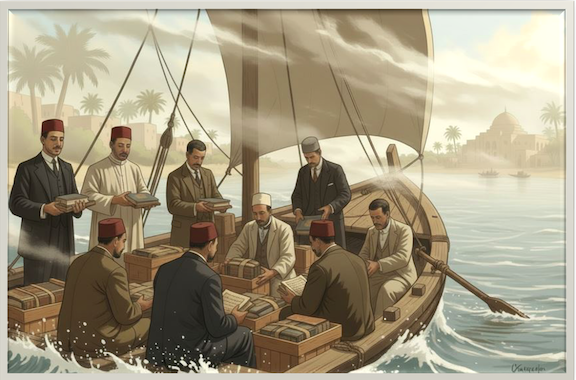
Hafs was from Iraq and died in 796 A.D. He had never met Mohammed. He had never seen the original Qur’an. He lived 144 years after the prophet. So, al-Haddad only chose what he thought was Hafs’ Qur’an. The educational authorities of Cairo gathered all the other Qur’ans (36 of them) that disagreed with Hafs’ and put them in a boat, taking them out into the middle of the Nile River, and dumped them (see above pic). [59] But that did not remove all those variants. Dr. Smith’s team have collected 37 different Qira’at Arabic Qur’ans in various marketplaces around the Arabic speaking world in recent years (see pic below). [60]
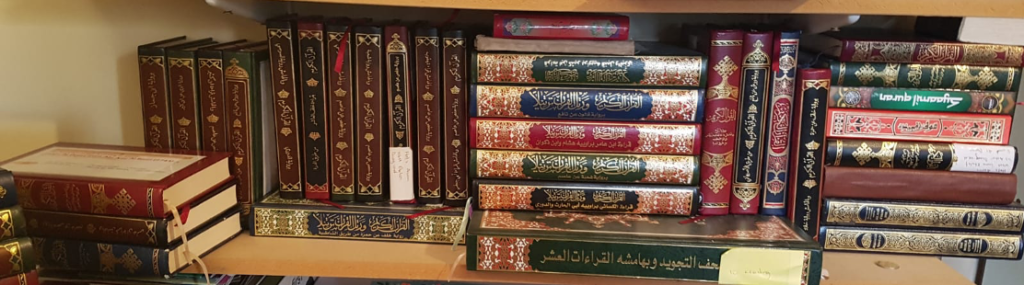
In 1936, when the government of Egypt realized how successful the 1924 Cairo Hafs’ Qur’an was in all of its schools, they decided to make the Hafs’ Qur’an standard for all Qur’ans in Egyptian schools. But that was only in Egypt.
Finally, in 1985, when King Fahd of Saudi Arabia realized how impactful the 1924 Cairo Hafs’ Qur’an was in Egypt, he decided to make this the standard Qur’an for the entire world. It became known as the “Faruq Edition,” named after King Faruq, who came to power in 1982. The Qur’an that is being used today, has only been standardized for the entire world for 41 years! And it comes from one student who created his own Qur’an in 796 A.D., 144 years after Mohammed.
Smith argues that the reason Brubaker has found over 4000 corrections (and counting) to the earliest manuscripts of the Qur’an is because those texts did not align with the much later Cairo Hafs’ text. Every time they inserted a word, erased a word or phrase, or covered a word or phrase, what was left was the Hafs’ standardized text.
C. The 63 Earliest Extant Fragments of the Qur’an.
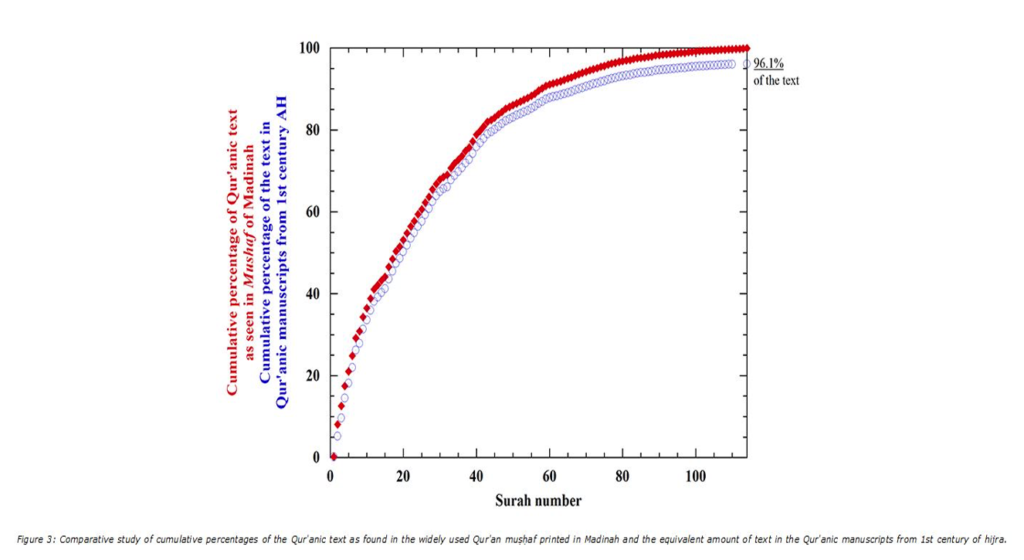
On the Islamic Awareness website (islamic-awareness.org) developed by Mansur Ahmed, they claim that within the first century of Islam (622 A.D. – 719 A.D.) they had 96% of the Qur’anic text (see above chart). [61] This figure is obtained from 63 different Qur’anic manuscripts, most of which are fragments or parts of manuscripts (see chart below).
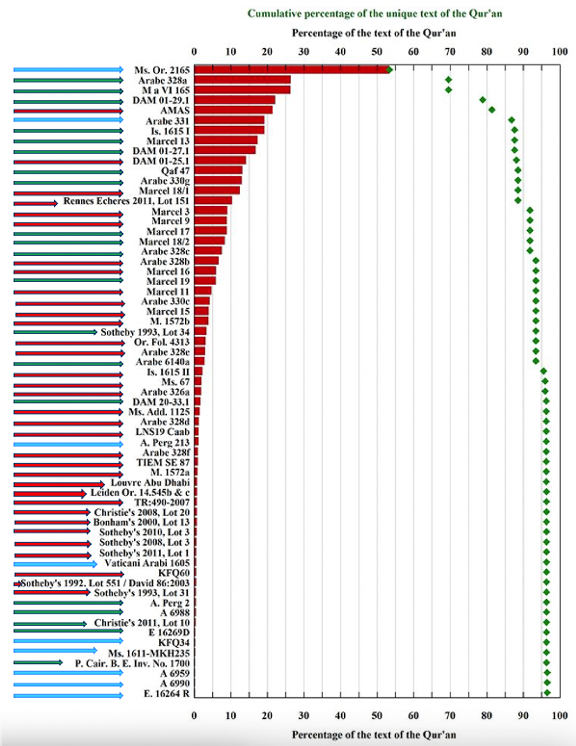
Dr. Smith’s team investigated these different manuscripts and found that 20 of the 63 manuscripts are tentatively dated, with disagreements between scholars (green arrows). No one has come to any conclusions about these. Notice that 3 of the top 5 manuscripts fall into this category. Then we see that 9 manuscripts are dated after 719 A.D. (blue arrows) and should not even be on the list. This includes the very top manuscript which is the most important one. The remaining 34 manuscripts (red arrows) are not dated because no one has done any work on them. So, they are pure speculation by the Muslims. Thus, we can conclude that none of these manuscripts are valid because all of them are either later, or tentatively dated, or have no supporting evidence! [62]
D. Pre-Islamic Sources in the Qur’an
Another difficulty with manuscript evidence for the Qur’an is that of the accounts involving many characters from the Bible, but they bear little similarity to the Biblical accounts. The Qur’anic stories include many distortions, amendments, and some bizarre additions to the familiar stories we have known and learned in the Bible. So, we ask, where did these stories come from, if not from the previous scriptures?
Many of these accounts come from other pre-Islamic Jewish and Christian apocryphal writings (some of it from the Jewish Talmud and Midrash)which appeared from 100 A.D. to 500 A.D., [63] and were not recognized by the Jews or the church to be authoritative or part of the canon of the Bible. [64]
When we compare some of the familiar sounding stories in the Qur’an with Jewish and Christian apocryphal literature, we find incredible similarities between these fictional apocryphal stories and the stories that are described in the Qur’an. Examples include the murder of Abel by Cain (Qur’an 5:31-32) borrowed from the Targum of Jonathan ben Uzziah, a second century writing, and the Jewish Mishnah Sanhedrin 4:5, a 5th century writing; [65] or the story of Abraham, the idols and the fiery furnace (Qur’an 21:51-71) taken from the Midrash Rabbah, a second century Jewish fable;[66] or the amusing story of Solomon, his talking Hoopoe bird, and the queen of Sheba who lifts her skirt when mistaking a mirrored floor for water (Qur’an 27:17-44), taken from the 2nd Targum of Esther, a second century writing. [67]
There are other instances where we find both apocryphal Jewish and Christian writings within the Qur’anic text. The account of Mt. Sinai being lifted up and held over the heads of the Jews as a threat for rejecting the law (Qur’an 7:171) comes from the second century Jewish apocryphal book, The Abodah Sarah. [68] The odd accounts of the early childhood of Jesus in the Qur’an can be traced to a number of Christian apocryphal writings which were rejected by the early church: the Palm tree which provides for the anguish of Mary after Jesus’s birth (Qur’an 19:22-26) and the baby Jesus talking from the cradle (Qur’an 19:29-33) both come from the second century false book, The Story of the Baby of Mary and the Childhood of the Savior; [69]the account of the infant Jesus creating birds from clay (Qur’an 3:49) was influenced by Chapter 2 in the second century Greek book, The Gospel of Thomas and also by Chapter 36 of the Arabic book, The Gospel of a Childhood. [70]
The descriptions of Hell in the Qur’an look a lot like the descriptions of hell in the Homilies of Ephraim, a Nestorian preacher of the sixth century. [71] Smith suggests that the author of the Qur’an in suras 42:17 and 101:6-9 was influenced by a fictitious book, The Testament of Abraham, written around 200 B.C. in Egypt, and later translated into Arabic and Greek, to teach that a scale or balance will be used on the day of judgment to weigh good and bad deeds in order to determine whether one goes to heaven or to hell. [72]
Additional borrowed Jewish, Christian, and other sources include: the angels Harut and Marut (Qur’an 2:102), from the Midrash Yalzut, Chapter 44; the 7 Heavens and 7 Hells (Qur’an 15:43-44; 17:44), from the traditions of Jagigah and Zuhal; the Mi’raj and Buraq, the winged horse (Quran 17:1), from the Testament of Abraham (200 B.C.); the Cave of the 7 Sleepers from the Story of the Martyrs (Gregory of Tours, or Diogenes Laertius); the Sirat Bridge (Qur’an 19:71) from the Chinavad from the Zoroastrian book Dinkart; Paradise, Houris, eyes like pearls (Qur’an 55:56-58; 56:22-24, 35-37), taken from Zoroastrian writings about Paaris, et al. [73] Smith states that some scholars think 30-60% of the Qur’an is borrowed from other sources, most of which were written between the 2nd – 5th centuries, suggesting that the creators of the Qur’an borrowed from the wrong sources!
The reason they borrowed from these other sources is because the Old and New Testaments of the Bible were not written in Arabic in the 7th – mid 8th centuries when the Qur’an was allegedly being compiled and completed. [74] Smith explains that many Jews lived in Arabia in the 7th-8th centuries, having fled Jerusalem after its destruction in 70 A.D. Several of the Jewish traditions were passed down orally from generation to generation. They would be retold around campfires to Arab traders, using the local vernacular. A lot of these stories would then be embellished. Others would be used as “bedtime” tales for the Jewish children. But the authentic Old Testament was never translated into Arabic until the late 8th century A.D., and the New Testament until the late 9th century A.D., thus, much too late to make it into the Qur’an. [75]
These accounts derived from Jewish and Christian apocryphal writings and other questionable sources have always been considered heretical by Christian and Jewish orthodox believers alike. How then did these sources make their way into a book that claims to be the final revelation from God? Shouldn’t this cause us to seriously question the divine origin of the Qur’an? It seems to this author that the Qur’an is a man-made book rather than a divine revelation from God.
Let’s now turn our attention to the manuscript evidence for the Bible and determine whether the Bible which we read today is historically accurate?
E. The Bible’s Manuscript Evidence
The Old Testament has survived in few complete manuscripts, most of which date from the ninth century A.D. or later. There are, however, abundant reasons for believing that these copies are reliable. Geisler and Nix note, “Several lines of evidence support this contention including: (1) the few variants existing in the Masoretic manuscripts; (2) the almost literal agreement of most of the Septuagint [the Greek translation of the Hebrew canon] with the Hebrew of the Masoretic Text (MT); (3) the scrupulous rules of the scribes who copied the manuscripts; (4) the similarity of parallel Old Testament passages; (5) archaeological confirmation of historical details of the text; (6) the agreement, by and large, of the Samaritan Pentateuch (SamP); (7) the thousands of Cairo Genezah manuscripts; and (8) the phenomenal confirmation of the Hebrew text by the Dead Sea Scroll (DSS) and Documents in the Judean Desert (DJD) discoveries.” [76] [brackets added]
In contrast to the Qur’an, the sheer number of New Testament manuscripts (MSS) which are existent today are astounding! Yet, Muslims argue that since we do not have the original manuscripts of the Bible, the reliability of the copies we do have is therefore in doubt. But this argument could also be directed at the Qur’an as recent discoveries have brought into question whether or not the earliest manuscripts of the Qur’an are close to the original Qur’anic text which Muslims claim was written down within 20 years of Mohammed’s death (see discussion above).
Because the Bible is a book, it was initially made up of manuscripts (handwritten copies). Subsequently, a primary means for determining its historical reliability today is the number of copies from those original manuscripts which are currently in one’s possession and the time interval between the original and earliest copy. This is known as the bibliographical test. [77] More copies of the original were made to preserve the original manuscript and to distribute the original to more and more people. Hence, the more copies we have the better we can compare between them and thus know if the document we now read corresponds with the original manuscript. Smith explains it like this: “It is much like a witness to an event. If we have only one witness to the event, there is the possibility that the witness’s agenda or even an exaggeration of the event has crept in, and we would never know the full truth. But if we have many witnesses, the probability that they all got it wrong becomes minute [small].” [78] [brackets added]
Also, the shorter the time interval between the original manuscript and the earliest copy, the greater the historical reliability of the document. Why? Because history has shown that the closer the copies are to the original, it usually means the fewer times it has been copied and therefore, the less chance it has of human error creeping in.
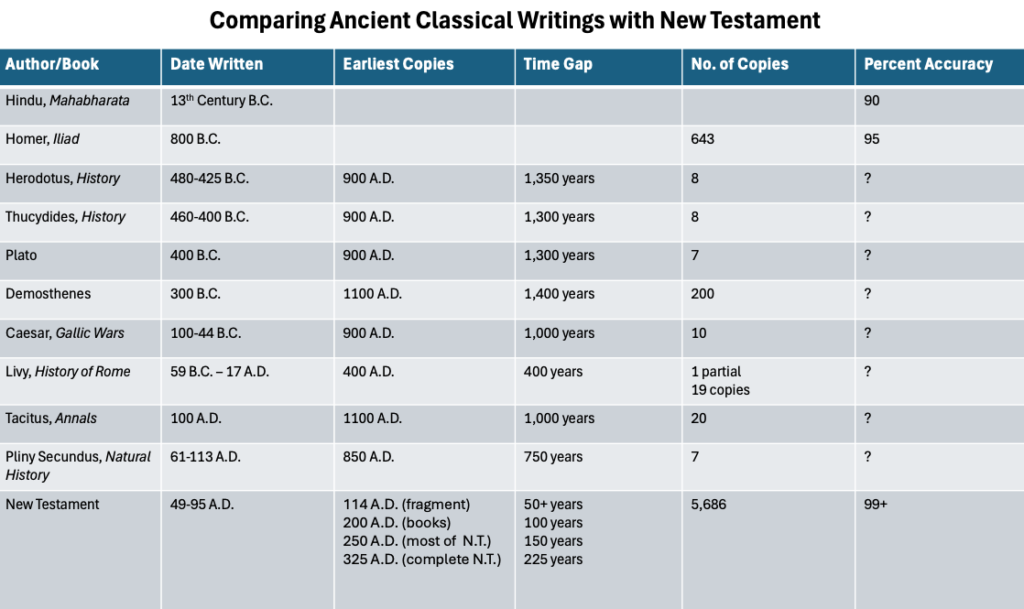
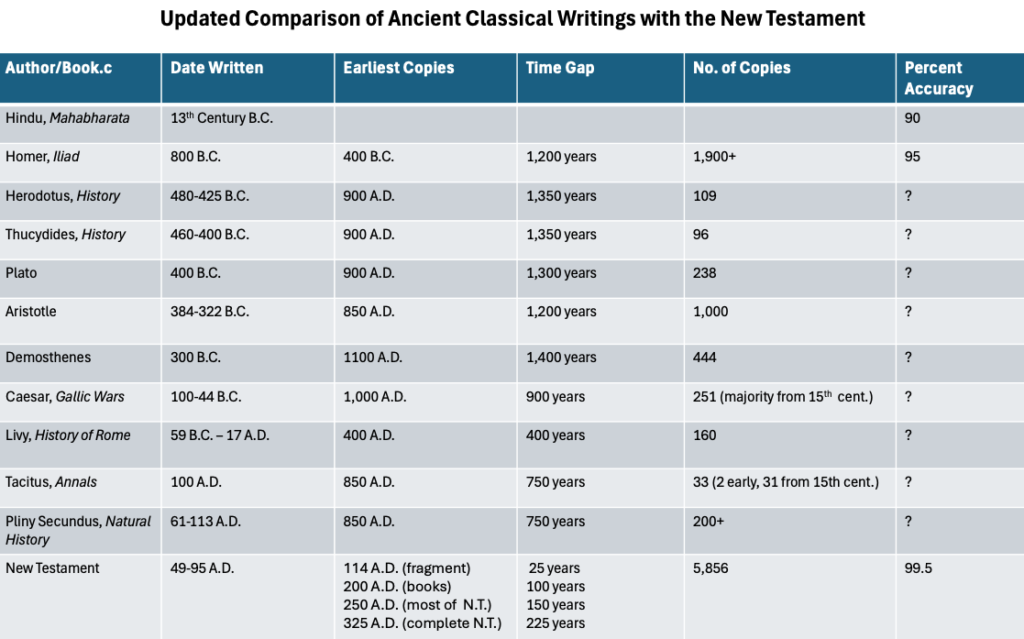
When comparing the New Testament, which was originally written in Koine Greek, with other credible ancient writings, the New Testament has far more manuscript authority than any other credible ancient literature as shown in the chart below. [79]
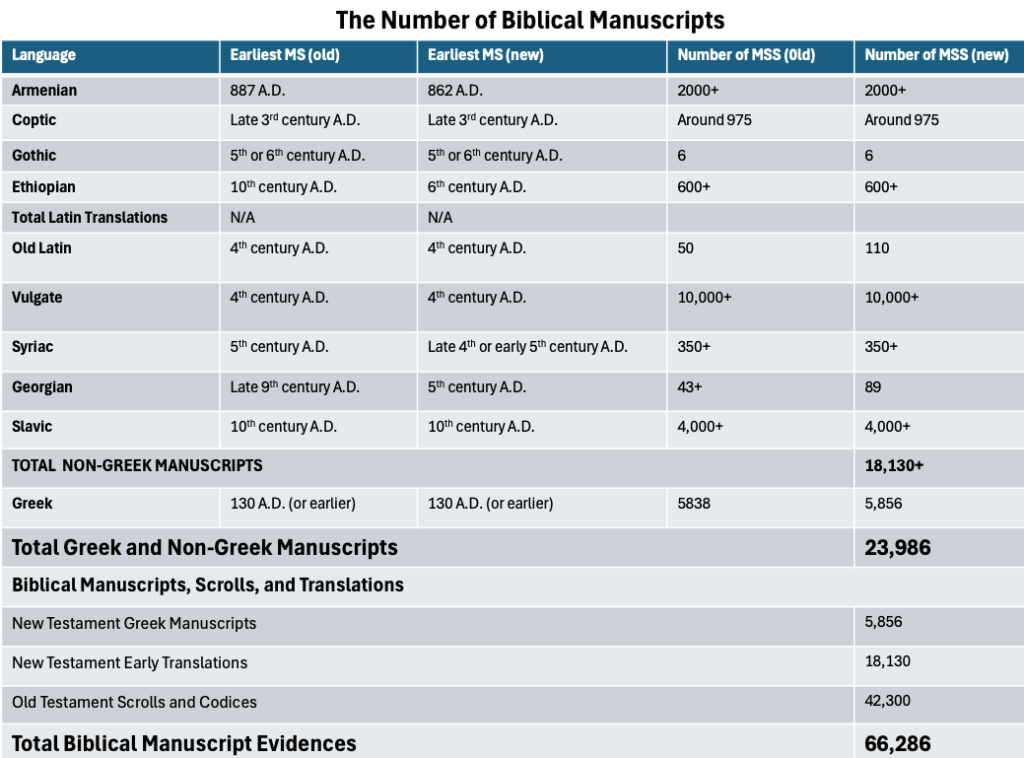
A more recent chart based on additional discoveries and new technologies (see below) called, “The Number of Biblical Manuscripts,” [80] shows an increase in manuscripts for the New Testament and includes Old Testament scrolls and codices [i.e., book form]. McDowell writes, “In the chart… the second and third columns compare both ‘old’ and ‘new’ dates determined for the earliest manuscript in each language. The two columns at the far right compare the ‘old’ and ‘new’ number of manuscripts estimated to be catalogued for that language. For each language, the data labeled ‘old’ was tabulated in 2012. The columns labeled ‘new’ show the data for each language as of August 2014—with the exception of the new number of Greek manuscripts which reflects the official number as of January 2017.
“This comparison reveals the change, if any, in dating and numbers of manuscripts that have occurred in that two-year interval, through the discovery of earlier manuscripts in a particular language or by the addition of newly discovered or catalogued manuscripts. Current research continues to change these totals. And we must realize that every day, marvelous new discoveries are being made. That is why the numbers of scroll and manuscript discoveries are out-of-date as soon as you print them. We recognize how astonishingly rapid is the increase of information and even the development of new methods to recover that data from manuscripts that had been thought to be forever illegible.” [81] [emphasis added]
In an updated chart showing an increase in manuscripts of major classical works and the New Testament based on additional discoveries and new technologies (see chart below), we still see that the New Testament is by far more reliable than any other ancient classical writing. [82]
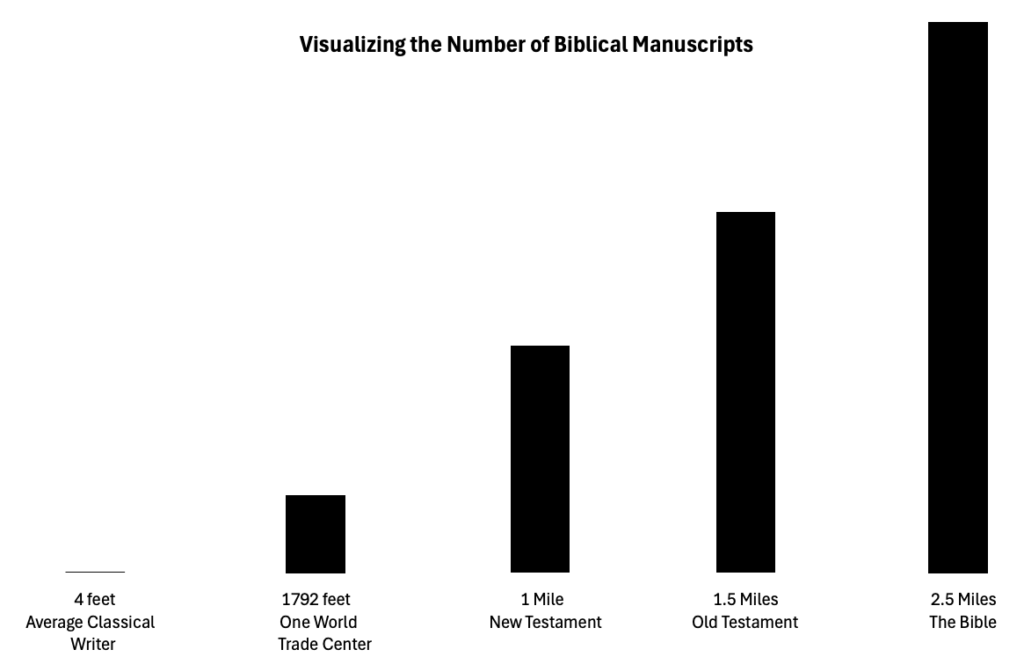
To help us visualize how many Biblical manuscripts exist today (see diagram below), McDowell states, “How high do you think the stack of New Testament manuscripts would be? Think about this: of just the 5,800+ Greek New Testament manuscripts, there are more than 2.6 million pages. Combining both the Old and New Testament, there are more than 66,000 manuscripts and scrolls.
“A stack of extant manuscripts for the average classical writer would measure about four feet high; this just cannot compare to the more than one mile of New Testament manuscripts and two-and-a-half miles for the entire Bible.” [83] [emphasis added]
While Muslims insist that the Qur’an has been perfectly preserved (which is highly suspect as shown previously), they miss the strength of this argument for the New Testament’s reliability, “since the Qur’an is only a medieval book (7th century A.D.). But most Muslims are totally unaware that for an ancient book (1st century A.D.), the New Testament is the most accurately copied book in the world.” [84] [emphasis added]
F. The Early Versions and Translations of the New Testament
Since Christianity has been a “going” faith from its beginning (cf. “Go… and make disciples of all the nations…” – Matt. 28:19; “Go into all the world and preach the gospel to everyone…” – Mark 16:15; “repentance and remission [forgiveness] of sins should be preached in His name to all nations” – Luke 24:46-48; “you shall be witnesses to me in Jerusalem… all Judea and Samaria, and to the end of the earth” – Acts. 1:8), the Scriptures were soon translated into the known languages of that period, some of which were written as early as 150 A.D., such as the Syriac Peshitta. [85] For that reason, other written translations or versions appeared over time such as Coptic translations (late 3rd century), Old Latin (4th century A.D.), Latin Vulgate (4th century A.D.), Syriac (late 4th century A.D.), Georgian (5th century A.D.), Gothic (5th or 6th century A.D.), Ethiopian (6th century A.D.), Armenian (mid 9th century A.D.), and Slavic (10th century A.D.), totally an additional 18,130+ existing manuscripts. [86] (see “The Number of Biblical Manuscripts” chart above). Smith writes, “The fact that we have so many translations of the New Testament points to its authenticity, as it would have been almost impossible, had the disciples or later followers wanted to corrupt or forge its contents, for them to have amassed all of the translations from the outlying areas and changed each one so that there would have been the uniformity which we find witnessed in these translations today.” [87]
G. Early Church Father’s Quotations of the New Testament
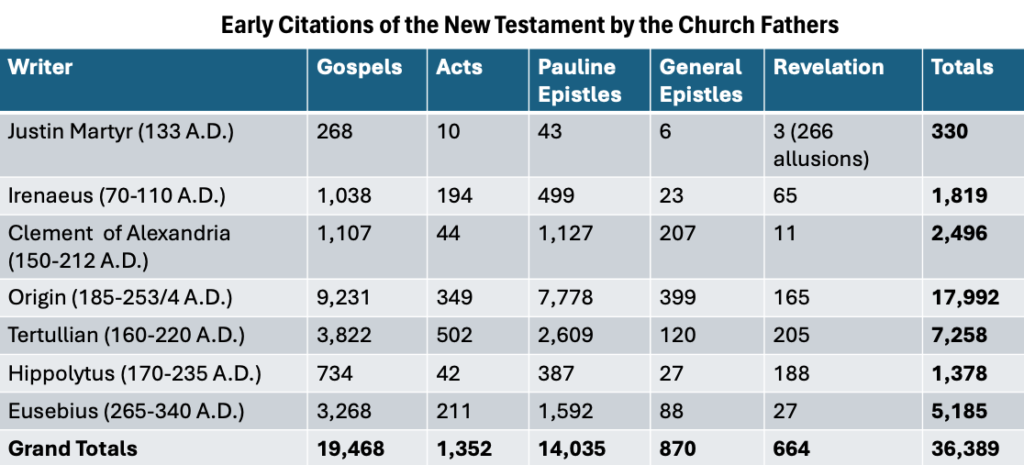
Another great attestation for the historical reliability of the New Testament manuscripts is the mass number of quotations taken from its pages by the early fathers (leaders) of the church (see chart above). [88] Geisler and Nix correctly conclude, “Not only did the early Fathers cite all twenty-seven books of the New Testament, they also quoted virtually all of the verses in all of these twenty-seven books. Five Fathers alone from Irenaeus to Eusebius possess almost 36,000 quotations from the New Testament… We know of no other book from the ancient world that exists largely in [total] by way of thousands of individual and selected quotations of it. It is an amazing fact that the New Testament could be reconstructed simply from quotations made within two hundred years of its composition.” [89] [brackets and emphasis added]
H. What the Qur’an says about the Bible [90]
Islam claims that the Bible has been corrupted because the Qur’an contradicts the Bible on many (if not all) of the Bible’s important teachings, events, and people which were recorded much earlier than the Qur’an. Therefore, for the Qur’an to be true, a person must be led to believe that it is the Bible that is false and has been corrupted. But where in the Qur’an does it say that the Bible has been corrupted? The truth is, the Qur’an declares just the opposite.
What does the Qur’an teach about the Bible? When we read the Qur’an, Allah and his prophet Mohammed give credit to the Bible as being preserved and perfect without any corruption. “O you who have believed, believe in Allah and his messenger [Mohammed] and the book [Qur’an], which he has sent down on his messenger, and the book[the Bible], which he has sent down before. Whoever becomes an infidel in Allah and his angels and his books and his messengers and the last day, so indeed, he has strayed far away astray.” (Qur’an 4:136). [91] [emphasis added] The Qur’an commands Muslims to believe in the Bible and its prophets. This is proof that the Bible was correct at the time of Mohammed.
Allah claims that he is the “guardian” over the “books” when he says to Mohammed, “And to you [Mohammed] we have sent down the book [the Qur’an] with the truth, confirming what is between his hands of the book [Bible] and as guardian over it.” (Qur’an 5:48a). [92] The Qur’an confirms the previous books of the Bible are and will be true as long as the Qur’an exists. [93] Since Muslims believe Allah is all-powerful, wouldn’t he be powerful enough to preserve the “book” (Bible) he claims to have authored which was in existence hundreds of years before Mohammed and the Qur’an?
The Qur’an says there is “guidance” and “light” in the Bible and the gospel of ‘Isā (the name of Islam’s Jesus). “Surely we have sent down the Torah, in it is guidance and light.” (Qur’an 5:44a). [94] “46 And in their footsteps, we sent ‘Isā, son of Mary, confirming what is between his hands of the Torah, and we gave him the Gospel, in it is guidance and light, and confirming what was between his hands from the Torah, and a guidance and a sermon to the fearer. 47 And that the people of the Gospel judge by what Allah has sent down in it. And whoever does not judge by what Allah has sent down, so those are the transgressors.” (Qur’an 5:46-47). [95] The Qur’an confirms in these verses that the Gospel is from God and is correct in Mohammed’s time. [96]
Allah declares that all the writers of the Bible were inspired. This proves that the Bible is the Word of God. “And we did not send before you any except men that we inspired, so ask the people of the reminder [Jews and Christians], if you were not knowing.” (Qur’an 16:43). [97]
Allah also told Mohammed to ask Jews and Christians about the truth of the Bible: “So, if you were in doubt concerning what we have sent down to you, so ask those who are reading the book before you; indeed, the truth came to you from your lord, so do not be of the doubters.” (Qur’an 10:94). [98] We learn two important facts in this one verse: First, we know from this verse that Christians and Jews had the Bible in their hands during the lifetime of Mohammed, because how could they read a book they do not have? Second, the Bible is perfect, for how could Allah command Mohammed to check his Qur’an with a corrupt book when he was “in doubt” about his own revelations? This is further proof that the Bible existed and was true in Mohammed’s day.
When Muslims say the Bible has been corrupted, then they are contradicting their Allah and their Qur’an because we have just read several verses in the Qur’an (Allah’s words) that confirm the Bible and its perfection, truthfulness, and preservation. Allah declares, “…And no one can change the words of Allah. ” (Quran 6:34; cf. 10;64; 18:27). [99]
If a Muslim still believes the Bible is corrupted, they are contradicting their own Qur’an, proving that there are inconsistencies in it and that the Qur’an cannot be from Allah: “Do they not consider the Qur’an? If it was from other than Allah, they would have found in it many inconsistencies.” (Qur’an 4:82). [100]
In summary, the manuscript evidence at our disposal today for the New Testament gives us nearly 24,000 Greek and non-Greek manuscripts with which to substantiate the historical accuracy of our current New Testament. The earliest of these manuscripts have now been dated at 117-138 A.D., [101] only 50+ years since the original. No other credible book from the ancient world has as small a time gap between the original composition and the earliest manuscript copies as the New Testament. [102] In addition, we have over 18,136 early translations of the New Testament which underscore the historical accuracy of the early manuscripts. We have scriptural quotations in the letters of the early Church fathers with which we could almost reproduce the New Testament if we so wished. This indeed is substantial manuscript evidence for the New Testament. But if this is not enough evidence, the Qur’an itself confirms the Bible and its perfection, truthfulness, and preservation without corruption.
II. Conclusion
So what comparisons are there between the manuscript evidence for the Qur’an and the Bible? We know from the historical record that by the end of the seventh century that Arabs had expanded right across North Africa and up into Spain, and east as far as India. The Qur’an (according to later Islamic tradition) was supposedly the centerpiece of their faith and practice at that time. Certainly, within that enormous sphere of influence there should therefore be some Qur’anic manuscripts which still exist to this day. Yet, there is nothing from that period at all. The only manuscripts which Islam provides turn out to have been compiled in the ninth century, while the earliest substantiated manuscript is dated 790 A.D., written not 1400 years ago as Muslims claim but a mere 1,200 years ago.
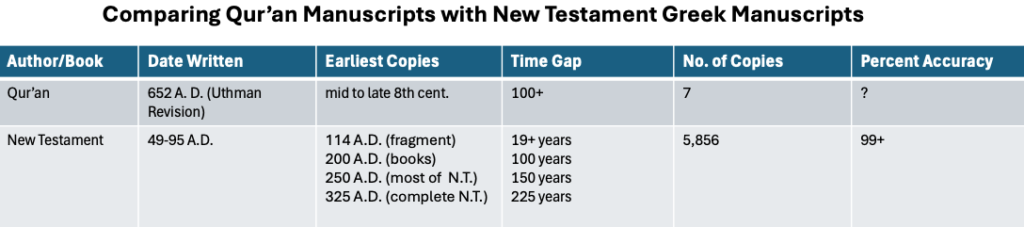
Look at the chart above comparing the Qur’an early manuscripts with the New Testament Greek manuscripts. [103] Notice the enormous difference between the number of early manuscripts for both books. We have learned that the accuracy of the Qur’an’s manuscripts has also been brought into question by Daniel Brubaker’s research. The thousands of manuscript variants of the Qur’an’s early manuscripts reveal a much less reliable book than what we possess in the New Testament.
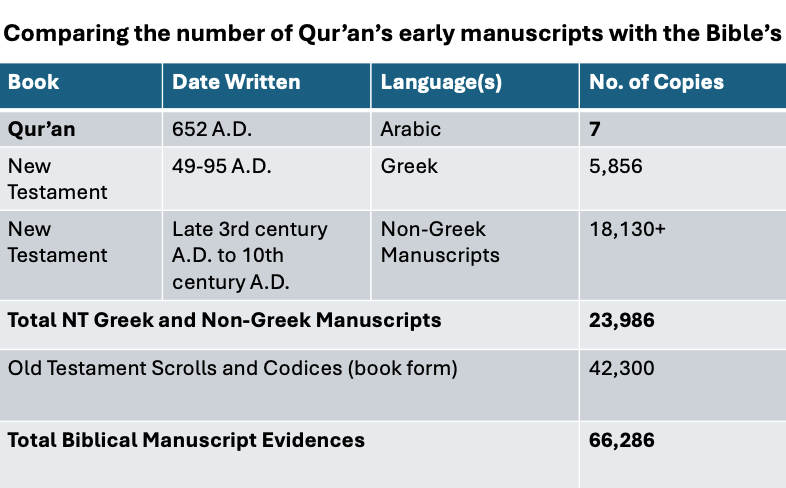
While Christianity can claim more than 5,850 known Greek manuscripts of the New Testament, over 18,130 early New Testament versions and translations, adding up to nearly 24,000 confirmed New Testament manuscripts still in existence, most of which were written between 25-400 years after the death of Christ, Islam cannot provide a single manuscript until well into the eighth century over 100 years after its supposed original compilation (see above chart comparing the two books). [104] If the Christians could retain so many thousands of ancient manuscripts, all of which were written long before the Qur’an, at a time when paper had not yet been introduced, forcing the dependency on papyrus which disintegrated with age, then one wonders why the Muslims are not able to forward a single manuscript from this much later period, during which the Qur’an was supposedly revealed? This indeed gives the Bible a much stronger claim for reliability than the Qur’an.
Furthermore, while the earliest New Testament manuscripts as well as the earliest letters from the church fathers correspond with the New Testament which we have in our hands, providing us with some certainty that they have not been unduly added to or tampered with, the Qur’anic material which we have in our possession abounds with stories whose origins we can now trace to second century Jewish and Christian apocryphal literature. We know in some cases who wrote them, when exactly they were written and at times even why they were written; and that none of them were from a divine source, as they were written by the most human of Rabbis and storytellers over the intervening centuries after the Bible had been canonized.
In addition, when the Bible’s total number of early manuscripts is compared to the Qur’an’s (see above chart), [105] the superiority of the Bible’s historical reliability is accentuated even more. Contrary to the standard Islamic narrative, the Qur’an is not complete nor unchanged as we have learned in this historical assessment. What our Muslim friends need is a better book which can give them guidance and light.
Usama Dakdok writes, “Many Muslim scholars who have had deep knowledge of Islam, some of whom even served as imams and professors in Al-Azhar University and other universities around the world, have become Christians. They have something in common which astonished me when I first discovered it. They reported that they had become Christians because they studied the Qur’an and discovered the falsehoods and the errors in it as they read the Bible. They saw the light and truth of the original account, not as it was copied and corrupted in the Qur’an.” [106] [emphasis added]
ENDNOTES:
[1] See the article posted by Pam Geller on July 1, 2009, entitled, “ISLAMIC INVASION OF AMERICA: THE 20 POINT PLAN,” at this LINK. Notice the references to the Qur’an in points 7 and 10. This 20-point plan originated from a refugee from the Muslim Middle East named Anis Shorrosh, author of ”Islam Revealed” and ”The True Furqan.” Anis is a Christian Arab American who emigrated from Arab-controlled Jerusalem in January 1967. Shorrosh says, “The following [20-point plan] is my analysis of Islamic invasion of America, the agenda of Islamists and visible methods to take over America by the year 2020.”
[2] Adapted from Jay Smith, “The Bible and The Qur’an – An Historical Comparison,” at www.pfandercenter.org. You can view this comparison at this Link.
[3] This paragraph is adapted from Dr. Jay Smith, March 9, 2026, class lecture entitled, “Manuscript Evidence for the Qur’an.”
[4] Tom Constable, Dr. Constable’s Notes on Daniel, 2025 Edition, pp. 6, 40.
[5] Conservative scholars believe Job was written during the Patriarchal period (2100 -1900 B.C.). See Roy B. Zuck, “Job,” The Bible Knowledge Commentary Wisdom, 2018 Kindle Edition, pp. 15-16.; Tom Constable, Notes on Job, 2025 Edition, pp. 1-2.
[6] Robert Vacendak, “Revelation,” The Grace New Testament Commentary: Revised Edition, 2019 Kindle Edition, pp. 1944-1945; John F. Walvoord, “Revelation,” The Bible Knowledge Commentary Epistles and Prophecy, 2018 Kindle locations 4701 to 4707; Archibald Thomas Robertson, A. T. Robertson’s Word Pictures in the New Testament, 2014 Kindle Locations 211099 -211108.
[7] Usama K. Dakdok, THE GENEROUS QUR’AN: An Accurate, Modern English Translation of the Qur’an, Islam’s Holiest Book (Venice, FL: Usama Dakdok Publishing, LLC, 2009 Smashwords Edition), pg. 36-37; cf. Dr. Jay Smith’s July 6, 2025, presentation entitled “Dismantling Islam Historically,” at Calvary Chapel Chino Hills. See the video of his presentation at this LINK. See also Jay Smith’s November 24, 2019, video presentation entitled, “Jay Smith Historical Critique Quran Origins 1,” at www.youtube.com. You can view this second video at this LINK.
[8] Norman L. Geisler and Abdul Saleeb, Answering Islam: The Crescent in Light of the Cross Second Ed. (Grand Rapids, MI: Baker Books, 1993, 2002), pg. 94; Daniel Janosik, THE GUIDE TO ANSWERING ISLAM: What Every Christian Needs to Know About Islam and the Rise of Radical Islam (Cambridge, OH: Christian Publishing House, 2019 Kindle Edition, pp. 33-34 cites Ali Dashti, Twenty-Three Years: A Study of the Prophetic Career of Mohammad (Mazda, 1994), pp. 47-58. Dakdok, THE GENEROUS QUR’AN, 2009 Smashwords Edition, pp. 5-10. Dakdok notes that the surahs written in Mecca include surahs 1, 6- 7, 10-12, 14-21, 23, 25-32, 34-46, 50-54, 56, 67-75, 77-97, 100-109, 111-114. The surahs written in Medina include surahs 2-5, 8-9, 13, 22, 24, 33, 47-49, 55, 57-66, 76, 98-99, 110.
[9] Geisler and Saleeb, Answering Islam, pg. 92 cites Michael Nazir-Ali, Frontiers in Muslim-Christian Encounter (Oxford: Regnum Books, 1987), pg. 124.
[10] Nabeel Qureshi, No God but One: Allah or Jesus? A Former Muslim Investigates the Evidence For Islam And Christianity (Grand Rapids, MI: Zondervan, 2016 Kindle Edition), pg. 107.
[11] Ibid., pg. 281 cites Sahih Bukhari 6.61.509.
[12] Ibid.
[13] Geisler and Saleeb, Answering Islam, 2002, pp. 92-93 cites Al-Bukhari (d. 870 A.D.), The Translation of the Meanings of Sahih Al-Bukhari, translated by Muhammad Muhsin Khan, Al-Medina: Islamic University, Vol. 6, pp. 477-478; Qureshi, No God but One: Allah or Jesus, 2016 Kindle Edition, pg. 281.
[14] Qureshi, No God but One: Allah or Jesus, 2016 Kindle Edition, pg. 49.
[15] Geisler and Saleeb, Answering Islam, pp. 92-93 cites Al-Bukhari, The Translation of the Meanings of Sahih Al-Bukhari, Vol. 6, pp. 477-478.
[16] Janosik, THE GUIDE TO ANSWERING ISLAM, 2019 Kindle Edition, pg. 34.
[17] Ibid., pg. 321; cf. Jay Smith, November 24, 2019, video entitled, “Jay Smith Historical Critique Quran Origins 1,” at www.youtube.com.
[18] Qureshi, No God but One: Allah or Jesus, 2016 Kindle Edition, pg. 119.
[19] Geisler and Saleeb, Answering Islam, 2002, pg. 93 cites Al-Bukhari, The Translation of the Meanings of Sahih Al-Bukhari, Vol. 6, pp. 478-479.
[20] Smith’s July 6, 2025, video presentation entitled, “Dismantling Islam Historically,” at www.youtube.com.
[21] Daniel Brubaker, Corrections in Early Qur’an Manuscripts: Twenty Examples (FULL COLOR EDITION) (Quran Manuscript Change Studies Book 1) (Lovettsville: Think and Tell Press,2019 Kindle Edition), pp. 1, 8; Qureshi, No God but One: Allah or Jesus, 2016 Kindle Edition, pg. 314.
[22] Smith’s July 6, 2025, video presentation entitled, “Dismantling Islam Historically,” at www.youtube.com.
[23] Jay Smith, November 24, 2019, video entitled, “Jay Smith Historical Critique Quran Origins 1,” at www.youtube.com.
[24] Ibid., cites Sahih Bukhari, Vol. 6, pg. 510.
[25] Geisler and Saleeb, Answering Islam, 2002, pg. 93 cites Al-Bukhari, The Translation of the Meanings of Sahih Al-Bukhari, Vol. 6, pp. 478-479.
[26] Smith, November 24, 2019, video entitled, “Jay Smith Historical Critique Quran Origins 1,” at www.youtube.com.
[27] Janosik, THE GUIDE TO ANSWERING ISLAM, 2019 Kindle Edition, pg. 321.
[28] Geisler and Saleeb, Answering Islam, 2002, pg. 94; Dakdok, THE GENEROUS QUR’AN, 2009 Smashwords Edition, pp. 5-10. Dakdok notes that the surahs written in Mecca include surahs 1, 6- 7, 10-12, 14-21, 23, 25-32, 34-46, 50-54, 56, 67-75, 77-97, 100-109, 111-114. The surahs written in Medina include surahs 2-5, 8-9, 13, 22, 24, 33, 47-49, 55, 57-66, 76, 98-99, 110.
[29] Geisler and Saleeb, Answering Islam, 2002, pg. 94.
[30] Ibid.
[31] Dakdok demonstrates that Qur’an 15:9 is referring to the Bible, not the Qur’an – see Usama K. Dakdok, Exposing the Truth about the Qur’an: The Revelation of Error, Volume 2 (Venice, FL: Usama Dakdok Publishing, LLC, 2013 Smashwords Edition), pp. 650-651.
[32] Smith’s July 6, 2025, presentation entitled “Dismantling Islam Historically,” at Calvary Chapel Chino Hills at www.youtube.com.
[33] Adapted from Smith, “Jay Smith Historical Critique Quran Origins 1,” at www.youtube.com.
[34] This approach is adapted from Smith, “The Bible and The Qur’an – An Historical Comparison,” at www.pfandercenter.org.
[35] Retrieved on November 1, 2025, from the September 25, 2022, article entitled “What is Papyrus?” at www.museumofthebible.org; Norman Geisler and William E. Nix, From God To Us Revised and Expanded: How We Got Our Bible (Chicago, IL: Moody Publishers, 1974, 2012 Kindle Edition), pg. 13.
[36] Brubaker, Corrections in Early Qur’an Manuscripts, 2019 Kindle Edition, pg. 2.
[37] Much of this section is retrieved from Smith, “The Bible and The Qur’an – An Historical Comparison,” at www.pfandercenter.org, unless otherwise noted.
[38] Ibid., cites John Wansbrough, The Sectarian Milieu: Content and Composition of Islamic Salvation History (Oxford: Oxford University Press, 1978), pp. 58-59.
[39] Ibid., cites Yahuda Nevo, “Towards a Prehistory of Islam,” Jerusalem Studies in Arabic and Islam, vol.17 (Hebrew University of Jerusalem, 1994), pg. 108; Wansbrough, The Sectarian Milieu, pg.119; Patricia Crone, The Meccan Trade and the Rise of Islam (Princeton University Press, 1987), pg. 204.
[40] Ibid., cites Wansbrough, The Sectarian Milieu, pg.119.
[41] Ibid., cites Nevo, “Towards a Prehistory of Islam,” Jerusalem Studies in Arabic and Islam, 1994, vol. 17, pg. 108; Patricia Crone, Slaves on Horses (Cambridge: Cambridge University Press, 1980), pp. 5-8.
[42] Ibid., cites R.S. Humphreys, Islamic History, a framework for Enquiry (Princeton, 1991), pg. 80.
[43] Ibid., cites Joseph Schacht, “A Revaluation of Islamic Traditions,” Journal of the Royal Asiatic Society of Great Britain (Hertford: Stephen Austin, 1949), pp. 143-154.
[44] Ibid., cites Annemarie Schimmel, Calligraphy and Islamic Culture (New York: New York University Press, 1984), pg. 4.
[45] Ibid., cites John Gilchrist, Jam’ Al-Qur’an (Jesus to the Muslims, 1989), pp. 140-154; Martin Lings and Yasin Hamid Safadi, The Qur’an: Catalogue of an Exhibition of Quran Manuscripts at the British Library, 3 April – 15 August 1976 (British Library, World of Islam Pub. Co., 1976), pp. 11-17.
[46] Ibid.
[47] Ibid., cites Lings and Safadi, The Qur’an, 1976, pp. 12-13, 17; Gilchrist, Jam’ Al-Qur’an, 1989, pp. 145-146; 152-153
[48] Ibid., cites Gilchrist, Jam’ Al-Qur’an, 1989, pp. 144-147.
[49] Smith, March 9, 2026, class lecture entitled, “Manuscript Evidence for the Qur’an,”cites Dr. Tayyar Altıkulaç, Al-Muṣḥaf Al-Sharif: Attributed To ʿUthmān Bin ʿAffān (IRICA, 2007), pp. 23, 36 – footnote 14a, 41f, 65, 71-72, 81; François Déroche, La transmission écrite du Coran dans les débuts de l’islam. Le codex Parisino-petropolitanus (Brill, 2009), pp. 172-177; cf. Jay Smith, “The Bible and The Qur’an – An Historical Comparison,” at www.pfandercenter.org where he cites Martin Lings and Yasin Hamid Safadi, The Qur’an: Catalogue of an Exhibition of Quran Manuscripts at the British Library, 3 April – 15 August, 1976 (British Library, World of Islam Pub. Co., 1976), pp. 11-20.
[50] Ibid., cites Rami Hussein Halaseh, The Topkapı Qurʾān Manuscript H.S. 32: History, Text, and Variants (De Gruyter, 2024), pg. 149.
[51] Ibid., cites Halaseh, The Topkapı Qurʾān Manuscript H.S. 32 (2024), pg. 83 and François Déroche, Qurʾans of the Umayyads: A First Overview (Brill, 2013), pg. 131.
[52] Brubaker, Corrections in Early Qur’an Manuscripts, 2019 Kindle Edition; see also David Wood’s August 12, 2022, video entitled, “The Corruption of the Quran (Jay Smith and David Wood),” at www.youtube.com . You can view the video at this Link. This video claims to prove conclusively that the Qur’an is corrupt.
[53] Brubaker, Corrections in Early Qur’an Manuscripts, 2019 Kindle Edition, pg. 10.
[54] Ibid., 2019 Kindle Locations 163 to 169.
[55] Ibid., pg. 10-11.
[56] Jay Smith, November 25, 2019, video presentation entitled, “Jay Smith Historical Critique Quran Origins 2,” at www.youtube.com. You can view the video at this LINK.
[57] Brubaker, Corrections in Early Qur’an Manuscripts, 2019 Kindle Edition, pg. 95.
[58] Ibid., pg. 96.
[59] Smith, November 25, 2019, video presentation entitled, “Jay Smith Historical Critique Quran Origins 2 at www.youtube.com cites Gabriel Said Reynolds (Ed.), The Qur’an in its historical context (London & New York: Routlege, 2008), pp. 2-3; Angelika Neuwirth & Nicholas Sinai (Eds.), The Qur’an in Context: Historical and Literary Investigations into the Qur’anic Milieu (Leiden/ Boston: Brill, 2010), pg. 1.
[60] Smith, November 25, 2019, video presentation entitled, “Jay Smith Historical Critique Quran Origins 2 at www.youtube.com .
[61] See charts at this LINK.
[62] Smith, March 9, 2026, class lecture entitled, “Manuscript Evidence for the Qur’an.”
[63] Norman Geisler and William E. Nix, From God To Us Revised and Expanded: How We Got Our Bible, 2012 Kindle Edition, pp. 124-125, 264-265.
[64] Ibid., pp. 124-128.
[65] Jay Smith’s April 3, 2022, video presentation entitled, “Jay Smith- Historical Critique Quran Origins,” at www.youtube.com. You can view the video at this LINK.; See also Dakdok, THE GENEROUS QUR’AN, 2009 Smashwords Edition, pg. 182.
[66] Dakdok, THE GENEROUS QUR’AN, 2009 Smashwords Edition, pg. 57; Smith’s April 3, 2022, “Jay Smith- Historical Critique Quran Origins,” at www.youtube.com.
[67] Ibid., pg. 523; Smith’s April 3, 2022, “Jay Smith- Historical Critique Quran Origins,” at www.youtube.com.
[68] Smith, “The Bible and The Qur’an – An Historical Comparison,” at www.pfandercenter.org.
[69] Dakdok, THE GENEROUS QUR’AN, 2009 Smashwords Edition, pg. 429.
[70] Ibid., pg. 109.
[71] Smith, “The Bible and The Qur’an – An Historical Comparison,” at www.pfandercenter.org cites John Glubb, The Life and Times of Muhammad (New York, Stein and Day, 1971), pg. 36.
[72] Ibid.
[73] Smith’s April 3, 2022, video presentation entitled, “Jay Smith – Historical Critique Quran Origins,” at www.youtube.com.
[74] Ibid.
[75] Ibid.
[76] Geisler and Nix, From God To Us Revised and Expanded, 2012 Kindle Edition, pg. 241; cf. see a more detailed discussion in pp. 193- 203.
[77] Josh McDowell and Sean McDowell, Evidence That Demands a Verdict: Life-Changing Truth for a Skeptical World (Nashville, TN: Thomas Nelson, 2017 Kindle Edition), pg. 46 cites John Warwick Montgomery, History and Christianity (Downers Grove, IL: InterVarsity Press, 1971), pg. 26.
[78] Smith, “The Bible and The Qur’an – An Historical Comparison,” at www.pfandercenter.org.
[79] From Norman L. Geisler and William E. Nix, A General Introduction to the Bible, rev. ed. (Chicago: Moody, 1986), pg. 408.
[80] McDowell, Evidence That Demands a Verdict: Life-Changing Truth for a Skeptical World, 2017 Kindle Edition, pg. 53 states that chart is adapted from Peter S. Cowe, “The Armenian Version of the New Testament,” in The Text of the New Testament in Contemporary Research: Essays on the Status Quaestionis, 2nd Ed., edited by Bart D. Ehrman and Michael W. Holmes (Leiden: Brill, 2013), pg. 256.
[81] McDowell, Evidence That Demands a Verdict: Life-Changing Truth for a Skeptical World, 2017 Kindle Edition, pp. 52-53.
[82] Adapted from Ibid.
[83] Ibid., pg. 53 cites Daniel B. Wallace, Lecture at Discover the Evidence, Dallas, TX, December 3–4, 2013.
[84] Geisler and Saleeb, Answering Islam, 2002, pg. 238.
[85] McDowell, Evidence That Demands a Verdict: Life-Changing Truth for a Skeptical World, 2017 Kindle Edition, pg. 50 cites Geisler and Nix, A General Introduction to the Bible, revised and expanded edition, 1986, pg. 317.
[86] Ibid., pp. 48-51.
[87] Smith, “The Bible and The Qur’an – An Historical Comparison,” at www.pfandercenter.org.
[88] Adapted from Geisler and Nix, From God To Us Revised and Expanded, 2012 Kindle Edition, pp. 60-64, 138; McDowell, Evidence That Demands a Verdict: Life-Changing Truth for a Skeptical World, 2017 Kindle Edition, pp. 64-65; and Dr. Daniel Janosik, March 2, 2026, class lecture entitled, “Manuscript Evidence for the Bible.”
[89] Geisler and Nix, From God To Us Revised and Expanded, 2012 Kindle Edition, pp. 217-220.
[90] Much of this section is adapted from the gospel tract entitled, “The Straight Way to Eternal Life,” by the Straightway of Grace Ministries, unless otherwise noted.You can learn more about this ministry to Muslims at www.TheStraightWay.org.
[91] Verse taken from Dakdok, THE GENEROUS QUR’AN, 2009 Smashwords Edition, pg. 164. All Qur’anic quotes are used by permission of Usama Dakdok Publishing, LLC.
[92] Ibid., pg. 186.
[93] Dakdok, THE GENEROUS QUR’AN, 2009 Smashwords Edition, pg. 186.
[94] Verse taken from Dakdok, THE GENEROUS QUR’AN, 2009 Smashwords Edition, pg. 185. All Qur’anic quotes are used by permission of Usama Dakdok Publishing, LLC.
[95] Verse taken from Ibid., pg. 186. All Qur’anic quotes are used by permission of Usama Dakdok Publishing, LLC.
[96] Dakdok, THE GENEROUS QUR’AN, 2009 Smashwords Edition, pg. 185.
[97] Verse taken from Ibid., pg. 383. All Qur’anic quotes are used by permission of Usama Dakdok Publishing, LLC.
[98] Ibid., pg. 315.
[99] Verse taken from Dakdok, THE GENEROUS QUR’AN, 2009 Smashwords Edition, pg. 208. All Qur’anic quotes are used by permission of Usama Dakdok Publishing, LLC.
[100] Verse taken from Ibid., pg. 154. All Qur’anic quotes are used by permission of Usama Dakdok Publishing, LLC.
[101] Geisler and Nix, From God To Us Revised and Expanded, 2012 Kindle Edition., pg. 204 refers to John Ryland’s Papyrus P52 fragment, the oldest New Testament Greek text (117-138 A.D.).
[102] Geisler and Saleeb, Answering Islam, 2002, pg. 238. Note: We do not include the Qur’an in this comparison, because it is only a medieval book (7th century A.D.)., whereas the New Testament is classified as an ancient book (1st century A.D.) – see Geisler and Saleeb, Answering Islam, 2002, pg. 238.
[103] Adapted from Geisler and Nix, From God To Us Revised and Expanded, 2012 Kindle Edition, pp. 60-64, 138; McDowell, Evidence That Demands a Verdict: Life-Changing Truth for a Skeptical World, 2017 Kindle Edition, pp. 64-65; and Janosik, March 2, 2026, class lecture entitled, “Manuscript Evidence for the Bible.”
[104] Adapted from McDowell, Evidence That Demands a Verdict: Life-Changing Truth for a Skeptical World, 2017 Kindle Edition, pg. 53 states that chart is adapted from Peter S. Cowe, “The Armenian Version of the New Testament,” in The Text of the New Testament in Contemporary Research: Essays on the Status Quaestionis, 2nd Ed., edited by Bart D. Ehrman and Michael W. Holmes (Leiden: Brill, 2013), pg. 256 and Janosik, March 2, 2026, class lecture entitled, “Manuscript Evidence for the Bible.”
[105] Ibid.
[106] Dakdok, Exposing the Truth about the Qur’an: The Revelation of Error, Volume 1, 2013 Smashwords Edition, pp. 20-21.