

Spiritual Warfare – Part 4

A man walks with his Bible for a spiritual battle, represented by the verse Ephesians 6:12

Introduction

       Last time we observed that the apostle Paul prepared his Christians readers at Ephesus (and us) for spiritual warfare by talking about the spiritual blessings or resources we have in Christ (Eph. 1:3-14). Next, he prayed for us to understand and experience God’s great power in raising Christ from the dead (Eph. 1:15-23) and then spoke of the authority we have in Jesus (Eph. 2:1-6). After praying for his readers to be rooted in the unlimited love of Christ (Eph. 3:17-19), Paul advises us not to grieve the Holy Spirit by giving “place” or ground to the devil through unresolved anger (Eph. 4:25-31). Instead, we are to be “filled” or controlled by the Holy Spirit (Eph. 5:18) in all our relationships, including relations with church members (Eph. 5:19-21), our spouses (Eph. 5:22-33), our children (Eph. 6:1-4), and our work relationships (Eph. 6:5-9). 

       After talking about all these relationships with different people, Paul wants us to understand that people are not our primary problem. Our primary struggle is in the spiritual realm. Hence, the apostle writes, “Put on the whole armor of God, that you may be able to stand against the wiles of the devil.” (Eph. 6:11). The Ephesian believers are commanded to “put on the whole armor of God,” not just some of His armor. For what purpose? That they “may be able to stand against the wiles of the devil.” The battle that Christians face every day is “against the wiles of the devil.” The Greek word translated “wiles” (methodeias) refers to the methods or strategies of “the devil” that he employs to deceive or trick us. [1]

       It is not just “the devil” we are fighting against (Eph. 6:11). We are fighting “against the wiles of the devil” which permeate the whole kingdom of darkness. The apostle writes, “For we do not wrestle against flesh and blood, but against principalities, against powers, against the rulers of the darkness of this age, against spiritual hosts of wickedness in the heavenly places.” (Eph. 6:12). Last time we looked at the four groupings of demonic spirits in this verse. I won’t take the time to review them in this article. But the main thing to understand is that our battle is not just with the Devil, but with his entire kingdom of darkness consisting of various demonic spirits under different levels of authority, all of which are under Satan, who is “the prince” (Eph. 2:2) of this kingdom, “the god of this age” (2 Cor. 4:4), and “the ruler of this world” (John 12:31; 14:30; 16:11; cf. Matt. 4:8-9).

The Whole Armor of God [2]
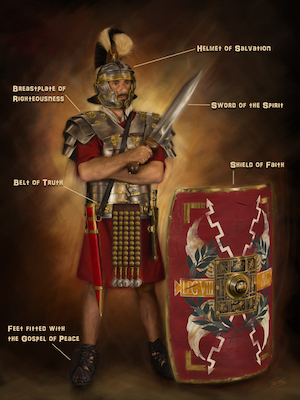
       Before we look in depth at the first piece of armor, the belt of truth today, we will look briefly at the “whole armor of God” (Eph. 6:11) because each piece of armor will describe some of the various ways the Devil tries to deceive or trick us. He will tempt us to think in a way that is contrary to God. So, keep this in mind as we look at each part of the armor of God in the months to come, Lord willing. 

       God is the One Who gives us the armor we need to stand victoriously against the enemy. But we must choose to use it. It is like a doctor giving us medicine, but it will not benefit us until we take it. If we do not use the armor God has given us, we will have no authority from heaven (Eph. 1:19-21; 2:5-6) with which to exercise here on earth against the wiles (trickery) of the Devil (Eph. 6:13). [3]   

       The six pieces of armor that Paul presents are divided into two categories of three. He introduces each of these two categories with different verbs. The first three are introduced with the verb “to be.” The last three are introduced with the verb “to take.” Why does Paul switch verbs halfway through the armament? He wants us to understand two specific, distinct orientations to the six pieces of armor. The first three relate to a state we should always be in. The last three are what we use on an as needed basis. [4]

      It is like a baseball player who has his uniform on during the entire game because that is the state he is in. But he only picks up the bat when it is time for him to go to the plate to play offense. And he only picks up his glove when it is time for him to go to the field to play defense. [5]

        The first three pieces of armor we have with us all of the time [6] (“having girded… put on… shod…” – Eph. 6:14-15). [7] This is the state we are always to be in. But the last three pieces of armor we are called to take and use as needed [8] (“taking … take…” Eph. 6:16-17). [9]

     The first piece of armor is the belt of truth (Eph. 6:14a). It teaches us that Satan wants to deceive us or make us be deceptive ourselves. [10] Either one is deadly. The New Age movement is part of his deception. Even evolution, which is so openly taught as science in our country’s educational system, has decreased peoples’ sensitivity to God and to what is right and wrong. 

       For example, years ago if people had mentioned casino gambling, horse track or dog track racing, or the lottery, the people of Iowa would have risen up in moral indignation. And yet subtly, the enemy of our souls has been able to persuade our state government to legislate such activities which say you really can gain something for nothing. You can get rich quickly so just gamble. Thousands of people are being deceived into gambling and are being robbed of their funds. Such behavior is addictive. But it doesn’t stop there, does it?

       There are also things like methamphetamine, cocaine, alcohol, pornography, sexual perversion, and occult experimentation – all of which are part of the Devil’s deception. Jesus reminds us that the Devil “is a liar and the father of it.” (John 8:44b). And one of the ways Satan wants to bring us into bondage is through his lies. This is why we need the belt of truth.

       Satan also wants to accuse us of wrongdoing and get us to compromise. He wants to point out our faults and weaknesses in addition to our sins so we will get so focused on our failures and problems, we won’t look to Jesus. He also wants us to lower our standards of righteousness by tempting us to open our lives to a little sinfulness or worldliness. It won’t hurt you to try that. Everyone else is doing it. Go ahead and do it. It’s fun. This is why we need the protection of the breastplate of righteousness (Eph. 6:14b). 

      The next piece of armor teaches us about that which will rob us of our peace – anxiety and worry. Hence, we need the sandals of the gospel of peace (Eph. 6:15) –  peace with God, peace of God, the God of peace, and the Person of peace. This piece of armor teaches us that Satan wants us to live in fear and anxiety. 

       The fourth piece of armor addresses unbelief. Hence, we are to take up the shield of faith (Eph. 6:16) which extinguishes all the fiery darts or arrows of the enemy. What is that talking about? It involves Satan’s temptation to get you to question God or to act independently of God. That is the way he approached Eve in the Garden of Eden (Gen. 3:1-5). Satan got Eve to question God and what He had said and what would happen if she were to partake of the forbidden fruit. 

       The fifth piece of armor deals with mind or thought control. Satan tries to put thoughts in our minds to make us think that his thoughts are our thoughts. And so, we are to wear the helmet of salvation (Eph. 6:17a). This is the one of the ways he primarily attacks the thoughts of believers. When he begins to move violently in a believer’s life, one of the first things they begin to be tormented with is that maybe they are not saved. Sometimes all manner of hideous thoughts projected into the believer’s mind are Satan’s way of putting his thoughts into our thoughts, making it so confusing that we conclude that his thoughts are really ours. Then he taunts us with, “How could anyone who claims to be a Christian have such sinful thoughts as that?” 

      The sixth and final piece of armor addresses the Devil’s attempt to get us to neglect the Bible. The last piece of armor is “the sword of the Spirit, the word of God” (Eph. 6:17b). Have you ever wondered why it is so difficult for you to read the Bible? Why is it so challenging to set aside time to study God’s Word and meditate on it? Why do you never get around to memorizing the Scripture? The Devil is behind this. He wants to keep you from being in the Word of God because it will expose him as a liar and deceiver. 

        We have an enemy who is very versatile and subtle, and he has schemes that if we are not aware of them, he will soon bring us into his bondage. Thankfully God has given us spiritual pieces of armor that are strong and powerful. Let’s begin now with the first piece of armor. 

The Importance of the Belt of Truth

       When the apostle Paul wrote the book of Ephesians, he was a prisoner (Eph. 3:1; 4:1) under house arrest in guarded rental quarters (Acts 28:30), chained to a Roman soldier (Eph. 6:20). [11] As he looks at this Roman soldier, he begins to draw a comparison between the soldier’s armor and the spiritual armor of God. He will talk about each piece of armor in the order that a Roman soldier put it on.

       The first piece of armor was extremely important to a soldier. The soldier first put on over his tunic (a loose, sleeveless shirt that reached to his knees), a belt that would hold both the breastplate and sheathe for his sword in place. [12] He would be able to tuck his long clothes into the belt so he could run and be ready to fight. [13] Without this belt on, a soldier would be less mobile and more vulnerable to attack on the battlefield. 

       Likewise, Paul emphasizes the importance of this piece of armor by mentioning it first. “Stand therefore, having girded your waist with truth…” (Eph. 6:14a). This shows us how important the truth is in our battle against Satan and his demonic armies (Eph. 6:12). Since Satan “is a liar and the father of it” (John 8:44b), it is essential that Christians wear this piece of armor to overcome his deceptions. 

The Ruthless Nature of Satan [14]

       The Greek word translated “waist” (osphus) in Ephesians 6:14a can refer to “the place where a belt… is worn, waist” or to “the place of the reproductive organs, the loins.” [15] Some translations say, “having girded your loins with truth.” (ASV; LSB; NASB1995; RSV). By mentioning the belt first and in this way, Paul emphasizes the ruthless nature of Satan’s attack. This belt buckled around the waist and covered the soldier’s vital organs from his belt line down to his mid thighs. [16] It protected him from the violent and ruthless actions of an enemy who tried to destroy him. 

       The Psalmist had an awareness of the ruthless nature of Satan. David writes, 3b Let those be ashamed who deal treacherously without cause… 19 Consider my enemies, for they are many; and they hate me with cruel hatred.” (Psa. 25:3b, 19). The Devil never fights fair and is extremely cruel. He has no problem hitting us below the belt. Satan will try to hit us when we are most vulnerable, doing whatever it takes to incapacitate and eventually destroy us. 

       For example, when we are weakened by an illness or experiencing tremendous grief due to the loss of a loved one, the Devil will attack us with the purpose of destroying us. He shows no mercy to a suffering person.

       We also see the brutal, cruel, and violent ways of Satan in his appearances in Scripture. For example, the man in the country of the Gadarenes was so violently oppressed by the powers of darkness that “always, night and day, he was in the mountains and in the tombs, crying out and cutting himself with stones.” (Mark 5:5). Satan’s torment of this man was so severe that the man constantly endured self-inflicted agony. 

       On another occasion when the Lord Jesus came down from the Mount of Transfiguration with Peter, James, and John, He met a desperate father whose son had a ruthless demon. The father said to Jesus, “Lord, have mercy on my son, for he is an epileptic and suffers severely; for he often falls into the fire and often into the water. So, I brought him to Your disciples, but they could not cure him.” (Matt. 17:15-16). This wicked spirit would often come upon this man’s son when he was near “the fire” or “the water.” Why would this demon do that? Because he wanted to throw him into the fire so that violent burning would happen to this boy during his seizures. He wanted to throw him into the water so he could drown this boy. It was not enough for this little boy to have violent seizures. Satan wanted to add to his sufferings by throwing him into the fire or the water. This is how brutal and cruel the kingdom of darkness is toward suffering people. 

       What do these examples say about the kingdom of darkness? It says that Satan’s kingdom always has as its purpose to violently hurt, wound, and destroy (cf. John 10:10a). Most people who have had experiences with the kingdom of darkness have no doubt about the cruelty and ruthlessness of this kingdom. 

       This is why Christians must always be on guard against the lies of the enemy. Deception and lies always bring us into the realm of the kingdom of darkness. Satan always speaks his native language when he lies. Jesus said of the Devil, “He was a murderer from the beginning, and does not stand in the truth, because there is no truth in him. When he speaks a lie, he speaks from his own resources, for he is a liar and the father of it.” (John 8:44). At first, Satan’s lies may seem very appealing and even pleasurable. And when we are tempted to lie, we are never more yielding to Satan’s deceptive ways than in that moment. But in that moment, we must remember that the Devil always intends to brutalize us, oppress us, torment us, destroy us, and take away our freedom in Christ. 

The Subtle Nature of Satan’s Schemes 

        By mentioning the belt of truth first, Paul also calls attention to the subtle nature of Satan’s schemes. Not only in John 8:44 is Satan called “a liar and father of it,” but the very last picture of Satan in the Bible also points to his subtle nature. Now when the thousand years have expired, Satan will be released from his prison and will go out to deceive the nations which are in the four corners of the earth, Gog and Magog, to gather them together to battle, whose number is as the sand of the sea. They went up on the breadth of the earth and surrounded the camp of the saints and the beloved city. And fire came down from God out of heaven and devoured them. 10 The devil, who deceived them, was cast into the lake of fire and brimstone where the beast and the false prophet are. And they will be tormented day and night forever and ever.” (Rev. 20:7-10). At the end of King Jesus’ “thousand years” reign, “Satan will be released from his prison” in the abyss and will “deceive the nations” which are over all the earth “to gather them together to battle” against King Jesus and His people [“the saints”] in Jerusalem (“the beloved city”](Rev. 20:7-9a). The unbelievers in this battle led by their earthly leader “Gog” from the land of “Magog” (Rev. 20:8; cf. Ezekiel 38:2-3) will be as numerous “as the sand of the sea” and will be the offspring or descendants of the infants or children who survived Armageddon because they were below the age of accountability (Rev. 20:9b). God will intervene with “fire … out of heaven” and destroy them (Rev. 20:9c). Then “the devil, who deceived them, was cast into the lake of fire … where the beast the false prophet are. And they will be tormented day and night forever and ever” (Rev. 20:10). Satan concluded his career by doing what was most natural for him to do. He “deceived” the nations (Rev. 20:8a, 10a). 

      The Greek word translated “deceived” (planaō) means “to lead astray, mislead, to cause someone to wander from the right way.” [17] This is Satan’s main tactic – to get us to believe his lies so he can bring us under his control. 

       We see Satan’s lies working constantly in the world, especially in the political scene. For example, under communism, the lie is the truth. According to the dogma of communism, as long as it advances the cause of communism it is the truth. [18] We also see this kind of deception in our own government here in the USA. During this presidential election year, we see candidates making promises that are contrary to their past political decisions. They present lies as though they were the truth and sadly, much of the American public believes those lies. 

        Satan’s deceptions are also evident among the religions of the world. Having worked with those steeped in Islam, I have observed that if a lie supports the cause of Allah, then it must be true. A Muslim does not hesitate to lie if it advances the cause of Islam. 

       Janosik writes, “The Islamic practice of taqiyya [deception], which allows Muslims to mislead non-believers in regard to the nature of a Muslim’s own belief in order to avoid persecution. This practice allows Muslims, both Shia and Sunni, to lie to non-Muslims in a time of war, persecution, or even minority status if the lie will protect Muslims and further the goals of Islam. In his article on taqiyya, Raymond Ibrahim quotes a Muslim authority, Sami Mukaram, who says,” [emphasis and brackets added] [19] “Taqiyya is of fundamental importance in Islam. Practically every Islamic sect agrees to it and practices it … We can go so far as to say that the practice of taqiyya is mainstream in Islam, and that those few sects not practicing it diverge from the mainstream … Taqiyya is very prevalent in Islamic politics, especially in the modern era.” [20]

       Mormonism initially claims to embrace Christianity. But what they don’t tell you is Jesus Christ and Satan, like the rest of us, were spirit brothers and sons of God before the spirit of Jesus was given a body by Mary in Bethlehem. The Mormon ‘Book of Moses’ presents Satan and Jesus as contending for the privilege of taking a body of flesh in order to become the redeemer, with Jesus winning the contest. [See Joseph Smith, Pearl of Great Price, Book of Moses 4:1-4.]” [21]  [emphasis added] 

       Mormonism also believes “all human beings and spirits, including Jesus and Satan, existed as spirit beings before being born. Physical birth gives bodies to these spirits, and an opportunity to choose right or wrong. Thus, the present life is a period of probation. The way a person lives in this life determines their status in the life after the resurrection. If the deeds of this life have been satisfactory and all temple obligations have been fulfilled, the individual becomes a god and is considered eligible to create ‘spirit children’ as God the Father did and populate a world of his own.” [22][emphasis added]

       We also see Satan’s deceptions in the world’s educational scene in such things as evolution that is so ardently taught today. Anyone who knows the truth of God (Gen. 1-2; Exod. 20:8-11; Psa. 33:6-9; Rom. 1:18-23; 2 Pet. 3:1-7; et al.), knows that evolution is a lie. [23] But still it is taught as the truth.

       We also see that schools are teaching Critical Race Theory (CRT) which says that negative stereotypes are being assigned to members of minority groups to benefit white people and increase racial oppression. [24]

       Neil Shenvi defines critical race theory as “an ideology that divides the world into oppressed groups and their oppressors and aims to liberate the oppressed.” [25] Sometimes called “Cultural Marxism,” CRT borrows concepts from classical Marxism dividing the world into the “haves” and the “have nots” and attempts to right the wrongs of previous generations through a redistribution of wealth and power. Unfortunately, CRT is pitting ethnic groups against each other in hopes of correcting historic inequalities. [26]

       Biblically speaking, racism is the sin of ethnic partiality or prejudice (Jas. 2:8-9; Lev. 19:15). Racism is wrong because there is only one race, and it is the human race which is in Adam (Acts 17:26). Racism has not only caused division, but it has caused great pain and suffering throughout history. Since racism is a real sin, we should repudiate it and address it from a biblical perspective. 

       Unfortunately, CRT advocates that truth is not determined objectively outside of oneself. Instead, CRT says that truth is determined experientially by historically oppressed groups of people; thus, different groups of people can have different “truths” according to this view. 

       But truth does not work that way. Truth is true outside of anyone’s perspective. For example, two plus two equals four no matter what your skin color or any of your past experiences. Bowling balls fall from airplanes regardless of what anyone believes about gravity. 

       Christians must remember where truth comes from: the Bible (John 17:17) and Jesus Christ (John 14:6; 1:14). Truth resides in God’s Word and the Person of Jesus Christ, not in oppressed groups of people. It does not matter if older white males in a so-called domineering culture believe it, or a young black lesbian doesn’t believe it. Believing or not believing the Bible or Jesus has no bearing on the truthfulness of either. The reason for this is because truth does not reside in a person’s perspective: truth resides outside any group’s shared experience. Ultimately, truth resides in the Person of the Lord Jesus Christ. [27]

       Jesus did not focus on the education, ethnicity, gender, income, social identity, or the sexual orientation of a person. His love excluded no one. Jesus Christ desires “all” people to be saved regardless of their education, ethnicity, gender, income, social identities, or sexual orientations. The apostle Paul exhorts us to pray for “all” people because Jesus desires “all” people to be saved and He died for “all” people (I Tim. 2:3-6). Jesus’ love is inclusive, not exclusive. But Satan wants to deceive us into thinking otherwise.

       Satan has a subtle strategy of using deception and lies to bring us under his control. He seeks to mislead us into bondage. This is why it is so important to put on the belt of truth.

What is the Truth? [28]

       The belt Christians are to put on is “truth” (alētheia). But what is the truth? Truth is the absolute standard by which reality is measured. It’s not something that changes based on feelings or perspective. A person can deny that gravity is true, but if he decides to jump off a building to prove it, he’s going to find that truth doesn’t care about his feelings or perspective. Truth exists whether you embrace it or not.” [29] [emphasis added]

     Truth is simply God’s view on any subject on the front end. But often what happens is people start with man’s view and wind up with truth (God’s view) when man’s view has failed. 

       This is why the Bible speaks so much about first. “Seek FIRST the kingdom of God.” (Matt. 6:33). “He [Christ] is FIRST in everything.” (Col. 1:18 NLT). “You have left your FIRST love.” (Rev. 2:4). We always need to start first with God’s view on any subject.

       Truth is more than feelings because feelings can fluctuate. Truth is also more than facts. You can have facts and not have the truth. For example, I can say, “I have a headache. My head is really hurting me.” So, I go to Walmart and purchase some extra strength Tylenol because the fact is my head is hurting. But the Tylenol is not working. I still have my headache. So, I go to my doctor, and he does a head scan and discovers I have a brain tumor. I was treating the fact without knowing the truth. The truth was my head was hurting because of a brain tumor. Which means I was trying to solve the fact with an insufficient medication. 

       Truth is God’s view on any subject. God has spoken, He has not stuttered. There are two answers to every question: God’s answer and everyone else’s. And everyone else’s answer is wrong all the time. People can be so preoccupied with facts that they never arrive at truth. And thus, they never get solutions. 

      It is not the truth that sets us free. It is the truth that we know that sets us free. Jesus said, “You shall know the truth, and the truth shall make you free.” (John 8:32). So, if it is truth, and you do not know it, you are still in bondage. 

      In January of 1863, President Lincoln signed and issued his famous Emancipation Proclamation, freeing all slaves throughout the Confederacy. But the slaves in Texas were not told until June 19, 1865. The information of the signing was true, but it was not passed on to everyone. African Americans in Texas did not discover this truth until a year and a half later. So, during those eighteen months, they lived in bondage with no authority to exercise their freedom because they did not know the truth. 

       The reason this is so critical in spiritual warfare is because our enemy is a liar. That is all that he does. Satan is a liar (John 8:44) and a deceiver (Rev. 12:9). And if he can use facts to trick us, he will. If we do not start with the truth, that is, God’s view on a subject, then we will automatically be in bondage. And the Devil will even use religion to keep us there. Nothing holds more people hostage than religion. 

       When Satan went to Eve in the garden of Eden, the first thing he said to her was, “Let’s talk about God.” “Has God indeed said…?” (Gen. 3:1). But do you know an important word that the Devil left out when he tempted Eve? In Genesis 2, we read over and over again, the phrase, “the Lord God (’Elōhîm Yahweh) …” (Gen. 2:4-5, 7-9, 15-16, 18-19, 21-22). When Satan spoke to Eve, he left out God’s relational name “Lord” (Yahweh). This indicates that he doesn’t mind religion as long as there is no relationship with the Lord God driving it. [30]

Defeating Satan with the Truth [31]

       How do we defeat Satan with the truth? We daily reach out and put on the truth. The Bible gives us four expressions or citadels of truth. The first is THE PERSON OF TRUTH. The Lord Jesus Christ is “the truth” (John 14:6) and is “full of truth” (John 1:14). Hence, Jesus is the Person of truth.

       When we clothe ourselves with truth, we are putting on the Lord Jesus. “But put on the Lord Jesus Christ, and make no provision for the flesh, to fulfill its lusts.” (Rom. 13:14). The Greek compound word translated “put on” is enduō = en (in) [32] + dunō (go down, set) [33] and thus means “to clothe in the sense of sinking into a garment.” We can “put on the Lord Jesus Christ” by focusing our minds and morality on Him. When we live by faith in Him (2 Cor. 5:7; Gal. 2:20), studying His Word (Josh. 1:8; John 8:31-32; 15:7a; 2 Tim. 2:15; 3:16-17), talking to Him in prayer (John 15:7b; Phil. 4:6-7), and seeking to reflect Him in our actions (Col. 3:23-24; I John 2:6), we are putting on the Lord Jesus. 

       At the moment of faith in Jesus for His gift of eternal life, we are given a new nature (cf. Eph. 4:24; I John 3:9) and identity (2 Cor. 5:17), much like being given a brand-new tuxedo. Paul exhorts us to conduct ourselves according to this new nature and identity. 

       When he says not to make any “provision for the flesh” (Rom. 13:14b), it helps to ask ourselves, “Would I climb through a garbage dumpster while wearing a brand-new tuxedo?” No, that filthy environment would contaminate our pristine suit. Yet that is what we are doing when we make plans to gratify the sinful desires of our “flesh.” Instead, we are to put on Christ’s purity and avoid climbing through the dumpsters of sin. [34]

       However, if we have been making plans to gratify our sinful desires or we have actually been climbing through the dumpsters of sin, it is time to take our brand-new tuxedo to the cleaners and let the Lord Jesus completely cleanse it with His blood. Come back into the light by confessing our sins to God (I John 1:7, 9) and to safe brothers or sisters in Christ (Jas. 5:16), so God can heal us and restore us to fellowship with Him. 

       The second expression or citadel of truth in the Bible is God the Holy Spirit, Who is called THE SPIRIT OF TRUTH. Jesus said, 13 However, when He, the Spirit of truth, has come, He will guide you into all truth; for He will not speak on His own authority, but whatever He hears He will speak; and He will tell you things to come. 14 He will glorify Me, for He will take of what is Mine and declare it to you.” (John 16:13-14). What does it mean to put on the Holy Spirit? It means that we look to the Holy Spirit to lead us in accord with the truth (God’s view on a subject) of what Jesus taught (John 14:26) and what the Bible teaches us. The Spirit of God will never lead us in a way that contradicts what Jesus taught or what the Bible says. As we read the Word of God, we ask the Holy Spirit to enable us to understand the truth as God intended (I John 2:20-27). We measure everything by whether or not it aligns with what the Holy Spirit has already revealed in the Bible. 

       And we are to be very careful to honor the Spirit of God. When we have difficulty understanding a Bible passage, we ask the Holy Spirit to guide us into the truth (John 16:13) and to protect us from error (I John 2:20-27; 4:1-6). Instead of rushing into things, especially religious things that may seem overly ecstatic and exciting, we step back and take time to measure things to see if they are in accord with what God’s Spirit has already said in the Word because He is the Spirit of truth. He always guides us into truth (John 16:13) which is always in harmony with Who the Lord Jesus Christ is (John 15:26; 16:14; cf. I John 2:20-27; 4:1-6) and what He has done (I Cor. 12:3; 15:3-6) because Jesus is the truth (John 14:6). The Spirit of truth can show us the lies we believe that have kept us in bondage to sin and shame and replace them with the liberating truth of God’s Word (cf. Psa. 119:28-29). 

       The third expression or citadel of truth is THE WORD OF TRUTH, THE BIBLE. Jesus prayed to His heavenly Father, “Sanctify them by Your truth. Your word is truth.” (John 17:17). When we put on the belt of truth, we are putting on the Scripture. That means we understand that the Bible is the “word of truth” as it is called so many times throughout the Bible (cf. Psa. 119:43, 160;  Acts. 26:25; 2 Cor. 6:7; 2 Tim. 2:15; Jas. 1:18; et al.). This is why I believe that inerrancy [35] is an essential part of our Christian faith. We can trust what the Bible says in all things. It is the Word of truth, not the Word of error. We can build our lives upon the stable foundation of the Word of truth so we can endure the storms of life (Matt. 7:24-27). 

       The word “sanctify” (hagiazō) in John 17:17, literally means to “set apart” [36] from the world or “to make holy.”[37] This is not referring to sinless perfection. It is referring to spiritual growth or maturity – progressively becoming more like Christ. How? 

       We are to be “set apart” from the world’s influence and its values “by” the Father’s “truth” which is His “word,”the Bible. Throughout the Bible we see that God’s Word is true. It is not full of errors as many claim today. We cannot grow spiritually apart from God’s Word. So, the way we grow in holiness is by renewing our minds in accordance with the truth of God’s Word (cf. Rom. 12:1-2). Disciples of Jesus must abide in His word if they are to know the truth of His word and be set free from Satan’s lies that enslave their lives to sin (cf. John 8:31-36, 44). We must feed upon God’s word to experience the victory Jesus has already won for us (John 16:33). 

       At a meeting, a Native American Indian said a black wolf lived in his heart, but when Christ became his Savior, a white wolf came to live in his heart, and the two wolves were then fighting all the time. After the meeting, someone approached him and asked, “Which wolf wins, the white one or the black one?” The Indian replied, “The one I feed the most.” If we feed upon God’s Word and do it, we are going to experience more victory over the world and Satan in our Christian lives.  But if we feed upon the lies of Satan, we will experience more defeat in our Christian lives and be conformed to the world. I like what D.L. Moody wrote on the flyleaf of his Bible. “This book will keep you from sin or sin will keep you from this book.” That is the truth. If I let this book become more and more a part of my life it will keep me away from sin (Psa. 119:9, 11, 28-29). Or sin can keep me away from reading His word. 

       The final expression or citadel of truth in the Bible is the Church, THE PILLAR AND FOUNDATION OF TRUTH. Paul writes, “I write so that you may know how you ought to conduct yourself in the house of God, which is the church of the living God, the pillar and ground of the truth.“ (I Tim. 3:15). Paul describes the church as “the pillar and ground of the truth.“  

       “Much as a pillar supports a roof, the local church is to hold up the truth. Without the church, there would be nothing on earth to hold up God’s truth. 

       “The ground is that on which things are built. Thus, the church is the foundation on which the truth is built. Without the church, the truth would not have a foundation on which to stand. The church protects the truth in the face of all who attack it. 

       “Biblically sound churches bless those in their location by being there. Such churches shine the truth into a dark and dying world.” [38] [emphasis added]

       This is a great reason to stay close to a local church that embraces God’s truth. We need God’s perspective especially as it relates to spiritual warfare. And a local church that is biblically sound is a great source of encouragement and protection for every Christian. 

Conclusion

       How do we put on the belt of truth? The same way we are to put on all the pieces of God’s spiritual armor – by means of prayer. Paul concluded his teaching on the armor of God by inviting his readers to pray: “Praying always with all prayer and supplication in the Spirit, being watchful to this end with all perseverance and supplication for all the saints.” (Eph. 6:18). How often are we to pray the armor of God? “Always.” Prayer is to be woven into all of our lives. Satan and his demonic armies never take a day off, so it would be best that we don’t take a day off from praying the armor of God. 

       “We need to stay in regular communication with God and pray in the Spirit in order to access heaven’s authority for intervention on earth (6:18). In other words, we must be on the same page as the Spirit, utilizing spiritual wisdom. The most powerful way to do that is to pray God’s Word back to Him and apply it to your situation.” [39]

       Praying the belt of truth back to God can become a wonderful worship experience. We can express appreciation for the Lord Jesus, Who is the Person of Truth, and the Holy Spirit, Who is the Spirit of Truth, and the Bible, the Word of Truth, and the Local Church, the Pillar and Foundation of Truth.

       Prayer: In the name of the Lord Jesus Christ, I pray the protection of the belt of truth described in Ephesians 6:14a. I pray its protection over my personal life, my home, my family, and the ministry You, Lord, have appointed for my life. I use the belt of truth directly against Satan and his kingdom of darkness. I thank You heavenly Father for the Person of the Truth, the Lord Jesus Christ. I cling to Him Who is the truth and is full of truth, as my strength and protection from all of Satan’s deceptions. Thank You Father God for the Holy Spirit Who is the Spirit of truth. I look to You, Holy Spirit, to lead me in accord with the truth of what Jesus taught and what the Bible teaches. I ask You, Spirit of truth, to warn me before I deceive anyone and to protect me always from believing Satan’s lies. Forgive me, Lord, for not speaking the truth. Show me any way in which I am being deceived. I desire that the Bible, the Word of truth, shall constantly gain a deeper place in my life. I pray that the truth of the Word of God may be my heart’s delight to study and memorize. Thank You, Lord God, for making my local church a pillar and foundation for Your truth in my life. Help me relate to my church and give protection to others as well as receive it myself. Thank You, Lord Jesus, for showing me that my ability to be strong and to do Your will requires the stabilizing power of the belt of truth. Thank You for providing this part of the armor of God. In Your mighty name, I pray, Lord Jesus. Amen. [40]

FOOTNOTES:

[1] Walter Bauer,  A Greek-English Lexicon of the New Testament, 2000 Kindle Edition, pg. 625.

[2] Much of this section is adapted from Mark Bubeck’s video message entitled, “4. The Wholeness of the Armor: Ephesians 6 Series,” on the BRMinistry app, unless otherwise noted. 

[3] Tony Evan’s video message at Dallas Theological Seminary (DTS) entitled, “The Armor of God,” on YouTube.

[4] Ibid.

[5] Ibid. 

[6] Tony Evans, The Tony Evans Bible Commentary, 2019 Kindle Edition, pg. 2665. 

[7] The first three verbs in Greek (perizōsamenoi… endysamenoi… hypodēsamenoi… ) are aorist middle participles which means they have already been put on by the soldier or Christian.  

[8] Evans, The Tony Evans Bible Commentary, 2019 Kindle Edition, pg. 2665.

[9] The Greek verb translated “taking…” (analabontes) is an aorist active participle, meaning the Christian is taking the shield of faith as needed and the last Greek verb translated “take…” (dexasthe) is an aorist middle imperative which is used of the last two pieces of armor and means for oneself to take them up as needed. 

[10]  The next several paragraphs are adopted from Mark Bubeck’s video message entitled, “4. The Wholeness of the Armor: Ephesians 6 Series,” on the BRMinistry app, unless otherwise noted. 

[11] Evans, The Tony Evans Bible Commentary, 2019 Kindle Edition, pg. 2629.

[12] Tom Constable, Dr. Constable’s Notes on Ephesians, 2024 Edition, pg. 146.

[13] J.B. Bond, “Ephesians,” Grace New Testament Commentary: Revised Edition, 2019 Kindle Edition, pg. 1399.

[14] Much of this section is adapted from Mark Bubeck’s video message, “5. Belted Against Satan’s Belt: Ephesians 6 Series,” on BRMinistry app, unless otherwise noted. 

[15] Walter Bauer,  A Greek-English Lexicon of the New Testament and Other Early Christian Literature, 2000 Kindle Edition, pg.  730.

[16] Bubeck, “5. Belted Against Satan’s Belt: Ephesians 6 Series,” on BRMinistry app. 

[17] Bauer, A Greek-English Lexicon of the New Testament, 2000 Kindle Edition, pp. 821-822.

[18] Bubeck, “5. Belted Against Satan’s Belt: Ephesians 6 Series,” on BRMinistry app.

[19] Daniel Janosik, THE GUIDE TO ANSWERING ISLAM: What Every Christian Needs to Know About Islam and the Rise of Radical Islam (Cambridge, OH: Christian Publishing House, 2019 Kindle Edition), pg. 172. 

[20] Ibid., pp. 172, 321 cites Sami Mukaram, At-Taqiyya fi ‘l-Islam (London: Mu’assisat at-Turath ad-Druzi, 2004), 7, quoted in Raymond Ibrahim, Beware Islam’s Doctrine of Deception, PJ Media, September 24, 2015: http://www.meforum.org/5522/ben-carson-taqiyya.

[21] Retrieved on October 27, 2024, from the article entitled, “Mormonism – Does it truly follow Jesus Christ?” at www.christiananswers.net

[22] Ibid. 

[23] See the following helpful articles or books exposing the deceptions of evolution – Simon Turpin, “How the Apostle Peter Relates to the Age of the Earth Debate: Analyzing 2 Peter 3:1-7,” at www.answersingenesis.org; Harold Dressler, “Evolution – Still an Option?” at www.answersingenesis.org; Ken Ham, The Lie: Unraveling the Myth: Evolution/Millions of Years, Updated Edition (Green Forest, AR: Master Books, 1987, 2024); Roger G. Gallop, Evolution: The Greatest Deception in Modern History (Scientific Evidence for Divine Creation), Second Edition (Ponte Vedra Beach, FL: Red Butte Press, Inc., 2011, 2014). 

[24] Retrieved on June 2, 2024, from Wikipedia article entitled, “Critical Race Theory” at en.m.wikipedia.org.

[25] Retrieved on June 2, 2024, from Brandon Clay and Frost Smith’s September 29, 2020, article entitled “Critical Race Theory in the Church,” at www.answersingenesis.org.

[26] Ibid. 

[27] The previous four paragraphs were adapted from Ibid.

[28] Much of this section is adapted from Tony Evan’s video message at DTS entitled, “The Armor of God,” on Youtube, unless otherwise noted. 

[29] Evans, The Tony Evans Bible Commentary, 2019 Kindle Edition, pp. 1820-1821.

[30] Ibid., pg. 137. 

[31] Much of this section is adapted from Bubeck, “5. Belted Against Satan’s Belt: Ephesians 6 Series,” on BRMinistryapp, unless otherwise noted. 

[32] Bauer, A Greek-English Lexicon of the New Testament, 2000 Kindle Edition, pg. 327.

[33] Ibid., pg. 264. 

[34] Adapted from Evans, The Tony Evans Bible Commentary, 2019 Kindle Edition, pp. 2465-2466.

[35] Inerrancy states that the Bible is the inspired Word of God, without error in the original autographs, accurate in all areas it touches, and true in all it says (Psa. 119:86, 151, 160, 172; Prov. 30:5-6; Matt. 5:18; John 17:17; 2 Tim. 2:15; 3:16-17; 2 Pet. 1:20, 21). The Bible is God’s complete written revelation to humankind and is the final authority for guidance in living the Christian life (Deut. 4:2; 12:32; Prov. 30:5-6; I Cor. 13:8-13; Heb. 4:12; Rev. 22:18). As the Scriptures in their entirety point to Jesus Christ and His death for the sins of the world on the cross, they are a complete and trustworthy guide to reveal God’s plan of salvation for all humankind (Luke 24:27, 44-48; John 5:39; 2 Tim. 3:15).  

[36] J. Carl Laney, Moody Gospel John Commentary (Chicago: Moody Press, 1992), pg. 307.

[37] Bauer, A Greek-English Lexicon of the New Testament, 2000 Kindle Edition, pp. 9-10.

[38] Robert Wilkin, “I Timothy,” The Grace New Testament Commentary: Revised Edition, 2019 Kindle Edition, pg. 1531.

[39] Evans, The Tony Evans Bible Commentary, 2019 Kindle Edition, pg. 2667.

[40] Adapted from Mark I. Bubeck, a prayer entitled “Prayer to Know and Speak Truth,” from Spiritual Warfare Prayers pamphlet (Chicago: Moody Publishers, 1997).

John 1 – Part 5: “Each One Reach One”

4He first found his own brother Simon, and said to him, ‘We have found the Messiah’ (which is translated, the Christ). 42 And he brought him to Jesus.” John 1:41-42a

God’s plan for reaching the world for Christ is to use each believer in some way to introduce another person to Jesus Christ and then train them to do the same. Jesus cast a huge vision for His followers to pursue, before He ascended to heaven. Look in Mark 16:15: “Go throughout the whole world and preach the gospel to all people.” (GNT)

Can you envision each of us having a part in introducing someone to Jesus? You may not actually share the gospel with them, but you may plant a seed in their lives. You may pray for them, show them kindness, and invite them to church or a small group. Wouldn’t it be exciting to see new faces in your Sunday Schools, small groups, and worship services, because each one of you played a part in inviting someone to come see Jesus? In other words, each one is to reach one. This is how Jesus’ first disciples got started, as we shall see in this chapter.

We are going to discover how each of us can reach another person or persons for Christ. Turn to John 1:35-51. If each one of us is going to reach another person for Christ, we must understand and apply some important principles.

First, we must GROW CLOSER TO CHRIST (1:35-39). There is a transfer of focus in the text from John the Baptist to Jesus. In the verses preceding today’s passage, the apostle John began to present “four consecutive days in simple, chronological order based on his personal observation of the events.” [1] (1:19-51). On the first day John the Baptist stated who he was not and who he was (1:19-23) before identifying Jesus as the One Who possesses superior authority by saying that he himself was unworthy to do even the most menial service for Christ (1:24-28). On the second day, John pointed others to Jesus as the Lamb of God, the Preexistent One, the One Who baptizes with the Holy Spirit, and as the Son of God (1:29-34).

We see the humility of John the Baptist as he directs his own followers to Jesus on the third day. 1:35-36: This is what we call “intimate evangelism”—pointing those closest to you to Jesus. “Again, the next day” (the third of four days), John the Baptist focuses the attention of “two of his disciples” on “Jesus as He walked” by, saying, “Behold, the Lamb of God!” The apostle John informs us that one of these two disciples is “Andrew” (1:40). The other disciple is most likely the apostle John himself whose pattern is to refer to himself indirectly throughout his gospel [2] (cf. 13:23; 18:15-16; 19:26; 20:2-4, 8; 21:20, 23-24).

When the Baptist says, “Behold” [3] he is telling his two disciples to “stop whatever they are paying attention to[4] and“look with wonder at the amazing Lamb of God!” John is encouraging his followers to transfer their focus onto Jesus now instead of him.

This is reinforced further by the apostle John’s use of Greek verbs and their tenses in 1:35-36. John the Baptist “stood” whereas Jesus “walked.” The verb translated “stood” [5] is in the pluperfect tense which means John was still standing at some point in the past after having previously stood. [6] Whereas the verb translated “walked” [7] is in the present tense and conveys that Jesus “was walking.

“The action in God’s economy was shifting from John’s baptism to the ministry of Jesus.” [8]

As “the Lamb of God,” Jesus is the only One who can provide free, unlimited forgiveness of sin. Christ is like a calculator. A calculator is not only good for what it can do; but also, for what it can undo. Christ can hit the clear button of redemption and remove all our guilt and stain the moment we believe in Him for complete forgiveness (Acts 10:43; Col. 2:13-14).

My wife shared something with me a while back at lunch that really touched me. You can see her insights in the picture above. The horizontal cross beam reminds us of what Psalm 103:12 says,“As far as the east is from the west, so far has He removed our transgressions from us.” The cross of Jesus provides the basis for removing our sins as far as the east is from the west (which is an infinite line), far out of our reach so we cannot retrieve them. The vertical post of the cross points to Micah 7:19 which says, “You will cast all our sins into the depths of the sea.” The cross provides the basis of casting our sins out of our sight into the depths of the sea.To the human mind it is unclear how the Lord clears – but let me tell you – clearly – He can do it! Like John the Baptist, we must point those closest to us to the unlimited forgiveness of Jesus Christ, the Lamb of God.

1:37: John’s disciples now “follow” or go along with Jesus. Christ does not invite them to follow Him as His disciples here. They “heard” Christ speak and want to learn more from Him so “they followed Jesus.” This means nothing more than they are accompanying the Lord. Christ does not call them to follow Him as His disciples until about a year later (Mark 1:16-18). How do I know this?

When we examine all four gospels, it becomes clear that the disciples whom Jesus called to follow Him in Mark 1:16-18 were already believers. In the Spring of A.D. 26 Peter, John, Philip, and Andrew met Jesus for the first time (John 1:35-51) and believed in Him. When Jesus invited Philip to follow Him (John 1:43), He was asking him to accompany Him to Galilee, not make a discipleship commitment. Philip believed in Christ because of spending time with Him (1:45). Four days after that first encounter, Jesus’ other disciples believed in Him after He turns water into wine (2:1-11). Several days later during the Passover Feast in Jerusalem, Jesus cleanses the temple (2:13-22). During the next several months, Christ instructs these new believers in the fundamental truths of salvation and assurance as He evangelizes Nicodemus, the Samaritan woman, and the city of Sychar (John 3-4).

John 4:35 mentions four months until harvest. The harvest takes place in the months of April or May. Four months prior would be January or February. Thus, between the mention of the first Passover (John 2:13) which is in April, and the time mentioned in John 4:35, almost one year has passed. During these months, John the Baptist is evangelizing Judea (John 3:22-36) and baptizing. So, several things have already taken place before we come to Mark 1. Mark 1:14 informs us that John the Baptist is now in prison. In John 1-3, John the Baptist is still ministering publicly. But in Mark 1, he is in prison. So, these disciples have known Jesus for at least a year when Christ approaches them in Mark 1:16. Peter is a believer. He has evangelized the city of Sychar with Christ. But in Mark 1, he is fishing for fish.

1:38a: When Jesus looks over His shoulder and sees these two disciples of John “following” Him, He asks them “What do you seek?”

“These are the first recorded words of Jesus in John’s Gospel. The question is actually profound. The word seek (zeteō) occurs thirty-five times in John’s gospel, referring often to the Judeans who were seeking to arrest and to kill Jesus. With this question Jesus was focusing their attention on their ultimate concern: What is it that you want out of life?” [9]

Christ may be asking us right now, “What do you seek” in life? Love… security… fulfillment… relationships… money… a job… fame… or healing? What is it you are seeking currently? Are you seeking Jesus? Only Jesus can meet our deepest needs. Only Christ can give us the love… acceptance… security and forgiveness that we crave.

1:38b-39: Jesus was Who John’s disciples were seeking. They refer to Christ as “Rabbi,” which John translated as “Teacher.” These two men wanted to know where Jesus was “staying” so they could remain with Him and learn more from Him as they had done with John the Baptist. Christ invites them to “Come and see.” They first had to “come” with Jesus before they could “see” or comprehend where He was staying.This has spiritual significance as well.

“Only by coming to Jesus could they really comprehend what they were seeking spiritually. The same thing holds true today.” [10]

These men were eager to spend time with Christ. John tells us “They came and saw where He was staying, and remained with Him that day (now it was about the tenth hour).” (1:39). This is the first of several time notices in John’s gospel (cf. 4:6, 52; 19:14). 

“The tenth hour” could refer either to 4 P.M., if John uses the Jewish timekeeping system from sunset to sunset, or to 10 A.M., if he uses the Roman’s reckoning of time from midnight to midnight. [11] Whether the apostle John meant 10 A.M. or 4 P.M., the main thing is he never forgot the hour when he first met Jesus. [12] The time that John and Andrew spent with Christ the rest of that day was very significant. It had eternal implications for them.

How about you? Have you met Jesus? Do you remember the first time you encountered Him? I remember the evening, not the exact hour, that I first met Jesus. It was on Monday, March 12, 1979, when Archie Griffin, a two-time Heisman Trophy winner and professional footbal player, came to our college to speak on the evening of Christian Emphasis Day. After Archie talked about his personal relationship with Christ, God showed me my need for the Savior so I could believe in Jesus for everlasting life.

After the assembly, I drove my parents’ car out into the country and pulled into a cornfield driveway to talk with God. Under the light of a beautiful full moon, while I was listening to a Christian song by Chuck Girard entitled “Lay Your Burden Down,” I received Jesus’ gift of forgiveness and eternal life by believing in Him. I will never forget that first meeting with Jesus that evening. It changed my eternal destiny and for that I am eternally grateful.

The words “staying” and “remained” in John 1:38b-39 come from the Greek word menō which the apostle John uses forty times in his gospel [13] to describe close fellowship with Christ, not one’s conversion. [14] Menō means “to stay, remain, abide, live, dwell.” [15] It literally refers to where one makes his or her home. We need to constantly make our home in Jesus’ presence. Where we make our home is where we spend our time. We must make the effort to reside in the truth of the Bible about Jesus and His love for us.   

How at home with Jesus are you? Are you cultivating a closer relationship with Him through prayer, the study of His Word, and hanging out with other Christians? When we spend time with Jesus, as Andrew and John did, our lives will never be the same. When we grow closer to Jesus, His heart for the lost will become ours. We will begin to see those who need to hear the gospel the same way that Jesus does – as someone Jesus loves and longs to save.

GO TO THOSE CLOSEST TO YOU AND TELL THEM ABOUT JESUS (1:40-46). The key to having boldness is spending time with Jesus Christ. As a result of spending part of a day with Christ, Andrew realizes that he must share his good news with his brother, Simon Peter. 1:40: John identifies “Andrew,” [16] the brother of “Simon Peter,” as one of the two disciples of John the Baptist who accompanied Jesus that day. The name “Andrew” means “manly” [17] or “courageous.” [18] It takes courage to bring others to Christ, especially family.

1:41: Can you picture Andrew? “I have to tell Peter my news right now.” What is his news? “We have found the Messiah.” Andrew is the first in John’s gospel to identify Jesus as the promised “Messiah” or “Christ.” Evangelism is not complicated. It is very clear and simple. Andrew already has eternal life because he believed Jesus was the Christ, the Messiah-God. According to I John 5:1, that is all anyone one must do to be saved: “Whoever believes that Jesus is the Christ is born of God.”

“To obtain eternal life one must believe that Jesus is the Messiah in the sense that He gives eternal life to those who believe in Him (see the discussion of 11:25-27 and 20:30-31).   

“When Jesus came, some, like John the Baptist (cf. 1:31, 33), already were born again since they believed in the Messiah for eternal life, though they did not yet know who He was. This is likely the case with Andrew and the other disciples of John the Baptist as well since John gives no report of Jesus speaking of eternal life to them. Evidently, they believed John’s preaching about the Coming One and believed in Him for eternal life. When they found out that Jesus is that Coming One, they sought to become His disciples.” [19]

The word “believe” in the New Testament means “to consider or be persuaded something is true and therefore worthy of one’s trust.” [20] Because all of us are born as sinners who deserve to die forever separated from God in the lake of fire (Ps. 51:5; Rom. 3:23; 6:23a; Rev. 20:15), we need a Savior to save us. The Bible tells us that Jesus Christ died for our sins and rose from the dead and is alive today to give eternal life to everyone who believes in Him (John 3:16; I Cor. 15:1-6). 

 The following 3-circle tool was developed by EvanTell, Inc., and is used with their permission. Ask yourself, what am I believing or trusting to get me to God’s heaven?

Starting from the left, some people believe their works will get them to heaven (1st Circle). Some people believe Christ plus their works will get them to heaven (2nd Circle). Others believe Christ alone will get them to heaven (3rd Circle).

Those who believe their works will get them to heaven are saying to God, Your Son’s death was unnecessary.” For if you can get to heaven trusting your works, Jesus did not need to die on the Cross. Those who believe Christ plus their works will get them to heaven, are saying to God, “Your Son’s death was disappointing,” that is, Jesus paid for some of my sins, but I must pay for the rest. But Jesus did not make a down payment for your sins. He made the full payment for your sins (John 19:30). Those who believe Christ alone will get them to God’s heaven, are saying to God, “Your Son’s death was sufficient.” Jesus paid it all and so all we must do is believe in Him alone to take us to His heaven. It is that simple.

Then what does Andrew do? 1:42a: That says it all. He simply brought his brother Simon to Jesus. That is all Andrew knew to do. Just get him to Jesus. Come and see. He pointed his brother to the One who could change him and satisfy all his needs. The more time we spend with Jesus, the more His heart will become ours. So, the closer we get to the heart of Christ, the closer we get to the people for whom He died.

Jesus’ heart bleeds for the lost. Luke 19:10 explains: “For the Son of Man has come to seek and to save that which was lost.” The heart of our Lord is a seeking heart. Aren’t you thankful for that? We would still be lost in our sins if Jesus did not seek us out. Look at God’s heart. First Timothy 2:3-4 say, “For this is good and acceptable in the sight of God our Savior, who desires all men to be saved and to come to the knowledge of the truth.” Is there any human being God does not want to be saved? No. God created hell for the devil and his angels (Matt. 25:41), not for people. God desires that all people go to heaven, and He wants to use you and me to introduce people to the Savior Who can get them there. He may use you at work, school, the marketplace, the Mall, or He may use you in your back yard talking across the fence with your neighbor. The key is to open your heart to Him, so He can use you. 

Those who live close to Christ capture His heart for the lost. For example, during my engagement to Pat before our wedding, I had no difficulty introducing her to my family, friends, and co-workers. Why? Because I had a personal relationship with her, and I was thrilled to be with her! And I wanted others to meet her because she was so awesome! How much more should this be true of our relationship with Jesus Christ? The church needs some Andrews who will be committed to bringing others to Jesus. We need older and younger Andrews.

Being an Andrew does not involve fancy evangelism methods and memorizing lots of Scripture, so you never make a mistake. Being an Andrew means getting them to Jesus. “Come and see.” Allow Jesus to make the transformation. You just be faithful to bring them to Jesus. We cannot change people, but Jesus can. We cannot make unfaithful spouses quit cheating, but Jesus can. We cannot make alcoholics quit drinking, but Jesus can. We cannot make drug addicts quit using, but Jesus can. We cannot make worriers stop worrying, but Jesus can. We cannot make abusive parents quit violating their children, but Jesus can. Our job is to get them to Jesus. Come and See! Don’t tell them to clean up their lives. Just ask them to come as they are and see Jesus for Who He really is. Then Christ will do the rest. Invite them to church… to Starbucks for coffee or to your own home for a meal where they can hear the clear and simple gospel.

In bringing his brother to meet Jesus, no man did the church a greater service than Andrew! Andrew appears two more times in John’s gospel (6:4-9; 12:20-22); both times he was bringing someone to Jesus. [21]

“A Christian’s testimony ought to accomplish what John the Baptist’s testimony did: pointing people to Jesus so that they want to follow Him. Notice the domino effect in this passage. Having encountered Jesus, Andrew wanted his brother to experience Him too. When you understand Who Jesus is, you’ll want others to know Him.” [22]          

 1:42b: And indeed, Jesus takes one look at Simon and sees more than a rugged fisherman. He identifies him as “Cephas,”[23] which means “a rock or stone.” “You are now Simon, but you will become Peter.” Jesus saw beyond the impulsive, head-strong, unreliable fisherman. He saw a solid rock. Jesus saw him for what he would become by His grace (even when it takes a while). Eventually God would use Peter to lead three thousand people to Christ through the preaching of one sermon on the day of Pentecost (Ac. 2:14-47).

Jesus’ interaction with Peter teaches us the importance of a new believer receiving a vision of what he or she can become in Christ. During this first stage of discipleship, the Lord gives us a vision of what we can become by His grace working in and through us. We need someone who can look beyond our faults and weaknesses and not only love us but also expect the best from us; someone who will believe in us; someone who will give us another chance; someone who will call us by another name. That Someone is Jesus Christ. Only He has the power to forgive all our sins and turn our weaknesses into strengths. That is what Jesus did with Peter and that is what He wants to do with you and me. Jesus sees the potential in each of us. You may think God cannot use you because of your weaknesses. Look to Christ to do through you what you could never do on your own!

But there is more. 1:43-44: On “the following day” (the fourth of four days beginning in 1:19) after Jesus renamed Peter, Christ “found Philip” [24] on the way “to Galilee” (1:43).The word “found” suggests Jesus was looking for Philip, He did not just happen to cross paths with him. Christ said to Philip, “Follow Me,” which could be translated, “keep on following Me” if Philip already was following Christ or “start following Me” if he was not yet following Christ.[25] When Jesus invited Philip to follow Him (1:43), He was asking him to accompany Him to Galilee, not make a discipleship commitment. Philip believed in Christ either through John the Baptist’s ministry before he met Jesus (cf. Acts 19:4), or as a result of spending time with Christ (1:45).

Some interpeters insist that following Christ is necessary to receive eternal life. I hear many pastors and churches preach this often. But this is contrary to the gospel of John which emphasizes believing in Christ alone as the only condition for eternal life (John 3:15-18, 36; 4:10-14; 5:24; 6:40, 47; 7:37-39; 11:25-27; 20:31; et al.).

Thus, what does Jesus mean when He says, 27 My sheep hear My voice, and I know them, and they follow Me. 28 And I give them eternal life” (John 10:27-28a)? Does this mean a person who truly believes must follow Christ as an obedient disciple to have eternal life which can never be lost as many preachers teach today?

The context of John 10:27-29 does not support this understanding. Jesus is using the word “follow” as a figure of speech referring to belief. Just as Jesus’ reference to sheep, is a figure of speech, so His reference to following Him is the same. Christ was not talking about literal sheep which physically follow a literal shepherd in this verse. Instead, He was illustrating salvation by picturing Himself as the Good Shepherd and believers as His sheep (cf. John 10:1-27).

In the context, Jesus addresses the unbelief of His Jewish audience, who questioned if He was the promised Messiah (John 10:24). Jesus replied to them, “I told you, and you do not believe. The works that I do in My Father’s name, they bear witness of Me. But you do not believe because you are not of My sheep, as I said to you.” (John 10:25-26). People who are not of His sheep do not believe. What then do His sheep do? They believe He is the Christ – the One Who gives eternal life to those who believe in Him. They hear His voice and respond in faith like sheep follow a shepherd (cf. John 10:4-5). They trust Him. So, in this context the unbelief of His Jewish audience (John 10:25-26) is set in contrast to His sheep following or believing in Him (John 10:27).

Bob Wilkins writes that “the picture of sheep hearing their shepherd’s voice and following him is a picture of childlike faith. In his book, The Gospel Under Siege, Zane Hodges says concerning that illustration, ‘That is to say, they [the sheep] commit their safety and well-being to the Shepherd who has summoned them to do so‘ (pg. 44). He goes on to say that this is clearly an act of faith, not discipleship.

“Hodges points out two other points which further prove that the figure refers to faith in Christ: the sequence of the coordinate clauses and the analogy of John 5:24.

“The verses in question have five clauses joined by the word ‘and.’ A definite progression is evident. The sequence of the clauses shows that ‘following Him’ is the condition—not the consequence—of eternal life. Jesus did not say, ‘I give them eternal life and they follow Me.’ Instead, He said, ‘They follow Me and I give them eternal life.’ Since faith in Christ is the sole condition of salvation in Scripture and in John’s Gospel, ‘following Him’ must be a figure for faith in Christ.

“In addition, John 5:24 is parallel to John 10:27-28. Both refer to hearing, believing, the giving of eternal life, the guarantee against eternal judgment, and the promise of the permanence of the relationship. The only difference between the two verses is that in John 10:27 believing is expressed by means of the figure of sheep following a shepherd.” [26]

Throughout the gospel of John, figures of speech are used to illustrate saving faith such as receiving (1:12; 5:43; 13:20), looking (3:14-15), asking (4:10), drinking (4:14; 7:37), hearing (5:24; 10:16, 27), coming (5:40; 6:35, 37, 44, 65; 7:37), eating bread (6:50, 51, 53, 54, 56, 58), entering (10:9), and following (10:27).

Christian author Charlie Bing writes: “These pictures of faith all denote receptivity, agreement, or trust. All are essentially simple activities and essentially passive. None communicates the idea of merit, work, effort, or achievement. Neither do they communicate an exchange of one’s life or the ongoing submission of one’s life to Jesus as Master in order to obtain eternal life.” [27]

The gospel of John distinguishes the freeness of salvation (John 4:10-14; 8:30-31a) from the costliness of discipleship (John 8:31-32). The only condition for everlasting life is belief in Jesus Christ alone for His free gift (John 3:14-18, 36; 4:10-14; 5:24; 6:40, 47; 7:37-39; 11:25-27; 20:31), but there are many conditions for discipleship including following Christ (John 8:12; 12:24-26; 21:19-22), abiding in Jesus’ word (John 8:31-32), loving one another (John 13:34-35), and bearing fruit (John 15:1-8). Those who insist that following Christ is a condition for receiving eternal life, fail to make this important distinction between conditions for salvation and conditions for discipleship. This has caused much harm to the unsaved because it distorts the gospel message making it more difficult for them to believe in Christ alone, and it also has caused the church to be less effective in evangelism.

The apostle John informs us that Philip was from the same city of “Bethsaida” as “Andrew and Peter” (1:44). This may explain why Jesus was looking for Philip. Andrew and Peter may have been acquaintances, if not friends, with Philip, and had something to do with Christ calling Philip. [28]

“Philip’s hometown of Bethsaida was on the northeast side of the Sea of Galilee (called ‘Bethsaida in Galilee’ in 12:21). Also, Andrew and Peter were born there. Politically, Bethsaida was in lower Gaulonitis in the territory of Herod Philip (Josephus The Antiquities of the Jews 18.2.1). Philip’s name is Greek, but his nationality cannot be inferred from that fact.” [29]

What Jesus did with Philip, Philip now does with Nathanael.  1:45a: As Jesus “found” Philip,so Philip “found” Nathanael. “Nathanael” means “God has Given” or “Given of God.” [30]

“The disciple learns from his Teacher, and spiritual multiplication occurs.” [31]  

1:45b: Philip informs Nathanael, “We have found Him of whom Moses in the law, and also the prophets, wrote.” This was an indirect way of telling Nathanael they had found the promised Messiah; the One Moses wrote about “in the law” (Gen. 3:15; 22:8; 28:12; 49:10; Num. 21:9; 24:17; Deut. 18:15-19; et al.) and “the prophets” also “wrote” “about (Isa. 7:14; 9:6-7; 52:13-53:12; Dan. 7:13; Mic. 5:2; Zech. 9:9; et al.). [32]

Philip identifies Christ as “Jesus of Nazareth, the son of Joseph.” “This is one of only three references to Joseph other than the birth and infancy accounts (see John 6:42 and Luke 4:22). By saying this it appears that Philip was unaware that Jesus was born of a virgin or that He was born in Bethlehem.” [33]

Christ had such an impact on Philip, that Philip wasted no time in telling Nathanael about Him. When we spend time with Jesus, it does not take long for us to start witnessing to others.

Nathanael is a little more skeptical than the other men who came to Jesus (cf. 1:37-44). He does not respond in immediate faith. 1:46a: Nathanael was somewhat shocked by Philip’s mention of “Nazareth.” He had difficulty believing that the Messiah would come from such an insignificant and relatively unknown place as Nazareth. But Nathanael’s question, “Can anything good come out of Nazareth?” suggests that insignificance was not the only problem.

“There was something unclean about the place. That was due to its geographical proximity to Sepphoris, the Roman capital of Galilee. Sepphoris was located just four miles north of Nazareth. When the Roman rulers of this region needed workmen, they drew from the laborers of Nazareth. Some of the citizens of Nazareth exploited this opportunity for personal gain. And so the people of Nazareth were disdained by my many Jews. It was an insignificant place with a quesitonable reputation.” [34]

“Recent archaeological discoveries suggest the town housed a garrison of Roman soldiers, and where you find a town full of bored soldiers, you find a nesting ground for vice and immorality. In addition, many Jews believed that contact with Gentiles rendered them ritually unclean.” [35]

The truth is the best thing in all the world came out of Nazareth [36] and Nathanael was about to discover this firsthand.

So, what does Philip do? Does he give up or start to argue with Nathanael? No. 1:46b: He does the only thing he knows to do. He says, “Come and seefor yourself. I don’t have all the answers but come and meet Jesus. Then you’ll see what I’m talking about.

GIVE THEM JESUS SO HE CAN BRING THEM TO HIMSELF (1:47-51). 1:47: As Nathanael approaches, Jesus makes a statement that reflects His supernatural insight into the character of the man: “Behold, an Israelite indeed, in whom is no deceit!”

“Nathanael was the opposite of the original Israel, namely, Jacob, who was very deceitful (Gen. 27:35-36; 28:12; cf. John 1:51). Therefore, Jesus virtually said that Nathanael was an Israelite in whom there was no Jacob.“ [37]

Jesus is saying, “I know you Nathanael for who you are, and you are a man of integrity.” 1:48a: Nathanael is surprised that Jesus would say this, so he says to Him, “How do You know me?” Nathanael is stunned because he has never met Jesus before so how could Christ know anything about him?

Christ shows in His response to Nathanael that His knowledge of his character was of supernatural origin. [38] 1:48b: I have never really made a connection until today between Philip’s invitation to Nathanael, “Come and see” (1:46b), and Jesus’ words to Nathanael, “Before Philip called you, when you were under the fig tree, I saw you.” Before Nathanael sees Jesus, Jesus “saw” him.

Christ sees us even when we cannot see Him. We may feel or think that Jesus does not see us. You may say to yourself, “There are billions of people in the world today, how could Jesus possibly see me among all these people?” The Bible assures us that God does see us.

Christ “saw” Nathanael’s heart as well as his presence under the fig tree. Perhaps Nathanael was praying or reading the Bible under that fig tree. Jesus is saying, “Nathanael, I know who you are. I know everything there is to know about you. I know what you think and where you go and what you do. And I want to have a relationship with you.”

If you can identify with Nathanael’s skepticism, please know that Jesus loves you and He sees where you are. He will also meet you where you are at. He will provide answers to your questions if you are willing to listen. He may come to you in unexpected ways such as through a dream or a vision. He knows everything about you – your likes and dislikes, your sorrows and your joys, your thoughts, actions, and words. He knows the hidden wounds of your heart. He knows the dark secrets in the depths of your soul and He still loves you and He longs to be in a personal relationship with you. 

How does Nathanael respond to the fact that Jesus saw him before they even met? 1:49: Christ’s supernatural knowledge of Nathanael moves the former skeptic to confess to Jesus, “Rabbi, You are the Son of God! You are the King of Israel!” Nathanael concludes,Only the Son of God could know this about me. You must be Him!” For Nathanael to believe that Jesus is the Son of God resulted in him having eternal life. John 20:31 says, “But these are written that you may believe that Jesus is the Christ, the Son of God, and that believing you may have life in His name.” When as an Israelite, Nathanael says Christ is “the King of Israel!” he is acknowledging Jesus to be his own King. This former skeptic is celebrating the discovery of the long-awaited Messianic King.

All of us have a fundamental need to be seen, especially when we are hurting or lonely. Jesus not only tells us that He sees us. He wants to show us that He sees us. He sees our fears, our pain, and our stress. He also sees this world that is perishing without Him. When you experience that Jesus sees you, like Nathanael did, many of you will respond in faith to Jesus because you realize He is much more than a mere man. He is the God Who sees us.      

This is the conclusion of a pregnant woman named Hagar after God met her in a place of despair and told her that the child in her womb would be a son called Ishmael because God heard her affliction (Gen. 16:11). So, Hagar called the name of the Lord, “You-Are-The-God-Who-Sees,” for she said, “Have I also here seen Him Who sees me?” (Gen. 16:13). God sees you and He wants to show you that He sees you.

1:50: Christ makes an important promise to Nathanael and the other disciples (the “you” in this verse is plural) that is set off by the phrase (“Most assuredly, I say to you…”)that is used nowhere else in the New Testament. But John uses this phrase twenty-five times in his gospel [39] to call attention to important affirmations. [40]      

Jesus says to Nathanael, “Because I said to you, ‘I saw you under the fig tree,’ do you believe? You will see greater things than these.” “Nathanael is the first person in John’s Gospel who is specifically said to believe in Jesus, although John indirectly shows that John the Baptist, Andrew, Peter, Philip, and the unnamed disciple believed too.” [41] Jesus is affirming that when we believe what God reveals to us, He will give us an even “greater” experience of Himself. [42] In other words, Nathanael had not seen anything yet. Christ’s demonstration of His supernatural knowledge was small compared to what Nathanael would see in the future. [43]

Not only did Jesus know about Nathanael’s character (1:47) and where he was when Philip found him (1:48), but He also knew what Nathanael had been thinking about under the fig tree.

1:51: Jesus uses the imagery of Jacob’s dream at Bethel when he saw “the angels of God ascending and descending” on a ladder (Gen. 28:12) to describe the “greater” (1:50) revelation that Nathanael and his fellow disciples [44] (and John’s readers) would receive concerning Christ.

“This Old Testament account is what Nathanael had been thinking about under the fig tree. How do I know? Because not only did Jesus make explicit reference to this story, but He also told Nathanael that he was ‘an Israelite in whom there is no deceit’ (1:47). Being a deceiver was exactly what Jacob was known for (see Gen 27:1-36). So, by these two comments, Jesus was making Nathanael aware that He knew what he was thinking.” [45]

“From 1:47-48, 51 it can be inferred that Nathanael was meditating on Jacob’s life, particularly on the incident recorded in Genesis 28:12. Jacob saw the angels going up and down a ladder. But Nathanael would see . . . the angels of God ascending and descending on the Son of Man. Just as Jacob saw angels from heaven communicating with earth, so Nathanael (and the others; though you is singular in John 1:50, the you in v. 51 is plural) would see Jesus as the divine Communication from heaven to earth. The Son of Man, replacing the ladder, is God’s link with earth (cf. Dan. 7:13; Matt. 26:64). Perhaps Jesus was also indicating that He is the new ‘Bethel,’ God’s dwelling place (Gen. 28:17; John 1:14).

“As the Son of Man, Jesus left heaven to come to the earth. Jesus used the term ‘Son of Man’ of Himself more than 80 times. It speaks of His humanity and suffering and His work as ‘the ideal Man.’” [46]

Christ replaces the imagery of a ladder in Jacob’s dream with “the Son of Man,” a reference to Himself (1:51; cf. John 3:13-14; 5:27; 6:27, 53, 62; 8:28; 12:23, 34; 13:31). Instead of the angels of God ascending and descending on a ladder, Jesus says they are “ascending and descending upon the Son of Man.” Jesus Christ is the Ladder or Mediator between heaven and earth, between God and man (John 3:13; I Tim. 2:5). Christ grants access to eternity. As He would tell His disciples later in John’s gospel, “No one comes to the Father except through Me” (14:6). [47]

Throughout the remainder of John’s gospel, Nathanael, and the other disciples along with John’s readers, would receive evidence that Jesus was the sole Mediator between God and humanity. [48] Because Christ is fully God and fully man (John 1:1, 14), He is the only One Who could provide a bridge between heaven and earth.

God had revealed Himself to Israel—the man and the nation—in a dream at Bethel previously (Gen. 28:10-22). Now God would reveal Himself to a true Israelite, Nathanael, to all Israel, and to the whole world, directly through Jesus.”  [49]

Daniel’s “Son of Man” is the prophesied King of Israel Who will rule over the whole world in the earth’s final kingdom (Dan. 7:13-14). Hence, Nathanael’s reference to Jesus as “the King of Israel” (1:49) is also part of the imagery in 1:51. [50]

In addition, the “greater things” Jesus would reveal to Nathanael and the other disciples (1:50) would also involve Jesus’ Second Coming to earth as “the King of Israel” (1:49). Christ had already shown His supernatural knowledge to Nathanael (1:48b), but when He comes the second time, He will show His supernatural power (1:51). When Christ comes back as King, the Bible says, 6 Let all the angels of God worship Him. 7 And of the angels He says: ‘Who makes His angels spirits and His ministers a flame of fire.’ “ (Hebrews 1:6-7). When Christ returns to earth at the end of the Tribulation (Rev. 19:11-21), He will establish His Millennial Kingdom on earth (Rev. 21:1-6) where angels will worship and assist Him as the universal King.

No matter how skeptical a person may be about Christianity, just introduce them to Jesus and let Him do the rest. You and I cannot change people, but we can introduce them to the One who can. Jesus takes Simon and makes him Peter. He takes the condemned and makes her forgiven. Jesus takes the skeptic and makes him a believer. He takes the sinner and makes her a saint. Jesus takes the drunkard and makes him sober. Christ takes the prostitute and makes her pure. Jesus takes the worrier and gives him peace. He takes the spiritually blind and makes her see. Jesus takes the dirty and makes him clean. Jesus changes lives.

In April of 2014, our entire family moved from Iowa in the USA to the Philippines where God called us to multiply disciples until all hear His gospel of grace! I believed the Philippines was and still is a strategic nation for reaching other nations with the gospel. Why? Because each year nearly one million Filipinos go overseas (OFWs – Overseas Filipino Workers) to get temporary or permanent jobs to send money back home to their families. Our strategy was to reach these Filipinos with the gospel and disciple them before they left to work overseas! Then they could make disciples in other nations! We cast this vision among Filipino pastors and churches and equipped them to reach Filipinos in their area whom God could use mightily in another nation for Christ!? God wants to use ordinary people like you and me all around the world to introduce people to Jesus.

Each one reach one evangelism. It is very simple. Let me summarize:

  • Recognize a person God wants you to reach and then pray for them (Who should come?) Pray for God to soften their heart and give you opportunities to share with them (think about them right now).
  • Refer a person (Who should they come and see? It’s all about Jesus). Point them to Him.
  • Remember our purpose (why should they come and see?) Because only Jesus can get them to heaven and only Jesus changes lives.

We need some Andrews and Philips who will determine by God’s grace, to bring one person or more to Jesus. Can you imagine how Andrew felt seeing his brother, Simon Peter, come to Christ? Can you imagine how he felt when Peter preached at Pentecost and three thousand people were saved (Ac. 2:14-47)? Andrew compels us to remember that God uses ordinary people to bring others to Christ. God may use you to introduce the next Simon Peter to Christ who will have a huge impact for the cause of Christ. The gospel is usually advanced one person at a time reaching one person at a time.

I think back about my mission trip to the southern Philippines on Sarangani Island in October 2015 with my friend, Pastor Boy.  On one morning after preaching the gospel at an elementary school, I asked one of the teachers if there were any other schools nearby. He hesitated and then said, “Yes there is another school about a 40-minute hike from here, but you don’t want to go there.” “Really?” I said, “Why is that?” He said, “Because it is all Muslim, and it is not safe for Christians to go there.” For the next two hours, several Christians tried to persuade us not to go to this school, but I kept asking them if they had gone there and they had not. So, I said, “Who will go if we don’t go to them?” They had no answer. At this juncture, we had a choice to make – do we seek to please these well-intentioned believers who do not want us to go, or do we seek to please our Father in heaven who desires that all people be saved?

Eventually my translator and a local Christian tribal leader made the 40-minute hike with me through the mountainous jungle towards the Muslim village. With each step I anticipated what the Lord would do when we got there. What are You going to do when we arrive at this village, Lord? How are You going to protect us? How will these people respond?

When we arrived at the Muslim village we were warmly welcomed by the teachers and Muslim principal (see photo). One of the teachers said they expected us. “Why?” I asked. She explained that she saw our pictures on Facebook when we were on Balut Island across from Sarangani Island at a school. God used Facebook to prepare this village for our arrival. As we shared the gospel with the students and teachers, they were very attentive to the message. All one-hundred twenty students and teachers indicated they trusted in Jesus alone for His gift of salvation at the end of the gospel presentation.  

Afterward we had a concert, with individual students praising our great God and Savior Jesus Christ. I got goose bumps listening to these newly saved children fill the jungle with songs of praise to their Savior!

Before we came to this village, the teachers and students may have felt that God does not see them. But when God brought us to them and enabled us to share the good news of Jesus Christ with them, they felt seen by God just as Nathanael did. And the most natural response for them was to receive Jesus by believing He is the Son of God (John 20:31), which is something that Islam vehemently denies. [51] But when people in darkness experience the God Who see them, religious barriers suddenly fade away so they can believe in Christ for everlasting life.    

As these children in the jungle sang praises to the Lord Jesus, I thought to myself, this is why we are in the Philippines. If we don’t go to these unreached villagers, who will go? Had we sought to please people we would not have gone to that village. But because our aim was to seek the approval of our Father in heaven, we went to the village that God had already prepared to hear and believe the gospel. 

What about you? Are you willing to go to people with the gospel that no one else wants to go to? Are you willing to go to lost individuals regardless of the costs because each person is precious and valuable to the Lord Jesus Christ? If not, ask the Lord to make you willing. Then ask Him to show you whom He wants you to share the gospel with this week. Write down their names and begin asking the Lord to prepare their hearts to hear and believe the gospel (John 16:7-11). Pray also for God to give you opportunities to share Jesus with them (Col. 4:3) this week before it is too late for them. And as you go to share with them, ask God to give you protection (2 Thess. 3:2-3), boldness (Acts. 4:29, 31), and clarity as you declare His gospel message (Col. 4:4) so His Word will spread swiftly throughout the area (2 Thess. 3:1).     

Remember: The gospel is usually advanced one person at a time, reaching one person at a time.

Swindoll presents the four following different approaches to evangelism based on the different ways the first five disciples were “found” (John 1:41, 43, 45) and came to faith in Christ. [52]

1. MASS EVANGELISM (1:35-39). This approach involves one gifted person, in this case, John the Baptist, who proclaims the gospel message to audiences who have not received the gift of eternal life. The Baptist pointed people to Jesus as the Lamb of God (1:36) and invited them to believe in Him (John 1:7; 3:36; cf. Acts 19:4). 

2. PERSONAL EVANGELISM (John 1:40-42). Personal evangelism takes place when a person shares the good news of Jesus Christ with a friend or loved one. This is exemplied by Andrew sharing with his brother Simon Peter. It is perhaps the most common and effective means by which people come to know the Lord, because they hear the gospel from someone they already know and trust.

3. CONTACT EVANGELISM (John 1:43-44). Contact evangelism, like personal evangelism, takes place when one individual shares the gospel with another, only in this case, the two may not have established a rapport. We have no record of contact between the two men before Jesus “found” Philip (John 1:43). It is likely that Andrew and Peter could have been acquaintances with Philip and spoke about him to Jesus. Upon Philip’s believing, Jesus called him to follow as a disciple. I wholeheartedly believe in “divine appointments” in which a person’s heart is prepared and the Lord places a willing messenger in his or her path. Contact evangelism doesn’t seek to convince another to believe; contact evangelism merely assists a willing heart to receive the gift of eternal life. However, belief may not occur right away. Many people who became Christians later in life admit to hearing the gospel several times before believing.

4. WORD EVANGELISM (John 1:45-51). The power of God’s Word dare not be underestimated. Nathanael’s conversion was preceded by his reading of Scripture about Jacob’s dream at Bethel involving angels of God ascending and descending upon a ladder (Gen. 28:10-22). Many people have come to know the Lord merely from reading Scripture, recognizing their need, and believing in Christ to give them eternal life while they were all alone, even before setting foot in a church. In 1898, two traveling businessmen recognized the power of the Bible to penetrate the hearts of nonbelievers and then founded an organization that is best known for its effective use of Word evangelism. We know them as The Gideons International. Their ministry of placing Bibles in hotels, hospitals, and schools has been the means of many people trusting Jesus Christ and becoming His disciples.

Prayer: Precious heavenly Father, thank You for entrusting us with Your gospel message to take to the entire world. Help us to grow closer to the Lord Jesus so His heart for the lost will capture ours in such a way that we will go to those closest to us and share Christ’s gospel message with them. Even though we may think we do not have what it takes to share Christ with others, especially our families, all You ask is that we tell them the truth about Jesus and He will do the rest. Some of us may identify with Nathanael’s skepticism, and we need to know that You see us and will meet us where we are at. Even though You know everything about us – the good and the bad – You still love us and want to be in a forever relationship with us. Show us our next step in knowing You better. In Jesus matchless name, we pray. Amen.

FOOTNOTES:

[1]  Swindoll, Insights on John, pg. 45.

[2] Laney, Moody Gospel John Commentary, pg. 54.

[3] Ide

[4] Bauer, A Greek-English Lexicon of the New Testament, pg. 720.

[5] heistēkei

[6] Retrieved on June 14, 2023, from article entitled “Lesson 3 Overview of the Tenses, Perfect Active, Pluperfect Active, οἶδα & ᾔδειν, Condition Contrary to Fact” at https://ntgreek.net/lesson23.htm

[7] peripatounti

[8] Blum, The Bible Knowledge Commentary Gospels, pg. 551.

[9] Wilkin, The Grace New Testament Commentary, Kindle Edition, pg. 182.

[10] Constable, Dr. Constable’s Notes on John, pg. 58.

[11] Laney, Moody Gospel John Commentary, pg. 55; Swindoll, Insights on John, pp. 46-47.

[12] Roberston, A. T. Robertson’s Word Pictures in the New Testament, Kindle Location 51180.

[13] John 1:32, 33, 38, 39 (2); 2:12; 3:36; 4:40 (2); 5:38; 6:27, 56; 7:9; 8:31, 35 (2); 9:41; 10:40; 11:6, 54; 12:24, 34, 46; 14:10, 17, 25; 15:4 (3), 5, 6, 7 (2), 9, 10 (2), 16; 19:31; 21:22, 23.

[14] Some interpreters equate believing in Christ with remaining or abiding in Him. The apostle John equates abiding in Christ to keeping His commandments (I John 3:24a). If abiding is the same as believing, then believing is keeping God’s commandments. This would result in a works-salvation that is contrary to the purpose of John’s gospel which is to persuade his non-Christian readers to “believe [not abide] that Jesus is the Christ, the Son of God, and that believing [not abiding] you may have life in His name. (John 20:31). For a more in-depth discussion on this topic see Joseph Dillow, Final Destiny, pp. 616- 619.

[15] Bauer, A Greek-English Lexicon of the New Testament, pp. 630-631.

[16] Andreas

[17] Roberston, A. T. Robertson’s Word Pictures in the New Testament, Kindle Location 420087.

[18] Bauer, A Greek-English Lexicon of the New Testament, pg. 76.

[19] Wilkin, The Grace New Testament Commentary, Kindle Edition, pg. 182.

[20] Bauer, A Greek-English Lexicon of the New Testament, pp. 818-819.

[21] Blum, The Bible Knowledge Commentary Gospels, pg. 552.

[22] Evans, The Tony Evans Bible Commentary, pg. 2201.

[23] Petros

[24] The name “Philip” (Philippos) means “lover of horses” (see Constable, Dr. Constable’s Notes on John, pg. 61).

[25] Akolouthei is a present imperative active verb which emphasizes the

continuation of following Christ if Philip had already begun to do so or to start

the ongoing process of following Christ if he had not begun to do so yet.

[26] Robert Wilkin, “Is Following Christ a Condition of Eternal Life?” Grace in Focus (Grace Evangelical Society, April 1990).

[27] Dr. Charlie Bing, “The Condition For Salvation In John’s Gospel,” Journal Of The Grace Evangelical Society, Vol. 9:16, (Spring 1996): 31.

[28] Wilkin, The Grace New Testament Commentary, Kindle Edition, pg. 182.

[29] Blum, The Bible Knowledge Commentary Gospels, pg. 553.


[30] Constable, Dr. Constable’s Notes on John, pg. 61

[31] Wilkin, The Grace New Testament Commentary, Kindle Edition, pg. 182.

[32] Laney, Moody Gospel John Commentary, pg. 57; Constable, Dr. Constable’s Notes on John, pg. 61.

[33] Wilkin, The Grace New Testament Commentary, Kindle Edition, pg. 182.

[34] Laney, Moody Gospel John Commentary, pg. 57.

[35] Swindoll, Insights on John, pg. 48.

[36]  Robertson, A. T. Robertson’s Word Pictures in the New Testament, Kindle

Location 51394

[37] Constable, Dr. Constable’s Notes on John, pg. 63.

[38] Laney, Moody Gospel John Commentary, pg. 58.

[39] The Greek phrase Amēn amēn legō humin is used in John 1:51; 3:3, 5, 11; 5:19, 24-25; 6:26, 32, 47, 53; 8:34, 51, 58; 10:1, 7; 12:24; 13:16, 20-21, 38; 14:12; 16:20, 23; 21:18

[40] Blum, The Bible Knowledge Commentary Gospels, pg. 554.

[41] Wilkin, The Grace New Testament Commentary, Kindle Edition, pg. 182.

[42] Evans, The Tony Evans Bible Commentary, pg. 2202.

[43] Constable, Dr. Constable’s Notes on John, pg. 65.

[44] The “you” in the Greek text shifts from second person singular in 1:50 to second person plural in 1:51.

[45] Evans, The Tony Evans Bible Commentary, pg. 2202.

[46] Blum, The Bible Knowledge Commentary Gospels, pg. 554.

[47] Evans, The Tony Evans Bible Commentary, pg. 2202.

[48] Wilkin, The Grace New Testament Commentary, Kindle Edition, pg. 183.

[49] Constable, Dr. Constable’s Notes on John, pg. 66.

[50] Ibid.

[51] See Sura 4:171 (pg. 96); Sura 5:19, 75-76 (pp. 100-101, 109); Sura 9:30-31 (pg. 183); Sura 17:111 (pg. 295); Sura 23:91 (pg. 364); Sura 25:2 (pg. 378) in The Qur’an, English Translation by Abdullah Yusuf Ali (Goodword Books, Kindle

Edition).

[52] Adapted from Swindoll, Insights on John, pp. 51-53.

John 1 – Part 3: “What is God Like?”

“And the Word became flesh and dwelt among us, and we beheld His glory, the glory as of the only begotten of the Father, full of grace and truth.” John 1:14

What is God like? Let’s see what some fifth graders said when their teacher at a Christian school asked her class to look at TV commercials and see if they could use them in some way to communicate ideas about God. God is like BAYER ASPIRIN. He works miracles. God is like a FORD. He’s got a better idea. God is like COKE. He’s the real thing. God is like HALLMARK CARDS. He cares enough to send His very best. God is like TIDE. He gets the stains out that others leave behind. God is like GENERAL ELECTRIC. He brings good things to life. God is like SEARS. He has everything. God is like ALKA-SELTZER. Try Him, you’ll like Him. God is like SCOTCH TAPE. You can’t see Him, but you know He’s there. God is like DELTA. He’s ready when you are. [1]

In John 1:14-18 we are going to see that God became a man to show us what He is like. In the first five verses of John, we saw that the Word, Jesus Christ, is our Creator God. Thus, when we look at Jesus, we are looking at our Creator God in human flesh. He made you and me to have a relationship with Him. So, what is God like?

GOD IS APPROACHABLE. 1:14a: John returns to the use of the “Word” [2] that he introduced in verse 1 when he writes, “And the Word became flesh.” The most amazing fact of history is that the eternal Logos, God Himself (1:1), voluntarily “became flesh” or a human being without ceasing to be God (1:14a). The word for “flesh” [3] here does not refer to humanity’s sinful flesh or desires (cf. Rom. 8:4-5; Gal. 5:16-17, 19-21), but to Jesus’ sinless human nature (cf. Rom. 1:3; 9:5; 2 Cor. 5:21; I Tim. 3:16; Heb. 2:14; 4:15; I Pet. 3:18). [4]

Unlike Adam and all his descendants before and after Christ who were born as sinners (Rom. 5:12; Ps. 51:5), Christ is the only Person to be born with a sinless human nature. The best explanation I have heard for this is that Jesus had a sinless Father in God the Holy Spirit (Matt. 1:20), whereas all other human beings had a sinful father. The sin nature seems to be passed on through the human father. “Therefore, just as through one man sin entered the world, and death through sin, and thus death spread to all men, because all sinned” (cf. Rom. 5:18).Although Eve sinned first in the Garden of Eden (Gen. 3:1-6), Adam is held accountable for sin’s entrance into the world.

The Bible also teaches that God visits “the iniquity of the fathers upon the children to the third and fourth generations” (Exod. 20:5; cf. Deut. 5:9). Generational sins are passed on through the fathers, not the mothers.This implies that the sin nature is transmitted through the fathers, not the mothers or both parents.

Hence, Christ possesses a sinless human nature because He was conceived by God the Holy Spirit in the womb of Mary (Matt. 1:20).

When John says “the Word became flesh (1:14a), he is emphasizing that Christ did not merely “appear” like a man; He became an actual man (cf. Phil. 2:5-9). [5]

In John’s day there were false teachers who taught that God could not become a man because all human flesh is inherently evil, and God is inherently good or perfect. Therefore, Jesus only appeared to be a human being.

Swindoll explains: “In our day, the influence of naturalism has so permeated culture that we have trouble accepting the deity of Christ. In John’s day, most people had no problem accepting Christ’s deity. They were more troubled by His humanity. The influence of Plato permeated every aspect of religion and philosophy so that anything tangible came to be seen as inherently evil. The great hope of Greek philosophers was to escape the foul, obnoxious material realm in order to commune with the divine mind, which existed only in the realm of pure ideas. In life, they tried to deny the body as a means of connecting with what they conceived of as god. They saw death as the liberation of the soul (the good aspect of man) from the prison of the body (the evil aspect of man). So, naturally, they recoiled from the notion that God would become anything genuinely physical.

“To preserve the sinlessness of God, philosophers invented all kinds of myths to explain how Christ could appear human without actually having earthly material be a part of His nature. The most common, Docetism, suggested that He only seemed to be tangible, but was in fact a heavenly apparition. The so-called ‘Gnostic Gospels’ tell stories of how Jesus created the illusion of eating food while never actually digesting it or needing to relieve Himself.” [6]

When John states “the Word became flesh,” his choice of words were very offensive to the false teachers of his day. “Flesh” meant something inherently evil to them. In essence, John is saying that “The Word became meat.” [7]

When John says the eternal Word “dwelt among us” the word translated “dwelt” [8] means “to tabernacle, take up residence.” [9] Just as God’s presence dwelt among the Israelites in the tabernacle (cf. Exod. 25:8-9; 33:7, 11), so He lived among people in the Person of Jesus Christ. King Solomon thought it incredible that God would dwell on the earth (1 Kings 8:27), but that is precisely what He did in Jesus.

While the docetistic false teachers in John’s day were resistant to the truth of Christ’s tangible human nature, John skillfully refuted their heresies with great skill under the guidance of the Holy Spirit. In his epistle he spoke of the Word of Life, Jesus Christ, as being “heard… seen with our eyes… looked upon, and our hands have handled.” (I John 1:1). Christ did not merely “appear “to be human. He became a tangible human being Who was “heard… seen…” and touched. To deny that Christ became tangible human flesh was “antichrist” and to be refuted (cf. I John 4:2-3).

“Conceived by the Holy Spirit in the womb of Mary (see Matt. 1:20), the divine Son of God became a man. He is thus the God-Man—not half man and half God, but one Person with a fully divine nature and a fully human nature. He is deity poured into humanity. He is fully human, so He cried as an infant, but He is fully divine and gave life to His mother! He is fully human so He had to sleep, but He is fully divine and can raise the dead back to life. Our God fully experienced what it is to be human—yet without sinning (see Heb. 4:15). He faced hunger, pain, temptation, grief, hardship, and rejection. You face no category of human experience that your Savior has not endured.” [10]

Religions seek to know how we as humans can get to God. Yet the Bible tells us that God came to us. The Word became flesh. Why did God become a man? So, we could approach Him and trust Him.

A construction company was once building a road through some mountainous country, using dynamite to build a roadbed. Steve, who worked for the company, was placing the dynamite charges. One day as he was getting ready to detonate a charge, he noticed that several little chipmunks had come out of the underbrush, playing around the hole where he had installed the explosives. Steve, being a tenderhearted guy, didn’t want to see those little chipmunks blown to bits, so he began trying to shew the chipmunks away. Each time however, they just came right back to the location. His supervisor, Charlie, came out to see what was holding up the blasting. Steve, exasperated, explained that those chipmunks would not get out of the danger area. Charlie chuckled, and then used the incident to talk about Jesus Christ.

He explained to Steve that the only way one of them could communicate with those chipmunks, was if one of them became a chipmunk, and yet at the same time, kept all the characteristics of a man. [11] Chipmunks are afraid of humans because we are twenty times their size. But if you become a chipmunk, they would be able to trust you and relate to you, because you would be able to communicate the great danger caused by the dynamite. This is exactly what God had to do too – He became a man to communicate with the human race what God is really like and to warn them of the incredible danger facing them if they rejected Christ. If God came to us in the fullness of His glory, we would be too frightened of Him to trust Him like a chipmunk would be too scared to trust us.

Jesus became a human being so that you and I could relate to Him and He to us. Therefore, we are to trust Him at all times because He understands us. “Since we do not have a High Priest who cannot sympathize with our weaknesses, but was in all points tempted as we are yet without sin; Therefore, let us boldly come to the throne of grace.” (Heb. 4:15-16). He voluntarily became one of us so that you and I would believe that our Savior knows how we feel.

Perhaps you have viewed God as some distant impersonal force who does not care about you or your circumstances. You may say to yourself, “How could God let COVID-19 happen? I have lost my income, my health, and my friends! What kind of God is this?” Please understand that the God of the Bible is not some distant dictator who delights in punishing people.

Christian author Max Lucado writes, “From the funeral to the factory to the frustration of a demanding schedule, Jesus Christ understands. When you tell God that you’ve reached your limit, He knows what you mean. When you shake your head at impossible deadlines, He shakes His, too. When your plans are interrupted by people who have other plans, He nods in empathy. He has been there. He knows how you feel… Rejection? He felt it. Temptation? He knew it. Loneliness? He experienced it. Death? He tasted it. And stress? He could write a best-selling book about it. Why did He do it? One reason. So that when you hurt, you will go to Him… and let Him heal you.” [12]

GOD IS FULL OF GRACE AND TRUTH. 1:14b: Now we are getting to the heart of this passage. John and the other disciples “beheld” Jesus’ “glory.” They were eyewitnesses to this.

“They saw His glory at the Mount of Transfiguration, in the signs Jesus did, and in His sinless life.” [13]

Christ’s glory was filled with “grace and truth.” Jesus maintained a perfect balance between these two attributes. Of all the phrases that God could have used to describe Jesus Christ, He chose “grace and truth.” “Grace “ [14] refers to “graciousness, favor, help, or goodwill.” [15] Theologians describe “grace” as God’s unmerited favor or getting what we do not deserve. We do not deserve eternal life, forgiveness, or salvation from hell, but Jesus Christ can freely offer this to us apart from any of our works because of His “grace” (John 4:10-14; Rom. 3:24; 4:4-5; 6:23b; 11:6; Ephes. 2:8-9). In the context, “grace” refers to the graciousness of Christ. [16]

The word for “truth” [17] means “truthfulness, dependability, uprightness in thought and deed, reality.” [18] “Truth” is the perfect standard of God’s holiness.Truth says there is a right way, a best way. Grace gives us the encouragement to get there.

In life, some things are true which makes other things false. We do reap what we sow. There are consequences to our actions. Truth is true. It is unbendable and unbreakable and unyielding. Jesus came full of truth. Every word that He spoke was truth. Christ never told a lie. Every action and every thought were true. When Satan came against Jesus tempting Him by perverting the Word of God just a little (Matt. 4:1-11), how did Jesus respond? It is written in God’s Word. Here’s the truth.” He always countered falsehood with truth.

Near the end of His life before Pilate, Jesus said, “Everyone who is of the truth hears My voice” (John 18:37). Pilate said to Him, “What is truth” (John 18:37-38)? Then Pilate walked away. That was a big mistake, because the One Who is “the way, the truth, and the life” (John 14:6) was right in front of him. The One Who is and knows all truth is there. So, truth must be included in grace or grace is merely tolerance.

Truth without grace is just as destructive as grace without truth. Truth without grace is unbearable. Only the arrogant, proud hypocrite thinks all he needs is truth, because he thinks he has it all together. In the Sermon on the Mount in Matthew 5-7, Jesus outlines the perfect life. In the middle of that sermon Jesus says, “Therefore you shall be perfect, just as your Father in heaven is perfect” (Matt. 5:48).  Jesus means what He says here. When I read the expectations of God on my life and I hear His call to be perfect, I say, “Lord I can’t do it. Have mercy on me a sinner, because I fall way too short. The bar is too high.” That’s the demand of truth all by itself and it overwhelms us. God says, “I didn’t just come in truth, I came in grace.”

Why are grace and truth so important? As humans, we tend to err on one side or the other of grace and truth. Grace without truth is wishy washy. It is a farce. It is called tolerance. There are no absolutes… no right or wrong… no consequences for our actions. Anything goes, resulting in lives without direction. There is nothing we can know for sure which is tolerance. For grace to be real, it must be based on truth.

For example, grace without truth is like taking your car to the body shop to get rid of the rust. You get the car back and it looks great. But a year later the rust appears again. The mechanic didn’t remove the rust, he just covered it up to make it look good. Eventually, the rust keeps coming back. That’s how it is when you try to ignore truth. You can ignore truth for a while, but it keeps coming back. I can ignore the law of gravity and step off a cliff – and the law of gravity still applies to me. It doesn’t matter what you believe in that case. If you ignore it, it bites you.

Without grace the shepherd says, “That stupid sheep is the one who wandered away. He is on his own now.” But grace causes him to leave the ninety-nine to find that sheep and bring him home so there is rejoicing (Luke 15:1-7).

Without grace the prodigal son stays in the pig pen and never comes home because he knows there is no forgiveness. He’s gone too far without grace. But grace sets him on the road home (Luke 15:11-32).

Without grace the truth demands that Peter who denied Jesus three times be done being an apostle. But Jesus comes to him in grace and says, “Feed My sheep. I’m not done with you yet Peter” (John 21:15-19).

Without grace the wedding feast is over because the family should have planned better, so they did not run out of wine. But Jesus stepped in with grace and transformed the water into wine (John 2:1-11).

Without grace the Samaritan woman, who had been married five times and divorced and was now living with a man who was not her husband, wouldn’t have even received a look much less a word from Jesus (John 4:1-26). But He spoke to her because of His grace, and her life was transformed.

Without grace, Matthew, the tax collector who was ripping everyone off, never gets called to follow Jesus. But Jesus comes to Him and says, “Follow Me” (Matt. 9:9-13).

Without grace, the thief on the cross dies in his sin and goes to hell. But with grace, Jesus says, “Today you will be with Me in Paradise” (Luke 23:39-43).

Praise God that Jesus came not just full of truth, but full of grace. The truth is as a Christian, you are not supposed to worry. But I thank God for His grace because I am so prone to worry.

The truth is God hates divorce (Mal. 2:16), but God comes to us in our brokenness and heals us.

The truth is sexual impurity degrades our bodies (I Cor. 6:12-20), but grace comes in and washes us clean.

The truth is that God calls homosexual and lesbian activity an abomination (Lev. 18:22; 20:13; Rom. 1:26-27), but God comes in with His grace and changes people.

The truth is God detests gossip and slander (Prov. 6:14, 19; 10:18;). But God comes in with His grace and washes us clean.          

The truth is our addictions and yielding to temptations reveal that we don’t have the faith that we should, but God with His grace gives us that strength.

The truth is our attachment to material things is idolatry. But God comes in with His grace and rescues us from the power of things.

 The truth is we should never get depressed as Christians – we should choose the joy of the Lord. But many of us struggle with this. But God comes in with His grace and lifts us up. You can take truths and swing them like a sword and do damage. But with grace we see God bring healing.

Do you remember the woman in John 8? The religious leaders were ready to stone her because the law (the truth) said you should (cf. Lev. 20:10). She was caught in the act of adultery, and they came to Jesus saying, “The law says she should die. What do you say, Jesus?” For a few moments, Jesus wrote on the ground, while they pestered Him. Then Jesus stood up and looked them in the eye and said, “He who is without sin among you, let him throw a stone at her first” (John 8:7).One by one, starting with the oldest, they all walked away. Jesus kept writing on the ground.

After a while there was no one left except Jesus and the woman. Jesus looked up at her and said, “Woman, where are those accusers of yours? Has no one condemned you?” (John 8:10). She said, “No one, Lord” (John 8:11a). Here’s the thing. On that day, there was somebody there Who could condemn her… Who could have thrown the first stone… there was someone Who was sinless – Jesus (cf. John 18:38b; 2 Cor. 5:21; Heb. 4:15; I Peter 3:18). He could have done it. Instead, Christ said to her, “Neither do I condemn you. Go and sin no more” (John 8:11b). That is grace and truth.

Grace and truth. Don’t keep living like that. That is a path of destruction. Here is the grace. Here is a new start for you. And here is the truth – there is a better way. I love what Max Lucado says: “God loves you just the way you are [that’s grace], but He refuses to leave you there [that’s truth].“ [19]

Truth expresses God’s righteous character and demands punishment for all our sins (Rom. 3:9-23). Jesus Christ was a perfect display of God’s truth. He is “the truth” (John 14:6). He was perfect and sinless (cf. 2 Cor. 5:21; Heb. 4:15; I Pet. 3:18). Even the political leaders could “find no fault in Him at all” (John 18:38; cf. Luke 23:4, 14-15, 22; John 19:4, 6). God’s judgment of sin fell on Jesus instead of us when He died on the cross in our place (Is. 53:5-6; Matt. 27:45-56; Rom. 5:8; I Cor. 15:3; 2 Cor. 5:21; I Peter 3:18). That is truth.

But grace is seen while Jesus was hanging on the cross. After His enemies physically and verbally abused Him, and nailed Him to a cross, Jesus prayed, “Father, forgive them, for they do not know what they do” (Luke 23:34). Did they deserve Christ’s forgiveness. No, none of us do. But grace offers forgiveness freely. Jesus also said to the thief hanging next to Him, “Today you will be with Me in Paradise” (Luke 23:43). Without grace, the thief on that cross dies in his sin and goes to hell.

Christ is full of grace and truth. He has the perfect ability to tell us the awful truth about ourselves, while holding us up by His grace. Because He is full of truth, He was the perfect sacrifice to pay the penalty for our sin (2 Cor. 5:21; I Pet. 3:18). Because He is full of grace, you can come to Him just as you are, without having to clean up your life first. And because He is full of truth, you can come in complete confidence knowing that He will keep His promise to forgive you and grant you eternal life the moment you believe in Him. Jesus promised, “He who believes in Me has everlasting life” (John 6:47).

That is grace and that’s truth. Jesus was full of both. Therefore, we are to seek to be gracious and truthful with one another (Ephes. 4:15). We are called to forgive others as Christ has forgiven us (Ephes. 4:32; Col. 3:13). Is there someone in your life that needs not just truth, but grace? Something has come between you and your relationship? They need to hear from you that the past is gone. It has been wiped out. That is the power of grace.

We also see that GOD IS ETERNAL. In addition to the apostle John’s and other disciples’ witness of Jesus,John now records the testimony of John the Baptist (1:15-18). [20]1:15: We are told that John the Baptist “bore witness” of Jesus. The Greek word translated “bore witness” martureō [21] is used in a courtroom setting (see comments on 1:7). And it means “to testify, give evidence, or speak the truth.” [22]

When John the Baptist testifies about Jesus, he is not speaking softly. The Bible says he “cried out.” The Greek word translated “cried out” [23] is imitative of a raven’s piercing cry or shriek. [24] It expresses an urgent scream or shout from someone who has deep emotions about their message. John was extremely passionate regarding what he was about to say. Why? Because he understood Who Jesus is and he also understood his purpose. John the Baptist was “sent from God… to bear witness of the Light,” Jesus Christ (John 1:6-7; 8:12). He understood his identity as “the voice of one crying in the wilderness: ‘Make straight the way of the Lord’” (John 1:23; cf. Is. 40:3). John’s purpose was to prepare the people of Israel “that all through him might believe” in their coming Messiah-God for His gift of everlasting life (John 1:7b; 3:36; cf. Acts 19:4). John’s voice was temporary, but his message was eternal.

The Baptist’s message centered around an eternal Person. He cried out, “This was He of whom I said, ‘He who comes after me is preferred before me, for He was before me’” (1:15b). The word translated “preferred” [25] denotes having greater dignity or rank than another (cf. Gen. 48:20; John 1:30). [26]

 In Bible times, chronological priority meant superiority (those who were born first were considered superior). John is saying that Jesus is superior to him because Christ came before him. John the Baptist recognized the preexistence of the Word, Jesus Christ, as God (John 1:1-2). Even though John the Baptist was born six months prior to Jesus (Luke 1:26, 36), John says “He was before me.”How could John the Baptist say this? He could say this because Jesus was always before John in His preexistent state as God.

In the Old Testament, the Lord God of the universe said, “This is what the Lord says— Israel’s King and Redeemer, the Lord Almighty: ‘I am the first and I am the last; apart from Me there is no God’” (Is. 44:6; cf. 41:4; 48:12). The God of the universe has no beginning and no end because He is eternal. This is what makes Him uniquely God.

In the last book of the Bible, the exalted Lord Jesus Christ said, “I am the Alpha and the Omega,” says the Lord God, “Who is, and Who was, and Who is to come, the Almighty” (Rev. 1:8). The apostle John shares Jesus’ testimony, “When I saw Him, I fell at His feet as though dead. Then He placed His right hand on me and said: ‘Do not be afraid. I am the First and the Last’” (Rev. 1:17; cf. 1:13). At the end of the Book of Revelation the exalted Lord Jesus Christ said, “I am the Alpha and the Omega, the First and the Last, the Beginning and the End” (Rev. 22:13). Make no mistake, the Lord God of the Old Testament is the same as the Lord Jesus Christ in the New Testament. This is John the Baptist’s message. He is acknowledging Jesus’ superiority as the eternal God with no beginning and no end when He says, “He was before me” (1:15b).

When the Coronavirus was in the news a lot, all of us are confronted with the frailty of humanity. None of us are promised life on earth tomorrow. God used COVID-19 to persuade people to think about what is eternal.

Since Jesus has no beginning and no end, we are to invest our lives in what lasts. What two things on this planet last for eternity? It is not your bank account… cell phone… video games… house… car… job… or your achievements. I have done a lot of funerals, and I have never seen anyone pull a U-Haul behind a hearse. What lasts forever on earth is people (Matt. 25:46) and the Word of God (I Pet. 1:23-24). We have an incredible opportunity to invest in both by preaching the gospel of Jesus Christ to the unsaved (Mark 16:15) and then training those who believe in Christ through the discipleship process (Matt. 28:19-20).             

With whom are you sharing the gospel and training in discipleship? If we are not evangelizing and then discipling those who believe the gospel, we are failing to invest our lives in what is lasting. But this need not continue. Today, you can decide to invest your life in what lasts forever. Ask God to show you whom He wants you to disciple or be discipled by. He enjoys answering that prayer.

1:16:  If John the Baptist is still speaking here, then the “we”refers to all Israelites. The phrase “grace for grace” [27] means “grace after grace.”[28]Like the waves along a beach, one wave of grace after another has been repeatedly manifested in Israel’s history. Everything the nation of Israel had received was based on the grace of Jesus Christ. Israel’s existence today (and ours) is a testimony of God’s grace.

An example of God’s grace in Israel’s history is seen the next verse. 1:17a: When the law was given through Moses, Israel stood in great need of God’s grace. While Moses was on Mount Sinai receiving the Law from God, Israel was down below sinning against the Lord by making a golden calf to worship (Exod. 32:1-6). For such a sin, the Law required only condemnation and judgment. Hence, God’s anger burned against His people (Exod. 32:7-10). But Moses prayed to God and God spared the nation by His grace (Exod. 32:14). A purifying judgment ensued (Exod. 32:15-29).

Moses then sought reassurance that God would forgive and accept the nation as His own. So “the Lord passed before him and proclaimed, ‘The lord, the Lord God, merciful and gracious, longsuffering, and abounding in goodness and truth, keeping mercy for thousands, forgiving iniquity and transgression and sin, by no means clearing the guilty, visiting the iniquity of the fathers upon the children and the children’s children to the third and the fourth generation’” (Exod. 34:6-7). We see a definite clash between God’s grace and truth here. How can God forgive “iniquity and transgression and sin” and yet “by no means clearing the guilty?” The solution is finally found in Jesus Christ.       

1:17b: Through Christ and His sacrifice as the Lamb of God, the dilemma is resolved. Truth expresses God’s righteous character and demands punishment for our sins. Christ was a perfect display of God’s truth. He was perfect and sinless. God’s judgment fell on Jesus instead of us. Grace is seen because of Christ’s death. We can cross over to God by faith in Jesus. God is now free to be gracious to all who receive that grace by faith in Christ.

Out of the “fullness” of His grace, Jesus blesses us with one wave of grace after another (John 1:16). One wave of grace is constantly replaced by a new one each day. “Blessed be the Lord, Who daily loads us with benefits.” (Psalm 68:19). Although we may be feeling bombarded with a multitude of challenges these days, God still has an endless variety of ways to bless us.

He may bless us with a friendly smile from a worker at a drive through window or from someone standing in line at a bus stop. And the truth of the matter is if we would smile more, we will encounter more people who are smiling back at us. Jesus’ grace also enriches our lives with natural beauty all around us. It may be in the form of a ray of sunshine on a cloudy day or blossoms on a flowering tree. In the morning it may be a bird’s beautiful song or in the evening it may be the splendor of the moon and the stars. All of God’s creation is there for us to enjoy.

When I look back on my life, the one word that stands out to me is “grace.” By God’s grace He has brought me through disappointment and pain, some of which was caused by others and much of which I brought on myself. At the age of nineteen, by His grace the Lord Jesus saved me from the penalty of all my sins and gave me everlasting life the moment I believed in Him. By His grace I was enabled to serve Him for over three decades. And by His grace He will lead me forward one day at a time.

1:18: John begins by saying, “No one has seen God at any time” (1:18a). You may wonder, “How can this be true when the Bible speaks of people seeing God?” (e.g., Exod. 33:21-23; Isa. 6:1-5; Rev. 1:10-18). Those encounters with God did not reveal the fullness of His glory or His unveiled divine essence. If people saw God’s unveiled glory or divine essence, they would not live (cf. Exod. 33:20).

The only One Who can and has seen God in the fullness of His glory and divine essence without dying, is His Son, Jesus Christ (John 6:46). The reason Jesus could do this is because He also is God. He has the same divine nature as God the Father. For example, when people say of a man named Clarence Smith, “He is the son of John Smith,” they are acknowledging that he has the same human nature as his father. Likewise, when the Bible says that Jesus is “the Son of God” (John 20:31), it is affirming that Jesus has the same divine nature as His Father in heaven.

Therefore, we can discover what God is like by knowing His “only begotten Son, who is in the bosom of the Father” (1:18b). The phrase “only begotten Son” does not mean Jesus had a beginning like a baby that is birthed by his parents, as many false religions teach today. The compound Greek word translated “only begotten” is monogenḗs, which literally means “one (monos) of a kind (genos).” [29] Jesus Christ is the only One of His kind. He is fully God (John 1:1-3) and fully Man (John 1:14). There has never been anyone like Him before or since. This is the message of the gospel of John.

The writer of this gospel, the apostle John, goes to great lengths to show Jesus’ deity (John 1:1, 34, 49; 5:16-47; 6:69; 8:57-59; 10:30-33; 11:27; 20:28; et. al). Jesus was unlike any other Person who has walked on this earth. In the Old Testament, the phrase “I Am” is how God identified Himself to Moses at the burning bush (Exod. 3:13-14). “I Am” is also how Jesus identified Himself to the people of Israel. He makes several “I AM” statements in the gospel of John: “I am the bread of life” (John 6:35), “I am the door” (John 10:9), “I am the Good Shepherd” (John 10:14), “I am the Resurrection and the Life” (John 11:25), “I am the Way, the Truth and the Life” (John 14:6), “I am the true Vine” (15:1). Each one of these staggering statements attested to the fact that Jesus was and is God.

Jesus also claimed to be equal with God and to be God Himself (John 5:17-18; John 10:10-33). This is why His enemies wanted to kill Jesus for blasphemy (Lev. 20:10; cf. John 5:18; 8:59; 10:31-33; 11:8). For example, when Jesus said, “He and the Father are one” (John 10:30), the Jews understood Him to claim to be God. They said, “For a good work we do not stone You, but for blasphemy, and because You, being a Man, make Yourself God” (John 10:33).

Did Muhammed, the founder of Islam, Buddha, the founder of Buddhism, Joseph Smith, the founder of Mormonism, or Charles Taze Russell, the founder of Jehovah Witnesses, claim to be equal with God? Jesus Christ not only claimed to be God, He proved He was God through His works (John 1-12), the greatest of which was His resurrection from the dead (John 20:1-18; cf. Romans 1:3-4)! Hallelujah, brothers and sisters in Christ! What a precious Lord and Savior we have in Jesus!

John also goes to great lengths to show Jesus’ humanity (John 1:14; 4:6; 11:35; 12:27; 19:28; et. al). Jesus had brothers and sisters like you and me (John 2:12; 7:3, 5; cf: Mark 6:3). Christ ate food and got thirsty just like you and me (John 19:28; 21:12, 15; cf. Matt. 9:11; 11:19; Mark 2:16; Luke 7:34). He experienced physical fatigue and even slept (John 4:6; cf. Matt. 8:24; Mark 4:38; Luke 8:23). Why? He became a man without ceasing to be God so He could understand what it is like for you and me to have family, food, and fatigue. The God of the Bible is not some distant uncaring deity like the religions of the world. He understands our needs and He came to earth to meet our most fundamental needs to be seen, safe, soothed, and secure.

When John says that Jesus was “in the bosom of the Father” (1:18b), he is referring to Christ’s very close and intimate relationship with God the Father. The word “bosom” [30] refers to the upper part of the chest where a garment naturally folded to form a pocket. [31] The picture here is that of a son resting his head on the chest of his father, experiencing a very close and intimate relationship with him. Jesus had the closest and most intimate relationship with God the Father. He knows the heart of God the Father better than anyone because His head often rested upon His Father’s chest in eternity past.

Who better to tell others what a Person is like than the One who is closest to that Person and has known Him the longest in an intimate relationship!?! There is no one more qualified to tell us what God is like than the only begotten Son of God who has known God the Father forever in the closest of relationships with Him.

This is why John then says, “He has declared Him” (1:18c). The word “declared” [32] is where we get our English words, “exegete” and “exegesis” from. It means to “set forth in great detail, to expound” [33] or “to lead out, to draw out in narrative, to recount.” [34] In seminary, we learned to “exegete” or explain God’s Word, the Bible. We were taught to “read out” of the Bible God’s intended meaning through a grammatical, historical, and literal interpretation instead of “reading into” the Bible our own biases and assumptions.

God the Son, Jesus Christ, has “exegeted” or “set forth in great deal” what God the Father is like. Jesus is more qualified than anyone else to explain what God the Father is like because He, being God, knows God the Father longer and more intimately than anyone else.

For some of you reading this, it may be very difficult for you to perceive God as your Father because you have been deeply wounded by your own earthly father through his absence or even his abuse towards you. You may detest the thought of God being a Father because your own earthly father caused you a lot of pain. Hence, you want nothing to do with fathers.

Please understand that God the Father is nothing like your absent or abusive father on earth. God wants you to know Him for Who He truly is. And there is no one more qualified to reveal God the Father to you than Jesus Christ.

Therefore, Jesus said, “He who sees Me sees Him [the Father] who sent Me” (John 12:45). He also said, “If you had known Me, you would have known My Father also; and from now on you know Him and have seen Him” (John 14:7). Christ said, “He who has seen Me has seen the Father” (John 14:9b) because Jesus is the perfect reflection of the Father.

If you want to know God the Father, get to know His only begotten Son, Jesus Christ, because He is God in human flesh (John 1:1, 14; Tit. 2:13; I Tim. 3:16; Heb. 1:8; I John 5:20). You can begin a relationship with God the Son and God the Father through faith. Jesus said, “Most assuredly, I say to you, he who hears My word and believes in Him who sent Me has everlasting life, and shall not come into judgment, but has passed from death into life” (John 5:24).

To believe in the Father Who sent Jesus is the same as believing in Jesus because Christ is the perfect reflection of the Father, being God Himself. Therefore, Jesus could say, “He who believes in Me, believes not in Me but in Him who sent Me” (John 12:44).

Jesus said, “he who hears My word and believes…” (John 5:24a). Have you heard Jesus’ promise of everlasting life and believed it? If so, Jesus guarantees the person who has heard and believed that he now “has [present tense] everlasting life” (John 5:24b). You do not have to wait until you die to experience everlasting life. If you have heard Jesus’ promise of everlasting life (John 3:16) and believed it, you can now experience His forever life every day of your life on earth and beyond!!!

Christ also guarantees to the one who has heard and believed His promise of eternal life that he “shall not [future tense] come into judgment” for his sins in the future (John 5:24c). Why?

Because Jesus was judged on the cross for all our sins when He died, and God the Father was satisfied with Jesus’ full payment for our sins (John 19:30; I John 2:2). Therefore, we will never be eternally punished for our sins if we have heard and believed Jesus’ promise of everlasting life.

Lastly, Jesus promises that the one who has heard and believed His promise of everlasting life “has passed [past tense] from death into life” (John 5:24d). This means that eternal death is behind you, not ahead of you. It is past, not present or future. You are now in the sphere of “life” or relationship with God. When God looks at our life after we believe in Christ, what does He see? He sees only the blood of His Son and His goodness in our lives (Ephes. 1:7; Rev. 1:5; 12:11). In the sphere of “life,” God has no charge against the believer (Rom. 8:33). The believer is “justified” (“declared totally righteous”) of all things based on his or her faith in Christ (Rom. 4:5). All our sin has been covered by the goodness of Jesus Christ (2 Cor. 5:21). We are seen by God as completely holy and perfect because of His grace (Ephes. 1:4). That is why God can let us into His heaven when we die if we have believed in Christ as our Savior.

We can know what God is like by looking at Jesus. He came to make the Father known. Christ is full of grace and truth. He has the perfect ability to tell us the awful truth about ourselves, while holding us up by His grace. Because He is full of truth, He was the perfect sacrifice to pay the penalty for our sin. Because He is full of grace, you can come to Him just as you are, without having to clean up your life first. And because He is full of truth, you can come in complete confidence knowing that He will keep His promise to forgive you and grant you eternal life the moment you believe in Him. Jesus promised, “He who believes in Me has everlasting life” (John 6:47). Do you believe this?

If someone asks you, “What is God like?” Encourage them to get to know Jesus Christ because to know Him is to know God since Jesus is fully God.

Prayer: Precious Lord Jesus, thank You for coming to earth to explain what God the Father is like so we may have a close and intimate relationship with Him and You. Please help us to see the Father as full of grace and truth like You, Lord. Renew our minds so we may see You both as You truly are – abounding in goodness, grace, love, mercy, and truth. Use us to point the unsaved to You by reflecting Your grace by being gracious to them and Your truth by being truthful with them. May those without eternal life be convinced that Your grace and truth guarantees them everlasting life the moment they believe in You alone, Lord Jesus. Please bring healing to those who have been deeply wounded by their earthly fathers or father figures so they may approach our Father in heaven as a good good Father who infinitely and unconditionally loves them. In Your mighty name we pray, Lord Jesus. Amen.

FOOTNOTES:

[1] http://www.christianforumsite.com/threads/kids-communicate-ideas-about-god.5430/.

[2] Logos

[3] sarx

[4] Bauer, A Greek-English Lexicon of the New Testament, pp. 914-16; cf. Constable, Dr. Constable’s Notes on John, pp. 36-37 cites Lewis S. Chafer, Systematic Theology, 1:382-96, 3:33-34, for discussions of Christ’s hypostatic union (the union of His divine and human natures in the Incarnation).

[5] Blum, The Bible Knowledge Commentary Gospels, Kindle Edition, pg. 546.

[6] Swindoll, Insights on John, pp. 25-26.

[7] Ibid., pg. 26.

[8] skēnoō

[9] Bauer, A Greek-English Lexicon of the New Testament, pg. 929.

[10] Evans, The Tony Evans Bible Commentary, pg. 2198.

[11] Haddon Robinson, Larry Moyer, Michael Cocoris, Nancy Hardin, Eight Vital Relationships for the Growing Christian (Dallas: EvanTell, Inc., 1982), Chapter 2, pg. 6. 

[12] Max Lucado, In the Eye of the Storm: A Day in the Life of Jesus, (Nashville: Thomas Nelson, Inc., 1991), pp. 16-18.

[13] Wilkin, The Grace New Testament Commentary, Kindle Edition, pg. 180.

[14] charitos

[15] Bauer, A Greek-English Lexicon of the New Testament, pp. 1079-1080.

[16] Constable, Dr. Constable’s Notes on John, pg. 40.

[17] alētheias

[18] Bauer, A Greek-English Lexicon of the New Testament, pp. 42-43.

[19] https://maxlucado.com/products/just-like-jesus/.

[20] Zane C. Hodges, “Grace after Grace—John 1:16,” Bibliotheca Sacra 135:537 (January- March 1978):34-45.

[21] martureō

[22] Bauer, A Greek-English Lexicon of the New Testament, pp. 617-618.

[23] krazō

[24] Bauer, A Greek-English Lexicon of the New Testament, pp. 563-564.

[25] emprosthen

[26] Bauer, A Greek-English Lexicon of the New Testament, pg. 325.

[27] charin anti charitos

[28] Constable, Dr. Constable’s Notes on John, pg. 42 cites those who hold to this view: F. F. Bruce, The Gospel of John: Introduction, Exposition and Notes (Grand Rapids: Wm. B. Eerdmans Publishing Co., 1983), pg. 42; Morris, The Gospel According to John, pg. 98; Hodges, “Grace after Grace” Bibliotheca Sacra, pp. 34-45; see also Robertson, A. T. Robertson’s Word Pictures in the New Testament, Kindle Location 50210 to 50228.  

[29] Bauer, A Greek-English Lexicon of the New Testament, pg. 658.

[30] kolpos

[31] Bauer, A Greek-English Lexicon of the New Testament, pp. 556-557.

[32] exēgēsato

[33] Bauer, A Greek-English Lexicon of the New Testament, pg. 349.

[34] Robertson, A. T. Robertson’s Word Pictures in the New Testament, Kindle Location 50363.

I John 4 – Part 2

“In this the love of God was manifested toward us, that God has sent His only begotten Son into the world, that we might live through Him.” I John 4:9

In 1966 Dionne Warwick made an album that included a song that would become very famous – “What the world needs now, is love, sweet love, it’s the only thing there is just too little of.” Fifty-seven years later I don’t think anything has changed. In this war-torn world of terrorism and fear, a little love would go a long way. And its not just the world and nations that need love. I believe more than ever that Christians also need love – lots of love.

But what is love? Listen to the answers of some four- to eight-year-olds: 1

1. When my grandmother got arthritis, she couldn’t bend over and paint her toenails anymore… So, my grandfather does it for her all the time, even when his hands got arthritis too. That’s love.” Rebecca (Age 8)

2. “Love is when a girl puts on perfume and a boy puts on shaving cologne and they go out and smell each other.” Karl (Age 5)

3. “Love is what makes you smile when you’re tired.” Terri (Age 4)

4. “Love is when you tell a guy you like his shirt, then he wears it every day.” Noelle (Age 7)

5. “Love is when Mommy sees Daddy smelly and sweaty and still says he is handsomer than Robert Redford.” Chris (Age 7)

6. “When you love somebody, your eyelashes go up and down and little stars come out of you.” Karen (Age 7)

7. “Love is when your puppy licks your face even after you left him alone all day.” Mary Ann (Age 4)

8. “Love is like a little old woman and a little old man who are still friends even after they know each other so well.” Tommy (Age 6)

After talking about how God’s Spirit can enable believers to discern the spirit of truth from the spirit of error in the world today (3:24-4:6), the apostle John will now focus on how God’s Spirit can manifest His love in our relationships with one another (4:7-11).

We cannot give what we do not have. Many people today have grown up in homes where they talked about love, but they did not experience unconditional love. As they have grown up, they find it very difficult to love unconditionally if they have never received this kind of love.

We must receive love before we can give it. How do we do this? Where do we find this kind of love? You don’t find it in humans or angels or animals. It comes from God, and He wants to share it with us, so we can share it with others.

Let’s remember that the apostle John was the youngest and closest of Jesus’ twelve disciples. He discovered that Jesus, the Messiah was magnetic (1:1-2). Christ draws us closer and closer to Himself. This is the experience John had with Jesus. And he wants his readers to enjoy an increasing intimacy with Jesus by practicing righteousness as God is righteous (2:29-3:10a) and by loving one another as God is love (3:10b-3:23; 4:7-21).

Towards the end of his life, love is practically all that John can talk and think about. By the time John writes this letter, he has learned that relationships are really all that matters. The toys, the titles, and trophies we collect don’t really matter; but relationships do.

John writes, “Beloved, let us love one another, for love is of God; and everyone who loves is born of God and knows God.” (I John 4:7). John includes himself when he says, “let us love one another.” Just as confessing that Jesus Christ has come in the flesh demonstrates that one is “of God” (4:2), so does loving one another, “for love is of God” (4:7a). 2 Something has happened to John. He has become obsessed with love because he has experienced God’s love in such a life-changing way.

What does this have to do with you and me? Everything. Most of us long to be loved, but we don’t know how to get it. Many of us long to give love, but we keep sabotaging our own efforts and making things worse. Like the husband who sought marriage counseling with his wife as a last resort to save their marriage. When they arrived at the counselor’s office, the counselor jumped right in and said, “What seems to be the problem?”

For the next fifteen minutes the wife talks 90 MPH about all the problems in their marriage while the husband just sits there with nothing to say. The counselor then goes over to the wife, picks her up by her shoulders, kisses her passionately and sets her back down. The wife sits there speechless. The marriage counselor looks over at the husband, who is staring in disbelief, and says to him, “Your wife needs that at least twice a week!” The husband scratches his head and replies, “I can have her here on Tuesdays and Thursdays.” We cannot give what we do not have.

The apostle John wants his readers to become more Christlike by loving one another as Jesus loves them. How does this happen? If we are to share God’s love with others, we must first receive God’s love for ourselves. The more we know God, the better we will love people.

John writes, 7bAnd everyone who loves is born of God and knows God. 8 He who does not love does not know God, for God is love.” (4:7b-8). John says, “God is love.” We cannot give what we do not have. God is love. If we have Him, we have love. If we do not have Him, we only think we have love because God not only cornered the market on love, He IS the market on love.

The person who has this kind of love is “born of God and knows God” (4:7b). The phrase “born of God” refers to new birth. The reason he or she must be “born of God” is because this kind of love is sourced in God (“for love is of God” – 4:7a). The non-Christian cannot produce this kind of love. 3 Before we can ever produce this kind of love in our lives, we must first be born of God. How? The Bible says you must simply believe in Jesus Christ: “Whoever believes that Jesus is the Christ is born of God.” (I John 5:1). To believe “Jesus is the Christ” is to believe that He is the promised Messiah-God (“Christ”) Who guarantees a future resurrection and never-ending life to all who believe in Him (cf. John 11:25-27).

In John 14:6, Jesus says, “I am the way, the truth, and the life. No one comes to the Father except through Me.” Jesus makes it very clear that there is only one way to God and that is through Him. Our sin, the wrong things we have done, separate us from God (Rom. 3:23; 6:23). This separation from God causes problems in every area of our lives – including our relationships. But Jesus has provided the only way back to God by dying on the cross for our sins and rising from the dead (I Cor. 15:3-6). The Lord Jesus now invites you to believe or trust in Him alone for eternal life. Christ said, “He who believes in Me has everlasting life” (John 6:47). It doesn’t matter how badly you have messed things up, you can come to Christ just as you are.

How many of you drive to work? Just as you trusted your vehicle to bring you to your workplace, so you must place your trust in Jesus Christ alone to give you eternal life. The good things you have done will not save you. Only Jesus can save you from your sins. The moment you place your trust in Jesus for eternal life, you become God’s child and God comes to live inside of you and love you always (John 1:12; 14:16-17; Romans 5:5). As you get to know Him and trust Him, He pours His love into your life so you can begin to love others.

Some of you are reading this today and you are ready to receive God’s love, aren’t you? Simply believe Jesus’ promise in John 6:47, “He who believes in Me has everlasting life.” Are you convinced Jesus was speaking the truth here and is therefore worthy of your trust? If so, you now have eternal life and Christ now lives inside you through His Holy Spirit.

If we are going to develop loving relationships, we must also refill ourselves. John said everyone who loves God’s way is “born of God and knows God” (4:7b). Once we have begun a relationship with God through faith in Jesus, it is important to stay close to Him and get to “know” Him. This is more than salvation; it is fellowship or closeness with God (cf. 2:3-5).

“Love stems from a regenerate nature and also from fellowship with God which issues in knowing Him (see 2:3-5).” 4

Notice that John says, “He who does not love does not know God, for God is love” (4:8). He does not say the absence of love means a person is not born of God. It would have been easy for him to say this if that was true. But he does not because the absence of love is evidence he “does not know God, for God is love.” Since “God is love,” those who abide in Him or know Him intimately (2:3-5) will manifest His loving character (4:7-8). Since “God is light” (1:5), those who abide in Him will walk in His light and manifest His holy character (1:7). Since God “is righteous” (2:29a), those who abide in Him practice righteousness (2:29b). 5

In I John 2:3-11, “John used the word ‘know’ in the sense of intimacy with God. Here he comes back to the same thought. A person can be born of God but quenching the Spirit. He could be walking in darkness. If so, he is quenching the Spirit, not walking with the Spirit, and therefore not enjoying the fruit of the Spirit like love and joy. If this is true of him, we can certainly say he is not close/intimate with God. He does not know God in this intimate sense, as we have discussed previously. So, the person who exercises agapē love has a relationship with and fellowship with God. The person who does not exercise agapē love might be a person who has a relationship with God but no fellowship with Him. It’s true that a person who lacks this kind of love might be an unbeliever, since unbelievers cannot produce this kind of love, but just to observe that a person is not exercising this kind of love does not prove he is an unbeliever. He could be a believer out of fellowship.” 6

“Fellowship with God is demonstrated and attained when Christians love each other. If love is from God, then there is no option. We must love one another (4:7). This is not rocket science. Since God is love, an absence of love in your life reveals an absence of fellowship with God. It indicates that you don’t know Him like you claim you do (4:8). As sure as the magnetic pull of the earth causes a compass to point north, the magnetic pull of God’s love at work in your heart will always point you to other brothers and sisters who need love.” 7

Staying close to God is not complicated. Picture your life as a bucket. You must have your bucket filled. And God’s love is like a fountain. The more you refill that bucket, the more love you will have to share with others. If you have been a Christian for a while, you can probably tell when your bucket is empty. You are easily irritated or angered. It’s hard to let go of past hurts, to trust him or her again, to expect the best of him or her. Perhaps you can’t stand being in the same room with the person. All of these are indications that you need to be refilled. 

You ask, “How do I do it?” Spend time with Jesus. Hang out with Him. Read what He has written in the Bible. Talk to Him about what you are reading and feeling. Treat Him like a close friend, and you’ll become a close friend. And when you get closer to Jesus, you will discover that you are more able to love those who matter to you. Come to church every week so you can hang out with the people who hang out with God. Join a small group where you can hang out more intimately with a few of God’s friends.

Can you see this? Is this making sense? Can you see why you need God’s love to love others? Some of you may be saying to yourselves, “Okay, so God commands us to love one another, but what does God’s love look like?” John gives us a beautiful picture of God’s love in the following verses.

9 In this the love of God was manifested toward us, that God has sent His only begotten Son into the world, that we might live through Him. 10 In this is love, not that we loved God, but that He loved us and sent His Son to be the propitiation for our sins.” (I John 4:9-10). John tells us several things about God’s love:

1. God’s love is visible. “The love of God was manifested toward us” (4:9a). The Greek word translated “manifested” (phaneroō) means to “become visible, reveal, make known.” 8 God’s love is not invisible. It can be known and seen. Love that is invisible is no love at all. 9

2. God’s love is volitional. “God sent” (4:9b). God the Father chose to send His Son to earth.His love involves an act of the will. It is not a feeling. If the Father waited to feel like sending His Son to suffer and die on our behalf, He would still be waiting. To love like God loves involves a decision to act on another’s behalf; 10 to do what is best for another person.

3. God’s love is selfless. “God has sent His only begotten Son” (4:9c). His love gives without expecting anything in return. Often, we give to get. That is not God’s love. If Jesus had been selfish, He would never have left heaven or if He had come to earth, He would have packed His bags and left at the first sign of rejection. But He didn’t. He endured incredible suffering because He came to give, not to get. If God’s love is controlling our lives, we will be givers, not getters.

4. God’s love is sacrificial. “God has sent His only begotten Son into the world” (4:9c). He not only gives, but He gives sacrificially. God’s love cost Him “His only begotten Son.” The Father did not give us His leftovers; He provided His very best. 11 Why? “That we might live through Him” (4:9d). Christ sacrificed Himself on the cross for our sins so we might “live” eternally with Him in heaven in the future (John 10:10b; 3:16; 14:2-3) and abundantly with Him on earth now (John 10:10c).

Anderson writes, “I remember the story of the little girl who had just memorized John 3:16. She asked her father, ‘If God loved the world so much, why didn’t He offer Himself? Why did He send His Son?’ For a moment the father was stumped. Then it dawned on him. ‘Well, honey, think how much more love it took for God to send His Son than to offer Himself. It would be much easier for me to sacrifice my own life for a good cause than to sacrifice you, my only daughter.’” 12

Jesus “saw our deepest need and gave of Himself. If you profess love without also embracing inconvenience and being willing to give up your rights, you don’t understand God’s love.” 13

5. God’s love serves the unlovable. 14In this is love, not that we loved God, but that He loved us” (4:10a). God’s love was not a response to our love. Before we came to Christ, we were His enemies (Rom. 5:10a). We rebelled against Him (Isaiah 53:6). We chose our own way instead of His. Yet Jesus set His love on us and pursued us to save us (Luke 19:10). He loved us even if we never loved Him back. God loves us when our walk of faith is weak or when it is strong. He sticks with us in the good times and the bad. Nothing about us makes Christ love us. He loves us because it is His nature to love. If God waited for us to love Him first, He would still be waiting. Thank God that He loved you and me first. His love does not require that you love Him back.

God calls us to love people who won’t respond in kind. But they need our love, nonetheless. The Lord wants to love our spouses or children even if they do not love us back. He calls us to love the person at work or the neighbor living next to us who never responds in kind to our love for them. Is this easy? Definitely not! But it is possible through Christ.

6. God’s love addresses sin. “He loved us and sent His Son to be the propitiation for our sins” (4:10b). The word “propitiation” (hilasmos) means “appeasement” or “expiation.” 15 Propitiation refers to the satisfaction God the Father felt when Jesus paid the penalty for all our sins (John 19:30). What should Christ’s death on the cross shout loud and clear? “God is satisfied with His Son’s payment for our sins!”

The story is told of two boys who were swimming in the lake. One of the boys went out too far, got in trouble, and began to sink. The second boy, seeing his friend in trouble, swam out to save him. He was able to keep the first boy afloat until help arrived, but in the process became exhausted and sank beneath the water. He drowned saving his friend.

Later that day, the parents of the boy who was saved came to the parents of the boy who died saving their son and said, “All we have on us right now is a dollar and eighty-three cents. We know it isn’t much, but we hope you’ll accept this as our payment to you for the life of our son.”

Now if you were the parents who had lost their son, how would you feel? I think you would feel terribly offended and insulted. But this is the way we appear to God when we try to offer Him our acts of human goodness as payment for our sins. Nothing we can offer God will ever begin to make up for what it cost Him to save us. Let’s not insult God by offering Him our $1.83 when He has given us His precious Son. The cost of our redemption is infinitely high. 16

We must be satisfied with what satisfied God the Father – His Son’s payment for all our sins. We must believe or trust in Christ alone to give us eternal life.

Earlier in I John we looked at expressing God’s love by meeting the physical needs of a Christian brother or sister (3:17-18). But here John reminds us that God’s love also addresses the spiritual needs of others. Only Christ can save people from the penalty of their sins forever, but that does not mean we are to ignore sin in the body of Christ 17 or in the lives of non-Christians. With humility and love, God’s love calls us to help those caught in sin. If they are nonbelievers, we are to share the gospel with them so they may believe in Christ and be forever saved from the penalty of their sins (Acts 16:31) and then learn to overcome sin by abiding in Christ (I John 2:3-6). If they are believers in Jesus, we are to come alongside of them to help them be restored to fellowship with Christ (Gal. 6:1).

Thirdly, in addition to receiving God’s love and being refilled with His love, we are to reflect His love to others.  Beloved, if God so loved us, we also ought to love one another.” (I John 4:11). In other words, if God loved us with this visible, volitional, selfless, sacrificial, serving, and satisfying love when we were least deserving, then we ought to love each other in the same way. Maybe our love cannot be as perfect as Jesus’ love, but it can grow in that direction. This is to be our goal.

When we experience God’s amazing love, we will naturally want to share that love with the people we love. Forty-fours years ago this month, God’s love changed my life and I have been sharing my story ever since.

We love because He first loved us (I John 4:19). We cannot give what we do not have, but once we have received God’s love, if we stay close to Him, we just get better and better at loving people.

If you are reading this article and you conclude that it is impossible for you to love the way God has loved us, please do not stop reading. Perhaps you have wounded your spouse or friend, and they have closed their heart off toward you. Do you realize that if you receive God’s love today by believing or trusting in Christ alone for His gift of eternal life, you will be able to be a better spouse or friend because God comes to live inside of you to love others through you? You have never been able to be a better spouse or friend than you are today if you receive Christ.

Receiving God’s love requires faith and humility on your part. Faith to believe that God will really love you and give you eternal life, and humility to admit that He is God, and you are not. Jesus said, Whoever believes in Him should not perish but have everlasting life.” (John 3:16b). Are you depending on Jesus alone for everlasting life? If yes, then congratulations, because you now have everlasting life and can experience God’s love everyday. You can now tell God through prayer what you have done. Remember that saying a prayer does not take us to heaven. Only believing or trusting in Christ alone does.

Prayer: Dear God, I need Your love in my life. I understand now that You loved me by sending Your Son to take my place and punishment when He died on the cross for my sins and rose from the dead. I am now believing or trusting in Jesus alone (not my good life, prayers, or religion) to give me the gift of everlasting life. Thank You for the everlasting life I just received. In Jesus’ name. Amen.

When you believed in Christ for His gift of eternal life, He came to live inside you through His Holy Spirit so that Christ now lives in and through you (John 1:12; Rom. 5:5; Gal. 2:20). With Christ living in you, you can ask Him to love others through you. Think of the person you have the hardest time loving. It may be your spouse, your child, or someone you work with. It could be someone who has hurt you deeply, but who needs the Lord. After you think of this person, you can offer this prayer in faith to the Lord.

Prayer: Lord Jesus, You know I feel no love for this person. You know that in my flesh, I have already rejected this person. Lord, You know the truth. You know that without Your help, I can’t forgive or love this person. But I know You love my enemy, so right now I give You permission to express Your love and forgiveness for this person through me. I can’t do this myself, but I’m going to trust You to love this person through me. In Your mighty name, I pray Lord Jesus. Amen.

Once you start really living like this, putting faith ahead of feelings, things are going to start happening. You are going to see God do things in your life you didn’t think possible. But let me caution you, it may feel awkward at first if you are not used to living by faith. But that’s okay, because we can get comfortable doing things we felt awkward doing at first (e.g., riding a bicycle, etc.).

ENDNOTES:

1. Adapted from Matt Hogan’s blog entitled, “20 Love Quotes From 4–8-Year-Old Kids (That Will Shock You)” at movemequotes.com.

2. Zane C. Hodges, The Bible Knowledge Commentary Epistles and Prophecy, Editors John F. Walvoord and Roy B. Zuck (David C. Cook, 2018 Kindle Edition), Kindle Location 3956.

3. David R. Anderson, Maximum Joy: I John – Relationship or Fellowship? (Grace Theology Press, 2013 Kindle Edition), pg. 200.

4. Hodges, The Bible Knowledge Commentary Epistles and Prophecy, Kindle Location 3961.

5. Tom Constable, Dr. Constable’s Notes on 1 John, 2022 Edition, pg. 96.

6. Anderson, Maximum Joy, pp. 200-201.

7. Tony Evans, CSB Bibles by Holman, The Tony Evans Bible Commentary (B & H Publishing Group, Kindle Edition, 2019), pg. 2947.

8. Walter Bauer, A Greek-English Lexicon of the New Testament and Other Early Christian Literature: Third Edition (BDAG) revised and edited by Frederick William Danker (Chicago: University of Chicago Press, 2000 Kindle Edition), pg. 1048.

9. Evans, The Tony Evans Bible Commentary, pg. 2947.

10. Ibid.

11. Ibid., pp. 2947-2948.

12. Anderson, Maximum Joy, pg. 203.

13. Evans, The Tony Evans Bible Commentary, pg. 2948.

14. Ibid.

15. Bauer, A Greek-English Lexicon of the New Testament, pg. 474.

16. R. Larry Moyer, Show Me How To Illustrate Evangelistic Sermons (Grand Rapids: Kregel Publications, 2012), pp. 211-212 cites Dr. Tony Evans, Totally Saved.

17. Evans, The Tony Evans Bible Commentary, pg. 2948.

Will Jesus Reject His Own?

“All that the Father gives Me will come to Me, and the one who comes to Me I will by no means cast out.”  John 6:37

After miraculously feeding thousands of people (John 6:1-14) and walking on water (John 6:15-21), Jesus begins His discourse on the bread of life for those who hunger spiritually (John 6:22-58). In the middle of this discourse, Christ makes an incredible promise to His listening audience: “All that the Father gives Me will come to Me, and the one who comes to Me I will by no means cast out.” (John 6:37). Let’s look closely at what Jesus says:

  • “All…,” not some or most, who have ever believed in Jesus prior to the Church Age are given to Christ by “the Father.” Before the Church Age (Acts 2:1ff), those who believed in Jesus as the coming Messiah belonged to God the Father. Because of Israel’s rejection of Christ (Matthew 12:22ff), Jesus anticipated the transfer of ownership of Old Testament believers to Him by the Father in anticipation of the coming Church Age (Matthew 16:18; cf. Acts 2:1ff). 1
  • “…the Father…” The safe keeping of Old Testament believers is not solely about a gracious Son trying to calm down an uncontrollably angry Father. The Father lovingly takes the initiative. 2
  • “…gives…,” not “quibbles over.” It is the Father’s great delight to entrust rebellious sinners who believed in the coming Messiah into the safe keeping of His Son.
  • “…will come…” The Father’s safe keeping of a believing sinner is never thwarted. All who have believed in Jesus in the Old Testament are securely kept by Christ after this transfer of ownership from the Father to the Son.
  • “The one who comes…” While the Father loves “all,” coming to Christ is an individual’s choice. God cares about “the one” sinner who is lost without Christ. We are not robots. We are not drawn to Christ against our wills kicking and screaming. Each human being has the freedom to choose to come to Christ by believing in Him (cf. John 6:35). 
  • “…comes to Me…” God is not inviting sinners to come to a set of doctrines, to a church, or even to the gospel. He is inviting us to come to a Person – Jesus Christ. 3
  • “…I will by no means cast out.” This phrase “I will by no means cast out” is emphatic in the Greek language (ou mē ekbalō exō). Literally it means, “I will no not ever cast out” the one who comes to Me. In Jesus’ day and ours, there are lost sinners who are deeply afraid that Jesus will not welcome them into His fold or family much less keep them forever. If there was no fear of being cast out, then there would be no need for Jesus to say this so emphatically both then and now. 

We may have many objections to this incredible promise from Jesus:

  • “But Lord, You don’t realize what I have done in my past!” “I will by no means cast out.”
  • “I have proudly turned away from You.” “I will by no means cast out.”
  • “I relied totally on myself.” “I will by no means cast out.”
  • “I have deeply hurt others with my own brand of selfishness and sin.” “I will by no means cast out.”
  • “I have served Satan all my life.” “I will by no means cast out.”
  • “I have sinned against Your grace.” “I will by no means cast out.”
  • “I have sinned against Your mercy.” “I will by no means cast out.”
  • “I have sinned against Your light.” “I will by no means cast out.”
  • “I have sinned against Your love.” “I will by no means cast out.”
  • “I have no good thing to bring with me.” “I will by no means cast out.”
  • “I cannot measure up to Your standard of holiness.” “I will by no means cast out.” 4

Jesus’ promise answers all our objections. Even when we run out of specific sins and failures, we may anticipate that Jesus will eventually reject us when He gets to know us better. We say to Him, “Lord, You know me better than anyone else, for sure, but You don’t know the darkness that is hidden from everyone deep in my soul.” Christ says, “I know it all.”

We retort, “But the thing is, it isn’t just my past. It is also my present.” “I understand,” He replies.

“But I don’t know if I can break free from this sin any time soon.” “That’s the only kind of person I am here to help,” Jesus says.

We say, “The burden is getting heavier and heavier all the time.” “Then let Me carry it,” He offers.

“It is too much to carry, Lord.” “Not for Me,” He assures.

“You don’t understand, Jesus. My sins are not against others. They are against You.” “Then I am the most suited to forgive them,” He responds.

“But the more of the wickedness You discover in me, the sooner You will reject me.” 5The one who comes to Me I will by no means cast out.”

When we come to Christ in faith we will be welcomed forever. The only condition for enjoying such everlasting love is to come to Him just as we are in faith. Jesus does not say, “The one who comes to Me feeling bad enough about their sin,” or “The one who comes to Me with a load of good works,” or “The one who comes to Me with extra devotion.” Christ simply says, “The one who comes to Me.” This is God’s amazing grace. It cannot be earned, and it cannot be undone. Once you come to Christ in simple faith, you are God’s child forever.

There may be some of us who still do not accept this assurance from Christ. It may be because we come from backgrounds which are filled with rejection. The main reason some of us have a hard time trusting people today is because we have experienced so much rejection while growing up. Perhaps a parent criticized us for everything we did, a teacher humiliated us, a friend betrayed us, a spouse left us, or an employer terminated us.

Every human being has limits. If we offend enough, if a relationship gets damaged enough, if we betray enough, we are cast out. The walls go up. But with Jesus, our sins and weaknesses are what qualify us to come to Him. Nothing but coming to Him in faith is required. 6

You may think, “My sins may not exhaust Christ’s acceptance of me, but what about my pain? What if my pain keeps piling up, and numbness starts to take over? As the months go by, won’t Jesus eventually cast me out because my burdens are too great for Him? Surely such intense pain is not designed for someone who comes to Christ and is promised never to be cast out?”

But Jesus does not say that “the one who comes with pain-free lives will by no means be cast out.” He simply says, “the one who comes to Me.” It is not what life gives to us but to Whom we come to in faith that determines Christ’s permanent acceptance of us. Jesus says we come to Him to enjoy His everlasting love. 7

I can hear someone says, “But what if I stop believing in Jesus after I come to Him? Won’t He cast me out?” 8 Jesus did not say, “The one who comes to Me and keeps coming to Me.” He simply says, “The one who comes to Me I will by no means cast out.” If Christ were to cast out a person who stops believing in Him after his or her conversion, He would have told a lie here. Coming to Christ in faith has permanent results. Jesus cannot lie because He is God (John 1:1; I John 5:20) Who is “full of truth” (John 1:14) and is “the truth” (John 14:6), and He never breaks His promise of eternal life (Titus 1:2). Jesus guarantees you will never be rejected by Him. If we will come to Jesus on His terms – believe in Him (even if it is just once) – He guarantees to accept us forever!

Prayer: Lord Jesus, thank You for taking our place on the cross when You received the punishment for sin that should have been ours so that when we come to You in faith we will never be cast out of God’s family. Although many of us have been deeply wounded by the rejection of others, please help us learn to trust You knowing You will never reject us regardless of what we or others do, say, or think. Heal us so we are no longer driven by the fear of rejection. Help us to rest in Your total acceptance of us. No longer do we need to seek the love and approval of others because we are totally loved and accepted by You. Use us Lord Jesus to share this good news with those who need it the most. We love You Lord and seek to live for You now. In Your matchless name we pray. Amen.

ENDNOTES:

1. Anthony B. Badger, Confronting Calvinism: A Free Grace Refutation and Biblical Resolution of Radical Reformed Soteriology (Anthony Badger, 2013), pp. 185-186.

2. Dane Ortlund, Gentle and Lowly: The Heart of Christ for Sinners and Suffers (Wheaton, IL: Crossway, 2020), pg. 60.

3. Adapted from Ibid., pp. 60-61 cites John Bunyan, Come and Welcome to Jesus Christ (Edinburgh: Banner of Truth, 2004) and in Vol. 1 The Works of John Bunyan, 3 Vols., ed. George Offor (repr., Edinburgh: Banner of Truth, 1991, pp. 240-299.

4. Adapted from Ortlund, pg. 62 who cites Bunyan in Come and Welcome to Jesus in The Works of John Bunyan, pp. 279-280.

5. Ortlund, pp. 63-64.

6. Ibid., pg. 64.

7. Ibid., pp. 64-65.

8. While Ortlund (pp. 65-66) and other Puritans believe that a true believer can never fall away from Christ (stop believing in Christ), nothing in Jesus’ promise suggests such an understanding. Our eternal security is not based upon our enduring faith but upon our Savior’s enduring faithfulness to His promises (2 Timothy 2:13). See Charles Stanley, Eternal Security, Can You Be Sure? (Nashville: Oliver Nelson, 1990), pg. 80.

Revelation 14 – Part 2

“Then I saw another angel flying in the midst of heaven, having the everlasting gospel to preach to those who dwell on the earth—to every nation, tribe, tongue, and people.” Revelation 14:6

After receiving revelation about Satan’s two wild beasts (the World Ruler and the False Prophet) who will triumph during the last half of the Tribulation period (13:1-18), the apostle John receives revelation that describes both what happens on earth to those who refuse the mark of the beast (14:1-5) and what happens to those who receive the mark of the beast (14:6-20).

Last time we discovered that the Lamb, the Lord Jesus Christ, was standing triumphantly on Mount Zion in Jerusalem on earth at the end of the Tribulation period along with the 144,000 Jewish evangelists who faithfully proclaimed Jesus’ gospel message to the ends of the earth during the last three and a half years of the Tribulation when the beast ruled without mercy over the earth (14:1; cf. 7:1-8; Matthew 24:14). Because of their faithfulness to Christ to the end of the Great Tribulation, these evangelists will be richly rewarded by King Jesus in His eternal Kingdom (14:2-5; cf. Romans 8:17-18; 2 Timothy 2:12; Revelation 2:25-27; 3:21).

In another scene of John’s vision on earth (14:6-13), the apostle hears four announcements that provide motivation to remain faithful to God and resist the beasts during the last half of the Tribulation period. God’s angels will make the first three announcements (14:6-12), and a voice from heaven will declare the fourth (14:13). 1

John records the first angel’s proclamation: “Then I saw another angel flying in the midst of heaven, having the everlasting gospel to preach to those who dwell on the earth—to every nation, tribe, tongue, and people.” (Revelation 14:6). This first angel is “another angel” like the archangel Michael (12:7), the closest specific angel in the context. 2 The phrase, “flying in the midst of heaven” (πετόμενον ἐν μεσουρανήματι), literally says, “flying in mid-heaven,” meaning in the sky between heaven and earth. 3

This first angel proclaims, “the everlasting gospel” to all earth-dwellers (14:6a). Unlike the message of the Beast and the False Prophet, which is evil and temporary, this message will be good (euangelion = God’s good news for humans 4) and eternal. It is “everlasting” because “it has eternal significance.” 5 “The ‘new’ [and false] religion of the Beast and False Prophet just described in Chapter 13… will blaspheme the God of the Two Witnesses as a vengeful, evil deity that is out to destroy earth’s environment and inhabitants. The angelic message will counteract these deceptive lies.” 6

This gospel proclamation is also universal in extent. It is not just for one nation, one people group, one ethnicity, or one language group, but for “every nation, tribe, tongue, and people” (14:6a). Why? Because the judgments of God are impacting the entire world during the Tribulation, so the inhabitants of every nation need to hear the truth about what is happening to them instead of the lies of the Beast and the False Prophet.

The content of this “everlasting gospel” is given in the next verse. “Saying with a loud voice, ‘Fear God and give glory to Him, for the hour of His judgment has come; and worship Him who made heaven and earth, the sea and springs of water.’” (Revelation 14:7). It is important to understand that this gospel message is not the same as the saving message the apostle John gave us in his gospel. That message said all anyone must do to have everlasting life is believe in Jesus as the Christ, the Son of God (John 20:31; cf. 1:12; 3:15-16, 36; 4:10-14; 5:24; 6:29, 35-40, 47; 7:37-39; 11:25-27; et. al).

This gospel message being proclaimed by the angel during the last half of the Tribulation period will counter the falsehood and deception of the Beast and False prophet who will blaspheme God, saying He is an unfair and vengeful god who delights in punishing people (14:7a). The gospel message of this angel will call unbelievers to “fear God and give glory to Him” because the reason for all this worldwide death and disaster is that “the hour of His judgment has come” (14:7b). 

When people on the earth understand why all the calamities are taking place during the Tribulation, they may be more likely to believe in Jesus for His gift of everlasting life. 7 These earth-dwellers are also to “worship” God because He “made heaven and earth, the sea and springs of water” (14:7c). God is worthy of worship because He is the Creator, and He has the right to judge what He has created (cf. Nehemiah 9:6; Psalm 33:6-9; 146:6). “When people refuse God’s authority and set themselves up as God, He has the right to judge them.” 8

However, if people will worship and give thanks to their Creator, God is more inclined to give them more truth (Romans 1:18-23),including the gospel of Jesus Christ which saves them from eternal judgment (Romans 1:15-16; cf. John 3:36; I Corinthians 15:1-8). This also relates to those who have never heard the gospel before.

I sometimes get asked, “What about those who have never heard the gospel of Jesus Christ? How could God punish them in hell if they have never heard about Jesus?” I believe the best answer is no one is without excuse because God has given every human being some degree of revelation from Him. He has given us general revelation in creation (Psalm 19:1-6) and special revelation in the Bible (Psalm 19:7-14). God has given all humankind evidence that He exists through the things He has made, so no one is without excuse. “For since the creation of the world His invisible attributes are clearly seen, being understood by the things that are made, even His eternal power and Godhead, so that they are without excuse” (Romans 1:20). Those who respond positively to general revelation by worshiping their Creator instead of His creation, will receive more specific revelation concerning God’s Son, Jesus Christ, because God “is a rewarder of those who diligently seek Him” (Hebrews 11:6).

An example of this is seen in Acts 10. A man named Cornelius had never heard of Jesus, but he was seeking God. 1 There was a certain man in Caesarea called Cornelius, a centurion… 2 a devout man and one who feared God with all his household, who gave alms generously to the people, and prayed to God always.” (Acts 10:1-2). God answered Cornelius’ prayers and sent the apostle Peter to him to proclaim the gospel of Jesus Christ to him and to those close to him (Acts 10:9-48).

Cornelius’ piety (“a devout man …who feared God”), generous giving (“who gave alms generously”), and persistent prayer (“prayed to God always”) did not save him. His fear of God and righteous works did not give him “peace” with God (10:35-36). All his devotion to God, prayers, and alms giving were expressions of his restlessness to be right with God. The apostle Peter correctly perceives this, so he speaks of Christ “preaching peace” (10:36). After declaring Jesus’ death and resurrection to Cornelius (10:39), Peter invites this religious man to “believe” in Christ for the forgiveness of his sins (10:43). And Cornelius did along with his relatives and close friends, and then they were all baptized (10:44-48). What Cornelius could not find in fearing God, prayers, and alms giving, he found in the name of Jesus Christ! Only the name of Jesus Christ has the power to save and forgive all our sins.

There are many people in the world today like Cornelius. They do not know about Jesus Christ, but they are responding positively to what God has revealed to them. They want to know the true and living God Who created the universe. And God is sending people like Peter to them, no matter where they live, so they can hear and believe the good news of Jesus Christ’s death and resurrection and live forever with Him in His heaven!

In the future Tribulation period, God will send this first angel to point the unsaved world to the true God and Creator of the universe. If people will respond positively to this message, and fear God, the Lord will send His Jewish evangelists to them to preach the gospel of Christ’s coming kingdom so they can enter His eternal kingdom by believing in Jesus alone (cf. Mark 1:15; Matthew 24:14; John 3:5-16).

What you think or believe about what might happen to those who have never heard the gospel of Jesus Christ does not mean you are not responsible to God on judgment day. Since you are reading this article, you are now responsible for how you respond to God’s Son, Jesus Christ. Someone once said, “Many things in the Bible I cannot understand; many things in the Bible I only think I understand; but there are many things in the Bible I cannot misunderstand.”

For example, a verse we cannot misunderstand is John 3:36: “He who believes in the Son has everlasting life; and he who does not believe the Son shall not see life, but the wrath of God abides on him.” We can live forever with God in His eternal kingdom if we believe in His Son, Jesus Christ. Or we can experience the wrath of God forever if we do not believe in God’s Son. For those who have not heard of Jesus yet, if they respond positively to the revelation God has given them, God will make sure to send a messenger to them to explain the gospel of Jesus Christ. “Oh, the depth of the riches both of the wisdom and knowledge of God! How unsearchable are His judgments and His ways past finding out!” (Romans 11:33). To Him be all the glory both now and forever!

Prayer: Lord God Almighty, Creator of the heavens and the earth, we praise You for Your eternal plan of redemption through Jesus Christ! No matter what age we live in, salvation has and always will be through faith alone in Your only perfect Son, Jesus Christ. Thank You for telling us You will send this first angel to proclaim the everlasting gospel to the world during a time of horrific judgments on the earth. Even amid the outpouring of Your wrath, You still desire that people will be rescued from eternal condemnation. O Lord, please lead us to those like Cornelius, who are responding positively to what You have already shown them, so we may share the good news of Jesus’ death and resurrection with them before it is too late. Your Word tells us that You desire all people to be saved (I Timothy 2:3-4) and that none should perish in hell (2 Peter 3:9). Because Jesus is “the way” to heaven (John 14:6), not one of many ways, we must go wherever You lead us to reach those who are perishing without Christ. Thank You for entrusting us with Your gospel. May we be found faithful to share it wherever You lead us. In the matchless name of Jesus Christ, we pray. Amen.

ENDNOTES:

1. Tom Constable, Notes on Revelation, 2017 Edition, pg. 157.

2. Ibid.

3. Bob Vacendak; Robert Wilkin; J. Bond; Gary Derickson; Brad Doskocil; Zane Hodges; Dwight Hunt; Shawn Leach, The Grace New Testament Commentary: Revised Edition (Grace Evangelical Society, Kindle Edition, 2019), pp. 1530, 1551.

4. Walter Bauer, A Greek-English Lexicon of the New Testament and Other Early Christian Literature: Third Edition (BDAG) revised and edited by Frederick William Danker (Chicago: University of Chicago Press, 2000 Kindle Edition), pg. 402.

5. Constable, pg. 158.

6. Vacendak, pg. 1551.

7. Ibid.

8. Ibid.

Revelation 12 – Part 3

“So the great dragon was cast out, that serpent of old, called the Devil and Satan, who deceives the whole world; he was cast to the earth, and his angels were cast out with him.” Revelation 12:9

Last time in our study of the book of Revelation, we saw that the dragon, Satan (12:9), failed to destroy the Christ Child at His birth and during His life and in His death, so Jesus could ascend victoriously to heaven after His resurrection (12:3-5). Since Satan cannot get to the Christ Child who is now on His throne in heaven (12:5), he is going to go after what is dearest to the Child – His people, Israel.

The apostle John writes, “Then the woman fled into the wilderness, where she has a place prepared by God, that they should feed her there one thousand two hundred and sixty days.” (Revelation 12:6). Christ’s birth and ascension to heaven in verse 5 took place some two thousand years ago, but the events described here in verse 6will take place in the future. The nation of Israel, represented by “the woman” (cf. 12:1-2; Genesis 37:9-11), will flee “into the wilderness” immediately at the middle of the Tribulation period when the Man of Sin (the Beast or Antichrist) occupies the rebuilt temple in Jerusalem and declares himself to be God (12:6a; cf. Matthew 24:15-21; 2 Thessalonians 2:3-4). 1

During the first half of the Tribulation many Jews will believe in the gospel of the kingdom proclaimed by the Two Witnesses from Jerusalem (11:1-6). This believing remnant (“our brethren” – 12:10) will need to get out of Israel as quickly as possible because Satan’s desire is to exterminate Israel so he can render God’s promises to them as false, making God a liar.

If Israel obeys Jesus’ command to flee to the mountains to the “place prepared by God” when the Man of Sin occupies the rebuilt Jewish temple (“abomination of desolation” – Matthew 24:15-16), God will “feed” or provide for her “there one thousand two hundred and sixty days” or three and a half years during the last half of the Tribulation period (12:6b). “God fed millions of Jews for forty years during their Exodus from Egypt, and He will do so again in Israel’s darkest hour.” 2

Hitchcock suggests that this place of refuge prepared by God for Israel could be the rock city of Petra in modern Jordan (cf. Micah 2:12-13; Daniel 11:41). He writes, “This place is also consistently described as being in ‘the mountains’ or ‘the wilderness’ (Matthew 24:16; Revelation 12:6, 14, NASB). Therefore, this city must be prepared by God in advance, must be in the hills and in the wilderness. The city of Petra fits all of these criteria: it is adequate to hold what may be one million Jewish people; it is both in the hills and the wilderness; and it is accessible to the fleeing remnant. Therefore, putting all these points together, it is apparent that God will provide the fleeing Jewish remnant an accessible place of refuge in the wilderness and in the hills that will be like a sheepfold and that will be outside the Antichrist’s domain. The place that best fits the clues provided in Scripture is the magnificent rock city of Petra.” 3

To protect Israel during the last half of the Tribulation, John writes, 7 And war broke out in heaven: Michael and his angels fought with the dragon; and the dragon and his angels fought, 8 but they did not prevail, nor was a place found for them in heaven any longer.” (Revelation 12:7-8). John then sees a “war” break “out in heaven” between “Michael,” the archangel who battled with Satan over the body of Moses (cf. Jude 1:9), 4 and Satan, “the dragon.” Michael is accompanied by “his” unfallen “angels” and Satan is joined by “his” fallen “angels” or demons (12:7). The angels’ way of fighting here will be like what they do on behalf of all believers today (cf. Hebrews 1:14). The accidents we narrowly escape, and the perfect timing of various life events are not coincidences, but heaven’s divine arrangements of all things for our good. 5

As Michael fought on Daniel’s and Israel’s behalf against demons in the Old Testament era (cf. Daniel 10:13), angels fight for believers today and will fight for Israel in the last half of the future Tribulation. 6 Daniel 12:1a explains this event when it says, “Michael shall stand up,” which undeniably refers to the fact that the archangel is ready to act on behalf of Israel (cf. Daniel 10:21). This war in heaven will occur just before the time of Jacob’s “trouble” – the last half of the Tribulation (cf. Daniel 12:1b). 7

Despite all of Satan’s raging, he, and his fallen angels “did not prevail” over Michael and his angelic army (12:8a). As a result, there was no “place found for them in heaven any longer” (12:8b). Satan and his demonic cohorts are prohibited from entering heaven ever again. Since the fall of humankind, Satan used this God-given access to make relentless accusations against the people of God (cf. Revelation 12:10; Job 1:6-12; 2:1-7), but near the middle of the Tribulation period, this access to God’s throne is stopped. 8 God will no longer hear Satan’s accusations against believers in His throne room. 9 In the end, Satan and his demonic armies will not be able to stop God’s plan for Israel nor His Son’s return to earth to set up His kingdom. 10

Hitchcock states,Both amillennialists and postmillennialists… view the casting of Satan from heaven in Revelation 12:7-9 as parallel with Luke 10:18-19. They point to Mark 3:27 and Matthew 12:25-29 as the fulfillment of the binding of Satan during the earthly ministry of Christ. For them, Satan’s activity and power are restricted during this present age. However, this contradicts the way Satan is pictured in the New Testament. Satan is called ‘the ruler of this world’ (John 12:31; 14:30), ‘the god of this world’ (2 Corinthians 4:4), ‘an angel of light’ (2 Corinthians 11:14), ‘the commander of the powers in the unseen world’ (Ephesians 2:2), and he is ‘like a roaring lion, looking for someone to devour’ (1 Peter 5:8). The devil schemes against believers (2 Corinthians 2:11; Ephesians 6:11), hinders us (1 Thessalonians 2:18), accuses us (Revelation (Revelation 12:10), and blinds the minds of the lost (2 Corinthians 4:4). Satan is anything but bound today. He is aggressively opposing the work of God. 11

“As someone once said, ‘If Satan is bound today, he must have an awfully long chain.’ Satan is characterized as the arch-deceiver in the New Testament. Yet, Revelation 20:3 says that when he is bound Satan will ‘not deceive the nations anymore.’ This does not fit the current situation. It demands a later time after the Lord’s coming.” 12

Satan’s defeat in heaven at the midpoint of the Tribulation led to his and his fallen angels’ expulsion to earth. So, the great dragon was cast out, that serpent of old, called the Devil and Satan, who deceives the whole world; he was cast to the earth, and his angels were cast out with him.” (Revelation 12:9). God identifies “the great dragon” as “that serpent of old, called the Devil and Satan.”

What do we learn about Satan in this verse? He is a “great dragon” who is fierce, cruel, and monstrous in nature. 13 As the “serpent of old,” he is crafty and subtle in character (cf. Genesis 3:1-5; 2 Corinthians 11:3). Satan is too strong and crafty for us to overcome his strategies on our own. We need God’s power and wisdom to experience victory over him in our Christian lives.

The name “Devil” (diabolos) means “Slanderer” or “Accuser.” 14 This title for “the evil one would have made a specially strong impact in the first century, for there was a well-known and well-hated figure called the delator, the paid informer. He made his living by accusing people before the authorities.” 15

In this church age the Devil focuses on accusing believers of wrongdoing. But because God has “justified” or declared believers totally righteous in His courtroom the moment we believe in Jesus apart from any works (Romans 4:5), no one can successfully accuse us of wrongdoing before God (cf. Romans 8:33), including the Devil.

The title “Satan” (Satanas) means “Adversary.” 16 Satan is not our friend. He is against us. He is our worst enemy. He hates us and wants to destroy our lives and testimony. But Jesus is our “Advocate” (I John 2:1-2) Who ceaselessly defends us and intercedes before God the Father’s throne in heaven (Hebrews 7:25). Whenever Satan accuses us of wrongdoing, Christ says to the Father, “I paid for that sin, Father.”   

John writes that Satan is the one “who deceives the whole world” (12:9b). The primary strategy Satan uses to accuse and oppose us is deception. The Devil cannot win spiritual battles by exerting authority because he has been defeated on the cross (cf. Colossians 2:14-15; Hebrews 2:14-15). So, Satan must win by deception, influencing our thinking through spiritual and worldly means. We permit Satan to achieve victories in our lives when we act on that deception rather than rejecting it as a lie. 17

How can we overcome Satan’s deception? Jesus tells us in John 8. 31 Then Jesus said to those Jews who believed Him, ‘If you abide in My word, you are My disciples indeed. 32 And you shall know the truth, and the truth shall make you free.’” (John 8:31). Christ is talking to Jewish believers who have eternal life, so He is not talking about salvation here. He is talking about the lifelong process of discipleship after we believe in Him for everlasting life.

Hence, the first way to overcome Satan’s deception is to believe in Jesus as the Christ, the Son of God, so you may have eternal life in His name (John 20:31). The only condition for eternal life is simply believing in Christ for it. Obviously, then if you want to be free from the deception of the Devil, you must believe or trust in Christ alone for His gift of everlasting life. And the moment you do, the eternal Son of God comes to live inside of you. If you don’t have Jesus Christ in your life, the only changes in your life will be superficial. You may read your Bible, pray, and go to church or counseling, but you are not going to experience lasting freedom from Satan’s lies without Christ in your life! Only Christ has the power to defeat the Devil’s deception in your life.

But overcoming deception does not stop with believing in Christ. Christ says to these believers, “If you abide in My word, you are My disciples indeed” (8:31b). What is the condition for being Jesus’ disciples? Abiding in His Word. To “abide” (menō) in Christ’s Word means “to continue or remain” 18 in Jesus’ teaching – literally, “to make one’s home at.”Where we make our home is where we spend our time. So, notice that you can believe in Jesus and not abide in His word. When believers “abide” or remain in Christ’s word, they “shall know the truth, and the truth shall make” them “free” (8:32).

Note two things. First, there is such a thing as truth. Truth is the absolute standard by which reality is measured. We live in a relativistic society that denies absolute truth, claiming, ‘What’s true for you may not be true for me.’ But truth is not based on our feelings, experiences, or desires. Truth is God’s viewpoint on every matter, and it is not subject to redefinition. Pilate would ask, ‘What is truth?’ (18:38), and the answer to that question is ‘Jesus’ (see 14:6).

“Second, knowing the truth results in genuine freedom. Don’t be confused. Truth alone doesn’t liberate; rather, the knowledge of the truth liberates. Deliverance comes when we know the truth—that is, when we hang out in what God says. When this happens, we will experience the truth setting us free from illegitimate bondage” 19 to Satan’s lies.

I cannot stress enough the importance of being a part of a discipleship relationship with other believers. We always learn from others, truths we would never learn on our own. Other people will help you see insights you would miss and help you apply God’s truth in a practical way. They can also help hold you accountable and I know I need that, don’t you? So, as we abide or remain in Christ’s word, we shall know the truth, and the truth, Jesus Christ (John 14:6), shall make us free from Satan’s deception. The truth will identify the lies we have been believing that have held us in bondage to sin and will also provide the remedy to overcome those lies. It is knowing and applying the truth of God’s Word that will overcome the Devil’s deception.

Prayer: Father God, thank You for reminding us that although Satan is a powerful and aggressive foe, he will not be victorious. Your angels will defeat him at the midpoint of the Tribulation period, so he never has access to Your throne in heaven again. And while Satan accuses us before You every day and night during this current Church Age, we have an Advocate, Jesus Christ, Who ceaselessly defends us and intercedes for us. Not only this, but Jesus also gives us eternal life the moment we believe in Him so we can subsequently abide in His Word and know the truth which sets us free from Satan’s lies. Please empower us, Lord, to know, believe and act on Your truth so that we may become all that You intended us to be for Your glory alone. In the mighty name of Jesus Who is the truth, we pray. Amen.

ENDNOTES:

1. Bob Vacendak; Robert Wilkin; J. Bond; Gary Derickson; Brad Doskocil; Zane Hodges; Dwight Hunt; Shawn Leach. The Grace New Testament Commentary: Revised Edition (Grace Evangelical Society, Kindle Edition, 2019), pg. 1542.

2. Ibid.   

3. Mark Hitchcock, The End: A Complete Overview of Bible Prophecy and the End of Days (Carol Stream, IL: Tyndale House Publishers, Inc., 2012 Kindle Edition), pp. 378, 490 491.

4. Vacendak, pg. 1542.

5. Tony Evans, CSB Bibles by Holman, The Tony Evans Bible Commentary (B & H Publishing Group, Kindle Edition, 2019), pg. 2397.

6. Ibid.

7. Vacendak, pg. 1543; see also John F. Walvoord, The Bible Knowledge Commentary Epistles and Prophecy, Editors John F. Walvoord and Roy B. Zuck, (David C Cook, 2018 Kindle Edition), location 5701 and Tom Constable, Notes on Revelation, 2017 Edition, pg. 136.  

8. Vacendak, pg. 1543. cf. Hitchcock, pg. 314.

9. Constable, pg. 136.

10. Evans, pg. 2397.

11. Hitchcock, pp. 413-414.

12. Ibid., pg. 414 cites Grant R. Osborne, Revelation (Grand Rapids: Baker Academic, 2002), pp. 702-703.

13. Contstable, pg. 136.

14. Ibid., see also Walter Bauer, A Greek-English Lexicon of the New Testament and Other Early Christian Literature: Third Edition (BDAG) revised and edited by Frederick William Danker (Chicago: University of Chicago Press, 2000 Kindle Edition), pg. 226.

15. Ibid., cites Leon Morris, The Revelation of St. John, Tyndale New Testament Commentary series, Reprint ed. (Leicester, England: Inter-Varsity Press, and Grand Rapids: Wm. B. Eerdmans Publishing Co., 1984), pg. 161; cf. William Barclay, The Revelation of John Vol. 2, The Daily Study Bible series, 2nd ed. (Edinburgh: Saint Andrew Press, 1964), pg. 102.

16. Ibid., cf. Bauer, pg. 916.

17. Evans, 2397.

18. Bauer, pp. 630-631.

19. Evans, pg. 1779.

How Can I Cope with Stress? (Video) Real Solutions to Real Problems – Part 1

This is the first video in a series entitled, “Real Solutions to Real Problems. You will learn how to cope with stress by discovering how to apply biblical principles from the life of Jesus Christ.

All Scriptures are from the New King James Version Bible unless otherwise noted. Digital images are used with permission from backpew.com by Jeff Larson, Goodsalt.com, Good News Productions International and College Press Publishing / FreeBibleimages.org, Arabs for Christ / FreeBibleimages.org, Sweet Publishing / FreeBibleimages.org, www.LumoProject.com, GoodSalt / goodsalt.com, or they are creative common licenses.

How much you matter to God – Part 4

“And when Jesus came to the place, he looked up and saw him, and said to him, ‘Zacchaeus, make haste and come down, for today I must stay at your house.’ ” Luke 19:5

We are learning from Jesus’ encounter with a wealthy man named Zacchaeus how much we matter to God. So far we have discovered…

– No matter how insignificant I feel, Jesus notices me (Luke 19:4-5a).

– No matter what other people say, Jesus affirms me (Luke 19:5ab).

Zacchaeus’ appearance made him feel lonely and insecure. His accusers made him feel bitter and resentful. But it was Zacchaeus’ sins, his own lifestyle, his own choices, that made him feel guilty and ashamed. So Jesus Christ did something even more shocking. He didn’t just walk up to the tree and look up and notice Zacchaeus. And He didn’t just call him by name and affirm him as a pure one in front of everybody else who hated him. 

Jesus then said, “Zacchaeus, make haste and come down, for today I must stay at your house.” (Luke 19:5). Jesus invited Himself to Zacchaeus’ home for dinner. This is truly amazing!

Think about this. The Son of God, walked all the way through town to find the biggest scoundrel in town and says, “I’m going to go to your house. I’m going to be your guest. Out of all these thousands of people, I choose you, Zacchaeus.”

This leads us to our third profound truth: NO MATTER WHAT I’VE DONE, JESUS ACCEPTS ME (Luke 19:5c-6) and He wants a relationship with me. This is the biggest mind blower of all. Jesus knew that there was no way that Zacchaeus would ever invite Him to his house because Zacchaeus was carrying a lot of hidden guilt, perhaps like some of us today. Because in his mind, Zacchaeus was thinking, “I’m not good enough to have Jesus Christ at my house. I’m not good enough to have God as my guest. You don’t know the things that I have done. I am not good enough to have a relationship with Him.”

And many of us have felt that way. We say to ourselves, “I’m not good enough. If you knew all the shameful things I have done You could never love me or want to spend time with me.” But we are wrong. Spending time with Jesus is not based on our goodness. It is based on God’s incredible love and grace for us. Regardless of all we have done wrong, Jesus Christ still wants a relationship with us.

So Jesus takes the initiative and says, “Zacchaeus, make haste and come down, for today I must stay at your house.” Notice, that Jesus did not say, “I would like to stay at your house.” No, He said “I must stay at your house.” This was a divine appointment. It was a necessary visit. 1  Since Jesus called Zacchaeus by name, He obviously knew Zacchaeus. He knew everything about him, but that did not deter Jesus from taking the initiative and inviting Himself to Zacchaeus’ house.

The truth is, like Zacchaeus, we have done a lot of things we are ashamed of. We have all hurt other people with our own brand of selfishness. Sometimes it is out in the open. Sometimes it is in secret. But we have hurt a lot of other people in our lives by the things we have said and done. Our choices have deeply wounded people. But Jesus wants to change us more than condemn us. Jesus said, “For God did not send His Son into the world to condemn the world, but that the world through Him might be saved.” (John 3:17). Christ came into the world to cleanse us, not condemn us. So He looks at you and me, and He says, “I know you, I love you, and I accept you in spite of all that you have done. And I want you to know and love Me and have a relationship with Me.”

Some of us may think, “If I come to Jesus Christ with all the dirt in my life, He is going to condemn me!” If this is how we think, then we don’t understand how much we matter to Jesus Christ. When we come to Christ in faith, no matter what we have done, Jesus still accepts us. Jesus said, “The one who comes to Me I will by no means cast out.” (John 6:37b). Christ guarantees that when you come to Him in faith, He will never reject you. This may be difficult for us to understand if we have experienced a lot of rejection in our lives.

But there is a big difference between people and God when it comes to forgetting our past. When we sin, people have a tendency to remind us of our past sins. But God forgets! The Bible says, “ ‘16 This is the covenant that I will make with them after those days,’ says the Lord: ‘I will put My laws into their hearts, and in their minds I will write them,’ 17 then He adds, ‘Their sins and their lawless deeds I will remember no more.’ ” (Hebrews 10:16-17). God was not teasing when He said He will remember our sins no more. God has a forgetful nature. “Just as it’s against your nature to eat tree or grow wings, it’s against God’s nature to remember forgiven sins.” 2

“You see, God is either the God of perfect grace… or He is not God. Grace forgets. Period. Grace does not judge! He who is perfect love cannot hold grudges. If He does, then He isn’t perfect love.” 3 Grace is when God gives us what we don’t deserve. He gives us what we need instead of what we deserve. None of us deserve to be forgiven. None of us deserve to have our sins remembered no more. But God’s grace forgives and forgets!

Think about this. If God did not forget, how could we pray? How could we sing to Him? How could we dare enter into His presence if the moment He saw us He remembered all our sinful past? 4

Let me illustrate this with a $100 bill. If I took a $100 bill and crumpled it up in my hand, would you still want it? Yes. But what if I stomped on that $100 bill with my dirty shoes on? Would you still want it? Yes, of course you would. But why? Because it has not lost any of its value. Yes, your life may be crumpled and stained by sin. It may be a total mess. But your life has not lost any value to God! And, yes, you have blown it but Jesus Christ still wants a relationship with you. 

When we come to Jesus, He accepts us and He will never reject us. No matter what we have done, Jesus wants a relationship with us. Knowing that Jesus notices everything in our lives, He affirms us regardless of what anyone else says about us, and He still wants a relationship with us in spite of the fact that we have rejected Him in the past, how should you respond to Him?

The way Zacchaeus did. The Bible says, “So he made haste and came down, and received Him joyfully.” (Luke 19:6). I think Zacchaeus was saved before he hit the ground. He thought, “This is a deal I am not going to get anywhere else. I am going to take advantage of it right now.” Zacchaeus didn’t just receive Jesus joyfully into his house that day, he joyfully received Jesus into his heart. His heart was filled with joy because no one had ever showed him such love and grace as Jesus just did!

With the God who notices… affirms… and accepts you and is waiting with open arms, give me one logical reason why you should refuse to receive him as your Savior. There is none. It is so simple. The Bible says, “But as many as received Him, to them He gave the right to become children of God, to those who believe in His name.” (John 1:12). Believe and receive. Zacchaeus joyfully received Jesus into his life by believing in Him. God became His Father in heaven and Zacchaeus became God’s child forever at that moment of faith.

Today I want to invite you, like Zacchaeus, to jump out of the tree you are in or get off the limb you are out on or get out of the dark hole and receive Jesus Christ into your life. How can you do that? The Bible says you must simply believe in Jesus Christ. “Whoever believes that Jesus is the Christ is born of God.” (I John 5:1). Jesus is the promised Christ, the Messiah-God (cf. Isaiah 9:6; John 1:1, 14, 41; 20:31). When you believe this, you are born of God. You are placed in God’s family forever and He will never cast you out (John 6:37).

In John 14:6, Jesus says, “I am the way, the truth, and the life. No one comes to the Father except through Me.” Jesus makes it very clear that there is only one way to God and that is through Him. Our sin, the wrong things we have done, separate us from God (Romans 6:23a). But Jesus has provided the only way back to God by dying on the cross for all our sins (John 19:30; I Corinthians 15:3-6). He took our place and punishment on the cross, was buried, and then rose again. The Lord Jesus is alive today and He now invites you to believe or trust in Him alone for His free gift of eternal life.

Just as you trust a chair to hold you up through no effort of your own, so you must trust in Jesus Christ alone as your only way to heaven. Your good life, religion, or prayers will not save you. Only Jesus can save you. The Bible says, “Nor is there salvation in any other, for there is no other name under heaven given among men by which we must be saved.” (Acts 4:12). Did you catch that? “No other name under heaven” can save us from eternal separation from God outside of Jesus Christ. Your monk, parent, pastor, peers, politician, priest, prophet, or imam, cannot save you from your sins. You and I cannot save ourselves. But Jesus Christ can.

And the moment you place your trust in Jesus for eternal life, you become God’s child and God comes to live inside you through His Spirit. He can change the way you see yourself.

If you just believed or trusted Christ alone today for His gift of salvation, I would like to give you a chance to tell God what you have done. You can pray this prayer in your heart, keeping in mind that prayer does not save, trusting Christ saves.

Prayer: Dear God, thank You for noticing every detail of my life… for seeing my potential in spite of my sin… for wanting a relationship with me in spite of all that I have done wrong. Today I realize there is nothing I can do to deserve heaven. So right now as best I know how, I am trusting You alone, Jesus, to forgive all my sins and to give me eternal life. Thank You for the assurance that I will now be with you in heaven when I die. Thank You for not being ashamed of me. I do not want to be ashamed of You, Lord Jesus. Please help me to see myself as You see me – forgiven, redeemed, and saved forever. Help me to tell others what You have done for me. In Your mighty name I pray Lord Jesus. Amen.

When you believed in Jesus, He placed you in God’s family forever (John 1:12; 6:37). All of your sins are forgiven (Colossians 2:13-14). God has forgotten all your sins so you can approach Him with boldness now through prayer (Hebrews 10:16-22). God is now Your Father in heaven and you are His child forever (Matthew 6:9). You now have many brothers and sisters in Christ all around the world. And at that moment of faith in Jesus, everything changed in your life just as it did in Zacchaeus’ life. Lord willing, we will discover next time just how dramatically Zacchaeus’ life changed and how Jesus can change our lives too.

ENDNOTES:

1. Tony Evans, CSB Bibles by Holman. The Tony Evans Bible Commentary (B & H Publishing Group, Kindle Edition, 2019), pg. 1717.

2. Retrieved from Steve Siemen’s communion meditation at NewLife Church in Pleasant Hill, Iowa on August 8, 2021.

3. Ibid.

4. Adapted from Ibid.

Lessons from the risen Lord Jesus – Part 6

“Jesus said to them, ‘Bring some of the fish which you have just caught.’ ” John 21:10

After Jesus miraculously enabled the disciples to catch a net full of fish, John recognized it was the Lord on the shore, so Peter dove into the sea to swim over to Jesus and the other disciples rode on their little boat to shore (John 21:6-8). When they arrived on shore, they saw Jesus cooking fish and bread over a fire of coals (John 21:9). John then informs us, “Jesus said to them, ‘Bring some of the fish which you have just caught.’ ” (John 21:10). Even though there was already one “fish” 1 on the fire (John 21:9), Jesus instructed the disciples to “bring some of the fish” 2  that they had “caught” (John 21:10). Why doesn’t the Lord miraculously multiply the one fish to feed these disciples? Why does He invite them to bring some of their own fish?

There are several attempts to explain this invitation. Some suggest Jesus did this because He wanted His disciples “to feel they had contributed in some way to the meal. Most dinner guests like to contribute a dish to the meal, and Jesus may have simply been sensitive to this need.” 3  Others say “this was all symbolic of how Jesus would carry out His mission through His disciples in the future, compared with how He had done it during His pre-cross ministry.” 4 Another says, “I believe our Lord’s object was to show the disciples that the secret of success was to work at His command, and to act with implicit obedience to His word.” 5  The explanation I like the best is that Jesus simply wanted them to enjoy His company so He invites them to bring some of their fish and have a meal with Him. 6  

Some people think the resurrected Lord Jesus is a phantom or a figment of their imagination. But John is telling us in this last chapter of his gospel that the resurrected Lord Jesus is real. He has built a fire for His disciples who are tired and hungry. He is cooking some fish and bread and invites them to join Him. He is sitting around the fire with His close friends to enjoy a delicious meal while they fellowship with one another. I can just imagine them talking with Jesus about their all-night fishing expedition with nothing to show for it and then suddenly, after they cast their net on the other side of their boat, they catch so many fish they cannot even haul it into their boat. This is a real relationship with the resurrected Christ. And this is what Jesus invites us to enjoy. So our sixth lesson is this: ACCEPT JESUS’ INVITATION TO ENJOY HIS COMPANY (JOHN 21:10).

There are people who think their relationship with the resurrected Christ is so spiritual, it is not real. It does not fit into their everyday life. They can experience the resurrected Lord Jesus at church when they are singing with other believers, but it is extremely difficult for them to experience Him on Monday morning. But these verses in John 21 are telling us how we can have breakfast with Jesus on a beach in the real daily experiences of our lives. We can experience a personal relationship with the resurrected Lord Jesus.  

These seven disciples returned to fishing while they waited for Jesus to meet them in Galilee. But Jesus was there on the shore. He knew they had been fishing all night without catching anything. He knew where the fish were so He instructed them to cast their net on the other side of their boat and they caught so many fish they could not haul them all into their boat. When they arrived on the shore, He invites them to bring some of their fish to enjoy with Him.

What I believe God is saying to us is that through His Holy Spirit, Jesus is present with us no matter where we go or what we do (cf. John 14:16-18). And He wants to be part of our daily lives. He wants us to experience His presence whether we are up in the mountains or out on a lake. He wants us to experience His presence in the city or out on a farm. When we realize that Jesus’ presence is everywhere we don’t have to fit Him into certain places at certain times. He can be part of every moment of our lives.

Christ wants to hang out with His disciples. He wants to spend time with His best friends. He wanted to eat a meal with them and He had some things to share with them. And He wants to do the same with you and me.

When is the last time you hung out with the risen Lord Jesus just to hang out? Unfortunately for many of us, we are so focused on our growth and ministry for Christ and making an eternal difference for Him in the world, that we don’t just hang out with Him. Every time we relate to Him we talk about some big problem or some issue that is so huge that it tires us out spiritually.

But when is the last time we simply hung out with the risen Lord Jesus and said, “Lord, I am so glad You are here!” If you are like me, you don’t do that often enough. It feels so calming just to enjoy the company of the risen Lord Jesus. He delights in us. He celebrates us. We do not have to perform or try to be someone or something we are not.

Some of us may think that sounds really strange. After all, Jesus is up in heaven and we are down here on earth. What exactly are you talking about? But that is not completely true. Remember, since Jesus is God (John 1:1, 14; 20:28; Titus 2:13; Hebrews 1:8; I John 5:20), His presence is everywhere through God the Holy Spirit. Through His Holy Spirit, the risen Lord Jesus lives in each of us who believe in Him (cf. John 7:37-39; Acts 10:43-47; Romans 8:11; Galatians 2:20; Ephesians 1:13-14). Jesus is here. He wants to say something to our hearts and minds. Have we learned to relax in the presence of our risen Lord Jesus Christ? If not, it is one of the key lessons of the Christian life – to relax in His presence. Have you learned to let Him “cook breakfast” for you? To provide for your needs?

All of us get invitations in our email inbox. With some of those invitations, when we open them up, we say, “No way am I going to that event! That is the last place in the world I want to be!” A second kind of email invitation is when we open it up, we think, “If nothing else is going on, maybe I will go to that. If I’m not too tired from work that day, I may go to that event.” Then there is a category three kind of email. When you open it up and look at it, you say, “There is no way I am going to miss that! I am going to be at that event for sure! I am really looking forward to this!”

Every invitation from the risen Lord Jesus needs to be in category three. “There is no way I am going to miss that! I am pumped to hang out with Jesus!”

We are not talking about an email invitation from Jesus or a Facebook invite. Jesus invited His disciples when He said, “Bring some of the fish which you have just caught.” How do we hear invitations from the risen Lord Jesus now? And if we have heard them, how will we recognize them as being from Him? How do we know if Christ is inviting us? He is not going to show up physically on a seashore and speak audibly to us so it must be an invitation that takes place in our hearts and minds. How do we know if the risen Lord Jesus Christ is saying something to our hearts and minds?

First of all, when Jesus speaks to us it is always consistent with His Word. God the Holy Spirit is referred to as “the Spirit of truth” (John 14:17). Jesus identified Himself as “the truth” in John 14:6. Hence, the Holy Spirit communicates “truth” about Jesus. Jesus identifies the truth as the Father’s “word” in John 17:17. The Holy Spirit guides us into all truth about Jesus through God’s Word (John 15:26; 16:13). It is through the Word that the Holy Spirit tells us what to do. He does not speak audibly to us, He speaks through the truth of the Bible. He will always “testify of” Jesus (John 15:26) and teach us what He “hears” Jesus say (John 16:13-15). The Holy Spirit is not going to teach something contrary to what Jesus has already taught. He will give us the ability to do what the Word says as we depend upon Him. We need the Holy Spirit to empower us to keep Jesus’ commands (John 14:15).

Here are some ideas about how this works. Any time you have a desire to worship God, that is probably an invitation from the risen Lord Jesus. It is consistent with His Word (Psalm 22:27; 29:2; 95:1, 6, 9; John 4:23-24; Ephesians 5:18-20; Philippians 3:3; Revelation 4:2-5:14; 7:11; 14:7; 15:4; 22:9), so accept it.

Whenever you have a desire to pray about something, that is probably an invitation from the risen Lord Jesus (Matthew 5:44; 6:5-7, 9; 9:38; 26:41; Luke 11:1-2; 18:1; Colossians 4:2-3; I Thessalonians 5:17; 2 Thessalonians 3:1). Accept it.

When a thought pops in your mind and you want to do something good for another person, that may be an invitation from Jesus Christ (Matthew 5:16, 44; Galatians 6:9-10; Ephesians 2:10; 6:5-9; Philippians 2:12-13; Colossians 3:22-24). Accept it.

Or when your heart is burdened to share the gospel with someone, it is probably from the risen Lord Jesus (Mark 16:15; Acts 1:8; 8:26-39; 2 Timothy 4:2). Accept it.

Maybe some of you are naturally good and you always think of prayer, worship, doing good things for others or sharing the gospel with them because you are such a “good” person. But I am not that way. The truth is, without the risen Lord Jesus Christ in my life, I would not do those things. It is only when Jesus says, “Why don’t you worship or pray, and why don’t you do something good or share the gospel with that person?” that I have learned to do those things. Those types of thoughts are not from my “good” human nature. I have learned when those thoughts come into my mind they are from the risen Lord Jesus Christ. Whenever we have these thoughts, accept them. Accept invitations from Jesus Christ any time they come. That will be the greatest thing you have ever done. It will be the greatest party that you have ever attended. Have a real relationship with the risen Lord Jesus Christ. Don’t settle for anything less.

Prayer: Lord Jesus, thank You for showing us that You are not some phantom or figment of the imagination. You are a real historical Person Who is alive today and wants to have a real personal relationship with each of us. Thank You for speaking to our hearts and minds through the Bible and Your Holy Spirit. Help us to recognize Your voice of truth and rely upon Your Spirit to accept Your invitations whenever they come to us. Saying, “Yes,” to You, Lord Jesus, is the greatest decision we could ever make! Thank You for this adventure with You called the Christian life. I look forward to hanging out with You today. Being in Your presence is so much better than life itself. I love You, my Lord and my God. In Your matchless name I pray. Amen.

ENDNOTES:

1. The Greek word for “fish” is opsarion which is singular.

2. The Greek word for “fish” is opsariōn which is plural.

3. J. Carl Laney Moody Gospel John Commentary (Chicago: Moody Press, 1992), pp. 376-377.

4. Tom Constable, Notes on John, 2017 Edition, pg. 391.

5. Ibid., pg. 392 cites Arthur W. Pink, Exposition of the Gospel of John Vol. 3 (Swengel, Pa.: I. C. Herendeen, 1945; 3 vols. in 1 reprint ed., Grand Rapids: Zondervan Publishing House, 1973), pg. 313.

6. The next several paragraphs are adapted from Tom Holladay’s September 4, 1996 message entitled, “Resurrected Purpose: John 21:1-24.”