The Qur’an or the Bible? (Two different Scriptures)
Introduction
In our last article we began to compare the sacred writings of Islam (the Qur’an) with the sacred writings of Christianity (the Bible). Both the Bible and the Qur’an claim to have been revealed at a certain place, and over a period of time. They speak of people, places, and events. If they are true, then we would expect to find evidence for their claims, and especially verification for what they say in the period in which they themselves claim they were revealed.
We learned that the standard Christian narrative says that the Bible, a collection of sixty-six books, was written by about forty people in three different languages – Hebrew (most of the Old Testament), Aramaic (Ezra 4:8-6:18; 7:12-26; Jer. 10:11; Dan. 2:4-7:28), [1] and Koine Greek (all the New Testament) – on three different continents (Asia, Africa, Europe) over a period of about two thousand years, from the time the book of Job was written during the patriarchal period (2100-1900 B.C.) [2]to the writing of the last book of the New Testament (Revelation) by the apostle John (95 A.D). [3]The first thirty-nine books are called the Old Testament and record the anticipation of the coming of Christ. The final twenty-seven books are called the New Testament and record Jesus’ life, death, resurrection, final victory, and rule on earth.
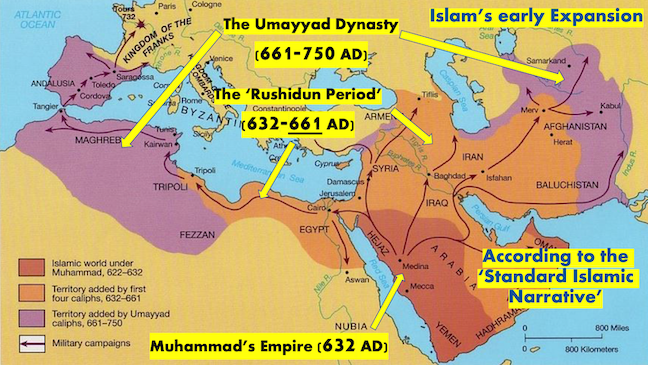
The standard Islamic narrative [4] teaches that the Qur’an, is uncreated and exists eternally on clay tablets in heaven (Qur’an 85:22). This uncreated Qur’an was sent down from Allah (the god of Islam) to one person only, the prophet Mohammed (Qur’an 39:41), through the angel Gabriel, in one language (Arabic), over a period of twenty-three years in two different locations – Mecca (610-622 A.D.) and Medina (622-632 A.D.) [5] – in central western Arabia (see above map). [6] Islam claims that Mohammed’s empire is represented by the brown area on the above map where Mecca and Medina are located. When Mohammed died in 632 A.D., that is how large Islam’s empire was.
After Mohammed died, then you have the next four successors to Mohammed called Caliphs who came to power: Abu Bakr (632-644 A.D.), Umar (634-644 A.D.), Uthman (644-656 A.D), and Ali (656-661 A.D.). These rulers expanded the Islamic Empire (lighter brown area) west to Tripoli, North Africa, north to Turkey, east to Afghanistan, and south down to Yemen and Oman. This time period is called the Rushidun Period (632-661 A.D.). And then during the Umayyad Dynasty (661-750 A.D.) established by Caliph Mu’awiya, and others after him, Islam expanded all the way west to Spain and northwestern Africa, further east to northwestern India and central Asia as represented by the purple area on the map.
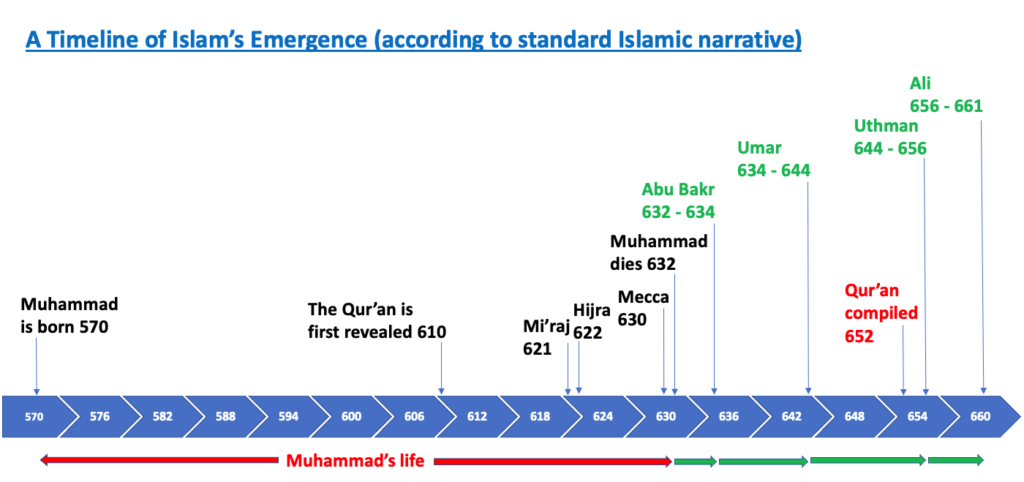
Let’s look at the timeline for Islam’s emergence according to the standard Islamic narrative (see above timeline). Mohammed was born in 570 A.D and started to receive his revelations in a place called Mecca in 610 A.D. In 621 A.D., the Mi’raj took place whereby Mohammed is suddenly awakened in the middle of the night and told to get on the back of a winged horse called a Buraq, which transported him from Mecca to Jerusalem where he ascended through the seven heavens and visited all the previous prophets (Jesus was found in the second heaven, Moses in the sixth, and Abraham in the seventh). [7] Finally, Mohammed was taken into the presence of Allah where he bargained Allah down in his command to pray fifty times to five times a day. [8]
In 622 A.D., Mohammed fled from Mecca 200 miles north up to Medina when he heard that leaders of Meccan tribes and clans vowed to assassinate him. This migration is known as the Hijra. [9] As Mohammed grows in strength and numbers, he takes over Medina and then returns to Mecca in 630 A.D. and takes it over and is therefore in control of both Mecca and Medina. In 632 A.D., Mohammed dies after being poisoned by one of his wives.
After Mohammed’s death, the first Caliph (successor to Mohammed) Abu Bakr reigned for two years (632-634 A.D.) and died peacefully. The second Caliph, Umar, ruled 10 years (634-644 A.D.) and was killed. Then Uthman reigned 12 years (644-656 A.D.) as the third Caliph before he was killed. It is during his rule that the Qur’an was compiled and completed in 652 A.D. Then Ali, the first cousin and son-in-law of Mohammed, reigns as the 4th Caliph from 656-661 A.D. and was assassinated. [10]
Thus, Islam was fully formed by 661 A.D. (mid 7th century) according to the standard Islamic narrative. But how do we know these people, places, and times in Islam’s history? Where did they come from? This leads us to discuss the documentary evidence.
The Qur’an’s Documentary Evidence
Smith states, “When anyone asks Muslims how they can be sure that the story they have of Muhammad is true, they point to numerous books on their bookshelves and claim that they were written by those who knew Muhammad; that they saw what he did and heard what he said. But they never show us their original ‘extant’ codices or manuscripts, nor do they ever give us any forensically tested dates concerning when exactly those books were originally written. To be valid witnesses for Muhammad we must have these traditional writer’s original ‘extant’ manuscripts to look at, in order to know whether they really wrote what they are purported to have written.
“Remember, the compilers of the prophet’s life and sayings all worked under the authority of the Muslim Caliphs. So, they would have had access to durable writing material, such as Parchments and Vellum (i.e. using animal skins), unlike our earliest Christian writings, which were all written on Papyrus (non-durable leaves). So, the Muslim written texts should still be in existence even today, a mere 1400 years later. Consequently, there is no excuse not to have the original manuscripts.
“Let’s find out what we now know about the ‘extant’ manuscripts of the Sira [Mohammed’s biography], the Hadith[Mohammed’s sayings], the Sahaba’s codices [Mohammed’s companions] and the Tabi’un’s codices (the 2nd generation), as well as the Ta’rikh [Mohammed’s history] and the Tafsir [Mohammed’s commentaries].” [11] [brackets and emphasis added]
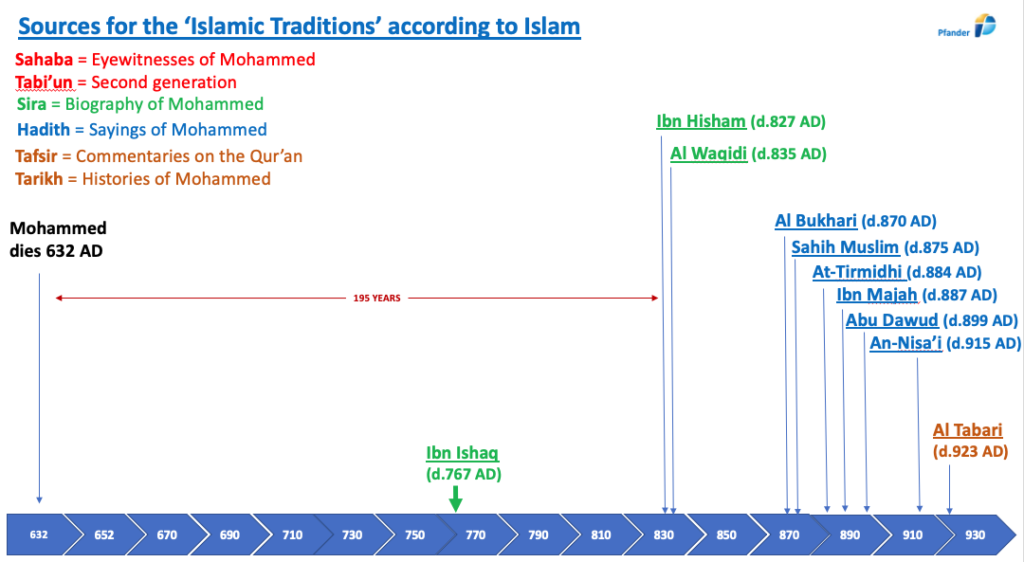
1) Available Muslim documents: Look with me at the above chart entitled “Sources for the ‘Islamic Traditions’ according to Islam.” [12] Islam claims that what we know about Mohammed and the Qur’an comes from several sources. First, it comes from the Sahaba or the eyewitnesses/companions of Mohammed and the Tabi’un, the second generation who received what they knew from the Sahaba, shown in red print above. Islam claims that these sources were written in the late 7th century to early 8th century, by Muwatta ibn Malik, Sahifa Hamman B. Munabbih, Musnad ibn Hanbal, Musanaf Abdul Razzaq, Musnad al-Tayalisi, Abi Shaybah. [13]
The second primary Muslim source is the Sira or biography of Mohammed shown in green print above. According to Islamic tradition, Ibn Ishaq (d. 767 A.D.) wrote Mohammed’s biography. [14] But notice that Ishaq died in 767A.D., over 130 years after Mohammed’s death. Did Ishaq know Mohammed or hear his teachings or observe his actions? No. So how could he have known Mohammed’s biography? We do not have any of Ishaq’s writings today. Hence, where did the biography of Mohammed come from?
Islamic tradition says Ibn Hisham wrote down what Ishaq said about the life of Mohammed, but Hisham died in 827 A.D, [15] almost 200 years after Mohammed’s death. And Hisham left out what he didn’t like about Ishaq’s portrayal of Mohammed. [16] Then another man, Al Waqidi (d. 835 A.D.) wrote down the military campaigns of Mohammed, but he also died 233 years after Mohammed’s death. [17] Thus, Ibn Hisham and Al-Waqidi actually give us the biography of Mohammed, not Ishaq. So, this is the first genre.
The third Muslim primary source is called the Hadith or sayings of Mohammed pictured in blue print in the above chart. These Muslim writers include Sahih Bukhari (d. 870 A.D.) who is considered the most important of all the other hadith contributors. He “admitted that of the 300,000 hadith he collected, he considered only 100,00 might be true. He then narrowed this number down to 7,275, many of which are repetitions so that the total number is in fact near 3,000. That means that even he admitted there were errors in over 295,000 [98%] of the hadith.” [18] [brackets and emphasis added] Other hadith contributors include Sahih Muslim (d. 875 A.D.), At-Tirmidhi (d. 892 A.D.), Ibn Maja(d. 886 A.D.), Abu Dawud (d. 899 A.D.), and An-Nisa’i (d. 915 A.D.). Notice that there is a gap of over 238+ years between the times Mohammed allegedly spoke these words and the first copies that are currently known by writers of the hadith. [19] Did any of these men know Mohammed or hear what he said? No. But Islam claims they wrote down what Mohammed said.
The fourth Muslim source is the tafsir or commentaries on the Qur’an pictured in light brown print in the chart above. Smith notes that 25% of the Qur’an is not even understood by Muslim scholars. [20] As I read the Qur’an, I find it difficult to comprehend. Some stories don’t have beginnings or endings, or they seem to begin in the middle of the story. There are no transitional phrases between stories to help you follow the author’s train of thought.
The fifth Muslim source is the Tarikh or the histories of Mohammed also pictured in light brown print in the above chart. Both the tafsir and tarikh contributions were first written down by Al Tabari who died in 923 A.D., [21] almost 300 years after Mohammed. Did Al Tabari know Mohammed or witness his words and actions? No, of course not.
Thus, according to the standard Islamic narrative, everything we know about Mohammed from Muslim documents – who he was and what he said and did – comes 50-300 years after Mohammed died.
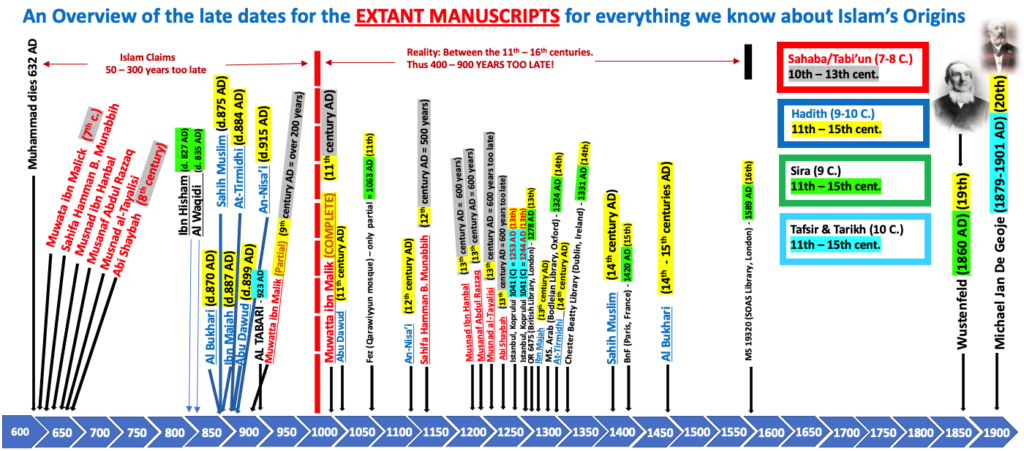
But more recent research shows that these Islamic documents are not nearly as old as Muslim scholars believe. Look at the timeline above for extant (existing) Manuscripts for everything we know about Islam’s origins. [22] From left to right, Islam claims that the Sahaba and the Tabi’un, the first and second generation of eyewitnesses to Mohammed and the Qur’an, were written in the late 7th to early 8th centuries, and yet there is no 7th – 8th century documents for these writings. They do not appear in writing until the 9th to 13th centuries: Muwatta ibn Malik:9th century (200 years later), Sahifa Hamman B. Munabbih: 12th century (500 years later), Musnad ibn Hanbal:13th century (600 years later), Musanaf Abdul Razzaq:13th century (600 years later), Musnad al-Tayalisi:13th century (600 years later), Abi Shaybah:13th century (600 years later) – this suggests they were all written by others over 200-600 years later and redacted or attributed back to the 7th – 8th centuries! Thus, they are most likely all fraudulent. [23]
Islam maintains that the Sira (biography of Mohammed), the Hadith (the sayings of Mohammed), the Tafsir(commentaries on the Qur’an) and the Tarikh (histories of Mohammed) all were written 200-300 years after Mohammed. However, Dr. Jay Smith has demonstrated that these supporting documents were written much later (11th-16th centuries), 400-900 years after Mohammed presumably lived, and then redacted or attributed back to the 7th-10th centuries. [24] Most of these documents were not canonized into written form until 1,200 – 1,270 years later than Mohammed.
For example, the Sira (biography of Mohammed), was comprised of 36 different biographies written down in the last few hundred years. But who wrote the standard work which Islam depends upon today? It was Heinrich Ferdinand Wustenfeld (1808 – 1899), who between 1858 – 1860 compiled the Sira taken from libraries and museums in six mostly European cities (Fez, London, Oxford, Dublin, Paris and London). [25] It was then translated into French and English, and “sanitized” by Alfred Guillaume [26] and others later on. Hence, the man whom Muslims are dependent on to know who their prophet is or what he did, is an elderly German linguist who wrote Mohammed’s story over 160 years ago. [27]
Furthermore, Islam claims that the Hadith (sayings of Mohammed) were created in the 9th-10th centuries, but this does not align with history. Their earliest extant manuscripts were actually created much later: [28] Abu Dawud: 11thcentury (400 years after Mohammed); An-Nasai: 12th century (500 years after Mohammed); Ibn Majah: 13th century (600 years after Mohammed); Jami’ At-Tirmidhi: 14th century (700 years after Mohammed); Sahih Muslim: 14thcentury (700 years Mohammed); Sahih Bukhari: 14th – 15th centuries (700-800 years after Mohammed). Not one of the Hadith was compiled in the 9th – 10th centuries. Their final extant manuscripts were not created until the 11th -15th centuries, which is 400 – 800 years later! Thus, not one of them ever heard a word Mohammed said!
What about Al Tabari’s Tafsir (commentaries on the Qur’an) and Ta’rikh (histories of Mohammed)? The edition of Al Tabari which everyone uses today was compiled by Michael Jan De Geoje, the professor of Arabic at Leiden University, Holland, between 1879 – 1901, and is known as the “Leiden Edition.” Yet, De Goeje used two 13th century Arabic manuscripts from Turkey as his model. So, even Al Tabari’s Ta’rikh and his Tafsir are not 10th century originals but are much later 13th century compilations which were merely redacted or attributed back to Al Tabari 300 years earlier. Yet, they are still 600 years later than Mohammed! What’s more, it took a Dutch scholar to compile them 1,200 years later! [29]
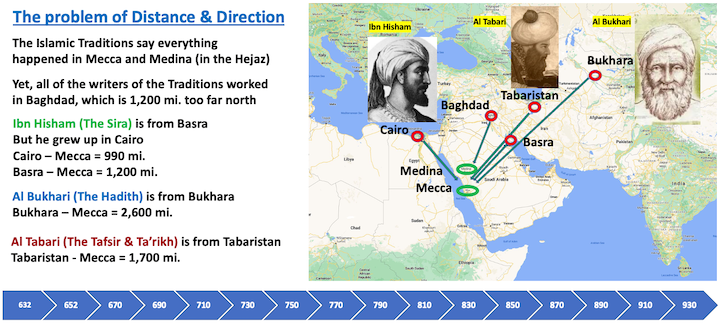
Another problem with the Muslim documentary evidence for the Qur’an has to do with distance and direction (see above map). [30] The Islamic Traditions say that everything happened in Mecca and Medina (circled in green on the map above), in west central Arabia. Mohammed was born in Mecca and lived there 52 years before he moved to Medina in 622 A.D. It was while he lived in Mecca and Medina that he received the Qur’an from 610 – 632 A.D. Yet everything we know about Mohammed did not come from those cities, it came from Baghdad, which is 1200 miles too far north.
Ibn Hisham, who wrote Mohammed’s biography (the Sira), is from Basra, but he grew up in Cairo and wrote in Baghdad. Cairo is 990 miles from Mecca. And Basra is 1200 miles from Mecca as is Baghdad. Sahih Bukhari who wrote down the sayings of Mohammed (the Hadith), is from Bukhara which is 2,6000 miles from Mecca. Al Tabariwho wrote down the commentaries of the Qur’an and the histories of Mohammed (The Tafsir & Tarikh) is from Tabaristan (northern Iran today) which is 1,7000 miles from Mecca. None of these traditional writers lived or worked in Mecca or Medina. They were too far to the north from Mecca and came from east and west of Baghdad.
Since these Muslim sources are much too late and too far away to provide confirmation of the reliability of the Qur’an, we must go back to the seventh century when Mohammed lived to determine what documents are available which can substantiate the reliability of the Qur’an.
2) The Doctrina Iacobi and 661 Chronicler: There are two seventh century documents outside the Islamic Traditions which are available for us to examine today which are helpful for our purposes here. Both of these documents deal with the relationship between the Arabs and the Jews. The first is the Doctrina Iacobi, the earliest witness of Mohammed and his “movement” available to us outside Islamic tradition. It is a Greek Christian polemical tract, from Carthage (Tunis), but written in Palestine, by a Christian apologist between 634 and 640 A.D. [31] The second is a chronicle supposedly written by the historian Bishop Sebeos in 660 A.D. [32]
The Qur’an implies that Mohammed’s relationship with the Jews was becoming unfavorable in 624 A.D. (or soon after the Hijra in 622 A.D.), and thus moved the direction of prayer, the Qibla at that time, from Jerusalem to Mecca, “144 Indeed, we have seen you turning your face toward the heaven. So we will have you turn to a direction which will please you. So turn your face toward the forbidden mosque [Masjid ul Haraam at Mecca]… 149 And from whatever place you come out, so turn your face toward the forbidden mosque and surely to the truth from your lord. And Allah is not unaware of what you do. 150 And from whatever place you come out, so turn your face toward the forbidden mosque, and wherever you were, to that part so turn your faces lest people have an excuse against you except those who are unjust among them. So do not fear them. And fear me that I may complete my grace on you, and perhaps you may be guided.” (Qur’an 2:144, 149-150). [33] In these verses Allah instructs Mohammed and his followers to turn toward the forbidden mosque in Mecca away from the mosque in Jerusalem, implying that relations between the Jews and Arabs were severed or at the least, strained.
In contrast to this, an early non-Muslim source describes a healthy relationship between the Muslims and Jews at the time of the first conquests (late 620s A.D.), and even later. Yet the Doctrina Iacobi warns of the Jews who mixed with the Saracens (Arabs), and the danger of falling into the hands of these Jews and Saracens(Arabs). [34] In fact, this relationship seems to continue on into the conquest of Palestine as an early Armenian source mentions that the governor of Jerusalem in the aftermath of the conquest was a Jew. [35] It is plausible that the Jews and Arabs (Saracens) seem to be allied together during the time of the conquest of Palestine and even for a short time after. [36] If these witnesses are correct, then one must ask how it is that the Jews and Saracens (Arabs) are allies as late as 640 A.D., when, according to the Qur’an, Mohammed dissolved his ties with the Jews as early as 624 A.D., more than 15 years earlier?
To answer that we need to refer to the earliest connected account of the career of Mohammed that is found in an Armenian chronicle from around 660 A.D., which is attributed by some to Bishop Sebeos. [37] The chronicler describes how Mohammed established a community which comprised both Ishmaelites (i.e. Arabs) and Jews, and that their unifying motivation was their common descent from Abraham: the Arabs through Ishmael, and the Jews through Isaac. [38] The chronicler believed Mohammed had bestowed both communities with a birthright to the Holy Land, while concurrently providing them with a monotheist genealogy. [39]
Hence, we find non-Muslim documentary sources contradicting the Qur’an, maintaining that there was a good relationship between the Arabs and Jews for at least an additional 15 years beyond that which the Qur’an alleges. Also, if Palestine was the focus for the Arabs, then the city of Mecca comes into question, and additional documentary evidence concerning Mecca may prove to be the most detrimental proof against the reliability of the Qur’an which we have to date.
3) Mecca: [40]
Islam maintains that Mecca is the oldest and best-known city in history. The Qur’an makes inferences to Mecca on its pages. The word “Mecca” is not mentioned in the following Qur’anic verses, but Islam understands them to refer to the city.Meccais where Adam and Eve were thrown down from heaven after they ate from the tree (Qur’an 7:24). We cannot find a city older than Adam and Eve, so Mecca is believed by Islam to be the oldest city. The first sanctuary appointed for humankind was that at “Becca,” understood by Islam to refer to Mecca (Qur’an 3:96). Mecca is the “mother of the villages” (Qur’an 6:92; 42:7). According to the Qur’an it was Abraham and Ishmael who built the Meccan Ka’aba (Qur’an 2:125-127). Mecca is where Abraham lived in 1900 B.C. when he destroyed the idols within the Ka’aba (Qur’an 21:51-71). Much of Mohammed’s story revolves around Mecca. He was born there in 570 A.D. and spent his formative years there until 622 A.D. when he fled to Medina. He returned to Mecca in 630 A.D. and took control of it. Mecca became the center for the Qibla (direction of prayer) in 624 A.D. (Qur’an 2:149-150). And Mecca is the center of trade North, South, East and West. [41] These all suggest that people have lived in Mecca from the very beginning of humankind.
Yet, the only clear reference to the word “Mecca” in the Qur’an is in one verse: “And he is who holds back their hands from you and your hands from them in the belly [valley] of Mecca after he had given you triumph over them, and Allah was seer of what you do.” (Qur’an 48:24). [42] [emphasis added] If Mecca is such an important place, why is it only mentioned once in the Qur’an? Doesn’t this signify that Mecca either was not that important to the author(s) of the Qur’an or it did not come into existence until later on?
However, when we look at the 9th and 10th century Islamic Traditions (which are actually 11th – 15th century), we see many references to the city of Mecca because they are written much later. [43] Mecca was in a valley and a parallel valley (Ibn Hisham; Al Bukhari 2:645, 2:685, 3:891, 2:815, 2:820, 4:227) with a stream (Al Bukhari 2:685), fields, (Al Bukhari 9:337), trees (Sahih al-Tirmidhi 1535), grass (Al Bukhari 9:337), fruit (Al Bukhari 4:281), clay and loam (Al Tabari VI 1079 p. 6), grain, palm trees, dates, olives, pomegranates (Qur’an 6:99, 141; 16:11, 67), with mountains overlooking the Ka’aba (Ibn Hisham; Al Bukhari 2:645, 2:685, 3:891, 2:815, 2:820, 4:227), where the pagans raised livestock (Qur’an 4:119). Mecca is described as a very fertile place in the Islamic Traditions and in the Qur’an.
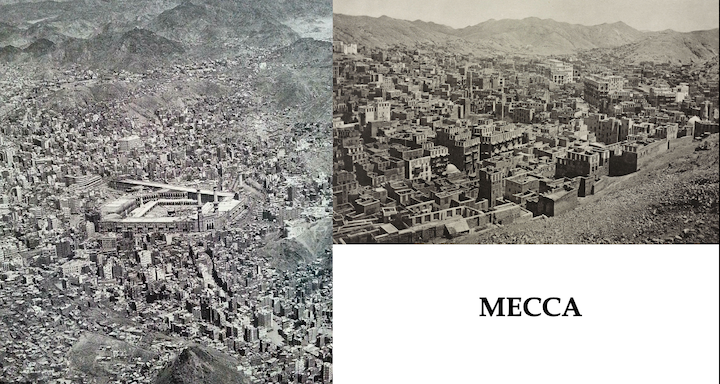
Yet, Townsend states that the physical and geographical features of Mecca do not line up with the Qur’an or the Hadith. [44] For example, “the mountains of Safa and Marwah, which mark the journey of Hagar in her quest for water, do not fit with the description in the Hadith. They are too small and close to each other. Also, the Hadith references to Mecca describe a place where the soil is suitable to grow fields of grain, trees, and grapevines. However, Mecca does not have olive trees, and it cannot even support the growth of food for camels and sheep. The Hadith also talks about two parallel valleys with a stream in between, but Mecca does not have these features. However, all of these features are found in the ancient city of Petra,” [45] much farther north from Mecca. Mecca is in a desert (see above pics), so it is too arid and dry to support the descriptions of fertility found in the Qur’an and Hadith, according to modern soil studies! [46] Mecca has never had the kind of fertility that these Islamic traditions claim.
From research carried out by both Crone and Cook, except for an inference to a city called “Makoraba” by the Greco-Egyptian geographer Ptolemy in the mid-2nd century A.D. (though it is not certain this allusion by Ptolemy referred to Mecca, as he only mentioned the name in passing), there is absolutely no other report of Mecca or its Ka’bain any authenticated ancient document; that is until the mid-eighth century, [47] when Mecca is mentioned in the Continuatio Byzantia Arabica, which is a source dating around 741 A.D. [48] In addition, Mecca is not even found on a map until around 900 A.D. [49]
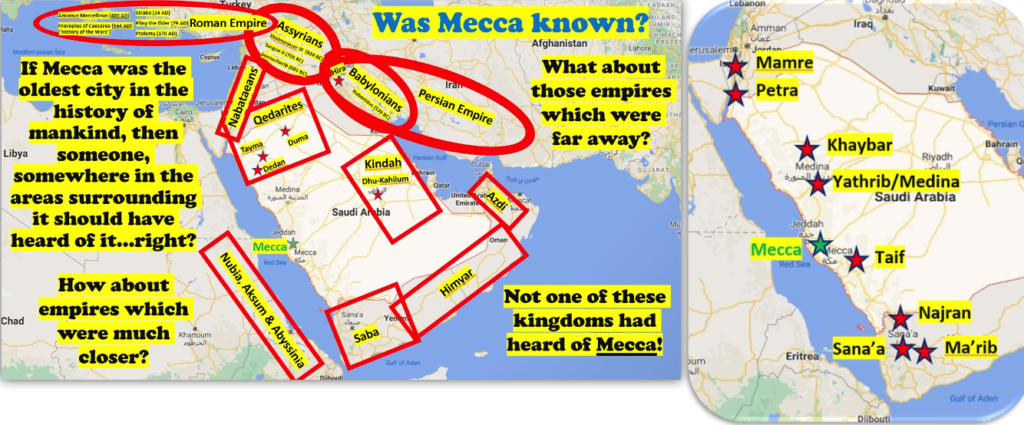
Dr. Crone visited several surrounding civilizations such as the Assyrian, Babylonian, Persian, Roman, Nabataeans, Qedarite, Himyarite, and Nubian civilizations, etc. (see red circle and rectangle areas on above map), and read their ancient documents and she could not find one reference to Mecca. [50] So, Crone visited the lesser-known towns closer to Mecca on the Arabian Western Plateau which were oases, and she found they were well-known and well documented all the way back to 300 B.C., yet she did not find one mention of Mecca (see above map). [51] Townsend agreed with Crone’s findings, stating that there is no primary source evidence of the existence of an ancient city in the present location of Mecca. [52] He observed that there are numerous mentions of Ta’if, just 70 miles away, as well as Najran, Sana’a, Medina, and Petra – but no mention of Mecca. There is even an absence of the name of Mecca in the ancient inscriptions found in the records of cities that occupied the Arabian Peninsula. [53] If Mecca was known as the “mother of the villages [cities]” as the Qur’an states (Qur’an 6:92; 42:7), then surely there would be documents from the 7th century, or earlier, that would mention the city as well as the people.
Even more problematic for Islam which claims that Mecca was the center of trading routes for Arabia in the 7th century and before, is that there is not any reference to trade with Mecca in the records of that time. [54] Patricia Crone did extensive research on the Meccan trade routes, and she learned that the ancient trading documents of that time referred to less significant towns close to Mecca, including Ta’if (which is south-east of Mecca), Yathrib (later Medina), as well as Khaybar, Petra, and Mamre in the north and Ma’rib, Sana’a, and Najran in the south (see above map), but no mention is made of Mecca from the 2nd to 8th centuries. [55]
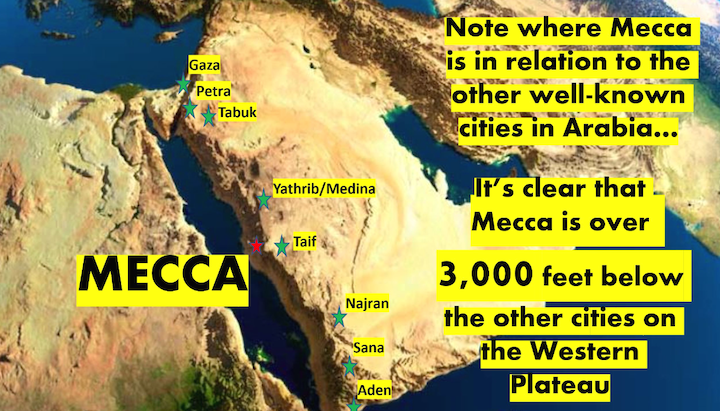
When we note the trade route through these towns (which were oases), we find that they are all located on the Western Plateau of the Arabian Peninsula, while Mecca is over 3,000 feet down below it in a desert, proving it was not on any trade route (see map above). [56]
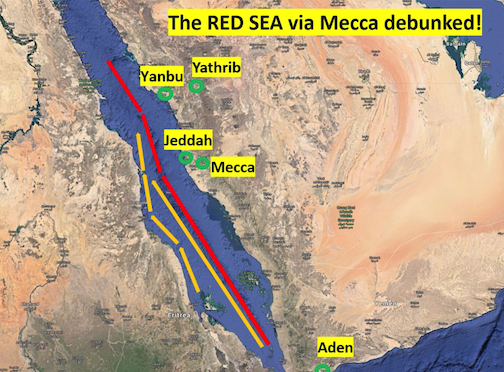
In addition, when Dr. Crone went to the Red Sea trade routes, she found that it was all along the East African coast, but not on the Arabian coast (see above map), proving none of the trade went through Mecca at all, confronting the notion that it was the center of trade.
Mecca, before 741 A.D. (which is considered the earliest documentary evidence for it anywhere), simply has no history, and even that reference is in Southern Turkey, which is too far north. When Ptolemy in the 2nd century wrote his book on Arabian geography, he never listed Mecca, so that none of the earliest 15th-16th century European maps of Arabia have Mecca listed on them either.
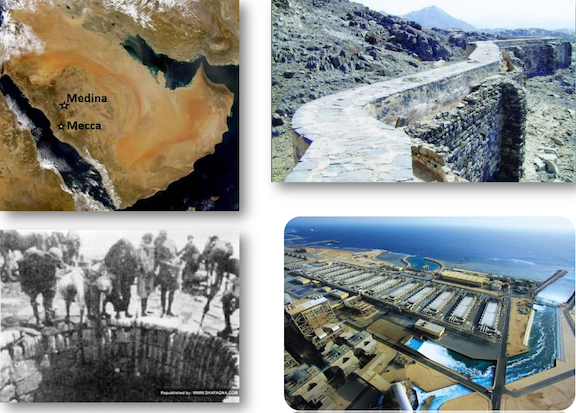
The reason for this is because Mecca was in the middle of a dessert and had no water. Trade needs people, and people need water, food and towns, all of which never existed in Mecca until the mid 8th century, over 100 years after Islam was supposedly created. Because of Mecca’s water problem, Queen Zubaydah’s Aqueduct was built in 801 A.D. (see upper left pic above), which then had to be refurbished 9 times in the subsequent 974 years due to the overbearing need for drinkable water; and then finally it was replaced with desalination plants after 1926 A.D. [57]
Islam claims that Allah miraculously provides “inexhaustible water” for 2 billion Muslims through the ZamZam well, which is currently only 3-9 feet across and 100 feet deep, and about 66 feet east of the Ka’aba in Mecca (see above middle pic). [58] But what they don’t tell you is that the ZamZam well gets all its water from desalination plants built by American and European companies. (see lower right pic above) [59]
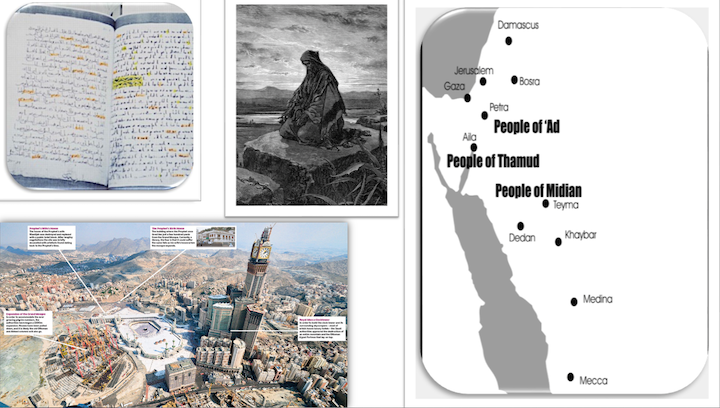
Linguists have observed that the Arabic word endings used in the Qur’an do not come from Mecca, but from Nabataean Aramaic, which is situated 600 miles farther north around the city of Petra (see above pic). [60]Geographically speaking, the Qur’an places fifty-four of its sixty-five referenced areas 600 – 1,000 miles farther north from Mecca (Ad = 23 times, Thamud = 24 times, and Midian = 7 times) suggesting the authors of the Qur’an came from much farther north in northern Arabia closer to the city of Petra (see above map). [61] Whoever wrote the Qur’an wrote from farther north where these places existed.
Islam contends that between 70 – 300 prophets were buried in Mecca in a kneeling position so they could keep praying, so we should be able to find them today. Yet, with all the skyscrapers being constructed there in recent years, requiring deep foundations, they have not yet dug up one prophet’s body. Smith concludes that it seems the Saudi Arabians, because of Mecca’s lack of history, are cementing up all the evidence, suggesting even they are either skeptical of its history or they don’t want the rest of the world to find out the truth about Islam’s origin (see above pic). [62]
Conclusion: Townsend, the author of The Mecca Mystery, concludes, “To put it as bluntly as possible: there is not a single shred of uncontested primary source evidence confirming the existence of an ancient city at the spot where the modern city of Mecca is located.” [63]
The documentary evidence not only contradicts the Qur’an’s dating on the split between the Arabs and the Jews, but it also contradicts both the Qur’an and the Hadith’s description of the city it identifies as the birthplace and cornerstone for Islam. The standard Islamic tradition refers to Mecca as a place with much vegetation, existing since Adam and Eve, and with up to 300 prophets buried there. Yet, it is not referred to until 741 A.D., and none of the early maps show Mecca at all. Not one prophet’s body has been discovered buried in Mecca. Scholars such as Patricia Crone examined the ancient historical and trading documents, and Mecca was not the great commercial center the later Muslim traditions would have us believe, as it was not known by the people who lived and wrote from that period of time. In fact, history shows that what the Qur’an and Hadith describe could not even qualify as a viable city during the time of Mohammed, and it certainly could not have been the center of the Muslim world at that time. In addition, research has debunked the Red Sea Trade via Arabia, proving it was all via Africa, because it had water and Mecca did not. None of the surrounding empires ever heard of Mecca, most likely because it lacked WATER.
How then can we believe that the Qur’an is reliable? Do these same types of problems exist with the Bible? Let’s turn our attention to…
The Bible’s Documentary Evidence
For the last several decades the documentary evidence for the reliability of the Bible has been an area of research which has increased rapidly. But this hasn’t always been so. The assumption by many former archaeologists was that the Old Testament was not written in the 10th – 14th centuries B.C. by the authors described within its text, but by later Jewish historians during the much later 2nd – 6th centuries B.C., and that the stories were then redacted or attributed back onto the great prophets such as Moses and David, etc. Yet, an enormous quantity of historical data has been uncovered and is continuing to be uncovered, as well as the new forensic research methods being employed to study them, so that many of these preconceived notions of authorship are simply no longer valid. For instance:
1) The oldest book of the Bible is considered to be Job which conservative scholars believe was written during the Patriarchal period of Abraham, Isaac, and Jacob (2100 -1900 B.C.). The following internal evidence confirms that Job was written during this period of time: [64]
a. Job’s wealth was reckoned in livestock (Job 1:3; 42:12), which was also true of Abraham (Gen. 12:16; 13:2) and Jacob (Gen. 30:43; 32:5).
b. The Sabeans and Chaldeans (Job 1:15, 17) were nomads in Abraham’s time, but in later years they were not nomadic.
c. The Hebrew word qeśîtâh, translated “piece of silver” (Job 42:11), is used elsewhere only twice (Gen. 33:19; Josh. 24:32), both times in reference to Jacob.
d. Job’s daughters were heirs of his estate along with their brothers (Job 42:15). This, however, was not possible later under the Mosaic Law if a daughter’s brothers were still living (Num. 27:8).
e. Literary works similar in some ways to the Book of Job were written in Egypt and Mesopotamia around the time of the patriarchs.
f. Several names of people and places in the book of Job were also associated with the patriarchal age. Examples include (Sheba, a grandson of Abraham (Gen. 25:3), and the Sabeans from Sheba (Job 1:15; 6:19); Tema, another grandson of Abraham (Gen. 25:15), and Tema, a location in Arabia (Job 6:19); Eliphaz, a son of Esau (Gen. 36:4), and Eliphaz, one of Job’s companions (Job 2:11); Uz, a nephew of Abraham (Gen. 22:21), and Uz, where Job lived (Job 1:1).
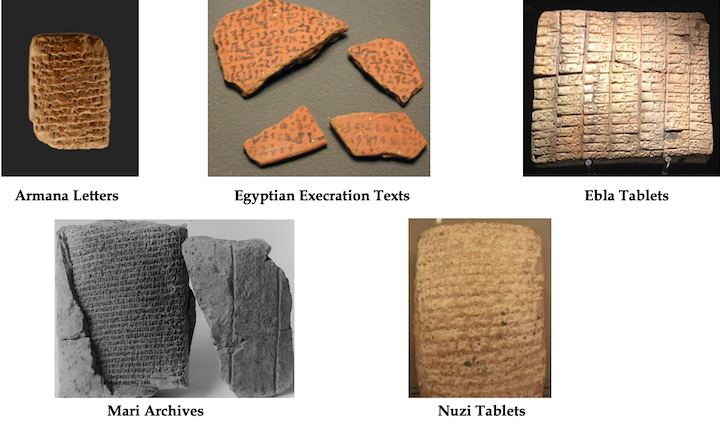
The documentary evidence for the Patriarchal period includes four sets of tablets which have been and are continuing to be uncovered from that area of the world. They demonstrate that the Biblical account is indeed historically reliable. Let’s briefly look at all five sets of tablets (see above pics): [65]
Armana Letters: (from Egypt) mention the Habiru or Apiru in Hebrew, which was first applied to Abraham in Genesis 14:13 and the name “Job” (Ayyabum).
Egyptian Execration Texts: These mention the names of people and places found in the book of Job: Sheba (Job 6:19), Tema and Eliphaz (Job 2:11; 4:1; 15:1; 22:1; 42:7, 9); Uz and Job (Job 1:1).
Ebla tablets: 1,800 tablets from Tel Mardikh (Northern Syria), dating from 2500-2250 B.C., [66] shows us that a thousand years before Moses, laws, customs and events were recorded in writing in that part of the world, and that the judicial proceedings and case laws were very similar to the Deuteronomy law code (i.e., Deuteronomy 22:22-30 codes on punishment for sex offenses). One tablet mentions and lists the five cities of Sodom, Gomorrah, Admah, Zeboiimand Zoar in the exact sequence which we find in Genesis 14:8! Until these tablets were uncovered, the existence of Sodom and Gomorrah had always been in doubt by historians.
Mari Archives: (from the Euphrates) mentions king Arriyuk, or Arioch of Genesis 14, and lists the towns of Nahor and Haran (from Genesis 24:10), as well as the names Benjamin and Habiru. They also mention the names Sheba, Eliphaz, Uz, and Job in the book of Job.
Nuzi tablets: (from Iraq) speaks about a number of customs which we find in the Pentateuch (i.e., Genesis – Deuteronomy) such as:
1. a barren wife giving a handmaiden to her husband (i.e., Hagar)
2. a bride chosen for the son by the father (i.e., Rebekah)
3. a dowry paid to the father-in-law (i.e., Jacob)
4. work done to pay a dowry (i.e., Jacob)
5. the unchanging oral will of a father (i.e., Isaac)
6. a father giving his daughter a slave-girl (i.e., Leah, Rachel)
7. the sentence of death for stealing a cult god (i.e., Jacob).
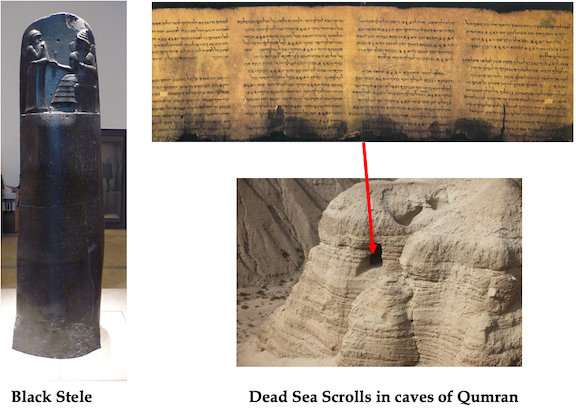
2) The Pentateuch (i.e. Genesis – Deuteronomy): In years past, skeptics contended that the Pentateuch could not have been written by Moses during his lifetime (ca. 1525-1405 B.C.), [67] because there was no evidence of any writing that early. Then the Black Stele was found in Susa (modern Iran) in 1901 with the detailed laws of Babylonian King Hammurabi which were written approximately 300 years before Moses, and in the same region. [68]
3) The Masoretic Text: There was also a lot of doubt about the reliability of the Old Testament documents, since the oldest manuscript in our possession was the Masoretic Text, written in 916 A.D. Skeptics asked how we can depend on a collection of writings whose earliest manuscripts are so recent? Then in 1947 came the amazing discoveries of the Dead Sea Scrolls in the caves of Qumran and along the Dead Sea written around 125 B.C. These scrolls show us that outside of minute copying errors it is identical to the Masoretic Text and yet it predates it by over 1,000 years! [69] We have further substantiation in the Septuagint, the Greek translation of the Hebrew text, which was composed around 250-150 B.C. [70]
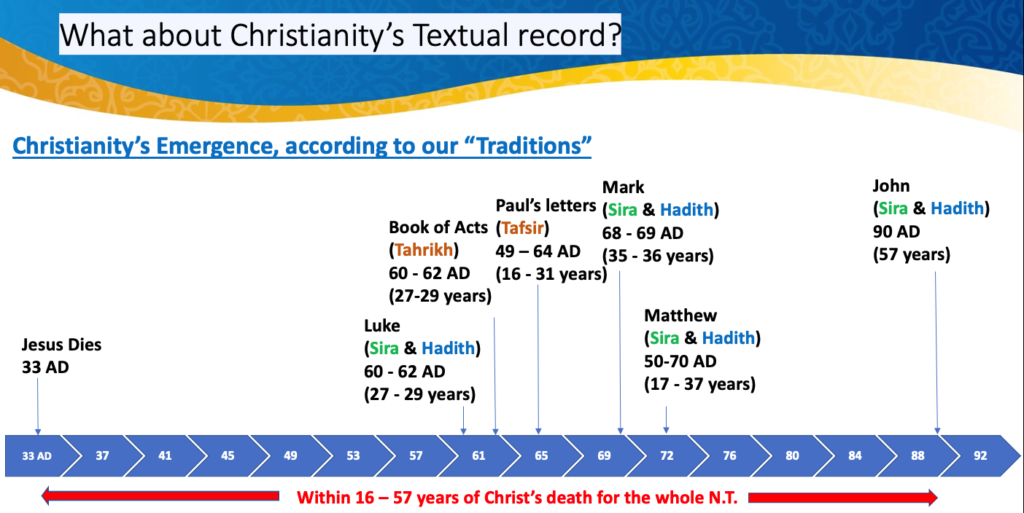
4) Available Christian documents: When we analyzed the Qur’an’s documentary evidence, we looked first at the Muslim documents. In the same manner, I want to look at the Christian documents now. In the above chart, [71] we list Christianity’s emergence according to our Traditions. When we look at the documentary evidence for Jesus, we start with the first Sira (biography of Jesus) and Hadith (sayings of Jesus) written by Luke from 60-62 A.D., [72] just 27-29 years after Jesus died. Then the book of Acts which is our Tahrikh or early histories of the church also written by Luke between 60-62 A.D., [73] likewise 27-29 years after the death of Christ. The apostle Paul’s letters to the churches are the Tafsir or commentaries on the life of Jesus between 49-64 A.D., [74] only 16-31 years after Jesus’ death. Next, we have the second Sira (biography of Jesus) and Hadith (sayings of Jesus) written by Mark (68-69 A.D.), [75] just 35-36 years after Christ’s death. Then we have Matthew’s Sira (biographies of Jesus) and Hadith (sayings of Jesus) written between 50-70 A.D, [76] only 17 – 37 years after the crucifixion of Jesus. And finally, we have the last Sira and Hadith written by John in 90 A.D., [77] just 57 years after the death of Jesus. Hence, within 16-57 years after Christ’s death, we have the entire New Testament. All of the New Testament writers lived in the same place Jesus lived, and they either knew Him personally, or they got their material from others who saw what He did and heard what He said.
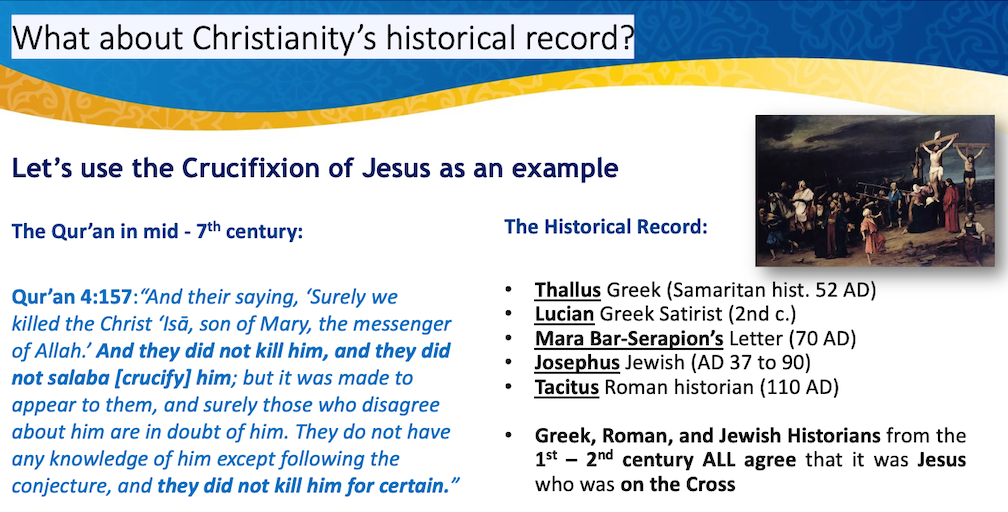
5) Available non-Christian documents: As an example, let’s look at the crucifixion of Christ, the most important event in history (see chart above). [78] The Qur’an, which Islam claims was written in the mid-7th century, says, “And their saying, ‘Surely we killed the Christ ‘Isā, son of Mary, the messenger of Allah.’ And they did not kill him, and they did not salaba [crucify] him; but it was made to appear to them, and surely those who disagree about him are in doubt of him. They do not have any knowledge of him except following the conjecture, and they did not kill him for certain.”(Qur’an 4:157). [79] [emphasis added] The Qur’an denies that their Jesus (‘Isā) actually died on the cross. It says it was made to appear he died by having another man take Christ’s place on the cross. Is the Qur’an’s claim supported by the historical documentary evidence from the 1st and 2nd centuries A.D. outside of Christianity? No.
Thallus, a Greek Samaritan historian writing about 52 A.D. spoke of the “darkness which accompanied the crucifixion of Christ.” [80] Josephus, the first-century Jewish historian (37-100 A.D.), [81] wrote that “there was a wise man who was called Jesus…. Pilate condemned him to be crucified and to die.” [82]Lucian, a Greek Satirist from the 2nd century A.D., “without using Jesus’ name he writes of that one whom they still worship today, the man in Palestine who was crucified because he brought this new form of initiation into the world.” [83]There is also a Syriac manuscript in the British Museum by a Syrian and probably Stoic philosopher, Mara Bar Serapion(sometime after 70 A.D), that asks, “What advantage did the Jews gain from executing their king? It was just after that their kingdom was abolished.” [84] The Roman historian, Tacitus (56-120 A.D.), spoke in his Annals of “Christ who was executed under Pontius Pilate in the reign of Tiberias.” [85]Most of these Greek, Roman, and Jewish 1st and 2nd century historians were opposed to Christianity, yet they all agree that Jesus Christ was crucified on a cross.
Who are we going to believe? The Qur’an, which Islam claims was written in the mid-7th century, over 600 years after Jesus walked on the earth, or these 1st and 2nd century Greek, Roman, and Jewish writers who lived much closer to the time of Jesus? We can see from this one example that Christianity has a much better historical record than does Islam.
Conclusion:
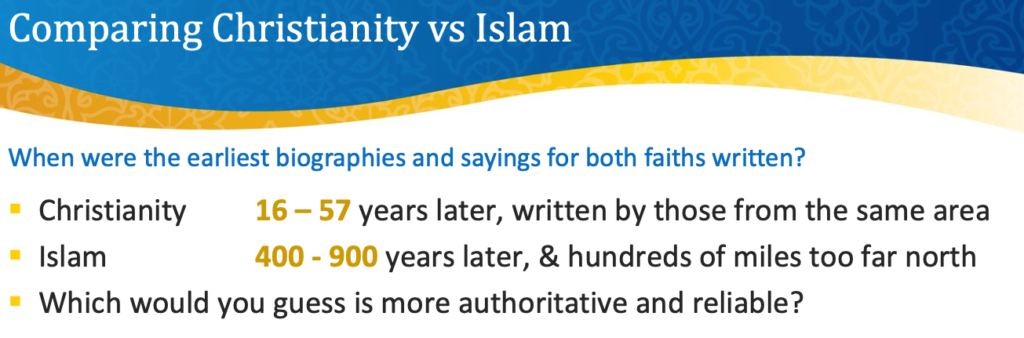
When we compare the historical documentary evidence of the Qur’an and the Bible (see above chart), we discover when the earliest biographies and sayings for both faiths were written. For Christianity, they were written 16-57 years after Jesus’ death on the cross by those from the same area. But for Islam, they were written 400-900 years later, and by those who were hundreds of miles too far north. Which do you think has more authority and reliability?
A former Muslim who became a Christian, writes, “After thoroughly investigating the truth claims of slam and Christianity, even while a Muslim, there was no avoiding the obvious truth: The evidence in favor of Christianity was far, far stronger than the evidence for Islam….
“The traditional Islamic narrative is incompatible with both the history of Christianity and even with its own historical records. To believe in the Islamic account of Christian origins while taking the historical records seriously, we would have to conclude that Jesus was an utterly incompetent Messiah and Allah is a deceptive God. The historical record of Islamic origins makes many scholars wonder whether Muhammad existed, and it makes scholars think the Quran was originally far more fluid and indeed a very different kind of book than it is today.
“The Islamic narratives of Christian origins, and even of Islamic origins, are incompatible with history. In other words, to believe the truth of Islam is to ignore the historical evidence.
“As a Muslim, I wanted to base my beliefs not on blind faith, not on what appealed to me, and not even on my family’s heritage. I wanted to ground my faith in reality. If I wanted to take the records of history seriously, I had to abandon my Islamic faith and accept the gospel.” [86] [emphasis added]
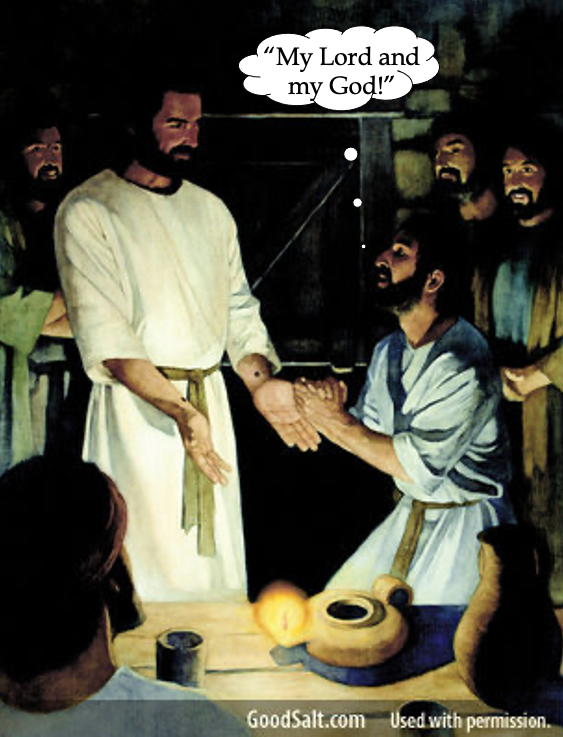
As Christians, we have the evidence to boldly and clearly proclaim Christ crucified to our Muslim friends. For centuries, the truth of Christianity has withstood criticism. In the first century, when one of Jesus’ disciples, Thomas, doubted the eyewitness testimony of Jesus’ resurrection (John 20:25) and demanded tangible evidence that Christ was alive before he would believe it. Jesus did not come to Thomas and tell him not to doubt or question such an important event. Instead, Christ says to Thomas, “Reach your finger here, and look at My hands; and reach your hand here, and put it into My side. Do not be unbelieving, but believing.” (John 20:27). Knowing full well the struggles going on in Thomas’ heart, Jesus invites him to explore with his hands (“Reach your finger here”) and his eyes (“look at My hands”) the reality of His resurrection body.
When Jesus said, “reach your hand here, and put it into My side,” He was referring to a literal hole in His side that was left by the spear. It had healed over but it left an obvious impression. Jesus did not condemn Thomas for his unbelief. He didn’t say, “You should not ask questions like that Thomas!” Christ gave Thomas undeniable evidence that He rose from the dead to answer his objection and then invites him to believe.
In our Judeo-Christian America, we are taught to think critically and question truth claims. Truth does not pull away from scrutiny. It stands up to it.
But in an Islamic community, you are to respect the Qur’an and not question it. The Qur’an encourages Muslims not to question it, lest they become “infidels” (non-Muslims): “101 O you who have believed, do not ask about things which, if they were revealed to you, it would be harmful to you. And if you ask of it when the Qur’an is sent down, it will be revealed to you. Allah will pardon you for this. And Allah is forgiving, forbearing. 102 The people before you asked such questions, and by them they became infidels.” (Qur’an 5:101-102).[87]
Dakdok comments about these verses, “What a way to understand the Qur’an! Just don’t ask questions because, if you ask, perhaps you won’t find an answer. On the other hand, if you do find the answer and it contradicts the teaching of the Qur’an, then perhaps you will become an infidel (unbeliever).
“Christians, on the other hand, are encouraged to ask questions and seek further understanding, which is one of the primary reasons that we have Bible study classes. In them, we can investigate and search for answers to all kinds of questions, and these answers are in the Word of God. Perhaps the greatest problem that Muslims face is the necessity to believe in a book, which in many cases they have not read, but whether they have or not, they simply cannot understand. As it is even written in its own pages, no one can even interpret it, except Allah himself!” [88] [emphasis added]
As Islam spreads throughout the U.S., it is essential that Christians speak the truth in love to Muslims about Islam and Christianity. When western scholars and followers of Christ ask questions about the Qur’an, Mohammed, and Mecca, Islamists will be confronted with the truth about their faith and its incompatibility with history. It is then, that we must share the good news of Jesus’ death and resurrection with them so they “may believe that Jesus is the Christ, the Son of God, and that believing [they]… may have life in His name.” (John 20:31).
ENDNOTES:
[1] Tom Constable, Dr. Constable’s Notes on Daniel, 2025 Edition, pp. 6, 40.
[2] Conservative scholars believe Job was written during the Patriarchal period (2100 -1900 B.C.). See Roy B. Zuck, “Job,” The Bible Knowledge Commentary Wisdom, 2018 Kindle Edition, pp. 15-16.; Tom Constable, Notes on Job, 2025 Edition, pp. 1-2.
[3] Robert Vacendak, “Revelation,” The Grace New Testament Commentary: Revised Edition, 2019 Kindle Edition, pp. 1944-1945; John F. Walvoord, “Revelation,” The Bible Knowledge Commentary Epistles and Prophecy, 2018 Kindle locations 4701 to 4707; Archibald Thomas Robertson, A. T. Robertson’s Word Pictures in the New Testament, 2014 Kindle Locations 211099 -211108.
[4] Much of this section is adapted from Dr. Jay Smith’s July 9, 2025, video presentation at Calvary Chapel Chino Hills, entitled, “Two New Findings That Mohammed Didn’t Exist,” at www.youtube.com, unless otherwise noted. View video at this LINK .
[5] Norman L. Geisler and Abdul Saleeb, Answering Islam: The Crescent in Light of the Cross Second Ed. (Grand Rapids, MI: Baker Books, 1993, 2002), pg. 94; Daniel Janosik, THE GUIDE TO ANSWERING ISLAM: What Every Christian Needs to Know About Islam and the Rise of Radical Islam (Cambridge, OH: Christian Publishing House, 2019 Kindle Edition, pp. 33-34 cites Ali Dashti, Twenty-Three Years: A Study of the Prophetic Career of Mohammad (Mazda, 1994), pp. 47-58. Usama Dakdok, THE GENEROUS QUR’AN, 2009 Smashwords Edition, pp. 5-10. Dakdok notes that the surahs written in Mecca include surahs 1, 6- 7, 10-12, 14-21, 23, 25-32, 34-46, 50-54, 56, 67-75, 77-97, 100-109, 111-114. The surahs written in Medina include surahs 2-5, 8-9, 13, 22, 24, 33, 47-49, 55, 57-66, 76, 98-99, 110.
[6] Map is adapted from Smith, July 9, 2025, “Two New Findings That Mohammed Didn’t Exist,” at www.youtube.com.
[7] Geisler and Saleeb, Answering Islam, pg. 75 cites Andrew Rippin and Jan Knappert, eds. and trans., Textual Sources for the Study of Islam(Manchester: University Press, 1986)), pp. 68-72; Arthur Jeffery, Islam: Muhammad and His Religion (Indianapolis and New York: The Bobbs-Merrill Company, Inc., 1958), pp. 35-46; and John Alden Williams, Islam (New York: George Braziller, 1962), pp. 66-69.
[8] Geisler and Saleeb, Answering Islam, pg. 164.
[9] Walter Martin, The Kingdom of the Cults: The Definitive Work on the Subject 6th Edition (Bloomington, MN: Bethany House Publishers, 2019 Kindle Edition), pp. 523-524.
[10] Smith, July 9, 2025, “Two New Findings That Mohammed Didn’t Exist,” at www.youtube.com.
[11] Ibid.
[12] Chart is adapted from Ibid.
[13] Ibid.
[14] Daniel Janosik, THE GUIDE TO ANSWERING ISLAM: What Every Christian Needs to Know About Islam and the Rise of Radical Islam (Cambridge, OH: Christian Publishing House, 2019 Kindle Edition), pg. 21.
[15] Ibid.
[16] Ibid., pp. 21-22; cf. Nabeel Qureshi, No God but One: Allah or Jesus? A Former Muslim Investigates the Evidence For Islam And Christianity (Grand Rapids, MI: Zondervan, 2016 Kindle Edition), pp. 261, 312 cites Ibn Hisham’s notes in The Life of Muhammad: A Translation of Ibn Ishaq’s Sirat Rasul Allah, trans. Alfred Guillaume (Oxford: Oxford Univ. Press, 2002), pg. 691.
[17] Smith, July 9, 2025, “Two New Findings That Mohammed Didn’t Exist,” at www.youtube.com.
[18] Geisler and Saleeb, Answering Islam, pg. 170
[19] Janosik, THE GUIDE TO ANSWERING ISLAM, 2019 Kindle Edition, pg. 23.
[20] Smith, July 9, 2025, “Two New Findings That Mohammed Didn’t Exist,” at www.youtube.com.
[21] Geisler and Saleeb, Answering Islam, pg. 62.
[22] Adapted from Smith, July 9, 2025, “Two New Findings That Mohammed Didn’t Exist,” at www.youtube.com.
[23] Ibid.
[24] Smith, July 9, 2025, “Two New Findings That Mohammed Didn’t Exist,” at www.youtube.com.
[25] Ibid.
[26] Alfred Guillaume, The Life of Muhammad: A Translation of Ibn Ishaq’s Sirat Rasul Allah (London: Oxford Univ. Press, 1955).
[27] Smith, July 9, 2025, “Two New Findings That Mohammed Didn’t Exist,” at www.youtube.com.
[28] Ibid.
[29] Ibid.
[30] Adapted from Ibid.
[31] S. P. Brock, “Syriac Views of Emergent Islam,” Studies on the First Century of Islamic Society, edited by G.H.A. Juynboll (Carbondale, So. Ill. Univ. Press, 1982), pg. 9; Patricia Crone and Michael Cook, Hagarism (Cambridge: Cambridge University Press, 1977), pg. 3.
[32] Crone and Cook, Hagarism (1977), pg. 6; Bishop Sebeos, Histoire d’Heraclius, tr. F. Macler (Paris, 1904), pp. 94-96.
[33] Verses taken from Usama K. Dakdok, THE GENEROUS QUR’AN: An Accurate, Modern English Translation of the Qur’an, Islam’s Holiest Book (Venice, FL: Usama Dakdok Publishing, LLC, 2009 Smashwords Edition), pp. 60-61. Used by permission of Usama Dakdok Publishing, LLC.
[34] N. Bonwetsch, (ed.), “Doctrina Iacobi nuper baptizati,” in Abhandlungen der Koniglichen Gesellschaft der Wissenschaften zu Gottingen,Philologisch-historische Klasse N.s., vol. xii (Berlin, 1910), pg. 88; Michael Cook, Muhammad (Oxford, Oxford University Press, 1983), pg. 75.
[35] K.R. Patkanean (ed.), Patmout’iun Sebeosi Episkoposi i Herakln (St. Petersburg, 1879), pg. 111; Bishop Sebeos, Histoire d’Heraclius, tr. F. Macler (Paris, 1904), pg. 103.
[36] Crone and Cook, Hagarism (1977), pg. 6.
[37] Ibid., and Sebeos, Histoire d’Heraclius (1904), pp. 94-96.
[38] Ibid., pg. 8; Sebeos, Histoire d’Heraclius (1904), pp. 94-96; Cook, Muhammad (1983), pg. 75.
[39] Ibid.
[40] Much of this section is adapted from Smith, July 9, 2025, “Two New Findings That Mohammed Didn’t Exist,” at www.youtube.com, unless otherwise noted.
[41] W. Montgomery Watt, Muhammad at Mecca (London: Oxford University Press, 1953), pp. 2-4.
[42] Verse taken from Usama K. Dakdok, THE GENEROUS QUR’AN: An Accurate, Modern English Translation of the Qur’an, Islam’s Holiest Book (Venice, FL: Usama Dakdok Publishing, LLC, 2009 Smashwords Edition), pg. 700. Used by permission of Usama Dakdok Publishing, LLC.
[43] Adapted from Smith, July 9, 2025, “Two New Findings That Mohammed Didn’t Exist,” at www.youtube.com.
[44] Janosik, THE GUIDE TO ANSWERING ISLAM, 2019 Kindle Edition, pg. 321 cites Peter Townsend, The Mecca Mystery: Probing the Black Hole at the Heart of Muslim History (Peter Townsend, 2018), pg. 50.
[45] Ibid., pp. 55-56 cites Townsend, The Mecca Mystery (2018),pp. 110-113.
[46] Dan Gibson, Qur’anic Geography: A Survey and Evaluation of the Geographical References in the Qur’an with Suggested Solutions for Various Problems and Issues (Canada: Independent Scholars Press, 2011), pg. 233.
[47] Cook, Muhammad (1983), pg. 74; Crone and Cook, Hagarism (1977), pg. 22.
[48] Ibid., pp. 54-55 cites Robert Hoyland, Seeing Islam as Others Saw It (Princeton, NJ: Darwin Press, 1997), pp. 43-44;
cf. Crone and Cook, Hagarism (1977), pp. 22, 171.
[49] Ibid., pg. 55 cites Townsend, The Mecca Mystery (2018), pg. 48.
[50] Smith, July 9, 2025, “Two New Findings That Mohammed Didn’t Exist,” at www.youtube.com.
[51] Ibid.
[52] Janosik, THE GUIDE TO ANSWERING ISLAM, 2019 Kindle Edition, pg. 54 cites Townsend, The Mecca Mystery (2018), pg. 48.
[53] Ibid., cites Townsend, The Mecca Mystery (2018), pg. 49.
[54] Ibid., pg. 55 cites Townsend, The Mecca Mystery (2018), pg. 53.
[55] Patricia Crone, Meccan Trade and the Rise of Islam (Princeton University Press, 1987), pp. 7, 11, 41-42; cf. Townsend, The Mecca Mystery (2018), pg. 49.
[56] Jay Smith, “The Bible and The Qur’an – An Historical Comparison,” at www.pfandercenter.org cites R.W. Bulliet, The Camel and the Wheel (Cambridge, Mass., 1975), pg. 105; N. Groom, Frankincense and Myrrh, a Study of the Arabian Incense Trade (London, 1981), pg. 193; W.W. Muller, “Weibrauch…,” off-print: Pauly-Wissowa, Realencyclopadie, Supplement and 15 (Munich, 1978), pg. 723. You can view Smith’s article at this Link.
[57] Smith, July 9, 2025, “Two New Findings That Mohammed Didn’t Exist,” at www.youtube.com.
[58] Retrieved on December 7, 2025, from a Wikipedia article entitled, “ZamZam Well,” at www.en.wikipedia.org.
[59] Smith, July 9, 2025, “Two New Findings That Mohammed Didn’t Exist,” at www.youtube.com.
[60] Janosik, THE GUIDE TO ANSWERING ISLAM, 2019 Kindle Edition, pg. 57 cites Robert Kerr, “The Language of the Koran,” Tingis Magazine, February 18, 2013 at https://www.tingismagazine.com/articles/the-language-of-the-koran/ and Mark Durie, The Qur’an and its Biblical reflexes: Investigations into the Genesis of a Religion (Rowman and Littlefield, 2018).
[61] Ibid., pg. 56 cites Townsend, The Mecca Mystery (2018), pg. 104 and Gibson, Qur’anic Geography (2011), pg. 137.
[62] Smith, July 9, 2025, “Two New Findings That Mohammed Didn’t Exist,” at www.youtube.com.
[63] Janosik, THE GUIDE TO ANSWERING ISLAM, 2019 Kindle Edition, pg. 321 cites Peter Townsend, The Mecca Mystery (2018), pg. 48.
[64] The following is retrieved from Roy Zuck, “Job,” The Bible Knowledge Commentary Wisdom, 2018 Kindle Edition, pp. 15-16; cf. Tom Constable, Dr. Constable’s Notes on Job, 2025 Edition, pp. 1-2.
[65] Adapted from Smith, “The Bible and The Qur’an – An Historical Comparison,” at www.pfandercenter.org, unless otherwise noted.
[66] Norman Geisler and William E. Nix, From God To Us Revised and Expanded: How We Got Our Bible (Chicago, IL: Moody Publishers, 1974, 2012 Kindle Edition), pg. 177.
[67] Tom Constable, Dr. Constable’s Notes on Genesis, 2025 Edition, pg. 2.
[68] Retrieved on December 6, 2025, from the article entitled, “Code of Hammurabi,” at www.history.com.
[69] Josh McDowell and Sean McDowell, Evidence That Demands a Verdict: Life-Changing Truth for a Skeptical World (Nashville, TN: Thomas Nelson, 2017 Kindle Edition), pp. 102-106; Geisler and Nix, From God To Us Revised and Expanded, 2012 Kindle Edition, pp. 201-203.
[70] Geisler and Nix, From God To Us Revised and Expanded, 2012 Kindle Edition, pp. 198-199.
[71] Adapted from Smith, July 9, 2025, “Two New Findings That Mohammed Didn’t Exist,” at www.youtube.com.
[72] Alberto Samuel Valdez, “Luke,” The Grace New Testament Commentary: Revised Edition, 2019 Kindle Edition, pg. 340.
[73] Alberto Samuel Valdez, “Acts,” The Grace New Testament Commentary: Revised Edition, 2019 Kindle Edition, pg. 747.
[74] Robert Wilkin, “Galatians,” The Grace New Testament Commentary: Revised Edition, 2019 Kindle Edition, pp. 1292-1293; Robert Wilkin, “2 Timothy,” The Grace New Testament Commentary: Revised Edition, 2019 Kindle Edition, pg. 1557.
[75] Barry K. Mershon, “Mark,” The Grace New Testament Commentary: Revised Edition, 2019 Kindle Edition, pp. 216-217.
[76] Hal Haller, Jr., “Matthew,” The Grace New Testament Commentary: Revised Edition, 2019 Kindle Edition, pg. 14.
[77] Tom Constable, Dr. Constable’s Notes on John, 2025 Edition, pp. 3-4.
[78] Adapted from Smith, July 9, 2025, “Two New Findings That Mohammed Didn’t Exist,” at www.youtube.com.
[79] Verse taken from Dakdok, THE GENEROUS QUR’AN: An Accurate, Modern English Translation of the Qur’an, Islam’s Holiest Book, 2009 Smashwords Edition, pg. 167. Used by permission of Usama Dakdok Publishing, LLC.
[80] Geisler and Saleeb, Answering Islam, pg. 288 cite F.F. Bruce, The New Testament Documents: Are They Reliable? (Chicago: Intervarsity Press, 1968), pg. 30
[81] McDowell, Evidence That Demands a Verdict: Life-Changing Truth for a Skeptical World, 2017 Kindle Edition, pg. 84.
[82] Geisler and Saleeb, Answering Islam, pg. 288 cite Josephus, Antiquities, 18:63; See discussion in McDowell, Evidence That Demands a Verdict: Life-Changing Truth for a Skeptical World, 2017 Kindle Edition, pp. 155-157.
[83] McDowell, Evidence That Demands a Verdict: Life-Changing Truth for a Skeptical World, 2017 Kindle Edition, pg. 148 cites Robert E. Van Voorst, Jesus Outside the New Testament: An Introduction to the Ancient Evidence (Grand Rapids, MI: Eerdmans, 2000), pg. 59.
[84] Geisler and Saleeb, Answering Islam, pg. 288 cite Bruce, The New Testament Documents: Are They Reliable (1968), pg. 31; for a more comprehensive treatment see, McDowell, Evidence That Demands a Verdict: Life-Changing Truth for a Skeptical World, 2017 Kindle Edition, pp. 149-150 cite Darrell L. Bock, Studying the Historical Jesus (Grand Rapids, MI: Baker Academic, 2002), pg. 53.
[85] Geisler and Saleeb, Answering Islam, pg. 288 cites Tacitus, Annals 15:44 cited by Bruce, The New Testament Documents: Are They Reliable (1968), pg. 22; for a more comprehensive treatment see, McDowell, Evidence That Demands a Verdict: Life-Changing Truth for a Skeptical World, 2017 Kindle Edition, pp. 150-153.
[86] Qureshi, No God but One: Allah or Jesus? 2016 Kindle Edition, pp. 290-291.
[87] Verses taken from Dakdok, THE GENEROUS QUR’AN: An Accurate, Modern English Translation of the Qur’an, Islam’s Holiest Book, 2009 Smashwords Edition, pg. 196.
[88] Excerpt from Usama K. Dakdok, Exposing the Truth about the Qur’an: The Revelation of Error, Volume 1 (Venice, FL: Usama Dakdok Publishing, LLC, 2013 Smashwords Edition), pg. 15.