Introduction
We have been looking at the whole armor of God in Ephesians 6 that protects us from the attacks of the kingdom of darkness. The apostle Paul instructs his Christian readers (including you and me) to “put on the whole armor of God” so we may stand against the “wiles” or trickery of the Devil (Eph. 6:11).
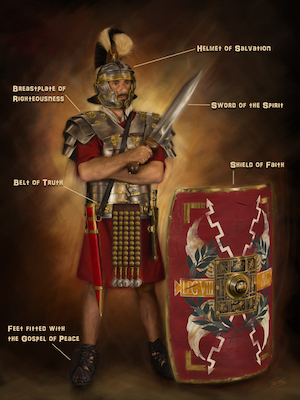
The apostle Paul presents six pieces of armor that are divided into two categories of three. He introduces each of these two categories with different verbs. The first three are introduced with the verb “to be.” The belt of truth, the breastplate of righteousness, and the shoes of peace we have with us all of the time [1] (“having girded… put on… shod…” – Eph. 6:14-15). [2] This is the state we are always to be in. But the last three pieces of armor we are called to take and use as needed [3] (“taking … take…” Eph. 6:16-17). [4] Today, we will begin to look at the first of these last three pieces of armor.
Paul describes the armor that Roman infantrymen wore in the order they would put it on. The soldier first puts on his belt which represents the Christian’s belt of truth (Eph. 6:14a). Since Satan is the father of lies (John 8:44), this first piece of armor is essential to protecting us from Satan’s deceptions and lies. We learned that truth is God’s viewpoint on a subject. It is the absolute standard by which reality is measured in its original form.Truth points us in the direction that God wants to lead us.
After putting on his belt, the soldier then puts on his breastplate which protects his vital organs in his chest region. “The breastplate” we are to put on is “righteousness” (dikaiosunē) which refers to the quality of “being right.” [5] Satan wants us to compromise God’s righteousness. He will use deception to accomplish this. Hence, we must begin with God’s truth which is the informational base that tells us the right thing to do. When God’s truth is operative in our lives, it points our heart in the direction of God’s righteousness. The breastplate of righteousness is our response to God’s truth or viewpoint on a matter. We are often faced with a myriad of choices and decisions in life, but how do we know we have made the right choices or decisions? How do we know we are moving in the right direction? How do we know we have the right perspective on a matter? This leads to the third piece of armor.
After putting on his belt and breastplate, the soldier then puts on his sandals which has spikes on the bottom of them to give him sure footing and mobility in the heat of battle. The sandals we are to put on are “the gospel of peace.” God’s peace is found in the “gospel” or good news of Jesus’ death and resurrection (I Cor. 15:1-8). This peace is not found in a pill, in entertainment, in the accumulation of wealth, in a favorite television program, in a movie, in a better job, in a vacation or in an image on the computer screen. That’s the world’s kind of peace which is momentary. God’s peace is found in the Person and work of the Lord Jesus Christ.
God’s peace will confirm that we are making the right decisions, moving in the right direction, and having the right perspective in our Christian lives. The Devil wants to rob us of God’s peace so we will live a life driven by fear and anxiety. He knows that whatever we fear, we give control to. Satan does not want us to let God control our lives, so he seeks to rob us of God’s peace. But the Lord wants to give us a deep-seeded calmness to move forward (“feet” suggest movement) with a decision even though hell may be breaking loose in our lives.
What is “the evil day”?

Paul writes, “Therefore, take up the whole armor of God, that you may be able to withstand in the evil day, and having done all, to stand.” (Eph. 6:13). Notice that Paul uses the same Greek word “take up” (analambanō) that he uses to address the fourth piece of armor: “Above all, taking (analambanō) the shield of faith with which you will be able to quench all the fiery darts of the wicked one.” (Eph. 6:16). It is extremely important that we take up “the whole armor of God” to withstand intense spiritual attacks, especially “in the evil day” (Eph. 6:13).
To what does “the evil day” refer? It is not referring to a twenty-four-hour period. [6] It refers to a full-frontal Satanic attack [7] from the pit of hell (Eph. 6:12) that seeks to steal, kill, and destroy us or our faith (John 10:10a). In Luke 4 after Satan finished tempting Jesus in the wilderness, Luke tells us the Devil “departed from Him until an opportune time” when he would unleash his worst attacks (Luke 4:13). So, “the evil day” refers to the time when great spiritual attacks take place in a Christian’s life, when all hell breaks loose. [8]
For example, Logan illustrates what this may look like when he talks about a client named Bill who found freedom from terrible sexual bondage during his counseling with Biblical Restoration Ministries. Logan told the client that an evil day would come for him.
Logan writes, “Nothing particular happened for about three months. Then one day Bill called me and said he had been asked to go to the local high school to take measurements for some architectural renovations the school wanted to make. For some reason, he told me, he had a bad feeling about the assignment, although there was nothing especially significant about it.
“When Bill went to the school to do the measurements, the students were putting on a play in the school theater, which meant he was not able to measure that part of the school. He would have to go back a second time to measure the theater. He called me again and asked me to pray for him.
“Bill arrived at the school theater and began his work. As he made his way along, he noticed some rooms off to the side of the theater, which also needed measuring. He turned the external light switch to one room, stepped inside, and quickly discovered a room filled with the very items he used when he practiced his sexual bondage. The items themselves were harmless, and I don’t want to leave the wrong impression about the school. But seeing all the clothing and miscellaneous items before him, Bill was suddenly confronted with his ‘evil day.’
“He told me later that the temptation was so strong he could almost hear a voice saying, ‘Go ahead, just this one time. It won’t hurt you just to touch them.’ But praise the Lord, Bill resisted the tempter in the name of Christ and walked out.
“Everything was fine until the next Valentine’s Day, which was near Bill’s one-year anniversary of freedom. He came under sustained attacks at home, at work, at church, and everywhere else he went that day.
“He called me and said, ‘Jim, it’s bad. I don’t know if I can make it.’ But the Lord gave him more grace, and Bill stood firm… Bill’s experience reinforces the nature of the evil day, which Bible scholar Clinton Arnold describes as specific times when the enemy’s attack comes with extraordinary power and the temptation to yield is exceptionally strong.” [9]
The “evil day” doesn’t come just once and then never reoccur. It can happen repeatedly in a Christian’s life. Satan and his demonic armies do not take vacations. They are constantly seeking to steal, kill, and destroy. Thus, we must constantly wear the whole armor of God.
The Importance of the Shield
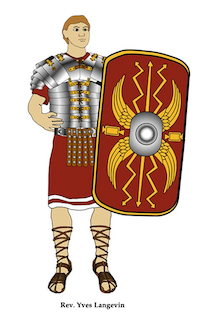
Paul introduces the fourth piece of armor with the words, “Above all” (Epi pasin), [10] to draw our attention to the criticalness of this piece of armor. The “shield of faith” is “above all” the other pieces of armor in its importance. It is as though the Holy Spirit, through the apostle Paul, wants us to know how vitally important the shield of faith is in our battle with the kingdom of darkness.
Many of us may take for granted the important shields that are in our lives. We can easily forget how much a shield means to us. For example, when we are in our homes enjoying an evening meal with family, we don’t notice what is happening outside until all of a sudden there is a violent thunderstorm. Suddenly, we find ourselves in the midst of dark clouds swirling above us that are filled with rain. Out of nowhere, we feel our house shudder as the thunder crashes and the lightning flashes all around us. We see the wind blowing intensely, causing the trees in our yard to bend over and then huge raindrops begin to pound against the siding and windows of our home. But none of these elements touch us. The shield of our homes protects us. Our clothes remained dry, and we remain safe from the raging storm outside.
During the summer months, when we drive at night in the Midwest, we can get annoyed by all the bugs that make a mess on our windshields. But do we ever stop to think what would happen if that windshield was not there? Were it not for our windshields, we would have those messy bugs all over our clothing and even on our glasses. Some of us may need to dig those bugs out of our mouths or extract them from a delicate eye. Do we ever stop to appreciate how our windshields protect us from those missiles of flying bugs that assault us at whatever speed we are driving. Instead of smashing against our faces, they smash against our windshields. They don’t touch us because the shield is in front of us.
This is the imagery that we have in Ephesians 6:16. Satan’s flaming missiles are coming at us all of the time, but they don’t touch us because the shield is in front of us. Were it not for the shield of faith, those flaming missiles would hurt us or worse, they would destroy us.
Why is the Shield of Faith of Such Great Importance? [11]
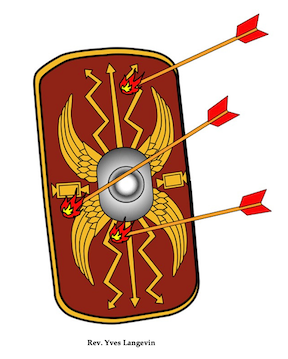
The fourth piece of armor addresses unbelief. Hence, we are to take up the shield of faith (Eph. 6:16) which extinguishes all the fiery darts or arrows of the enemy. What is that talking about? It involves Satan’s temptation to get you to question God or to act independently of God. That is the way he approached Eve in the Garden of Eden (Gen. 3:1-5). Satan got Eve to question God and what He had said and what would happen if she were to partake of the forbidden fruit. Why is the shield of faith of such great importance?
First, the shield of faith is critical to our protection because of its extensiveness. Paul says, “Above all, taking the shield of faith with which you will be able to quench all the fiery darts of the wicked one.” (Eph. 6:16). The “shield of faith” is able to “quench” (sbennumi) or “extinguish / put out” [12] “all” the fiery “darts” (belē – pl. / belos – singular) or “arrows” [13] of the Devil. The Greek word belos is often used to describe something that is swift, piercing, or potentially harmful. It conveys the idea of a projectile that is launched with intent and precision. These “darts” or arrows were “fiery” or “ablaze in order to set fire to the enemies’ clothing or camp or homes.” [14]
Roman soldiers used two kinds of shields – a round one used in marching (aspis) and a larger rectangular one used in battle (thureos). The term Paul uses here refers to the larger battle shield [15] which was made of wood and was 2 ½ feet wide by 4 feet long. It was overlaid with leather. [16] “Before a battle in which flaming arrows might be shot at them, the soldiers wet the leather covering with water to extinguish the arrows.” [17]
Such a large shield could protect a soldier’s entire body when he was positioned properly behind it. A soldier that was advancing against a fierce enemy would want the large shield because it was capable of deflecting the most incoming arrows that were intended to pierce the armor and body of the soldier.
God has provided a shield of faith for the Christian which protects us from “all,” not just some, but from “all” of Satan’s flaming arrows that he shoots at us. God provides protection for us in every direction – in front of us, behind us, above us, beside us, and beneath us. His protection is comprehensive and complete so we can approach the battlefield with confidence in our God to protect us.
Second, the shield of faith is critical in its objectiveness. The shield is the object of our faith. The shield is not our faith. We can put our faith in the wrong thing which will not protect us at all. For example, we have heard reports of soldiers wearing good luck charms such as a rabbit’s foot to protect them from the bullets of the enemy. Those soldiers’ bodies, however, were riddled with bullet holes because their faith was in the wrong object. Putting our faith in the wrong object will not protect us at all. I will talk more about the object of our faith in the next section.
Third, the shield of faith is critical in its subjectiveness. As we wear the shield of faith, there is a confidence in our hearts that we will be protected. This does not mean that the enemy will not come close to destroying God’s people. Such was the case of Job when God told Satan that he could touch Job’s children, his livestock and servants, and even Job’s own health, but God would not let the Devil take Job’s life (Job 1:12- 2:8). I am convinced that Satan would destroy all of us were it not for God’s protection.
When any of Satan’s fiery arrows pass through the shield of faith, no longer are they the destroying missiles that the Devil intended. Instead, when those arrows pass through the shield of faith they become a refining, purifying influence in our Christian lives that God uses for our good and our spiritual growth (cf. I Pet. 1:6-8; 4:12-16). This is why it is so important to have the shield of faith in its proper place. God can bring good out of what Satan intends for evil (cf. Luke 22:31-32; I Tim. 19-20).
Fourth, the shield of faith is critical in its intensiveness. The imagery in Ephesians 6:16 is one of “fiery darts” or blazing missiles coming toward us. This emphasizes the intense, deadly nature of this spiritual battle. This is a strategic method that Satan utilizes to attack God’s people.
One of the ways that armies in ancient warfare would successfully advance against an enemy city with fortified walls protecting them, was to have a row of soldiers with flaming arrows in the front. They would shoot their flaming pitch pointed arrows over the walls onto the roofs of structures inside the walls of the city. As these structures would begin to burn, the soldiers standing guard on the walls and the gates to the city, ready to protect the city, would be drawn away from their positions to fight the fires that were spreading all over the city. These fires would distract them and take them away from their guarding position so that invading soldiers could climb the city walls or break through the city gates with their battering rams to conquer the city.
These flaming arrows that Satan sends our way are intended to distract us and lead us away from our position in Christ so our families will be destroyed as well as our Christian testimony and lives. The adversary wants to get us so busy putting out the fires in our lives that we forget the victory that we have in the Lord Jesus Christ.

Two of the most destructive fiery darts that Satan uses today to get a Christian to doubt his or her faith is pornography and the written word. Pornography is just as common among Christians as it is non-Christians.[18]Research has shown that the longer a Christian views porn, the less will be their spiritual disciplines and the more doubts they will have about their faith. They are less likely to read their Bibles, attend church, pray, and participate in Christian service. [19]
While the written word can be used to build up and encourage, Satan uses it to destroy a Christian’s faith. For example, Samuel Clemens (i.e., Mark Twain) grew up in a religious home and deeply studied the Bible at a young age. After his marriage he and his wife read the Bible and prayed together daily. But just eight years later he told a minister, “I don’t believe a word of your Bible was inspired by God any more than any other book?” [20]
What changed Mark Twain from a devoted believer to a cynic? “Part of it was his revulsion over the God of strict Calvinism who would select some for heaven and others for hell before they were born. But another book on origins was published in 1859 – Charles Darwin’s Origin of the Species. After reading this work Twain’s faith fell victim to the destructive power of the written word.” [21]
Anderson also cites Dan Brown’s book, The Da Vinci Code, which looks at the world of religious history with a goal of trying to show that Christianity diminished the rights of women. Anderson demonstrates how Brown twisted the truth in his attempt to discredit Christianity.[22] I wonder how many of the millions of Brown’s readers have become skeptical, or worse, opposed to the Christian faith because of his written word.
What is the Shield? [23]
As mentioned above, the shield is not our faith. The phrase, “of faith” (tēs pisteōs), is a subjective genitive in the original language, meaning our faith is directed toward the shield. The shield is the object of our faith. Since the shield is the object of our faith, then what is the shield? When we take up the shield of faith to protect us, what is it we are taking up?
First, we are taking up the omnipresence of God. Throughout the Old Testament, the word “shield” is often used of God. About ten years after Abram had moved his family out of his homeland toward Canaan, the Lord said to him, “Do not be afraid, Abram. I am your shield…” (Gen. 15:1b). God reassured Abram that He would be his shield of protection so no one could thwart God’s promises to Abram of great blessing, his own land, and many descendants (Gen. 12:1-4; cf. 15:5-21).
King David wrote, “For You, O Lord, will bless the righteous; with favor You will surround him as with a shield.” (Psa. 5:12). God protected David from every direction with His favor. Again, David writes, “As for God, His way is perfect; the word of the Lord is proven; He is a shield to all who trust in Him.” (Psa. 18:30; cf. 2 Sam. 22:31; Psa. 144:2). Notice how “trust” (faith) is directed toward God Who acts as “a shield” of protection.
In the New Testament during Paul’s second missionary journey, he came to the city of Corinth where he encountered resistance from the Jews when he preached to them that Jesus is the Christ (Acts 18:5-6). No doubt Paul was discouraged and fearful of what might happen to him at Corinth. “9 Now the Lord spoke to Paul in the night by a vision, ‘Do not be afraid, but speak, and do not keep silent; 10 for I am with you, and no one will attack you to hurt you; for I have many people in this city.’” (Acts 18:9-10). The Lord assured Paul that His presence would protect Paul from being hurt. Strengthened by God’s protective presence, Paul ministered in Corinth for another 18 months (Acts 18:11).
Second, we are taking up the substitutionary death and life of the Lord Jesus Christ. The blood of Jesus Christ acts as a shield to us the moment we believe in Christ to save us from the penalty of all our sins. The apostle Paul writes, “9 Much more then, having now been justified by His blood, we shall be saved from wrath through Him. 10 For if when we were enemies we were reconciled to God through the death of His Son, much more, having been reconciled, we shall be saved by His life.” (Rom. 5:9-10). Just as we have “been justified” (past tense) “by His blood” and “reconciled” (past tense) “to God through the death of His Son” so “we shall be saved” (future tense) “from wrath through Him… by His life.” We were saved (past tense) from the penalty of sin forever the moment we believed in Jesus’ substitutionary “death” on the cross for our sins (Rom. 5:9a, 10a; cf. Acts 16:31), so Satan cannot successfully oppose us (Rom. 8:31-32), accuse us (Rom. 8:33), or condemn us (Rom. 8:34) in God’s courtroom. But what many Christians do not understand is that we shall be saved (future tense) from the power of sin as we believe in Jesus’ substitutionary “life” (Rom. 5:9b, 10b; cf. Jas. 1:21-22; Gal. 2:20).
Anderson writes, “We gained eternal life as He became our substitute in death, but we shall enjoy an abundant life as He becomes our substitute in life… The hardest thing for a non-Christian to believe in is the substitutionary death of Christ, but the hardest thing for a Christian to believe in is the substitutionary life of Christ. Romans 5:10 is about His substitutionary life. In this ‘swing section’ of Romans the author is turning away from his focus on justification from the penalty of sin to salvation from the power of sin. And being saved in this section is to be delivered from the tyranny of the sin nature in one’s life (the wrath of Rom. 1:18).” [24] [emphasis added]
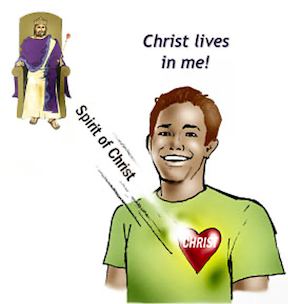
The apostle Paul also writes, “I have been crucified with Christ; it is no longer I who live, but Christ lives in me; and the life which I now live in the flesh I live by faith in the Son of God, who loved me and gave Himself for me.” (Gal. 2:20). When we come to faith in Christ, we are united with Him spiritually in His death (“I have been crucified with Christ”) and resurrection (cf. Rom. 6:1-11). Therefore, “it is no longer I who live, but Christ lives in me.” This is the substitutionary life of Christ which is absolutely necessary for us to live the victorious Christian life (cf. Rom. 5:10). Our identity in Christ is the most important thing about us. [25] “Everything else is secondary. We must die to any identity we have that is independent of Christ.” [26]
But there is a sense in which the believer lives: “… And the life which I now live in the flesh (sarx),” does not refer to the Christian’s sinful “flesh,” but to his physical body. [27] Living a substitutionary life requires “faith in the Son of God, who loved me and gave Himself for me” (Gal. 2:20b). In essence Paul affirmed, “If He loved me enough to give Himself for me, then He loves me enough to live out His life in me.” [28]
Hence, just as we put our faith alone in Jesus’ substitutionary death to be justified (declared totally righteous) before God (Rom. 5:8-9a, 10a), so we must now put our faith alone in Christ’s substitutionary life to deliver us from the power of sin in our Christian lives (Rom. 5:9b, 10b; cf. Rom. 6:1-8:39). We can no more save ourselves from the power of sin in our Christian lives than we could save ourselves from the penalty of sin when we were non-Christians.
“Christ died a substitutionary death for us. We all believe that, if we are born again. But what we fail to realize is that Christ wants to live a substitutionary life in us as well. The victorious Christ life is a substitutionary life. We must substitute the Christ-life for the self-life. ’When sin knocks on your door, send Christ to answer.’ When I am obedient to an evil lust, it is usually because I choose to be so. It is because I chose to do it eagerly because I love it so much, or it is because I am trying to battle it with the self-life rather than the Christ-life.” [29][emphasis added]
So, taking up the shield of faith means that when an evil lust comes knocking on our door to tempt us to sin or doubt our Christian faith, we can choose to send Jesus to answer it and send that evil lust or temptation where He wants it to go. We don’t have to try harder or punish ourselves. We simply transfer our trust onto Christ living in us to say “No” to our fleshly lusts.
Third, we are taking up the protective presence of God’s holy angels. Our shield of protection includes the ministry of God’s holy angels to Christians on their journey of faith. “Are they [God’s angels – cf. Heb. 1:13] not all ministering spirits sent forth to minister for those who will inherit salvation.” (Heb. 1:14). God sends His holy angels “to minister” to Christians “who will inherit salvation.”
To “inherit salvation” refers to sharing in Christ’s future victory over His enemies as the previous Old Testament quotes established (Heb. 1:5a; Psa. 2:7). The context of Psalm 2:7 contains the idea of Christ’s enemies being defeated (Psa. 2:1-3, 10-12). “Salvation” in Psalms was often used to refer to the deliverance of God’s people from the oppression of their enemies and the resulting enjoyment of God’s blessings (Psa. 3:2, 8; 18:2; 35:3; 37:39; 71:15; 118:14-15, 21; 132:16; et al.). [30] The quote in Hebrews 1:9 from Psalm 45:6-7 refers to Christ’s reign during the Millennial Kingdom with His “companions,” who like King Jesus, “loved righteousness and hated lawlessness” and “endured” affliction until the end of their lives on earth (Heb. 1:9; cf. Heb. 3:1, 14; 12:1-2). [31]
Hebrews 1:13a quotes from Psalm 110:1 which also alludes to the defeat of Christ’s enemies “after the millennium, with all physical and spiritual foes defeated (1 Cor. 15:24-26; Rev. 20:14), the Son will sit beside the Father and rule the new universe forever (Rev. 22:1-5).” [32] For believers to share in Jesus’ victory over His enemies and reign with Him over all the earth in the future, they must persevere by faith in their faithfulness to Christ to the end of their Christians lives on earth (cf. Matt. 25:21b, 23b; Luke 22:28-30; 2 Tim. 2:12; Rev. 2:26-27; 3:21). They will need the assistance and protection of God’s holy angels ministering to them on this journey of faith (Heb. 1:14).
“We can draw comfort and confidence that our walk to the kingdom has unseen aides. The visible world is a beautiful but fearful, fallen place while the invisible realm is occupied with those hostile to Christ and His own. Thankfully, God wants to give us to His Son as companions, so He assigns angels to assist us.
“They protect us physically, wrestle enemy spirits who attack us, and it is possible angels may visit and encourage us from time to time. They are our unknown assistants who labor at the King’s word to see that we have needed help to faithfully persevere. We are not alone in our struggles at any time or in any circumstance.” [33] [emphasis added]
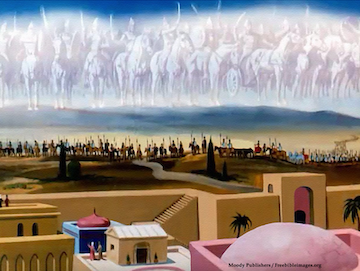
An example of God’s angels protecting God’s people is recorded in 2 Kings 6. When surrounded by the great Syrian army, Elisha encouraged his servant not to be afraid because “those who are with” Elisha and his servant “are more than those who are with” the Syrian army (2 Kings 6:16). Then Elisha prayed for the Lord to “open” the eyes of his servant so he could “see” what Elisha knew to be there by faith – the angelic armies of God surrounding and protecting them (2 Kings 6:17a). Then the servant saw that “the mountain was full of horses and chariots of fire all around Elisha.” (2 Kings 6:17b).
John Paton was a missionary in the New Hebrides Islands. One night, hostile natives surrounded the mission station, intent on burning out the Patons and killing them. Paton and his wife prayed during that terror-filled night that God would deliver them. When daylight came, they were amazed to see their attackers leave. A year later, the chief of the tribe was converted to Christ. Remembering what had happened, Paton asked the chief what had kept him from burning down the house and killing them. The chief replied in surprise, ‘Who were all those men with you there?’ Paton knew no men were present – but the chief said he was afraid to attack because he had seen hundreds of big men in shining garments with drawn swords circling the mission station. It was then that Paton realized God sent His angels to protect them. [34]
When we are under intense Satanic attack, it is important to see with the eyes of faith that God is always with us and His angels outnumber our enemies (Psa. 91:11). God has a security system that is far greater than any military or technology today. Let’s look to the Lord to deliver us from all our fears, whether real or imagined (cf. Psalm 34:4, 6-7).
What is faith?
Evans writes with regard to Ephesians 6:16, “What is faith? It’s acting like God’s telling the truth – being obedient to God’s view on a matter. Whatever temptations the devil fires at you, you can overcome him by believing God’s Word and acting on it. Acting in faith is like activating a divine fire extinguisher.” [35]
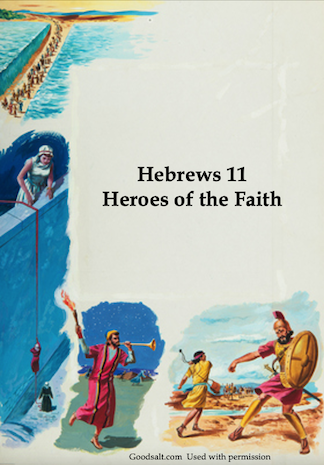
To understand what faith is, let’s look at a chapter in the book of Hebrews. The book of Hebrews was written to encourage believers to persevere in a life of faith. The readers of Hebrews were tempted to defect from Christianity in the midst of suffering. To counter this discouragement, the writer gives many examples in the Old Testament of people who persevered by faith in the face of great difficulties in Hebrews 11.
To begin this chapter, the author of Hebrews gives us a definition of faith: “Now faith is the substance of things hoped for, the evidence of things not seen.” (Heb. 11:1). The word translated “substance” (hupostasis) in this context means “the confidence or assurance that one has in something,” especially in what God has said, and then act accordingly. [36]
The word translated “evidence” (elegchos) refers to a “a conviction about” something. [37] “In light of the examples cited, the author has in mind an assurance about things God has revealed or called a person to do (not things one wishes to happen).” [38]
When we combine these two words, we see that faith is the assurance and conviction of unseen things. Faith brings unseen future things into the present. However, faith can differ in its objects and outcomes. [39]
For example, saving faith is when a non-Christian believes or is persuaded that Jesus gives everlasting life to those who believe in Him (John 3:15-16; 11:25-26; I Tim. 1:16). So, the object of saving faith is Christ and His promise of eternal life, and the outcome is he receives everlasting life in the present and a kingdom entrance in the future (John 3:3-16). So, saving faith determines our entrance into Christ’s future kingdom on earth (John 3:5-18; cf. Matt. 18:3; 21:31-32; Mark 10:15; Luke 18:17; Rev. 20:4-6; et al.).
The first hero of the faith mentioned in Hebrews 11 illustrates saving faith. “Abel” was acknowledged by God to be “righteous” through his faith which offered “a more excellent sacrifice than Cain” (Heb. 11:4). Like Abel, the readers of Hebrews found acceptance before God through the “more excellent sacrifice” of the Lord Jesus Christ (Heb. 9:11-10:18).
Enduring faith is described in Hebrews 11:5ff and it is when believers are persuaded that God “is, and that He is a rewarder of those who diligently seek Him” (Heb. 11:6). Therefore, they endure in pursuing God and His future rewards. Such faith pleases God and makes one a companion (“partaker”) of Christ so they will rule with Him in His future kingdom on earth (Heb. 1:8-9; 2:5-8; 3:1, 14; cf. Matt. 25:21b, 23b; Luke 22:28-30; 2 Tim. 2:12; Rev. 2:26-27; 3:21). Thus, our enduring faith determines our kingdom experience. [40]
Many examples of enduring faith are given by the author, beginning with “Enoch” who walked with God three hundred years, and thus “pleased” Him, so he was taken to be with God and “did not see death.” (Heb. 11:5; cf. Gen. 5:21-24). By faith, “Noah” saved his “household” from God’s world judgment by building the ark and inherited the cleansed earth after the Flood (“became heir of the righteousness”) which parallels the readers potential inheritance of the “world to come” (Heb. 11:7; cf. Heb. 2:5; Gen. 6:13-9:19). “Abraham,” also became an heir by faith when he ”obeyed” the Lord and went to live like a foreigner “in the land of promise” that would later become his inheritance because he looked forward to the heavenly “city” of the New Jerusalem (Heb. 11:8-10; cf. Gen. 12:1ff; Rev. 21:2, 9-27).
“Sarah” trusted in God’s promise to overcome her barrenness and provide “a child” (Heb. 11:11-12). These Old Testament believers saw the promised rewards from a distance and persevered in life looking for “a heavenly country” of their own, refusing to return to the previous one (Heb. 11:13-15).
The author of Hebrews also alludes to Abraham’s faith which endured the trial of offering up “Isaac,” as he believed God “was able to raise him up … from the dead” (Heb. 11:17-19). By faith, “Isaac” and “Jacob” looked to God to fulfill His promises to Abraham in the future by pronouncing blessings on their descendants (Heb. 11:20-21). By faith, “Joseph” was confident God would deliver “the children of Israel” in the future from Egypt so “his bones” could be buried in the land of promise (Heb. 11:22).
By faith baby “Moses” was “hidden… by his parents” and his life was preserved (Heb. 11:23). By faith “Moses” overcame the enticements of the world looking to his and Israel’s future “reward” (Heb. 11:24-26). He also triumphed over Pharoah’s “wrath” by faith and avoided God’s judgment by faith as he kept “the Passover” (Heb. 11:27-28).
By faith Israel “passed through the Red Sea” on dry land but their enemies drowned trying to do so (Heb. 11:29). By faith “the walls of Jericho fell down” after the Israelites encircled them seven days (Heb. 11:30). By faith “Rahab” the prostitute escaped physical destruction “when she received the spies with peace” (Heb. 11:31).
The writer of Hebrews refers to Old Testament believers during the times of the judges (“Gideon… Barak … Samson… Jephthah”) and kings (“Samuel… David”) whose faith was triumphant during difficult and dark times (Heb. 11:32-35a). Others endured extreme suffering (“tortured… mockings… scourgings… chains… imprisonments… stoned… sawn in two… slain with the sword… destitute… tormented… wandered in deserts and mountains, in dens and caves…” because they were convinced they would “obtain a better resurrection” with special reward (Heb. 11:35b-38).
The writer of Hebrews concludes this chapter by noting that these Old Testament heroes of faith had not yet received the “promise” of their inheritance which was “something better for us” because only then could Christians in this current church age endure their current experiences of becoming “partners” (metachoi) of Christ Who will share those hopes with all of us (Old and New Testament believers) in the future (Heb. 11:39-40).
In relation to Hebrews 11, Evans writes, “To exercise faith is to have confidence about an expectation without visible proof that it will happen. What makes this confidence possible? The trustworthiness of the object of faith. The question we must answer is this: Is God trustworthy? And as I like to say, faith is acting like God is telling the truth. If you want to increase your faith, grow in your understanding of God. Believers of the past trusted Him by faith and won God’s approval (Heb. 11:2). Notice that each of the heroes of the faith mentioned in this chapter acted on what they believed.” [41]
It is important to understand thatthese heroes of the faith in Hebrews 11 were not perfect, but they were persevering. The examples of these Old Testament believers testify (“witnesses” – Heb. 12:1) to us about God’s faithfulness and care as they lived a life of faith. These believers had weaknesses just like you and me, but they kept going in faith.
Remember Noah (Heb. 11:7)? He got drunk and his son saw his nakedness. Noah says to us: “I know how it feels to fail as a parent but keep on going.” What about Abraham? He didn’t know where he was going (Heb. 11:8-10), and his life tells us: “I know what it’s like to be uncertain about where God is taking you but keep going.” And Sarah (Heb. 11:11-12)? She had a physical handicap, and her life says to us: “I know what it feels like to be disadvantaged but keep on going.” Jacob was a liar (Heb. 11:21), and his life says to us: “I know how guilty you sometimes feel after lying to yourself and others but keep on going.” Moses kept making up excuses to avoid going back to Pharaoh (Heb. 11:23-29) and his life says: “I know what’ it’s like to feel inadequate for what God asks you to do – you don’t have the words or the energy but keep going.” Rahab had a problem with her past (Heb. 11:30-31), and her life testifies: “I know what it’s like to have regrets about your past but keep on going.” Samson and David had a problem with lust (Heb. 11:32), and yet their lives tell us to keep going by faith.
How can we prepare our shield of faith for battle?
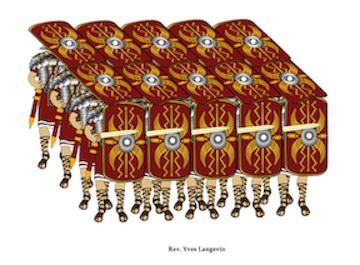
As mentioned above, before a battle involving flaming arrows being shot at them by their enemies, soldiers poured water on the leather covering of their shields to extinguish flaming arrows. [42] One of the ways we can anoint our faith and keep it from becoming rigid and brittle, is to worship God individually and corporately. Focusing on God’s greatness can renew and strengthen our faith. So, when we are alone, sing (or shout if you can’t sing) out loud to Jesus. As we adore and praise the Lord, the water of the Holy Spirit can pour over us and “quench all the fiery darts of the wicked one.”
It is also worth noting that Roman soldiers “could close ranks with these shields, the first row holding theirs edge to edge in front, and the rows behind holding the shields above their heads. In this formation they were practically invulnerable to arrows, rocks, and even spears.” [43] This is a beautiful picture of corporate worship whereby Christians are interlocking their shields of faith to worship God. Through corporate adoration and praise toward our Great God and Savior, the water of the Holy Spirit can pour over us and renew and strengthen our faith in God as our shield.
King David wrote, “He has put a new song in my mouth – praise to our God; many will see it and fear, and will trust in the Lord.” (Psa. 40:3). New songs to God that reflect the new manifestations of His grace toward us, will increase our “praise” and “many will see it and fear, and will trust in the Lord.” Being sensitive to the new manifestations of God’s grace to us in our songs to Him as a corporate body (“many”) will increase our “fear” or admiration of Him and lead us to “trust in the Lord” more in our daily lives.
Satan wants to keep us from worshiping the Lord and gathering with other brothers and sisters in Christ because he knows that an isolated believer is much more vulnerable to his attacks. But believers who are vitally connected to the Lord and fellow Christians through worship, will enjoy a renewed and strengthened faith that is eager to trust God for protection, especially when the battle gets intense.
Conclusion
Satan would like nothing more than to “steal… kill… and destroy” (John 10:10a) our faith in God. But God has given us “the shield of faith” (Eph. 6:16) to take up “in the evil day” (Eph. 6:13) to overcome the flaming arrows of the powers of darkness.
I remember the 1996 Olympic games well in Atlanta because of a little American gymnast named Kerri Strug. [44] In the team competition, the United States women’s gymnastics team was in the lead over the Russian team going into the final rotation, with the Russians on the floor exercise and the USA on the vault. Kerri had to get a high enough score to defeat the Russian gymnasts’ scores on the floor exercise. So, all the pressure is on little Kerri to sprint down the runway, push off the springboard, propel herself over the vaulting horse, flip, and land standing up on the mat so she could get a high enough score to win.
So, Kerri takes off running, she hits the springboard and flips over the vaulting horse and comes down wrong, severely injuring her ankle. She falls down in pain and gets a low score. You could hear the hush over the crowd, particularly among the Americans, as it seemed as though all hope of winning a gold medal was now in jeopardy. Kerri began to weep because this whole thing is riding on her.
But she gets one more attempt on the vault. Kerri can hardly walk, let alone run down the runway, push off the springboard, flip over the vaulting horse, and land standing up to get a high enough score to win. She is weeping as she tries to stand up on one leg.
But over in the corner was her famous gymnastic coach, Béla Károly. He looks over at Kerri crying and he shouts at her, “Kerri, look at me! Don’t take your eyes off me. I know you are hurting. I know you are in pain. I know you can’t walk, but you keep your focus on me because I want to tell you that you can do this! I know you don’t think you can do it. I know you are hurting. You can barely walk. But don’t look at your foot, you look at me! Don’t look at your circumstances because if you look down there all you will see is more defeat. Kerri, I want you to keep your eyes on me. Now you go back there, Girl, and do this thing one more time. But when you go back there, your full attention is to be on me!”
Little Kerri limps around to the starting place, casting her eyes over to her coach. She keeps looking at him because she must piggyback on his faith because her circumstances don’t give her the power to piggyback off of her own faith. But in her anguish and pain, she looks down, half running and half limping down the runway to the springboard, where she pushes off and flips over the vaulting horse, and comes down on both feet, and immediately she lifts up her injured ankle so she can stand in place on one leg. The crowd goes crazy, because she landed on two legs even though she could only stand on one.
And the USA’s gymnastic team won the gold medal because little Kerri looked at someone in her corner who said, “Don’t look at your situation. Don’t look at your circumstance. I know you feel it. I know it’s real but keep your eyes on me!”
I believe the author of Hebrews would say to us to keep our eyes on “Jesus, the author and finisher of our faith” (Heb. 12:2). Christ would say to us, “Don’t look at your situation. You can’t ignore it because it hurts. But if you keep your eyes on Me, even if you have to limp, you are going to land right, and you will be able to stand your ground in the evil day.”
As with the other pieces of armor, we put on the shield of faith through prayer (Eph. 6:18).
Prayer: Father God, what a wonderful joy it is for us to know that You have provided for Your people to overcome the flaming arrows of the powers of darkness by giving us the shield of faith. Eagerly, we take up the shield of faith against all the blazing arrows that Satan fires at us. We know that You are our shield, O Lord. As we rely on Your presence, the substitutionary death and life of Jesus, and Your holy angels to protect us, we can stand our ground when all hell breaks loose against us. Help us to keep our shield of faith renewed and strengthened by worshipping You individually and corporately with other believers. Please grant us the grace to keep looking to Jesus no matter what we face or what we feel on our journey of faith. In the matchless name of the Lord Jesus Christ, we pray. Amen.
FOOTNOTES:
[1] Tony Evans, The Tony Evans Bible Commentary, 2019 Kindle Edition, pg. 2665.
[2] The first three verbs in Greek (perizōsamenoi… endysamenoi… hypodēsamenoi…) are aorist middle participles which means they have already been put on by the soldier or Christian.
[3] Evans, The Tony Evans Bible Commentary, 2019 Kindle Edition, pg. 2665.
[4] The Greek verb translated “taking…” (analabontes) is an aorist active participle, meaning the Christian is taking the shield of faith as needed and the last Greek verb translated “take…” (dexasthe) is an aorist middle imperative which is used of the last two pieces of armor and means for oneself to take them up as needed.
[5] Walter Bauer, A Greek-English Lexicon of the New Testament, 2000 Kindle Edition, pp. 247-248.
[6] Jim Logan, Reclaiming Surrendered Ground (Chicago: Moody Press, 1995), pg. 179.
[7] Evans, The Tony Evans Bible Commentary, 2019 Kindle Edition, pg. 2665.
[8] Logan, Reclaiming Surrendered Ground, pg. 179.
[9] Ibid., pp. 179-180.
[10] The Greek Majority Text has the preposition epi (above) instead of en (in addition, besides)found in the older Greek manuscripts.
[11] Much of this section is adapted from Mark Bubeck’s video message entitled “8. The Shield of Faith: Ephesians 6 Series,” on BRMinistry app, unless otherwise noted.
[12] Bauer, A Greek-English Lexicon of the New Testament, 2000 Kindle Edition, pg. 917.
[13] Ibid., pg. 174.
[14] Archibald Thomas Robertson, A. T. Robertson’s Word Pictures in the New Testament, 2014 Kindle Locations 155026 to 155047.
[15] J. B. Bond, “Ephesians,” The Grace New Testament Commentary: Revised Edition, 2019 Kindle Edition, pg. 1399.
[16] Harold Hoehner, “Ephesians,” The Bible Knowledge Commentary Acts and Epistles, 2018 Kindle Edition, pg. 436.
[17] Tom Constable, Dr. Constable’s Notes on Ephesians, 2024 Edition, pg. 148 cites The NET2 Bible note on 6:18.
[18] Shimer writes, “There is virtually no difference in monthly porn use among non-Christian men (65%) versus Christian men (64%).”See Ted Shimer, The Freedom Fight: The New Drug and the Truths that Set Us Free (Houston: High Bridge Books, 2020), pg. 20 cites Proven Men Porn Survey (conducted by Barna Group), located at https://provenmen.org/2014PornSurvey/
[19] Ibid., pp. 62-66.
[20] David R. Anderson, Position and Condition: An Exposition of the Book of Ephesians (Grace Theological Press, 2017 Kindle Edition), pp. 415-416.
[21] Ibid., pg. 416.
[22] Ibid., pp. 407-415.
[23] Much of this section is adapted from Mark Bubeck’s video message entitled “8. The Shield of Faith: Ephesians 6 Series,” on the BRMinistry app, unless otherwise noted.
[24] David R. Anderson, Free Grace Soteriology: Third Edition (Grace Theology Press, 2018 Kindle Edition), pg. 358.
[25] Evans, The Tony Evans Bible Commentary, 2019 Kindle Edition, pg. 2602.
[26] Ibid.
[27] Tom Constable, Dr. Constable’s Notes on Galatians, 2024 Edition, pg. 48; cf. Bauer, A Greek-English Lexicon of the New Testament and Other Early Christian Literature, 2000 Kindle Edition, pg. 915.
[28] Donald Campbell, The Bible Knowledge Commentary Acts and Epistles, 2018 Kindle Edition, pg. 436.
[29] Anderson, Free Grace Soteriology: Third Edition, 2018 Kindle Edition, pp. 279-280.
[30] Zane C. Hodges, The Bible Knowledge Commentary Epistles and Prophecy, 2018 Kindle Locations 220 to 225.
[31] Rick Oglesby, Among the King’s Companions: Position Yourself Today to Be Among Those Who Rule With Christ (Rick Oglesby, 2018 Kindle Edition), pg. 29.
[32] Ibid.
[33] Ibid., pp. 29-30.
[34] Adapted from Billy Graham, Angels: God’s Secret Agents Second Edition (Nashville, TN: W Publishing, 1995), 2024 Kindle Edition, pp. 3-4.
[35] Evans, The Tony Evans Bible Commentary, 2019 Kindle Edition, pg. 2666.
[36] Paul Tanner, “Hebrews,” The Grace New Testament Commentary: Revised Edition, 2019 Kindle Edition, pg. 1687.
[37] Ibid., pg. 1688.
[38] Ibid.
[39] Oglesby, Among the King’s Companions: Position Yourself Today to Be Among Those Who Rule With Christ, 2018 Kindle Edition, pg. 111.
[40] Ibid.
[41] Evans, The Tony Evans Bible Commentary, 2019 Kindle Edition, pg. 2854.
[42] Constable, Dr. Constable’s Notes on Ephesians, 2024 Edition, pg. 148 cites The NET2 Bible note on 6:18.
[43] Ibid.
[44] This closing illustration is adapted from Tony Evan’s video message entitled, “The Shield of Faith,” posted on August 8, 2012, on youtube.com.

