Spiritual Warfare – Part 7

Introduction

       We have been looking at the whole armor of God in Ephesians 6 that protects us from the attacks of the kingdom of darkness. The apostle Paul instructs his Christian readers (including you and me) to “put on the whole armor of God” so we may stand against the “wiles” or trickery of the Devil (Eph. 6:11).

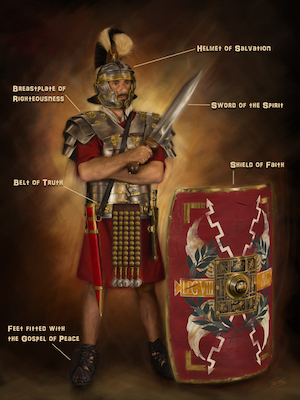
       The apostle Paul presents six pieces of armor that are divided into two categories of three. He introduces each of these two categories with different verbs. The first three are introduced with the verb “to be.” The belt of truth, the breastplate of righteousness, and the shoes of peace we have with us all of the time [1] (“having girded… put on… shod…” – Eph. 6:14-15). [2] This is the state we are always to be in. But the last three pieces of armor we are called to take and use as needed [3] (“taking … take…” Eph. 6:16-17). [4] Today, we will begin to look at the first of these last three pieces of armor.

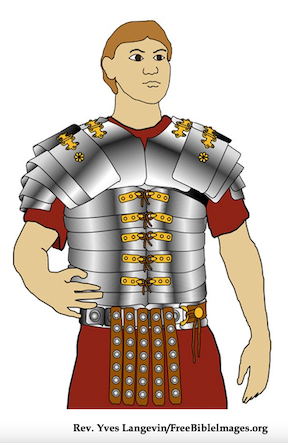
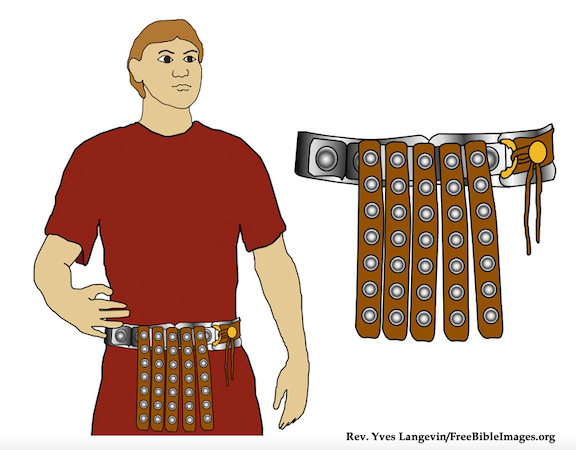
       Paul describes the armor that Roman infantrymen wore in the order they would put it on. The soldier first puts on his belt which represents the Christian’s belt of truth (Eph. 6:14a). Since Satan is the father of lies (John 8:44), this first piece of armor is essential to protecting us from Satan’s deceptions and lies. We learned that truth is God’s viewpoint on a subject. It is the absolute standard by which reality is measured in its original form.Truth points us in the direction that God wants to lead us.

       After putting on his belt, the soldier then puts on his breastplate which protects his vital organs in his chest region. “The breastplate” we are to put on is “righteousness” (dikaiosunē) which refers to the quality of “being right.” [5] Satan wants us to compromise God’s righteousness. He will use deception to accomplish this. Hence, we must begin with God’s truth which is the informational base that tells us the right thing to do. When God’s truth is operative in our lives, it points our heart in the direction of God’s righteousness. The breastplate of righteousness is our response to God’s truth or viewpoint on a matter. We are often faced with a myriad of choices and decisions in life, but how do we know we have made the right choices or decisions? How do we know we are moving in the right direction? How do we know we have the right perspective on a matter? This leads to the third piece of armor.

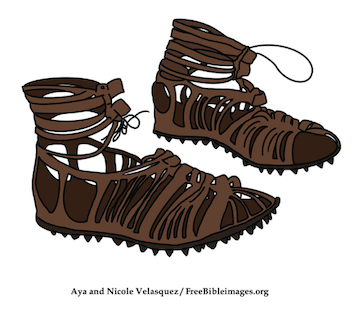
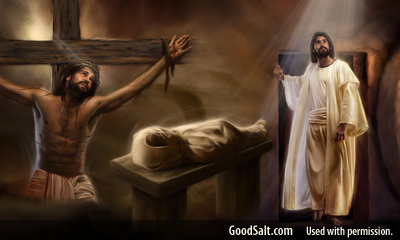
       After putting on his belt and breastplate, the soldier then puts on his sandals which has spikes on the bottom of them to give him sure footing and mobility in the heat of battle. The sandals we are to put on are “the gospel of peace.” God’s peace is found in the “gospel” or good news of Jesus’ death and resurrection (I Cor. 15:1-8). This peace is not found in a pill, in entertainment, in the accumulation of wealth, in a favorite television program, in a movie, in a better job, in a vacation or in an image on the computer screen. That’s the world’s kind of peace which is momentary. God’s peace is found in the Person and work of the Lord Jesus Christ.

       God’s peace will confirm that we are making the right decisions, moving in the right direction, and having the right perspective in our Christian lives. The Devil wants to rob us of God’s peace so we will live a life driven by fear and anxiety. He knows that whatever we fear, we give control to. Satan does not want us to let God control our lives, so he seeks to rob us of God’s peace. But the Lord wants to give us a deep-seeded calmness to move forward (“feet” suggest movement) with a decision even though hell may be breaking loose in our lives.   

What is “the evil day”?

A man walks with his Bible for a spiritual battle, represented by the verse Ephesians 6:12

       Paul writes, “Therefore, take up the whole armor of God, that you may be able to withstand in the evil day, and having done all, to stand.” (Eph. 6:13). Notice that Paul uses the same Greek word “take up” (analambanō) that he uses to address the fourth piece of armor: “Above all, taking (analambanō) the shield of faith with which you will be able to quench all the fiery darts of the wicked one.” (Eph. 6:16). It is extremely important that we take up “the whole armor of God” to withstand intense spiritual attacks, especially “in the evil day” (Eph. 6:13).

       To what does “the evil day” refer? It is not referring to a twenty-four-hour period. [6] It refers to a full-frontal Satanic attack [7] from the pit of hell (Eph. 6:12) that seeks to steal, kill, and destroy us or our faith (John 10:10a). In Luke 4 after Satan finished tempting Jesus in the wilderness, Luke tells us the Devil “departed from Him until an opportune time” when he would unleash his worst attacks (Luke 4:13). So, “the evil day” refers to the time when great spiritual attacks take place in a Christian’s life, when all hell breaks loose. [8]

        For example, Logan illustrates what this may look like when he talks about a client named Bill who found freedom from terrible sexual bondage during his counseling with Biblical Restoration Ministries. Logan told the client that an evil day would come for him.

       Logan writes, “Nothing particular happened for about three months. Then one day Bill called me and said he had been asked to go to the local high school to take measurements for some architectural renovations the school wanted to make. For some reason, he told me, he had a bad feeling about the assignment, although there was nothing especially significant about it.

       “When Bill went to the school to do the measurements, the students were putting on a play in the school theater, which meant he was not able to measure that part of the school. He would have to go back a second time to measure the theater. He called me again and asked me to pray for him.

       “Bill arrived at the school theater and began his work. As he made his way along, he noticed some rooms off to the side of the theater, which also needed measuring. He turned the external light switch to one room, stepped inside, and quickly discovered a room filled with the very items he used when he practiced his sexual bondage. The items themselves were harmless, and I don’t want to leave the wrong impression about the school. But seeing all the clothing and miscellaneous items before him, Bill was suddenly confronted with his ‘evil day.’

       “He told me later that the temptation was so strong he could almost hear a voice saying, ‘Go ahead, just this one time. It won’t hurt you just to touch them.’ But praise the Lord, Bill resisted the tempter in the name of Christ and walked out.

       “Everything was fine until the next Valentine’s Day, which was near Bill’s one-year anniversary of freedom. He came under sustained attacks at home, at work, at church, and everywhere else he went that day.

       “He called me and said, ‘Jim, it’s bad. I don’t know if I can make it.’ But the Lord gave him more grace, and Bill stood firm… Bill’s experience reinforces the nature of the evil day, which Bible scholar Clinton Arnold describes as specific times when the enemy’s attack comes with extraordinary power and the temptation to yield is exceptionally strong.” [9]

       The “evil day” doesn’t come just once and then never reoccur. It can happen repeatedly in a Christian’s life. Satan and his demonic armies do not take vacations. They are constantly seeking to steal, kill, and destroy. Thus, we must constantly wear the whole armor of God.

The Importance of the Shield
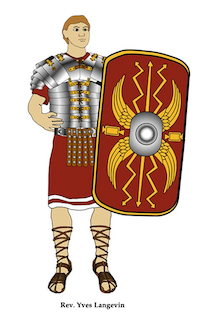
       Paul introduces the fourth piece of armor with the words, “Above all” (Epi pasin), [10] to draw our attention to the criticalness of this piece of armor. The “shield of faith” is “above all” the other pieces of armor in its importance. It is as though the Holy Spirit, through the apostle Paul, wants us to know how vitally important the shield of faith is in our battle with the kingdom of darkness.

       Many of us may take for granted the important shields that are in our lives. We can easily forget how much a shield means to us. For example, when we are in our homes enjoying an evening meal with family, we don’t notice what is happening outside until all of a sudden there is a violent thunderstorm. Suddenly, we find ourselves in the midst of dark clouds swirling above us that are filled with rain. Out of nowhere, we feel our house shudder as the thunder crashes and the lightning flashes all around us. We see the wind blowing intensely, causing the trees in our yard to bend over and then huge raindrops begin to pound against the siding and windows of our home. But none of these elements touch us. The shield of our homes protects us. Our clothes remained dry, and we remain safe from the raging storm outside.

       During the summer months, when we drive at night in the Midwest, we can get annoyed by all the bugs that make a mess on our windshields. But do we ever stop to think what would happen if that windshield was not there? Were it not for our windshields, we would have those messy bugs all over our clothing and even on our glasses. Some of us may need to dig those bugs out of our mouths or extract them from a delicate eye. Do we ever stop to appreciate how our windshields protect us from those missiles of flying bugs that assault us at whatever speed we are driving. Instead of smashing against our faces, they smash against our windshields. They don’t touch us because the shield is in front of us.

       This is the imagery that we have in Ephesians 6:16. Satan’s flaming missiles are coming at us all of the time, but they don’t touch us because the shield is in front of us. Were it not for the shield of faith, those flaming missiles would hurt us or worse, they would destroy us.

Why is the Shield of Faith of Such Great Importance? [11]
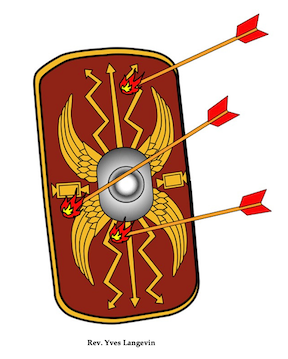
      The fourth piece of armor addresses unbelief. Hence, we are to take up the shield of faith (Eph. 6:16) which extinguishes all the fiery darts or arrows of the enemy. What is that talking about? It involves Satan’s temptation to get you to question God or to act independently of God. That is the way he approached Eve in the Garden of Eden (Gen. 3:1-5). Satan got Eve to question God and what He had said and what would happen if she were to partake of the forbidden fruit. Why is the shield of faith of such great importance?

       First, the shield of faith is critical to our protection because of its extensiveness. Paul says, “Above all, taking the shield of faith with which you will be able to quench all the fiery darts of the wicked one.” (Eph. 6:16). The “shield of faith” is able to “quench” (sbennumi) or “extinguish / put out” [12] “all” the fiery “darts” (belē – pl. / belos – singular) or  “arrows” [13] of the Devil. The Greek word belos is often used to describe something that is swift, piercing, or potentially harmful. It conveys the idea of a projectile that is launched with intent and precision. These “darts” or arrows were “fiery” or “ablaze in order to set fire to the enemies’ clothing or camp or homes.” [14]

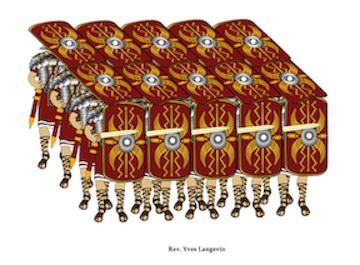
       Roman soldiers used two kinds of shields – a round one used in marching (aspis) and a larger rectangular one used in battle (thureos). The term Paul uses here refers to the larger battle shield [15] which was made of wood and was 2 ½ feet wide by 4 feet long. It was overlaid with leather. [16] “Before a battle in which flaming arrows might be shot at them, the soldiers wet the leather covering with water to extinguish the arrows.” [17]

       Such a large shield could protect a soldier’s entire body when he was positioned properly behind it. A soldier that was advancing against a fierce enemy would want the large shield because it was capable of deflecting the most incoming arrows that were intended to pierce the armor and body of the soldier.  

       God has provided a shield of faith for the Christian which protects us from “all,” not just some, but from “all” of Satan’s flaming arrows that he shoots at us. God provides protection for us in every direction – in front of us, behind us, above us, beside us, and beneath us. His protection is comprehensive and complete so we can approach the battlefield with confidence in our God to protect us.

       Second, the shield of faith is critical in its objectiveness. The shield is the object of our faith. The shield is not our faith. We can put our faith in the wrong thing which will not protect us at all. For example, we have heard reports of soldiers wearing good luck charms such as a rabbit’s foot to protect them from the bullets of the enemy. Those soldiers’ bodies, however, were riddled with bullet holes because their faith was in the wrong object. Putting our faith in the wrong object will not protect us at all. I will talk more about the object of our faith in the next section.

       Third, the shield of faith is critical in its subjectiveness. As we wear the shield of faith, there is a confidence in our hearts that we will be protected. This does not mean that the enemy will not come close to destroying God’s people. Such was the case of Job when God told Satan that he could touch Job’s children, his livestock and servants, and even Job’s own health, but God would not let the Devil take Job’s life (Job 1:12- 2:8). I am convinced that Satan would destroy all of us were it not for God’s protection.

        When any of Satan’s fiery arrows pass through the shield of faith, no longer are they the destroying missiles that the Devil intended. Instead, when those arrows pass through the shield of faith they become a refining, purifying influence in our Christian lives that God uses for our good and our spiritual growth (cf. I Pet. 1:6-8; 4:12-16). This is why it is so important to have the shield of faith in its proper place. God can bring good out of what Satan intends for evil (cf. Luke 22:31-32; I Tim. 19-20).

       Fourth, the shield of faith is critical in its intensiveness. The imagery in Ephesians 6:16 is one of “fiery darts” or blazing missiles coming toward us. This emphasizes the intense, deadly nature of this spiritual battle. This is a strategic method that Satan utilizes to attack God’s people.

       One of the ways that armies in ancient warfare would successfully advance against an enemy city with fortified walls protecting them, was to have a row of soldiers with flaming arrows in the front. They would shoot their flaming pitch pointed arrows over the walls onto the roofs of structures inside the walls of the city. As these structures would begin to burn, the soldiers standing guard on the walls and the gates to the city, ready to protect the city, would be drawn away from their positions to fight the fires that were spreading all over the city. These fires would distract them and take them away from their guarding position so that invading soldiers could climb the city walls or break through the city gates with their battering rams to conquer the city.

       These flaming arrows that Satan sends our way are intended to distract us and lead us away from our position in Christ so our families will be destroyed as well as our Christian testimony and lives. The adversary wants to get us so busy putting out the fires in our lives that we forget the victory that we have in the Lord Jesus Christ.

A man is chained to computer late at night.

       Two of the most destructive fiery darts that Satan uses today to get a Christian to doubt his or her faith is pornography and the written word. Pornography is just as common among Christians as it is non-Christians.[18]Research has shown that the longer a Christian views porn, the less will be their spiritual disciplines and the more doubts they will have about their faith. They are less likely to read their Bibles, attend church, pray, and participate in Christian service. [19]  

       While the written word can be used to build up and encourage, Satan uses it to destroy a Christian’s faith. For example, Samuel Clemens (i.e., Mark Twain) grew up in a religious home and deeply studied the Bible at a young age. After his marriage he and his wife read the Bible and prayed together daily. But just eight years later he told a minister, “I don’t believe a word of your Bible was inspired by God any more than any other book?” [20]

       What changed Mark Twain from a devoted believer to a cynic? “Part of it was his revulsion over the God of strict Calvinism who would select some for heaven and others for hell before they were born. But another book on origins was published in 1859 – Charles Darwin’s Origin of the Species. After reading this work Twain’s faith fell victim to the destructive power of the written word.” [21]

       Anderson also cites Dan Brown’s book, The Da Vinci Code, which looks at the world of religious history with a goal of trying to show that Christianity diminished the rights of women. Anderson demonstrates how Brown twisted the truth in his attempt to discredit Christianity.[22] I wonder how many of the millions of Brown’s readers have become skeptical, or worse, opposed to the Christian faith because of his written word. 

What is the Shield? [23]

       As mentioned above, the shield is not our faith. The phrase, “of faith” (tēs pisteōs), is a subjective genitive in the original language, meaning our faith is directed toward the shield. The shield is the object of our faith. Since the shield is the object of our faith, then what is the shield? When we take up the shield of faith to protect us, what is it we are taking up?

      First, we are taking up the omnipresence of God. Throughout the Old Testament, the word “shield” is often used of God. About ten years after Abram had moved his family out of his homeland toward Canaan, the Lord said to him, “Do not be afraid, Abram. I am your shield…” (Gen. 15:1b). God reassured Abram that He would be his shield of protection so no one could thwart God’s promises to Abram of great blessing, his own land, and many descendants (Gen. 12:1-4; cf. 15:5-21).

       King David wrote, “For You, O Lord, will bless the righteous; with favor You will surround him as with a shield.” (Psa. 5:12). God protected David from every direction with His favor. Again, David writes, “As for God, His way is perfect; the word of the Lord is proven; He is a shield to all who trust in Him.” (Psa. 18:30; cf. 2 Sam. 22:31; Psa. 144:2). Notice how “trust” (faith) is directed toward God Who acts as “a shield” of protection.

       In the New Testament during Paul’s second missionary journey, he came to the city of Corinth where he encountered resistance from the Jews when he preached to them that Jesus is the Christ (Acts 18:5-6). No doubt Paul was discouraged and fearful of what might happen to him at Corinth. Now the Lord spoke to Paul in the night by a vision, ‘Do not be afraid, but speak, and do not keep silent; 10 for I am with you, and no one will attack you to hurt you; for I have many people in this city.’” (Acts 18:9-10). The Lord assured Paul that His presence would protect Paul from being hurt. Strengthened by God’s protective presence, Paul ministered in Corinth for another 18 months (Acts 18:11).

       Second, we are taking up the substitutionary death and life of the Lord Jesus Christ. The blood of Jesus Christ acts as a shield to us the moment we believe in Christ to save us from the penalty of all our sins. The apostle Paul writes, 9 Much more then, having now been justified by His blood, we shall be saved from wrath through Him. 10 For if when we were enemies we were reconciled to God through the death of His Son, much more, having been reconciled, we shall be saved by His life.” (Rom. 5:9-10). Just as we have “been justified” (past tense) “by His blood” and “reconciled” (past tense) “to God through the death of His Son” so “we shall be saved” (future tense) “from wrath through Him… by His life.” We were  saved (past tense) from the penalty of sin forever the moment we believed in Jesus’ substitutionary “death” on the cross for our sins (Rom. 5:9a, 10a; cf. Acts 16:31), so Satan cannot successfully oppose us (Rom. 8:31-32), accuse us (Rom. 8:33), or condemn us (Rom. 8:34) in God’s courtroom. But what many Christians do not understand is that we shall be saved (future tense) from the power of sin as we believe in Jesus’ substitutionary “life” (Rom. 5:9b, 10b; cf. Jas. 1:21-22; Gal. 2:20).

       Anderson writes, “We gained eternal life as He became our substitute in death, but we shall enjoy an abundant life as He becomes our substitute in life… The hardest thing for a non-Christian to believe in is the substitutionary death of Christ, but the hardest thing for a Christian to believe in is the substitutionary life of Christ. Romans 5:10 is about His substitutionary life. In this ‘swing section’ of Romans the author is turning away from his focus on justification from the penalty of sin to salvation from the power of sin. And being saved in this section is to be delivered from the tyranny of the sin nature in one’s life (the wrath of Rom. 1:18).” [24] [emphasis added]
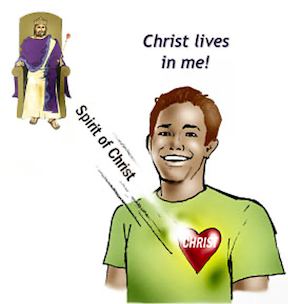
       The apostle Paul also writes, “I have been crucified with Christ; it is no longer I who live, but Christ lives in me; and the life which I now live in the flesh I live by faith in the Son of God, who loved me and gave Himself for me.” (Gal. 2:20). When we come to faith in Christ, we are united with Him spiritually in His death (“I have been crucified with Christ”) and resurrection (cf. Rom. 6:1-11). Therefore, “it is no longer I who live, but Christ lives in me.” This is the substitutionary life of Christ which is absolutely necessary for us to live the victorious Christian life (cf. Rom. 5:10). Our identity in Christ is the most important thing about us. [25] “Everything else is secondary. We must die to any identity we have that is independent of Christ.” [26]

       But there is a sense in which the believer lives: “… And the life which I now live in the flesh (sarx),” does not refer to the Christian’s sinful “flesh,” but to his physical body. [27] Living a substitutionary life requires “faith in the Son of God, who loved me and gave Himself for me” (Gal. 2:20b). In essence Paul affirmed, “If He loved me enough to give Himself for me, then He loves me enough to live out His life in me.” [28]

       Hence, just as we put our faith alone in Jesus’ substitutionary death to be justified (declared totally righteous) before God (Rom. 5:8-9a, 10a), so we must now put our faith alone in Christ’s substitutionary life to deliver us from the power of sin in our Christian lives (Rom. 5:9b, 10b; cf. Rom. 6:1-8:39). We can no more save ourselves from the power of sin in our Christian lives than we could save ourselves from the penalty of sin when we were non-Christians.

       “Christ died a substitutionary death for us. We all believe that, if we are born again. But what we fail to realize is that Christ wants to live a substitutionary life in us as well. The victorious Christ life is a substitutionary life. We must substitute the Christ-life for the self-life. ’When sin knocks on your door, send Christ to answer.’ When I am obedient to an evil lust, it is usually because I choose to be so. It is because I chose to do it eagerly because I love it so much, or it is because I am trying to battle it with the self-life rather than the Christ-life.” [29][emphasis added]

       So, taking up the shield of faith means that when an evil lust comes knocking on our door to tempt us to sin or doubt our Christian faith, we can choose to send Jesus to answer it and send that evil lust or temptation where He wants it to go. We don’t have to try harder or punish ourselves. We simply transfer our trust onto Christ living in us to say “No” to our fleshly lusts.

       Third, we are taking up the protective presence of God’s holy angels. Our shield of protection includes the ministry of God’s holy angels to Christians on their journey of faith. “Are they [God’s angels – cf. Heb. 1:13] not all ministering spirits sent forth to minister for those who will inherit salvation.” (Heb. 1:14). God sends His holy angels “to minister” to Christians “who will inherit salvation.”

       To “inherit salvation” refers to sharing in Christ’s future victory over His enemies as the previous Old Testament quotes established (Heb. 1:5a; Psa. 2:7). The context of Psalm 2:7 contains the idea of Christ’s enemies being defeated (Psa. 2:1-3, 10-12). “Salvation” in Psalms was often used to refer to the deliverance of God’s people from the oppression of their enemies and the resulting enjoyment of God’s blessings (Psa. 3:2, 8; 18:2; 35:3; 37:39; 71:15; 118:14-15, 21; 132:16; et al.). [30] The quote in Hebrews 1:9 from Psalm 45:6-7 refers to Christ’s reign during the Millennial Kingdom with His “companions,” who like King Jesus, “loved righteousness and hated lawlessness” and “endured” affliction until the end of their lives on earth (Heb. 1:9; cf. Heb. 3:1, 14; 12:1-2). [31]  

       Hebrews 1:13a quotes from Psalm 110:1 which also alludes to the defeat of Christ’s enemies “after the millennium, with all physical and spiritual foes defeated (1 Cor. 15:24-26; Rev. 20:14), the Son will sit beside the Father and rule the new universe forever (Rev. 22:1-5).” [32] For believers to share in Jesus’ victory over His enemies and reign with Him over all the earth in the future, they must persevere by faith in their faithfulness to Christ to the end of their Christians lives on earth (cf. Matt. 25:21b, 23b; Luke 22:28-30; 2 Tim. 2:12; Rev. 2:26-27; 3:21). They will need the assistance and protection of God’s holy angels ministering to them on this journey of faith (Heb. 1:14).

       “We can draw comfort and confidence that our walk to the kingdom has unseen aides. The visible world is a beautiful but fearful, fallen place while the invisible realm is occupied with those hostile to Christ and His own. Thankfully, God wants to give us to His Son as companions, so He assigns angels to assist us.

       “They protect us physically, wrestle enemy spirits who attack us, and it is possible angels may visit and encourage us from time to time. They are our unknown assistants who labor at the King’s word to see that we have needed help to faithfully persevere. We are not alone in our struggles at any time or in any circumstance.” [33] [emphasis added]
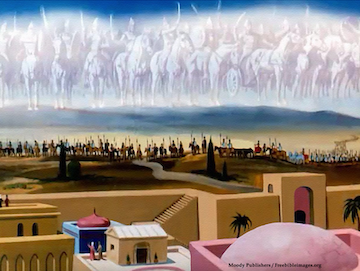
       An example of God’s angels protecting God’s people is recorded in 2 Kings 6. When surrounded by the great Syrian army, Elisha encouraged his servant not to be afraid because “those who are with” Elisha and his servant “are more than those who are with” the Syrian army (2 Kings 6:16). Then Elisha prayed for the Lord to “open” the eyes of his servant so he could “see” what Elisha knew to be there by faith – the angelic armies of God surrounding and protecting them (2 Kings 6:17a). Then the servant saw that “the mountain was full of horses and chariots of fire all around Elisha.” (2 Kings 6:17b).

       John Paton was a missionary in the New Hebrides Islands. One night, hostile natives surrounded the mission station, intent on burning out the Patons and killing them. Paton and his wife prayed during that terror-filled night that God would deliver them. When daylight came, they were amazed to see their attackers leave. A year later, the chief of the tribe was converted to Christ. Remembering what had happened, Paton asked the chief what had kept him from burning down the house and killing them. The chief replied in surprise, ‘Who were all those men with you there?’ Paton knew no men were present – but the chief said he was afraid to attack because he had seen hundreds of big men in shining garments with drawn swords circling the mission station. It was then that Paton realized God sent His angels to protect them. [34]

       When we are under intense Satanic attack, it is important to see with the eyes of faith that God is always with us and His angels outnumber our enemies (Psa. 91:11). God has a security system that is far greater than any military or technology today. Let’s look to the Lord to deliver us from all our fears, whether real or imagined (cf. Psalm 34:4, 6-7).

What is faith?

       Evans writes with regard to Ephesians 6:16, “What is faith? It’s acting like God’s telling the truth – being obedient to God’s view on a matter. Whatever temptations the devil fires at you, you can overcome him by believing God’s Word and acting on it. Acting in faith is like activating a divine fire extinguisher.” [35]
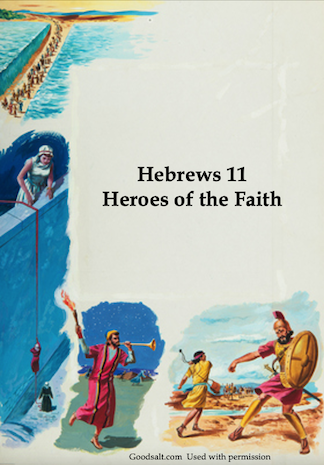
       To understand what faith is, let’s look at a chapter in the book of Hebrews. The book of Hebrews was written to encourage believers to persevere in a life of faith. The readers of Hebrews were tempted to defect from Christianity in the midst of suffering. To counter this discouragement, the writer gives many examples in the Old Testament of people who persevered by faith in the face of great difficulties in Hebrews 11.

       To begin this chapter, the author of Hebrews gives us a definition of faith: “Now faith is the substance of things hoped for, the evidence of things not seen.” (Heb. 11:1). The word translated “substance” (hupostasis) in this context means “the confidence or assurance that one has in something,” especially in what God has said, and then act accordingly. [36]

       The word translated “evidence” (elegchos) refers to a “a conviction about” something. [37] “In light of the examples cited, the author has in mind an assurance about things God has revealed or called a person to do (not things one wishes to happen).” [38]

       When we combine these two words, we see that faith is the assurance and conviction of unseen things. Faith brings unseen future things into the present. However, faith can differ in its objects and outcomes. [39]

       For example, saving faith is when a non-Christian believes or is persuaded that Jesus gives everlasting life to those who believe in Him (John 3:15-16; 11:25-26; I Tim. 1:16). So, the object of saving faith is Christ and His promise of eternal life, and the outcome is he receives everlasting life in the present and a kingdom entrance in the future (John 3:3-16). So, saving faith determines our entrance into Christ’s future kingdom on earth (John 3:5-18; cf. Matt. 18:3; 21:31-32; Mark 10:15; Luke 18:17; Rev. 20:4-6; et al.).

       The first hero of the faith mentioned in Hebrews 11 illustrates saving faith. “Abel” was acknowledged by God to be “righteous” through his faith which offered “a more excellent sacrifice than Cain” (Heb. 11:4). Like Abel, the readers of Hebrews found acceptance before God through the “more excellent sacrifice” of the Lord Jesus Christ (Heb. 9:11-10:18).

       Enduring faith is described in Hebrews 11:5ff  and it is when believers are persuaded that God “is, and that He is a rewarder of those who diligently seek Him” (Heb. 11:6). Therefore, they endure in pursuing God and His future rewards. Such faith pleases God and makes one a companion (“partaker”) of Christ so they will rule with Him in His future kingdom on earth (Heb. 1:8-9; 2:5-8; 3:1, 14; cf. Matt. 25:21b, 23b; Luke 22:28-30; 2 Tim. 2:12; Rev. 2:26-27; 3:21). Thus, our enduring faith determines our kingdom experience. [40]

       Many examples of enduring faith are given by the author, beginning with “Enoch” who walked with God three hundred years, and thus “pleased” Him, so he was taken to be with God and “did not see death.” (Heb. 11:5; cf. Gen. 5:21-24). By faith, “Noah” saved his “household” from God’s world judgment by building the ark and inherited the cleansed earth after the Flood (“became heir of the righteousness”) which parallels the readers potential inheritance of the “world to come” (Heb. 11:7; cf. Heb. 2:5; Gen. 6:13-9:19). “Abraham,” also became an heir by faith when he ”obeyed” the Lord and went to live like a foreigner “in the land of promise” that would later become his inheritance because he looked forward to the heavenly “city” of the New Jerusalem (Heb. 11:8-10; cf. Gen. 12:1ff; Rev. 21:2, 9-27).

       “Sarah” trusted in God’s promise to overcome her barrenness and provide “a child” (Heb. 11:11-12). These Old Testament believers saw the promised rewards from a distance and persevered in life looking for “a heavenly country” of their own, refusing to return to the previous one (Heb. 11:13-15).

       The author of Hebrews also alludes to Abraham’s faith which endured the trial of offering up “Isaac,” as he believed God “was able to raise him up … from the dead” (Heb. 11:17-19). By faith, “Isaac” and “Jacob” looked to God to fulfill His promises to Abraham in the future by pronouncing blessings on their descendants (Heb. 11:20-21). By faith, “Joseph” was confident God would deliver “the children of Israel” in the future from Egypt so “his bones” could be buried in the land of promise (Heb. 11:22).

       By faith baby “Moses” was “hidden… by his parents” and his life was preserved (Heb. 11:23). By faith “Moses” overcame the enticements of the world looking to his and Israel’s future “reward” (Heb. 11:24-26). He also triumphed over Pharoah’s “wrath” by faith and avoided God’s judgment by faith as he kept “the Passover” (Heb. 11:27-28).

       By faith Israel “passed through the Red Sea” on dry land but their enemies drowned trying to do so (Heb. 11:29). By faith “the walls of Jericho fell down” after the Israelites encircled them seven days (Heb. 11:30). By faith “Rahab” the prostitute escaped physical destruction “when she received the spies with peace” (Heb. 11:31).

       The writer of Hebrews refers to Old Testament believers during the times of the judges (“Gideon… Barak … Samson… Jephthah”) and kings (“Samuel… David”) whose faith was triumphant during difficult and dark times (Heb. 11:32-35a). Others endured extreme suffering (“tortured… mockings… scourgings… chains… imprisonments… stoned… sawn in two… slain with the sword… destitute… tormented… wandered in deserts and mountains, in dens and caves…” because they were convinced they would “obtain a better resurrection” with special reward (Heb. 11:35b-38).

       The writer of Hebrews concludes this chapter by noting that these Old Testament heroes of faith had not yet received the “promise” of their  inheritance which was “something better for us” because only then could Christians in this current church age endure their current experiences of becoming “partners” (metachoi) of Christ Who will share those hopes with all of us (Old and New Testament believers) in the future (Heb. 11:39-40).

        In relation to Hebrews 11, Evans writes, “To exercise faith is to have confidence about an expectation without visible proof that it will happen. What makes this confidence possible? The trustworthiness of the object of faith. The question we must answer is this: Is God trustworthy? And as I like to say, faith is acting like God is telling the truth. If you want to increase your faith, grow in your understanding of God. Believers of the past trusted Him by faith and won God’s approval (Heb. 11:2). Notice that each of the heroes of the faith mentioned in this chapter acted on what they believed.” [41]

       It is important to understand thatthese heroes of the faith in Hebrews 11 were not perfect, but they were persevering. The examples of these Old Testament believers testify (“witnesses” – Heb. 12:1) to us about God’s faithfulness and care as they lived a life of faith. These believers had weaknesses just like you and me, but they kept going in faith. 

       Remember Noah (Heb. 11:7)? He got drunk and his son saw his nakedness. Noah says to us: “I know how it feels to fail as a parent but keep on going.” What about Abraham? He didn’t know where he was going (Heb. 11:8-10), and his life tells us: “I know what it’s like to be uncertain about where God is taking you but keep going.” And Sarah (Heb. 11:11-12)? She had a physical handicap, and her life says to us: “I know what it feels like to be disadvantaged but keep on going.” Jacob was a liar (Heb. 11:21), and his life says to us: “I know how guilty you sometimes feel after lying to yourself and others but keep on going.” Moses kept making up excuses to avoid going back to Pharaoh (Heb. 11:23-29) and his life says: “I know what’ it’s like to feel inadequate for what God asks you to do – you don’t have the words or the energy but keep going.” Rahab had a problem with her past (Heb. 11:30-31), and her life testifies: “I know what it’s like to have regrets about your past but keep on going.” Samson and David had a problem with lust (Heb. 11:32), and yet their lives tell us to keep going by faith.  

How can we prepare our shield of faith for battle?
       As mentioned above, before a battle involving flaming arrows being shot at them by their enemies, soldiers poured water on the leather covering of their shields to extinguish flaming arrows. [42] One of the ways we can anoint our faith and keep it from becoming rigid and brittle, is to worship God individually and corporately. Focusing on God’s greatness can renew and strengthen our faith. So, when we are alone, sing (or shout if you can’t sing) out loud to Jesus. As we adore and praise the Lord, the water of the Holy Spirit can pour over us and “quench all the fiery darts of the wicked one.”

       It is also worth noting that Roman soldiers “could close ranks with these shields, the first row holding theirs edge to edge in front, and the rows behind holding the shields above their heads. In this formation they were practically invulnerable to arrows, rocks, and even spears.” [43] This is a beautiful picture of corporate worship whereby Christians are interlocking their shields of faith to worship God. Through corporate adoration and praise toward our Great God and Savior, the water of the Holy Spirit can pour over us and renew and strengthen our faith in God as our shield.

       King David wrote, “He has put a new song in my mouth – praise to our God; many will see it and fear, and will trust in the Lord.” (Psa. 40:3). New songs to God that reflect the new manifestations of His grace toward us, will increase our “praise” and “many will see it and fear, and will trust in the Lord.” Being sensitive to the new manifestations of God’s grace to us in our songs to Him as a corporate body (“many”) will increase our “fear” or admiration of Him and lead us to “trust in the Lord” more in our daily lives.       

       Satan wants to keep us from worshiping the Lord and gathering with other brothers and sisters in Christ because he knows that an isolated believer is much more vulnerable to his attacks. But believers who are vitally connected to the Lord and fellow Christians through worship, will enjoy a renewed and strengthened faith that is eager to trust God for protection, especially when the battle gets intense.

Conclusion

       Satan would like nothing more than to “steal… kill… and destroy” (John 10:10a) our faith in God. But God has given us “the shield of faith” (Eph. 6:16) to take up “in the evil day” (Eph. 6:13) to overcome the flaming arrows of the powers of darkness.

       I remember the 1996 Olympic games well in Atlanta because of a little American gymnast named Kerri Strug. [44] In the team competition, the United States women’s gymnastics team was in the lead over the Russian team going into the final rotation, with the Russians on the floor exercise and the USA on the vault. Kerri had to get a high enough score to defeat the Russian gymnasts’ scores on the floor exercise. So, all the pressure is on little Kerri to sprint down the runway, push off the springboard, propel herself over the vaulting horse, flip, and land standing up on the mat so she could get a high enough score to win.

       So, Kerri takes off running, she hits the springboard and flips over the vaulting horse and comes down wrong, severely injuring her ankle. She falls down in pain and gets a low score. You could hear the hush over the crowd, particularly among the Americans, as it seemed as though all hope of winning a gold medal was now in jeopardy. Kerri began to weep because this whole thing is riding on her.

       But she gets one more attempt on the vault. Kerri can hardly walk, let alone run down the runway, push off the springboard, flip over the vaulting horse, and land standing up to get a high enough score to win. She is weeping as she tries to stand up on one leg.

       But over in the corner was her famous gymnastic coach, Béla Károly. He looks over at Kerri crying and he shouts at her, “Kerri, look at me! Don’t take your eyes off me. I know you are hurting. I know you are in pain. I know you can’t walk, but you keep your focus on me because I want to tell you that you can do this! I know you don’t think you can do it. I know you are hurting. You can barely walk. But don’t look at your foot, you look at me! Don’t look at your circumstances because if you look down there all you will see is more defeat. Kerri, I want you to keep your eyes on me. Now you go back there, Girl, and do this thing one more time. But when you go back there, your full attention is to be on me!”

       Little Kerri limps around to the starting place, casting her eyes over to her coach. She keeps looking at him because she must piggyback on his faith because her circumstances don’t give her the power to piggyback off of her own faith. But in her anguish and pain, she looks down, half running and half limping down the runway to the springboard, where she pushes off and flips over the vaulting horse, and comes down on both feet, and immediately she lifts up her injured ankle so she can stand in place on one leg. The crowd goes crazy, because she landed on two legs even though she could only stand on one.  

       And the USA’s gymnastic team won the gold medal because little Kerri looked at someone in her corner who said, “Don’t look at your situation. Don’t look at your circumstance. I know you feel it. I know it’s real but keep your eyes on me!”

       I believe the author of Hebrews would say to us to keep our eyes on “Jesus, the author and finisher of our faith” (Heb. 12:2). Christ would say to us, “Don’t look at your situation. You can’t ignore it because it hurts. But if you keep your eyes on Me, even if you have to limp, you are going to land right, and you will be able to stand your ground in the evil day.”

       As with the other pieces of armor, we put on the shield of faith through prayer (Eph. 6:18). 
       Prayer: Father God, what a wonderful joy it is for us to know that You have provided for Your people to overcome the flaming arrows of the powers of darkness by giving us the shield of faith. Eagerly, we take up the shield of faith against all the blazing arrows that Satan fires at us. We know that You are our shield, O Lord. As we rely on Your presence, the substitutionary death and life of Jesus, and Your holy angels to protect us, we can stand our ground when all hell breaks loose against us. Help us to keep our shield of faith renewed and strengthened by worshipping You individually and corporately with other believers. Please grant us the grace to keep looking to Jesus no matter what we face or what we feel on our journey of faith. In the matchless name of the Lord Jesus Christ, we pray. Amen.

FOOTNOTES:

[1] Tony Evans, The Tony Evans Bible Commentary, 2019 Kindle Edition, pg. 2665.

[2] The first three verbs in Greek (perizōsamenoi… endysamenoi… hypodēsamenoi…) are aorist middle participles which means they have already been put on by the soldier or Christian.  

[3] Evans, The Tony Evans Bible Commentary, 2019 Kindle Edition, pg. 2665.

[4] The Greek verb translated “taking…” (analabontes) is an aorist active participle, meaning the Christian is taking the shield of faith as needed and the last Greek verb translated “take…” (dexasthe) is an aorist middle imperative which is used of the last two pieces of armor and means for oneself to take them up as needed.

[5] Walter Bauer, A Greek-English Lexicon of the New Testament, 2000 Kindle Edition, pp. 247-248.

[6] Jim Logan, Reclaiming Surrendered Ground (Chicago: Moody Press, 1995), pg. 179.

[7] Evans, The Tony Evans Bible Commentary, 2019 Kindle Edition, pg. 2665.

[8] Logan, Reclaiming Surrendered Ground, pg. 179.

[9] Ibid., pp. 179-180.

[10] The Greek Majority Text has the preposition epi (above) instead of en (in addition, besides)found in the older Greek manuscripts.

[11] Much of this section is adapted from Mark Bubeck’s video message entitled “8. The Shield of Faith: Ephesians 6 Series,” on BRMinistry app, unless otherwise noted.

[12] Bauer, A Greek-English Lexicon of the New Testament, 2000 Kindle Edition, pg. 917.

[13] Ibid., pg. 174.

[14] Archibald Thomas Robertson, A. T. Robertson’s Word Pictures in the New Testament, 2014 Kindle Locations 155026 to 155047.

[15] J. B. Bond, “Ephesians,” The Grace New Testament Commentary: Revised Edition, 2019 Kindle Edition, pg. 1399.

[16] Harold Hoehner, “Ephesians,” The Bible Knowledge Commentary Acts and Epistles, 2018 Kindle Edition, pg. 436.

[17] Tom Constable, Dr. Constable’s Notes on Ephesians, 2024 Edition, pg. 148 cites The NET2 Bible note on 6:18.

[18] Shimer writes, There is virtually no difference in monthly porn use among non-Christian men (65%) versus Christian men (64%).”See Ted Shimer, The Freedom Fight: The New Drug and the Truths that Set Us Free (Houston: High Bridge Books, 2020), pg. 20 cites Proven Men Porn Survey (conducted by Barna Group), located at https://provenmen.org/2014PornSurvey/

[19] Ibid., pp. 62-66.

[20] David R. Anderson, Position and Condition: An Exposition of the Book of Ephesians (Grace Theological Press, 2017 Kindle Edition), pp. 415-416.

[21] Ibid., pg. 416. 

[22] Ibid., pp. 407-415. 

[23] Much of this section is adapted from Mark Bubeck’s video message entitled “8. The Shield of Faith: Ephesians 6 Series,” on the BRMinistry app, unless otherwise noted.

[24] David R. Anderson, Free Grace Soteriology: Third Edition (Grace Theology Press, 2018 Kindle Edition), pg. 358.

[25] Evans, The Tony Evans Bible Commentary, 2019 Kindle Edition, pg. 2602.

[26] Ibid.

[27] Tom Constable, Dr. Constable’s Notes on Galatians, 2024 Edition, pg. 48; cf. Bauer, A Greek-English Lexicon of the New Testament and Other Early Christian Literature, 2000 Kindle Edition, pg. 915.

[28]  Donald Campbell, The Bible Knowledge Commentary Acts and Epistles, 2018 Kindle Edition, pg. 436.

[29] Anderson, Free Grace Soteriology: Third Edition, 2018 Kindle Edition, pp. 279-280.

[30] Zane C. Hodges, The Bible Knowledge Commentary Epistles and Prophecy, 2018 Kindle Locations 220 to 225.

[31] Rick Oglesby, Among the King’s Companions: Position Yourself Today to Be Among Those Who Rule With Christ (Rick Oglesby, 2018 Kindle Edition), pg. 29.

[32] Ibid.

[33] Ibid., pp. 29-30.

[34] Adapted from Billy Graham, Angels: God’s Secret Agents Second Edition (Nashville, TN: W Publishing, 1995), 2024 Kindle Edition, pp. 3-4.  

[35] Evans, The Tony Evans Bible Commentary, 2019 Kindle Edition, pg. 2666.

[36] Paul Tanner, “Hebrews,” The Grace New Testament Commentary: Revised Edition, 2019 Kindle Edition, pg. 1687.

[37] Ibid., pg. 1688.

[38] Ibid.

[39] Oglesby, Among the King’s Companions: Position Yourself Today to Be Among Those Who Rule With Christ, 2018 Kindle Edition, pg. 111.

[40] Ibid.

[41] Evans, The Tony Evans Bible Commentary, 2019 Kindle Edition, pg. 2854.

[42] Constable, Dr. Constable’s Notes on Ephesians, 2024 Edition, pg. 148 cites The NET2 Bible note on 6:18.

[43] Ibid.

[44] This closing illustration is adapted from Tony Evan’s video message entitled, “The Shield of Faith,” posted on August 8, 2012, on youtube.com.

Spiritual Warfare – Part 6

Introduction

       As the celebration of Jesus’ birth approaches, I am reminded of that first Christmas which is recorded from a human perspective in Matthew’s and Luke’s gospels (Matt. 1:21-2:12; Luke 2:1-20). It is presented as a very peaceful event involving Mary and Joseph, some angels, shepherds, wise men, and the baby Jesus. The angels praised God saying, “Glory to God in the highest, and on earth peace, goodwill toward men!” (Luke 2:14). Hence, most Christmas celebrations today focus on the peace that surrounded the birth of Jesus, assuming He would bring peace “on earth” during His First Coming. 

        But at the beginning of the week before Jesus’ crucifixion when Christ triumphantly entered Jerusalem, a multitude of His followers praised God, saying: “Blessed is the King who comes in the name of the Lord! Peace in heaven and glory in the highest!” (Luke 19:38). Notice they say, “Peace in heaven,” not “peace on earth.” The first coming of Christ would establish spiritual peace “in heaven” between God and humankind (Rom. 5:1; Eph. 2:16-18). But it won’t be until Jesus’ Second Coming to earth that universal peace “on earth” will be established by King Jesus during His thousand-year reign on earth (Rev 20:4-6; Isa. 2:1-4; 9:6b-7; Mic. 4:1-5). 

       In Revelation 12:1-5, the apostle John shares a version of the Christmas story that is from heaven’s perspective, and it is the opposite of peace (see above picture). This version of the Christmas story involves three main characters: the woman, representing the nation of Israel who endured much pain in bringing the Messiah into the world (Rev. 12:1-2; cf. Gen. 37:9-11); the Child, representing the Lord Jesus Christ (Rev. 12:2, 5); and the dragon, representing the Devil (Rev. 12:3-4a, 9).

       When Jesus is born into the world, Satan is there with his army of demons represented by “a third of the stars of heaven” (Rev. 12:4a), waiting to destroy Him: “And the dragon (Satan) stood before the woman who was ready to give birth, to devour her Child (Jesus) as soon as it was born” (Rev. 12:4b – parenthesis added). While shepherds are watching, angels are singing, and wise men are worshipping, Satan is waiting to make his move. The attempt to kill the Child John sees in this vision is probably a reference to king Herod’s brutal attempt to kill Jesus (cf. Matt. 2:16).

       The next verse says, “She bore a male Child who was to rule all nations with a rod of iron. And her Child was caught up to God and His throne.” (Rev. 12:5). In this version of the Christmas story Jesus goes from being born at Bethlehem, to ruling on the throne of the universe. John uses this one verse to summarize the birth, life, death, resurrection, ascension, and future reign of the Lord Jesus Christ. Satan not only used Herod in an attempt to kill the baby Jesus, but He would later use Judas to betray Him, Pilate to condemn Him, and the Roman soldiers to crucify Him. All the fury of hell would be released against the Child born on that silent night.

      The rest of Revelation 12 talks about the last half of the Tribulation period when Satan and his fallen angels are cast down from heaven and persecute the people of God – the nation of Israel (cf. 12:7-17). Since Satan could not destroy the Christ Child Who is now on His throne in heaven, he is going to go after what is dearest to the Child – His own people. This is why there is so much opposition against God’s people today, especially His Jewish people, and it will only intensify as the Second Coming of Christ to earth draws near. If the Devil can destroy Israel before Jesus returns to earth with His Bride, the Church (Rev. 19:7-21), then there can be no triumphant return of Christ and Satan will rule the earth.

       John’s version of the Christmas story reminds us we are in a struggle with a dragon. It is a struggle we can’t win; it is a struggle Jesus already won. You see, if you are a child of God through faith in Jesus Christ, Satan is going to attack you. “Satan” means adversary. During this Christmas season (and all our lives), he wants to rob us of the joy and peace of Christmas by reminding us of our sins and shortcomings. He will accuse us of the times we have lied and been unfaithful, of the times we’ve lost our temper and broken our promises.

The Armor of God

       How can we deal with this intense spiritual battle whereby the enemy seeks to rob us of God’s peace? The apostle Paul instructs his Christian readers (including you and me) to “put on the whole armor of God” so we may stand against the “wiles” or trickery of the Devil (Eph. 6:11). Paul describes the armor that Roman infantrymen wore in the order they would put it on.

       The soldier first puts on his belt which represents the Christian’s belt of truth (Eph. 6:14a). Since Satan is the father of lies (John 8:44), this first piece of armor is essential to protecting us from Satan’s deceptions and lies. We learned that truth is God’s viewpoint on a subject. It is the absolute standard by which reality is measured in its original form.Truth points us in the direction that God wants to lead us.

       After putting on his belt, the soldier then puts on his breastplate which protects his vital organs in his chest region. “The breastplate” we are to put on is “righteousness” (dikaiosunē) which refers to the quality of “being right.” [1] God’s truth is the informational base that tells us the right thing to do. The truth points our heart in the direction of God’s righteousness. The breastplate of righteousness is our response to God’s truth or viewpoint on a matter.

       When God’s truth and righteousness are operative in our lives, it will lead to the next piece of armor which has to with our feet or shoes (Eph. 6:15). Why is this so important?

The Importance of Our Feet

      In the 21st century, we have shoes for every occasion. There are dress shoes, casual shoes, work shoes, and many kinds of athletic shoes. There are shoes for cold weather, warm weather, and rainy weather. We have indoor shoes and outdoor shoes. There are specialty shoes like dance shoes (ballet,  tap, etc.), work boots (steel-toe, waterproof, etc.), and orthopedic shoes. Some of you may have a closet full of shoes that are designed to adorn your feet. The fact that we have so many varieties of shoes today demonstrates the importance of our feet. [2]

      It is also a very serious thing to have feet that hurt. Have you ever noticed how difficult it is to focus on an objective when your feet are hurting? When your feet hurt, you hurt are over. When our feet hurt, we do not make a good soldier. This is why our military places great emphasis on examining the feet of a soldier. They understand that a person’s feet need to be comfortable to be a good soldier. God understands this more than anyone. [3]

The Soldier’s Sandals

       God wants His people to wear a certain kind of shoes all the time because they will address an important issue regarding spiritual warfare in our lives. After a Roman soldier put on his belt and breastplate (Eph. 6:14), he then puts on his sandals: “And having shod your feet with the preparation of the gospel of peace.” (Eph. 6:15). The Greek word translated “shod” (hupodeō) is a compound word meaning “under” (hupo) plus “to bind/tie” (deō)or “to bind/tie under or beneath” [4](sandals). [5] It refers here to what you are wearing on your feet at all times. [6]

       The word translated “preparation” (hetoimasia) refers to the state of “readiness.” [7] If we are wearing these shoes, we will be ready for the Devil’s attacks against us. We will be prepared to deal with our enemy’s methods of deception.

        To properly understand this piece of armor, we need to realize that the Roman soldier had what modern-day American football players have. They had cleats or spikes coming out of the bottom of their shoes. “Roman soldiers wore sandals with cleats built in to help them have firm footing and to stand their ground under attack.” [8] These spikes on the bottom of a soldier’s sandals gave him stability and mobility on the battlefield. They kept him from slipping and sliding when he was under attack.

       If we were in a battle in Paul’s day, we had better be well-shod. There would be nothing worse than losing our footing with an enemy standing over us with a sword in his hand. [9]

       Paul has already emphasized the need to be stationary in battle by using the word “stand” (stēnai) or a form of this word (antistēnai/stēte) four times (Eph. 6:11, 13-14). Why? Because the Devil wants to knock us off our feet. He wants to knock us to the ground and keep us there. He desires to remove us from our place of stability.

       When Paul says to have our feet “shod,” he is talking about placing ourselves in a stationary position so that when all hell breaks loose “in the evil day” (Eph. 6:13), Satan cannot knock us down or knock us out. Why? Because what we are wearing on our feet gives us stability and sure-footedness.

       If you are like me, you know what it is like to be knocked over by the evil one. Our circumstances have knocked us over. Our finances have knocked us over. Our relationships with certain people have knocked us over. Our jobs have knocked us over. Our feet have slipped, and we are going down.

       So, what this third piece of armor teaches us is that God wants to create stability or sure-footedness for us so that when we face a Satanic full-frontal attack, we can stand firm. Evans explains, “Through the cross and resurrection of Christ, victory is already won. The devil has lost. The only power he has is the power you give him. We are to stand firm in Christ’s victory. Paul tells the Ephesians over and over: stand (6:11, 13-14). In other words, stay in the area where victory has been achieved under the cover of God’s armor. When you stand under an umbrella, it doesn’t stop the rain. But it does stop you from getting wet. You have to dress for success in this thing called the Christian life.” [10] [emphasis added]

The Purpose of Satan’s Attack

       Remember that the Devil is a thief (John 10:10a). He knows he cannot take away our salvation because we are secure forever in Christ after we believe in Him for His free gift of eternal life which can never be lost (cf. John 3:16; 6:35-40; 10:28-29; Rom. 8:38-39; Eph. 1:13-14; I John 5:13). Since the evil one cannot keep us out of heaven, he wants to make us experience hell on earth. [11] How does he do this?

       This third piece of armor teaches us that Satan wants to rob us of God’s “peace.” The opposite of “peace” is anxiety. The Devil wants God’s children to live with anxiety and fear. He knows that whatever we fear, we give control to. Hence, the purpose of the enemy’s attacks is to keep God from controlling our lives, so our salvation is not manifested through us. He wants to keep us defeated and discouraged.

       But God wants His people to have feet that are not hurting in the area of “peace.” The Lord understands that one of the Devil’s strategies is to rob God’s people of His peace. Satan wants to promise us peace through his “wiles” or trickery. He will promise us peace through counterfeit religions, drugs, education, entertainment, materialism, the occult, and sex outside of marriage. Often times we discover that we have less peace than we did before we pursued the enemy’s counterfeit peace. It is that way with everything Satan promises to use to give us peace. Instead of giving us peace, Satan’s ways lead us into bondage and death.

What is Peace?

       But God’s “peace” is real, and it protects us from the activities of the kingdom of darkness. But what is this “peace” God wants us to wear all the time? The Greek word for “peace” (eirēnē) in Ephesian 6:15 refers to a “state of concord, harmony, or well-being” [12] between Jews and Gentiles (Eph. 2:14-15) and between God and humankind (Eph. 2:16-18).

       Jesus used this word for “peace” (eirēnē) twice in John 14:27 when He referred to two types of peace. The first kind refers to His work on the cross. “Peace I leave with you.” (John 14:27a). The word “leave” (aphiēmi) implies something that Jesus does. Christ’s death on the cross would provide eternal “peace with God” (Rom. 5:1) for us because all our sins would be forgiven (Acts 10:43; Col. 2:13-14). The meaning of “peace” in this case “is the spiritual well-being that results from being rightly related to God through Jesus Christ.” [13]

       The second type of peace in verse 27 is the kind that Jesus enjoyed on earth. He says, “My peace I give to you” (John 14:27b). In the context (cf. John 14:21, 23), this peace of Christ’s is given to obedient believers. It arises from a life of faith in God. It refers to a calmness “that would come to their hearts from trusting God and from knowing that He was in control of all events that touched their lives.” [14]

       Christ distinguishes His peace from the kind of peace the world can give – “not as the world gives do I give to you.” (John 14:27c). The world cannot offer eternal peace with God. The world denies that people need to be reconciled to God. The world says that people are inherently good because they are created in the image of God. “Because God loves everyone,” the world says, “There is no need for reconciliation with God.” The world offers a false peace to people. Sin has distorted God’s image in people. Some churches deny this because the world has influenced them to believe that people are inherently good and do not need a Savior.

       The peace the world offers depends on one’s circumstances and is temporary. Itis deceptive and misleading. But the peace Jesus offers is the calm and tranquility of the soul that is independent of our external situation. [15]

       This peace is much like the painting above. [16] The sky is black with storm clouds. The waves are violently billowing up and down against the rocky shore. There is turmoil and chaos all around. 

       But on the right side of this portrait about halfway up the rocky cliff at the edge of this horrific circumstance of life, was a mother bird sitting on her nest protecting her young. One little light piercing the darkness of the clouds was shining down on the bird as it sat peacefully on its nest. 

       This picture portrays biblical peace. Biblical peace is not the absence of problems. It is not “when nothing is wrong, I am calm.” Biblical peace is when everything is wrong, and we are still calm. It is when circumstances or situations are not conducive to rest, but we are able to chill. Biblical peace is when there is calm on the inside while there is nothing but chaos on the outside. We do not know we have biblical peace until circumstances are not peaceful.

       When Jesus spoke of His peace in John 14:27, it was the night before His crucifixion. There was nothing peaceful about Jesus’ situation. He knew it would involve terrible darkness when all hell would break loose against Him and He would experience separation from His heavenly Father for the first and last time when the sin of the world would be placed upon Christ as our Substitute for sin (cf. 2 Cor. 5:21; I Pet. 3:18). Yet Jesus could speak with confidence about giving His peace to His disciples the night before His brutal death on a cross. Christ lived this peace, and He wants to empower us to do the same.

Where Do We Find this Peace?

       This third piece of armor speaks of standing in “the preparation of the gospel of peace” (Eph. 6:15). The “peace” that Jesus gives us is found in “the gospel.” This peace is not found in a pill or an injection or in entertainment or in the accumulation of wealth. It is not found in our favorite television program or movie. Nor is it found on a vacation or in an image on the computer screen. This peace is not found in a better job or in a counseling session. That’s the world’s kind of peace which is momentary.

       The peace that God wants us to continually wear on our feet is found in “the gospel.” To understand the “peace” that the apostle Paul is talking about, we need to understand the gospel. The Greek word for “gospel” is euangelion, which means “good news.” [17] So, what is the good news?

       The apostle Paul defines the “gospel” or good news by which we are saved today when he writes, that Christ died for our sin according to the Scriptures, and that He was buried, and that He rose again the third day according to the Scriptures, and that He was seen by Cephas, then by the twelve. After that He was seen by over five hundred brethren at once…” (I Cor. 15:3-6). The gospel is that Christ died for our sins and rose from the dead. We are saved from an eternity in hell when we believe in the good news of Jesus’ death and resurrection as our Substitute for our sins (Acts 16:31). At that moment of faith in Christ, we receive both the complete forgiveness of all our sins (Acts 10:43; Col. 2:13-14) and the gift of eternal life (John 3:14-16). Jesus says we are born again (John 3:3). But you may say, “I am born again but I still have anxiety and worry – the opposite of peace.” 

       One reason we may still have worry after we are born again is because we do not understand or believe the gospel. Most Christians apply the gospel only to what it takes to get to heaven. But that is just part of the gospel. The gospel also has a lot to do with living a victorious life on earth. [18]

       The apostle Paul writes, “For if when we were enemies we were reconciled to God through the death of His Son, much more, having been reconciled, we shall be saved by His life.” (Rom. 5:10). Notice that “the death of” Jesus “reconciled” (past tense) us to God so we could go to heaven (justification), but Jesus’ “life” “shall” (future tense) save us from the power of sin and its consequences (sanctification) on earth (cf. Rom. 1:18-32; 5:9). [19] Most of us know the gospel because of Jesus’ death, but we have missed the gospel of His life which progressively gives us victory over the power of sin as we learn to walk in the Spirit (cf. Rom. 6:1-8:39).

       Evans writes, “The death of Jesus reconciled us to God, but Jesus didn’t stay dead. He’s alive right now. And He’s interceding for us (see Heb. 7:25) in order to give us victory over the power of sin and its consequences. Think about it. If Jesus could take you from hell to heaven by dying, what He can do for you by living is even more exciting. Many believers who have accepted the saving death of Christ have yet to understand and access the saving life of Christ, which gives us victory in history. [20] [emphasis added]

       Let’s look now at what our sandals of peace include. [21]

Our Position that Protects our Mental Peace

       These sandals of peace include our POSITION THAT PROTECTS OUR MENTAL PEACE: “Therefore, having been justified by faith, we have peace with God through our Lord Jesus Christ.” (Rom. 5:1). The Greek word translated “justified” (diakaioō) means to be declared totally righteous [22] by our holy God [23] in heaven’s courtroom.  The perfect righteousness of Christ in us has been imputed or credited to our account in heaven by virtue of our position in Jesus.[24] 

        “Justification is a legal concept meaning that in God’s courtroom, He pronounced us innocent of all charges. He does this through what theologians call ‘imputation’—taking Jesus’s perfect record and crediting it to our accounts.” [25] [emphasis added]

       Notice in Romans 5:1 that we are “justified” not by our good life, prayers, or religion, but “by faith.” Peace with God is “through our Lord Jesus Christ.” The moment we believe in Jesus Christ and His death on the cross for all our sins, we are “justified” or declared totally righteous before God as if we had never sinned.

       The preposition “with” (pros) in the phrase “peace with God” (pros ton Theon) is very important  (Rom. 5:1). This preposition used with the accusative case (ton Theon) refers to being “friendly with” God. [26] It is the promise that through justification by faith in Jesus, the enmity and hostility that existed between a holy God and a sinful people is totally removed. The war has ended between the Christian and his or her God! And we have peace “with God.”

       How does the Christian know he has peace “with” God? There is only one way to know this, and it is through faith in God’s promise. Justification before God is not a feeling or experience. It is a judicial, legal declaration from a holy God.

       The nature of this peace is of course judicial, since justification is the act of God as our Judge. We should avoid understanding the idea as inner tranquility. The peace involved here is like that which results when two warring nations are no longer in a hostile relationship to each other.” [27] [emphasis added]

       That is why Romans 5:1 begins with the word “Therefore…” It is as though God is pointing His finger back to the finished work of Jesus Christ on the cross (cf. Rom. 4:24-25). “Therefore,” because of what Jesus has done, you have “been justified by faith” and you “have peace with God.” The war with God is over! The battle has ended!

       But Satan will try to rob Christians of this peace. He will attempt to make us think that God is angry with us. That God could never forgive us. That God is against us. He may whisper in our ears, “The reason you have so many troubles is because God is mad at you. He keeps punishing you because He is against you.”

       While it is true that God disciplines His wayward children (Heb. 12:5-11), His discipline of us is not evidence that He hates us or is mad at us. It is evidence that He loves us: My son, do not despise the chastening of the Lord, nor be discouraged when you are rebuked by Him; for whom the Lord loves He chastens.” (Heb. 12:5-6).

       Thus, putting on the sandals of peace means we have an intellectual understanding of what God’s Word says – that the believer in Jesus has “peace with God.” If we are to “stand” against the wiles of the devil (Eph. 6:11), we must know this positional truth, review it, and abide in it daily, never turning aside from it even during Satan’s most vicious or subtle attacks.

The Possession of Peace

       But our sandals of peace also include our POSSESSION OF PEACE. This can be seen in Philippians 4. Be anxious for nothing, but in everything by prayer and supplication, with thanksgiving, let your requests be made known to God; 7 and the peace of God, which surpasses all understanding, will guard your hearts and minds through Christ Jesus.” (Phil. 4:6-7). This aspect of our sandals of peace protects our emotional peace (“anxious”). God wants the Christian to not only have legal or mental peace (“peace with God”), but to also have emotional peace (“peace of God”).

      How do we gain this relationship of peace? It comes through the practice of prayer. When Paul writes in Philippians 4:6, “Be anxious for nothing…” (Phil. 4:6a), he is saying not to lose your emotional peace even though you may be facing a worrisome situation. Don’t try to resolve your anxiety by worrying about the situation. Instead, he says to resolve this worrisome situation with “prayer” (Phil. 4:6b). Talk to God about what makes you anxious. When was the last time we got alone with God and talked to Him about what we are worried about? Talking about it helps to diffuse the power of worry. But it does not stop there.

       Then God says, “in everything by… supplication” (Phil. 4:6c). The word “supplication” means to tell God what you need. Few people ever identify what they need because they are so busy worrying.

       For example, some of us may be worried about our health. So, we talk to the Lord about that. And as we do that, ask God to help us identify the underlying need. Perhaps we need protection from illness especially during the aftermath of COVID. Or perhaps we are afraid of death because we are not prepared for it. So, we need assurance of life after death. Ask God to give you the assurance that there is everlasting life both now and after death through believing in Jesus (cf. John 11:25-26). Thus, talk to the Lord about what you need from Him.

       Next, God says, “with thanksgiving, let your requests be made known to God” (Phil. 4:6d). One of my mentors taught me that the word “requests” refers to our heart’s desires which align with God’s will. Psalm 37:4 says, “Delight yourself also in the Lord, and He shall give you the desires of your heart.” The Hebrew word for “delight” (anog) can mean “to be soft” [28] or lean toward God. Just as a house plant leans in toward the sunlight coming through a window to get nutrients from the sun, so we need to lean into God during these challenging times to nourish our souls, and He promises to give us the desires or dreams of our hearts. So, talk to God about your desires or dreams. Ask God what He wants to do in your life.

       Notice that God wants us to pray with “thanksgiving.” He wants us to have a thankful heart. Why? Because when we trust God to supply our needs and wants in advance during difficult times, we can accept those circumstances and respond more appropriately. Also, gratitude stimulates the release of dopamine (happy chemical) in our brain which decreases our stress and enhances our sleep.

       As we talk to God about our anxiety, needs, and desires with thanksgiving, He promises that “the peace of God, which surpasses all understanding, will guard your hearts and minds through Christ Jesus” (Phil. 4:7). The “peace of God” is like a deep calmness in the midst of life’s storms. For example, the water underneath the surface of the ocean remains calm during a storm (see above pic). We can experience a deep-seeded calmness in our souls when we surrender to God in prayer as we face these challenging times.

       The phrase “will guard,” pictures an armed soldier walking back and forth in front of the city gate, protecting the occupants inside the city from intruders. God’s peace constantly protects those who choose to talk to Him about their worries and ask Him for what they need and want.

       Do we know this experientially? Are we practicing this kind of prayer? We live in a day of cell phones. If someone wants to get a hold of us, they send us a text or call us on our phones. Our phones alert us through vibration or a distinct sound that someone wants to talk to us.

       This illustrates how God sometimes wants us to talk to Him in prayer. One of the ways God may alert us to His desire for us to talk to Him is by allowing us to feel uneasy or anxious about something. This may be His way of inviting us to spend time alone with Him in prayer. Putting on the sandals of peace includes practicing this kind of prayer.

The Protection of Peace

       Our sandals of peace also include THE PROTECTION OF PEACE. The apostle Paul writes, “The things which you learned and received and heard and saw in me, these do, and the God of peace will be with you.” (Phil. 4:9). Paul is not talking about the “peace of God” in this verse, but “the God of peace.” This aspect of peace results when believers walk in obedience to God (“The things which you learned and received and heard and saw in me, these do…”). Paul says that when we follow the godly example of another believer, we can experience “the God of peace” being with us.

       Bubeck suggests that “the God of peace” refers to the protection of our will. The strong powerful nearness of God to us (“the God of peace will be with you”) will protect our will. It is that “peace” which God brings to us when our enemies greatly outnumber us and are about to destroy us, and the God of peace says, “No more! You cannot touch him! He is mine!” [29] 

       There are many examples of this in the Old Testament when God’s people, Israel, are surrounded by their enemies who greatly outnumbered them and were about to destroy them with no apparent way of escape. And God’s people cried out to Him, and “the God of peace” showed up and put their enemies to flight or destroyed them. Sometimes He did this with hornets or sounds in the treetops (or heavens) which frightened them and caused confusion or fear, so they fled and were defeated (cf. Exod. 23:22-28; Deut. 7:17-22; Josh. 24:11-12; I Sam. 7:10-11; 2 Sam. 5:22-25; 2 Kgs. 6:8-23; 18:1-19:37; I Chron. 14:13-17; 2 Chron. 31:1-22). And at other times God caused Israel’s enemies to turn against each other so they could be defeated (cf. 2 Chron. 20:1-24).

       God is so powerful that “when a man’s ways please the Lord, He makes even his enemies to be at peace with him.” (Prov. 16:7). God is able to make our enemies be at peace with us quickly when we live in a way that pleases Him. They will have to flee simply because of Who God is.

       It is not surprising that the phrase “the God of peace” is used in the New Testament in the context of obedience and Christian growth (cf. Rom. 15:33; 16:20; 2 Cor. 13:11; Phil. 4:9; I Thess. 5:23; Heb. 13:20-21). If we are hurting in our peace, it is important to examine our obedience to God. Are we trying to walk our own way instead of God’s way? Are we seeking our own pleasure instead of God’s?

       The Lord may let us walk our own way, but please know that “the God of peace will be with” us. He wants us to be near to Him but that cannot be our experience if we are walking our own way instead of His way.

The Person of Peace

       These sandals of peace also include THE PERSON OF PEACE. 13 But now in Christ Jesus you who once were far off have been brought near by the blood of Christ. 14 For He Himself is our peace, who has made both one, and has broken down the middle wall of separation.” (Eph. 2:13-14). Our sin not only separates us from God, but it also separates us from the people of God. The Ephesians were Gentiles who were called “Uncircumcision” by the Jews who are referred to as “the Circumcision” (Eph. 2:11).

       In their unsaved condition before the Cross, Ephesians 2:12 tells us that Gentiles “were without Christ,” having no corporate national hope centered on the promise of a coming Messiah, as the Jews did. They were “aliens from the commonwealth of Israel” in that God excluded them in having a part in what He planned to do in and through the nation of Israel. The Gentiles were “aliens” from Israel in this sense. [30] Nor did Gentiles have a direct part in the “promises” of God to Israel contained in the biblical covenants (e.g., Abrahamic – Gen. 12:1-3; 13:15-17; 15:17-21; 17:1-22; Mosaic – Exod. 19:1-24:8; and Davidic – 2 Sam. 7:12-17; I Chron. 17:3-14; 2 Chron. 7:17-18; 13:5; 21:7;  Psa. 89:1-4; et al.). As a race of people, the Gentiles had “no hope” of a corporate future promised by God to which they could look and in which they could hope, as Israel did. [31] And worst of all, they were “without God in the world.” The Greek word translated “without God” (atheos) is where we get our English word “atheist” from. Before the cross, Gentile unbelievers may have worshiped many gods, but they were without the one and only true God. [32]

       “But… the blood of Christ” not only brought us “near” to God, but it also brings Jews and Gentiles (“you who once were far off”) near to one another (Eph. 2:13). How did this take place? “For He Himself is our peace, who has made both one, and has broken down the middle wall of separation.” (Eph. 2:14). Jesus is “our peace” Whose atoning sacrifice on the cross has made Jew and Gentile “both one,” having “broken down the middle wall of separation.”

       What is this “middle wall of separation”? The next verse tells us: “…Having abolished in His flesh the enmity, that is, the law of commandments contained in ordinances, so as to create in Himself one new man from the two, thus making peace.” (Eph. 2:15). Jesus “abolished in His flesh” by dying on the cross “the enmity” or hostility that was created by the Jewish “law of commandments contained in ordinances.”

       The Mosaic Law had been the cause of the hostility between Jews and Gentiles. It was the “barrier” that separated Jews and Gentiles. Its dietary distinctions, and laws requiring separation in particular, created hostility between Jews and Gentiles. Jesus Christ broke down the barrier and the hostility that resulted from it by terminating the Mosaic Law. When Jesus Christ died, He fulfilled all the demands of the Mosaic Law (cf. Col. 2:14). When He did that, God ended the Mosaic Law as His rule of life for the Jews. The word “abolished” (katargeō) means to “cause something to come to an end or to be no longer in existence, wipe out.” [33] The Mosaic Law ceased to be God’s standard for regulating the life of His people when Christ died (Rom. 10:4; Gal. 3:24-25; et al.). [34]

       God did this through His shed blood on the cross to “create in Himself one new man from the two, thus making peace.” Christ died in our place “to make one body out of the two very distant groups. When a Jew or Gentile trusts in Christ for eternal life, he is placed in union with other believers in the Body of Christ. Jesus Christ by His death removed the barrier that separated Jews and Gentiles. By faith they become one new man, the Body of Christ, the Church. Christ is the end of the Law to all who believe (Rom. 10:4). 

       “God reconciled both Jews and Gentiles to Himself in one body through the cross, thereby putting to death the enmity (between Gentiles and Jews who believe in Christ). The Law that divided is removed, and Jews and Gentiles are in one body together.” [35] [emphasis added]

       Christ, Who is “our peace,” died “that He might reconcile” Jews and Gentiles “to God in one body,” the church, “through the cross, thereby putting to death the enmity” created by the Jewish Law (Eph. 2:16).

       This Person of peace protects our spirit. It has to do with our spiritual relationship with Jesus. [36] Our Christian faith is not primarily a system of dogmas and doctrines. It is primarily a relationship with a Person – Jesus Christ. This is a relationship that we enter into through faith alone in Christ alone (Eph. 1:13-14; 2:8-9). As we grow closer to Jesus, the more we can experience Him as “our peace” and the more we can live peaceably with other Christians. Satan seeks to divide Christians, so they do not express the image of God by living peacefully in unity with one another. But Jesus Christ is “our peace” and He is the source of reconciliation and restoration of peace within His body, the church.

Conclusion [37]

       God wants His peace to be the norm for His children on the battlefield. When God’s truth is operative in our lives, it will point us in the direction of His righteousness. We are faced with a myriad of choices and decisions in life, but how do we know we have made the right choices or decisions? How do we know we are moving in the right direction? How do we know we have the right perspective on a matter? God’s peace will confirm it. The Lord will give us a deep-seeded calm to move forward (“feet” suggest movement) with a decision even though hell may be breaking loose in our lives.   

      But if anxiety or worry is our normal way of operating, then we are not wearing the shoes God has given us. Please note that I am not talking about certain times of worry because we all battle that in our flesh. But if worry is normative for us then these shoes or sandals of peace are not being worn on our feet.

       Are we wearing our sandals of peace every day? Do we take time to put them on? Are we taking time to remember and review that we have “peace with God” now because God has declared us (not made us) to be totally righteous (“justified”) the moment we believed in Jesus (Rom. 5:1)? Are we experiencing the emotional “peace of God” through prayer and the fullness of the Holy Spirit’s presence in our lives (Phil. 4:6-7)? Through obedience, are we experiencing “the God of peace” (Phil. 4:9) Who makes even our enemies to be at peace with us (Prov. 16:7)? And are we getting to know the Person of “our peace” (Eph. 2:13-17) more intimately, so we can live more peaceably with our brothers and sisters in Christ? In the midst of war, God wants us to stand victoriously in “the gospel of peace.”

       Submarine crewmen do not get nervous when there is a storm at sea because they can go deep down where the waters are calm. Fish do not have anxiety attacks when it is storming because they know that severe storms will only reach approximately three hundred feet below sea level, [38] so they go down three hundred and one feet where it is peaceful.

       When our world gets chaotic, it is time for us to go deep into the spiritual realm where God says there is peace and calm. God will give us “perfect peace” when our mind is focused on Him (Isa. 26:3). Instead of retreating to the world for its false sense of peace, we need to redirect our attention to the mind of God. When our thoughts agree with God’s, we will experience His peace.

       For example, [39] when the three Hebrew young men, Shadrach, Meshach, and Abednego, who had  been promoted “over the affairs of the province of Babylon where they were captives” (Dan. 3:49), refused to serve the gods of Babylon and worship the ninety-foot-tall gold statue (Dan. 3:1) of king Nebuchadnezzar, they were told by the king they would be “cast immediately into the midst of a burning fiery furnace” (Dan. 3:15). When these three young men heard this news that they were about to be burned alive – which, by the way, would normally obliterate anyone’s sense of peace – they responded to Nebuchadnezzar saying, 16 O Nebuchadnezzar, we have no need to answer you in this matter. 17 If that is the case, our God whom we serve is able to deliver us from the burning fiery furnace, and He will deliver us from your hand, O king. 18 If not, let it be known to you, O king, that we do not serve your gods, nor will we worship the gold image which you have set up.” (Dan. 3:16b-18).

       Their response infuriated Nebuchadnezzar, so he commanded his servants to “heat the furnace seven time more than it was usually heated” (Dan. 3:19b). The king was extremely upset that these Hebrew men feared their God more than the king’s death threat, so he had them tied up and thrown “into the midst of the burning fiery furnace” (Dan. 3:20-21). The flames of the furnace were so intense that the mighty men carrying them were “killed” (Dan. 3:22). Keep in mind that these three men were wearing several layers of clothing (Dan. 3:21) which were most likely flammable, so there appeared to be no hope of their survival. 

       After a while, the king looked into the furnace and he was shocked to “see four men loose, walking in the midst of the fire” (Dan. 3:25a) because they had only thrown three men into the furnace. And now he sees four of them, and the three men  were no longer tied up. They were “walking” around in the midst of these intense flames full of peace and calm, “and they are not hurt” (Dan. 3:25b). How was this possible? Because there was a fourth Person with them in the fire and the kings says He had “the form…  like the Son of God.” (Dan. 3:25c). This was the pre-incarnate Lord Jesus Christ Who joined them in this terrible circumstance. God’s presence protected them from the fire (cf. Isa. 43:2). 

       It is important to understand that God is not going to join the world to help us out if we retreat to the world to find peace. If we are conforming to the world’s values and allurements and get into a bad situation as a result, and then cry out to God, He is not going to join the world because then He would be compromising His peace to join the world’s peace. These men did not bow to the king of Babylon. They remained faithful to God even though they did not know for sure if He would deliver them from this terrible situation.  

       Instead of looking to the world for peace, God wants us to take a stand in this pagan world with our minds focused on the God of peace. When we do this, the God of peace will show up in the fiery trials of life and give us His peacewhich surpasses human understanding. His presence will remove the chains or ropes that bind us so we can move freely. His presence will deliver us from the intense fires of life.

       Some of us may be facing some very significant fiery trials right now. Maybe we have lost our job or lost our health. Perhaps we have lost a relationship with a loved one. God wants us to go deep into the spiritual realm to connect with His mind so His peace can be ours. He wants us to wear these shoes of peace at all times. 

       How do we do this? As with the other pieces of armor, we can put on our shoes of peace through prayer (Eph. 6:18).  

Prayer: Lord Jesus, we are living in an increasingly chaotic world that lacks Your peace. We praise You because You not only brought us peace, but You are also our peace. Protect us from anything that would rob us of Your peace. Please help us to wear our sandals of peace every day so we may stand victoriously against the trickery of the Devil. We claim the peace with God that is ours through justification by faith alone in Jesus alone (Rom. 5:1). We desire the peace of God that touches our emotions and feelings through prayer (Phil. 4:6-7). Through our obedience, we seek the God of peace (Phil 4:9) Who makes even our enemies to live at peace with us. And we want to grow closer to You Jesus, because You are our peace. Satan and his kingdom of darkness are relentless in their efforts to keep believers divisive toward one another. As the accuser of believers, the Devil continually plants suspicions in our hearts. In the authority and name of the Lord Jesus Christ, we pull down that work of darkness and bind our enemy that he might not succeed. We ask the Holy Spirit to bring to a stop all divisive works active in our lives and in all the lives of other believers. The diversity of Your body, Lord Jesus, is part of its beauty and appeal to the lost. It adds to Your glory. Help us to love one another in our diversity. In Your precious and mighty name, we pray, Lord Jesus. Amen. [40]

FOOTNOTES:

[1] Walter Bauer, A Greek-English Lexicon of the New Testament, 2000 Kindle Edition, pp. 247-248.

[2] Adapted from Tony Evans’ video message entitled “The Shoes of Peace” on youtube.com.

[3] Adapted from Mark Bubeck’s video message, “7. Peace in the Midst of War: Ephesians 6 Series,” on the BRMinistry app.

[4] Bauer, A Greek-English Lexicon of the New Testament, 2000 Kindle Edition, pg. 1037. 

[5] Archibald Thomas Robertson, A. T. Robertson’s Word Pictures in the New Testament, 2014 Kindle Location 154992.

[6] The Greek verb hupodēsamenoi is in the aorist or past tense, meaning “having shod.” As with the first two pieces of armor, this refers to the state we should always be in.

[7] Bauer, A Greek-English Lexicon of the New Testament, 2000 Kindle Edition, pg. 401.

[8] Tony Evans, The Tony Evans Bible Commentary, 2019 Kindle Edition, pg. 2666.

[9] Jim Logan, Reclaiming Surrendered Ground (Chicago: Moody Press, 1995), pg. 182.

[10] Evans, The Tony Evans Bible Commentary, 2019 Kindle Edition, pg. 2665.

[11] Evans’ video message entitled “The Shoes of Peace” on youtube.com.

[12] Bauer, A Greek-English Lexicon of the New Testament, 2000 Kindle Edition, pp. 287-288.

[13] J. Carl Laney, Moody Gospel John Commentary (Chicago: Moody Press, 1992), pg. 265.

[14] J. Dwight Pentecost, The Words and Works of Jesus Christ (Grand Rapids: Zondervan, 1981), pg. 440.

[15] Evans’ video message entitled “The Shoes of Peace” on youtube.com.

[16] This portrait is used with permission from the artist, Katrina Case (see  katrinacaseart.com). 

[17] Bauer, A Greek-English Lexicon of the New Testament, 2000 Kindle Edition, pg. 402.

[18] Adapted from Evans’ video message entitled “The Shoes of Peace” on youtube.com.

[19] The theme of the book of Romans is the “salvation” or deliverance from God’s present-day wrath introduced in Romans 1:16-32. This deliverance includes justification through faith in Christ’s death (Rom. 2:1-5:9a, 10a) and sanctification through faith in Christ’s life (Rom. 5:9b, 10b-8:39). See Zane C. Hodges, “Romans,” The Grace New Testament Commentary, 2019 Kindle Edition, pg. 966ff; Evans, The Tony Evans Bible Commentary, 2019 Kindle Edition, pg. 2416ff; Joseph Dillow, Final Destiny: The Future Reign of The Servant Kings: Fourth Revised Edition (Grace Theology Press. 2018 Kindle Edition), pp. 198-199.

[20] Evans, The Tony Evans Bible Commentary, 2019 Kindle Edition, pg. 2430.

[21] Much of these next four sections are adapted from Bubeck’s video message, “7. Peace in the Midst of War: Ephesians 6 Series,” on the BRMinistry app, unless otherwise noted.

[22] Tom Constable, Dr. Constable’s Notes on Romans, 2023 Edition, pg. 77.

[23] The Greek word translated “justified” (dikaiōthentes) is in the passive voice, indicating that God is the One Who justifies the believing sinner.

[24] David R. Anderson, Free Grace Soteriology: Third Edition (Grace Theology Press, 2018 Kindle Edition), pp. 115-116.

[25] Evans, The Tony Evans Bible Commentary, 2019 Kindle Edition, pp. 2424-2425.

[26] Bauer, A Greek-English Lexicon of the New Testament, 2000 Kindle Edition, pg. 874.

[27] Hodges, The Grace New Testament Commentary, 2019 Kindle Edition, pg. 1012.

[28] Francis Brown, Samuel R. Driver, and Charles A. Briggs, A Hebrew and English Lexicon of the Old Testament (Omaha, NE: Patristic Publishing, 2020 Kindle Edition), pg. 2564.

[29] Bubeck’s video message, “7. Peace in the Midst of War: Ephesians 6 Series,” on the BRMinistry app.

[30] Tom Constable, Dr. Constable’s Notes on Ephesians, 2024 Edition, pg. 59. 

[31] Ibid.

[32] J. B. Bond, “Ephesians,” The Grace New Testament Commentary, 2019 Kindle Edition, pg. 1367.

[33] Bauer, A Greek-English Lexicon of the New Testament, 2000 Kindle Edition, pg. 525.

[34] Constable, Dr. Constable’s Notes on Ephesians, 2024 Edition, pg. 63.

[35] Bond, “Ephesians,” The Grace New Testament Commentary, 2019 Kindle Edition, pg. 1368.

[36] Bubeck, “7. Peace in the Midst of War: Ephesians 6 Series,” on the BRMinistry app.

[37] Much of this section is adapted from Evans’ video message entitled “The Shoes of Peace” on youtube.com, unless otherwise noted.

[38] Retrieved on December 14, 2024, from “How do hurricanes impact the deep ocean?” at www.oceanexplorer.noaa.gov.

[39] Adapted from Evans’ video message entitled “The Shoes of Peace” on youtube.com.

[40] Adapted from Mark Bubeck’s prayers entitled, “Prayer for Christian Unity” and “Prayer to Wear the Armor of God,” from Spiritual Warfare Prayers pamphlet (Chicago, IL: Moody Publishers, 1997). 

Spiritual Warfare – Part 5

Introduction

       In our spiritual warfare series, we are now looking at each piece of armor that a Christian is to wear to successfully stand against “the wiles” or deceptions of the devil (Eph. 6:10-13). The six pieces of armor that Paul presents to us are in the order that a Roman soldier would put them on. They are divided into two categories of three.

       He introduces each of these two categories with different verbs. The first three are introduced with the verb “to be.” The last three are introduced with the verb “to take.” Why does Paul switch verbs halfway through the armament? He wants us to understand two specific, distinct orientations to the six pieces of armor. The first three relate to a state we should always be in. The last three are what we use on an as needed basis. [1]

       The first three pieces of armor we have with us all of the time [2] (“having girded… put on… shod…” – Eph. 6:14-15). [3] This is the state we are always in. But the last three pieces of armor we are called to take and use as needed [4] (“taking … take…” Eph. 6:16-17), [5] especially “in the evil day” (Eph. 6:13b) when all hell breaks loose and seeks to steal, kill, and destroy us (John 10:10a).

       Last time we looked closely at the first piece of armor, the belt of truth (Eph. 6:14a), which teaches us that Satan wants to deceive us or trick us to do what is contrary to God’s will. This piece of armor enables us to overcome the lies and deceptions of the devil.

       Truth is the absolute standard by which reality is measured. [6] It is God’s viewpoint on any subject. We can defeat Satan by reaching out and putting on each citadel of truth God has given us through prayer: The Person of Truth (John 1:14; 14:6; Rom. 13:14), The Spirit of Truth (John 14:26; 15:26; 16:13-14; I John 2:20-27), the Word of Truth (John 17:17; 8:31-32; Psa. 119:9, 11, 28-29, 43, 160; 2 Tim. 2:15; 3:16-17; and the Church, the Pillar and Foundation of Truth (I Tim. 3:15). [7]

The Breastplate

       After a Roman soldier puts his belt on over his tunic (a loose, sleeveless shirt that reaches to his knees) to provide mobility in battle and serve as a place on which he could hang his armor, he then puts on his “breastplate” (thōraka). The breastplate was usually made of bronze or chain mail and covered the soldier’s body from his neck to his thighs, [8] protecting the vital organs in the chest area and below, [9] including his heart, lungs, liver, spleen, stomach, and intestines. And it also covered his back so that from the top of his spine to below his kidneys, he was protected from the thrust of the enemy’s spear or sword. [10] This is a vital piece of armor designed to protect a Roman soldier. Knowing this about the soldier’s breastplate ought to help us realize how vitally important this piece of armor is to the Christian.

       The Bible instructs us, “Keep your heart with all diligence, for out of it spring the issues of life.” (Prov. 4:23). Just as the physical heart is central to our physical well-being, pumping life-giving blood and giving us functionality in every part of our being, so God has given us a spiritual heart that pumps His life throughout all our spiritual relationships. And since our battle with the kingdom of darkness is spiritual, our spiritual heart becomes the pump that gives us spiritual victory. [11]

       Therefore, God has given us a special piece of armor called the “breastplate of righteousness.” This righteousness stands as our position with God which cannot be touched or altered by the enemy. It has been eternally settled in heaven’s courtroom. However, to be victorious on earth, our position in heaven must be matched with our practice on earth. Thus, once we learn what our position with God is, we can then align our practice with that position. And when we do that, God is free through the Holy Spirit to pump His life through our life, so we live life as God intended it to be lived, overriding Satan’s attempts and attacks to bring defeat into our Christian lives. [12]

What is Righteousness? [13]

       Last time we discovered that we begin dressing for success in spiritual warfare by putting on the belt of truth (Eph. 6:14a). Truth is God’s viewpoint on a matter. So, in spiritual warfare, we start with truth by finding out what God thinks about a certain subject.    

       Then we are to put on “the breastplate of righteousness” (Eph. 6:14b). The breastplate Christians are to put on is “righteousness.” The word “righteousness” (dikaiosunē) refers to the quality of “being right” [14] as God defines it.               

       Righteousness” is not “better than others,” or “good enough,” but right, as in, “right with God.” [15]

       “Righteousness is the standard God requires for people to become acceptable to Him.” [16] This standard is based upon the truth. The truth is the informational base that tells me the right thing to do.

       The opposite of righteousness is wrongness. Wrongness is functioning or operating in opposition to the truth. But truth is whatever God says about a subject regardless of how many people agree or disagree with Him. Righteousness is my response to God’s truth.

       In basketball, the basketball hoop is ten feet high. That is the standard of the basketball goal if you are playing basketball. If we lower the basketball hoop, we have lowered the standard.

       What a lot of people do in relation to God, is lower the standard and shoot, and make the shot, and think they did something that is acceptable to the Lord. They adjusted God’s standard of righteousness to a level they could attain, and concluded they are okay to God, when in reality they were not. They had lowered the divine standard to a human standard.

       Until we operate on God-based truth that gives us the standard of God’s righteousness, we are not going to align with God’s standard of righteousness. Why is this so important?

How Satan Attacks Us in the Area of Righteousness [17]

       Since the opposite of God’s righteousness is wrongness, when we do not align with God’s righteousness in our Christian lives, we are going to be very vulnerable to spiritual attack. Because Paul is talking about spiritual warfare and “wickedness in heavenly places” (Eph. 6:12), we need to understand that demons function on wrongness. Wrong is not just wrong. It is also an invitation to demons to join the wrongness.

       Evans illustrates this by saying that when we leave trash laying around our house for too long of a time, we don’t just have trash to deal with. The unaddressed trash invites roaches, ants, mice, and rats to join the party. When food has been left out for too long of a time, one roach tells another roach that they have been invited into the house. So, in addition to the trash in the house, we now have unwanted guests.

       God wants us to understand that unrighteousness (trash) is an invitation to demons (roaches) to join our “trashiness,” so we are not just dealing with unrighteousness (trash), we are also having to deal with demons who have made their home in our unrighteousness. And just as trash invites a variety of unwanted guests (e.g., ants, roaches, mice, rats, etc.,), so our unrighteousness invites a variety of demons of all sizes, shapes, and dispositions.

       Our unrighteousness invites the demonic flow and blocks the movement of God. Hence, two things happen with our unrighteousness. Demons are invited into our wrongness, which makes a bad place worse. And God is blocked out. Thus, God’s movement in our lives is limited because we are not wearing the breastplate of righteousness.

       Our unrighteousness gives Satan a legal right to occupy a place in our lives (cf. Eph. 4:25-27). We have invited the enemy to take up ground in our Christian lives. We have given him control over that part of our Christian lives. We can pray all we want about the roaches in the house, but until we remove the trash in the house, we are still going to have those unwanted guests. Why? Because those roaches (demons) have a legal right to be there because we are saying to them, “I am feeding you today.” As long as we continue in unrighteousness, no amount of praying is going to remove the demonic presence in our lives. They will not listen to our prayers because we are still feeding them with our trash.

       As Christians, we often settle for trash management. We know we should not have the trash (unrighteousness), and we don’t want the roaches (demons), so we try to manage the trash.

       For example, when we invite people to our house, we want our house to appear to be clean. So, we grab the trash and all the mess laying around, and we throw it in the closet. We want to keep our trash (unrighteousness) hidden so people will not know just how trashy (unrighteous) we truly are.

       So, we present an appearance of godliness. We try to think, speak, and act righteously, but inwardly our trash (unrighteousness) is producing a stench. It’s like having a trash compactor in the house. We keep putting trash in it and it reduces the size of our garbage. But the problem is, if we don’t take that trash out, eventually it will fill the house with its unwanted stench. And our spouse will get a whiff of that trash scent, and she will know it is there even if it is not visible, because there is a standard that has a scent to it.

       God can detect the scent for unrighteousness. So even if we are good at managing our trash, packing it down, hiding it in the closet, the garage, or in the attic so people cannot see it, God still knows it is in our lives. All demons have done is go to the garage, the closet, or garage – wherever we are hiding the trash. They have not left the premises because they know that the trash (unrighteousness) is still occupying the space.

        One does not have to be a Christian for long to understand how tenacious the Devil is with regard to his attacks against righteousness. We mentioned last time how each piece of armor teaches us how Satan can come against us. The Devil wants to devour us and destroy us in this area of righteousness (I Pet. 5:8). He primarily does this in two ways. [18]

       The first way Satan attacks us in the area of righteousness is to accuse us of our lack of righteousness. From his book, Overcoming the Adversary, Mark Bubeck shares four contrasts between the way the Holy Spirit comes to us and the way the Devil approaches us.    

       The first contrast shows us that when the Holy Spirit comes to us, He seeks to show us that our infinite worth and value to God makes God desire our fellowship (Gen. 1:26-27; Psa. 139:1-23; Matt. 13:44-46; I Cor. 6:20-21). He delights in spending time with us (Psa. 17:8; 18:19; 149:4; Isa. 62:5; Zeph. 3:17). But Satan wants to convince us that we are so bad and so flawed that God would not want anything to do with us.

       The second contrast teaches us that when the Holy Spirit comes to us, He seeks to show us that there is forgiveness and restoration available to us no matter how often or badly we have sinned (Psa. 23:3; 32:1-11; 51:1-13; 103:3, 10-14; Micah 7:19; John 21:15-17; Acts 10:43; Col. 2:13-14; I John 1:7, 9). But when the Devil comes to us, he seeks to persuade us that there is no forgiveness nor restoration available to us. He tells us we have committed the unpardonable sin [19] and that we are so bad that Satan deserves to have us forever!

       The third contrast instructs us that when the Holy Spirit comes to us, He uses God’s Word to give us hope and assurance of God’s love and forgiveness (cf. Rom. 5:1-8; 8:1, 5-6, 31-39). But when Satan approaches us, he takes God’s Word out of context to try to convince us that there is no hope for us; that God could not possibly ever forgive us.

       The fourth and final contrast shows that when the Holy Spirit comes to us, He builds faith, hope, and love in our hearts and increases our confidence in the assurance of our salvation (John 6:35-40; 10:28-29; I Cor. 13:13; I Thess. 5:8; I John 2:25-26; 5:1, 13). On the other hand, when Satan comes to us, he creates doubt, despair, and resentment toward God and toward His Word and His people. He wants to convince us that no one as bad as us could ever be saved and get into heaven.

      The second way Satan attacks us is to tempt us to compromise God’s righteousness. Satan seeks to convince us that it is not important to live according to the righteous standards God has given us in the Bible and even in our own conscience which many times has been made sensitive by the Holy Spirit and God’s Word.  

       The Devil seeks to get us to compromise the difference between right and wrong. He may say things to us like, “It won’t hurt you to try that especially if it helps you get what you want.” “Everyone else is doing it, so it must be okay.” “Go ahead and do it. It’s fun.” “No one else has to know.” “It doesn’t matter if you participate in a little worldliness. God understands your needs.” “It is only a weakness.” “This is the only way you can endure stress or face pain.” “You cannot change.”      

       On the other hand, when we do fail, Satan will come and try to persuade us that we have no righteousness; that we are not worthy before God at all. When we yield to sin repeatedly, without confessing or forsaking it, Satan has a right to claim that area we have compromised (Eph. 4:25-27).  

       Putting on the breastplate of righteousness means we combat these two ways that Satan attacks us in this area of God’s righteousness. It is at the very heart of the battle against the enemy.

      But what does it mean to put on the breastplate of righteousness? What is required to put on this piece of armor? First, we need a doctrinal understanding of the three types of God’s righteousness.

Imputed Righteousness

       The word “impute” is not a common word that we use today, but the apostle Paul uses it in Romans 4 when he refers to Old Testament examples of justification by faith. For example, when he refers to David and Abraham’s examples of faith alone for justification, he writes, But to him who does not work but believes on Him who justifies the ungodly, his faith is accounted for righteousness, just as David also describes the blessedness of the man to whom God imputes righteousness apart from works… 21 And [Abraham] being fully convinced that what He had promised He was also able to perform. 22 And therefore ‘it was accounted to him for righteousness.’ 23 Now it was not written for his sake alone that it was imputed to him, 24 but also for us. It shall be imputed to us who believe in Him who raised up Jesus our Lord from the dead… ” (Rom. 4:5-6, 21-24). [brackets added] The word “impute” (logizomai) in these verses means the perfect “righteousness” of God is “credited” or “placed to one’s account.” [20]

       We may not be as familiar with the word “impute,” but the word “credit” probably speaks volumes to us. Anderson writes, “We have credit cards, we have a credit score, or we may have credit at the bank. If the bank were to ‘credit something to our account,’ we know what that means. And that is exactly what ‘impute’ means. When we trust Jesus as our Savior, His perfect life of righteousness is credited to our account in heaven.

       “Philippians 4:17 says that we have an account in heaven. This account has a debit column and a credit column. As unbelievers we had an account full of debits and no credits. Isaiah 64:6 says all of our righteous deeds were like dirty rags. This doesn’t mean I had no righteous deeds. I did. That’s why they were called righteous deeds. The problem is these righteous deeds don’t go into the credit column of our account in heaven. They’re called rags by Isaiah because they‘re not acceptable to God. Why? Because they were produced by my own human energy and strength. They were deeds of human righteousness and not divine righteousness.” [21] [emphasis added]

       All our righteous deeds are stained with sin according to Isaiah 64:6. Hence, all our righteous deeds cannot open the gates of heaven. For example, “When Bill Gates claims he does not believe in God, let alone Christ, and gives a billion dollars to help the problem of AIDS in Africa, that is most certainly a righteous deed. But that righteous deed would not open the gates of heaven for him. It does not go into the credit column of his account. Why? Because to get into heaven we have to be perfect. [22] [emphasis added]

       This is what Jesus taught in His Sermon on the Mount. He said, “For I say to you, that unless your righteousness exceeds the righteousness of the scribes and Pharisees, you will by no means enter the kingdom of heaven.” (Matt. 5:20). The scribes and Pharisees were considered by Jesus’ Jewish audience to be the most righteous people of that day. But Jesus says the “righteousness” of His audience must exceed the righteousness of these religious leaders to enter the kingdom of heaven. Whose righteousness would surpass these devoted religious leaders’ righteousness? Later, in the same chapter, Christ says, “Therefore you shall be perfect, just as your Father in heaven is perfect.” (Matt. 5:48). Only the righteousness of God is “perfect.” [23]

        It is important to understand that Jesus was speaking to both believers (“His disciples” – Matt. 5:1) and the unbelieving “multitudes” who had followed Him (Matt. 4:24-5:1). He was using His Sermon on the Mount to provide a standard of conduct for His believing disciples as they anticipate living in the coming Kingdom of God on earth. But Christ also uses His Sermon on the Mount to convict His unsaved audience of their need for God’s imputed righteousness through faith alone in Christ alone (cf. Rom. 3:21-4:24). [24]

       Anderson adds, Anything short of perfection will not do. There’s not a great scale in the sky on which God will put our debits on one side and our credits on the other side and accept us if our credits outweigh our debits. No, just one sin is one too many. That’s why when Satan committed one sin in heaven, he had to go. He was cast out of heaven.

       “So that leaves us with a big problem. The Bible says that all men fall short of the glory of God, which includes His perfect holiness. These sins go into our debit column. In order for us to go to heaven we need two things: we need to have the debits swept away, and we need to have a life of perfect righteousness. Since none of us can live the life of perfect righteousness, we must look to another.

       “Only Jesus Christ lived a perfect life, and when we trust in His work for us on the cross, our sins are wiped away because He took our sins upon Himself. But, secondly, His perfect life is credited to our account. That’s divine righteousness. When this is credited to our account, we have a new standing before God. Our new position is in Christ. And since we are in Christ, we are seated at the right hand of God the Father in heavenly places (Col. 3:1-3) [see also Eph. 1:19-21; 2:5-6]. And nothing can separate us from the love of God in Christ Jesus (Rom. 8:39).” [25] [emphasis and brackets added]

       Notice in Romans 4:5 that God “justifies” or declares righteous the “ungodly” person who “believes,” not behaves (“work”). It is the believing person’s “faith” that “is accounted for righteousness.” The moment we believe in Jesus Christ and His death on the cross for all our sins, God “justifies” or declares us totally righteous before Him as if we had never sinned.

       Hence, when a sinner believes in Jesus, he or she is declared by our holy God to be the opposite of what they are. So, if we were deceitful before our conversion, God declares us to be truthful. If we were greedy, God declares us to be generous. If we were hateful, God announces us to be loving. If we were impatient, God says we are patient. If we were promiscuous, God declares us to be pure at the moment of faith in Christ. If we were proud, God declares us to be humble. If we were selfish, God declares us to be selfless.

       However, there is a great deal of confusion today regarding the relationship between faith and works. Much of this confusion originates from a theologian and philosopher named Augustine (A.D. 354-430), who greatly influenced the soteriology (study of salvation) of Roman Catholics, the Reformers, and even Calvinists and Arminians today.

       Augustine had a scant knowledge of New Testament Greek which “caused him to misunderstand diakaioō (δικαιόω), translating it in its present infinitive form, ‘to make righteous,’ [26] “as opposed to the defining truth of the Reformers that this word meant ‘to declare righteous.’ The distinction was enough to cause a schism in Western Christianity. Whereas the former meaning signified a change of character, the latter meaning referred to a change of standing. ‘To make righteous’ looked to one’s experience in life, but ‘to declare righteous’ looked to the courtroom of heaven. The temporal significance of the distinction in meanings was monumental. Augustine saw justification (the making of righteous character) as a life-long effort, whereas Luther understood that one could be ‘declared righteous’ in God’s court at a moment of time.” [27] [emphasis added]

       This is extremely significant to understand. Martin Luther understood “court room” justification to mean “that one could be declared righteous (justified) in his position or standing before God, but still be sinful in his character and condition in his temporal body” [28] [emphasis added] – a truth that Augustine never understood.

       Augustine was persuaded “that the character of Christ needed to be infused into the character of the sinner from regeneration at water baptism (usually of infants) until death in order for the person to be made righteous (justified) enough to enter God’s heaven. Even the vast majority of God’s elect would not pass muster, so they would be consigned to Purgatory until the final vestiges of sin could be eliminated from their character. Only then could they march confidently through heaven’s gates. So, for Augustine justification was a life-long process. In fact, Purgatory was a provision of God for those in whom the process had not been completed.” [29] [emphasis added]

       What Augustine did was erroneously wed justification with sanctification. He confused entering the Christian life (justification) with living the Christian life (sanctification). This has led some teachers today to mistakenly front-load the gospel by requiring good works in order to get saved (Romanism & Traditional Protestantism). It has led other teachers to backload the gospel by requiring good works to stay saved (Arminianism) or good works as a necessary proof of genuine salvation (Calvinism), so that in each case you MUST HAVE GOOD WORKS to ultimately go to heaven. Consider these options which are taught today:

ScenarioFaith in Jesus Christ +good works = maybe heavenFaith in Jesus Christ =maybe heaven if you maintain good works, confess your sins, remain faithful, etc.Faith in Jesus Christ = salvation + good works to ultimately arrive at heaven
ProponentsRomanism & TraditionalProtestantismArminianismCalvinism

       Each of these scenarios requires good works in order to ultimately arrive in God’s heaven. This is NOT God’s grace. “But if it is of works, it is no longer grace.” (Rom. 11:6). Good works are not the means of obtaining or maintaining salvation but are designed to be the result of receiving God’s free gift of salvation (Eph. 2:8-10). When good works are required to enter heaven, how will you ever know when you have done enough? You won’t until after you die.

        Wiersbe correctly states, “Do not confuse justification and sanctification. Sanctification is the process whereby God makes the believer more and more like Christ. Sanctification may change from day to day. Justification never changes. When the sinner trusts Christ, God declares him righteous, and that declaration will never be repealed. God looks on us and deals with us as though we had never sinned at all!” [30] [emphasis added]

        In case you doubt that we need to be “justified” or declared totally righteous before a holy God, it is important to understand our condition before we come to faith in Christ. The Bible tells us, “And you, who once were alienated and enemies in your mind by wicked works…” (Col. 1:21). Before we became Christians, “we were enemies” of God and needed to be “reconciled to” Him “through the death of His Son” (Rom. 5:10). The prophet Isaiah tells us, “All we like sheep have gone astray; we have turned, everyone, to his own way; and the Lord has laid on Him the iniquity of us all” (Isa. 53:6). We need to be reconciled to God because of our sin. God does not need reconciling to us, we need reconciling to God. We turned away from God. He never moved. We moved. The people God created rebelled against their Creator and sinned so that death spread to all people because all sinned (Gen. 3:1-7; cf. Rom. 3:23; 5:12-14, 18a).

       The non-Christian is described in Ephesians when Paul writes, “we all once conducted ourselves in the lusts of our flesh, fulfilling the desires of the flesh and of the mind, and were by nature children of wrath, just as the others.” (Eph. 2:3). Because we were driven by our sinful lusts and desires, we were the objects of God’s “wrath” or displeasure before we became Christians. That is not a very likeable thought, is it?

       The apostle John writes, “He who believes in the Son has everlasting life; and he who does not believe the Son shall not see life, but the wrath of God abides on him.” (John 3:36). The person who refuses to believe in Christ remains under God’s “wrath.” The non-believer remains God’s enemy.

       How does the Christian know he or she is justified or declared totally righteous before God? There is only one way to know this, and it is through faith in God’s promise. Justification before God is not a feeling or experience. It is a judicial, legal declaration from a holy God.

       Logan explains why he believes the breastplate of righteousness refers to the imputed righteousness of God: “The reason for this is that when it comes to standing against the accuser, Christ is the only Person Who is totally blameless. Satan could point at no sin in Christ’s life (John 14:30), whereas you and I have plenty of things in our lives Satan can accuse us of, even things we have been forgiven of by Christ.

       “That’s why we need to stand with Christ’s righteousness around us like a breastplate. When we stand in Christ, Satan has nothing to touch in us, nothing to accuse us of. The enemy and his underlings aren’t afraid of us, but they’re afraid of Christ.” [31] [emphasis added]

Imparted Righteousness

       The second type of righteousness we need to understand from the Scripture is the imparted righteousness of God. When we believed in Christ, the perfect righteousness of God was imputed or credited to our account in heaven. We were declared totally righteous in our standing before God.

       But when we believed in Jesus, God also imparted to us a new nature consisting of His righteousness and holiness. The apostle Paul writes, 20 But you have not so learned Christ, 21 if indeed you have heard Him and have been taught by Him, as the truth is in Jesus: 22 that you put off, concerning your former conduct, the old man which grows corrupt according to the deceitful lusts, 23 and be renewed in the spirit of your mind, 24 and that you put on the new man which was created according to God, in true righteousness and holiness.” (Eph. 4:20-24). Paul is telling us that we are not to live the way we used to live before we became Christians (Eph. 4:17-19) because we are not the people we used to be (Eph. 4:20-24).

       We “have not so learned Christ” by engaging in the activities that characterized our lives before we became Christians (Eph. 4:20). To learn Christ, we must be in a relationship with Him whereby we “heard Him and have been taught by Him, as the truth is in Jesus” (Eph. 4:21). Remember, “truth” is God’s viewpoint on a matter and that is where we need to start.

       The clothes of the “old man” (who we were before Christ) need to be “put off” before we can put on our new wardrobe. These old clothes refer to our “former conduct” as unsaved people who grew “corrupt according to the deceitful lusts” (Eph. 4:22). Lusts or sinful desires are “deceitful.” “They promise satisfaction but bring only an aftertaste of emptiness.” [32] Christians can permit their lusts or sinful desires to direct their decisions, leaving them defeated and discouraged.

       Paul is saying to take off those dirty clothes and put on the new clothes of the “new man” (our new nature) which include “true righteousness and holiness” (Eph. 4:24). This new nature “was created according to God.” When we were born again through faith in Jesus, God deposited a righteous seed (new nature) within us called the “spirit” (Eph. 4:23). [33]

       The apostle John speaks of this new nature in his first epistle: “Whoever has been born of God does not sin, for His seed remains in him; and he cannot sin, because he has been born of God.” (I John 3:9). John had just stated that “the Son of God was manifested, that He might destroy the works of the devil” (I John 3:8). The primary way that Christ destroys the work of the devil is to give believers (“whoever has been born of God”) a new sinless self (“His seed”) which “cannot sin” (I John 3:9). Since God cannot sin (I John 1:5), the divine nature He places inside His children cannot sin either. A sinless Parent cannot beget a sinful child. So, sin is never an act of the born-again nature inside us because it is incapable of sinning (I John 3:9) and because all sin is sourced in the devil (I John 3:8).

       Anderson writes, “His divine nature is passed down through His divine seed. The new birth places His seed in us. Just as my physical seed cannot produce something outside its genetic code, so God’s seed cannot produce something contrary to His nature, that is, sin. God’s nature cannot produce sin. God’s nature in us (His seed) cannot produce sin.” [34] [emphasis added]

       Many have wondered how this understanding can harmonize with John’s statement in I John 1:8 that Christians who say they have no sin are self-deceived. Hodges explains: “In 1:8 John warns, ‘If we say that we have no sin, we deceive ourselves.’ But in 3:9 he says, ‘whoever has been born of God does not sin.’ As total persons, believers do sin and can never claim to be free of it, but their ‘inward self’ that is regenerated does not sin.

       “In describing his struggle with sin Paul notes that two diverse impulses are at work. So he can say, ‘For I delight in the law of God according to the inward man. But I see another law in my members, warring against the law of my mind, and bringing me into captivity to the law of sin which is in my members’ (Rom 7:22-23; italics added). Previous to this he had concluded, ‘Now if I do what I will not to do, it is no longer I that do it, but sin that dwells in me’ (v 20; italics added). His conclusion is simple; ‘So then, with the mind I myself serve the law of God, but with the flesh the law of sin’ (v 24). At the core of his being (in his inward man) he does not and cannot sin. The inward man (the ‘regenerate self’) is absolutely impervious to sin, fully enslaved to God’s will. If sin occurs, it is not the inward man who performs it.

       Sin does exist in the Christian, but it is foreign and extraneous to his regenerated inner self, where Christ dwells in perfect holiness. Since Christ is eternal life (1 John 5:20), the one who possesses that life cannot sin because he is born of God. The divine seed (sperma) of that life remains (menō, ‘abides,’ ‘stays’) in him who is born again, making sin an impossibility at the level of his regenerate inward self.” [35] [emphasis added]

       How we see ourselves determines how we live. The apostle Paul wants his Christian readers, including you and me, to see themselves as a “new man” who possesses a new nature at the core of their being which is “created according to God, in true righteousness and holiness” (Eph. 4:24) so they will manifest this righteous nature by living righteously. This type of Christian is represented by the above image on the left. He or she is visibly manifesting God’s righteous nature inside them by doing what is right. However, this is not what gets them to heaven. We will only go to heaven by receiving God’s gift of salvation by grace through faith alone in Christ alone (Eph. 1:13-14; 2:8-9). But manifesting our true identity by practicing Christ’s righteous behavior will glorify God now on earth (Matt. 5:16) and reap eternal rewards in the future at the Judgment Seat of Christ (cf. I Cor. 3:8-15; 2 Cor. 5:10). 

       On the other hand, a Christian who is yielding to his or her sinful flesh (“deceitful lusts”) is hiding his or her new righteous and holy nature inside them. This type of believer is represented by the image on the right. He or she is concealing his or her righteous and holy born-again nature by not living righteously. Failure to manifest their new nature through their actions does not jeopardize their salvation, but it does disrupt their fellowship with God and other believers (I John 1:3-10; 2:9-11; et al.) and forfeit eternal rewards in the future (I Cor. 3:8-15). 

       So how does a Christian move from putting off the old man that is corrupted by deceitful lusts (Eph. 4:22) to putting on the new man that is characterized by God’s “righteousness and holiness” (Eph. 4:24)? This leads to the third type of righteousness.

Implemented Righteousness [36] 

       When God makes our inside righteous at the moment of faith in Christ (imparted righteousness), He wants our outside to match (implemented righteousness). The way for a Christian to implement the righteous seed God has given him is to put off the clothes of the old man (Eph. 4:22) and put on the clothes of the new man (Eph. 4:24). How does he or she make that happen? The verse in between these two verses tells us how: “And be renewed in the spirit of your mind.” (Eph. 4:23).

       When speaking of unbelievers, Paul uses words like “mind,” “understanding,” and “ignorance” (Eph. 4:17-18). The common denominator is their thinking. Our lifestyle too is controlled by our thoughts. So, the key to taking off the old and putting on the new is to “be renewed in the spirit of your mind.” (Eph. 4:23). Instead of going back to the mindset we had before Christ, we must “put on the new man,” which requires a new way of thinking, a “renewed… mind.”  [37]

       The more we make our home in God’s Word (Psa. 119:9, 11; John 15:7; I John 2:14b), the more the Holy Spirit brings our thoughts in line with His own so that we think thoughts after Christ (I Cor. 2:10-16). The renewing of our minds involves God’s thoughts merging with ours so we can know and do His will (Rom. 12:1-2).

       What we are talking about here is the sanctification process which begins with our perfected and redeemed “spirit.” The Bible tells us, “Now may the God of peace Himself sanctify you completely; and may your whole spirit, soul, and body be preserved blameless at the coming of our Lord Jesus Christ.” (I Thess. 5:23).  Notice the word order: “spirit, soul, and body.” God’s truth informs us that He has deposited a righteous and holy seed in our “spirit” (Eph. 4:23-24; cf. I John 3:9). This is our new nature.

       Our “spirit” cannot receive any contaminated information because it has been sealed by the Holy Spirit (Eph. 1:13-14). Our “spirit” wants to lay hold of God’s truth. That is why Paul says, “I delight in the law of God according to the inward man.” (Rom. 7:22).  The “inward man” (Rom. 7:22) is the “new man” or new nature that is righteous and holy (Eph. 4:24). It craves the Word of God.

       Hence, when God’s truth says at the core of our being we were “created according to God, in true righteousness and holiness” (Eph. 4:24), our “spirit” snatches that truth up. As we continue to meditate on this truth from God, and our “spirit” takes it in, a release valve opens up. This release valve sends “righteousness” that is within our “spirit” out to our “soul.” Now our “soul” is becoming transformed into “righteousness,” not because our “body” has changed it, but because our “spirit” released “righteousness” into the “soul.” When the “soul” takes hold of this “righteousness” released by the “spirit,” it then tells the “body” it needs to think, speak, and act righteously. Since the “body” listens to the “soul,” and the “soul” now listens to the “spirit,” and the “spirit” listens to the truth of God’s Word, we end up being transformed into the “righteousness” of God.  

      Too many Christians are trying to manage “righteousness” by starting with the “body” instead of the “spirit.” They focus on behavior instead of belief. They work from the outside inward. This is backwards. We cannot fix ourselves.

       How many addicts have said, “I am not going to do that anymore”? That is not a bad thing to say, but it does not work because the addict does not have the power to stop his unwanted behavior. If he did have the power, he would not be addicted.   

       God wants us to start with the innermost part of our being, the “spirit.” God starts with the inside and works outward. Released righteousness makes us righteous in the heart and mind first, and then in our actions. That is how the breastplate of righteousness functions.

       If I told you I buried $1 million that is yours for the taking in your backyard, you would probably drop what you are doing right now and grab a shovel and run out into your backyard to start tearing it up. You are not going to answer your phone or check social media or change your clothes. You are going to streak out into your backyard and dig as deep and wide and for as long a time as it takes to uncover something of great value that has been buried deep down in your backyard. Every effort that you make to get to that $1 million will be worth it because it is so valuable. Once you dig it up, you can use it for so much more. [38]

       When we trusted Christ for His gift of salvation, God deposited deep down within our spirit all the righteousness that belongs to Jesus Christ. But we cannot benefit from that righteousness unless we are willing to go down there with God’s truth and dig it up. Then God can release His righteousness within our “spirit” and send it out into our “soul” which will send it to our “body,” transforming our “spirit, soul, and body” into the likeness of Jesus Christ. That is the breastplate of righteousness. It will guard our spiritual heart so it can pump God’s life throughout our “spirit, soul, and body.

Conclusion

       How do we put on the breastplate of righteousness? The same way we are to put on all the pieces of God’s spiritual armor – by means of prayer. Paul concluded his teaching on the armor of God by inviting his readers to pray: “Praying always with all prayer and supplication in the Spirit, being watchful to this end with all perseverance and supplication for all the saints.” (Eph. 6:18).

Prayer: Heavenly Father, thank You for providing the breastplate of righteousness to guard my spiritual heart so it can pump Your life throughout my spirit, soul, and body. I praise You for declaring me to be totally righteous in Your sight apart from any good works I do when I believe in Jesus Christ. I praise You for freely crediting Jesus’ perfect righteousness to my account in heaven so Satan cannot successfully accuse me or condemn me of wrongdoing in Your courtroom. Thank You that my salvation does not rely on my good works, nor my ability to keep rules and regulations, but on Jesus alone Who died in my place on the cross and rose from the dead. I praise You for depositing deep down in my spirit all the righteousness that belongs to Jesus Christ. Help me to appropriate that righteousness by faith as I dig deep with Your Word of truth so my spirit can release Your righteousness to my soul, and my soul can release that righteousness to my body, transforming my spirit, soul and body into Jesus’ likeness. Please help me, I pray, to manifest Your righteous and holy nature by doing what is right in Your eyes so my heart is protected from the assaults of the Devil. I beg You to strengthen and protect the most vulnerable places in my life with Your righteousness.  In the mighty name of the Lord Jesus Christ, I pray. Amen.     

FOOTNOTES:  

[1] Tony Evan’s video message at Dallas Theological Seminary (DTS) entitled, “The Armor of God,” on youtube.com.

[2] Tony Evans, The Tony Evans Bible Commentary, 2019 Kindle Edition, pg. 2665.

[3] The first three verbs in Greek (perizōsamenoi… endysamenoi… hypodēsamenoi… ) are aorist middle participles which means they have already been put on by the soldier or Christian.  

[4] Evans, The Tony Evans Bible Commentary, 2019 Kindle Edition, pg. 2665.

[5] The Greek verb translated “taking…” (analabontes) is an aorist active participle, meaning the Christian is taking the shield of faith as needed and the last Greek verb translated “take…” (dexasthe) is an aorist middle imperative which is used of the last two pieces of armor and means for oneself to take them up as needed.

[6] Evans, The Tony Evans Bible Commentary, 2019 Kindle Edition, pp. 1820-1821.

[7] Adapted from Mark Bubeck’s video, “5. Belted Against Satan’s Belt: Ephesians 6 Series,” on the BRMinistry app.

[8] Tom Constable, Dr. Constable’s Notes on Ephesians, 2024 Edition, pg. 147 cites A. Skevington Wood, “Ephesians,” in Ephesians-Philemon Vol. 11 of The Expositor’s Bible Commentary 12 vols., Edited by Frank E. Gaebelein and J. D. Douglas (Grand Rapids: Zondervan Publishing House, 1978), pg. 87.

[9] Walter Bauer, A Greek-English Lexicon of the New Testament and Other Early Christian Literature: Third Edition revised and edited by Frederick William Danker (Chicago: University of Chicago Press, 2000 Kindle Edition), pp. 463-464.

[10] Mark Bubeck’s video, “5. Belted Against Satan’s Belt: Ephesians 6 Series,” on the BRMinistry app.

[11] Adapted from Tony Evan’s video message entitled, “Breastplate of Righteousness,” on youtube.com

[12] Adapted from Ibid.

[13] Much of this section is adapted from Ibid., unless otherwise noted.

[14] Bauer, A Greek-English Lexicon of the New Testament, 2000 Kindle Edition, pp. 247-248.

[15] Evans, The Tony Evans Bible Commentary, 2019 Kindle Edition, pg. 2417.

[16] Evans, video message entitled, “Breastplate of Righteousness,” on youtube.com.

[17] Much of this section is adapted from Ibid., unless otherwise noted.

[18] The following eleven paragraphs in this section are adapted from Bubeck, “5. Belted Against Satan’s Belt: Ephesians 6 Series,” on the BRMinistry app., unless otherwise noted

[19] See article entitled, “Can a Christian Commit Blasphemy of the Holy Spirit?” at this LINK

[20] Bauer, A Greek-English Lexicon of the New Testament, 2000 Kindle Edition, pg. 597.

[21] David R. Anderson, Position and Condition: An Exposition of the Book of Ephesians (Grace Theological Press, 2017 Kindle Edition), pp. 435-436.

[22] Ibid., pg. 436.

[23] See Zane C. Hodges, Grace in Eclipse: A Study on Eternal Rewards (Corinth, TX: Grace Evangelical Society, 2016), pp. 33-39.

[24] Ibid., pp. 33-42.

[25] Anderson, Position and Condition, 2017 Kindle Edition, pp. 436-437.

[26] Anderson, Free Grace Soteriology, 2018 Kindle Edition, pg. 8 cites Augustine, On the Spirit and the Letter, pg. 45.

[27] Ibid., pp. 8-9.

[28] Ibid., pg. 9.

[29] Ibid.

[30] Constable, Dr. Constable’s Notes on Romans, 2023 Edition, pg. 79 cites Warren W. Wiersbe, The Bible Exposition Commentary, 2 vols. (Wheaton, Ill.: Victor Books, Scripture Press, 1989), Vol. 1, pg. 552.

[31] Jim Logan, Reclaiming Surrendered Ground (Chicago: Moody Press, 1995), pg. 181.

[32] Anderson, Position and Condition, 2017 Kindle Edition, pg. 188.

[33] Evans, video message entitled, “Breastplate of Righteousness,” on youtube.com.

[34] David R. Anderson, Maximum Joy: I John – Relationship or Fellowship? (Grace Theology Press, 2013 Kindle Edition), pg. 159.

[35] Zane C. Hodges, “I John,” The Grace New Testament Commentary: Revised Edition, 2019 Kindle Edition, pp. 1884-1885.

[36] Much of this section is adapted from Evans, video message entitled, “Breastplate of Righteousness,” on youtube.com, unless otherwise noted.

[37] Evans, The Tony Evans Bible Commentary, 2019 Kindle Edition, pp. 2653-2654.

[38] Adapted from Evans, video message entitled, “Breastplate of Righteousness,” on youtube.com.

Spiritual Warfare – Part 4

A man walks with his Bible for a spiritual battle, represented by the verse Ephesians 6:12

Introduction

       Last time we observed that the apostle Paul prepared his Christians readers at Ephesus (and us) for spiritual warfare by talking about the spiritual blessings or resources we have in Christ (Eph. 1:3-14). Next, he prayed for us to understand and experience God’s great power in raising Christ from the dead (Eph. 1:15-23) and then spoke of the authority we have in Jesus (Eph. 2:1-6). After praying for his readers to be rooted in the unlimited love of Christ (Eph. 3:17-19), Paul advises us not to grieve the Holy Spirit by giving “place” or ground to the devil through unresolved anger (Eph. 4:25-31). Instead, we are to be “filled” or controlled by the Holy Spirit (Eph. 5:18) in all our relationships, including relations with church members (Eph. 5:19-21), our spouses (Eph. 5:22-33), our children (Eph. 6:1-4), and our work relationships (Eph. 6:5-9). 

       After talking about all these relationships with different people, Paul wants us to understand that people are not our primary problem. Our primary struggle is in the spiritual realm. Hence, the apostle writes, “Put on the whole armor of God, that you may be able to stand against the wiles of the devil.” (Eph. 6:11). The Ephesian believers are commanded to “put on the whole armor of God,” not just some of His armor. For what purpose? That they “may be able to stand against the wiles of the devil.” The battle that Christians face every day is “against the wiles of the devil.” The Greek word translated “wiles” (methodeias) refers to the methods or strategies of “the devil” that he employs to deceive or trick us. [1]

       It is not just “the devil” we are fighting against (Eph. 6:11). We are fighting “against the wiles of the devil” which permeate the whole kingdom of darkness. The apostle writes, “For we do not wrestle against flesh and blood, but against principalities, against powers, against the rulers of the darkness of this age, against spiritual hosts of wickedness in the heavenly places.” (Eph. 6:12). Last time we looked at the four groupings of demonic spirits in this verse. I won’t take the time to review them in this article. But the main thing to understand is that our battle is not just with the Devil, but with his entire kingdom of darkness consisting of various demonic spirits under different levels of authority, all of which are under Satan, who is “the prince” (Eph. 2:2) of this kingdom, “the god of this age” (2 Cor. 4:4), and “the ruler of this world” (John 12:31; 14:30; 16:11; cf. Matt. 4:8-9).

The Whole Armor of God [2]

       Before we look in depth at the first piece of armor, the belt of truth today, we will look briefly at the “whole armor of God” (Eph. 6:11) because each piece of armor will describe some of the various ways the Devil tries to deceive or trick us. He will tempt us to think in a way that is contrary to God. So, keep this in mind as we look at each part of the armor of God in the months to come, Lord willing. 

       God is the One Who gives us the armor we need to stand victoriously against the enemy. But we must choose to use it. It is like a doctor giving us medicine, but it will not benefit us until we take it. If we do not use the armor God has given us, we will have no authority from heaven (Eph. 1:19-21; 2:5-6) with which to exercise here on earth against the wiles (trickery) of the Devil (Eph. 6:13). [3]   

       The six pieces of armor that Paul presents are divided into two categories of three. He introduces each of these two categories with different verbs. The first three are introduced with the verb “to be.” The last three are introduced with the verb “to take.” Why does Paul switch verbs halfway through the armament? He wants us to understand two specific, distinct orientations to the six pieces of armor. The first three relate to a state we should always be in. The last three are what we use on an as needed basis. [4]

      It is like a baseball player who has his uniform on during the entire game because that is the state he is in. But he only picks up the bat when it is time for him to go to the plate to play offense. And he only picks up his glove when it is time for him to go to the field to play defense. [5]

        The first three pieces of armor we have with us all of the time [6] (“having girded… put on… shod…” – Eph. 6:14-15). [7] This is the state we are always to be in. But the last three pieces of armor we are called to take and use as needed [8] (“taking … take…” Eph. 6:16-17). [9]

     The first piece of armor is the belt of truth (Eph. 6:14a). It teaches us that Satan wants to deceive us or make us be deceptive ourselves. [10] Either one is deadly. The New Age movement is part of his deception. Even evolution, which is so openly taught as science in our country’s educational system, has decreased peoples’ sensitivity to God and to what is right and wrong. 

       For example, years ago if people had mentioned casino gambling, horse track or dog track racing, or the lottery, the people of Iowa would have risen up in moral indignation. And yet subtly, the enemy of our souls has been able to persuade our state government to legislate such activities which say you really can gain something for nothing. You can get rich quickly so just gamble. Thousands of people are being deceived into gambling and are being robbed of their funds. Such behavior is addictive. But it doesn’t stop there, does it?

       There are also things like methamphetamine, cocaine, alcohol, pornography, sexual perversion, and occult experimentation – all of which are part of the Devil’s deception. Jesus reminds us that the Devil “is a liar and the father of it.” (John 8:44b). And one of the ways Satan wants to bring us into bondage is through his lies. This is why we need the belt of truth.

       Satan also wants to accuse us of wrongdoing and get us to compromise. He wants to point out our faults and weaknesses in addition to our sins so we will get so focused on our failures and problems, we won’t look to Jesus. He also wants us to lower our standards of righteousness by tempting us to open our lives to a little sinfulness or worldliness. It won’t hurt you to try that. Everyone else is doing it. Go ahead and do it. It’s fun. This is why we need the protection of the breastplate of righteousness (Eph. 6:14b). 

      The next piece of armor teaches us about that which will rob us of our peace – anxiety and worry. Hence, we need the sandals of the gospel of peace (Eph. 6:15) –  peace with God, peace of God, the God of peace, and the Person of peace. This piece of armor teaches us that Satan wants us to live in fear and anxiety. 

       The fourth piece of armor addresses unbelief. Hence, we are to take up the shield of faith (Eph. 6:16) which extinguishes all the fiery darts or arrows of the enemy. What is that talking about? It involves Satan’s temptation to get you to question God or to act independently of God. That is the way he approached Eve in the Garden of Eden (Gen. 3:1-5). Satan got Eve to question God and what He had said and what would happen if she were to partake of the forbidden fruit. 

       The fifth piece of armor deals with mind or thought control. Satan tries to put thoughts in our minds to make us think that his thoughts are our thoughts. And so, we are to wear the helmet of salvation (Eph. 6:17a). This is the one of the ways he primarily attacks the thoughts of believers. When he begins to move violently in a believer’s life, one of the first things they begin to be tormented with is that maybe they are not saved. Sometimes all manner of hideous thoughts projected into the believer’s mind are Satan’s way of putting his thoughts into our thoughts, making it so confusing that we conclude that his thoughts are really ours. Then he taunts us with, “How could anyone who claims to be a Christian have such sinful thoughts as that?” 

      The sixth and final piece of armor addresses the Devil’s attempt to get us to neglect the Bible. The last piece of armor is “the sword of the Spirit, the word of God” (Eph. 6:17b). Have you ever wondered why it is so difficult for you to read the Bible? Why is it so challenging to set aside time to study God’s Word and meditate on it? Why do you never get around to memorizing the Scripture? The Devil is behind this. He wants to keep you from being in the Word of God because it will expose him as a liar and deceiver. 

        We have an enemy who is very versatile and subtle, and he has schemes that if we are not aware of them, he will soon bring us into his bondage. Thankfully God has given us spiritual pieces of armor that are strong and powerful. Let’s begin now with the first piece of armor. 

The Importance of the Belt of Truth

       When the apostle Paul wrote the book of Ephesians, he was a prisoner (Eph. 3:1; 4:1) under house arrest in guarded rental quarters (Acts 28:30), chained to a Roman soldier (Eph. 6:20). [11] As he looks at this Roman soldier, he begins to draw a comparison between the soldier’s armor and the spiritual armor of God. He will talk about each piece of armor in the order that a Roman soldier put it on.

       The first piece of armor was extremely important to a soldier. The soldier first put on over his tunic (a loose, sleeveless shirt that reached to his knees), a belt that would hold both the breastplate and sheathe for his sword in place. [12] He would be able to tuck his long clothes into the belt so he could run and be ready to fight. [13] Without this belt on, a soldier would be less mobile and more vulnerable to attack on the battlefield. 

       Likewise, Paul emphasizes the importance of this piece of armor by mentioning it first. “Stand therefore, having girded your waist with truth…” (Eph. 6:14a). This shows us how important the truth is in our battle against Satan and his demonic armies (Eph. 6:12). Since Satan “is a liar and the father of it” (John 8:44b), it is essential that Christians wear this piece of armor to overcome his deceptions. 

The Ruthless Nature of Satan [14]

       The Greek word translated “waist” (osphus) in Ephesians 6:14a can refer to “the place where a belt… is worn, waist” or to “the place of the reproductive organs, the loins.” [15] Some translations say, “having girded your loins with truth.” (ASV; LSB; NASB1995; RSV). By mentioning the belt first and in this way, Paul emphasizes the ruthless nature of Satan’s attack. This belt buckled around the waist and covered the soldier’s vital organs from his belt line down to his mid thighs. [16] It protected him from the violent and ruthless actions of an enemy who tried to destroy him. 

       The Psalmist had an awareness of the ruthless nature of Satan. David writes, 3b Let those be ashamed who deal treacherously without cause… 19 Consider my enemies, for they are many; and they hate me with cruel hatred.” (Psa. 25:3b, 19). The Devil never fights fair and is extremely cruel. He has no problem hitting us below the belt. Satan will try to hit us when we are most vulnerable, doing whatever it takes to incapacitate and eventually destroy us. 

       For example, when we are weakened by an illness or experiencing tremendous grief due to the loss of a loved one, the Devil will attack us with the purpose of destroying us. He shows no mercy to a suffering person.

       We also see the brutal, cruel, and violent ways of Satan in his appearances in Scripture. For example, the man in the country of the Gadarenes was so violently oppressed by the powers of darkness that “always, night and day, he was in the mountains and in the tombs, crying out and cutting himself with stones.” (Mark 5:5). Satan’s torment of this man was so severe that the man constantly endured self-inflicted agony. 

       On another occasion when the Lord Jesus came down from the Mount of Transfiguration with Peter, James, and John, He met a desperate father whose son had a ruthless demon. The father said to Jesus, “Lord, have mercy on my son, for he is an epileptic and suffers severely; for he often falls into the fire and often into the water. So, I brought him to Your disciples, but they could not cure him.” (Matt. 17:15-16). This wicked spirit would often come upon this man’s son when he was near “the fire” or “the water.” Why would this demon do that? Because he wanted to throw him into the fire so that violent burning would happen to this boy during his seizures. He wanted to throw him into the water so he could drown this boy. It was not enough for this little boy to have violent seizures. Satan wanted to add to his sufferings by throwing him into the fire or the water. This is how brutal and cruel the kingdom of darkness is toward suffering people. 

       What do these examples say about the kingdom of darkness? It says that Satan’s kingdom always has as its purpose to violently hurt, wound, and destroy (cf. John 10:10a). Most people who have had experiences with the kingdom of darkness have no doubt about the cruelty and ruthlessness of this kingdom. 

       This is why Christians must always be on guard against the lies of the enemy. Deception and lies always bring us into the realm of the kingdom of darkness. Satan always speaks his native language when he lies. Jesus said of the Devil, “He was a murderer from the beginning, and does not stand in the truth, because there is no truth in him. When he speaks a lie, he speaks from his own resources, for he is a liar and the father of it.” (John 8:44). At first, Satan’s lies may seem very appealing and even pleasurable. And when we are tempted to lie, we are never more yielding to Satan’s deceptive ways than in that moment. But in that moment, we must remember that the Devil always intends to brutalize us, oppress us, torment us, destroy us, and take away our freedom in Christ. 

The Subtle Nature of Satan’s Schemes 

        By mentioning the belt of truth first, Paul also calls attention to the subtle nature of Satan’s schemes. Not only in John 8:44 is Satan called “a liar and father of it,” but the very last picture of Satan in the Bible also points to his subtle nature. Now when the thousand years have expired, Satan will be released from his prison and will go out to deceive the nations which are in the four corners of the earth, Gog and Magog, to gather them together to battle, whose number is as the sand of the sea. They went up on the breadth of the earth and surrounded the camp of the saints and the beloved city. And fire came down from God out of heaven and devoured them. 10 The devil, who deceived them, was cast into the lake of fire and brimstone where the beast and the false prophet are. And they will be tormented day and night forever and ever.” (Rev. 20:7-10). At the end of King Jesus’ “thousand years” reign, “Satan will be released from his prison” in the abyss and will “deceive the nations” which are over all the earth “to gather them together to battle” against King Jesus and His people [“the saints”] in Jerusalem (“the beloved city”](Rev. 20:7-9a). The unbelievers in this battle led by their earthly leader “Gog” from the land of “Magog” (Rev. 20:8; cf. Ezekiel 38:2-3) will be as numerous “as the sand of the sea” and will be the offspring or descendants of the infants or children who survived Armageddon because they were below the age of accountability (Rev. 20:9b). God will intervene with “fire … out of heaven” and destroy them (Rev. 20:9c). Then “the devil, who deceived them, was cast into the lake of fire … where the beast the false prophet are. And they will be tormented day and night forever and ever” (Rev. 20:10). Satan concluded his career by doing what was most natural for him to do. He “deceived” the nations (Rev. 20:8a, 10a). 

      The Greek word translated “deceived” (planaō) means “to lead astray, mislead, to cause someone to wander from the right way.” [17] This is Satan’s main tactic – to get us to believe his lies so he can bring us under his control. 

       We see Satan’s lies working constantly in the world, especially in the political scene. For example, under communism, the lie is the truth. According to the dogma of communism, as long as it advances the cause of communism it is the truth. [18] We also see this kind of deception in our own government here in the USA. During this presidential election year, we see candidates making promises that are contrary to their past political decisions. They present lies as though they were the truth and sadly, much of the American public believes those lies. 

        Satan’s deceptions are also evident among the religions of the world. Having worked with those steeped in Islam, I have observed that if a lie supports the cause of Allah, then it must be true. A Muslim does not hesitate to lie if it advances the cause of Islam. 

       Janosik writes, “The Islamic practice of taqiyya [deception], which allows Muslims to mislead non-believers in regard to the nature of a Muslim’s own belief in order to avoid persecution. This practice allows Muslims, both Shia and Sunni, to lie to non-Muslims in a time of war, persecution, or even minority status if the lie will protect Muslims and further the goals of Islam. In his article on taqiyya, Raymond Ibrahim quotes a Muslim authority, Sami Mukaram, who says,” [emphasis and brackets added] [19] “Taqiyya is of fundamental importance in Islam. Practically every Islamic sect agrees to it and practices it … We can go so far as to say that the practice of taqiyya is mainstream in Islam, and that those few sects not practicing it diverge from the mainstream … Taqiyya is very prevalent in Islamic politics, especially in the modern era.” [20]

       Mormonism initially claims to embrace Christianity. But what they don’t tell you is Jesus Christ and Satan, like the rest of us, were spirit brothers and sons of God before the spirit of Jesus was given a body by Mary in Bethlehem. The Mormon ‘Book of Moses’ presents Satan and Jesus as contending for the privilege of taking a body of flesh in order to become the redeemer, with Jesus winning the contest. [See Joseph Smith, Pearl of Great Price, Book of Moses 4:1-4.]” [21]  [emphasis added] 

       Mormonism also believes “all human beings and spirits, including Jesus and Satan, existed as spirit beings before being born. Physical birth gives bodies to these spirits, and an opportunity to choose right or wrong. Thus, the present life is a period of probation. The way a person lives in this life determines their status in the life after the resurrection. If the deeds of this life have been satisfactory and all temple obligations have been fulfilled, the individual becomes a god and is considered eligible to create ‘spirit children’ as God the Father did and populate a world of his own.” [22][emphasis added]

       We also see Satan’s deceptions in the world’s educational scene in such things as evolution that is so ardently taught today. Anyone who knows the truth of God (Gen. 1-2; Exod. 20:8-11; Psa. 33:6-9; Rom. 1:18-23; 2 Pet. 3:1-7; et al.), knows that evolution is a lie. [23] But still it is taught as the truth.

       We also see that schools are teaching Critical Race Theory (CRT) which says that negative stereotypes are being assigned to members of minority groups to benefit white people and increase racial oppression. [24]

       Neil Shenvi defines critical race theory as “an ideology that divides the world into oppressed groups and their oppressors and aims to liberate the oppressed.” [25] Sometimes called “Cultural Marxism,” CRT borrows concepts from classical Marxism dividing the world into the “haves” and the “have nots” and attempts to right the wrongs of previous generations through a redistribution of wealth and power. Unfortunately, CRT is pitting ethnic groups against each other in hopes of correcting historic inequalities. [26]

       Biblically speaking, racism is the sin of ethnic partiality or prejudice (Jas. 2:8-9; Lev. 19:15). Racism is wrong because there is only one race, and it is the human race which is in Adam (Acts 17:26). Racism has not only caused division, but it has caused great pain and suffering throughout history. Since racism is a real sin, we should repudiate it and address it from a biblical perspective. 

       Unfortunately, CRT advocates that truth is not determined objectively outside of oneself. Instead, CRT says that truth is determined experientially by historically oppressed groups of people; thus, different groups of people can have different “truths” according to this view. 

       But truth does not work that way. Truth is true outside of anyone’s perspective. For example, two plus two equals four no matter what your skin color or any of your past experiences. Bowling balls fall from airplanes regardless of what anyone believes about gravity. 

       Christians must remember where truth comes from: the Bible (John 17:17) and Jesus Christ (John 14:6; 1:14). Truth resides in God’s Word and the Person of Jesus Christ, not in oppressed groups of people. It does not matter if older white males in a so-called domineering culture believe it, or a young black lesbian doesn’t believe it. Believing or not believing the Bible or Jesus has no bearing on the truthfulness of either. The reason for this is because truth does not reside in a person’s perspective: truth resides outside any group’s shared experience. Ultimately, truth resides in the Person of the Lord Jesus Christ. [27]

       Jesus did not focus on the education, ethnicity, gender, income, social identity, or the sexual orientation of a person. His love excluded no one. Jesus Christ desires “all” people to be saved regardless of their education, ethnicity, gender, income, social identities, or sexual orientations. The apostle Paul exhorts us to pray for “all” people because Jesus desires “all” people to be saved and He died for “all” people (I Tim. 2:3-6). Jesus’ love is inclusive, not exclusive. But Satan wants to deceive us into thinking otherwise.

       Satan has a subtle strategy of using deception and lies to bring us under his control. He seeks to mislead us into bondage. This is why it is so important to put on the belt of truth.

What is the Truth? [28]

       The belt Christians are to put on is “truth” (alētheia). But what is the truth? Truth is the absolute standard by which reality is measured. It’s not something that changes based on feelings or perspective. A person can deny that gravity is true, but if he decides to jump off a building to prove it, he’s going to find that truth doesn’t care about his feelings or perspective. Truth exists whether you embrace it or not.” [29] [emphasis added]

     Truth is simply God’s view on any subject on the front end. But often what happens is people start with man’s view and wind up with truth (God’s view) when man’s view has failed. 

       This is why the Bible speaks so much about first. “Seek FIRST the kingdom of God.” (Matt. 6:33). “He [Christ] is FIRST in everything.” (Col. 1:18 NLT). “You have left your FIRST love.” (Rev. 2:4). We always need to start first with God’s view on any subject.

       Truth is more than feelings because feelings can fluctuate. Truth is also more than facts. You can have facts and not have the truth. For example, I can say, “I have a headache. My head is really hurting me.” So, I go to Walmart and purchase some extra strength Tylenol because the fact is my head is hurting. But the Tylenol is not working. I still have my headache. So, I go to my doctor, and he does a head scan and discovers I have a brain tumor. I was treating the fact without knowing the truth. The truth was my head was hurting because of a brain tumor. Which means I was trying to solve the fact with an insufficient medication. 

       Truth is God’s view on any subject. God has spoken, He has not stuttered. There are two answers to every question: God’s answer and everyone else’s. And everyone else’s answer is wrong all the time. People can be so preoccupied with facts that they never arrive at truth. And thus, they never get solutions. 

      It is not the truth that sets us free. It is the truth that we know that sets us free. Jesus said, “You shall know the truth, and the truth shall make you free.” (John 8:32). So, if it is truth, and you do not know it, you are still in bondage. 

      In January of 1863, President Lincoln signed and issued his famous Emancipation Proclamation, freeing all slaves throughout the Confederacy. But the slaves in Texas were not told until June 19, 1865. The information of the signing was true, but it was not passed on to everyone. African Americans in Texas did not discover this truth until a year and a half later. So, during those eighteen months, they lived in bondage with no authority to exercise their freedom because they did not know the truth. 

       The reason this is so critical in spiritual warfare is because our enemy is a liar. That is all that he does. Satan is a liar (John 8:44) and a deceiver (Rev. 12:9). And if he can use facts to trick us, he will. If we do not start with the truth, that is, God’s view on a subject, then we will automatically be in bondage. And the Devil will even use religion to keep us there. Nothing holds more people hostage than religion. 

       When Satan went to Eve in the garden of Eden, the first thing he said to her was, “Let’s talk about God.” “Has God indeed said…?” (Gen. 3:1). But do you know an important word that the Devil left out when he tempted Eve? In Genesis 2, we read over and over again, the phrase, “the Lord God (’Elōhîm Yahweh) …” (Gen. 2:4-5, 7-9, 15-16, 18-19, 21-22). When Satan spoke to Eve, he left out God’s relational name “Lord” (Yahweh). This indicates that he doesn’t mind religion as long as there is no relationship with the Lord God driving it. [30]

Defeating Satan with the Truth [31]

       How do we defeat Satan with the truth? We daily reach out and put on the truth. The Bible gives us four expressions or citadels of truth. The first is THE PERSON OF TRUTH. The Lord Jesus Christ is “the truth” (John 14:6) and is “full of truth” (John 1:14). Hence, Jesus is the Person of truth.

       When we clothe ourselves with truth, we are putting on the Lord Jesus. “But put on the Lord Jesus Christ, and make no provision for the flesh, to fulfill its lusts.” (Rom. 13:14). The Greek compound word translated “put on” is enduō = en (in) [32] + dunō (go down, set) [33] and thus means “to clothe in the sense of sinking into a garment.” We can “put on the Lord Jesus Christ” by focusing our minds and morality on Him. When we live by faith in Him (2 Cor. 5:7; Gal. 2:20), studying His Word (Josh. 1:8; John 8:31-32; 15:7a; 2 Tim. 2:15; 3:16-17), talking to Him in prayer (John 15:7b; Phil. 4:6-7), and seeking to reflect Him in our actions (Col. 3:23-24; I John 2:6), we are putting on the Lord Jesus. 

       At the moment of faith in Jesus for His gift of eternal life, we are given a new nature (cf. Eph. 4:24; I John 3:9) and identity (2 Cor. 5:17), much like being given a brand-new tuxedo. Paul exhorts us to conduct ourselves according to this new nature and identity. 

       When he says not to make any “provision for the flesh” (Rom. 13:14b), it helps to ask ourselves, “Would I climb through a garbage dumpster while wearing a brand-new tuxedo?” No, that filthy environment would contaminate our pristine suit. Yet that is what we are doing when we make plans to gratify the sinful desires of our “flesh.” Instead, we are to put on Christ’s purity and avoid climbing through the dumpsters of sin. [34]

       However, if we have been making plans to gratify our sinful desires or we have actually been climbing through the dumpsters of sin, it is time to take our brand-new tuxedo to the cleaners and let the Lord Jesus completely cleanse it with His blood. Come back into the light by confessing our sins to God (I John 1:7, 9) and to safe brothers or sisters in Christ (Jas. 5:16), so God can heal us and restore us to fellowship with Him. 

       The second expression or citadel of truth in the Bible is God the Holy Spirit, Who is called THE SPIRIT OF TRUTH. Jesus said, 13 However, when He, the Spirit of truth, has come, He will guide you into all truth; for He will not speak on His own authority, but whatever He hears He will speak; and He will tell you things to come. 14 He will glorify Me, for He will take of what is Mine and declare it to you.” (John 16:13-14). What does it mean to put on the Holy Spirit? It means that we look to the Holy Spirit to lead us in accord with the truth (God’s view on a subject) of what Jesus taught (John 14:26) and what the Bible teaches us. The Spirit of God will never lead us in a way that contradicts what Jesus taught or what the Bible says. As we read the Word of God, we ask the Holy Spirit to enable us to understand the truth as God intended (I John 2:20-27). We measure everything by whether or not it aligns with what the Holy Spirit has already revealed in the Bible. 

       And we are to be very careful to honor the Spirit of God. When we have difficulty understanding a Bible passage, we ask the Holy Spirit to guide us into the truth (John 16:13) and to protect us from error (I John 2:20-27; 4:1-6). Instead of rushing into things, especially religious things that may seem overly ecstatic and exciting, we step back and take time to measure things to see if they are in accord with what God’s Spirit has already said in the Word because He is the Spirit of truth. He always guides us into truth (John 16:13) which is always in harmony with Who the Lord Jesus Christ is (John 15:26; 16:14; cf. I John 2:20-27; 4:1-6) and what He has done (I Cor. 12:3; 15:3-6) because Jesus is the truth (John 14:6). The Spirit of truth can show us the lies we believe that have kept us in bondage to sin and shame and replace them with the liberating truth of God’s Word (cf. Psa. 119:28-29). 

       The third expression or citadel of truth is THE WORD OF TRUTH, THE BIBLE. Jesus prayed to His heavenly Father, “Sanctify them by Your truth. Your word is truth.” (John 17:17). When we put on the belt of truth, we are putting on the Scripture. That means we understand that the Bible is the “word of truth” as it is called so many times throughout the Bible (cf. Psa. 119:43, 160;  Acts. 26:25; 2 Cor. 6:7; 2 Tim. 2:15; Jas. 1:18; et al.). This is why I believe that inerrancy [35] is an essential part of our Christian faith. We can trust what the Bible says in all things. It is the Word of truth, not the Word of error. We can build our lives upon the stable foundation of the Word of truth so we can endure the storms of life (Matt. 7:24-27). 

       The word “sanctify” (hagiazō) in John 17:17, literally means to “set apart” [36] from the world or “to make holy.”[37] This is not referring to sinless perfection. It is referring to spiritual growth or maturity – progressively becoming more like Christ. How? 

       We are to be “set apart” from the world’s influence and its values “by” the Father’s “truth” which is His “word,”the Bible. Throughout the Bible we see that God’s Word is true. It is not full of errors as many claim today. We cannot grow spiritually apart from God’s Word. So, the way we grow in holiness is by renewing our minds in accordance with the truth of God’s Word (cf. Rom. 12:1-2). Disciples of Jesus must abide in His word if they are to know the truth of His word and be set free from Satan’s lies that enslave their lives to sin (cf. John 8:31-36, 44). We must feed upon God’s word to experience the victory Jesus has already won for us (John 16:33). 

       At a meeting, a Native American Indian said a black wolf lived in his heart, but when Christ became his Savior, a white wolf came to live in his heart, and the two wolves were then fighting all the time. After the meeting, someone approached him and asked, “Which wolf wins, the white one or the black one?” The Indian replied, “The one I feed the most.” If we feed upon God’s Word and do it, we are going to experience more victory over the world and Satan in our Christian lives.  But if we feed upon the lies of Satan, we will experience more defeat in our Christian lives and be conformed to the world. I like what D.L. Moody wrote on the flyleaf of his Bible. “This book will keep you from sin or sin will keep you from this book.” That is the truth. If I let this book become more and more a part of my life it will keep me away from sin (Psa. 119:9, 11, 28-29). Or sin can keep me away from reading His word. 

       The final expression or citadel of truth in the Bible is the Church, THE PILLAR AND FOUNDATION OF TRUTH. Paul writes, “I write so that you may know how you ought to conduct yourself in the house of God, which is the church of the living God, the pillar and ground of the truth.“ (I Tim. 3:15). Paul describes the church as “the pillar and ground of the truth.“  

       “Much as a pillar supports a roof, the local church is to hold up the truth. Without the church, there would be nothing on earth to hold up God’s truth. 

       “The ground is that on which things are built. Thus, the church is the foundation on which the truth is built. Without the church, the truth would not have a foundation on which to stand. The church protects the truth in the face of all who attack it. 

       “Biblically sound churches bless those in their location by being there. Such churches shine the truth into a dark and dying world.” [38] [emphasis added]

       This is a great reason to stay close to a local church that embraces God’s truth. We need God’s perspective especially as it relates to spiritual warfare. And a local church that is biblically sound is a great source of encouragement and protection for every Christian. 

Conclusion

       How do we put on the belt of truth? The same way we are to put on all the pieces of God’s spiritual armor – by means of prayer. Paul concluded his teaching on the armor of God by inviting his readers to pray: “Praying always with all prayer and supplication in the Spirit, being watchful to this end with all perseverance and supplication for all the saints.” (Eph. 6:18). How often are we to pray the armor of God? “Always.” Prayer is to be woven into all of our lives. Satan and his demonic armies never take a day off, so it would be best that we don’t take a day off from praying the armor of God. 

       “We need to stay in regular communication with God and pray in the Spirit in order to access heaven’s authority for intervention on earth (6:18). In other words, we must be on the same page as the Spirit, utilizing spiritual wisdom. The most powerful way to do that is to pray God’s Word back to Him and apply it to your situation.” [39]

       Praying the belt of truth back to God can become a wonderful worship experience. We can express appreciation for the Lord Jesus, Who is the Person of Truth, and the Holy Spirit, Who is the Spirit of Truth, and the Bible, the Word of Truth, and the Local Church, the Pillar and Foundation of Truth.

       Prayer: In the name of the Lord Jesus Christ, I pray the protection of the belt of truth described in Ephesians 6:14a. I pray its protection over my personal life, my home, my family, and the ministry You, Lord, have appointed for my life. I use the belt of truth directly against Satan and his kingdom of darkness. I thank You heavenly Father for the Person of the Truth, the Lord Jesus Christ. I cling to Him Who is the truth and is full of truth, as my strength and protection from all of Satan’s deceptions. Thank You Father God for the Holy Spirit Who is the Spirit of truth. I look to You, Holy Spirit, to lead me in accord with the truth of what Jesus taught and what the Bible teaches. I ask You, Spirit of truth, to warn me before I deceive anyone and to protect me always from believing Satan’s lies. Forgive me, Lord, for not speaking the truth. Show me any way in which I am being deceived. I desire that the Bible, the Word of truth, shall constantly gain a deeper place in my life. I pray that the truth of the Word of God may be my heart’s delight to study and memorize. Thank You, Lord God, for making my local church a pillar and foundation for Your truth in my life. Help me relate to my church and give protection to others as well as receive it myself. Thank You, Lord Jesus, for showing me that my ability to be strong and to do Your will requires the stabilizing power of the belt of truth. Thank You for providing this part of the armor of God. In Your mighty name, I pray, Lord Jesus. Amen. [40]

FOOTNOTES:

[1] Walter Bauer,  A Greek-English Lexicon of the New Testament, 2000 Kindle Edition, pg. 625.

[2] Much of this section is adapted from Mark Bubeck’s video message entitled, “4. The Wholeness of the Armor: Ephesians 6 Series,” on the BRMinistry app, unless otherwise noted. 

[3] Tony Evan’s video message at Dallas Theological Seminary (DTS) entitled, “The Armor of God,” on YouTube.

[4] Ibid.

[5] Ibid. 

[6] Tony Evans, The Tony Evans Bible Commentary, 2019 Kindle Edition, pg. 2665. 

[7] The first three verbs in Greek (perizōsamenoi… endysamenoi… hypodēsamenoi… ) are aorist middle participles which means they have already been put on by the soldier or Christian.  

[8] Evans, The Tony Evans Bible Commentary, 2019 Kindle Edition, pg. 2665.

[9] The Greek verb translated “taking…” (analabontes) is an aorist active participle, meaning the Christian is taking the shield of faith as needed and the last Greek verb translated “take…” (dexasthe) is an aorist middle imperative which is used of the last two pieces of armor and means for oneself to take them up as needed. 

[10]  The next several paragraphs are adopted from Mark Bubeck’s video message entitled, “4. The Wholeness of the Armor: Ephesians 6 Series,” on the BRMinistry app, unless otherwise noted. 

[11] Evans, The Tony Evans Bible Commentary, 2019 Kindle Edition, pg. 2629.

[12] Tom Constable, Dr. Constable’s Notes on Ephesians, 2024 Edition, pg. 146.

[13] J.B. Bond, “Ephesians,” Grace New Testament Commentary: Revised Edition, 2019 Kindle Edition, pg. 1399.

[14] Much of this section is adapted from Mark Bubeck’s video message, “5. Belted Against Satan’s Belt: Ephesians 6 Series,” on BRMinistry app, unless otherwise noted. 

[15] Walter Bauer,  A Greek-English Lexicon of the New Testament and Other Early Christian Literature, 2000 Kindle Edition, pg.  730.

[16] Bubeck, “5. Belted Against Satan’s Belt: Ephesians 6 Series,” on BRMinistry app. 

[17] Bauer, A Greek-English Lexicon of the New Testament, 2000 Kindle Edition, pp. 821-822.

[18] Bubeck, “5. Belted Against Satan’s Belt: Ephesians 6 Series,” on BRMinistry app.

[19] Daniel Janosik, THE GUIDE TO ANSWERING ISLAM: What Every Christian Needs to Know About Islam and the Rise of Radical Islam (Cambridge, OH: Christian Publishing House, 2019 Kindle Edition), pg. 172. 

[20] Ibid., pp. 172, 321 cites Sami Mukaram, At-Taqiyya fi ‘l-Islam (London: Mu’assisat at-Turath ad-Druzi, 2004), 7, quoted in Raymond Ibrahim, Beware Islam’s Doctrine of Deception, PJ Media, September 24, 2015: http://www.meforum.org/5522/ben-carson-taqiyya.

[21] Retrieved on October 27, 2024, from the article entitled, “Mormonism – Does it truly follow Jesus Christ?” at www.christiananswers.net

[22] Ibid. 

[23] See the following helpful articles or books exposing the deceptions of evolution – Simon Turpin, “How the Apostle Peter Relates to the Age of the Earth Debate: Analyzing 2 Peter 3:1-7,” at www.answersingenesis.org; Harold Dressler, “Evolution – Still an Option?” at www.answersingenesis.org; Ken Ham, The Lie: Unraveling the Myth: Evolution/Millions of Years, Updated Edition (Green Forest, AR: Master Books, 1987, 2024); Roger G. Gallop, Evolution: The Greatest Deception in Modern History (Scientific Evidence for Divine Creation), Second Edition (Ponte Vedra Beach, FL: Red Butte Press, Inc., 2011, 2014). 

[24] Retrieved on June 2, 2024, from Wikipedia article entitled, “Critical Race Theory” at en.m.wikipedia.org.

[25] Retrieved on June 2, 2024, from Brandon Clay and Frost Smith’s September 29, 2020, article entitled “Critical Race Theory in the Church,” at www.answersingenesis.org.

[26] Ibid. 

[27] The previous four paragraphs were adapted from Ibid.

[28] Much of this section is adapted from Tony Evan’s video message at DTS entitled, “The Armor of God,” on Youtube, unless otherwise noted. 

[29] Evans, The Tony Evans Bible Commentary, 2019 Kindle Edition, pp. 1820-1821.

[30] Ibid., pg. 137. 

[31] Much of this section is adapted from Bubeck, “5. Belted Against Satan’s Belt: Ephesians 6 Series,” on BRMinistryapp, unless otherwise noted. 

[32] Bauer, A Greek-English Lexicon of the New Testament, 2000 Kindle Edition, pg. 327.

[33] Ibid., pg. 264. 

[34] Adapted from Evans, The Tony Evans Bible Commentary, 2019 Kindle Edition, pp. 2465-2466.

[35] Inerrancy states that the Bible is the inspired Word of God, without error in the original autographs, accurate in all areas it touches, and true in all it says (Psa. 119:86, 151, 160, 172; Prov. 30:5-6; Matt. 5:18; John 17:17; 2 Tim. 2:15; 3:16-17; 2 Pet. 1:20, 21). The Bible is God’s complete written revelation to humankind and is the final authority for guidance in living the Christian life (Deut. 4:2; 12:32; Prov. 30:5-6; I Cor. 13:8-13; Heb. 4:12; Rev. 22:18). As the Scriptures in their entirety point to Jesus Christ and His death for the sins of the world on the cross, they are a complete and trustworthy guide to reveal God’s plan of salvation for all humankind (Luke 24:27, 44-48; John 5:39; 2 Tim. 3:15).  

[36] J. Carl Laney, Moody Gospel John Commentary (Chicago: Moody Press, 1992), pg. 307.

[37] Bauer, A Greek-English Lexicon of the New Testament, 2000 Kindle Edition, pp. 9-10.

[38] Robert Wilkin, “I Timothy,” The Grace New Testament Commentary: Revised Edition, 2019 Kindle Edition, pg. 1531.

[39] Evans, The Tony Evans Bible Commentary, 2019 Kindle Edition, pg. 2667.

[40] Adapted from Mark I. Bubeck, a prayer entitled “Prayer to Know and Speak Truth,” from Spiritual Warfare Prayers pamphlet (Chicago: Moody Publishers, 1997).

IF YOU ONLY HAVE 60 SECONDS TO LIVE, WHAT DOES GOD SAY YOU MUST DO TO GET TO HEAVEN? (Video)

With tensions escalating in our world today, you may be wondering how much longer you will be able to live here on earth. This VIDEO explains from the Bible what you must do to go to heaven, whether you have 60 seconds or 60 years to live. Please share this video with those you want to see in heaven. Thank you.

Note: The Acts 16 pictures belong to Sweet Publishing / FreeBibleimages.org. The movie clip of hell is used with permission from the makers of The Free Gift movie.

Spiritual Warfare – Part 3

Introduction

       Many Americans, including born again Christians, relegate the topic of spiritual warfare to “the old days” during the Middle and Dark Ages when “people were not as enlightened as we are now,” they argue. “We know so much more than those people did, so we don’t have to ascribe to a supernatural explanation to many of the things that happen to us today. Modern science and the principles of psychology can account for many of the things our ancestors thought were supernatural.” [1]

      Americans tend to believe that spirits are only active in countries that are more primitive such as in animistic nations. Animism is where people believe God left His spirits – good and bad – to run the world. Though animistic people don’t fret about the good spirits, they spend their whole lives afraid of offending the evil spirits. Americans believe animistic people struggle with real or imagined spiritual enemies because of their openness to them. [2]

       While Christians are correct to reject the animistic view of the world, they are incorrect to believe that everything that happens on earth can be addressed by natural or scientific explanations. Too many believers have concluded that the spirit world is not real or relevant or even needs to be dealt with.

       Sometimes Christians think they can compartmentalize spiritual warfare and shove it into a corner and let “the experts” deal with it. They will just deal with their “flesh” (Eph. 2:3) and the “world” (Eph. 2:2a), and not mess with the spiritual realm (“the prince of the power of the air” – Eph. 2:2b). I was like this until more recently.

Spiritual Warfare Clarified

       When the Bible speaks of spiritual warfare it is presented as a worldview. It is two kingdoms in conflict. The kingdom of God is in conflict against the kingdom of darkness (Matt. 12:22-30). Therefore, the apostle Paul can say when a person comes to faith in Jesus, he or she has been “delivered from the power [exousia = authority] of darkness and conveyed … into the kingdom of the Son of His love.” (Col. 1:13). [3]

       Hence, when the Bible addresses spiritual warfare, it is a way of viewing everyday life. It is not a compartmentalized ministry. It is not some dramatic display of bizarre stuff going on like is depicted in The Exorcist movie. Spiritual warfare is a way of viewing life. It is recognizing that Jesus is powerfully at work in the world today. This world is not a Christian’s permanent home (cf. Phil. 3:20). We are just visiting this planet (I Pet. 2:11) and there is something much bigger on the other side of this life. [4]

       God has something He wants to accomplish through His people. God wants to deliver people who have been victimized by the kingdom of darkness and bring them into His Church, where they can find redemption that is in the Lord Jesus Christ (Eph. 1:7). He wants to bring them freedom from the bondage that is oppressing them (John 8:31-36).  

The First Century Context

       In today’s reflection, we are going to begin looking at one of the most important passages in the Bible concerning spiritual warfare – Ephesians 6:10-20. Before we look closely at the first three verses in this passage, we need to look at the first century context in which this letter was written.

       The author of Ephesians is the apostle “Paul” (Eph. 1:1) who wrote this letter in A.D. 60 during his first imprisonment (Eph. 3:1; 4:1; 6:20) in Rome. [5] Paul was set apart by God to make three missionary journeys to take the gospel to Gentile nations (Acts 13:1ff). Near the end of his second missionary journey, Paul came to the city of Ephesus for a short time on his way back to Antioch (Acts 18:19-22).

       On his third missionary journey, Paul stayed in Ephesus for approximately three years (Acts 20:31) where several amazing things happened through Paul. These included Paul baptizing a dozen of John the Baptist’s followers (Acts 19:1-7). He had discussions in the hall of Tyrannus which resulted in “all who dwelt in Asia” hearing “the word of the Lord” (Acts 19:8-10). Unusual miracles occurred which caused “evil spirits” to go out of people (Acts 19:11-12). When Jewish exorcists and the seven sons of Sceva tried to imitate Paul by attempting to cast out evil spirits in the name of the Lord Jesus, they were overpowered by the evil spirits which caused the citizens of Ephesus to live in fear (Acts 19:13-17). Many of the new believers who “practiced magic” confessed their occultic practices and burned “their [occultic] books… in the sight of all” (Acts 19:19-20). The  city rioted over silversmith Demetrius’ loss of business because of people who turned to Christ from worshiping the great Ephesian goddess Diana or Artemis (Acts 19:23-41). [6]

       We also know from history that Ephesus was the third largest city in the Roman Empire with a population of about 250,000 to 500,000 people. It was the hub for reaching all Asia Minor (i.e., modern-day western Turkey) with the gospel (Acts 19:10). It was a culturally diverse city, having been colonized by the Greeks and then by the Persians. When Paul wrote to the Christians in Ephesus, they were under the Roman government. All the residents of Ephesus believed in gods and goddesses. [7] Ephesus was world famous for the Temple of Diana (i.e., Artemis), who was revered as the mother goddess who had supposedly fallen from heaven and was worshiped there. [8] The general population of Ephesus was animistic. It was a hotbed for magical practices which included summoning spirits to do good and bad things. [9]

       When Jesus said, “Bless those who curse you” (Luke 6:28), the word “curse” meant more than saying a four-letter word to someone in the first century. It referred to summoning spirits to cause you harm. The people of Ephesus would call on angels for protection along with their gods and goddesses. These people had tremendous fears. They were taught that there were good spirits who could help them against evil spirits. We will see in today’s verses that Paul confronts these beliefs and tells the Ephesian Christians that these “good spirits” they thought would help them against evil spirits are really in league with “the prince of the power of the air” (Eph. 2:2b). [10]

Ephesians 6:10-13

       With this said, let’s look at Ephesians 6:10-13. Paul begins by writing, “Finally, my brethren, be strong in the Lord and in the power of His might.” (Eph. 6:10). The word “Finally” (to loipou), refers to more than the final topic of his book to the Ephesian believers (“brethren”). Paul is saying, Finally, I can say to you what I’ve wanted to tell you about spiritual warfare. But first, I had to prepare you for this topic, and it took five and a half chapters to do that.” [11] [emphasis added]

       Paul prepared his Christian readers (including us) for spiritual warfare by talking about the spiritual blessings or resources we have in Christ (Eph. 1:3-14). Next, he prayed for us to understand and experience God’s great power in raising Christ from the dead (Eph. 1:15-23) and then spoke of the authority we have in Jesus (Eph. 2:1-6). After praying for his readers to be rooted in the unlimited love of Christ (Eph. 3:17-19), Paul advises us not to grieve the Holy Spirit by giving “place” or ground to the devil through unresolved anger (Eph. 4:25-31). Instead, we are to be “filled” or controlled by the Holy Spirit (Eph. 5:18) in all our relationships, including relations with church members (Eph. 5:19-21), spouses (Eph. 5:22-33), children (Eph. 6:1-4), and work relationships (Eph. 6:5-9).

       After talking about all these relationships with different people, Paul wants us to understand that people are not our primary problem. Our struggles with people are rooted in the spiritual realm.

       Hence, Paul says, “Finally, my brethren, be strong in the Lord and in the power of His might.” (Eph. 6:10). Human strength is not enough to defeat our spiritual enemies. We must “be strong in the Lord and in the power [kratos –  power that overcomes resistance] of His might [ischuos – inherent strength].” Some of the same words Paul used for God’s great power in raising Jesus from the dead (Eph. 1:19-21) are used here.

       Next Paul writes, “Put on the whole armor of God, that you may be able to stand against the wiles of the devil.” (Eph. 6:11). The Ephesian believers are commanded to “put on the whole armor of God,”not just some of His armor. For what purpose? That they “may be able to stand against the wiles of the devil.” The battle that Christians face every day is “against the wiles of the devil.” The Greek word translated “wiles” (methodeias) refers to the methods or strategies of “the devil” that he employs to deceive or trick us. [12]

      Satan “is happy for you to picture him as a cartoon character wearing a red jumpsuit with horns and carrying a pitchfork so that you won’t take him seriously. Meanwhile, like an opposing football team, his demonic realm watches your game film. They know your history, your weak spots, and your sin patterns. Their goal is to keep you from experiencing God’s will for your life. You’re not their first assignment. They’re good at what they do.” [13] [emphasis added]

       We need God’s armor to deal with the spiritual roots of our problems. Why? “For we do not wrestle against flesh and blood, but against principalities, against powers, against the rulers of the darkness of this age, against spiritual hosts of wickedness in the heavenly places.” (Eph. 6:12). Before we can put on the armor of God, Paul wants us to know who we are fighting against. The apostle mentions four groupings of demonic spirits we are battling.

       The first group is “principalities.” The Greek word for “principalities” is archas which refers to “an authority figure who initiates activity or process, ruler, authority” and can include “the sphere or domain of one’s official activity, rule, office.” [14] Hence, the word prince is an appointed authority, and a municipality indicates a region or sphere of political governance. So, these demonic spirits are appointed to govern over certain geographical areas in the kingdom of darkness. [15]

       No wonder we see so much confusion and disunity among nations today and even within our own country. But it is easily explained when we remember that these great unseen “principalities” are exercising the deciding influence among political leaders today. [16]

       An example of this grouping of demons is seen in Daniel 10. Daniel was told by an angel that his prayer had been heard and answered, but that the angel bringing the answer was delayed for twenty-one days by “the prince of the kingdom of Persia” (Dan. 10:12-13). That this was an angel and not a mere human is supported by the fact that the archangel Michael had to be called upon for help. Hence, this “prince” was a demonic principality.

       The second group Paul addresses is “powers” (exousias). This word refers to demons who seek to have power or “ruling authority” [17] over the lives of individuals. They especially want to exercise control over God’s people.

       Have you ever sensed any dominant feelings when you walk into a building? When I did an  evangelism internship in the inner city of Dallas, TX in the mid 1980s, I would go from apartment building to apartment building seeking to share the gospel with the lost. In some apartments, I would get an overwhelming sense of hopelessness that was written on the faces of the tenants. In another building, I might get a predominant feeling of violence or immorality. I believe these overwhelming feelings were the presence of these demonic “powers” that sought to influence people. Many missionaries believe the controlling spirit over America is materialism which has led the masses to forget about God and focus on their own self-sufficiency.

       The third grouping of demonic spirits is “the rulers of the darkness of this age.” The Greek word translated “rulers” is kosmokratoras and literally means “world-rulers/powers.” [18] Logan suggests that these are demons assigned to men and women in leadership to influence their decisions for the kingdom of darkness. He believes that pastors also have this demon assigned to them. [19]

       These demonic rulers seek to keep humanity in the darkness of Satan’s world system. From them come cunningly devised teachings intended to draw people away from God or even deny that He exists. “A prime example is evolution, which, though backed by no genuine evidence, is yet accepted… by the scientific community of our day. It is propagated and defended with blind allegiance and is forced upon children and youth in our schools as a reality.” [20] [emphasis added]

       The fourth and final group is “spiritual hosts of wickedness” (pneumatika tes ponerias) or “spirit- forces of evil.” [21] Logan believes these are evil spirits associated with religion. He states, “Did you know that more people around the world are turning to New Age teaching than are turning to Christ? That’s even true in the former Soviet Union and the countries of Eastern Europe which have so recently been freed from communism.

       “How do you account for this? There is no world headquarters for the New Age movement. They don’t send out missionaries. I don’t think you can explain this kind of thing in merely human terms.

       “Consider the unquestioning loyalty of the Branch Davidians outside Waco, Texas in early 1993. The authorities had to restrain David Koresh’s people from running back into the building to be burned up. Consider also the willingness of most parents to give their children poisoned Kool-Aid at the command of Jim Jones in Guyana. Would any parent normally do that? The only explanation for such behavior – a kind of religious fanaticism and delusion that resulted in senseless death – is demonic influence.” [22] [emphasis added]

       Notice that all these demonic spirits are “in the heavenly places” (Eph. 6:12b; cf. Eph. 1:3, 20; 2:6; 3:10) which refers “to the spiritual realm where God and Satan battle for our allegiance. We live in the physical realm with our problems, needs, struggles, and sins. But whatever happens in the physical realm originates in the spiritual realm. Conflict in our homes, then, is a spiritual problem. Although conflict is visible fruit, its root is spiritual in nature. Thus, we need a spiritual solution to our circumstances. That’s why we must live with a spiritual worldview.” [23]

        Paul then writes, “Therefore, take up the whole armor of God, that you may be able to withstand in the evil day, and having done all, to stand.” (Eph. 6:13). Our spiritual enemy wants us to fear, but God wants us to “stand.” Four times the word “stand” or a form of it is used in Ephesians 6:10-14. Why? Because we have an enemy that wants to knock us down and keep us down. Hence, it is extremely important that we take up “the whole armor of God” to withstand intense spiritual attacks “in the evil day.” This last phrase refers to a full-frontal Satanic attack [24] from the pit of hell. In Luke 4 after Satan finished tempting Jesus in the wilderness, Luke tells us the Devil “departed from Him until an opportune time” when he would unleash his worst attacks (Luke 4:13).  So “the evil day” refers to the time when great spiritual attacks take place in a Christian’s life, when all hell breaks loose. [25]

       Evans explains, “Through the cross and resurrection of Christ, victory is already won. The devil has lost. The only power he has is the power you give him. We are to stand firm in Christ’s victory. Paul tells the Ephesians over and over: stand (6:11, 13-14). In other words, stay in the area where victory has been achieved under the cover of God’s armor. When you stand under an umbrella, it doesn’t stop the rain. But it does stop you from getting wet. You have to dress for success in this thing called the Christian life.” [26]

The Authority of the Believer

      Keep in mind that Paul tells us that God the Father (Eph. 1:17) 20 raised” Jesus “from the dead and seated Him at His right hand in the heavenly places, 21 far above all principality and power and might and dominion, and every name that is named, not only in this age but also in that which is to come.” (Eph. 1:20-21). The Lord Jesus Christ is in the seat of highest authority “in the heavenly places, far above all” angelic beings (“principality and power and might and dominion”), including Satan and his demonic armies. All spiritual authorities and rulers are subject to Jesus Christ, “not only in this age” in which we live, “but also in that which is to come.”

       Remember when Jesus met His disciples on a mountain in Galilee after His resurrection? He said to them, “All authority has been given to Me in heaven and on earth.” (Matt. 28:18). There are two different Greek words sometimes translated “power” in the Bible. Dunamis means the ability to carry out [27] and perform and is properly translated “power.”  Exousia means the right to use power [28]and is properly translated “authority.” Christ uses the second word here, exousia –  the right to use His ability to do all things. Christ has legitimate authority, Satan does not.

       For example, suppose I walk out of the Bankers Trust building and for no reason at all, a six-foot six inch, three-hundred-pound madman comes charging down the sidewalk, flying into me and sprawling me all over the ground. He, being bigger than me, has the power; but he has no right to do that. On the other hand, suppose I had just robbed that bank, and it was a six-foot six inch, three-hundred-pound policeman who tackled me. He would have the authority – both the ability and the right to use that ability. That is what Jesus is claiming here. He has “all authority… in heaven and on earth.”  

       The authority Jesus exercised over demons “on earth” (cf. Matt. 8:16, 28-33; 9:32-33; 12:21-22; 15:22-25; 17:18; Mark 1:25-27, 32-34, 39; 3:14-15; 5:1-18; 7:25-30; 9:25; 16:9; Luke 4:33-41; 8:2, 26; 9:1, 42; 10:17; 11:13-14; 13:32; et al) is also the same authority He exercises over them “in the heavenly places.” Demons could not resist Christ or disobey Him on earth. When He asked them their name, they told Him (cf. Mark 5:9; Luke 8:30). When He commanded them to leave their host, they left (cf. Matt. 8:16; 9:32-33; 17:18; Mark 1:32-34; Luke 4:33-36). When He told them to be quiet, they were silent (cf. Mark 1:34; Luke 4:35, 41). They went where Christ sent them (Matt. 8:31-32; Mark 5:11-13; 9:25-27; Luke 8:27-33). His command was final.

       I believe we receive this same authority of Christ when we receive eternal life by believing in Jesus. “But as many as received Him, to them He gave the right [exousia = authority] to become children of God, to those who believe in His name.” (John 1:12). So, this authority is accessible to all Christians.

       In Luke 9:1, we read, “Then He called His twelve disciples together and gave them power [dunamis] and authority [exousia] over all demons.” Christ had just shown His power and authority over demons (Luke 8:2, 26-35), and now He was giving His power and authority to His disciples. Behind the “authority” possessed by us as believers, there is a “power” that is infinitely greater than that which backs our spiritual enemies, and which they are compelled to recognize.

       When the seventy returned from preparing the way for Jesus in every city and place where He was about to go (Luke 10:1), they told Jesus, “Lord, even the demons are subject to us in Your name.” (Luke 10:17). The word translated “subject” (hupatassō) is a military term and refers to voluntarily placing oneself under the authority of another. [29] It conveys the ideas of submission and obedience. Notice that demons were subject to the seventy in Jesus’ name. They were submitting to Christ’s authority given to these believers.

      Christ then said to the seventy, “Behold, I give you the authority [exousia] … over all the power of the enemy, and nothing shall by any means hurt you.” (Luke 10:19). I used to believe this authority Christ gave His disciples was limited to the first century as a way of confirming God’s message and messengers. But what the apostle Paul teaches in Ephesians has persuaded me to believe otherwise.

       This incredible power of God is described by the apostle Paul in Ephesians 1:19: “What is the exceeding greatness of His power [dunamis – dynamic supernatural power from which we get our English word dynamite] toward us who believe, according to the working [energeian – energetic power from which comes the English word energy] of His mighty [kratous –  power that overcomes resistance] power [ischuos – inherent strength]. [30] God’s power was much too great for the powers of darkness to prevent Jesus’ resurrection.

       This amazing accumulation of words for God’s power underscores the magnitude of “the exceeding greatness of His power” which is available to Christians. If our circumstances are difficult, we need to remember that God’s great power “raised” Jesus from “the dead.” Our circumstances cannot get any worse than that! And that same resurrection power is available to us. Through our connection with Jesus, God can invade our circumstances and demonstrate that He is sufficient. [31]

       Let’s now compare the status of the Lord Jesus in Ephesians 1:19-20 with the changing status of unbelievers to believers in Ephesians 2:1-6: [32]

Ephesians 1:19-20 Status of the Lord Jesus ChristEphesians 2:1-2, 5-6 Status of Unbelievers Becoming Believers
“…according to the working [energeia – energy] of His mighty power” – Eph. 1:19“…according to the course of this world, according to the prince of the power of the air, the spirit who now works [energeō – energizing] in the sons of disobedience.” – Eph. 2:2
“….from the dead…” – Eph. 1:20b“And you… were dead in trespasses and sins… even when we were dead in trespasses” – Eph. 2:1, 5a
“… which He worked [energeō – energized] in Christ when He raised [egeirō] Him…” – Eph. 1:20a“…made us alive together with Christ (by grace you have been saved), and raised us up together [sunegeirō]…” – Eph. 2:5b-6a
“…and seated [kathizō] Him at His right hand…” – Eph. 1:20b“…and made us sit together [sugkathizō]…” – Eph. 2:6b
“in the heavenly places…” – Eph. 1:20c“in the heavenly places in Christ Jesus…” Eph. 2:6c

       The Holy Spirit led the apostle Paul to structure this entire passage to show that the Lord Jesus and His people were raised together: [33]

Christ was dead… We were dead

God energized Christ … God made us alive together with Christ

Christ was raised up from the dead… We were raised up with Him

God seated Christ at His right hand in the heavenly places… God seated us with Christ in the heavenly places

      The great power of God which raised Jesus from the dead, also raised His body, the church, spiritually. Head (Jesus) and body (the church) are naturally raised together. Jesus Christ is now “seated” at the “right hand” of God the Father “far above all principality and power and might and dominion,” including the Devil and his demonic armies, “in the heavenly places.” (Eph. 1:20-21). And when God the Father sees His Son sitting at His right hand at the place of highest authority, He also sees you and I seated there, too (see diagram above). When we were saved by grace through faith in Jesus, we were relocated to the heavenly places seated next to the Lord Jesus (Eph. 2:5-6). As God’s people, we now occupy with Jesus the same exalted position of power and authority. We no longer need to be afraid of Satan and his demonic servants because we are seated next to Jesus Who occupies the seat of highest authority in the heavenly places.

      To be elevated to the heavenly places next to Jesus “has no other meaning than that we are made sharers, potentially and partially for the present age, of the authority which is His. We are made to sit with Him; that is, we share His throne. To share a throne means without question to partake of the authority which it represents. [34] [emphasis added]

        “In God’s plan we have been elevated for this very purpose: that we may even now exercise, to the extent that we embrace it spiritually, the authority over the powers of the air. This includes authority over the conditions which those powers have caused on the earth and are still creating through their endless manipulations of the minds and circumstances of humanity.” [35] [emphasis added]

        Evans explains, “Think of this like a video teleconference in which you’re in two places at once—seated physically in one place but operating in another. Believers are present in two places at the same time: we’re physically located on earth but operate from heavenly places. God wants our position there to dictate our activity on earth. Only by operating from a spiritual perspective will you have access to God’s kingdom power and provisions to deal victoriously with life in the physical realm.” [36] [emphasis added]

Conclusion

      When the apostle Paul said we do not “wrestle” against flesh and blood (Eph. 6:12a), he was describing a type of wrestling that is far different than we are used to seeing on TV today, which is often nothing more than entertainment.

       “In Paul’s day, wrestling matches were serious, grim events. Usually, two slaves would wrestle in a final match until one of them could no longer get up. The winner would then climb to his feet and put his foot on the neck of the loser. He would call for a sword and flick out the eyes of the loser, who would walk in darkness the rest of his life as a reminder that he lost the wrestling match.        

       “Why would a wrestler risk blindness like that? Because the slave who won was set free along  with his family. Their names were inscribed on the wall of the city, he never had to pay taxes again, and his children would have access to the finest education. It was worth the risk.” [37] [emphasis added]

       When you and I wrestle against principalities and powers in the demonic realm, there is a lot at stake as well. If we lose, if we fail to exercise the authority the Lord Jesus has given us over the demonic realm and do not wear the full armor of God, we will fall into sin that breaks our closeness or fellowship with God and can lead us into increasing spiritual attacks and bondage to sin and shame.

       If we have been losing our battles with temptation, it is important to get alone with the Lord and ask Him to show us where we are vulnerable. It may be anger or bitterness, fear or worry, envy or pride, unforgiveness, childhood trauma and wounds, etc. Satan knows our areas of vulnerability. But so does the Lord, and He can show us what they are and how to be prepared to “stand” in the victory He has already won through His death and resurrection. Next time, Lord willing, we will begin to look at how to wear the whole armor of God.

 FOOTNOTES:

[1] Jim Logan, Reclaiming Surrendered Ground (Chicago: Moody Press, 1995), pg. 19.

[2] Ibid.

[3] Clinton Arnold’s May 19, 2000, video teaching entitled, “A Balanced Perspective on Spiritual Warfare,” on the BRMinistry app.

[4] Ibid.

[5] J. B. Bond, The Grace New Testament Commentary, 2019 Kindle Edition, pg. 1352.

[6] Harold Hoehner, The Bible Knowledge Commentary Acts and Epistles, 2018 Kindle Edition, pg. 436.

[7] Arnold, “A Balanced Perspective on Spiritual Warfare,” on the BRMinistry app.

[8] Bond, The Grace New Testament Commentary, 2019 Kindle Edition, pg.

[9] Arnold, “A Balanced Perspective on Spiritual Warfare,” on the BRMinistry app.

[10] Ibid.

[11] Logan, Reclaiming Surrendered Ground, pg. 177.

[12] Walter Bauer,  A Greek-English Lexicon of the New Testament, 2000 Kindle Edition, pg. 625.

[13] Evans, The Tony Evans Bible Commentary, 2019 Kindle Edition, pg. 2664.

[14] Bauer,  A Greek-English Lexicon of the New Testament, 2000 Kindle Edition, pg. 138.

[15] Logan, Reclaiming Surrendered Ground, pg. 178.

[16] John A. Macmillan with Dr. Paul King, The Authority of Believers: The Updated Expanded Classic, 2023 Kindle Location 354.

[17] Bauer,  A Greek-English Lexicon of the New Testament, 2000 Kindle Edition, pg. 353.

[18] Ibid., pg. 561.

[19] Logan, Reclaiming Surrendered Ground, pg. 178.

[20] Macmillan and King, The Authority of Believers, 2023 Kindle Locations 1402 to 1412.

[21] Bauer,  A Greek-English Lexicon of the New Testament, 2000 Kindle Edition, pg. 837.

[22] Logan, Reclaiming Surrendered Ground, pg. 179.

[23] Tony Evans, The Tony Evans Bible Commentary, 2019 Kindle Edition, pp. 2632-2633.

[24] Ibid., pg. 2665.

[25] Logan, Reclaiming Surrendered Ground, pg. 179.

[26] Evans, The Tony Evans Bible Commentary, 2019 Kindle Edition, pg. 2665.

[27] Bauer,  A Greek-English Lexicon of the New Testament, 2000 Kindle Edition, pg. 263.

[28] Ibid., pg. 353.

[29] Tom Constable, Dr. Constable’s Notes on Ephesians, 2024 Edition, pp. 119-120 cites The Nelson Study Bible edited by Earl D. Radmacher (Nashville: Thomas Nelson Publishers, 1997), pg. 1990.

[30] The meanings of these Greek words are taken from Hoehner, The Bible Knowledge Commentary Acts and Epistles, 2018 Kindle Edition, pg. 436.

[31] Tony Evans, The Tony Evans Bible Commentary, 2019 Kindle Edition, pg. 2637.

[32] Adapted from Macmillan and King, The Authority of Believers, 2023 Kindle Location 301.

[33] Adapted from Ibid.

[34] Ibid., 2023 Kindle Location 325.

[35] Ibid., 2023 Kindle Location 328.

[36] Evans, The Tony Evans Bible Commentary, 2019 Kindle Edition, pg. 2633.

[37] Logan, Reclaiming Surrendered Ground, pg. 176. 

Spiritual Warfare – Part 2

In today’s reflections, I will be sharing a summary of what the Lord Jesus has been teaching me through Biblical Restoration Ministries (BRM) concerning the biblical process for finding freedom in Christ that delivers us from spiritual bondage.

As stated in the first part of this spiritual warfare series, Satan is a defeated enemy. He has been stripped of his power at the cross of the Lord Jesus Christ (Col. 2:13-15; Heb. 2:14-15). The Devil has no power over God’s children except what we permit him to have in our Christian lives. Here is a summary of the steps to freedom in Christ: [1]

1. WE MUST SEE AND FEEL SIN AS JESUS DOES. That is, we must have a genuine repentance of sin. When a Christian expresses a desire to find freedom in Christ, it is important not to assume that he or she has genuinely repented of his or her sin. Only the Holy Spirit can convict us of sin (cf. John 16:7-11).

The apostle Paul wrote to the believers at Corinth, 8 For even if I made you sorry with my letter, I do not regret it; though I did regret it. For I perceive that the same epistle made you sorry, though only for a while. 9 Now I rejoice, not that you were made sorry, but that your sorrow led to repentance. For you were made sorry in a godly manner, that you might suffer loss from us in nothing.” (2 Cor. 7:8-9). The “sorrow” the Corinthians felt from a previous “letter” Paul wrote to them, was of a “godly manner” (2 Cor. 7:8-9). This sorrow they felt was what God felt about their sin. Since Jesus dwells in our hearts through the Holy Spirit (Eph. 3:16-17; Gal. 2:20), genuine repentance of a Christian feels what Jesus feels about something, especially our sin. This is key to experiencing victory over spiritual bondage. When we feel and think the same way as Jesus does about our sin, we experience God’s deliverance from that sin.

“For godly sorrow produces repentance leading to salvation, not to be regretted; but the sorrow of the world produces death.” (2 Cor. 7:10).  “Godly sorrow” or grief about our sin that God sees and feels, “produces repentance leading to salvation.”  The word “salvation” refers to “deliverance” from that sin. Since Paul is writing to Christians (2 Cor. 1:1, 8, 19-24; 3:2-3; 4:13-14; et al.), he is not talking about deliverance from the penalty of sin to get to heaven. He is talking about deliverance from the power of sin so one may grow spiritually and experience victory in his or her Christian life over that sin.

“The sorrow of the world” is grief about getting caught in our sin or having to face the consequences of our sin. This type of sorrow does not deliver from that sin. Instead, this grief produces “death.” Godly sorrow feels and sees sin the same way God does and leads to repentance that delivers from that sin.

2. WE MUST TAKE BACK THE GROUND GIVEN TO THE ENEMY. As discussed in part 1 of this spiritual warfare series, we give “place” or “ground” to the Devil (Eph. 4:26-27) when we refuse to let go of our sin, confess it, and forsake it (Prov. 28:13). Satan wants to build his “strongholds” (2 Cor. 10:4) of lies on the ground we have given him which will begin to undermine our relationship with and testimony for Jesus.

After repenting, the way we take back that ground we have given to the enemy is by making an open declaration that what we did was wrong. This involves announcing that in the mighty name of the Lord Jesus Christ and by the power of His blood, we are asking Him to take back any ground we have yielded to Satan. We announce to the forces of evil that right now, we renounce Satan’s works and ways in our lives, and that we want nothing to do with them any longer.

Logan writes, “For many this declaration is where the real battle starts. Why? Because they are standing against Satan, in most cases for the first time in their lives! These are Christians who have let Satan push them around and keep them in bondage their whole lives without ever once resisting him.

“Remember that ‘ground’ is legal jurisdiction. It is like giving the enemy the key to my house. Whey I yield ground, I am giving the enemy permission to attack me with destructive thoughts and temptations. Looking at it from another angle, I have strayed into his jurisdiction, his territory, and that gives him a claim I must renounce.” [2] [emphasis added]

The occult is one area where we can clearly give Satan ground on which to build his strongholds. Other areas include bitterness, lack of a clear conscience, pride, sexual sin, and unforgiveness. [3]

Once all the ground has been taken back from the Devil (his legal right to attack us), then it is time to command the enemy in the name and blood of the Lord Jesus Christ to leave and go where Jesus sends him, never to return nor send replacements.

3. TEARING DOWN STRONGHOLDS. The Devil is a liar (John 8:44). As discussed in part 1, a “stronghold” is a fortress of lies that Satan builds in our hearts and minds (2 Cor. 10:4). Unlike fortresses that are built with stone and brick, these strongholds cannot be destroyed by the weapons of our flesh.

What undermines and destroys a lie? The truth! Christ said that the truth is what sets us free from bondage to sin and shame (John 8:31-32). The more we abide in Jesus’ word, the more we will know the truth which will help us identify the lies we have believed so we can replace them with Jesus’ truth (cf. Psa. 119:28-29).

Keep in mind that Satan is a deceiver (Rev. 12:9). Since Jesus defeated the Devil at the cross (Col. 2:13-15), Satan’s only power in our lives now is in the lie and deception. A deception is when our mind and emotions believe something that is not true. Deceptions may be 90 percent truth and only 10 percent lie, but the power of a deception is only broken when we discern that it is a lie.

Our enemy is not only a liar and a deceiver, but he is also “the accuser of our brethren” (Rev. 12:10).  Satan will accuse God to me, me to God, and me to me. He will intrude his thoughts into our minds and then accuse us for having them. [4]

For example, if you listen to your parents constantly criticizing you, you will begin to believe you can’t do anything right or be good enough. Satan can use that critical voice to develop thoughts and feelings of deep inadequacy and insecurity so that they become a stronghold in your life.

The Bible says the Devil is “the ruler of the world” (John 12:31; 2 Cor. 4:3-4; Eph. 2:2). He can use his world system to shape our beliefs. He may use family, peers, education, politics, television, social media, and even the music we listen to. That is why it is essential that we renew our minds by thinking God’s thoughts through the power of the Holy Spirit and the Word of God (Rom. 12:2). One way to do that is by focusing our minds on what is true, noble, just, pure, lovely, and of good report (Phil. 4:8).

4. BUILDING TOWERS OF TRUTH. When we tear down a stronghold, it is important to build a tower of truth in its place. This involves reprogramming our minds with the truth about ourselves, God, and Satan and his ways. God’s Word, the Bible, is the ultimate source of the truth we need to replace Satan’s strongholds of lies. Then when the Devil comes with his intruding thoughts – lies, deceptions, and accusations – we can flee to the tower.

I love this verse: “The name of the Lord is a strong tower; the righteous run to it and are safe.” (Prov. 18:10). “The name of the Lord” Jesus Christ is our strong tower. He is “the truth” (John 14:6) and He is “full of truth” (John 1:14). When we “run” (not walk) to Jesus and listen to and do what Jesus says to us in His word, we can be “safe” from the attacks of the evil one.

5. TAKING THOUGHTS CAPTIVE. The Bible instructs us, 3 For though we walk in the flesh, we do not war according to the flesh. 4 For the weapons of our warfare are not carnal but mighty in God for pulling down strongholds, 5 casting down arguments and every high thing that exalts itself against the knowledge of God, bringing every thought into captivity to the obedience of Christ.” (2 Cor. 10:3-5). Spiritual warfare takes place in the mind of Christians. We see this with the use of the following words: “arguments… knowledge… thought.”

God wants us to take “every thought into captivity to the obedience of Christ” (2 Cor. 10:5). We are to bring our thoughts in line with what God desires and what pleases Him.

Evans writes, “Satan’s strategy is to block the knowledge and/or application of God’s Word in the thinking of believers so that they can be held hostage by his lies, which are communicated through false teaching.

“If addictive behavior is present in a person’s life, that behavior is not the stronghold but merely its fruit. Strongholds can only be demolished by the knowledge of God – that is, by truth. As Jesus told his disciples, ‘The truth will set you free’ (John 8:32). When your relationship to the living Word connects to the written Word, ‘you really will be free’ (John 8:36). If you’re not taking every thought captive to obey Christ and are instead succumbing to a stronghold, it’s because you either don’t know the truth or aren’t making use of the truth you know.”  [5] [emphasis added]

Another reason a Christian may not be taking every thought captive to obey Christ and is therefore succumbing to a stronghold, is because the thought is not from himself. It may be from the Devil or his wicked spirits. Such a thought requires Jesus to take that thought captive. I believe this is what happened in Matthew 16:21-23.

When Jesus predicted His upcoming sufferings, crucifixion, and resurrection (Matt. 16:21), Peter rebuked Christ for talking about the cross. “Far be it from You, Lord; this shall not happen to You!” (Matt. 16:22). Immediately Jesus does not just inform Peter that this thought was from the Devil, but He rebukes the Devil, saying,  “Get behind Me, Satan! You are an offense to Me, for you are not mindful of the things of God, but the things of men.” (Matt. 16:23).Jesus did not tell Peter to take that thought captive because he was not capable of doing that. Instead, Jesus rebuked the Devil. What this tells me is there are some of our thoughts that Christ Himself must take captive because they come from the enemy who is oppressing us.

How do we differentiate between our own thoughts and Satan’s when both are contrary to God’s will? I believe one way is to see if we can take them captive through prayer and the application of God’s Word. God wants us to control our thoughts. Otherwise, why would He tell us to take them captive to obey Christ (2 Cor. 10:5)? If we are unable to take the thoughts captive that are contrary to the will of God, it may be because they come from our enemy.

In recent years, I encountered thoughts that dominated my thinking and behavior which were contrary to my Christian beliefs and values. It was not until I went to Biblical Restoration Ministries that those dominating thoughts were taken to Jesus to send where He wanted them to go. This resulted in a new level of freedom from sin and shame that I had never experienced before. I give all the glory to my Lord Jesus in me Who is far greater than he who is in the world.

Lord willing, in the future we will begin to look at the spiritual conflict all Christians face and the resources God has given us to experience victory in our lives.

FOOTNOTES:

[1] Much of the following is adapted from Jim Logan, Reclaiming Surrendered Ground (Chicago: Moody Press, 1995), pp. 38-42.

[2] Ibid., pg. 40.

[3] Ibid.

[4] Ibid., pg. 41.

[5] Tony Evans, The Tony Evans Bible Commentary, 2019 Kindle Edition, pg. 2578.

WHO AM I?

God wants us to know that we are far more than what we have been told by Satan and other people. No one has the power to define us but the One Who created us and redeemed us. God takes a lot of time in the Bible to tell us who we are when we become His children through faith in Jesus (John 1:12; I John 5:1). The phrase “in Christ” or “in Him” is used 120 times in the New Testament and refers to how God sees us after we become children of God by believing in Jesus.

Who am I after I come to faith in Jesus?

I am never alone (Deut. 31:6, 8; Isa. 41:10; Matt. 28:20; Heb. 13:5)

I am the apple of my Father’s eye (Ps. 17:8; Matt. 6:26; 10:29-31)

I am a delight to God (Ps. 18:19; Zeph. 3:17)

I am cherished and loved by God (Ps. 27:10)

I am hope-filled (Ps. 27:13; Jer. 29:11; Rom. 5:5)

I am helped, not helpless (Isa. 41:10, 13)

I am redeemed by God and therefore, I belong to Him (Isa. 43:1b).

I am always loved by God no matter what (Jer. 31:3; Rom. 5:8; 8:37-39)

I am the salt of the earth (Matt. 5:13)

I am the light of the world (Matt. 5:14)

I am a child of rest, no longer having to work for my salvation (Matt. 11:28)

I am precious to Jesus Who gave up everything to redeem or purchase me (Matt. 13:45-46; I Cor. 6:19-20; I Pet. 1:18-19)

I am given authority over all the power of the enemy (Luke 10:17, 19-20)

I am given everlasting life and will not be judged for my sins in the future (John 5:24)

I am free from bondage to sin positionally (John 8:31-36)

I am part of the True Vine, a channel of Christ’s life (John 15:1, 5)

I am chosen and appointed by Christ to produce lasting fruit (John 15:16)

I am given the power of the Holy Spirit inside me (Acts 1:8; Rom. 8:11; Gal. 5:22-23)

I am given peace with God through faith in Jesus (Rom. 5:1)

I am given hope because the love of God was poured out in my heart through the Holy Spirit (Rom. 5:5)

I am dead to sin (Rom. 6:2, 11; I Pet. 2:24)

I am set free from the power of sin (Rom. 6:2-11)

I am a slave of righteousness (Rom. 6:18)

I am slave of God (Rom. 6:22)

I have the Spirit of adoption by whom I cry out to God, ‘Abba (Daddy/Papa), Father.’” (Rom. 8:15)

I am free from accusation in Christ (Rom. 8:33)

I am free from condemnation in Christ (Rom. 8:34)

I have an eternal inheritance from God (glorified resurrection body/eternal dwelling on the New Earth) that cannot be taken from me (Rom. 8:17a; Gal. 3:26, 29; Eph. 1:14; cf. John 14:1-3; I Cor. 15:35-58; Phil. 3:21; Rev. 21-22)

I am more than a conqueror through Christ Who loved me (Rom. 8:37)

I can never be separated from God’s love (Rom. 8:38-39)

I have the mind of Christ (I Cor. 2:16)

I am a holy temple where the Holy Spirit now lives (I Cor. 3:16; 6:19; Eph. 2:21-22)

I am united to the Lord and am one spirit with Him (I Cor. 6:17)

I am a member of Christ’s body (I Cor. 12:27; Eph. 5:30)

I am not the great “I AM” (Exod. 3:14; John 8:24, 28, 58), but by the grace of God, I am what I am (I Cor. 15:10)

I am a new creation (2 Cor. 5:17)

I am reconciled to God (2 Cor. 5:18a)

I am a minister of reconciliation (2 Cor. 5:18b-19)

I am an ambassador for Christ (2 Cor. 5:20)

I am good enough in Christ (2 Cor. 5:21)

I am a bondservant of Christ (Gal. 1:10)

I can change because Jesus now lives inside me through His Spirit (Gal. 2:20; cf. Rom. 8:11)

I am redeemed from the curse of the Law (Gal. 3:13; I Pet. 1:18-19)

I am a son of God through faith in Jesus and am one in Christ (Gal. 3:26, 28)

I am a saint (one declared totally righteous) at the core of my being, not a sinner (Eph. 1:1; I John 3:9)

I am chosen or wanted by God (Eph. 1:4a; Col. 3:12a)

I am holy and without blame before God (Eph. 1:4b)

I am totally accepted by God in Christ (Eph. 1:6)

I am totally forgiven in Christ (Eph. 1:7; Col. 2:13-14)

I am sealed by the Holy Spirit Who guarantees my safe and secure delivery to God in heaven (Eph. 1:13-14)

I am God’s precious inheritance (Eph. 1:18)

I am seated in a position of authority and victory next to Jesus in the heavenly places far above all other authorities (Eph. 1:20-21; 2:5-6)

I am God’s masterpiece, not a mistake (Eph. 2:10)

I have been brought closer to God through the blood of Christ (Eph. 2:13)

I have instant access to the Father by one Spirit (Eph. 2:18)

I am a fellow-citizen with the rest of God’s family (Eph. 2:19)

I am a prisoner of Christ (Eph. 3:1; 4:1)

I am a new man created according to God, in true righteousness and holiness (Eph. 4:24)

I am a child of light, defined by the light of Jesus Christ, not by the darkness of my sin (Eph. 5:8; cf. John 12:36)

I am a citizen of heaven, seated in heaven right now (Phil. 3:20; Eph. 2:6)

I have what it takes in Christ (Phil. 4:13)

I am delivered from the power of darkness into the kingdom of the Son of His love (Col. 1:13)

I am complete in Christ, lacking nothing (Col. 2:10)

I am safely and securely hidden with Christ in God (Col. 3:3)

I am an expression of the life of Christ because He is my life (Col 3:4; Deut. 30:20).

I am deeply loved by God (Col. 3:12a; I John 3:1)

I am credited with Christ’s holiness and therefore I am accepted by God (Col. 3:12a)

I am a son of light and not of darkness (I Thess. 5:5)

I am a perfected worshiper of Christ through His once and for all sacrifice (Heb. 10:10, 14)

I am God’s child born again of the incorruptible seed of the Word of God that stands forever (I Pet. 1:3, 23)

I am one of God’s living stones being built up in Christ as a spiritual house (I Pet. 2:5)

I am a member of a chosen generation, a royal priesthood, and a holy nation (I Pet. 2:9a)

I am a special person to God (I Pet. 2:9b)

I am an alien and stranger to this world in which I temporarily live (I Pet. 2:11a)

I am cared for by God (I Pet. 5:7)

I am an enemy to the devil (I Pet. 5:8)

I am a child of God and will resemble Jesus when He returns (I John 3:1-2)

I am an overcomer because greater is He who is in me than he who is in the world (I John 4:4)

I overcame the world’s opposition when I believed in Jesus (I John 5:1, 4)

I am born of God and the wicked one cannot touch or harm my born-again nature (I John 5:18)

SPIRITUAL WARFARE – Part 1

The Lord has burdened me (Jeff) to address something that many Christians are either unaware of or simply do not wish to acknowledge. It has to do with spiritual warfare – the conflict in the spiritual realm that impacts the physical realm.

For years I have battled trauma-based problems that have nearly destroyed my marriage, my family, and even my own life. I have spent thousands of dollars to receive treatment from various reputable counselors and recovery programs to find freedom from these problems that have controlled me. While I found these people and programs to be somewhat helpful, I remained stuck with these problems that were controlling my life, and thus, I was losing hope fast. That is, until I went to Biblical Restoration Ministries (BRM) in Sioux City, Iowa, over a month ago.

At BRM, I discovered that the primary roots of my problems were spiritual rather than emotional, psychological, or physical. I feel embarrassed to even say that because here I am a former pastor and missionary who failed to take my own advice that I had given to many Christians during thirty-two years of vocational ministry. I also discovered at BRM that my problems were not unique to me. There are thousands of Christians who have similar battles as I do. Why is this?       

Because every born-again Christian is a target for our enemy. Unlike the good news of Jesus’ love for us and His terrific plan for our lives, the bad news is that the Devil hates each of us and has a terrible plan for our lives. Satan’s plan can be summarized in John 10:10a: “The thief does not come except to steal, and to kill, and to destroy…” Let’s look at each part of Satan’s plan:

“to steal” – Satan wants to rob Christians of the eternal significance of their lives. He wants us to get so focused on our problems and circumstances that we will never reach out to Jesus or to other believers who can help us. That way, we are no threat to the Devil. Our enemy wants to steal the fruit of the Holy Spirit (Gal. 5:22-23) in our lives. That is why every attack of the enemy is designed to get our eyes off Jesus (cf. Heb. 12:2) and onto ourselves and our problems. [1]

One of the common ways Satan attacks Christians in this area is to steal their assurance of salvation. Since the Devil knows that eternal life is free (John 4:10; cf. Rom. 6:23a; Ephes. 2:8-9) and can never be lost once we receive it by faith alone in Jesus alone (John 6:35-40; 10:28-29; Rom. 8:31-39; Ephes. 1:13-14), he will try to steal our assurance of salvation. He will seek to convince us that no true child of God would have the kinds of sinful thoughts, feelings, or actions that we may struggle with.

If he can deceive us into thinking we have lost our salvation or we were never saved to begin with, then we will be more inclined to think and act like a non-Christian instead of the true child of God we are by grace through faith alone in Christ alone. Satan knows that if he can successfully attack our identity in Christ, he has won a significant battle. He understands that we act in the way we perceive ourselves to be (cf. Prov. 23:7a). So, if we perceive ourselves to have lost our salvation or never had it to begin with, we will think and act more like a non-Christian thinks and acts.

“to kill” – The second part of Satan’s plan is to “kill” the Christian. But he cannot do that without God’s permission, so the Devil will tell the Christian to do it for him. Our enemy will try to convince children of God that the only way out of their life-controlling problems is to take their own life. Suicide is not just a non-Christian problem. Christians can also struggle with thoughts of suicide because they have lost hope, and some have even successfully taken their own lives.

The Centers for Disease and Control and Prevention reports that suicide rates increased approximately 36% between 2000–2021. Suicide was responsible for 48,183 deaths in 2021, which was about one death every 11 minutes. [2] The number of people who think about or attempt suicide is even higher. In 2021, an estimated 12.3 million American adults seriously thought about suicide, 3.5 million planned a suicide attempt, and 1.7 million attempted suicides. [3]
Suicide affects people of all ages. In 2021, suicide was among the top 9 leading causes of death for people ages 10-64. Suicide was the second leading cause of death for people ages 10-14 and 20-34. [4] It would be naïve for us to think that none of those statistics included Christians. [5]

Logan writes about Christians who struggle with suicidal thoughts, “‘I might as well end it all,’ they reason. Others think, ‘My situation is hopeless; I might as well give up and divorce my wife.’ And some believe, ‘Oh, I’m just born that way. I’ve got bad genes, or a physical problem.’ Each abandons hope he or she can be useful to God; they move to the sidelines as injured servants of God.” [6]

“to destroy” – The enemy wants to destroy our relationships especially with other Christians because he knows that believers who live in unity with one another provide an excellent expression of the image of God for a watching world to observe.

The apostle Paul writes to Christians in the city of Ephesus,  25 Therefore, putting away lying, ‘Let each one of you speak truth with his neighbor,’ for we are members of one another. 26 Be angry, and do not sin: do not let the sun go down on your wrath, 27 nor give place to the devil.” (Ephes. 4:25-27). Christians are to speak “truth” to one another (Ephes. 4:25) in love (Ephes. 4:15) because God’s “truth” is what sets us free from Satan’s lies (cf. John 8:31-36, 44). However, hearing the truth from another believer can sometimes be hurtful.

Hence, God instructs us in those instances to “be angry, and do not sin: do not let the sun go down on your wrath.” (Ephes. 4:26). The feeling of anger is not wrong in and of itself. Even God feels anger (cf. Exod. 4:14; Num. 11:10; Deut. 7:4; Mark 3:5; John 2:13-16; 3:36; Rom. 1:18; 12:19; Col. 3:6; Heb. 3:11; 4:3; Rev. 6:16; 19:15; et. al). Why is it important to resolve our anger before we go to bed? Because unresolved anger gives “place to the devil” (Ephes. 4:27).

The Greek word for “place” (topos) can mean “an inhabited place, a favorable circumstance for doing something, an opportunity.” [7]  When believers let their anger control them instead of taking control of their anger, bitterness and resentment can set in and give the devil a “chance” or “opportunity” to exert his influence [8] and create division among God’s people.

Let’s remember that the apostle Paul is writing to Christians at Ephesus whom he calls saints (Ephes. 1:1), who are blessed with every spiritual blessing in the heavenly places (Ephes. 1:3), including their redemption in Christ and their forgiveness (Ephes. 1:7), their salvation from hell (Ephes. 1:13a), and the seal of the Holy Spirit which guarantees their safe and secure delivery to heaven in the future (Ephes. 13b-14). Yet the apostle also teaches that Satan can influence these believers who are destined for heaven.

The key word is “influence.” You may ask, “Can a Christian be demon-possessed?”  There is much debate among Christians about this topic. The word “demon-possessed” itself causes a lot of confusion.

Tim Warner says, “We obtain our English word ‘demon’ by transliterating the Greek word daimon. We should have done the same with the Greek word daimonizomai – a verb form of the same Greek root. It would then come into English as ‘demonize’ and we could then speak of the degree to which a person could be demonized rather than being limited to the either-or options imposed by the possessed-not possessed view.”[9]

Warner concludes, “Spiritual ‘possession’ clearly implies ownership and would seem to include the control of one’s eternal destiny. [It] would be impossible to be owned and controlled by Satan and have a saving relationship with Christ at the same time. So, if the question is, ‘Can a Christian be demon-possessed?’, the answer is clearly no.”[10] [emphasis added]

The apostle Paul already taught that those who “heard” and “believed” the gospel “were sealed by the Holy Spirit of promise, who is the guarantee of our inheritance until the redemption of the purchased possession, to the praise of His glory.” (Ephes. 1:13-14). The word “sealed” (sphragizō) was used in the ancient world to refer to a legal signature which guaranteed the promise or contents of what was sealed. It signifies ownership and security caused by the backing of the owner. [11]

“In Ephesians 1:13-14, we are told that the Holy Spirit Himself is the seal. He is impressed upon us, so to speak. His presence in our lives is thus a guarantee of God’s protection and that we are owned by God. A broken seal was an indication that the person had not been protected. The Holy Spirit cannot be broken. He is the seal of ownership. In Ephesians 4:30, we are told that we are sealed unto the day of redemption. This sealing ministry of the Spirit is forever and guarantees that we will arrive safely for the redemption of our bodies and entrance into heaven (Romans 8:23). He is the seal that we are now owned and protected by God until the day of redemption.” [12] [emphasis added]

The word “guarantee” (arrabōn) was a regular feature of the Greek business world. The “arrabōn” was a part of the purchase price of anything paid in advance as a guarantee that the rest of the price should in due time be paid. [13] The seal of the Holy Spirit guarantees that the remainder of our “inheritance” blessings will eventually be given to us. The primary aspect of our inheritance involves life in heaven with the Lord Jesus.

Registered mail is a good example of the seal of the Holy Spirit. When something is registered at the post office it is sealed until delivered. Only two persons can open registered mail – the sender (if it is delivered back to him) and the recipient. When we believe in Christ for eternal life, we are sealed by God the Holy Spirit until we go to heaven. God is the One who sends us on our way to heaven, and God in heaven is the Recipient on our arrival. There is no power greater than God who can break the Holy Spirit’s seal. Only God can break this seal and He promises not to do so “until the redemption of the purchased possession” which is when the Christian is delivered safely and securely to God in heaven.   

I love the way Tony Evans describes this: “When you believe in Christ as your Savior, God puts you inside an envelope called Christ. You are ‘in Christ.’ But God also guarantees delivery. He registers the letter and seals it with the Holy Spirit – indicating that He is its owner and the only One qualified to open it.

“Paul also says the Holy Spirit is God’s pledge to us – the down payment of our inheritance (1:14), the guarantee that God will do for us everything He promised for His children. Like an engagement ring, the Holy Spirit is like a down payment on an eternal commitment. The Spirit is a heavenly first installment given in anticipation of eternal life, a life that is eternally secure. He’s a foretaste of what’s ahead.” [14] [emphasis added]

The Bible clearly tells us Jesus Christ bought or redeemed us at the cost of His own blood (Ephes. 1:7), and therefore, we are forever owned by Jesus (I Cor. 6:19; Ephes. 1:13-14). Nowhere in the Bible are we told that Jesus sold us to the Devil. Satan does not own a Christian nor control his or her eternal destiny. Jesus does.

But to what degree can the Devil and his demonic armies influence believers in Jesus? The kingdom of darkness can only influence Christians “to the extent that we allow them to do so… The act of giving or allowing Satan to take any amount of control in our life is referred to as ‘giving ground.’” [15]

If we hold on to sin in our lives and do not deal with it in the power of the Holy Spirit, we are giving the enemy an entrance into our lives. This is the idea Paul presented in  Ephesians 4:26-27 when he said that unresolved anger gives place or opportunity to the devil. So as believers in Jesus, we can give ground to Satan. He cannot take it in our lives without our cooperation and permission. All he can do is influence us: plant evil thoughts, make suggestions, or place temptations in our path. [16]

Satan wants to gain ground in our Christian lives so he can use it on which to build his “strongholds” (2 Cor. 10:4) of lies which will begin to undermine our relationship with and testimony for Jesus. A stronghold can be defined“as a mindset impregnated with hopelessness that causes me to accept as unchangeable something that we know is contrary to the will of God.”  [17]

This does not mean that every time a Christian sins, he is giving Satan ground on which to build a towering fortress of lies. No, we give the Devil ground when we refuse to let go of our sin, confess it, and forsake it (Prov. 28:13). This is made clear in Ephesians 4:26-27. It is not one moment of anger that gives Satan ground on which to build a stronghold. It is anger that is stored up, nurtured, and allowed to develop into bitterness and the other terrible things the apostle Paul describes in Ephesians 4:31. Hence, Satan can turn an act of sin into a regular practice of sin, and from there it degenerates into a habit which leads down into bondage where the believer is “caught in the cords of his sin” (Prov. 5:22). [18]

Logan explains it this way: Giving ground is like giving Satan the land and the ‘building permit,’ the permission he needs to erect his stronghold. All he has to do then is start digging the foundation.”

Satan’s strongholds are built upon the foundation of lies. Satan is “a liar and the father of it.” (John 8:44). Since the Devil was stripped of his power at the cross of Jesus Christ (Col. 2:13-15; Heb. 2:14-15), his only power now is in the lie. He uses deception to get our eyes off the Lord Jesus and on to our circumstances and problems.

The past several years I had gone down this path of destruction. I gave Satan ground in my life where he built strongholds that nearly destroyed my life. But God in His great mercy and grace intervened and is bringing me out of this spiritual bondage. Next time, Lord willing, I will share with you what I am learning from Jesus through BRM concerning the biblical process for finding freedom in Christ that delivers us from spiritual bondage.

FOOTNOTES: 

[1] Jim Logan, Reclaiming Surrendered Ground (Chicago: Moody Press, 1995), pg. 27.

[2] Centers for Disease Control and Prevention, National Center for Health Statistics. National Vital Statistics System, Mortality 2018-2021 on CDC WONDER Online Database, released in 2023. Data are from the Multiple Cause of Death Files, 2018-2021, as compiled from data provided by the 57 vital statistics jurisdictions through the Vital Statistics Cooperative Program. Accessed at http://wonder.cdc.gov/mcd-icd10-expanded.html on Jan 11, 2023.

[3] Substance Abuse and Mental Health Services Administration (2022). Key substance use and mental health indicators in the United States: Results from the 2021 National Survey on Drug Use and Health (HHS Publication No. PEP22-07-01-005, NSDUH Series H-57). Center for Behavioral Health Statistics and Quality, Substance Abuse and Mental Health Services Administration. https://www.samhsa.gov/data/report/2021-nsduh-annual-national-report.

[4] Centers for Disease Control and Prevention, National Center for Health Statistics. National Vital Statistics System, Mortality 2018-2021 on CDC WONDER Online Database, released in 2023. Data are from the Multiple Cause of Death Files, 2018-2021, as compiled from data provided by the 57 vital statistics jurisdictions through the Vital Statistics Cooperative Program. Accessed at http://wonder.cdc.gov/mcd-icd10-expanded.html on Jan 11, 2023.

[5] See Corey Widmer’s September 27, 2023, Christianity Today article entitled, “Our Church Lost Three Men to Suicide in Two Years,” at https://www.christianitytoday.com/ct/2023/september-web-only/suicide-stats-christian-church-community-pastor-resources.html

[6] Logan, Reclaiming Surrendered Ground, pg. 27.

[7] Walter Bauer, A Greek-English Lexicon of the New Testament and Other Early Christian Literature: Third Edition revised and edited by Frederick William Danker (Chicago: University of Chicago Press, 2000 Kindle Edition), pp. 1011-1012.

[8] Ibid., pg. 1012.

[9] Logan, Reclaiming Surrendered Ground, pg. 32 cites Timothy Warner, Spiritual Warfare (Wheaton, ILL: Crossway, 1991), pg. 79.

[10] Ibid., cites Warner, Spiritual Warfare, pg. 80.

[11] Bauer, A Greek-English Lexicon of the New Testament, pg. 980.

[12] Joseph Dillow, Final Destiny: The Future Reign of The Servant Kings: Fourth Revised Edition (Grace Theology Press, 2018 Kindle Edition), pg. 756.

[13] Bauer, A Greek-English Lexicon of the New Testament, pg. 134.

[14] Tony Evans, The Tony Evans Bible Commentary, 2019 Kindle Edition, pg. 2635.

[15] Logan, Reclaiming Surrendered Ground, pg. 33 cites Scott Moreau, The World of Spirits (Nairobi, Kenya: Evangel Publishers, 1990), pg. 90.

[16] Ibid., pg. 35.

[17] Ibid., pg. 34 cites Ed Silvoso, “How to Reach Our Cities for Christ” videocassette (Oak Brook, ILL: Institute in Basic Life Principles, 1992).

[18] Adapted from Ibid., pg. 36.

WAS THE RECENT SOLAR ECLIPSE A SIGN THAT CHRIST’S COMING IS NEAR?

On my bike ride last Monday (April 8, 2024) while I was stopped at a stoplight, a woman walking her dog asked me if I was waiting for the eclipse. I said the coming of Christ is more important to me than the coming of a solar eclipse. [1] She agreed, but then she asked if the solar eclipse was a sign that Christ’s coming is near, citing Jesus’ words from His Olivet Discourse, “Immediately after the tribulation of those days the sun will be darkened, and the moon will not give its light…” (Matt. 24:29) prior to Christ’s return to earth (Matt. 24:30-31). About three weeks ago while I was driving my wheelchair van at work, a client’s caregiver said her church taught that this solar eclipse was the last chance for people to get right with God because Jesus was coming back to earth at that time. 

Is this solar eclipse one of the signs that Jesus spoke of regarding His coming to earth? Well, the solar eclipse has come and gone, but Jesus did not return to earth. Should this surprise us? No. Why do I say this?

Because there are no prophetic signs that must take place before Jesus comes back for His church. Those who conclude that Jesus’ reference to the darkening of the sun prior to His return to earth refers to this recent solar eclipse are confusing two different aspects of Jesus’ Second Coming which Christ alludes to in Matthew 24.

When His disciples ask, “When will these things be? And what will be the sign of Your coming, and of the end of the age?” (Matt. 24:3), Christ answers the second question (“And what will be the sign of Your coming, and of the end of the age?”) first in Matt. 24:4-35 which describes the seven-year Tribulation period that will contain many “signs” of the nearness of Jesus return to earth. This is designated by the words “the sign” (to semeion) used only in verses 3 and 30. Jesus begins with a survey of the entire seven years (Matt. 24:4-14) followed by a closer look at the last half of the seven-year Tribulation (Matt. 24:15-28).

Then in verse 29 Jesus uses the phrase, “Immediately after the tribulation of those days…” to introduce His description of His Second Coming described in Matthews 24:30-31. Christ explains in Matthew 24:32-35 how the events of the seven-year Tribulation He just described (Matt. 24:5-31) are like the springtime budding of the fig tree. Just as the budding of the fig tree in the spring signals the nearness of summer, so the events that take place during the Tribulation provide clear evidence of the nearness of Christ’s Second Coming. Throughout Matthew 24:5-31 there are many observable “signs” or “warnings” that signal Christ’s future return to earth. In Matthew 24:32-35 Jesus commands His disciples to “learn this parable from the fig tree” and “When you see all these things, know that it [His return to earth] is near.”

But when we come to Matthew 24:36, Jesus says, “But of that day and hour no one knows.” Now Jesus is talking about His coming without any preceding observable signs that signal His return. Jesus is talking about two different aspects of His Second Coming – one that involves observable signs(Matt. 24:4-31) and one that involves no observable signs (Matt. 24:36-44). (see chart)

The Greek phrase “But of” (peri de) that Jesus uses in Matthew 24:36 at the beginning of the sentence marks a new section of thought that looks back to the previous material to answer an unanswered question. Hence, Jesus answers the disciples’ first question (“When will these things be?”) in verse 3 about when the end-time events will begin. Because of this major transitional marker (peri de), “the coming of the Son of Man” (Matt. 24:37) is referring to a different phase of the Lord’s return. 

The peri de (“But of”) of verse 36 is followed by the phrase “that day and hour.” In Matthew 24, only the phrase “those days” (plural) had been used (24:19, 22, 29). But in verse 36, Jesus changes to “that day” (singular). Why? Because He is transitioning to talk about the Old Testament “day of the Lord” which was considered an imminent event – it could take place at any moment (Ezek. 30:3, 9; Joel 3:14, 18; Zeph. 1:7-15). The apostle Paul also uses “day” for the imminent day of the Lord in I Thessalonians 5:4 where he is speaking of the sudden removal of the church prior to the wrath of God during the Tribulation period (I Thess. 4:13-5:11; cf. 1:10). Both the pretribulational rapture and day of the Lord are illustrated by the thief in the night imagery which is an imminent event (cf. Matt. 24:43; Luke 12:39-40; I Thess. 5:2; 2 Pet. 3:10). 

After Jesus looked at the events of Daniel’s 70th  week of years as a whole (Matt. 24:4-35), He now talks about the beginning of that week (Matt 24:36-44) which will catch everyone by surprise. Jesus explains that the coming of “that day and hour” will be like “the days of Noah” in which people “were eating and drinking, marrying and giving in marriage, until the day that Noah entered the ark, and did not know until the flood came and took them all away, so also will the coming of the Son of Man be” (Matt. 24:38-39; cf. Luke 17:27-28 where a similar description of the days of Lot is given).  The lifestyles described in the days of Noah and Lot have existed in every generation since the early days of human history. These lifestyles are ones of normalcy and indifference.

In Matthew 24:41-42, two men are working in a field and two women are grinding at the mill which also focuses on normal, unsuspecting lifestyles. Jesus’ point in Matthew 24:37-39 is that just as normal and unsuspecting lifestyles existed prior to the great worldwide judgment of the flood in Noah’s day, so too normal and unsuspecting lifestyles will exist prior to the sudden beginning of the day-of-the-Lord judgments which begin after the Rapture of the church. The people of Noah’s day “did not know” about the coming worldwide flood “until the flood came and took them all away” (Matt. 24:39). Is it likely that the world will not know about the devastating judgments that have been inflicting it during the past seven-year Tribulation (Matt. 24:5-31; cf. Rev. 6:6-17)? Not likely. It is much better to understand Jesus’ Noah illustration corresponding to the time of the sudden arrival of the day of the Lord and the pretribulation rapture. 

The word “taken” in Matthew 24:40-41 refers to believers being taken in the rapture before the Tribulation. While Jesus uses the word airo (“took…away”) in Matthew 24:37 to refer to unbelievers being taken in judgment by the Flood, He uses a different word for “taken” (paralambano) in Matthew 24:40-41. This Greek word, paralambano, has the meaning of “take into close association, take (to oneself), take with/along.[2] It conveys the idea of personal accompaniment. In other words, believers will be taken to be with Christ forever at the rapture of the church (cf. I Thess. 4:15-17). Two days after His teaching in Matthew 24, Jesus used the word paralambano in John 14:3 to describe the taking of believers in a pretribulational rapture – “And if I go and prepare a place for you, I will come again and receive [paralambano] you to Myself; that where I am, there you may be also” (John 14:3). 

This understanding is substantiated further by the word for “left” (aphiemi) in Matthew 24:40-41 which has the idea of “abandon” when its object is a person (cf. Matt. 4:11, 22; 8:15; 13:36; 19:29; 22:22, 25; 26:56, etc.). God will never abandon believers (Heb. 13:5). Two days after Jesus’ teaching in Matthew 24, He used aphiemi in John 14:18 when He said, “I will not leave [aphiemi] you as orphans; I will come to you” (John 14:18). Rather than referring to unbelievers being taken to judgment and believers being abandoned by the Lord in Matthew 24:40-41, Christ is referring to believers being taken to be with Jesus forever at the rapture of the church and unbelievers being abandoned to face God’s wrath during the seven-year tribulation period on the earth. The judgments of the day of the Lord will come on unbelievers and they will not escape (I Thess. 5:3). 

Jesus employs “the thief” imagery in Matthew 24:42-44 to encourage His disciples to “watch” and “be ready” for His any-moment coming for them. This thief imagery is also used in several other prophetic passages dealing with the rapture and day of the Lord, most importantly I Thess. 5:2-4 and 2 Peter 3:10. A thief depends upon the element of surprise. He does not give any forewarning of his coming. Hence, the thief imagery used in Matthew 24:42-44 must refer to the pretribulational rapture of the church which has no observable signs prior to it (Matt. 24:36-44). But the Second Coming of Christ to earth at the end of the tribulation has many observable signs (Matt. 24:5-31). 

The use of the word “watch” (gregoreo) in Matthew 24:42-43 in connection with the thief imagery conveys the idea of imminency – it could happen at any moment. Gregoreo occurs several times in prophetic passages taught by Jesus (Matt. 24:42, 43; 25:13; Mark 13:34, 35, 37; Luke 12:37) and the apostles Paul ( I Thess. 5:6, 10) and John (Rev. 3:2, 3; 16:15). Eight of the twelve uses of gregoreo in prophecy take place with the thief imagery (Matt. 24:42-43; Luke 12:37-39; I Thess. 5:2-10; Rev. 3:2-3; Rev. 16:15). Even in non-prophetic passages, imminency is connected to the use of the verb “to watch” (cf. Matt. 26:45; Acts 20:31; I Pet. 5:8). It is most appropriate to understand Jesus’ command to “watch” or be “alert” (gregoreo) in connection with the thief imagery in Matthew 24:42-44, to refer to an imminent, pretribulational return of Christ prior to the tribulation period. Hence, we can be confident that the apostle Paul’s use of the verb “to watch” in I Thessalonians 5:6 and 10 in the context of an imminent pretribulational rapture was derived from Jesus’ use of the same word in Matthew 24:42-44 where He stressed watchfulness in the context of His imminent pretribulational rapture. 

Hence, when people mistakenly refer to the recent solar eclipse as a sign of the nearness of Christ’s return to earth, they are confusing the second aspect of Christ’s coming which will be preceded by observable signs (i.e. the sun darkening, etc.) with the first aspect (i.e. the rapture or removal of the church) which will not be preceded by observable signs (see chart).


Before I left the woman who asked me about the solar eclipse being a sign of the nearness of Christ’s coming, I told her that Jesus’ coming for His church could happen at any moment. There are no prophetic signs that must take place before He comes for those who are His. The key is to be ready for His return.

If you are not certain you have the gift of eternal life from Jesus and that you will go to heaven when Christ comes for His church at any moment, you can receive His gift right now. Jesus said, “He who believes in Me has everlasting life.” (John 6:47). Are you persuaded that Jesus was speaking the truth when He said this, and He is therefore worthy of your trust? If so, then Christ guarantees you now have everlasting life, and you will enter His heaven in the future whether you die first (2 Cor. 5:6-8; Phil. 1:21-23) or He comes back while you are alive (I Thess. 4:15-17).

If you do know you have everlasting life as a result of believing in Jesus (I John 5:13), it is important not to let anything eclipse the light of the Son in your life. The recent solar eclipse occurred when the Moon passed between the Earth and the Sun and blotted out all or some of the Sun’s light, depending on where you live. When we permit someone or something to come between us and the Son that blocks His light from reaching us, we experience broken fellowship with Jesus. The key is for us to remain open and honest before the Son, Who is light (I John 1:5-7). When God reveals sin in our lives, we simply confess that sin to Him, and He is faithful and just to forgive that sin and cleanse us of all our unknown sins or unrighteousness (I John 1:9).

FOOTONOTES:

[1] According to NASA there has been an average of 2-3 solar eclipses of all kinds each year every 1,000 years and about 2 total solar eclipses every 3 years (retrieved on April 12, 2024, from https://science.nasa.gov/eclipses/future-eclipses/eclipse-2024/faq/).

[2] Walter Bauer, A Greek-English Lexicon of the New Testament and Other Early Christian Literature, 2000 Kindle Edition, pg. 767.