God’s Grace and Suicide

Living during a global pandemic makes it especially difficult to connect with one another. There is a great emphasis on social distancing. People cannot connect with one another as easily as before because of all the COVID restrictions and the fear of getting sick. The additional stress caused by COVID increases the chance of conflict with one another which can also become a barrier to connecting with one another. Emotional needs are much greater during this pandemic. There is more fear and depression which can lead people to isolate themselves from others. More people feel hopeless and think of taking their own lives.

A question that may arise during this pandemic is, “Will a believer in Jesus Christ who commits suicide still go to heaven?” The answer to this is strongly related to one’s view of God’s grace.

WHAT DOES GOD SAY ABOUT A BELIEVER WHO COMMITS SUICIDE?

In Romans 8:31-39, God answers four questions or accusations that can arise in cases of suicide:

1.MAN’S ACCUSATION: Doesn’t such a death as suicide prove that God works against us, not for us? Isn’t this what prompts a believer to take his life?”

GOD’S ANSWER: “What then shall we say to these things? If God is for us, who can be against us? He who did not spare His own Son, but delivered Him up for us all, how shall He not with Him also freely give us all things?” (Romans 8:31-32) God says, “Since I am for you (and no one is greater than Me), no one can successfully oppose you, including yourself.” When the unexpected happens, you need to ignore the lie that God is against you. He is on your side. God does not work against us. How wrong it would be to believe that God turns His back on the believer who commits suicide. God is FOR US – on our side – deeply interested in our needs, our hurts, our pain, our failures and loneliness. 

Proof of this: God gave His Son to die for our sins, including the sin of suicide (Romans 8:32). 

2. MAN’S ACCUSATION: “Doesn’t the suicide of a Christian confirm the fact that Christianity really doesn’t have the solutions to man’s problems?” 

GOD’S ANSWER: “Who shall bring a charge against God’s elect? It is God who justifies.” (Romans 8:33) God says, “No one can successfully press charges against a believer in Christ because I have declared him totally righteous on the basis of his faith in My Son.” No one can successfully accuse any Christian who commits suicide because God does not even accuse him – He declares him totally righteous or not guilty the moment he believed in Jesus Christ. No one can bring an accusation against the Christian who commits suicide that will stand. But how difficult it is at times to realize God’s interest and presence! It’s like the sun – every day – it shines. No one could EVER say – the sun isn’t shining! We may say, “I can’t feel it or see it”…but fly high enough and there it is!

3. MAN’S ACCUSATION: “Doesn’t such an act as suicide deserve condemnation?” 

GOD’S ANSWER: “Who is he who condemns? It is Christ who died, and furthermore is also risen, who is even at the right hand of God, who also makes intercession for us.” (Romans 8:34) God says, “No one can successfully condemn the believer who commits suicide because My Son – 

“… was condemned to death for his sins, removing his guilt (8:34b).

“… was raised to life, satisfying My demand to punish his sins (8:34c). 

“… is at My right hand defending him against all accusations (8:34d).” When Satan comes to God’s throne with accusations against the believer who commits suicide, God looks to His Son, and Jesus says, “Father, I paid for that sin.”

“… intercedes for him (8:34e).”

Now let me make something quite clear. I am not suggesting that such a death is condoned in Scriptures… for God assures us that He has not only designed LIFE but LIFE MORE ABUNDANTLY for His children (John 10:10). However, the struggles and pain are often too great for a person who commits suicide. But God does not condemn him because Christ has taken his or her punishment. 

4. MAN’S ACCUSATION: “Doesn’t such an act separate a person from God’s love and presence? Isn’t this the classic act of rejection?”

GOD’S ANSWER: “Who shall separate us from the love of Christ? Shall tribulation, or distress, or persecution, or famine, or nakedness, or peril, or sword? …Yet in all these things we are more than conquerors through Him who loved us. For I am persuaded that neither death nor life, nor angels nor principalities nor powers, nor things present nor things to come, nor height nor depth, nor any other created thing, shall be able to separate us from the love of God which is in Christ Jesus our Lord.” (Romans 8:35-39) Nothing, including suicide, can separate a Christian from the love of God. Even though others may stop loving us or we may stop loving ourselves, God’s love will never abandon us. Nothing you do, say, or think can separate you from God’s love. Absolutely nothing. 

Listen to Jesus’ own words: “My sheep hear My voice, and I know them…and I give them eternal life, and they shall never perish; neither shall anyone snatch them out of My hand. My Father, who has given them to Me, is greater than all; and no one is able to snatch them out of My Father’s hand.” (John 10:27-29) That includes the believer who commits suicide!  

Who shall oppose us? NO ONE. Who shall accuse us? NO ONE. Who shall condemn us? NO ONE. Who shall separate us from God’s love? NO ONE. The believer who commits suicide is in God’s presence – no more tears, crying, pain, death or darkness… all that is gone. His body awaits that incredible moment when it will be raised and changed—NEVER TROUBLED AGAIN WITH INNER DISTURBANCE  …CONFLICT …INSECURITY…UNREST…

HOW CAN I OVERCOME THOUGHTS OF SUICIDE?

  • Aim to work on the causes of your emotional pain, not just the symptoms.
  • If your depression is due to guilt, admit your sin to the Lord (Psalm 32:1-5; I John 1:9).
  • When you are depressed, place your hope in God (Psalm 42:5; Lamentations 3:20-25).
  • Avoid being isolated (Ecclesiastes 4:9-10). Stay connected to loving and supportive friends.
  • Seek help from others (Galatians 6:2; James 5:13-16).
  • Listen to uplifting Christian music and sing (I Samuel 16:14-23).
  • Identify and replace the lies underlying your suicidal thoughts with God’s truth. Jesus came so you could have life, but Satan came to steal, kill and destroy (John 10:10). Suicidal thoughts often stem from some of Satan’s lies.Focus on the truth of God’s Word, not Satan’s lies (John 8:31-32). If you are not aware of the lies you believe, journal your thoughts and feelings, relying on the Holy Spirit to reveal the underlying lies. Then ask God to remove the lies that cause you to have suicidal thoughts and graciously replace them with His truth (Psalm 119:28-29).

WHAT IF I SUSPECT SOMEONE I KNOW IS HAVING THOUGHTS OF SUICIDE?

  • Don’t be afraid to talk to them about it. We are only as sick as our secrets. Ask questions like: “Are you thinking about taking your life? Do you have a suicide plan as to how you would do it? Why do you think that’s the only answer?” Talking about suicide does not plant suicidal thoughts in someone who is already depressed. Talking about suicide actually decreases the possibility of that person taking his or her life because it diffuses its power. (If someone has a plan to kill themselves, make sure they get medical assistance immediately!)
  • Obtain a verbal “non-suicide” contract or commitment not to do anything that would be harmful or self-destructive without first talking with you or with a counselor, pastor, or another trusted person. 
  • Ask them to think through these questions: “If you died and came back to life, could you find other reasons for being glad to be alive? Would the Lord’s promises of love and guidance though your trials still be in place? Would the sun still shine and water still be cool and refreshing? Would there still be adventures in life and growth in relationships? Could some positive reasons for living, as opposed to dying, be developed?” Yes, yes, a thousand times yes! There is hope for the hopeless!


Receiving Life Freely – Part 6 (Video)

This is the sixth video in a series about the gospel of John – the only book of the Bible whose primary purpose is to tell non-Christians how to obtain eternal life and a future home in heaven (John 20:31). This video looks at the sixth miracle of Jesus recorded in the gospel of John involving His miraculous healing of a man born blind (John 9:1-41).

The movie clip subtitles are from the Good News Translation. All other Scripture are from the New King James Version of the Bible unless otherwise noted. Gospel of John pictures are used with permission from Jesus.net, www.GoodSalt.com,  John Paul Stanley / YoPlace.com, or they are creative common licenses. The Gospel of John movie clip is used with permission from Jesus.net. You may view the entire Life of Jesus movie at https://jesus.net/the-life-of-jesus/.

Connecting in a Disconnected World of Covid (Video)

Although this video was prepared for a church anniversary in the Philippines, its biblical principles can apply to any culture. We will not only look at the challenges of connecting with other people during this age of COVID-19, we will also turn to the Bible to discover how we can connect with one another in more effective ways. If you are feeling all alone and without hope, this video is for you.

How can we endure difficult times? Part 6

“Then the detachment of troops and the captain and the officers of the Jews arrested Jesus and bound Him.” John 18:12

In the first twelve verses of John 18, we are learning how to endure difficult times. So far we have discovered we can do this when we…

– Learn about the love of Christ (John 18:1a).

– Look to the Lord in prayer (John 18:1b).

– Lean on the power of Christ (John 18:2-8a). 

– Listen to the command of Christ (John 18:8b).      

– Let Christ protect us now (John 18:9-11).

The sixth and final way to endure difficult times is to LET CHRIST HAVE YOUR BURDENS BECAUSE HE UNDERSTANDS (John 18:12; cf. Hebrews 4:15). The apostle John writes, “Then the detachment of troops and the captain and the officers of the Jews arrested Jesus and bound Him.” (John 18:12). Although the disciples were not arrested, Jesus was “arrested… and bound.” The word “arrested” (synelabon) means “to grasp together or seize.” 1 Since Jesus offered no resistance, it is not clear why they “bound” the Lord. Perhaps they were afraid Jesus might use His supernatural powers and attempt to escape.

This verse is especially powerful for those who are incarcerated. They have been arrested. Jesus was also arrested. Christ was arrested even though He was innocent. There are some in prison today who were arrested even though they were innocent. Jesus was falsely accused. Some prisoners may have also been falsely accused. Christ has much in common with those in jail or prison. As some of you reading this article know, being arrested is not a pleasant experience, especially if you are innocent. Christ understands what it is like to be arrested. He knows what it is like to be falsely accused. He understands how you feel, and He wants to help you. He has a greater capacity to care for you because He understands what you have gone through (cf. Hebrews 4:15).

The Bible says, 6 Therefore humble yourselves under the mighty hand of God, that He may exalt you in due time, 7 casting all your care upon Him, for He cares for you.” (I Peter 5:6-7). Christ cares more for you than any other person in the universe. Let Him have your burdens and worries. 

John wrote his gospel so non-Christians “may believe that Jesus is the Christ, the Son of God, and that believing you may have life in His name.” (John 20:31). As you read this, you may not know for sure that you will go to heaven when you die. We have learned several truths from John 18:1-12 about Jesus that compel us to believe in Him for everlasting life:

1. Believe in Jesus because He loves you and paid the full penalty for your sins (John 18:1a; 1:29; 19:30). When Christ crossed over the Brook of Kidron which was soaked with the blood of the Passover Lambs, He was reminded that as the Lamb of God, He would be sacrificed on a cross for the sin of the world (John 1:29). Christ could have turned around and run to safety. But He did not. Why? Because of His great love for you and me. Jesus continued up to the Garden of Gethsemane knowing that He would be arrested and crucified for you and for me. That’s how much He loves us! Christ loves you and me whether we are a good moral person or a person who has spent more time in jail than out of jail. Even when we are at our worst, God still gives us His very best. The Bible tells us, “But God demonstrates His own love toward us, in that while we were still sinners, Christ died for us.” (Romans 5:8). Jesus loves us and wants to begin a forever relationship with us. Believe in Him.

2. Believe in Jesus because He has prayed for you (John 18:1b; cf. 17:20-26; Luke 22:39-43). When Jesus was in the Garden of Gethsemane, He was thinking of our sins being placed on Him when He would die on the cross. This is why the Bible tells us that  “He began to be sorrowful and deeply distressed.” (Matthew 26:37). Christ was overwhelmed by the thought of being separated from His Father in heaven as our sins would be placed upon Him. Yet Jesus prayed, “Father, if it is Your will, take this cup [of suffering] away from Me; nevertheless not My will, but Yours, be done” (Luke 22:42). Through prayer, Jesus submitted to His Father’s will which included dying for our sins in our place.

3. Believe in Jesus because there is power in His name to give you eternal life and keep you secure forever (John 18:2-8a; cf. 10:28-29; 20:31). Since Jesus has the power to make an army fall down before Him, He also has the power to give us eternal life which can never be lost. The Bible tells us, “Nor is there salvation in any other, for there is no other name under heaven given among men by which we must be saved.” (Acts 4:12). “No other name” – not Muhammed (Islam), Buddha (Buddhism), Confucius (Confucianism), Joseph Smith (Mormonism), Charles Taze Russell (Jehovah Witnesses), Ellen G. White (Seventh-Day Adventist), Theophilus Lindsey (Unitarianism), Rubin Ecleo (PBMA), Apollo Carreón Quiboloy (Restoration Church/ Kingdom of Jesus Christ), Felix Manalo (Iglesia Ni Cristo), Eli Soriano (Ang Datin Daan) – nor any other religious founders can save us from our sins. Only Jesus Christ can save us from our sins because He paid our sin debt in full when He died in our place on the cross and rose from the dead (John 19:30; I Corinthians 15:1-8), proving that His claim to be God is true (Romans 1:3-4). Believe in Him.

4. Believe in Jesus because He has the power of command (John 18:8b). When the Roman soldiers and temple guards came to arrest Jesus, Christ tells them what to do and they follow His orders. They don’t arrest any of His disciples because He has the power of command. If we are going to go to heaven when we die, we must listen to and obey the command to believe in Christ for everlasting life. “And this is His commandment: that we should believe on the name of His Son Jesus Christ…” (I John 3:23). There are many religious leaders commanding us what to do to go to heaven – pray toward the east five times a day. Go to church. Turn from your sins. Confess your sins. Meditate. Pray every day. Be baptized with water. Give to the poor. Keep the Sabbath. Love your neighbor as yourself. Do to others as you would have them do to you. But none of these are things Jesus commanded us to do to have everlasting life. What did Jesus say to do to have everlasting life? “Whoever believes in Him should not perish but have everlasting life” (John 3:16). Do you believe this? If you do, Jesus guarantees that you now have everlasting life.

5. Believe in Jesus Who will protect you forever (John 18:9-11). Just as Jesus protected Peter and the other disciples physically from the well-armed soldiers and guards, He will also protect us spiritually forever the moment we believe in Him (John 10:28-29). No one will be able to overpower Christ and take His eternal life away from us. We are secure in His hands forever.

6. Believe in Jesus because He understands your need for eternal life (John 18:12; cf. Romans 3:23; 6:23; Revelation 20:15). All of us deserve to be in a spiritual prison forever in a place called hell because all of us have sinned against God (Romans 3:23; Revelation 20:15). Our sin separates us from God because He is holy and righteous and cannot be around our sin (Isaiah 59:2; 64:6; Romans 6:23). Just as Jesus understands what it is like to be arrested and falsely accused, He also knows how it feels to be separated from God because the sin of the world was placed on Him when He died on the cross, causing Him to be temporarily separated from His heavenly Father (cf. Matthew 27:46; 2 Corinthians 5:21).

Christ does not want you to die forever in hell (I Timothy 2:3-4). This is why He died in your place and rose from the dead – so you could live with Him forever in heaven. All He asks is that you believe or trust in Him alone for His free gift of eternal life. Jesus said, “He who believes in Me has everlasting life.” (John 6:47; cf. John 4:10-14; 11:25-26; Romans 6:23b).

When you believe in Jesus for His gift, Christ gives you everlasting life starting at that moment of faith (John 6:47). How long does everlasting life last? Forever! Does eternal life ever end? No. So even if you sin tomorrow, next month, or next year, do you still have everlasting life? Yes, because Jesus remains faithful to His promise of everlasting life (John 3:16; 6:47) even if we are unfaithful to Him (cf. 2 Timothy 2:13).

The Bible also says that when you believe in Jesus for eternal life, you become a member of God’s family forever. John 1:12 says, “But as many as received Him, to them He gave the right to become children of God, to those who believe in His name.” So if you believed in Jesus for eternal life, God is now your Father and you are His child forever. If God is your Father and He is my Father, what does that make you and me? Brothers and sisters in Christ because we now have the same Father in heaven. It does not matter what color of skin you have or what culture you are from. If you believe in Jesus, we are family because of the shed blood of Jesus Christ. The color of His blood is the same as yours and mine.

And when you believe in Jesus, He comes to live inside you (Galatians 2:20) through His Holy Spirit (Romans 8:11; Galatians 3:2; Ephesians 1:13-14). And He promises never to leave you nor forsake you (Hebrews 13:5). So if Jesus always lives inside you, do you ever have to feel lonely? No. You may feel lonely at times, but your feelings can lie to you. Focus on the truth of God’s Word instead of your feelings.

The Bible also says that when you believed in Jesus, you now have a future home in heaven (John 3:16; Revelation 21-22). So there is no need to be afraid of death. Even if people threaten to kill you for sharing Christ, you do not need to be afraid because Christ guarantees to take you to heaven the moment you take your last breath (John 11:25-26; 14:2-3; cf. 2 Corinthians 5:6-8; Philippians 1:21-23).

If you have never understood and believed this before today, but now you do – you can tell God this through prayer. Praying this prayer is not what gets you to heaven. Only believing in Jesus alone for His gift of eternal life gets you to heaven. This prayer is simply a way to tell God you are now trusting in His Son. If you would like, you can say to God:

“Dear Lord Jesus, I come to you now as a sinner. I cannot save myself. I believe You died in my place on a cross and rose from the dead. I am now trusting in You alone, Jesus (not my prayers, my religion, or my good life), to give me everlasting life and a future home in heaven. Thank You, Jesus, for the everlasting life I now have and for the future home I will have in heaven. In Your powerful name I pray. Amen.”

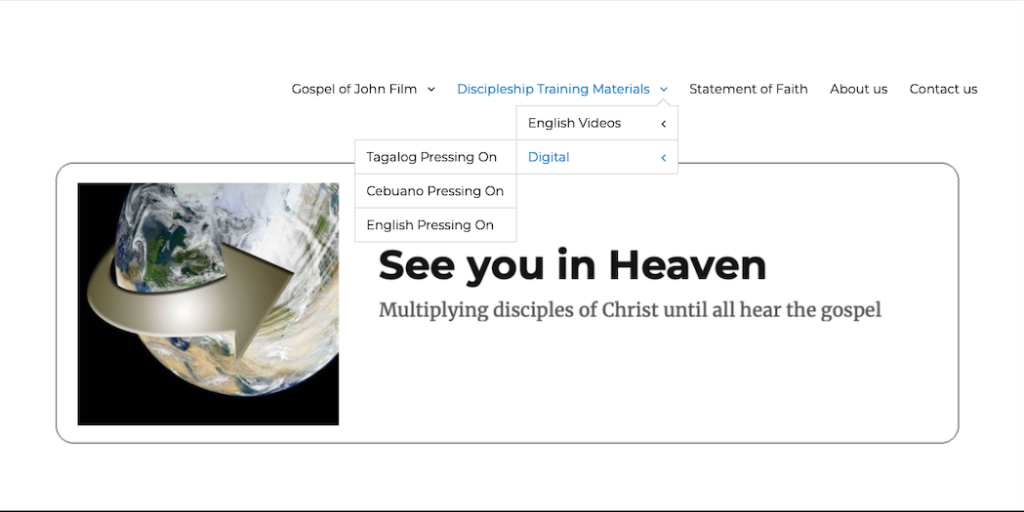
Diagram 1

To help you grow in your new relationship with Jesus Christ, please download our free digital discipleship materials on this website (see diagram 1) to go through with other people who are seeking to know Jesus. Thank you, and may Jesus richly bless you.

ENDNOTES:

1. A Greek-English Lexicon of the New Testament and Other Early Christian Literature, compiled by Walter Bauer, trans. and adapted by William F. Arndt and F. Wilbur Gingrich, 2nd ed., rev. and augmented by F. Wilbur Gingrich and Frederick W. Danker (Chicago: University of Chicago Press, 1979), pg. 776; Archibald Thomas Robertson, Word Pictures in The New Testament, Vol V: John and Hebrews (Grand Rapids: Baker Book House, 1932), pg. 286.

Transforming a nation and world

“Therefore hear the parable of the sower.” Matthew 13:18

Jesus explains His parable of the sower (Matthew 13:2-9) to His disciples to prepare them for the different types of responses to the preaching of God’s Word (Matthew 13:18-23). Each soil in this parable represents a different response to God’s message. Some to whom we share the gospel are like “the wayside” soil (Matthew 13:4, 19) who will not receive or believe in Jesus (Matthew 13:19; Luke 8:12).

Others are like “the stony places” (Matthew 13:5-6, 20-21) who “believe [the gospel] for a while” (Luke 8:13) but never really make a commitment to follow Christ as His disciple and “fall away” because of adversity (Matthew 13:20-21; Luke 8:13). They are “hearers only” of the Word like James talks about (James 1:22). They deceive themselves into thinking they can grow spiritually simply by hearing God’s Word without doing what it says. They are not willing to follow Jesus regardless of the costs.

A third type of person we will discover is like the seed that “fell among thorns” (Matthew 13:7, 22). These are those who believe in Jesus and start to follow Him, but they never bear much fruit because they are so distracted by worldliness and wealth (Matthew 13:22; Luke 8:14).

So far this has been disappointing. If this is the kind of response we can expect to get from many people, why go on? Jesus tells us why! He tells us not to become discouraged because eventually we will come across the fourth kind of person, a person who bears much fruit after believing the gospel (Matthew 13:8, 23; Luke 8:15). Unless we are willing to endure those who reject His message, those who fall away, and those who are too distracted, we will never discover the pure joy of finding those who are fruitful!

And notice that Jesus tells us that some of these fruitful ones will bear fruit “a hundredfold, some sixty, some thirty” (Matthew 13:23). One of the blessings we will experience if we continue to faithfully sow the seed of God’s Word, is that we will begin discovering these amazingly productive believers. These fruitful believers are “super spreaders” because they are super at spreading the seed of God’s Word. These are the “doers of the word” (James 1:22). They will far exceed us in witnessing and planting new churches.

The way to discover these “good soil” believers, is to train everyone in discipleship who believes the gospel! The “good soil” believers will quickly emerge. They will immediately become doers of the Word of God. As these super spreaders emerge among us, we will begin to see a more significant movement take place in our country and world as well. But the whole process begins with those who are faithful to sow the seed – to preach the gospel and train in discipleship those who believe in Jesus (Mark 16:15; Matthew 28:19-20).

This is the key to a transformed life and nation, not the political process. I believe more than ever, that Jesus is calling His church to return to the discipleship process in order to see our nation and world change for His glory! Christ implores us, “Hear the parable of the sower.” (Matthew 13:18). Will we hear and obey our Lord and Master! Perhaps today is when some of us begin  to sow the seed of His Word!!! Please know that His Word will not return to Him void, but it shall accomplish what He pleases, and it shall prosper in the thing for which He sent it (Isaiah 55:11)!

Prayer: Lord Jesus, all authority has been given to You in heaven and on earth (Matthew 28:18). Your one and only plan to reach the world for Your glory is the discipleship process whereby we preach Your gospel message to everyone in the world, and then call those who believe Your gospel to commit to follow You as a disciple through water baptism. Then we are to teach them to obey all Your commands (Mark 16:15; Matthew 28:19-20). Please enable us to be faithful to spread the seed of Your gospel message to this world which is perishing without You, Lord Jesus! Thank You for explaining the different types of responses we can expect from our audiences as we proclaim Your Word. By Your grace, enable us to endure those who reject Your message, those who fall away, and those who are too distracted, so we may discover the pure joy of finding those who are super at spreading the seed of Your Word to others!!! Your discipleship process is what transforms individuals, nations, and the world, not a political process. Please forgive us for looking in the wrong places for transformation. I beg You to bring us back to the basics of the Bible and the discipleship process, my Lord and my God. May Your Holy Spirit give us the boldness and vision to pursue You and Your discipleship process until all hear Your gospel message!!! Thank You for the assurance that You are always with us as we make disciples for Your glory (Matthew 28:20b). In Your matchless name I pray Lord Jesus. Amen.

How can we endure difficult times? Part 1

“When Jesus had spoken these words, He went out with His disciples over the Brook Kidron…” John 18:1a

All of us face stressful times, but how do we handle them? Some people spend time serving those less fortunate than them. For example, one psychologist says, “Every Friday for ninety minutes at lunch, I become the Beverage Lady at a local soup kitchen. I serve coffee, tea, and juice to people whose problems are much bigger than mine – poverty, homelessness, paralyzing disabilities. Having direct contact with folks with real problems is a big stress-reliever.”

A physician comments, “Staring into our aquarium with its Angelfish and Fantail Guppies, puts me in touch with another realm. And whenever I get especially upset, I spin the globe in my office. San Jose, CA, where I live, is just a tiny spot. California is a sliver. There’s a huge world out there, and even my worst problems are just a microscopic part of it.”

Retreating to the bathtub is where one psychologist goes to prepare herself to deal with stressful times. “A long hot bath is a luxurious way to relax. In addition to the soothing effect of the steamy water, bathing gives me time to catch up with all the little things I do for myself. Sometimes I read cookbooks or magazines. Other times, I shop through catalogues. I might bring in a TV and watch sitcoms or videos.”

When stressful times approach us, how do we respond? In John 18, Jesus Christ was about to face the most stressful time of His earthly life. We saw in John 14-17, Jesus and His disciples making their way from the Upper Room to the Garden of Gethsemane. It is in the garden where Jesus prepares Himself to face His arrest, trial, and crucifixion. We are going to learn more about who Jesus is and what He can do for us in the first twelve verses of John 18. So how we can endure difficult times?

The first way is to LEARN ABOUT THE LOVE OF CHRIST (John 18:1a). This may not seem obvious to you at first, but please allow me to explain how the Lord showed me this principle. John tells us, “When Jesus had spoken these words, He went out with His disciples over the Brook Kidron…” (John 18:1a). After finishing His High Priestly prayer in John 17:1-26 (“spoken these things”) on the west side of the Kidron Valley, Jesus and His disciples crossed “over the Brook Kidron” to go up to the Garden of Gethsemane. The Kidron Valley lies east of Jerusalem and separates the city from the Mount of Olives. The valley has a small stream that flows during winter and spring rains, but it is dry most of the summer. 1 None of the other gospel writers mention Jesus crossing the Brook Kidron, but John does. Why?

One major reason for including this detail is because the apostle John is presenting Jesus as the New Passover Lamb in his gospel (cf. I Corinthians 5:7). In John 1:29, John the Baptist says of Jesus, “Behold! The Lamb of God who takes away the sin of the world!” If you read through the Old Testament, you will find it is filled with many blood sacrifices. Abel, the son of Adam, offered a lamb to God and God smiled upon that sacrifice (Genesis 4:4). Later Abraham made offerings to God (Genesis 15:9-21).

While slaves in Egypt, the children of Israel were instructed to sacrifice a lamb and sprinkle its blood on their doorposts, so the angel of death would see the blood and pass over their family without killing the firstborn (Exodus 12:1-13). To commemorate His deliverance of the Israelites from slavery in Egypt, God instituted the Passover feast to be observed every year (Exodus 12:14-51). But this feast also pointed to the coming Deliverer and Savior of all people – Jesus Christ.  

John wants his readers to know that Jesus Christ is our Passover Lamb. Just as “the blood of the lambs served as a substitute for the blood that the people should have shed as punishment for their sins (see Leviticus 4:32-34; 5:6),” 2 so Jesus is our Substitute Who died in our place to satisfy God’s demand to punish the sin of the world (John 1:29; 19:30; cf. 2 Corinthians 5:21; I Peter 3:18).

Consider these similarities between the Passover lambs and Jesus: 3

  • Passover lambs had to be a young male “without blemish” (Exodus 12:5). Jesus was also a relatively young adult male without blemish or sin (Luke 3:23; John 19:38; 19:4, 6; 2 Corinthians 5:21; Hebrews 4:15; I Peter 1:19).
  • Passover lambs had to be examined four days from the selection to the sacrifice (Exodus 12:3, 6a). Christ lived a meticulously examined life.
  • The Passover lamb had to be slain in public (Exodus 12:6b-7). Jesus also died publicly (John 19:16-30).

Beginning with John 19:24 and continuing to verse 37, John the apostle records four events that demonstrate Jesus truly is our substitutionary Passover Lamb which the Old Testament animal sacrifices foreshadowed: 4

  • They cast lots for His garments (John 19:24)…………… Fulfillment of Psalm 22:18
  • His legs were not broken (John 19:33)……… Passover fulfillment of Exodus 12:46
  • He was pierced (John 19:34a-37)………………………… Fulfillment of Zechariah 12:10
  • Blood and water came out (John 19:34b)…………………………… Fulfillment of what??

Why did John record this last detail involving “blood and water” coming out of Jesus’ side when He was pierced with a spear? John’s reference to Zechariah 12:10 says nothing of the “blood and water” flowing together. This is an important detail because John writes, 34 But one of the soldiers pierced His side with a spear, and immediately blood and water came out. 35 And he who has seen has testified, and his testimony is true; and he knows that he is telling the truth, so that you may believe. 36 For these things were done that the Scripture should be fulfilled, ‘Not one of His bones shall be broken.’ 37 And again another Scripture says, “They shall look on Him whom they pierced.” (John 19:34-37). John testifies to these events so his readers “may believe.” John recorded this blood and water coming out as a proof of Who Jesus was by what He fulfilled. But there is no Old Testament verse referring to lamb’s blood and water streaming in unison. So what did Jesus’ blood and water coming out of His side fulfill?

“John was also thinking of the Passover in his day, not the Egyptian Passover only. What is the difference? In the first Passover there was no temple. Even its predecessor, the tabernacle, had not been set up; this did not occur until the Israelites crossed the Red Sea and encamped at the foot of Mount Sinai where they received Torah, the Law. At the first Passover the lambs were slain at home and eaten at home, Exodus 12:1-8. Since there was no tabernacle or temple, there was also no central sacrificial altar for the slaying of such animals. However, in John’s and Jesus’ time centuries later, there was a resplendent white limestone temple atop Mount Moriah (today’s Temple Mount in Jerusalem) where hundreds of lambs were slain.

“As a result, thousands of gallons or liters of lambs’ blood had to be disposed of. But how? By being poured into a drain at the ‘base of the altar’ (Leviticus 1:11, 13; 4:7, 18, 25, 30, 34), a rule that applied to both tabernacle and temple. For instance, the First Temple ( i.e., Solomon’s ) required ten lavers of water for rinsing blood from sacrificial offerings, II Chronicles 4:6. Therefore in the Second Temple of John’s day, voluminous amounts of water were poured into the altar’s drainage system to flush away the blood of lambs. Since the Temple Mount was a hill with a flat limestone surface, where did the drains empty? They spewed into the Kidron Valley below. The Temple’s drains are referred to in various sources such as the Jewish Talmud and in archaeologist Leen Ritmeyer’s, The Temple and the Rock, p. 57.5

Only John records that Jesus compared His own body to the Temple:  19 Jesus answered and said to them, ‘Destroy this temple, and in three days I will raise it up.’ 20 Then the Jews said, ‘It has taken forty-six years to build this temple, and will You raise it up in three days?’ 21 But He was speaking of the temple of His body. 22 Therefore, when He had risen from the dead, His disciples remembered that He had said this to them; and they believed the Scripture and the word which Jesus had said.” (John 2:19-22).

According to John, Jesus not only became the New Atoning Passover Lamb, but also the New Temple through whom the Divine Spirit – symbolized by water (cf. John 7:37-3) – could now flow to the masses, as had been symbolized by the gushing drains of King Solomon’s Temple and later by Herod’s Temple. To John, at least, “the blood and water” was proof that the Temple building and its sacrifices paralleled Jesus’ body and His crucifixion (John 2:19-21). Hence, the “missing” fulfillment verse is not an Old Testament one, but rather one spoken earlier by Jesus, which implies that Jesus saw Himself as the Temple personified, and John the gospel writer is the only one who recorded this. 6

  • Blood and water came out (John 19:34b)……………… Fulfillment of John 2:19-21

At the risk of being redundant, one of the possible reasons why John included the detail of Jesus crossing “over the Brook Kidron” was because the people in Jerusalem would have known that during the time of Passover something significant would have happened if Jesus would have crossed over the bottom of this valley to the top of the other side. William Barclay writes, “All the Passover lambs were killed in the Temple, and the blood of the lambs was poured on the altar as an offering to God. The number of lambs slain for the Passover was immense. On one occasion, thirty years later than the time of Jesus, a census was taken, and the number was 256,000. We may imagine what the Temple courts were like when the blood of all these lambs was dashed on to the altar. From the altar there was a channel down to the brook Kidron, and through that channel the blood of the Passover lambs drained away. When Jesus crossed the brook Kidron, it would still be red with the blood of the lambs which had been sacrificed; and as he did so, the thought of his own sacrifice would surely be vivid in his mind.” 7

So Jesus, the Lamb of God, Who was going to be slain for the sins of the world (John 1:29), had to step over this brook which by this time was soaked with the blood of the Passover lambs (cf. Luke 22:7). As Jesus and His disciples stepped over this brook, no doubt they saw and smelled this water mixed with the Passover lambs’ blood. What a foreshadowing of what Jesus was going to do for them, and for you and me. What a beautiful picture of His love for us (cf. Romans 5:8). He was willing to go up to the Garden of Gethsemane where He would be arrested even though He knew what was going to unfold that night. That is love! When people are at their worst, God stills gives us His very best. He gave His only begotten Son to die in our place for our sins.

When we face difficult times, we may doubt that God loves us. We may feel like He has abandoned us. We may accuse God of being unfair when He allows us to suffer. But please understand there was a time when God was unfair. It is when He sent His sinless Son to die in the place of guilty sinners. “He made Him who knew no sin to be sin for us, that we might become the righteousness of God in Him.” (cf. 2 Corinthians 5:21).

The perfect Son of God was punished on the cross instead of guilty sinners. Was that fair to Jesus!?! Of course not. But thank God for His love and grace which sent His perfect Son to pay the debt for our sins that we could never pay – “the just for the unjust, that He might bring us to God” (I Peter 3:18). We can endure these difficult times when we ponder our Savior’s great love for us. Christ knew what was going to happen that night before His crucifixion, yet He still crossed the Kidron Brook because of His love for you and me. Learn about His infinite love. It will give you the hope you need to endure trials.

The Bible tells us, 3 And not only that, but we also glory in tribulations, knowing that tribulation produces perseverance; 4 and perseverance, character; and character, hope. 5 Now hope does not disappoint, because the love of God has been poured out in our hearts by the Holy Spirit who was given to us.” (Romans 5:3-5). As Christians suffer, they learn to “glory in tribulations, knowing” that their sufferings develop spiritual growth (“perseverance… and character, hope”). 

As Christians faithfully endure difficulties, it results in a sense of “hope” or confidence that God will see them through to the end of their sufferings. This “hope does not disappoint, because the love of God has been poured out in our hearts by the Holy Spirit who was given to us” the moment we believed in Jesus for everlasting life (cf. John 7:37-39; Romans 8:9; Galatians 3:2; Ephesians 1:13-14). Our hope does not disappoint us because it is the hope of God’s love. God’s love gives us this hope. Knowing He loves us and has our best interest in mind, increases our hope. Tony Evans writes, “Even in our suffering, God’s Spirit provides a fresh experience of God’s love to us and for us.” 8 Hope is the confidence that we will receive good from God. Without this hope, we would not be able to remain faithful to God when we face difficulties in life.

Prayer: Lord Jesus, Your Word is so powerful and relevant to us today. All of us are facing difficult times. And all of us need to know You still love us when we face these hardships. You understand what it is like to suffer for a greater cause. The night before Your horrible death on a cross, You crossed over the Brook Kidron which was still red with the blood of the Passover lambs which had been sacrificed in the temple above, and as You did this, You were probably thinking of Your own upcoming sacrifice on the cross when both blood and water would flow from Your pierced side after You would die. Jesus, thank You for going up that hill to the Garden of Gethsemane to be arrested. Even today You still give us Your best when we may be at our worst. Knowing Your amazing love for us empowers us to endure difficulties without fear or shame (I John 4:18). O Lamb of God, thank You for being our Passover Lamb!!! In the matchless name of Jesus Christ I pray. Amen.  

ENDNOTES:

1. J. Carl Laney, Moody Gospel John Commentary (Chicago: Moody Press, 1992), pg. 316.

2. The Evangelism Study Bible (Grand Rapids: Kregel Publications, copyright 2014 EvanTell, Inc.), pg. 1161.

3. The NKJV Study Bible, General Editor Earl D. Radmacher (Nashville: Thomas Nelson, 2007), pg. 108).

4. See Tony Badillo’s article at http://templesecrets.info/jnbldwtr.html.

5. Ibid., also on the Temple drains, see also Hastings, A Dictionary of the Bible, Vol. 5, p. 696, and the Babylonian Talmud, Tractate Middoth, Chapter III, Mishnah 2 Soncino 1961 Edition, page 12; and Babylonian Talmud: Tractate ‘Abodah Zarah, Folio 4.

6. Ibid.

7. William Barclay, William Barclay’s Daily Study Bible, Commentary on John, 1956-1959, vs. 18:1-14. https://www.studylight.org/commentaries/dsb/john-18.html.

8. Tony Evans, CSB Bibles by Holman. The Tony Evans Bible Commentary (B&H Publishing Group, Kindle Edition, 2019), pg. 1930.

Receiving Life Freely – Part 5 (Video)

This is the fifth video in a series about the gospel of John – the only book of the Bible whose primary purpose is to tell non-Christians how to obtain eternal life and a future home in heaven (John 20:31). This video looks at the fifth miracle of Jesus recorded in the gospel of John involving His miraculous walking on water (John 6:15-21).

The movie clip subtitles are from the Good News Translation. All other Scripture are from the New King James Version of the Bible unless otherwise noted. Gospel of John pictures are used with permission from www.GoodSalt.com, Sweet Publishing / www.FreeBibleimages.org, Good News Productions International and College Press Publishing / www.FreeBibleimages.org, David Padfield / www.FreeBibleimages.org, The Edge Group and Lion Hudson Ltd. / www.FreeBibleimages.org, or they are creative common licenses. The Revelation Art is used by permission of Pat Marvenko Smith, copyright 1992. To order art prints visit her “Revelation Illustrated” site, http://www.revelationillustrated.com. The Gospel of John movie clip is used with permission from Jesus.net. You may view the entire Life of Jesus movie at https://jesus.net/the-life-of-jesus/.

Finding security in this insecure world

“But you, Bethlehem Ephrathah, though you are little among the thousands of Judah, yet out of you shall come forth to Me the One to be Ruler in Israel, Whose goings forth are from of old, from everlasting.” Micah 5:2

This year people are reeling from pandemics, hurricanes/typhoons, volcanoes, social unrest, political battles, wild fires, and riots all of which leave us feeling insecure. Many of us may be wondering what in the world is God doing?

The people of Israel may have felt a similar type of insecurity in the time of the prophet Micah. Micah admits that the situation his people were living in was gloomy: the nation was in extreme distress, Jerusalem was under siege, and the king has been humiliated. Much of the distress of the people was caused by the misuse of authority by the nation’s leaders (Micah 3:1-12).

In contrast to the wicked and greedy leaders of Israel in Micah’s day, there would come forth from the insignificant town of “Bethlehem Ephrathah… the One to be Ruler in Israel.” Dr.Tony Evans writes, Hundreds of years later, God would sovereignly ensure the fulfillment of this prophecy through a Roman census that took Joseph and his pregnant bride, Mary, to his ancestral home of Bethlehem. There, in the humblest of circumstances, Mary gave birth to the One who would one day rule the world (see Luke 2:1-7).” 1

The name “Bethlehem” means “house of bread.” How fitting that “the Bread of Life,” Jesus Christ (John 6:35, 51a), would come down from heaven to be born in Bethlehem, the “house of bread,” which had also been the home of King David (cf. 1 Samuel 16:1, 18-19; 17:12). The name “Ephrathah” means “fruitful.” Only through Jesus Christ, “the True Vine” (John 15:1), can believers be enabled to be fruitful and fulfilled for the Father’s glory (cf. John 15:1-8).

The One born in this most insignificant town would be the most significant Person to ever live on earth. He is the One “Whose goings forth are from of old, from everlasting.” He is not just any “Ruler,” He is a Divine Ruler Who is the “everlasting” God! When Mary and Joseph looked into the face of the Child of Bethlehem, they were looking into the face of God.

Thank God for sending His only begotten Son, “the Bread of Life,” to the “house of bread” so that “if anyone eats of this bread [i.e. believes in Him – John 6:35], he will live forever” (John 6:51a)! Only Jesus Christ can satisfy our hunger for eternal life (cf. John 6:35) and give us security that lasts forever (John 10:28-29).

The reason? Because, as Micah says, only Jesus Christ is fully God (“from everlasting” – cf. Isaiah 9:6-7; 44:6; John 1:1, 14-18, 34, 49; 5:16-47; 6:69; 8:57-59; 14:7-9; 10:30-33; 11:27; 20:28, 31; Acts 16:31, 34; 20:28; Romans 1:3-4; 9:5; I Timothy 3:16; 4:10; Titus 2:13; Hebrews 1:8; I John 5:20; Revelation 1:17; 22:13; et al.) and fully Man (“Bethlehem… out of you shall come forth to Me the One to be Ruler in Israel” – cf. Matthew 8:24; 9:11; Mark 6:3; John 1:14; 2:12; 4:6; 7:3, 5; 11:35;12:27; 19:28; 21:12; Philippians 2:6-8; I Timothy 2:5; et al.), Who died for all our sins and rose from the dead, so we can have eternal life the moment we believe in Him (Micah 5:2; cf. John 3:14-16; I Corinthians 15:3-6).

Micah shared this hope-filled message with people who were overwhelmed with life and God wants to use us to do the same. Thank the Lord that the Bread of Life was born in the House of Bread so the world may have life in His name!

Prayer: Father God, thank You for sending the Bread of Life to be born in the House of Bread so we may have everlasting life in His name the moment we believe in Him! Just as Mary held You, Jesus, in her womb in the beginning of Your life on earth in human form without ceasing to be God, so You will hold us in the end because You remain faithful to Your promise (John 10:28-29). Thank You for security that lasts, especially in this insecure world. Please use us to spread this hope-filled message to those who are desperately in need of Your love and grace. In the mighty name of our God, Jesus Christ, we pray. Amen.

ENDNOTE:

1. Tony Evans, CSB Bibles by Holman. The Tony Evans Bible Commentary (B&H Publishing Group, Kindle Edition, 2019), pg. 1414.

How can we be effective witnesses to a hostile world? Part 2

“Remember the word that I said to you, ‘A servant is not greater than his master.’ If they persecuted Me, they will also persecute you. If they kept My word, they will keep yours also.’ ” John 15:20

Jesus Christ experienced love and hate from people during His time on earth. While most of the people ended up hating Christ and had Him crucified, some came to love Him. Those who loved Him received more intimate and life-changing truths from Him (cf. John 14:21; 15:14).

The night before His crucifixion, Jesus shared intimate truths with His devoted followers to prepare them to carry on His ministry after He departs and ascends to heaven to be with His heavenly Father. After speaking to His eleven believing disciples about their relationship to one another (John 15:12-17), He then directs their attention to their relationship with the world (John 15:18-16:4). Jesus wanted to prepare His disciples (and us) for the opposition they would face after He ascends to the Father in heaven. How can we be effective witnesses to a hostile world?  

Last time we learned the first way is to realize that you will face the same conflict with the world that Jesus did (John 15:18-19). The second way to be an effective witness to a hostile world is to RECALL WHAT JESUS HAS ALREADY TAUGHT US (John 15:20). As followers of Christ, we are not to think we will be treated better by the world than Jesus was.

Christ said to His eleven believing disciples, “Remember the word that I said to you, ‘A servant is not greater than his master.’ If they persecuted Me, they will also persecute you. If they kept My word, they will keep yours also.” (John 15:20). Jesus reminded His disciples of what He already taught them after He washed their feet at the Last Supper (cf. John 13:16). He said, “A servant is not greater than his master.” Earlier Jesus used this statement to encourage them to humbly serve one another as He had done when He washed their feet. Now in this context, He uses that statement to explain why they will face persecution. Christ meant that His disciples are not greater than Him in the sense that they will not escape persecution from the world when walking with the Lord. Since their Master (Jesus) was “persecuted” by the world, the world “will also persecute” His servants. 

Conversely, Jesus says, “If (since)1 they kept My word, they will keep yours also.” People often treat servants the same way they would treat the servant’s master. Hence, Christ is saying that just as some people followed His teaching, so there will be some who follow His disciples’ teaching.

In the midst of the world’s hatred and rejection toward Christ and His followers, Jesus is giving us hope. While most rejected Christ and His message, some did not. Likewise, “while most will reject the words of the apostles, some will accept their witness. For example, on the Day of Pentecost, just fifty days after Jesus spoke these words, Peter led over three thousand to faith in Jesus (Acts 2:14-41).” 2

When you and I share the gospel with others, some will oppose the message and others will receive it. It is important to remember this when we face an antagonistic crowd. Don’t give up on someone if they are not receptive the first time you try to share Christ with them. Some people may need to hear the gospel several times before they believe in Jesus. Or there may be people in a crowd of antagonists who are receptive. You may not be aware of that at the time you share with them because they are too intimidated to express their receptivity. Let the Holy Spirit draw them to Jesus among hostile listeners.

For example, in 2013 when I went with Filipino pastors to a critical area in the southern Philippines to preach in public schools, students there were very responsive. On one particular day, we stopped at an all-Muslim school to share the gospel with students, but the students had already been dismissed. We noticed that there was a crowd of about two hundred fifty adult Muslims having a Parent/Teacher meeting. We asked if we might share the good news of Jesus Christ with them and the moderator permitted us to do so.

As I began to share about the love of the God of Abraham and how He wanted to have a personal relationship with them, I noticed a group of about twenty-five Muslim women dressed in their Islamic head gear, and they were forming a circle. They would keep looking at me through the opening in their head gear and then they would look at one another. I didn’t know what they were going to do, but I just knew that Jesus did not want my translator and I to stop preaching. By God’s grace we boldly shared Christ crucified to them and then invited them to believe in the Lord Jesus for eternal life and a future home in heaven. When I asked them to raise their hands if they were now trusting in Christ alone as their only way to heaven, all two hundred fifty adult Muslims lifted up their hands. Hallelujah! My translator and I then made a quick exit out of there to go to the next school.

We can be more effective witnesses for Christ in this hostile world as we remember the things He taught us about the world’s hostility toward His followers. His teaching will give us strength in the future when we face opposition because Jesus warned us in advance, so we would not be overtaken by surprise.Regardless of how people respond, we are to faithfully represent Christ on the earth.

When we go through dark times, look back at the times of light and what Jesus already taught us during that time. Our tendency is to forget the lessons that Jesus already taught us when we go through tough times. When pressures pile up on us, we can easily throw away the biblical truths the Lord has given us (cf. Ecclesiastes 7:7). During dark times, get alone with the Lord and read His Word. Listen to His voice of truth. Let Him give you His power as His Spirit renews your mind with the everlasting truths of His Word.

Prayer: Lord Jesus, thank You for warning me in advance that when I identify with You, I will receive the same kind of treatment from the world that You received. While most people will oppose Your message through me, there will be some who will embrace it. Please help me to focus on those who are receptive so I can follow them up and teach them to follow You as You did for me through Your faithful followers when I first got saved. Regardless of how people respond, please empower me to faithfully represent You on earth while there is still time left. In Your mighty name I pray. Amen.

ENDNOTES:

1. The phrase εἰ τὸν λόγον μου ἐτήρησαν is a first-class condition meaning some did keep or obey Jesus’ teaching.

2. Robert Wilkin; J. Bond; Gary Derickson; Brad Doskocil; Zane Hodges; Dwight Hunt; Shawn Leach. The Grace New Testament Commentary: Revised Edition, (Grace Evangelical Society, Kindle Edition, 2019), pg. 537.

How can we calm our troubled hearts in a chaotic world? Part 3

“And now I have told you before it comes, that when it does come to pass, you may believe.” John 14:29

Our world is huge!!! This is just one planet in our vast universe. Over 7.8 billion people live on this planet. It can be overwhelming to see all these people along with all the nations of our world, not to mention all the problems and pain. I don’t know if you have noticed lately, but the world is lost in total chaos! COVID-19 has brought the world to its knees in fear! Then there is the spread of terrorism, social and political unrest, shootings, kidnappings, road rage, flooding, earthquakes, sex scandals. There is a push toward globalism that some fear is a movement toward a one world government ruled by elitists. All of this is very troubling.

How can we calm our troubled hearts in a chaotic world? We are learning from the Lord Jesus Christ how this can take place. So far we have discovered we can calm our troubled hearts by focusing on…

– The promise of insight from the Holy Spirit (John 14:25-26).

– The peace of Christ (John 14:27).

Today we learn to calm our troubled hearts by focusing on THE PROPHETIC WORD OF CHRIST (John 14:28-29). Jesus said to His eleven believing disciples the night before His crucifixion, “You have heard Me say to you, ‘I am going away and coming back to you.’ If you loved Me, you would rejoice because I said, ‘I am going to the Father,’ for My Father is greater than I.” (John 14:28). Jesus’ upcoming departure still troubled His disciples. He explained that their troubled hearts are due to the fact that they do not “love”Him like He wanted them to. If they did love Him, they “would rejoice because” He said He was “going to the Father, for”His “Father is greater than” Him.

For Jesus loves His Father in heaven, and His upcoming departure to be with Him meant that his mission – the reason for which He had come into the world—was almost complete. 1  Laney says that “Bruce notes that the conjunction ‘for’ before ‘the Father is greater than I’ attaches to the preceding clause, ‘I am going to the Father.’ Jesus is on His way back to the Father who sent Him. Because ‘a messenger is not greater than the one who sent him’ (John 13:16), Jesus must render to the Father an account of His mission.” 2

What does Jesus mean when He says, “My Father is greater than I”? It is important to understand the gospel of John as a whole to properly understand individual verses. John has made it clear in his gospel that Jesus is equal with the Father as God (John 1:1; 5:18-47; 8:58; 10:30; 14:9; 20:28-29). He cannot mean that He is a lesser deity than the Father as some false religions claim.

“Jehovah’s Witnesses, Unitarians, and other Arians interpret Jesus’ words here this way. Arius was a heretic in the early church who denied Jesus’ full deity. Jesus was not speaking ontologically (i.e., dealing with His essential being, His nature), since He had affirmed repeatedly that He and the Father were one ontologically (1:1-2; 10:30; 14:9; 20:28).” 3 “God is one and there are no degrees of deity. Jesus and God the Father are one in essence” (John 10:30). 4

In John 14:28, Jesus is saying the Father had a “greater” position of glory in heaven while Jesus was in humble human form on earth. Jesus temporarily laid aside His glory that He possessed in eternity past (John 17:5) when He took the form of a bond servant on earth (Philippians 2:5-8). When Jesus says “My Father is greater than I,” He is talking about His Father’s office or role, not His nature.

For example, when I consider myself compared to the President of the United States, I would not hesitate to say that the President is greater than I. He is in charge of the entire nation and is one of the most powerful men in the world, whereas I am just a normal citizen. So the President is greater than I, far greater; but we are both equally human. In his essence, the President is just a human being, as am I, and in that sense we are equal. So when I say, “The President is greater than I,” I am referring to his office, not his essence. In office, he is greater than I; in essence, we are equal. Similarly, when Jesus says, “My Father is greater than I,” that does not mean Jesus is not God. The Father has a different role, a higher office than Jesus, but that does not mean the Father is greater in essence. They are both equal in essence. They are both God.

The disciples should have “rejoiced” that Jesus was going to His Father because, even though His departure meant loss for them, it meant a restoration of the glory and joy He once shared with His Father. Instead of thinking of Jesus’ best interests, they were only thinking of themselves. It wasn’t wrong for the disciples to grieve the upcoming loss of Jesus’ companionship and personal presence. But they were to grieve differently than unbelievers grieve. 5

We may experience a similar conflict of emotions when a believing family member or friend dies. We grieve our loss, but we can also rejoice now that our loved one is with the Lord Jesus Christ in heaven (cf. I Thessalonians 4:13-18)! 6

Next Christ said, “And now I have told you before it comes, that when it does come to pass, you may believe.” (John 14:29). Jesus explains to His disciples that He has “told” them of His departure to go to His Father in heaven (John 14:28) before “it comes, that when it does come to pass,” they “may believe” in His Person and claims to be the Messiah, the Son of God. Although the disciples’ faith would falter immediately after Christ’s crucifixion (cf. Mark 16:11-14; Luke 24:11, 25, 37-38; John 20:19a, 24-25), their faith would be restored at Jesus’ post-resurrection appearances and ascension to heaven (cf. Matthew 28:9; Luke 24:52-53; John 20:26-29; Acts 1:1-11). Christ did not share of His departure to trouble their hearts. He shared this with them, so they would not be overtaken by surprise. The disciples’ faith would grow stronger after Jesus’ resurrection and ascension (cf. John 13:19). The disciples would then view Jesus’ teaching here as fulfilled prophecy. 7

Fulfillment of Bible prophecy is a great source of comfort and support to believers during difficult times (cf. Isaiah 46:8-10). God has revealed everything we need to know about our future in His Word so that we can prepare for those events.

For example, the Lord Jesus Christ revealed many details about our future in the last book of the Bible, the book of Revelation (see above diagram). The apostle John writes, “Blessed is he who reads and those who hear the words of this prophecy, and keep those things which are written in it; for the time is near.” (Revelation 1:3). God promises a special blessing for those who read, hear, and obey [“keep”] “the words of this prophecy [in the book of Revelation]because “the time [of the prophecy’s fulfillment] is near [it could happen at any moment]. Bible Prophecy is given to us not only to make us knowledgeable of things to come, but to help us PREPARE for them so we and others can be ready to face the Lord.

This reminds me of the TV show called Early Edition (1996-2000). The main character, Gary Hobson, is startled to open his door one day to find a cat sitting on a newspaper, a newspaper that has a publishing date of the next day. It wasn’t today’s newspaper, it was tomorrow’s newspaper distributed today. Every single day, Gary Hobson would receive the newspaper for the next day. So the TV show was called Early Edition because he received tomorrow’s news today. The point of the show was Gary trying to save people from the tragedy that was going to happen tomorrow because he received news about it today. So every day he was rescuing people and changing the destinies of people because he had received the Early Edition.

Jesus Christ has given us the Early Edition in Bible Prophecy. He is telling us today about what is going to happen tomorrow, so we can change the destiny of our tomorrow and the tomorrow’s of other people today. The tragedy is for us to receive God’s Early Edition and keep it to ourselves. God has given us the Early Edition about the world we live in, so we can influence its direction by how we choose to live today. You cannot know someone’s house is going to burn down tomorrow and then keep silent about it today. God has told us that people who do not trust in Jesus Christ alone for everlasting life will spend eternity burning in the Lake of Fire (John 3:36b; Revelation 20:15). It is imperative that we warn people of this today, so they can escape an eternity separated from God before it is too late.

If you have not yet believed in Christ alone yet, then hear and believe God’s promise in John 3:36: He who believes in the Son has everlasting life; and he who does not believe the Son shall not see life, but the wrath of God abides on him.” To believe in God’s Son, Jesus Christ, means to trust or depend on Him alone for His gift of everlasting life.

For example, believing in Jesus is a lot like riding on an airplane. When you ride on an airplane as a passenger, do you have to push the plane to get it off the ground? No, of course not. Do you have to flap your arms to keep the plane in the air? No, not at all. All you must do is trust a person – your pilot – to fly you to your destination. In the same way, Jesus is inviting you to trust in Him alone to get you to heaven. No amount of your good works can help Jesus get you to heaven. Simply believe or trust in Him alone Who died for your sins and rose from the dead, and He guarantees you a home in heaven in the future.

If you have never understood and believed this before, and now you do – you can tell God this through prayer. But remember, praying a prayer does not get you to heaven. Only believing or trusting in Jesus alone gets you to heaven. This prayer is a way of telling God you are now trusting in His Son.

Prayer: Dear God, I have been overwhelmed with all of the chaos in the world today. Thank You so much for getting my attention with all the drama that is taking place on our planet. Thank You also for warning me of the lake of fire that awaits all those who reject Your Son, Jesus Christ. God, I know I am a sinner and that I cannot save myself. I believe Jesus died in my place for all my sins and rose from the dead. As best I know how, I am now trusting in Jesus alone (not my good life, my prayers, nor my religion) to give me everlasting life now and a future home in heaven. Thank You so much for the everlasting life I now have and for the future home I will have in heaven. In Jesus’ name I pray. Amen.

If you have already trusted Christ for His free gift or you just did trust in Him, please share this good news with everyone you meet and then train those who believe in Christ to follow Him as a disciple because we do not have much time left! To help you be trained in discipleship or to train others in discipleship, please download our English digital discipleship training materials above.

Rather than fretting about what tomorrow holds, focus on Who holds tomorrow in His hands. Psalm 31:14-15 says, “But as for me, I trust in You, O Lord; I say, ‘You are my God.’ My times are in Your hand.”

ENDNOTES:

1. Tony Evans, CSB Bibles by Holman. The Tony Evans Bible Commentary (B&H Publishing Group, Kindle Edition, 2019), pg. 1804.

2. J. Carl Laney, Moody Gospel John Commentary (Chicago: Moody Press, 1992), pg. 266 referencing F. F. Bruce, The Gospel of John: Introduction, Exposition, and Notes (Grand Rapids: Eerdmans, 1983), p 307, n. 15.

3. Tom Constable, Notes on John, 2017 Edition, pg. 277.

4. Robert N. Wilkin, “The Gospel According to John,” The Grace New Testament Commentary, Vol. 1: Matthew – Acts (Denton, TX: Grace Evangelical Society, 2010), pg. 447.

5. Robert Wilkin; J. Bond; Gary Derickson; Brad Doskocil; Zane Hodges; Dwight Hunt; Shawn Leach. The Grace New Testament Commentary: Revised Edition, (Grace Evangelical Society, Kindle Edition, 2019), pg. 531.

6. Constable, Notes on John, pg. 277.

7. Ibid., pg. 278.

8. Edwin A. Blum, The Bible Knowledge Commentary, New Testament Edition (Wheaton: Victor Books, 1983), pg. 324.