God uses little things to make big things happen

“But when the children of Israel cried out to the Lord, the Lord raised up a deliverer for them: Ehud the son of Gera, the Benjamite, a left-handed man… Now Ehud made himself a dagger (it was double-edged and a cubit in length) and fastened it under his clothes on his right thigh.” Judges 3:15-16

After Joshua died, Israel started to compromise their commitment to drive out the inhabitants of the land of Canaan (Judges 1:21-36). And so began the following cycle: departure from the Lord, discipline by Israel’s enemies, the Lord has pity when His people cry for help, God raises up a deliverer (judge) who defeats their enemies, their deliverer dies, and Israel returns to the false gods of the pagan inhabitants of the land (Judges 2:11-19).

One such deliverer that God raised up was a “left-handed man” named “Ehud,” who would deliver Israel from the oppressive rule of “Eglon king of Moab” (Judges 3:12, 15). We are told, “Now Ehud made himself a dagger (it was double-edged and a cubit in length) and fastened it under his clothes on his right thigh” (Judges 3:16). Ehud’s “double-edged” sword was sharp on both sides and would be an effective weapon against Israel’s enemies. The fact that Ehud “fastened” this sword “under his clothes on his right thigh” would make it difficult to be detected.

When Ehud delivered “the tribute to Eglon” who “who was a very fat man,” he “sent away the people who had carried the tribute” and told the king he had “a secret message for” him (Judges 3:17-19a). This prompted the king to send “all who attended him” out of his “private chambers” so he could be alone with Ehud (Judges 3:19a-20a). After Ehud told the king, “I have a message from God for you,” he “arose from his seat” and took the king completely off guard when he “reached with his left hand, took the dagger from his right thigh, and thrust it into his belly” (Judges 3:20b-21). After killing king Eglon, Ehud led the tribe of Ephraim to victory over the Moabites and Israel enjoyed “rest” in “the land…for eighty years” (Judges 3:25-30).

It is important not to miss the fact that God not only providentially moves in the course of history to accomplish major events, but He also uses a string of little things like a “left-handed” man who wears his “double-edged sword… under his clothes on his right thigh” to bring about those major events.  

God uses little things to make big things happen. Like when a team of six short-term American missionaries and six Filipino evangelists went to a spiritually dark island called Dinagat in the southern Philippines in January of 2012. After arriving on the island which had a reputation for driving missionaries off the island or even poisoning them, one of the older mission team members began to preach the gospel outside a marketplace. An older woman said the Americans on the mission team fulfilled an ancient prophecy on the island which spoke of white-skinned people coming to the island and bringing many blessings.

As result, the Lord opened up many doors, including a radio/television station, for the gospel to spread throughout the island. The Lord used the skin color of a small team of American missionaries to help spread the gospel throughout the island. Let us not forget that God can string together little things (e.g. the color of your skin, your left-handedness, the size of your nose, your love for fish, etc.) to make big things happen for His glory.

Prayer: Lord God, thank You for reminding us that You can use little things in our lives to make big things happen for Your glory. Help us to pay attention to how You fit together the little things to make major events take place. You can use our looks, mannerisms, and interests to advance Your gospel message in a world that is becoming increasingly dark without Christ. We surrender all we have to You for Your glory. In the matchless name of Jesus Christ we pray. Amen.

How can we overcome failure and religious hatred? Part 1

All of us have experienced failure in our lives. Perhaps you embarrassed yourself by forgetting the name of the person you were talking to or the friend you meant to introduce. Maybe you missed the catch for the final out in a baseball game or you forgot the crucial line in a school play. Some of us may have lost a wedding ring or engagement ring never to be recovered. After making a mistake, how do you respond? Did you beat yourself up? Did you feel remorse or apologize, if applicable? Or do you blame someone else for your mistakes? How long does it take you to get over a mistake?

As we talk about making mistakes, I am reminded of a conversation between a pastor and a lawyer. The pastor asked the lawyer, “Sir, do you ever make mistakes in pleading?” “I do,” replied the lawyer. “And what do you do with mistakes?” inquired the pastor. “Why, I mend them, if large ones. If small ones, I let them go. And I pray, sir.” The lawyer continued by asking, “Do you ever make mistakes in preaching?” “Yes, sir, I have,” replied the pastor. “What do you do with your mistakes?” asked the lawyer. “Why, sir, I dispose of them in the same manner as you do. Not long ago when I was preaching, I meant to observe that the devil was the father of liars, but I made a mistake and said the father of lawyers. The mistake was so small that I let it go.”

All of us have experienced failure in our Christian lives. That is a reality. How we respond to failure can determine the direction we move from that point on. We can move forward or backward in our Christian lives.

Starting today, we are going to look at two kinds of responses to Christ crucified in John 18:13-27 over the next few days. One response will teach us about failure – factors that contribute to it and how to overcome it. The other response will teach us about how to handle the hatred of religious people toward Christ crucified. The events of John 18:13-27 are like a drama presented on two stages. Stage one is presented first (John 18:13-14) while the action on stage two takes place (John 18:15-18). Then the action shifts back to stage one (John 18:19-24) and then returns to stage two (John 18:25-27).

In these verses we are going to discover some things that took place during the final hours of Jesus’ life before He was crucified. Christ has already been arrested by the Roman soldiers and Jewish temple guards (John 18:12). He now must face the first of six trials. Three would be religious trials: one before Annas (John 18:12-14, 19-23), one before Caiaphas (Matthew 26:57-68), and one before the Sanhedrin (Matthew 27:1-2). And there would be three Civil Trials: One before Pilate (John 18:28-38), one before Herod (Luke 23:6-12), and one before Pilate (John 18:39-19:1). 1

“And they led Him away to Annas first, for he was the father-in-law of Caiaphas who was high priest that year.” (John 18:13). After Jesus was arrested by the Roman soldiers and Jewish temple officers, He was led back across the Kidron Valley into the city of Jerusalem to appear before the religious authorities. It seems as though there are two high priests in this section (cf. John 18:13, 19, 24). But understanding the historical background will help to explain this observation.

According to the Mosaic Law, the high priest was the most important member of the Jewish community because he was the only one authorized by God to offer sacrifices for the sins of the community on the Day of Atonement (Exodus 30:10; Leviticus 16).

According to Jewish law, the high priestly office was to be lifelong and hereditary. But during King Herod’s rule, the high priest was frequently dismissed and replaced because the Romans didn’t like the concentration of power in one person.

But because the Jews believed the office of high priest was lifelong, the high priest retained a good measure of power and prestige among the Jewish population even after removal from office. 3  Such was the case with Annas. He “had been appointed high priest by Quirinius, governor of Syria, in A.D. 6 and remained until he was deposed by Valerius Gratus, procurator of Judea, in A.D. 15. According to the Jewish law the high priestly office was for life, but the Romans did not like the concentration of power in one person so they frequently changed high priests.” 4

Because the office of high priest is lifelong, it is not surprising that the matter of Jesus’ arrest and trial was first brought to Annas, the father-in-law of Caiaphas, the high priest officially recognized by the Roman authorities. Annas was a very powerful man. So great was his influence that eventually five of his sons, as well as his son-in-law and grandson, became high priests. 5  The Jews virtually regarded him as a high priest, although Caiaphas held the title officially.

Annas was also very wealthy. He owned the famous Bazaars of Annas, which ran a monopoly on the temple sale of animals for sacrifices and the stalls of the money-changers. 6  Twice Jesus had cleansed the temple, once at the beginning of His ministry (John 2:13-22) and again at the end of His ministry (Matthew 21:12-16; Mark 11:15-19; Luke 19:45-47). From the day of the first cleansing of the temple, Annas hated Jesus. Now at last he has Jesus in his power.

To Annas “was the task assigned of the preliminary hearing of the urgent case under consideration. This preliminary hearing took place in one of the apartments of the high priest’s palace, a large building surrounding a central court, designated for the uses of Annas, whose residence was in another part of the city, between the Tyropoean valley and the upper city.” 7

Ironically, the Jewish religious leaders begin to break law after law with their various trials even though they are trying Jesus for not keeping the law. “Some of the main problems with the trial of Jesus include the following.

“1. There Was No Possibility Of A Fair Trial. To begin with, the Sanhedrin should have never held the trial. They had plotted to kill Jesus ahead of time. Consequently they were hardly in a position to render a fair verdict as to his guilt or innocence. This is especially true of the High Priest Caiaphas. He is the one who said that it was necessary for Jesus to die for the entire nation. The High Priest was the supreme judge in Israel. It was his responsibility to see that a person be given a fair trial. At the very least, he should have not participated in trial in any manner. Yet he was the driving force behind the arrest and trial of Jesus. Therefore there was no possibility that Jesus could have been given a fair trial.

“2. A Capital Trial At Night Was Illegal. It was illegal to try capital cases at night. By doing so the Sanhedrin broke the law. When a person’s life was at stake the trial could only be held during the day.

“3. They Should Not Have Looked For Witnesses After The Trial Started. According to Jewish law, a trial starts when witnesses come forward to testify. The Sanhedrin should not have gone out to look for witnesses. The witnesses come first, then the trial.

“4. They Should Not Have Looked For False Witnesses. Not only should the Sanhedrin have not looked for witnesses, they certainly should not have looked for false witnesses if Jesus were to be given a fair trial. The verdict, of course, was never in doubt.

“5. The False Witnesses Should Have Been Punished. Since the Sanhedrin knew the testimony of the witnesses was false, these witnesses, according to Jewish law, should have been punished. The fact that they were not is another illegality.

“6. The Judgment Should Have Been Delayed Till Next Day. In capital cases, judgment was to be delayed until the next day. The fact that they pronounced judgment immediately is another sign of the illegal nature of the trial.

“7. There Is Not Supposed To Be A Trial On Day Before The Sabbath Or Before Holy Days. Since the judgment in a capital case could not be rendered until the next day, it was illegal to try someone on the day before the Sabbath or before some holy day. During the Sabbath day or holy day there could be no legal meeting of the Sanhedrin. Consequently the timing of the trial was also illegal.

“8. They Never Considered Jesus’ Testimony. There is also the problem of Jesus’ testimony. When Jesus was put under oath he acknowledged that he was the Messiah – the promised Deliverer. This admission of Jesus was what caused the Sanhedrin to cry out that he was guilty of death. However, they never stopped to consider the possibility that Jesus was telling the truth. There was not the slightest interest in attempting to find out whether Jesus may indeed be the promised Messiah. There was no evidence that was allowed to be given on Jesus’ behalf and they weighed no evidence before making their judgment.

“Conclusion: When all the facts are weighed it becomes clear that those who tried Jesus on that night were not interested in giving him a fair trial. The verdict had been determined ahead of time. They only went through the motions of the appearance of a fair trial. Jesus was illegally and wrongfully tried… Therefore when all the facts are considered we conclude that Jesus’ trial was the greatest injustice in all of history.” 8

When you study the trials that Jesus faced, Christ looks more and more innocent and those who were trying Him looked more and more guilty. These were trials that proved the innocence of the accused and the guilt of the accusers. They were unfair in every way. Yet John informs us in the next verse, “Now it was Caiaphas who advised the Jews that it was expedient that one man should die for the people.” (John 18:14). The apostle alludes to Caiaphas who unknowingly prophesied that Jesus would need to die for the people. This verse indicates what can be expected as the outcome of the trials. The outcome was certain. Events would lead rapidly to Jesus’ death. It is doubtful Caiaphas meant spiritual benefits “for” the people, but rather political and monetary benefits “for” the nation’s leaders. Nonetheless, God was in control and would use these unfair religious and civil trials to bring about the means of salvation through the death of His Son.

Do you get upset when life is unfair like this? When things are not handled fairly there is something inside us that stirs our anger. Especially those of us who have grown up in America. There is something about the American spirit, the Bill of Rights, and all those things that just burns us up when life is not fair. But notice that God took an unfair trial, held by unrighteous people, and used it to accomplish His perfect will – Jesus going to the cross to die for our sins. We can easily get so focused on what is fair in America that we conclude that God has lost control. We need to remember that somebody can treat us unfairly but it doesn’t keep God from treating us righteously. 

This leads to our first principle: We can overcome religious hatred when we REALIZE LIFE IS NOT ALWAYS FAIR, BUT GOD ALWAYS IS (John 18:13-14). Let’s not forget this. The truth is life is not fair. Jesus did not deserve to be on trial. He lived a perfect life on earth because He was and is God (John 1:1; 2 Corinthians 5:21; Hebrews 4:15; I Peter 3:18; I John 5:20). If life was not fair for the perfect Son of God, why would we expect life to be fair when we are imperfect sinners!?!

“The world is anything but a fair place. A young man in the prime of his life is killed by a drunk driver who walks away without a scratch. Drug dealers and pornography peddlers make millions of dollars and live in mansions. A less qualified applicant gets the job. The best runner is tripped from behind by another and loses the race. Our response is, ‘It isn’t fair,’ as if labeling it that way somehow changes things. King Solomon, perhaps the wisest man of all time, understood life’s unfairness when he noted, ‘There is something else meaningless that occurs on earth: the righteous who get what the wicked deserve, and the wicked who get what the righteous deserve. This too, I say, is meaningless.’ (Ecclesiastes 8:14).” 9

But we need to remember that when life is not fair, God is always fair toward us. If God is not just, He isn’t God and can’t be in control of everything. If God ever once unfairly disciplined or punished a person, it would disqualify Him as God and mean that He is not in control of everything. We see miscarriages of justice all the time here on earth, but there is never a miscarriage of justice with God. We can never honestly say to God that He didn’t handle something fairly or right.” 10   Why? Because only God has all the information about a situation. He is all-knowing and fair, but we are not. So none of us are in a position to critique the God of the universe.

When the books are not being balanced in this world we need to remember this is not where the books are balanced anyway. Heaven will determine the balancing of the books. 11  God will make everything right in His time. His judgment of the world will be fair. He will judge everyone according to their works (Romans 2:5-11). For the unbeliever, God will judge him or her according to their works to determine their degree of punishment in the lake of fire at the Great White Throne Judgment (Revelation 20:11-15). For the believer in Jesus Christ, God will judge him or her according to their works to determine the degree of their rewards in Christ’s coming Kingdom at the Judgment Seat of Christ (I Corinthians 3:8-15; 2 Corinthians 5:9-11; Revelation 22:12). God will make things right in His time.

Embracing this truth that life is not fair, but God always is, can give us peace when we are treated unfairly. Just as Jesus “committed Himself to Him who judges righteously” when He was unfairly treated by His enemies (I Peter 2:23), so we can do the same when we face unjust situations, knowing that God is fair and He will bring our enemies to justice one day (cf. 2 Thessalonians 1:3-10; Revelation 15:3-4; 16:5-7; 20:11-15).

Prayer: Lord Jesus, You know what it is like to live in a world that is not fair. Sometimes we let that world bring us down. We see how the world tolerates people who embrace its values, but it hates Christians who live out Your values. It is not fair. But You never promised us that the world would be fair to us. Lord, help us not to forget Who You are and Who You want to be in our lives and in our world. Lord Jesus, thank You for reminding us that in the future You will balance the books and bring justice to this unfair world. Knowing this enables us to live peacefully even when we are treated unfairly. Remind us that no matter how powerful human institutions around us might seem or people in our lives might seem, in comparison to You, all human power looks feeble and foolish. You are the Lord that we need. You are the King that we need.  We worship You as the Lord and King. We need You, Jesus. We thank You for being in our lives. In Your powerful name we pray. Amen. 

ENDNOTES:

1. Louis A. Barbieri, Jr., The Bible Knowledge Commentary Gospels, Editors John F. Walvoord and Roy B. Zuck, (David C Cook, 2018 Kindle Edition.), pg. 157.

2. J. Carl Laney, Moody Gospel John Commentary (Chicago: Moody Press, 1992), pg. 320.

3. Ibid.

4. Edwin A. Blum, The Bible Knowledge Commentary Gospels, Editors John F. Walvoord and Roy B. Zuck, (David C Cook, 2018 Kindle Edition.), pp. 682-683.

5. Laney, pg. 321.

6. J. W. Shepard, The Christ of the Gospels (Grand Rapids: Eerdmans, 1946), pp. 573-575.

7. Ibid.

8. Don Stewart’s article, “Did Jesus Receive a Fair Trial?” at https://www.blueletterbible.org/faq/don_stewart/don_stewart_250.cfm.

9. Chris Thurman, The Lies We Believe (Thomas Nelson, 2019 Kindle Edition), pp. 83-84.

10. Chris Thurman, The Lies We Believe about God: Knowing God for Who He Really Is (David C Cook, 2017 Kindle Edition), pg. 86.

11. Tom Holladay’s sermon on Wednesday, July 17, 1996, entitled, “Jesus on Trial.”

Is Jesus Christ Alive Today? (Video)

This video is about the everlasting hope that is found in the risen Lord Jesus Christ. Why do millions of people around the world celebrate Easter? What evidence is there that Jesus Christ is alive today? Discover the answers to these questions and much more. Please share this video with those you want to see in heaven.

Scripture are from the New King James Version unless otherwise noted. The song “Because He Lives I Can Face Tomorrow” by Jesusman, is Public Domain Mark 1.0 and is therefore not subject to copyright. Pictures are used with permission from Good News Productions International and College Press Publishing/ www.Freebibleimages.org, www.Goodsalt.com, or they are creative common licenses.

Lesson 1 Part 2 – Sharing the Gospel (Video)

This video provides practical instruction on how to share the good news or gospel of Jesus Christ with those who do not have Christ in their lives. If you are eager to introduce people to the Savior of the world, this video will equip you to do just that! This video is also great for those who do not know for sure they will go to heaven when they die. The contents of this video will clearly show them from the Bible what they must know and believe to go to heaven.

Lesson 1 Part 1 – Plan of Salvation Introduction (Video)

This video introduces the Pressing On discipleship training. It provides an overview of the eight lessons which include the Plan of Salvation, Prayer, Daily Time with God, the God Who Saved Us, the Church, Fighting Shame, God’s Will for Your Life, and Abiding in God’s Word. Get started today in learning to multiply followers of Jesus Christ until all hear His gospel message. Additional lessons are currently being revised and should be available in the near future. It is recommended you download the English digital Pressing On materials under the “discipleship training materials” dropdown menu to take notes as you listen to the video.

Lesson 1 Part 3: Assurance and Eternal Security (Video)

This is the third video of our Lesson 1 discipleship training. It addresses the foundational truths of assurance of salvation and eternal security. Assurance of salvation is the certainty that you have eternal life based solely on the promise of everlasting life Jesus Christ makes to all who believe in Him. Eternal security is possessing Jesus’ gift of everlasting life which can never be lost. The believer in Jesus is secure forever.

God’s Grace and Suicide

Living during a global pandemic makes it especially difficult to connect with one another. There is a great emphasis on social distancing. People cannot connect with one another as easily as before because of all the COVID restrictions and the fear of getting sick. The additional stress caused by COVID increases the chance of conflict with one another which can also become a barrier to connecting with one another. Emotional needs are much greater during this pandemic. There is more fear and depression which can lead people to isolate themselves from others. More people feel hopeless and think of taking their own lives.

A question that may arise during this pandemic is, “Will a believer in Jesus Christ who commits suicide still go to heaven?” The answer to this is strongly related to one’s view of God’s grace.

WHAT DOES GOD SAY ABOUT A BELIEVER WHO COMMITS SUICIDE?

In Romans 8:31-39, God answers four questions or accusations that can arise in cases of suicide:

1.MAN’S ACCUSATION: Doesn’t such a death as suicide prove that God works against us, not for us? Isn’t this what prompts a believer to take his life?”

GOD’S ANSWER: “What then shall we say to these things? If God is for us, who can be against us? He who did not spare His own Son, but delivered Him up for us all, how shall He not with Him also freely give us all things?” (Romans 8:31-32) God says, “Since I am for you (and no one is greater than Me), no one can successfully oppose you, including yourself.” When the unexpected happens, you need to ignore the lie that God is against you. He is on your side. God does not work against us. How wrong it would be to believe that God turns His back on the believer who commits suicide. God is FOR US – on our side – deeply interested in our needs, our hurts, our pain, our failures and loneliness. 

Proof of this: God gave His Son to die for our sins, including the sin of suicide (Romans 8:32). 

2. MAN’S ACCUSATION: “Doesn’t the suicide of a Christian confirm the fact that Christianity really doesn’t have the solutions to man’s problems?” 

GOD’S ANSWER: “Who shall bring a charge against God’s elect? It is God who justifies.” (Romans 8:33) God says, “No one can successfully press charges against a believer in Christ because I have declared him totally righteous on the basis of his faith in My Son.” No one can successfully accuse any Christian who commits suicide because God does not even accuse him – He declares him totally righteous or not guilty the moment he believed in Jesus Christ. No one can bring an accusation against the Christian who commits suicide that will stand. But how difficult it is at times to realize God’s interest and presence! It’s like the sun – every day – it shines. No one could EVER say – the sun isn’t shining! We may say, “I can’t feel it or see it”…but fly high enough and there it is!

3. MAN’S ACCUSATION: “Doesn’t such an act as suicide deserve condemnation?” 

GOD’S ANSWER: “Who is he who condemns? It is Christ who died, and furthermore is also risen, who is even at the right hand of God, who also makes intercession for us.” (Romans 8:34) God says, “No one can successfully condemn the believer who commits suicide because My Son – 

“… was condemned to death for his sins, removing his guilt (8:34b).

“… was raised to life, satisfying My demand to punish his sins (8:34c). 

“… is at My right hand defending him against all accusations (8:34d).” When Satan comes to God’s throne with accusations against the believer who commits suicide, God looks to His Son, and Jesus says, “Father, I paid for that sin.”

“… intercedes for him (8:34e).”

Now let me make something quite clear. I am not suggesting that such a death is condoned in Scriptures… for God assures us that He has not only designed LIFE but LIFE MORE ABUNDANTLY for His children (John 10:10). However, the struggles and pain are often too great for a person who commits suicide. But God does not condemn him because Christ has taken his or her punishment. 

4. MAN’S ACCUSATION: “Doesn’t such an act separate a person from God’s love and presence? Isn’t this the classic act of rejection?”

GOD’S ANSWER: “Who shall separate us from the love of Christ? Shall tribulation, or distress, or persecution, or famine, or nakedness, or peril, or sword? …Yet in all these things we are more than conquerors through Him who loved us. For I am persuaded that neither death nor life, nor angels nor principalities nor powers, nor things present nor things to come, nor height nor depth, nor any other created thing, shall be able to separate us from the love of God which is in Christ Jesus our Lord.” (Romans 8:35-39) Nothing, including suicide, can separate a Christian from the love of God. Even though others may stop loving us or we may stop loving ourselves, God’s love will never abandon us. Nothing you do, say, or think can separate you from God’s love. Absolutely nothing. 

Listen to Jesus’ own words: “My sheep hear My voice, and I know them…and I give them eternal life, and they shall never perish; neither shall anyone snatch them out of My hand. My Father, who has given them to Me, is greater than all; and no one is able to snatch them out of My Father’s hand.” (John 10:27-29) That includes the believer who commits suicide!  

Who shall oppose us? NO ONE. Who shall accuse us? NO ONE. Who shall condemn us? NO ONE. Who shall separate us from God’s love? NO ONE. The believer who commits suicide is in God’s presence – no more tears, crying, pain, death or darkness… all that is gone. His body awaits that incredible moment when it will be raised and changed—NEVER TROUBLED AGAIN WITH INNER DISTURBANCE  …CONFLICT …INSECURITY…UNREST…

HOW CAN I OVERCOME THOUGHTS OF SUICIDE?

  • Aim to work on the causes of your emotional pain, not just the symptoms.
  • If your depression is due to guilt, admit your sin to the Lord (Psalm 32:1-5; I John 1:9).
  • When you are depressed, place your hope in God (Psalm 42:5; Lamentations 3:20-25).
  • Avoid being isolated (Ecclesiastes 4:9-10). Stay connected to loving and supportive friends.
  • Seek help from others (Galatians 6:2; James 5:13-16).
  • Listen to uplifting Christian music and sing (I Samuel 16:14-23).
  • Identify and replace the lies underlying your suicidal thoughts with God’s truth. Jesus came so you could have life, but Satan came to steal, kill and destroy (John 10:10). Suicidal thoughts often stem from some of Satan’s lies.Focus on the truth of God’s Word, not Satan’s lies (John 8:31-32). If you are not aware of the lies you believe, journal your thoughts and feelings, relying on the Holy Spirit to reveal the underlying lies. Then ask God to remove the lies that cause you to have suicidal thoughts and graciously replace them with His truth (Psalm 119:28-29).

WHAT IF I SUSPECT SOMEONE I KNOW IS HAVING THOUGHTS OF SUICIDE?

  • Don’t be afraid to talk to them about it. We are only as sick as our secrets. Ask questions like: “Are you thinking about taking your life? Do you have a suicide plan as to how you would do it? Why do you think that’s the only answer?” Talking about suicide does not plant suicidal thoughts in someone who is already depressed. Talking about suicide actually decreases the possibility of that person taking his or her life because it diffuses its power. (If someone has a plan to kill themselves, make sure they get medical assistance immediately!)
  • Obtain a verbal “non-suicide” contract or commitment not to do anything that would be harmful or self-destructive without first talking with you or with a counselor, pastor, or another trusted person. 
  • Ask them to think through these questions: “If you died and came back to life, could you find other reasons for being glad to be alive? Would the Lord’s promises of love and guidance though your trials still be in place? Would the sun still shine and water still be cool and refreshing? Would there still be adventures in life and growth in relationships? Could some positive reasons for living, as opposed to dying, be developed?” Yes, yes, a thousand times yes! There is hope for the hopeless!


Receiving Life Freely – Part 6 (Video)

This is the sixth video in a series about the gospel of John – the only book of the Bible whose primary purpose is to tell non-Christians how to obtain eternal life and a future home in heaven (John 20:31). This video looks at the sixth miracle of Jesus recorded in the gospel of John involving His miraculous healing of a man born blind (John 9:1-41).

The movie clip subtitles are from the Good News Translation. All other Scripture are from the New King James Version of the Bible unless otherwise noted. Gospel of John pictures are used with permission from Jesus.net, www.GoodSalt.com,  John Paul Stanley / YoPlace.com, or they are creative common licenses. The Gospel of John movie clip is used with permission from Jesus.net. You may view the entire Life of Jesus movie at https://jesus.net/the-life-of-jesus/.

Connecting in a Disconnected World of Covid (Video)

Although this video was prepared for a church anniversary in the Philippines, its biblical principles can apply to any culture. We will not only look at the challenges of connecting with other people during this age of COVID-19, we will also turn to the Bible to discover how we can connect with one another in more effective ways. If you are feeling all alone and without hope, this video is for you.

How can we endure difficult times? Part 6

“Then the detachment of troops and the captain and the officers of the Jews arrested Jesus and bound Him.” John 18:12

In the first twelve verses of John 18, we are learning how to endure difficult times. So far we have discovered we can do this when we…

– Learn about the love of Christ (John 18:1a).

– Look to the Lord in prayer (John 18:1b).

– Lean on the power of Christ (John 18:2-8a). 

– Listen to the command of Christ (John 18:8b).      

– Let Christ protect us now (John 18:9-11).

The sixth and final way to endure difficult times is to LET CHRIST HAVE YOUR BURDENS BECAUSE HE UNDERSTANDS (John 18:12; cf. Hebrews 4:15). The apostle John writes, “Then the detachment of troops and the captain and the officers of the Jews arrested Jesus and bound Him.” (John 18:12). Although the disciples were not arrested, Jesus was “arrested… and bound.” The word “arrested” (synelabon) means “to grasp together or seize.” 1 Since Jesus offered no resistance, it is not clear why they “bound” the Lord. Perhaps they were afraid Jesus might use His supernatural powers and attempt to escape.

This verse is especially powerful for those who are incarcerated. They have been arrested. Jesus was also arrested. Christ was arrested even though He was innocent. There are some in prison today who were arrested even though they were innocent. Jesus was falsely accused. Some prisoners may have also been falsely accused. Christ has much in common with those in jail or prison. As some of you reading this article know, being arrested is not a pleasant experience, especially if you are innocent. Christ understands what it is like to be arrested. He knows what it is like to be falsely accused. He understands how you feel, and He wants to help you. He has a greater capacity to care for you because He understands what you have gone through (cf. Hebrews 4:15).

The Bible says, 6 Therefore humble yourselves under the mighty hand of God, that He may exalt you in due time, 7 casting all your care upon Him, for He cares for you.” (I Peter 5:6-7). Christ cares more for you than any other person in the universe. Let Him have your burdens and worries. 

John wrote his gospel so non-Christians “may believe that Jesus is the Christ, the Son of God, and that believing you may have life in His name.” (John 20:31). As you read this, you may not know for sure that you will go to heaven when you die. We have learned several truths from John 18:1-12 about Jesus that compel us to believe in Him for everlasting life:

1. Believe in Jesus because He loves you and paid the full penalty for your sins (John 18:1a; 1:29; 19:30). When Christ crossed over the Brook of Kidron which was soaked with the blood of the Passover Lambs, He was reminded that as the Lamb of God, He would be sacrificed on a cross for the sin of the world (John 1:29). Christ could have turned around and run to safety. But He did not. Why? Because of His great love for you and me. Jesus continued up to the Garden of Gethsemane knowing that He would be arrested and crucified for you and for me. That’s how much He loves us! Christ loves you and me whether we are a good moral person or a person who has spent more time in jail than out of jail. Even when we are at our worst, God still gives us His very best. The Bible tells us, “But God demonstrates His own love toward us, in that while we were still sinners, Christ died for us.” (Romans 5:8). Jesus loves us and wants to begin a forever relationship with us. Believe in Him.

2. Believe in Jesus because He has prayed for you (John 18:1b; cf. 17:20-26; Luke 22:39-43). When Jesus was in the Garden of Gethsemane, He was thinking of our sins being placed on Him when He would die on the cross. This is why the Bible tells us that  “He began to be sorrowful and deeply distressed.” (Matthew 26:37). Christ was overwhelmed by the thought of being separated from His Father in heaven as our sins would be placed upon Him. Yet Jesus prayed, “Father, if it is Your will, take this cup [of suffering] away from Me; nevertheless not My will, but Yours, be done” (Luke 22:42). Through prayer, Jesus submitted to His Father’s will which included dying for our sins in our place.

3. Believe in Jesus because there is power in His name to give you eternal life and keep you secure forever (John 18:2-8a; cf. 10:28-29; 20:31). Since Jesus has the power to make an army fall down before Him, He also has the power to give us eternal life which can never be lost. The Bible tells us, “Nor is there salvation in any other, for there is no other name under heaven given among men by which we must be saved.” (Acts 4:12). “No other name” – not Muhammed (Islam), Buddha (Buddhism), Confucius (Confucianism), Joseph Smith (Mormonism), Charles Taze Russell (Jehovah Witnesses), Ellen G. White (Seventh-Day Adventist), Theophilus Lindsey (Unitarianism), Rubin Ecleo (PBMA), Apollo Carreón Quiboloy (Restoration Church/ Kingdom of Jesus Christ), Felix Manalo (Iglesia Ni Cristo), Eli Soriano (Ang Datin Daan) – nor any other religious founders can save us from our sins. Only Jesus Christ can save us from our sins because He paid our sin debt in full when He died in our place on the cross and rose from the dead (John 19:30; I Corinthians 15:1-8), proving that His claim to be God is true (Romans 1:3-4). Believe in Him.

4. Believe in Jesus because He has the power of command (John 18:8b). When the Roman soldiers and temple guards came to arrest Jesus, Christ tells them what to do and they follow His orders. They don’t arrest any of His disciples because He has the power of command. If we are going to go to heaven when we die, we must listen to and obey the command to believe in Christ for everlasting life. “And this is His commandment: that we should believe on the name of His Son Jesus Christ…” (I John 3:23). There are many religious leaders commanding us what to do to go to heaven – pray toward the east five times a day. Go to church. Turn from your sins. Confess your sins. Meditate. Pray every day. Be baptized with water. Give to the poor. Keep the Sabbath. Love your neighbor as yourself. Do to others as you would have them do to you. But none of these are things Jesus commanded us to do to have everlasting life. What did Jesus say to do to have everlasting life? “Whoever believes in Him should not perish but have everlasting life” (John 3:16). Do you believe this? If you do, Jesus guarantees that you now have everlasting life.

5. Believe in Jesus Who will protect you forever (John 18:9-11). Just as Jesus protected Peter and the other disciples physically from the well-armed soldiers and guards, He will also protect us spiritually forever the moment we believe in Him (John 10:28-29). No one will be able to overpower Christ and take His eternal life away from us. We are secure in His hands forever.

6. Believe in Jesus because He understands your need for eternal life (John 18:12; cf. Romans 3:23; 6:23; Revelation 20:15). All of us deserve to be in a spiritual prison forever in a place called hell because all of us have sinned against God (Romans 3:23; Revelation 20:15). Our sin separates us from God because He is holy and righteous and cannot be around our sin (Isaiah 59:2; 64:6; Romans 6:23). Just as Jesus understands what it is like to be arrested and falsely accused, He also knows how it feels to be separated from God because the sin of the world was placed on Him when He died on the cross, causing Him to be temporarily separated from His heavenly Father (cf. Matthew 27:46; 2 Corinthians 5:21).

Christ does not want you to die forever in hell (I Timothy 2:3-4). This is why He died in your place and rose from the dead – so you could live with Him forever in heaven. All He asks is that you believe or trust in Him alone for His free gift of eternal life. Jesus said, “He who believes in Me has everlasting life.” (John 6:47; cf. John 4:10-14; 11:25-26; Romans 6:23b).

When you believe in Jesus for His gift, Christ gives you everlasting life starting at that moment of faith (John 6:47). How long does everlasting life last? Forever! Does eternal life ever end? No. So even if you sin tomorrow, next month, or next year, do you still have everlasting life? Yes, because Jesus remains faithful to His promise of everlasting life (John 3:16; 6:47) even if we are unfaithful to Him (cf. 2 Timothy 2:13).

The Bible also says that when you believe in Jesus for eternal life, you become a member of God’s family forever. John 1:12 says, “But as many as received Him, to them He gave the right to become children of God, to those who believe in His name.” So if you believed in Jesus for eternal life, God is now your Father and you are His child forever. If God is your Father and He is my Father, what does that make you and me? Brothers and sisters in Christ because we now have the same Father in heaven. It does not matter what color of skin you have or what culture you are from. If you believe in Jesus, we are family because of the shed blood of Jesus Christ. The color of His blood is the same as yours and mine.

And when you believe in Jesus, He comes to live inside you (Galatians 2:20) through His Holy Spirit (Romans 8:11; Galatians 3:2; Ephesians 1:13-14). And He promises never to leave you nor forsake you (Hebrews 13:5). So if Jesus always lives inside you, do you ever have to feel lonely? No. You may feel lonely at times, but your feelings can lie to you. Focus on the truth of God’s Word instead of your feelings.

The Bible also says that when you believed in Jesus, you now have a future home in heaven (John 3:16; Revelation 21-22). So there is no need to be afraid of death. Even if people threaten to kill you for sharing Christ, you do not need to be afraid because Christ guarantees to take you to heaven the moment you take your last breath (John 11:25-26; 14:2-3; cf. 2 Corinthians 5:6-8; Philippians 1:21-23).

If you have never understood and believed this before today, but now you do – you can tell God this through prayer. Praying this prayer is not what gets you to heaven. Only believing in Jesus alone for His gift of eternal life gets you to heaven. This prayer is simply a way to tell God you are now trusting in His Son. If you would like, you can say to God:

“Dear Lord Jesus, I come to you now as a sinner. I cannot save myself. I believe You died in my place on a cross and rose from the dead. I am now trusting in You alone, Jesus (not my prayers, my religion, or my good life), to give me everlasting life and a future home in heaven. Thank You, Jesus, for the everlasting life I now have and for the future home I will have in heaven. In Your powerful name I pray. Amen.”

Diagram 1

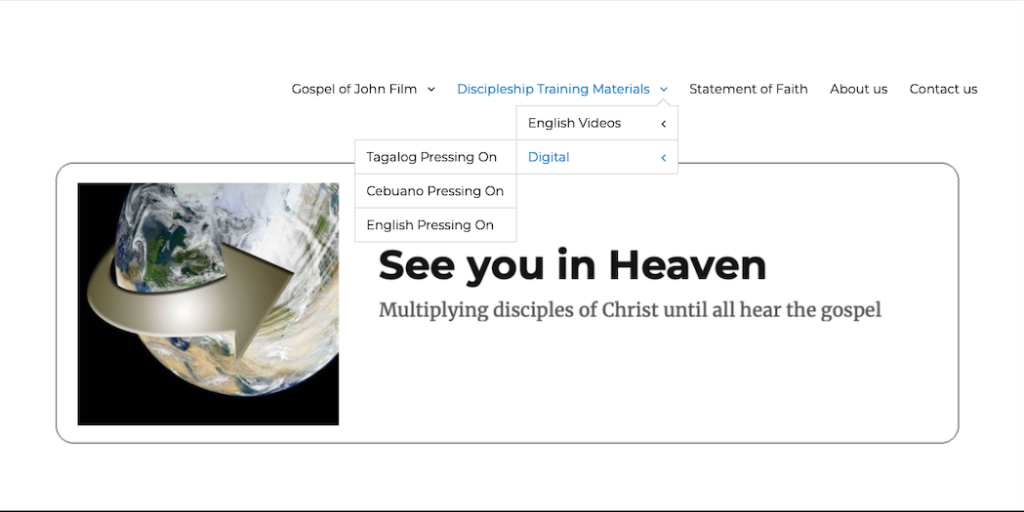
To help you grow in your new relationship with Jesus Christ, please download our free digital discipleship materials on this website (see diagram 1) to go through with other people who are seeking to know Jesus. Thank you, and may Jesus richly bless you.

ENDNOTES:

1. A Greek-English Lexicon of the New Testament and Other Early Christian Literature, compiled by Walter Bauer, trans. and adapted by William F. Arndt and F. Wilbur Gingrich, 2nd ed., rev. and augmented by F. Wilbur Gingrich and Frederick W. Danker (Chicago: University of Chicago Press, 1979), pg. 776; Archibald Thomas Robertson, Word Pictures in The New Testament, Vol V: John and Hebrews (Grand Rapids: Baker Book House, 1932), pg. 286.